George Dodd’s Spitalfields
George Dodd came to Spitalfields to write this account for Charles Knight’s LONDON published in 1842. Dodds recalls the rural East End that still lingered in the collective memory and described the East End of weavers living in ramshackle timber and plaster dwellings which in his century would be “redeveloped” out of existence by the rising tide of brick terraces, erasing the history that existed before.
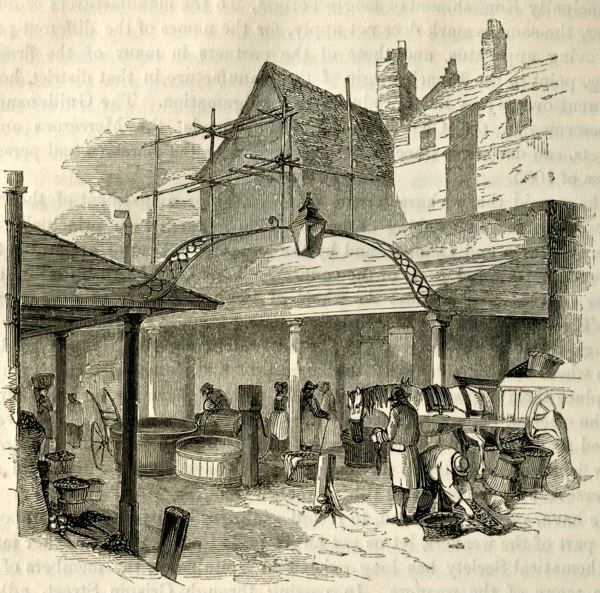
Spitalfields Market
It is not easy to express a general idea respecting Spitalfields as a district. There is a parish of that name but this parish contains a small portion only of the silk weavers and it is probable that most persons apply the term Spitalfields to the whole district where the weavers reside. In this enlarged acceptation, we will lay down something like a boundary in the following manner – begin at Shoreditch Church and proceed along the Hackney Rd till it is intersected by Regent’s Canal, follow the course of the canal to Mile End Rd and then proceed westward through Whitechapel to Aldgate, through Houndsditch to Bishopsgate, and thence northward to where the tour commenced.
This boundary encloses an irregularly-shaped district in which nearly the whole of the weavers reside and these weavers are universally known as “Spitalfields” weavers. Indeed, the entire district is frequently called Spitalfields although including large portions of Bethnal Green, Shoreditch, Whitechapel and Mile End New Town. By far the larger portion of this extensive district was open fields until comparatively modern times. Bethnal Green was really a green and Spitalfields was covered with grassy sward in the last century.
It may now not unreasonably be asked, what is “Spitalfields”? A street called Crispin St on the western side of Spitalfields Market is nearly coincident in position with the eastern wall of the Old Artillery Ground and this wall separated the Ground from the Fields which stretched out far eastward. Great indeed is the change which this portion of the district has undergone. Rows of houses, inhabited by weavers and other humble persons, and pent up far too close for the maintenance of health, now cover the green spot now known as Spitalfields.
In the evidence taken before a Committee in the House of Commons on the silk trade in 1831-2, it was stated that the population of the district in which the Spitalfields weavers resided could be no less at that time than one hundred thousand, of whom fifty thousand were entirely dependent on the silk manufacture and remaining moiety more or less dependent indirectly. The number of looms seems to vary between about fourteen to seventeen thousand and, of these, four to five thousand are unemployed in times of depression. It seems probable, as far as the means exist of determining it, that the weavers are principally English or of English origin. To the masters, however the same remark does not apply, for the names of the partners in the firms now existing, point to the French origin of manufacture in that district.
A characteristic employment or amusement of the Spitalfields weavers is the catching of birds. This is principally carried on in the months of March and October. They train “call-birds” in the most peculiar manner and there is an odd sort of emulation between them as to which of their birds will sing the longest, and the bird-catchers frequently lay considerable wagers on this, as that determines their superiority. They place them opposite each other by the width of a candle and the bird who sings the oftenest before the candle is burnt out wins the wager.
If we have, on the one hand, to record the unthrifty habits and odd propensities of the weavers, let us not forget to do them justice in other matters. In passing through Crispin St, adjoining the Spitalfields Market, we see on the western side of the way a humble building, bearing much the appearance of a weaver’s house and having the words “Mathematical Society” written up in front. Lowly and inelegant the building may be but there is a pleasure in seeing Science rear her head in a locality, even if it is humble one.
A ramble through Bethnal Green and Mile End New Town in which the weavers principally reside, presents us with many curious features illustrative of the peculiarities of the district. Proceeding through Crispin St to the Spitalfields Market, the visitor will find some of the usual arrangements of a vegetable market but potatoes, sold wholesale, form the staple commodity. He then proceeds eastwards to the Spitalfields Church, one of the “fifty new churches” built in the reign of Queen Anne and along Church St to Brick Lane. If he proceed northward up the latter, he will arrive, first, at the vast premises of Truman, Hanbury & Buxton’s brewery, and then at the Eastern Counties Railway which crosses the street at a considerable elevation. If he extends his steps eastwards, he will at once enter upon the districts inhabited by the weavers.
On passing through most of the streets, a visitor is conscious of a noiselessness, a dearth of bustle and activity. The clack of the looms is heard here and there, but not to a noisy degree. It is evident in a glance that many of the streets, all the houses were built expressly for weavers, and in walking through them we noticed the short and unhealthy appearance of the inhabitants. In one street, we met with a barber’s shop in which persons could have “a good wash for a farthing.” Here we espied a school at which children were taught “to read and work at tuppence a week.” There was a chandler’s shop at which shuttles, reeds and quills, and the smaller parts of weaving apparatus were exposed for sale in a window in company with split-peas, bundles of wood and red herrings. In one little shop, patchwork was sold at 10d, 12d and 16d a pound. At another place was a bill from the parish authorities, warning the inhabitants that they were liable to a penalty if their dwelling were kept dirty and unwholesome, and in another – we regretted this more than anything else – astrological predictions, interpretations of dreams and nativities, were to be purchased “from three pence upwards.”
In very many of the houses, the windows numbered more sheets of paper than panes of glass and no considerable number of houses were shut up altogether. We would willingly present a brighter picture, but ours is a copy from the life.
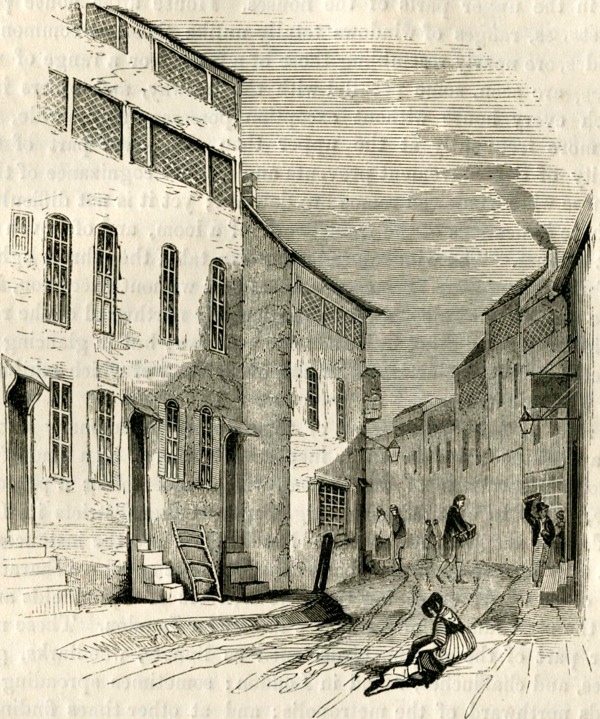
Pelham St (now Woodseer St), Spitalfields

Booth St (now Princelet St), Spitalfields
Images courtesy © Bishopsgate Insitute
Thomas Fairchild, Gardener of Hoxton

Next time you visit Columbia Rd Flower Market, once you have admired the infinite variety of plants on display, walk West until you come to the Hackney Rd. Directly ahead, you will discover a small neglected park and burial ground where, on the right hand side of the gate, is this stone which commemorates Thomas Fairchild (1667-1729) the Hoxton gardener.
Thomas Fairchild was the first to create a hybrid, making history in 1717 by the simple act of taking pollen from a Carnation and inserted it into a Sweet William in his Hoxton nursery, thereby producing a new variety that became known as “Fairchild’s Mule.” Everyone who loves Columbia Rd Market should lay flowers on this stone for Thomas Fairchild, because without his invention of the technique of hybridisation most of the plants on sale there would not exist. Yet when I went along with my Carnations in hand for Thomas Fairchild, I found the stone overgrown with moss that concealed most of the inscription.
Apprenticed at fifteen years old in 1682 to Jeremiah Seamer, a clothmaker in the City of London, Thomas Fairchild quickly decided that indoor work was not for him and decided to become a gardener. He had to wait until 1690 when he completed his apprenticeship to walk out of the City and up past Spitalfields to Shoreditch – where, in those days, the housing ended at St Leonards Church and beyond was only fields and market gardens. Thomas Fairchild found employment at a nursery in Hoxton, up beyond the market, but within a few years he took it over, expanding it and proceeding to garden there for the next thirty years.
In Hoxton, he kept a vineyard with more than fifty varieties of grapes, one of the last to be cultivated in England, and his nursery became a popular destination for people to wonder at all the exotic plants he grew, sent as specimens or seeds from overseas, including one of the first banana trees grown here. By 1704 he was made a freeman of the City of London as a member of the Worshipful Society of Gardeners and in 1722 he published, “The City Gardener. Containing the most experienced Method of Cultivating and Ordering such Ever-greens, Fruit-Trees, flowering Shrubs, Flowers, Exotic Plants, &c. as will be Ornamental and thrive best in the London Gardens.”
Drawing upon Thomas Fairchild’s thirty years of experience in Hoxton, it was the first book on town gardening, listing the plants that will grow in London, and how and where to plant them. He took into account the sequence of flowers through the seasons, and even included a section on window boxes and balconies. This slim volume, which has recently been reprinted, is a practical guide that could be used today, the only difference being that we do not have to contend with the smog caused by coal fires which Thomas Fairchild found challenging for many plants that he would like to grow.
When he died in 1729, it was his wish to be buried in the Poor’s Ground of St Leonard’s Church in the Hackney Rd and he bequeathed twenty-five pounds to the church for the endowment of an annual Whitsun sermon on either the wonderful works of God or the certainty of the creation. This annual event became known as the “Vegetable Sermon” and continued in Shoreditch until 1981 when, under the auspices of the Worshipful Society of Gardeners, it transferred to St Giles, Cripplegate.
Thomas Fairchild presented his hybrid to the Royal Society and, although its significance was recognised, the principle was not widely taken up by horticulturalists until a century later. In Thomas Fairchild’s day grafting and cuttings were the means of propagation and even “Fairchild’s Mule,” the extraordinary hybrid that flowered twice in a year, was bred through cuttings. Hybrids existed, accidentally, before Thomas Fairchild – Shakespeare makes reference to the debate as to their natural or unnatural qualities in “The Winters’ Tale” – yet Thomas Fairchild was the first to recognise the sexes of plants and cross-pollinate between species manually. Prefiguring the modern anxiety about genetic engineering, Thomas Fairchild’s bequest for the Vegetable Sermons was an expression of his own humility in the face of what he saw as the works of God’s creation.
I have no doubt Thomas Fairchild would be delighted by his position close to the flower market, but, as a passionate gardener and plantsman who made such an important and lasting contribution to horticulture, he would be disappointed at the sad, unkempt state of the patch of earth where he rests eternally. Given that his own work “The City Gardener” describes precisely how to lay out and plant such a space, it would be ideal if someone could take care of this place according to Thomas Fairchild’s instructions and let the old man rest in peace in a garden worthy of his achievements.

My Pinks bought from Columbia Rd Market

From “The City Gardener,” 1722

Plaque by the altar in Shoreditch Church commemorating Thomas Fairchild’s endowment for the “Vegetable Sermon.”


A pear tree in Spitalfields

You may also like to read about
At Fishmongers’ Hall
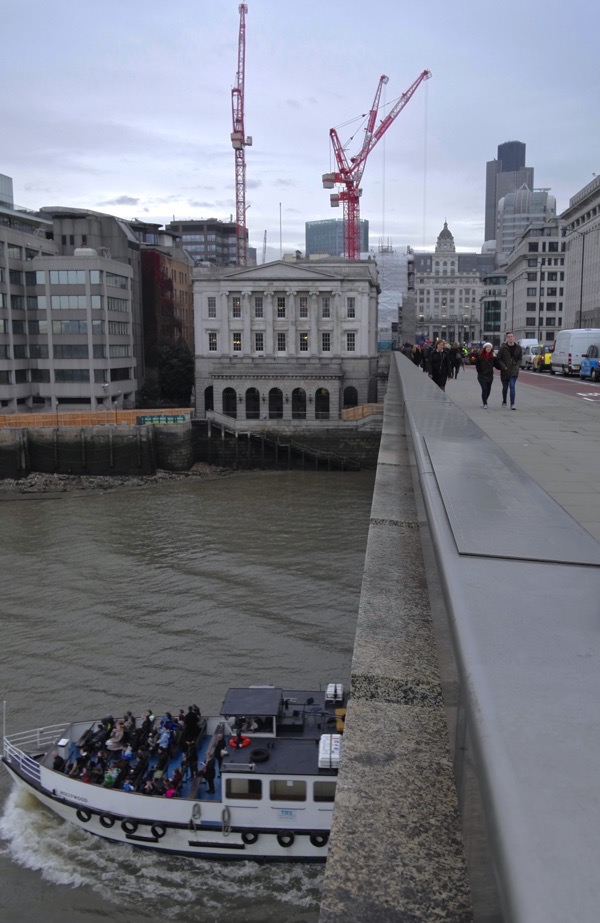
This palatial building of Portland stone tucked under the west side of the foot of London Bridge is Fishmongers’ Hall. Many a time I have passed by on an errand to the Borough to buy fresh fish and cast my eyes upon it, so – as one for whom the worship of fish is almost a religion – I was delighted to enter this temple to the wonders of the deep.
The Fishmongers’ Company were already long-established on this site when they received their first Royal Charter in 1272 from Edward I, the fish-loving king, and their earliest hall on this site was recorded in 1301. A monopoly on fish trading brought great wealth to the Company, and in the fourteenth century three fishmongers were successive Lord Mayors of London, John Lovekyn, Sir William Walworth and William Askham. Subsequently, they secured Fishmongers’ Wharf in 1444 and retained its sole usage for unloading their catch until 1666, prior to the development of Billingsgate Market which traded on the east side of London Bridge until 1982.
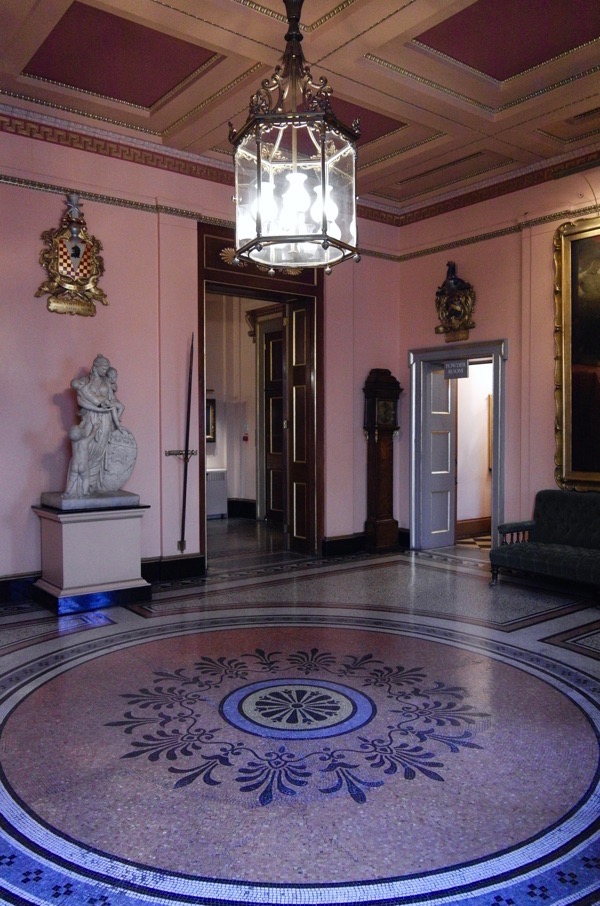
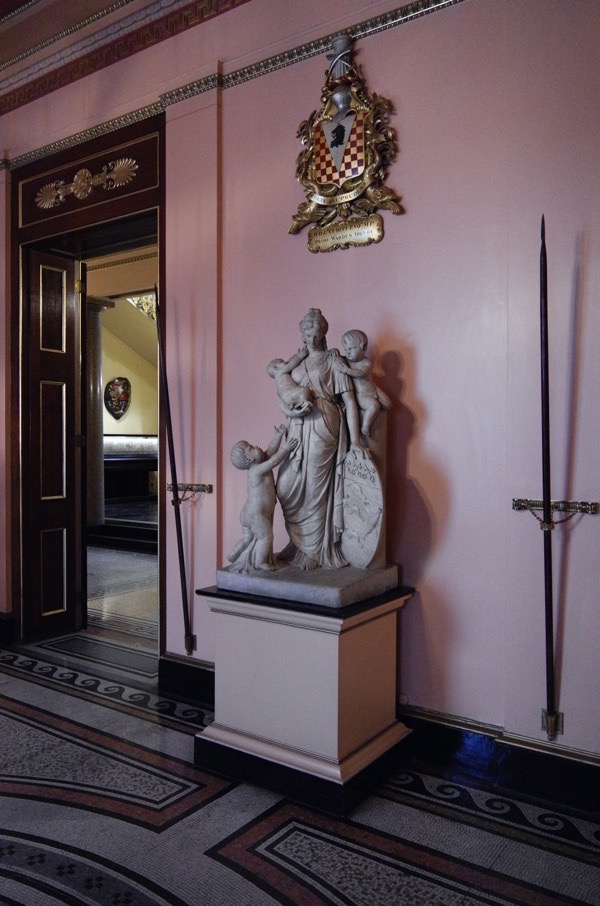
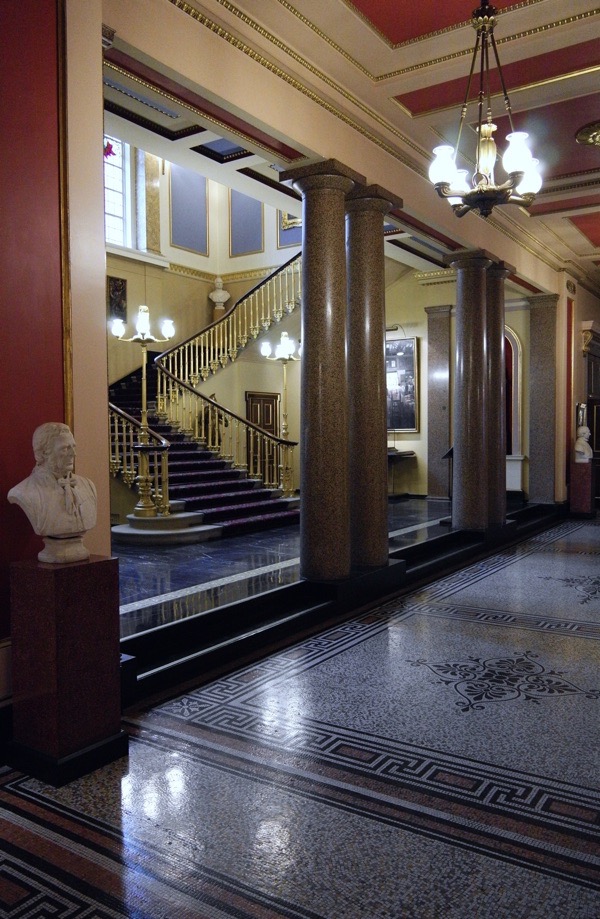
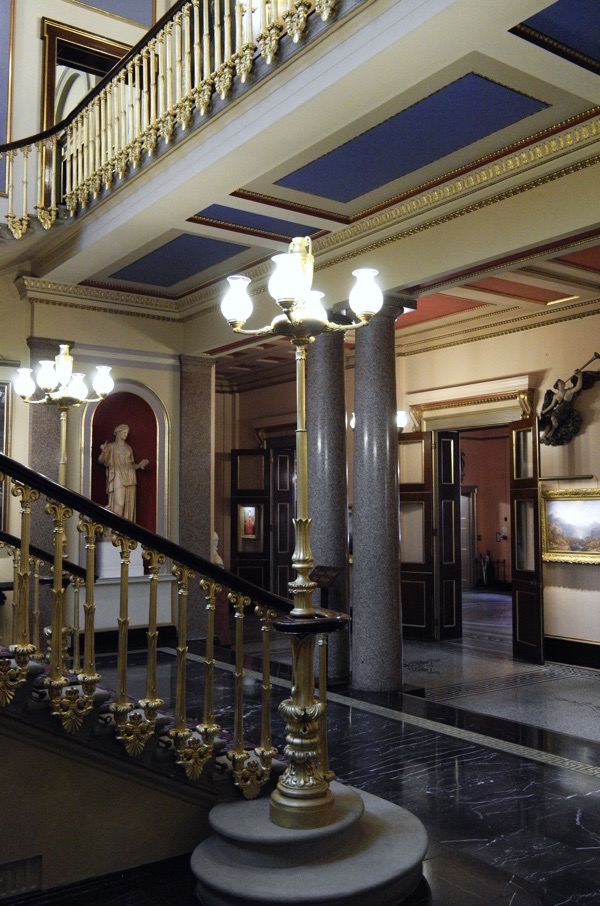
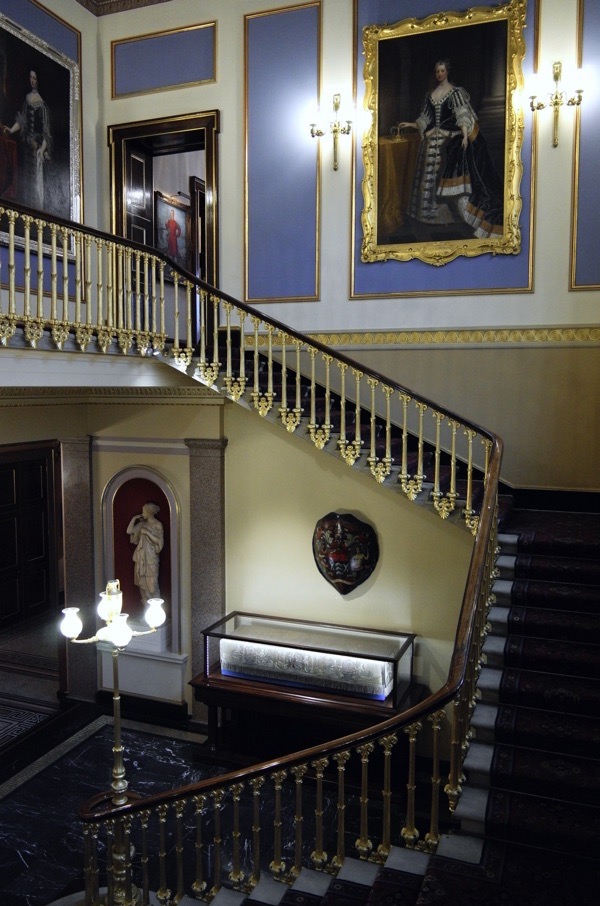
This most-recent Fishmongers Hall was constructed as part of the new London Bridge in the eighteen-thirties, designed by Henry Roberts but constructed from drawings by George Gilbert Scott. The tone is partly that of a stately home and partly that of a lofty public institution, yet salmon pink walls in the vestibule and mosaics gleaming like fish scales conjure an atmosphere unique to the Fishmongers’ Company, heightened by an astonishing collection of historic paintings, sculptures and artefacts which evoke all things fishy.
A lavishly embroidered funeral pall created by nuns around 1500, portraying Christ handing the keys of Heaven to St Peter the fisherman and embellished with mermen and mermaids, testifies to a former age of credulity, while a sturdy chair fabricated with timber from old London Bridge and with a seat containing a stone from the same source reminds us of the detail of history in this spot. The combination of architectural opulence and multiple fish references suggests that the Hall itself might be understood as a fishmonger’s distinctive vision of Heaven, where St Peter awaits the newly-departed at the head of a gilded staircase.
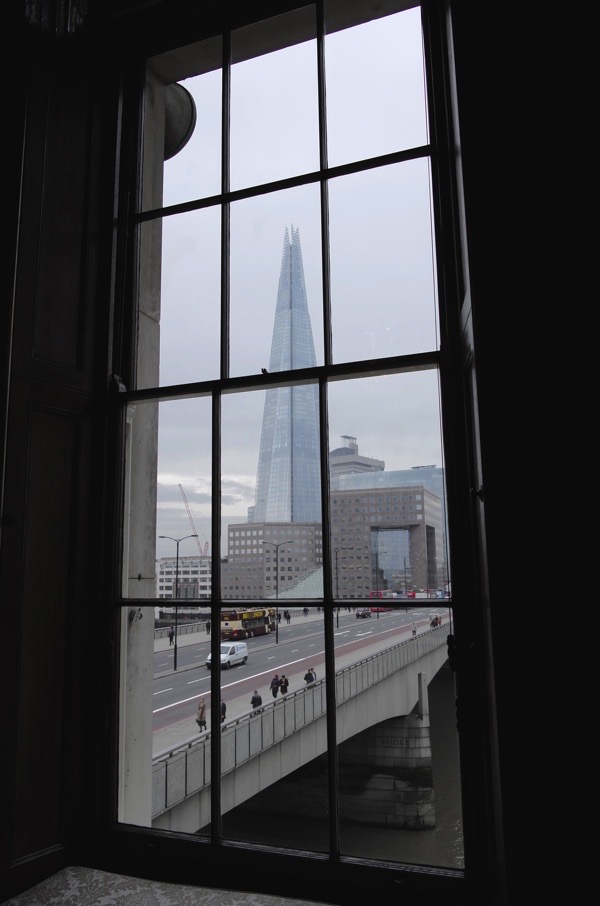
At every turn in this building, you are reminded of fish, the ocean and the ancient trade established more than seven centuries in this place, which fills your mind with thoughts of fishmongery and makes it startling to peer out from the prevailing silence in the Fishmongers’ Hall upon the clamour of the modern city with the Shard looming overhead.
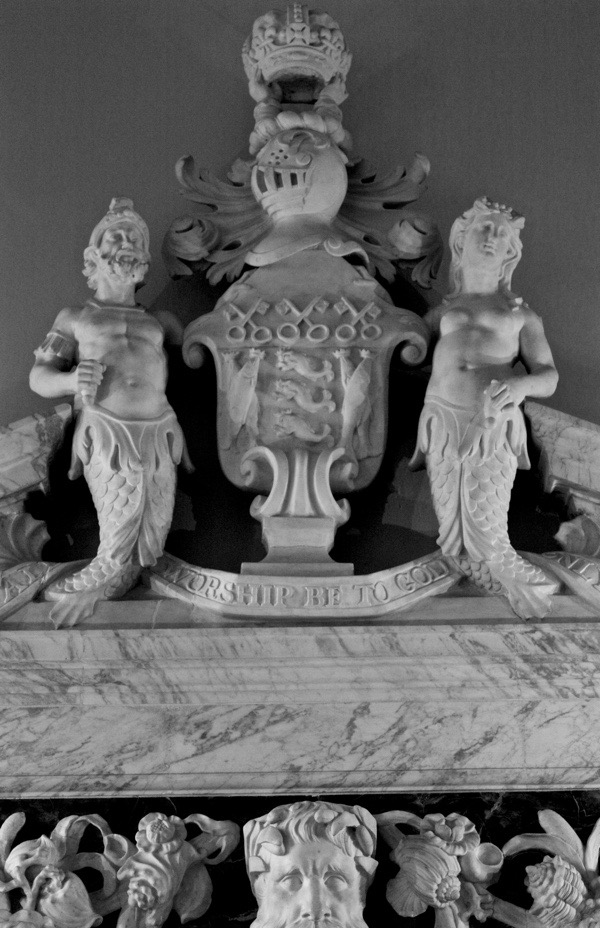
Crest of the Fishmongers’ Company
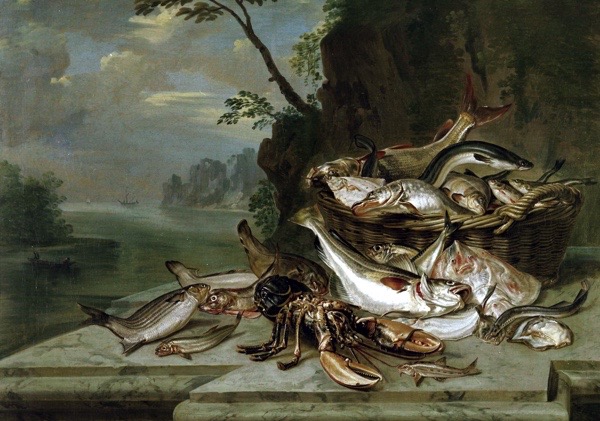
Wonders of the Deep, 1 by Arnold Von Hacken
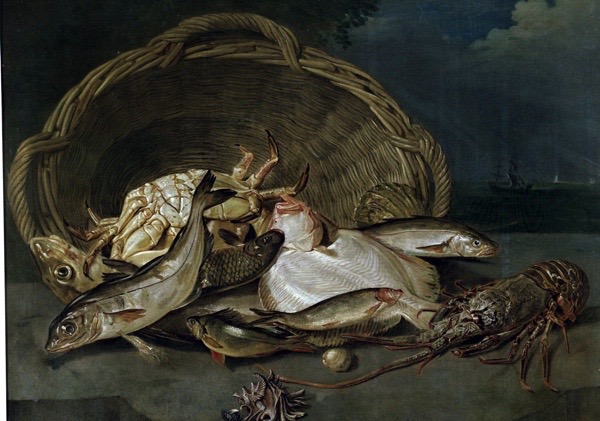
Wonders of the Deep, 2 by Arnold Von Hacken
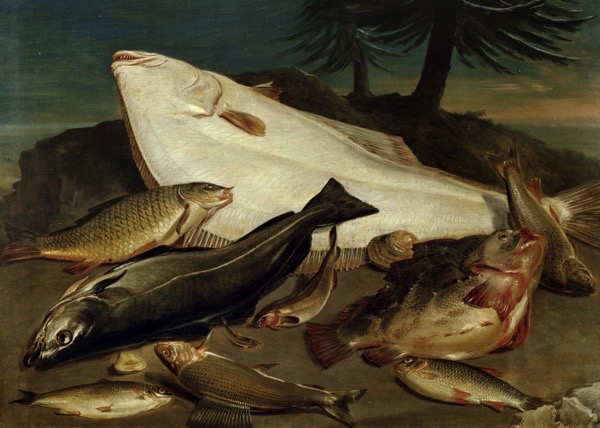
Wonders of the Deep, 3 by Arnold Von Hacken
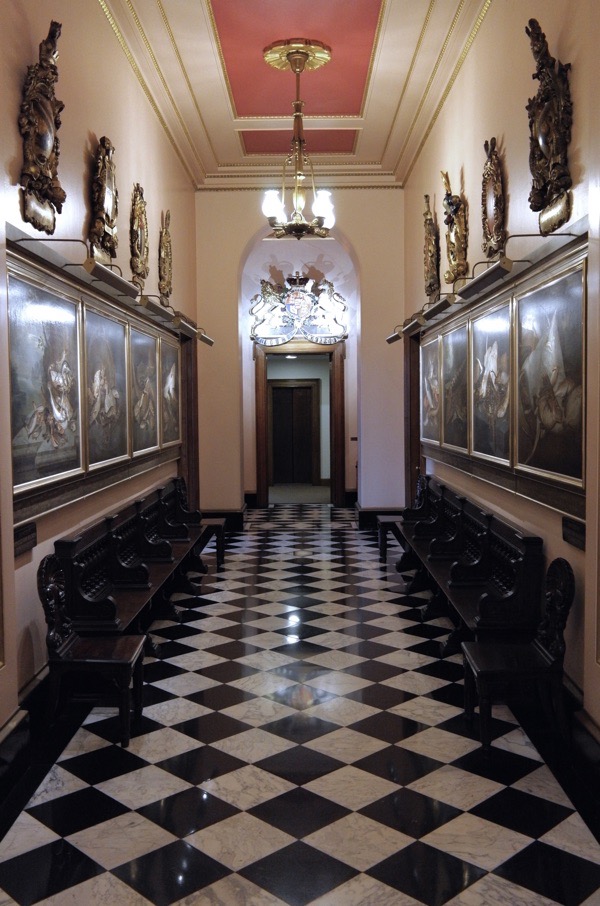
Arnold Von Hacken’s eight paintings of Wonders of the Deep
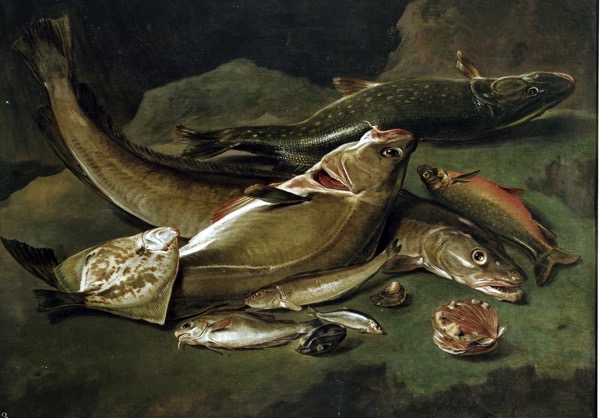
Wonders of the Deep, 4 by Arnold Von Hacken
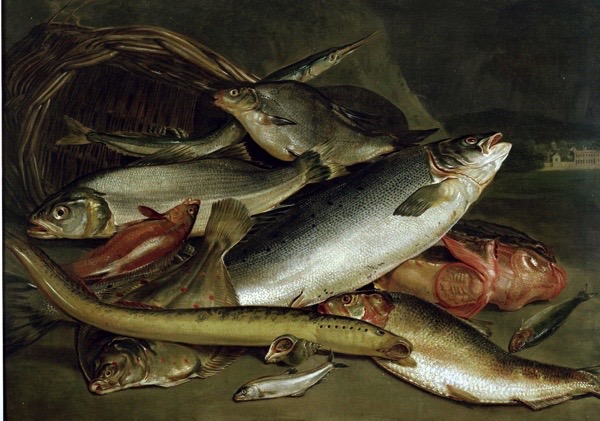
Wonders of the Deep, 5 by Arnold Von Hacken
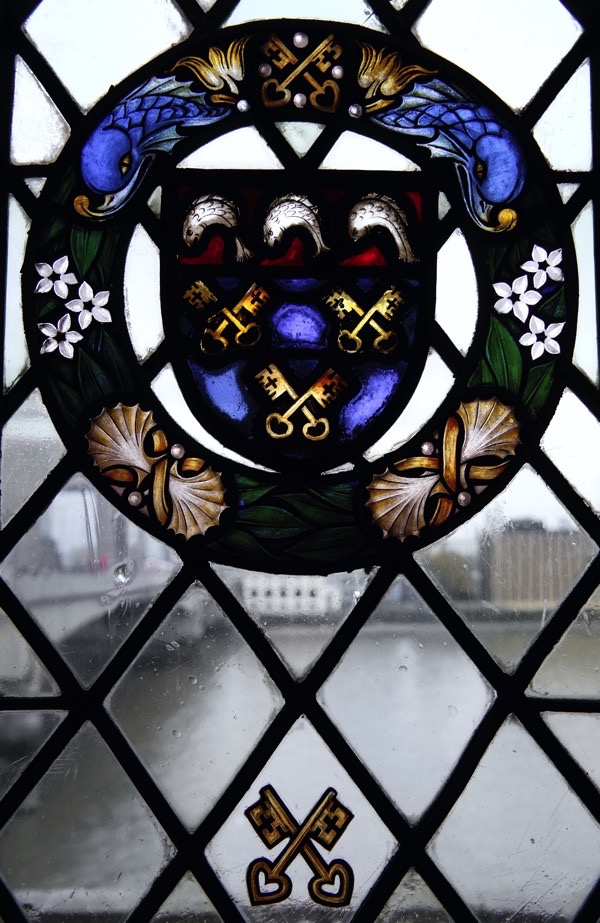
This stained glass of the earlier Fishmongers’ Crest dates from the before the Fire of London
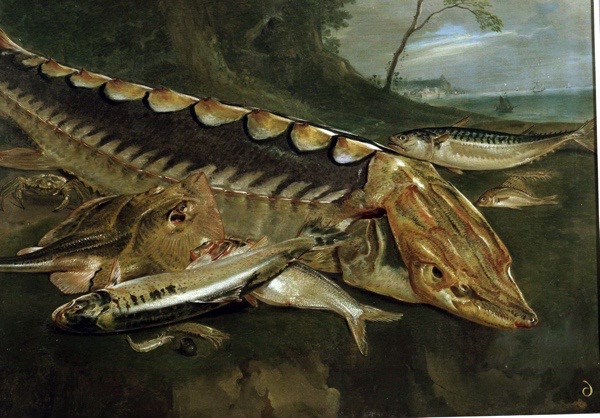
Wonders of the Deep, 6 by Arnold Von Hacken
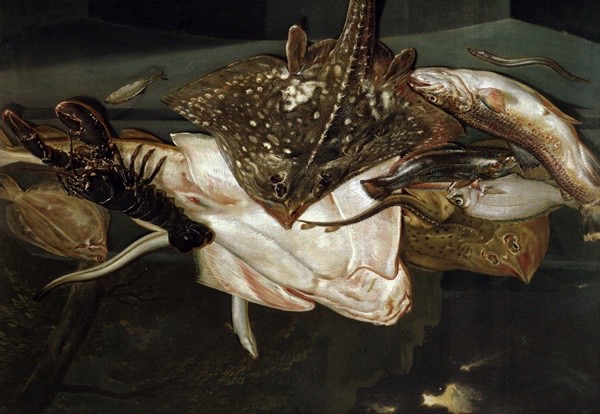
Wonders of the Deep, 7 by Arnold Von Hacken
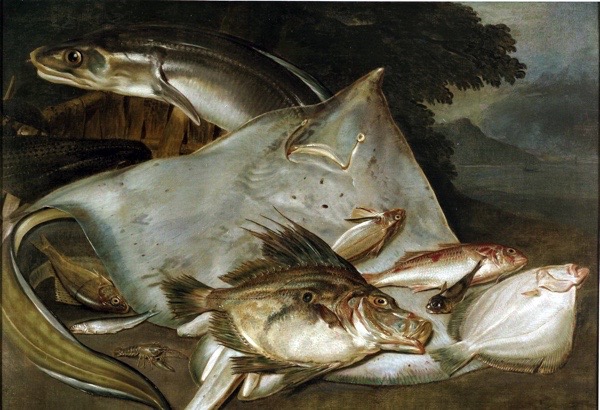
Wonders of the Deep, 8 by Arnold Von Hacken
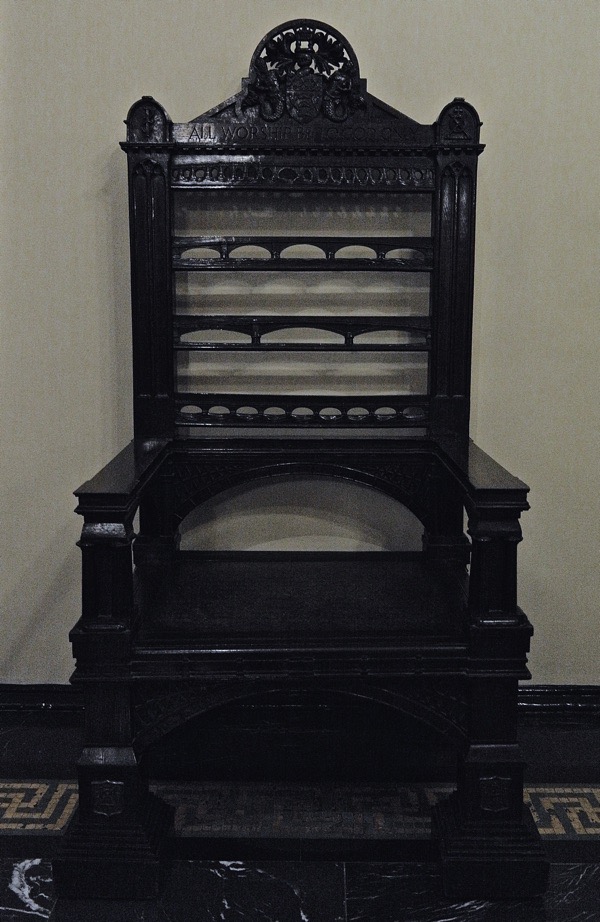
Chair made from the timber of old London Bridge with a seat including a piece of stone from the bridge and a back showing designs of subsequent bridges
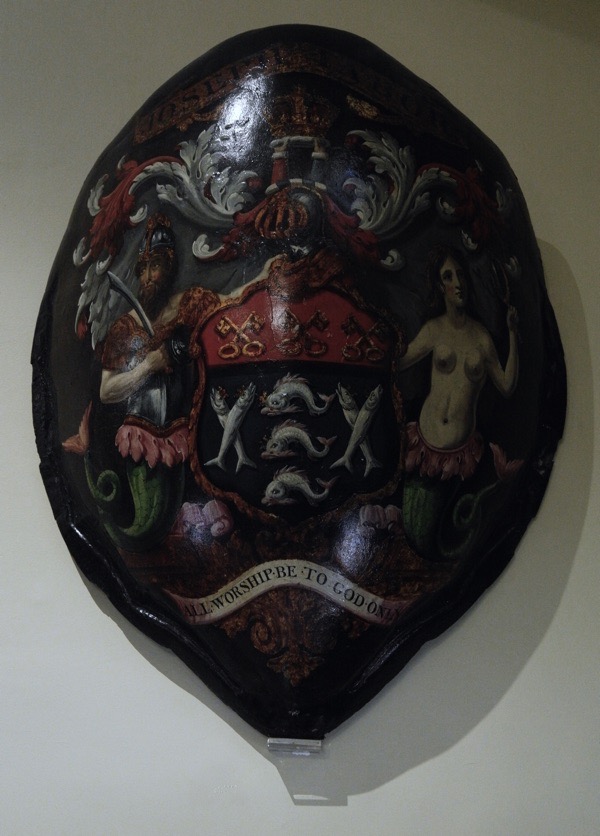
Turtle shell painted with the crest of the Fishmongers’ Company
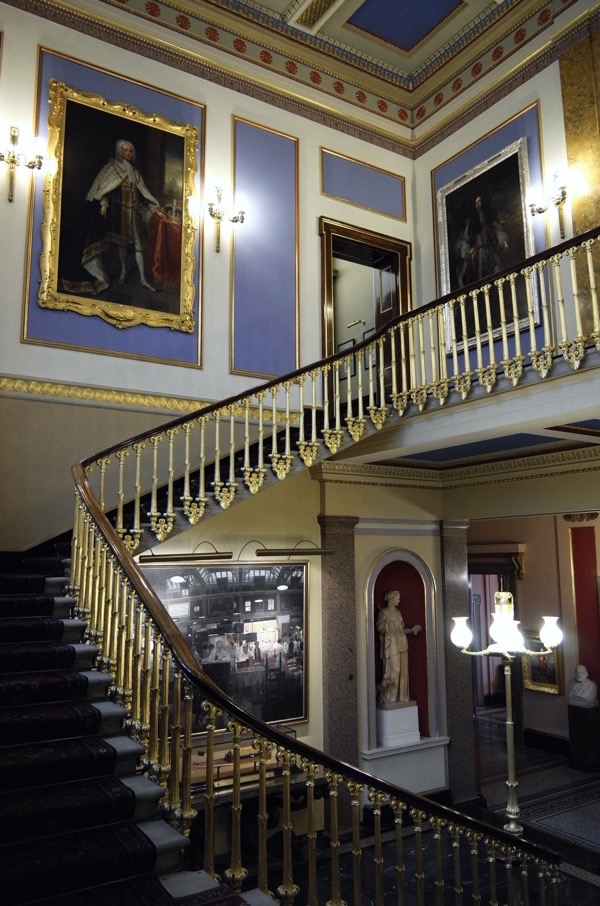
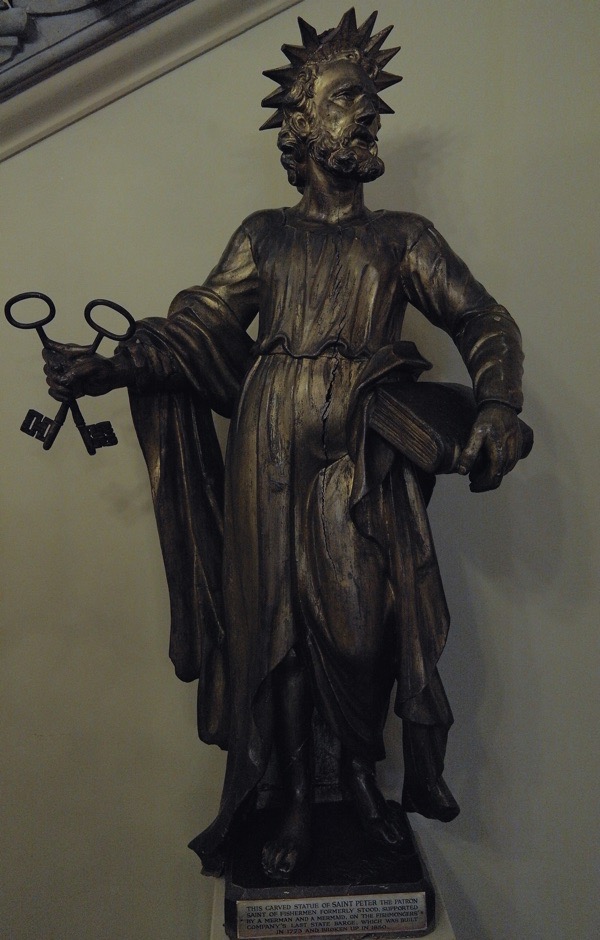
Figure of St Peter the Fisherman from the Fishmongers’ barge
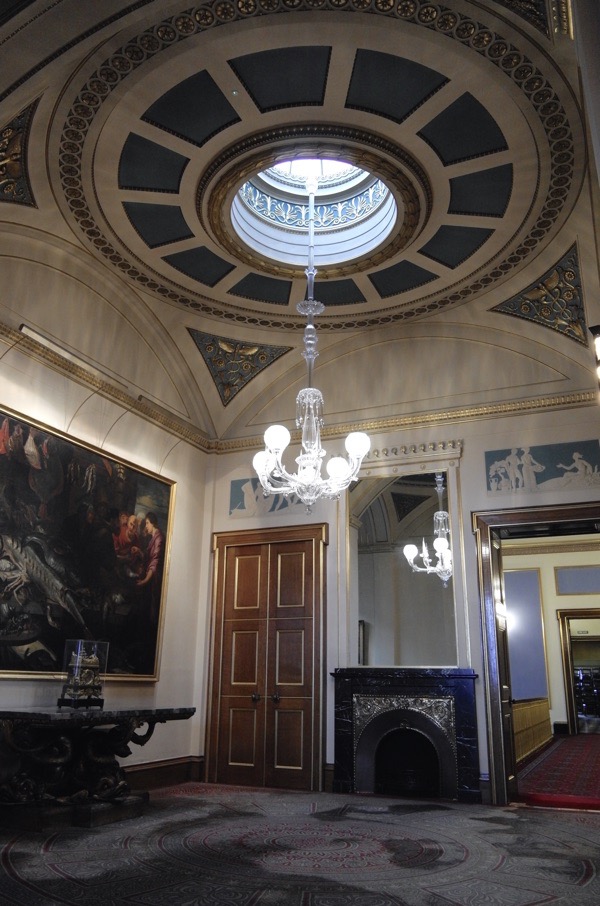
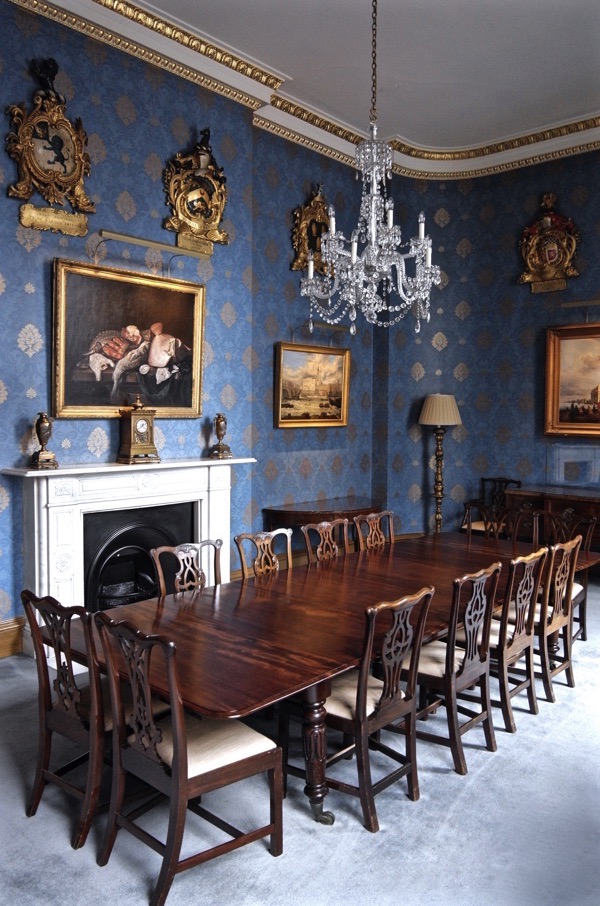
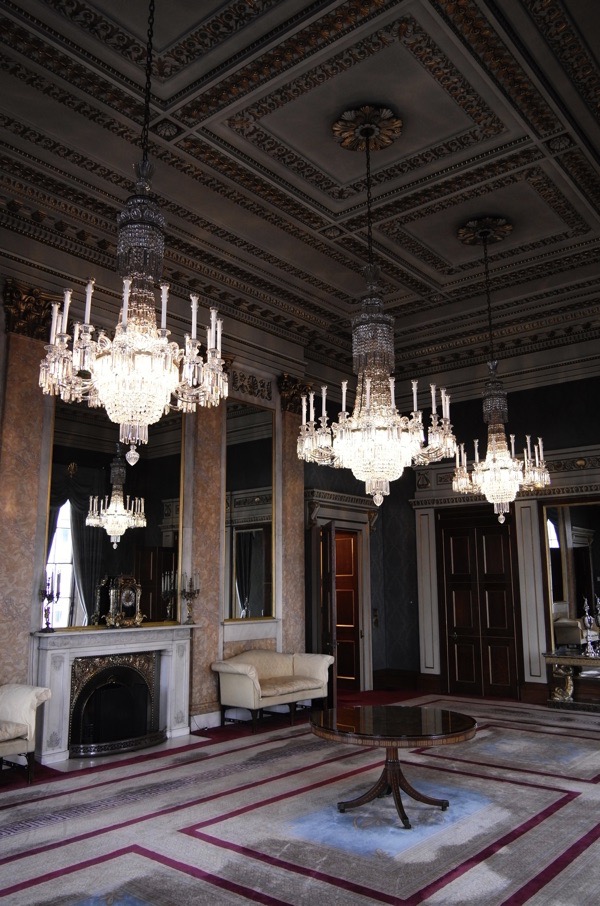
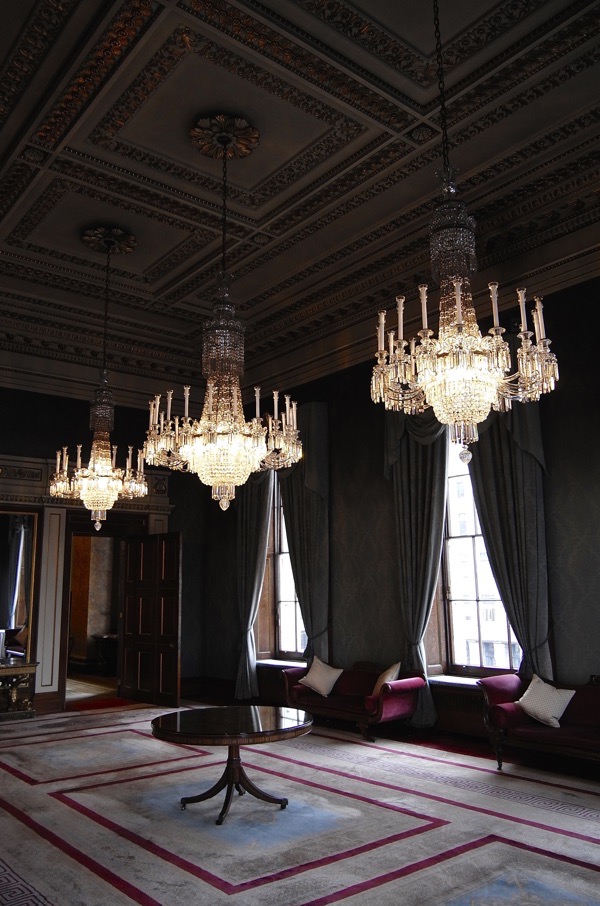
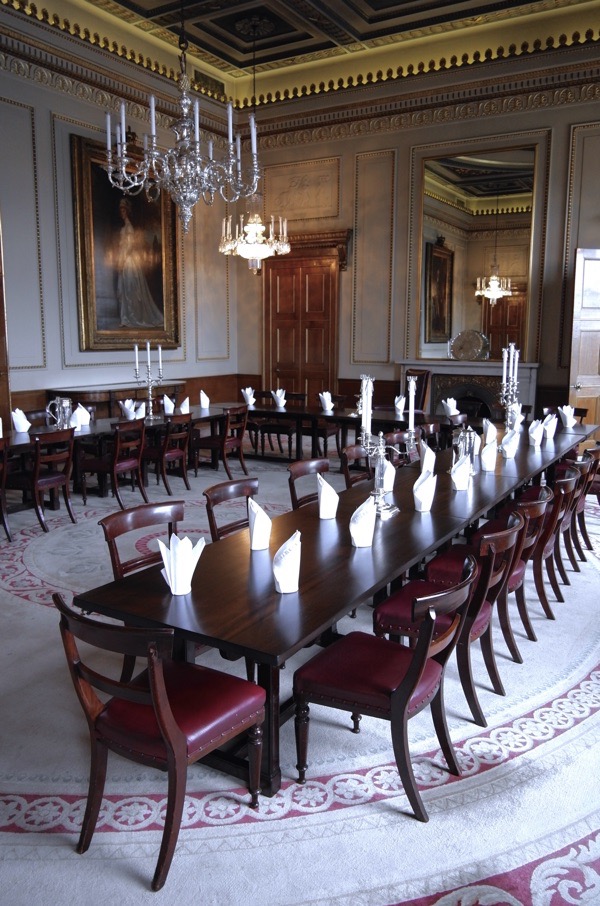
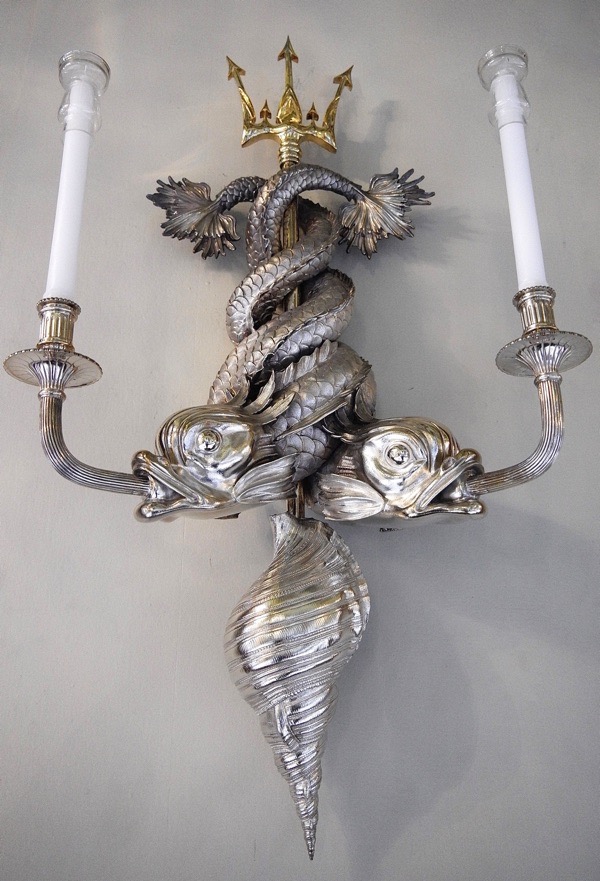
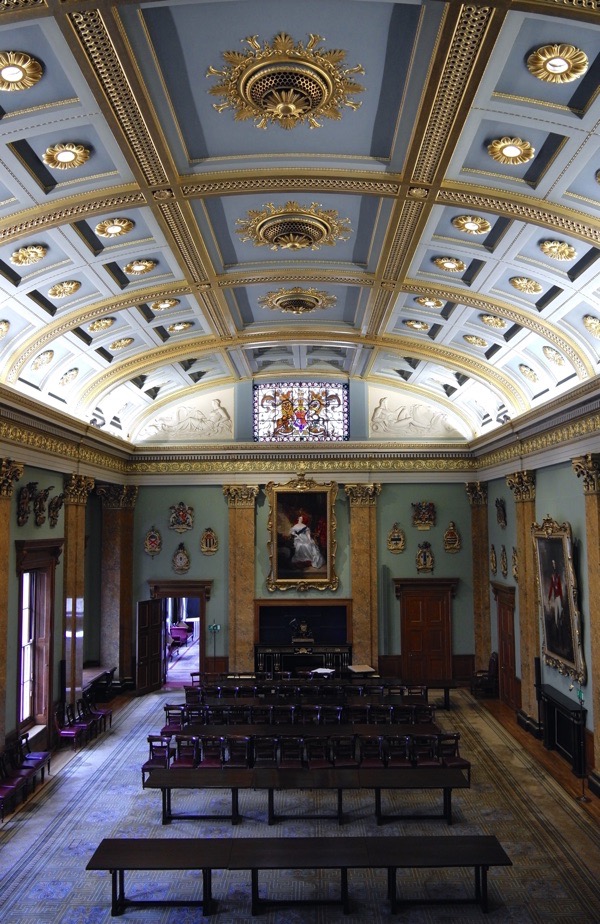
Queen Victoria presides over the Great Hall
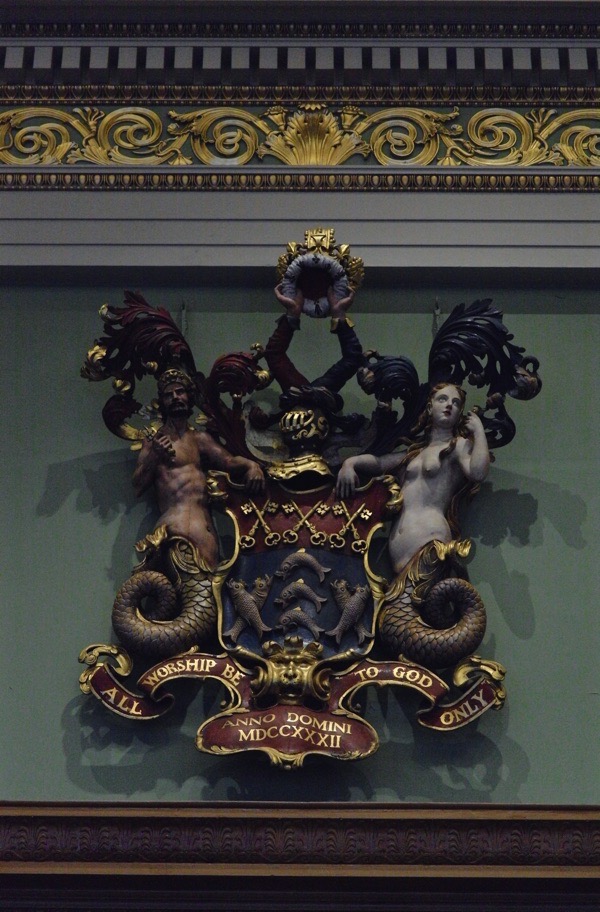
Fishmongers’ crest in the Great Hall
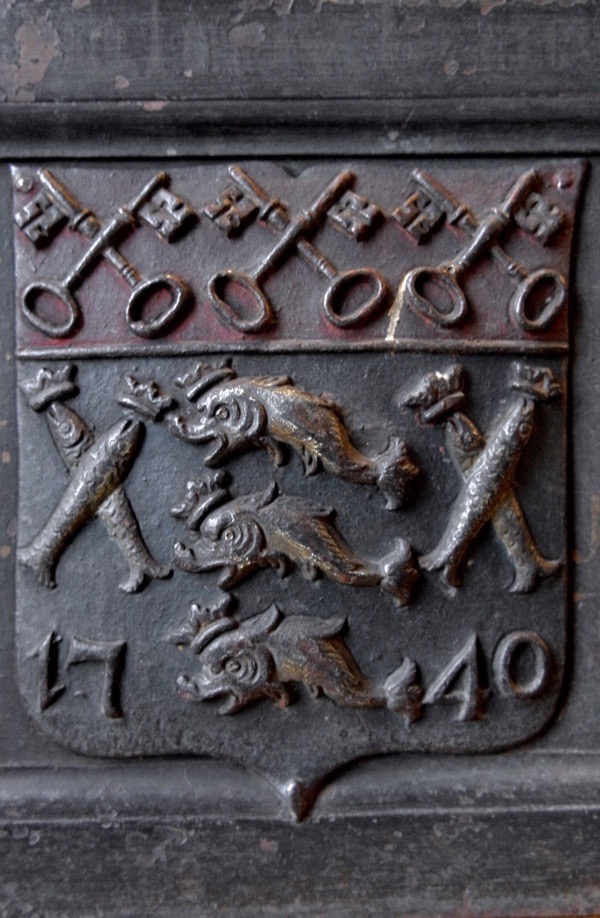
Fishmongers’ crest from a steel muniment box
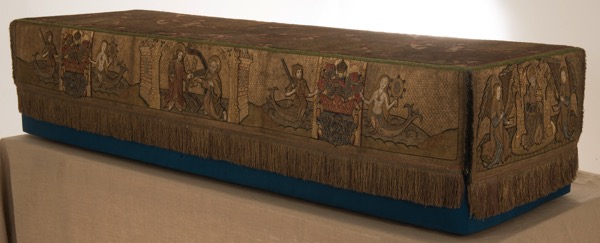
Fishmongers’ funeral pall embroidered by nuns c. 1500
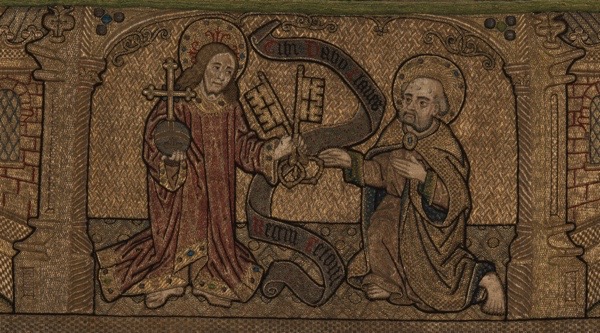
Christ hands the keys of Heaven to St Peter, the Fisherman
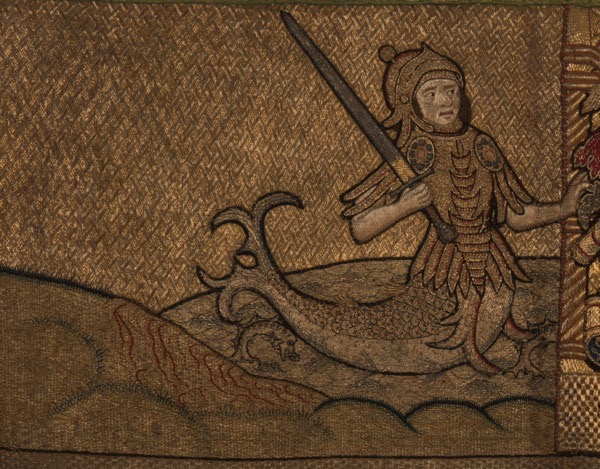
Merman from the pall
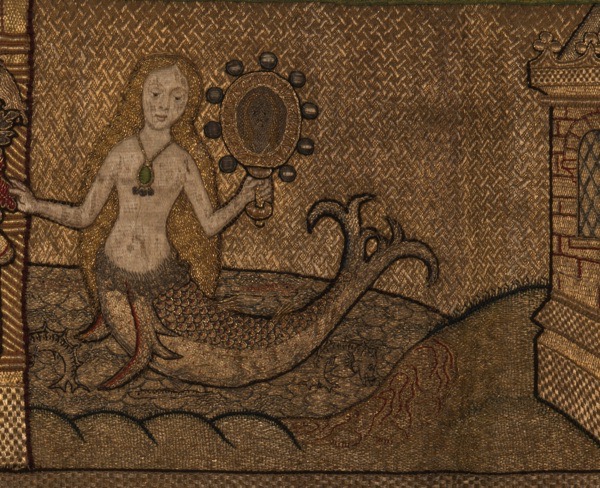
Mermaid from the pall

Fishmongers’ Hall, Fishmongers’ Wharf
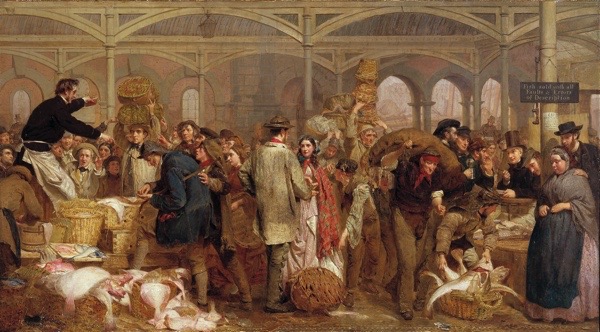
Interior of Billingsgate Market at 6am by George Elgar Hicks
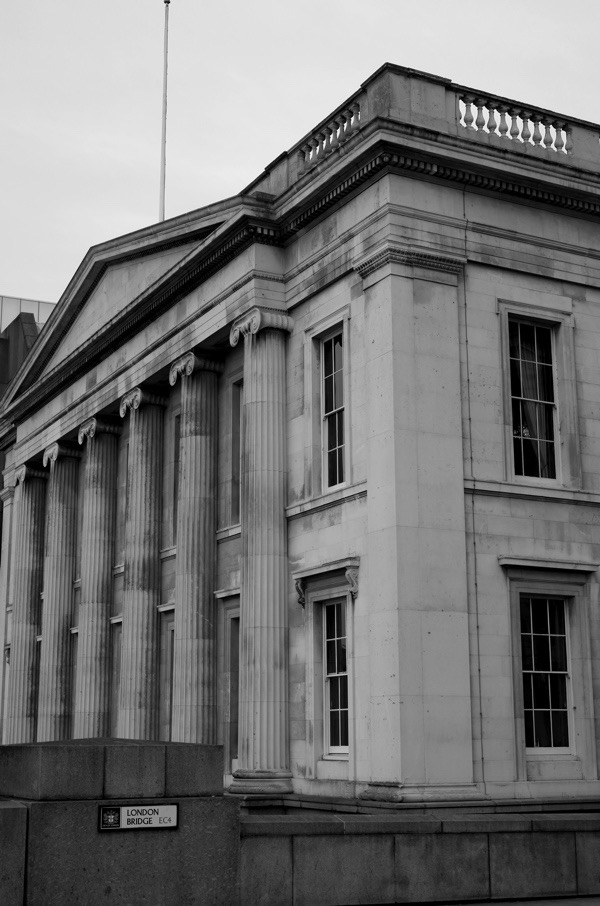
Fishmongers’ Hall, London Bridge
Paintings reproduced courtesy of Fishmongers’ Hall
You may also like to take a look at
Sylvester Mittee, Welterweight Champion

Sylvester Mittee
I shall never forget my visit to Sylvester Mittee, unquestionably one of the most charismatic and generous of interviewees. We met in his multicoloured flat in Hackney where Sylvester keeps his collection of hats that he waterproofs by painting with the excess gloss paint left over from decorating his walls. During the course of our interview I began to go blind due to a migraine, yet Sylvester cured me by pummelling my back as a form of massage. Thanks to Sylvester’s therapy, I was bruised for weeks afterwards but my migraine was dispelled, and I came away with this remarkable interview.
“666 is my birth number, and my mother got scared until a priest told her that 666 is God’s number. I was called “spirit” back then. My mother, she went to the marketplace a few months before I arrived. She told people she could already feel me kicking and they said, “I think it’s the devil you got in there!”
My father was born in 1906, he was a very sober man and he liked to give beatings. He especially liked to beat me and I learnt to take it. He came to Britain from St Lucia in 1961, he’s passed away now. My mother still lives in St Lucia, she was born in 1926, she’s a tough old girl.
1966, 1976 and 1986 were important years for me, and at school nobody got more sixes than I did. Six is the number of truth and love and enlightenment. The only time I believed six was unlucky was when I was ill and life wasn’t happening for me.
I’ve been fighting for my life since I stepped off that banana boat at Southampton in 1962. Does a banana boat sound primitive? Ours had air-conditioning and a swimming pool.
My dad worked his bollocks off, doing everything he could to keep us alive. At first, he had a place in Hackney, then he rented a little run-down one bedroom flat in Bethnal Green, with my parents in one room and eight kids in the other, two girls and six boys. We had to live very close in them days. I came from St Lucia with my mum and dad in 1962 and my four sisters came in 1964 and my remaining four brothers in 1966.
When I came to England racism was bare. The kids in the playground ganged up on me and outnumbered me and they attacked me. Nobody did anything about it, parents, teachers, nobody. There was etiquette in fighting back home, but there was none of that in England. I was taught that you let people get up and you don’t hit people when they are down. But, if somebody hits you, you hit them back – that’s how I was brought up. I had to learn to fight. And I had to be good at it to survive. I had no choice. I fought to live and boxing became my life.
Before I knew how to reason, boxing was a short cut. The demons that you have inside, they control you unless you can think in a philosophical way. Boxing becomes a microcosm of the world when you are exposed to the extreme highs and lows of this life.
The experiences that boxing gave me have allowed me to grow. I’m like a tree and the punches I throw are the leaves I drop, so boxing is like photosynthesis for me. I fulfill my immediate needs, but I can also recognise my greater needs, and it is a chance to grow stronger.
Boxing is an opportunity to profess your philosophy through your actions and discover who you truly are. We are born into a part in life and expected to play our part bravely, and I am playing my part as good as I can. Boxing taught me how to grasp life. But the achievement is not in the winning, the enterprise will only hurt you if you seek perfection. I was European Welterweight Champion, but I say boxing just helped me get my bearings in life.
The boys in the playground who beat me, they were the ones who bought tickets to see me fight and they were cheering me on, supporting me. It gave me heart. I like to think it changed them, made them better people. I am a youth worker now in Hackney, and I also go to old people’s homes to do fitness classes and mobility exercises. Those kids that fought me in the playground and beat me, they live around me still. Now they are grown up and I work with some of their kids, and they come to me and tell me their parents remember me from school.”

Sylvester Mittee, European Welterweight Champion 1985.


Sylvester in his living room.

Sylvester on the cover of Boxing New 1985.
Photographs copyright © Alex Sturrock
You may also like to read my interviews with
Ron Cooper, Lightweight Champion Boxer
and
Mortlake Jugs
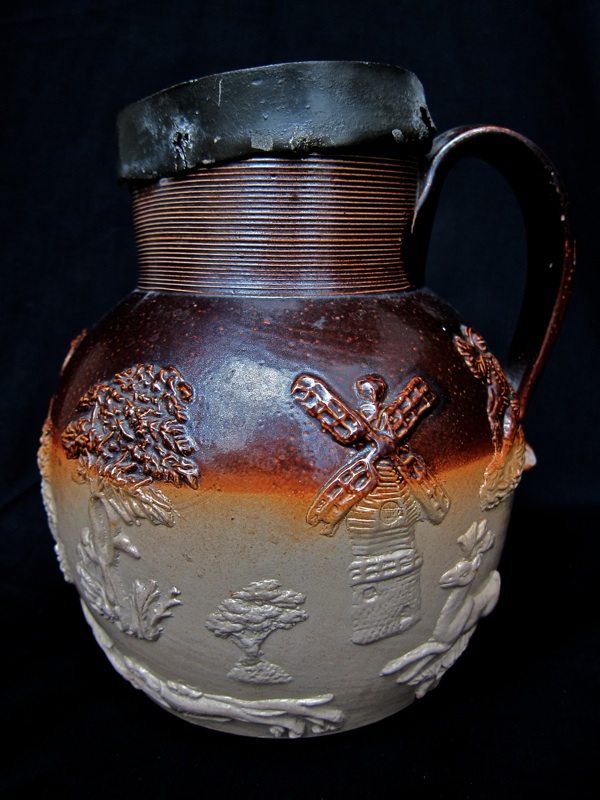
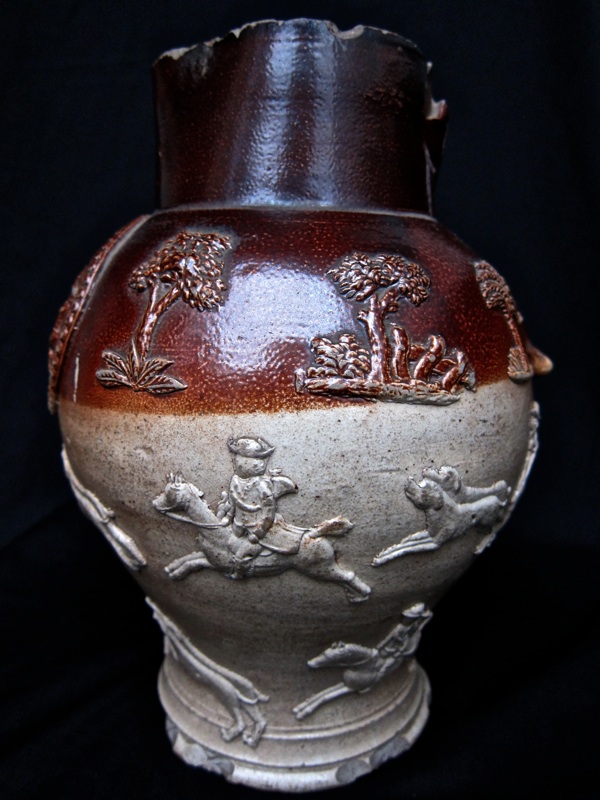
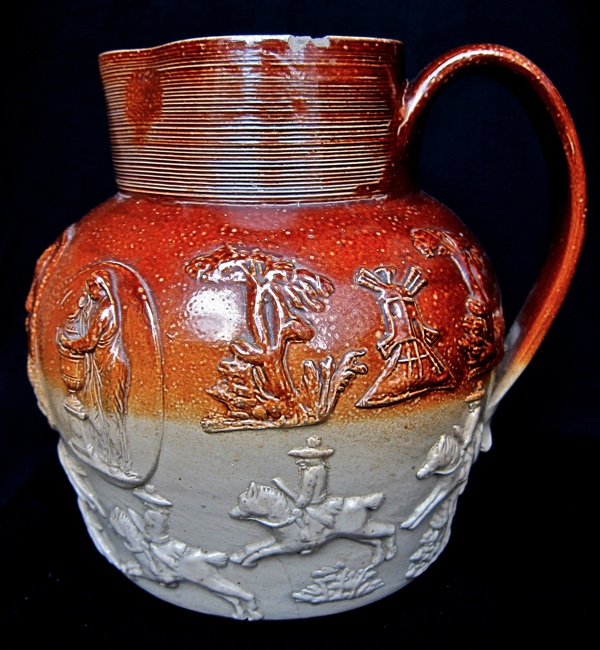
Once, every household in London possessed an ale jug, in the days before it was safe to drink water or tea became widely affordable. These cheaply-produced salt-glazed stoneware items, that could be bought for a shilling or less, were prized for their sprigged decoration and often painstakingly repaired to extend their lives, and even prized for their visual appeal when broken and no longer of use.
All these jugs from the collection of Philip Mernick were produced in Mortlake, when potteries were being set up around London to supply the growing market for these household wares throughout the eighteenth century. The first of the Mortlake potteries was begun by John Sanders and taken over by his son William Sanders in 1745, while the second was opened by Benjamin Kishere who had worked for Sanders, and this was taken over by his son William Kishere in 1834.
These jugs appeal to me with their rich brown colouration that evokes the tones of crusty bread and their lively intricate decoration, mixing images of English country life with Classical motifs reminiscent of Wedgwood. Eighteenth-century Mortlake jugs are distinguished by the attenuated baluster shape that follows the form of ceramics in the medieval world yet is replaced in the early-nineteenth century by the more bulbous form of a jug which is still common today.
There is an attractive organic quality to these highly-wrought yet utilitarian artefacts, encrusted with decorative sprigs like barnacles upon a ship’s hull. They were once universally-familiar objects in homes and ale houses, and in daily use by Londoners of all classes.
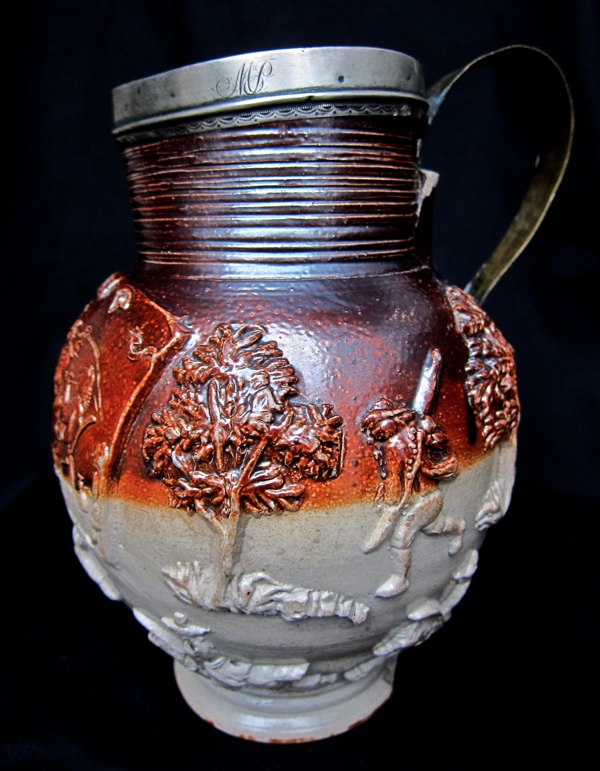
1790s ale jug repaired with brass handle and engraved steel rim
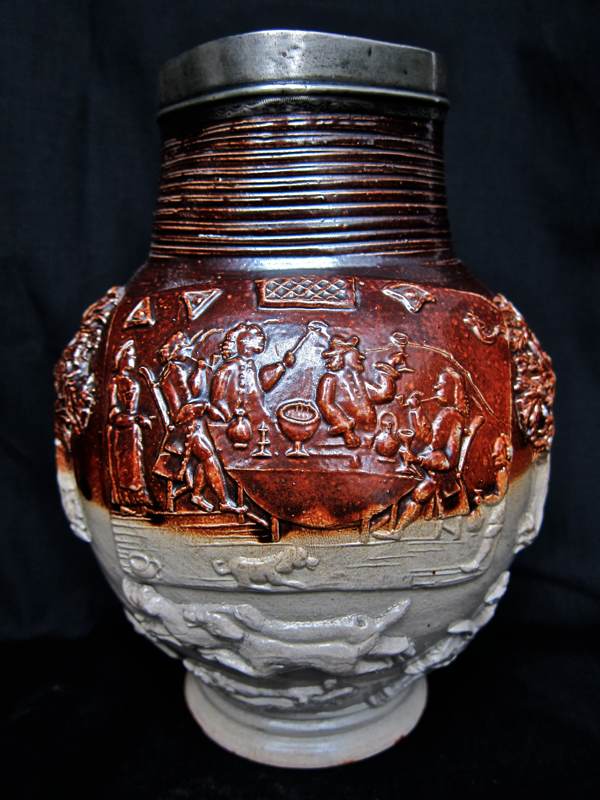
A panel of “The Midnight Conversation” after a print by Hogarth
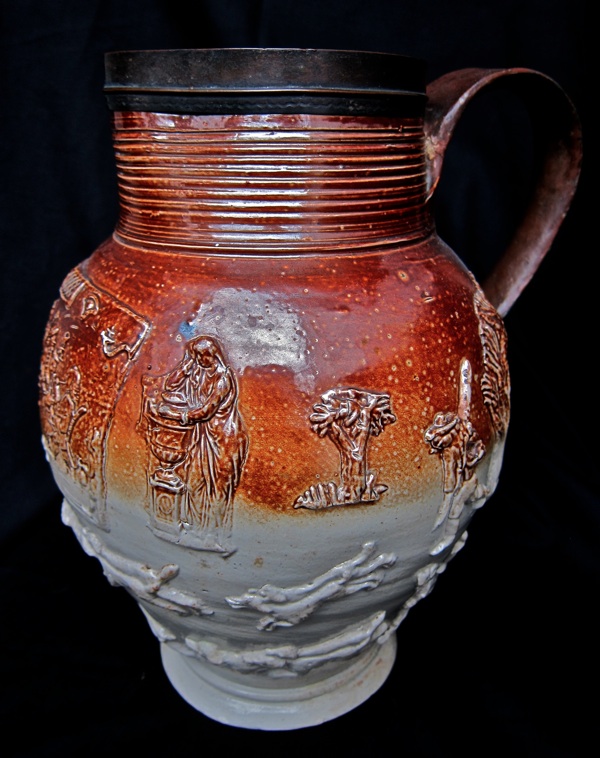
Classical motifs mixed with rural images
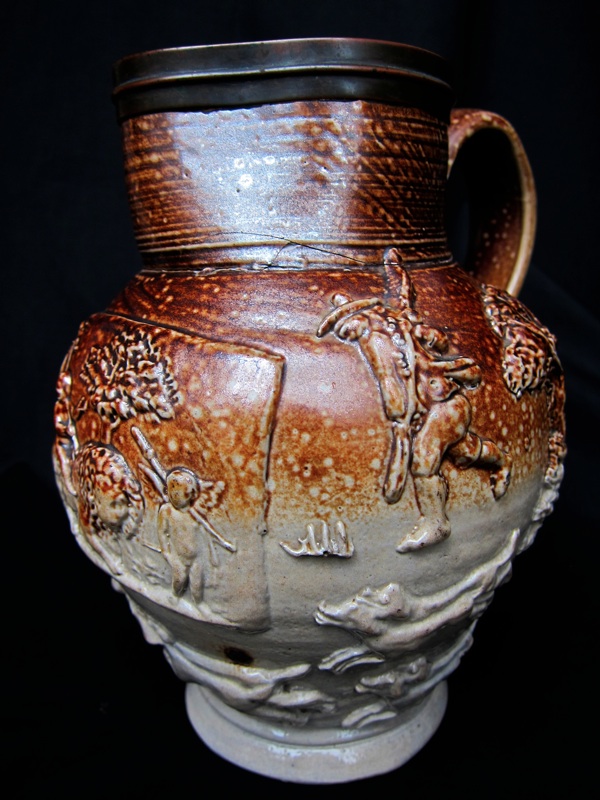
A panel of “Cupid’s Procession”
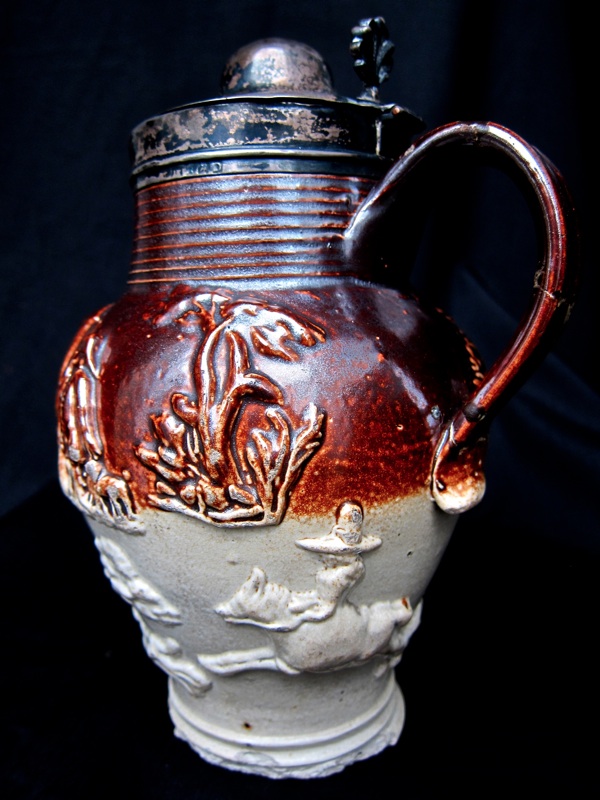
A woman on horseback portrayed on this jug
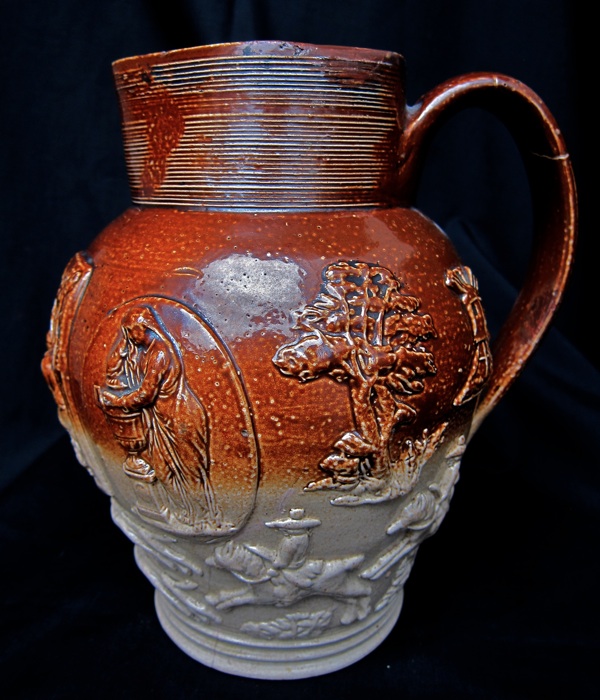
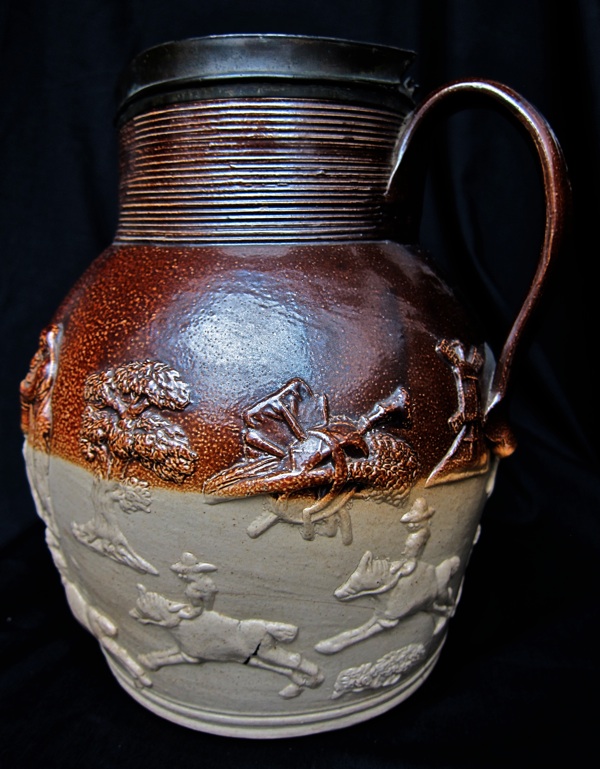
Agricultural implements and women riders
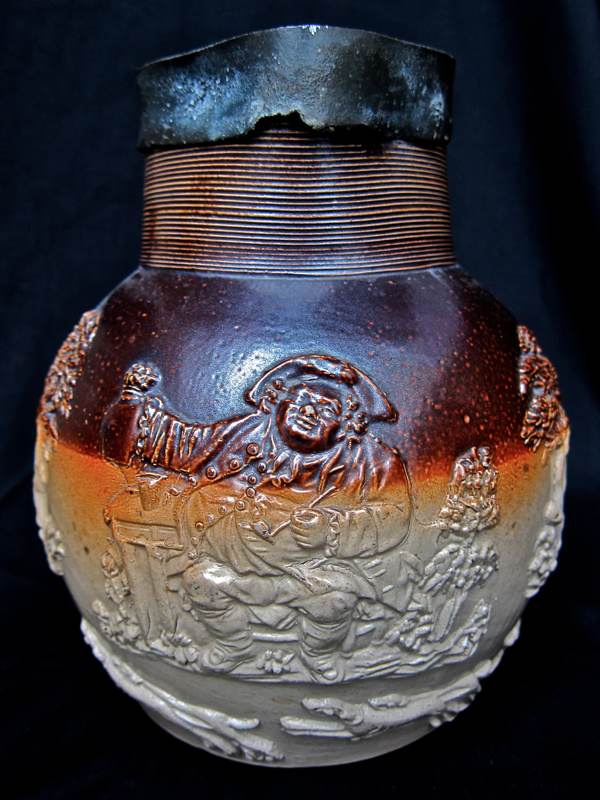
Toby Fillpot
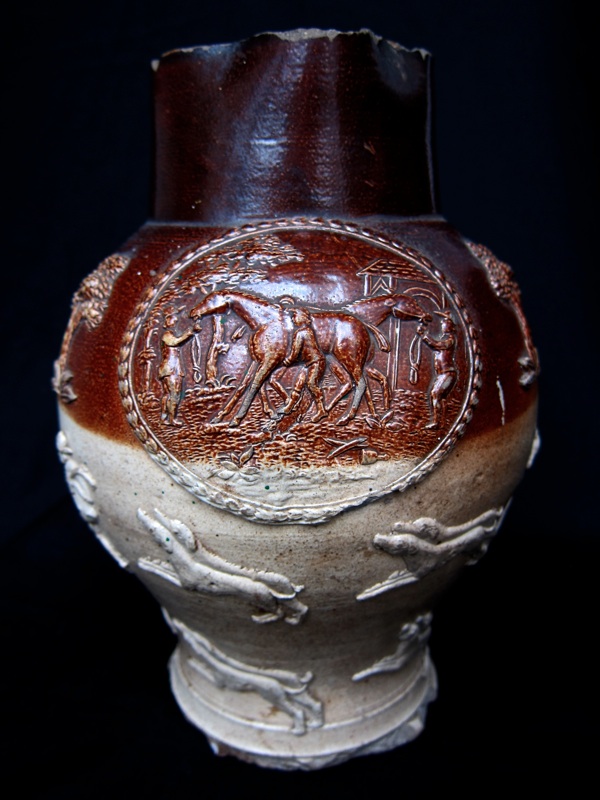
Panel of Racehorses
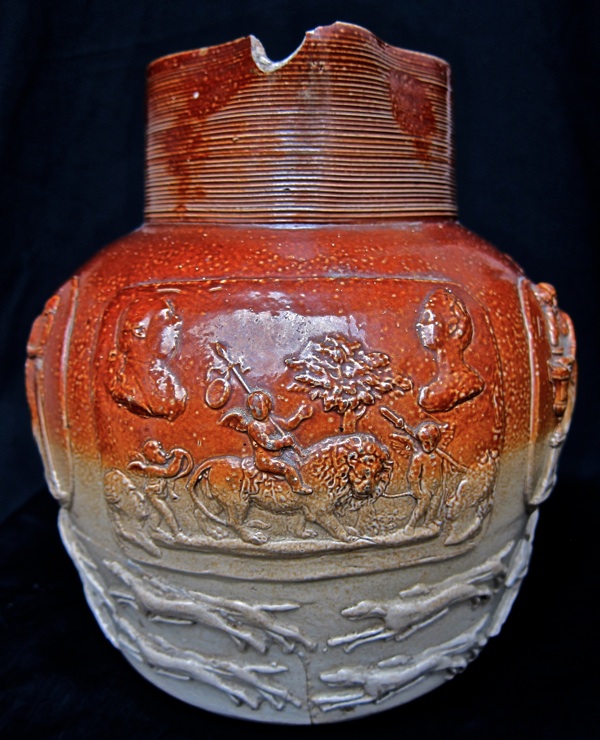
Cupid’s procession with George III & Queen Charlotte and Prince of Wales & Caroline of Brunswick
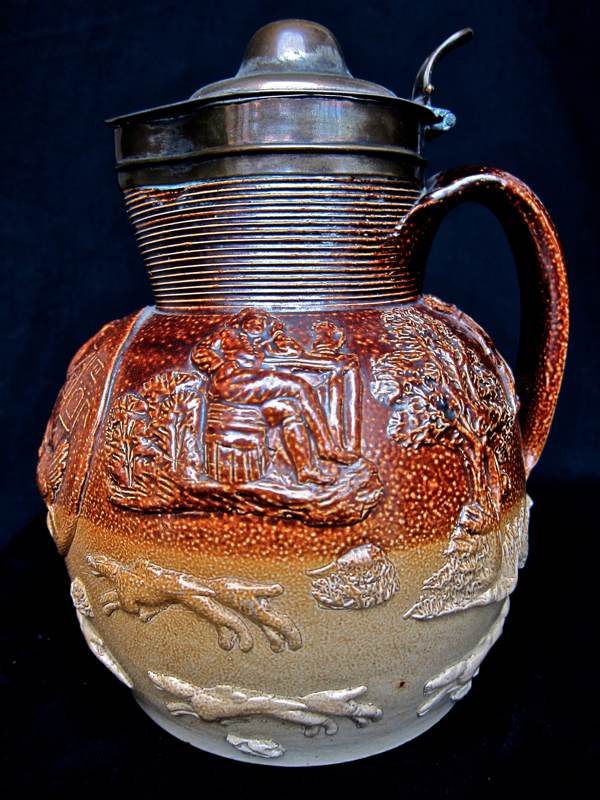
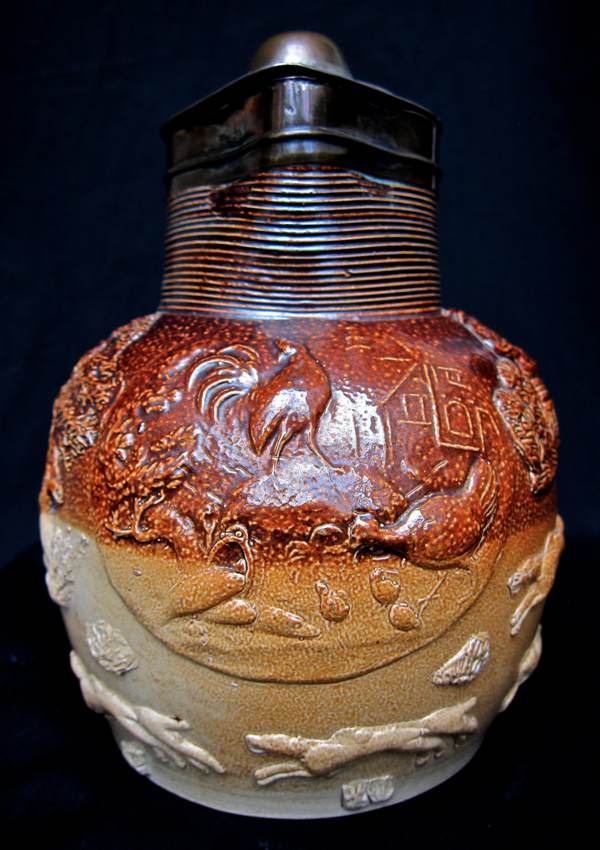
Panel of “Cockerell on the Dungheap”
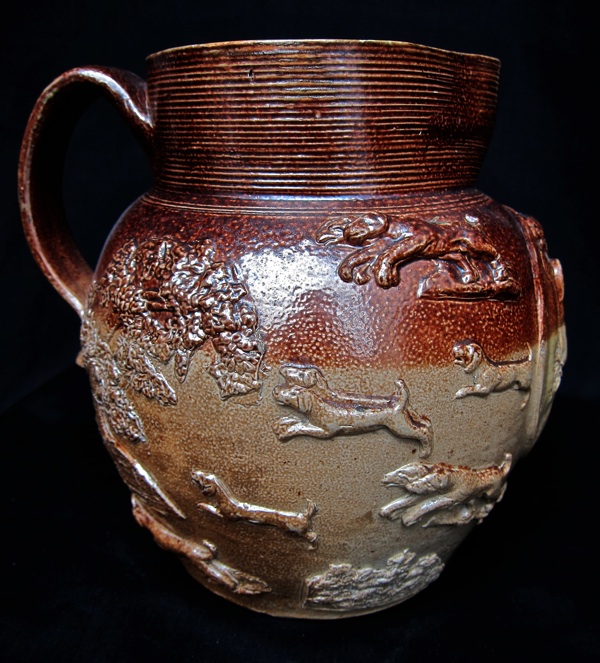
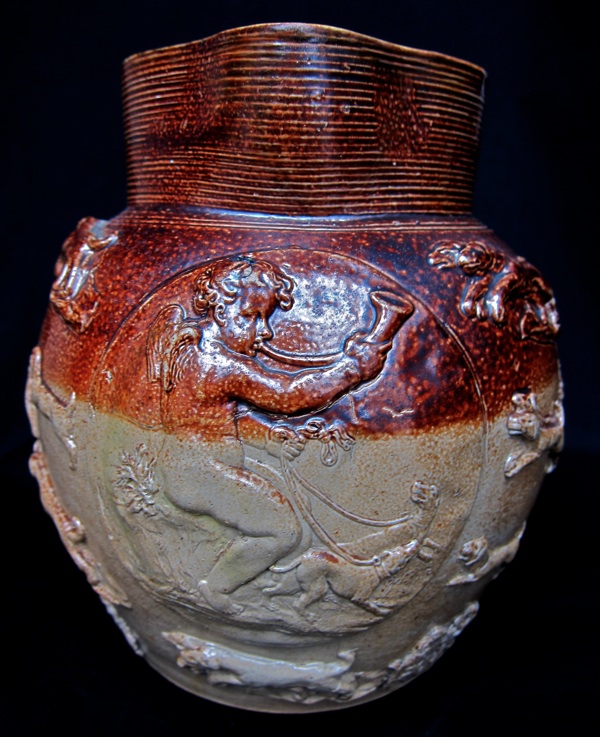
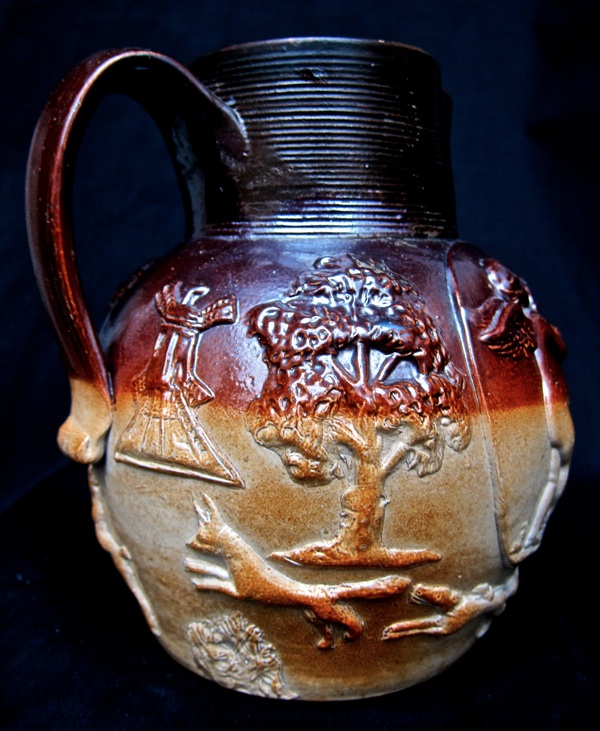
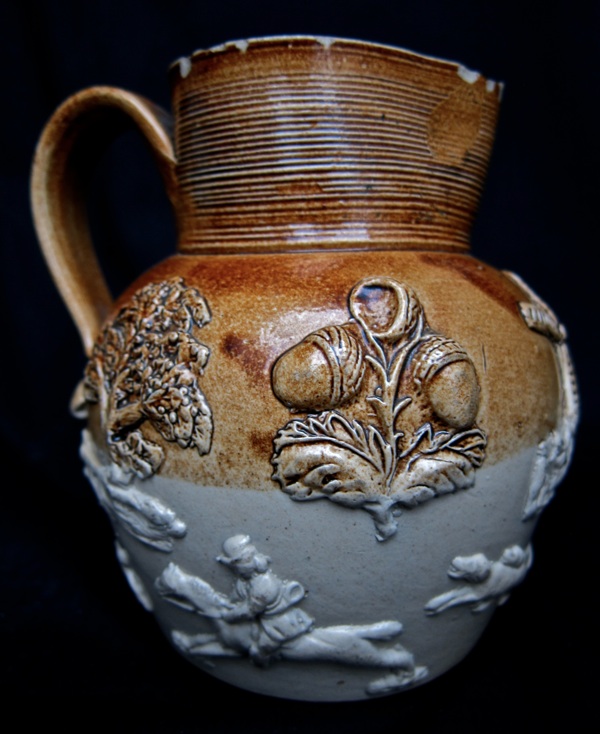
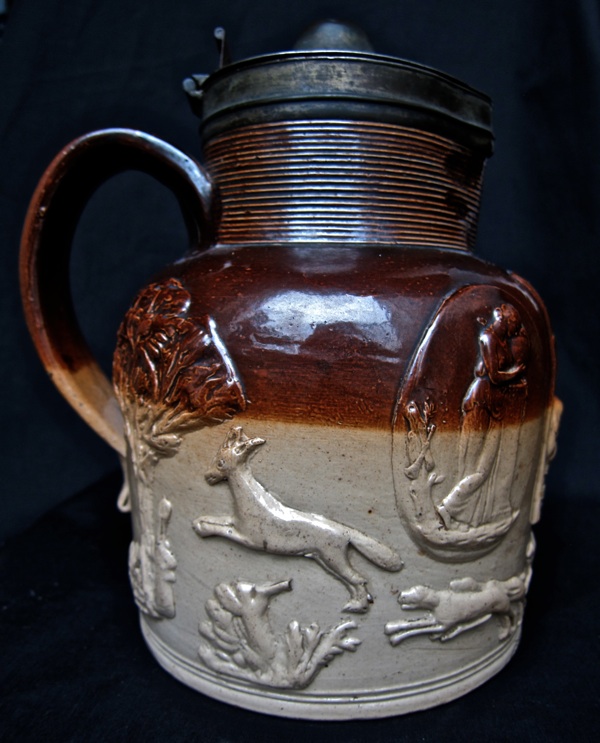
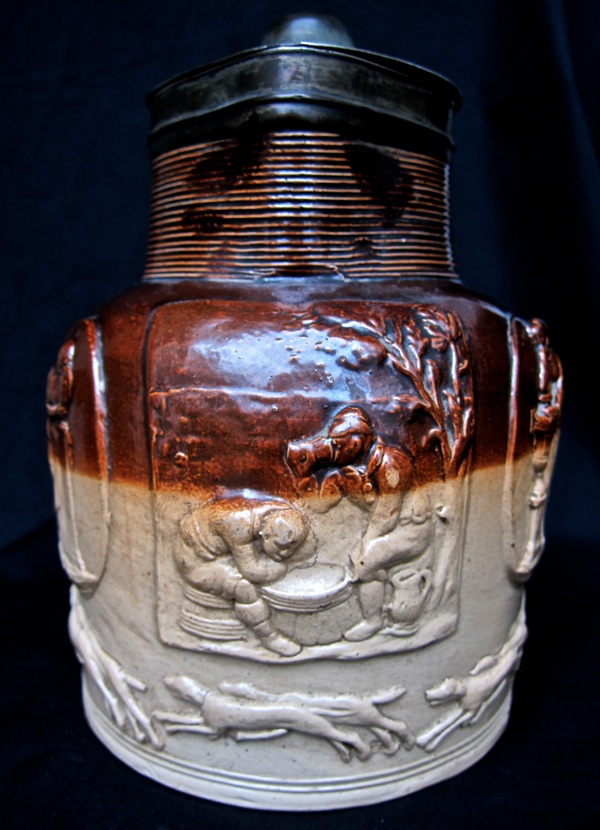
Panel of “The Two Boors”
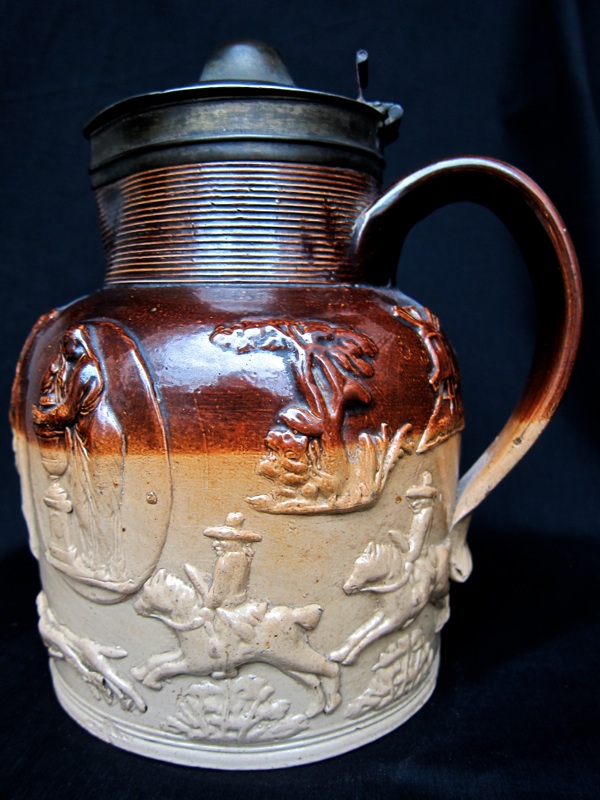
Square- based jug of 1800/1810
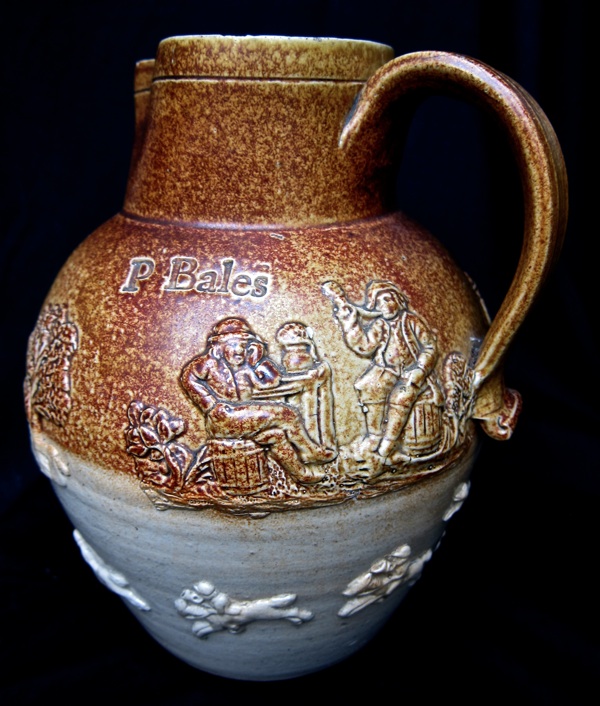
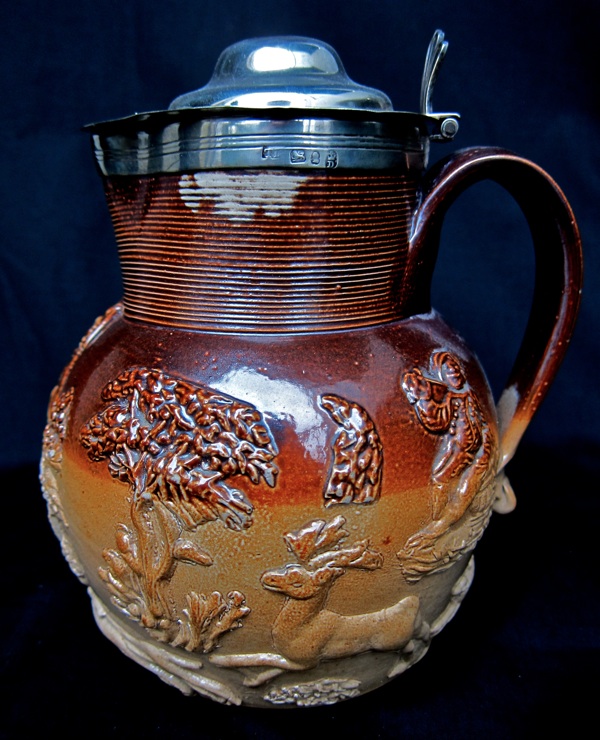
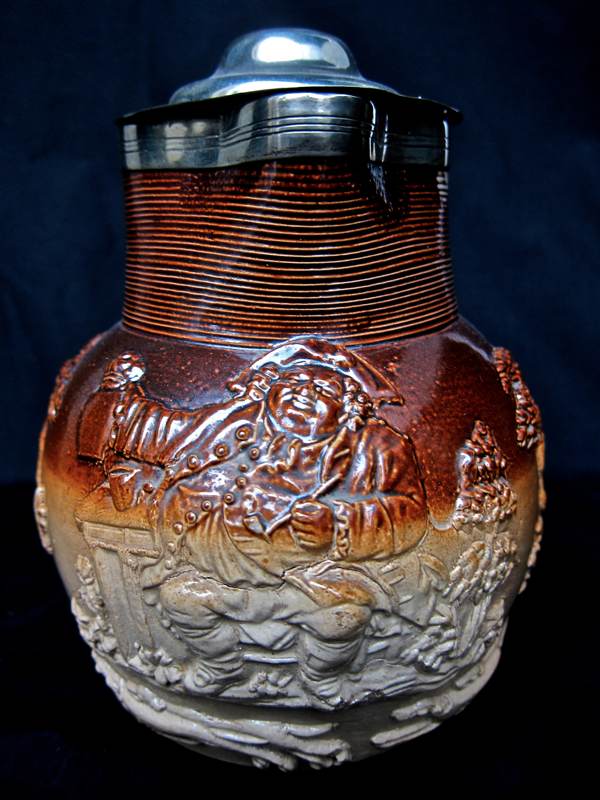
Toby Fillpot
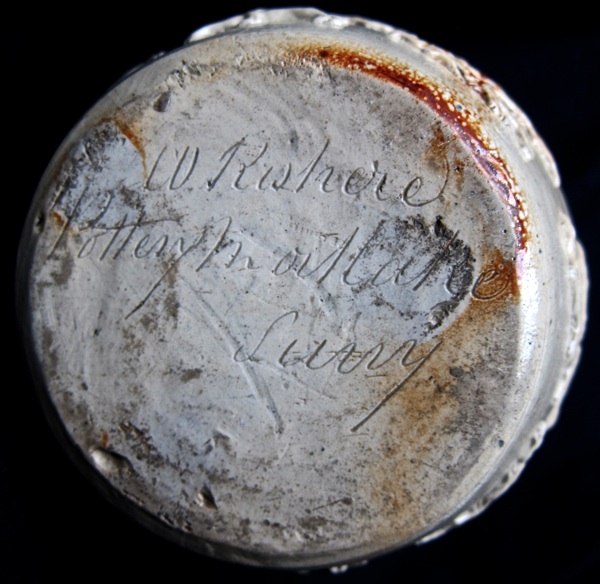
William Kishere, Pottery Mortlake, Surrey
You may also like to look at
John Claridge’s Cafe Society
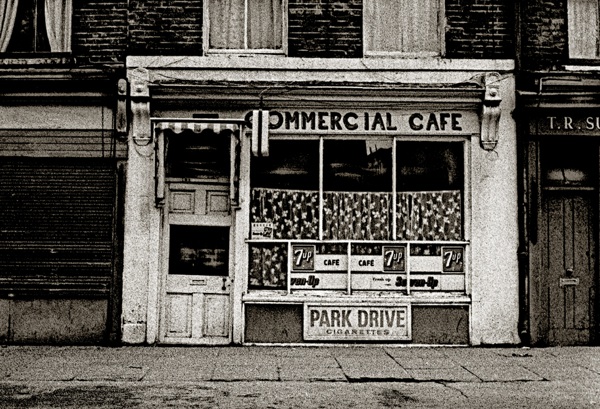
Commercial Cafe, Commercial Rd 1965
“This was one of those places you could just pop in from the cold and warm up,” photographer John Claridge recalled affectionately while contemplating this beloved cafe of yesteryear, “I love the front of it – it was just beautiful, especially the typography. The window above the curtain used to get all steamed up. It was very welcoming, you know, and it was was gorgeous to come in and have a nice cup of tea.”
In this set of photographs, John shows us his collection of cherished East End cafes, accompanied by some random portraits of people that you might expect to meet in them. “Everywhere you went, you would find a cafe where you could go in and get a bacon sarnie and a cup of tea,” he told me ,“they were not fancy restaurants but you could always rely on getting a cuppa and a sandwich.” In John’s youth, the East End was full of independently-run cafes where everyone could afford to eat, and his pictures celebrate these egalitarian and homely places that were once centres for the life of the community.
“You don’t have to build things up, you just show people the beauty of what is.” John assured me, neatly encapsulating his modest aesthetic which suits these subjects so well.
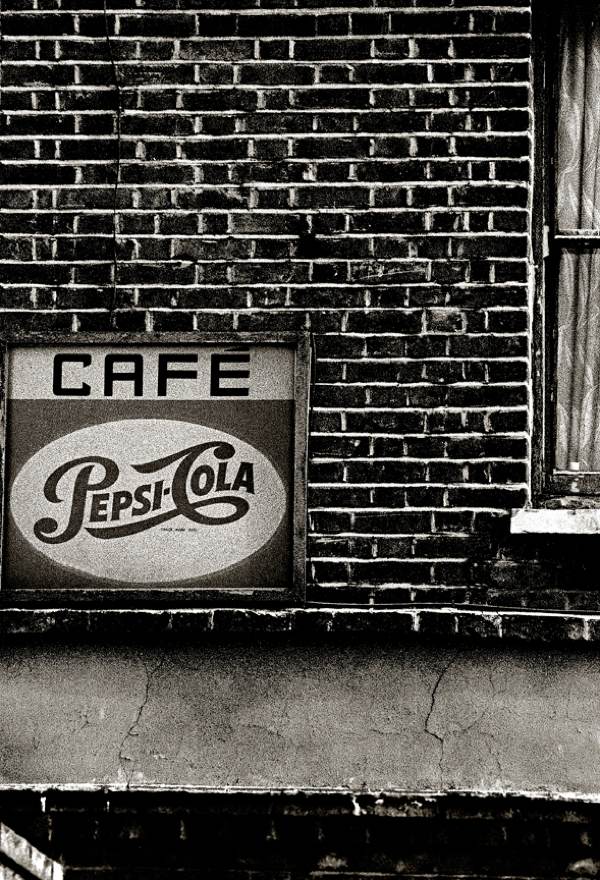
Pepsi, Narrow St 1963 – “I just love these graphics, and when you see it you hope it’s not going to go.”
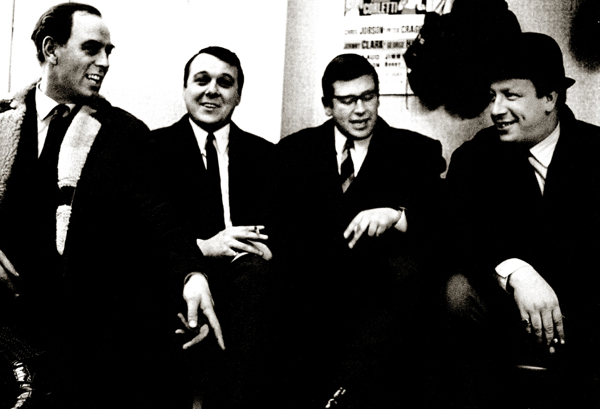
Boxing managers at Terry Lawless’ Gym, E16 1969.
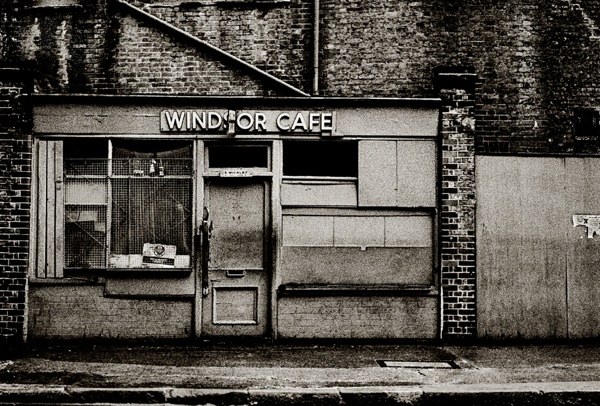
Windsor Cafe, 1982.
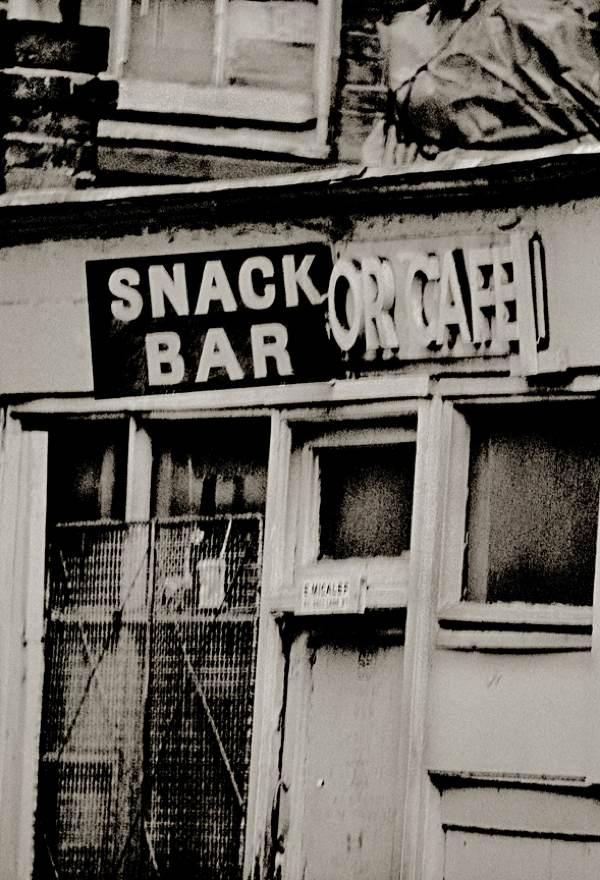
Windsor Cafe, 1982 – “As I walked past the Windsor Cafe, I looked back and saw ‘Snack Bar or Cafe.’ Genius!”
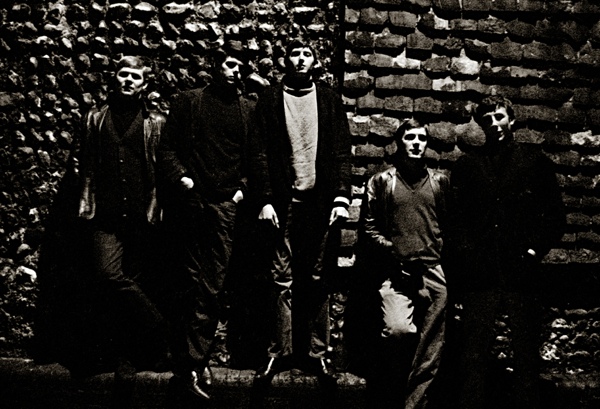
The Wall, 1961 – “We were all seventeen. At weekends we’d go down Southend. Peter on the left, his sister was going out with Georgie Fame.”
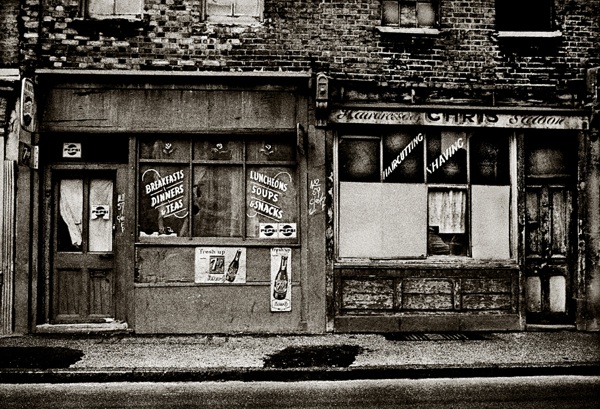
7Up, Spitalfields 1967.
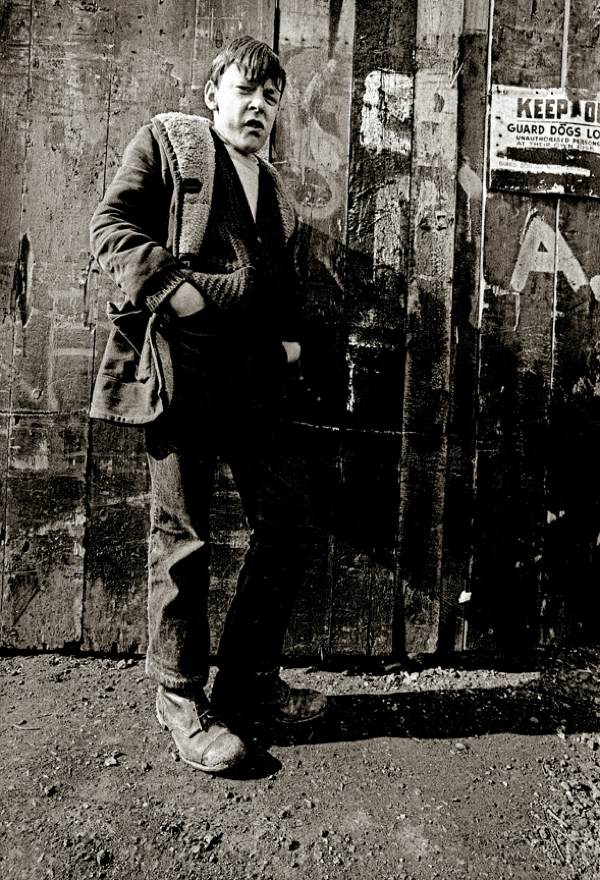
Michael Ferrier, Breaker’s Yard, E16 1975 – “He looks like the artful dodger.”
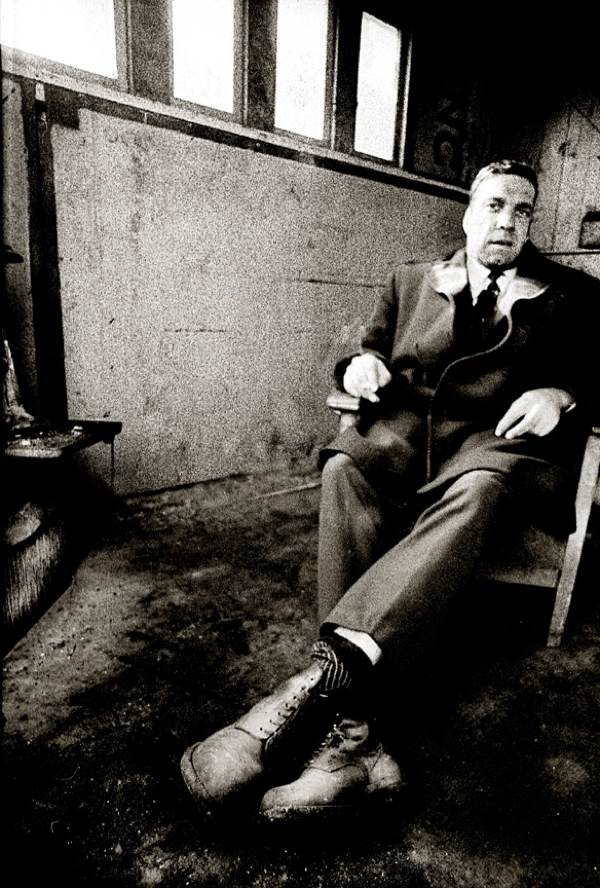
Alfie Ferrier, Breaker’s Yard, E16 1975 – “Michael’s father was sitting inside the hut with his little wood-burner, where he had his cup of tea and a cigarette.”
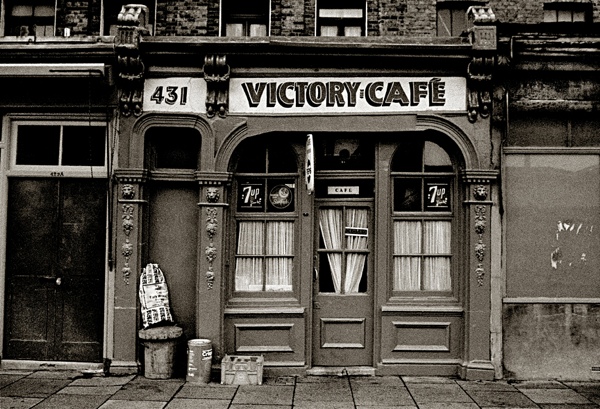
Victory Cafe, Hackney Rd 1963 – “This was very early, they’d just delivered the sack of potatoes.”
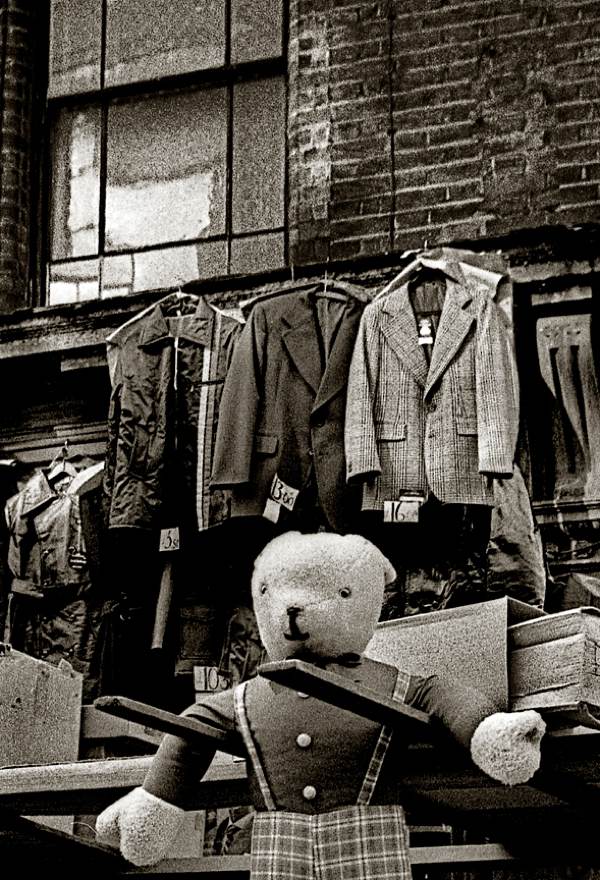
Ted, Cheshire St 1967 – “This made me laugh, it’s his wardrobe in the background hanging there. It’s as if he’s about to burst into song or something!”
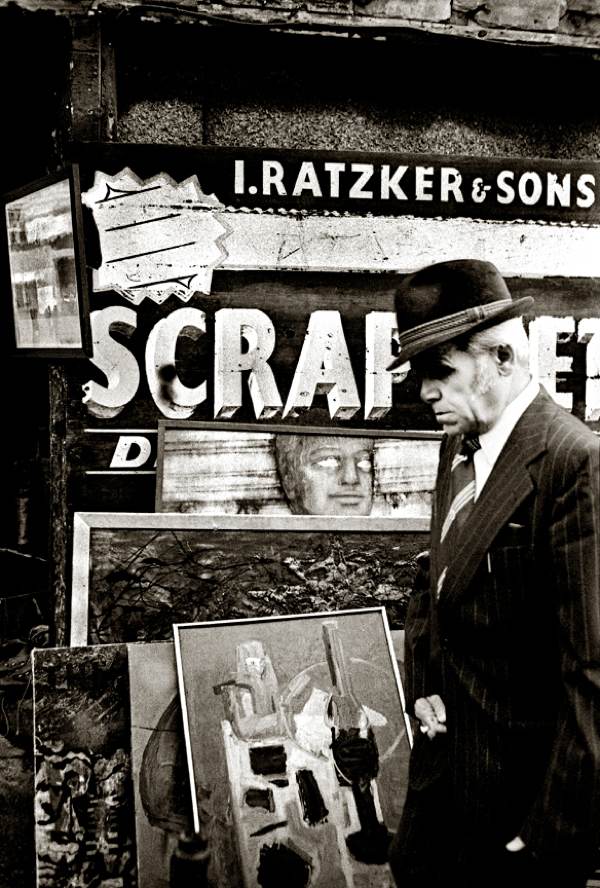
Scrap, Brick Lane 1966.
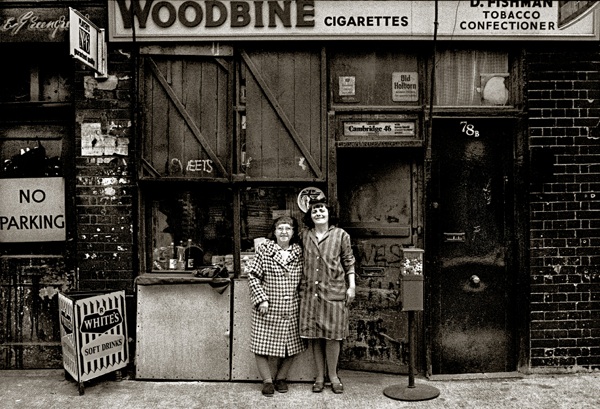
78b, Spitalfields 1967 – “You remember the lady in the kiosk? This is her with her friend.”
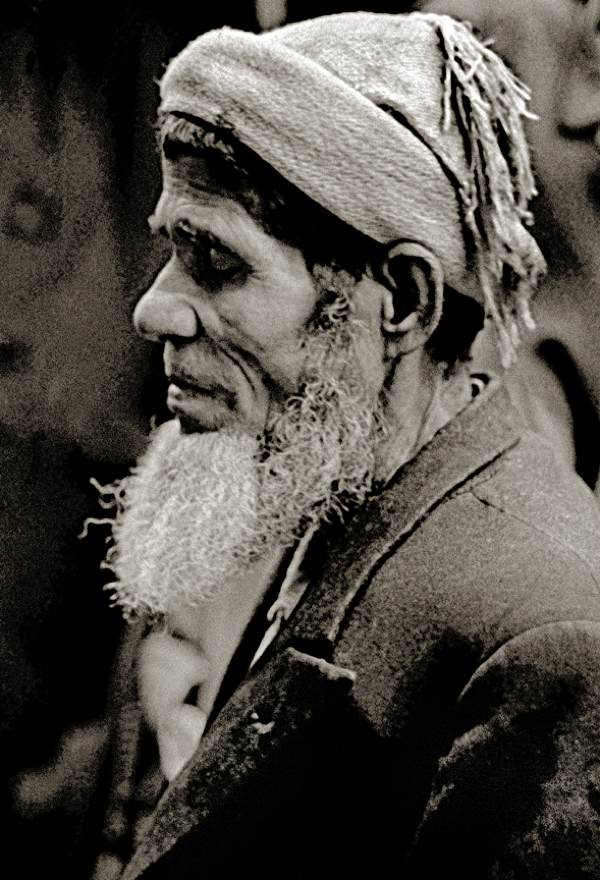
Spitalfields 1963 – “Just a chap standing with his eyes closed. He looked content and I didn’t want to disturb him.”
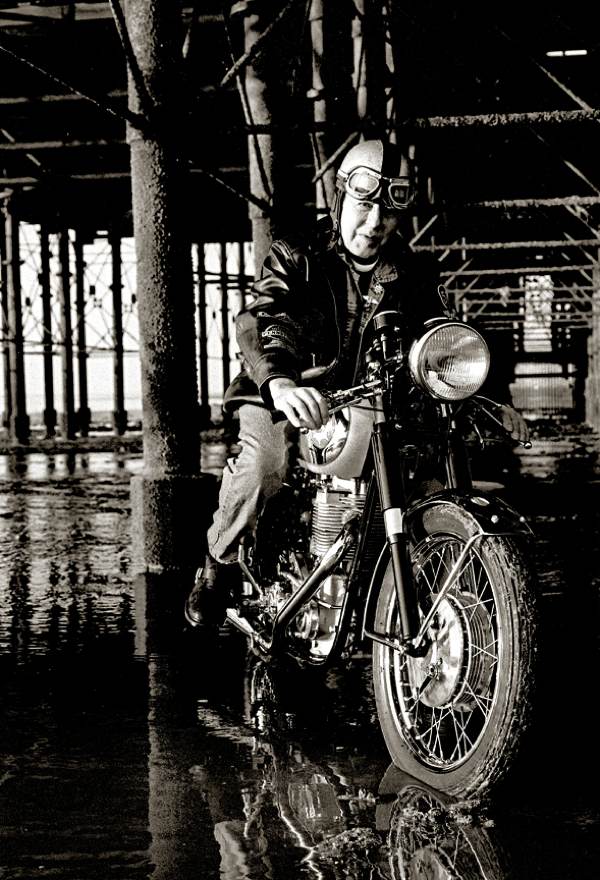
Father Bill Shergold, founder of 59 Club, at Southend – “I met him at the 59 Club to say hello. And someone wanted me to do a portrait for a charity thing, so I said, ‘Absolutely, we’ll get him down to Southend.'”
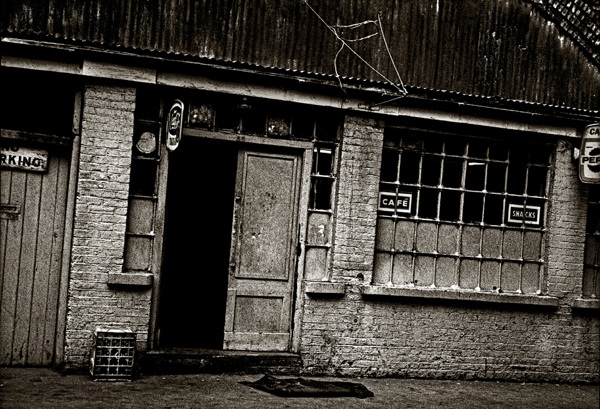
Cafe under a railway arch, E1 1968.
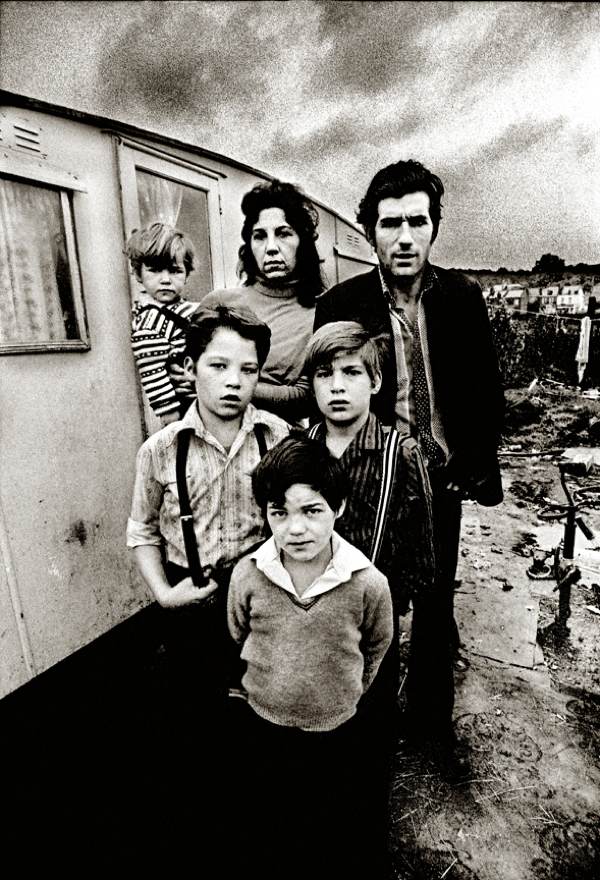
Isle of Dogs, 1970s – “This couple with the four kids lived in that tiny caravan. I did this picture for a charity to make people aware of poor living conditions.”
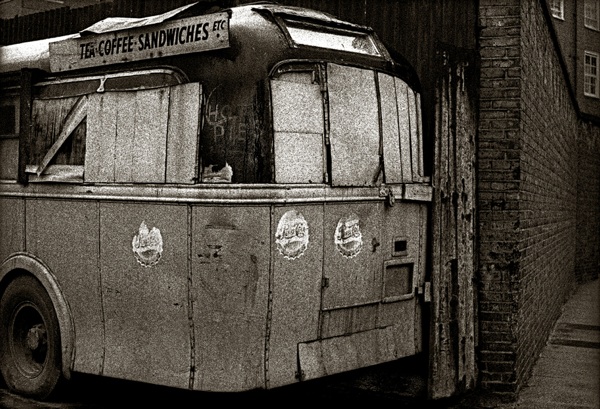
Hot Pies, E2 1982 – “It makes you think twice whether you would eat one of their hot pies.”
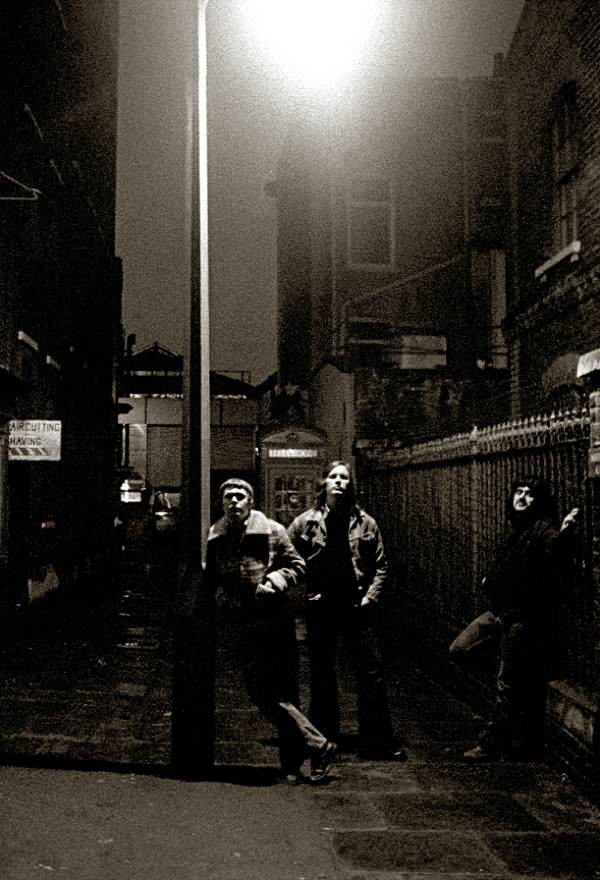
Under the Light, Puma Court, Spitalfields 1970 – “Two of my ex-brother-in-laws with Santi, a Spaniard who became a squash champion – we were on the way to the pub. Keith was working at the Truman Brewery in Brick Lane at the time and I had a studio in the City, so I said, ‘I’ll meet you after work for a drink.'”

Dog, Wapping – “This was taken for anti-litter campaign and the headline was ‘You foul the pavement more than he does.'”
Photographs copyright © John Claridge
You may also like to take a look at
Along the Thames with John Claridge
How To Demolish A Listed Building
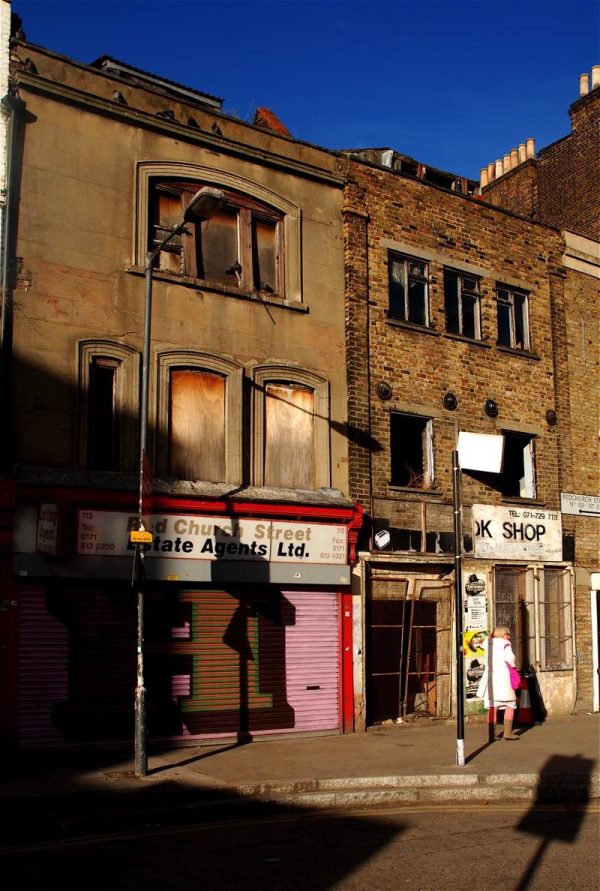
113 & 115 Redchurch St
Do you imagine that a listed building is safe from demolition? Then you are wrong, because this is the fate of an important grade II listed 1735 weavers’ house at 113 Redchurch St. It is to be ‘dismantled and reinstated,’ to quote the weasel words of the planning application approved by Tower Hamlets Council, submitted by the owners of the Truman Brewery who own this building as part of their substantial local property portfolio.
If the word ‘demolition’ had been used in the planning application, then consultation with national amenity societies such as the Georgian Group and Society for Protection of Ancient Buildings would be required, yet this is demolition by another name. The authentic character, human detail and historic quality of the building will be lost.
While the fine mansions of the silk merchants in Spitalfields are familiar, the modest houses of the journeymen weavers in Shoreditch and Bethnal Green are far less known. Few have survived, which makes this pair at 113 & 115 Redchurch St that retain many of their original features especially significant.
Peter Guillery’s The Small House in Eighteenth-Century London is the definitive work on the subject. Guillery features these houses which were built by William Farmer, a local carpenter who became a Freeman of the City of London. Guillery writes ‘the absence of information about lower-status housing has led to skewed representations of the housebuilding world of eighteenth century London. These buildings are important representations of an all but ‘craft-less’ vernacular tradition in the metropolis.’
When I visited the Redchurch St weavers’ houses in 2013 in the company of members of the Spitalfields Trust and a Tower Hamlets Conservation Officer, I was impressed to witness the layers of patina and encounter the humble workrooms of the eighteenth century journeymen, unaltered as if the weavers had just left. The dereliction was palpable, yet the buildings were in no worse state than many others rescued locally by the Spitalfields Trust over the past forty years, such as 5 & 7 Elder St in the seventies.
At that time, we were told the owner intended to restore both buildings but wished to remove the dividing wall on the ground floor to permit a retail space occupying both houses. While the Trust welcomed repair of the structures, they would not endorse removal of the ground floor wall, suggesting instead the insertion of a connecting door as a means to achieve the same result without compromising the integrity of the buildings.
How curious then that the Spitalfields Trust – with their acknowledged expertise in this field – were not consulted about the recent planning application for 113 Redchurch St to be ‘dismantled and reinstated.’
Troubling questions arise. Since Tower Hamlets Conservation Officers were aware of the risk, why was a listed property able to decay to the point at which it became ‘too far gone’? Why was no notice served upon the owner to fulfil their obligation to protect a listed building? Why is there to be no oversight or independent supervision of the dismantling of the fabric and its reinstatement?
Most critically, if a listed building such as this can become ‘too far gone’ and then be demolished, does the protection supposedly afforded by Historic England’s listing status mean anything anymore?
In 2020, we saw the demolition of three Regency cottages of 1828-31 beside the Regent’s Canal and the Art Deco Rex Cinema of 1938 in Bethnal Green, described in their planning applications as ‘retention.’ In fact, the cottages have been newly built back in enlarged, altered form while the site of the former cinema remains a hole in the ground. It appears that the word ‘retention’ has come to mean its opposite.
Unfortunately this destructive act is not an isolated incident for the owners of the Truman Brewery. They have a disappointing record in stewardship of the historic properties in their possession. This January, when they obtained their permission to demolish the Redchurch St house, marked the anniversary of an earlier act of vandalism – tearing up the ancient cobbled yard at the Truman Brewery within the curtilage of the listed buildings to the east of Brick Lane in 2021.
It comes as no surprise that these are the same people who want to build a shopping mall at the brewery site adjoining Brick Lane with four floors of corporate offices on top, widely believed to be the first step in the redevelopment of the Truman Brewery into a corporate plaza.
You will recall the planning application for the shopping mall and office block was approved by two councillors last year despite more than seven thousand letters of objection. A Judicial Review on the lawful or otherwise nature of this decision takes place at the High Court on June 29th and the Save Brick Lane Coalition has now raised over £23,000 but still needs to find another £17,000 in order to proceed.
Click here to support the fighting fund for the Judicial Review
The Save Brick Lane Coalition includes Bengali East End Heritage Society, East End Preservation Society, East End Trades Guild, House of Annetta, Nijjor Manush, Spitalfields Life & Spitalfields Trust.
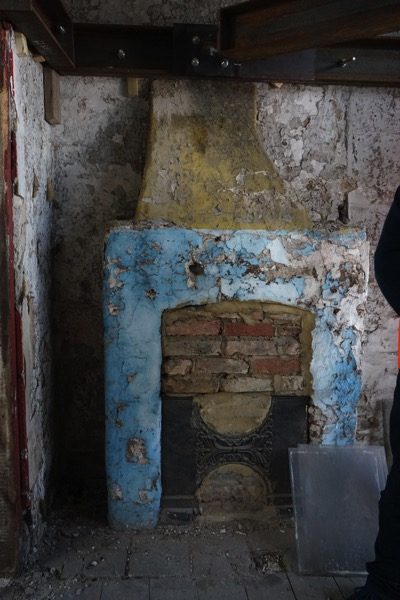
Eighteenth century chimney breast with old range
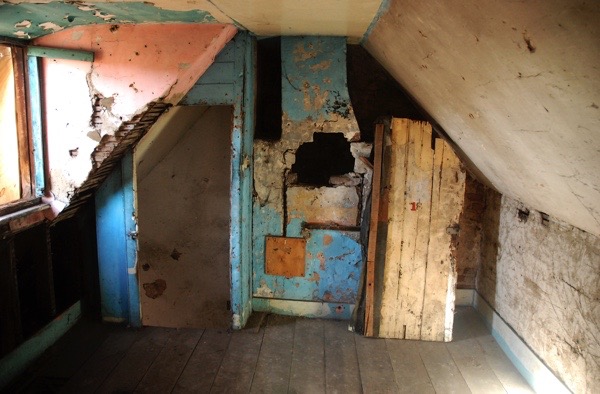
Weaver’s garret
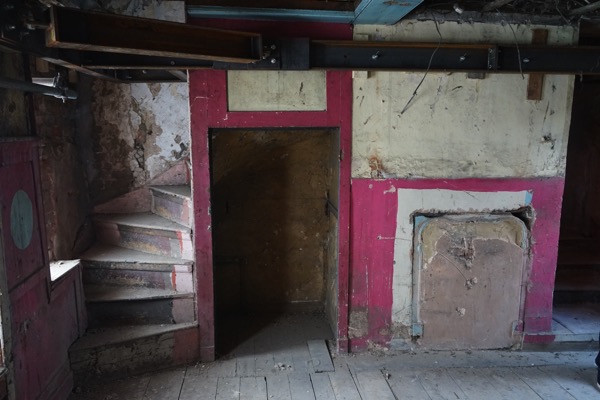
The narrow corner staircase leaves the workspace clear for looms
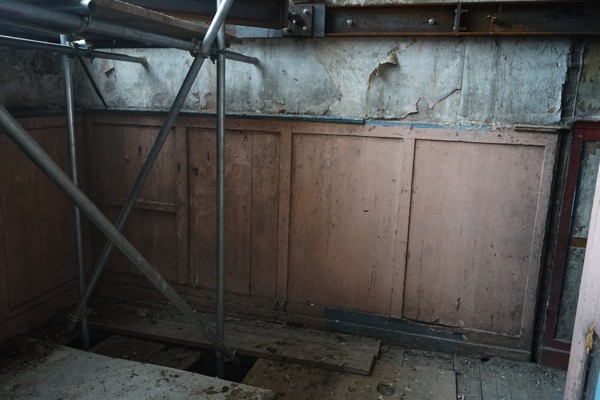
Surviving panelling
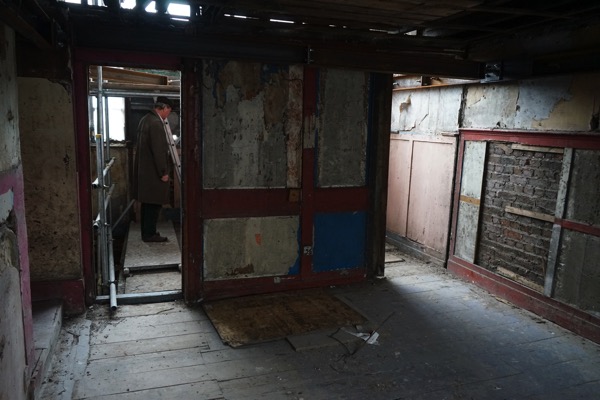
Eighteenth century wooden partition wall
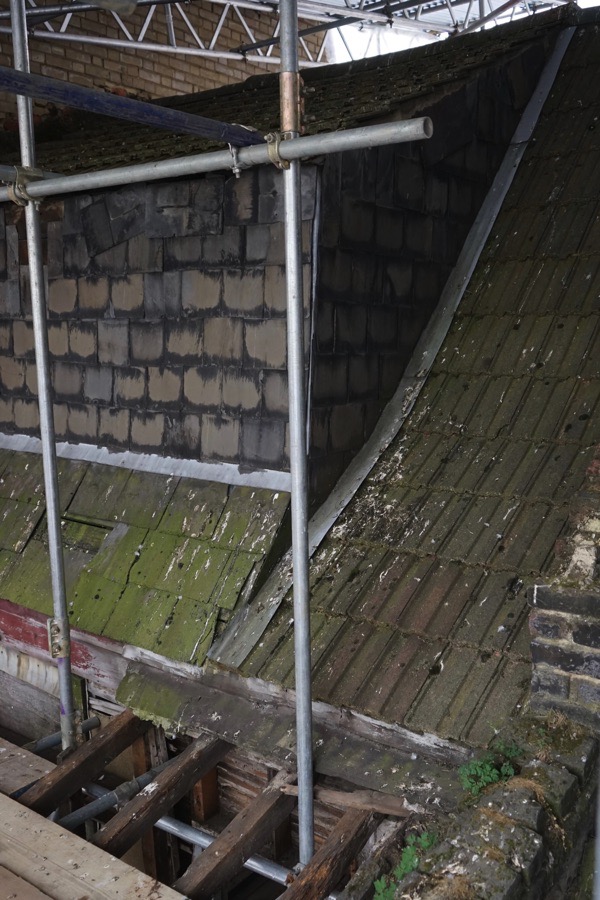
Pantiled roofs such as this were once ubiquitous in Spitalfields
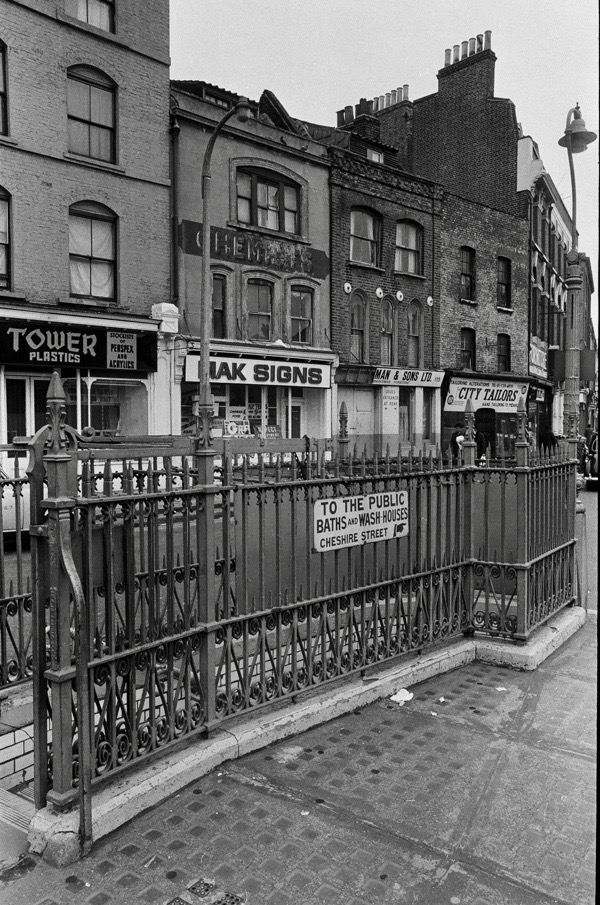
113 & 115 Redchurch St in the seventies before the front wall of 115 was rebuilt
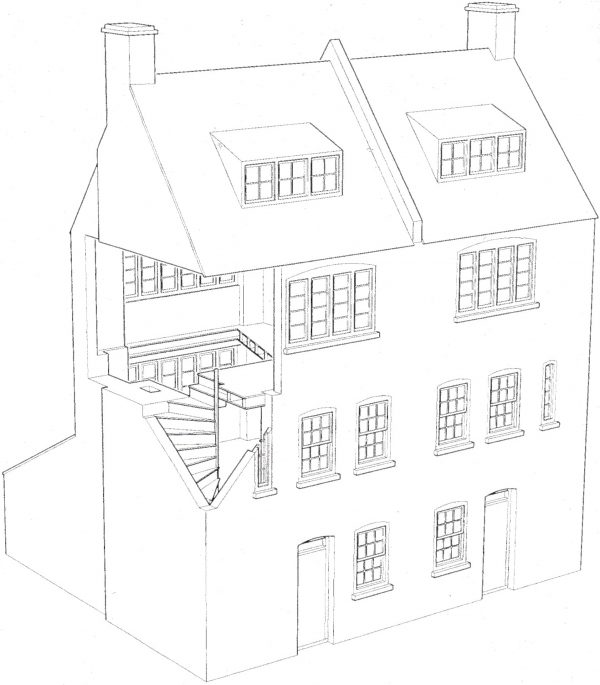
113 & 115 Redchurch St as built in 1735
Photographs copyright © Spitalfields Trust
You may also like to read about