Ann Sotheran’s West End Champions
The Gentle Author’s Tour of the City of London: Meet me at 2pm on EASTER MONDAY on the steps of St Paul’s Cathedral for a tour of sightseeing and storytelling, rambling through the alleys and byways of the Square Mile in search of the wonders and the wickedness of the City. (Also booking for Spring Bank Holiday Monday 4th May)

The Champion
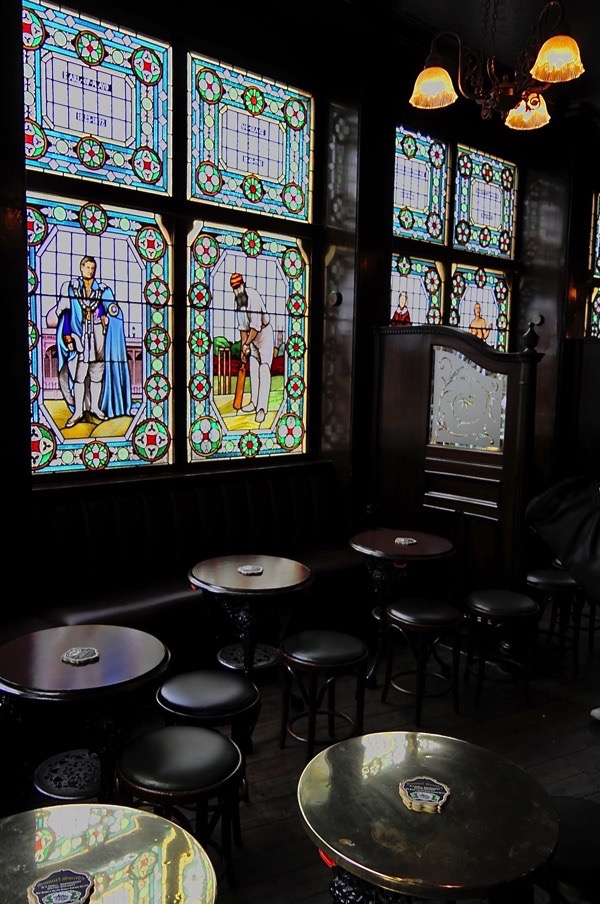
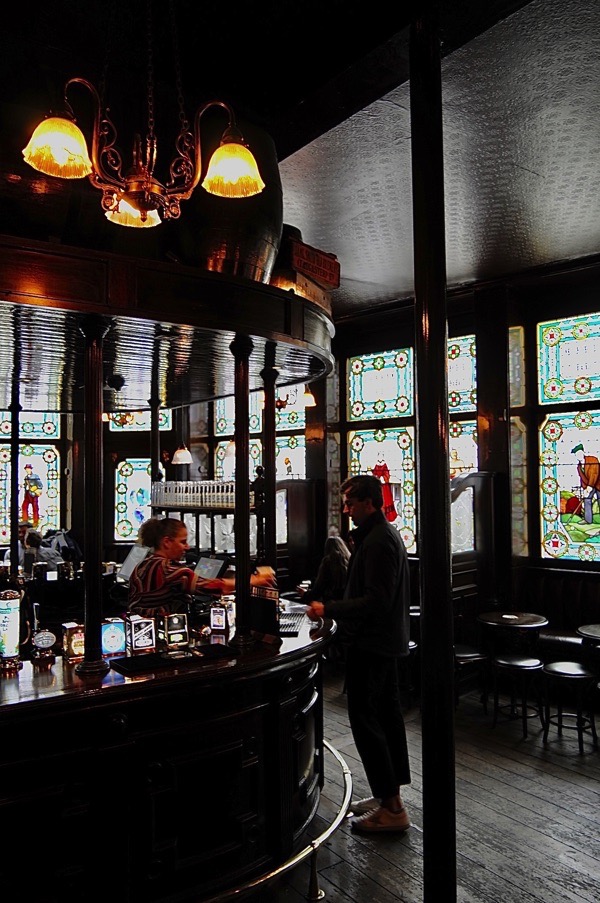
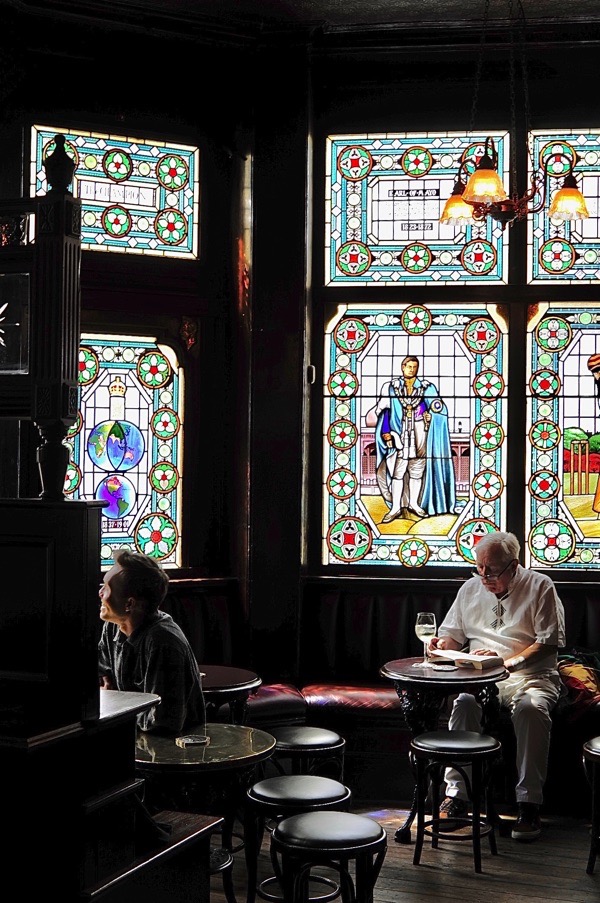
Perhaps more than anywhere else in London, Oxford St is where the grief of the world can descend upon me without warning – especially when I make the foolish mistake of going in person to the West End to buy a pillowcase. In such circumstances, there is fortunately a nearby refuge where I can seek respite from the urban clamour. It is The Champion in Well St – just minutes walk from the nightmarish agglomeration of chain stores – where Ann Sotheran‘s magnificent stained glass windows cast a spell of benign quietude.
The Champion has been there on the corner of Wells St and Eastcastle St since before 1869 and you would be forgiven for assuming that the glorious array of stained glass dates from this era, but you would be mistaken because it was designed and installed in 1989. The husband and wife publicans who live upstairs informed me that this imaginative notion was the inspiration of a member of the Samuel Smith family of brewers who own the pub and commissioned the glass from Ann Sotheran to endow it with distinction.
Thirty years later these gaudy portraits of Victorian worthies offer a generous welcome to the weary shopper, proving that there is still mileage in the traditional pub when it is as cherished and as handsome as The Champion.
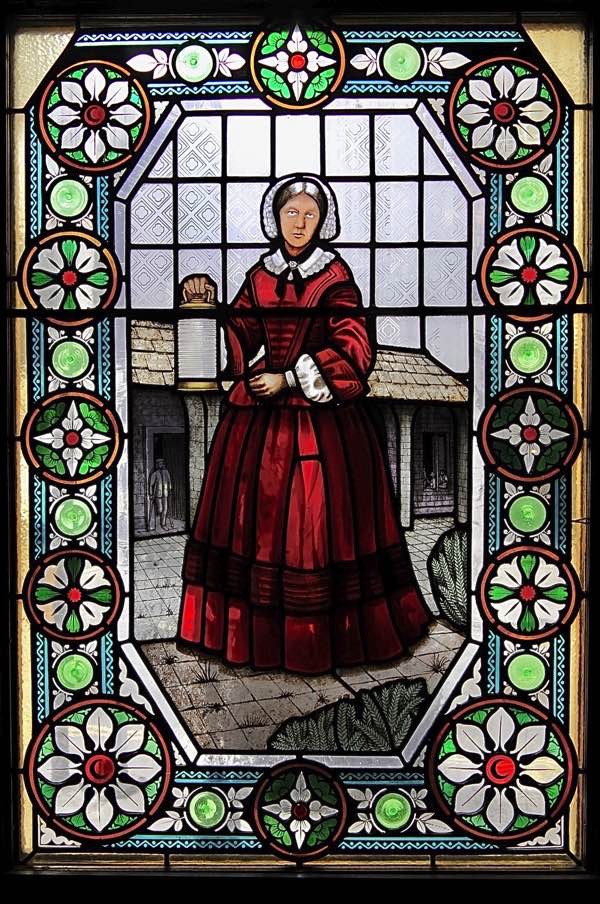
Florence Nightingale (1820-1910) gained professional status for nurses and raised hospital standards in the Crimea
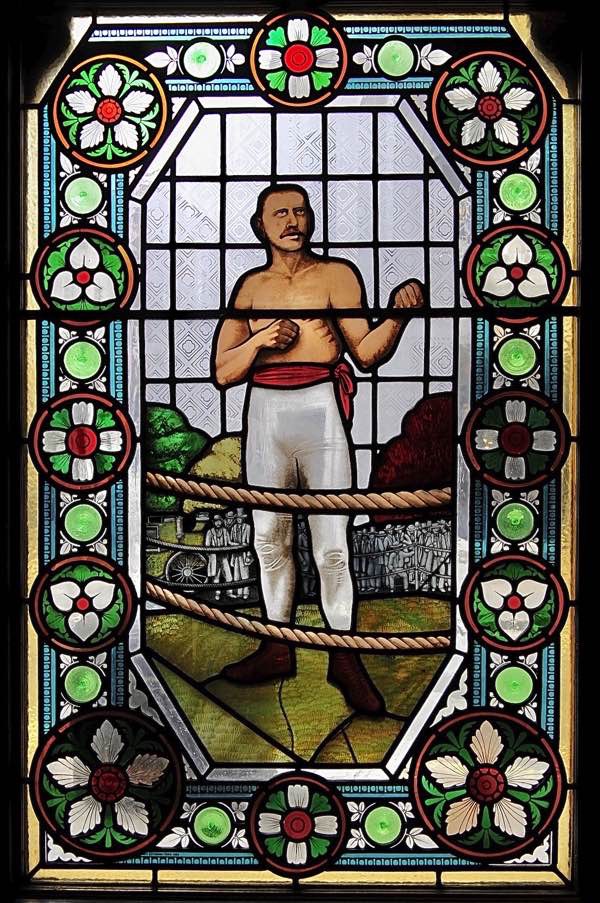
Bob Fitzsimmons (1862-1917) The only Englishman to have won three world titles at different weights
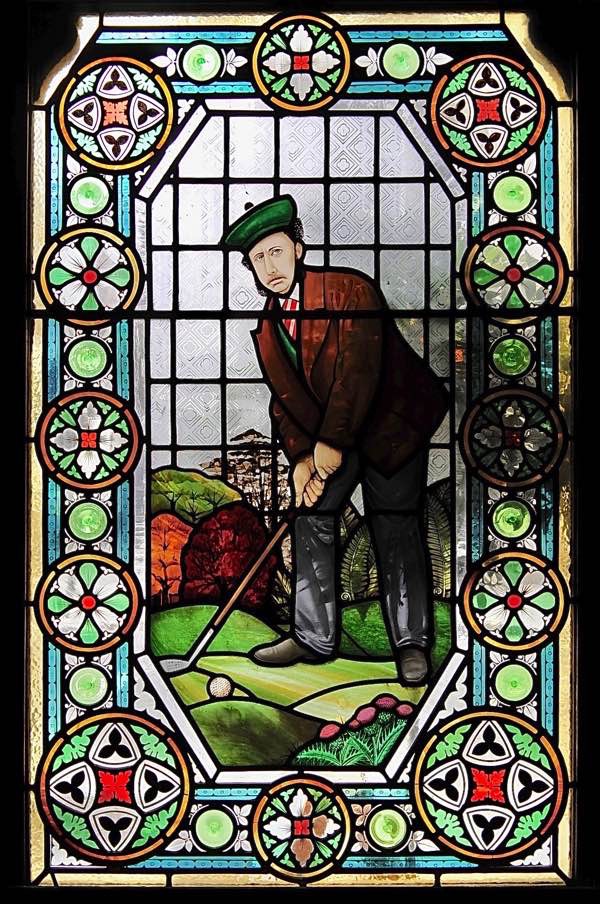
Young Tom Morris (1851-1875) won four consecutive Open Championships, first at the age of seventeen
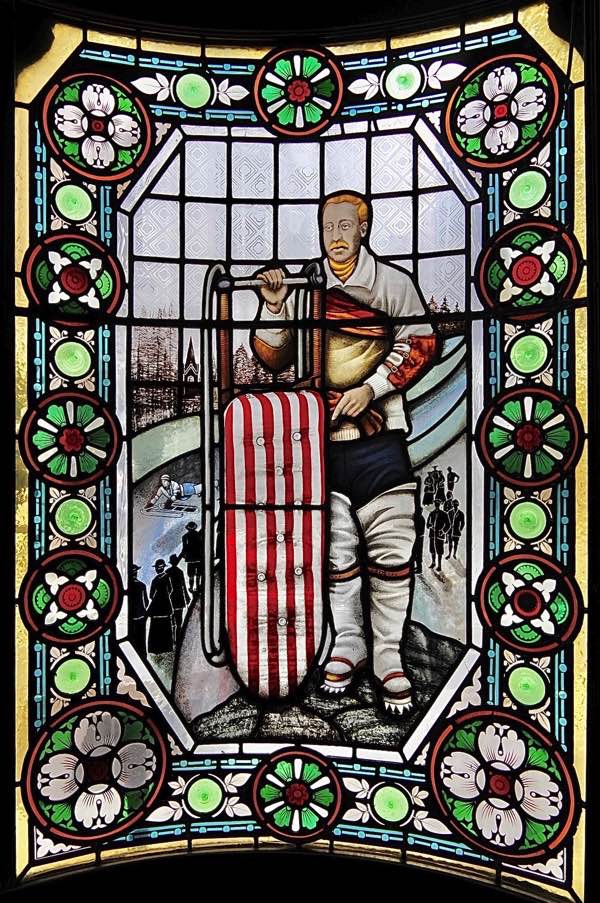
Capt Bertie Dwyer (1872-1967) ‘Flying Bertie Dwyer was one of the early Cresta riders, a President of the St Moritz Tobogganing Club and winner of several trophies
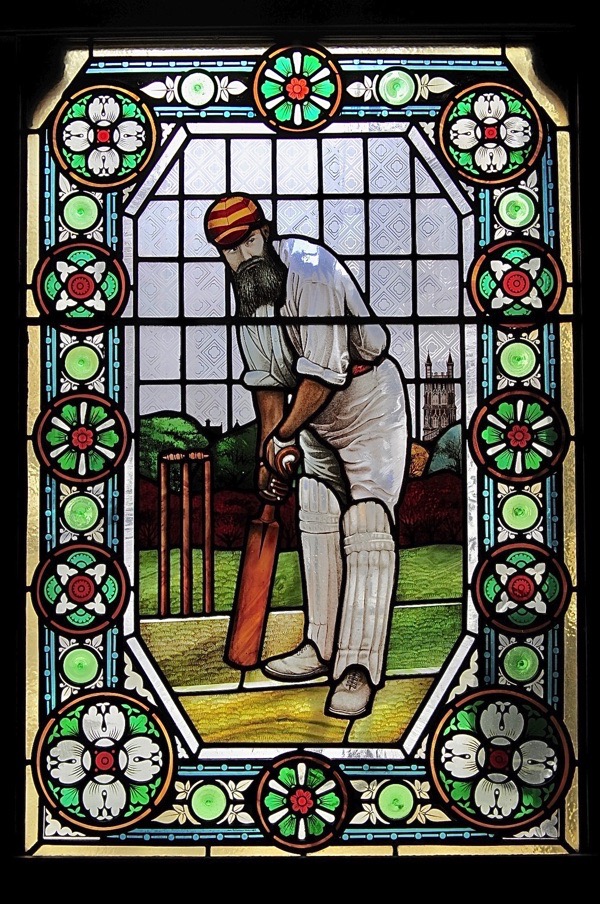
W G Grace (1848-1915) A legendary figure whose all round ability and enthusiasm dominated cricket for over thirty years
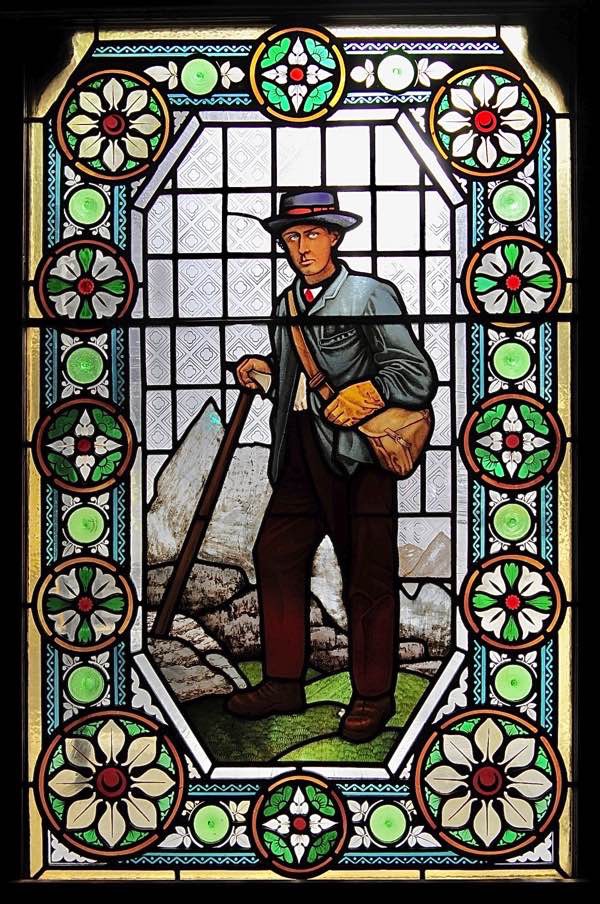
Edward Whymper (1840-1911) became a traveller and mountaineer, the first man to climb the Matterhorn and Chimborazo in the Andes
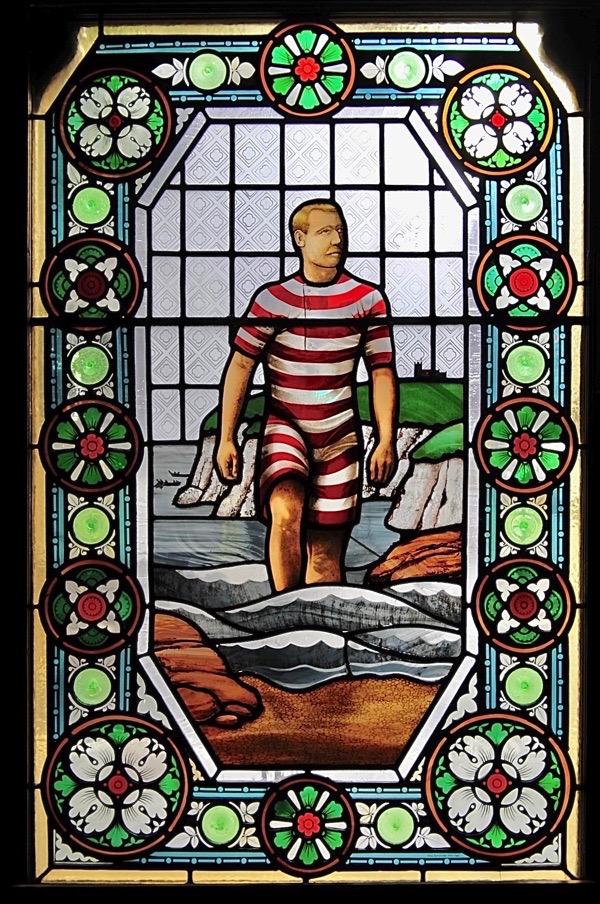
Capt Matthew Webb (1848-1883) was the first to swim the English Channel (thirty-four miles in twenty-one hours) He died swimming across Niagara Falls
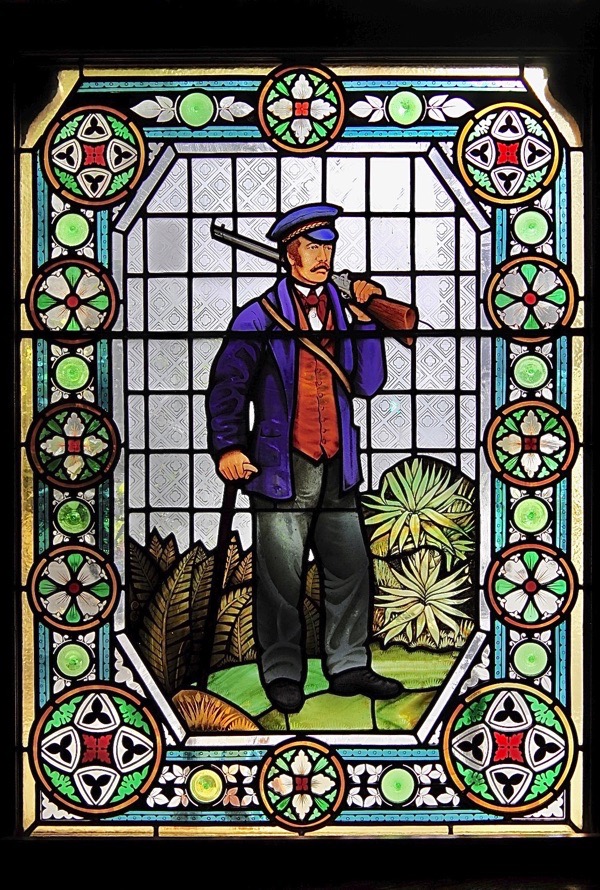
David Livingstone (1813-1873) Originally sent to Africa as a missionary, he mapped and explored vast areas of the continent
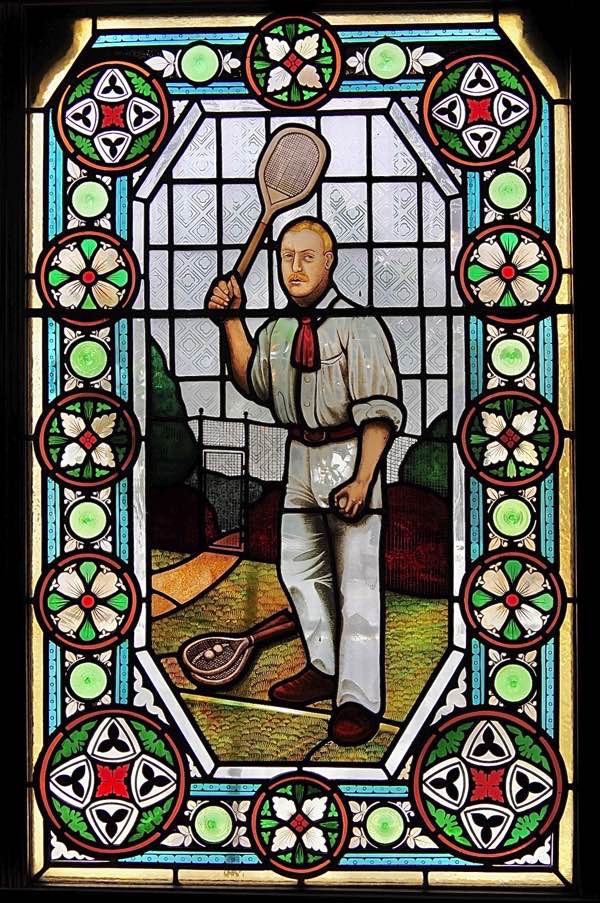
William Renishaw (1861-1904) Winner of seven singles and seven doubles cups, he with his brother, made Lawn Tennis into a sport
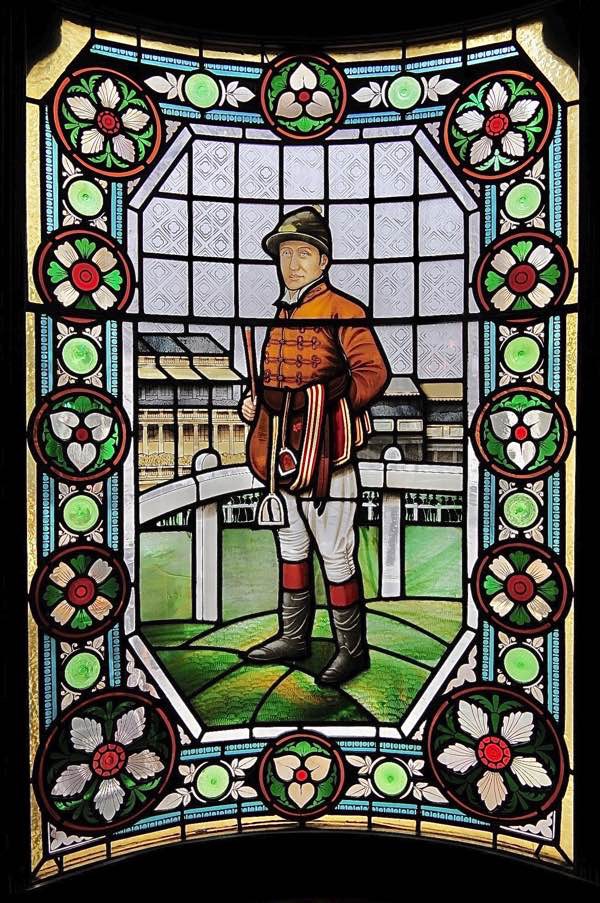
Fred Archer (1857-1886) Possibly the greatest jockey ever, being Champion Jockey for thirteen consecutive years, with twenty-one classic victories
You may also like to read about
The Ceremony Of The Widow’s Buns
The Gentle Author’s Tour of the City of London: Meet me at 2pm on EASTER MONDAY on the steps of St Paul’s Cathedral for a tour of sightseeing and storytelling, rambling through the alleys and byways of the Square Mile in search of the wonders and the wickedness of the City. (Also booking for Spring Bank Holiday Monday 4th May)
Fifteen years ago on a cold Good Friday, I attended the ceremony of the widow’s buns at Bow. The ceremony will taking place at 2pm today.
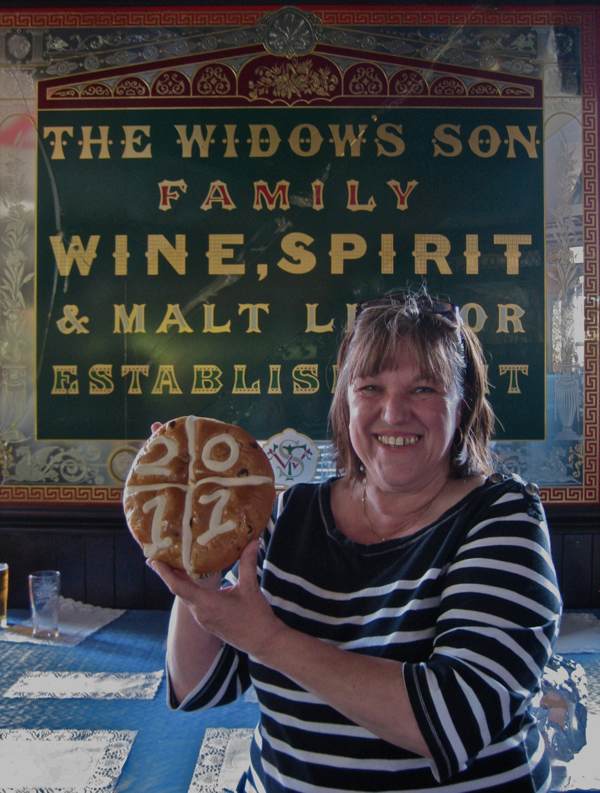
Baked by Mr Bunn’s Bakery in Chadwell Heath
On Good Friday, what could be more appropriate to the equivocal nature of the day than an event which involves both celebration of Hot Cross Buns and the remembrance of the departed in a single custom – such is the ceremony of the Widow’s Buns at Bow.
A net of Hot Cross Buns hangs above the bar at The Widow’s Son in Bromley by Bow, and each year a sailor comes to add another bun to the collection. And this year I was there to witness it for myself, though – before you make any assumption based on your knowledge of my passion for buns – I must clarify that no Hot Cross Buns are eaten in the ceremony, they are purely for symbolic purposes. Left to dry out and gather dust and hang in the net for eternity, London’s oldest buns exist as metaphors to represent the passing years and talismans to bring good luck but, more than this, they tell a story.
The Widow’s Son was built in 1848 upon the former site of an old widow’s cottage, so the tale goes. When her only son left to be a sailor, she promised to bake him a Hot Cross Bun and keep it for his return. But although he drowned at sea, the widow refused to give up hope, preserving the bun upon his return and making a fresh one each year to add to the collection. This annual tradition has been continued in the pub as a remembrance of the widow and her son, and of the bond between all those on land and sea, with sailors of the Royal Navy coming to place the bun in the net every year.
Behind this custom lies the belief that Hot Cross Buns baked on Good Friday will never decay, reflected in the tradition of nailing a Hot Cross Bun to the wall so that the cross may bring good luck to the household – though what appeals to me about the story of the widow is the notion of baking as an act of faith, incarnating a mother’s hope that her son lives. I interpret the widow’s persistence in making the bun each year as a beautiful gesture, not of self-deception but of longing for wish-fulfilment, manifesting her love for her son. So I especially like the clever image upon the inn sign outside the Widow’s Son, illustrating an apocryphal scene in the story when the son returns from the sea many years later to discover a huge net of buns hanging behind the door, demonstrating that his mother always expected him back.
When I arrived at the Widow’s Son, I had the good fortune to meet Frederick Beckett who first came here for the ceremony in 1958 when his brother Alan placed the Hot Cross Bun in the net, and he had the treasured photo in his hand to show me. Frederick moved out from Bow to Dagenham fifteen years ago, but he still comes back each year to visit the Widow’s Son, one of many in this community and further afield who delight to converge here on Good Friday for old times’ sake. Already, there was a tangible sense of anticipation, with spirits uplifted by the sunshine and the flags hung outside, ready to celebrate St George next day.
The landlady proudly showed me the handsome fresh 2011 Hot Cross Bun, baked by Mr Bunn of Mr Bunn’s Bakery in Chadwell Heath who always makes the special bun each year -” fabulous buns!” declared Kathy, almost succumbing to a swoon, as he she held up her newest sweetest darling that would shortly join its fellows in the net over the bar. There were many more ancient buns, she explained, until a fire destroyed most of them fifteen years ago, and those burnt ones in the net today are merely those few which were salvaged by the firemen from the wreckage of the pub. Remarkably, having opened their hearts to the emotional poetry of Hot Cross Buns, at the Widow’s Son they even cherish those cinders which the rest of the world would consign to a bin.
The effect of the beer and the unseasonal warm temperatures upon a pub full of sailors and thirsty locals rapidly induced a pervasive atmosphere of collective euphoria, heightened by a soundtrack of pounding rock, and, in the thick of it, I was delighted to meet my old pal Lenny Hamilton, the jewel thief. “I’m not here for the buns, I’m here for the bums!” he confided to me with a sip of his Corvoisier and lemonade, making a lewd gesture and breaking in to a wide grin of salacious enjoyment as various Bow belles, in off-the-shoulder dresses, with flowing locks and wearing festive corsages, came over enthusiastically to shower this legendary rascal with kisses.
I stood beside Lenny as three o’ clock approached, enjoying the high-spirited gathering as the sailors came together in front of the bar. The landlord handed over the Hot Cross Bun to widespread applause and the sailors lifted up their smallest recruit. Then, with a mighty cheer from the crowd and multiple camera flashes, the recruit placed the bun in the net. Once this heroic task was accomplished, and the landlady had removed the tinfoil covers from the dishes of food laid out upon the billiard table, all the elements were in place for a knees-up to last the rest of the day. As they like to say in Bromley by Bow, it was “Another year, another Good Friday, another bun.”
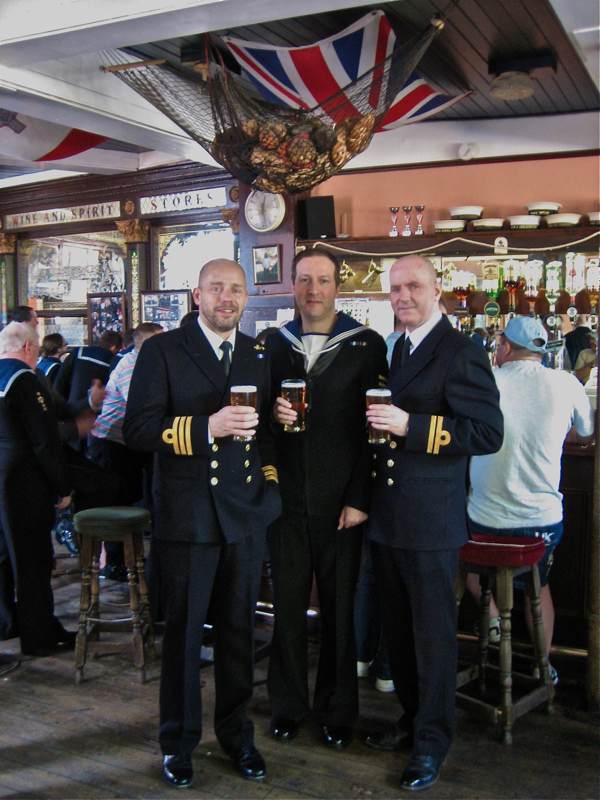
Peter Gracey, Nick Edelshain and Roddy Urquhart raise a pint to the Widow’s Buns.
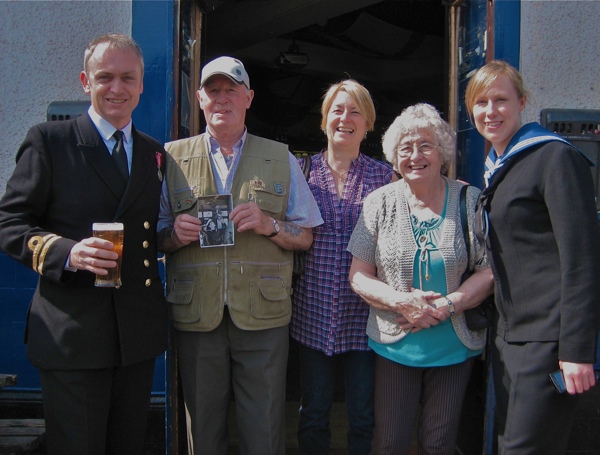
Tony Scott and Debbie Willis of HMS President with Frederick Beckett holding the photograph of his brother placing the bun in the net in 1958.
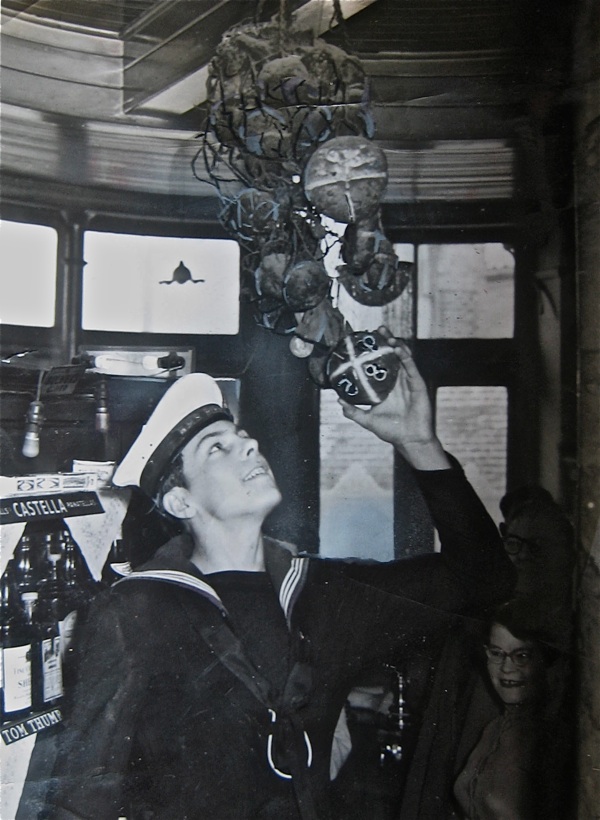
Alan Beckett places the bun on Good Friday, 4th April 1958.
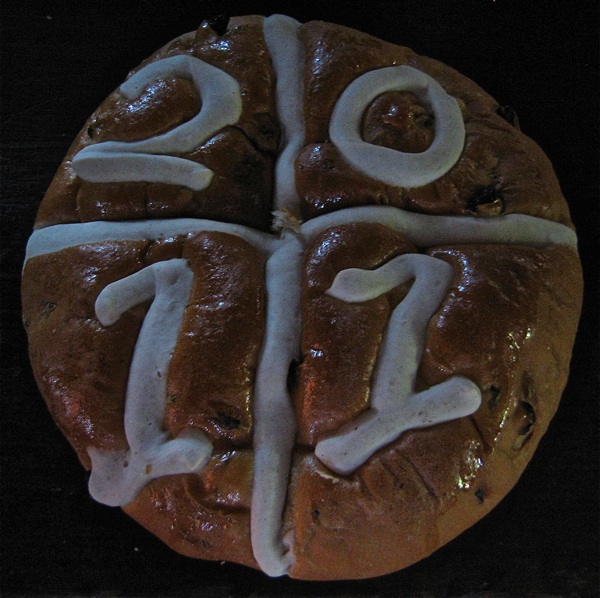
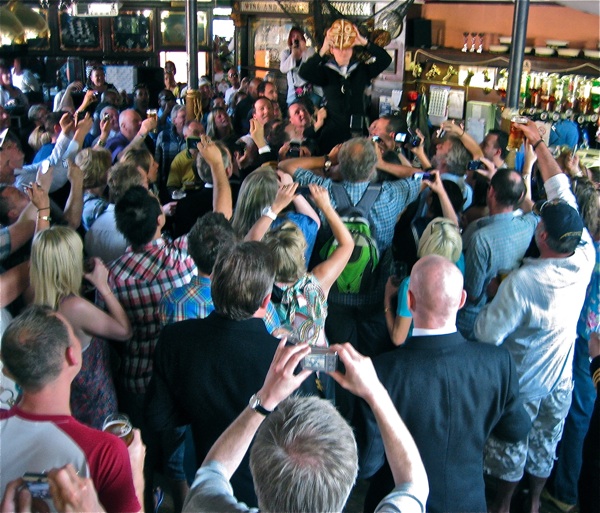
3 pm, Good Friday, 22nd April 2011.

The Widow’s Son was the local for my pal Lenny Hamilton, the jewel thief.
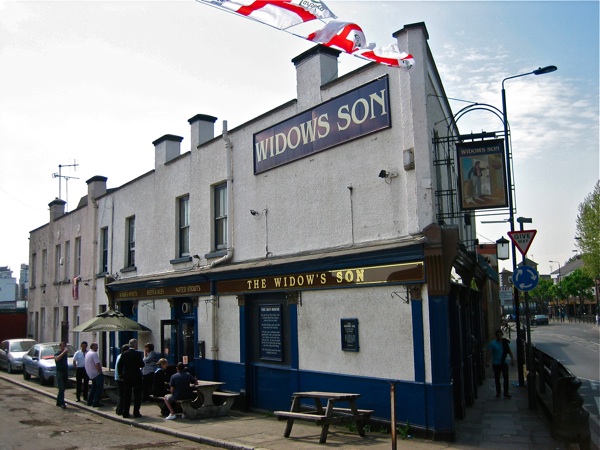
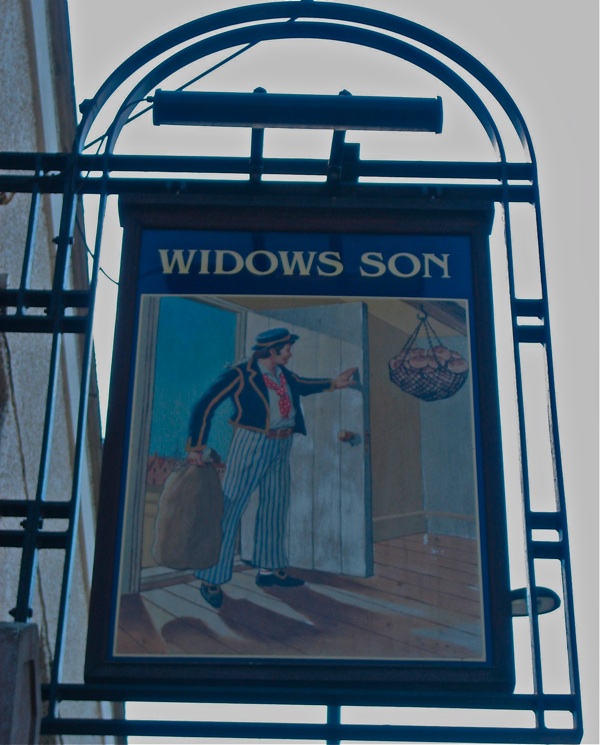
A Widow’s Son of Bromley by Bow
by Harold Adshead
A widow had an only son, The sea was his concern, His parting wish an Easter Bun Be kept for his return. But when it came to Eastertide No sailor came her way To claim the bun she set aside Against the happy day. They say the ship was lost at sea, The son came home no more But still with humble piety The widow kept her store. So year by year a humble bun Was charm against despair, A loving task that once began Became her livelong care. The Widow’s Son is now an inn That stands upon the site And signifies its origin Each year by Easter rite The buns hang up for all to see, A blackened mass above, A truly strange epitome Of patient mother love.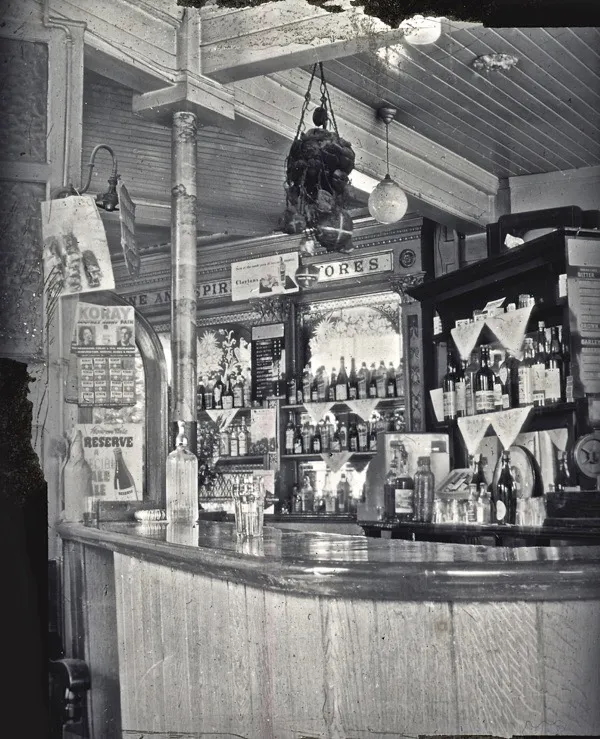 London’s oldest buns photographed by London & Middlesex Archaeological Society in the 1940s
The Tower Of Old London
The Gentle Author’s Tour of the City of London: Meet me at 2pm on EASTER MONDAY on the steps of St Paul’s Cathedral for a tour of sightseeing and storytelling, rambling through the alleys and byways of the Square Mile in search of the wonders and the wickedness of the City. (Also booking for Spring Bank Holiday Monday 4th May)
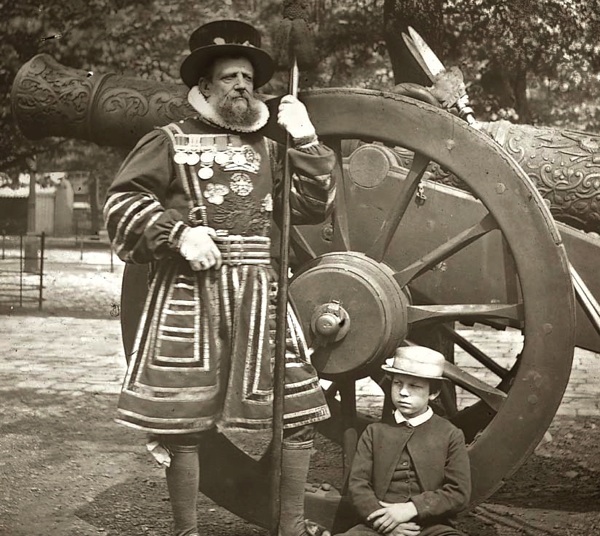
A contemplative moment at the Tower
Rummaging through the thousands of glass slides from the collection of the London & Middlesex Archaeological Society, used for magic lantern slides a century ago at the Bishopsgate Institute, I came upon these enchanting pictures of the Tower of London.
The Tower is the oldest building in London, yet paradoxically it looks even older in these old photographs than it does today. Is it something to do with the straggly beards upon the yeoman warders? Some inhabit worn-out uniforms as if they themselves are ancient relics that have been tottering around the venerable ruins for centuries, swathed in cobwebs. Nowadays, yeoman warders are photographed on average four hundred times a day and they have learnt how to work the camera with professional ease, but their predecessors of a century ago froze like effigies before the lens displaying an uneasy mixture of bemusement and imperiousness. Their shabby dignity is further undermined in some of these plates by the whimsical tinter who coloured their uniforms in clownish tones of buttercup yellow and forget-me-not blue.
As the location of so many significant events in our history, the Tower carries an awe-inspiring charge for me. And these photographs, glorying in the magnificently craggy old walls and bulbous misshapen towers, capture its battered grim monumentalism perfectly. Today, the Tower focuses upon telling the stories of prisoners of conscience that were held captive there rather than displaying the medieval prison guignol, yet an ambivalence persists for me between the colourful pageantry and the inescapable dark history. In spite of the tourist hordes that overrun it today, the old Tower remains unassailable by the modern world.
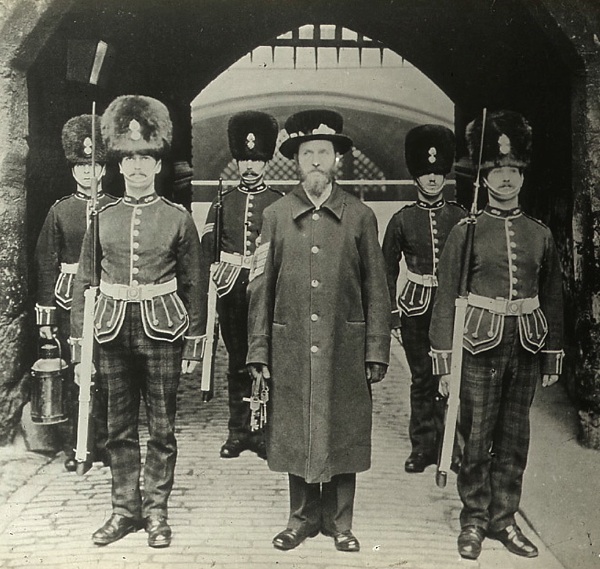
The Ceremony of the Keys, c.1900
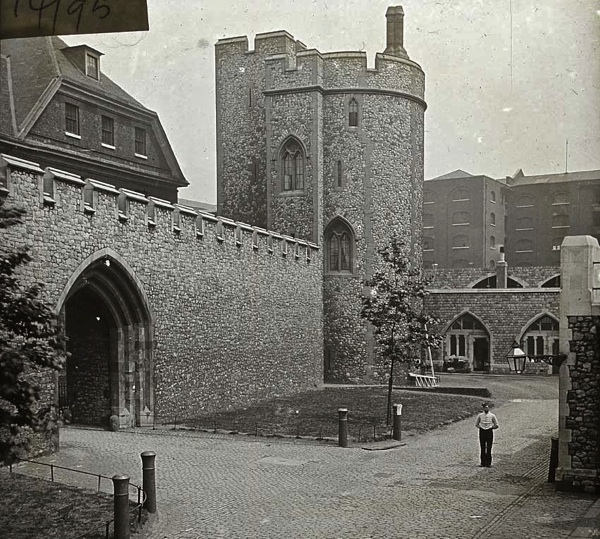
Salt Tower, c. 1910
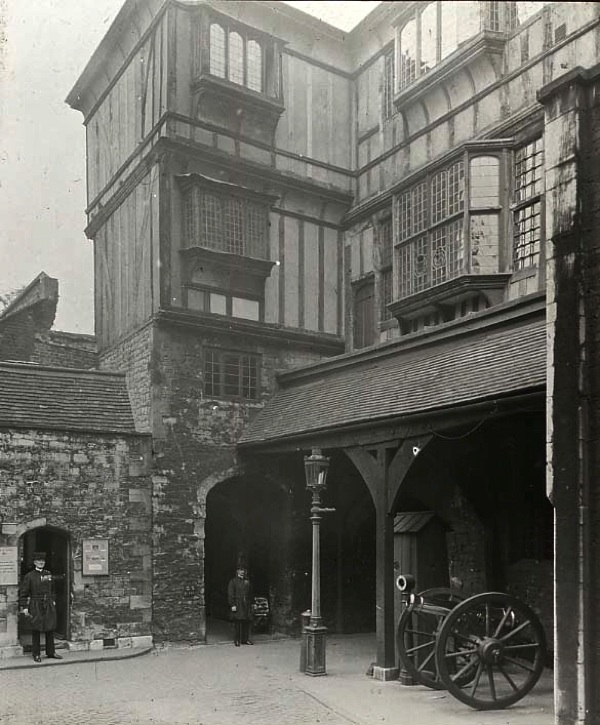
Byward Tower, c.1910
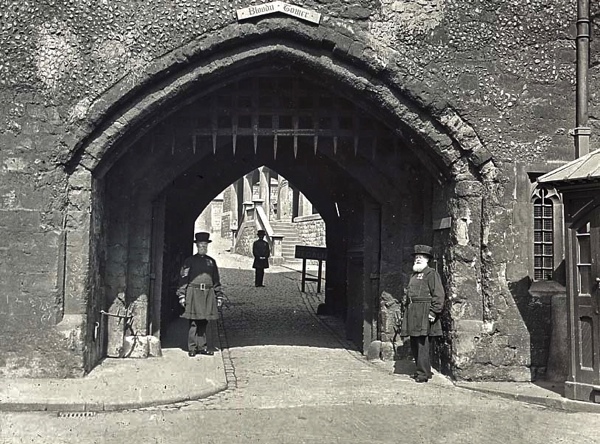
Bloody Tower, c. 1910

The Tower seen from St Katharine’s Dock, c.1910
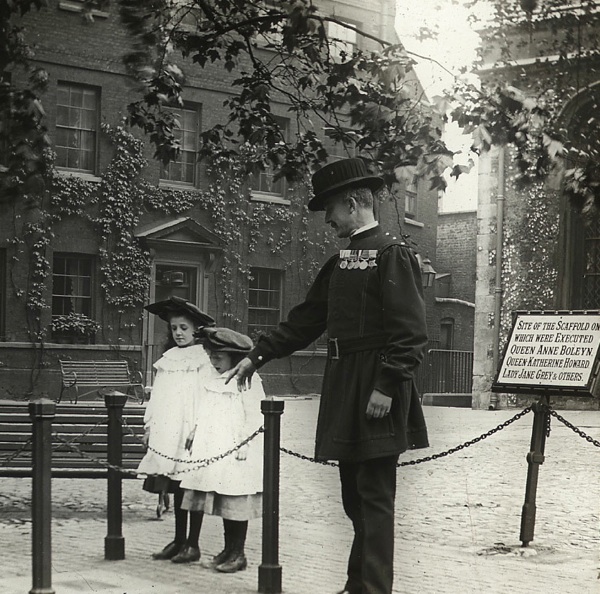
Tower Green, c.1910
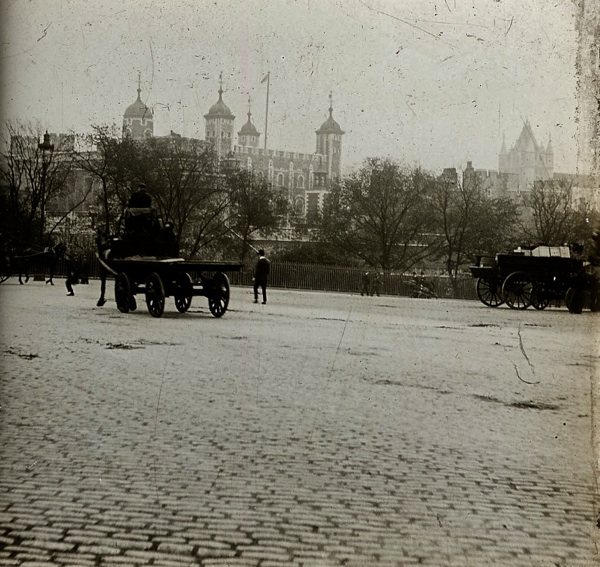
View from Tower Hill, c, 1900
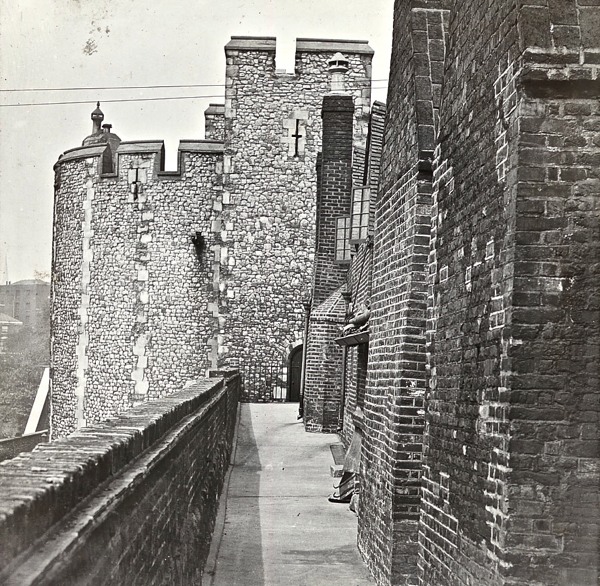
Upon the battlements, c. 1900
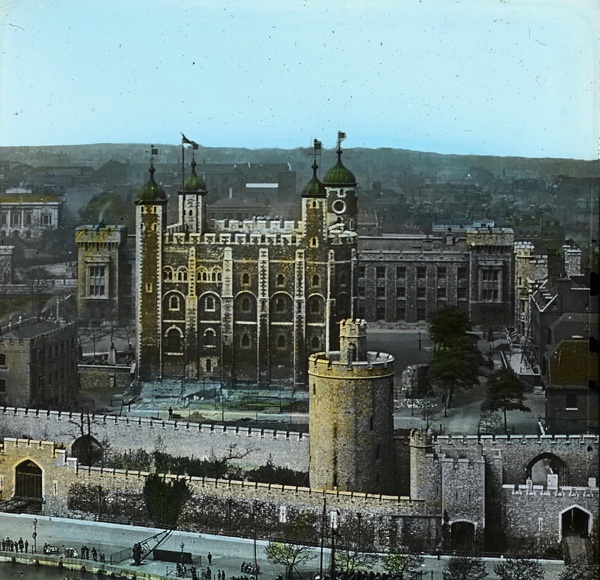
View from the Thames, c. 1910
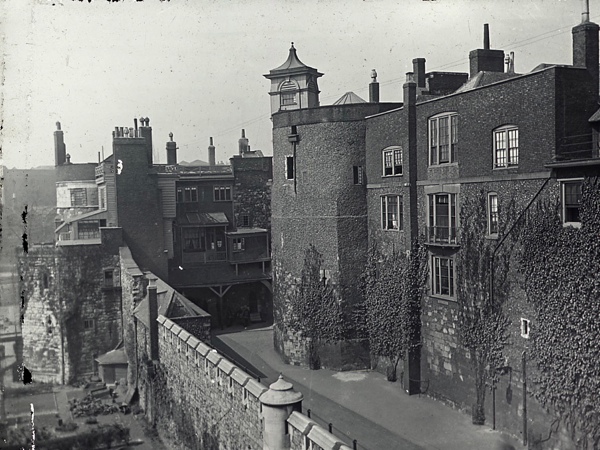
Bell Tower, c.1900
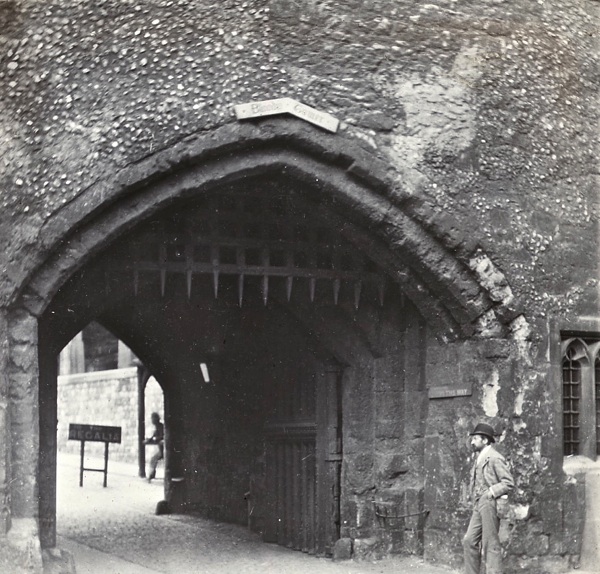
Bloody Tower, c. 1910
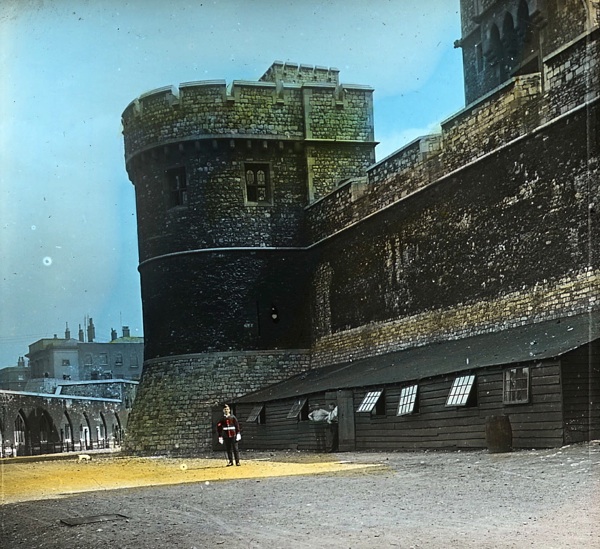
Courtyard at the Tower, c.1910
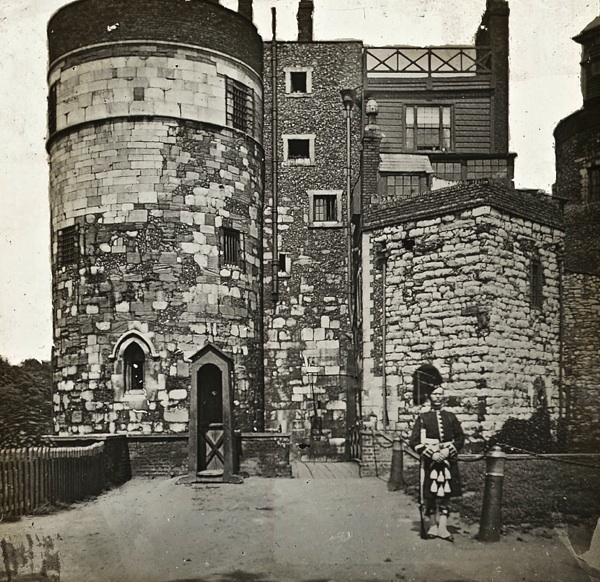
Byward Tower, c 1910

Yeoman warders at the entrance to Bloody Tower, c. 1910

Vegetable plot in the former moat adjoining the Byward Tower, c.1910
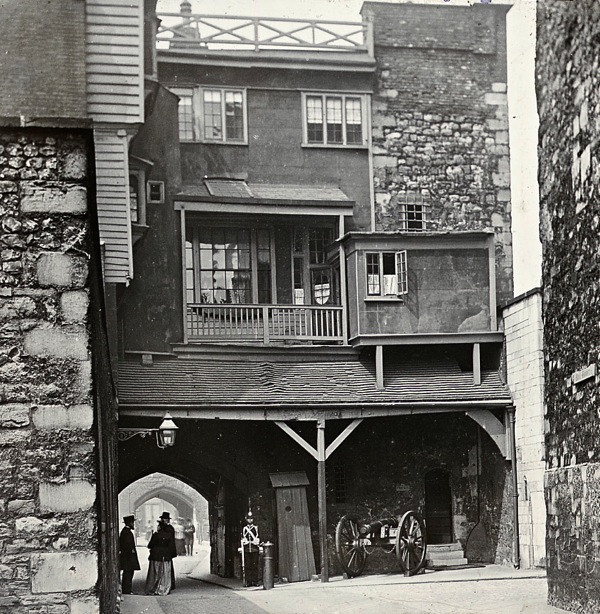
Byward Tower, c. 1900
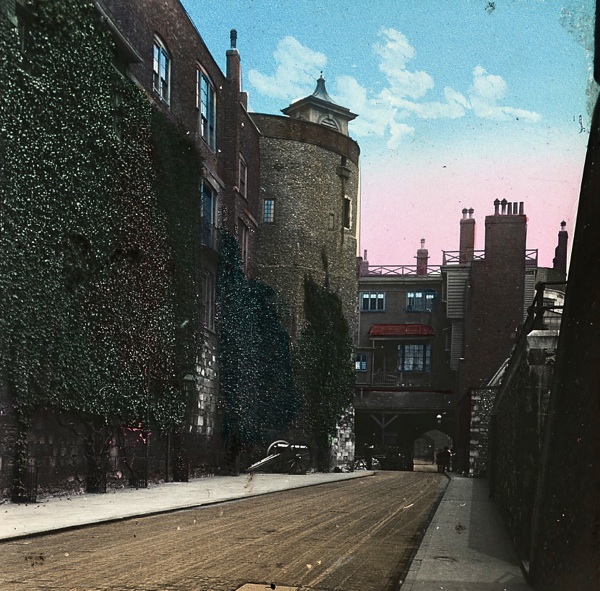
Water Lane, c 1910
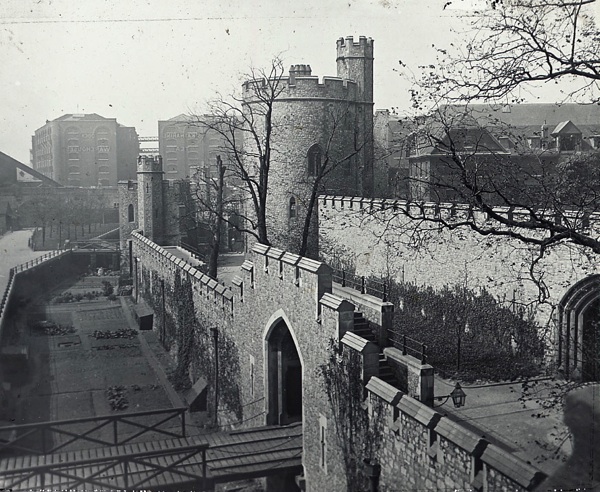
Rampart, c 1900
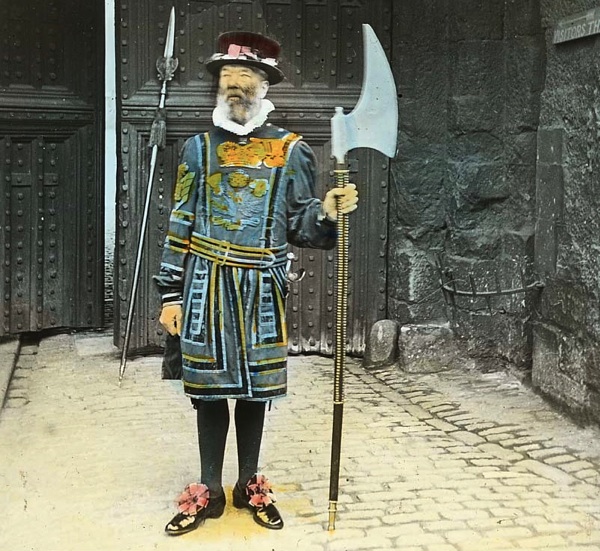
Yeoman Gaoler – “displaying an uneasy mixture of bemusement and imperiousness.”
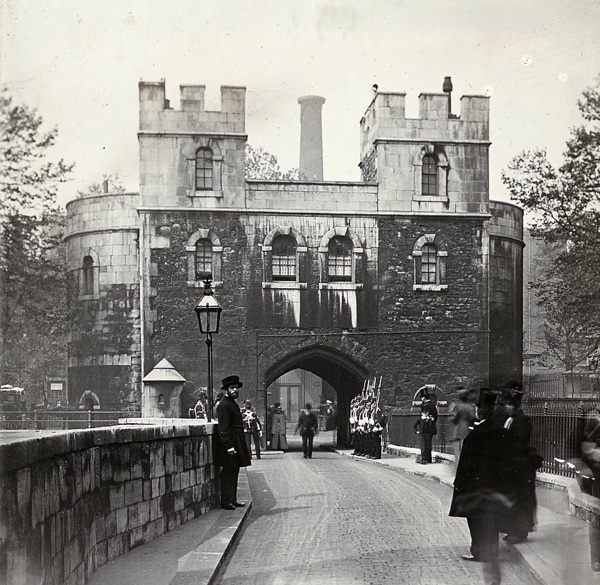
Middle Tower, c. 1900

Steps leading from Traitors’ Gate, c. 1900
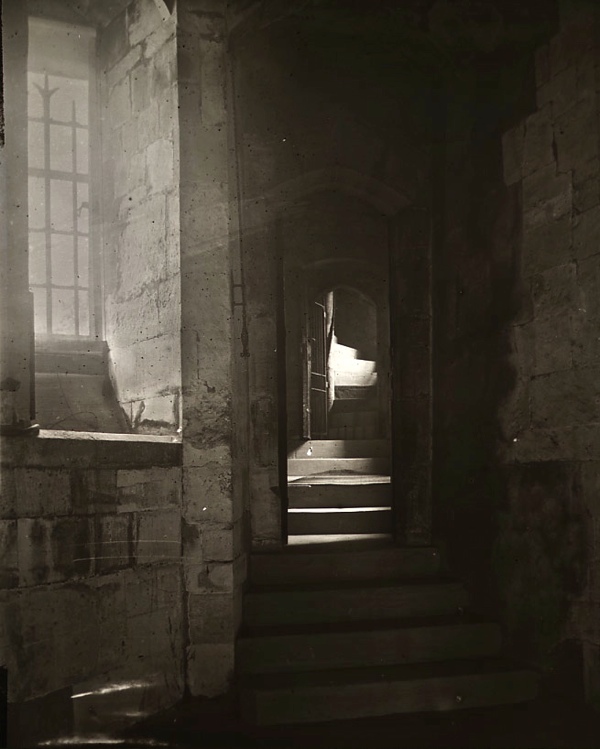
Steps inside the Wakefield Tower, c. 1900
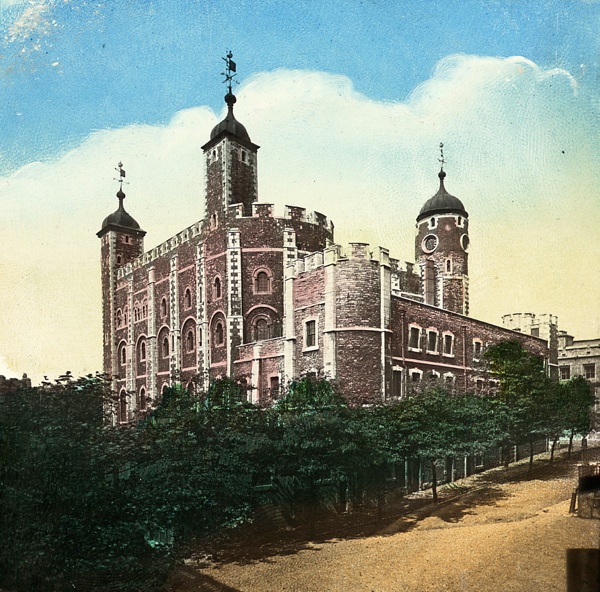
The White Tower, c. 1910
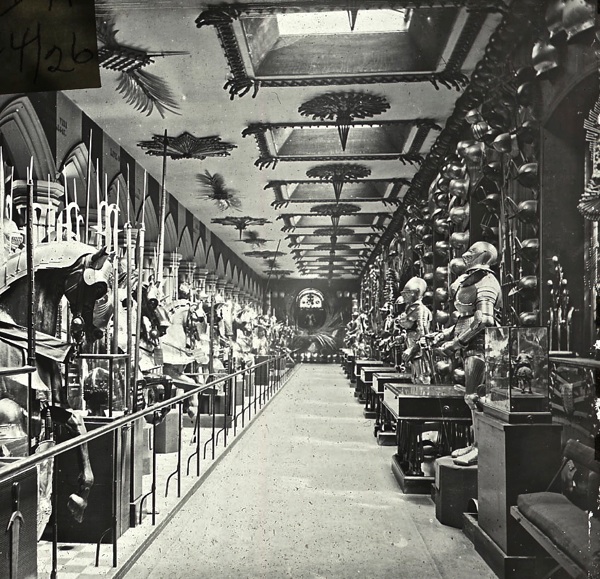
Royal Armoury, c. 1910
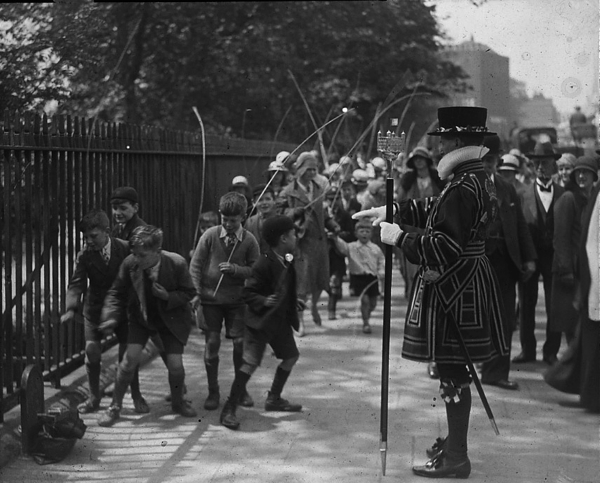
Beating the Bounds, c. 1920

Cannons at the Tower of London, c. 1910
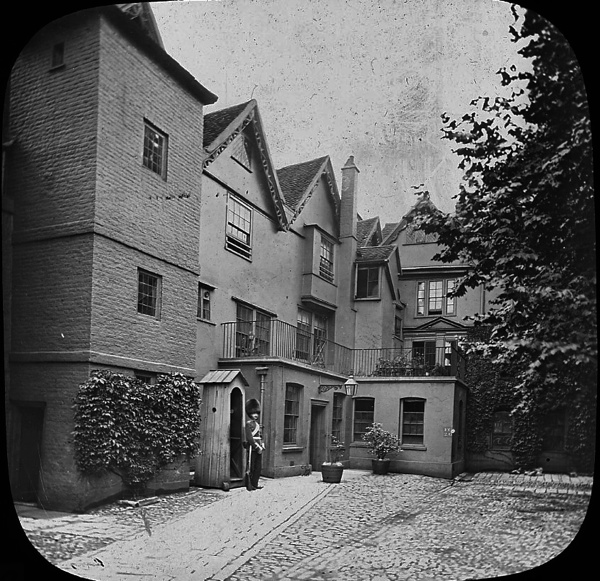
Queen’s House, c. 1900
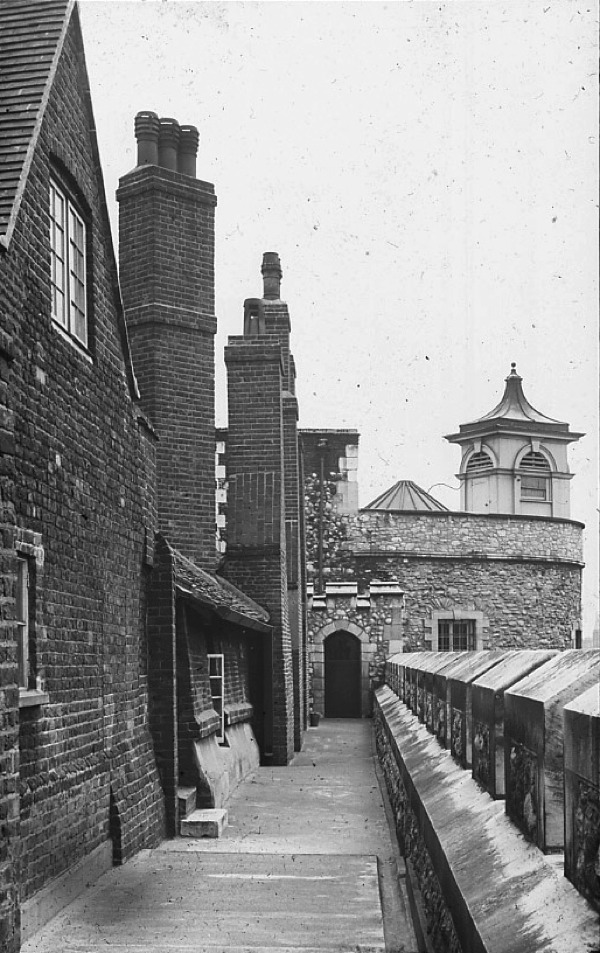
Elizabeth’s Walk, Beauchamp Tower, c. 1900
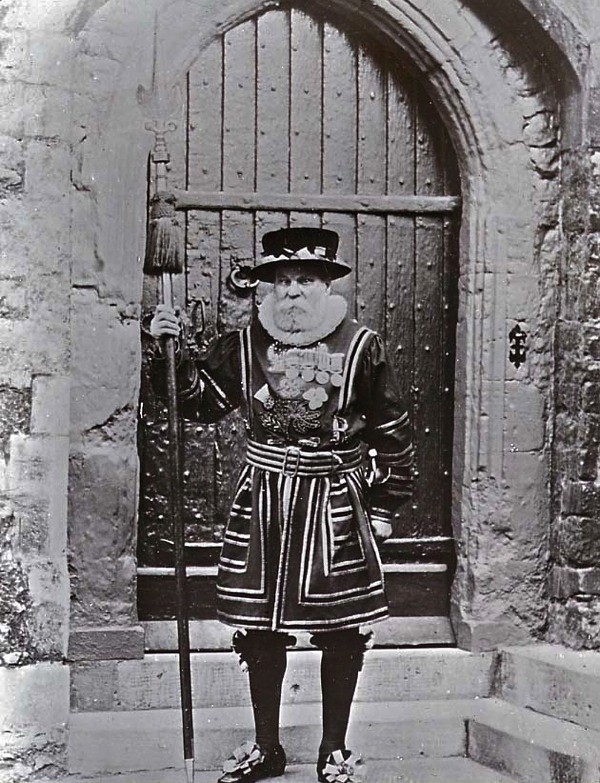
Yeoman Warder, c. 1910
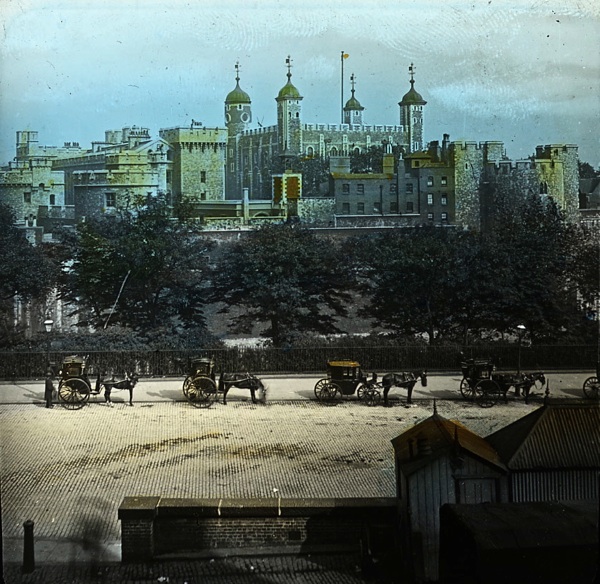
Tower seen from St Katharine’s Dock, c. 1910
Images courtesy Bishopsgate Institute
Residents of Spitalfields and any of the Tower Hamlets may gain admission to the Tower of London for one pound upon production of an Idea Store card.
You may like to take a look at these other Tower of London stories
Chris Skaife, Raven Keeper & Merlin the Raven
Alan Kingshott, Yeoman Gaoler at the Tower of London
Graffiti at the Tower of London
Beating the Bounds at the Tower of London
Ceremony of the Lilies & Roses at the Tower of London
Bloody Romance of the Tower with pictures by George Cruickshank
John Keohane, Chief Yeoman Warder at the Tower of London
Constables Dues at the Tower of London
The Oldest Ceremony in the World
A Day in the Life of the Chief Yeoman Warder at the Tower of London
A Walk Along The Black Path
The Gentle Author’s Tour of the City of London: Meet me at 2pm on EASTER MONDAY on the steps of St Paul’s Cathedral for a tour of sightseeing and storytelling, rambling through the alleys and byways of the Square Mile in search of the wonders and the wickedness of the City. (Also booking for Spring Bank Holiday Monday 4th May)
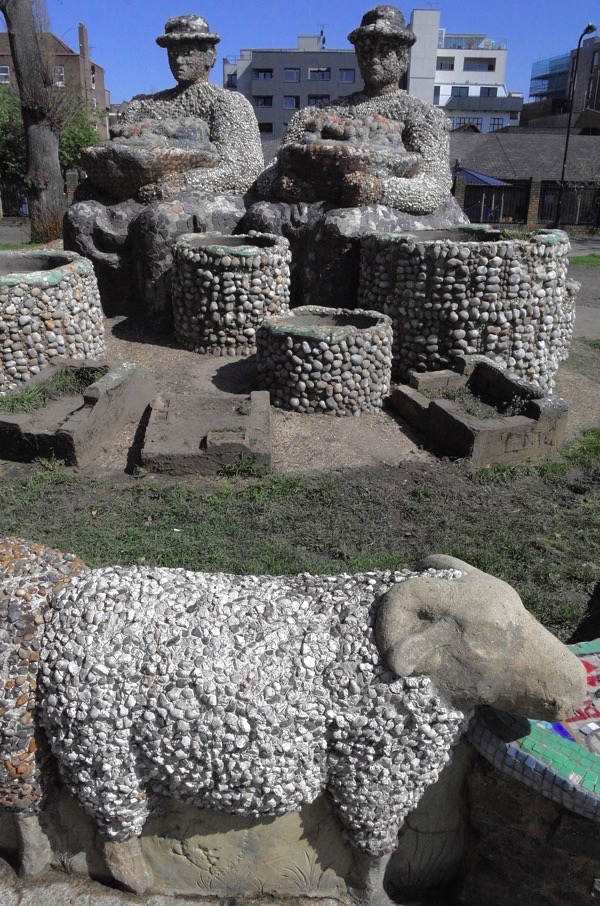
Sculpture of porters resting at London Fields
Taking to heart the observation by the celebrated poet & resident of Aldgate, Geoffrey Chaucer, that April is the time to go on pilgrimages, each year I set out for day’s walk along the ancient Black Path from Walthamstow to Shoreditch. The route of this primeval footpath is still clearly visible upon the map of the East End today, as if someone had taken a crayon and scrawled a curved diagonal line across the grid of the modern street plan. There is no formal map of the Black Path yet any keen walker with a sense of direction may follow it as I did.
Tracing a trajectory running northeast and southwest between Shoreditch Church and the crossing of the River Lea at Clapton, the Black Path links with Old St in one direction and extends beyond Walthamstow in the other. Sometimes called the Porter’s Way, this was the route cattle were driven to Smithfield and the path used by smallholders taking produce to Spitalfields Market. Sometimes also called the Templars’ Way, it links the thirteenth century St Augustine’s Tower on land once owned by Knights Templar in Hackney with the Priory of St John in Clerkenwell where they had their headquarters. No-one knows how old the Black Path is or why it has this name, but it once traversed open country before the roads existed. These days the path is black because it has a covering of asphalt.
On the warmest day of spring I took the train from Liverpool St Station up to Walthamstow to commence my walk, seeking respite in the sunshine after the harsh winter that outstayed its allotted season. In observance of custom, I commenced my pilgrimage at an inn, setting out from The Bell and following the winding road through Walthamstow to the market. A tavern by this name has stood at Bell Corner for centuries and the street that leads southwest from it, once known as Green Leaf Lane, reveals its ancient origin in its curves that trace the contours of the land.
Struggling to resist the delights of pie & mash and magnificent 99p shops, I felt like Bunyan’s pilgrim avoiding the temptations of Vanity Fair as I wandered through Walthamstow Market which extends for a mile down the High St to St James, gradually sloping away down towards the marshes. Here I turned left onto St James St itself before following Station Rd and then weaving southwest through late nineteenth century terraces, sprawling over the incline, to emerge at the level of the Walthamstow Marshes.
Then I walked along Markhouse Avenue which leads into Argall Industrial Estate, traversed by a narrow footpath enclosed with high steel fences on each side. Here you may find Allied Bakeries, Bates Laundry and evangelical churches including Deliverance Outreach Mission, Praise Harvest Community Church, Celestial Church of Christ, Mountain of Fire & Miracle Ministries and Christ United Ministries, revealing that religion may be counted as an industry in this location.
Crossing an old railway bridge and a broad tributary of the River Lea brought me onto the Leyton Marshes where I was surrounded by leaves unfurling, buds popping and blossom exploding – natural wonders that characterise the rush of spring at this sublime moment of the year. Horses graze on the marshes and the dense blackthorn hedge which lines the footpath provided a sufficiently bucolic background to evoke a sense that I was walking an ancient footpath through a rural landscape. Yet already the municipal parks department were out, unable to resist taking advantage of the sunlight to give the verges a fierce trim with their mechanical mower even before the the plants have properly sprouted.
It was a surprise to find myself amidst the busy traffic again as I crossed the Lea Bridge and found myself back in the East End, of which the River Lea is its eastern boundary. The position of this crossing – once a ford, then a ferry and finally a bridge – defines the route of the Black Path, tracing a line due southwest from here.
I followed the diagonal path bisecting the well-kept lawn of Millfields and walked up Powerscroft Rd to arrive in the heart of Hackney at St Augustine’s Tower, built in 1292 and a major landmark upon my route. Yet I did not want to absorb the chaos of this crossroads where so many routes meet at the top of Mare St, instead I walked quickly past the Town Hall and picked up the quiet footpath next to the museum known as Hackney Grove. This byway has always fascinated me, leading under the railway line to emerge onto London Fields.
The drovers once could graze their cattle, sheep and geese overnight on this common land before setting off at dawn for Smithfield Market, a practice recalled today in the names of Sheep Lane and the Cat & Mutton pub. The curve of Broadway Market leading through Goldsmith’s Row down to Columbia Rd reveals its origin as a cattle track. From the west end of Columbia Rd, it was a short walk along Virginia Rd on the northern side of the Boundary Estate to arrive at my destination, Shoreditch Church.
If I chose to follow ancient pathways further, I could have walked west along Old St towards Bath, north up the Kingsland Rd to York, east along the Roman Rd towards Colchester or south down Bishopsgate to the City of London. But flushed and footweary after my six mile hike in the heat of the sun, I was grateful to return home to Spitalfields and put my feet up in the shade of the house. For millennia, when it was the sole route, countless numbers travelled along the old Black Path from Walthamstow to Shoreditch, but last week there was just me on my solitary pilgrimage.
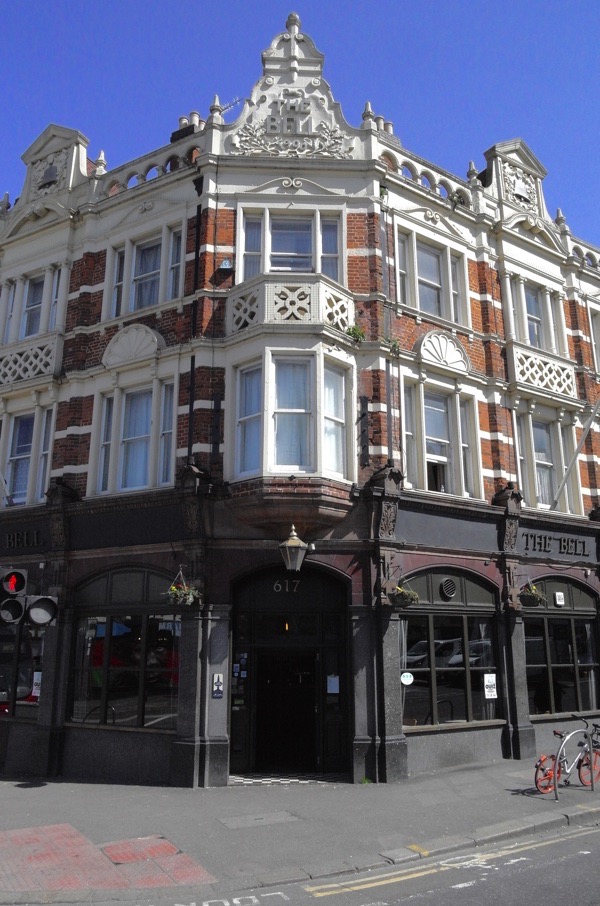
At Bell Corner, Walthamstow
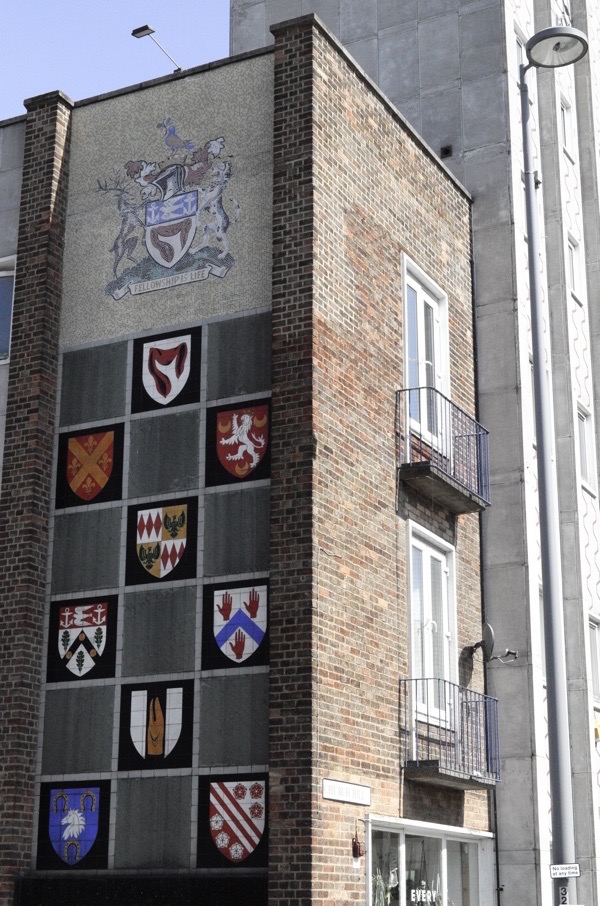
‘Fellowship is Life’
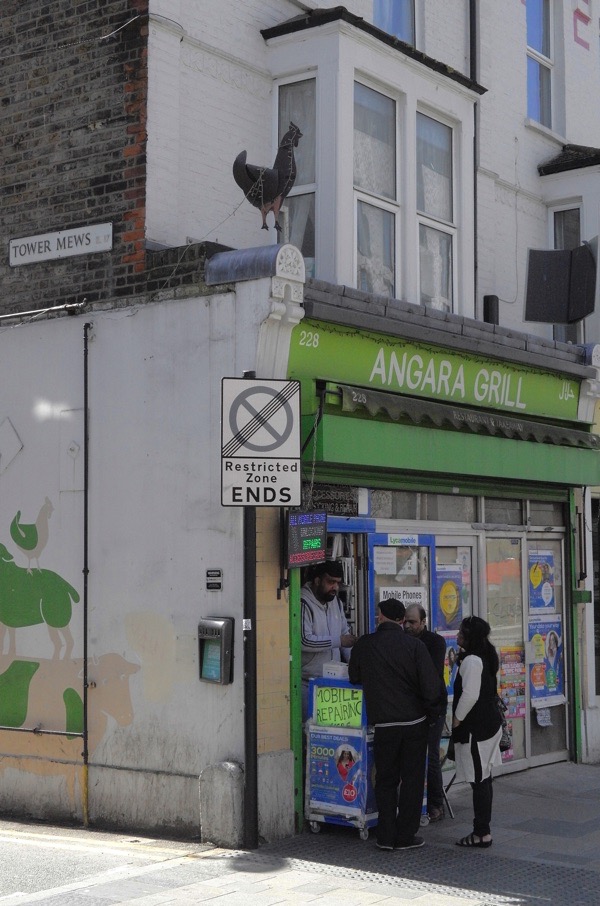
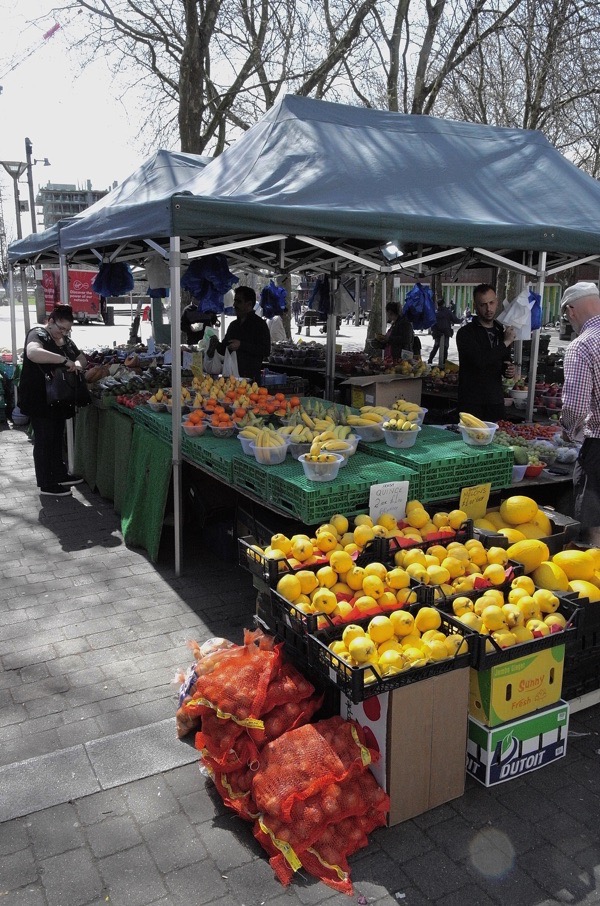
Two quinces for £1.50 in Walthamstow Market
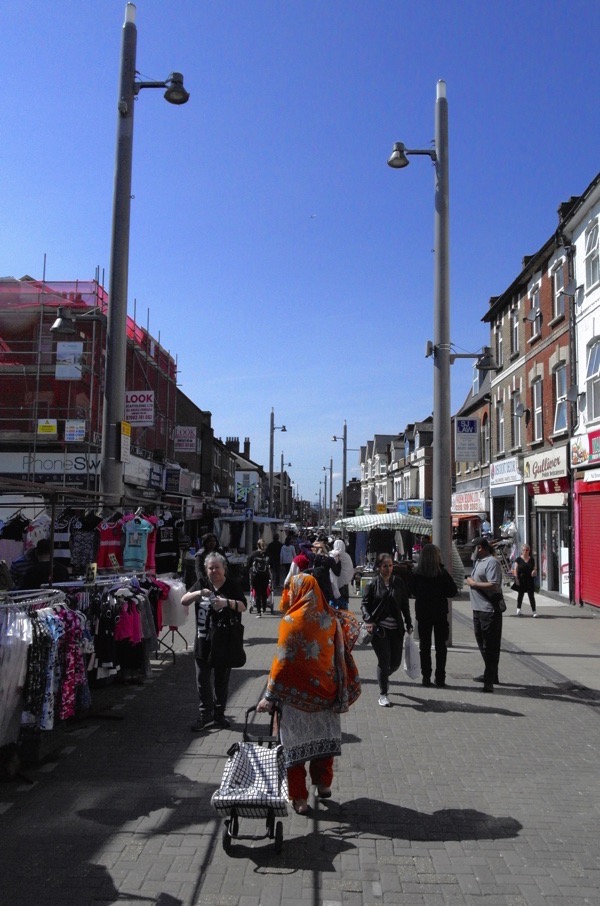
Walthamstow Market is a mile long
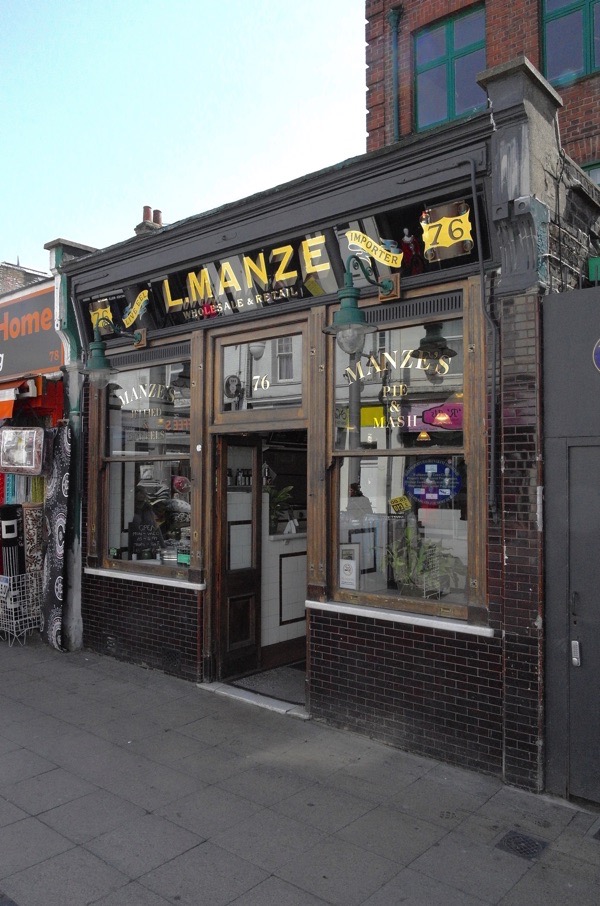
‘struggling to resist the delights of pie & mash’
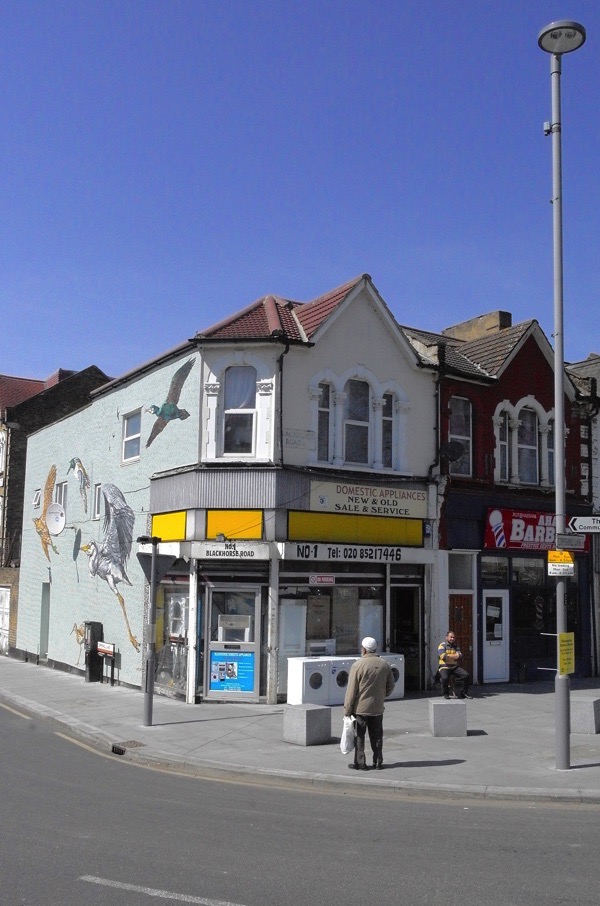
At St James St
Station Rd
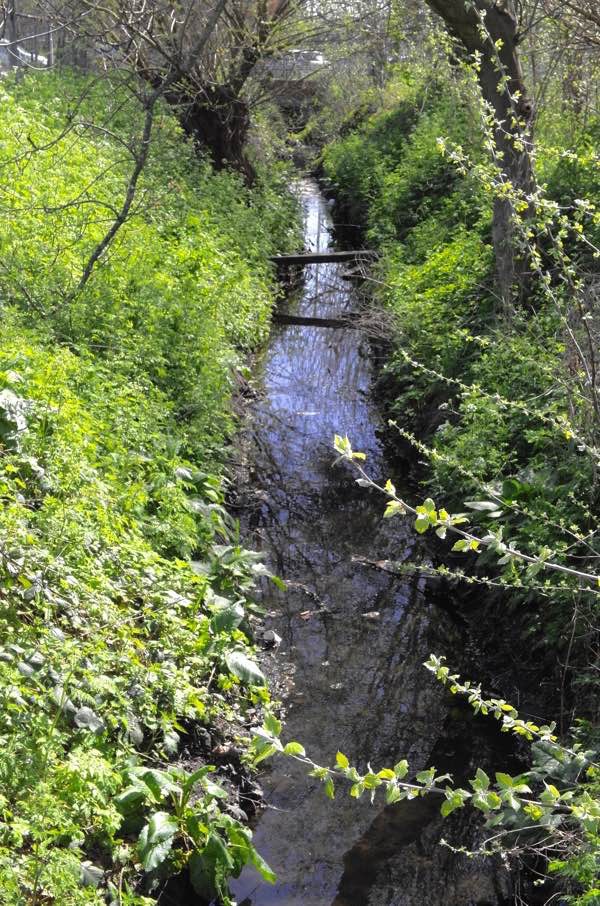
‘leaves unfurling, buds popping and blossom exploding which characterise the rush of spring’
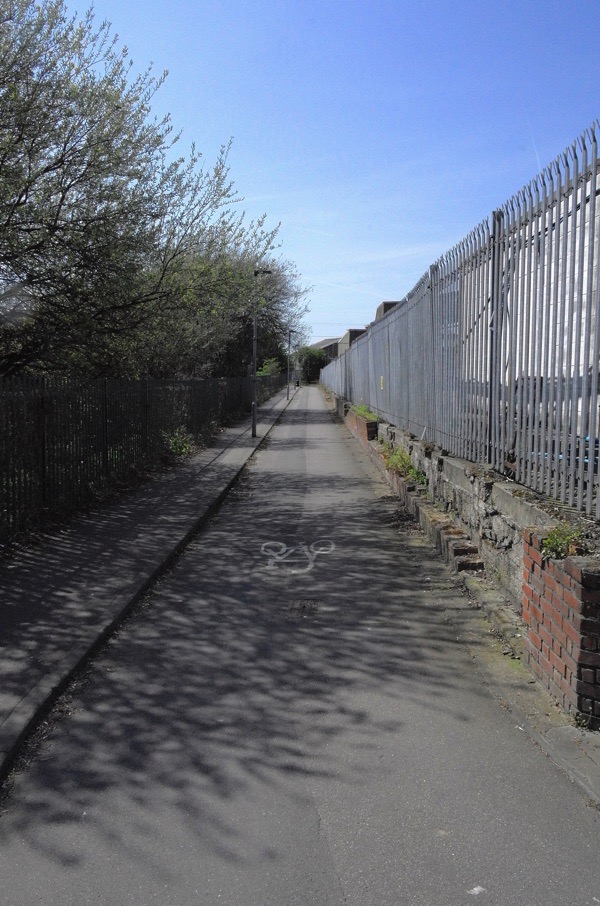
Enclosed path through Argall Industrial Estate skirting Allied Bakeries
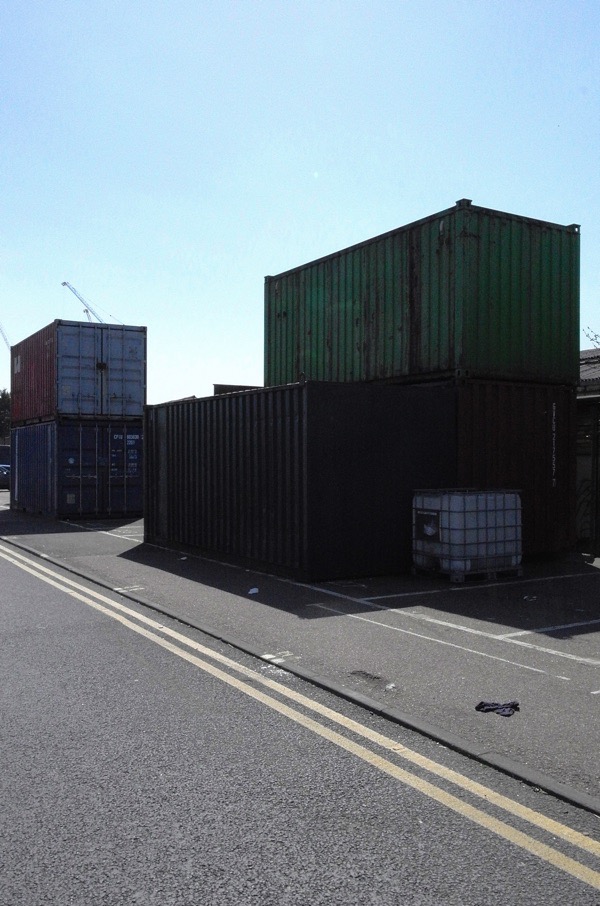
Argall Avenue

‘These days the path is black because it has a covering of asphalt’
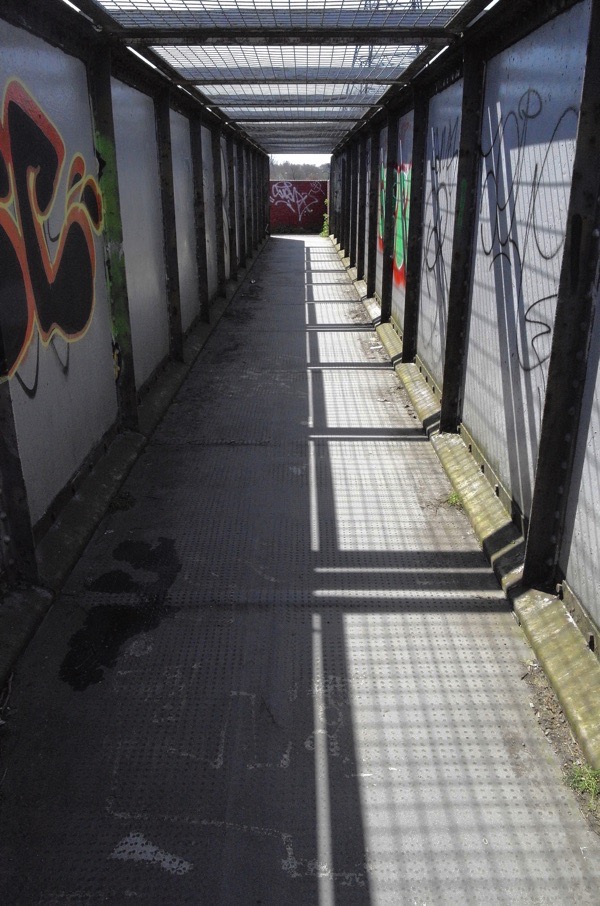
Railway bridge leading to the Leyton marshes
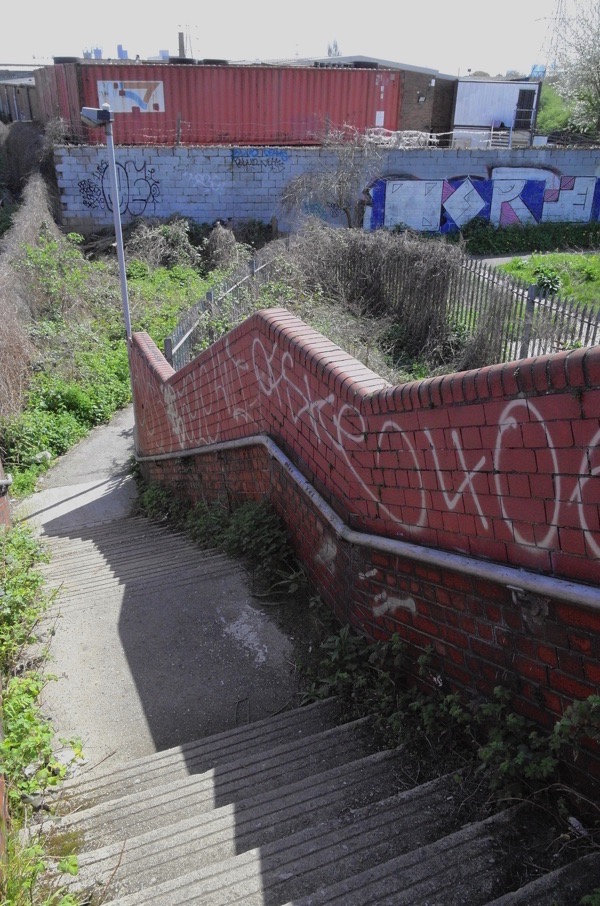
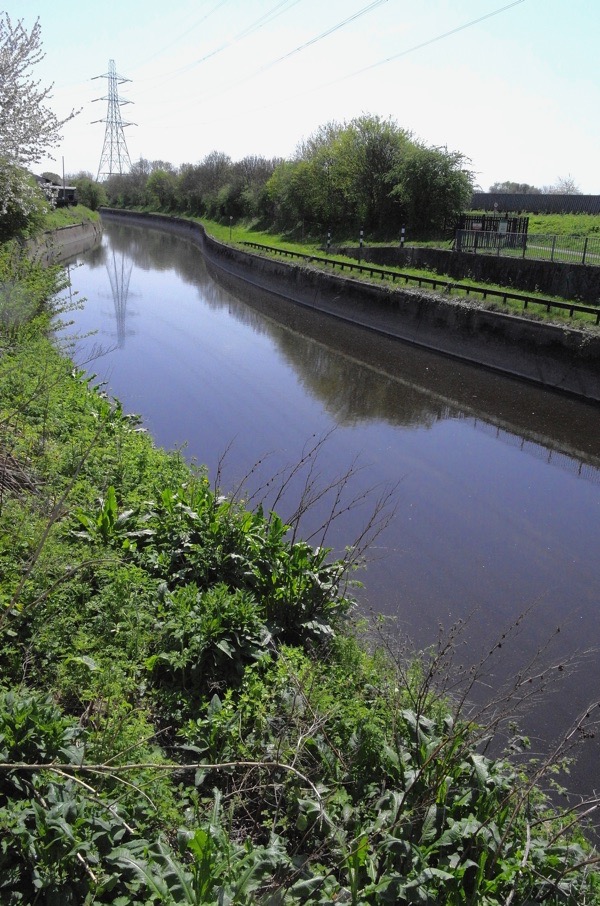
A tributary of the River Lea

Horses graze on the Leyton marshes
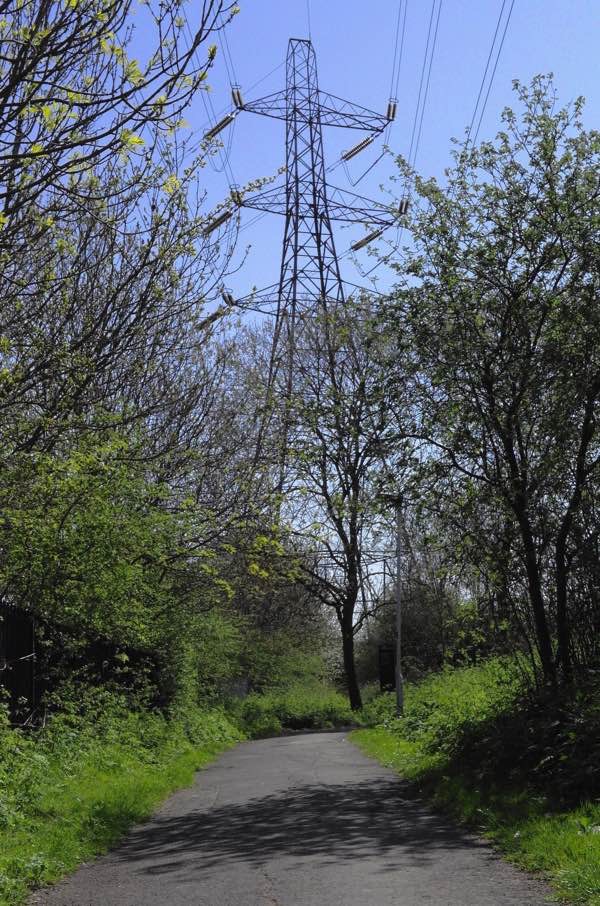
“dense blackthorn which line the footpath provided a sufficiently bucolic background to evoke a sense that I was walking an ancient footpath”
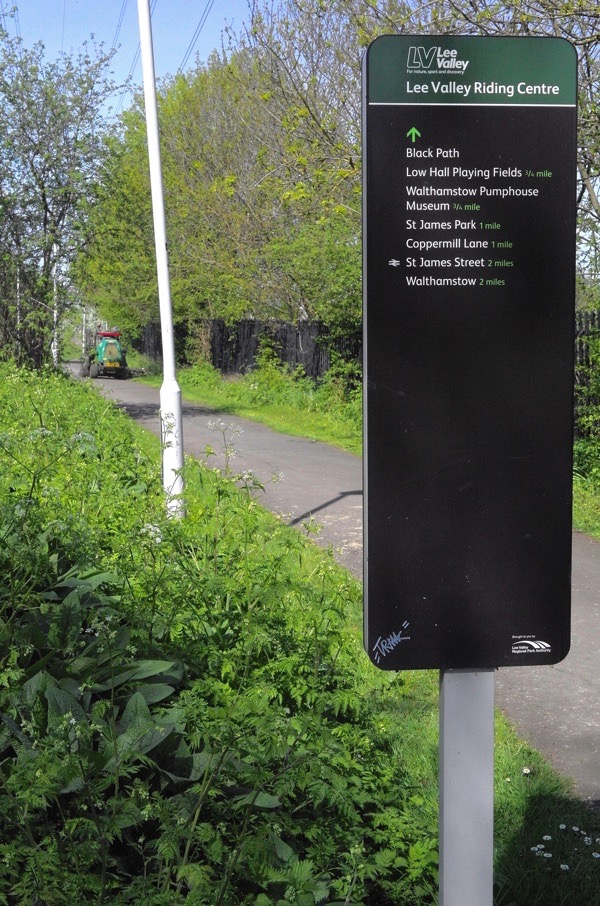
‘the municipal parks department were out, unable to resist taking advantage of the sunlight to give the verges a fierce trim with their mechanical mower even before the the plants have properly sprouted’
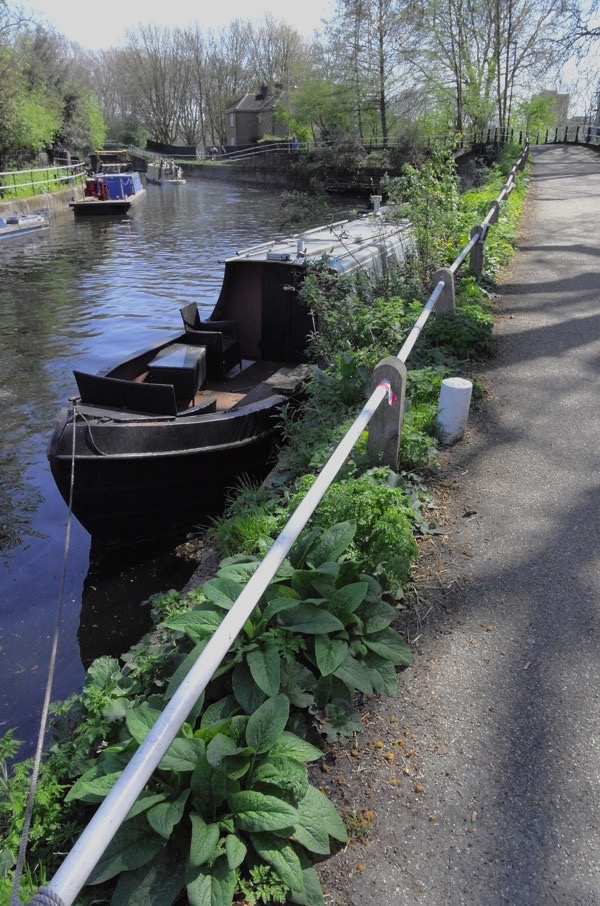
The River Lea is the eastern boundary of the East End
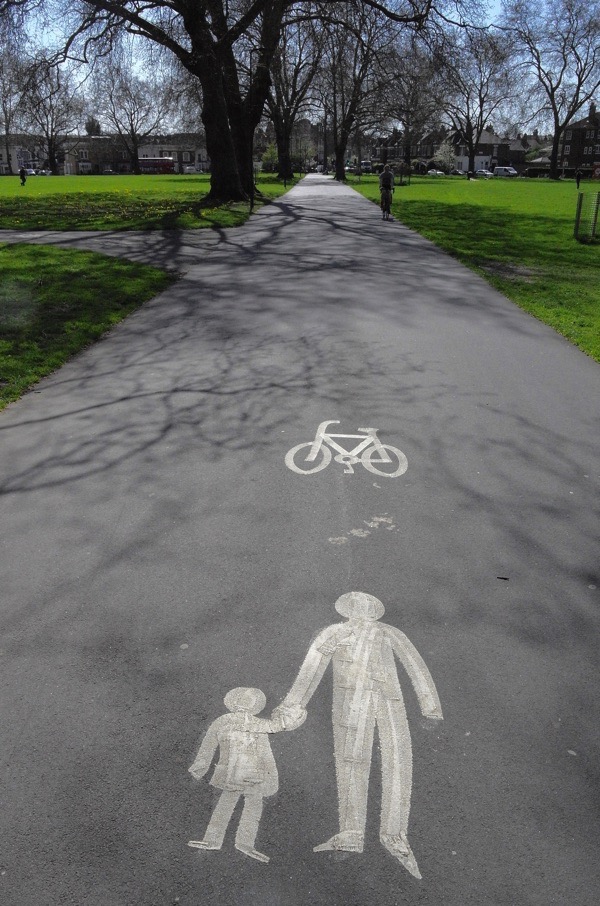
Across Millfields Park towards Powerscroft Rd
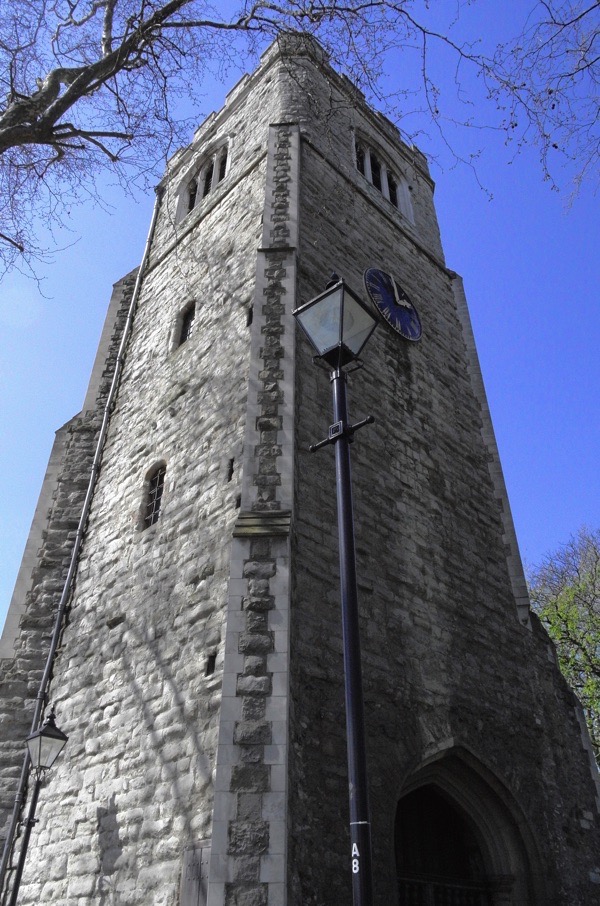
Thirteenth century St Augustine’s Tower in Hackney
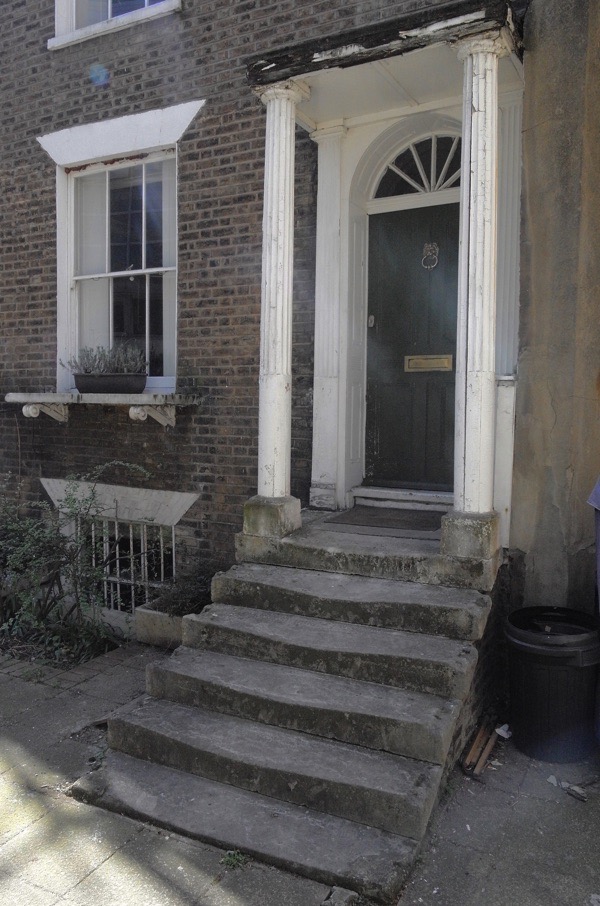
Worn steps in Hackney Grove
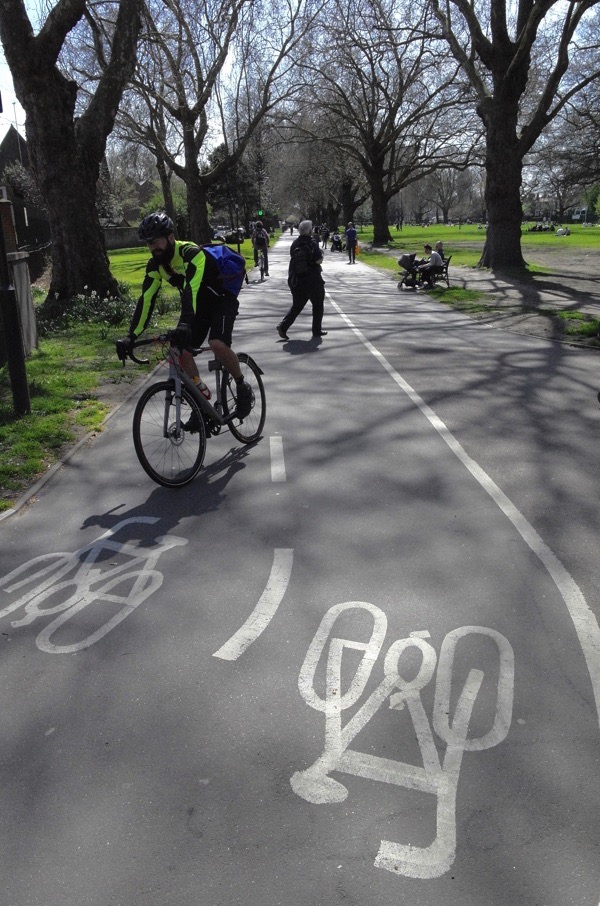
In London Fields
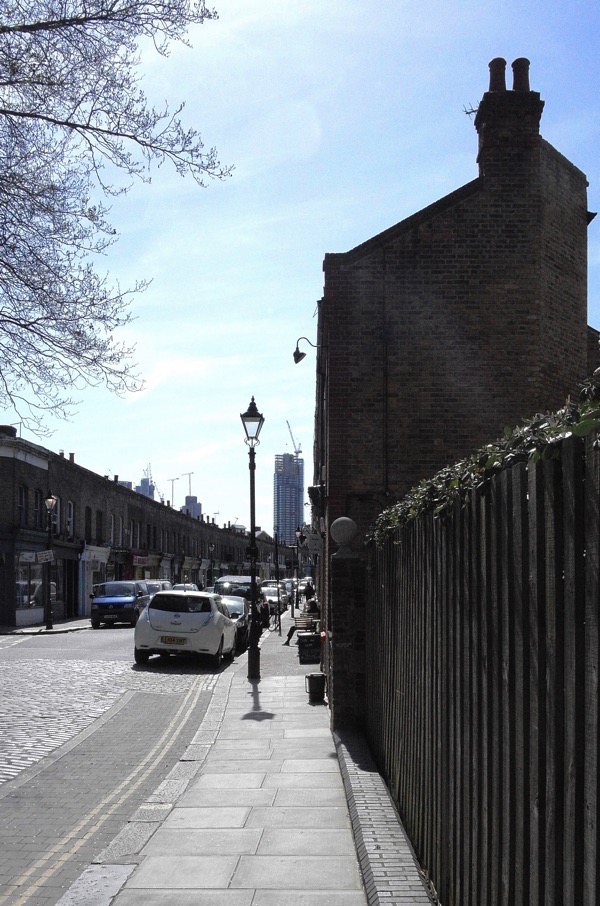
Columbia Rd
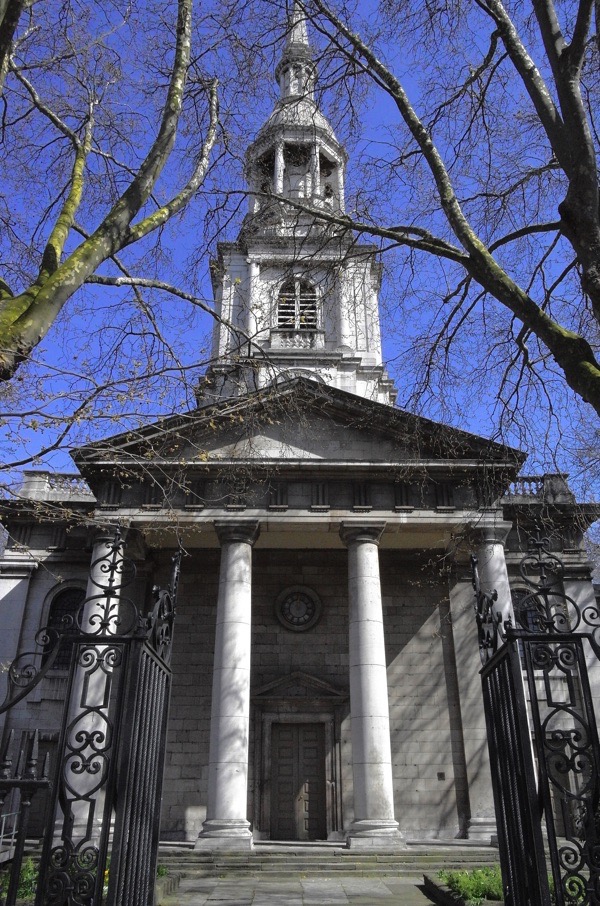
St Leonard’s Church, Shoreditch
You may also like to read about
David Hoffman’s Easter In Stepney
The Gentle Author’s Tour of the City of London: Meet me at 2pm on EASTER MONDAY on the steps of St Paul’s Cathedral for a tour of sightseeing and storytelling, rambling through the alleys and byways of the Square Mile in search of the wonders and the wickedness of the City. (Also booking for Spring Bank Holiday Monday 4th May)
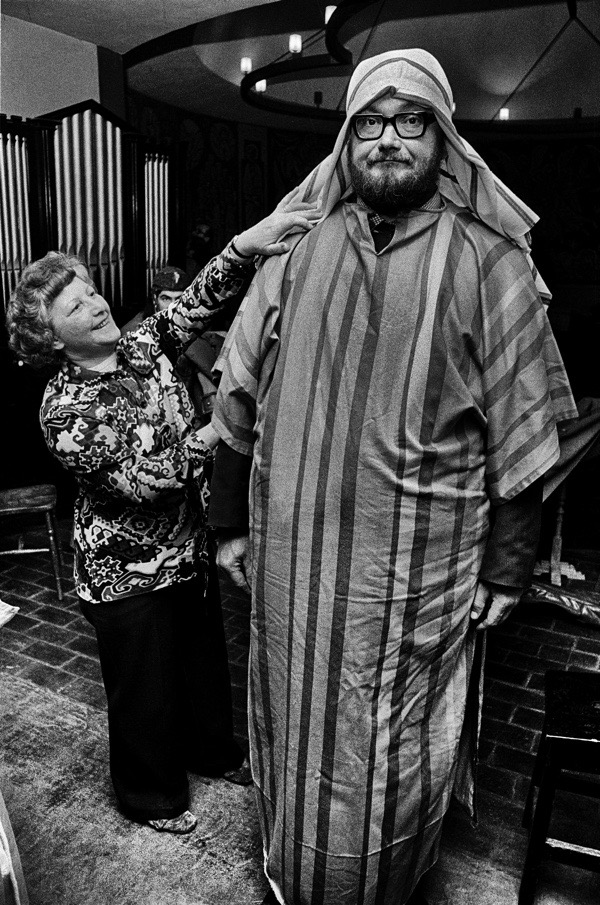
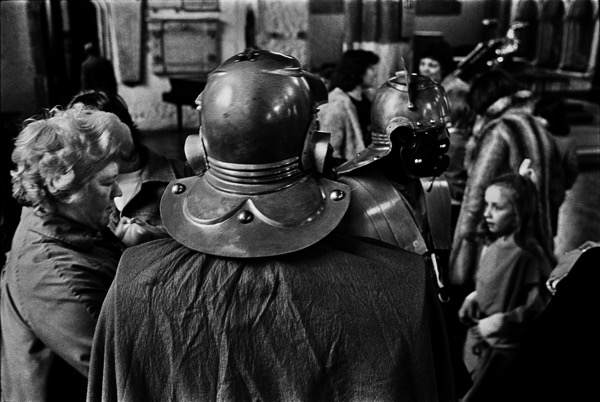
A costume fitting
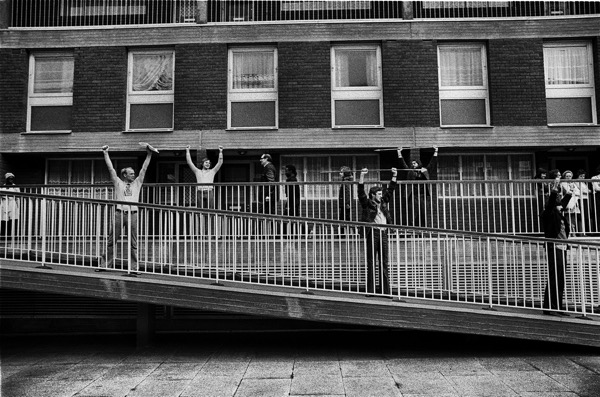
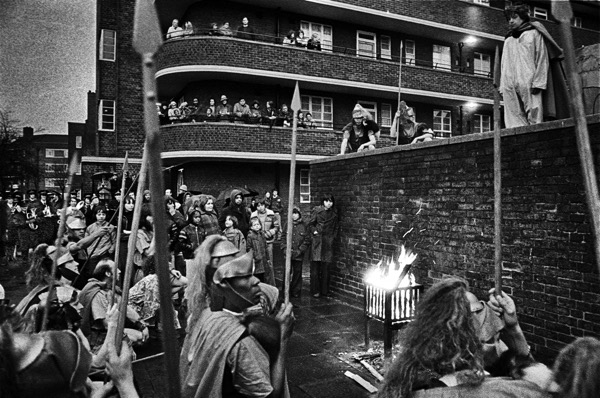
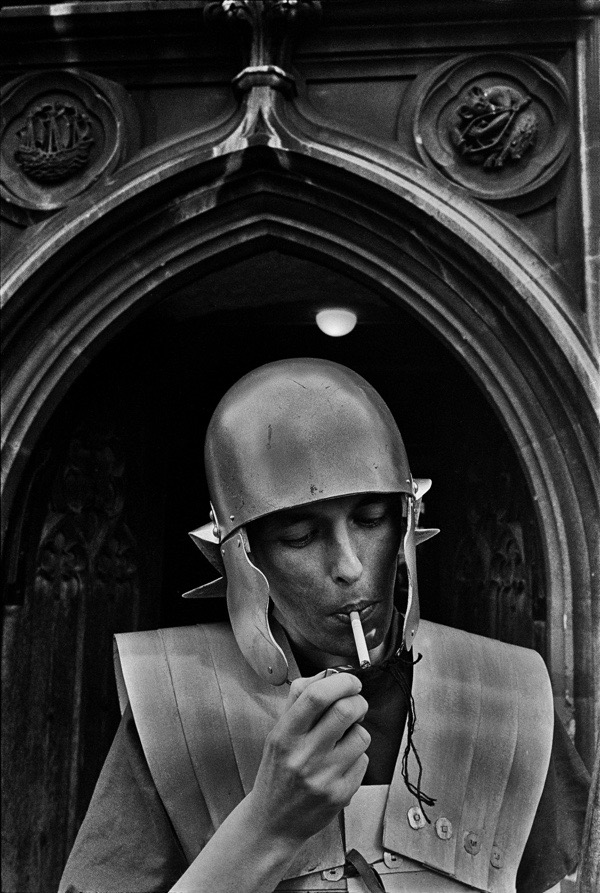
In the late seventies, Contributing Photographer David Hoffman documented the religious drama enacted upon the streets of Stepney around Easter time, recording astonishing images of magical realist intensity which feel closer to the medieval world than to our own day.
Gordon Kendall who played Jesus wrote this memory of his experience.
‘On a cold wet and depressing evening in April 1980, well over 100 actors, production crew and 2000 people lived through the experience of Our Lord’s Way Of The Cross enacted in the streets and estates of Stepney.
The excitement and challenge of playing Jesus really began on the Sunday before the event. Some of the actors were trying out their costumes and they looked very impressive.
Half way through the rehearsal, I needed to visit the toilet and so excused myself from the bodyguard of soldiers in costume. I knocked at the door of a flat. A lady came out and I requested the use of her toilet. She looked at me very oddly – she was a elderly lady – and she asked me who I was. I replied I was playing the part of Jesus and she flashed me a look which revealed she did not believe me, but she said ‘Come in.’
As I went through the flat I could see someone sleeping on the sofa in the lounge. When I closed the bathroom door, I could hear the woman waking up her friend and saying, ‘Nell, there’s a man in the toilet who says he’s Jesus.’ Then I heard some rapid movement and I could only wonder at the thoughts of this woman, struggling to her feet.
There was a knocking at the front door as I came out of the toilet and the two women opened it to be confronted by a fierce Roman Centurion in full regalia, asking if Jesus was in the flat. Fortunately, they relaxed into joyous smiles and it was kisses and handshakes all round as we departed.’
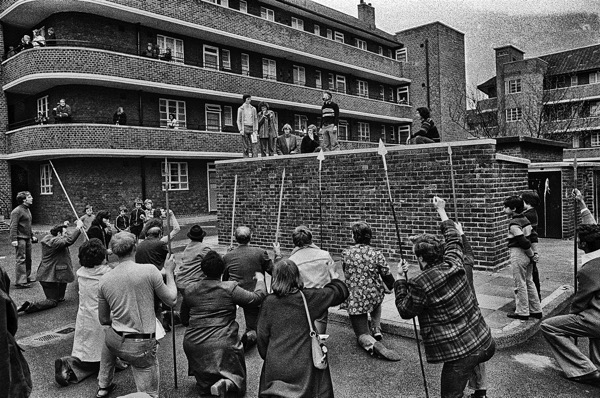
Roman soldiers
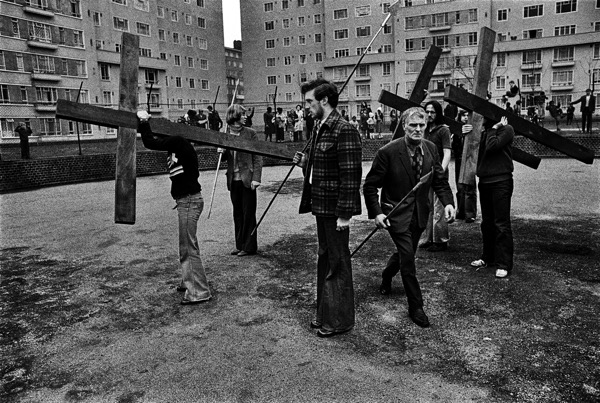
Jesus in flares
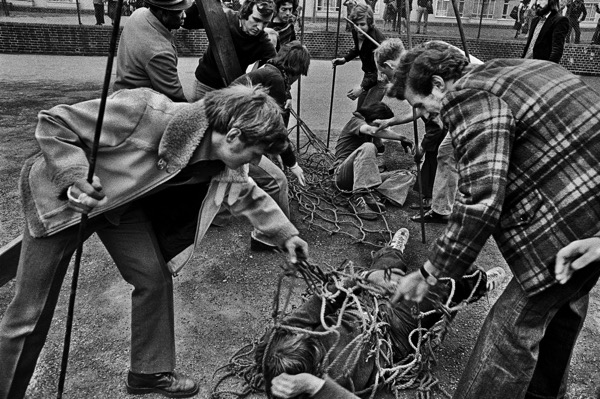
The arrest of the two thieves
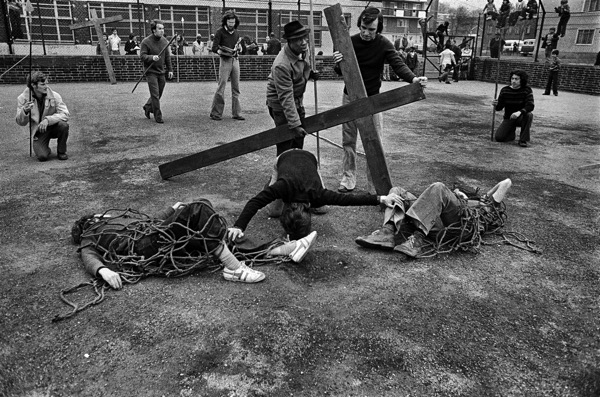
Preparing for the crucifixion
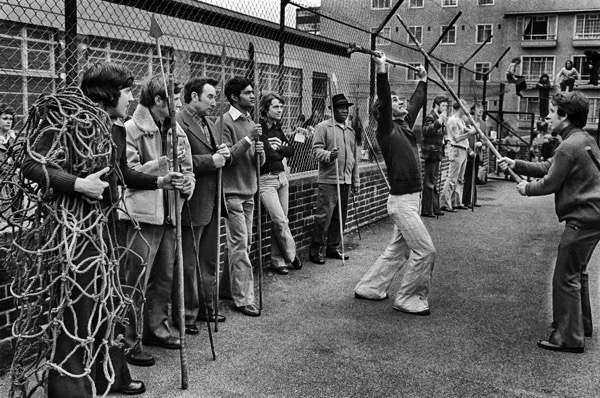
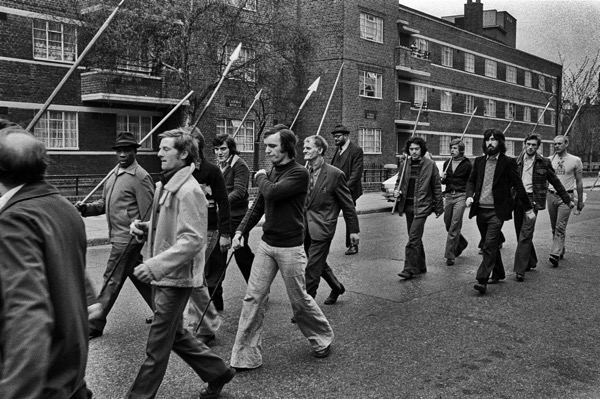
A Roman legion marching
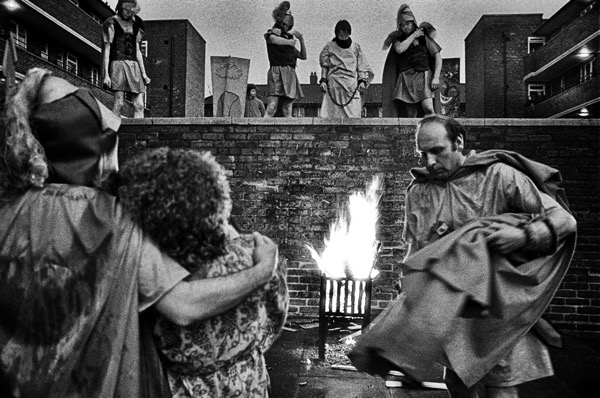
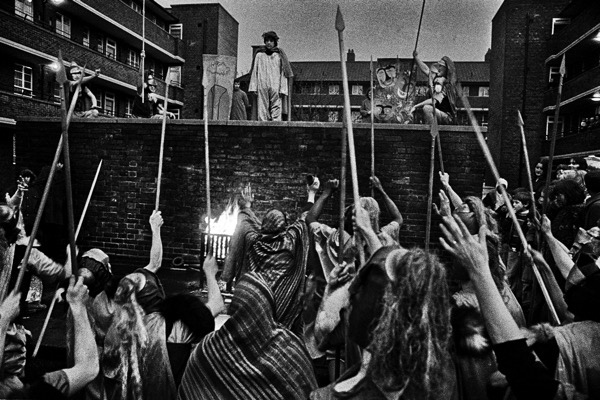
Pilate speaks
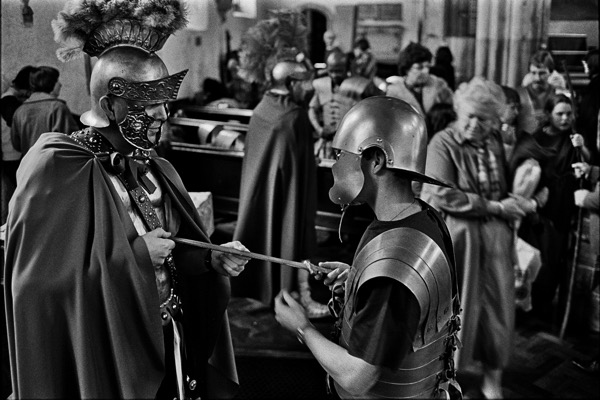
Roman soldiers at St Dunstan’s
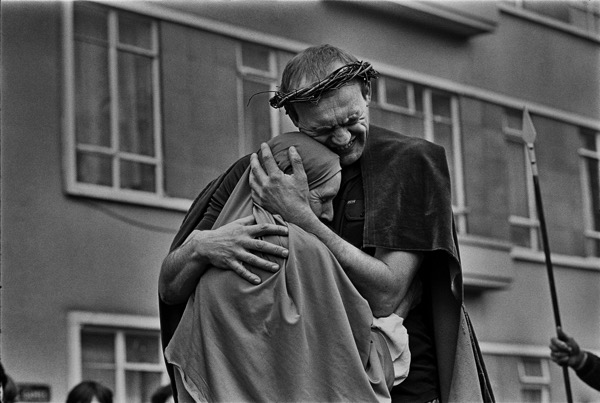
Jesus consoles Mary
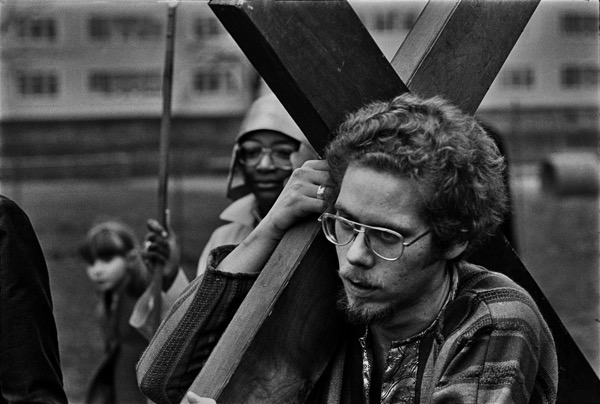
Bespectacled Jesus
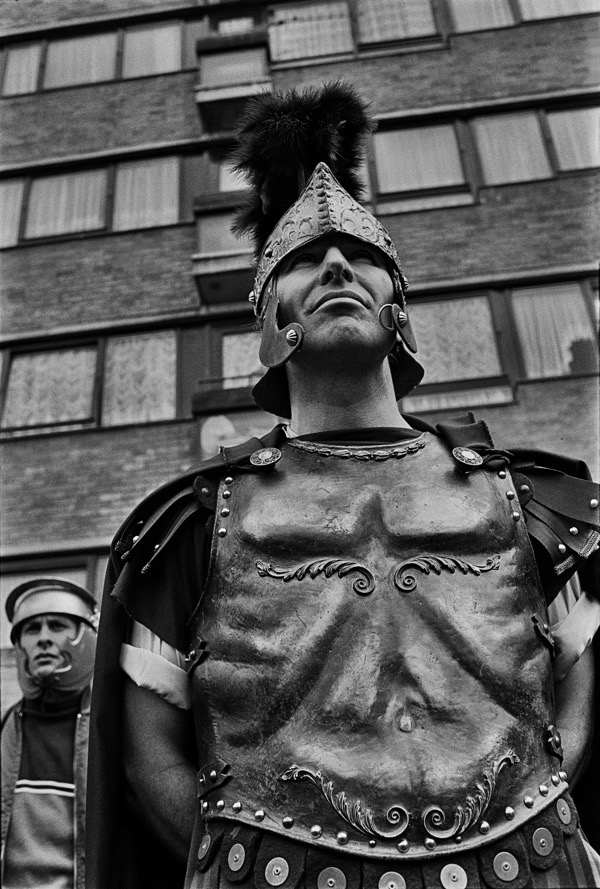
Roman Centurion in regalia
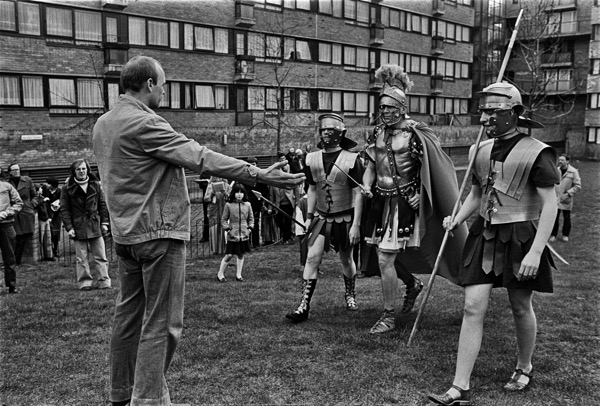
Jesus gives himself up
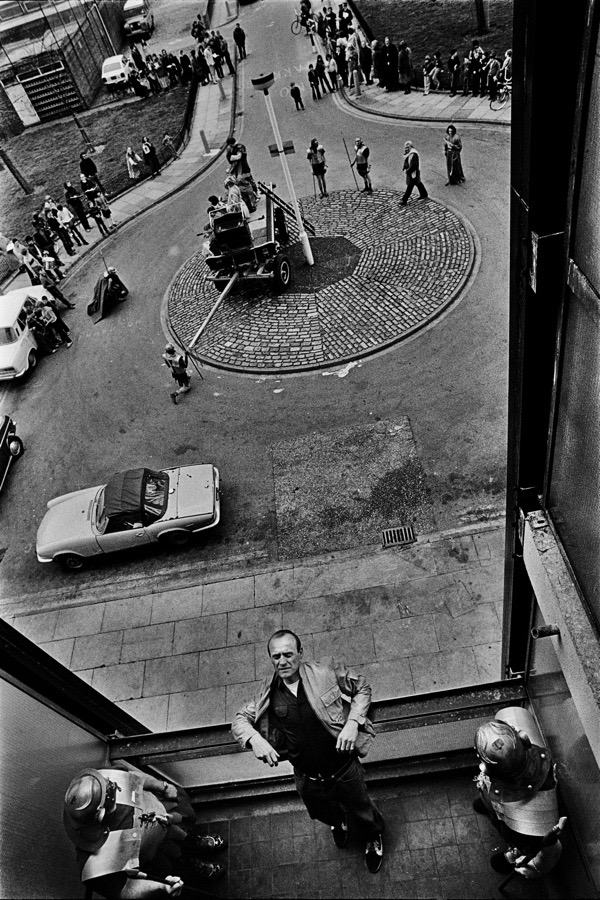
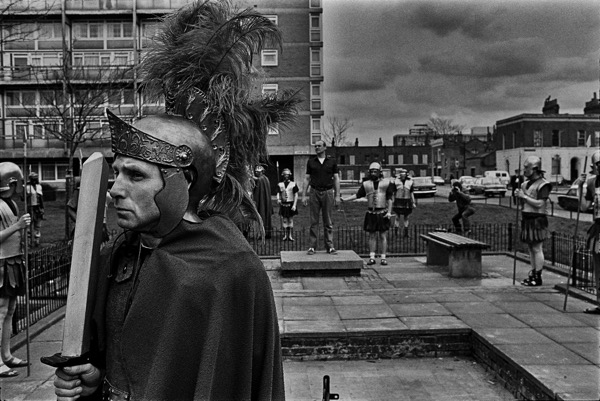
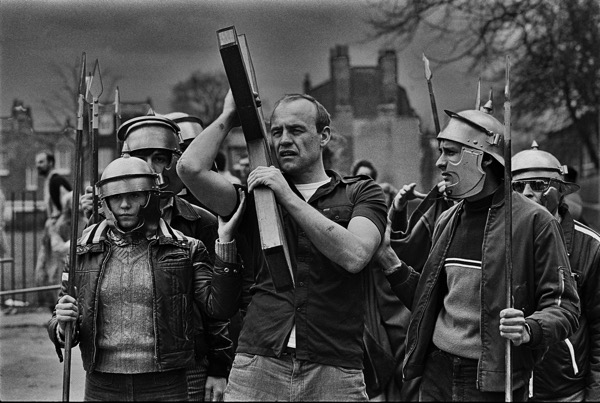
The march to the crucifixion
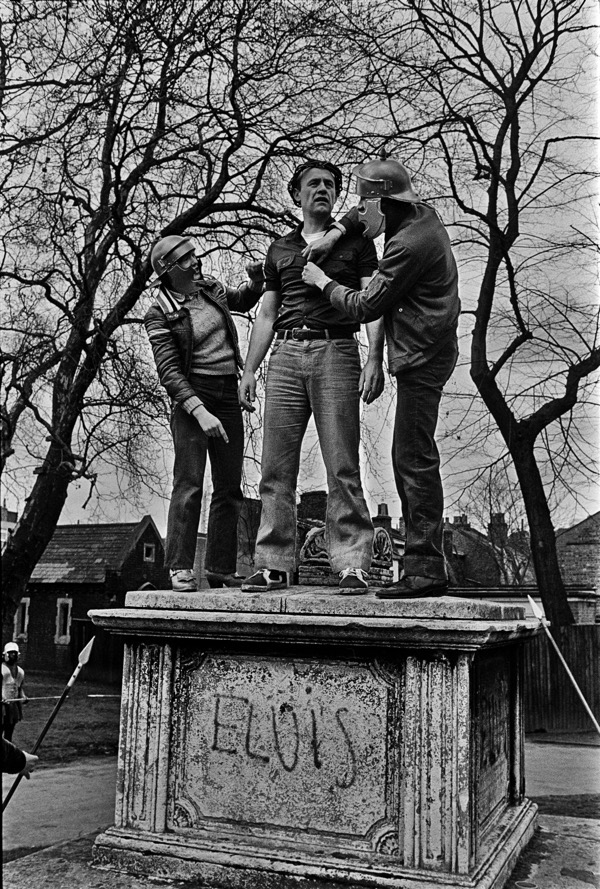
The soldiers stripping Jesus of his raiments
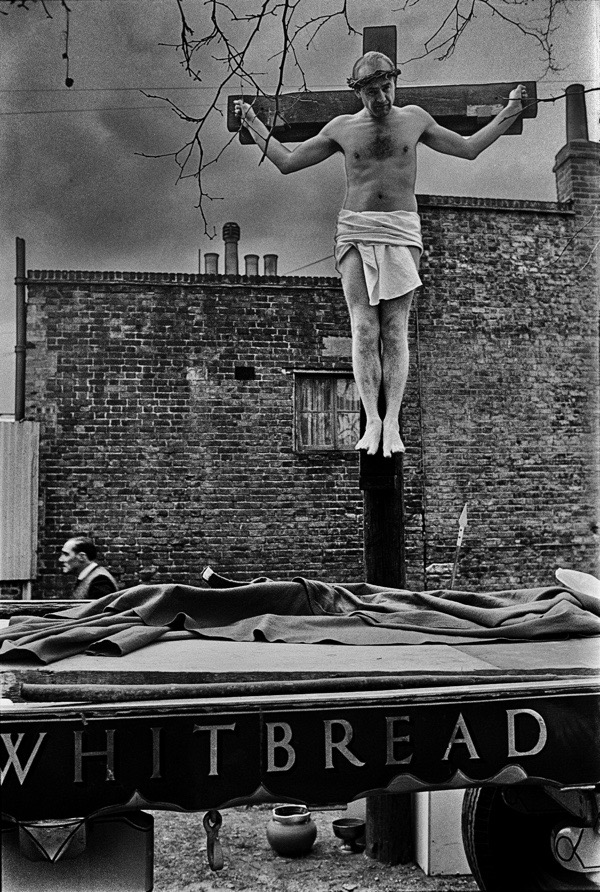
Crucifixion courtesy of Whitbread
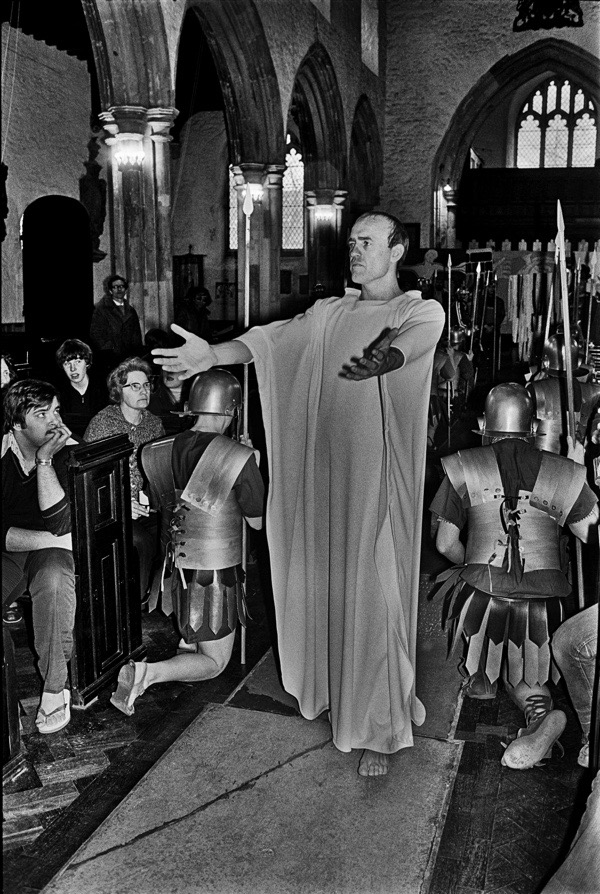
Behold, Jesus is risen in St Dunstan’s Church!
Photographs copyright © David Hoffman
You may also like to take a look at
David Hoffman at Fieldgate Mansions

Click here to order a copy of David Hoffman’s Endurance & Joy in the East End 1971-1987
Arful Nessa’s Sewing Machine
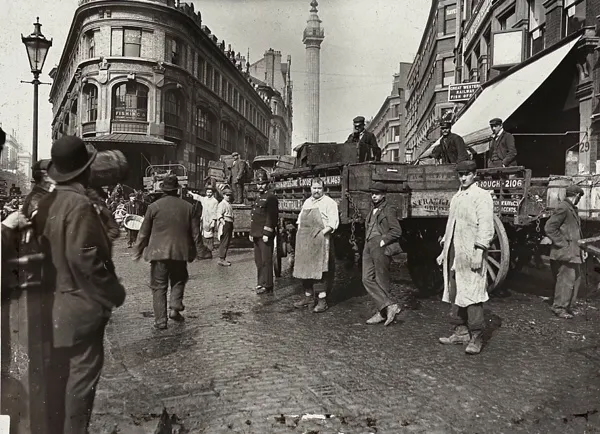
The Gentle Author’s Tour of the City of London: Meet me at 2pm on EASTER MONDAY on the steps of St Paul’s Cathedral for a tour of sightseeing and storytelling, rambling through the alleys and byways of the Square Mile in search of the wonders and the wickedness of the City. (Also booking for Spring Bank Holiday Monday 4th May)
Contributing Writer Delwar Hussain writes a memoir of his mother and her sewing machine
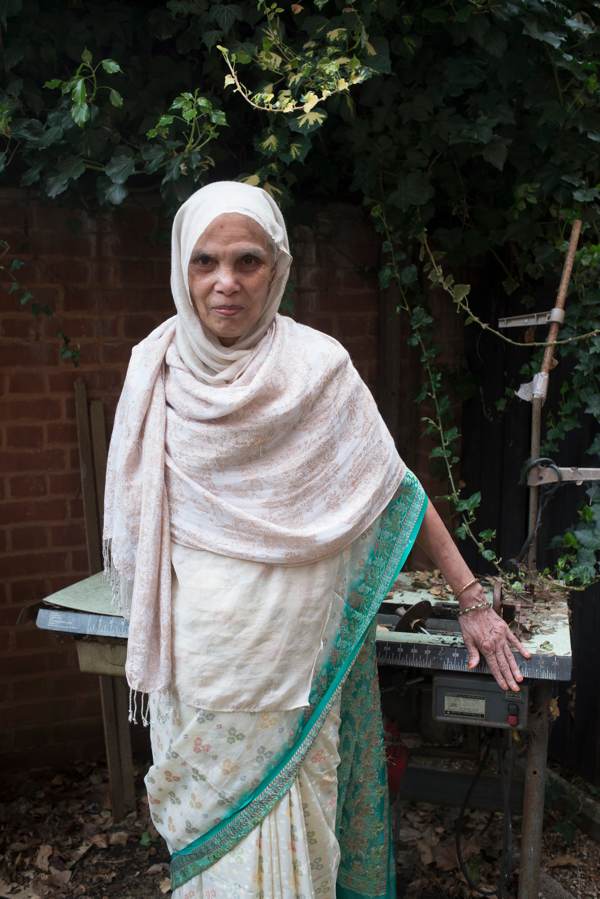
Arful Nessa with her sewing machine table
Rather than the sound of Bow bells, I was born to the whirring of sewing machines in my ear. Throughout most of my childhood, my mother did piecework while my father worked in a sweatshop opposite the beigel shop on Brick Lane, stitching together leather jackets for Mark & Spencer. The factory closed down long ago.
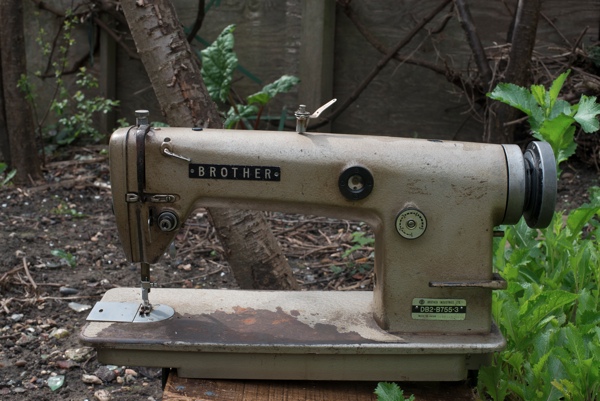
Initially my mother’s industrial-grade Brother sewing machine was in the kitchen, in between the sink and the pine wood table. But it took up too much space there and was also considered dangerous, once ambulatory children started populating the house. It was decided that it would be moved to one of the attic rooms on the top floor of our home, following the custom of the Huguenot silk weavers of the past. There the machine lived and there my mother would be found hunched over it, during all hours of the day and often late into the night. She says it was most hard on her back and shoulders, which would ache from the work.
“The men used to work in the factories. I preferred to do it at home because it was less work compared to what they did. They had to work harder,” she explains, “I began before the children were born. I wasn’t doing much at home, so I thought I should try it and earn a little money. Other women were working as machinists then and an old neighbour who had lived on Parfett St taught me how to operate the machine. I couldn’t do pockets, but I did pleats, belts and hems on skirts for women who worked in offices. I took in work for a factory on Cannon St Rd that made suits and another on New Rd that made blouses.”
For a while my mother sewed the lining into jackets and winter coats, working for a short Sikh man who had a clothes shop on Fournier St. He had quick steps and a bunch of heavy keys dangling from the belt on his trousers. The man still owes her money, she recalls. He would give her wages in arrears, promising to pay, but it never materialised. Following him, she worked for another man, who also did not pay. “Where would you go looking for them today?” my mother asks, “Everyone we used to know around here has left. So much has changed.”
I remember the almost-sweet smell of the machine oil, the thick needles, bundles of colourful nylon yarn, piles and piles of skirts in all shades and sizes, the metal bobbin cases and the sound of the sewing machine. When the foot peddle was down, the vibration could be felt throughout the house. Strangely, this provided a sense of comfort – the knowledge that my mother was upstairs and everything in the world was as it should be.
When I was around twenty, my brothers and sisters and I colluded with each other to get rid of the sewing machine. It had lain dormant in the attic room ever since my mother gave up taking in piecework some years previously. The work had slowly become more irregular and less financially rewarding. “When I first started, I was able to earn around seventy-five pence per skirt, then towards the end, when there were many more women working, it dropped to around ten pence per coat.” These were also the days when much of the manufacturing in East London was being shipped out to parts of the world where there was cheaper labour, including Bangladesh and Turkey.
With my mother’s working paraphernalia left as it was, the space resembled Rodinsky’s room – he was the mythical recluse who once lived a few doors down from us in the attic of 19 Princelet St and who had disappeared one day, leaving everything intact. I had an idea to turn our attic into a study, installing my PC which my mother had bought for me from the money she had saved from sewing. With a separate monitor, keyboard and large hard drive, it was almost as big as her Brother sewing machine.
She had always been a hoarder, so we knew that getting rid of it was going to be a delicate and difficult matter. We had given her prior warnings, but these had fallen on deaf ears. Then one night, when she had gone to bed, my siblings and I crept upstairs and, with a lot of effort, detached the head of the sewing machine from the table. Huffing and puffing, we carried it down three flights of stairs and delicately dumped it at the end of our street. We did the same with the table base.
Of course, she discovered the machine was missing the next day and was incredibly upset. She had “spent one hundred and forty pounds on it,” she said. “It still worked,” she said, “why had we not told her, she could have given it to someone at least, instead of it being thrown away” and “what had she done to deserve children who were so wasteful.” After that, I forgot all about the Brother sewing machine that once lived in our attic.
Recently, I returned from a research trip to Dhaka. I am currently writing a book about the people of that city and had interviewed garment workers about their lives and fears. I came home and was speaking to my mother about it when the subject of her earlier life as a machinist came up. And then she announced her revelation.
My mother and our Somali neighbour had managed to rescue the sewing machine from where my brothers, sisters and I had thought we had discarded the thing. The two women had somehow managed to shuffle the table base along, scraping hard along the pavement. But instead of bringing it back to the house, they took it to the neighbour’s, where it was to stay in the garden until they decided what to do with it. The machine head on the other hand was far too heavy for them to carry and they abandoned it.
This disclosure had to be investigated. My mother and I immediately knocked on our neighbour’s door, and asked if it was still there. The neighbour led us to the garden where, hidden behind wooden boarding and tendrils of ivy, we found the sewing machine my mother had spent so many years working on.
Considering it had endured years outdoors, it looked like it was still in relatively good health. Bits of it, such as the bobbin winder and the spool base were slightly rusty, but the address of the showroom on Cambridge Heath Rd where my mother bought it was clearly labelled and the motor looked in working condition.
She is still upset with my brothers and sisters and me for throwing it away. This confused me. “Why would you want to hold onto something that is a source of oppression?” I asked, high-mindedly. “The machine helped to feed and educate my family,” she answered quietly.
My mother then reminded me that my aunt, her sister, also had a Brother sewing machine and made skirts for many years from her kitchen in Bethnal Green. We went to speak to her. She no longer works as a seamstress and has resorted to keeping her dismembered machine on the veranda of her ground floor flat. The table now stores pots and pans, baskets containing seeds and drying leaves. The head was in the bottom drawer of a metal cabinet next to it, wrapped up in a Sainsbury’s shopping bag. My aunt still has some of the cloth which she would make into skirts and she showed me the pleats on a piece of salmon-coloured material.
“Most of the women in this block worked for different factories and one of them taught me how to do it. I worked for a Turkish man on Mare St for around seven years. I would get started around 7am after the morning prayer at 6am. I can’t remember where the skirts were being sold, but they were for well known shops in the West End. In one day, I could work on fifty or sixty pieces. Some days I made around a hundred. I received around forty or fifty pence per piece and could earn around three hundred pounds per week. But it was all irregular, nothing was fixed. My children would help by cutting the loops off when they got home after school. There is no work anymore, but I kept the machine in case I needed to fix things. It still works.”
While I took notes, sitting on the chair she would sit on whilst working, I could hear dregs of conversation between the two sisters, comparing the quality of oranges in Bethnal Green market to Asda and Iceland, as well as recalling what happened to other women whom they both knew that had worked as seamstresses. This industry, now gone, is a piece of the thread that joins the past with the present in the East End and, in turn, unites the people who have come to make this part of London their home.

My aunt with her sewing machine in Bethnal Green
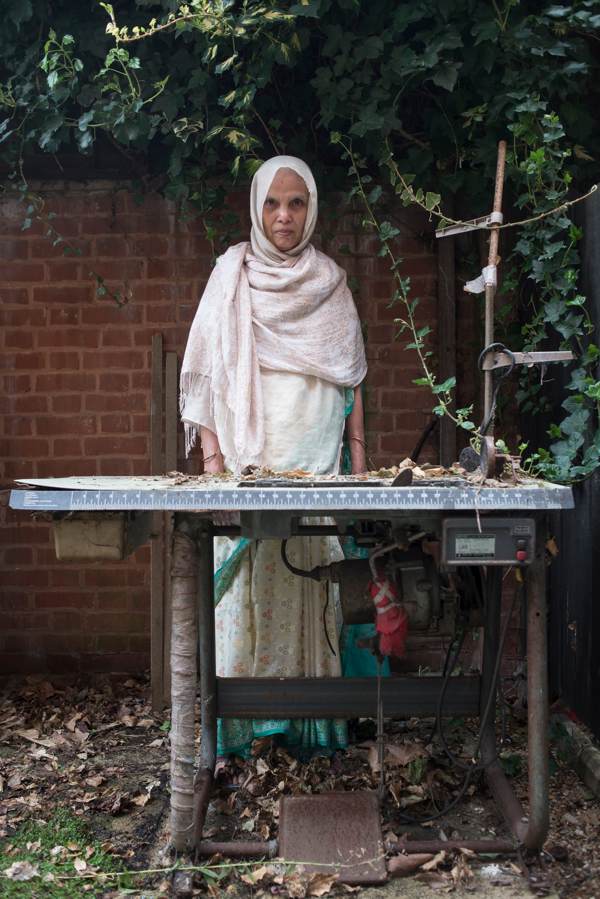
Arful Nessa
Photographs copyright © Sarah Ainslie
You may like to read Delwar Hussain’s other story about his mother
The Auriculas Of Spitalfields

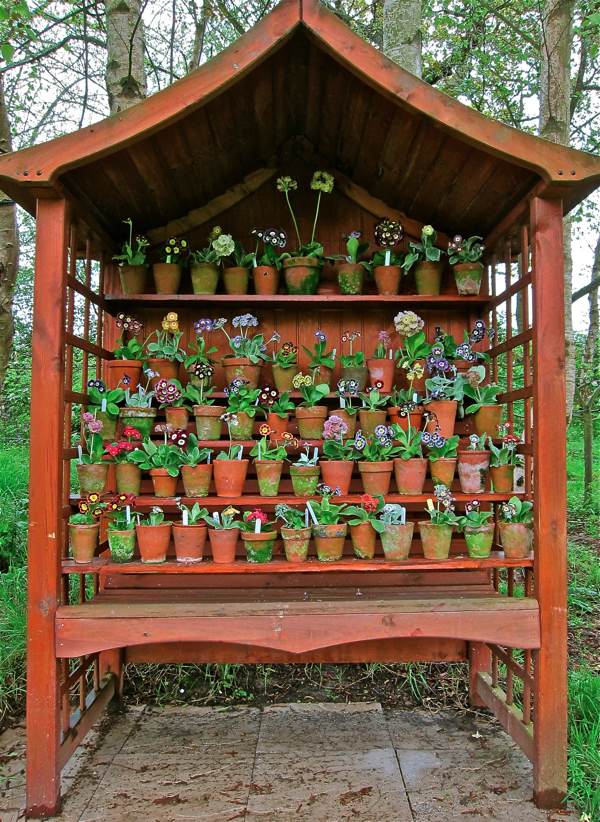
An Auricula Theatre
In horticultural lore, auriculas have always been associated with Spitalfields and writer Patricia Cleveland-Peck has a mission to bring them back again. She believes that the Huguenots brought them here more than three centuries ago, perhaps snatching a twist of seeds as they fled their homeland and then cultivating them in the enclosed gardens of the merchants’ grand houses, and in the weavers’ yards and allotments, thus initiating a passionate culture of domestic horticulture among the working people of the East End which endures to this day.
You only have to cast your eyes upon the wonder of an auricula theatre filled with specimens in bloom – as I did in Patricia’s Sussex garden – to understand why these most artificial of flowers can hold you in thrall with the infinite variety of their colour and form. “They are much more like pets than plants,” Patricia admitted to me as we stood in her greenhouse surrounded by seedlings,“because you have to look after them daily, feed them twice a week in the growing season, remove offshoots and repot them once a year. Yet they’re not hard to grow and it’s very relaxing, the perfect antidote to writing, because when you are stuck for an idea you can always tend your auriculas.” Patricia taught herself old French and Latin to research the history of the auricula, but the summit of her investigation was when she reached the top of the Kitzbüheler Horn, high in the Austrian Alps where the ancestor plants of the cultivated varieties are to be found.
Auriculas were first recorded in England in the Elizabethan period as a passtime of the elite but it was in the eighteenth and nineteenth centuries that they became a widespread passion amongst horticulturalists of all classes. In 1795, John Thelwall, son of a Spitalfields silk mercer wrote, “I remember the time myself when a man who was a tolerable workman in the fields had generally beside the apartment in which he carried on his vocation, a small summer house and a narrow slip of a garden at the outskirts of the town where he spent his Monday either in flying his pigeons or raising his tulips.” Auriculas were included alongside tulips among those prized species known as the “Floristry Flowers,” plants renowned for their status, which were grown for competition by flower fanciers at “Florists’ Feasts,” the precursors of the modern flower show. These events were recorded as taking place in Spitalfields with prizes such as a copper kettle or a ladle and, after the day’s judging, the plants were all placed upon a long table where the contests sat to enjoy a meal together known as “a shilling ordinary.”
In the nineteenth century, Henry Mayhew wrote of the weavers of Spitalfields that “their love of flowers to this day is a strongly marked characteristic of the class.” and, in 1840, Edward Church who lived in Spital Sq recorded that “the weavers were almost the only botanists of their day in the metropolis.” It was this enthusiasm that maintained a regular flower market in Bethnal Green which evolved into the Columbia Rd Flower Market of our day.
Known variously in the past as ricklers, painted ladies and bears’ ears, auriculas come in different classes, show auriculas, alpines, doubles, stripes and borders – each class containing a vast diversity of variants. Beyond their aesthetic appeal, Patricia is interested in the political, religious, cultural and economic history of the auricula, but the best starting point to commence your relationship with this fascinating plant is to feast your eyes upon the dizzying collective spectacle of star performers gathered in an auricula theatre. As Sacheverell Sitwell once wrote, “The perfection of a stage auricula is that of the most exquisite Meissen porcelain or of the most lovely silk stuffs of Isfahan and yet it is a living growing thing.”
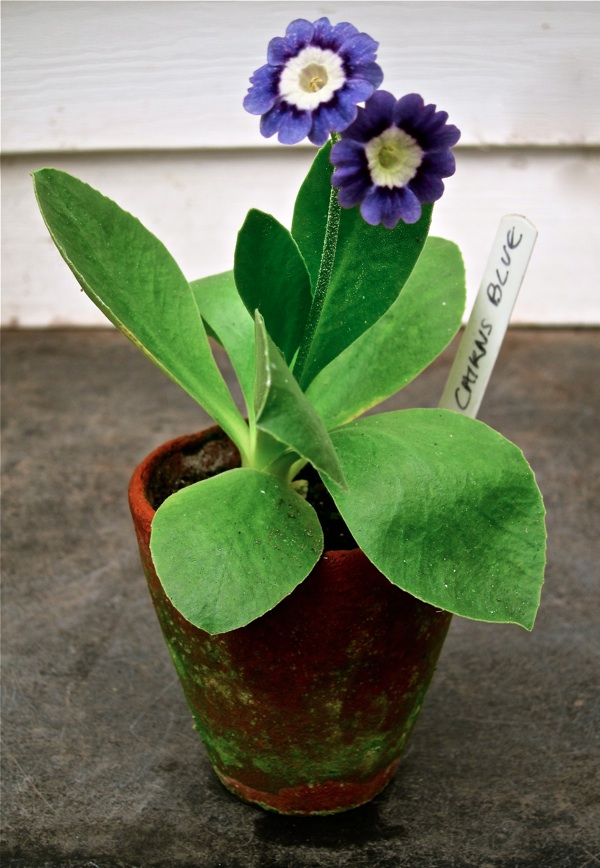
Mrs Cairns Old Blue – a border auricula

Glenelg – a show-fancy green-edged auricula

Piers Telford – a gold-centred alpine auricula

Taffetta – a show-self auricula

Seen a Ghost – a show-striped auricula

Sirius – gold-centred alpine auricula

Coventry St – a show-self auricula
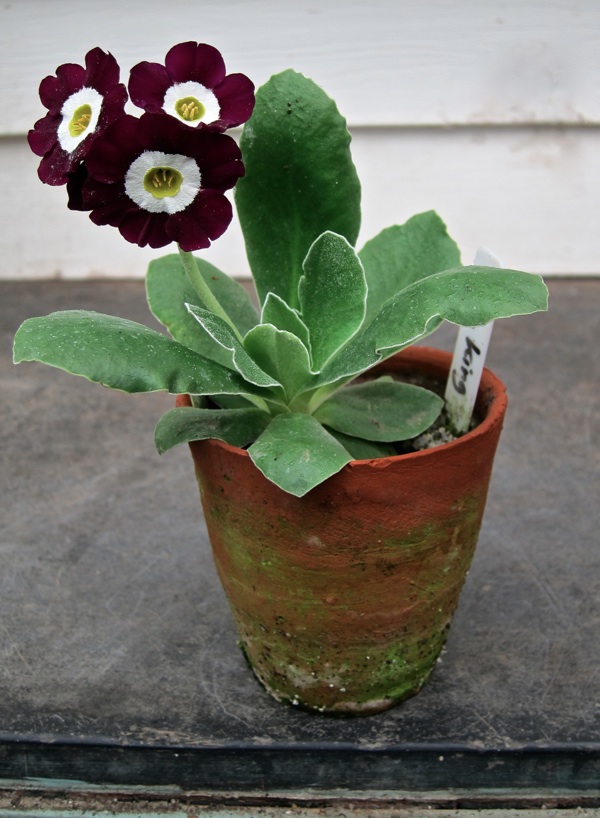
M. L. King – show-self auricula

Mrs Herne – gold-centred alpine auricula

Dales Red – border auricula

Pink Gem – double auricula

Summer Wine – gold-centred alpine auricula

McWatt’s Blue – border auricula

Rajah – show-fancy auricula

Cornmeal – show-green-edged auricula

Fanny Meerbeek – show-fancy auricula

Piglet – double auricula

Basuto – gold-centred alpine auricula

Blue Velvet – border auricula

Patricia Cleveland-Peck in her greenhouse.
You may also like to take a look at