
A Review In The Oldie
Tickets are available for my tour throughout September & October
Click here to book for THE GENTLE AUTHOR’S TOUR OF SPITALFIELDS
I am delighted to republish this review by Patrick Barkham from the August issue of The Oldie


Chris Kelly’s Cable St Gardeners
Tickets are available for my walking tour now
Click here to book for THE GENTLE AUTHOR’S TOUR OF SPITALFIELDS
In September 2003, photographer Chris Kelly was invited to the open day of Cable Street Community Gardens and the result was a year-long project which culminated in an exhibition and a book. Fifty-two plot holders took part, aged from seven to eighty and originating from a dozen different countries, yet all unified by a love of gardening and the need for a haven where they could cultivate flowers, grow vegetables, chat to neighbours or enjoy solitude. Today, it is my delight to publish a selection of Chris Kelly’s beautiful portraits of the Cable St Gardeners. “Some of the old faces are no longer there,” Chris told me,“but the gardens thrive, new people have joined and it is still a magical place.”

Bill Wren – I was born in Wapping and I moved to Shadwell nine years ago. I’ve had the plot for about fifteen years. We never had a garden when I was young. The nearest I came to gardening was picking hops in Kent. Later I had a friend in Burgess Hill and I used to grow things in her garden. That’s where the greenhouse came from, I put it on the roof of the car and brought it up from Sussex. I’ve built a shed here and a pond. There are plenty of frogs and newts, and I’ve planted a bank next to the road. It’s a wildlife haven now.

Jane Sill – I was born in Liverpool. My grandfather had an allotment in County Durham and my father was a very good gardener. I helped with weeding and cultivated sunflowers. I was living in Cable Street in the late seventies in a top floor flat with no balcony. One day I went to a community festival and Friends of the Earth were offering plots here. I was given one in 1980 and I knew straight away how important it was to establish ourselves as an organisation. We’ve had a two year waiting list since 1981. At one time I was working in a Job Centre and people used to come in and put their names down for a plot.

Mohammed Rahmat Ali Pathni – I have always been a gardener. I started on my father’s land in Bangladesh and when I came to live in Birmingham in 1978 I had a garden behind the back yard. I have lived in Wapping since 1983 and started gardening in Cable Street ten years ago. I’m enjoying myself and it helps my frozen shoulder. I taught my children to garden and my wife often works here too. Many gardeners provide food for other people and I regularly give vegetables to friends. I also write poetry which is printed in the Eurobangla News Weekly, and I am a member of a writers’ group.

Alison Cochran – I moved to Shadwell five years ago because of the allotments and I live just across the road. I noticed them when I was living in Bethnal Green. I was born in Salisbury on a hill fort. I was keen on gardening when I was a child but when I came here I hadn’t gardened for years. I knew I wanted lots of flowers, but now I also grow salad vegetables and leeks, tomatoes, carrots and radishes. The soil is wonderful, everything seems to thrive here. I’ve used Victorian bricks for the paths because I wanted my plot to be in keeping with nearby housing.

Monir Uddin – I’ve lived in the borough for twenty years and I’ve gardened here for eight or nine years. The plot was completely wild at first. I had to uproot everything and it took about two years to get the soil right. I used to grow about sixty different plants and vegetables, including huge pumpkins. I love experimenting with plants and growing them for their medicinal properties. I’m a photographer and I also wanted to produce plants to photograph. I’ve done many different types of work including weddings and portraits. I was involved in the Bollywood film industry, I’ve photographed celebrities and at one time I had a restaurant.

Agatha Athanaze – I’ve been gardening here for twelve years. I was born in Dominica and came to Tower Hamlets in 1961. I’ve done different jobs. I’ve been a machinist and a cleaner. I live in Wapping now. I had a garden in Dominica so I did have some experience. The vegetables came first – I grow cabbages, onions, spring onions, runner beans, carrots, tomatoes, rhubarb and kidney beans. I like flowers too. I’ve ordered roses from Holland and from Spalding. I just like to come here and grow things. There are two benches but I haven’t time to sit down.

John Kelly – I was born in Cork City and I wasn’t a gardener. I came to this country in 1943 to work in the construction industry and started gardening as a hobby and to feed the family. I’ve had the plot here for seventeen years. I didn’t know much but I picked it up as I went along. I’ve always grown vegetables, never flowers. I can’t spend too much time here because I have to look after my wife and I have health problems too. I hate the sight of weeds but I don’t throw them out. I leave them on the ground to let them rot and they form green manure.

Manda Helal – I’m from Hertfordshire and I’ve lived in Tower Hamlets for twenty-six years. I’ve always been keen on gardening. We had a big garden when I was a child and I was given a section of my own. I’ve had my plot here for three years. My flat in Whitechapel is small and dark, so it’s wonderful to come here. The wheels are a frame for pumpkins. Squashes and pumpkins are so versatile. I grow artichokes and rocket, garlic, kale, cabbage, cauliflower, spinach and climbing purple beans. I’ve taught pottery in the borough for years and more recently I became a compost educator for the Women’s Environmental Network.

John Stokes – I’ve been gardening at Cable Street since I retired six years ago. I asked one of the nuns in the convent across the road and she said the allotments were for local people. I had no experience but I was brought up on a farm and I found I had an instinct for gardening. I came over from Ireland fifty years ago. I worked for London Transport for thirty-six years and missed only nine days. Now I’m at the gardens almost every day in summer and twice a week in winter. I grow vegetables for myself and my cousin and an aunt.

Anna Gaudion – I was born in Guernsey. I’ve lived in Stepney for the last ten years and I work as a midwife in Peckham. I was brought up in the country and I love being outside, hearing birds and growing things. I like allotments too, even just seeing them from trains. I’ve had this plot for three years now. My shed is made from a packing case used to take an object abroad from the British Museum where I was a curator. I enjoy cultivating flowers so I planted a nature garden. I share my plot with Claire who grows vegetables. Mine is the higgledy-piggledy part.

Andy Pickin – I grew up in Finchley and we moved to Shadwell twenty years ago. We spent eight years in Huntingdon when the firm moved there but most of us came back to London. I wanted an allotment because I’d always had great fun sharing one with my dad. I’ve had the plot for fourteen years. I grew vegetables because money was tight and the first year’s crop was fantastic. Our thirteen children all liked coming here when they were young. The older ones grow their own vegetables now. My wife likes the gardens too, she knows I sometimes come here to get away from the telly or the kids arguing.

Robin & Maria Albert – Robin was in catering before becoming a gardener eight years ago. He was born in Mile End and he’s lived in London all his life. I was born in London too and brought up in Margate. My family is always trying to persuade us to move out to Kent but we like living in Bethnal Green. We grow flowers at home but we wanted somewhere separate for vegetables. The fact that everything is organic is part of the appeal. Producing your own pure food is very satisfying. We have some flowers too and a pond that attracts frogs. I can’t do so much now but I still find gardening very therapeutic.

Ray Newton – I’ve always grown things. I share this plot with Agatha. We grow about a dozen different types of vegetables. It’s all organic. We don’t use pesticides. I retired last year from teaching business studies at Tower Hamlets College. Before that I worked in industry and at one time I was manager of a betting shop. I studied for O and A levels at evening classes and then took a degree course. I became a teacher and taught for twenty-five years. My other interests are local history and football. I’m the secretary of the History of Wapping Trust and a lifelong Millwall supporter.

Will Daly – I was a founder member of the gardens. I was in a nearby pub when Jane came in with another Irish chap and they persuaded me to have a plot. I’ve been in the borough for twenty-seven years. I was born in Ireland and I made a living salmon fishing on a tributary of the Shannon. I came to this country in 1951 and did building work. One of my brothers came over too but he missed the river and went home after a while. I still go back to Ireland but only for weddings and funerals. I can’t do very much gardening now but I love the peace of it.

Raymond Hussey – This is my second year. I live in one of the flats nearby. I’m growing vegetables and learning as I go along. What I’m most proud of is the brussels. And my runner beans were unbelievable. I don’t know whether it’s the soil or me talking to them. Weeds are a problem. Sometimes I’d like to use gallons of weedkiller but we’re not allowed. So I come in and have a chat. I call them everything but weeds. I was born on one of the estates off Brick Lane. I’ve done lots of things including acting. In my last job I was a dustman but I got trapped by the lorry. I still can’t do heavy work so the plot’s a bit of a mess but it’s my little world and I love it.

Robin, Yvonne and Katie Guess – We live at the other end of Cable Street. There’s a small courtyard garden but Yvonne and I were used to growing fruit and vegetables before we lived in London. We love soft fruit, we had a huge crop last year. We grow several vegetables and Yvonne has planted a mixed flower and herb bed. Our daughter Katie likes planting and picking but not weeding. We’re both from the south-east. I’ve been in the East End since 1968 and I worked on the Isle of Dogs as a quality control chemist. Now I’m with the Music Alliance in Oxford Street dealing with composer copyright.

Carl Vella – I came to Tower Hamlets from Malta in 1950 and worked for the NHS, mostly as a fitter and stoker. I’m retired and since I took over the plot four years ago I like to come here every day. I grow mostly vegetables – potatoes and cabbages. I’m on my own now so I give a lot of produce away to an elderly neighbour. I live in the flats nearby and there’s no garden. Coming here stops me getting fed up. I take my dog for a walk, go to the bookie’s and come here. I’d like to bring Pedro more often but he won’t stay in one place.

Sister Elizabeth O’Connor – Our Order has been part of the local community since 1859 and I came to the convent in 1949. After the houses here were demolished the site became a dumping ground until Friends of the Earth initiated the gardens project. When I retired from teaching in 1991, I started gardening here. All the sisters appreciate home grown vegetables and having fresh flowers for the chapel. As a child in County Clare I enjoyed helping my father in our kitchen garden. Apart from the practical use, the gardens are a great place for breaking down barriers and it’s especially good that women can feel safe here on their own.

Graham Kenlin – I was born in Bermuda. My father was a navy chef and had a land-based job working for an admiral. We came back to England when I was four and I grew up in Hackney. I’ve lived in Wapping for thirty-eight years and I’ve had a plot here for about fifteen years. My family have always had allotments. It’s very relaxing but I’m a lazy gardener. I’m an archaeologist and I work abroad sometimes so the plot gets neglected. I’ve had the odd good year but normally I do just enough to stay credible. I like growing large weeds, anything that’s interesting.

Sheila McQuaid – I came across the gardens at an open day. It was such an oasis of green and calm that I put my name down on the spot. Gardening is in the family. My parents were horticulturalists and I grew plants as a child but I’ve only become really interested in the last ten years. We decided on fruit because it’s expensive, especially if you want organic, and it doesn’t need constant attention. I was born and brought up in Cornwall and I’ve lived in Tower Hamlets for twenty-five years. I’m a housing adviser for Camden Council and I work for Stitches in Time on community textile projects.

Anna Girvan and John Griemsman – We’ve had the plot for about ten years. We’re in a 10th floor flat in Limehouse and we wanted somewhere to spend time outside and to grow vegetables. I’m from Belfast and I’ve lived in Limehouse for twenty-five years. John is from Wisconsin and he’s been here for almost thirty years. I work as a librarian in the West End and John is a special needs assistant. I’m more pleased by the flowers in the end than the vegetables. My favourite is a dahlia that Annemarie gave me. It’s a beautiful purple pink and it flowers for such a long time.

Mary Laurencin – I’ve been gardening here for about ten years. A cousin asked me to help then passed the plot on to me. I’d never gardened before but I was suffering from depression and sometimes it was the only place I felt comfortable. I learned to garden mainly by watching television. I’m from St Lucia and I’ve lived in Tower Hamlets for forty years. I came to England in 1962 and at one time I did four jobs every day – I worked in a cafe, had a job at Sainsbury’s, I was a machinist and I did some cleaning. I grow vegetables here. I love flowers but you can’t eat flowers.

Conrad, Donald and James Korek – I garden here with my wife Catherine and our two younger sons, Donald, ten, and James, six. Our eldest boy isn’t interested now. We’ve lived in the borough for fourteen years and started gardening at Cable Street about a year after we arrived. We have a flat nearby and we like to spend time outdoors. I was born in North London and Catherine was brought up on a farm in Scotland, so she has more experience of growing food. James likes weeding and he supports Arsenal. Donald is a West Ham supporter and he’s good at picking up stones and chatting to the other gardeners.

Annemarie Cooper – I’m a supply teacher and I write poetry. I’ve had a plot since 1986. I didn’t know anything about gardening but I love nature and being close to the earth. My dad was a very good vegetable gardener. He and my grandfather shared a plot and they were always arguing about it. I’ve lived in Tower Hamlets for twenty years. When I started here I thought I wanted to grow flowers then I got into vegetables. I love growing sweet peas and big flashy dahlias. Really I like anything that deigns to grow. I enjoy growing tomatoes and digging up potatoes.

Emir Hasham – I’m on the waiting list and until I have a plot I’ll be working on the communal area. My work is computer based graphics and special effects for television and what I like about gardening is the real honest labour and getting my hands dirty. It will be great to grow my own fruit and vegetables My parents used to garden and I helped as a child. I was born in Sheffield. My mum is a Yorkshire lass and my dad is mainly Asian. I’ve lived in Tower Hamlets for twelve years now. I haven’t a garden at home and there’s only so much you can grow on a balcony.

Anwara Begum – I was born in Bangladesh. My father was a businessman and had some land. My seven sisters and I helped mother with the farming. We never had to buy food from the market and we sold bamboo and bananas. When I was sixteen I came to live in Tower Hamlets and ten years ago I started gardening at Cable Street. The four children helped when they were younger but now they are busy with other things. They have to study and help with the housework. I’m studying too – IT, Childcare, Maths and English. And I’m taking Bengali GCSE as well as doing voluntary work in a nursery school.

Joseph Micallef – I first came to the borough from Malta in 1955 and settled here permanently in 1961. I’ve had the plot for ten years. I didn’t know anything about gardening but my father had a farm in Malta so I knew something about agriculture. The vegetables came first and my wife likes the flowers, but I just enjoy seeing things grow and passing the time here. A lot of the produce is given away. You do tend to get too much at once. People look at the plot and think I’m an expert but I’m not, I just plant things and they grow.
Photographs copyright © Chris Kelly
You may also like to take a look at Chris Kelly’s Columbia School Portraits 1996
William Caslon, Letter Founder
Tickets are available for my walking tour now
Click here to book for THE GENTLE AUTHOR’S TOUR OF SPITALFIELDS

Portrait by Francis Kyte, 1740

Double-click to enlarge William Caslon’s Specimen of Typefaces from 1734
William Caslon was the first major letter founder in London and, nearly three centuries later, remains the pre-eminent letter founder this country has produced. Before Caslon, there was little letter founding in Britain and most type was imported – even Shakespeare’s First Folio was printed with French type. But Caslon’s achievement was to realise designs and produce type which have been widely used ever since. And it all happened here, around the eastern fringes of the City of London. The Caslon family tomb stands alone today in front of St Luke’s Old St, just yards from where William Caslon started his first letter foundry in Helmet Row in 1727 and, with pleasing consistency, it is lettered in Caslon type.
A native of Cradley in Worcestershire and the son of a shoemaker, Caslon was apprenticed as a Loriner (or metalworker) to Edward Cookes in the Minories in 1706. Here the young apprentice learnt the essentials of metal casting that were to prove so crucial to his career but, most significantly, he undertook the engraving of letters onto gun barrels. Equally, the company produced punches of letters for book-binding and there is a legend that Caslon’s talent for type design was first spotted by a printer, coming upon his lettering upon the spine of a book in a shop.
Marrying the sister of a fellow apprentice in 1719, Caslon set up his first type foundry in Helmet Row in 1727. This initiative was based upon the success of a commission for the Society for the Promotion of Christian Knowledge who required an Arabic typeface to be used in religious texts distributed among Christian communities in the Middle East. Yet it was in the creation of his distinctly English version of Roman letters and italics, derived from the Dutch typefaces that were most commonly used in London at that time, which was the decisive factor in the establishment of Caslon’s reputation.
Caslon’s first type Specimen of 1734 exemplifies a confidence and clarity of design which has become so familiar that it is difficult to appreciate in retrospect. The Specimen offered a range of styles and sizes of type with an unprecedented authority and a distinctive personality which is immediately recognisable. As a consequence of the legibility and grace of Caslon’s work, his became the default choice of typeface for books and all kinds of publications in the English-speaking world for the next two centuries.
Caslon’s own background in engraving and metalwork was the ideal preparation for the cutting of letter punches and, among the related trades of watch-making and instrument-making which thrived in the City of London, he was able to find others with the necessary skills. Each letter had to be cut by hand at first and some of these punches are preserved at St Bride Printing Library – breathtakingly intricate pieces of metalwork upon a microscopic scale. Once complete, these punches were impressed into copper to make moulds, known as matrices, that were used for the casting of type for printing.
Moving in 1727 to larger premises in Ironmongers’ Row, by 1730 Caslon had eclipsed his competitors, securing the exclusive contract to supply type to the King’s printers. Later, Benjamin Franklin was to choose Caslon’s type for printing both the Declaration of Independence and the American Constitution.
In 1734, Caslon established himself in his permanent premises in Chiswell St, where the letter foundry continued until 1936. At this address, he staged monthly concerts upon an organ fitted into his music room, serving beer that he brewed himself. Caslon had inaugurated a long-standing dynasty, naming his first son William and, by 1742, specimens designed by William Caslon junior were being produced. It was a pattern that, like the typefaces, was replicated until well into the twentieth century. Caslon retired in 1750 to a house in the Hackney Rd opposite the Nag’s Head (where Hackney City Farm is today), and soon after he moved into his country house in Bethnal Green, where he died in 1766.
Within a generation, Caslon’s first types acquired the moniker Caslon Old Face, referring to their antique credentials yet, with innumerable recuttings, these typefaces have persisted to the present day when other types that once superceded them have been long forgotten. Caslon’s letters are often characterised as distinctively British in their sensibility and there is a lack of uniformity among them which sets them apart from their European counterparts, yet the merit of Caslon’s letters is their ability to mingle harmoniously among their fellows and create a pleasing texture upon the page – balancing the requirements of order and variety to achieve a satisfying unity.

In Helmet Row, off Old St, where William Caslon established his first type foundry in 1727.

William Caslon’s letter foundry in 1750

The Caslon letter foundry in 1900 (Photograph from St Bride Printing Library)
 Dedication page of William Caslon’s Specimen

The Caslon Letter Foundry in Chiswell St ran from 1734 until 1936.

Elisabeth Caslon (known as the Widow Caslon) who ran the foundry after her husband’s death

William Caslon II (born 1720, died 1778)

William Caslon III (born 1754, died 1833)

Henry William Caslon IV (born 1786, died 1850)

Henry William Caslon V (born 1814, died 1874)

Display faces became very popular in the nineteenth century.

Vignettes from a nineteenth century Caslon Specimen Book.

Steam trains from a Caslon Specimen Book.

The Caslon Family tomb at St Luke’s Old St.

Caslon letters on Caslon’s tomb.

Unless otherwise ascribed all archive images courtesy Bishopsgate Institute
You may also like to read about
Thirteenth Annual Report
Tickets are available for my walking tour now
Click here to book for THE GENTLE AUTHOR’S TOUR OF SPITALFIELDS

This year, it has been a pleasure to welcome so many readers to Spitalfields in person and enjoy a ramble around the streets in your company.
Although it was never my intention to do walking tours, it has proved an unexpected delight. For years, readers had been coming to visit the locations of my stories and often, when I eavesdropped on tour guides in Spitalfields, I recognised whole sentences lifted from writing. And this was an entirely satisfactory state of affairs, until someone pointed out to me that I had the opportunity to create a better alternative to the exploitative serial killer tours that blight our neighbourhood. Thus The Gentle Author’s Tour of Spitalfields was born.
It was never my intention to get involved in politics either, yet I have found that when you write about things you love then you have no choice but to defend them if they come under threat.
As a consequence of our campaign to Save the Bethnal Green Mulberry and the Judicial Review that confirmed the legal protection for the five hundred year old tree last year, I am pleased to confirm that Crest Nicholson – developer of the former London Chest Hospital – have abandoned their plans and sold the site to Clarion Housing Group which has publicly announced commitments to ‘retaining the mulberry tree in its current location’ and ‘providing more genuinely affordable homes that meet local need.’ This is a result and we shall hold them to it.
Cuttings from Shakespeare’s Mulberry are owed to many campaign supporters. Unfortunately, the cuttings failed in 2021 and this year the owners decided to give the tree a rest from pruning in order to overcome an infection that has afflicted many mulberries recently. We hope to take new cuttings next spring and deliver them to our patient supporters in the autumn of 2023.
We were proud when Grayson Perry’s End of Covid Bell debuted at the Royal Academy Summer Exhibition this year, made in support of our ongoing campaign to Save The Whitechapel Bell Foundry. Meanwhile, the developers’ option to buy the land at the rear of the foundry – where they planned to build their tower – has lapsed, which means that the boutique hotel scheme is now dead. Over the coming year, I will be reporting on progress of The London Bell Foundry, which has been set up with the ambition of acquiring and reopening the foundry as a fully working foundry.
Thanks in no small part to the letters written by you – the readers of Spitalfields Life – the City of London Planning Committee rejected proposals to convert the historic Custom House on the Thames bank into a boutique hotel. Despite the approval of Historic England, this plan was also rejected at a Public Inquiry, opening the door to the building and quayside being opened for public access and cultural use in the manner of Somerset House.
Closest to home has been the battle to Save Brick Lane from the proposed Truman Brewery Shopping Mall. Despite seven and a half thousand objections, two councillors out of a committee of just three members voted the decision through in questionable circumstances. One who approved it claimed that they ‘could not disappoint the developer.’ The subsequent local elections in which the Mayor of Tower Hamlets, who supported the development, was voted out of power along with the councillors who approved it revealed the strength of public opinion.
We now await the verdict of the Judicial Review on whether the granting of permission for the Truman Brewery Shopping Mall was lawful. The new Mayor has pledged to develop a community-led master plan for the entire brewery site, which makes the verdict of the High Court a potential watershed for the future of Spitalfields, deciding whether community or corporate interests will prevail.
Thus, with these thoughts in mind, ends the thirteenth year in the pages of Spitalfields Life.
I am your loyal servant
The Gentle Author
Spitalfields, 26th August 2022

The Gentle Author’s cat, Schrodinger
You may like to read my earlier Annual Reports
At Waltham Abbey
Tickets are available for my walking tour today & Saturday
Click here to book for THE GENTLE AUTHOR’S TOUR OF SPITALFIELDS
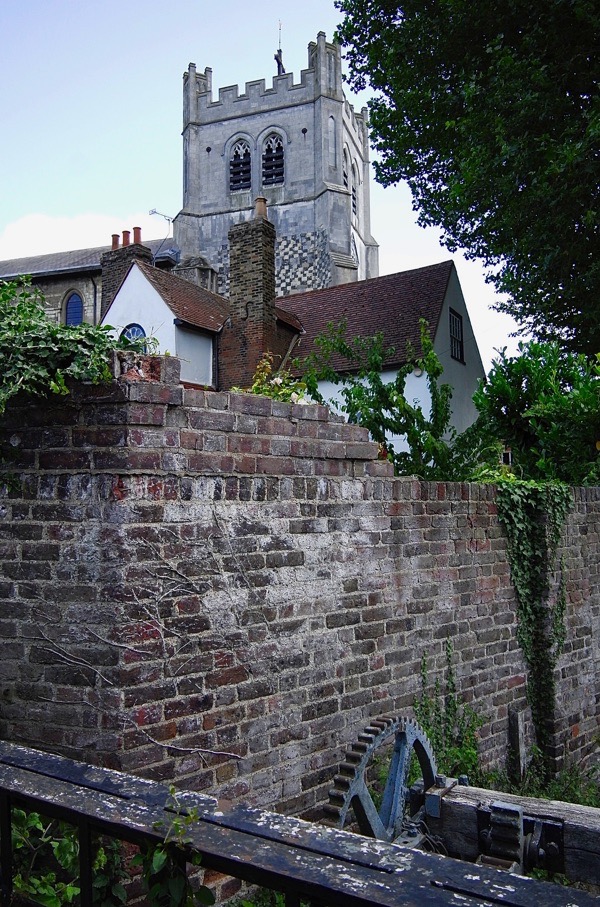
I cycled along the River Lea to Waltham Abbey. On my approach, even from the riverbank, I could see the majestic tower rising over the water meadows as the Abbey has done for the past thousand years, commanding the landscape and undiminished in visual authority.
Once you see it, you realise you are following in the footsteps of the innumerable credulous pilgrims who came here in hope of miraculous cures from the holy cross, which had reputedly relieved Harold Godwinson of a paralysis as a child before he became King Harold.
To the south of the Abbey church lies the market square, bordered with appealingly squint timber frame buildings punctuated by handsome eighteenth and nineteenth additions. Despite the proximity of the capital, the place still carries the air of an English market town.
Yet the great wonder is the Abbey itself, founded in the seventh century, built up by King Harold and destroyed by Henry VIII. Despite the ravages of time, the grandeur and scale of the Abbey is still evident in the precincts which have become a public park. Although the church that impresses today is less than half the size of what it was, it is enough to fire your imagination. An imposing stone gateway greets the visitor to the park where long, battered walls outline the former extent of the buildings. A tantalising fragment of twelfth century vaulting, which formerly served as the entrance to the cloisters, encourages the leap to conjure the cloisters themselves where now is merely an empty lawn. A walled garden filled with lavender and climbing roses draws you closest to the spirit of the place.
The outline of the former Abbey church is marked upon the grass and at the eastern end lies a surprise. A plain stone engraved with the words ‘Harold King of England Obit 1066,’ indicating this is where legend has it that he was laid to rest after the Battle of Hastings. I realised that maybe the remains of the man in the tapestry, killed by the arrow in the eye, lay beneath my feet. Coming upon his stone unexpectedly halted me in my tracks.
This was one of those startling moments when there is a possibility of history being real, something tangible, causing me to reflect upon the Norman Conquest. A thousand years ago, their power found its expression in the vast complex of buildings here, which were destroyed five hundred years ago as the expression of another power.
We too live in a time of dramatic transition, emerging from the shadow of the pandemic and accommodating to our country’s divorce from Europe. I cycled from Spitalfields to Waltham Abbey as a respite from the times, yet here I was confronting it in a mossy green churchyard. The equivocal consolation of the historical perspective is that it reminds us that empires rise and fall, but life goes on.


Effigy of King Harold

Harold cradles Waltham Abbey in his arm


The Lady Chapel

Victorian villa in the churchyard

The Welsh Harp


These vaults are all that is left of the twelfth century cloisters


Here lies Harold, the last Anglo Saxon King of England

Waltham Abbey
You may also like to read about
Philip Lindsey Clark’s Sculptures In Widegate St
Tickets are available for my walking tour this Thursday & Saturday
Click here to book for THE GENTLE AUTHOR’S TOUR OF SPITALFIELDS

Next time you pass through Widegate St, walking from Bishopsgate towards Artillery Passage on your way to Spitalfields, lift up your eyes to see the four splendid sculptures of bakers by Philip Lindsey Clark (1889 – 1977) upon the former premises of Nordheim Model Bakery at numbers twelve and thirteen. Pause to take in the subtle proportions of this appealing yet modest building of 1926 by George Val Myers in which the sculpture is integrated so successfully, just as at Broadcasting House which Val Myers designed five years later with Eric’s Gill’s figures upon the front.
Clark’s work shares a similar ambition to illuminate the transcendental in existence and, from 1930, onwards his sculpture was exclusively of religious subjects. Born in Brixton, son of Scots architectural sculptor Robert Lindsey Clark, he trained in his father’s studio in Cheltenham and then returned to London to study at the City & Guilds School in Kennington. Enlisted in 1914, he was severely wounded in action and received a Distinguished Service Order for conspicuous gallantry. Then, after completing his training at the Royal Academy Schools, he designed a number of war memorials including those in Southwark and in Kelvingrove Park, Glasgow.
The form of these ceramic reliefs of bakers – with their white glaze and sparing use of blue as a background – recalls religious sculpture, especially stations of the cross, and there is something deeply engaging about such handsome austerely modelled figures with their self-absorbed presence, preoccupied by their work. The dignity of labour and the poetic narrative of transformation in the baking of bread is made tangible by these finely judged sculptures. My own favourite is the figure of the baker with his tray of loaves upon his shoulder in triumph, a satisfaction which anyone who makes anything will recognise, borne of the work, skill and application that is entailed in creation.
These reliefs were fired by Carters of Poole, the company that became Poole Pottery, notable for their luminous white glazes, elegant sculptural forms and spare decoration using clear natural colours. They created many of the tiles for the London Underground and their relief tiles from the 1930s can still be seen on Bethnal Green Station.
Philip Lindsey Clark’s sculptures are those of a man who grew up in the artists’ studio, yet witnessed the carnage of First World War at first hand, carrying on fighting for two days even with a piece of shrapnel buried in his head, and then turned his talents to memorialise those of his generation that were gone. After that, it is no wonder that he saw the sublime in the commonplace activity of bakers. Eventually Lindsey Clark entered a Carmelite order, leaving London and retiring to the West Country where he lived until the age of eighty-eight.
So take a moment next time you pass through Widegate St – named after the wide gate leading to the ‘spital fields that once was there – and contemplate the sculptures by Philip Lindsey Clark, embodying his vision of the holiness of bakers.


George Val Myer’s former Nordheim Model Bakery with sculptures by Philip Lindsey Clark.
You may also like to read about
A Night in the Bakery at St John
Dorothy Annan’s Murals in Farringdon St
At Embassy Electrical Supplies
Tickets are available for my walking tour this Thursday & Saturday
Click here to book for THE GENTLE AUTHOR’S TOUR OF SPITALFIELDS

Mehmet Murat
It comes as no surprise to learn that at Embassy Electrical Supplies in Clerkenwell, you can buy lightbulbs, fuses and cables, but rather more unexpected to discover that, while you are picking up your electrical hardware, you can also purchase olive oil, strings of chili peppers and pomegranate molasses courtesy of the Murat family groves in Cyprus and Turkey.
At certain fashionable restaurants nearby, “Electrical Shop Olives” are a popular feature on the menu, sending customers scurrying along to the Murats’ premises next morning to purchase their own personal supply of these fabled delicacies that have won acclaim in the global media and acquired a legendary allure among culinary enthusiasts.
How did such a thing come about, that a Clerkenwell electrical shop should be celebrated for olive oil? Mehmet Murat is the qualified electrician and gastronomic mastermind behind this singular endeavour. I found him sitting behind his desk at the rear of the shop, serving customers from his desk and fulfilling their demands whether electrical or culinary, or both, with equal largesse.
“I am an electrician by trade,” he assured me, just in case the fragrance of wild sage or seductive mixed aromas of his Mediterranean produce stacked upon the shelves might encourage me to think otherwise.
“I arrived in this country from Cyprus in 1955. My father came a few years earlier, and he got a job and a flat before he sent for us. In Cyprus, he was a barber and, according to our custom, that meant he was also a dentist. But he got a job as an agent travelling around Cyprus buying donkeys for Dr Kucuk, the leader of the Turkish Cypriots at that time – the donkeys were exported and sold to the British Army in Egypt. What he did with the money he earned was to buy plots of land around the village of Louroujina, where I was born, and plant olive saplings. He and my mother took care of them for the first year and after that they took care of themselves. Once they came to the UK, they asked relatives to watch over the groves. They used to send us a couple of containers of olive oil for our own use each year and sold the rest to the co-operative who sold it to Italians who repackaged it and sold it as Italian oil.
I trained as an electrician when I left school and I started off working for C.J. Bartley & Co in Old St. I left there and became self-employed, wiring Wimpy Bars, Golden Egg Restaurants and Mecca Bingo Halls. I was on call twenty-four hours and did electrical work for Faye Dunaway, the King of Jordan’s sister and Bill Oddie, among others. Then I bought this shop in 1979 and opened up in 1982 selling electrical supplies.
In 2002, when my father died, I decided I was going to bring all the olive oil over from Louroujina and bottle it all myself, which I still do. But when we started getting write-ups and it was chosen as the best olive oil by New York Magazine, I realised we had good olive oil. We produce it as we would for our own table. There is no other secret, except I bottle it myself – bottling plants will reheat and dilute it.
If you were to come to the village where I was born, you could ask any shopkeeper to put aside oil for your family use from his crop. I don’t see any difference, selling it here in my electrical shop in Clerkenwell. It makes sense because if I were to open up a shop selling just oil, I’d be losing money. The electrical business is still my bread and butter income, but many of the workshops that were my customers have moved out and the Congestion Charge took away more than half my business.
Now I have bought a forty-five acre farm in Turkey. It produces a thousand tons of lemons in a good year, plus pomegranate molasses, sweet paprika, candied walnuts and chili flakes. We go out and forage wild sage, wild oregano, wild St John’s wort and wild caper shoots. My wife is there at the moment with her brother who looks after the farm, and her other brother looks after the groves in Cyprus.”
Then Mehmet poured a little of his precious pale golden olive oil from a green glass bottle into a beaker and handed it to me, with instructions. The name of his farm, Murat Du Carta, was on the label beneath a picture of his mother and father. He explained I was to sip the oil, and then hold it in my mouth as it warmed to experience the full flavour, before swallowing it. The deliciously pure oil was light and flowery, yet left no aftertaste on the palate. I picked up a handful of the wild sage to inhale the evocative scent of a Mediterranean meadow, and Mehmet made me up a bag containing two bottles of olive oil, truffle-infused oil, marinated olives, cured olives, chili flakes and frankincense to carry home to Spitalfields.
We left the darkness of the tiny shop, with its electrical supplies neatly arranged upon the left and its food supplies tidily stacked upon the right. A passing cyclist came in to borrow a wrench and the atmosphere was that of a friendly village store. Outside on the pavement, in the sunshine, we joined Mark Page who forages truffles for Mehmet, and Mehmet’s son Murat (known as Mo). “I do the markets and I run the shop, and I like to eat,” he confessed to me with a wink.

Carter, the electrical shop cat.

From left to right, Mark Page (who forages truffles), Murat Murat (known as Mo) and Mehmet Murat.
Embassy Electical Supplies, 76 Compton St, Clerkenwell, EC1V 0BN


