
Tony Bock At Watney Market

Tony Bock took these pictures of Watney Market while working as a photographer on the East London Advertiser between 1973 and 1978. Within living memory, there had been a thriving street market in Watney St, yet by the late seventies it was blighted by redevelopment and Tony recorded the last stalwarts trading amidst the ruins.
In the nineteenth century, Watney Market had been one of London’s largest markets, rivalling Petticoat Lane. By the turn of the century, there were two hundred stalls and one hundred shops, including an early branch of J.Sainsbury. As a new initiative to revive Watney Market is launched this spring, Tony’s poignant photographs offer a timely reminder of the life of the market before the concrete precinct.
Born in Paddington yet brought up in Canada, Tony Bock came back to London after being thrown out of photography school and lived in the East End where his mother’s family originated, before returning to embark on a thirty-year career as a photojournalist at The Toronto Star. Recalling his sojourn in the East End and contemplating his candid portraits of the traders, Tony described the Watney Market he knew.
“I photographed the shopkeepers and market traders in Watney St in the final year, before the last of it was torn down. Joe the Grocer is shown sitting in his shop, which can be seen in a later photograph, being demolished.
In the late seventies, when Lyn – my wife to be – and I, were living in Wapping, Watney Market was our closest street market, just one stop away on the old East London Line. It was already clear that ‘the end was nigh,’ but there were still some stallholders hanging on. My memory is that there were maybe dozen old-timers, but I don’t think I ever counted.
The north end of Watney St had been demolished in the late sixties when a large redevelopment was promised. Yet, not only did it take longer to build than the Olympic Park in Stratford, but a massive tin fence had been erected around the site which cut off access to Commercial Rd. So foot and road traffic was down, as only those living nearby came to the market any more. The neighbourhood had always been closely tied to the river until 1969 when the shutting of the London Docks signalled the change that was coming.
The remaining buildings in Watney St were badly neglected and it was clear they had no future. Most of the flats above the shops were abandoned and there were derelict lots in the terrace which had been there since the blitz. The market stalls were mostly on the north side of what was then a half-abandoned railway viaduct. This was the old London & Blackwall Railway that would be reborn ten years later as the Docklands Light Railway and prompt the redevelopment we see today.
So the traders were trapped. The new shopping precinct had been under construction for years. But where could they go in the meantime? The new precinct would take several more years before it was ready and business on what was left of the street was fading.
Walking through Watney St last year, apart from a few stalls in the precinct, I could see little evidence there was once a great market there. In the seventies, there were a couple of pubs, The Old House At Home and The Lord Nelson, in the midst of the market. Today there are still a few old shops left on the Cable St end of Watney St, but the only remnant I could spot of the market I knew was the sign from The Old House At Home rendered onto the wall of an Asian grocer.
I remember one day Lyn came home, upset about a cat living on the market that had its whiskers cut off. I went straight back to Watney St and found the beautiful tortoiseshell cat hiding under a parked car. When I called her, she came to me without any hesitation and made herself right at home in our flat. Of course, she was pregnant, giving us five lovely kittens and we kept one of them, taking him to Toronto with us.”


Eileen Armstrong, trader in fruit and vegetables


Joe the Grocer

Gladys McGee, poet and member of the Basement Writers’ group, who wrote eloquently of her life in Wapping and Shadwell. Gladys was living around the corner from the market in Cable St at this time.


Joe the Grocer under demolition.

Frames from a contact sheet showing the new shopping precinct.
Photographs copyright © Tony Bock
You may like to see these other photographs by Tony Bock
The Auriculas Of Spitalfields

An Auricula Theatre
In horticultural lore, auriculas have always been associated with Spitalfields and writer Patricia Cleveland-Peck has a mission to bring them back again. She believes that the Huguenots brought them here more than three centuries ago, perhaps snatching a twist of seeds as they fled their homeland and then cultivating them in the enclosed gardens of the merchants’ grand houses, and in the weavers’ yards and allotments, thus initiating a passionate culture of domestic horticulture among the working people of the East End which endures to this day.
You only have to cast your eyes upon the wonder of an auricula theatre filled with specimens in bloom – as I did in Patricia’s Sussex garden – to understand why these most artificial of flowers can hold you in thrall with the infinite variety of their colour and form. “They are much more like pets than plants,” Patricia admitted to me as we stood in her greenhouse surrounded by seedlings,“because you have to look after them daily, feed them twice a week in the growing season, remove offshoots and repot them once a year. Yet they’re not hard to grow and it’s very relaxing, the perfect antidote to writing, because when you are stuck for an idea you can always tend your auriculas.” Patricia taught herself old French and Latin to research the history of the auricula, but the summit of her investigation was when she reached the top of the Kitzbüheler Horn, high in the Austrian Alps where the ancestor plants of the cultivated varieties are to be found.
Auriculas were first recorded in England in the Elizabethan period as a passtime of the elite but it was in the eighteenth and nineteenth centuries that they became a widespread passion amongst horticulturalists of all classes. In 1795, John Thelwall, son of a Spitalfields silk mercer wrote, “I remember the time myself when a man who was a tolerable workman in the fields had generally beside the apartment in which he carried on his vocation, a small summer house and a narrow slip of a garden at the outskirts of the town where he spent his Monday either in flying his pigeons or raising his tulips.” Auriculas were included alongside tulips among those prized species known as the “Floristry Flowers,” plants renowned for their status, which were grown for competition by flower fanciers at “Florists’ Feasts,” the precursors of the modern flower show. These events were recorded as taking place in Spitalfields with prizes such as a copper kettle or a ladle and, after the day’s judging, the plants were all placed upon a long table where the contests sat to enjoy a meal together known as “a shilling ordinary.”
In the nineteenth century, Henry Mayhew wrote of the weavers of Spitalfields that “their love of flowers to this day is a strongly marked characteristic of the class.” and, in 1840, Edward Church who lived in Spital Sq recorded that “the weavers were almost the only botanists of their day in the metropolis.” It was this enthusiasm that maintained a regular flower market in Bethnal Green which evolved into the Columbia Rd Flower Market of our day.
Known variously in the past as ricklers, painted ladies and bears’ ears, auriculas come in different classes, show auriculas, alpines, doubles, stripes and borders – each class containing a vast diversity of variants. Beyond their aesthetic appeal, Patricia is interested in the political, religious, cultural and economic history of the auricula, but the best starting point to commence your relationship with this fascinating plant is to feast your eyes upon the dizzying collective spectacle of star performers gathered in an auricula theatre. As Sacheverell Sitwell once wrote, “The perfection of a stage auricula is that of the most exquisite Meissen porcelain or of the most lovely silk stuffs of Isfahan and yet it is a living growing thing.”

Mrs Cairns Old Blue – a border auricula

Glenelg – a show-fancy green-edged auricula

Piers Telford – a gold-centred alpine auricula

Taffetta – a show-self auricula

Seen a Ghost – a show-striped auricula

Sirius – gold-centred alpine auricula

Coventry St – a show-self auricula

M. L. King – show-self auricula

Mrs Herne – gold-centred alpine auricula

Dales Red – border auricula

Pink Gem – double auricula

Summer Wine – gold-centred alpine auricula

McWatt’s Blue – border auricula

Rajah – show-fancy auricula

Cornmeal – show-green-edged auricula

Fanny Meerbeek – show-fancy auricula

Piglet – double auricula

Basuto – gold-centred alpine auricula

Blue Velvet – border auricula

Patricia Cleveland-Peck in her greenhouse.

You may also like to take a look at
The Highdays & Holidays Of Old London
On Easter Monday, let us consider the highdays & holidays of old London

Boys lining up at The Oval, c.1930
School is out. Work is out. All of London is on the lam. Everyone is on the streets. Everyone is in the parks. What is going on? Is it a jamboree? Is it a wingding? Is it a shindig? Is it a bevy? Is it a bash?
These are the high days and holidays of old London, as recorded on glass slides by the London & Middlesex Archaeological Society and once used for magic lantern shows at the Bishopsgate Institute.
No doubt these lectures had an educational purpose, elucidating the remote origins of London’s quaint old ceremonies. No doubt they had a patriotic purpose to encourage wonder and sentiment at the marvel of royal pageantry. Yet the simple truth is that Londoners – in common with the rest of humanity – are always eager for novelty, entertainment and spectacle, always seeking any excuse to have fun. And London is a city ripe with all kinds of opportunities for amusement, as illustrated by these magnificent photographs of its citizens at play.
Are you ready? Are you togged up? Did you brush your hair? Did you polish your shoes? There is no time to lose. We need the make the most of our high days and holidays. And we need to get there before the parade passes by.

At Hampstead Heath, c.1910.

Walls Ice Cream vendor, c.1920.

At Hampstead Heath, c.1910.

At Hampstead Heath, c.1910.

Balloon ascent at Crystal Palace, Sydenham, c.1930.

At the Round Pond in Kensington Gardens, 1896.

Christ’s Hospital Procession across bridge on St Matthews Day, 1936.

A cycle excursion to The Spotted Dog in West Ham, 1930.

Pancake Greaze at Westminster School on Shrove Tuesday, c.1910.

Variety at the Shepherds Bush Empire, c.1920.

Dignitaries visit the Chelsea Royal Hospital, c.1920.

Games at the Foundling Hospital, Bloomsbury, c.1920.

Riders in Rotten Row, Hyde Park, c.1910.

Physiotherapy at a Sanatorium, 1916.

Vintners’ Company, Master’s Installation procession, City of London, c.1920.

Boating on the lake in Battersea Park, c.1920.

The King’s Coach, c.1911.

Queen Victoria’s Diamond Jubilee procession, 1897.

Lord Mayor’s Procession passing St Paul’s, 1933.

Policemen gives directions to ladies at the coronation of Edward VII, 1902.

After the procession for the coronation of George V, c.1911.

Observance of the feast of Charles I at Church of St. Andrew-by-the-Wardrobe, 1932.

Chief Yeoman Warder oversees the Beating of the Bounds at the Tower of London, 1920.

Schoolchildren Beating the Bounds at the Tower of London, 1920.

A cycle excursion to Chingford Old Church, c.1910.

Litterbugs at Hampstead Heath, c.1930.

The Foundling Hospital Anti-Litter Band, c.1930.

Distribution of sixpences to widows at St Bartholomew the Great on Good Friday, c.1920.

Visiting the Cast Court to see Trajan’s Column at the Victoria & Albert Museum, c.1920.
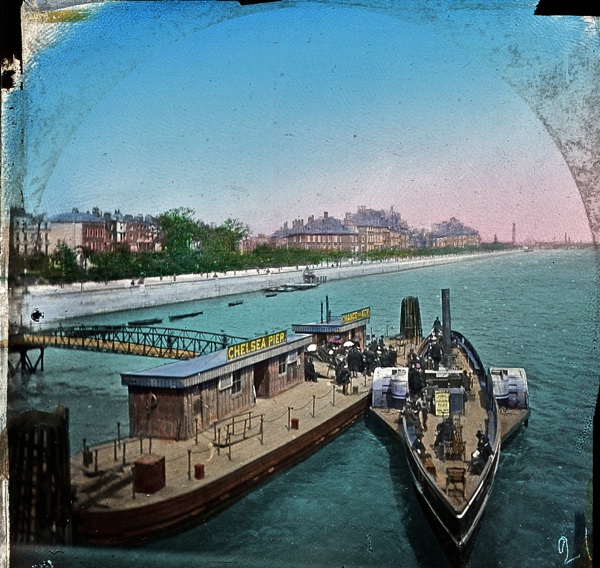
A trip from Chelsea Pier, c.1910.

Doggett’s Coat & Badge Race, c.1920.

Feeding pigeons outside St Paul’s, c.1910.

Building the Great Wheel, Earls Court, c.1910.
Glass slides copyright © Bishopsgate Institute
You may also like to take a look at
Viscountess Boudica’s Easter
On Easter Sunday, we celebrate our dearly beloved Viscountess Boudica of Bethnal Green who once entertained us with her seasonal frolics and capers but now is exiled to Uttoxeter

She may be no Spring chicken but that never stopped the indefatigable Viscountess Boudica of Bethnal Green from dressing up as an Easter chick!
As is her custom at each of the festivals which mark our passage through the year, she embraced the spirit of the occasion wholeheartedly – festooning her tiny flat with seasonal decor and contriving a special outfit for herself that suited the tenor of the day. “Easter’s about renewal – birth, life and death – the end of one thing and the beginning of another,” she assured me when I arrived, getting right to the heart of it at once with characteristic forthrightness.
I felt like a child visiting a beloved grandmother or favourite aunt whenever I call round to see Viscountess Boudica because, although I never knew what treats lie in store, I was never disappointed. Even as I walked in the door, I knew that days of preparation preceded my visit. Naturally for Easter there were a great many fluffy creatures in evidence, ducks and rabbits recalling her rural childhood. “When my uncle had his farm, I used to put the little chicks in my pocket and carry them round with me,” she confided with a nostalgic grin, as she led me over to admire the wonder of her Easter garden where yellow creatures of varying sizes were gathering upon a small mat of greengrocer’s grass, around a tree hung with glass eggs, as if in expectation of a sacred ritual.
I cast my eyes around at the plethora of Easter cards, testifying to the popularity of the Viscountess, and her Easter bunting and Easter fairy lights that adorned the walls. There could be no question that the festival was anything other than Easter in this place. “As a child, I used to get a twig and spray it with paint and hang eggs from it,” she explained, recalling the modest origin of the current extravaganza and adding, “I hope this will inspire others to decorate their homes.”
“Cadbury’s Dairy Milk is my favourite,” she confessed to me, chuckling in excited anticipation and patting her waistline warily, “I probably will eat a lot of chocolate on Easter Monday – once I start eating chocolate, I can’t stop.” And then, just like that beloved grandmother or favourite aunt, Viscountess Boudica kindly slipped a chocolate egg into my hands, as I said my farewell and carried it off under my arm back to Spitalfields as a proud trophy of the day.


Viscountess Boudica writes her Easter cards


“yellow creatures of varying sizes were gathering upon a small mat of greengrocer’s grass, around a tree hung with glass eggs, as if in expectation of a sacred ritual”

Viscountess Boudica turns Weather Girl to present the forecast for the Easter Bank Holiday – “I predict a dull start with a few patches of sunshine and some isolated showers. In the West Country, it will be nice all day with temperatures between sixty and eighty degrees Farenheit. There will be a small breeze on the coast and sea temperature of around fifty-nine degrees Farenheit.”


Easter blessings to you from Viscountess Boudica!

Viscountess Boudica and her fluffy friends
Be sure to follow Viscountess Boudica’s blog There’s More To Life Than Heaven & Earth
Take a look at
The Departure of Viscountess Boudica
Viscountess Boudica’s Domestic Appliances
Viscountess Boudica’s Halloween
Viscountess Boudica’s Christmas
Viscountess Boudica’s Valentine’s Day
Viscountess Boudica’s St Patrick’s Day
Read my original profile of Mark Petty, Trendsetter
and take a look at Mark Petty’s Multicoloured Coats
Robson Cezar’s New Whitechapel Market Houses

Through these last winter months, Spitalfields artist Robson Cezar has been collecting wooden fruit crates in Whitechapel Market on the way to his studio in Bow again, and making them into a new series of intricately crafted little wooden houses.
Each one is a day’s work for Robson and many are recognisable as inspired by buildings around the East End – including houses, signal boxes and a chapel. Photographer Sarah Ainslie visited him in his studio this week to document his creations. Every one is different and each comes with an LED light and battery.
The houses are £85 each plus £3.50 postage & packing. We are selling them on a first-come-first-served basis, so if you would like one please email spitalfieldslife@gmail.com giving your first, second and third choice, and we will supply payment details. We can only post these within the United Kingdom.
These houses are sculptures not toys and we do not recommend them for children under the age of twelve.


“During the first lockdown I walked the empty streets and reflected on the importance of having a safe and comfortable living space, especially during a time of crisis. I was inspired to create small wooden house sculptures using fruit and vegetable crates. My experience growing up in a tiny wooden house without any comfort in a favela in Brazil influences my work. To find scrap wood, I go to Whitechapel Market, which I pass every day on my way to my studio in Bow.”
Robson Cezar


C

E

F

G

H

I

K

M

N

Photographs copyright © Sarah Ainslie
You may also like to read about
Robson Cezar’s Wooden Houses from Whitechapel
The Way Of The Cross In Stepney

David Hoffman undertook a significant body of photography documenting the East End in the seventies and eighties that I plan to publish this year as a book entitled, A PLACE TO LIVE, Endurance & Joy in Whitechapel, accompanied by a major photographic exhibition at House of Annetta in Spitalfields.
I believe David’s work is such an important social document, distinguished by its generous humanity and aesthetic flair, that I must publish a collected volume. I have raised around a third of the money and have a growing list of supporters for this project now, so if you share my appreciation of David’s photography and would support this endeavour, please drop me a line at spitalfieldslife@gmail.com

A costume fitting
In the late seventies, Contributing Photographer David Hoffman documented the religious drama enacted upon the streets of Stepney around Easter time, recording astonishing images of magical realist intensity which feel closer to the medieval world than to our own day.
Gordon Kendall who played Jesus wrote this memory of his experience.
‘On a cold wet and depressing evening in April 1980, well over 100 actors, production crew and 2000 people lived through the experience of Our Lord’s Way Of The Cross enacted in the streets and estates of Stepney.
The excitement and challenge of playing Jesus really began on the Sunday before the event. Some of the actors were trying out their costumes and they looked very impressive.
Half way through the rehearsal, I needed to visit the toilet and so excused myself from the bodyguard of soldiers in costume. I knocked at the door of a flat. A lady came out and I requested the use of her toilet. She looked at me very oddly – she was a elderly lady – and she asked me who I was. I replied I was playing the part of Jesus and she flashed me a look which revealed she did not believe me, but she said ‘Come in.’
As I went through the flat I could see someone sleeping on the sofa in the lounge. When I closed the bathroom door, I could hear the woman waking up her friend and saying, ‘Nell, there’s a man in the toilet who says he’s Jesus.’ Then I heard some rapid movement and I could only wonder at the thoughts of this woman, struggling to her feet.
There was a knocking at the front door as I came out of the toilet and the two women opened it to be confronted by a fierce Roman Centurion in full regalia, asking if Jesus was in the flat. Fortunately, they relaxed into joyous smiles and it was kisses and handshakes all round as we departed.’

Roman soldiers


Jesus in flares

The arrest of the two thieves

Preparing for the crucifixion


A Roman legion marching


Pilate speaks


Roman soldiers at St Dunstan’s


Jesus consoles Mary

Bespectacled Jesus

Roman Centurion in regalia

Jesus gives himself up


The march to the crucifixion

The soldiers stripping Jesus of his raiments

Crucifixion courtesy of Whitbread

Behold, Jesus is risen in St Dunstan’s Church!
Photographs copyright © David Hoffman
You may also like to take a look at
Hot Cross Buns At St Bartholomew The Great
Click here to book for THE GENTLE AUTHOR’S TOUR OF THE CITY OF LONDON on Easter Monday
Tomorrow at 11:30am sees the Ceremony of the Widow’s Sixpence in Smithfield

Distribution of buns to widows in the churchyard of St Bartholomew the Great
St Bartholomew the Great is one of my favourite churches in the City, a rare survivor of the Great Fire, it boasts the best Norman interior in London. Composed of ancient rough-hewn stonework, riven with deep shadow where feint daylight barely illuminates the accumulated dust of ages, this is one of those rare atmospheric places where you can still get a sense of the medieval world glimmering. Founded by Rahere in 1123, the current structure is the last vestige of an Augustinian Priory upon the edge of Smithfield, where once martyrs were burnt at the stake as public entertainment and the notorious St Bartholomew Fair was celebrated each summer from 1133 until 1855.
In such a location, the Good Friday tradition of the distribution of charity in the churchyard to poor widows of the parish sits naturally. Once known as the ‘Widow’s Sixpence,’ this custom was institutionalised by Joshua Butterworth in 1887, who created a trust in his name with an investment of twenty-one pounds and ten shillings. The declaration of the trust states its purpose thus – “On Good Friday in each year to distribute in the churchyard of St. Bartholomew the Great the sum of 6d. to twenty-one poor widows, and to expend the remainder of such dividends in buns to be given to children attending such distribution, and he desired that the Charity intended to be thereby created should be called ‘the Butterworth Charity.'”
Those of us who gathered in the churchyard at St Bartholomew the Great on Good Friday were blessed with sunlight. Yet we could not resist a twinge of envy for the clerics in their heavy cassocks and warm velvet capes as they processed from the church in a formal column, with priests at the head attended by vergers bearing wicker baskets of freshly buttered Hot Cross Buns, and a full choir bringing up the rear.
In the nineteen twenties, the sum distributed to each recipient was increased to two shillings and sixpence, and later to four shillings. Resplendent in his scarlet robes, Rev Martin Dudley, Rector of St Bartholomew the Great climbed upon the table tomb at the centre of the churchyard traditionally used for that purpose and enacted the motions of this arcane ceremony – enquiring of the assembly if there were a poor widow of the parish in need of twenty shillings. To his surprise, a senior female raised her hand. “That’s never happened before!” he declared to the easy amusement of the crowd.
I detected a certain haste to get to the heart of the proceedings – the distribution of the Hot Cross Buns. Rev Dudley directed the vergers to start with choir who exercised admirable self-control in only taking one each. Then, as soon as the choir had been fed, the vergers set out around the boundaries of the yard where senior females with healthy appetites reached forward eagerly to take their allotted Hot Cross Buns in hand. The tense anticipation gave way to good humour as everyone delighted in the strangeness of the ritual which rendered ordinary buns exotic. Reaching the end of the line at the furthest extent of the churchyard, the priests wasted no time in satisfying their own appetites and, for a few minutes, silence prevailed as the entire assembly munched their buns.
Then Rev Martin returned to his central position upon the table tomb. “And now, because there is no such thing as free buns,” he announced, “we’re going to sing a hymn.” Yet we were more than happy to oblige, standing replete with buns on Good Friday and enjoying the April sunlight.

The Priory Church of St Bartholomew the Great, a century ago.


John Betjeman once lived in this house overlooking the churchyard.


The ceremony of the Widow’s Sixpence in the nineteen twenties.

“God’s blessing upon the frosts and cold!”

A crowd gathers for the ceremony a hundred years ago.

Hungry widows line up for buns.

The churchyard in the nineteenth century.


Rev Martin Dudley BD MSc MTh PhD FSA FRHistS AKC is the 25th Rector since the Reformation.

Testing the buns.


The clerics ensure no buns go to waste.

Hymns in the cold – “There is a green hill far away without a city wall…”


The Norman interior of St Bartholomew the Great at the beginning of the twentieth century.

The Gatehouse prior to bombing in World War I and reconstruction.

Archive images courtesy Bishopsgate Institute
You may also like to read about


