
The Old City Of London
The City of London has long been a subject of fascination for me and these powerfully atmospheric glass slides of over a century ago from the London & Middlesex Archaeological Society Collection at the Bishopsgate Institute evoke the drama and mystery of this ancient citadel magnificently.
Starting on Sunday 4th June, join me on the first Sunday of each month through the summer at 2pm on a storytelling ramble across the Square Mile, from the steps of St Paul’s through the narrow alleys and lanes to the foot of old London Bridge, in search of the wonders and the wickedness of the City of London.
Click here to book for THE GENTLE AUTHOR’S TOUR OF THE CITY OF LONDON
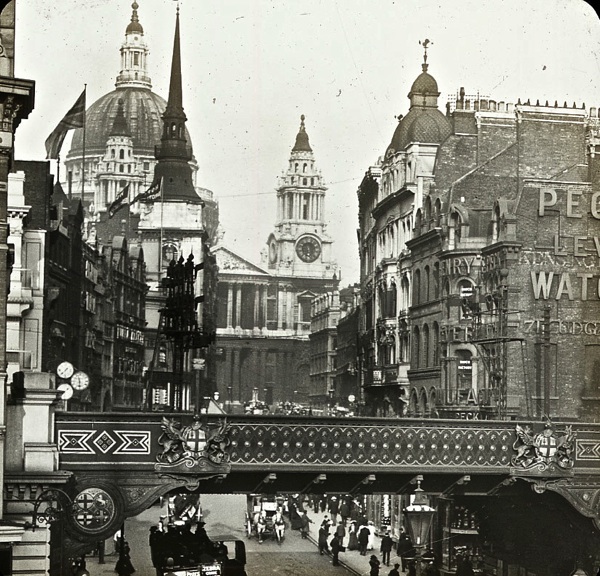
Ludgate Hill

George & Vulture

Throgmorton St

Apothecaries Hall

Goldsmiths Hall

Tower Bridge

Mansion House

London Bridge

Earl of Warwick

The Old Dick Whittington, Clothfair

Billingsgate Market

The Little Midshipman, Leadenhall St

Leadenhall Market

St Mary Woolnoth

Doors in Laurence Pountney Lane

St Michael’s Cornhill

St Mary Le Bow

Watchhouse Smithfield

London Bridge

St Margaret Pattens

The Pannyer Boy

St Paul’s Cathedral

St Helen’s Bishopsgate

Fishmongers Hall

Leadenhall Market

Mark Lane

All Hallows London Wall

Royal Exchange

St Paul’s Cathedral
London & Middlesex Archaeological Society Collection photos courtesy Bishopsgate Institute
In Search Of Joseph Merceron
Biographer Julian Woodford, author of The Boss of Bethnal Green, will be telling the breathtakingly appalling story of Joseph Merceron on Tuesday 2nd May 6pm at the Hanbury Hall in Hanbury St where Merceron was baptised in 1764.
CLICK HERE TO BOOK A TICKET FOR £6
Joseph Merceron was the East End’s first corrupt politician and also the East End’s first gangster, ruling Spitalfields and Bethnal Green for fifty years through the end of the eighteenth century and the early nineteenth century. Yet he was also an exploitative developer who built swathes of substandard housing, which ultimately led to cholera outbreaks and contributed to the human catastrophe of poverty and overcrowding in the nineteenth century East End.

Birthplace of Joseph Merceron “On Sunday 29th January 1764, Joseph Merceron was born on Brick Lane, which formed the boundary between the parishes of Spitalfields and its eastward neighbour Bethnal Green. His parents were James Merceron, a Huguenot pawnbroker and former silk weaver, and his second wife Ann. The Mercerons had three other children: Annie, Joseph’s two-year-old sister, John, almost thirteen, and Catherine, eight, the latter two being the surviving offspring from James’s first marriage.”

“Joseph was christened at the local Huguenot church known as La Patente, in Brown’s Lane (the building and lane are now known as Hanbury Hall and Hanbury Street) just a short walk from his parents’ house. The Mercerons, like other Huguenot families in the area, clung tightly to their nationality. Joseph’s details in the register of baptisms – the first recorded at La Patente for 1764 – were entered in French, which many families still insisted on speaking out of respect for their ancestors.”

“On the corner of Fournier Street stands the Jamme Masjid, since 1976 one of London’s largest mosques. For much of the twentieth century it was a synagogue, and before that it spent a decade as a Methodist chapel. Originally, before a brief occupation by the London Society for Promoting Christianity amongst the Jews, it was a Huguenot church. High on a wall is the date of its completion, 1743, and a sundial with its motto: Umbra Sumus (‘we are shadows’).”

“The Merceron pawnshop at 77 Brick Lane was at the epicentre of this district, among a row of ramshackle buildings directly opposite Sir Benjamin Truman’s imposing and famous Black Eagle brewery. The Black Eagle was one of the largest breweries in the world. To those living opposite, the mingled odours of yeast, malt and spilt beer – not to mention the steaming output of the many dray horses – must have been overpowering, even by the pungent standards of the times. The noise, too, was tremendous, as the shouts of draymen punctuated the rumble of horse-drawn carriages and carts up and down the lane.”


“The judge had ordered the execution to take place several miles away at Tyburn, the usual site of such events in London, but the master weavers – keen to dispose of Valline and Doyle in front of their own community to discourage further loom cutting – lobbied successfully to change the location to ‘the most convenient place near Bethnal Green church’. Several thousand people assembled outside The Salmon & Ball to see Valline and Doyle hang. Bricks and stones were thrown during the assembly of the gallows. They protested their innocence to the end, but to no effect. Doyle’s last words were enough to ignite an already explosive situation. As soon as the hanging was over, the crowd tore down the gallows and surged back to Spitalfields…”

“On 26th October 1795, Joseph Merceron donned his magistrate’s wig and robes and climbed the steps of the imposing Sessions House on Clerkenwell Green for his first Middlesex Sessions meeting. This was a world away from Brick Lane. The Sessions House, built in the aftermath of the Gordon Riots, was awe-inspiring and was said to rival any courthouse in England.”

“St John on Bethnal Green was built by the eminent architect Sir John Soane but budgetary constraints led to his grand design for a steeple being aborted, replaced with a stunted tower of particularly phallic design that rapidly became a source of bawdy amusement throughout the neighbourhood. Merceron was outraged. Announcing that the design had ‘mortified and disappointed the expectations of almost every individual’, he ordered Brutton to write to complain. The task put Brutton in an acutely awkward position: how to explain the exact nature of the problem? The vestry clerk’s literary skills were tested to the limit as he described the tower’s ‘abrupt termination in point of altitude’ that made it ‘an object of low wit and vulgar abuse’.”

“All the great and good of London’s East End were there. Twenty thousand people, packed six deep in places along the Bethnal Green Road, had turned out to see the cortège on its way to St Matthew’s church. Just before one o’clock the procession arrived, at a sedate walking pace. The jet-black horses, with their sable plumes, were blinkered to prevent anything from distracting the stately progress of the hearse. Merceron was the original ‘Boss’ of Bethnal Green, the Godfather of Regency London, controlling its East End underworld long before celebrity mobsters such as the infamous Kray twins made it their territory. His funeral at the church of St Matthew, Bethnal Green – the very same church where the Krays’ funerals would be held more than 150 years later – reflected his importance: it was by far the biggest event to take place at the church since it was established in the 1740s.”

Tomb of Peter Renvoize “His closest ally and childhood friend, Peter Renvoize, was repeatedly elected as churchwarden for much of this period, from which position he helped Merceron pull off his most audacious financial coup yet. Bethnal Green’s share of the government relief grant was £12,200, equivalent to almost three times the annual poor’s rates raised by the parish. Having obtained the money, Merceron appointed himself chairman of a committee, with four of his closest associates, including Renvoize, to manage its distribution. What happened next is difficult to determine. But it is clear that, five months after the government had advanced the funds, there were several thousand pounds sitting in Merceron’s own account.”

“As for Joseph Merceron, lying buried in the shadow of the vestry room he dominated for half a century, there is one last strange episode to recount. In the afternoon sunshine of Saturday 7th September, 1940, as millions of Londoners sat down to their tea, the ‘Blitz’ began. Bethnal Green suffered terribly, and in the carnage St Matthew’s church took a direct hit from an incendiary bomb. Next morning it was a roofless, burnt out shell, but two gravestones survived the bombing intact. The first, outside the main entrance to the church, is that of Merceron’s old friend Peter Renvoize. About twenty paces away, a large pink granite slab, surrounded by a low iron rail in the shelter of the south wall of the church, is the grave of Joseph Merceron and his family. He spent a lifetime cheating the law, somehow it is fitting that he should have cheated the Luftwaffe too.”

“Merceron Houses, erected in 1901 by the East End Dwellings Company on land formerly part of Joseph Merceron’s garden in Bethnal Green.”
You may also like to read about
The Spitalfields Bowl
CLICK HERE TO JOIN ME FOR A WALK AROUND SPITALFIELDS
NEW FOR 2023: CLICK HERE TO JOIN ME FOR A TOUR OF THE CITY OF LONDON

One of these streets’ most-esteemed long-term residents summoned me to view an artefact that few have seen, the fabled Spitalfields Bowl. Engraved by Nicholas Anderson, a pupil of Laurence Whistler, it incarnates a certain moment of transition in the volatile history of this place.
I arrived at the old house and was escorted by the owner to an upper floor, and through several doors, to arrive in the room where the precious bowl is kept upon its own circular table that revolves with a smooth mechanism, thus avoiding any necessity to touch the glass. Of substantial design, it is a wide vessel upon a pedestal engraved with scenes that merge and combine in curious ways. You have the option of looking down upon the painstakingly-etched vignettes and keeping them separate them in your vision, or you can peer through, seeing one design behind the other, morphing and mutating in ambiguous space as the bowl rotates – like overlaid impressions of memory or the fleeting images of a dream.
Ever conscientious, the owner brought out the correspondence that lay behind the commission and execution of the design from Nicholas Anderson in 1988. Consolidating a day in which the glass engraver had been given a tour of Spitalfields, one letter lists images that might be included – “1. The church and steeple of Christ Church, Spitalfields, and its domination of the surrounding areas. 2. The stacks, chimneys and weaving lofts. 3. The narrowness of the streets and the list and lean of the buildings with their different doorways and casement windows.”
There is a mesmerising quality to Nicholas Anderson’s intricate design that plays upon your perception, offering insubstantial apparitions glimpsed in moonlight, simultaneously ephemeral and eternal, haunting the mind. You realise an object as perilously fragile as an engraved glass bowl makes an ideal device to commemorate a transitory moment.
“It took him months and months,” admitted the proud owner,“and it represents the moment everything changed in Spitalfields, in which the first skyscraper had gone up and there were cranes as evidence of others to come. The Jewish people have left and the Asians are arriving, while at the same time, you see the last of the three-hundred-year-old flower, fruit and vegetable market with its history and characters, surrounded by the derelict houses and filthy streets.”
Sequestered in a locked room, away from the human eye, the Spitalfields Bowl is a spell-binding receptacle of time and memory.


The Jewish soup kitchen

To the left is the Worrall House, situated in a hidden courtyard between Princelet St & Fournier St


A moonlit view of Christ Church over the rooftops of Fournier St

The bird cage with the canary from Dennis Severs House


“He was a tinker who overwintered in Allen Gardens and used to glean every morning in the market…”

To the left is Elder St and the plaque commemorating the birth of John Wesley’s mother is in Spital Sq.

An Asian couple walk up Brushfield St, with the market the left and the Fruit & Wool Exchange and Verdes to the right

Photographs copyright © Lucinda Douglas-Menzies
The Broderers Of St Paul’s
CLICK HERE TO JOIN ME FOR A WALK AROUND SPITALFIELDS
NEW FOR 2023: CLICK HERE TO JOIN ME FOR A TOUR OF THE CITY OF LONDON

Anita Ferrero
Like princesses from a fairy tale, the Broderers of St Paul’s sit high up in a tower at the great cathedral stitching magnificent creations in their secret garret. Contributing Photographer Sarah Ainslie & I climbed up one hundred and forty-one steps to pay a visit upon these nimble-fingered needleworkers.
‘There are fourteen of us, we chat, we tell stories and we eat chocolate,’ explained Anita Ferrero by way of modest introduction, as I stood dazzled by the glittering robes and fine embroidery. ‘It’s very intense work because the threads are very bright,’ she added tentatively, lest I should think the chocolate comment revealed undue levity.
I was simply astonished by the windowless chamber filled with gleaming things. ‘There are thirteen tons of bells suspended above us,’ Anita continued with a smile, causing me to cast my eyes to the ceiling in wonder, ‘but it’s a lovely sound that doesn’t trouble us at all.’
Observing my gaze upon the magnificent textiles, Anita drew out a richly-embellished cope from Queen Victoria’s Jubilee. ‘This is cloth of gold’ she indicated, changing her voice to whisper, ‘it ceased production years ago.’
‘There are still wonderful haberdashers in Kuala Lumpur and Aleppo,’ she informed me as if it were a closely-guarded secret, ‘I found this place there that still sold gold thread. If someone’s going to Marrakesh, we give them a shopping list in case they stumble upon a traditional haberdashery.’ Next, Anita produced a sombre cope from Winston Churchill’s funeral, fashioned from an inky black brocade embroidered with silver trim, permitting my eye to accommodate to the subtler tones that can be outshone by tinsel.
In this lofty chamber high above the chaos of the city, an atmosphere of repose prevails in which these needlewomen pursue their exemplary work in a manner unchanged over millennia. I was in awe at their skill and their devotion to their art but Anita said, ‘As embroiderers, we are thankful to have a purpose for our embroidery because there’s only so many cushions you can do.’
I walked over to a quiet corner where Rachel Rice was stitching an intricate border in gold thread. ‘I learnt my skills from my mother and grandmother, and I always enjoyed sewing and dressmaking but that’s not fine embroidery like this,’ she admitted, revealing the satisfaction of one who has spent a life devoted to needlework. Yet she qualified her pride in her craft by admitting her humanity with a weary shrug, ‘Some of the work is extremely tedious and it’s never seen.’
‘We are all very expert but our eyesight is fading and a few of us are quite elderly,’ confided Anita, thinking out loud for the two of them as she picked up the story and exchanged a philosophical grin with Rachel. Nowhere in London have I visited a sanctum quite like the Broderers chamber or encountered such self-effacing creative talents.
‘We not so isolated up here,’ emphasised Anita, lifting the mood with renewed enthusiasm, ‘Most people who work in the Cathedral know we’re here. We often do favours for members of staff, taking up trouser hems etc – consequently, if we have a problem, we can call maintenance and don’t have to wait long.’
I was curious to learn of the Broderers’ current project, the restoration of a banner of St Barnabas. ‘He’s the one saint I’d like to meet because he’s called ‘The Son of Encouragement’ – he looks like a nice guy,’ confessed Anita fondly, laying an affectionate hand upon the satin, ‘We’re restoring the beard of St Barnabas at present and we’re getting Simon the good-looking Verger up here to photograph his beard.’

Rachel Rice – ‘I learnt my skills from my mother and grandmother’


Sophia Sladden


Margaret Gibberd

‘As embroiderers, we are thankful to have a purpose for our embroidery because there’s only so many cushions you can do.’


Judy Hardy

‘We chat, we tell stories and we eat chocolate..’


Virger Simon Brears is the model for the beard of St Barnabas


View from the Triforium
Photographs copyright © Sarah Ainslie
You may also like to take a look at
Ernest George’s London Etchings
CLICK HERE TO JOIN ME FOR A WALK AROUND SPITALFIELDS
NEW FOR 2023: CLICK HERE TO JOIN ME FOR A TOUR OF THE CITY OF LONDON

Aldgate
Stefan Dickers, Archivist at Bishopsgate Institute, introduced me to these fine copper plate etchings by Ernest George (1839-1922). In the eighteen-eighties, George set out to immortalise those fragments of London which spoke of times gone by and Londoners long dead, recording buildings and views which have for the most part now disappeared.
I realise that my affection for these images sets me in line with the generations of chroniclers who have made it their business to document the transience of the city, starting with John Stow who wrote the very first Survey of London between 1560 and 1598 to describe the streets of his childhood that were vanishing before his eyes.
Ernest George’s etchings were published by the Fine Art Society in New Bond St in 1884, a magnificent temple of culture designed by Edward William Godwin which survived through the twentieth century only to close in August 2018.

Bishopsgate

Wych St, Strand

Fouberts Place, Soho

Crown Court, Pall Mall

St Bartholomew, Smithfield

Warwick Lane, City

Tower of London

London Bridge

Staple Inn, Holborn

Drury Lane

St John’s Gate, Clerkenwell

Limehouse

Shadwell
Images courtesy Bishopsgate Institute
You may also like to look at
The Bluebells Of Bow
CLICK HERE TO JOIN ME FOR A WALK AROUND SPITALFIELDS THIS SPRING

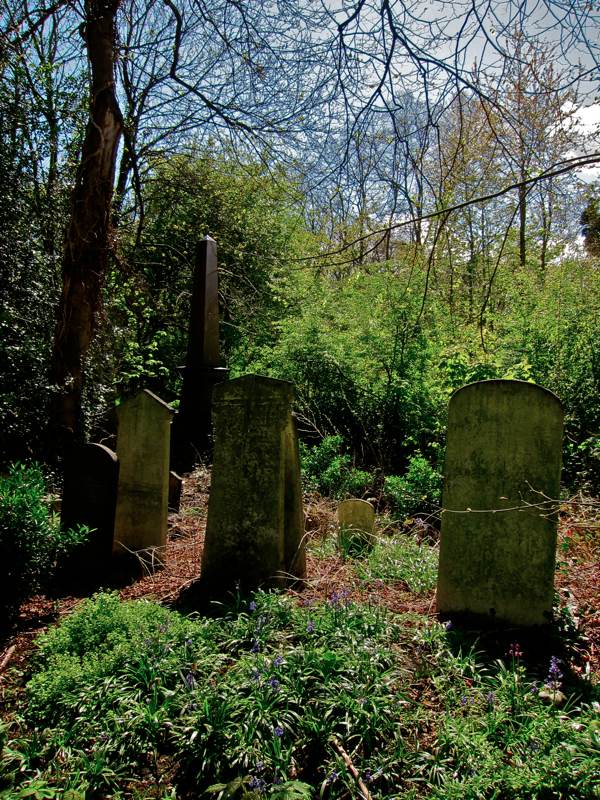
With a few bluebells in flower in my garden in Spitalfields, I was inspired make a visit to Bow Cemetery and view the display of bluebells sprouting under the tall forest canopy that has grown over the graves of the numberless East Enders buried there. In each season of the the year, this hallowed ground offers me an arcadian refuge from the city streets and my spirits always lift as I pass between the ancient brick walls that enclose it, setting out to lose myself among the winding paths, lined by tombstones and overarched with trees.
Equivocal weather rendered the timing of my trip as a gamble, and I was at the mercy of chance whether I should get there and back in sunshine. Yet I tried to hedge my bets by setting out after a shower and walking quickly down the Whitechapel Rd beneath a blue sky of small fast-moving clouds – though, even as I reached Mile End, a dark thunderhead came eastwards from the City casting gloom upon the land. It was too late to retrace my steps and instead I unfurled my umbrella in the cemetery as the first raindrops fell, taking shelter under a horse chestnut, newly in leaf, as the shower became a downpour.
Standing beneath the dripping tree in the half-light of the storm, I took a survey of the wildflowers around me, primroses spangling the green, the white star-like stitchwort adorning graves, a scattering of palest pink ladies smock highlighting the ground cover, yellow celandines sharp and bright against the dark green leaves, violets and wild strawberries nestling close to the earth and may blossom and cherry blossom up above – and, of course, the bluebells’ hazy azure mist shimmering between the lines of stones tilting at irregular angles. Alone beneath the umbrella under the tree in the heart of the vast graveyard, I waited. It was the place of death, but all around me there was new growth.
Once the rain relented sufficiently for me to leave my shelter, I turned towards the entrance in acceptance that my visit was curtailed. The pungent aroma of wild garlic filled the damp air. But then – demonstrating the quick-changing weather that is characteristic of April – the clouds were gone and dazzling sunshine descended in shafts through the forest canopy turning the wet leaves into a million tiny mirrors, reflecting light in a vision of phantasmagoric luminosity. Each fresh leaf and petal and branch glowed with intense colour after the rain. I stood still and cast my eyes around to absorb every detail in this sacred place. It was a moment of recognition that has recurred throughout my life, the awe-inspiring rush of growth of plant life in England in spring.




You may also like to read about
Thierry Girard’s East End
Today it is my pleasure to show these photographs by Thierry Girard from 1976

“More than simply pictures from my early years as a photographer, these are the starting point of my photographic work. At the beginning of 1976, when I was twenty-four, I had just graduated from Paris Institute of Political Studies and I had no specific idea about my future. I was very interested in photography, I bought my first photography books and I went to exhibitions, but I had very little experience.
At that time, my interest was in British photography and photographs taken in Britain by foreigners. I was an Anglophile. I was fond of Bill Brandt’s work, of course, and I was familiar with the photographs of Tony Ray-Jones, Homer Sykes and David Hurn – but the real catalyst was to be Robert Frank’s portfolio of London & Wales published in the 1975 edition of the Creative Camera International Yearbook. Knowing London rather well —I had stayed there several times in the previous years— I immediately related to the atmosphere of Frank’s pictures.
So I decided to go back to London for a challenge, a rite of initiation: to face the outside world and do photography. I stayed in the East End where I had lived as a student, although I did not intend to do a reportage about the East End or Eastenders. I just wanted to walk for hours and days in, snatching bits of life, passing through dilapidated districts, pushing doors of pubs, rambling through markets and playing with kids. I spent time with a wonderful couple, clever and cheerful people, but living in poverty in a damp basement flat while sewing ties for chic French companies. At lunchtime or in the evenings I went to strip pubs. The people attending the shows, both men and women, were locals.
I hope these photographs made in London in 1976 are worth revisiting. Very few of these pictures have ever been published or exhibited, but what I did there at the time has been decisive for my future as a photographer.” – Thierry Girard

At the Elephant, Dalston

In Brick Lane

At the Elephant, Dalston

In Bethnal Green

Alan B, homeworker in Graham Rd, Hackney

In Mare St

In Wapping

In Ridley Rd Market

In Dalston

Betty & Penny B, Graham Rd, Hackney

In Hackney

At Limehouse Social Club

In Wapping

At Limehouse Social Club

In Bethnal Green

In Tower Hamlets

In Hackney

In Hackney

Hackney Empire
Photographs copyright © Thierry Girard
You may also like to take a look at


