
The Tale Of James Hadfield’s Pistol
CLICK HERE TO JOIN ME FOR A WALK AROUND SPITALFIELDS THIS SPRING
NEW FOR 2023: CLICK HERE TO JOIN ME FOR A TOUR OF THE CITY OF LONDON

Click to enlarge this print, reproduced courtesy of V&A Museum
Biographer Julian Woodford, author of ‘The Boss of Bethnal Green’, will be telling the breathtakingly appalling story of Joseph Merceron on Tuesday 2nd May 6pm at the Hanbury Hall in Hanbury St where Merceron was baptised in 1764.
CLICK HERE TO BOOK A TICKET FOR £6
Merceron was the East End’s first corrupt politician and also the East End’s first gangster, ruling Spitalfields and Bethnal Green for fifty years through the end of the eighteenth century and the early nineteenth century.
Today Julian Woodford outlines the tale of James Hadfield, mysterious would-be assassin of George III, revealing how his pistol found its way into the hands of Merceron and where it is today.
When I talk about how Joseph Merceron ruled the East End for half a century, I am often asked ‘How did he get away with it?’ It is a question I could not answer until I discovered that he owned a gun which almost changed English history.
In 1795, Merceron used his position of influence in Bethnal Green to become a magistrate. Just weeks afterwards, King George III’s carriage windows were shattered by an angry mob as he travelled to open Parliament and Prime Minister William Pitt the Younger launched a ‘reign of terror’ with laws forbidding public assembly or publication of ‘seditious writings.’ Secretly, the Home Office also set up an extensive spy network in the East End administered by the local magistrates and their clerks.
During the early seventeen-nineties, in the wake of the French Revolution, radical societies sprang up across London – especially in the East End. Their members agitated for universal suffrage or, in more extreme, cases a revolution of their own. Over the next few years, Pitt’s ‘Gagging Acts’ were applied with increasing severity and the Home Office spies busied themselves in infiltrating radical societies. Democratic activists and mutineering sailors were rounded up and incarcerated without trial at Coldbath Fields Prison in Clerkenwell.
The ritual abuse they suffered at the hands of the Prison Governor, Thomas Aris, was ignored or even encouraged by Merceron and his fellow magistrates. But when the prisoners’ plight was raised in Parliament by the radical MP Sir Francis Burdett, it became the subject of a national scandal that rocked the Pitt government and damaged the credibility of the Middlesex magistrates.
Then, in the spring of 1800, came an act of terror that appeared to justify Pitt’s harsh conservatism. James Hadfield was a British soldier who had suffered horrendous head wounds in the Napoleonic Wars, and been captured and tortured by the French. Released in a prisoner exchange but traumatised to the point of insanity and unfit for further service, Hadfield was simply turned onto the London streets. Here he encountered an itinerant preacher named Bannister Truelock, who persuaded Hadfield he could trigger the Second Coming of Christ – he just needed to shoot the King and die in the attempt.
On 15th May 1800, Hadfield bought an old flintlock pistol from a pawnbroker and made his way to Drury Lane Theatre, where George III was due to attend a Royal Command Performance. As the King took a bow from the Royal Box, Hadfield pulled out his pistol and fired, narrowly missing his Majesty. Despite a lengthy investigation and an apparemt attempt by the government to rig the jury, Hadfield was acquitted of murder on the grounds of insanity, setting an important legal precedent. Instead of being executed, he was committed to the Bethlehem hospital in Moorfields where he spent the next forty-one years writing poems to his pet squirrels.
You might wonder what the connection is to The Boss of Bethnal Green? In 2006, when I started researching my book, I traced Joseph Merceron’s descendants and met his great-great-great grandson Daniel, who showed me an ancient tin box full of Merceron’s papers. This was enough to make my journey worthwhile, but I was dumbstruck when Daniel walked back into the room brandishing an old flintlock pistol and casually announced that – according to family lore – it had once belonged to The Boss and was used in an assassination attempt on George III at Drury Lane in 1800.
That was all Daniel knew and, although I remembered James Hadfield’s story, I could not think how Joseph Merceron could possibly have been involved. Just an hour’s research on the internet uncovered the answer. The transcript of Hadfield’s trial revealed the key prosecution witness was Major Wright, a solicitor of Wellclose Sq and clerk to the Tower Hamlets magistrates. He was a significant figure in Merceron’s circle and closely linked to the Home Office spy network. At Drury Lane, the Major had been sitting within arm’s reach of Hadfield and collared him with his weapon after the event. Among the trial papers are letters from Home Office spies claiming that Hadfield and Truelock were members of the London Corresponding Society which had infiltrated army regiments, including Hadfield’s 15th Light Dragoons.
Remarkably, Major Wright was allowed to keep the pistol as a souvenir. Yet his will lists a print of the assassination attempt among his effects not the gun, which had given to his master – Joseph Merceron. Based on the evidence, I believe Major Wright was secretly tailing James Hadfield on behalf of the Home Office, but it did not suit the government to blow his cover at Hadfield’s trial.
This anecdote offers the explanation for the astonishing longevity of Joseph Merceron’s career as the Godfather of Regency London. Despite being responsible for appalling corruption on a vast scale, he was the devil-the-government-knew, manning the front line in the East End for William Pitt’s ‘war on sedition.’ Merceron owned and licensed many of the pubs where the radical societies met. Merceron’s clerks were actively involved in running spies and, despite repeated attempts to prosecute him during his first three decades in power, the government repeatedly refused to do so and it was only in 1818 – well after the end of the Napoleonic Wars – that he was finally brought to trial and jailed briefly.

James Hadfield’s pistol – the gun that nearly changed history
You may also like to read about
Among The Pagans At Beltane
CLICK HERE TO JOIN ME FOR A WALK AROUND SPITALFIELDS THIS SPRING
NEW FOR 2023: CLICK HERE TO JOIN ME FOR A TOUR OF THE CITY OF LONDON

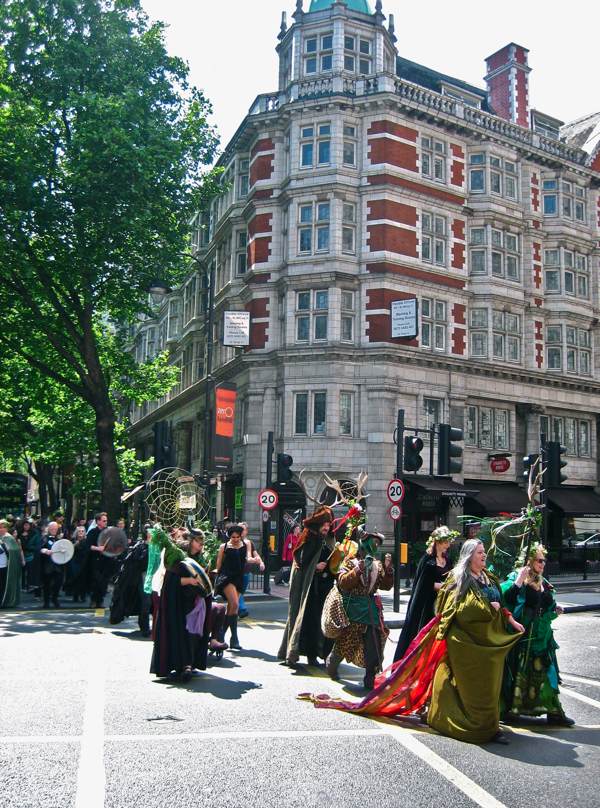
When my friend Geraldine Beskin, the witch, who runs the Altlantis Bookshop invited me to attend the Pagan Pride Parade, I knew it was too good an opportunity to miss. From far and wide, emerging from their secret groves and leafy bowers, the pagans converged upon Red Lion Square. They dusted off their antlers, wove their garlands of green and desported themselves in floaty dresses to meet the morn. Many were old friends who have gathered here annually in this quiet corner of the old square in Holborn for years to celebrate pagan rites, and they were eager to embrace the spirit of the occasion, joining hands and frolicking mischievously in a long line weaving in and out of the crowd to the rhythm of the tabor.
On my arrival, I had the honour of shaking hands with the druid of Wormwood Scrubs, attired in an elegant white robe adorned with a fabulous green beetle. “I studied theology but I lost my faith,” he confessed, raising his eyebrows for dramatic effect, “but in 1997, I was rehoused next to Wormwood Scrubs and there was a crescent-shaped line of trees outside my house and – for some reason I don’t understand – I went out to greet the dawn and discovered I had Druidic tendencies.” Next I met Carol, an ethereal soul with ivy woven in her long flowing hair, in an ankle length emerald crushed velvet dress and eau de nil cape. “I feel so tremendously privileged to know that I am not on my own, that I am loved and protected.” she said, clasping her hands, casting her eyes towards the great trees overarching the square and smiling affectionately. Leaning against the railings nearby was Vaughan – naked from the waist and swaggering a pair of horns at a jaunty angle, he was eager to show me his panpipes. “I love Nature,” he declared, beaming, “I keep my bees and chickens and I grow herbs. I love collecting my eggs and I make my own remedies – it’s such a natural way of life…”
The cheery atmosphere was pervasive, though I was a little alarmed by the police van and officers placed strategically around the square, conjuring visions of all the pagans getting arrested for misrule and ending up in a cell. But Geraldine Beskin reassured me the police were there to stop the traffic to allow the pagans’ free passage through Holborn and up Southampton Row to Russell Square. “Once upon a time we wouldn’t be allowed to appear in public, but these days we are more accepted.” she revealed, flashing her sparkling eyes,“The council have given us their approval, now they realise we are not devil worshippers.” Geraldine Beskin led the Pagan Pride Parade in partnership with Jeanette Ellis who started it many years ago, the first of its kind in the world. And when the heavenly orb reached its zenith these twin goddesses gave the nod to the officers, stepping forth regally as the police motorbikes roared into life to escort the procession of ladies in flowing gowns and gentlemen with horns protuberant.
They were a joyous sight with their coloured robes and long hair drifting on the breeze, as they advanced up Southampton Row and streamed into the gardens of Russell Square where they circled the fountains. Before long, an audacious red-haired maiden in a blue satin gown was prancing barefoot in the water to the beat of a drum, then a dog and other pagans followed to enjoy a good humoured splashing match. “We’re celebrating male energy and the sap rising at this time of the year,” Geraldine explained to me in delight, as we surveyed the watery mayhem erupting before our eyes.

Geraldine Beskin – “the council have given us their approval, now they realise we are not devil worshippers.”

J.T.Morgan, the Druid of Wormwood Scrubs – “for reasons I don’t understand I went out to greet the dawn.”

Jeanette Ellis started the Pagan Pride Parade fourteen years ago.

Vaughan Wingham -“I’m proud to be pagan”

Carol Mulcahy – “I feel tremendously privileged…”




Pagans celebrate in Russell Square.
You may also like to read about
East End Beer Bottle Labels
CLICK HERE TO JOIN ME FOR A WALK AROUND SPITALFIELDS THIS SPRING
NEW FOR 2023: CLICK HERE TO JOIN ME FOR A TOUR OF THE CITY OF LONDON

Paul Shearsmith kindly sent me these splendid mid-twentieth century labels from Charrington’s at the Anchor Brewery in Mile End and Mann Crossman & Paulin at the Albion Brewery in Whitechapel. It makes me thirsty just contemplating their bold designs, strong typefaces and vibrant warm colours. Anyone fancy joining me for a pint of Toby Brown Ale or a glass of Mann’s Barley Wine? Cheers!


You may also like to take a look at
Simon Pettet’s Tiles At Dennis Severs’ House
The exhibition MAKING HISTORY: THE CERAMIC WORK OF SIMON PETTER and SIMON’S STORY, the new tour devised by The Gentle Author, open next week at Dennis Severs’ House.
Click here to book for both the exhibition and tour at Dennis Severs’ House

Anyone who has ever visited Dennis Severs’ House will recognise this spectacular chimneypiece in the bedroom with its idiosyncratic pediment designed to emulate the facade of Christ Church, Spitalfields.
The fireplace itself is lined with an exquisite array of delft tiles which you may have admired, but very few people today know that these tiles were made by craftsman Simon Pettet in 1985, when he was twenty years old and living in the house with Dennis Severs. Simon was a gifted ceramicist who mastered the technique of tile-making with such expertise that he could create new delft tiles in the authentic manner which were almost indistinguishable from those manufactured in the seventeenth century.
In his tiles for this fireplace, Simon made a witty leap of the imagination, using them to create a satirical gallery of familiar Spitalfields personalities from the nineteen eighties. Today his splendid fireplace of tiles exists as a portrait of the neighbourhood at that time, though so discreetly done that unless someone pointed it out to you, it is unlikely you would ever notice amongst all the other beguiling details of Dennis Severs’ House.
Simon Pettet died of AIDS in 1993, eight years after completing the fireplace and just before his twenty-eighth birthday, and today his ceramics, especially this fireplace in Dennis Severs’ House, comprise an intriguing and poignant memorial to remind us of a short but extremely productive life. Simon’s death imparts an additional resonance to the humour of his work now, which is touching in the skill he expended to conceal his ingenious achievement. As with so much in these beautiful old buildings, we admire the workmanship without ever knowing the names of the craftsmen who were responsible and Simon aspired to this worthy tradition of anonymous artisans in Spitalfields.
Once I learnt the story, I wanted to go over to Folgate St and take a look for myself. And when I squatted down to peer into the fireplace, I could not help smiling at once to recognise Gilbert & George on the very first tile I saw. Simon had created instantly recognisable likenesses that also recalled Tenniel’s illustrations of Tweedledum & Tweedledee. Most importantly, the spontaneity, colour, texture and sense of line were all exactly as you would expect of a delft tile. Taking my camera and tripod in hand, I spent a couple of happy hours with my head in the fireplace before emerging sooty and triumphant with this selection of photographs of Simon’s tiles for you to enjoy. Reputedly, there is a portrait of Dan Cruickshank, but it must be hidden behind the fire irons because I could not find it that day.
When I had almost finished photographing all the tiles, I noticed one placed at the top right-hand side that was entirely hidden from the viewer by the wooden surround on the front of the fireplace. It was almost completely covered in soot too, but I used a kitchen scourer to remove the grime and discovered this most-discreetly placed tile was a portrait of Simon himself at work making tiles. The modesty of the man was such that only someone who climbed into the fireplace, as I did, would ever find Simon’s own signature tile.

Gilbert & George

Raphael Samuel, foremost historian of the East End

Ricardo Cinalli, artist

Jim Howett, furniture maker, whom Dennis Severs saw as the fly on the wall in Spitalfields

Ben Langlands & Nikki Bell, two artists who made money on the side as housepainters

Simon De Courcy Wheeler, photographer

Julian Humphreys, who renovated his bathroom regularly, “Tomorrow is another day”

Scotsman, Paul Duncan, who worked for the Spitalfields Trust

Douglas Blain, director of the Spitalfields Trust, who was devoted to Hawksmoor

The individuals portrayed in this notorious incident in Folgate St cannot be named for legal reasons

Keith and Jane Bowler of Wilkes St

Her Majesty the Cat, known as “Madge,” watching “Come Dancing”

Marianna Kennedy and Ian Harper, who were both students at the Slade

Rodney Archer with his mother Phyllis, of Fournier St

Anna Skrine, secretary of the Spitalfields Trust

Simon’s discreetly place self-portrait


The fireplace Simon Pettet made for Martin Lane’s house in Elder St, with the order of service for Simon’s funeral tucked behind

Simon Pettet, designer and craftsman (1965-93)
Charles Hindley’s Cries Of London
CLICK HERE TO JOIN ME FOR A WALK AROUND SPITALFIELDS THIS SPRING
NEW FOR 2023: CLICK HERE TO JOIN ME FOR A TOUR OF THE CITY OF LONDON
In his History of the Cries of London, Ancient & Modern of 1884, Charles Hindley reused many woodblocks from earlier publications and this series below dates from perhaps a century earlier.
Of all the sets I have published in these pages, these prints best illustrate the necessity of the Cries, since in most cases it would not be possible for customers to tell at a distance what sellers had in their baskets so, as well as announcing their presence, the Cries declared the wares on offer. There is a particular animated quality to this set, tracing the footsteps of the hawkers as they trudge the narrow streets, negotiating the puddles and the filth – and it makes you realise how much walking was involved, lugging produce round the city on foot.

Newcastle Salmon! Dainty fine Salmon! Dainty fine Salmon! Newcastle Salmon!

Yorkshire Cakes, who’ll buy Yorkshire Cakes? All piping hot – smoking hot! hot! hot!

Buy my Flowers, sweet Flowers, new-cut Flowers! New Flowers, sweet Flowers, fresh Flowers, O!

Buy green and large Cucumbers, Cucumbers, green and large, Cucumbers, twelve a penny!

Buy Rosemary! Buy Sweetbriar! Rosemary & Sweetbriar, O!

Come and buy my Walking Sticks or Canes! I’ve got them for young and old.
 Buy my Cranberries! Fine Cranberries! Buy my Cranberries! Fine Cranberries!

Buy my fine Gooseberries! Fine Gooseberries! Threepence a quart! Ripe Gooseberries!

Pears for pies! Come feast your eyes! Ripe Pears, of every size, who’ll buy?

One a penny, two a penny, Hot Cross Buns! One a penny, two a penny, Hot Cross Buns!

Worcestershire Salt!

Buy Great Eels!

Buy Great Plaice!
 Buy Great Smelts!
 Buy Great Whiting!

Hats or Caps! Buy, Sell or Exchange!

Bread & Meat! Bread & Meat!

Hot fine Oatcakes! Hot fine Oatcakes!

Fine Oranges & Lemons! Oranges & Lemons!

I sweep your Chimney clean, O! Sweep your Chiney clean, O!

Buy my Diddle Dumplings, hot! hot! Diddle, diddle, diddle, Dumplings hot!

I have Hot Codlings, Hot Codlings!
You may also like to take a look at these other sets of the Cries of London I have collected
More John Player’s Cries of London
More Samuel Pepys’ Cries of London
Geoffrey Fletcher’s Pavement Pounders
William Craig Marshall’s Itinerant Traders
H.W.Petherick’s London Characters
John Thomson’s Street Life in London
Aunt Busy Bee’s New London Cries
Marcellus Laroon’s Cries of London
William Nicholson’s London Types
Francis Wheatley’s Cries of London
John Thomas Smith’s Vagabondiana of 1817
John Thomas Smith’s Vagabondiana II
John Thomas Smith’s Vagabondiana III
Thomas Rowlandson’s Lower Orders
Sarah Ainslie’s Somali Portraits
CLICK HERE TO JOIN ME FOR A WALK AROUND SPITALFIELDS THIS SPRING
NEW FOR 2023: CLICK HERE TO JOIN ME FOR A TOUR OF THE CITY OF LONDON
Contributing Photographer Sarah Ainslie undertook this fine series of Somali portraits, accompanied with eloquent testimonies dictated by her subjects

Adan Jama Mohammed – Seaman
“I came to this country when I was twenty years old in 1958. Before than I was in Aden, working on a small passenger boat, but when I came here I was thirty years as a seaman and living in Middlesbrough. I started on 8th April 1959 as a merchant seaman, earning £21.50 a month. Until 1980 it was my job, then I worked on big container ships. We didn’t have much to do. I married in 1987 and I had a family in Middlesbrough, but we had to leave because they closed the docks and the factories. I had a house and a family, and a mortgage I couldn’t pay. The building society said if I didn’t pay £70 a month, they would take the house back. I had to sell the house at half price, and now my children are grown up and don’t want to know me. I live on my own in a flat at the Seamen’s Mission in West Ferry Rd, Isle of Dogs, and my family live on the other side of London. I don’t like living here in this city, there’s too many people – but you can’t help it, if you don’t have a choice. I do have some friends at the Mission. It was a hard life as a seaman.”

Ahmed Hassan Sulieman – Seaman
“I was born in Aden, when I was a schoolboy everyone over sixteen joined the army. My father was in the First World War and he was killed fighting for the British in Egypt in 1918, when I was four. So my brother and I, we wanted to join the army and take revenge on the people who killed him. All my family were in the army. All the army, they treated us very good – white and black together, no colour bar.
In 1944, I was shot in the leg while I was on a British ship that was sunk by two German U-boats off Durban. We were at sea on a raft for two days and two nights before we were marooned on land without food. I went inland and walked for six days to search for help before the British found us and took us to Durban, and when we recovered they sent us back to fight. In Egypt, four thousand people were being killed a day at that time.
I was also in Germany and Japan, the kamikaze pilots crashed into our ship. It was a very bad war, but we wanted to win – losing was nothing. I am brave because I wanted to beat the Germans and I fought for myself, I didn’t want to be captured. I was happy when we won the war and I’m happy that I’m still alive. I had four medals but I lost two recently, I never asked for them.
At the end of the war, they gave us a passport and a suit of clothes, and they brought us here to the Seamen’s Mission where I live today. So we were quite happy. I’ve been here seventy years. They said you are fit to work and I joined the Merchant Navy. I got £200 a month, before that I only got £24 a month and I had to shovel coal but the food was free. I worked as a merchant seaman until I got too old and I have lived in the Seamen’s Mission for the last forty years. I and my brother we used to go back to Somalia every year, until he was killed in a car crash in Poplar in 1980.
They told me I could bring my family over, but there’s nowhere here for them to stay. I had eight children, all grown up. Now haven’t seen them for over a year and I feel sick, and I want to go home for good. I’m too old and I want to see my children.”

Shamsa Hersi – Manager of Somali Elders Day Centre
“I was born in a town called Burao in Somaliland and I came to UK as a refugee in 1990 when I was a child. From an early age, I wanted to work for UNICEF and in those days my great uncle used to work for the United Nations, he talked to me about his work when I was eight. I cared for my family for many years in Somalia – it is second nature to me, but you have to train to be a Social Worker. I believe that if you can work with people to help them, then it gives you a more rewarding life. I studied at university in the UK and I have a qualification in psycho-therapy and a diploma in working with people who have had traumatic life experiences. It’s about giving something back for the support I received when I came to this country. It takes a lot of guts and hard work and skills to build relationships, but it’s a privilege to work with these people – they are survivors.”

Ali Mohammad – Day Care Officer
“In 1988, there was a civil war in Somalia and I fled to my brother Isaac who was a senior official at the Ministry of Education in Mogadishu. Then, in 1989, there was a massacre – fifty-six people in my tribe were shot. They dug a mass grave and shovelled them in, but there was boy who was not shot and fell in the grave too. He managed to get out and spread the news. My brother told me to go to South Africa or India, anywhere away from Somalia, and he gave me 200,000 Somali shillings and $100. I went to India and then to Bangladesh where I studied at Dhaka University, hoping to come to Europe. My grandfather Uma Hassan sent me some money from London and my visa came through before I graduated, so he told me to come at once and I arrived at Heathrow on August 21st 1992. Because I had a family address, I decided to surprise them. I took a minicab to Poplar and they couldn’t believe it was me when I arrived!
I shared a two bedroom flat with another guy in Woolwich. The country was in recession at that time and there were no jobs. Some of the Somalis who came before me didn’t try to find work, they were so negative. They said, ‘As a black guy, you haven’t got a chance.’ But I tried and, after a month, I got a job as a kitchen porter at Queen Elizabeth Military Hospital in Woolwich, all the kitchen staff and cleaners were employed by a contractor. At first, I found it hard to get all the work completed on time but it got easier after a while. I got £2.85 an hour. Language was a problem and it was a very physical job, I found it exhausting. I couldn’t understand the people I worked with because they spoke colloquially – innit? – whereas I spoke more formal English.
I enrolled at Greenwich University and while I was working seven until seven for five days, on the other two days I did my part-time course. What I earned, I sent home but there wasn’t much left after I paid the bills. I lost my job when the contract ended after one year and eight months but by the time I finished I was earning £4.50 an hour. After three years at university, I left with a diploma in computing but I was unemployed for three months. I could only get work one day a week, doing cleaning and security in the City, I couldn’t find a decent job – they were all shut to me.
Someone told me there was an apprenticeship in Social Care available for a resident of the Ocean Estate. I was still living in Woolwich but I thought, ‘I could move to the Ocean Estate.’ A Somali landlord had a four bedroom flat with an empty room, so I took it and I got the job. They paid £500 a month and I did six months working in Social Care with disabled people, seniors and children. I did well and, in 1995, I spotted a job for a Day Care Officer advertised. By then I had my certificate, so I applied and I won that one. And this is the job I do now here at the Somali Elders Day Centre. I got married in 1997 and I have three daughters and I live in Bethnal Green, five minutes walk from my work. I know everyone in this area.”

Ahmed Yunis – Seaman
“I came here in 1956 when I was a sailor in the Royal Navy. I felt comfortable in London because at that time my country was a British colony. I came on a Saturday and I left on the Monday. I was only here two days, I went to the Merchant Navy office and they gave me a job which lasted until 1982, when I retired. I lived in Liverpool for twenty-eight years but I consider London my home.
I am ninety-three years old. I have two wives, one here and one in Somalia. My London wife is forty-five and I have four children under eleven, the youngest is six. I am a grateful father. I am also a great-grandfather. If you don’t smoke or drink or kiss women, you stay healthy.”

Kinsi Abdulleh – Artist
“When I got off the plane in the eighties as an eighteen-year-old refugee, I had an older family of relations to go to in Cable St. I remember thinking, ‘We’re going to England.’ and we passed Westminster and the Tower, and we ended up in this run-down, dark little side street. I thought, ‘God, what have we come to? This is really poor, like being in Africa. I’m jumping from the frying pan into the fire!’ But, on the other hand, I fell in love with the place. I went to college and it was exciting that I could get up and go without supervision. I watched the Jackson 5 on TV and bought jeans, even though the older generation expected me to be more conventional. They said, ‘You’ve only been in the city two days and you’re going ice skating!’ They had a false outdated view of my country that I was supposed to believe. I came from the city not the village. People imagine you’ve come from Zululand and you live up a tree. I spent the formative years of my life being displaced, so I should be the one longing for tribal culture, but I am frustrated by the patriarchal tribal culture. I’ve been fortunate to end up in a place where people have extended a hand to me. I can go anywhere in Tower Hamlets, and that’s why I’ve stayed because I can walk down the street here and make my own history.”

Ali Mohammed Adan – Seaman
“I first came to London by ship in March 1958. I stayed in Aldgate for a night and went to Newport where my cousin had a house. There are many Somalis there. From that day until I retired in 1990, I was in the Merchant Navy, and I brought my family over from Somaliland. In 1970, I moved back to London to Bethnal Green but my wife and daughters chose to stay in Newport.
In Somaliland, I owned over a hundred camels and sheep. Nobody keeps camels anymore, everyone sold them and moved to the city. They say, ‘It’s too much work.’ But keeping camels and sheep and living on a farm, it’s a good life because you eat every day. Everybody wants to do it again now.”

Ismail Ibrahim – Seaman
“I came to this country in 1958 from the South Yemen which was a British colony. I was born a British subject and I am still a British subject. They say to me, ‘Why do you like it so much?’ I say, ‘I don’t know any other government.’ I joined the Merchant Navy in 1960. After we fought in the Falkland Islands in 1982, I came back and joined the Ministry of Defence from 1983 until 2000. I was in Czechoslovakia with the United Nation Forces from 1984-89, then I was in Georgia. I was in Cyprus but when they were going into Iraq, I said, ‘I’m not going.’ I retired four years ago. In the Navy, I worked in the engine room and in the Merchant Navy, I was coxswain.
I was born in British Somaliland, in the city of Berbera, one of six brothers and four sisters. In 1960, we got independence and they joined British Somaliland to Somalia which had been an Italian colony and was run by the mafia – they rape, they kill. So we decided to get our land back and have self-government, and we fought for twelve years. They killed my father, they killed my brother and they killed my children.
In 1991, we got independence again, and we settled down and all was ok in Somaliland. The country needs European help because there are no roads and no facilities. So what can I do now? – I’m ok but a bit old. I’ve got four boys and two girls, and an ex-wife in Somlia that my brother took on, and a wife here in the City Rd that I don’t live with. I was away on a ship while my children were being born, I was always at sea not here with my children as they grew up. They don’t know me. My life was sea, sea, sea.”

Ahmed Esa – Seaman
“I joined the Navy in 1953 in Aden, I was a young guy and I just wanted to work and visit other countries. I came to Plymouth in 1953 and stayed with the Navy until 1969 when I joined the Merchant Navy. I retired in 1988 after thirty-nine years. My brother was in the Merchant Navy too, he was younger than me. He came to London and enlisted, but I never worked in London. All that time, my family was at home, so I fetched them here and they live in London now. I haven’t been back to Somalia since 1996, I can’t afford to cost of the trip. Being in the Navy, it was a hard life – all that time at sea, even if you got to different countries. I’ve have no home, I’m living here in the Seaman’s Mission and waiting for flat of my own. I’m a single man again, now my children have grown up. My brother caught a virus and died in Forest Gate. Life in London is solitary, though I have a few friends at the Mission from the Merchant Navy. I was a deck hand, a carpenter and an able-bodied seaman, an odd-jobs man.”

Yurub Qalib Farah – Day Care Officer
“I came to this country on my own as an asylum seeker in 2001. I had friends here to stay with and I went to college in Haringey, studying English Language and Computers – before I came this country I was working as a secretary. In 2002, I started searching for work, and people said Tower Hamlets is the best place to find a job and I learned that Mayfield House was advertising for a Day Care Worker. I called up the number and came for an interview with the manager at 2pm on November 11th 2002, and I have worked here ever since. My ambition is to help people and be a good care worker, and in this job I am using the experience I have had to help others. I got married in February 2004, and we don’t have children but my sister came to join us. I went back to visit my family in Somalia for the first time in ten years last Christmas. There had been some changes and my friends had moved to a different area, so it was like another country to the one I knew. It was safe but so hot. I think I have two homes, here and there – and I’m glad to have that. When I said to my friends, ‘I’m going home,’ they say,‘Which home?’ And then they say, ‘Can we come with you?'”

Ahmed Awad Yusuf – Seaman
“I first came here in 1959 at nineteen years old. At that time Somalia was a British colony and I had a British passport. Seven of us, we took a ship to Marseilles and caught a train to Dover and then arrived at Liverpool St. There were a couple of Somali coffee shops in Leman St and I stayed at one for three days. A friend of mine lived in Newport so I took a train from Paddington and stayed with him for four weeks, and then I lived in Cardiff for three years. First of all, I went to the Social Security and they gave me £2.10 a week, while I was looking for a job. I worked three years in Cardiff Dock. The Merchant Navy were looking for seamen and they gave me a job for twenty six and a half years. I moved back over here to London in 1965, and I lived in Leman St, Cable St and at the Seamen’s Mission in East India Dock Rd, and in 1984, I returned to Somaliland. But in 1990, I came back here with my wife and children. I live in Leman St, it’s the place I first came and it’s where the people I know are. I’ve been all over the world, Africa, Canada, Australia, New Zealand, Gulf States, China, Japan – all the places the British ruled.”

Ruquiya Egeh – Housing Association Manager
“I came here in 1988 as refugee from Somalia at the age of fourteen. I came speaking not a word of English. I was one of twelve children, but both of my parents were teachers and my father was able to send money to support us. Fortunately, my elder sister who I came with was nineteen, that’s why we weren’t fostered, she was old enough to be my guardian. At first, we were taken to the Home Office and then sent to a refugees’ hostel somewhere in London, before being taken to temporary accommodation in Forest Gate. We met some Saudi people at the mosque and I was able to go to Swanley School in Whitechapel. But the other pupils treated me as a stupid person because I couldn’t speak the language and I had playground fights because I thought they were swearing at me. Within a space of two years, I managed to learn enough English to pass seven GCSEs. I came from a good educational background and I wanted to prove I knew something.
I found college much more difficult because there was less support yet I managed to pass Health & Social Care, but I hated it and my sister went through depression at that time too. In the second year of college, I changed courses so that I could use my strengths and I did Arabic, Maths, Chemistry, Biology and Physics, and I did well and applied to University. Getting into University was a big deal and I studied Biomedical Science at Greenwich University. I got married in my second year of college and became pregnant with my first child, which let me down because I was so exhausted I fell asleep in classes. But my husband supported me and his parents looked after the baby so I could work. By the third year of University, I had three children. It made me want to achieve, I was the first person in my family to get a University degree and, when I rang my father, he said, ‘Well done, you made me proud. You were my first child to go University, now I can hold my head up.’
When I work with people who have got language problems, I know their frustration. Now I’m pushing my children. I say,‘You’ve got to be first in the class,’ just like my father said to me. I tell them, ‘If you have a good education, you can get a good job and earn good money. Knowledge is power.'”

Mahoumed Ali Mohammed – Seaman
“I came to London in 1948 and I stayed here at Seaman’s Mission for a while and for four months at the Strand Palace Hotel. I worked for the British railways for twenty years, as a porter, as an assistant lorry driver and in signalling in the Underground. Then, in the seventies, I joined the Merchant Navy and the Royal Navy for another twenty years until I retired in 1992. I was based in Cardiff but I came back to London in 1996. I have a girl and boy and my wife lives in Cardiff. When I called and said,‘I’m going to London,’ she said, ‘I’m staying here with my kids.’ I’m eighty-eight now and I live in Bethnal Green.”

Ibrahim Abdullah – Surveyor of Works
“I first came to London in 1956 and studied at the Brixton School of Building for a Diploma in Civil Engineering and then I went back home. At that time, the British ruled the country and I became a Surveyor of Works. I did not return to Britain until 15th June 1990, fleeing the Civil War, and then I brought my wife and family with me. We became British Citizens and now I come regularly to Mayfield House Day Centre to meet other Somalis who were seamen, and there are lots of them. I find it calm and cool, no problems here.”
Photographs copyright © Sarah Ainslie
You may also like to take a look at
Simon Pettet At Dennis Severs’ House

Dennis Severs with Simon Pettet (standing)
Have you ever wondered about the lives of the people who lived at 18 Folgate St in the nineteen eighties – Dennis Severs and his circle – those who worked together, creating what is now known as Dennis Severs’ House? To me, their stories have always been a subject of at least as great interest as the tale of the fictional Huguenot family that Dennis Severs invented.
Two years ago, it was my great delight when the Spitalfields Trust invited me to reinvent Dennis Severs’ tours as part of renewal of the house after the pandemic. Now I am thrilled that they have invited me back to script and direct an entirely new tour, exploring the real lives of the residents of 18 Folgate St in the rooms where they lived and worked.
My new tour is SIMON’S STORY, focussing on Simon Pettet, a young and gifted ceramicist who met Dennis outside Heaven, the nightclub beneath Charing Cross Station, as an eighteen-year-old art student in 1983 and moved in with him shortly after.
Personally and creatively, Dennis and Spitalfields opened a whole new world of possibilities that allowed Simon’s work to develop in a unique way. He reimagined traditional blue-and-white pottery, employing vernacular techniques and historical references to create the pieces of delftware which enliven 18 Folgate St today.
Yet in 1984, at nineteen years old, Simon Pettet was diagnosed HIV+ as one of the earliest cases in this country and he died at the age of just twenty-eight in 1993, leaving ten years of work including tiles, profile pots, a barber’s bowl, a money box, a marriage plate, obelisks and mugs.
SIMON’S STORY is devised from interviews I undertook with Patrick Handscombe who lived at 18 Folgate St at that time and is performed by actor Joel Saxon who plays the role of ‘Paddy’, narrating the intimate tale of Simon and his relationship with Dennis Severs.
The new tour is launched to complement the exhibition MAKING HISTORY: THE CERAMIC WORK OF SIMON PETTET, opening on 4th May and running until 4th June, curated by Rupert Thomas, formerly editor of The World of Interiors.
Click here to book for both the exhibition and tour at Dennis Severs’ House

Simon Pettet’s self portrait tile at Dennis Severs’ House

Simon Pettet (1965-1993)


