
At Westminster Abbey


The past is a cluttered and shadowy place, filled with wonders we do not know and things that we choose to forget. These were my thoughts on visiting Westminster Abbey for the first time in many years.
On the day of my arrival, the living were outnumbered by the 3300 dead interred here yet, more than this, the over 300 statuary easily outnumbered the animated souls in the Abbey too. It is hard not to get overwhelmed by the weight of history in a place of such dense and heavy significance as this. Greater than the sense of a vast contained space is the feeling of how narrow and gloomy it is, and how crowded with tombs and memorials, like a great skull crowded with too many memories and not all of them good ones.
It is the nature of the place and of our history that this is literally a shrine to imperialism. Confronted with bombastic statues of those who subjugated the world, it was my great relief to discover Thomas Fowell Buxton, brewer and abolitionist, sitting quietly on a chair for eternity as if he were waiting to greet me. And just a few feet away sat William Wilberforce, also approachable in an armchair, by contrast with those colonial ‘heroes’ asserting their bellicose virility upright on plinths.
The myth of the abbey’s origin is that fisherman had a vision of St Peter while fishing near Thorn Island on the Thames in the seventh century and founded a church on the site. But the recorded origins of the abbey lie with our own St Dunstan of Stepney who installed a community of Benedictine monks here around 970.
Of particular fascination for me is the Cosmati Pavement laid down by Islamic craftsmen in 1268 for Henry III at the centre of the abbey. This intricate mystical design of interwoven circles composed of coloured mineral stones is believed to be a symbolic map of the cosmos – the primum mobile – and it is at the centre of this pavement that every monarch has been crowned since 1066.
Perhaps the most magical part of the abbey are the ancient battered tombs of the early English kings, such as Henry V and Richard II, personalities whom we feel we know thanks to William Shakespeare. Once you reach the east end of the old abbey, steps ascend to Henry VII’s Lady Chapel. You enter the light of a renaissance chapel from the gloom of the medieval abbey and the astonishing geometric detail of the fan vaulting high overhead takes your breath away.
Even as they were rivals in life, it is surprising to discover that Elizabeth I and Mary are both memorialised here in shrines of apparent equal status, each in a separate side chapel set apart diplomatically at distance on either side of the main space.
It is impossible not to be moved by the worn stones under your feet, smoothed by the tread of our innumerable forebears through centuries and the poignant multiplicity of tombs and effigies, striving so hard to win eternal remembrance for those who are now entirely forgotten.
I must confess to unease about the selection of writers honoured in Poets’ Corner which to my eyes appears as remarkable for the omissions as much as for those who are included. I have not been here since I attended the inauguration of a plaque for John Clare in 1993. On this recent visit, it delighted me more to visit the tomb of a favourite writer, Aphra Behn, the first woman to earn her living by the pen, in the cloister. Even if the inscription ‘Here lies a proof that wit can never be / proof enough against immortality’ is less than generous and, thankfully, is now proven incorrect.


William Wilberforce


Cosmological Pavement


The Coronation Chair


Tomb of Henry V

Henry VII’s Lady Chapel


Poets’ Corner

Tomb of Aphra Behn in the cloister

You may also like to read about
Stan Jones & The Coronation

Stan’s photograph of his Coronation decorations in 1953 that was published in The Times

Stan’s photograph of his Diamond Jubilee decorations in 2012
Such has been the movement of people and the destruction and reconstruction of neighbourhoods in the last century that I often wonder if anyone at all is left here from the old East End. So you can imagine my delight when I met Stan Jones (1929-2021) of Mile End who lived in his house for more than eighty years, moving there at the age of ten from a nearby street.
Contributing Photographer Sarah Ainslie & I were enchanted to be welcomed by Stan to his extraordinary home where nothing had ever been thrown away. Every inch of the house and garden had found its ideal use in the last eight decades and Stan was a happy man living in his beloved home that was also the repository of his family history.
Fortunately for us Stan had been taking photographs all this time, starting out in the days of glass plate negatives, and below you can see a few examples of his handiwork. Famously, Stan photographed the exterior of his house from the Coronation in 1953 and his picture was published in The Times, which led to return visits by the daily newspapers on subsequent occasions of national celebration to record Stan’s unchanging decorations on the front of his unaltered house.
Most inspiring to me was Stan’s sense of modest satisfaction with his existence in his small house backing onto the railway line. Mercifully untroubled by personal ambition, Stan immersed himself in domesticity and creative pastimes, and enjoyed fulfilment at the centre of his intimate community over all this time. Such was his contentment that not even a World War with bombs dropping from the sky could drive Stan out of his home. Stan never had any desire to go anywhere else because he found that all which life has to offer could be discovered in a back street in Mile End.
“I was born nearby in Coutts Rd in 1929 and I came here with my mother and father in March 1939, so I have lived in this house for eighty years. I have no brothers or sisters and I never married. I did have one cousin until last December, but he has gone now and my closest relative is his daughter who lives in Hornchurch.
My mother was Ethel and father was Arthur, they were both from Stepney. My grandparents all lived in Stepney, just across the other side of Mile End Road. My mother was one week older than my father but they both passed away within nine weeks of each other in 1978, when they were seventy-five.
My father was an engineer, repairing steam lorries, until he got a job with the council as mace bearer to the Mayor. Also he was personal messenger to the Town Clerk of Stepney, all through the war he carried messages around on a bike.
My mother was a machinist until the day she got married, then she never went out to work any more. Before fridges and freezers, women had to go out shopping every day to buy food and look after the children. He had to work to feed her, keep her in clothes and pay the rent, which was about a pound a week. That was their life.
I had a happy childhood but it was very lonely, I never had friends, I always had hobbies indoors. I hardly got any education. I only went to Malmesbury Rd School for a few months before the war started and the schools shut down. Most children were evacuated but I never went away, I did not want to. I was here right through the war. I went back to school for about six months after the war and that was my education because you left school at fourteen in those days. I must have educated myself because I did not have much schooling.
On the first night of the air raids, a row of houses down this road got a direct hit. Most nights, I was in the Anderson shelter with my mother. We were down there when the bomb fell just along the road and when a flying bomb hit the railway bridge and ripped it in half and the two halves were lying in the road. I must have been frightened but I cannot remember.
My father did not go into the army because the Town Clerk was a barrister and made him exempt. Instead, he was in the Home Guard out on duty at the Blackwall Tunnel or wherever.
My mother was not well after the war and she was not keen to push me in to work, so I was about fifteen before I started work at a shopfitters in Commercial St. I was with them for forty-eight years, that was my working life. I started in packing, then became a despatch manager and finally warehouse manager, keeping check of stock.
I had a Brownie box camera, and I took pictures if we went out for a day at the seaside and at local celebrations. My photograph of this house decorated for the Coronation in 1953 was published in The Times. But I did not go out a lot as I say, because a lot of my photography was not actually taking pictures. I did a lot of black and white processing for other people. I had a dark room upstairs and, in summer, when people were taking photos I was the one upstairs developing their films. This was all for neighbours, people at work, you know. If they took them to the chemist, they would have to wait a week to get them back, but they got them back next morning from me!
Never being married, I was not pushed into a better paid job. In 1946 my first week’s wages were £2.50 and a rise was twelve and a half pence. It improved as the years went on, although not top wages. I never had a pension scheme but, for my loyalty, they gave me a monthly allowance.
I am very happy here in this house. Most of the others have been extended, but this one is as it was built.”

Stan Jones

Stan at home

Arthur & Ethel Jones at their wedding on Christmas Day in 1928


Ethel at Brighton in the thirties

Arthur with Stan at Brighton in the thirties

Stan in his pedal car in the thirties

Stan’s photograph of his childhood dog

Stan’s photograph of a train at the end of his garden – ‘Sometimes our cats strayed onto the railway tracks and never came back, one returned without a tail!’

Arthur Jones stands at the centre of this group of steam lorry drivers in the thirties

Arthur Jones escorts the Mayor of Stepney and King George the Sixth with the Queen Mother to visit the bombing of Hughes Mansions in Vallance Rd

The Mayor’s chauffeur comes to pick up Arthur for his mace-bearing duties

Arthur stand on the left as Clement Attlee speaks

Arthur Jones leads the procession through Stepney to St Mary & St Michaels Church

Ethel & Arthur Jones in the back garden

Stan shows the glass plate of his famous photograph

Stan Jones outside his house

Stan’s photograph of entertainment for the Coronation Party in Mile End, 1953

Stan’s photograph of the conga at the Coronation Party in Mile End, 1953

Stan’s photograph of a display at the shopfitters where he worked

Stan’s photograph of mannequins

Stan as a youth

Ethel & Arthur Jones in later years

Stan Jones in his garden
Portraits copyright © Sarah Ainslie
You may also like to read about
Brian Barrett, Foundry Foreman

CLICK HERE TO BOOK FOR MY SPITALFIELDS WALKS FROM 13TH MAY
CLICK HERE TO BOOK FOR MY CITY OF LONDON WALKS FROM 4TH JUNE

Brian Barrett was packing up alone in the foundry on Friday, when I dropped by to pay a visit at J.Hoyle & Son – although he seemed in no hurry to leave. “Looking forward to the weekend?” I queried, to permit him an exit line if he chose to take it. “I hate Fridays,” was Brian’s unexpectedly ambiguous response, “one day nearer to Monday, isn’t it?”
So there we were together, standing in the stillness of a shaft of sunlight upon the sandy floor of the old foundry, enjoying this brief moment of peace when the work was done and contemplating the achievement of the past week, manifest in the castings of iron stair rods laid out in front of us. Already my suspicion was that Brian was a little unconvincing in his reluctance to anticipate next week but as I did not wish cloud his satisfaction, I simply asked if he was finished for this week. “I shall come in on Saturday for a few hours,” he confirmed with a placid smile through his straggly beard, just to reassure me that his job was no ordeal.
In this venerable brick building beside the canal glimmers the spirit of the Industrial Revolution and even earlier – because iron casting is one of the oldest technologies known to man – and at J.Hoyle & Son the essentials have not altered since they set up in 1880, as one of the many small foundries that operated in the East End at that time. Ironwork cast here at J.Hoyle & Son (the Beehive Foundry) can be seen upon the National Portrait Gallery, the British Museum, the Houses of Parliament, 10 Downing Street, the Bank of England, the Natural History Museum, and SmithfieldMarket – as well as the lamp posts along the Chelsea Embankment.
On every occasion I have passed, I have caught a fleeting glimpse from the street into the hazy dim interior of this foundry, a place of dusty old equipment and raw creation, containing both the dark furnace of William Blake’s Jerusalem and the chiaroscuro familiar from the paintings of Joseph Wright of Derby. My father was apprenticed at a foundry at the age of twelve, yet I had never been inside a foundry and all this time I have carried a burning curiosity to get into one of these places. So it was a vivid and emotional moment for me when I stepped through the threshold in the twentieth century facade of J.Hoyle & Son into the vast darkness of the nineteenth century foundry beyond.
Everything was encrusted with black sand, settled like ash, as if I was in the proximity of a volcano, and there was an intense metallic smell – which I learnt was formaldehyde used to set the moulds – that filled the lungs. And after a lifetime of expectation, it was a privilege to be welcomed by Brian, the limber and sinewy custodian in his proud lair, to this environment that is so alien to the city street outside yet strangely reassuring to me.
Brian was born nearby on King Edward’s Rd, Hackney, in 1944, and he now lives in Well St just over the road from the foundry. “I’ve been at Hoyle & Son for sixteen years.” he revealed,“I started off as a labourer in another foundry at seventeen and progressed from there. I just fell into it – and I never considered doing anything else.” And then he qualified this expectation, in case it should appear too casual, adding, “You’ve got to be good though, you’ve either got the fingers for it or you haven’t.”
Today, Alan Hoyle runs the business founded by his grandfather John Hoyle and now Brian his foreman is training Ben Hoyle, the fourth generation, as a general apprentice in all areas of foundry practice. Hoyle & Son own an enormous pattern book that allows them to match almost any historic railing or piece of ironwork to replace it, receiving business from restoration projects nationwide and giving Brian with a continuous stream of intriguing project, both casting and repairs, to fill his days.
As the foreman with a team of seven, Brian runs holds the responsibility of running the furnace, taking the pig iron that you see piled up by the door and heating it to thirteen hundred degrees ready for pouring. “You make a lot of friends if you’re working the furnace in the Winter.” he quipped sagely, referring to the ever-open foundry doors that bring in the Spring breezes now but render the workplace less sympathetic in January. “Estuary Iron” is often used these days which contains graphite and is tougher and less brittle than conventional cast iron. Another modern intervention is the vast computerised sand pump, towering over the foundry, that can pump eight tonnes of sand an hour, mixed with resin to make the moulds for casting. “We used to work with damp black sand, but this combination allows us to get better detail,” explained Brian. Once the casts are cracked out of the moulds, they are put into the shop blaster – a bizarre variant upon a tumble dryer, that fires steel shot at the rotating pieces of iron to remove scraps and clean up the shape.
I was inspired to see this foundry work continuing in time-honoured fashion and know that no piece of railing or fence need ever be irreparable, thanks to the talents of Brian and the team at J.Hoyle & Son. “No-one likes getting their hands dirty, do they?” asked Brian rhetorically, displaying his grimy paws to me when I offered my hand to shake his. Yet although for generations white collar jobs have been widely perceived as superior to blue collar employment, and my father spoke of his apprenticeship in vaguely apologetic terms, it is obvious that there can be dignity and fulfilment in manual work – such as here at this foundry – requiring real skill and accomplishment.
Brian’s hands looked like my father’s hands, lined with ingrained dirt, which I remember from my childhood and that magically renewed after his retirement, as if he had worked at a desk his whole life. I am proud and a little envious that my father undertook an apprenticeship in a foundry, and I hope future generations will see the magic of these essential industries – appreciating the primal delight in getting your hands dirty.
Brian Barrett and I shook hands on it.


Brian’s furnace with the crucible for molten iron at the ready.

The computerised sand pump mixes beach sand with hardeners and resin to make moulds.


The shop blaster where new castings are tumbled amongst steel shot.


Options for spindles.

A fraction of the patterns in stock.

Pages of the pattern book adorn the office walls.

Brian opens a mould to take a look.

You may like to read about
The Roundels of Spitalfields cast at James Hoyle & Son
Join The Bottletop Royalty!

Robson Cezar, the King of the Bottletops has been making these ingenious bottletop crowns for the forthcoming coronation celebrations, permitting everyone to be crowned his weekend.
They are suitable for men and woman who aspire to become bottletop kings and queens, and for younger folk who wish to be bottletop princes and princesses.
A satin ribbon tied at the back of the head means one size fits all.
CLICK HERE to order your bottletop crown and face the coronation with confidence!
CROWNS ORDERED TODAY WILL BE POSTED FIRST CLASS TODAY


Robson Cezar, The King of the Bottletops

Photographs copyright © Sarah Ainslie

A pair of bottletop princesses model Robson Cezar’s crowns
You may also like to read about
Robson Cezar, King of the Bottletops
King of the Bottletops at St Katharine’s Precinct
William Oglethorpe, Cheese Maker
CLICK HERE TO BOOK FOR MY SPITALFIELDS WALKS FROM 13TH MAY
CLICK HERE TO BOOK FOR MY CITY OF LONDON WALKS FROM 4TH JUNE

William Oglethorpe, Cheese Maker of Bermondsey
Everyone knows Cheddar, Stilton, Wensleydale and Caerphilly, but there is an unexpected new location on the cheese map of Great Britain. It is Bermondsey and the man responsible is William Oglethorpe – seen here bearing his curd cutter as a proud symbol of his domain, like a medieval king wielding a mace of divine authority.
When photographer Tom Bunning & I went along to Kappacasein Dairy under the railway arches beneath the main line out of London Bridge in the early morning to investigate this astonishing phenomenon, we entered the humid warmth of the dairy in eager anticipation and encountered an expectant line of empty milk churns.
Already Bill had been awake since quarter to four. He had woken in Streatham then driven to Chiddingstone in Kent and collected six hundred litres of milk. Beyond us, in a separate room with a red floor and a large glass window sat a hundred-year-old copper vat containing that morning’s delivery of milk, which was still warm. Bill with his fellow cheesemakers Jem and Agustin, dressed all in white, worked purposefully in this chamber, officiating like priests over the holy process of conjuring cheese into existence. I stood mesmerised by the sight of the pale buttery liquid swirling against the gleaming copper as Bill employed his curd cutter, manoeuvring it through the milk as you might turn an oar in a river.
Taking a narrow flexible strip of metal, he wrapped a cloth around it so that the rest extended behind like a flag. Holding each end of the strip and grasping the corners of the cloth, Bill leaned over the vat plunging his arms deep down into the whey. When he lifted the cloth again, Agustin reached over with practised ease to take two corners of the cloth as Bill removed the sliver of metal and – hey presto! – they were holding a bundle of cheese, dredged from the mysterious depth of the vat. It was as spellbinding as any piece of magic I have ever seen.
“Cheesemaking is easy, it’s life that is hard,” Bill admitted to me with a disarming grin, when I joined the cheesemakers for their breakfast at a long table and he revealed the long journey he had travelled to arrive in Bermondsey. “I grew up in Zambia,” he explained, “And one day a Swiss missionary came to see my father and asked if I’d like to go to agricultural school in Switzerland.”
“I earned a certificate of competence,” he added proudly, assuring me with a wink, “I’m a qualified peasant.” Bill learnt to make cheese while working on a farm in Provence with a friend from agricultural college. “It was simply a way to sell all the milk from the goats, we made a cheese the same way the other farmers did,” he informed me, “We didn’t know what we were doing.”
Bill took me through to the next railway arch where his cheeses are stored while they mature for up to a year. He cast his eyes lovingly over the neat flat cylinders each impressed with word ‘Bermondsey’ on the side. Every Wednesday, the cheeses are attended to. According to their type, they are either washed or stroked, to spread the mould evenly, and they are all turned before being left to slumber in the chilly darkness for another week.
It was while working for Neals Yard Dairy that Bill decided to set up on his own as cheese maker. Today, Kappacasein is one of handful of newly-established dairies in London producing distinctive cheeses and bypassing the chain of mass production and supermarkets to distribute on their own terms and sell direct to customers. Yet Bill chooses to be self-deprecating in his explanation of why he is making cheese in London. “It’s just because I can’t buy a farm,” he claims, shrugging in enactment of his role of the peasant in exile, cast out from the rural into the urban environment.
“I’m interested in transformation,” Bill confided to me, turning serious as he reached his hand gently down into the vat and lifted up a handful of curds, squeezing out the whey. These would form the second cheese to come from the vat that morning, a ricotta. All across the surface, nodules of cheese were forming, coming into existence as if from primordial matter. “I don’t want to interfere,” Bill continued, thinking out loud and growing philosophical as he became absorbed in observing the cheese form, “Nature’s that much more complicated – if you let it do its own thing that’s much interesting to me than trying to impose anything. It’s about finding an equilibrium with Nature.”
Let me confess I had an ulterior motive for being there. One day, I ate a slice of Bill’s Bermondsey cheese and became hooked. It was a flavour that was tangy and complex. One piece was not enough for me. Two pieces were not enough for me. Eventually, I had to seek the source of this wonder and there it was in front of me at last – the Holy Grail of London cheese in Bermondsey.

Cutting the curd


The curds

Squeezing the curds

Scooping out the cheese


The second batch of cheese from the whey is ricotta


Jem Kast, Cheese Maker

Ana Rojas, Yoghurt Maker

Agustin Cobo, Cheese Maker


The story of cheese


William Oglethorpe, Cheese Maker of Bermondsey
Photographs copyright © Tom Bunning
Visit KAPPACASEIN DAIRY, 1 Voyager Industrial Estate, Bermondsey, SE16 4RP
In The Empty City Of London
CLICK HERE TO JOIN ME FOR A WALK AROUND SPITALFIELDS THIS SPRING

Sweeps process through the City of London on May Day (photo courtesy Bishopsgate Institute)
NEW FOR 2023: CLICK HERE TO JOIN ME FOR A TOUR OF THE CITY OF LONDON

St Andrew by the Wardrobe
The dust is gathering in the City of London today. I used to visit at weekends and holidays to seek solitude in the empty streets but now the streets are always empty. I read a report that office occupancy has plateaued at 22%. Three years ago, pavements were widened to permit more space when office workers returned. Yet they are never coming back like they did before. Corporations have learned they can function with smaller offices in this new age of flexible working, and save a lot of money too. No-one knows quite what happens next. If this is the slow death of the City of London, what will become of all the office towers? And of those still being built? Meanwhile I walk the streets of the City and photograph my favourite dusty corners as the tumbleweed blows down Cheapside.

Amen Corner

St Andrew’s Hill

St Andrew by the Wardrobe

Greyfriars Garden

Charterhouse

Charterhouse Sq

Cloth Fair

Cloth Fair

St Bartholomew’s

Bartholomew Close

Watling St

College Hill

College Hill

Dowgate Hill

Abchurch Yard

Lawrence Pountney Hill

Lawrence Pountney Hill

Lawrence Pountney Lane

Reflection of St Margaret Pattern
You may also like to take a look at
A Brief Horticultural History Of The East End
CLICK HERE TO JOIN ME FOR A WALK AROUND SPITALFIELDS THIS SPRING
NEW FOR 2023: CLICK HERE TO JOIN ME FOR A TOUR OF THE CITY OF LONDON
Plantswoman Margaret Willes sent me this brief horticultural history of the East End

Early twentieth century garden at the rear of WF Arber & C0 Ltd, Printing Works
Today Spitalfields and Shoreditch are intensely urban areas but, four centuries ago, the scene was very different. Maps of this era show that behind the main roads flanked by houses and cottages, there were fields of cattle and, close by the city walls, laundrywomen laying out their washing to dry.
Many craftsmen who needed to be near to the City of London, yet who did not wish to be liable to its trading restrictions, found a home here. At the end of the sixteenth century, Huguenot silk weavers fleeing from religious persecution in the Spanish Netherlands and France, and landing at ports such as Yarmouth, Colchester and Sandwich, made their way to the capital. Records of this first wave of Huguenots and their arrival in Spitalfields are sparse, but there are references to them in the rural village of Hackney for instance.
Just as these ‘strangers’ took up residence east of London, so too did actors and their theatres. William Shakespeare lodged just within the City walls in Silver St, in the fifteen-nineties, in the home of an immigrant family from Picardie, the Mountjoys, who were involved in silk and wire-twisting.
Tradition tells us that these refugees brought with them their love of flowers. Bulbs and seeds may easily be transported, so they could have brought their floral treasures in their pockets. The term ‘florist’ first appears in English in 1623 when Sir Henry Wotton, scholar, diplomat and observer of gardens wrote about them to an acquaintance. He was not using ‘florist’ in its modern sense as a retailer of cut flowers, but rather as a description of an enthusiast who nurtured and exhibited pot-grown flowers such as tulips and carnations. One flower that has been traditionally associated with the Spitalfields silk weavers is the auricula, with its clear-cut colours. Auricalas do not like rain, so those who worked at home were in an ideal position to be able to bring them under cover when inclement weather threatened.
Another ‘outsider’ living in Spitalfields in the mid-seventeenth century was the radical apothecary, Nicholas Culpeper. He set up home in the precincts of the former Priory of St Mary Spital with his wife Alice Ford in 1640, probably choosing to be outside the City in order to able to practise without a licence. A Nonconformist in every sense, he disliked the elitism of the medical profession and in his writings threw down a challenge by offering help to all, however poor they were. He develop his knowledge by gathering wild flowers and herbs, but it is likely he also cultivated them in his own garden. His English Physitian, later known as the Complete Herbal, is one of the most successful books published in the English language and is still available today.
Culpeper’s books are a reminder that the garden has been for centuries the vital source of all medicines and poultices in this country. As London expanded, and private gardens within the City walls were built over, so the supply of medicinal herbs for apothecaries and housewives became of vital importance. Some of the market herbwomen are mentioned by name in the records of 1739-40 of the Fleet Market along with their places of residence. Hannah Smith, for example, came from Grub Sin in Finsbury, but others from further afield, such as Bethnal Green and Stepney Green. The remedies of the period required large quantities of certain herbs, such as wormwood and pennyroyal, and these women cultivated these as market gardeners.
With the Revocation of the Edict of Nantes in 1685 by Louis XIV, a fresh wave of Huguenot refugees arrived, this time from France rather than the Lowlands. We know much more about these people, including their love of flowers, along with singing birds and linnets, which until quite recently could still be bought from Club Row Market. The French king made a mistake in divesting his realm of some of the most talented craftsmen: gunsmiths and silversmiths as well as silk weavers. The skill of the weavers was matched by their love of flowers in the exquisite silks they produced for court mantuas, the ornate dresses made for aristocratic ladies attending the court of St James. In these designs, a genuine attempt was made to produce botanical naturalism rather than purely conventional floral motifs and although today the most famous designer was Anna-Maria Garthwaite, there were others working alongside her in these streets.
As Spitalfields grew more developed in the eighteenth century, so the pressure on land increased and many of the gardens were built over with new houses. Some residents appear to have taken to their rooftops, creating gardens and building aviaries for their birds up there. Thomas Fairchild, who cultivated a famous nursery in Hoxton, recommended the kind of plants that could survive at this height, including currant trees. Others created gardens upon grounds along the Hackney and Mile End roads. A commissioner reporting on the conditions of the handloom weavers in the early nineteenth century described one such area, Saunderson’s Gardens in Bethnal Green.
“They may cover about six acres of ground. There is one general enclosure round the whole, and each separate garden is divided from the rest by small palings. The number of gardens was stated to be about one hundred and seventy: some are much larger than the rest. In almost every garden is a neat summer-house, where the weaver and his family may enjoy themselves on Sundays and holidays …. There are walks through the ground by which access is easy to the gardens.
The commissioner found that vegetables such as cabbages, lettuces and peas were cultivated, but pride of place was given to flowers. “There had been a contest for a silver medal amongst the tulip proprietors. There were many other flowers of a high order, and it was expected that in due time the show of dahlias for that season would not fail to bring glory to Spitalfields. In this neighbourhood are several dealers in dahlias.”
The competitions held for the finest florists’ flowers were fiercely fought. The Old Bailey sessions records include cases where thieves had broken into gardens not only to steal from the summer houses, but to take prize bulbs too. The Lord Mayor’s Day, 9th November, was traditionally the time to plant the bulbs and, in the spring, judges visited the gardens to make their decisions.
But these gardens were doomed, for the eastern parts of London – Bethnal Green, Stepney Green and Hackney – were being overwhelmed by street after street of new terraced houses. The handloom weavers of the area were likewise doomed, as the silk industry was threatened by competition from overseas and by looms powered by machinery in this country. Their love of flowers, however, was not to be dimmed, and a picture of a Spitalfields weaver in 1860 working alongside his daughters in a garret shows plants on the windowsill, while a contemporary account describes a fuchsia in pride of place near a loom, with its crimson pendants swinging to the motion of the treadles.
Root plants could be bought from sellers, especially along the Mile End Rd, and cut flowers from Spitalfields Market. At the beginning of the twentieth century, a market specifically for flowers and plants was established in Columbia Rd in Shoreditch. This followed the failure of an elaborate food market built by the philanthropist, Angela Burdett-Coutts in the nineteenth century. Her project had been based on a prospective railway line to deliver fish, which never materialised, while the traders preferred to sell outdoors and their customers, many of whom were Jewish immigrants, wanted to buy on Sunday. Originally, Columbia Market traded on Saturday but a parliamentary act moved it to Sunday, enabling Covent Garden and Spitalfields traders to sell their leftover stock, and this market thrived, attesting to the persistent love of flowers in the East End of London.

London Herb Woman, late sixteenth century from Samuel Pepys collection of Cries of London

Nicholas Culpeper (1616-1654), the Spitalfields Herbalist

An auricula theatre

The tomb of Thomas Fairchild (1667-1729) the Hoxton gardener

Rue, Sage & Mint – a penny a bunch! Kendrew’s Cries of London

Buy my watercress, 1803

Buy my Ground Ivy, 1803

Chickweed seller of 1817 by John Thomas Smith

This is John Honeysuckle, the industrious gardener, with a myrtle in his hand, the produce of his garden. He is justly celebrated for his beautiful bowpots and nosegays, 1819

Here’s all a Blowing, Alive and Growing – Choice Shrubs and Plants, Alive and Growing, eighteen-twenties

Selling flowers on Columbia Rd in the nineteen seventies Photo by George Gladwell
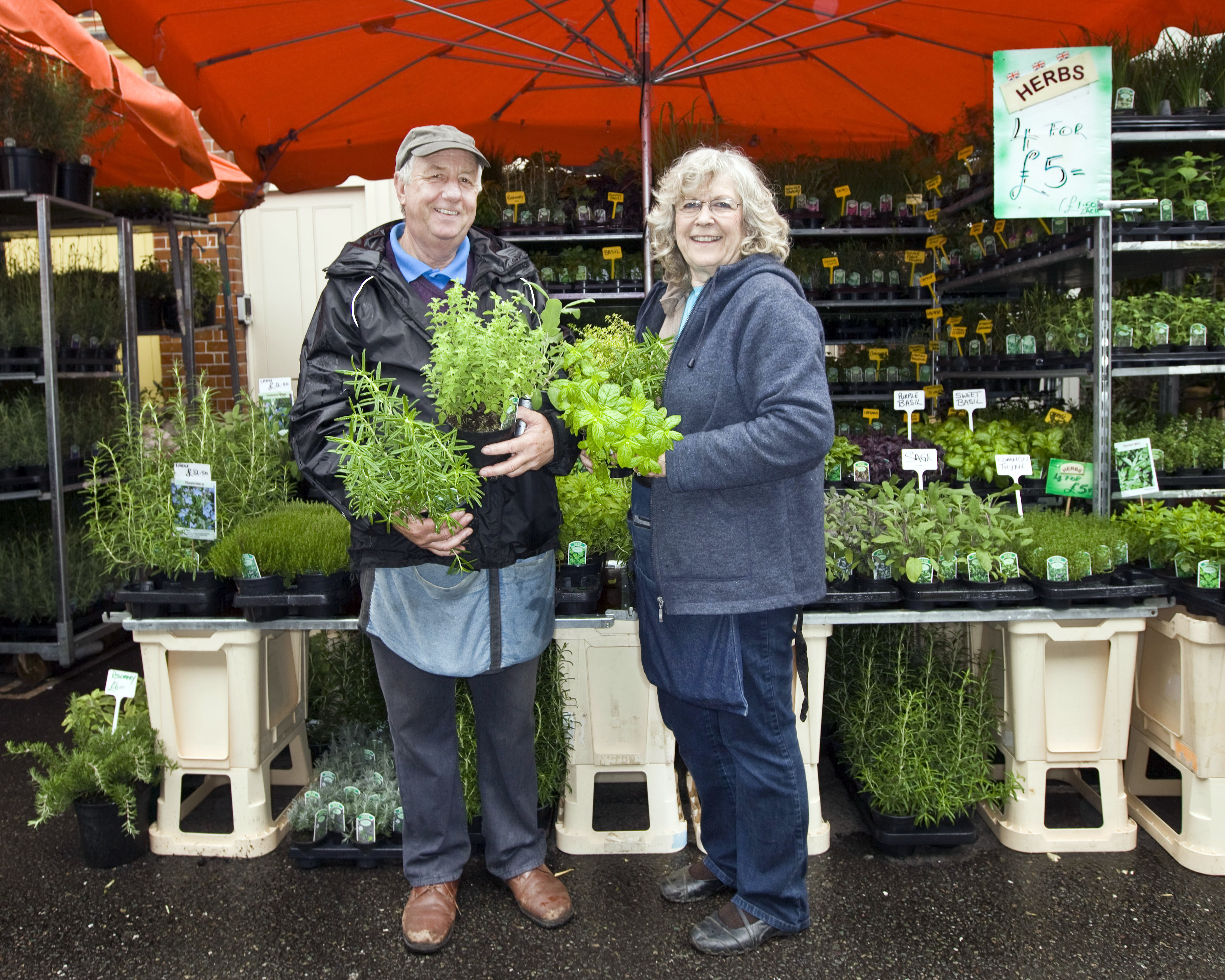
Mick & Sylvia Grover, Herb Sellers in Columbia Rd – Portrait by Jeremy Freedman

Margaret Willes in her garden – Portrait by Sarah Ainslie
The Gardens of the British Working Class by Margaret Willes is published by Yale University Press
You may also like to read about
Nicholas Culpeper, Herbalist of Spitalfields
Thomas Fairchild, Gardener of Hoxton


