
East End Beano Season

Tickets are available for my tour throughout July, August & September

A beano from Stepney in the twenties (courtesy Irene Sheath)
We have reached that time of year again when a certain clamminess prevails in the city and East Enders turn restless, yearning for a trip to the sea or at the very least an excursion to glimpse some green fields. In the last century, pubs, workplaces and clubs organised annual summer beanos, which gave everyone the opportunity to pile into a coach and enjoy a day out, usually with liberal opportunity for refreshment and sing-songs on the way home.

Ladies’ beano from The Globe in Hartley St, Bethnal Green, in the fifties. Chris Dixon, who submitted the picture, recognises his grandmother, Flo Beazley, furthest left in the front row beside her next door neighbour Flo Wheeler, who had a fruit and vegetable stall on Green St. (courtesy Chris Dixon)

Another beano from the fifties – eighth from the left is Jim Tyrrell (1908-1991) who worked at Stepney Power Station in Limehouse and drank at the Rainbow on the Highway in Ratcliff.

Mid-twentieth century beano from the archive of Britton’s Coaches in Cable St. (courtesy Martin Harris)

Beano from the Rhodeswell Stores, Rhodeswell Rd, Limehouse in the mid-twenties.

Taken on the way to Southend, this is a ladies’ beano from The Beehive in the Roman Rd during the fifties or sixties in a coach from Empress Coaches. The only men in the photo are the driver and the accordionist. Joan Lord (née Collins) who submitted the photo is the daughter of the publicans of The Beehive. (Courtesy Joan Lord)

Terrie Conway Driver, who submitted this picture of a beano from The Duke of Gloucester, Seabright St, Bethnal Green, points out that her grandfather is seventh from the left in the back row. (Courtesy Terrie Conway Driver)

Taken on the way to Southend, this is a men’s beano from The Beehive in the Roman Rd in the fifties or sixties in a coach from Empress Coaches. (Courtesy Joan Lord)

Beano in the twenties from the Victory Public House in Ben Jonson Rd, on the corner with Carr St. Note the charabanc – the name derives from the French char à bancs (“carriage with wooden benches”) and they were originally horse-drawn.

A crowd gathers before a beano from The Queens’ Head in Chicksand St in the early fifties. John Charlton who submitted the photograph pointed out his grandfather George standing in the flat cap holding a bottle of beer on the right with John’s father Bill on the left of him, while John stands directly in front of the man in the straw hat. (Courtesy John Charlton)

Beano for Stepney Borough Council workers in the mid-twentieth century. (Courtesy Susan Armstrong)

Martin Harris, who submitted this picture, indicated that the driver, standing second from the left, is Teddy Britton, his second cousin. (Courtesy Martin Harris)

In the Panama hat is Ted Marks who owned the fish place at the side of the Martin Frobisher School, and is seen here taking his staff out on their annual beano.

George, the father of Colin Watson who submitted this photo, is among those who went on this beano from the Taylor Walker brewery in Limehouse. (Courtesy Colin Watson)

Pub beano setting out for Margate or Southend. (Courtesy John McCarthy)

Men’s beano from c. 1960 (courtesy Cathy Cocline)

Late sixties or early seventies ladies’ beano organised by the Locksley Estate Tenants Association in Limehouse, leaving from outside The Prince Alfred in Locksley St.

The father of John McCarthy, who submitted this photo, is on the far right squatting down with a beer in his hand, in this beano photo taken in the early sixties, which may be from his local, The Shakespeare in Bethnal Green Rd. Equally, it could be a works’ outing, as he was a dustman working for Bethnal Green Council. Typically, the men are wearing button holes and an accordionist accompanies them. Accordionists earned a fortune every summer weekend, playing at beanos. (courtesy John McCarthy)

John Sheehan, who submitted this picture, remembers it was taken on a beano to Clacton in the sixties. From left to right, you can seee John Driscoll who lived in Grosvenor Buildings, Dan Daley of Constant House, outsider Johnny Gamm from Hackney, alongside his cousin, John Sheehan from Constant House and Bill Britton from Holmsdale House. (Courtesy John Sheehan)
Images courtesy Tower Hamlets Community Homes
You may also like to read about
Bishopsgate Bicycles, 1896
Click here to book THE GENTLE AUTHOR’S TOURS for July & August
The plethora of bicycle shops around Spitalfields today is not a new phenomenon as confirmed by this 1896 catalogue for The Metropolitan Machinists’ Co, reproduced courtesy of the Bishopsgate Institute


Images courtesy Bishopsgate Institute
You may also like to take a look at
Malcolm Johnson At St Botolph’s
Click here to book THE GENTLE AUTHOR’S TOURS for July & August

Dan Jones’ painting of Malcolm Johnson at Botolph’s, Aldgate 1982
These days, with his gentle blue eyes and white locks, Reverend Dr Malcolm Johnson is one of the most even-tempered radicals that you could meet, yet the work he did at St Botolph’s in Aldgate was truly extraordinary in its bold and compassionate nature. From 1974 until 1992, Malcolm was responsible for the ‘wet’ shelter that operated in the crypt, offering sustenance, showers and moral support to those that everyone else turned away. While other shelters refused admission to homeless people with alcohol or drugs in their possession, St Botolph’s did not and when I sought further, asking Malcolm to explain the origin of this decision, he simply said, “I believe you have to accept people as they are.”
The project at St Botolph’s was eminently pragmatic, working with people individually to find long-term accommodation in hostels and providing support in establishing a life beyond their homelessness and addiction. But shortly after Malcolm left St Botolph’s in 1992, the shelter was closed by his successor and it has sat unused for the past twenty years, making it a disappointing experience for Malcolm to return and be confronted with the shadow of his former works.
“I can’t tell you how upsetting it is, seeing it like this – it used to be such a wonderful place, full of energy and life, and now its just a store” he admitted to me when Photographer David Hoffman & I accompanied him on a visit to the disused crypt last week. Yet it proved to be a pertinent moment for reflection, as Malcolm told me the story of how it all happened.
“I had been Chaplain at Queen Mary University for seven years and specialised in counselling gay and lesbian people, so the Bishop thought I needed a quiet City parish where I could get on with my writing next. But, when I arrived. the crypt had been operating for five years and was catering for seventy homeless people each night, and I felt that wasn’t enough. I realised that we were here in the City of London surrounded by big companies, so I went to ask their assistance and I was lucky because they helped me, and I persuaded the City of London Corporation to give us seventy-thousand pounds a year too. The volunteers were all sorts, housewives, city workers after a day at the office and students from the polytechnic. I decided that it would be a wet crypt and we wouldn’t charge for food.
I was the rector upstairs and the director down here in the crypt – I believed the church had to be one outfit, upstairs and down. I went to Eddy Stride at Christ Church Spitalfields to ask what I should do, I had no experience so I had to learn. Over time, we expanded the shelter, we had quite a lot of full-time workers and we established four long-term hostels in Hackney. We were getting about two to three hundred people a night and it was quite an experience, but I was never frightened. Only once did a man take a swing at me, and all the others gathered round and grabbed him.
I missed this place so desperately when I left because you never knew what was going to happen when you walked through the door, it was wonderful, but I felt eighteen years was enough. Then, quite suddenly after I left in 1992, my successor closed the crypt and they said it went bankrupt, although I never understood what happened because we’d done a benefit at the Bank of England shortly before and, if there had been problems, I know my City friends would have come in to save it.”
The crypt of St Botolph’s is still equipped as a homeless shelter, functional but abandoned, pretty much as Malcolm left it and still harbouring emotive memories of those who passed through, many of whom are now dead. Encouragingly, Malcolm told me the current rector is considering whether it could be reopened.
This would itself be sufficient story and achievement for one man, yet there was another side to Malcolm Johnson’s ministry. As one of the first in the Church of England to come out as gay in 1969, he established the office of the Gay & Lesbian Christian Movement at St Botolph’s and even became known as the Pink Bishop for his campaigning work.
“I had always thought that if clergy can bless battleships and budgerigars, we could bless two people in love,” was his eloquent justification for his blessing of gay couples. Unsurprisingly, it was a subject that met opposition within the Church of England but, by the mid-eighties, the subject of AIDS became an unavoidable one and St Botolph’s was the first church to appoint a full-time minister to care for those affected by the HIV virus, as well as opening a dedicated hostel for this purpose.
In spite of his sadness at the closure of his shelter in the crypt, it was inspiring to meet Malcolm Johnson, a man with an open heart and a keen intelligence, who had the moral courage to recognise the truth of his own experience and apply that knowledge to better the lives of others.

“If clergy can bless battleships and budgerigars, we could bless two people in love…”

At St Botolph’s, 1978

Malcolm Johnson recalls the wet shelter in the crypt, now disused

At St Botolph’s, 1978

“I believe you have to accept people as they are.”

At St Botolph’s, 1978

“I can’t tell you how upsetting it is seeing it like this, it used to be such a wonderful place full of energy and life, and now it’s just a store”

Malcolm Johnson stands left at this midnight mass for the homeless at St Dunstan’s Stepney in 1978
Photographs copyright © David Hoffman
You may also like to take a look at
and the work of another heroic campaigner
Old Whitechapel Letterheads & Receipts

Click here to book THE GENTLE AUTHOR’S TOURS for July & August
It is my delight to publish these old Whitechapel letterheads and receipts from Philip Mernick‘s astonishing ephemera collection. Many are remarkable for the beauty of their typographic design as well as revealing the wide range of industry and commerce.

Speigelhalters were in Whitechapel from 1928 until 1988

Gardiner’s Corner was a familiar landmark in East End for generations


This was the family business of the artist Nathaniel Kornbluth


All letterheads and receipts courtesy of Philip Mernick
You may also like to take a look at
A Few Pints With John Claridge
Click here to book THE GENTLE AUTHOR’S TOURS for July & August

THE DRINK, E14 1964
Photographer John Claridge claims he is not a drinker, but I was not entirely convinced once I saw this magnificent set of beer-soaked pictures that he lined up on the bar, exploring aspects of the culture of drinking and pubs in the East End. “I used to go along with my mum and dad, and sit outside with a cream soda and an arrowroot biscuit,” John assured me, recalling his first childhood trips to the pub,“…but they might let you have a drop of brown ale.”
Within living memory, the East End was filled with breweries and there were pubs on almost every corner. These beloved palaces of intoxication were vibrant centres for community life, tiled on the outside and panelled on the inside, and offering plentiful opportunities for refreshment and socialising. Consequently, the brewing industry thrived here for centuries, inspiring extremes of joy and grief among its customers. While Thomas Buxton of Truman, Hanbury & Buxton in Spitalfields used the proceeds of brewing to become a prime mover in the abolition of slavery, conversely William Booth was motivated by the evils of alcohol to form the Salvation Army in Whitechapel to further the cause of temperance.
“When I was fifteen, we’d go around the back and the largest one in the group would go up to the bar and get the beers,” John remembered fondly, “We used to go out every weekend, Friday, Saturday and Sunday. We’d all have our suits on and go down to the Puddings or the Beggars, the Deuragon, the Punchbowl, the Aberdeen, the Iron Bridge Tavern or the Bridge House.” Looking at these pictures makes me wish I had been there too.
Yet the culture of drinking thrives in the East End today, with hordes of young people coming every weekend from far and wide to pack the bars of Brick Lane and Shoreditch, in one non-stop extended party that lasts from Friday evening until Sunday night, and stretches from the former Truman Brewery up as far as Dalston.
Thanks to John’s sobriety, we can enjoy a photographic pub crawl through the alcoholic haze of the East End in the last century – when the entertainment was homegrown, the customers were local, smoking and dogs were permitted, and all ages mixed together for a night out. Cheers, everybody!

A SMOKE, E1 1982. – “There was a relaxed atmosphere where you could walk in and talk to anybody.”

THE CONVERSATION, E1 1982. – “Who is he speaking to?”

DARTBOARD, E17 1982. -“I used to be a darts player, just average not particularly good.”

SINGING, E1 1962. -“She’d just come out of the pub…”

THE MEETING, E14, 1982. -“You don’t know what’s going on. There’s a big flash car parked there. Are they doing a piece of business?”

SLEEP, E1 1976. – “They used to club together and get a bottle of VP wine from the off-licence, and mix it with methylated spirits.”

BEERS, E1 1964. – “This is Dickensian. You wonder who’s going to step from that door. Is it the beginning of a story?”

ROUND THE BACK, E3 1963.

DOG, E1 1963. -“Just sitting there while his master went to get another pint of beer.”

EX-ALCHOHOLIC, E1 1982. – “He lived in Booth House and seemed very content that he had pulled himself out of it.”

LIVE MUSIC, E16 1982. -“It was a cold winter’s day and raining, but I had to get this picture. Live music and dancing in a vast expanse of nothing?”

THE BEEHIVE, E14 1964. – “She never stopped giggling and laughing.”
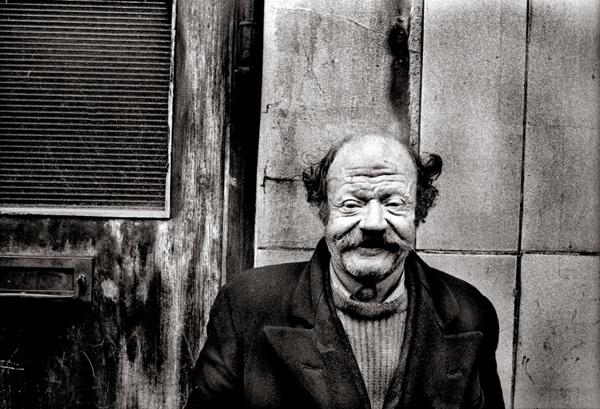
THE SMILE, E2 1962. -“He said, ‘Would you like me to smile?’ He was probably not long for this world, but he was very happy.”

IN THE BAR, E14 1964. -“I’d just got engaged to my first wife and she was one of my ex-mother-in-law’s friends. Full of life!”

THROUGH THE GLASS, E1 1982. -“I think the guy was standing at the cigarette machine.”

THE CALL, E16 1982. -“Terry Lawless’ boxing gym was above this pub. It looks as if everything is collapsing and cracking, and the shadows look like blood pouring from above.”

WHITE SWAN, E14 1982

LIGHT ALE, 1976 -“Four cans of light ale and he was completely out of it.”

CLOSED DOWN, Brick Lane 1982.
Photographs copyright © John Claridge
You may also like to take a look at
Billy & Charley’s Leaden Men
Click here to book THE GENTLE AUTHOR’S TOURS for July & August
“Curious leaden figures discovered at Shadwell” read the shameless announcement published in the ‘Illustrated Times’ of February 26th 1859, placed there by George Eastwood, eager dealer in the works of Billy & Charley, two East End mudlarks turned forgers who succeeded in conning the London archaeological establishment for decades with their outlandish and witty creations.
These fine examples of Shadwell shams from the collection of Philip Mernick fascinate and delight me with their characterful demeanours, sometimes fearsome and occasionally daft – inspiring my speculative captions which you see below.

Witch doctor

Telephonist

Blood-thirsty

Indignant

Hookah pipe

Popish

St Peter

Bemused

Listening

Aghast

Weary Conqueror


Surly Knight


CURIOUS LEADEN FIGURES DISCOVERED AT SHADWELL
Announcement by George Eastwood, Billy & Charley’s dealer, published in the Illustrated Times, February 26th, 1859
“A very considerable addition has been made during the winter to the singular leaden signacula found at Shadwell, which were the subject of a trial at Guildford. They are now on view at Mr. George Eastwood’s, Haymarket, where they have been inspected by some of the most experienced antiquaries, who, while they one and all concur in asserting the perfect genuineness of these remarkable objects, do not fully agree in explaining the purpose for which they were made. Upon one point there is no dispute, and that is, that the figures date from Queen Mary’s time, and were probably used in religious processions. Some of the badges resemble the earlier pilgrims’ signs.
The centre figure shown in the illustration we give of these additions to archaeological science, is that of a king holding a sword in his left hand and with the other pointing downward. The head is surmounted by a crown, the hair is long and flowing, the beard square in form and the face altogether bears great resemblance to the effigies seen on some of our early Saxon coins. To the right of this figure is another, evidently a bishop, judging from the mitre which he wears – the dress is apparently extremely rich in ornamentation. Immediately in front of thisfigure stands a smaller one, also of an ecclesiastic, but having no inscription on its base like the others. Again, in front of this another mitred statue holding a scepter of globular form at the top and dressed in robes of costly material. To the left are two well-formed bottles with handles, the lesser one having winged figures around the body. The larger one has also figures upon it and a foliated pattern. To the left of the king, who forms the centre of our group, stands a female figure, in not very graceful attitude, bearing a scepter in one hand and having the other resting on her hip. The remainder are but repetitions, to a great extent, of those already described and require no further explanation.”
You may also like to take a look at
George Gladwell’s Columbia Rd Market

Our walks have been awarded a Travellers’ Choice award by Trip Advisor after an unbroken run of over eighty five star reviews
Click here to book THE GENTLE AUTHOR’S TOURS for July & August

This is George Gladwell (1929-2020) selling his Busy Lizzies from the back of a van at Columbia Rd in the early seventies, drawing the attention of bystanders to the quality of his plants and captivating his audience with a bold dramatic gesture of presentation worthy of Hamlet holding up a skull. George began trading at the market in 1949 and it is my delight to publish this selection of his old photographs.
There is an air of informality about the flower market as it is portrayed in George’s pictures. The metal trolleys that all the traders use today are barely in evidence, instead plants are sold from trestle tables or directly off the ground – pitched as auctions – while seedlings come straight from the greenhouse in wooden trays, and customers carry away their bare-rooted plants wrapped in newspaper. Consequently, the atmosphere is of a smaller local market than we know today, with less stalls and just a crowd of people from the neighbourhood.
You can see the boarded-up furniture factories, that once defined Bethnal Green, and Ravenscroft Buildings, subsequently demolished to create Ravenscroft Park, both still in evidence in the background – and I hope sharp-eyed readers may also recognise a few traders who continue working in Columbia Rd Market today.
Over the years, many thousands of images have been taken of Columbia Rd Flower Market, but George Gladwell’s relaxed photographs are special because they capture the drama of the market seen through the eyes of an insider.
“I arrived in this lonely little street in the East End with only boarded-up shops in it at seven o’clock one Sunday morning in February 1949. And I went into Sadie’s Cafe where you could get a whopping great mug of cocoa, coffee or tea, and a thick slice of bread and dripping – real comfort food. Then I went out onto the street again at nine o’ clock, and a guy turned up with a horse and cart loaded with flowers, followed by a flatback lorry also loaded with plants.
At the time, I had a 1933 ambulance and I drove that around to join them, and we were the only three traders until someone else turned up with a costermonger’s barrow of cut flowers. There were a couple more horse and carts that joined us and, around eleven thirty, a few guys came along with baskets on their arms with a couple of dozen bunches of carnations to sell, which was their day’s work.
More traders began turning over up over the next few months until the market was full. There were no trolleys then, everything was on the floor. Years ago, it wasn’t what you call “instant gardening,” it was all old gardeners coming to buy plants to grow on to maturity. It was easy selling flowers then, though if you went out of season it was disappointing, but I never got discouraged – you just have to wait.
Mother’s Day was the beginning of the season and Derby Day was the finish, and it still applies today. The serious trading is between those two dates and the rest of the year is just ticking over. In June, it went dead until it picked up in September, then it got quite busy until Bonfire Night. And from the first week of December, you had Christmas Trees, holly and mistletoe, and the pot plant trade.
I had a nursery and I lived in Billericay, and I was already working in Romford, Chelmsford, Epping, Rochester, Maidstone and Watford Markets. A friend of mine – John – he didn’t have driving licence, so he asked me to drive him up on a Sunday, and each week I came up to Columbia Rd with him and I brought some of my own plants along too, because there was a space next to his pitch.
My first licenced pitch was across from the Royal Oak. I moved there in 1958, because John died and I inherited his pitches, but I let the other four go. In 1959, the shops began to unboard and people took them on here and there. That was around the time public interest picked up because formerly it was a secret little market. It became known through visitors to Petticoat Lane, they’d walk around and hear about it. It was never known as “Columbia Rd Flower Market” until I advertised it by that name.
It picked up even more in the nineteen sixties when the council introduced the rule that we had to come every four weeks or lose our licences, because then we had to trade continuously. In those days, we were all professional growers who relied upon the seasons at Columbia Rd. Although we used to buy from the Dutch, you had to have a licence and you were only allowed a certain amount, so that was marginal. It used to come by train – pot plants, shrubs and herbaceous plants. During the war, agriculture became food production, and fruit trees planted before the war had matured nicely. They sold masses of these at the Maidstone plant auctions and I could pick them up for next to nothing and sell them at Columbia Rd for two thousand per cent profit. Those were happy times!
In the depression at the end of the nineteen fifties, a lot of nurserymen sold their plots for building land because they couldn’t make it pay and it made the supply of plants quite scarce. So those of us who could grow our own did quite well but, although I did a mail order trade from my nursery, it wasn’t sufficient to make ends meet. Hobby traders joined the market then and they interfered with our trade because we were growers and kept our stock from week to week, but they would sell off all their stock cheap each week to get their money back. I took a job driving heavy haulage and got back for Saturday and Sunday. I had to do it because I had quite a big family, four children.
In the seventies, I was the first to use the metal trolleys that everyone uses now. My associates said I would never make it pay because I hocked myself up to do it. At the same time, plants were getting plastic containers, whereas before we used to sell bare roots which made for dirty pitches, so that was progress. All the time we were getting developments in different kinds of plants coming from abroad. You could trade in these and forget growing your own plants, but I never did.
Then in the nineties we had problems with rowdy traders and customers coming at four in the morning, which upset the residents and we were threatened with closure by the council. We had a committee and I was voted Chairman of the Association. We negotiated with the neighbours and agreed trading hours and parking for the market, so all were happy in the end.
It’s been quite happy and fulfilling, what I’ve finished up with is quite a nice property – something I always wanted. I like hard work, whether physical or mental. I used to sell plants at the side of the road when I was seven, and I used to work on farms helping with the milking at five in the morning before I went to school. I studied architecture and yet, as a job, I was never satisfied with it, I preferred the outdoor life and the physical part of it. Having a pitch is always interesting – it’s freedom as well.”

Albert Harnett

Colin Roberts


Albert Playle


Bert Shilling

Ernie Mokes

The magnificently named Carol Eden.


Fred Harnett, Senior

Herbie Burridge

George Burridge, Junior


Jim Burridge, Senior

Kenny Cramer

Lou Burridge

Robert Roper


Ray Frost

Robert Roper

George Burridge


