
Conditions Of Living
A new exhibition CONDITIONS OF LIVING, at Four Corners until 2nd September, explores how photographers have represented housing and homelessness in East London over the last century.

Spitalfields Gardens by Jack London, 1902, courtesy of Huntington Library

A family in a tenement house in Lisburn St, Bethnal Green, by an unknown photographer, 1923, courtesy of Getty Images

‘These are the dwellings’ by Humphrey Spender, 1938, courtesy of Getty Images

‘Leaving Town’ by Bert Hardy 1940, courtesy of Getty Images

Sewing in Mickey’s Shelter, an improvised air-raid shelter under the Fruit & Wool Exchange in Spitalfields, 1941, by Bert Hardy, courtesy of Getty Images

New Houses in Poplar by Monty Meth, 1951, courtesy of Getty Images

Pauline Rump and her younger sister reflected, Rothschild Dwellings by Nick Hedges, 1969

Sylvia in Tenterground, Spitalfields, by Moyra Peralta 1970s

Bromley St, Stepney, by Andrew Scott, 1975

Mrs Baldwin, Charles Dickens House, Mansford St Estate, Bethnal Green, Tom Learmonth, 1978

Father and son protest against Liberal Democrat housing policy by Lloyd Gee, 1990s

Eviction in Hackney by Brian Harris, 1991

‘Conditions of Living,’ poor doors for social housing but a lobby for private flats, New Holland Estate, Commercial St, by Anthony Luvera, 2023
© All photos copyright of individual photographers or photo libraries as specified
You may also like to take a look at
At Dr Johnson’s House

Click here to book THE GENTLE AUTHOR’S TOURS for July & August
I walked over to Fleet St to pay a visit upon Dr Samuel Johnson who could not resist demonstrating his superlative erudition by recounting examples of lexicography that came to mind as he showed me around the rambling old house in Gough Sq where he wrote his famous Dictionary

House. n.s. [hus, Saxon, huys, Dutch, huse, Scottish.] 1. A place wherein a man lives, a place of human abode. 2. Any place of abode. 3. Place in which religious or studious persons live in common, monastery, college. 4. The manner of living, the table. 5. Family of ancestors, descendants, and kindred, race. 6. A body of parliament, the lords or commons collectively considered.

Acce’ss. n.s. [In some of its senses, it seems derived from accessus, in others, from accessio, Lat. acces, Fr.] 1. The way by which any thing may be approached. 2. The means, or liberty, of approaching either to things or men. 3. Encrease, enlargement, addition. 4. It is sometimes used, after the French, to signify the returns of fits of a distemper, but this sense seems yet scarcely received into our language.

To Rent. v.a. [renter, Fr.] 1. To hold by paying rent. 2. To set to a tenant.

Ba’ckdoor. n.s. [from back and door.] The door behind the house, privy passage.

Door. n.s. [dor, dure, Saxon, dorris, Erse.] The gate of a house, that which opens to yield entrance. Door is used of houses and gates of cities, or publick buildings, except in the licence of poetry.

Hábitable. adj. [habitable, Fr. habitabilis, Lat.] Capable of being dwelt in, capable of sustaining human creatures.

Time. n.s. [ꞇıma, Saxon, tym, Erse.] 1. The measure of duration. 2. Space of time. 3. Interval. 4. Season, proper time.

Stair. n.s. [ꞅꞇæᵹꞃ, Saxon, steghe, Dutch.] Steps by which we rise an ascent from the lower part of a building to the upper. Stair was anciently used for the whole order of steps, but stair now, if it be used at all, signifies, as in Milton, only one flight of steps.

Chair. n.s. [chair, Fr.] 1. A moveable seat. 2. A seat of Justice or authority. 3. A vehicle borne by men, a sedan.

Díctionary. n.s. [dictionarium, Latin.] A book containing the words of any language in alphabetical order, with explanations of their meaning, a lexicon, a vocabulary, a word-book.

A’ftergame. n.s. [from after and game.] The scheme which may be laid, or the expedients which are practised after the original design has miscarried, methods taken after the first turn of affairs.

Mystago’gue. n.s. [μυσταγωγὸς, mystagogus, Latin.] One who interprets divine mysteries, also one who keeps church relicks, and shews them to strangers.

Box. n.s. [box, Sax. buste, Germ.] 1. A case made of wood, or other matter, to hold any thing. It is distinguished from chest, as the less from the greater. It is supposed to have its name from the box wood. 2. The case of the mariners compass. 3. The chest into which money given is put. 4. The seats in the playhouse, where the ladies are placed. (David Garrick’s box illustrated)

Fascina’tion. n.s. [from fascinate.] The power or act of bewitching, enchantment, unseen inexplicable influence.

A’fternoon. n.s. [from after and noon.] The time from the meridian to the evening.

Intelléctual. n.s. Intellect, understanding, mental powers or faculties. This is little in use.

Prívacy. n.s. [from private.] 1. State of being secret, secrecy. 2. Retirement, retreat. 3. [Privauté, Fr.] Privity; joint knowledge; great familiarity. Privacy in this sense is improper. 4. Taciturnity.

Lexicógrapher. n.s. [λεξικὸν and γράφω, lexicographe, French.] A writer of dictionaries, a harmless drudge, that busies himself in tracing the original, and detailing the signification of words.

Ca’binet. n.s. [cabinet, Fr.] 1. A set of boxes or drawers for curiosities, a private box. 2. Any place in which things of value are hidden. 3. A private room in which consultations are held.

A’bsence. n.s. [See Absent.] 1. The state of being absent, opposed to presence. 2. Want of appearance, in the legal sense. 3. Inattention, heedlessness, neglect of the present object.

Work. n.s. [weorc, Saxon, werk, Dutch.] 1. Toil, labour, employment. 2. A state of labour. 3. Bungling attempt. 4. Flowers or embroidery of the needle. 5. Any fabrick or compages of art. 6. Action, feat, deed. 7. Any thing made. 8. Management, treatment. 9. To set on Work To employ, to engage.


Way. n.s. [wœʒ, Saxon, weigh, Dutch.] The road in which one travels.

Court. n.s. [cour, Fr. koert, Dut. curtis, low Latin.] 1. The place where the prince resides, the palace. 2. The hall or chamber where justice is administered. 3. Open space before a house. 4. A small opening inclosed with houses and paved with broad stones.

Cat. n.s. [katz, Teuton. chat, Fr.] A domestick animal that catches mice, commonly reckoned by naturalists the lowest order of the leonine species.

To Mew. v.a. [From the noun miauler Fr.] To cry as a cat.
Visit Dr Johnson’s House, 17 Gough Square, EC4A 3DE
At The Georgian Group
Click here to book THE GENTLE AUTHOR’S TOURS for July & August

Behold the magnificence of this seventeen-nineties Adam Brothers’ house in Fitzroy Sq which serves as the headquarters of The Georgian Group.


C A Mathew, Photographer

Click here to book THE GENTLE AUTHOR’S TOURS for June & July
On my tour, we visit some of the locations of C A Mathew‘s photographs to discover how Spitalfields has changed. One theory is Mathew took the photos to record the Jewish street life of Spitalfields and another is he took them to pass the time when his train from Liverpool St Station was delayed by two hours – but on my tour we reveal the truth behind the mystery of the photographer’s intentions.

In Crispin St, looking towards the Spitalfields Market
On Saturday April 20th 1912, C.A.Mathew walked out of Liverpool St Station with a camera in hand. No-one knows for certain why he chose to wander through the streets of Spitalfields taking photographs that day. It may be that the pictures were a commission, though this seems unlikely as they were never published. I prefer the other theory, that he was waiting for the train home to Brightlingsea in Essex where he had a studio in Tower St, and simply walked out of the station, taking these pictures to pass the time. It is not impossible that these exceptional photographs owe their existence to something as mundane as a delayed train.
Little is known of C.A.Mathew, who only started photography in 1911, the year before these pictures and died eleven years later in 1923 – yet today his beautiful set of photographs preserved at the Bishopsgate Institute exists as the most vivid evocation we have of Spitalfields at this time.
Because C.A.Mathew is such an enigmatic figure, I have conjured my own picture of him in a shabby suit and bowler hat, with a threadbare tweed coat and muffler against the chill April wind. I can see him trudging the streets of Spitalfields lugging his camera, grimacing behind his thick moustache as he squints at the sky to apprise the light and the buildings. Let me admit, it is hard to resist a sense of connection to him because of the generous humanity of some of these images. While his contemporaries sought more self-consciously picturesque staged photographs, C.A.Mathew’s pictures possess a relaxed spontaneity, even an informal quality, that allows his subjects to meet our gaze as equals. As viewer, we are put in the same position as the photographer and the residents of Spitalfields 1912 are peering at us with unknowing curiosity, while we observe them from the reverse of time’s two-way mirror.
How populated these pictures are. The streets of Spitalfields were fuller in those days – doubly surprising when you remember that this was a Jewish neighbourhood then and these photographs were taken upon the Sabbath. It is a joy to see so many children playing in the street, a sight no longer to be seen in Spitalfields. The other aspect of these photographs which is surprising to a modern eye is that the people, and especially the children, are well-dressed on the whole. They do not look like poor people and, contrary to the widespread perception that this was an area dominated by poverty at that time, I only spotted one bare-footed urchin among the hundreds of figures in these photographs.
The other source of fascination here is to see how some streets have changed beyond recognition while others remain almost identical. Most of all it is the human details that touch me, scrutinising each of the individual figures presenting themselves with dignity in their worn clothes, and the children who treat the streets as their own. Spot the boy in the photograph above standing on the truck with his hoop and the girl sitting in the pram that she is too big for. In the view through Spitalfields to Christ Church from Bishopsgate, observe the boy in the cap leaning against the lamppost in the middle of Bishopsgate with such proprietorial ease, unthinkable in today’s traffic.
These pictures are all that exists of the life of C.A.Mathew, but I think they are a fine legacy for us to remember him because they contain a whole world in these few streets, that we could never know in such vibrant detail if it were not for him. Such is the haphazard nature of human life that these images may be the consequence of a delayed train, yet irrespective of the obscure circumstances of their origin, this is photography of the highest order. C.A.Mathew was recording life.

Looking down Brushfield St towards Christ Church, Spitalfields.

Bell Lane looking towards Crispin St.

Looking up Middlesex St from Bishopsgate.

Looking down Sandys Row from Artillery Lane – observe the horse and cart approaching in the distance.

Looking down Frying Pan Alley towards Crispin St.

Looking down Middlesex St towards Bishopsgate.

Widegate St looking towards Artillery Passage.

In Spital Square, looking towards the market.

At the corner of Sandys Row and Frying Pan Alley.

At the junction of Seward St and Artillery Lane.

Looking down Artillery Lane towards Artillery Passage.

An enlargement of the picture above reveals the newshoarding announcing the sinking of the Titanic, confirming the date of this photograph as 1912.

Spitalfields as C.A.Mathew found it, Bacon’s “Citizen” Map of the City of London 1912.
Photographs courtesy of Bishopsgate Institute
Tim Marten, Guitar Repairs
Click here to book THE GENTLE AUTHOR’S TOURS for June & July

Tim Marten by Colin O’Brien
Guitars have been manufactured in St Giles since the days of Queen Anne but now – thanks to the redevelopment of Denmark St – Tim Marten is one of the very last to make and repair instruments in this corner of Soho. I visited Tim in the tiny panelled workshop in the beautiful sixteen-nineties house where he pursued his trade, prior to his move to new premises in Charing Cross Rd.
“When I was a teenager I wanted to learn to play guitar, and I couldn’t afford to buy one and I was reasonably good at woodwork, so I made one. It was horrible! As soon as I’d finished it, I began to understand where I’d gone wrong, so I embarked on my second one and I cured some of the mistakes I’d made the first time round. After about eighteen months – maybe longer – with the help of various other people, I’d finished my third, curing the mistakes I’d made the second time round. I refined it down and down, until I had a guitar I could actually go out and play. It held its own against factory-made bought guitars. That was quite a reasonable instrument, and I went from there!
I came from an engineering background. My father and my uncle were both very good engineers and I used to build Airfix kits and fly model aeroplanes. I was always interested in mechanics and quite good at understanding how things worked. I was one of those small boys whose immediate reaction after Christmas lunch was to start taking their toys apart to see how they worked.
I spent my late teens and early twenties playing in bands round London and Bristol and, if anyone had problems, I’d fix their guitars. It just escalated from there. I was fortunate to meet someone who worked behind the counter at Andy’s Guitar Workshop in Denmark St, just across the road from where I am now. It was the first specific guitar repair workshop in Central London. That was in 1979.
It was run by Andy Preston but it was called ‘Andy’s‘ because that was the name of the Greek greengrocers on the ground floor and we were in the basement. There were quite a few music shops in the street but Andy’s had flats above and a greengrocer at street level. Our customers had to go round the back and down the stairs to our workshop below. I was twenty-two and I had some ideas I was working on for designs for guitars, and my friend who was the counter hand said, ‘Why don’t you come down and speak to the guys I work with?’ So I did and we had a long chat, and I was offered my first job and I’ve been doing it ever since.
Then I joined Led Zeppelin as a guitar technician and went off touring for ten years. I worked for various other bands and had a shop of my own up in Church Lane, Hornsey, just underneath The Kinks‘ studio. So I got to know Ray Davies and did a lot of touring with The Kinks. I played guitar professionally and found I earned more money gigging three nights a week than I did mending guitars in my little workshop, so it became a necessity to go out each Thursday, Friday and Saturday and play. Back in those days, it was quite a lucrative thing to do.
Things went spectacularly wrong in 2000, and I lost the shop and my business. But within a couple of days of realising that was going to happen and wondering what on earth I was going to do with myself, Andy Preston rang up from his hugely-expanded guitar shop which had become internationally known and taken over the whole building. He asked me to come back and run his repair department because they needed somebody with experience. So the door opened and I walked into it.
I stayed there until Andy went bust and sold his shop onto Rick Harrison, when I started working independently and I’ve been independent ever since. I’ve had my workshop in this room for about six years, before that it was Central Sound recording studios. I have no proof but I have been told that David Gray recorded Babylon in this very room. The building has listed status and is as it was constructed after the Great Fire of London, one of four remaining buildings in Denmark St from that time. This was originally intended as housing and it is slated to be returned to housing. I am going to be booted out and this is going to be turned into luxury flats. I am on two months’ notice, so that could happen as soon as six months from now.
I don’t think the ethos of Denmark St has changed very much at all since I first came here in 1979. Up until four or five years ago, when Cliff Cooper sold out the leases to the current owners who are property developers, there was very little change in the street apart from the signs above the shops as businesses came and went. Denmark St has always been a bit of a shabby sideshow in very nice way.
From the fifties, it was always the centre for music, when the music publishers started moving in and then the recording studios followed. There were three recording studios here in the sixties. From the eighties, shops came and went but they were always music shops, and the place was in need of a lick of paint. It has always been like that and, to a certain extent, that is its charm. Now restaurants are moving in, the developers are taking over and we are being moved out. It’s coming to an end despite our loudest protests.
We got hit very hard by the internet and it took the industry a while to adapt. I think that was one of the reasons Andy got into financial difficulties. For the repair side of the business, the internet helps no end. I get a lot of work from people who have bought guitars online. They come in the door, I take one look at it and say, ‘You just got this on ebay, didn’t you?’ and they ask, ‘Yes, how did you know?’ and I say, ‘Because if you’d played it before you bought it, you’ never have bought it!’ I tell them, ‘Yes I can fix it for you but it’s going to cost more money than if you had bought it properly from a shop in the first place.’ So I view the internet as a mixed blessing, although I do make a lot of money out of people who buy stuff and find that it is not as described. I end up sorting it out.
It’s the tinkering side of things, the satisfaction of getting things right, that I like. I do mostly repairs now and only a little design work. There’s a lot of satisfaction in getting something working properly and you give it back to the customer, and a big smile comes over them. ‘Oh wow, that’s brilliant! I’ve been fighting this thing for years – if only I’d known you ten years ago!’
Like any job, it can become repetitive. There are certain repairs you do in your sleep. That’s what I call the bread-and-butter work. It’s well paid, so – if I spend three days a week doing that – I know that I’ve made enough to sit down and do something a bit more creative.
In this industry, it’s a great way to spend a day but it’s a lousy way to make a living. Especially making guitars, because it is so time-consuming and you can’t compete with the guys who have got all the machinery and industrial spraying facilities. The quality of the stuff coming out of the far east now is so good that you have to be able to charge a disproportionate amount of money for a guitar because it is handmade. Or you do bespoke work, I enjoy making things that you couldn’t buy in a shop.
If you look around my workshop, you will see that I am surrounded by projects that I have got halfway through but never got around to finishing. It’s what I do in the quiet periods, but I’ve acquired a reputation for being good at repairs and it’s getting to the point where I have more work than I can do. If you look around, there’s thirty guitars here waiting to be repaired. They are numbered up to fifty-seven and I am working on number twenty-six at the moment. Some of them will take five minutes but others will take me three weeks to fix.
I’ve always got three or four jobs on the go at once and, as you can see, there there are guitars lying around in various stages of repair. While I am waiting for glue or lacquer to dry, I will put it on one side and return to it tomorrow. Repairing instruments is a job where you don’t work on one at a time and finish it.
When I was running the repair department at Andy’s Guitar Workshop, I had four people working under my supervision and I enjoyed the responsibility and the teaching and the social life as well. Now it’s just me yet I am not alone because I have a constant stream of customers and the phone never stops ringing.”


Photographs copyright © Estate of Colin O’Brien
Tim Marten, Guitar Repairs, 125 Charing Cross Rd, London, WC2H 0EW9
You may also like to read about
So Long, Beattie Orwell

Click here to book THE GENTLE AUTHOR’S TOURS for June & July
Beattie Orwell died last Thursday at the fine age of one hundred and five

Portrait of Beattie Orwell by Phil Maxwell
It was my delight to accompany photographer Phil Maxwell to visit one hundred and five year old Beattie Orwell and sit beside her in her cosy flat while she talked to me of her century of existence in this particular corner of the East End.
A magnanimous woman who delighted in the modest joys of life, Beattie was nevertheless a political animal who is proud to be one of the last living veterans of the Battle of Cable St – a formative experience that inspired her with a fiercely egalitarian sense of justice and led to her becoming a councillor in later life, acutely conscious of the rights of the most vulnerable in society.
In spite of her physical frailty, Beattie’s moral courage granted her an astonishing monumental presence as a human being. To speak with Beattie was to encounter another, kinder world.
“I am Jewish and both my parents were East Enders, born here. My father’s parents came over from Russia. On my mother’s side, her parents were born here but her grandfather was born in Holland. So I am a bit of a mixture!
My father Israel worked as a porter at the Spitalfields Market and my mother Julia was a cigar maker at Godfrey & Phillips in Commercial St. I grew up in Brunswick Buildings in Goulston St, until I got bombed out. It was horrible, we had a little scullery, too small to swing a cat. My mother had one bedroom and, the three children, we slept in a put-you-up. I had two sisters Rebecca & Esther. Rebecca was the eldest, she very clever at dressmaking. When she was fifteen, she could make a dress. We needed her because my father died when he was forty-four, he had three strokes and died in Vallance Rd Hospital. I was only thirteen. He used to take me everywhere, he was marvellous. He took to me to the West End to visit my aunt, she was an old lady with a parrot and lived on Bewick St. We used to have a laugh with the parrot.
We moved to City Corporation flats in Stoney Lane and I went to Gravel Lane School. It was lovely school, they taught us housewifery. We had a little flat in the school and we used to clean it out, then go shopping in Petticoat Lane to buy ingredients to make a dinner, imagining we were married. The boys used to do woodwork and learnt to make stools and things like that. I loved that school. When I was twelve it closed and I went to the Jewish Free School in Bell Lane. It was very strict and religious. When the teacher wanted us to be quiet, she’d say, ‘I’m waiting!’ It was good, I enjoyed my school life.
I left when I was fourteen and I went to work right away, dressmaking in Alie St. I used to lay out material. I do not know why but I must have heavy fingers, I could not manage the silk. It used to fall out of my hands. I only lasted a week before I left, I could not stand it. Then I went to work with my sister at Lottereys in Whitechapel opposite the Rivoli Picture Palace, they used to make uniforms for solders. I went into tailoring, men’s trousers, putting the buttons on with a machine. We worked long hours and it was hard work. By the time I got married I was earning two pounds and ten shillings a week. I never earned big money. I worked all the way through the war. I gave all the money to my mother and she gave me a shilling back. I used to walk up to the West End. It was threepence on the trolley bus.
I was nineteen in 1936. I was there with all the crowds at the Battle of Cable St. I am Jewish and I knew we must fight the fascists. They were anti-semitic, so I felt I had to do it. I was not frightened because there were so many people there. If I was on my own I might have been frightened, but I never saw so many people. You could not imagine. Dockers, Scottish and Irish people were there. It was a marvellous atmosphere. I was standing on the corner of Leman St outside a shop called ‘Critts’ and everyone was shouting ‘ They shall not pass!’ I was with my friend and we stood there a long time, hours. So from there we walked down to Cable St where we saw the lorry turned over. I never saw the big fighting that happened in Aldgate because I was not down there, but I saw them fighting in Cable St near this turned over lorry. From there, we walked down to Royal Mint St, where the blackshirts were. They were standing in a line waiting for Oswald Mosley to come. So I said to my friend, ‘We’d better get away from here.’
We went back through Cable St to the place where we started. From there, the news came through ‘They’re not passing.’ We all marched past the place where Fascists had their headquarters – they threw flour over us, shouting – to Victoria Park where we had a big meeting with thousands of people. I had never seen anything like it in my life and I used to go to all the meetings. I never went dancing. My mother used to say, ‘I don’t know where I got you from!’ because I was only interested in politics. I am the only one like this in the whole family. I still know everything that is going on.
I used to go to Communist Party socials in Swedenborg Sq, off Cable St, and – being young – I used to enjoy it. Then I joined the Labour Party, the Labour League of Youth it was called. We used to go on rambles. It was lovely. We went to Southend once. I always used to march to Hyde Park on May Day and carry one of the ropes of our banner. I met my husband John in Victoria Park when I was with the Young Communists League, although I was not a member. They had a Sports Day and my husband was running for St Mary Atte Bowe because he was a Catholic. I met him and we went to a Labour Party dance. We got married in 1939.
We managed to get a flat in the same building as my mother, at the top of the stairs. They were private flats and I remember standing outside with a banner saying, ‘Don’t pay no rent!’ because the owners would not do the flats up. They did not look after us, it was horrible thing for us to have to do but it worked. I laugh now when I think about it. I was always brave. I am brave now.
We got bombed out of those flats while my husband was in the army. I had a baby so they sent me to Oxford where my husband was based with the York & Lancasters. We had a six-roomed house for a pound a week. My mother and sister came with me and they looked after my baby while I went to work in munitions. I was a postwoman too and I used to get up at four in the morning and walk over Magdalen Bridge.
I came back to the East End to try to get a flat here and I got caught in one of the air raids, but I knew this was where I had to live. My mother used to get under the stairs in Wentworth St when there was a raid and put a baby’s pot on her head. The war was terrible.
They sent my husband to Ikley Moor and it was too cold for him, so we came back for good. I managed to get two horrible little side rooms in Stoney Lane, sharing a kitchen between four and a toilet between two. I had no fridge, just a wooden box with chicken wire on the front. I used to go the Lane and buy two-pennorth of ice and put the butter in there. I had to buy food fresh everyday. There was a black market trade in fruit. These flats had been built for the police but the police would not have them, so they let them out to other people. All the flats were named after royalty, we were in Queens Buildings. I watched them building new flats in Cambridge Heath Rd but, before I could get one of them, I was offered a lot of horrible flats. Yet when I got there we were overcrowded, until we got a three bedroom flat at last, because I had two girls and a boy. I lived sixty-seven years there.
My husband never earned much money so I had to carry on working. He had twenty-two shillings a week pension from the army. He did all kinds of things and then got a job in the Orient Tea Warehouse. In 1966, when he was going to be Mayor of Bethnal Green and they would not give him time off, he went up to the Hackney Town Hall and got a job in the Town Clerk’s Office. He was always good at writing, he had lovely hand writing.
I became a councillor and I loved it. Our council was the best council, they were best to the old people. We used to go and visit all the old people’s homes. I never told them I was coming because I used to try and catch them out. We checked the quality of food and how clean it was. I organised dinners in York Hall for all the old people and trips to Eastbourne, but it has all been done away with – they do nothing now.
I was a councillor for ten years from 1972 until 1982. I had to fight to get the seat but I always loved old people, my husband was the same. He was known as the ‘Singing Mayor’ because he used to sing in all the old people’s homes. From when I was forty-two, I used to go round old people’s homes on Friday nights and I still do it. We have dinners together, turkey, roast potatoes and sausages, with trifle for afters.”


Beattie Orwell (1917-2023)
Photographs copyright © Phil Maxwell
Lucy Hart, Gardener
Click here to book THE GENTLE AUTHOR’S TOURS for June & July

One of my favourite gardens in London is at Fulham Palace. So it was a great delight to cycle over from Spitalfields to meet the horticultural genius behind this wondrous creation, Lucy Hart, Head Gardener. Contributing Photographer Sarah Ainslie joined us, driving from Bethnal Green to create the accompanying photoessay.
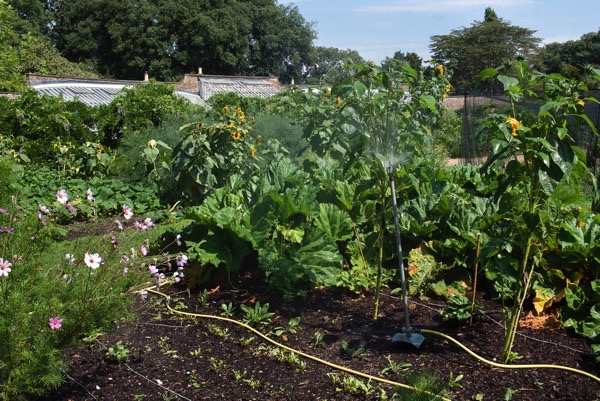
In recent years, Lucy has created an enchanted vegetable garden interwoven by flowers within the confines of this ancient walled enclave overlooked by the tower of All Saints, Fulham. I defy anyone not to be seduced by Lucy’s inspired planting combinations – purple gladioli and cabbages or carrots and marigolds – enfolded among old fruit trees and punctuated by long lines of runner beans.
This is the ultimate walled garden of romance, recalling The Secret Garden or Tom’s Midnight Garden, with a fine knot garden and magnificent architectural glasshouses filled by the pungent fragrance of tomato leaves, all within the embrace of crumbling Tudor walls lined with deep herbaceous borders.
Escaping the blinding sunlight at noon, Lucy, Sarah & I sought refuge within the shadow of a venerable apple tree. Lucy told us her story, revealing her horticultural passions, while the sprinklers tick-ticked around us casting rainbows as their showers of waterdrops fell upon the verdant foliage.
“When I was thirteen, I started working on Saturdays at my local nursery in Wallington, Surrey, paying attention to the pelargoniums and seasonal bedding plants, salvias and busy lizzies. I took the job because I needed some cash but I thought, ‘I like this and I really quite enjoy it.’ I used to go home with my arms covered in little cuts from potting up roses but it was good fun.
I went to horticultural college at sixteen and worked at Merrist Wood for three years doing a diploma while living in halls. It was just so much fun and, for a year out, I worked on a nursery in Littlehampton. Then I did a degree in Horticulture at Writtle College and that broadened my horizons in terms of the scientific side. My background is in the production and propagation of plants.
It was then I started working in gardens, working for landscape companies doing domestic gardens, and got accepted for the Kew Diploma. That opened my eyes further to the botanical side of it all, which was a life-changing experience for me. I worked at Great Dixter, Powis Castle and for Beth Chatto, expanding my ideas of what a garden could be. Before that I was only working with seedlings, I never saw plants in flower!
I stayed at Kew Gardens for eight years before I got the job here at Fulham Palace Gardens. The walled garden was used to grow municipal wallflowers for the borough when I arrived. My brief was to bring the place back to life with a vegetable garden, involve the community and create a visitor attraction. The nineteenth century glasshouses had just been rebuilt and they dug out the moat. The wisteria was here and some old fruit trees, but otherwise it was quite empty.
Debs Goodenough, Head Gardener at Highgrove, came to give me advice and I remember walking round with her asking her, ‘Got any ideas?’ She had done a similar project at Osborne House.
We have a Tudor wall but the garden was laid out by Bishop Terrick in 1767 and planted by Bishop Longford in the eighteen-thirties. He put in the knot garden with box hedges, so I replanted that first. It means that when people walk through the gate, they immediately see flowers.
An archaeological investigation revealed that there were cross paths which we have reinstated. We did a big community archaeological dig, looking for garden archaeology revealing signs of how it might have been and we found these diagonal bed shapes, which inspired the layout for the vegetable garden we have today. But because there are no surviving plans I had free rein to do what I wanted, so it only has a loose relationship to an eighteenth century garden.
I was keen to plant around the existing trees and we also found old tree pits lined with clay to retain the moisture – it is so well drained here next to the Thames – so I decided to plant an orchard too. There is a record of there having been a plum orchard here. This garden is an ancient scheduled monument which brings some restrictions where we can plant trees. I have added espalier fruit trees – pears, quinces, apples, peaches, cherries and plums – and herbaceous borders along the walls, including the pollinators border which I only planted last year.
This garden has multiple roles. It is for education and I have three apprentices who each have a flower bed to grow their crop. They have to nurture and know it intimately, deciding when to water and when to thin it out. We also teach volunteers to grow vegetables and I do an introduction to vegetable growing for the general public too. The garden has a display value, people come to see the flowers and we sell our produce which is an important source of income.
We plant flowers among the vegetables so that beds are not bare but these companion plants are selected to repel parasites. We plant French marigolds throughout because they have an oily fragrance which repels aphids and black fly. The calendula are also the host of a beneficial insect which predates on pests. We grow organically here without using pesticides. Our worst pests are the squirrels who eat all the apples and the parakeets who are such lazy eaters, they just take one bite out of each apple. We even have a rabbit that lives in the churchyard who gnaws the newly-planted trees. I have only seen the one and I am still trying to find his burrow.
We sell all our vegetables and flowers but do I get a bit funny about the cabbages and lilies because I think they are so beautiful growing in the ground. We count ourselves really lucky to have this walled garden of thirteen acres for gardening in the middle of London.”




Photographs copyright © Sarah Ainslie
You may also like to read about my first visit


