
The Microcosm Of London

Click here to book for my next tour of the City of London on Sunday 21st April

Billingsgate Market
(click on this plate or any of the others to enlarge and examine the details)
In 1897, Charles Gosse, Archivist at the Bishopsgate Institute, was lucky enough to buy a handsome 1809 edition of Thomas Rowlandson & Augustus Pugin’s ‘Microcosm of London’ from Quaritch booksellers in Piccadilly with just one plate missing, yet it took him until 1939 to track down a replacement to fill the gap and complete his copy – and the single plate cost him more in 1939 than the entire three volumes in 1897. Then the volumes were stolen in the nineteen-eighties but, thankfully, returned to the Bishopsgate years later as part of Operation Bumblebee, tracking art thefts back to their owners – and just waiting there for me to come upon them.
Augustus Charles Pugin, the architectural draftsman (and father of Augustus Welby Pugin who designed the Palace of Westminster) had the idea to create a lavish compendium of views of London life but it was the contribution of his collaborator Thomas Rowlandson who brought another dimension, elevating these images above the commonplace. While Pugin created expansive and refined architectural views, Rowlandson peopled them with an idiosyncratic bunch of Londoners who take possession of these spaces and who, in many cases, exist in pitifully unsentimental contrast to the refinement of their architectural surroundings.
How very pleasant it is to be a tourist in the metropolis of 1809, thanks to the magnificent plates of the ‘Microcosm of London.’ Here are the wonders of the capital, so appealingly coloured and so satisfyingly organised within the elegant classical architecture that frames most social activity, while also conveniently ignoring the domestic reality of the greater majority of the populace.
In only a few plates – such as Carlton House and the House of Commons – does Thomas Rowlandson submit to the requirement of peopling these spaces with slim well-dressed aspirational types that we recognise today from those familiar mock-ups used to sell bad architecture to the gullible. Yet the most fascinating plates are those where he has peopled these rationally conceived public spaces with the more characterful and less willowy individuals who illustrate the true diversity of the human form, and he satisfies our voyeuristic tendencies by celebrating the grotesque and the theatrical. In Billingsgate Market, Rowlandson takes a composition worthy of Claude and peoples it with fishwives fighting, revealing affectionate delight in the all-too familiar contrast exemplified by aspirational architecture and the fallibility which makes us human.
While the first impression is of harmony and everyone in their place – whether it be church, masquerade, asylum, theatre, prison or lecture hall – examining these pictures close-up reveals the genius of Thomas Rowlandson which is unable to resist introducing grotesque human drama or adding comic specimens of humanity to these idealised urban visions. Just like an early nineteenth century version of ‘Where’s Wally?’, Rowlandson implicitly invites us to seek the clowns.
Even if in some plates, such as the Drawing Room in St James, he appears to acquiesce to a notion of mannequin-like debutantes, Rowlandson more than makes up for it at the Bank of England where – surprise, surprise – the buffoons take centre stage. Spot the duffer in a stripy waistcoat with a girl on each arm in Vauxhall Gardens, or the dolts all robed up in coats of arms at Herald’s College, or the Masquerade where – as characters from Commedia dell’Arte – the funsters seem most in their element.
Meanwhile at the Post Office, in cubicles not so different from those in call centres of our own day, clerks are at work in identical red uniforms which deny them the individuality that is the vain prerogative of the rich in this vision of London. Equally, at the asylum nobody gets to assert themselves, while the prison inmates are diminished both in size and colour by their environment.
In the ‘Microcosm of London,’ Augustus Pugin portrayed an architect’s fantasy vision of a city of business, of politics, of religion, of education, of entertainment, of punishment and reward, but – thankfully – Thomas Rowlandson populated it with life.

Fire in London – the dreadful fire which took place on 3rd March 1791 at the Albion Mills on the Surrey side of Blackfriars Bridge. We have selected this from many objects of a similar nature which frequently occur in this great metropolis, because the representation afforded an opportunity of a more picturesque effect, the termination of the bridge in front and St Paul’s in the background contribute interesting parts to a representation which is altogether great and awful.

Pillory, Charing Cross. A place chosen very frequently for this kind of punishment, probably on account of its being so public a situation. An offender thus exposed to public view is thereafter considered infamous. There are certain offences which are supposed to irritate the feelings of the lower classes more than others, in which case a punishment by Pillory becomes very serious.

Guildhall. Examination of a bankrupt before his creditors, Court of King’s Bench Walk. The laws of England, cautious of encouraging prodigality and extravagance allow the benefits of the bankruptcy laws to none but the traders. If a trader is unable to pay his debts it is misfortune and not a fault.

Leaden Hall Market is a large and extensive building of considerable antiquity, purchased by the great Whittington in 1408 and by him presented to the City.

Astley’s Amphitheatre. Mr Rowlandson’s figures are here, as indeed they invariably are, exact delineations of the sort of company who frequent public spectacles of this description. With respect to teaching horses to perform country dances, how far thus accomplishing such an animal renders him more happy or a more valuable member of the horse community is a question I leave to be discussed by the sapient philosophers.

Bartholomew Fair, a spirited representation of this British Saturnalia. To be pleased in their own way, is the object of all. Some hugging, some fighting, others dancing, while many are enjoying the felicity of being borne along with the full stream of the mob.

Bow St Office, giving an accurate representation of this celebrated office at the time of an examination. The police of this country has hitherto been very imperfect, until Henry Fielding, by his abilities, contributed the security of the public, by the detection and prevention of crimes.

Covent Garden Market. The plate represents the bustle of an election for Westminster. The fruit and vegetable market certainly diminishes the beauty and effect of this place as a square, but perhaps the world does not furnish another instance of another metropolis supplied with these articles in equal goodness and profusion.

Christie’s Auction Room. The various effect which the lot – A Venus – has on the company is delineated with great ability and humour. The auctioneer, animated by his subject, seems to be rapidly pouring forth such a string of eloquence as cannot fail to operate on the feelings of his auditors.

The House of Commons is plainly and neatly fitted up, and accommodated with galleries, supported by slender iron capitals adorned with Corinthian capitals, from the ceiling hangs a handsome branch.

Drawing from life at the Royal Academy, Somerset House

The College of Physicians. There is nothing remarkable in the interior of the building except the library and the great hall – which is handsomely represented in this print is a handsome well-proportioned room. The eager disputatious attitude of the figure which is represented as leaning forward in the act of interrogating the candidate, is finely contrasted with two figures on the right hand, one of whom seems to have gathered up his features in supercilious indifference.

Exhibition Room, Somerset House. It would not be easy to find ay other artist, except Mr Rowlandson who was capable of displaying so much separate manner in the delineations placed upon the walls and such an infinite variety of small figures, contrasted with each other in a way so peculiarly happy. To point out any number of figures as peculiarly entitled to attention, would be an insult to the spectator, as very many would necessarily be left out of the catalogue, and everyone of taste will discern them at a glance.

Pass-Room, Bridewell. An interesting and accurate view of this abode of wretchedness. It was provided that paupers, claiming settlement in distant parts of the kingdom should be confined for seven days, prior to being sent of their respective parishes. This is the room apportioned by the magistrate for one class of miserable females.

Royal Cock Pit. It is impossible to examine this picture with any degree of attention, and not enjoy the highest degree of satisfaction at this successful exertion of the artists’ abilities. The regular confusion which this picture exhibits, tells a tale that no combination of words could possibly have done so well.

The Hall, Carlton House. Conceived with classic elegance that does honour to the genius of the late Mr Holland who as the architect, the tout-ensemble is striking and impressive.

The Custom House, in the uppermost of which is a magnificent room running the whole length of the building. On this spot is a busy concourse of nations who pay their tribute towards the support of Great Britain. In front of this building, ships of three hundred and fifty tons burthen can lie and discharge their cargoes.

The Post Office

The Royal Circus

The Great Hall, Bank of England

Dining Room, Asylum

Royal Geographic Society

Drawing Room, St James

St Martin in the Fields

Pantheon Masquerade

King’s Bench Prison

Sadler’s Wells Theatre

Coal Exchange

Herald’s College

Surrey Institution

Fleet Prison

Watercolour Exhibition, Old Bond St

Drury Lane Theatre

Coldbath Prison

Hall and Staircase, British Museum

Common Council Chamber, Guildhall

Vauxhall Gardens
Images courtesy Bishopsgate Institute
The Oranges & Lemons Churches
Click here to book for my next tour of the City of London on Sunday 21st April

St Clement’s, Eastcheap
“Oranges and lemons,” say the bells of St. Clement’s.

Site of St Martin Orgar, Martin Lane
“You owe me five farthings,” say the bells of St. Martin’s.

St Sepulchre-without-Newgate
“When will you pay me?” say the bells of Old Bailey.

St Leonard’s, Shoreditch
“When I grow rich,” say the bells of Shoreditch.

St Dunstan’s, Stepney
“When will that be?” say the bells of Stepney.

St Mary Le Bow, Cheapside
“I do not know,” says the great bell of Bow.
You may also like to take a look at
The Inescapable Melancholy Of Phone Boxes
Click here to book for my next tour of the City of London on Sunday 21st April

Red phone boxes are a cherished feature of my personal landscape because, in my childhood, we never had a telephone at home and, when I first made a phone call at the age of fifteen, it was from a box. In fact, for the major part of my life, all my calls were made from boxes – thus telephone calls and phone boxes were synonymous for me. I grew up with the understanding that you went out to make a phone call just as you went out to post a letter.
Yet the culture of mobile phones is now so pervasive I was shocked to discover I had hardly noticed as the red telephone boxes have vanished from our streets and those few that remain stand redundant and unused. So I set out with my camera to photograph the last of them, lest they should disappear without anybody noticing. It was a curious and lonely pilgrimage because, whereas they were once on every street, they have now almost all gone and I had to walk miles to find enough specimens to photograph.
Reluctantly, I must reveal that on my pitiful quest in search of phone boxes, I never saw anyone use one though I did witnessed the absurd spectacle of callers standing beside boxes to make calls on their mobiles several times. The door has fallen off the one in Spitalfields, which is perhaps for the best as it has been co-opted into service as a public toilet while the actual public toilet nearby is shut.
Although I must confess I have not used one myself for years, I still appreciate phone boxes as fond locations of emotional memory where I once experienced joy and grief at life-changing news delivered down the line. But like the horse troughs that accompany them on Clerkenwell Green and outside Christ Church, Spitalfields, phone boxes are now vestiges of a time that has passed forever. I imagine children must ask their mothers what these quaint red boxes are for.
The last phone boxes still stand proud in their red livery but like sad clowns they are weeping inside. Along with pumps, milestones, mounting blocks and porters’ rests these redundant pieces of street furniture serve now merely as arcane reminders of a lost age – except that era was the greater part of my life. This is the inescapable melancholy of phone boxes.

Ignored in Whitechapel

Abandoned in Whitechapel

Rejected in Bow

Abused in Spitalfields

Irrelevant in Bethnal Green

Shunned in Bethnal Green

Empty outside York Hall
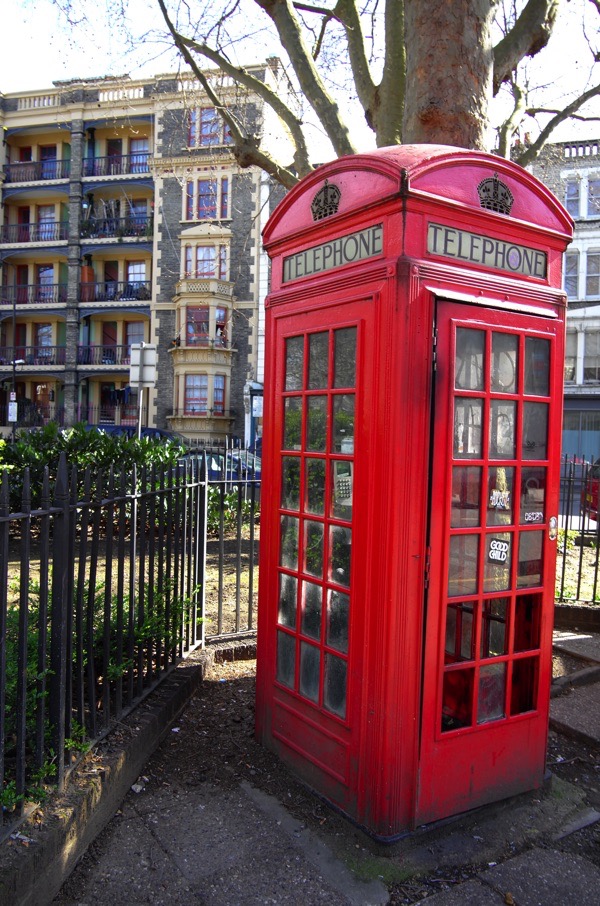
Desolate in Hackney Rd

Pointless in St John’s Sq

Irrelevant on Clerkenwell Green

Invisible in Smithfield

Forgotten outside St Bartholomew’s Hospital

In service outside St Paul’s as a quaint location for tourist shots
You may also like to take a look at
Charles Chusseau-Flaviens’ Petticoat Lane

Click here to book for my next tour of the City of London on Sunday 21st April

Petticoat Lane
Photographer Charles Chusseau-Flaviens came to London from Paris and took these pictures, reproduced courtesy of George Eastman House, before the First World War – mostly likely in 1911. This date is suggested by his photograph of the proclamation of the coronation of George V which took place in that year. Very little is known of Chusseau-Flaviens except he founded one of the world’s first picture agencies, located at 46 Rue Bayen, and he operated through the last decade of the nineteenth and first decade of the twentieth century. Although their origin is an enigma, Chusseau-Flaviens’ photographs of London and especially of Petticoat Lane constitute a rare and precious vision of a lost world.

Petticoat Lane


Sandys Row with Frying Pan Alley to the right

Proclamation of the coronation of George V, 1911

Crossing sweeper in the West End

Policeman on the beat in Oxford Circus, Regent St

Beating the bounds for the Tower of London, Trinity Sq

Boats on the Round Pond, Kensington Gardens

Suffragette in Trafalgar Sq
Photographs courtesy George Eastman House
You may also like to take a look at
At Oitij-jo Kitchen

‘We want to celebrate the work that the women do’
People often ask where they can find authentic Bengali food in Spitalfields and I have found the answer in Oitij-jo Kitchen, a women’s collective who run the catering operation at Rich Mix Arts Centre in the Bethnal Green Rd. This Sunday April 14th you can join the Eid celebrations there and experience a traditional Bhorta Bengali New Year lunch, served from 1pm – no booking required.
Last week, Contributing Photographer Sarah Ainslie spent a morning recording the activity in the kitchen while I sat down with co-founder Maher Anjum who explained to me what it is all about, before we all reconvened for a taste test.
“Four of us set up the Oitij-jo collective in 2013 straight after the 2012 London Olympics. We had Akram Khan in the opening ceremony but nothing else. We were all creatives, so we asked ourselves ‘Where are we in this scenario?’
We set up Oitij-jo to be a platform for creative practitioners from the Bangladeshi disapora, representing them, supporting them, especially emerging artists, but also showcasing our rich cultural heritage and translating it into what is happening now. Oitij-jo in bangla means heritage. It was important to us to take it to the future, so that the next generation have an understanding and can interpret it in their own way, because it is only at that point that it is alive.
In 2016, we did a year’s residency at the Gram Bangla restaurant in Brick Lane displaying art works with a new exhibition every three months. It was the first restaurant which served traditional Bengali food, and that was when food became part of our project. We had a lot of conversations with the restauranteurs about the nature of our food. And we realised that food was such an important part our cultural identity, it was something we wanted to work with. There was a visible lack of women in the restaurant sector and in catering in general, so we decided to focus on bringing in Bangladeshi women. It’s culture that people carry, even if may not pay attention to it, we simply say ‘Have some food.’
One of the things that women who work with us tell us is, ‘People say ‘thank you’ for the food I prepare for them. That’s really nice because at home it’s taken for granted. No-one’s going to thank you for the food you put on the table, it’s come-eat-go.’ For a lot of these women, the recognition of what they are doing is a recognition of themselves and food becomes an intrinsic part of who they are, part of their identity.
British Bangladeshi women are some of the least economically active of the population this country, three times less likely to be paid the same wages as anyone else. What are we doing about it? The creative sector is one of the most productive, but the involvement of black, Asian and people from other ethnic minorities is one of the least.
We see Otijo-jo kitchen as the means of giving women the pathway to self-discovery and self-esteem, while exploring the question of what is food for the British Bangladeshi community.
The so-called colonial curry – and what is seen to be ‘curry’ – has a complicated lineage, but there is a place for it and it has made a huge contribution to the community where employment was not available. It was a way for people to establish themselves and be their own bosses, rather than waiting for a job that might never come. We need to acknowledge that but it gets complicated when we ask, ‘What is the food? Who does it? And how does it happen?’
What we want to do is something quite different. We want to celebrate the work that the women do and the food which we consider is traditional Bengali food that people eat at home.
We could not get any funding, so we did a crowdfund in 2018 and raised a tiny amount of money, and started in 2019. Since then we have worked with about sixty women. We do not expect them to stay with us because we want them to gain the ability and self-confidence, get the skills and experience, and move on to do what they want to do.
Many women who come to us have never been in paid employment, they have very little experience of being outside the home or being in a working environment. We want them to build up the confidence to say ‘I can be here’ and be able to talk to people.
We have around a dozen women working with us at present. Once the women have finished their training period, they can stay on working with us and earn the London Living Wage. While they are training with us, they get a daily bursary.
We are a charity and a social enterprise, so we have to make sure we earn money to continue this work. Over the years, we have developed menus and recipes that are our style of cooking. The women who join us learn to cook our recipes the way we cook them.
We serve food at Rich Mix each Thursday to Sunday from 3pm to 9pm. The rest of the time, we use the kitchen here to do catering. We do conferences, seminars, weddings, any kind of occasion. We provide a hundred student lunches for a university twice a week, that’s a very different kind of catering. We did a conference for the Serpentine Gallery at Somerset House for one hundred and twenty people, breakfast, tea, lunch and something in the afternoon too.
Most of the women find us through word of mouth and we are having people contacting us all the time. We have a wide range of ages from around twenty to over sixty and we feel that’s really important because they brings different skills, experiences and abilities. Women come from across Tower Hamlets and the East End.
When we first started, someone asked, ‘If people want vegan food, what shall we give?’ If you have plain rice and dhal which is a standard Bengali meal, that is vegan. Bangladesh is a nation of rivers, so our heritage is that we eat vegetarian and vegan food all the time. You could say that we are going with the trend, except that is normal traditional food for us.”


Surma Khanom, Maher Anjum, Hajira Bibi & Rohema Begum
Photographs copyright © Sarah Ainslie
You may also like to read about
Blossom Time In The East End

CLICK HERE TO BOOK YOUR TICKET

In Bethnal Green
Let me admit, this is my favourite moment in the year – when the new leaves are opening fresh and green, and the streets are full of trees in flower. Several times, in recent days, I have been halted in my tracks by the shimmering intensity of the blossom. And so, I decided to enact my own version of the eighth-century Japanese custom of hanami or flower viewing, setting out on a pilgrimage through the East End with my camera to record the wonders of this fleeting season that marks the end of winter incontrovertibly.
In his last interview, Dennis Potter famously eulogised the glory of cherry blossom as an incarnation of the overwhelming vividness of human experience. “The nowness of everything is absolutely wondrous … The fact is, if you see the present tense, boy do you see it! And boy can you celebrate it.” he said and, standing in front of these trees, I succumbed to the same rapture at the excess of nature.
In the post-war period, cherry trees became a fashionable option for town planners and it seemed that the brightness of pink increased over the years as more colourful varieties were propagated. “Look at it, it’s so beautiful, just like at an advert,” I overheard someone say yesterday, in admiration of a tree in blossom, and I could not resist the thought that it would be an advertisement for sanitary products, since the colour of the tree in question was the exact familiar tone of pink toilet paper.
Yet I do not want my blossom muted, I want it bright and heavy and shining and full. I love to be awestruck by the incomprehensible detail of a million flower petals, each one a marvel of freshly-opened perfection and glowing in a technicolour hue.

In Whitechapel
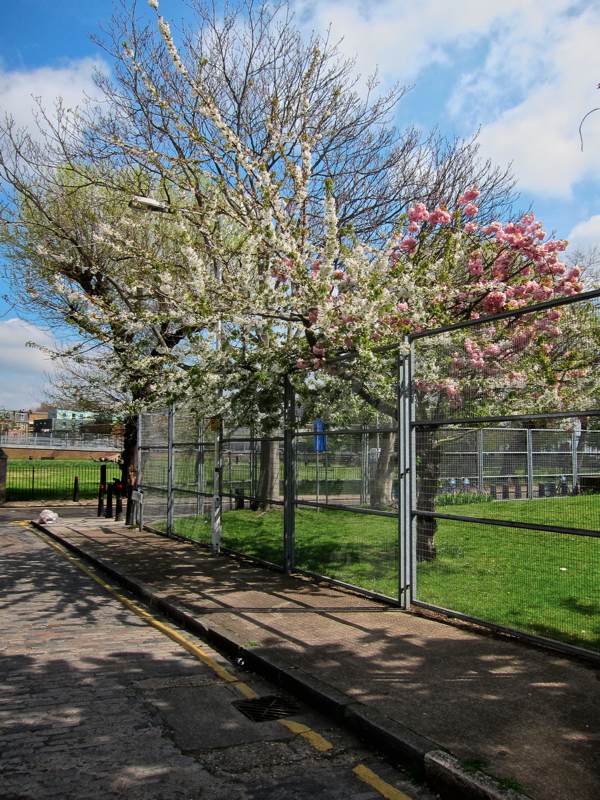
In Spitalfields

In Weavers’ Fields

In Haggerston

In Weavers’ Fields

In Bethnal Green

In Pott St

Outside Bethnal Green Library

In Spitalfields

In Bethnal Green Gardens

In Museum Gardens

In Museum Gardens

In Paradise Gardens

In Old Bethnal Green Rd

In Pollard Row

In Nelson Gardens

In Canrobert St

In the Hackney Rd

In Haggerston Park

In Shipton St

In Bethnal Green Gardens

In Haggerston

At Spitalfields City Farm

In Columbia Rd

In London Fields

Once upon a time …. Syd’s Coffee Stall, Calvert Avenue
Neil Martinson, Photographer

CLICK HERE TO BOOK YOUR TICKET
Neil Martinson documented the working life of Hackney and the East End throughout the seventies and eighties. Neil was born and brought up in Hackney, where he started taking street scenes and became a founder member of the Hackney Flashers photography collective.

Cheshire St


Steve Manning

Ridley Rd Market

Brian Simons

Bethnal Green Rd

Tony Kyriakides

Ken Jacobs

Ken Jacobs

Brian Simons

Stoke Newington

Ridley Rd Market


Lew Lessen


Abney Park Cemetery
Photographs copyright © Neil Martinson
You may also like to take a look at


