
George Parrin, Ice Cream Seller

Next tickets for THE GENTLE AUTHOR’S TOUR OF SPITALFIELDS are available for Saturday 22nd June
My pal George is out pedalling around the streets again, so if you see him be sure to stop him and buy one!

‘I’ve been on a bike since I was two’
I first encountered Ice Cream Seller, George Parrin, coming through Whitechapel Market on his bicycle. Even before I met him, his cry of ‘Lovely ice cream, home made ice cream – stop me and buy one!’ announced his imminent arrival and then I saw his red and white umbrella bobbing through the crowd towards us. George told me that Whitechapel is the best place to sell ice cream in the East End and, observing the looks of delight spreading through the crowd, I witnessed the immediate evidence of this.
Such was the demand on that hot summer afternoon that George had to cycle off to get more supplies, so it was not possible for me to do an interview. Instead, we agreed to meet next day outside the Beigel Bakery on Brick Lane where trade was a little quieter. On arrival, George popped into the bakery and asked if they would like some ice cream and, once he had delivered a cup of vanilla ice, he emerged triumphant with a cup of tea and a salt beef beigel. ‘Fair exchange is no robbery!’ he declared with a hungry grin as he took a bite into his lunch.
“I first came down here with my dad when I was eight years old. He was a strongman and a fighter, known as ‘Kid Parry.’ Twice, he fought Bombardier Billy Wells, the man who struck the gong for Rank Films. Once he beat him and once he was beaten, but then he beat two others who beat Billy, so indirectly my father beat him.
In those days you needed to be an actor or entertainer if you were in the markets. My dad would tip a sack of sand in the floor and pour liquid carbolic soap all over it. Then he got a piece of rotten meat with flies all over it and dragged it through the sand. The flies would fly away and then he sold the sand by the bag as a fly repellent.
I was born in Hampstead, one of thirteen children. My mum worked all her life to keep us going. She was a market trader, selling all kinds of stuff, and she collected scrap metal, rags, woollens and women’s clothes in an old pram and sold it wholesale. My dad was to and fro with my mum, but he used to come and pick me up sometimes, and I worked with him. When I was nine, just before my dad died, we moved down to Queens Rd, Peckham.
I’ve been on a bike since I was two, and at three years old I had my own three-wheeler. I’ve always been on a bike. On my fifteenth birthday, I left school and started work. At first, I had a job for a couple of months delivering meat around Wandsworth by bicycle for Brushweilers the Butcher, but then I worked for Charles, Greengrocers of Belgravia delivering around Chelsea, and I delivered fruit and vegetables to the Beatles and Mick Jagger.
At sixteen years old, I started selling hot chestnuts outside Earls Court with Tony Calefano, known as ‘Tony Chestnuts.’ I lived in Wandsworth then, so I used to cycle over the river each day. I worked for him for four years and then I made my own chestnut can. In the summer, Tony used to sell ice cream and he was the one that got me into it.
I do enjoy it but it’s hard work. A ten litre tub of ice cream weighs 40lbs and I might carry eight tubs in hot weather plus the weight of the freezer and two batteries. I had thirteen ice cream barrows up the West End but it got so difficult with the police. They were having a purge, so they upset all my barrows and spoilt the ice cream. After that, Margaret Thatcher changed the law and street traders are now the responsibility of the council. The police here in Brick Lane are as sweet as a nut to me.
I bought a pair of crocodiles in the Club Row animal market once. They’re docile as long as you keep them in the water but when they’re out of it they feel vulnerable and they’re dangerous. I can’t remember what I did with mine when they got large. I sell watches sometimes. If anybody wants a watch, I can go and get it for them. In winter, I make jewellery with shells from the beach in Spain, matching earrings with ‘Hello’ and ‘Hola’ carved into them. I’m thinking of opening a pie and mash shop in Spain.
I am happy to give out ice creams to people who haven’t got any money and I only charge pensioners a pound. Whitechapel is best for me. I find the Asian people are very generous when it comes to spending money on their children, so I make a good living off them. They love me and I love them.”


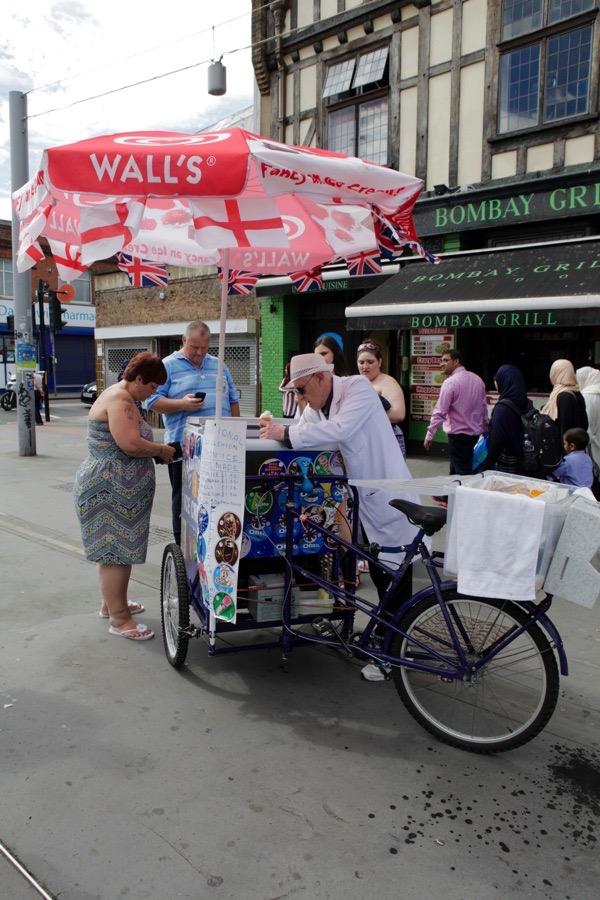


Photographs copyright © Estate of Colin O’Brien
You might also like to read about
Matyas Selmeczi, Silhouette Artist
A Walk In The City With PC Lew Tassell
Next tickets for THE GENTLE AUTHOR’S TOUR OF SPITALFIELDS are available for Saturday 22nd June
Taking advantage of the early summer sunshine, Lew Tassell and I enjoyed a recent stroll through the City as he regaled me with tales of yesteryear.

PC Lewis Tassell on the beat in the seventies
‘Over my thirty years in the City of London Police I spent a lot of time engaged in duties other than walking the beat – security assignments, interviews, meetings and conferences in different locations in the Square Mile. Here are a few places of which I have fond memories and one in particular that was tragically sad.’

Pump Court
‘Working for twenty years in the Fraud Squad and a further sixteen years at the Serious Fraud Office, I spent a lot of time at case conferences in barristers’ chambers at 4 Pump Court off Middle Temple Lane where Henry Fielding lived in the eighteenth century.
The original buildings dated back to 1625 but many were destroyed during World War II and 4 Pump Court was rebuilt in 1952. The case in question took a number of years and led to the successful conviction of two fraudsters after a long trial at the Old Bailey in which the prosecution was led by a senior barrister from 4 Pump Court.
Walking through the Temple Estate is like stepping back in time, a haven in the centre of the metropolis. There are still gas lamps in Middle Temple Lane which in the eighties they were being switched on and off manually each day, although they are automatic today. ‘

Middle Temple Lane

Royal Courts of Justice
‘The Royal Courts of Justice house the High Court and Court of Appeal of England & Wales. During the seventies whilst working in the CID at Bishopsgate Police Station, I had a case of theft that went to trial at the Central Criminal Court, Old Bailey. All cases where the defendant elected to go to trial ended up at the Bailey no matter how trivial. This used to annoy some judges who were more used to dealing with high profile cases of murder, rape, robbery or fraud, rather than simple theft.
In fact my case was moved at the last minute from the Old Bailey, where they had no court available, to the Law Courts. So I ended up giving evidence here and it was all over in about two days with the defendant was found guilty.’

Micks Cafe
‘This was a Fleet St institution in the seventies when it was open twenty-four hours and seven days a week. It was constantly busy during the day but even busier at night when it was frequented by the print workers, drunks on their way home and homeless people who went there to keep warm, especially in winter.
On night duty in the seventies, we carried out a plain clothes observation in the cafe. It was suggested that the place was a location for dealing stolen gear and whatever was wanted by print workers could be sourced at Micks, though not – I should add – from those that ran it.
Needless to say the observations were fruitless since we stuck out like sore thumbs, sitting at cramped grimy tables sipping stewed tea all night. The establishment later acquired a apostrophe and became Mick’s Cafe before it closed in the nineties.’


St Paul’s Cathedral
‘I had many security duties at St Paul’s and I have had the good fortune to visit every part, from the crypt beneath to the cross on the top. One night when the cathedral was closed and sealed, I was tasked with patrolling the crypt alone in the dim light of the early hours of the morning. It was one of the few times that I have been truly spooked. I stood before the sarcophagus of the Duke of Wellington and immediately behind me was the tomb of Admiral Horatio Nelson. For some reason I started to shiver. Perhaps it was just the weight of history coupled with the fact it was in the middle of the night and I was on my own in the dark?
In 1982 I was on a security detail for a Service of Celebration & Thanksgiving to mark 60 years of the BBC in the presence of Her Majesty The Queen & His Royal Highness The Duke of Edinburgh, as well as many other VIPs. Sir Charles Groves was conducting the BBC Symphony Orchestra with members of the Scottish, Welsh & Northern Symphony Orchestras. It was by ticket only and there were no exceptions. When I checked in Sir Charles, he was followed by a woman who I stopped because she did not have a ticket. Sir Charles turned and exclaimed ‘That’s my wife, if you don’t let her in there will be no bloody music’. Today here is a memorial stone to him in the cathedral.’


Wood St Police Station
‘My base in the Fraud Squad for twenty years was Wood St Police Station. It was built in 1965 to house the communications department, the stables and garage as well as accommodation in the tower block, mainly for single men and women who were serving in the force.
When I joined the Squad in 1979, they occupied what was the former living accommodation. It was a fine building but not really conducive for use as a police station. The garage was underground with low ceilings that had exposed pipes and ductwork, making it unsuitable for many police vehicles and the canteen was directly above the stables which made it unpleasant in hot weather. In later years much of the building fell into disrepair because alterations could not be made to bring it up to the standard required for a modern police station since it was a Grade II* listed building. The building is now to be converted to a luxury hotel.’


Guildhall
‘This is a fifteenth century Grade I listed building with a stunning medieval Great Hall where I fulfilled security duties at many functions over the years – banquets for visiting heads of state and Lord Mayor’s banquets. On two occasions, I even attended banquets myself as a guest at celebrations of the achievements of the Fraud Squad.’


Moorgate Station
‘As a police officer there are many tragic events that you have to deal with as best you can. On 28th February 1975 I was on early duty when I went into the front office at Bishopsgate Police Station. The phone rang and was answered by the sergeant. He asked me to walk around to Moorgate tube before my break as a train had run into the buffers. At the time, it was the worst peacetime accident on the London Underground that had happened. Forty-three people died and seventy-four others were injured. I still use Moorgate tube and I am always reminded of that dreadful day. There is a plaque at the station and a memorial in Finsbury Sq listing the names of those who died.’
You may also like to trace our previous walks
Postcards From Petticoat Lane
Next tickets for THE GENTLE AUTHOR’S TOUR OF SPITALFIELDS are available for Saturday 22nd June

Today I am sending you postcards from Petticoat Lane. Here are the eager crowds of a century ago, surging down Middlesex St and through Wentworth St, everyone hopeful for a bargain and hungry for wonders, dressed in their Sunday best and out to see the sights. Yet this parade of humanity is itself the spectacle, making its way from Spitalfields through Petticoat Lane Market and up to Aldgate, before disappearing into the hazy distance. There is an epic quality to these teeming processions which, a hundred years later, appear emblematic of the immigrants’ passage through this once densely populated neighbourhood, where so many came in search of a better life.
At a casual glance, these old postcards are so similar as to be indistinguishable – but it is the differences that are interesting. On closer examination, the landmarks and geography of the streets become apparent and then, as you scrutinise the details of these crowded compositions, individual faces and figures stand out from the multitude. Some are preoccupied with their Sunday morning, while others raise their gaze in vain curiosity – like those gentlemen above, comfortable at being snapped for perpetuity whilst all togged up in their finery.
When the rest of London was in church, these people congregated to assuage their Sunday yearning in a market instead, where all temporal requirements might be sought and a necessary sense of collective human presence appreciated within the excited throng. At the time these pictures were taken, there was nowhere else in London where Sunday trading was permitted and, since people got paid in cash on Friday, if you wanted to buy things cheap at the weekend, Petticoat Lane was the only place to go. It was a dramatic arena of infinite possibility where you could get anything you needed, and see life too.


Images copyright © Bishopsgate Institute
You might also like to read about
Laurie Allen of Petticoat Lane
The Wax Sellers of Wentworth St
Margaret Rope’s East End Saints
Click here to book your ticket for THE GENTLE AUTHOR’S TOUR OF SPITALFIELDS

A familiar East End scene of 1933 – children playing cricket in the street and Nipper the dog joining in – yet it is transformed by the lyrical vision of the forgotten stained glass artist Margaret Rope, who created a whole sequence of these sublime works – now dispersed – depicting both saints of legend and residents of Haggerston with an equal religious intensity.
This panel is surmounted by a portrayal of St Leonard, the sixth century French saint, outside a recognisable St Leonard’s church, Shoreditch, with a red number six London bus going past. Margaret Rope’s extraordinary work mixes the temporal and the spiritual, rendering scenes from religious iconography as literal action and transforming everyday life into revelations – describing a universe that is simultaneously magical and human.
Between 1931 and 1947, the artist known simply to her family as ‘”Tor,” designed a series of eight windows depicting “East End Everyday Saints” for St Augustine’s church off the Hackney Rd, portraying miracles enacted within a recognisable East End environment. And for many years these charismatic visionary works were a popular attraction, until St Augustine’s was closed and Margaret Rope’s windows removed in the nineteen eighties, with two transferred across the road to St Saviour’s Priory in the Queensbridge Rd and the remaining six taken out of the East End to be installed in the crypt of St Mary Magdalene, Munster Sq. Intrigued by the attractive idea of Margaret Rope’s transcendent vision of the East End, I set out to find them for myself this week.
At St Saviour’s Priory, Sister Elizabeth was eager to show me their cherished windows of St Paul and St Margaret, both glowing with luminous rich colour and crammed with intricate detail. St Paul, the patron saint of London, is depicted at the moment of his transformative vision, beneath St Paul’s Cathedral – as if it were happening not on the road to Damascus but on Ludgate Circus. The other window, portraying St Margaret, has particular meaning for the sisters at St Saviours, because they are members of the Society of St Margaret, whose predecessors first came from Sussex to Spitalfields in 1866 to tend to the victims of cholera. In Margaret Rope’s window, St Margaret resolutely faces out a dragon while Christ hands a tiny version of the red brick priory to John Mason Neale, the priest who founded the order. Both windows are satisfyingly engaging exercises in magical thinking and the warmth of the colour, especially the turquoise greens and soft pinks, delights the eye with its glimmering life.
I found the other six windows in the crypt of St Mary Magdalene near Regents Park, used as a day centre for seniors, where they are illuminated from the reverse by fluorescent tubes. The first window you see as you walk in the door is St Anne, which contains an intimate scene of a mother and her two children, complete with a teddy bear lying on the floor and a tortoiseshell cat sleeping by the range. Next comes St George, who looks like a young athlete straight out of the Repton Boxing Club, followed by St Leonard, St Michael, then St Augustine and St Joseph. All share the same affectionate quality in their observation of human detail, rendered with a confidence that sets them above mere decorative windows. These are poems in stained glass that manifest the resilient spirit of the East End which endured World War II. Another window by Margaret Rope in St Peters in the London Docks, completed in 1940, showed people celebrating Midnight Mass at Christmas in a bomb shelter.
Margaret Edith Aldrich Rope was born in 1891 into a farming family on the Suffolk coast at Leiston. Her uncle George was a Royal Academician, and she was able to study at Chelsea College of Art and Central School of Arts & Crafts, where she specialised in stained glass. Unmarried, she pursued a long and prolific working life, creating over one hundred windows in her fifty year career, taking time out to join the Women’s Land Army in World War I and to care for evacuees at a hospital in North Wales during World War II, before returning to her native Suffolk at the age of eighty-seven in 1978.
Her nickname “Tor” was short for tortoise and she signed all her works with a tortoise discreetly concealed in the design – and upon close examination, every window reveals hidden texts inscribed into the richly coloured shadows. So much thought and imagination is evident in these modest works in the magical realist style – which transcend their period as neglected yet enduring masterpieces in the underrated art of stained glass – that I recommend you make your acquaintance with the stylish work of Margaret Rope, which celebrates the miraculous quality of the everyday.

St Leonard is portrayed in a moment of revelation outside St Leonard’s Church, Shoreditch, with Arnold Circus in the background and a London bus passing in the foreground.

The lower panel of the St George window.

A domestic East End scene from the lower panel of the St Anne’s window.

This tortoise-shell cat is a detail from the panel above.

The lower panel from the St Michael window.

Mother Kate, Prioress of St Saviour’s and Father Burrows with his dog, Nipper, standing outside St Augustine’s in York St, now Yorkton St. In the right hand corner you can see the tortoise motif that Margaret Rope used to sign all her works.

Sisters of St Saviour’s Priory, portrayed in the lower panel of the St Margaret window, 1932.

Margaret Rope’s St Paul and St Margaret, now in the entrance of Saviour’s Priory, Queensbridge Rd.

Stained glass artist, Margaret Edith Aldrich Rope known as “Tor” (1891-1988)
Peri Parkes’ East End
Click here to book your ticket for THE GENTLE AUTHOR’S TOUR OF SPITALFIELDS

House in the East, 1980-81
It was through the artist Doreen Fletcher, who is celebrated for her paintings of the East End, that I first learnt about the work of Peri Parkes.
Doreen wrote, ‘My good friend Peri Parkes was perhaps the artist with the most integrity I have ever met. His standards were so high that he was reluctant to exhibit anything he produced, always finding the outcome lacking somehow. Fellow artists tried hard to persuade him to have a one man show to no avail. He painted the East End assiduously during the eighties until he took a teaching post in Cornwall in 1992, however he continued to revisit to Bow right up until his death too soon at the age of fifty-six.’
On Doreen’s recommendation, I took the train to Hertford to meet Peri’s daughters, Lucie & Zoe who showed me fifty of their father’s paintings which have been mostly stored in a cupboard since he died in 2009. The quality and significance of this work was immediately apparent and I knew at once that I must devote a chapter in my book East End Vernacular, Artists Who Painted London’s East End Streets in the 20th Century to celebrate the rare talent and rigorous vision of Peri Parkes.
Out of the tragedy of a broken relationship, Peri Parkes created a transcendent series of paintings and it is impossible not to touched by the self portraits that he included in his work, of the lonely man walking in the park or climbing onto his bike.
Lucie & Zoe are the custodians of this legacy and they spoke affectionately to me about their father as we sat surrounded by his wonderful paintings.
Zoe – My father was from Hampstead Garden Suburb in Finchley. He had a Greek mother – who named him Pericles, she came from quite a well-to-do family and his father was a solicitor. Dad was born and grew up there but he left home very young, about sixteen. Then he met Lindsey, my mum, and they had me when he was just eighteen. My grandmother bought a house in Ridge Rd Crouch End and we all lived there.
Lucie – When he was nineteen, he got a scholarship to the Slade. I should add that when he was sixteen, he went off to Afghanistan, back-packing. He and mum first met at the railway station, just before he was about to leave and there was obviously a spark. Once he came back, they met up again and married when he was eighteen and mum was seventeen.
Zoe – When I was a baby, he used to take me off to college with him. He put me on his back and off we would go to the Slade.
Lucie – Mum had agoraphobia after she had Zoe, so he had to take her with him – a nineteen-year-old with his baby.
Zoe – They split up when I was six and Lucie was three, around 1979. He went to stay with his friend Martin Ives in a prefab in Conder St, Stepney and we stayed with our mum in her mum’s house. After that he got a housing association flat next to Bow Rd Station and then he moved just around the corner to Mornington Grove.
Lucie – He never had a studio, he just painted in the flat where he lived. He was completely unmaterialistic and his whole flat was his studio with bare floors, bare walls, furniture that he picked up from skips or off the street, boxes and then piles and piles of paints. All over the furniture there was paint splatters and full ashtrays. He did not really ever think about comfort.
Zoe – He was so driven by painting. He had a one track mind. He did not really want anything else in life but to be able to paint and to go to the pub.
Lucie – We used to go and stay with him every other weekend in the prefabs and hang around in the back yard, I remember doing snail races and counting slugs while he painted.
Zoe – He took us round galleries quite a lot, which as children was quite boring to us – but he used to get very enthusiastic about things he wanted to see.
Lucie – To say he was very self-absorbed is only half the picture because he was not egotistical, he was actually quite a humble person, and a loving and affectionate dad. I remember lying in bed in the prefabs when it was freezing cold and he used to tell us stories, and they were brilliant. We loved him and loved being with him, but he was not really able to give to his relationships because everything was about painting.
Zoe – I think he struggled with depression a lot, whether it was to do rejection as an artist or with not getting things right. He was a real perfectionist and he had massive temper flare ups if he was not satisfied with his work. Yet he had a real community in London. He used to go to the Coborn Arms every night and he had a crew of friends there.
Lucie – Nothing he did was ever right or good enough for him. He was always striving to be better. He could not give his paintings away let alone sell them but, if he did give one away to a family member, he took it back because it was not quite good enough. If he was here now, he would be looking at his paintings, very dissatisfied, and he would want to make changes.
He was driven to paint what he saw in front of him. I do not think he was driven to tell the story of the East End, it was just that, wherever he was, he painted obsessively to capture what he was seeing. Most of them are from his window in his living room or the back of his prefab.
Zoe – He was always submitting pictures for exhibitions and competitions, and he took the rejection quite personally.
Lucie – When his relationship broke down with mum he was deeply hurt. I think the more things went wrong in his life, the more he channelled everything into painting. I can remember him taking us home on the tube once and him looking at us and tears pouring down his face. That sticks with me because I knew then that he really cared and was hurt by the whole thing, but he could not express any of that – it all went into his painting.
Zoe – I look at these paintings and I see them as dad’s life at the time, from the time arrived in the East End in 1977 until he left in 1992. The style at the beginning is quite different from the later ones. He went on holiday to the tiny town of St Just on the farmost westerly point of Cornwall and fell in love with it. The day after returning from holiday he saw a job for a part time art teacher there in the newspaper, it was like an act of fate. He had taught Art at the Blessed John Roche School in Poplar and he wanted out of London. He loved it in Cornwall and lived in the most remote place. He said Cornwall was as close as he could get to Greece in this country.
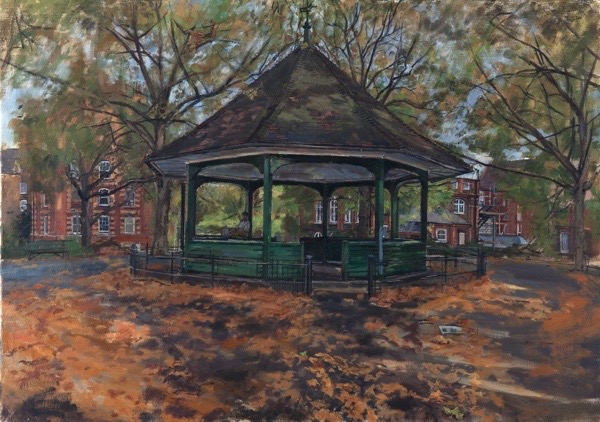
Arnold Circus, 1990-92

The Dinner Ladies, c.1986-9 (Wellington Way School, Bow E3)

Wellington Way School E3, 1985-6

Bow Triangle in Winter, 1990-92

The Departure, c.1992-4 (Mornington Grove, Bow E3)

Bow Church, c.1987-92

Conder St, Stepney, 1977-80

Conder St, Stepney, c.1980

City view from St Bernard’s School, St Matthew’s Row, E2, c.1987 (Click on this image to enlarge)
Paintings copyright © Estate of Peri Parkes

Click here to buy a copy of EAST END VERNACULAR for £25
David Johnson’s Cafes
Click here to book your ticket for THE GENTLE AUTHOR’S TOUR OF SPITALFIELDS

Fredson’s Cafe, Alie St
David Johnson took these magnificent photographs of cafes in Kodachrome around 1980.
“When I lived in East London, I started this project to photograph some classic cafes, mainly in the East End – but also elsewhere as I came across them in my travels. I think it was the sign-writing and eclectic typography which were the main attractions. I realised that they were not going to be around much longer. Many were run by Italian families who started up in the post-war period. Annoyingly, I did not make a note of the locations – so if you can help, please leave a comment.”
David Johnson

Aeron Cafe

Bridge Cafe

Corner Parlour

Alfredo’s Cafe, Islington

Sign at Alfredo’s Cafe

Flock-In

Gee’s Cafe

George’s Cafe, Whitechapel

The Happy Fillet

Jim’s Cafe, Islington

Jubilee Cafe

Moon & Sixpence Cafe

Norman’s Nosh Bar

Norman’s Nosh Bar

Phyllis’s Cafe

Silvio Cafe

The Ninety Eight

The Village Rest

Viking Cafe

Magno Cafe

Leslie’s Cafe

Crawford Cafe

Cafe

Empire Cafe

Photographs copyright © David Johnson
You may also like to take a look at
David Johnson’s East End
Click here to book your ticket for THE GENTLE AUTHOR’S TOUR OF SPITALFIELDS

Liverpool St Station
Shall we take a tour around the East End in the early eighties in the company of David Johnson, courtesy of his wonderful Kodachrome photographs?
“My interest in London’s history goes back to the late sixties, when as a teenager I would take the train from Oxford and then, using a Red Bus Rover ticket and a copy of Geoffrey Fletcher’s The London Nobody Knows, discover some of the most interesting and off-beat parts of the capital. In 1977, seeking a job after graduating and with a strong interest in photography, I ended up in London selling cameras in Tottenham Court Rd. I first explored the old wharves and docklands before they disappeared and then, after moving to Dalston, the East End. Derelict buildings, faded signs, architecture on a human scale are all things which I liked to photograph then – and still do today.”
David Johnson
 Liverpool St Station
 Liverpool St Station
 Liverpool St Station

Artillery Lane

Brushfield St

Christ Church Spitalfields

Fashion St

Spitalfields barber

Hanbury St

Brick Lane

Homeless men in Spitalfields

The City from Spitalfields

Whitechapel Market

Wapping Police Station

Wapping

St Paul’s School, Wellclose Sq

Wapping High St

River Plate Wharf

Wapping

Wapping Pier Head

The Gun, Isle of Dogs

The Black Horse, Limehouse

Grove Place, Hackney

Empress Coaches, Hackney

Regent’s Canal

Cat & Mutton Bridge

Broadway Market

Broadway Market

George Tallet, Fishmonger, Hackney

Carr’s Pet Stores, Hackney

Trederwen Rd, Hackney
Photographs copyright © David Johnson


