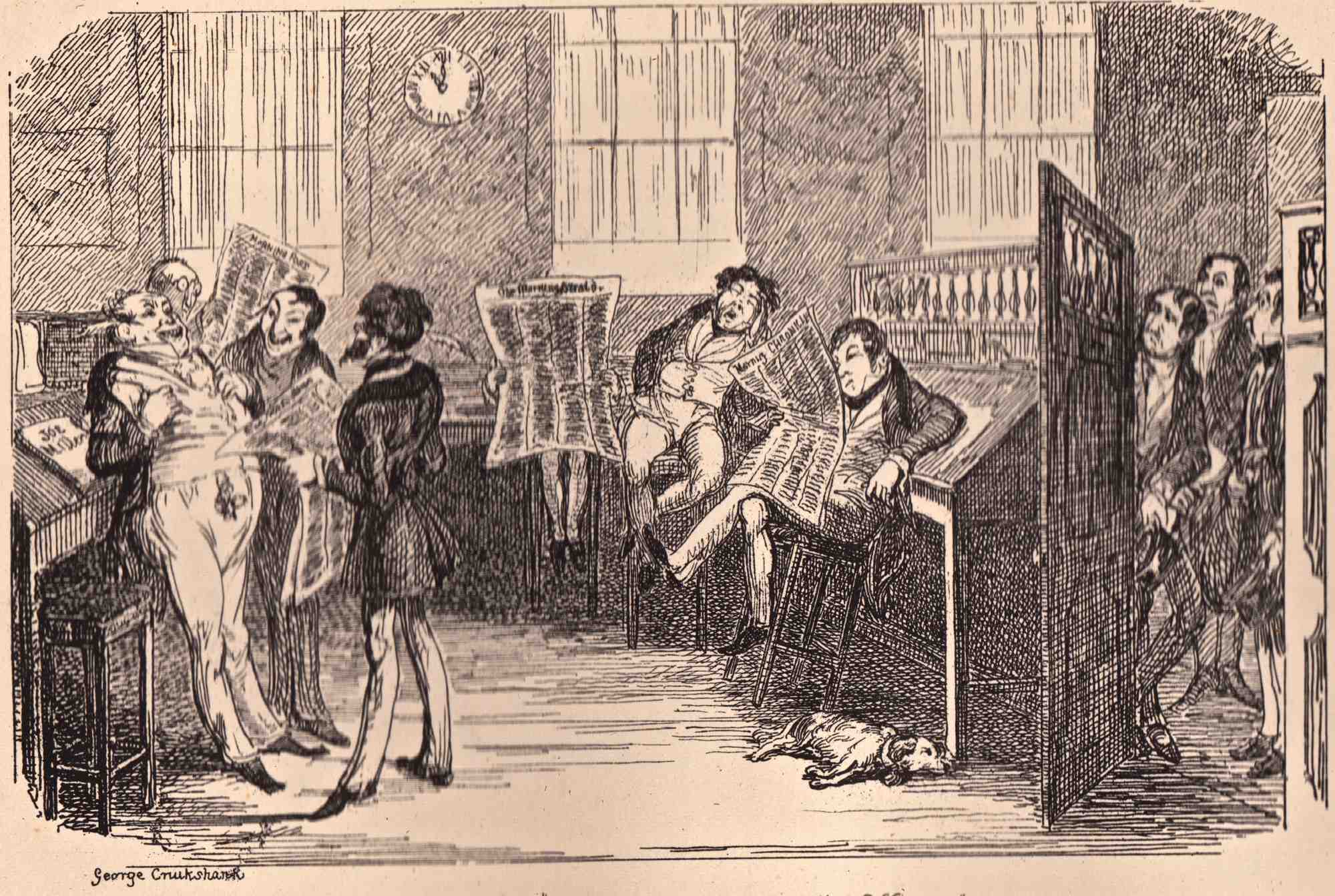
George Cruikshank’s London Summer

Click here to book your ticket for THE GENTLE AUTHOR’S TOUR OF SPITALFIELDS

JULY 1838 – Flying Showers in Battersea Fields
Should you ever require it, here is evidence of the constant volatility of English summer weather, courtesy of George Cruikshank’s Comic Almanack published by Henry Tilt of Fleet St annually between 1835 & 1853, illustrating the festivals and seasons of the year for Londoners. (Click on any of these images to enlarge)

JUNE 1835 – At the Royal Academy

JUNE 1836 – Holidays at the Public Offices

JUNE 1837 – Haymaking

JULY 1835 – At Vauxhall Gardens

JULY 1836 – Dog Days in Houndsditch

JULY 1837 – Fancy Fair

AUGUST 1836 – Bathing at Brighton

AUGUST 1837 – Regatta

SEPTEMBER 1835 – Bartholomew Fair

SEPTEMBER 1837 – Cockney Sportsmen
You may also like to take a look at
Audrey Kneller Of Elder St
Click here to book your ticket for THE GENTLE AUTHOR’S TOUR OF SPITALFIELDS

Audrey on trip to Epping Forest, aged twelve in 1957
Audrey Kneller sent me this evocative memoir of her years in Elder St.
Elder St was not a pretty place in spite of its name. No buds burst forth each spring to awaken our spirits and no birds sang merrily to remind us of the wonders of nature. Instead soot lay unmolested in every crevice of the ancient brickwork, while the clanking and hissing of steam trains shunting reminded us of the presence of the large London terminus. Poverty was a mantle we refused to wear, but it lurked menacingly on every street corner.
Early in 1953, my Auntie Sophie happened to bump into Millie Berman, an old school friend of my mother’s. This chance meeting was to bring great changes. Millie lived with her daughter on the upper floors of a rented house in Elder St and was looking for someone to take over the tenancy as she was intending to move. Clearly this was an opportunity not be missed.
Shortly after the Coronation in June 1953, we left the comfort of our temporary home in Edgware and moved into the four-storey terraced house at 20 Elder St, Norton Folgate, E1. Our first impressions were far from favourable. The tallness of the houses and total absence of trees or even a blade of grass was very forbidding. However we gradually settled and discovered the bizarre fascinations of an urban existence.
At the back, towards Bishopsgate, there was a large bomb site where I joined some boys playing cowboys and indians, and had a lovely time amid the dirt and rubble. My mother, being a genteel person, was quite horrified when I returned home looking the worse for wear. Thereafter I played more civilised games with my sister and the other refined children of the neighbourhood inside the safe confines of the street. The bomb site, however, came into its own on Guy Fawkes Night when the sky was lit up with the flames of a huge bonfire and accompanying fireworks, watched by us from a third floor bedroom window.
Our part of Elder St was an ideal playground, not only because it sheltered us from traffic but also because of the numbers of children living in the surrounding houses and tenements, so we were seldom short of playmates. In those days, the threat of the motor car was almost non-existent, leaving us to play unrestricted and unhampered, a freedom children cannot enjoy today.
In fact, I cannot remember ever, in the early days of our life in Elder St, seeing a car impinge on our games of higher and higher, piggy in the middle and others too numerous to mention. We played in the road outside our door and no-one ever prevented us from chalking out our squares on the pavement for hopscotch. The black-painted iron bars above the basement in front of the some of the houses could easily be squeezed behind, if a side bar was missing, in order to retrieve a lost ball. These hump-shaped grills were nicknamed “airies,” and a cry would often go up, “It’s gone down the airy!” It was up to the smallest and bravest of us to crawl down into the tiny space below, and once down there you had an awful feeling of being trapped in a cage until you emerged triumphant with the lost ball.
I remember long summer evenings spent playing in the street and the man who came along on his three-wheeler, peddling ices. “Yum Yum” was the brand name and yum yum his ice lollies were, delicious and creamy. A good selling point was that every so often one of the lolly sticks would have the name “YUM YUM” printed on it and whoever had such a stick could have another lolly free on presenting it to the ice cream man. Once this fact became known, some of us sat in the gutter scratching the words “YUM YUM” on our spare sticks. But the ice cream man was not fooled and, some time later, when he came round again after an unexpectedly long interval, the name of the product had been changed to “WHIM”. The lollies were the same but somehow the gilt had gone from the gingerbread.
I recall with affection the Josephs family. Simon Josephs was my age and lived with his parents, two maiden aunts and an elderly grandmother around the corner in Fleur-de-Lis St. Their house was much smaller than ours and poorly built but they were a happy family. They even had a television set, which we did not have, and we lost no opportunity when invited to view. We also spent happy hours playing with Simon and his games, especially my favourite one of Monopoly.
Next door to the Josephs lived an elderly spinster and her bachelor brother who was disabled, having been afflicted with shell shock in the First World War, and I remember sitting with them one Yom Kippur evening waiting for the fast to end. One by one, the tiny houses and the dark overcrowded tenements in Fleur-de-Lis St became empty and boarded up awaiting demolition. The Josephs, we heard later, were re-housed in a new flat on the Ocean Estate in Mile End.
Number 26 Elder St was a tall narrow house accommodating two families, one Jewish and the one Gentile. My sister Yvonne and I would sometimes sit on the steps of the house playing gobs or five stones with the daughters of the respective families. Avril Levy from the Jewish family had a famous auntie, Adele Leigh a renowned opera singer, who would often call round, leaving her sporty two-seater Sunbeam Rapier outside the house.
In Blossom St lived a family that to me epitomised poverty both materially and spiritually. The children were neglected and ran around with bare feet and bare bottoms. I was very shocked because they were so different from us yet lived almost on our doorstep. One day, Christine, a little girl who lived at 16 Elder St, decided that we should venture into the house in Blossom St. We peered inside what seemed to be a dark hole with no semblance of what I considered to be the trappings of a home. Dirt and decay lay all around and I caught a glimpse of a man lying asleep on an old armchair which, instead of cushions, was covered with sacks filled with horse hair. Overcome by feelings of horror, disbelief and the foul stench that pervaded the building, we stepped backwards into the street, and quickly walked back to the welcome ‘civilisation’ of Elder St, never to set foot again in Blossom St.
As to the past history of our house, we were led to believe that it was built in the early eighteen-hundreds. I cannot support the validity of this but the house certainly contained some unusual features.
Looking through the windows at the back, high walls surrounded the yard which was no more than ten feet in depth, just enough space for a coal storage area and a washing line to be strung across. Our convenient position near Liverpool St Station could also be a disadvantage, if the wind was blowing in the wrong direction our clean laundry would be showered with a fine layer of soot.
Ours was the only house in Elder St – and for all we knew anywhere else in Norton Folgate – to have a bathroom. The fittings were brass and, instead of having a normal plughole, there was a tall brass post affair which had to be lifted up to let the water run away. Hot water came from an ancient geyser on the wall above the bath but woe betides anyone who fell foul of the delicate lighting-up procedure. I did once and was greeted with a loud bang. The secret was to run the water first and then ignite the gas. Henceforth, unless my mother or sister were there to do the honours, I felt it safer to spend my bath times in an old zinc tub in front of the fireplace in the living room.
Nevertheless, it was handy to have a bathroom, especially as a connecting door led into the back bedroom thereby giving us a bathroom en suite! The toilet was situated next to the bathroom on the first floor landing. To have an inside toilet was again untypical of the area, most toilets being situated outside in the backyard, as I found at our cousin’s house in Buxton St.
A house of this size required regular maintenance and my mother employed a spare-time handyman to keep the interior in a good state of repair. He came and went for six years, painting, papering, plumbing and fixing, and no sooner had he finished on the top floor than it was time to start again at the bottom, rather like the Forth Bridge.
An interesting feature of the house was a long speaking tube with a whistle at one end, extending from the top floor right down to the basement. Presumably a device once used by servants, this was a source of amusement. Another source of great amusement to us, as well as to other children in our street, was the wall panelling. We succeeded in convincing them that one on the first floor landing slid back to reveal a secret passageway, such as the ones used by Cavaliers to escape the Roundheads during the Civil War.
One day, my sister told some children playing in the street that there was something strange in our basement and they immediately came to investigate. Meanwhile, I had dressed up a tailor’s dummy in an old red frock and hid behind it. As the children descended the basement stairs, I slowly moved the dummy forward, calling out in an eerie voice. The inquisitive children scattered in haste, believing me to be a headless ghost!
Not long after we moved into Elder St, we discovered the presence of unwelcome lodgers lurking behind the skirting boards. After mousetraps failed to catch them, we acquired the services of a cat. One day, one of our cousins from Buxton St called round with a tabby who had the perfect markings of a tiger, so the name stuck. Tiger was a wonderfully docile pet but he lived up this name in keeping the rodent community at bay.
One day I found him sitting on the landing and tried to pick him to carry him downstairs but he would not budge. I could not understand it until my mother pointed out that he was standing guard over a small hole in the skirting board. We left him there all that day and eventually he returned to us of his own accord, presumably having accomplished his mission.
As to the other houses in Elder St, I am sure that none of us children had any idea of their historic value. As far as I could see, we were surrounded by decaying walls and we had to make the best of the situation until circumstances improved.
Although we may have been devoid of pastoral pleasures in Spitalfields, life was far from dull. We were living on the fringes of a great nucleus of Jewish enterprise and culture – consisting of delicatessens, bakeries, butcher shops and kosher restaurants, intermingled with other Jewish-owned businesses in the garment, jewellery and shoe trades, bookshops, a Yiddish theatre and numerous synagogues – stretching from Brick Lane southward to Houndsditch and eastward as far as Bow. This was our heritage, we had returned to the roots set down by our grandparents and thousands of other immigrants fifty years earlier.

Audrey’s tenth birthday tea in 1955
You may also like to read about
Peter Rayner, Baker, Bell Tuner & Train Driver
Click to book your ticket for THE GENTLE AUTHOR’S TOUR OF SPITALFIELDS this Saturday

Peter Rayner
It is rare that you meet anyone with such an array of practical skills and accomplishments as Peter Rayner. I visited Peter at his home in Stratford where he told me his story.
“On my father’s side, I am an East End boy and, on my mother’s side, I am Leicestershire. They met when dad was in the army and mum was in the land army in Kent but although I was born and bred in Hertfordshire I consider myself an East Ender.
I always wanted to be a train driver but I left school and went into catering. My parents told me there would be more money in it. I had always been interested in making bread and cakes. I got all my qualifications and I worked for a small family bakers in Enfield but, when the old boy died, I was unemployed.
Through my bellringing, I heard there was a job going at Whitechapel Bell Foundry so I tried my hand there. I had learnt to ring bells at St Mary’s Cheshunt at the age of twenty.
I joined the foundry in October 1973 when I was twenty-four. My job was tuning bells, shaving metal off the inside. They normally cast bells sharp and by increasing the internal diameter you bring the note down in pitch to what you want. They taught me, the only place you can learn to make bells is in a bell foundry. The first job I worked on with Wallace Spragget and John Slater was the bells for All Saints, Worcester. Wally had worked Gillett & Johnston’s bell foundry which was in Croydon and, when it shut down, he transferred to Whitechapel. He had spent his life tuning bells and he took me under his wing and taught me.
The Whitechapel Bell Foundry was an old world place, still in the Victorian era, but I enjoyed working there because there was so much history. When I was there they demolished the old chain shop which was a bit ramshackle and built the new extension on the back.
Apart from the odd spell when it was quiet, were always fairly busy. When people asked me how many people worked at the bell foundry, I used to joke, ‘Only about half of us!’ It was thirty-five people but about fifteen were only concentrating on the handbells, while the rest of us were doing the big bells, making the moulds, casting the bells, tuning the bells and building the frames.
The moulds are a mixture of London clay, horse hair, goats hair and various types of sand so when it is mixed up it is a form of black pudding, though I would not recommend eating it.
I liked working there because I have always enjoyed working with my hands. I was working on old bells coming in for retuning, because they did not know how to tune bells in the old days. Some would be five, six or seven hundred years old. It will be two, three or five hundred years before the bells I worked on need any further attention. Bells do not often wear out. They get dirty and covered in crap from pigeons. Generally bells come in because the frame and fittings are completely worn out.
I worked on the bells for Durham, Gloucester and Canterbury Cathedrals, and also Hexham Abbey, Barking Abbey and Romsey Abbey. In London, Chelsea Old Church, Wimbledon, St Leonards Streatham and St Clement Danes among others. So I can say I have left my mark in bells.
The largest bell I was involved with was the American Bicentennial Bell cast in 1975 for the celebrations in 1976 in Philadelphia. It was about seven feet in diameter and weighed five and a half tons. A big bell. We did replica Liberty Bells, I was involved in casting fifteen of them. The plan was to put one in every state of the union, but how far they got with that I do not know. They were still knocking them out when I left the foundry in 1987.
When I first joined the bell foundry, it was run by Douglas and William Hughes. Alan who became the next bell founder was Bill Hughes’ son. He took over the business when they retired. Douglas Hughes had been an army officer and if you did something wrong you got a tongue lashing, but that was the end of it. Bill Hughes was quieter and he did all the working inspections and paperwork, getting the estimates done. I got on alright with both of them.
After Wally Spragget died, I took over bell tuning but by then I was married with a mortgage and things were getting a bit tight financially, so I had to find a better paid job. I got a job as a guard on the Underground, it was double the wages. After I finished my training, I was based at Golders Green but after nine months I was transferred to the East End depots. I became a train driver on the District Line based in Earls Court and Parsons Green for ten years.
When the Jubilee Line opened I knew there would be a depot in the East End, so I put my application in and transferred to Stratford in 1997. I was a test train driver until the Jubilee Line extended and I was on it for about ten years, so I fulfilled my ambition to be a train driver. I had a really rough day once, one of those days when everything goes wrong on the tube and I got home home late. I slammed my retirement notice in next morning and got a full pension.
That was eleven years ago but I am still heavily involved in bell ringing and I have bought a canal boat and I do model railways. I do most of the cooking at home and, occasionally, I provide bread and cake for bellringers dinners and things like that.“

Peter Rayner tuning a bell at the Whitechapel Bell Foundry in the seventies
You may also like to read about
Nigel Taylor, Tower Bell Manager
The Gentle Author’s Tour Of Ghastly Facades

The White Hart was established in Bishopsgate in 1240
I am thrilled to premiere THE GENTLE AUTHOR’S TOUR OF GHASTLY FACADES in Spitalfields this summer.
Join me on my first humorous tour of ghastly facadism on Saturday 24th August at 2pm. I shall be telling fascinating tales of the old buildings that have been lost, and explaining why it is happening and what it means. Based my book THE CREEPING PLAGUE OF GHASTLY FACADISM, I guarantee to induce laughter and horror in equal measure.
Ticket price includes complimentary tea and cake served in the drawing room of an eighteenth century house at the end of the tour.

Blossom St, Norton Folgate (image courtesy of Stanton Williams)

Commercial St, Norton Folgate

The Former Fruit & Wool Exchange, Brushfield St

Great Eastern Railway stables in Quaker St is now a Hub Hotel

At Toynbee Hall

The former Cock a Hoop in Artillery Lane

Proposed facadism in Commercial St that was rejected by Tower Hamlets planning committee

The facade of Paul Pindar’s House from Bishopsgate is now in the Victoria & Albert Museum

CLICK HERE TO ORDER A COPY OF THE CREEPING PLAGUE OF GHASTLY FACADISM
You may also like to read about
Remembering Mr Pussy In Summer
Click to book your ticket for THE GENTLE AUTHOR’S TOUR OF SPITALFIELDS this Saturday
In these dreamy days of high summer, I often think of my old cat Mr Pussy

While Londoners luxuriate in the warmth of summer, I miss Mr Pussy who endured the hindrance of a fur coat, spending his languorous days stretched out upon the floor in a heat-induced stupor. As the sun reached its zenith, his activity declined and he sought the deep shadow, the cooling breeze and the bare wooden floor to stretch out and fall into a deep trance that could transport him far away to the loss of his physical being. Mr Pussy’s refined nature was such that even these testing conditions provided an opportunity for him to show grace, transcending dreamy resignation to explore an area of meditation of which he was the supreme proponent.
In the early morning and late afternoon, you would see him on the first floor window sill here in Spitalfields, taking advantage of the draught of air through the house. With his aristocratic attitude, Mr Pussy took amusement in watching the passersby from his high vantage point on the street frontage and enjoyed lapping water from his dish on the kitchen window sill at the back of the house, where in the evenings he also liked to look down upon the foxes gambolling in the yard.
Whereas in winter it was Mr Pussy’s custom to curl up in a ball to exclude drafts, in these balmy days he preferred to stretch out to maximize the air flow around his body. There was a familiar sequence to his actions, as particular as stages in yoga. Finding a sympathetic location with the advantage of cross currents and shade from direct light, at first Mr Pussy sat to consider the suitability of the circumstance before rolling onto his side and releasing the muscles in his limbs, revealing that he was irrevocably set upon the path of total relaxation.
Delighting in the sensuous moment, Mr Pussy stretched out to his maximum length of over three feet long, curling his spine and splaying his legs at angles, creating an impression of the frozen moment of a leap, just like those wooden horses on fairground rides. Extending every muscle and toe, his glinting claws unsheathed and his eyes widened gleaming gold, until the stretch reached it full extent and subsided in the manner of a wave upon the ocean, as Mr Pussy slackened his limbs to lie peacefully with heavy lids descending.
In this position that resembled a carcass on the floor, Mr Pussy could undertake his journey into dreams, apparent by his twitching eyelids and limbs as he ran through the dark forest of his feline unconscious where prey were to be found in abundance. Vulnerable as an infant, sometimes Mr Pussy cried to himself in his dream, an internal murmur of indeterminate emotion, evoking a mysterious fantasy that I could never be party to. It was somewhere beyond thought or language. I could only wonder if his arcadia was like that in Paolo Uccello’s “Hunt in the Forest” or whether Mr Pussy’s dreamscape resembled the watermeadows of the River Exe, the location of his youthful safaris.
There was another stage, beyond dreams, signalled when Mr Pussy rolled onto his back with his front paws distended like a child in the womb, almost in prayer. His back legs splayed to either side, his head tilted back, his jaw loosened and his mouth opened a little, just sufficient to release his shallow breath – and Mr Pussy was gone. Silent and inanimate, he looked like a baby and yet very old at the same time. The heat relaxed Mr Pussy’s connection to the world and he fell, he let himself go far away on a spiritual odyssey. It was somewhere deep and somewhere cool, he was out of his body, released from the fur coat at last.
Startled upon awakening from his trance, like a deep-sea diver ascending too quickly, Mr Pussy squinted at me as he recovered recognition, giving his brains a good shake, once the heat of the day had subsided. Lolloping down the stairs, still loose-limbed, he strolled out of the house into the garden and took a dust bath under a tree, spending the next hour washing it out and thereby cleansing the sticky perspiration from his fur.
Regrettably the climatic conditions that subdued Mr Pussy by day, also enlivened him by night. At first light, when the dawn chorus commenced, he stood on the floor at my bedside, scratched a little and called to me. I woke to discover two golden eyes filling my field of vision. I rolled over at my peril, because this provoked Mr Pussy to walk to the end of the bed and scratch my toes sticking out under the sheet, causing me to wake again with a cry of pain. I miss having no choice but to rise, accepting his forceful invitation to appreciate the manifold joys of early morning in summer in Spitalfields, because it was not an entirely unwelcome obligation.
You may also like to read
Mr Pussy Gives his First Interview

Click here to order a signed copy for £15

Colin O’Brien In Brick Lane Market
Click to book your ticket for THE GENTLE AUTHOR’S TOUR OF SPITALFIELDS this Saturday

Shall we take a walk through Cheshire St, Brick Lane, Sclater St and Club Row with Photographer Colin O’Brien to experience the life of the market in the nineteen-eighties?
“I loved markets as a child, because I grew up during the nineteen forties in Clerkenwell and I used to go to Leather Lane to hear the patter of the stallholders. There is this mystique about markets for me. I love being surrounded by people and I feel safe in a crowd.” Colin told me, his grey eyes shining in excitement, as we made our way through the crowd onto the bare ground between Cheshire St and Grimsby St where traders sold their wares directly on the earth by the light of lamps and candles.
“I’m a bit of a collecting sort of person, myself.” Colin admitted as we scanned the pitiful junk on sale, “I like old things.”
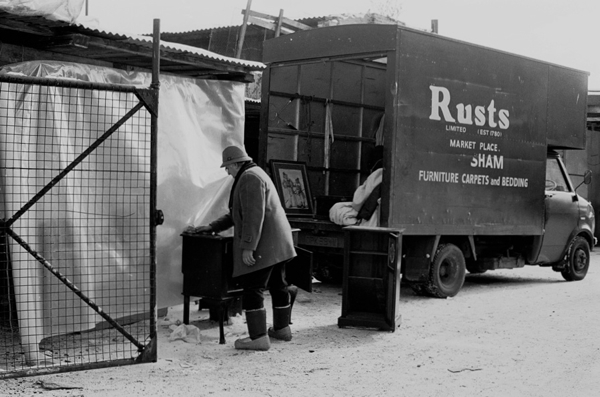
Examining Colin’s pictures later, just a fraction of the total, I realised that most were taken when the market was clearing up and portrayed individuals rather than the crowd. “Packing up is when everything happens,” he explained to me, “they dump all the unsold stuff in the street and the scavengers come to take it. You look at what’s discarded and it’s the history of the time.”
I noticed that the woman sitting at the centre of Colin’s photograph “Coming and goings at the corner of Brick Lane” was surrounded by five men and yet not one was looking at her. I realised that he had photographed her invisibility, and that the same was true for his other soulful portraits of market-goers, market-traders, homeless people, old people and marginal characters – all portrayed here with human sympathy through the lens of Colin O’Brien, yet gone now for ever.


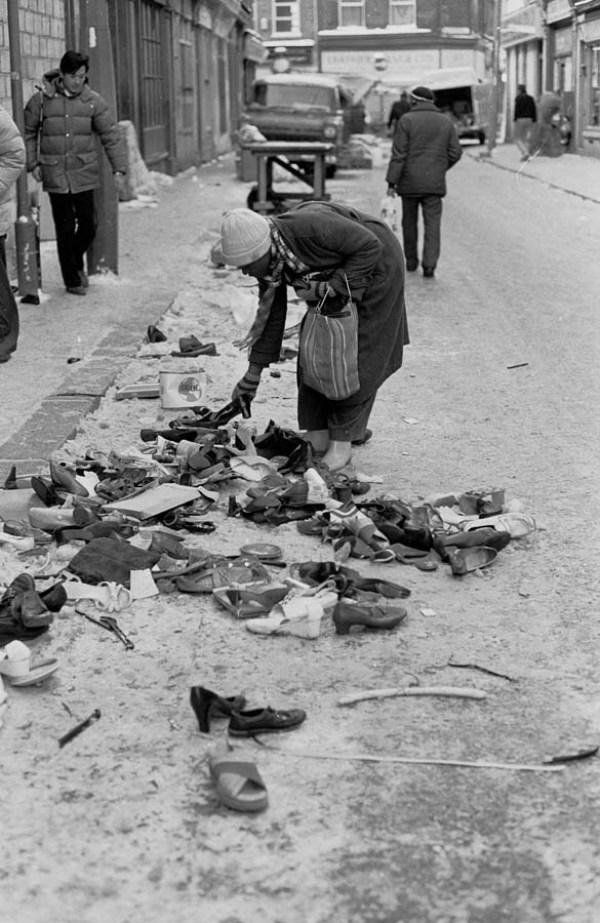


Coming and goings at the corner of Brick Lane.


At the time of the miners’ strike.




Photographs copyright © Estate of Colin O’Brien
Philip Cunningham’s Pub Crawl
Click to book your ticket for THE GENTLE AUTHOR’S TOUR OF SPITALFIELDS this Saturday
Shall we join Photographer Philip Cunningham for a pub crawl around the East End a generation ago? It starts at Phil’s local, The Three Crowns in Mile End Rd, very convenient for a quick pint when he was living in his grandfather’s house in Mile End Place in the seventies.

Ada & Polo, 1973
“When we moved to Mile End Place in 1971 our local pub, The Three Crowns, was just round the corner. We would go there often. Everyone used to go to the pub in those days, it was almost an extension of home. The Three Crowns was pretty rough.
It was run by a Jewish lady called Ada. Her elderly father helped behind the bar and she had a young Palestinian barman known as ‘Toffee.’ There was another barman, known as ‘Polo,’ who had a terrible stammer yet was very popular. And they all lived together above the pub.
There was a small snug in the middle of The Three Crowns which was highly sought after. It held about six people and was like being in your own private room. If it was occupied, you kept an eye out and, when it became vacant, you would run in quickly and take it.
One night, while I was drinking with my pal ‘John Boy,’ we were both potless and decided to pool our money, but found we did not have enough for another drink so we put it in the slot machine instead. To our amazement, we won the jackpot! Ada was not happy. She stormed over and unplugged the machine. She usually knew when the machine was about to give up the jackpot and would have it for herself. We spent all our winnings in her pub but, if Ada gave you a withering look, you knew you’d upset her.
There was a gambling club, The 81 Club, two doors away and people would often run in and hand Ada a bundle of notes, which she would stuff in her apron pocket. I think she was some type of banker. Ada made the best beef sandwiches I ever tasted. She was a fabulous character surrounded by other characters at The Crowns, real solid people that lived hard lives and knew who they were.
When Ada retired, The Three Crowns was taken over by Terry (known as ‘Turksie’) & Brenda Green. Terry had been a Docker and he and Brenda had a lot of work done on it, I believe out of his severance pay. I became friends with Terry’s brother, Jimmy. We would wander round the borough together and he would tell me tales of the old days, and van dragging – jumping on the back of a moving goods wagon and pulling off packages.
The Three Crowns was a successful pub but Terry & Brenda left to live in Portugal. The picture of Jimmy, the unnamed photographer and John the Fruit was taken just before they left. I cannot remember the photographer’s name but he told me I should buy a Zenza Bronica camera, which I did and have been using it ever since.
After the Greens’ departure, The Three Crowns changed entirely and the deafening music drove us away. The new tenants did not stay long and the place went down the tubes. When I returned years later, I was shocked to see that the fabulous tiled mural of the ‘field of the cloth of gold’ which adorned the entrance had been smashed up. Someone had tried to remove it from the wall but with the most destructive consequences. Only half the mural was left and the rest had been replaced by rendered cement. I doubt if they even got a single intact tile. It was the most pointless greedy vandalism.
I loved the East End, rough, tough, and mad – there was an energy about the place, but I think the East End I knew has mostly gone.” – Philip Cunningham

Jimmy, Terry & Brenda Green at The Three Crowns 1983

Jimmy Green, Unnamed Photographer & John The Fruit at The Three Crowns 1983

Interior at The Three Crowns 1983

The Three Crowns, Mile End Rd, 1983

The Queen’s Head, York Sq, Stepney, 1983 (Recently sold to property developers)

The former Lord Napier, Whitechapel -‘The Lord Napier was never a pub in my time’ 1979

Formerly The Laurel Tree, Brick Lane, c.1985

‘I have never been into The Florist Arms in Globe Rd but I am determined to visit because I am told it is good fun’ c.1983

‘The Waterman’s Arms was just next to the school I was teaching in on the Isle of Dogs and I went in quite a lot. It was once owned by Daniel Farson and Shirley Bassey would come and sing there.”

Waterman’s Arms, c.1984

‘The Wentworth in Eric St was an OK pub but it always reminded me of my dealings with the District Surveyor, which was depressing’ 1980

‘I went into the Duke of York a lot as friends of mine lived in Antill Rd’ c.1980

‘The Oxford Arms in Milward St behind the London Hospital was always full of nurses and medics, very popular’ c.1984

‘The Old Globe in Globe Rd was a disaster in my time. The loud music they played could probably have been heard on the moon. There was always massive overspill onto the pavement and, in the morning, the entire area was covered in broken glass. It was a young people’s pub.’ 1979

The Bell, Middlesex St, c.1985

‘The Railway Tavern in Grove Rd was a nice pub and played a lot of jazz in my time’ c.1984

The Beehive, Commercial St, Spitalfields – seen from Christ Church yard

‘I thought The Old King’s Head was on Burdett Rd but I can’t find a trace of it, yet I do remember from my two visits that it was a nice pub’

‘The Lion in Tapp St was one of the grottiest pubs I’ve been into. If it still exists, I hope it’s changed. There were holes in the lino and the floor was sticky with beer. The beer was good but not much else.’ c.1985/6

‘The Three Suns in Aldgate had elaborate brickwork on it, but I could never understand this panel. It seemed to have something to do with a Shakespeare play.’ c.1986

‘I only went into the Forty Fives in Mile End Rd once with my friend Grahame, the window cleaner. We wanted to have a drink in every pub from The Three Crowns to the Whitechapel Art Gallery, but I don’t think we made it.’ 1985/6

‘The Albion in Bethnal Green Rd was one of my favourite pubs’

The Red Cow, Mile End Rd, 1986
Photographs copyright © Philip Cunningham
You may also like to take a look at
Philip Cunningham’s East End Portraits
More of Philip Cunningham’s Portraits