
‘Smilin’ Sammy McCarthy, Featherweight Boxer

Click to book your ticket for THE GENTLE AUTHOR’S TOUR OF SPITALFIELDS this Saturday

Sammy McCarthy (1932-2020)
Let me tell you the story of “Smilin'” Sammy McCarthy, one of legends of East End Boxing. Voted “Best British Boxer of 1951” by Boxing Times, Sammy was a golden boy who won eighty-three out of his ninety amateur contests and represented England four times in the nineteen fifties, before becoming British Featherweight Champion twice and then Lightweight Champion after that.
Yet Sammy was resolute in his refusal to be called a hero. With his impeccable manners and old-fashioned proper way of talking, he was the paragon of self-effacement – an enigma who modestly ascribed his spectacular boxing career to no more than a fear of disappointing others. His contemporaries informed me that only once I knew about his background, could I fully appreciate the true impulse behind Smilin’ Sammy’s suave temperament, but what I discovered was something far more surprising than I ever expected.
Born in 1931 as one of ten children, Sammy grew up in a terrace off Commercial Rd next to Watney Market as the son of costermonger. “My father used to go round the streets selling fruit and veg and we all helped him, and I helped him more than anyone but I always hated it,” Sammy revealed to me, explaining how he visited Spitalfields Market each day with his father in the early morning and stood outside the church while his father bought the produce. Then Sammy had to wheel the loaded barrow back to Stepney but, although it gave him the physical strength which made him a boxer, it was also was a source of humiliation when Sammy’s schoolmates jeered. “Subconsciously, I suppose I was a bit of snob – I wanted to be posh even though I didn’t know the meaning of the word.” he confided with a blush, expressing emotions that remained current for him even after all the years.
Sammy’s elder brother Freddie was a boxer before him and Sammy had a vivid memory of hiding under the table as a child, while his father and brother listened to the celebrated Tommy Farr and Joe Louis fight on the radio. “All the talk was of boxing and I so much wanted to participate but I was naturally timid,” he admitted to me shyly, “I was frightened of being frightened, I suppose – but after my fights I was always so elated, it became like a drug.”
Sammy joined the St George’s Gym in Stepney where his brother trained. “I absolutely loved it but each time I went, I was extremely nervous.” he continued, breaking into his famous radiant smile, “At fifteen I had my first fight and lost on points, so I didn’t tell my father but he found out and cuffed me for not telling him, because he didn’t mind.”
“I had a great following thanks to my two uncles who sold tickets and everybody in the markets bought them because my brother was already well-known. So there used to be coach loads coming to watch me box and I was always top of the bill, not because I was good but because I always sold plenty of tickets.” It was a characteristic piece of self-deprecation from a champion unrivalled in his era.
At nineteen, Sammy turned professional under the stewardship of renowned managers Jarvis Astaire and Ben Schmidt. “Every time I go to West End, I still go to Windmill St and stand outside where the training gym used to be. All the big film stars, like Jean Simmons and John Mills, they used to go there to the weigh-in before a big fight.” he told me proudly.
In spite of his meteoric rise, Sammy was insistent to emphasise his vulnerability. “Everyone’s nervous, but I was petrified, not of fighting but of letting the side down,” he assured me. “I’d rather fight a boxer who thought he could fight but actually couldn’t,” Sammy announced, turning aphoristic and waving a finger,“than a boxer who thought he couldn’t fight but really could.” And I understood that Sammy was speaking of himself in the latter category. “It makes you sharp,” he explained, “your reflexes are very fast.”
‘”I retired at twenty-six, but I didn’t know I was going to retire,” admitted Sammy with a weary smile,“I had to meet these people who were putting a book together about me and it turned out to be the ‘This Is Your Life’ TV programme. It was 1957 and they expected me to announce I was going to retire. I must have been a little disappointed but maybe I hadn’t seen I was slowing down a little.”
Married with two children and amply rewarded by the success of his boxing career, Sammy bought a pub, The Prince of Wales, known as “Kate Odders” in Duckett St, Stepney. You might think that Sammy had achieved fulfilment at last, but it was not so. “I hated every moment because I like home life and as a publican you are always being called upon.” he confessed, “I had a little money and I spent it all unfortunately.”
“My boxing career, it gave me confidence in myself. Boxing made me happy.” Sammy concluded as our conversation reached its natural resolution,” I didn’t enjoy the fights, but I love the social life. You meet the old guys and you realise it’s not about winning, it’s about giving of your best.” Living alone, Sammy led a modest bachelor existence in a neatly kept one bedroom flat in Wanstead but he met regularly with other ex-boxers, among whom he was popular character, a luminary.
And that is where this story would have ended – and it would have been quite a different kind of story – if Sammy had not confronted me with an unexpected admission. “I want you to know why I am divorced from my wife and separated from my children,” he announced, colouring with a rush of emotion and looking me in the eye, “I’m telling you, not because I’m boasting about it but because I don’t want you to make me out to be a hero.”
There was a silence as Sammy summoned courage to speak more and I sat transfixed with expectation. “I robbed banks and I stole a lot of money, and I was caught and I was put in prison for years.” he said.
“I think I was too frightened not to do it,” he speculated, qualifying this by saying,“I’m not making excuses.”
“I’m reformed now.” he stated, just to be clear.
“I was alright in prison because I’m comfortable with my own company and I read books to pass the time,” he added, to reassure me.
“But why did you do it?” I asked.
“Because we never had anything,” he replied, almost automatically and with an abject sadness. His lips quivered and he spread his hands helplessly. He had been referring back – I realised – to his childhood in the family of ten. A phrase he said earlier came back into my mind,“I can’t say that I experienced hardship,” he told me,“not by comparison with what my parents went through.”
Subsequently, a little research revealed that Sammy had been convicted three times for armed robbery and served sentences of three, six and fourteen years. When I think of Smilin’ Sammy now, I think of his sweet smile that matched the Mona Lisa in its equivocation. It was a smile that contains a whole life of fear and pain. It was a smile that knew joy yet concealed secrets. It was a smile that manifested the uneasy reconciliation which Sammy made with the world in the course of his existence.

Smilin’ Sammy McCarthy


Sammy McCarthy, the Stepney Feather, has Peter Morrison against the ropes under a fierce attack at the Mile End Arena.

Sammy McCarthy makes Denny Dawson cover up under a straight left attack.

Jan Maas goes headlong to the canvas after taking a Sammy McCarthy “special” to the chin.

Still smiling! Not even a knockdown can remove the famous smile from Sammy McCarthy, as he goes down for a count of “eight” in the fifth round.


Smilin’ Sammy McCarthy
You may also like to read about
A Conversation With Milly Rich
Click to book your ticket for THE GENTLE AUTHOR’S TOUR OF SPITALFIELDS this Saturday

“You know, being a hundred is a lot of years to account for…”
Portrait of Milly Rich (1917-2017) by Patricia Niven
The Gentle Author – Are you from the East End?
Milly Rich – I am from the last place I have lived! But I was born at 19 Commercial Rd on October 23rd 1917, which of course was during the First World War and my mother, Leah, told me that the air raid warnings were sounding at the time. People were terrified of air raids but my she had a basement under her shop in Commercial Rd where she took shelter.
My mother made corsets and she taught me to make them too. Corsets were a vital part of a lady’s outfit in those days because – of course – smart clothes needed a good foundation and a good foundation was a nice heavily-boned corset with a strong steel bust in the front. Everybody had remarkably good posture, not slumped – like you see today – over a hand-held computer.
The Gentle Author – Your mother was proprietor of the shop?
Milly Rich – I have a picture of her standing outside the shop with her two assistants when she was not yet twenty. She was very creative, very artistic – and she got her first job in an embroidery factory in Hanbury St. Then she opened a shop at 87 Brick Lane and – many years later – it transpired that the young man I married was the son of the owner of the embroidery factory where my mother had once been a designer. So the world is full of concentric circles!
The Gentle Author – Tell me about your father.
Milly Rich – My father, Morris Levrant, was an ‘émigré of the Empire of Russia’ and I know that because he went to America first and patented an airtight valve for bicycle tyres when he was thirty. He was very clever. My mother said he spoke nine languages and he was an inventor. He was born in Siedlce in Poland where my daughter has traced our family back to 1733.
He left a wife and three children in New York when he came to London and my mother’s father was not very happy about that. Apparently, my grandfather put him through hoops to prove that he was properly divorced. I do not know how he got the divorce but he obviously did because otherwise they would not have allowed the marriage. My parents were married in Princelet St Synagogue and I was born in 1917, so I suppose they were married in 1916.
The Gentle Author – Do you have brothers and sisters?
Milly Rich – I had one brother, Mossy. He is dead now, he died at seventy-five years old. I suppose it speaks volumes for the kind of life we led that he had rickets, which is caused by malnutrition. He was very good with his hands and became a jeweller and worked in Black Lion Yard and Hatton Garden.
When the Jews were promised a homeland in the Balfour Declaration, my father decided he would settle in what was then Palestine. Of course, he was an inventor, and he was agog to go and be an inventor there – he was a clever chap. So in 1921 we set sail.
The Gentle Author – You shut the shop in Commercial Rd?
Milly Rich – Yes, we got rid of it and went off to Palestine but a war broke out there and, in the first month, my father was killed and he was buried there. He was only forty when he died and left three children in New York. We found them not very long ago. The two sisters were still alive, they were ten and eleven years older than me. We went and stayed with them, and they were lovely. They turned out to be artists and designers too
When my father died, my mother was expecting my brother, so she could not come back from Palestine at once but she did not speak the language and, of course, my father had all the money – she was stuck in Jaffa. Fortunately my uncle – my mother’s sister’s husband – came to the rescue and got us back to England. By that time, I was three, I remember. And we were stuck in Boulogne because I had a watery eye – they thought it was catching – an eye disease, maybe trachoma but it was just a trapped eyelash.
On our return, we stayed with my uncle in Whitechapel. He had a jewellery shop opposite the Whitechapel Gallery, it was museum as well in those days. I remember they had a septic mouse in a case on the stairs and an illuminated panorama of Medieval London on the landing. It was lovely, I used to stand and stare at it for hours.
We stayed there until my uncle found the shop at 192 Bethnal Green Rd. It was flanked on one side by the Liberal Party headquarters, Sir Percy Harris was the MP, and on the other side by a newsagent. They were not Jewish, but everybody was on excellent terms and there was no anti-Semitism where we were.
We lived above the shop and we had tenants as well, who had to come through the shop. Originally, it been a house and garden but it had been transformed into one great long space. My mother had a curtain put up to screen people walking through because they had to cross our parlour, which my mother also used as a fitting room for the corsets.
Women used to come in and treat her as an agony aunt. Like a hairdresser or a dressmaker, she was a recipient of confidences. All the locals would tell my mother their troubles which invariably were to do with their husbands. They used to speak Yiddish so that I should not hear but, knowing they were speaking so I could not understand, I soon picked up Yiddish. I never let on that I could and, of course, I would tell the stories to my friends at school which was a source of much merriment.
There was a window in the parlour so my mother could see if anyone came into the shop. My brother used to climb up to look through it at the women trying on the corsets and, of course, a good time was had by all!
The Gentle Author – What took you out of Bethnal Green?
Milly Rich – I won a scholarship to Central Foundation School in Spital Sq. It was a fee-paying school at the time and there used to be quite a division between the scholarship girls and the fee-paying pupils. I was a great reader and I have always loved words and I had a good vocabulary. The other children did not like it. “Oh you’ve swallowed a dictionary,” that was a great insult. I did not care, did I? From there, I won another scholarship but I could not make up my mind whether to go to the London School of Economics, because I wanted to be a journalist, or St Martin’s School of Art.
In the event, I decided I would not train to be a journalist because I was not going to learn shorthand – I was not going to take down anybody else’s words. So I took the place at St Martin’s instead and hated it. We used to sign in and go off to the local Lyons teashop and sit there for hours, making patterns on the tablecloth with the salt cellar. Eventually, my mother could not afford for me to stay there any longer because I only got ten shillings a week and I did not like it anyway – I do not like any form of regimentation.
I got a job inscribing certificates because I was quite good at lettering and I did that for a couple of months. It was trees in Israel. They kept planting forests and I used to write ‘five trees planted in the name of so-and-so on the occasion of his this-and-that.’
I did not do it for long, I got a job in a drawing office instead. I told them I could do it, even though I had never held a drawing pen in my life. They said, “Well, here’s one – take it home and bring it back tomorrow, completed.” I went into an art shop and asked, “How do you do this?” They showed me a drawing pen and how you filled it and how you used it, so I went home and I did the drawing and I took it back the next day and I got the job. The drawing office was quite fun actually, I enjoyed it there. It was right at the top of Crown House, which is still there on the corner of Drury Lane and Aldwych. We used to feed the pigeons and there was a Sainsbury’s around the corner which delivered lunch in a box. You got a sandwich and some orange juice and a piece of cake for sixpence.
You know – being nearly a hundred is a lot of years to account for.
The Gentle Author – Tell me about Moss, your husband.
Milly Rich – We met at a play-reading group. He was a writer, and I always liked plays and acting and so on. We met there and he would walk me home.
The Gentle Author – Where did he come from?
Milly Rich – His father had the embroidery factory in Hanbury St, where my mother had once worked doing the patterns although we did not realise that at the time. It was only when our parents were introduced that they realised that they all knew each other already. Small world. People were so ready to help each other, I do not know if people are still like that in the East End, but they were once. I remember the blackshirts marching down Bethnal Green Rd and shouting “The Jews, the Jews, we’ve got to get rid of the Jews!” Whenever they passed our shop, my brother used to be outside yelling.
The Gentle Author – Did you feel threatened?
Milly Rich – I do not think I was aware of it, but I became aware because Moss used to take me to the political meetings and the Unity Theatre. When there was the Battle of Cable St, we went there. I remember leaning on the lamppost outside Gardiner’s Corner and we were all yelling, “They shall not pass, they shall not pass.”
The Gentle Author – That was eighty years ago.
Milly Rich – Then war was declared and we all thought the first air raid would obliterate London. Everybody was terrified and I had known Moss four years, so he said “We’d better get married right away, while we can,” and he got a special licence. I did not want any fuss and I told my mother, “I’m not having any ‘do’” because getting married, especially in Jewish families, was a great occasion you know. I said, “I’m not having any family there.” It was the custom then – I do not know what people do now– for the woman to take the man’s name but I did not like that, so I said, “If I have got to take your name, you have got to take my name.” His name was Rich and my name was Levrant so we became Levrant Rich, which sounds quite good.
The Gentle Author– Was that unusual in those days?
Milly Rich – Goodness knows! Moss was very easy about it, he said he did not care. My mother said she would kill herself if we did not get married in the synagogue, but I said “I’m not having anyone there , I don’t want a fuss,” so she agreed she would not tell anyone. But when Moss and I arrived at the synagogue, standing outside wreathed in smiles was my fat Aunty Milly and her husband. I said, “I’m not going to do it!” and we turned tail and ran away, so we did not get married that day.
We came back the next day and got married when nobody was there. We got no photographs, nothing. It was just the two of us, and Moss had to go back to work because he was in the timber importing business, doing the advertising, and everybody thought the work was absolutely vital. So he went back to work and I went shopping in Petticoat Lane for a couple of cups and saucers and a saucepan.
Moss had found us an attic room at 4 Mecklenburgh Sq and we went back there. It was one pound a week which was a lot of money for rent. There was an oven on the landing which four other tenants used and we each took a turn to put a shilling in the meter. Sometimes, I would come back early and find the landlady on her knees fiddling the meter!
When the air raid siren went, we dashed down to the shelter which was just opposite. One night we got a direct hit. The thing shuddered but it did not go off and we were marshalled out by wardens. I remember walking up Gray’s Inn Rd with fires blazing on either side right up to Euston Station. There were aeroplanes droning overhead and the church opposite the station was on fire. We were ushered into the station and we spent the rest of the night there, before returning to Mecklenburgh Sq.
Although our rent was one pound a week, Moss earned four pounds and I earned two pounds and a bit, so we only had just over six pounds as our total income. After our pound rent was paid and Moss had ten cigarettes delivered each day, I used to be able to send stuff to the laundry. They would come and collect and deliver it, all freshly ironed, and a sheet was tuppence to launder. Can you imagine? Shirts and everything. I never did any washing myself. As well as Mrs Pointy the landlady, there was a caretaker who kept our two rooms clean for two shillings a week, which was very nice. Mrs Pointy used to feed her cat cods’ heads and the smell – I can still smell it – was absolutely indescribable.
The Gentle Author – Nowadays in London, many people spend half their wages on rent.
Milly Rich – I was just thinking about the nature of progress. When I was young, it was usual for a woman to stay at home and the man would bring home the money – his wage could support the wife and the family. Now two wages are not enough, do you call that progress?
Transcript by Rachel Blaylock

Milly, aged one and a half in 1919

Milly, aged five in 1922
 Milly, aged eighteen in 1935

Milly, aged twenty in 1939

Moss in 1939

Milly & Moss’ Marriage Certificate, 1939

Milly’s London Transport card, 1939

Milly & Moss in the forties

Milly & Moss in the eighties – Milly & Moss were married for seventy-two years
You may also like to read about
Maurice Sills, St Paul’s Cathedral Treasure
Jack Corbett, London Oldest Fireman
Aaron Biber, London’s Oldest Barber
Blackie, The Last Spitalfields Market Cat
Click to book your ticket for THE GENTLE AUTHOR’S TOUR OF SPITALFIELDS this Saturday

Here you see Blackie, the last Spitalfields market cat, taking a nap in the premises of Williams Watercress at 11 Gun St. Presiding over Blackie – as she sleeps peacefully among the watercress boxes before the electric fire with her dishes of food and water to hand – is Jim, the nightman who oversaw the premises from six each evening until two next morning, on behalf of Len Williams the proprietor.
This black and white photograph by Robert Davis, with a nineteenth century barrow wheel in the background and a nineteen-fifties heater in the foreground, could have been taken almost any time in the second half of the twentieth century. Only the date on the calendar betrays it as 1990, the penultimate year of the Spitalfields Fruit & Vegetable Market, before it moved East to Stratford.
In spite of Jim the nightman’s fond expression, Blackie was no pet. She was a working animal who earned her keep killing rats. Underneath the market were vaults to store fresh produce, which had to be sold within three days – formalised as first, second and third day prices – with each day’s price struck at two in the morning. But the traders often forgot about the fruit and vegetables down in the basement and it hung around more than three days, and with the spillage on the road which local residents and the homeless came to scavenge, it caused the entire market to become a magnet for vermin, running through the streets and into the labyrinth beneath the buildings.
It must have been paradise for a cat that loved to hunt, like Blackie. With her jet black fur, so black she was like a dark hole in the world running round on legs, vanishing into the shadow and appearing from nowhere to pounce upon a rat and take its life with her needle-sharp claws, Blackie was a lethally efficient killer. Not a submissive creature that could be easily stroked and petted as domestic cats are, Blackie was a proud beast that walked on her own, learnt the secret of survival on the streets and won independent status, affection and respect through her achievements in vermin control.
“They were all very pleased with Blackie for her great skill in catching rats, she was the last great market cat,” confirmed Jim Howett, a furniture maker who first met Blackie when he moved into a workshop above the watercress seller in 1988. “The other traders would queue up for kittens from Blackie sister’s litters because they were so good at rat-catching. Blackie brought half-dead rats back to teach them how to do it. Such was Blackie’s expertise, it was said she could spot a poisoned rat at a hundred feet. The porters used to marvel that when they said, ‘Blackie, there’s a rat,’ Blackie would focus and if the rat showed any weakness, would wobble, or walk uncertainly, she would turn her back, and return to the fire – because the rat was ill, and most likely poisoned. And after all, Blackie was the last cat standing,” continued Jim, recounting tales of this noble creature that has become a legend in Spitalfields today.
“The story was often told of a kitten trained by Blackie, taken by a restaurant and hotel in the country. One day it brought a half-dead rat into the middle of a Rotary Club Function, seeking approval as it had learnt in Spitalfields, and the guests ran screaming.”
The day the Fruit & Vegetable Market left in 1991, Blackie adjusted, no longer crossing the road to the empty market building instead she concentrated on maintaining the block of buildings on Brushfield St as her territory by patrolling the rooftops. By now she was an old cat and eventually could only control the three corner buildings, and one day Charles Gledhill a book binder who lived with his wife Marianna Kennedy at 42 Brushfield St, noticed a shadow fly past his window. It was Blackie that he saw, she had fallen from the gutter and broken a leg on the pavement below. “We all liked Blackie, and we took care of her after the market left,” explained Jim, with a regretful smile. “So we took her to the vet who was amazed, he said, ‘What are you doing with this old feral cat?’, because Blackie had a fierce temper, she was always hissing and growling.”
“But Blackie recovered, and on good days she would cross the road and sun herself on palettes, although on other days she did not move from the fire. She became very thin and we put her in the window of A.Gold to enjoy the sun. One day Blackie was stolen from there. We heard a woman had been seen carrying her towards Liverpool St in a box but we couldn’t find her, so we put up signs explaining that Blackie was so thin because she was a very old cat.”
“Two weeks later, Blackie was returned in a fierce mood by the lady who taken her, she apologised and ran away. Blackie had a sojourn in Milton Keynes! We guessed the woman was horrified with this feral creature that growled and scratched and hissed and arched its back.”
“After that, Blackie got stiffer and stiffer, and one day she stood in the centre of the floor and we knew she wasn’t going to move again. She died of a stroke that night. The market porters told me Blackie was twenty when she died, as old as any cat could be.”
Everyone knows the tale of Dick Whittington, the first Lord Mayor of London whose cat was instrumental to his success. This story reminds us that for centuries a feline presence was essential to all homes and premises in London. It was a serious business to keep the rats and mice at bay, killing vermin that ate supplies and brought plague.
Over its three centuries of operation, there were innumerable generations of cats bred for their ratting abilities at the Spitalfields Market, but it all ended with Blackie. Like Tess of the D’Urbevilles or The Last of the Mohicans, the tale of Blackie, the Last Great Spitalfields Market Cat contains the story of all that came before. Cats were the first animals to be domesticated, long before dogs, and so our connection with felines is the oldest human relationship with an animal, based up the exchange of food and shelter in return for vermin control.

Blackie at 42 Brushfield St

Blackie in her final years, 1991/2

Nineteenth century print of Dick Whittington & his cat
You may also like to read about
Marie Iles, Machinist
Click to book your ticket for THE GENTLE AUTHOR’S TOUR OF SPITALFIELDS this Saturday

Apart from memorable excursions outside London as an evacuee, Marie Iles lived her entire life within a quarter mile of Stepney and it suited her very well. Those wartime experiences taught her the meaning and importance of home, yet living close to Stepney City Farm she still enjoyed a reminder of the rural world she grew to love as a child.
A natural storyteller, Marie laid out the tale of her formative years for me with confidence and eloquent precision. Blessed with independent thought from an early age, Marie quickly learnt to stand up for herself and to appreciate the moral quality of people’s actions, whilst she was suffering enforced exile from her beloved Stepney amidst the tumultuous events of a world war.
It was the meeting with her husband Fred Iles that provided the sympathetic resolution of Marie’s dislocated early years and resulted in an enduring relationship which sustained them both for over sixty-five years.
“I was born on 9th August 1930 in Fair St, Stepney, while we were living upstairs in two rooms in my nan’s house, and when I was four or five we moved to Garden St. But I usually lived with my nan – whom everyone knew as Aunt Kit – because I loved her so much. I had a happy childhood playing in the streets, games like Hopscotch and Knocking Down Ginger. We was always running around and the police would pick us up and take us to Arbor Sq Police Station and give us bread and jam.
One day, I came indoors and my mum and dad had the wireless going and there was a quiet atmosphere, which was very unusual in our house, and I heard the voice of a man saying, ‘And England is at war with Germany.’ So I says to my mum, ‘Are we at war?’ and she says, ‘Yes.’ I said, ‘Are the Germans coming?’ and she said, ‘Yes, but not to Garden St.’
The siren went when I was out shopping with my nan in the old street at the side of St Dunstan’s church and, all of a sudden, there was bombs dropping and aeroplanes. My nan said, ‘You run home to your mum quick,’ but I wouldn’t leave her. So she said, ‘Run!’ and I ran on the spot to show I was running. Eventually, we got home to Garden St and my mum, who had a phobia that she might be taken ill or die with dirty feet, was saying, ‘Get a bowl of water, I’ve got to wash my feet.’ When the bombing eased up, my nan said, “I’ll take the two girls home where there is an Anderson shelter,’ and, as we came out, it was a terrifying sight – where there had been houses, there was just piles of bricks and rubble, and there was a horrible smell of smoke and, that night, the sky was red with the light of the fires.
We stayed at my nan’s a few weeks after that, until one day I was at my mother’s and she said, ‘You’re going on a holiday, you, Kitty and Johnny.’ We was excited! My mum pinned a label onto each of us with our name and address on it, and filled a carrier bag for each of us with our belongings. We went to school and there was a couple of coaches waiting, and my nan said, ‘Write to us and always say your prayers every night,’ and she put three sixpences in my hand. I thought, ‘I’ve got money and I’m going on holiday,’ and I was pleased. We all got on the coach together, me and Kitty and Johnny. Then, as we were going, I dropped my three sixpences in the excitement and it felt like the end of the world – not because of the money, but because my nan had given them to me.
We arrived at what I later found out was Denham. We was dropped at the corner of the street, and ladies came over and picked who they fancied. Johnny went with a Mrs Burrell, a lovely little country lady with red cheeks. Kitty and me, we went with Mrs Rook. She had a nice house, that was what we would call ‘posh,’ and she had a grown up son and daughter, Ken and Joyce, and her husband Mr Rook. Yet I hated it, I was so homesick and cried every night for a fortnight but my sister loved it. I asked her, ‘Why don’t you get homesick?’ She said, ‘Because you are here. Wherever you are, I am alright.’ I was her elder sister.
One morning, Mrs Rook said, ‘Why don’t you put on your coats and go out for a walk?’ And the first person we met was Mr Goddard, my headmaster from school in Stepney. He took hold of my hand and asked, ‘Have you got a nice place to stay?’ I said, ‘Yes, but I hate it I miss my home.’ So he said, ‘Look Marie, do you want me to tell your mother what you said and have her worrying about you?’ And I said, ‘ No, don’t tell her,’ and, after that, I was alright and I had a happy time. And that was when I first noticed flowers and the trees opening up. Once there was snow, and Mrs Rook sent me to Denham village for an errand, and I saw these flowers peeking up through the snow – crocuses – and I thought it was a little miracle, that flowers grew in the snow.
Then it seemed the bombing stopped and they took us back to London, and we was there for a while until they sent us off again. They put us on a train at Paddington and we stopped overnight at an army barracks and slept on the floor, and me and Kitty cuddled up under a blanket. Other kids were crying but I wasn’t homesick. In the morning, the soldiers gave us breakfast of ham and hard-boiled eggs and tea and bread and jam. We travelled on and we came to this little village near Rugby called ‘Crick.’ A Mrs Watts picked us out and she lived in Cromwell Cottage, a nice house, and she gave us three meals a day but this lady had no compassion whatsoever. She took us because she didn’t want to do war work. She turned us out at seven-thirty to go to school, and she used to go to the pictures in Rugby twice each week and we had to wait outside in the bitter cold until she came home.
When the summer comes and you’re playing outside, it doesn’t seem so bad. But, one day, we’d had our dinner and were going back to school, and I knew she had a basket of apples in the larder, so I decided to pinch one. We each took bites of the apple, sharing it between the two of us on the way to school. When we got in that evening, she says to me, ‘You thieving Cockney! You come from the slums of London and you don’t appreciate a good home.’ Now I was always a bit of a rebel – I think it was because of growing up with so many brothers – so I thought, ‘I won’t stand for this.’ So I said to Kitty, ‘We’re not going to stay here with this wicked lady.’
Down at the bottom of the hill, lived an old lady and her husband – they must have been seventy. I went there and knocked on the door and asked, ‘Could you take two evacuees?’ She said, ‘Who are they?’ I said, ‘It’s my sister and me.’ She said, ‘Alright, take the old pram and go and get all your things.’ So we went back to Mrs Watts. I said, ‘I’m leaving, I’m going somewhere else to live.’ And her husband, Jack Watts – he was one of the kindest men I ever met – he said, ‘Marie, stop and think what you are doing.’ But I never did, and that night we went down to the old lady and the old man. Talk about ‘out of the frying pan into the fire’! She never cooked, she just gave us a bit of toast sometimes. Then she decided to visit her son and daughter for a holiday, and left us alone there with the old man, her husband. He used to go into the woods all day and cut willow branches and make clothes pegs. Meanwhile, Micky – my little brother – came down because my mother was having another baby up in London. We never had a thing to eat, so we used to go to people’s allotments and pull up raw vegetables and eat them, carrots and even turnips.
There was this plum tree in the garden with this big green plum hanging on it, and before she went the old lady said, ‘I expect to see that big green plum still hanging there when I return.’ But as time went on it got riper and riper, and the day before she was due to return I couldn’t stand it no more. I picked the plum and we all had bites of it – me, Kitty and Micky. Unfortunately, when he knew the owner was due to come home, Micky wet the bed. I took the sheet off and tried to wash it myself but I left it on the line and, when she came home, she asked, ‘What’s this sheet doing on the line?’ And Micky said, ‘I wet the bed,’ and she beat him unmercifully and he hung onto my legs crying, ‘Marie, Marie.’
Once again, rebellion came to the fore, and I said to my brother and sister, ‘Come on, I’m going to walk back to London.’ It was only eighty miles. So, with what money we had, we bought some pears and we were walking up the road and we came to this little bridge and I thought, ‘I can’t walk all that way with these kids, they’re too little.’ I always had a little bag with me and I looked inside and found a stamped addressed envelope that my nan had sent me. It was a Monday, the first day of the school holidays, and I sat down and wrote my tale of woe to my nan, and I posted it and said, ‘Let’s go back.’ And, as the week went on, we seemed to forget about things.
On Friday morning, it was pouring with rain and we got up and came downstairs, and she’d cooked us a big bowl of porridge. She says to me, ‘You’ve written to your granny. You’ve got a letter, your brother’s coming down to pick you up and take you home.‘ I don’t think I ever felt as happy in all my life as I did that morning. Next morning was Saturday. We all got up, didn’t wash, and got all our things together and sat on the grass verge outside the cottage. Jimmy wasn’t on the first bus that came or the second and, by one o’ clock, I was beginning to think, ‘He’s not coming.’ We waited there all this time, and the old woman and old man never called us in to give us a drink or anything.
The four o’ clock bus came and, all of a sudden, I looked up and there was Jimmy coming down the hill. He had a navy blue suit and a red shirt and his tie was blowing in the wind. I said, ‘We’re ready! We’re ready!’ He said, ‘I’ve got to let the lady know that I’m taking you.’ So he went inside and she said, ‘I’ve had a terrible time with those children.’ And he brought us back to London, and back to my dad and my mum who was in hospital having a new baby, Paul. So I went round to stay with my nan ’til my mum came home and I was beside myself with joy.
Garden St had got bombed and my mum and dad moved to Albert Gardens but my mum never liked it because it was number thirteen, so they moved again to an eight bedroom house – because by then I had seven brothers and one sister – at forty-six Stepney Green. Jimmy went into the army and got wounded in Normandy, Bobby went to Scotland in the army, Johnny was sent to Germany and Micky was sent to Malaya, Kuala Lumpur. Then we got the rockets – the doodlebugs – and that was almost as terrifying as the bombs. You’d hear the engine of a plane and then it stopped and you’d sit there in deathly silence and suddenly there’d be a big explosion. I know it’s a wicked thing to say but you’d think, ‘Thank God it’s not us.’
Then gradually, everyone came back home again to live in Stepney Green and, after everything settled down, I went to work in the rag trade as a machinist. And when I was nineteen, I met my lovely Fred. I was coming home from Victoria Park with my friend Betty and, as we walked past The Fountain pub in the Mile End Rd, there was a coach outside. My friend said, ‘Would you like a ride in a coach?’ And, all of a sudden, Fred appeared in the door of the pub with a pint of beer in his hand and called out to the driver, ‘These two girls are looking for a ride.’ I had never been in a pub but Fred said to me, ‘Hang on, wait ’til I’ve finished this pint and I’ll walk along with you.’ So I said to my friend, ‘Who does he think he is? We don’t know him.’ We carried on walking and I heard footsteps running behind us and I knew it was Freddie and his mate. He came alongside me and said, ‘I’ve got a camera. Would you like me to come round and take your photo?’ And my friend said, ‘Take no notice of him, he’s just making it up. He hasn’t got a camera.’ Freddie said, ‘Do you mind? I’m not speaking to you. I’m speaking to her.’
And when I turned and looked at him, I fell in love with him. They say there’s no such thing as love at first sight but there is. I arranged to meet him the next night on the corner but, when I arrived, he wasn’t there – I didn’t realise he was on the other side of the road, waiting to see if I’d turn up. So I went back home and my mum was looking out the window, and she saw what happened and she said to him, ‘You’re late, young man!’ And we courted for four years because we couldn’t get anywhere to live and then we got married at St Dunstan’s, Stepney, on 1st August 1953. We got two rooms at the top of a block of flats, Dunstan House, Stepney Green. The toilet was on the landing and the sink too, but we thought it was our little paradise.
Unfortunately, we couldn’t have children, our only regret in life. But my sister Kitty, and her son Alan and his wife Susan, they’ve always shared everything with us, and looked after us through thick and thin. And every year, we go to stay with Kitty and we have a really lovely old traditional Christmas. There’s nothing we like better than to go down memory lane together, it helps to keep us all close.”

Marie & Fred in their kitchen in Rectory Sq, Stepney.

Marie, Johnny and Kitty at Denham with Mrs Rook – “I loved the country life, especially when it was conker season and there were ripe apples. If my family had been there, I’d never have left.”

Marie’s sister Kitty, hop-picking with her grandfather after the war.

Marie hits a hole in one.

Marie & Fred’s wedding, 1st August 1953

On honeymoon in Ramsgate August 1953

Marie & Fred go Flamenco.

Kitty with her children, Marie and her mother in the fifties.

Marie and her dog Rufus when they lived in the prefab in Ashfield St.

Marie & Fred at a family wedding in the eighties.

Marie & Fred enjoy an adventure on the river.

The three evacuees grown-up – Johnny, Marie and Kitty.

Fred & Marie celebrated their sixtieth wedding anniversary on 1st August 2013
You may also like the read about
Javed Iqbal, TV Repair Man

Click to book your ticket for THE GENTLE AUTHOR’S TOUR OF SPITALFIELDS

If you are looking for TV repair in the East End, I recommend you visit Master Tech in Heneage St off Brick Lane – where, not only will the job be done expertly and at a fair price, but most importantly you will have the opportunity to meet Javed Iqbal, one of Spitalfields’ most engaging raconteurs.
Although I do not even possess a TV, I was happy to spend my Saturday morning in Javed’s shop beside his workbench and surrounded by TV spare parts, as he topped up my tea cup from his thermos flask, while I perched listening to his extraordinary monologues, covering so many areas of existence with appealing levity. There is an indomitable good humour that underscores Javed’s conversation. A buoyancy which I found especially heroic when he revealed the years of overt antipathy and threats of physical violence he has withstood – just to create a modest life for himself.
One huge window gives onto Heneage St, and Javed sits upon a tall stool, level with his work bench at the centre of his shop, while the wall behind him is lined with shelves stacked with televisions waiting his attention. Upon the bench sits a large flat screen monitor with the back removed and – while exploring this labyrinth of wires and components – Javed is in his element, talking as he works.
“I came to Brick Lane from Pakistan with my father in 1960, and I went to Christ Church School across the road. On the first day, I went into the playground and I had my arm broken. I was the first Asian boy at the school.
I was seven. I came with my five year old brother Tasleem. We came in February and it was very cold indeed. It was strange, because I had never seen snow before and there was deep snow. We travelled BOAC. It was a beautiful experience. Forget the wonder of an aeroplane, I had never been in a car.
My father came in 1958. First he went to Liverpool and then came here and ran the Star Cafe on the corner, 66 Brick Lane. Once he was established, he came to fetch us. My father was very rich man thanks to the restaurant business, but he gambled it all away playing poker with Gregory Peck. He had the talent as a gambler and in those days there were few Asians, so it was a novelty for them to have one at the table.
The first house I lived in was 22 Princelet St where my father had a basement. Jews were the only people that would rents rooms to us. In those days, Irish, Jews, Blacks and Asians were known as ‘dogs.’ When I was a little boy, the Seven Stars across the road was dominated by the Kray Brothers. Every Friday night, somebody would go out from there round all the businesses in Brick Lane and whatever you did, you had to pay.
I was allowed to watch television from four until five thirty and then my step-mother would down sticks, she had the temper of a gorilla. After school, I went to help in my father’s cafe. The Pakistanis were all coming here to Brick Lane. It was a mixed area then, the gateway for everybody basically.
When I started at the Robert Montefiore Secondary School in Deal St, it was a different headache. The pupils were divided between Christians and Jews, with two lunch sittings, kosher and non-kosher. One week the Jews ate first and the next week the Christians ate first. There was no halal in this country then, but Muslims can eat kosher so I ate with the Jews. I had one friend, Janel Singh, we were the only two Asians in the school, a Pakistani and an Indian. People looked at us in a different way.
On the first day, we were told to take our clothes off and they thought we must have TB because we were both so skinny. When we went to school, the white people used to hit us. The Turkish people were scared as well, so we got together. When we went to school, we had to go four or five of us together to be safe. The headmaster was Rhodes Boyson who became education minister for Margaret Thatcher, and he said, ‘What happens outside the school is not my responsibility.’
When I left school, I worked as a porter at the Royal London Hospital and I was learning TV repair after hours with a man from Mauritius who had a shop in the Roman Rd. One night, I was beaten up there by skinheads – it was sixteen to one. They beat me unconscious and, after I came round and stopped a taxi to take me to the hospital, the driver refused when he saw all the blood. He said he didn’t want to get blood on the inside of his taxi. I had a broken jaw. Later, I joined an anti-racist march here in Brick Lane after the death of Blair Peach and I was beaten up again. This time, by the police with truncheons.
Thanks to a Jewish doctor, Dr Wootliff, a good friend of my father’s, I got the biggest break of my life. He wrote me a reference and I got a job at Alba TV manufacturers in Tabernacle St. I was fitting radiograms together and I got a penny, ha’penny for each one. I thought,’Bloody Hell! This is a production line.’ Most of my friends were white and they had already broken into skilled trades. I really wanted to be a TV repair man.
I went to an interview in Dagenham. They said, ‘Forget about the job, this area is not good for black people. Just leave now before somebody puts a knife in you.’ I got a job in Canning Town for Multibroadcast where I found it bloody hard. There were many customers when they answered the door and saw you, they wouldn’t let you in the house. It was the worst place I could imagine working. The people were all dockers and they didn’t like my face. I’d park my car and when I’d return there’d be shit on it. After six months, I quit.
In the late seventies, I was working for a TV repair company called Derwent in Streatham. There was this great guy called George, an English guy. If you brought in a broken TV and put it on the bench, he’d say, ‘Put the kettle on!’ and light a fag. Before the kettle boiled and he’d smoked the fag, the TV would be repaired. He inspired me. TV repairs were in big demand. One day I went to repair a TV and the customer’s brother was there who was also TV repairman, he worked for Visionhire. He asked me how much I earned a week, and when I told him £16, he offered me £50 a week to join his company.
I opened up my own shop here in Heneage St, Spitalfields in 1976. It used to be a sweets and paraffin shop belonging to a Mr Lewis, and I came here as a child with my father to buy sweets. It took me a year to clear out the rubbish and fix it up. I am the only Pakistani here surrounded by Bengalis. I said to them, ‘Fair enough, the country is divided but it’s nothing to do with me!’ If God don’t give me, then the Devil will give me, and I will serve the mixed community. I started with ten shillings and I have worked here for thirty-eight years. And I am grateful to the Bengalis because I am still working and it is all through word of mouth.
I believe no country gives you anything, it’s what you can give and make that counts. I bought a house out of working in this shop. If you look back at the past, all the immigrants that made money started their own businesses. Even Marks & Spencer started here in Spitalfields in Old Montague St.
I have struggled quite a bit but with Allah’s help I have got through. I am not an Asian anymore, I am more British than the bloody British.”

‘People looked at us in a different way’

‘In those days, Irish, Jews, Blacks and Asians were known as ‘dogs”

‘If God don’t give me, then the Devil will give me …’

‘With Allah’s help, I have got through …’
Master Tech, 1 Heneage St, Spitalfields, E1 5LJ
You may also like to read about
Manny Silverman, Tailor
Click to book your ticket for THE GENTLE AUTHOR’S TOUR OF SPITALFIELDS

Manny Silverman, aged nine in 1941
Manny Silverman has a lucky ticket. It is a bus ticket numbered 9999, punched with a single hole to indicate the destination as Brick Lane and it dates from Manny’s childhood, growing up in Bacon St in the nineteen forties. Until this day, Manny keeps the ticket as a talisman, and, “I’ve been very lucky,” Manny assured me several times while he was telling me his story. Yet while it is apparent that Manny has enjoyed good fortune in his life, it soon became clear there were other forces than simply good luck at work in shaping Manny’s destiny.
Diminutive of build with delicate hands, weary eyes, and a gracious deferential style, Manny wears his history lightly. Fastidiously groomed and neatly dressed, he picked me up from the station at East Finchley in his two seater open-topped Mercedes. At home, Manny produced photocopies of his birth certificate, his indenture papers as an apprentice, his medal for performing King John, his letter offering a directorship of Moss Bros and – of course – his lucky bus ticket. Speaking of the ups and downs of his life, Manny was neither apologetic nor swanky, instead his tone was that of wonder at how it has all turned out.
“I was born in Mother Levy’s Nursing Home in Whitechapel in January 1932. My parents had only come from Lithuania a few months before, so I arrived just in time. My father Abraham was a tailor and my mother was Altke, known as Ettie, and I had a younger sister, Lilli. At first, we lived in Myrdle St, and then we moved to Bacon St where I spent my childhood. We shared two rooms, the four of us, and in the winter the pipes froze and when the spring came they burst. We had no running water and the toilet was in the yard. Each week, we used to go the Hare St (now Cheshire St) public baths and pay one penny to have a wash.
When I saw those baths, years later from first class carriage of a train coming into Liverpool St Station, I thought, ‘You’ve been lucky somewhere along the line.’ If you are the child of first generation immigrants, the first thing they want you to have is a trade that you can carry, because if you can sew or cut hair then you always have the opportunity to make money at your finger tips. And I thought, ‘Here I am, after all this time, still doing the same thing, even if they don’t ask me to sew a suit anymore.’
I only spoke Yiddish when I went to school in Wood Close at the age of four, and my schooling was limited because I was evacuated several times during the war. At twelve, I overcame the shyness that is still with me, braved the blackout, and made my way along to join the Cambridge & Bethnal Green Boys Club in Chance St. My first experience was seeing Maxie Lea and I made lifelong relationships there, not necessarily friends, but when we meet up it is as if time has stood stood still. I was never athletic but really good at drama and when we entered the London Federation of Boys’ Clubs contest, all the members came along to support us. At seventeen, I won a medal for playing King John and I’ve still got the script. I also got a good crit for my performance as Cassius, I always played heavies.
After I left school in 1946, at the age of fourteen, I was overseen by the Jewish Board of Guardians. My father had been ill for a while and they were helpful to me when he died. Harry Moss, Chairman and Managing Director of Moss Bros, was one of the patrons of the Boys Club. (They started as Moses Brothers but decided that ‘Moss Bros’ sounded better than ‘Moses Bros.’) He said to me, ‘Look, you can join us in our workshop in Covent Garden.’ In those days, Moss Bros still did bespoke tailoring and they had six cutters.
At twenty-one, I got itchy feet and left on good terms, on the understanding I could come back. And then, when Monty Moss who produced our plays at the Boys’ Club got engaged, I dropped in to wish him congratulations and he said, ‘You’re not working?’ He took me into Harry Moss’ office, and I told them I didn’t want to be a tailor anymore, so Harry said, ‘Start work as a porter in the secondhand department.’ The business had begun in the 1850s with Old Moses, who bought unredeemed pledges of suits and sold them in Kings Cross and Covent Garden, wheeling a barrow between both places. In the secondhand hand department, I recorded what I thought the suits were worth alongside what they had been bought for and in no time, Harry Moss said, ‘Will you do a bit of buying for me?’ I saw a lot of opportunities for the company that no-one else could see.
In the following years, I was made production director, deputy managing director, chief executive, and unemployed – replaced by a member of the Moss family. After forty years with the company, I found myself in my mid-fifties, out of work with a young family and a large mortgage. Some friends of mine asked me to join them and in 1987 we bought Norman Hartnell, the Royal Couturier, which was in administration, with a view to relaunch it. We made worldwide news and employed Marc Bohan from Dior as designer on the principle that if he brought 10% of his clientele with him, we would have a success. But we ran out of cash and that was the end of that. Since 1985, I have been working as an expert witness in the fields of criminal negligence and insurance claims. I say to people, ‘I will never tell you what you want to hear, but – whatever I advise you to do – I will always explain.’ This is how I operate.
I left the East End when I moved to East Finchley in 1969. I always admired the scarlet geraniums outside this house and when it came on the market I was lucky enough to be able to buy it. I try to go back to the East End, with my son who is in his forties, once a year. He says, ‘Dad, I already know where you went to school.’ But I do like to go back, I’m an unashamed romantic, when it comes to the past. It’s not just to look at where I came from, it’s part of who I am. You can’t not be what you are, and I was a cockney.”

Manny Silverman’s lucky bus ticket to Brick Lane.

Manny at his Bar Mitzvah in 1945.

Manny learns tailoring at fourteen years old.

Manny won a medal for playing the lead in Shakespeare’s “King John” at seventeen.

Manny in the swinging sixties.

Manny was Chief Executive of Moss Bros from 1980 to 1987.

Manny bought Royal Couturier Norman Hartnell in 1987

Manny (Emmanuel) Silverman
Read my other Cambridge & Bethnal Green Boys Club Stories
Maxie Lea MBE, Football Referee
At the Cambridge & Bethnal Green Boys Club 86th Annual Reunion
At The Two Puddings
Click to book your ticket for THE GENTLE AUTHOR’S TOUR OF SPITALFIELDS

Shirley & Eddie Johnson on their first day behind the bar in 1962
Through four decades, from 1962 until 2000, Eddie Johnson was landlord of the celebrated Two Puddings in Stratford, becoming London’s longest serving licensee in the process and witnessing a transformation in the East End. When Eddie took it on, the Two Puddings was the most notorious pub in the area, known locally as the Butcher’s Shop on account of the amount of blood spilt. Yet he established the Puddings as a prime destination, opening Britain’s first disco and presenting a distinguished roll call of musicians including The Who – though the pub never quite shook off its violent notoriety.
“I’ve had a lot of blows,” Eddie confided to me with a crooked grin, his eyes glinting enigmatically. Even at eighty, Eddie retained a powerful and charismatic demeanour – very tall, still limber and tanned with thick white hair. Of the old East End yet confident to carry himself in any company, Eddie admitted to me he was the first from his side of town to make it into Peter Langan’s Brasserie in Stratton St, mixing with a very different clientele from that in Stratford Broadway. It was indicative of the possibility of class mobility at the time, and there were plenty from the West End who were persuaded to take the trip east and experience the vibrant culture on offer at the Puddings.
“I came from the Old Ford Rd and I suppose you’d refer to it as a slum by today’s standards, but I never thought that because I had a happy childhood, even if we had an outside toilet and went to the bath house each week. The public library was heaven to me, all polished wood and brass, and I got a great love of schoolboys’ adventure stories which made me wish I could go to public school though, of course, I’d have hated it if I did. After I got married and had a son and then another, I had a number of dead end jobs. When I came out of the army, I became involved with a rough crowd. I worked with my brother Kenny organising dances. I was a bit of a hooligan and I got stabbed in a dance hall. But then I found a job as a Tally-clerk in the docks and became involved with the Blue Union – the skilled workers and stevedores. I was the Tally-clerk on Jack Dash’s strike committee. I loved it down there and, though I didn’t make a lot of money, I didn’t care because I loved the freedom. We could more or less do what we wanted.
The licensee of the Two Puddings got in trouble with the police, so Kenny and I bought the lease because we were frightened of losing the dance hall. Since my brother couldn’t hold the licence owing to an earlier court case, I had to take it. Now I didn’t fancy managing a pub and I had been to the Old Bailey for GBH, so I had to be upfront with the police in Stratford but they were horrible. They said,‘We’ve seen you driving around in a flash car,’ and I said, ‘I’l tell you where you can stick your licence!’ But this butcher, Eddie Downes, a huge fat man with a completely bald head who looked like a cartoon butcher, he told me not to worry. He had a reputation as a grass and he was always boasting about his connections to the police. ‘You’ll still get your meat from me?’ he asked, and three months later we were granted a licence.
We moved into the Puddings and after the opening night, I said, ‘I can’t stand this,’ and then I stayed forty years. I used to come downstairs on a Friday night and look around hoping there weren’t going to be any fights and I’d get all tensed up, but after a few light ales I’d be happy as a sandboy. The place would be packed and we’d be serving beer in wet glasses – it was fairly clean and people didn’t mind. We sold four hundred dozen light ales in a week, nowadays a pub is lucky to sell two dozen. We worked six nights a week plus a fortnight holiday a year and, on Wednesdays, my wife and I used to go up to the West End for a night out – but after forty years, it was tough.
At the end of the sixties, they knocked down a lot of buildings and did a redevelopment in Stratford. We lost all our local trade and the immigrants that came to live there didn’t have a culture of drinking, but we still had our music crowd. It was ear-splitting music really and we were the first pub to have UV. We called the club the Devil’s Kitchen and got a licence till two in the morning, and it was ever so popular. People came from far and wide.”
At the end of the last century, changes in the law required breweries to sell off many of their pubs and the Two Puddings changed hands, resulting in a controversy over discounts offered to publicans and a court case that saw Eddie Johnson thrown out of his job.
He retired to Suffolk and organised his stories into an eloquent memoir. It was the outcome of lifetime’s fascination with literature that began with a passion for schoolboy adventures and led Eddie to read the great novelists during his hours of employment in the London Docks. His first story was printed in The Tally-Clerk at that time, but he realised his ambition to become a writer with the publication of “Tales from the Two Puddings,” and I recommend it to you.
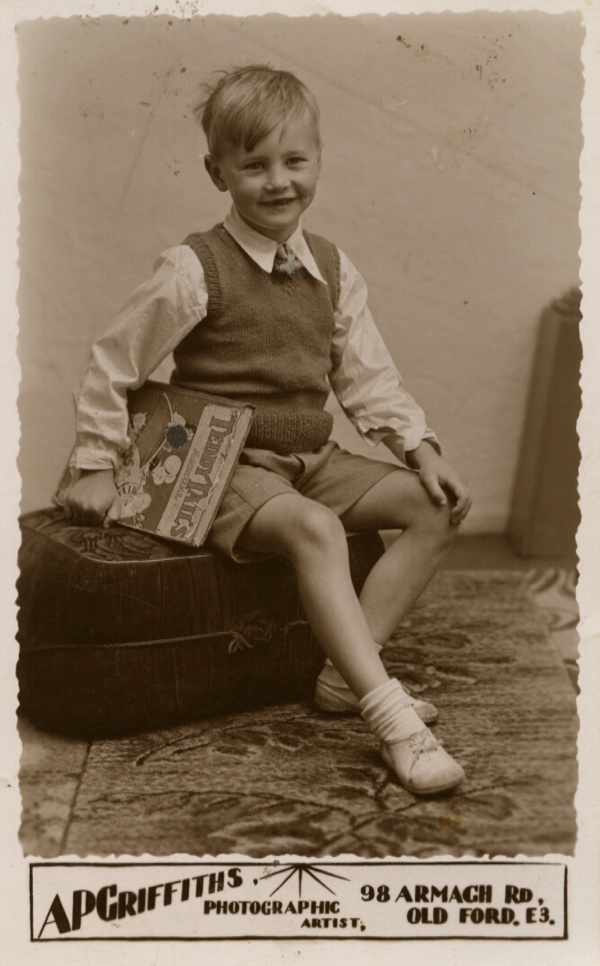
Eddie aged nine, 1941.

Eddie when he worked in the docks.


Early Saturday morning and preparing to open. Eddie behind the bar and George the potman to his right.

Old George the potman.


Shirley Johnson with Rose Doughty, the famous wise-cracking barmaid.


Eddie’s sister Doreen (second left) and friends heading upstairs to the Devil’s Kitchen, above the Puddings (photograph by Alf Shead)

Eddie and his brother Kenny with their beloved Uncle John in the Puddings.

Saturday night in the Puddings.

Joe and Sue, Eddie’s father-in-law and mother-in-law, enjoying a Saturday night in the Puddings.

Eddie Johnson
You may also like to read about


