
Mama Thai, The Noodles Of Spitalfields
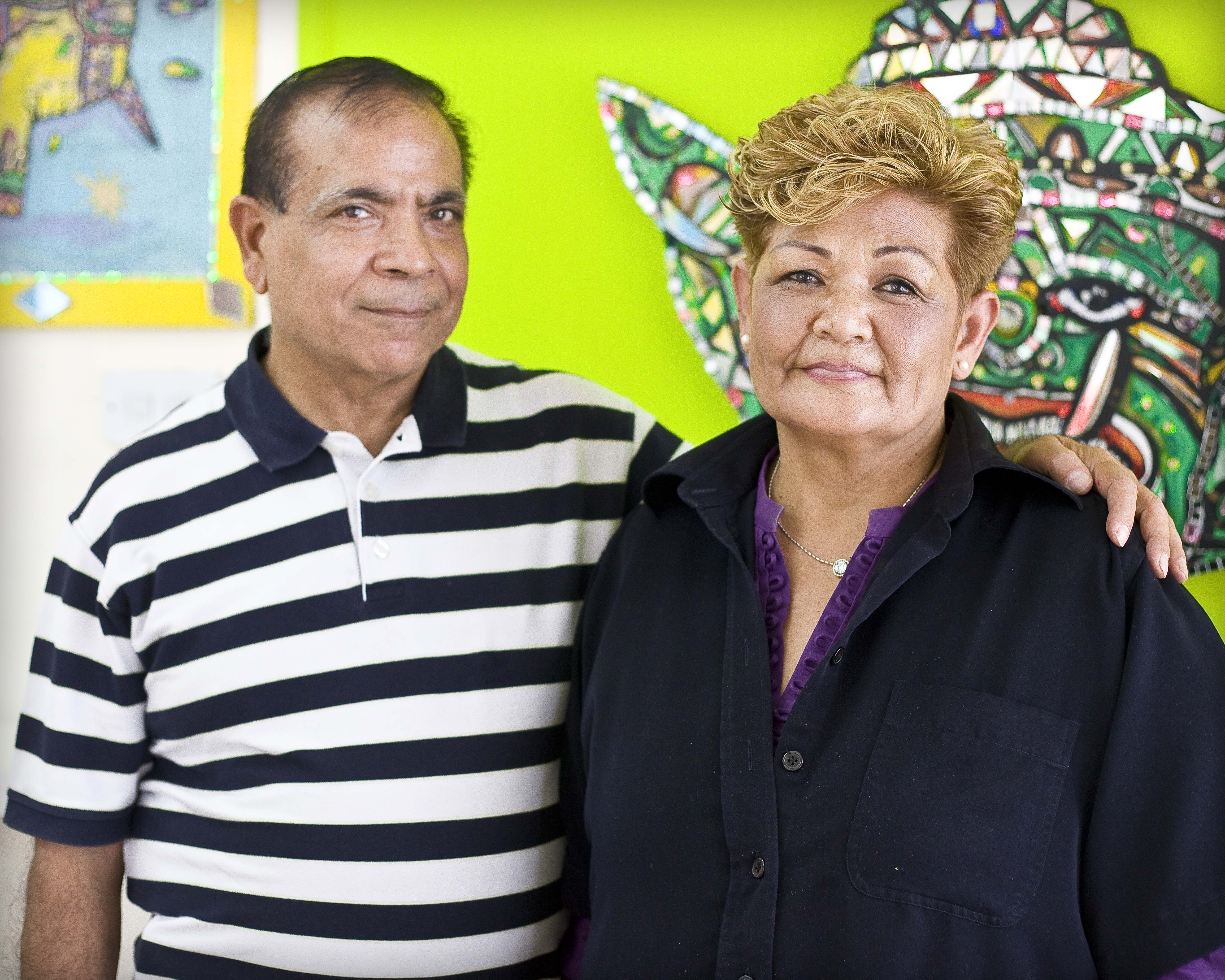
Pam & Raj Chawla, proprietors of “Mama Thai,” began selling noodles from a wooden hut in the Spitalfields Market on the very first day it reopened after the wholesale Fruit & Vegetable Market moved out in 1991. In those days, I used to go every Sunday and buy my week’s supply of vegetables from the stalls, and then perch on a bench in the cavernous empty market to wolf a steaming plate of Mama Thai’s spicy noodles with chilli sauce. Before the renovations, there was a train set that gave rides around the market, football pitches and all kinds of community events, of which the dog show was most notable, and, sitting amongst all this chaotic life, Thai noodles were the perfect meal to warm my body and raise my spirits after hours of trudging around Columbia Rd and Brick Lane in the frost.
Today Pam & Raj have a shop at the corner of Toynbee St and Brune St, fifty yards down a side street from Christ Church, Spitalfields, where hordes of office workers come every day with long lists of orders to carry off dishes of their delicious and keenly priced noodles and curry for lunch. A cooked meal for under five pounds is rare now – especially in Spitalfields – yet at Mama Thai you can buy good quality food prepared daily in the kitchen from fresh ingredients, with a drink to accompany it too, and get change from five pounds – vegetarian dishes are £3.50 and meat dishes £4.50. There is a touching egalitarianism about this welcoming brightly coloured restaurant, run with pride by Pam & Raj for a loyal coterie of over five hundred regular customers, who keep coming back to show their appreciation every week.
In these sweltering temperatures of midsummer, I find it as restorative as in the chills of midwinter to enjoy a plate of spicy noodles with chilli sauce – so, photographer Jeremy Freedman and I have enjoyed memorable lunches at Mama Thai’s twice this week. Jeremy likes mild curry while hot noodles are my penchant. Over the nearly twenty years I have been eating Mama Thai’s noodles, I have learnt the fine art of applying the chilli sauce sparingly – enough to make the mouth sing, not so much as to burn my tongue. It is a lesson I acquired haphazardly through ceaseless experimentation, which taught me always to keep a glass of water to hand in the early years, though readers with a delicate palate can be reassured that a range of milder flavoured dishes are also available.
Although, in the last twenty years, Mama Thai has only moved a few hundred yards from the Spitalfields Market to Toynbee St, this story began far away on another continent. It is a saga that involves a lot of hard work, and romance too, culminating in this present happy moment, the apogee of Mama Thai.
Raj Chawla, our hero, is a restless spirit with perceptive dark eyes, who won a scholarship from India to study in Germany and, upon his return in 1971, decided to seek a life in Thailand. There he learnt to cook in an American grill and managed a German restaurant in Bangkok, living above the shop. It was there that the demure Pam, our heroine, caught his attention when she came to sit in the restaurant, engendering a tender romance which continues to this very day, as the picture above testifies. Together, the couple came to London in 1975 on a work permit to study hotel management, starting a stall at Camden Lock each weekend selling noodles cooked by Pam, who like many great cooks is self-taught, improvising her dishes and learning through experience.
Thinking back to when I used to buy noodles from Mama Thai in the Spitalfields Market to warm myself in the Winter years ago, I wonder what it can have been like cooking and selling noodles all day in a freezing wooden hut, with a large serving hatch open to the air. Yet the scrupulous cleanliness of Mama Thai’s restaurant reveals that Pam is a hardy spirit, who works from nine until nine each day, scouring the entire place top to bottom at the end of service to create the immaculate environment she requires to cook her subtly spiced dishes and present them beautifully next day.
On the first day trading in Spitalfields, Mama Thai took just twenty pounds, but over time business grew to capacity. Then, in spite of Pam & Raj’s perseverance, Mama Thai had to leave the market when the renovations replaced the wooden huts with steel and glass spaces – now occupied by franchised chain restaurants – which command a rent far beyond the turnover of a small independent trader. It took Pam & Raj a year to find the current premises, but it is a credit to their tenacity (assisted by long-term collaborators Ooma and Peter) that today while those homogenous restaurants are closing in their expensive central locations, Mama Thai is deservedly thriving in this side street where discerning thrifty diners seek it out.
Last year, Raj took retirement after nineteen years at his day job at the post office and now Pam is teaching him to cook vegetarian dishes. “She’s the boss,” declared Raj with the cheeky grin of the student on a scholarship in a foreign land, indicating Pam, who glides around concealing her deep concentration with effortless poise and an easy smile. Possessing the perfect hair, make-up and inscrutable grace of a forties screen goddess and ruling the kitchen with unspoken authority, Pam is capable of speaking volumes simply by raising a single eyebrow, which was exactly what she did at that moment, eloquently confirming Raj’s statement.
I was putting away my notebook, ready to order lunch, when a passing office worker, shovelling noodles into his mouth with clownish delight as he walked out the door, announced spontaneously to the world, “This is where I come when I’m hungry!” Pam & Raj laughed, because he proved their point – out of their intelligence and talent they have created a beautiful situation offering good food that everyone can afford and we love them for it.

Ooma

Peter

Photographs copyright © Jeremy Freedman
Joan Rose at Arnold Circus

Joan Rose last walked through this gate at the Rochelle School in 1936 when she was ten years old. “I was quite happy at this school, though I turned rebel at eleven when I crossed Arnold Circus to Virginia Rd School, and I don’t know why.” declared the redoubtable Joan, with the casual recklessness that is her privilege at the fine age of eighty-four, now that (as far as we know) her teachers Miss Bell, Miss Faulkner, Miss Danielle and Miss Rees are not waiting on the other side of the gate to give her a good hiding.
“I was ‘plainy plainy’ – ‘plain Joan'”, whispered Joan, revealing her childhood nickname. “Not a very nice person,” she confided, in amusement at her former self. Making up for lack of conventional good looks by demonstrating the independence of thought, the character and wit that have carried her through life with such buoyant spirits, “I got the cane a number of times for answering back,” she confided with a smirk.
Now that sufficient time has passed, we can safely reveal the disgraceful incident with Miss Beany, the science teacher at Virginia Rd School. “After six weeks, I said, ‘Do you know Miss Beany, you bore me to tears? Every time I come to your class it’s the same thing with the bunsen burner and the flask which nobody understands.’ Then I turned to class and said ‘All put your pens down.’ My mother made me take a bunch of flowers to Miss Beany. And Miss Beany said, ‘Thankyou so much, sit down. Your parents are very nicely spoken – I don’t know where they got you from.” confessed Joan, still smarting from this putdown of seventy years ago though, pertinently, she herself grew up to enjoy a long and successful career as a teacher.
This novel anecdote serves to illustrate how the class terror at eleven can become the most charming octogenarian you could wish to take a stroll around Arnold Circus with today. Brought up on the Boundary Estate until she was evacuated in 1939 at the age of thirteen, Joan is blessed with an astounding memory for names and details of her childhood, and she will cheerfully run through the list of every single one of her contemporaries in her class at the Rochelle School in 1936 if you ask – the neatest party trick I know.
Joan Rose’s grandfather Albert Raymond opened Raymond’s greengrocers in Calvert Avenue (in the space that is now Leila’s Shop) in 1899 when the Boundary Estate was first built, and Joan’s father Alfred ran it until the nineteen sixties. Joan is now patron of the Friends of Arnold Circus and – drawing a discreet curtain over her school record – she has been invited to cut the cake on the day of the centenary celebrations on July 18th.
Through these snapshots published here, you are invited to join our stroll around Arnold Circus on a golden Summer’s evening – as seventy years fell away to reveal many of the cherished landmarks of Joan’s childhood as full of vivid meaning for her as ever they were.

Joan Rose last bought fish and chips at this shop in Club Row in 1939. “Tuppence for a fish, a penny for chips, and a penny for a wally cucumber!” announced Joan, declaring her regular order to the closed door, and getting excited as the memory resurfaced of innumerable fish suppers she enjoyed here.

Above this shop lived Kaplan the cobbler, who had a tiny premises round the corner in Old Nichol St. “If they were shut, you knocked and he brought your boots down to you,” explained Joan, recalling that this corner shop always sold groceries, a fact to which her father turned a blind eye, even though they were not a member of the Fruit & Vegetable Federation (that ensured grocers where evenly spaced), as he was.

“This is where I celebrated the Silver Jubilee of Queen Mary and King George V in 1935. “ Joan told me proudly, “We had one long table the length of the yard and everybody brought food.” Joan lived with her family in the building to the right, Laleham Buildings, until she was evacuated in 1939 – which was fortunate because the flat took a direct hit. All the family managed to salvage from the rubble was their three-piece suite (“We had it recovered”) and their bedroom suite which Joan still uses today.

This shop in Calvert Avenue, which has been boarded up for years, is the site of Kossoff’s legendary bakery run by the uncle and father of Leon Kossoff the painter – Joan’s father signed the naturalization papers for the uncle. Joan remains full of wonder at the unforgettable quality of Kossoff’s baking, and the first bread slicing machine to be installed here, a fierce miracle of technology that cut off the finger of one of the assistants. The shop was so narrow that the bakers required an extension at the rear, and Joan and I walked round the back to discover the mark on the wall, revealing where the bakehouse once stood.

Joan remembers the Magnet Laundry, run in her time by Mrs Andrews, that occupied the left half of this trading space when she was five years old in 1931, because that was her very first bedroom window up above to the left in Cookham Buildings – before her family economised, moving round the corner to a flat with lower rent in Laleham Buildings. At the Magnet Laundry, dirty linen was differentiated into “best wash” and “bag wash,” the former being her father’s shirts and the latter being everything else. On Joan’s left was Lil’s delicatessen that sold delicious pickled herrings and beyond that the Rent Office (now the Community Laundrette) then Dr Murphy’s surgery before Kossoff’s the bakers.


Phoebe Hannah Raymond, Joan’s grandmother, and grandfather Albert Raymond outside the shop in Calvert Avenue in 1899. At Phoebe’s funeral in 1936, Joan saw the first motor cortege (when horse-drawn hearses were still the norm), and every boy and girl from Virginia Rd and Rochelle school lined up on the bandstand to pay respects.
Calvert Avenue was Joan’s first street and she knows every one of the premises and their occupants, seeing it all clearly in her mind. On one side of Raymond’s, the space that is now Leila’s Cafe was a confectioner. On the other side was a Welsh dairy (Lewis then Thomas then Jones), next Mendelbourn who made wicker furniture, next Feldman the tailor (now Ally Capellino) and Usiskins the furrier (now Guven Newsagent).
One day after the end of World War II, a roasted peanut salesman pulled up in a van in Calvert Avenue outside Raymond’s shop and although Joan’s canny grandparents preferred to invest in a machine to roast their own, Joan was sold – because she married the handsome young salesman Ron Rose and left Arnold Circus with him to have her own family.
It was only in this century that Joan returned to discover her grandparents’ shop had been reopened selling groceries again. This was the catalyst that brought back all the memories for Joan and a new friendship too, with Leila McAlister. “When you get to know places they become bigger, that’s what has happened to me as I have got to know Arnold Circus all over again, even though it seemed small when I first returned.” said Joan, delighted to rediscover her spiritual home after all this time.
You may like to read these other stories about Joan Rose:
Alan Dein, East End Shopfronts 1988

“In my twenties, I’d been doing a number of oral history recordings, working for the Museum of the Jewish East End which was very active recording stories of the life of Jewish people who had settled here.” explained Alan Dein, broadcaster and oral historian, as we sat together in the yard of the Toynbee Hall while he outlined the background to his fascinating collection of more than a hundred photographs of East End shopfronts.
“My photographs of the derelict shopfronts record the last moments of the Jewish community in the area – the bustling world of the inter-war years had been moved into the suburbs, and the community that stayed behind was less identifiable. In the nineteen eighties they were just hanging on, some premises had been empty for more than five years. Like a mouthful of broken teeth, a boxer’s mouth that had been thumped, with holes where teeth once were.”
Feeding both his passions, for taking photographs and for collecting, Alan took these pictures in 1988 while walking around the streets of the East End at a time when dereliction ruled. Although his family originate from the Jewish East End and his Uncle Lou was a waiter at Blooms, Alan was born elsewhere and first came here to study “I became a student at the City of London Polytechnic in Old Castle St and spent a lot of time hanging out here – though the heart of the area for me at that time was the student common room and bar.”
“Later, in 1988, I moved back here to live in a co-operative housing scheme in Whitehorse Rd in Stepney and then I had time to walk around in this landscape that evoked the fragmentary stories I had heard of my grandparents’ lives in the East End. My family thought I was mad to move back because when they left the East End they put it behind them, and it didn’t reflect their aspirations for me. The eighties were a terrible time for removing everything, comparable to what the Victorians had done a century earlier. So I photographed the shopfronts because this landscape was not going to last and then I put the pictures in a box.”
“It was important they were in colour. A lot of memories of the East End were in black and white reflecting the political oppositions of Left and Right, and hard work and poverty, but I have always loved peeling paint, paint that has been weathered and worn seafront textures. This was just at the last moment before these buildings were going to be redeveloped. In the eighties my grandmother died, and the story I heard from her generation was of the ‘monkey parade’, when once people walked up and down the Mile End Road to admire the gleaming shopfronts and goods on display.”
In many of these photographs, there is a visible contradiction between the implicit ambition to present a confident facade and the narrative of disappointment which time and humanity have written upon these once proud frontages. This is the source of the emotionalism in these images, seeing faded optimism still manifest in the choice of confident colours and sprightly signwriting, becoming a palimpsest overwritten by the elements, human neglect and graffiti. In spite of the flatness of these impermeable surfaces, in each case we know a story has been enclosed that is now shut off from us for ever.
Alan no longer lives in the East End, though today he returns to record oral histories. Beyond their obvious importance as an architectural and a social record, Alan’s library of photographs of shopfronts are also a map of his exploration of his own cultural history – their cumulative heartbreak exposing an unlocated grief that is easily overlooked in the wider story of the movement from East End slums to better housing in the suburbs.
Yet Alan sees hope in these tantalising pictures too, in particular the photo at the top, of Lipmans Kosher Poultry Dealer, in which the unknown painter ran out of paint while erasing the name of the business, leaving the word “Lip” visible. “A little bit of lip!” as Alan Dein terms it brightly, emblematic of the undying resilience of people throughout the turbulence of social change.

Goulston St

In Whitechapel

Redchurch St

Cheshire St

Hessel St

Quaker St

Toynbee St

In E2

Great Eastern St

Hessel St

Relocated to Edgware…

Brick Lane

Wilkes St

Whitechapel High St
Photographs copyright © Alan Dein
Columbia Road Market 41

Even though my garden is mostly in the shade, I needed to water regularly this week as the temperatures soared, and when I visited Roy Emmin’s marvellous roof sculpture garden in Whitechapel it turned my mind towards plants that like dry conditions. So, at the market today I bought this Eryngium varifolium for £5 to plant in a dry corner exposed to the sun, and I also bought a bunch of Eryngium (in a slightly different variety) for £2.50 to illustrate the flowers for you.
I remember when my grandmother first showed me Eryngium in her garden or Sea Holly as she called it – because you do sometimes see it growing in the marshes or dunes at the shore. Until that moment, I had only thought that gardens were about pretty coloured flowers, but she taught me the sophistication of difference and the led me to see the beauty where others might see ugliness. “It takes all sorts,” was one of her favoured expressions, referring to the world as well as to her garden.
I especially like the dramatically veined leaves of Eryngium varifolium and there is something exquisitely surreal about these fine blue/green/grey flowers emerging from this supremely spiky plant. Just as the residents of Spitalfields are not all pretty flowers, we have our share of spiky personalities too, yet everyone contributes to bring variety and contrast to the beauty of the garden.


Another spiky wonder from my garden
Cleo’s Barber Shop

In Spitalfields this week, the Cleovoulou family celebrated a joyous moment of renewal, as they united in common purpose to reopen the old barber’s shop their father Kyriacos Cleovoulou (widely known as Cleo) ran from 1962 until his death five years ago. It was his daughter Stavroulla (widely known as Renee) who led the initiative, while her brothers Panayiotis and George have embraced the venture wholeheartedly too, undertaken with the blessing of their mother Niki (widely known as Nicole).
The emotional catalyst for Stavroulla was the death in April of her Uncle Takis, when she realised she could not let the family business die. All the family were taught to cut hair by Kyriacos, yet pursued other ways to make a living, though that might be about to change now everyone is working to bring new life back to this beautiful match-board lined barber’s shop opposite the almshouses in Puma Court. No-one knows exactly how long there has been a barber’s shop here, though the discovery of a nineteenth century barber’s chair in the cellar suggests at least a century, and Kyriacos himself claimed it was the oldest barber’s shop in London.
By chance, I arrived on the very day of the launch, just as Niki entered with the completed brocade dress she had sewn for her daughter Stavroulla to wear on this special occasion. Stavroulla’s eyes lit up with excitement to see the dress that incarnated this bright moment of new life, and with a shake of her glistening curls, she ran from the room to slip it on – returning a moment later, glowing with happiness and pride. Next, George arrived with an angelic smile, bearing trays of his mother’s baking, which he carried through into the sunny paved yard where a folding table had been set with the cherished Coalport tea service that was his parents’ wedding present. Once upon a time, Kyriacos used to nurture vegetables in pots here in this suntrap, in between giving hair cuts. Today, local residents and neighbours were coming round for high tea, Stavroulla’s son Dominik would be DJing on a wind-up gramophone, Panayiotis was going to perform a traditional Greek dance and George was playing the bouzouki. But in the meantime, I had the opportunity of a quiet chat with Stavroulla while she gave photographer Jeremy Freedman a wet shave, offered complimentary to guests that day. “I’m meeting my dad’s clients and they are telling me stories about him.” she confided, in delight at this unexpected bonus of reopening the salon – enabling Stravroulla to learn more about her father through the intimate reminiscences of his long-term customers.
As she wielded the cut-throat razor with inborn confidence, Stavroulla explained that both her parents came to London from Cyprus during the nineteen forties. Over time, Kyriacos became a revered figure in Spitalfields, cutting Gilbert & George’s hair for over thirty years, and renowned for sitting small Bengali boys upon a plank to give them their very first haircut when they were four years old. He and Niki lived over the shop then, bringing up their two sons here, though by the time Stavroulla, their youngest, was born they had moved to North London. Yet she has vivid childhood memories of Spitalfields,“We used to visit dad on Saturdays, and we played in all the old houses that were wrecked and boarded up then – the ghost houses we called them.”
“When you lose someone you love, you appreciate what was special about that person,” commented Stavroulla, changing tone as she contemplated the absence of her father on this special day honouring his memory, “He was a very simple man. He was all about us, his family, his barber’s shop, his bible and his allotment. Before he became a Jehovah’s Witness, he was very quiet and then after he found his religion, he couldn’t stop talking about the bible.” The bible, discreetly in the corner, is just one detail among many, placed by the children in the salon, telling the story of their father’s era. Over recent weeks they have been busy cleaning up the place, repainting the frontage in its original colours, getting new signwriting, collecting antique barber’s shop fittings and arranging everything, down to the last detail of a simple rack of plastic combs for sale, hung in exactly the same place their father had it, and even the cardboard “Be back soon” note on the door, written on a business card.
In adulthood, each of the children went their separate ways. Twelve years ago, Stavroulla moved into the building next door when she married, but found herself bringing up her son as a single parent while running a business with her mother making couture gowns under their own label “Nicolerenee,” as well as being a permanent makeup artist. Meanwhile, Panayiotis became a lecturer in Cyprus and George started a business specialising in credit card software. More recently, all three children have been practising their wet shave technique in advance of opening the barber’s shop, and the two softly-spoken brothers are now experimenting with lime wash as part of their plan to renovate both buildings that the family own in Puma Court, retaining all the paneling and details they remember from childhood.
At the last moment before it was lost, the Cleovoulou family realised the beauty of what they had, and, through an appreciation of the dignity of their father’s lifetime as a barber, they have rediscovered their common bond as a family, creating a future from the recognition of their shared past. Let us applaud them in this heartfelt endeavour which reinstates a lost Spitalfields landmark, Cleo’s Barber Shop, offering the personal service that is unique to a family business while enriching the human fabric of the city too.

Stavroulla Cleovoulou holding her father’s price list, pictured with her dog Beans.

Nineteenth century barber’s chair discovered in the basement.

Kyriacos Cleovoulou in the barber’s shop he ran for over thirty years.


Niki and Kyriacos at their allotment.
New photographs © Jeremy Freedman
Read more about The Barbers of Spitalfields.
Lucinda Douglas-Menzies, Spitalfields Portraits

I have always admired the portraits of local personalities upon the walls of The Golden Heart in Commercial St but I never knew who took these elegant pictures, so I was delighted when Ricardo Cinalli introduced me to the photographer Lucinda Douglas-Menzies in his studio in Puma Court this week.
Lucinda first came to live in Spitalfields in the late nineteen eighties when she met her future husband Anthony de Jasay. They brought up their two children here in his old house in Elder St and now live in a flat above the Spitalfields Market. She has enjoyed a distinguished photographic career with more than seventy works in the National Portrait Gallery collection and recently completed a series of thirty-eight portraits of eminent astronomers which were exhibited at the National Portrait Gallery and around the country in 2009.
Next day, Lucinda kindly invited me round to her modest studio on the first floor of the Heba building in Brick Lane, where she explained that it was Sandra Esqulant who first offered her an exhibition at The Golden Heart. Having accepted Sandra’s offer, once Lucinda considered the scale of the rooms and the social nature of the space, it became apparent that a collection of portraits would be ideal. So, with Sandra’s advice, Lucinda began approaching local people, some were her neighbours and friends, others were patrons of The Golden Heart that Sandra knew – and quickly the project acquired a life of its own. Taking these lively portraits and displaying them in this celebrated meeting place proved such a popular success in 2002 that another exhibition followed in 2004, and the pictures of Sandra’s closest friends still hang in pride of place upon the bar wall today.
It is my pleasure to publish these lucid images from Lucinda Douglas-Menzies’ Spitalfields Portraits. Although you may recognise some of Lucinda’s subjects, in compiling this new selection, we have deliberately picked others that we wish to introduce to you.
At the top is Eric Reynolds, founding director of Urban Space Management who is fondly remembered – amongst his other regeneration schemes – for his revitalisation of the Spitalfields Market in the early nineties. When he showed Lucinda around the Bishopsgate Goods Yard, he hoped he might be able to bring life back to the vast abandoned brick arches there, but he went on to develop a centre for arts and creative activity at Trinity Buoy Wharf instead. Lucinda remembers Eric arrived for the session on his motorbike, wearing the full-length raincoat you see in the picture, and she photographed him in 2004 standing on the former railway bridge over Brick Lane.

“I got to know Gary Wilson from buying fruit at his stall outside Whitechapel Station,” explained Lucinda, remembering this vibrant personality who suffered a heart attack and died while still young, photographed here in the midst of life, standing at the rear of his van. “He was really nice guy who worked on equal terms alongside the Bengali traders – he cut through all the barriers.” recalled Lucinda affectionately, “Many of my subjects came to the East End but he was born and bred here – as local as anyone could be.” His unexpected death endows this portrait of 2004 with a haunting poignancy today.

Michelle Norgan pictured in 2002 astride Chester her Cob, outside the Spitalfields City Farm that she helped run for many years. The perfection of this bucolic image with its immaculately groomed horse and correctly turned out rider, standing under the may trees in blossom, exists in strange contrast to the urban images that define this collection of pictures, yet the farm is an integral part of the identity of Spitalfields. Michelle gamely dressed up for this picture in a formal outfit, entirely unlike her usual work clothes, to create this exuberantly absurd tableau.

Raphael Samuel was Lucinda’s neighbour and became a friend, a circumstance which afforded the opportunity for this luminous intimate portrait taken three years before his death in 1996. Pre-eminent historian of the East End and author of “Theatres of Memory”, Raphael Samuel, with his wife Alison Light, was one of the very first to move to Elder St in appreciation of the architecture in the days when the street was derelict. The East London History Centre at the Bishopsgate Institute where his papers are preserved is today named the Raphael Samuel Centre in his memory.

This portrait of artist and Spitalfields resident Gillian Wearing was taken at a sitting with her partner Michael Landy. The portrait of Landy is in the National Portrait Gallery and their joint portrait can be seen at The Golden Heart, yet this picture has not been published before. I wanted to include it here because it is one of my favourite of Lucinda Douglas-Menzies’ photographs, a quiet masterpiece of classical portraiture in which the simplicity of composition and poise of the sitter serve both to disarm and captivate the viewer.

Critic Edward Greenfield, pictured here in in 2004 in the living room of his house in Folgate St, looks very fine in his beautifully polished riding boots, surrounded by the tottering piles of CDs that have overtaken his dwelling, and which, in their overwhelming profusion, manifest the concrete evidence of his encyclopaedic knowledge of music. On the staff of the Guardian for over forty years, among his many accomplishments, Edward Greenfield is a popular broadcaster, a regular contributor to Gramophone magazine since 1960 and co-author of the Penguin Guide to CDs.

Johnny Vercoutre, Tilly Vercoutre, Suzette Field and Glory photographed in 2004 at their home in Shoreditch High St, furnished throughout in a rigorously authentic early twentieth century style, and including a private cinema. On the ground floor, Johnny runs “Time for Tea”, and in the surrounding streets you will commonly see examples of his collection of vintage trucks and vans that he hires out for films. In 2009, Suzette Field opened the singular “Shop of Horrors” with Viktor Wynd on Mare St.

As everyone who lives in Spitalfields knows, Gilbert & George walk everywhere, and Lucinda wanted to capture this perambulatory quality in her portrait, so she asked them to walk down Fournier St and freeze in the moment of walking. It was an inspired gesture on her part which imbues the illustrious duo with the surreal quality of mechanical figures, permitting them scope to perform upon the stage of the urban theatre that is their imaginative universe.
Photographs copyright © Lucinda Douglas-Menzies
Mr Pussy in Summer

Those of you that are luxuriating in the warmth of Summer, spare a thought for Mr Pussy who has a fur coat surgically attached and spends his languorous days stretched out upon the floor in a heat-induced stupor. As the sun reaches its zenith, his activity declines and he seeks the deep shadow, the cooling breeze and the bare wooden floor to stretch out and fall into a deep trance that can transport him far away to the loss of his physical being. Mr Pussy’s refined nature is such that even these testing conditions provide an opportunity for him to show grace, transcending dreamy resignation to explore an area of meditation of which he is the supreme proponent.
In the early morning and late afternoon, you will see him on the first floor window sill here in Spitalfields, taking advantage of the draught of air through the house. With his aristocratic attitude, Mr Pussy seeks amusement in watching the passersby from his high vantage point on the street frontage and enjoys lapping water from his dish on the kitchen window sill at the back of the house, where in the evenings he also likes to look down upon the foxes gambolling in the yard.
Whereas in Winter it is Mr Pussy’s custom to curl up in a ball to exclude drafts, in these balmy days he prefers to stretch out to maximize the air flow around his body. There is familiar sequence to his actions, as particular as stages in yoga. Finding a sympathetic location with the advantage of cross currents and shade from direct light, at first Mr Pussy will sit to consider the suitability of the circumstance before rolling onto his side and releasing the muscles in his limbs, revealing that he is irrevocably set upon the path of total relaxation.
Delighting in the sensuous moment, Mr Pussy stretches out to his maximum length of over three feet long, curling his spine and splaying his legs at angles, creating an impression of the frozen moment of a leap, just like those wooden horses on fairground rides. Extending every muscle and toe, his glinting claws unsheath and his eyes widen gleaming gold, until the stretch reaches it full extent and subsides in the manner of a wave upon the ocean, as Mr Pussy slackens his limbs to lie peacefully with heavy lids descending.
In this position that resembles a carcass on the floor, Mr Pussy can undertake his journey into dreams, apparent by his twitching eyelids and limbs as he runs through the dark forest of his feline unconscious where prey are to be found in abundance. Vulnerable as an infant, sometimes Mr Pussy cries to himself in his dream, an internal murmur of indeterminate emotion, evoking a mysterious fantasy that I can never be party to. It is somewhere beyond thought or language. I can only wonder if his arcadia is like that in Paolo Uccello’s “Hunt in the Forest” or whether Mr Pussy’s dreamscape resembles the watermeadows of the River Exe, the location of his youthful safaris.
There is another stage, beyond dreams, signalled when Mr Pussy rolls onto his back with his front paws distended like a child in the womb, almost in prayer. His back legs splayed to either side, his head tilts back, his jaw loosens and his mouth opens a little, just sufficient to release his shallow breath – and Mr Pussy is gone. Silent and inanimate, he looks like a baby and yet very old at the same time. The heat relaxes Mr Pussy’s connection to the world and he falls, he lets himself go far away on a spiritual odyssey. It is somewhere deep and somewhere cool, he is out of his body, released from the fur coat at last.
Startled upon awakening from his trance, like a deep-sea diver ascending too quickly, Mr Pussy squints at me as he recovers recognition, giving his brains a good shake, now the heat of the day has subsided. Lolloping down the stairs, still loose-limbed, he strolls out of the house into the garden and takes a dust bath under a tree, spending the next hour washing it out and thereby cleansing the sticky perspiration from his fur.
Regrettably the climatic conditions that subdue Mr Pussy by day, also enliven him by night. At first light, when the dawn chorus commences, he stands on the floor at my bedside, scratches a little and calls to me. I waken to discover two golden eyes filling my field of vision. I roll over at my peril, because this will provoke Mr Pussy to walk to the end of the bed and scratch my toes sticking out under the sheet, causing me to wake again with a cry of pain. Having no choice but to rise, accepting his forceful invitation to appreciate the manifold joys of early morning in Summer in Spitalfields, it is not an entirely unwelcome obligation.

You can read more about Mr Pussy here:


