
Helen Galland, Spitalfields City Farm

Even though the temperatures of high Summer are here, the effects of last Winter are still with us, as I discovered when I arrived at the Spitalfields City Farm to meet Helen Galland who has been farmyard manager here for the last seven years. Helen was busy mixing up powdered ewe’s milk and decanting it into bottles with teats for the orphaned lambs – who were fully aware it was feeding time and making loud hungry baaing sounds on the other side of the farmyard. The poor quality grazing occasioned by the severity of last Winter left many ewes unable to feed all their young, hence the number of “orphaned” lambs this year.
As we climbed into the sheep pen with bottles in hand, where the noisy young diners were waiting, children in the adjoining playground ran to the fence and asked excitedly if they could feed the lambs. When Helen consented, they sprinted around the block in anticipation to arrive at the pen where Helen handed them the bottles, and much hilarity, delight and mobile phone footage ensued as the thirsty lambs quickly sucked the bottles dry.
“Many children grow up in tower blocks and estates where they cannot even have pets,” explained Helen to me later, “so they have no direct contact with animals, which they need to do if they are to learn respect for life and understand that animals have needs.” It was both an eloquent summation of the role of the city farm itself and a heartfelt declaration of a personal creed for Helen, a trained zoologist who works sixty hours each week here with the animals.
We retreated from the midday sun into the cool of the animal sheds where Helen is rearing chicks to replace two Bantam Blue Orpingtons that died recently. “I wanted to breed them here but I never managed to get a clutch of their eggs so I had to buy some Buff Orpington eggs off the internet.” she explained as she lifted the lid of the cage where she was nurturing the tiny little fluffy birds, stumbling around with stumpy wings like clockwork toys and falling suddenly asleep, even in the feed bowl, as if they needed winding up again.
Only one of the six eggs that came through the mail hatched and this single survivor has tested Helen’s ingenuity to rear it successfully, becoming an intense focus for her energies in the process. Deploying cunning old tricks, she placed the head of a mop in the cage where the chick could seek maternal consolation and a mirror so that, like the caged songbird, the chick had a companion to speak with, until two others she loaned from another farm arrived to teach the necessary social skills for a hen. By tapping her finger in the grain and the water, while making the noises of a mother hen, Helen herself taught the Orpington chick to feed. Now at a week old, it runs to her hand and responds to her touch. We were both mesmerised by this helpless creature, quick with life, that had just shed the nib from its beak which enabled it to peck its way out of the egg and into existence. “They get uglier from now on!” quipped Helen, spellbound by her charge.
Helen arrives at a quarter to eight every morning and leaves at a quarter to eight in the evening five days a week, all year round, in a job that entails a great detail of manual labour yet which she embraces with an infectious joy. Her tattoos, pink hair and combat pants impart a punky street credibility (closer to Tank Girl than the shepherdesses of yore), that enables her to be an energetic advocate to all the school children that come daily to encounter the different animals, gain respect for their fellow creatures and understand the origins of their food. Like the others who run the farm, Helen is a knowledgeable professional who works hard to tend the livestock, as well as communicating her knowledge and passion for the animals, not forgetting office work and the constant necessity to chase funding to keep the whole enterprise afloat.
I remember when I first visited the Spitalfields City Farm, walking across a muddy urban wasteland to visit the animals in pens, looking quite forlorn in a former railway siding. Much less verdant than today, it was a curiosity that existed in defiance of its environment, yet remarkably it is still here thanks to the staying power of a few industrious individuals like Helen. I have always loved it for leavening the neighbour with its anachronistic poetry – delivering farmyard sounds, of cockerels crowing and sheep bleating, upon the wind. They bring us down to earth with their age-old cries, because the truth is that the anachronism is not the farm, it the city that surrounds it. And for the benefit of our collective sanity we all need to be reminded of this daily, an essential duty that falls to the modest hens and sheep – this the story of how Helen Galland takes care of the animals and the animals take care of us in return.
If you are interested in volunteering to work at the farm or sponsoring an animal click here.


On the roof with Roy Emmins

On a humid midsummer’s day in Whitechapel, the ideal place to be is up on the roof with Roy Emmins, in his wonderful sculpture garden at the back of the Royal London Hospital. Peering down upon everyone else, looking like ants going about their business with entirely mysterious imperatives, it is a refreshingly liberating experience, and if there is any breeze to be had, you feel its cooling influence up here, wafting the scents of Roy’s flowers over the rooftops. From this lofty roost, Roy can look back fondly to the hospital where for thirty-two years he worked as porter, surrounded today by the some of the sculptures that have occupied him full-time since he took early retirement from the hospital fifteen years ago.
For the last thirty years, Roy has inhabited this tiny caretaker’s flat, added as an afterthought upon the roof of a streamlined art deco block in Turner St, and it was my pleasure to pay him a visit there. Roy took me up in the lift to the top floor, opened his blue front door and genially ushered me inside. To my delight, I found four small rooms organised meticulously, like cabins on a boat, with all kinds of shelves and cabinets where everything had its place, and every space was embellished with the great variety of Roy’s extraordinary sculptures and paintings, bestowing a magical presence of their own – from tiny birds shaped out of tinfoil to graceful human figures hewn from alabaster.
Each narrow room has windows on either side, with views across the roofs and far over the city on both sides. On the South side is a bare roof covered in pigeons who conveniently leave fertilizer that Roy gratefully collects for his flourishing garden on the North side. Stocked from Columbia Road and Watney Markets, Roy’s roof garden possesses an intriguing selection of plants. Hardy varieties that withstand wind and thrive in dry conditions suit this location best, and I admired Roy’s inspired combinations of succulents, miniature trees and colourful border planting, like heucheras, artemisias, gazzanias, ox-eye daisies and mallow, mixed in with potatoes and three kinds of tomato plants.
Yet it is the sculpture that make Roy’s garden pure poetry, his charismatic stone and concrete figures encrusted with lichen and bronze figures patinated green by the elements. At first, you do not spot all of them lurking among the plants, driftwood, shells and pots, but, as they catch your eye, you see the individual sculptures against the backdrop of the distant cityscape, proposing extraordinary contrasts of scale that fire the imagination.
Roy’s earthly paradise is occasionally shattered when helicopters fly low overhead to land at the nearby helipad on the roof of the hospital. It gave our conversation some pauses for consideration, as we sipped our tea, waiting for the din of the whirring steel monster to pass over. However, the authorities at the hospital are conveniently moving the helipad shortly, away from Roy’s flat, up onto the top of the gleaming blue towers. The startling modernity of this new development exists in bizarre contrast to Roy’s first experience when he began working at the hospital in 1964 as a catering porter, and he remembers delivering milk to the matron’s flat in the eighteenth century West wing, with an old parlour retaining all of its nineteenth century furnishings including an aspidistra on a stand.
To the East, directly across Turner St, is the deconsecrated church of St Augustine with St Philip, now used as the hospital library and archive, where the Elephant Man’s hat is kept, and Roy pointed out the bronze bell at our eye level, still hanging high upon the rooftop, where once he saw a kestrel perch to pull the feathers off a small bird and devour it for its dinner. To the West, gesturing in the opposite direction, Roy pointed out the former hostel in Fieldgate St that once counted Lenin and Orwell amongst its transient occupants. In this location, rich in every kind of cultural and historical resonance, Roy is alive to all the stories, which serve as a colourful background to the quiet home where he spends most of his time in his roof garden at this time of year.
Two weeks ago, Roy acquired a new companion, Max, a short-haired black tomcat with a sturdy muscular body and a forthright personality. Previously living the life of a homeless alley cat, with battle scars and mange to prove it, under Roy’s benign influence Max already looks healthier. He has quickly made himself sublimely at home on Roy’s rooftop, even jumping with reckless innocence across the chasm onto the chimney stack of The Good Samaritan pub next door and sunning himself among the chimney pots. As Roy and I enjoyed our tea and idle conversation upon the roof top beneath the sunshine and slow-moving clouds, with astute opportunism Max took advantage of the companionable shade we created, stretching out beneath our seats.
Moving between his rooftop flat and the studio down in Cable St, where he makes his sculptures, it is a modest yet enviable existence Roy has carved out for himself. As I said “Goodbye”, he handed me a bag with the noble paper mache lion that I bought from him, which now sits upon my desk as a constant reminder of Roy’s vision. I do not know if Roy Emmins’s placid spirit is the result of the life he has created for himself or whether his personality led him to seek out these calm spaces conducive to his sympathetic nature, so instead I must credit it all to the unique quality of his inventive imagination, creating such a prodigious range of work with constantly renewing delight.
You can read about my visit to Roy’s studio by clicking here and you can see more of his work at www.emminsart.org


Max contemplates a death-defying leap onto the chimney stack of The Good Samaritan pub next door.

Roy Emmin’s paper mache lion.
Colin Taylor, the secret language of Tic-Tac

As soon as Rob Ryan alerted me to the remarkable work of Colin Taylor, a young graphic designer who has been on placement at his studio, I went over immediately to meet Colin at the Central St Martins degree show, held in the atmospheric spaces of the former Nicholls & Clarke building on Shoreditch High St.
Colin, who originates from Dagenham and possesses a keen eye and a generous smile, used to be taken along to the dog races at Walthamstow, Romford and Brighton by his dad, uncle and grandad. “Once,” Colin confided to me, with a broad grin of amazement, “I was sitting next to a tic-tac and I wondered what the hell he was at.” Years later, Colin has returned to the racetracks to investigate the secret world of the tic-tacs and create a unique graphic record of their vanishing language of gestures.
A tic-tac – in case you wondered – is someone who works for a bookmaker at a race track, keeping him apprised of the bets being laid elsewhere and the odds being offered by the other bookies. While this is essential knowledge for any bookie if he is to maintain a competitive edge, it is also information that needs to be communicated discreetly in a form that is not obvious to other parties. Out of this situation arose an ingenious terminology and language of signs which, like its proponent, takes the name “tic-tac.” With tremendous speed and facility, tic-tacs are able to keep the bookie informed, through visual signals, of everything they need to know. The bookies could receive information from as many as four tic-tacs working for them simultaneously, whilst also taking bets from punters. “At the heart of the language was the need for quickness of communication,” explained Colin. In the minutes between each race, the tic-tacs would be continuously signaling everything they saw in front of them.
Inspired by campaigns to record lost languages in remote corners of the globe, Colin headed down to the racetracks to record the fading language and culture of tic-tac, which declined with the rise of the mobile phone and has not been practised for the last ten years. Little has ever been written of the language and lore of tic-tac, so Colin set out to record the entire vocabulary while it was still possible, not just the terminology but the hand gestures as well.
It took Colin three months of visiting racetracks, getting to know those there that were once tic-tacs but now work as bookies. At first he encountered resistance, but through perseverance he made friends with a tic-tac called Michael. Once he made this connection, Colin returned each night for the next week to speak more with Michael, and gradually other tic-tacs joined the conversation too. “I think Michael was quite pleased that someone showed serious interest. When I learned that Michael’s father had also been a tic-tac and realised that all the guys still knew the language, it was such a rush of excitement,” admitted Colin, “I wanted them to unload all they knew about the language onto me.” Outlining his approach, Colin said, “Each night I had a plan of specific questions to ask, because I respected the fact that they were trying to work while talking to me.” Eventually Colin persuading the tic-tacs to let him photograph them between races, and his tenacity was rewarded by the tic-tacs running through their entire lexicon of gestures to be recorded by his camera.
Colin’s discoveries reveal something of the intriguing history and origins of the language, which he has arranged in three categories, “Cash Amounts,” reporting the size of bets being laid, “Odd Gestures,” conveying the odds being offered by other bookmakers, and “Trap Numbers,” noting the gates assigned to each dog. All this has been organised by Colin into three elegant books, in which he has honed the text and arranged the type with exemplary typographic judgement, complementing his linocuts that illustrate the gestures with appealing directness and wit. These modest cuts, no more than three inches square, reveal a bold graphic sensibility that references the Beggarstaff Brothers in its confident use of large areas of rich black, combined with an unusual, almost photographic use of light and shade.
Unsurprisingly, Colin himself has now developed a facility for tic-tac, running through any sequence of gestures with practiced ease and able to illustrate more sophisticated techniques whereby the language is communicated by barely perceptible twitches, sufficient for a recipient who already knows the signs. Through his persistence and creativity, Colin has uncovered a neglected area of discourse that has its own culture and history, but he becomes most animated when speaking of the friends that he made at the racetrack – in particular, Michael, whose father was also a tic-tac, and Skinny, a tic-tac in his late seventies with a career of over forty years who still returns to the race track each night, even though he can no longer work. In the end Colin’s project is no mere cultural curiousity, nor is it an antholopological exercise, it a serious record celebrating a phenomenon that exists as a fine illustration of the endless witty ingenuity of working people.


Bottle refers to odds of two to one. This originates from the early nineteenth century when spruce was used in the production of beer, referred to as a “bottle of spruce” which cost a deuce, leading to the use of “bottle” to convey the value of two. Score originates from the practice of counting sheep in twenties, carving a notch or a score on a stick to keep a tally, hence tap chest with hand. Pony for £25, derives from the pony illustrated on the twenty five rupee note when British soldiers were serving in India, while Monkey for £500 derives from the monkey on the five hundred ruppee note. Grand meaning £1000, is conveyed by the gesture of playing a grand piano.

Skinny
Columbia Road Market 40

In the unseasonable shivering temperature of the market early this morning, I realised that now is the time for Bellflowers. From tall Canterbury Bells to low ground cover varieties, there are so many options with these (mostly blue) Campanulas, that I did not know which to choose. After careful consideration of proportion and colour, I bought this Campanula pulla for £1.50, an alpine variety no more than three inches high. As regular readers will know, my garden is so tiny that I am always searching for plants to bring detail, and this plant rewards close examination handsomely. I love the deep (almost Bluebell) tone, the elongated flowers and glossy texture which make the flowers a close match for those glass lampshades of a century ago. The trend is to breed larger plants but I prefer these tiny varieties, with finer proportions and details that are even more beautiful seen in miniature.
From my bathroom, I heard my neighbour shriek in his garden, and leaned out of the window to discover the joyous news that his white Passionflower, which he planted two years ago, has flowered at last. Let me admit, I was fearful that this plant, more exotic and fleshy than the more commonplace variety I have, would survive last Winter. But it did and now it is flowering. I ran round with my camera to photograph the first cool white (almost pale green) flower for you, so you can admire this otherworldly bloom that glows in the sunlight and turns flourescent in the dusk, before closing up each night.

A Spitalfields weaver’s stool

I found this in Brick Lane yesterday, disregarded on the pavement outside a leather shop that was being refitted. I walked past and stopped in my path and turned back, I could not believe my eyes. I knew what it was but I never expected to see it there. Nearby stood a couple of workmen who were stripping out the shop and I asked the men if they had cleared out the stool and if I could buy it. Withholding my excitement, I offered five pounds and after a little negotiation my cash was accepted. Maybe they put the stool on the pavement hoping someone would simply take it away and I was a fool to pay – but this question was of no consequence to me because I had found a Spitalfields weaver’s stool. In spite of its bare utilitarian construction, knowing the meaning of this object, which exists as an illustration of the history of this place, makes it an object of fascination to me.
I knew it was a weavers’ stool because Danny Tabi, the last furrier in Spitalfields has one that he found in the Gale Furs factory in Fournier St when he began working there in the nineteen sixties. He remembered the day of the shooting of The London Nobody Knows in 1967, regretting that he never left his work to be filmed in the travelling shot along Fournier St, in which today he can identify all the faces. When I visited him early one morning last Winter, he proudly pulled the weavers’ stool out from under his sewing machine bench and placed it on his worktable, explaining what it was and pointing out the standardised aspects of the design.
These stools date from an era when it was cheaper to knock together something by hand than get it mass-produced. Essentially constructed from three pieces of one plank, with a couple of cross pieces, and sides to the seat added, this was something a carpenter could make in ten minutes. The “V” cut into each of the side supports created an approximation to four legs, making it stable upon irregular floors, as there are to be found in the old houses that were appropriated as factories here.
Originally used by weavers at looms, Danny explained that these stools became the standard for machinists in the clothing industry in Spitalfields. The close similarities between the stool I found and Danny’s suggest that the design was honed over time to arrive at a standard stool. The splayed angle of the legs and depth of the “V” is consistent, and the sides of the seat have their ends cut away on both stools. A little higher than a chair, it is tall enough for my thighs to be parallel with the ground when I sit upon it.
Although, in most illustrations I have found, the weaver stands or sits upon a cross piece attached to the loom, I am aware that there were different looms for different purposes. Maybe when Danny described this as a weaver’s stool, he referred to it as a common design used in the weaving industry? I cannot know the story of this stool, it can only exist as a general reminder of those who worked with their hands here for centuries in the textile industry. For an object of such cheap manufacture it has fulfilled its purpose well, outliving those who made it to become a relic of an industry that has all but vanished from these streets.
My stool declares its recent history through the printed plastic tape with the words “Future Designs” taped along the wooden edges of the seat. A name that possesses aspirations in absurd contradiction to the mundane wooden stool it graces. Should I remove this tape? Pasted upon the seat itself are closely lettered documents containing the date 1956 as part of the Conditions of Carriage by Road Act. Should I remove these? The stool has been mended with an extra cross piece added to stabilise it, more crudely done than the originals, and it has wood blocks glued underneath the seat to keep the structure rigid. Just the wear of hands upon the sides has worn the ridges in the woodgrain into relief.
I like this sad old stool for its functional austerity and evidence of wear. I shall not alter it. Commonplace objects that are used by many people in the course of daily life always speak to me more than rare precious artefacts. I cannot tell if this stool is fifty or one hundred years old, but I do know it has seen a lot of use and thereby carries the story of countless thousands of hours expended upon the weaving and sewing of cloth here – where I shall keep it – in Spitalfields.
You might like to read Charles Dickens’ account of visiting a weaver’s loft in Spitalfields in 1851 that I published in the Spring.

James Lowe, St John Bread & Wine

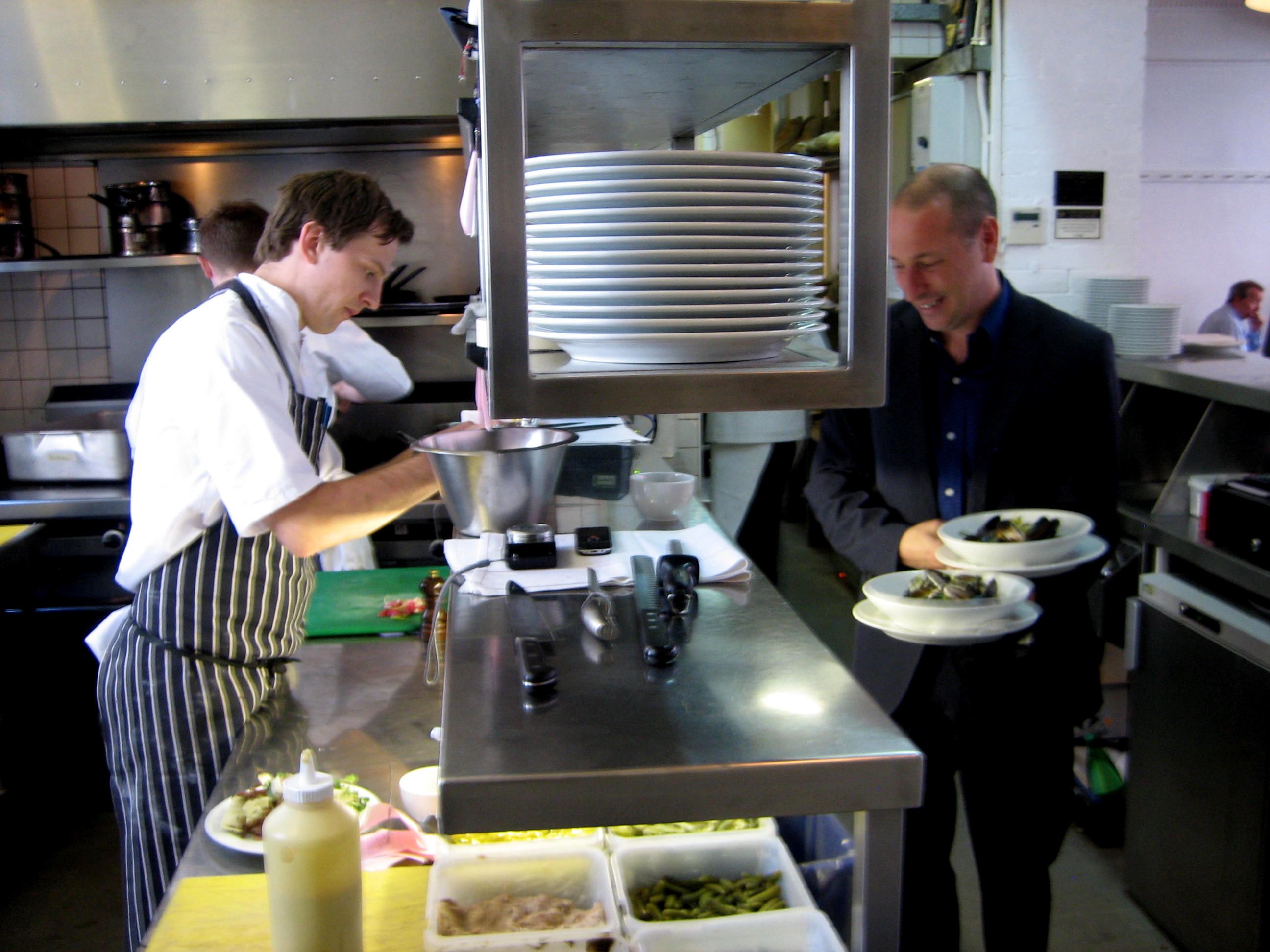
For years I have enjoyed meals at St John Bread & Wine in Commercial St and although I have always been impressed by this smooth operation, I never exactly knew who was running the ship. So, this week I went in to meet James Lowe who has been Head Chef here for more than three years now. If I had simply opened my eyes, I should have realised immediately who was in charge, because on most days you will see James standing behind the counter in the kitchen – commanding the helm of his vessel – with his sous chef to his right and the chef supervising the ovens upon his left.
From this central point, James can see the whole restaurant and beyond to the passing traffic of Commercial St. Standing next to James for the duration of a lunch service this week, I quickly sensed the excitement of this favoured location. The still point of our turning world in Spitalfields, St John Bread & Wine restaurant occupies the central position, both in terms of culture and topography – with the Market opposite, the Church to the left and The Golden Heart to the right. At the centre of this particular universe, James presides attentively, ensuring that all is well in the kitchen.
The waiters deliver your orders to James and he lines up the pink slips of paper upon the front of the metal shelf, scratching his chin as he scrutinises them, working out the correct order of things. With salad coming from one side and cooked food from the other direction, James puts the dishes together on the counter, sliding the slips of paper from left to right as they become ready to serve. Everything is done with relaxed efficiency and the trio maintain a constant changing dance, that forms and reforms throughout the lunch service. There are escalations of energy, there are flames, and even moments of stillness, and when James calls “Service”, the waiter whisks the plate away to your table and James puts the completed order on the spike.
When James shakes your hand and looks you in the eye, you are immediately aware of how intensely present in the moment he is. This quality, combined with a natural openness, creates a striking first impression. James told me he originally set out to be a pilot, but he thought otherwise after the events of 9/11 and became a chef. Even though I would trust James to fly me across the Atlantic safely and with minimal turbulence, I am convinced that he made the right decision. “This is my favourite restaurant in London,” James declared, “that’s why I came to work here.” A bold statement plainly spoken with the absolute, yet not immodest tone, that is his style. “I came to eat at St John and I thought, ‘I’ve got to find out how this is done.'” he revealed, confiding the origin of his grand passion. Within a few short years, James moved from the Wapping Project to La Trompette in Chiswick, Heston Blumenthal’s Fat Duck by way of The River Cafe and arrived here at St John Bread & Wine, full of vitality and creative ideas.
St John in Spitalfields suits James rather than the Smithfield restaurant, because he is as interested in vegetables as in fish and meat. An enthusiasm reflected in the choice of peas in the pod served raw this week, and the unique range of wild leaves – purslane, sea aster, rock samphire, marsh samphire and sorrel – collected by St John’s own forager, and served fresh to bring extra piquancy to cooked fish and meat. During a quiet moment in the lunch service, James let me taste each of these leaves and I was fascinated by the varieties of subtle tangy peppery flavours they offered.
“The produce we use here is the best of anywhere I’ve worked” admitted James, who always carries his mobile with him to maintain contact with suppliers, including Farmer Tom who was imminently expected with lambs and Ben the fish dealer who rings at ten each morning to report the day’s catch. James puts fresh fish on the menu each night at seven, landed that morning and delivered by Ben at seven. An arrangement that ensures freshness, yet can very occasionally yield unexpected dramas if Ben gets stuck in traffic.
Before lunch service began, we enjoyed a brief conference on the art of menu writing, which proved an enlightening introduction to the wider challenge of James’ role. Twice every day the menu is rewritten, taking into account the lyrical contrasts and variety that the restaurant is famous for, and exploiting the culinary possibilities of each season too. But more than this immediate prospect, James is always thinking ahead with his orders and doing preparatory work, making soups, and marinating meat and fish, ready for tomorrow or the next day. Add to this, the fact that St John never reheats food – some meat is slow cooked for up to eight hours and served when it is ready – and you begin to realise what a huge logistical exercise it is.
As James blithely took me through his MEP (mise en place) list, the tasks that are necessary for the dishes on next day’s menu to be ready, with every job assigned to a different member of staff, my head began to swim. Yet James holds the entire process in his mind comfortably, fourteen evolving menus each week, ordering from suppliers, choreographing the tasks and ultimately bringing it all to the plate with such eloquent clarity that the quality of the food speaks for itself. This is what I love about St John, the artful simplicity of the dishes, presented in a unelaborated style, allows you to savour the ingredients for their true distinctive flavour. And now I know who is the talent responsible for this subtle art that conceals its own sophistication.




Spitalfields Antiques Market 12

This is the eminent John O’Brien who has been dealing in lighters for over forty years and has a stock of around four thousand. “I have collectors from all over the world who buy my lighters. At the moment it’s the Russians – anything Russian sells.” declared John, his green eyes glittering in delight, before snatching one lighter after another from his collection, flipping and snapping them to produce flames in innumerable ingenious methods. “At an early age, I was given a collection of lighters and I loved the mechanisms, especially perpetual lighters from the eighteen nineties.” he told me, revealing the catalyst that sparked his life-long enthusiasm.

This is Linda Lewis who has been a dealer in kitchenalia, vintage china and glass for twenty years. With enviable stamina, she gets up at four thirty to drive here in all seasons from her home in North Essex. “My partner is a banker, so this is just part-time,” Linda whispered discreetly, adding “but now he’s been made redundant, maybe I’ll have to go back to doing it full-time.” Yet, demonstrating her appealingly buoyant nature, Linda qualified this by saying, “I love it, I wouldn’t do it otherwise. It’s a passion, and because I like it so much, it doesn’t seem like work.”

This is Jan Gordon who has been trading in Spitalfields for five years and six weeks. “Personally, I deal in jewellery though I rarely wear it,” she confided to me eagerly, “it’s just a magpie instinct – whenever I open a box of glittery things, it’s such a wonderful uplifting feeling. Now I’ve got the best of both worlds because I enjoy it and I seem to do well out of it too.” When I admired the box of old lead figures amongst all the toby jugs and old china tea sets on her stall, Jan explained that some of the stock was her husband’s, “Toys are really his thing.”, she revealed with an affectionate grin.

This is Ian Jeffries and Wayne Shires, who describe themselves as a couple of Spitalfields virgins, enjoying their first day on the market. Two old friends, both shopaholics, now downsizing and decluttering, Ian & Wayne were positively bristling with excitement. “We’re just here to see what the ride is like today,” quipped Ian, an interior designer with a saucy grin and suave attitude. Already they had sold a lot to the other dealers, “I think they smelled fresh meat!” declared Wayne, a former club promoter and DJ, rubbing his hands in gleeful anticipation.
Photographs copyright © Jeremy Freedman


