
Ricardo Cinalli, artist

When artist Ricardo Cinalli graduated from the University of Rosario in Argentina, a mentor offered to introduce him to Salvador Dali, if Ricardo was prepared to travel to London. In 1973, travelling by boat across the Atlantic to Barcelona in anticipation of encountering his hero, Ricardo was unfortunately delayed by two whole weeks and when he arrived in London, Dali was gone – but instead he discovered a whole new life.
At a party, Ricardo met Eric Elstob who was buying a house in Fournier St, opening the door to a surreal world of an entirely different nature. “We came to Spitalfields on a very depressing day. My God, it was a dump! I said to Eric, ‘Are you crazy?’ It was overwhelming – the market, the rats, the prostitutes and the meths drinkers outside the house. And the minute he opened the door I could see the place was in a horrible condition. But Eric explained to me to the history of the Huguenots, and the bells in the church rang and suddenly I understood the magic. He said to me, ‘You are invited to join my life’s project to restore this house.’ I had nothing to lose, so I said ‘Yes.’ He was a brave man to want to come and live here when no-one was interested. We had no money, we did all the work ourselves.”
Sitting comfortably in a green leather chair rescued from the Market Cafe, Ricardo speaks lyrically about his memorable introduction to Spitalfields, now these Herculean labours are safely in the past. It was an era when an imaginative few first recognised the beauty in the neglected houses and set about restoring them by their own labours, as Ricardo and Eric did at 14 Fournier St, taking seven years to bring it to conclusion.“It was a very exciting time, but for a person like myself it was very difficult, because I wasn’t used to this kind of dereliction, I was brought up in a house with ceilings and floors. We restored these houses with our own hands. Gilbert & George next door, they restored the panels one by one personally. To me it was unthinkable that I could do that, I was a painter, an artist. I came from a petit bourgeois background where you get someone else to do it. Yet I really had a fantastic time – it was horrible sometimes but there were moments of great joy too. And in the process I learnt something of the history of old London.”
After pausing to collect his thoughts silently,“I did that,” said Ricardo philosophically, gesturing towards Fournier St,” and then I did this,” he continued, referring to the house in Puma Court where he lives today. “And then I said, ‘Enough is enough!'”, he added, adopting the understated heroic tone of a Roman emperor reflecting on past victories, a role that suits his gracious nature and venerable Latin features perfectly.
Until this week, I only knew Ricardo Cinalli from his portrait on one of Simon Pettet’s tiles at Dennis Severs House, so I was exhilarated to walk into his five metre by five metre cube studio, dug into the ground beneath his narrow old house in Puma Court, complete with a glass pyramid ceiling looking up towards the lofty spire of Christ Church, Spitalfields. With supreme politesse, Ricardo opened the panel set into the floor of the studio to show me all the proud artefacts that he found in the construction of his studio, which are preserved there. As he dug down, Ricardo realised he was excavating a rubbish dump, with broken ceramics stretching from the sixteenth to the nineteeth century, innumerable oyster shells and clay pipes, rollers used by men in the eighteenth century to curl their wigs and even a pot of perfume with an address in Paris – once belonging to one of those Huguenot weavers that Eric Elstob first told Ricardo about, so many years before.
Working in his Spitalfields studio, Ricardo creates spirited and passionate paintings that are Baroque in their emotionalism and Surrealist in their imaginative extravagance. Over a career spanning more than thirty years, he has become internationally renowned for his works on canvas, his huge pastel drawings, his theatre designs and his murals which include a vast fresco in a cathedral in Umbria and now his magnum opus – more than five years in the making – a giant fresco covering all the walls of a custom-built edifice in Punta del Este in Uruguay. An Argentinian of Italian descent, with his modest manners and ambitious paintings, Ricardo convincingly incarnates the spirit of his Renaissance predecessors in the art of fresco.
Ricardo led me from his minimalist studio into the tiny old house balanced on top of it. We ascended a narrow staircase with trompe l’oeil panelling into a living room lined with actual wooden panelling rescued from the former synagogue in Fournier St. Each floor comprises just one room and on the next storey is Ricardo’s bedroom and bathroom, all in one space, with every surface painted with classical designs. Finally, we reached the kitchen under the eaves with windows on both sides – like the foc’sle of a ship – allowing us exciting views in both directions over the roofscape of Spitalfields.
As we drank our tea quietly, gazing up from the kitchen window to the spire that overshadows the house, Ricardo told me the story of how his cat “Dolce” went missing when he was living in Fournier St, while the church was being renovated. One still moonlit night, Ricardo heard a distant “miaow” coming from high up. Cats will always climb upwards, and Dolce was found at last, stuck at the top of the spire.
“Spitalfields has some magic element, don’t you think?” Ricardo proposed delicately with a sympathetic smile, casting his deep brown eyes contemplatively upwards to Hawksmoor’s bizarre edifice looming over us. Seeing it through Ricardo’s eyes, from his sunlit painted kitchen, at the top of this narrow house, perched above his extraordinary cube studio with the pyramid on the roof, it was only natural to agree. Ricardo Cinalli never met Salvador Dali but he found his own magic instead, here in Spitalfields.

In Ricardo Cinalli’s giant mural-in-progress in Uruguay, entitled “Humanistic Homage to the Millennium,” the figures are eight metres high. Click on this image to enlarge.
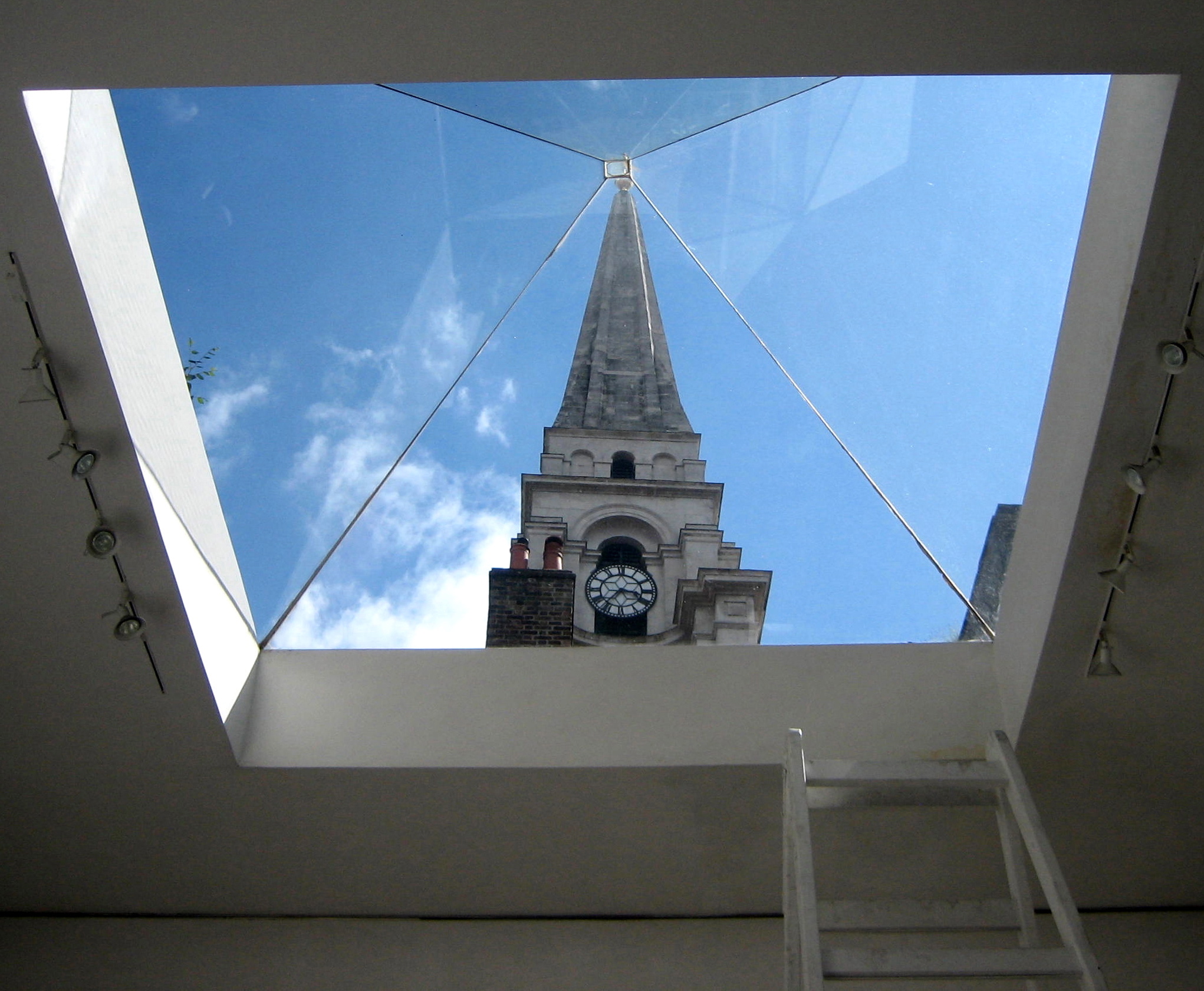
The glass pyramid on the roof of Ricardo Cinalli’s Spitalfields studio.

Banana boxes that are souvenirs of the seven years Ricardo spent restoring 14 Fournier St.

Finds discovered while digging the hole for the studio. Note the eighteenth century clay curlers for men’s wigs and the Huguenot perfume pot from Paris.

Looking towards Fournier St from the rear of Puma Court.
In Search Of The Walbrook

Ever since the Rev Turp pointed out to me the spot outside Shoreditch Church where the river Walbrook had its wellspring, I have been curious to discover what happened to this lost river which once flowed from here through the City to the Thames. This photograph of the Walbrook, which was taken by Steve Duncan, the urban explorer, deep beneath the Bank of England in 2007, gives the answer. The river has been endlessly covered over and piped off, until today it is entirely co-opted into the system of sewers and drains.
Yet in spite of this, the water keeps flowing. Irrespective of our best efforts to contain and redirect water courses, the movement of water underground always eludes control. A fascinating detail of this photo, which shows the sewer deep below the City, built in the eighteen forties, is that today the water table in the City has risen to the level where water is actually pouring from the surrounding earth into the tunnel between the bricks.With astonishing courage, Steve Duncan enters these secret tunnels through manhole covers and undertakes covert explorations, bringing back photos of the unseen world that he finds down there, as trophies. I was captivated by this nightmarish subterranean image, which reminded me that the primordial force of nature that this river manifests still demands respect.
Lacking Steve’s daredevil nature and experience in potholing, I decided to keep my exploration above ground, following the path of the river and seeing what sights there are to be discovered upon the former banks of this erstwhile tributary of the Thames. The Walbrook has attracted its share of followers over the years, from anti-capitalist protestors who attempted to liberate the river by opening hydrants along its route, to milder gestures adopted by conceptual artists, sacrificing coins to the river through storm drains and releasing fleets of paper boats into the sewers.
The historian John Stow is the primary source of information about the Walbrook, writing in his “Survey of London” in 1598 – though even in his time it was already a lost river, “The running water so called by William Conquerour in his saide Charter, which entereth the citie,&c. (before there was any ditch) betweene Bishopsgate and the late made Posterne called Mooregate, entred the wall, and was truely of the wall called Walbrooke… it ranne through the citie with divers windings from the North towards the South into the river of Thames… This water course having diverse Bridges, was afterwards vaulted over with bricke, and paved levell with the Streetes and Lanes where through it passed, and since that also houses have beene builded thereon, so that the course of Walbroke is now hidden under ground, and therby hardly knowne.”
Arriving at St Leonard’s Shoreditch, as the first drops of water from the ominous lowering clouds overhead began to fall, the Rev Turp’s description of the poisoning of the Walbrook (when seepage from the seventy-six thousand human remains in the churchyard found its way into the watercourse) came to mind. The Walbrook, which entered through the wall beside the church of All Hallows on the Wall, was the only watercourse to flow through the City and was both an important source of freshwater as well as a conduit to remove sewage, two entirely irreconcilable functions.
There is no evidence of the route of the brook outwith the wall and so I walked straight down Curtain Rd, entering the City at London Wall, with the church of All Hallows on the Wall to my left. I turned right on London Wall, where the brook was once channeled along the wall itself. At Copthall Avenue, I turned left where the watercourse flowed South down through Token House Yard, under St Margaret’s Church and the Bank of England. As I left Copthall Avenue to walk through the maze of narrow lanes, including Telegraph Alley and Whalebone Alley, the changing scale indicated I was entering the ancient city. Then I enjoyed a breathtaking moment as I passed through the dark low passage into Token House Yard, discovering a long tall street with cliffs of grey buildings on either side, that ended in the towering edifice of the Bank of England.
From here, I walked down Princes St to emerge at the front of the Bank facing the Mansion House, basking for a moment in the drama of this crossroads, before walking onwards down Poultry past Grocer’s Hall and then turning left to arrive at the Temple of Mithras. Just an outline in stone today, the former temple which was discovered in 1954 on the bank of the Walbrook, eighteen feet below modern ground level, and moved to this location. Desolate and disregarded now, collecting litter beneath the condemned blocks of Temple House, it is a miraculous survival of two millennia, standing at the head of the navigable river where barges were berthed in Roman times .
At the time of these excavations, a square token of lead with the name Martia Martina carved backwards on it was found, once thrown into the Walbrook – in Celtic culture this was believed to bring bad luck to the subject. Also, in the eighteen sixties, Augustus Pitt Rivers uncovered a large number of human skulls in the river bed, which could be either those of a Roman legion who surrendered to the Britons or the remnants of Boudica’s rebellion. Both these finds may reflect a spiritual significance for the watercourse.
Next stop for me was Christopher Wren’s church of St Stephen Walbrook on the far bank of the Walbrook. My favourite of his City churches, this is always a place to savour a moment of contemplation, beneath the changing light of the dome that appears to float, high up above the roof. The name of this street, Walbrook, within the ward of Walbrook confirms beyond doubt that you are in the vicinity of the lost river, and from here it is a short walk down Cloak Lane by way of College Hill to Walbrook Wharf on the riverfront below Cannon St Station, where the Walbrook meets the river Thames. In the end, whatever route they came by, this is where the raindrops that fell outside Shoreditch Church arrived eventually.
I am entranced by the romance of the lost river Walbrook – even if it may have been a stinking culvert rather than the willow-lined brook of my imagination – because when you are surrounded by the flashy overbearing towers of the City, there remains a certain frail consolation in the knowledge that ancient rivers still flow underground beneath your feet.

All Hallows on the Wall, where the Walbrook entered the City of London.

The passage from Whalebone Alley to Token House Yard.

Approaching the Bank of England.

The Roman temple of Mithras stood on the bank of the Walbrook.

Christopher Wren’s church of St Stephen Walbrook with altar by Henry Moore.

The dome of St Stephen Walbrook.

Joanna Moore, Artist

When I arrived to meet Joanna Moore at the end of an afternoon’s drawing in Christ Church, Spitalfields, a small crowd had gathered to peer over her shoulder at her work. As you can see from the photo above, it is an interior that presents a considerable challenge to an artist. I would not choose to sit down with a pen and paper and try to draw it, but this was precisely what Joanna had done. It was her first attempt and, in a single session lasting just a couple of hours, she succeeded with such style that as the drawing approached completion, people stopped to marvel at her facility with lines.
I took Joanna to the Market Coffee House afterwards, to celebrate her remarkable afternoon’s work, of which she appeared modestly unaware. In the Coffee House she opened a portfolio to show me her other drawings of Spitalfields. Last year, Joanna came to live in an old house in Hanbury St for a couple of months and while she was here, something extraordinary happened, she discovered a compulsion to draw. “Life started changing and I went part-time in my job because I needed to see how well I could draw. I realised that if I didn’t do it now, I’d never do it. And this coincided with moving to Spitalfields – I found it so inspiring here.” explained Joanna, recalling this last harsh Winter which proved such a cathartic and creative time in her life.
As Joanna produced an array of the fine drawings from her portfolio which record her time here, she spoke of the excitement of the circumstances from which they arose. “It was lonely living here in this beautiful old house, but I was determined to draw – separated from the people around me, I didn’t know anyone, I was just renting a basement. I bought myself fingerless gloves to work outside, but it was so cold I could only do an hour’s drawing at a time. You can deal with the cold in your head and body, though when your hands get cold, then you can’t control your fingers to draw anymore.”
It was apparent from these fluent drawings that Joanna’s achievement was far greater than simply retaining control of her fingers, but more than this, I was inspired by the personal discovery these works manifested. The nest of lines within these quiet yet sophisticated drawings trace the birth of a vibrant talent. Within the pluralism of contemporary art, there is a resurgence of drawing and a recognition that a talent and facility for draughtsmanship – which Joanna has found within herself – is not to be under-rated. In architectural drawing, most people struggle to get their lines in the right place when attempting to record structures, but for Joanna this is second nature, she can do it with ease, and brings wit and humanity along too.
Joanna never set out to draw, she trained as an architect yet became alienated at the idea of life in front of a computer terminal, switching to Art History in the middle of her studies. Since leaving Cambridge in 2007, Joanna worked as an architectural historian but found herself increasingly fascinated with looking at the buildings she was working on. Now, at twenty-five years old, Joanna has discovered who she is and exactly what she wants to do, embarking on a year’s course at the Prince’s Drawing School in Shoreditch this September.
“Now I’ve started, the more I draw, the faster I get and the freer I get – so when I go to drawing school I want to be pushed, because it’s something I have to do.” admitted Joanna, her eyes gleaming with determination and passion for her chosen course in life. The loss of income will mean moving back home to South London to live with her parents, though as both her mother and father also possess the talent for drawing, this could turn out to be the supportive environment Joanna needs to launch herself upon her new path.
“It’s a very pure pleasure,” said Joanna with a gentle smile, considering her portfolio and aspiring to find words for the dynamic experience of drawing,”That’s why I’m driven, it’s the purest art form you can get – to record what’s in front of you. I don’t want to use my drawings as the basis for paintings because I’m more interested in drawing the next thing.”
Too few people follow their enthusiasms, and so I was inspired to meet Joanna Moore at this crucial moment in her life. In learning of the special meaning that Spitalfields has for Joanna, I encountered a young woman of willpower, intelligence and talent commencing a great journey, astute yet open to all the possibilities that life can bring.
You can see more of Joanna’s drawings on her website www.town-mouse.co.uk and I hope you will see more here too because Joanna will be accompanying me upon some future assignments.

Princelet St

Petticoat Lane Market


Spitalfields Antique Market

Fournier St

Christ Church, Spitalfields
Columbia Road Market 39


Last night, I wandered down to Limehouse and enjoyed a quiet supper of haddock & chips at The Grapes on the river. On this beautiful Summer’s evening the place was pleasantly empty, on account of the lack of a television set on the night of the commencement of the World Cup. I was woken at four thirty by the chorus of birds in Spitalfields and, before seven, my neighbour and I strolled up the road to the flower market in the sunlight and breeze of the morning – where we found the place similarly deserted. I can only assume that many drowned their sorrows after the match last night and are feeling the effects today.
We bought a tray of Tobacco Plants (Nicotiana), eight plants for a fiver, to share between our gardens. For myself, I bought a Scabious for £5, and another Astrantia (Major) for £6 my collection. Although I already have several Astrantia Major, the plant I bought today was distinctly different. I must admit to a growing fascination with the subtle detail and variety of these starry flowers which draw the eye with their exquisite detail.
All the roses of East London are in bloom now, and everywhere I walk around the territory I come across extravagant fragrant displays, from Spitalfields to Limehouse. In my garden, this old moss rose, Alfred de Dalmas (a variety of 1855) has come into flower. With its multiple layers of petals and sherbet scent, it resembles some fancy confection, conjured out of meringue by a pastry chef.

A Walk With Mike Myers

This distinguished gentleman is Mike Myers, known as the Spitalfields Crooner, whom I wrote about earlier this year. You may recall that I republished his 1986 pub profile of The Golden Heart from “Spitalfields News”, which Mike edited during the nineteen eighties.
Last week, Mike and I took a walk together through Spitalfields. Undaunted by the cold weather, he was waiting for me eagerly, sheltering from the rain under the market canopy – just outside the front door that leads to his flat above the shops in the old market building. In spite of the dismay weather, Mike looked cheery with his colourful golfing umbrella in one hand and his file of photos in the other. We were going to undertake an epic journey through time and emotion to the other side of Spitalfields, where Mike grew up in the nineteen thirties. For Mike, Spitalfields is a rich mythical landscape of the imagination filled with colourful images and legendary characters from his long life in these streets surrounding Christ Church.
Mike hummed show tunes under his breath to raise our spirits as we made our way across Brushfield St, down Frying Pan Alley and up Middlesex St to The Bell at the corner of New Goulston St, where he spent the first forty years of his life. We took shelter under another canopy to survey the empty street in silence, while Mike opened his file of photographs. “At one time it used to be a thriving street and now look at it!” declared Mike, shaking his head in wonder at the transformations time can wreak. Pointing to the closed shops that now only deal wholesale, he indicated the former locations of the draper, the boot & shoe repair, the sweet shop, the shoe shop on the corner, the laundry and the synagogue. “It was a self-contained area, everything you needed you could get in the butchers, fishmongers and delis,” Mike recalled proudly,“People came from all over London to shop here when it was the Jewish quarter.”
Opposite us once stood Brunswick Buildings, one tenement among many, that stretched from here to Aldgate. It was the dwelling where Mike spent his early life and a crowded residence for many hundreds living in overcrowded conditions, with one family to a room, and shared toilets, washing and cooking facilities on stairwells. “There’s been two books written about it,” added Mike, to emphasise the drama of the life that he knew. Yet in spite of the poor housing, Mike has very positive memories of his time in New Goulston St, “Everybody coped with the small amount of space. What you haven’t got you don’t know about, so you don’t grieve for it. I had a great childhood, safe to go out and play. You made your own amusements. We used to play football and cricket in the streets, because you never saw a car – nobody could afford one.”
“We enjoyed the radio at home, but the cinema was the place to go out for entertainment,” continued Mike with enthusiasm, introducing the opening of the Mayfair Cinema in Brick Lane in 1936 where he saw William Powell in “Escapade” in the first week. Thanks to the presence of the Mayfair Cinema, now long gone, Mike became a film buff and was the only one in the audience when Laurence Olivier’s “Henry V” and “Hamlet” were shown, years later. Looking West towards the City of London, Mike indicated the street where he had one of his first jobs, “During the war, I was working across the road, loading dresses into a van and the next thing I knew I was on the floor of the van, because a V2 rocket had dropped just round the corner.”, he revealed, still grateful for his lucky escape.
As Mike and I walked slowly back through Wentworth St in the gentle rain, he admitted that – although the once vibrant market was a wonderful playground for a child – he is not sentimental for the world that is gone. After the war, most of the Jewish people left these streets to seek a better life in the suburbs. “In the seventies, everything started to go down.” he explained dispassionately, “The tenements housed people at cheap rents. They served their time just after the war. But people wanted change. People wanted better homes – especially if you are bringing up five kids in two rooms.”
In 1974, when Brunswick Buildings was compulsorily purchased and demolished by the GLC, Mike was moved to the flat in the 1886 Horner Building where he still lives today, in rooms adorned with movie posters and lined with shelves of DVDs. When we arrived back from our short sentimental journey of less than a mile, I was curious to learn more. But I had to content myself, for now, with photographing Mike there in his home above the Spitalfields Market, his point of arrival, surrounded by the evidence of his passion for cinema that began at the Mayfair Cinema in 1936.
Witnessing the changes in Spitalfields over a lifetime has given Mike a generous philosophical outlook and you will see him most days in the streets about the market, a benign presence – commonly absorbed in thought, yet ever curious about the life of the street – humming show tunes to himself, expressive of his characteristic levity and lightness of touch which have carried him through life with such grace.
As part of the Spitalfields Festival, Mike Myers has recorded an audiotour, enabling you to hear more of his stories of the neighbourhood and follow in Mike’s footsteps along his life’s journey from one side of Spitalfields to the other. You can download it by clicking here.

Mike Myers in Wentworth St, “Singin’ in the Rain.”

Brunswick Buildings, New Goulston St, where Mike grew up.

The explosion of the V2 rocket at the top of Middlesex St in 1944 that gave Mike a close call.
David Sawer, composer

The composer in the rose garden is David Sawer, whose opera Rumpelstiltskin is performed at St Leonards Church in Shoreditch tonight as part of the Spitalfields Festival. He looks full of life in the bright morning sunshine, photographed before one of the final rehearsals. Though perhaps a second glance at the picture reveals a certain professional reserve too – because I have no doubt he has a few adjustments in mind that he requires, before everything is as it should be for the performances. Even this seventy minute opera took ten months to compose, so you will understand – with so much work involved – David has a right to be particular.
David Sawer’s music is distinguished by a bold vibrant emotionalism, persuasive in tone and dramatic in effect. Although aware of his antecedents in modern music, David writes compelling melodies which are engaging to the widest audience. To put it simply, anyone that has got ears can recognise David writes beautiful music. I cannot separate David from his music because, as a personality, he is blessed with a rare animated quality, which means that when you are with him you cannot fail to be aware he has so much going on inside. Sometimes I wonder if David has one layer of skin missing, because his mercurial internal currents of thought and feeling are almost legible upon his large oval face, changing like patterns of light on water, just as the layers of texture in his music constantly shimmer and transform. It makes for exciting conversations and gives him a bewitching charismatic intensity too.
Once upon a time I wrote the words for an opera of David Sawer’s produced by the Royal Opera, it was an unforgettable experience and it brought me face to face with the magic that a composer works. I spoke to Myfanwy Piper who had worked with Benjamin Britten and she gave me salient advice. She told me to create a dramatic story but avoid overtly emotional language, leaving that to the music. So, in my libretto, I restricted myself to lines like “Open the door.” and, once David was happy with what I had done, I absented myself only returning at the dress rehearsal, months later, to hear the music for the first time. Although we had constructed an emotional drama on paper, I was entirely unprepared for the musical realisation of this. In his music, David had manifested the emotions of the characters more vividly than I had ever dreamed. I thought I knew what was behind the words, but David found so much more. It was a revelation, and it remains an elusive mystery to me how a composer can conjure music of such potency out of air.
When I met with him this week, three more operas down the line, David was eager to talk about the nature and ambitions of his latest work, “Rumpelstiltskin”, a seventy minute piece which involves ten performers and thirteen instrumentalists, staged by his long-term collaborators, director Richard Jones and designer Stewart Laing. “I didn’t want it in a theatre where the detail gets lost, I wanted to create an intimate ballet that works like a silent film – where the audience are able to get more involved because they haven’t got people singing at them. Instead the story is told through people moving and articulating the music. If you look at Tchaikovsky’s ballet scores there are stage directions every five lines – so I just pulled the story apart, writing my own directions throughout the score.”
“It’s about the fact that someone puts a lie into the world because he can’t pay his rent,” David added with an enigmatic smile, setting up the premise of the story,” So he says his daughter can spin straw into gold and she’s put in a dungeon with straw and has to spin it – The idea of spinning straw is very enticing musically, music’s very good at expressing change and transformation over time. – Then Rumpelstiltskin offers to do it, but the pact is she agrees to give him her baby in a year’s time.”
Originally transcribed by the Brothers Grimm in the eighteen forties, the story of Rumpelstiltskin can be seen as reflecting the anxiety around the replacement of human skills, like spinning, through mechanisation. But David’s interest is in the ambivalence of the character of Rumpelstiltskin himself – the mysterious outsider who becomes the eventual scapegoat. In this production, his identity remains ambiguous, allowing the drama to retain its fullest resonance as a fable. “It is quite religious, a crucifixion story.” added David contemplatively.
It is clear that David loves the collaborative world of the theatre in contrast to the solitary months at his desk. A large-scale opera can entail years of labour, composing and transcribing all the parts for the orchestra and singers. “You’ve got to get the balance right,” said David, sketching out his relationship to his craft, “The problem is if someone wants an opera for 2018, how are you going to pace yourself? It can be hard, because you need to have adrenalin but not get hysterical either.” Then he rolled his eyes in self parody, but afterwards left the question hanging in the air, because he did not want to think about it too much today. Instead he had critical time with the musicians and performers, before everything came together, after ten months of composition and weeks of rehearsal, in the performances that are the culmination of his work.
As he spoke, David’s hands were in constant precise motion – tracing lines of thought in the air -occasionally tapping the table and once applying all his fingers, as if it were a piano. To David, music is a concrete thing that he can describe with his hands, and it is also something intangible, coursing through his mind and body as he speaks. It is inside him and outside him, like air, it is his element. David’s singular movement and nature are expressions of his remarkable musical talent. I cannot imagine David without music. It is what he does and who he is. More than anyone I have ever met, David Sawer incarnates his music.

Production photo of Rumpelstiltskin by Keith Pattison
Spitalfields Antique Market 11

This is Jimmie Fish of Fish Island Antiques in Hackney. An ex-cocktail waiter on cruise ships who once served Rod Stewart, in an impressive reinvention, Jimmie now deals in industrial and workshop items, like desks, lockers, lamps and trunks. A proud Cumbrian from Carlisle with dark ginger hair and keen grey eyes, full of humour and bristling with positive energy – thriving in his new profession – Jimmie declared, “You get on better, if you’ve got a bit of character and personality about you. It’s good fun, every day’s different and you are your own boss!” Plain words that, in Jimmy’s mouth, became a declaration of independence.

This is Lily Beth Wood, daughter of Stuart (who we featured in May), which makes her a third generation market trader, at least. Lily was enjoying helping out her dad on his stall, while on half term holiday from St Peter’s School, down in Wapping where she lives. “I collect small things when the tide goes out,” said Lily, proudly outlining her mudlarking activities on the banks of the Thames, and revealing an inherited curiosity about things from the past, “Sometimes I find old ship’s nails, bones, oyster shells, bullets, book hinges and once I found a clay pipe in three pieces.”

This is Paul the Urban Shepherd. “I work with serious clothing but make it fun. My stock is countrywear, not made in the city but worn in the city,” said Paul, introducing the trend for men’s clothing from the provinces, appropriated by fashionable gallants here in London and worn with an urban attitude. Fondly drawing my attention to the quality on display, “It’s very well made – designed to last a lifetime – and, if it doesn’t fit exactly, it can easily be tailored to the new owner.” he explained. A style ambassador, Paul intuitively understands the necessary combination of levity and sobriety in menswear.

This happy couple comprises Sue Stokes & Leo Kurunis, loving mother and son. Sue lives in Bath and is an antique dealer while Leo lives in Hackney and is in a band. “Leo doesn’t come home very often,” confided Sue, who got up at three thirty in the morning to drive down to London which her stock of French antiques. This is Sue’s first week in Spitalfields, but she plans to be here every Thursday in future, taking the opportunity to stay over at Leo’s place in Hackney each week and see more of her son – that is, if he is not out gigging with Lord Auch.
Photographs copyright © Jeremy Freedman


