
Return to W. F. Arber & Co, Printing Works

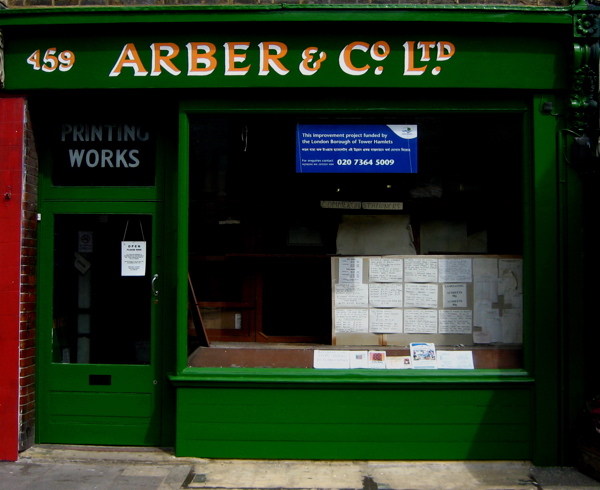
There have been changes at W.F.Arber & Co Ltd (the printing works opened by Gary Arber’s grandfather in 1897 in the Roman Rd) since I was last here in February. At that time, Gary was repairing the sash windows on the upper floors, replacing rotten timber and reassembling the frames with superlative skill. This Spring, Gary was the recipient of a small grant from the Olympic fund for the refurbishment of his shop front, which had not seen a lick of new paint since Gary last painted it in 1965.
The contractors were responsible for the fresh coat of green but Gary climbed up a ladder and repainted the elegant lettering himself with a fine brush, delicately tracing the outline of the letters from the originals, just visible through the new paint. This was exactly what he did once before, in 1965, tracing the lettering from its first incarnation in 1947, when the frontage was spruced up to repair damage sustained during the war.
No doubt the Olympic committee can sleep peacefully in their beds now, confident that the reputation of our nation will not be brought down by shabby paintwork on the front of W.F.Arber’s Printing Shop, glimpsed by international athletes making their way along the Roman Rd to compete in the Olympics at Stratford in 2012. Equally, Gary is happy with his nifty new paint job and so all parties are pleased with this textbook example of the fulfilment of the ambitious rhetoric of regeneration in East London which the Olympics promises.
If you look closely, you will see that the glass bricks in the pavement have been concreted over. When Gary found they were cracking and there was a risk of some passerby falling eight feet down into the subterranean printing works, he obtained quotes from builders to repair them. Unwilling to pay the price of over five thousand pounds suggested – with astounding initiative, Gary did the work himself. He set up a concrete mixer in the basement printing shop, filled the void beneath the glass bricks with rubble, constructed a new wall between the building and the street, and carried all the materials down the narrow wooden cellar stairs in a bucket, alone. Gary’s accomplishments fill me with awe, for his enterprising nature, undaunted resilience and repertoire of skills.
“I shouldn’t be alive,” said Gary with a wry melancholic smile, referring not to his advanced years but to a close encounter with a doodle bug, while walking on his way down the road to school during the war, “The engine cut, which means it was about to explode and I could see it was coming straight for me, but then the wind caught it and blew it to one side. We lost all the glass in the explosion! Another day, my friend David Strudwick and I were eyeballed by the pilots of two Fokker Wolf 190s. We saw them looking down at us but they didn’t fire. – David joined the airforce at the same time I did, he flew Nimrods and died many years later, while making a home run during a cricket match in Devon.”
These thoughts of mortality were a sombre counterpoint to the benign season of the year. Leading Gary to recall the happy day his father and grandfather walked out of the printing works at dawn one Summer’s morning and, in their enthusiasm for walking, did not stop until they got to Brighton where they caught the train home, having walked sixty miles in approximately twelve hours.
In those days, Gary’s uncles Len and Albert, worked alongside Gary’s father and grandfather here in the print shop, when it was a going concern with six printing presses operating at once. Albert was an auxiliary reserve fireman who was killed in the London blitz and never lived to see his baby daughter born. Gary told me how Albert worked as a printer by day and as a fireman every night, until he was buried hastily in the City of London in an eight person grave. “I don’t know when he slept!” added Gary contemplatively. There was no trace of the grave when Gary went back to look for it, but now Albert is commemorated by a plaque at the corner of Althelstan Grove and St Stephen’s Rd.
Whenever I have the privilege of speaking with Gary, his conversation always spirals off in fascinating tangents that colour my experience of contemporary life, proposing a broad new perspective upon the petty obsessions of the day. My sense of proportion is restored. This is why I find it such a consolation to come here, and leads me to understand why Gary never wants to retire. Each of Gary’s resonant tales serve to explain why this printing shop is special, as the location of so much family and professional life, connected intimately to the great events of history, all of which remains present for Gary in this charmed location.
Now that Gary is a sole operator, with only one press functional, he is scaling back the printing operations. And I joined him as he was taking down the printing samples from the wall where they have been for over half a century, since somebody pasted them onto some cheap paper as a temporary measure. It was the scrutiny of these printing specimens that occasioned the reminiscences outlined above. Although these few samples comprise the only archive of Arber’s printing works, yet even these modest scraps of paper have stories to tell, of businesses long gone, because Gary remembers many of the proprietors vividly as his erstwhile customers.
I was fascinated by the letters ADV, indicating the Bethnal Green exchange, which prefix the telephone numbers on many of these papers. Gary explained this was created when smart people who lived in the big houses in Bow Rd objected to having BET for Bethnal Green, which they thought was rather lower class, on their notepaper. There were letters to the Times and a standoff with the Post Office, until the local schoolmaster worked out that dialling BET was the same as dialling ADV – which might be taken to stand for ‘advance’ indicating a widely-held optimistic belief in progress, which everyone could embrace. So just like Gary’s Olympic paint job, all parties were satisfied and looked to the future with hope.

“Bill Newman of Advance Insulation used to be covered in white asbestos powder. The whole place was like a flour mill! He smoked a fat cigar which we thought was the cause of the cancer that killed him, but later we learnt the truth. The Victoria Box Company closed in the nineteen sixties after a woman had her fingers cut off by a tin pressing machine and the compensation claim shut the company down. Mr Courcha was around in the nineteen fifties, he had a huge lump on his bald head like something out of a comic. We had three generations of Meggs chimney sweeps until the introduction of the smokeless zone finished them off.”

“Sollash made boxes, the factory took up four or five shops in the Hackney Rd but they packed up when Mr Sollash got old. You see that bull on the Bull Hotel notepaper, that was the bull we used on butcher’s bills! ‘Dr.’ means ‘debtor’, it was standard on invoices then.”

“This is a World War II ration card from Osborne the Butcher. Harry Osborne was a German who changed his name during World War I, his son Len ran the business until he retired in the nineteen seventies.”


You may like to read about my previous visits to Gary Arber’s printing works:
Jo & Sheba Eferoghene, Novo Fashions

Many times I have dawdled in Wentworth St to marvel at the wonderful range of dazzling African fabrics on sale in the specialist shops that line this street, drawing me with their powerful allure, every one presided over by charismatic sassy ladies who are both the proprietors and style exemplars in this glamorous world of “wax” and “lace.”
Since 1608, this neighbourhood has been known as “Petticoat Lane” on account of the textile and clothing markets here and, even though the name was changed in 1830, this is still how it is referred to. Where once Huguenot weavers wove cloth in the seventeenth and eighteenth centuries, in a location that was heart of the Jewish clothing industry in the nineteenth and twentieth centuries, today it is Nigerian and Ghanaian women that uphold the traditional identity of these streets as a centre for textiles. They have made it the pre-eminent destination in London for the variety and quality of African fabric on sale here.
So it was a rare pleasure for me when Trevor of Liverpool St Chicken (that I wrote about in February) introduced me to Jo & Sheba Eferoghene, two vivacious sisters who run Novo Fashions at the corner of Wentworth and Leyden St, a tiny treasure trove of a narrow shop stacked to the roof with every kind of colourful attractive fabric in pattern and lace. “My mother was a dealer in Nigeria, so we learnt it from her and it is something we both love to do,” confessed Sheba, her bright eyes – enhanced by eyeshadow in peacock shades – glittering in delight. She welcomed me graciously, gesturing freely to the dazzling kaleidoscopic displays lining every wall. “The African fabric, this is what we wear – and the demand is so great that there never can be too much!”, she declared in dignified celebration.
Next, Jo, the other half of this impressive duo, came to greet me from the rear of the shop – alive with charm, and emerging suddenly from the melee of vivid competing patterns resplendent in a poker dot dress. She explained that although as sisters they work together, Sheba takes more responsibility for the shop, while she, the senior, travels around the globe to buy the fabric. With the keen sensibility and shrewd authority of a born businesswoman, Jo sets out three times a year to visit the distant warehouses of the cloth salesmen who turn up in Wentworth St leaving their cards, because she wants to be certain of the quality of the fabric she is buying for her customers.
The biggest selling textile in Wentworth St is “wax” – meaning batik fabric, created using the technique whereby patterns are printed onto cloth in wax which resists dye. Elaborate designs are built up through successive layers of dying, forming bold geometric patterns in strong colours. It is indicative of our modern world that very little of this “African” fabric is from Africa, in fact the best “wax” originates from Holland. Sheba apprised me of this with professional expertise, laying out a length of lustrous mustard coloured cloth as an example of “Holland wax” manufactured by Vlisco in Helmond for the African market. China and Thailand also produce wax, and Sheba hauled specimens from the shelves creating an extravagant collage of coloured cloth for me to appreciate, before she revealed there is also an “English Wax,” though ironically this recently moved manufacture from Manchester to Ghana.
Cloth is sold in pre-cut lengths of six yards, sufficient to make an outfit. For a woman, six yards gives you two sarongs, a top and a scarf, or a boubou (long kaftan) plus a headscarf – whereas for a man, six yards is enough to make a buba (short kaftan) plus sokoto (trousers). Although the wax fabric is for everyday wear, Jo & Sheba also sell elaborate “lace” manufactured in Switzerland and Austria, expensive perforated cloth, sometimes richly embroidered and sequined, that is reserved for special occasions, weddings, birthdays and other celebrations.
Once you bear in mind that lace can be combined with wax in a single outfit, topped off with a contrasting cloth (a gele) tied around the head and also accessorized with costume jewellery, then you begin to realise the dizzying number of permutations that are presented by the fabrics in this tiny shop. This is where Jo & Sheba offer professional advice as stylists, because commonly people come to get fabric for an entire wedding party to dress everyone in toning outfits, yet with the most expensive cloth for the bride and groom. With so many different outfits for a single event, I can see that it takes a miracle of diplomacy to steer people away from potentially disastrous colour combinations towards a sympathetic scheme. Yet equally, the creative possibilities for mixing these patterns and vibrant tones are limitless.
Jo & Sheba Eferoghene have been trading in Wentworth St for eight years – dealing to neighbours and friends from their home before that – and through working together and demonstrating strength of character they have won loyal customers and built a reputation for discernment, crucial when the entire street is full of shops in direct competition. In the serious business of wax and lace, these two proud sisters know what they are talking about, and the photographs below of them modelling their own glorious fabric are absolute confirmation that they really know how to wear it too.
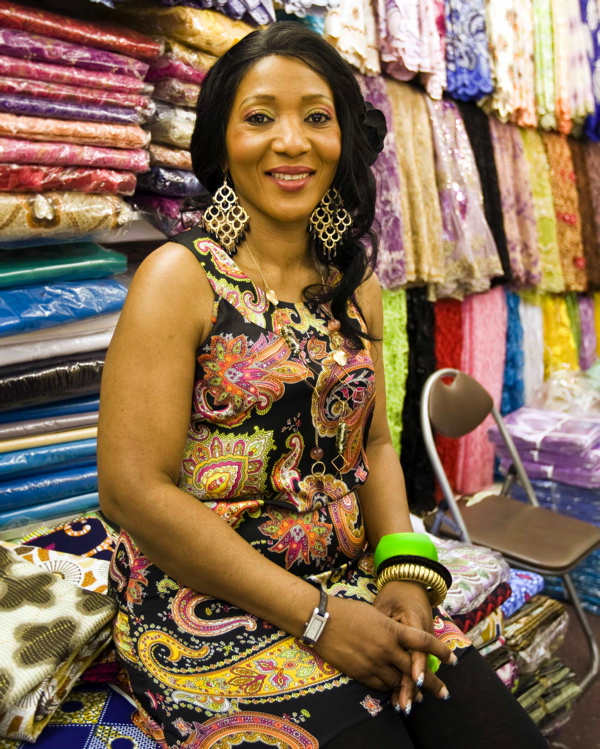
Sheba Eferoghene
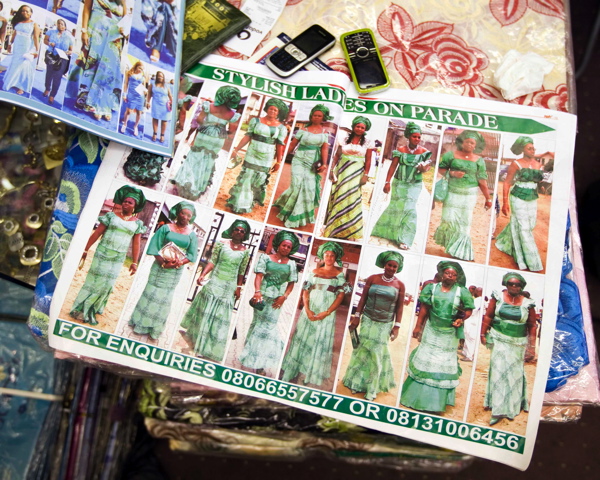
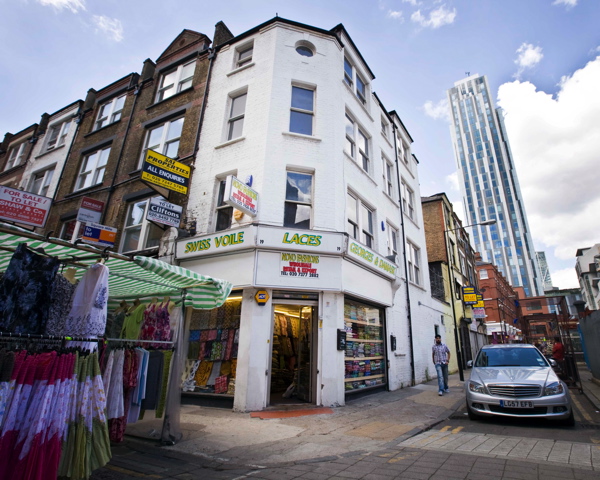
Novo Fashions at the corner of Wentworth St and Leyden St.

The Eferoghene sisters, Jo, Helen & Sheba, celebrating Helen’s sixtieth birthday in their own fabrics.

Rose, Sheba & Jo at a wedding celebration for which Novo Fashions supplied the fabric.

Jo, Morayo, Rose & Sheba at a child’s tenth birthday party dressed in Novo Fashions’ fabrics.
New photographs copyright © Jeremy Freedman
The Boat Club photographic collection
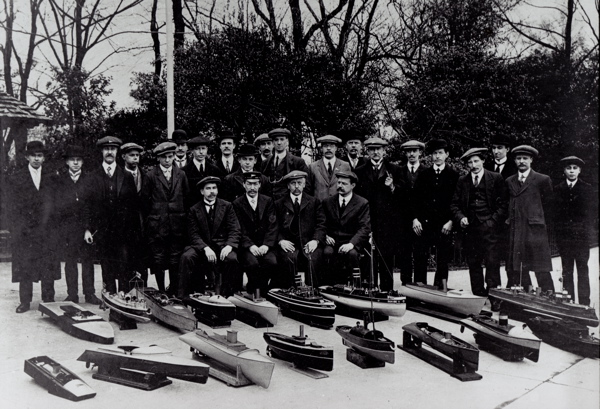

Inspired by Lucinda Douglas-Menzies’ photo essay on the Victoria Model Steam Boat Club, I walked over to Victoria Park yesterday to meet Keith Reynolds, the secretary, a sympathetic man with an appealingly straggly moustache, who had agreed to let me take a look at the club’s photographic collection. So, as the members got steam up on the lakeside, I sat inside the club house and sifted through the archive, listening to all the variously enigmatic whistling and chugging sounds coming from the shore. Keith told me that the club existed even before the founding of the Model Steam Boat Club in 1904, preceded by a Model Sailing Boat Club that he believes was founded in 1875. The venerable club house dates from this period and Keith showed me where the lockers once were, custom-built to store huge model sail boats, before the age of steam took over.
There are just a handful of early black and white pictures, donated years ago by member Olive Cotman. The photograph above is from January 3rd 1937, but the earlier one at the top is tantalizingly undated. As well as the impressive display of model boats in both photographs, the members display a fine selection of hats, and in the top picture, if you look closely, you can see the pennant-shaped club badge pinned onto many of the caps. The dignity of these men, so serious with their moustaches and caps yet so proud to be photographed with their fleet of model steam boats, is very touching. I presume these boats were miniature versions of the vessels that you might see a mile away on the Thames at that time. By contrast, the diversity of the 1937 picture draws you into a relationship with individuals in the crowd, who braved the chill wind of Victoria Park in January to watch the model boats. The anonymous schoolboy in his cap is more interested in the camera than the boats, he gazes towards us and into eternity.
As I looked through the many thousands of photographs from the modern era taken by Janet Reynolds, Keith’s wife, over the thirty-five Summers since their marriage, I became fascinated by these idyllically beautiful colour pictures which tenderly evoke so many long happy Sunday afternoons. I realised that I was looking at images of the younger selves of those same members of the club who I had been introduced to that morning. Keith has been sailing steam boats for fifty years – since he was ten, although he had to wait until he was fourteen to become a full-fledged member in his own right, in 1964.
One day Keith’s father stopped by the lake to speak with the father of the current chairman Norman Lara, and that was how it began for the Reynolds family, which has now been involved for four generations. “She married into the Boating Club,” admitted Keith affectionately, referring to the induction of his wife Jan, “She took photographs because she didn’t want to boat, but then she decided it was more fun to get involved, and now my daughter and my grandson of fourteen are also members.” I was intrigued by Keith’s statement, revealing the narrative behind these lyrical images, which were taken by a photographer who became seduced by this diminutive nautical sport, embracing it as a family endeavour to entertain successive generations.
Out on the shore, Keith introduced me to the engineer Phil Abbott who showed me the oldest vessel still in use, a steam-powered straight-racing boat with the chic melancholic name of “All alone” from 1920, beside it sat “Yvonne” a high-speed steam-powered straight-racing boat from 1947. These boats speak of the different eras of their manufacture,“All alone,” with its brass funnels and tones of brown with an eau-de-nil interior, possesses a quiet twenties elegance in direct contrast to the snazzy red and beige forties colour scheme of the speed boat, that raises its prow arrogantly in the water as it roars along.
“All alone” was made by Arthur Perkins, who offered it to the club, as many members do, before his demise. “Yvonne” has a similar provenance. And when Keith explained that he had acquired half of the thirty-seven boats he possessed, making the others himself, I began to wonder if perhaps the focus of the club was the boats rather than the members. They are in effect mere custodians, providing maintenance for these vessels, enabling them to sail on, across Victoria Park Boating Lake, over decades and through generations.
Keith pinned a blue and white pennant-shaped enamel club badge on my shirt, just like those in the photo at the very top, and confessed that the club is eager for new members. It does not matter if you do not have a boat, anyone is welcome to join the conversation at the lakeside, and guidance is offered if you want to buy or make your own vessel, he explained courteously. It would be the perfect excuse to spend every Sunday boating for the rest of your life and you would be joining the honoured ranks of men and women who have pursued this noble passtime since 1904 on the lake in Victoria Park. These treasured photographs speak for themselves.
Contact Keith Reynolds of the Victoria Model Steam Boat Club by email vmscvictoriapark@aol.com




Columbia Road Market 42

It is not my custom, on the whole, to buy cut flowers – but they are in such profusion now at the market, at such low prices, that I could not resist. In these baking days of high Summer there is something quite magical about walking from the blinding sunlight of the day into the cool of the dark rooms in the old house where flowers glow in the half-light. Last week, I bought three bunches of lush Peonies for just £5 that I replaced this morning with these Larkspur, two bunches for a fiver.
Like last week, I was on the lookout for plants that will thrive in a dry sunny location under my window. This week, I bought a white Scabious for £4 and a Geranium (cinerum Ballerina) for £6. Scabious reminds me of childhood holidays in Dorset where I first saw them growing wild on the chalky downs, and this white one will be an interesting compliment to the blue one I already have. The Geranium is of the evergreen perennial variety that grows close to the ground, again this will give an interesting contrast to the other Geraniums I have in pink and blue, and some with dark foliage. The delicate lilac pink flowers, with intricate dark veins and neat diminutive leaves, of this particular variety, appealed to me.


My East End Photography Competition

Spitalfields Life was one of the winners in the My East End Photography Competition – for this portrait of Gary Arber the third generation printer, that I took in February in the comp room of the printing works in Roman Rd, opened by Gary’s grandfather Walter Francis Arber in 1897, where once the Suffragettes’ handbills were printed. “I’m here under duress because I’m an airman,” Gary told me when I first met him, because he sacrificed a career flying Lincoln Bombers to take over the printing works when his father died in 1954. Presiding over this print shop of a century ago where the twentieth century passed through like a whirlwind, Gary still retains the nonchalant professionalism of a flying ace.
On Thursday night, I went over to meet Gary when he shut up shop at five thirty and we sauntered casually along together down the Roman Rd to the Four Corners centre for film and photography, for the opening of an exhibition of the winning photos, where at a small ceremony Gary graciously accepted the award on my behalf. Among over four hundred entries, there were a large number of interesting photographs that add up to an impressive panorama of the East End at this moment. After searching through all the entries, it is my pleasure to present this small personal selection of works that caught my eye. Other notable inclusions were pictures by Spitalfields Life contributing photographers Sarah Ainslie and Jeremy Freedman, Sarah’s portrait of John Wright in Shadwell and Jeremy’s picture of Sandys Row Synagogue at dawn.
The judges of the competition were Martin Parr, photographer, Steven Berkoff, actor, and Kate Edwards of the Guardian. Speaking for the judges, Steven Berkoff said, “The pictures that stuck out for me were the pictures that expressed the deepest humanity. There is something eternal about the East End – a toughness and sturdiness, a tremendous amount of tolerance to difficult times.”

Yilmaz the tailor, Leyla Guler

Ann & Kitty eating jellied eels at the Eid party, Micahel Jones

Family in Lounge, Mary Cavanagh

Meat Trolley, Ridley Rd Market, Dalston, Agnes Sanvito

Old Sailor in Brick Lane, Johnny Pitts

Hasidic jews blessing the sun at dawn in Clissold Park, Olivia Harris

East London Line workforce, Scott Cullen

Working Nights, Bella Felling

I worked on the locks at the docks for twenty years,Vince Felice

Looking East from Canary Wharf on a snowy day, Shamir Sangrajka

Scattered thoughts, Jourdan.
Victoria Park Model Steam Boat Club

Spitalfields Life contributing photographer, Lucinda Douglas-Menzies became fascinated by the Victoria Park Model Steam Boat Club while out walking in the park. Over successive Sundays, her interest grew as she went back to watch the regattas, meet the members and learn the story of the oldest model boat club in the world, founded in 1904. Her photographic essay records the life of this society of gentle enthusiasts, many of whom have been making and racing boats on this lake for generations, updating the designs and means of propulsion for their intricate craft in accordance with the evolution of maritime vessels over more than a century. Starting on Easter Sunday, the club holds as many as seventeen regattas annually.
“Meet you at ten o’clock Sunday morning at the boating lake!” was the eager response of Norman Lara, the chairman, when Lucinda rang to enquire about his club. “On the morning I arrived, a group of about a dozen model boat enthusiasts were already settled in chairs by the water’s edge with a variety of handmade boats on display.” explained Lucinda, who was treated to a tour of the clubhouse by Norman. “We are very lucky, one of the few clubs to have this. Tower Hamlets are very good to us, they keep the weeds down in the lake and last year we were given a loo.” he said, adding dryly, “It only took a hundred years to get one.”
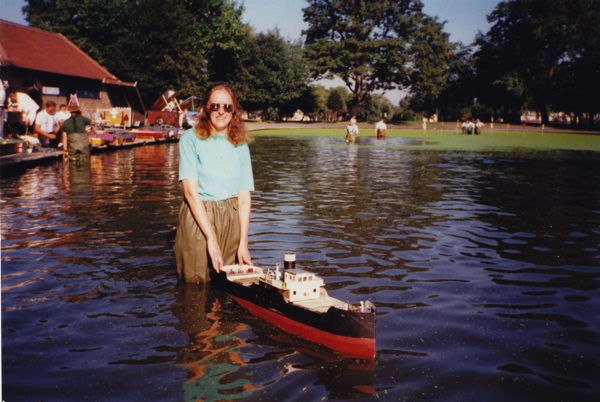
Meanwhile, the members had pulled on their waders and were preparing their vessels at the water’s edge, before launching them onto the sparkling lake. Here Norman introduced Lucinda to Keith Reynolds, the club secretary, who outlined the specific classes of model boat racing with the precision of an authority, “There are five categories of “straight running” boats. These include functional, scale boats (fishing boats, cabin cruisers, etc), scale ships (warships, cruise boats, liners,merchant ships, liners, merchant ships – boats on which you could sustain life for more than seven days), metre boats (with strict rules of engine size and length) and – we had to create a special category for this one – called “the wedge,” basically a boat made of three pieces of wood with no keel, ideal for children to start on.” In confirmation of this, as Lucinda looked around, she saw children accompanied by their parents and grandparents, each generation with their boats of varying sophistication and period design, according to their owners’ experience and age.
Readers of Model Engineering Magazine were informed in 1907 that “the Victoria Park Model Steam Boat Club were performing on a Saturday afternoon before an enormous public of small boys who asked, ‘What’s it go by mister?'” It is a question that passersby still ask today, now that additional racing classes have been introduced for radio controlled boats with petrol engines and even hydroplanes.
“We have around sixty members,” continued Keith enthusiastically, “but we could with some more, as a lot don’t sail their boats any longer, they just enjoy turning up for a chat. It’s quiet today, but you should come back next Sunday to our steam rally when the bank will be thick with owners who bring their boats from all over. Some are so big they run on lawn mower engines!”
It was an invitation that Lucinda could not resist and she was rewarded with a spectacle revealing more of the finer points of model boat racing. She discovered that “straight running,” which Keith had referred to, is when one person launches a boat with a fixed rudder along a course (usually sixty yards long) where another waits at the scoring gates to catch the vessel. The closer to a straight course your boat can follow, the more points you win, defined by a series of gates around a central white gate, which scores a bull’s-eye of ten points if you can sail your boat through it. On either side of the white gate are red, yellow and orange gates each with a diminishing score, because the point of the competition is to discover whose boat can follow the truest course.
Witnessing this contest, Lucinda realised that – just like still water concealing deep currents – as well as having extraordinary patience to construct these beautiful working models, the members of the boat club also possess fiercely competitive natures. This is the paradox of sailing model boats, which appears such a lyrical pastime undertaken in the peace and quiet of the boating lake, yet when so much investment of work and ingenuity is at stake (not to mention hierarchies of individual experience and different generations in competition), it can easily transform into a drama that is as intense as any sport has to offer.
Lucinda’s eloquent pictures capture this subtle theatre adroitly, of a social group with a shared purpose and similar concerns, both mutually supportive and mutually competitive, who all share a love of the magic of launching their boats upon the lake on Sundays in Summer. It is an activity that conjures a relaxed atmosphere – as, for over a century, walkers have paused at the lakeside to chat in the sunshine, watching as boats are put through their paces on the water and scrutinising the detail of vessels laid upon the shore, before continuing on their way.


Photographs copyright © Lucinda Douglas-Menzies
Spitalfields Antiques Market 13

Although Nana Jan (pictured here with her loyal assistant Daniel Almeida) is selling everything because she has cancer and wants to divest herself of possessions before she dies, she continues to live a life that is as far beyond self-pity as you could imagine. “I never expected to see my grandchildren and now I have great-grandchildren!” she whispered excitedly, before proudly revealing the huge tattoo of an angel filling her chest – that she had done when a double mastectomy left her unable to look at her body. Sometimes adversity can bring out extraordinary qualities in people and the joyous Nana Jan possesses an inspirational strength of character that is a bold example to us all.

This is the supremely graceful Adrienne Harris, holding this exquisite tile for an Italian woman who asked to buy the entire set of forty and then mysteriously disappeared. I was deeply impressed when another customer asked Adrienne how to discern real tortoiseshell from reproduction, and with consummate professionalism, Adrienne simply held contrasting examples up to the light and distinguished the authentic from the fake in a moment, demonstrating the knowledge that comes with experience. If you are the woman who wants the tiles please get in touch, because you obviously have great taste and you would not want to disappoint the lovely Adrienne would you?

This is Lottie Muir & Amanda Bluglass who met on Guardian Soulmates seeking romance and discovered instead a shared passion for “Thames treasures and coastal coterie”. ” I am a mudlarker and a letterpress fanatic,” explained Lottie, “so I collect Roman glass and Medieval pottery from the Thames, which washes up against my flat in Rotherhithe, and arrange my discoveries in type cases.” Lottie’s finds are complimented by things selected by Amanda who is a sculptor from Buckfastleigh, “All are chosen for shape or some kind of sculptural beauty,” she added with calm authority, in contrast to Lottie’s giddy excitement on this first day of their new venture.

This is Jessica Hazel & Markus Maverick, who have been dealing in vintage clothes and fabric each Sunday for over a year but have chosen to branch out into antiques and bric-a-brac now. “I’m not interested in modern things,” announced Jessica, London correspondent for www.mooks.com, who developed her passion for dressing up in old clothes as a child in her grandmother’s attic. With their playful outfits, Jessica & Markus are superlative ambassadors for their business – and Markus, famous for rocking his swanky Victorian dandy look with exuberant theatricality, admitted that he recently got talent-spotted in Brick Lane to play Jack the Ripper on the History Channel.
Photographs copyright © Jeremy Freedman


