
Agnese Sanvito, photographer

At the end of the lane in Ridley Rd Market in Dalston is a small square – of sea containers used as shops and hair salons, and corrugated iron shelters harbouring stalls – that fascinates photographer Agnese Sanvito. “It doesn’t look like London,” she explained to me, “I like it because it has its own character.” The new railway station opened nearby recently and across the line is a huge development of flats. When Agnese heard that a million pound redevelopment was promised for the market, she took her camera and set out to record the elusive character of life at this scruffy end of the market, which may be about to change for good. It was one of the first bright days in Spring and she took her pictures in the warm light of late afternoon.
This was in March. Just the month before, Agnese had quit her job to make a living full-time as a photographer. Six months later, Agnese can now look back on this time, secure in the knowledge that she had an assignment each week, sometimes several, and was one of the winners of the My East End Photography Competition, for the photograph of the butcher in Ridley Rd Market which she took that afternoon in March. Before Agnese returned to the South of Italy for a month to enjoy a Summer break with her family in her homeland, we met at Cafe Otto in Dalston and enjoyed a stroll around the market together.
“A new place is easier, because everything is seen freshly” revealed Agnese, referring to her travel assignments as a landscape photographer,“but I have passed through Ridley Rd Market lots of times and I wanted to capture its distinctive character. Photographing a place you know requires you to think more about what kind of pictures you take.” At first, Agnese took pictures of exotic fruit and colourful cakes but then she realised they could equally be photographed in other places. “I didn’t like it, because I’d seen it before,” she explained, shaking her long straight dark hair in self-criticism and revealing a rigorous searching photographic ambition to avoid the obvious.
The result of Agnese’ work is this modest set of six images focussed around the luminous picture of the butcher with a shopping trolley full of meat. There is nothing picturesque about these photographs – executed with a light touch – that record the utilitarian aspect of the market yet have subtleties which repay attention. The central photograph of the butcher is an image of naked capitalism, a frank realist picture of carcasses piled in a trolley by a small trader in a blood spattered coat. But in spite of the harshness of the image, the butcher is portrayed with empathy and the warm light – rendered on film rather than using digital photography – colours the shadows blue and even casts the red meat in a soft tone. In any portrait, there is a tension between exposing or sentimentalizing the subject, and this photograph is perfectly balanced, empathetic while also retaining a respectful distance. None of Agnese’ slyly disarming pictures tell you how to look at them – they are not demonstrative – like all good photographs, they invite you to search the image.
“I am interested in things that are in a process of change,” confided Agnese engimatically, so I asked her for an illustration and she came up with an unexpected example – underground toilets. Agnese is getting up at four in the morning to photograph public toilets in London that have been converted for other uses, and taking pictures of the exteriors when there is a magical dawn light and no-one on the streets. Next, Agnese showed me her photographs of the overgrown Murwillumbah railway line crossing Australia’s Byron Bay, lyrical empty landscapes with barely defined rails running through. It was when she explained to me that these were the lines that connected to Sydney and Brisbane serving the whaling industry, now closed down, that I became compelled. Agnese choses subjects that are contingent, inflecting all her pictures with an unspecified drama that the viewer must unravel.
Leaving the cafe and walking through the glorious chaos of the market as it was closing for the day, with piles of boxes everywhere, crates of fruit, bales of cloth, bowls of fish and piles of meat, all rich with pungent smells in the Summer heat, we arrived at the square at the end. Here were the African hair salons, named “God Willing” and “God First,” operating from sea containers. Here was the haberdashers, bewildering in its proliferation of buttons and ribbons and zips and threads. Here was the butcher with piles of goats’ feet on sale and here were the wire trolleys that they use to transport their meat, exactly as you see in Agnese’ photo. “I like this market, because it is their market,” commented Agnese, referring to the traders and their local customers, and recognising that there is a dignity in this working marketplace which serves a specific community day to day.
We parted at the edge of the market and Agnese promised to send me some of her pictures of underground toilets, once she has enough that she is satisfied with. I may have months to wait but I am already looking forward to it.


Photographs copyright © Agnese Sanvito
At Bow Cemetery
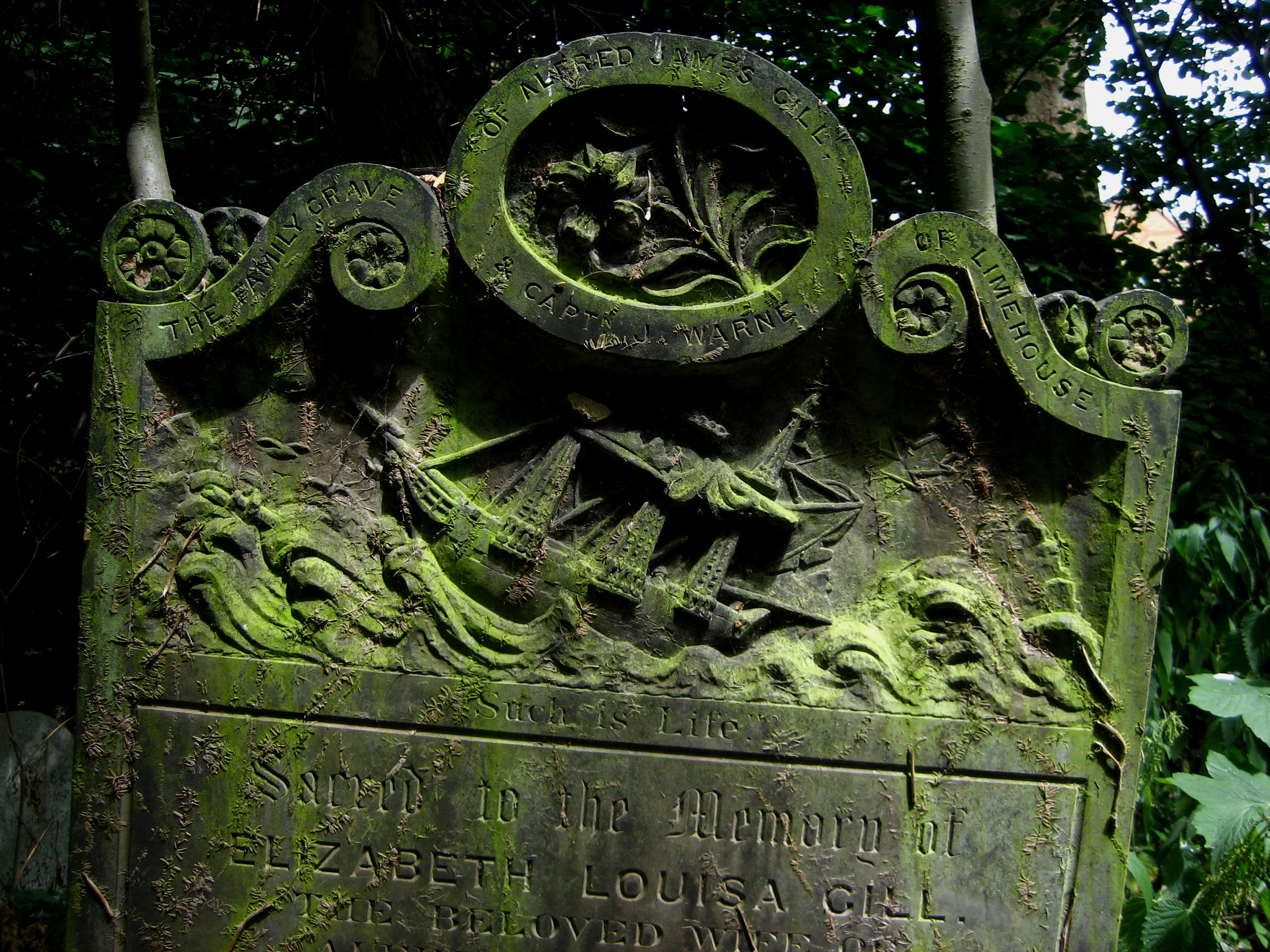
At least once each Summer, I direct my steps eastwards from Spitalfields along the Mile End Rd towards Bow Cemetery, one of the “Magnificent Seven” created by act of Parliament in 1832 as the growing population of London overcrowded the small parish churchyards. Extending to twenty-seven acres and planned on an industrial scale, “The City of London and Tower Hamlets Cemetery” as it was formally called, opened in 1841 and within the first half century alone around a quarter of a million were buried here.
Although it is the tombstones and monuments that present a striking display today, most of the occupants of this cemetery were residents of the East End whose families could not afford a funeral or a plot. They were buried in mass public graves containing as many as forty bodies of random souls interred together for eternity. By the end of the nineteenth century the site was already overgrown, though burials continued until it was closed in 1966.
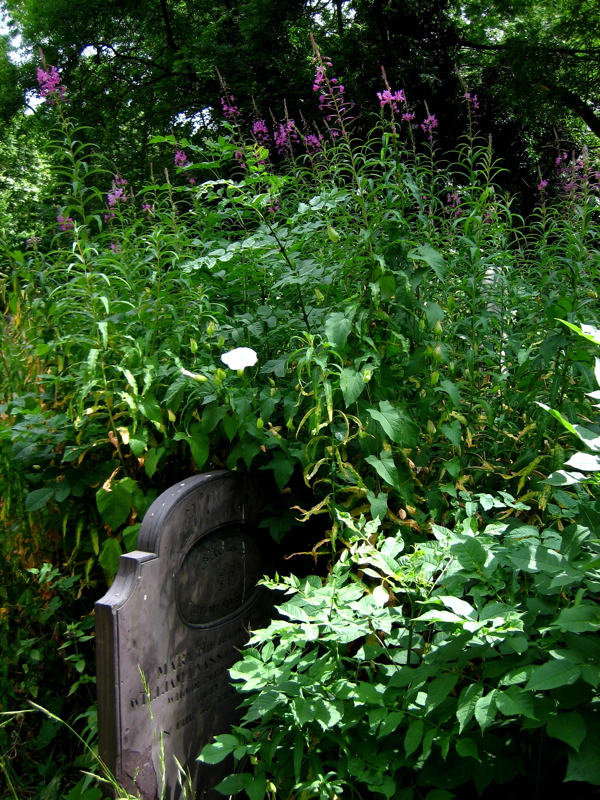
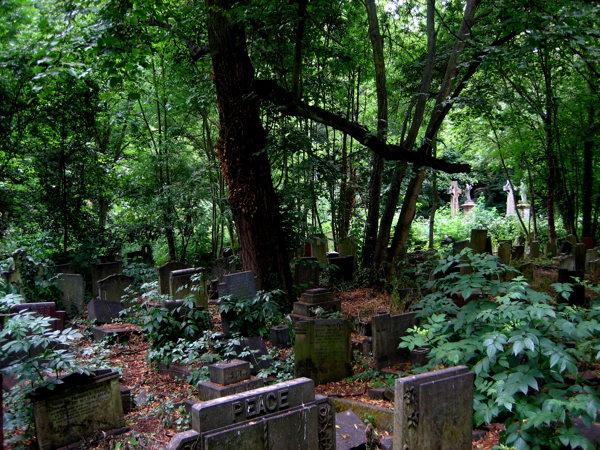
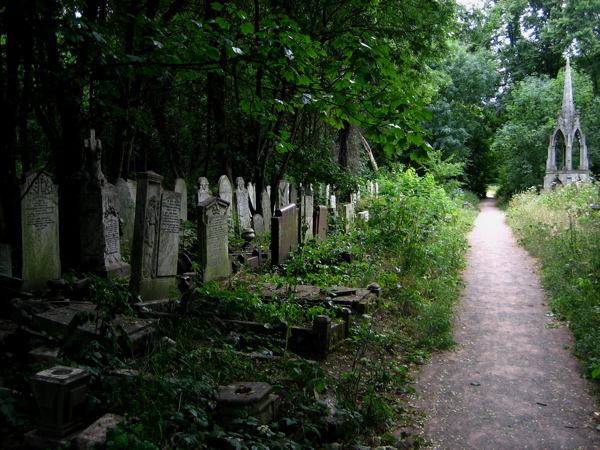
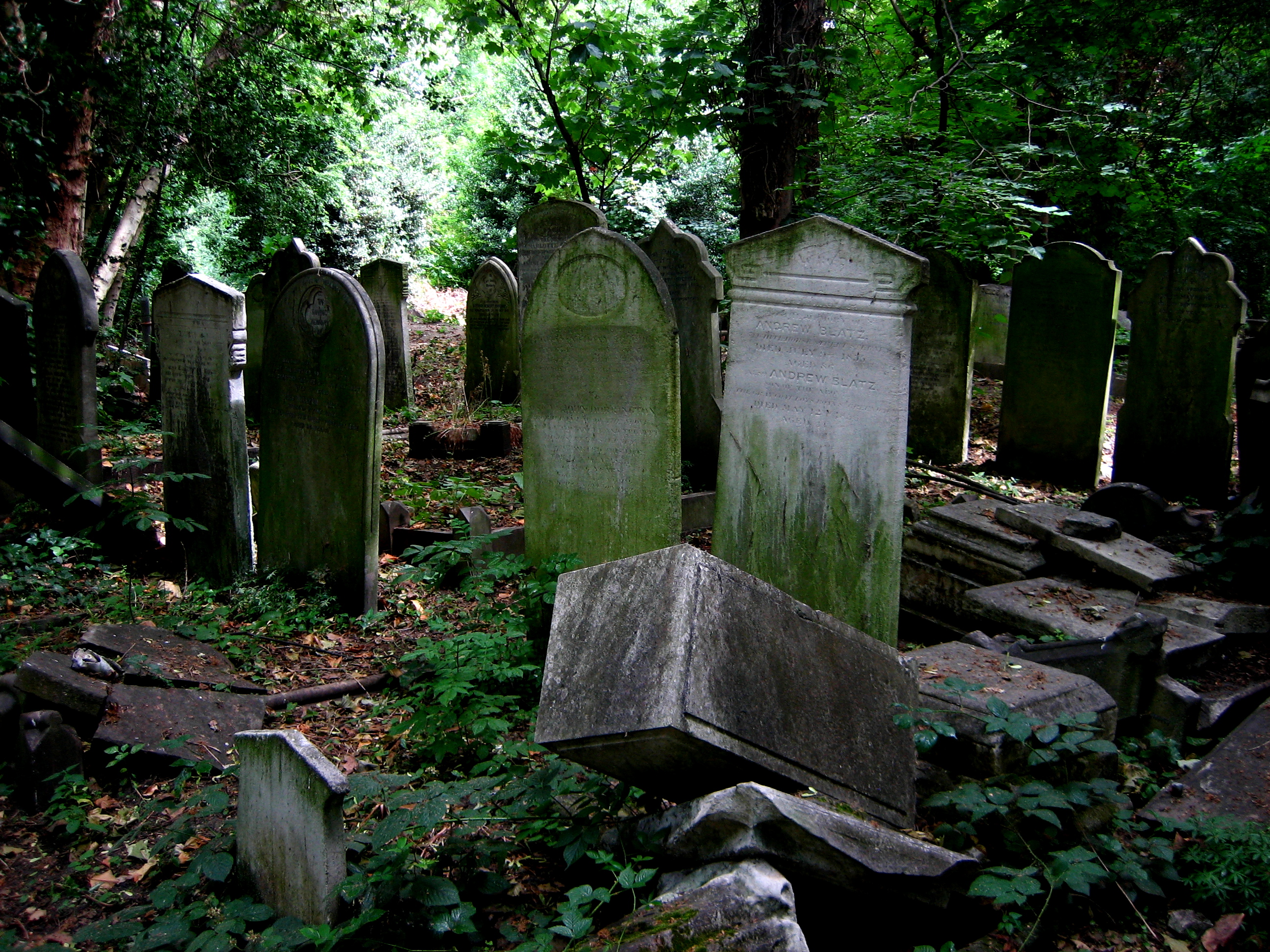
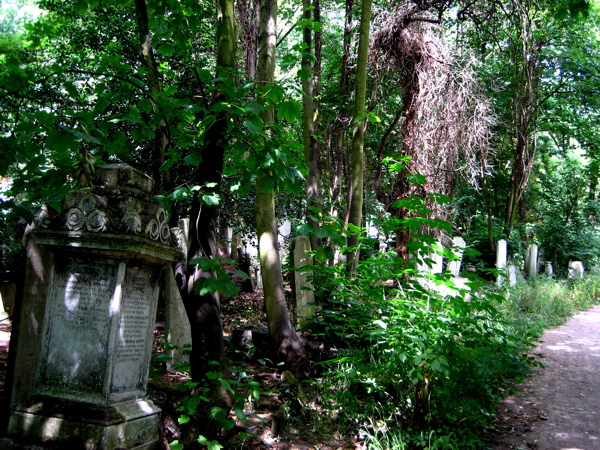
Where death once held dominion, nature has reclaimed the territory and a magnificent broadleaf forest has grown, bringing luxuriant growth that is alive with wildlife. Now the tombstones and monuments stand among leaf mould in deep woods, garlanded with ivy and surrounded by wildflowers. Tombstones and undergrowth make one of the most lyrical contrasts I can think of – there is a beautiful aesthetic manifest in the grim austerity of the stones ameliorated by vigorous plant life. But more than this, to see the symbols of death physically overwhelmed by extravagant new growth touches the human spirit. It is both humbling and uplifting at the same time. It is the triumph of life. Nature has returned and brought more than sixteen species of butterflies with her.
This is the emotive spectacle that leads me here, turning right at Mile End tube station and hurrying down Southern Grove, increasing my pace with rising expectation, until I walk through the cemetery gates and I am transported into the green world that awaits. At once, I turn right into Sanctuary Wood, stepping off the track to walk into a tall stand of ivy-clad sycamores, upon a carpet of leaves that is shaded by the forest canopy more than twenty metres overhead and illuminated by narrow shafts of sunlight descending. It is sublime. Come here to see the bluebells in Spring or the foxgloves in Summer. Come at any time of the year to find yourself in another landscape. Just like the forest in Richard Jefferies’ novel “After London,” the trees have regrown to remind us what this land was once like, long ago before our predecessors ever came here.
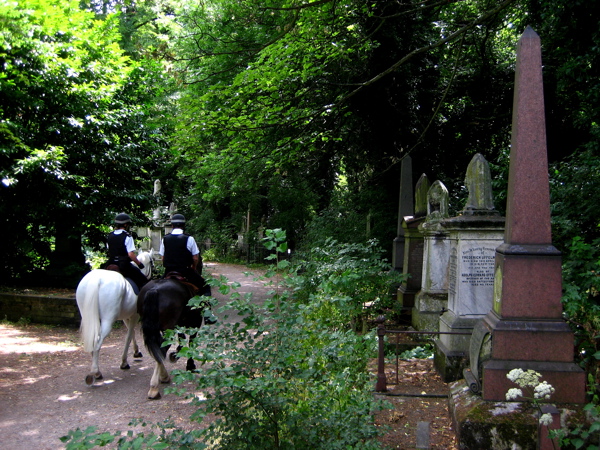
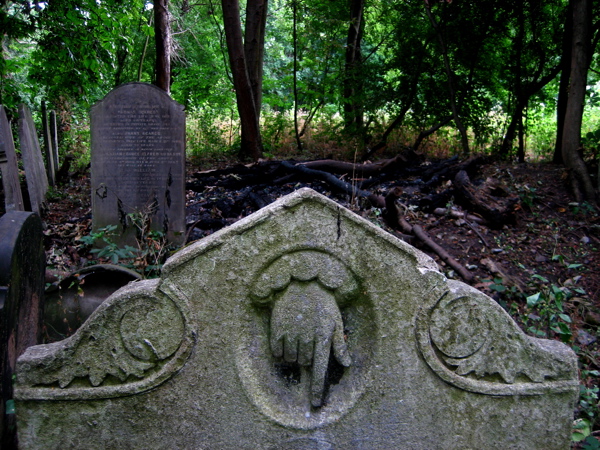
Over time, the tombstones have weathered and worn, and some have turned green, entirely harmonious with their overgrown environment, as if they sprouted and grew like toadstools. The natural stillness of the forest possesses greater resonance between cemetery walls and the deep green shadows of the woodland seem deeper too. There was almost no-one alive to be seen on the morning of my visit, apart from two police officers on horseback passing through, keeping the peace that is as deep as the grave.
Just as time mediates grief and grants us perspective, nature also encompasses the dead, enfolding them all, as it has done here in a green forest. These are the people who made East London, who laid the roads, built the houses and created the foundations of the city we inhabit. The countless thousands who were here before us, walking the streets we know, attending the same schools, even living in some of the same houses we live in today. The majority of those people are here now in Bow Cemetery. As you walk around, names catch your eye, Cornelius aged just two years, or Eliza or Louise or Emma, or Caleb who enjoyed a happy life, all over a hundred years ago. None ever dreamed a forest would grow over their head, where people would come to walk one day to discover their stones in a woodland glade. It is a vision of paradise above, fulfilled within the confines of the cemetery itself.
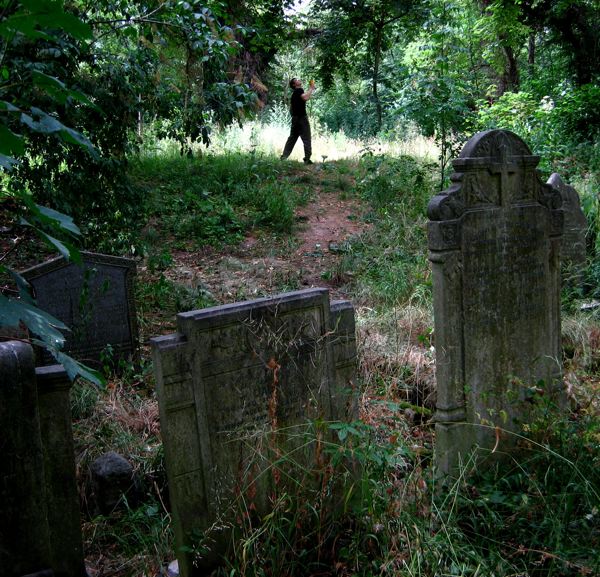
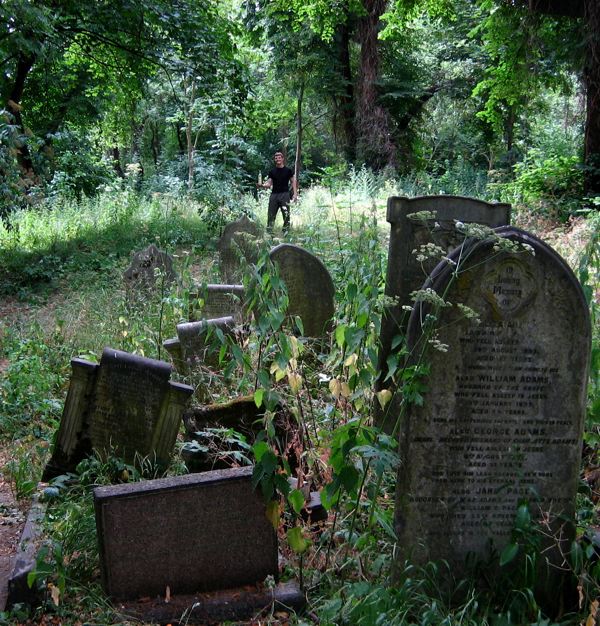
As I made my progress through the forest of tombstones, I heard a mysterious noise, a click-clack echoing through the trees. Then I came upon a clearing at the very heart of the cemetery and discovered the origin of the sound. It was a solitary juggler practicing his art among the graves, in a patch of sunlight. There is no purpose to juggling than that of delight, the attunement of human reflexes to create a joyful effect. It was a startling image to discover, and seeing it here in the deep woods – where so many fellow Londoners are buried – made my heart leap. Outside on the streets, a million people were going about their business while in the vast wooded cemetery there was just me, the numberless dead and the juggler.


Find out more at www.towerhamletscemetery.org
The Tailors of Spitalfields
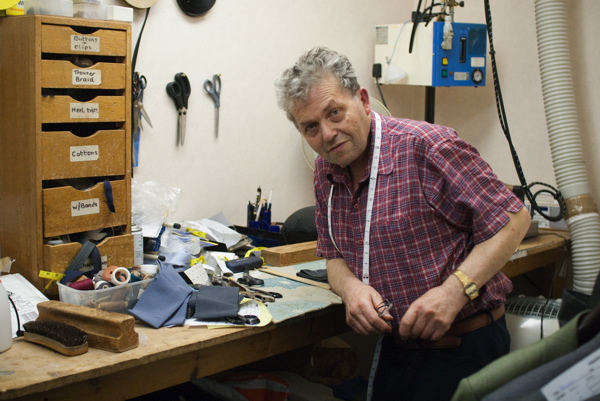
In 1956, when tailor Alan Shaw was twenty-one, as a young man starting out in the world, he opened up his own workshop in Whitechapel across the road from the Royal London Hospital. There were so many tailors workshops in the East End then that he had to search to find his own space, because everywhere he looked there were other tailors at work.
It is a very different picture today, and, when I set out to search for tailors in Spitalfields, I could only find a handful in the directory. Spitalfields Life contributing photographer Sarah Ainslie and I set to visit them in person to make a survey and see what we might find.
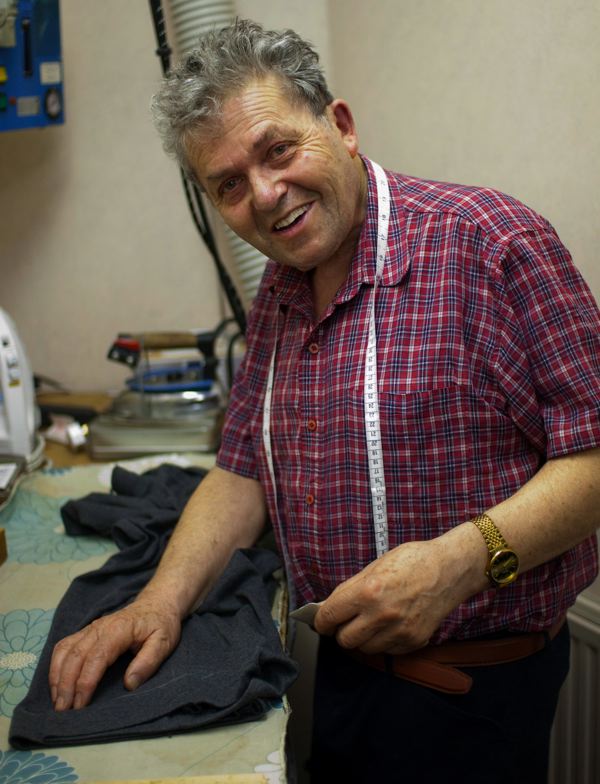
In a humid windowless room in Artillery Passage, we had the privilege to shake hands with Alan who now works for Norton & Townsend, doing their alterations at a bench in a narrow corner of a first floor storeroom. With a deferential nod to the sharp City types lingering outside, we made our way inside from Artillery Passage to stand upon the deep carpet of the showroom. We were told that all the tailoring is done off site, and these premises are simply where customers come to make orders and have their fittings. But brand manager Graham Hall intuited immediately who we would most like to meet, and we were grateful to be ushered up a back staircase and into Alan’s workroom. The circumstances could not be more modest in contrast to the affluence of the customers. Yet, although Alan no longer does tailoring any longer, he is every inch a tailor and, as the most senior practitioner in Spitalfields, we were eager to pay due reverence to this distinguished yet unassuming gentleman.
“It’s a good trade,” said Alan, speaking softly with an easy smile and quite surprised at our interest, “You can get a lot of satisfaction from putting a suit on someone and knowing it looks good. The whole business is in satisfying the customer. They bring back their friends and that’s how you built up contacts. I started at fifteen and my whole family were in the trade, my brother Norman had a big factory in Princelet St. When I was young I had loads of jobs but unfortunately all the little tailors have dropped away and there’s no workshops left in the East End any more. I’m seventy-five now and I only do a few days a week – but I continue because it’s part of my life.”
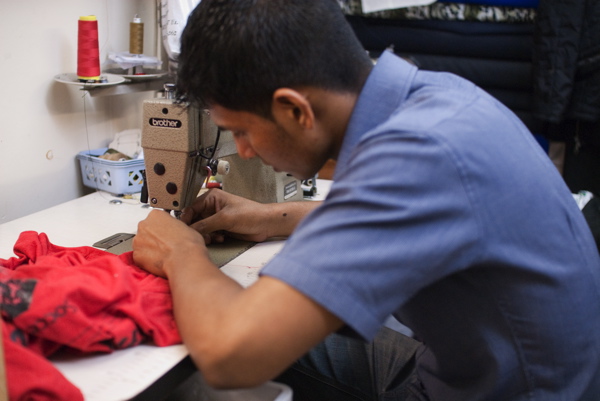
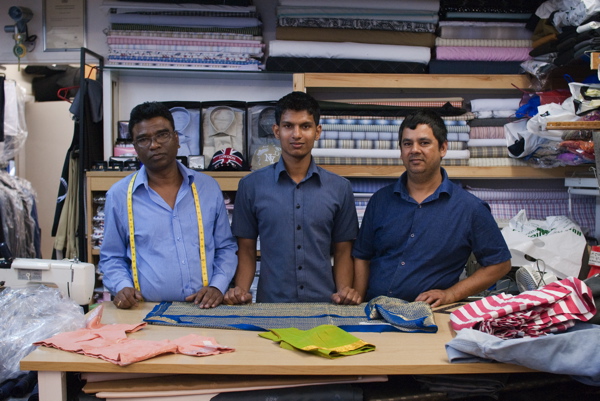
Alan would have been surprised to meet young Sharjahan, barely into his twenties, and working enthusiastically with colleagues Guffar and Lillur in the cramped backroom at Hussain Tailoring in Hanbury St – for a business that primarily serves the Bengali residents of Spitalfields, making suits, copies of customers’ clothes, and doing repairs and alterations too. With bolts of suiting arrayed on either side of the old wooden counter, wide enough to lay out a garment where Guffar was cutting a ladies’ tunic from richly woven green silk, this lively establishment is exactly how I imagine a tailor’s shop to be.
We were honoured by an invitation to visit the sweltering low-ceilinged workroom, where Sharjahan proudly showed us four sewing machine benches and three hemming machines around the walls, and the pressing bench in the middle of the workspace – another sewing machine and buttonholer were outside in the shop. As we spoke, he set about pressing a pair of worn stonewashed jeans, swiftly marking off the legs with chalk to tailor them for the owner. Meanwhile, two eminent white-haired gentlemen had arrived for a conversation in the front of the shop, revealing the premises as a social hub where local people constantly come and go, passing the time of day and making and collecting orders.
It could not have been in greater contrast to the cool of the cavernous office of Neil O’Brien tailors on the first floor of the former Fruit & Vegetable Exchange Building in Brushfield St. Agent Richard Elliott sat alone at his desk, in between visiting the offices of law firms, investment banks and private equity companies, where customers can order their suits without ever visiting his premises. A former sales manager for read-to-wear tailor Chester Barrie, Richard has worked for the last six years as an agent, visiting customers in offices, taking measurements and fitting suits. Welcoming us genially, in spite of our arrival unannounced and out of the blue, he snatched a fine linen jacket from a rail – hand-stitched in a unique style by a traditional family business in Puglia – as an example of the finesse of their Italian tailoring.
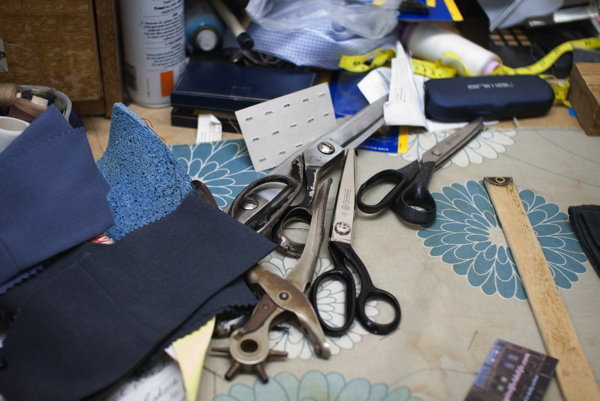
Our final stop was Max Hence, the tailor in Folgate St, now incorporated into Eveleigh & Read where executive Paul Read – natty in a glossy two piece with just one button at the front – was eager to show off his two hundred year old shears as an illustration of the traditional core values of the business that he started four years ago. Although all their garments are individually bespoke, Paul was keen to emphasise that they endeavour to suit every pocket, or – in other words – you can cut your coat to your cloth here. The biggest surprise here was to discover that, although some tailoring is done in Italy, Eveleigh & Read have a tailors’ workshop in Shoreditch. Excited, I thought we had found the object of our quest, if not in Spitalfields then nearby in Shoreditch, but Paul remained inscrutable, insisting that we could not visit it. Like the last rare specimen of an endangered species, the location of the tailoring workshop must remain a jealously protected trade secret.
In a single morning, we walked through the history of tailoring in Spitalfields, from the friendly neighbourhood tailor to the corporate agents speaking the paradoxical rhetoric of family businesses and British craftmanship. And memorably we encountered the king of Spitalfields tailors, Alan Shaw, a heroically soulful figure who carries the story of when the East End was full of tailors, just half a century ago.
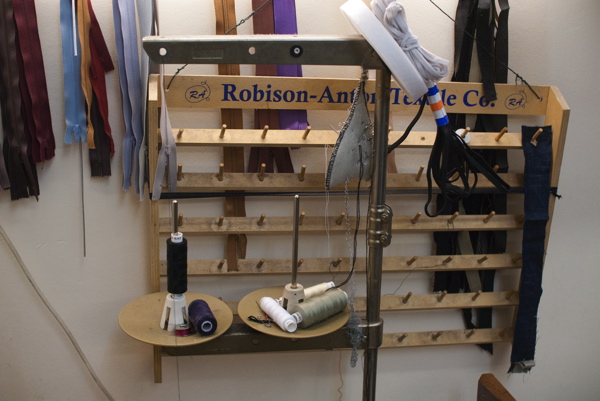
Let me confess, I was more interested in the workrooms than the showrooms, which were calculated to flatter the customers’ tastes. However the economics of tailoring reconfigures the labour market, in the end it is about the rare human skill of working with cloth, creating outfits of subtle psychology that engineer modest transformations to show the wearer at their best, and this is what touches me.
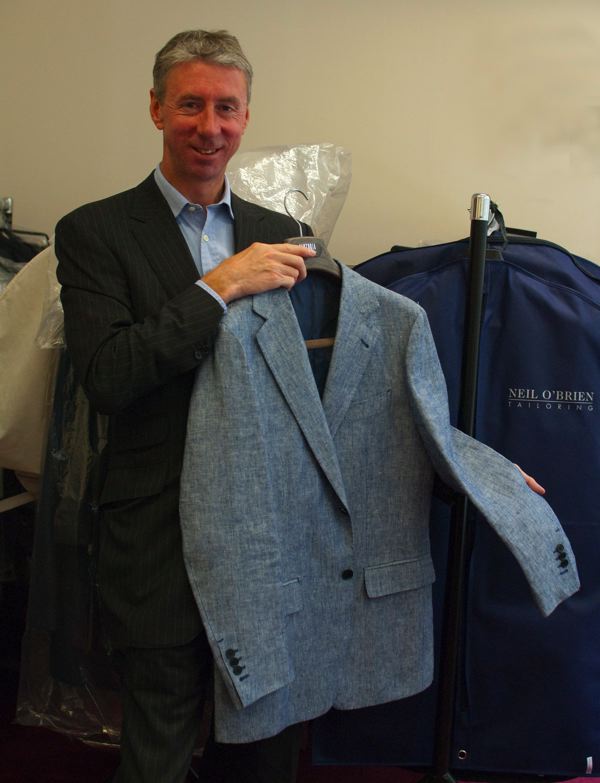
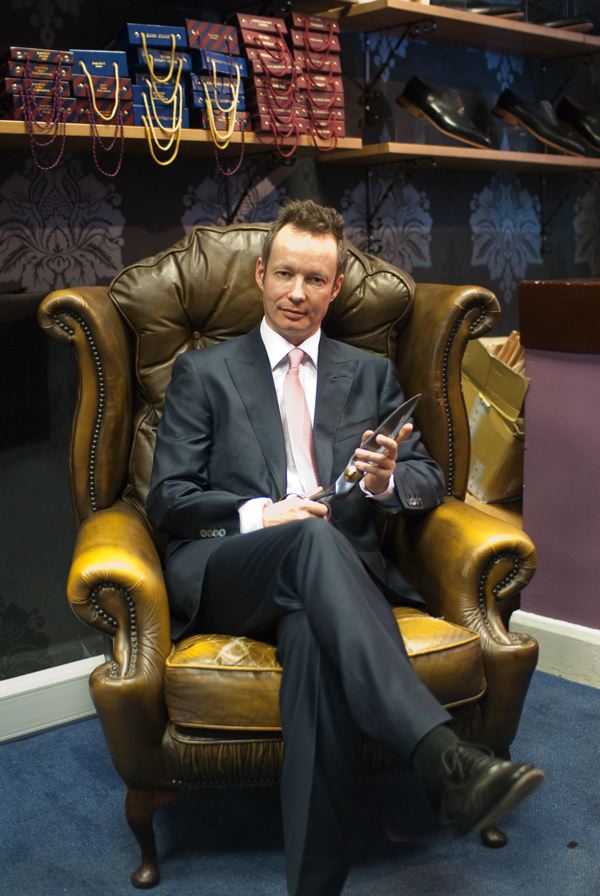
Photographs copyright © Sarah Ainslie
Columbia Road Market 43

There was a party in my garden last night but, rather than face the debris, I got out of bed at dawn, headed out the door and walked up the road to the market instead, passing St Anne’s the Brazilian church where I could hear the young Brazilians, who had been up all night partying, still singing for joy.
For a mere £3.50 I bought a tray of sixteen assorted Cornflowers, sufficient to fill two pots to stand on an exposed sunny wall and give me a display of flowers in soft blues and delicious strawberry pinks for the rest of Summer. Almost nothing speaks of high Summer in England as vividly as the Cornflower that I think of scattered among wild Poppies in meadows of golden corn. I remember them from the “Cottage Garden Mixtures” of seeds that I used to buy for my childhood garden. This domesticated variety comes under the charming name of Batchelor’s Button and I love the subtle complexity of the snowflake patterns adopted by the flowers, each one presenting a different intricate delight, perfectly counterpointed by the grey-green foliage.



At Shakespeare’s first theatre

Over in Shoreditch, just a few minutes walk from where I sit writing in Spitalfields, is the site of a seventeenth century playhouse called “The Theatre” built by James Burbage in 1576, where William Shakespeare’s career as a dramatist began. In this, the first custom-built public theatre, Shakespeare played as an actor and his first plays were performed, notably Romeo & Juliet and an early version of Hamlet.
Stepping through a blank door in the wooden hoarding in New Inn Yard, I walked along a raised pathway to look down upon the archaeological dig and see where the earth has been painstakingly scraped back to reveal the foundations of the ancient playhouse. Senior archaeologist Heather Knight of the Museum of London indicated the section of curved stonework which comprised part of the inner wall of the theatre and next to it a section of the paving of the passage where, more than four hundred years ago, the audience walked through into the body of the theatre, once they had paid their penny admission. Beyond this paving, a beaten earth floor has been uncovered, sloping gently down in the direction of the stage. This is where the audience stood to watch Shakespeare’s early plays for the first time.
For any writer, Shakespeare is a name that has a resonance above all others, and once Heather Knight explained what I was seeing, it took a while for the true meaning to sink in. My head was full with the cacophony of the dusty sunlit street and the discordance of heavy traffic and, superficially, the site itself was like any other archaeological dig I have visited. There was no poetry in it. But then the words of Hamlet came to me, “To die, to sleep. To sleep, perchance to dream. Ay, there’s the rub. For in that sleep of death what dreams may come, when we have shuffled off this mortal coil, must give us pause…” And my stomach began to churn because I knew I was standing on the other side of Shakespeare’s unfathomable dream. It was as if I could feel the tremor of the London earthquake of 1580 coursing through my body. The monstrous city grew diaphanous and the street sounds faded away.
We know no more of what happens in the sleep of death than Shakespeare did. Yet we can say we do know the literal substance of the dreams evoked by these lines from Hamlet – the things that were to come in the space where Hamlet’s words were spoken by James Burbage’s son Richard, who was the first to play the role. We know things unknown to the writer or the actor or the audience in that moment, and, in this sense it may be said that we ourselves (even the archaeologists) are all part of Shakespeare’s boundless dream within the sleep of his own death.
We know that after a disagreement in 1598 The Theatre was covertly demolished by the theatre company while the freeholder Giles Allen was away for Christmas and the materials used to construct The Globe in Southwark the following Spring. We know that a factory was built on the site in the seventeenth century, then a house in the eighteenth century, and a warehouse in the nineteenth century until it became a lumber yard in the twentieth century, before archaeologists came along with sonar devices in the twenty-first century to ascertain the position of the theatre – although the workers in the lumber yard and all the local people always knew the yard was on top of “Shakespeare’s Theatre”.
But it was never Shakespeare’s theatre in any real sense, it is unlikely the audience here were aware of any particular significance in the event, when they heard his words, because he was an unknown quantity then. Plays were performed just once from cue scripts without any rehearsal or expectation of posterity. Each actor had a roll of paper with their character’s lines, plus their cue lines – so they knew when to speak. The implications of this were twofold. Firstly, the actors had to listen attentively to each other so they did not miss their cues. Secondly, beyond a broad knowledge of the story the actors might not know exactly what was going to happen in a scene. It placed the actor in the present tense of the dramatic moment, discovering it for the first time and knowing no more than their character did. The actor playing Romeo might take the poison without knowing that Juliet was going to wake up.
Shakespeare’s plays were conceived to play upon the spontaneous poetry of the elusive instant that, for both actors and audience, occurred uniquely. This embrace of the ephemeral moment is both innate to the form of Shakespeare’s plays and it is their subject too – the fleeting brilliance of life. These works were delights that, as transient as butterflies on Summer days, existed without expectation of longevity. The beautiful paradox is that, in recognition of their superlative quality, Shakespeare’s colleagues collated and printed them, so that his words could travel onwards through time and space to become the phenomenon we know today. And this modest piece of earth in Shoreditch is where it all began.
Releasing me from my idle speculation upon the dust, Heather Knight held up a concrete discovery in triumph. It was an earthenware ale beaker that she found recently, with a lustrous green glaze, which fitted the hand perfectly – a drinking vessel that Shakespeare would recognise, of the style that would be used in the tavern scenes at The Boars’s Head in Henry IV Part One, first performed at The Theatre. Heather has never found a complete beaker before and because it was discovered at The Theatre and is contemporary with Shakespeare, it is a magic artifact. It is something from Shakespeare’s world that he could have seen or touched. Although we can never know, we are permitted to dream.

This tiny plate marks the site of The Curtain Theatre that superceded The Theatre, just fifty yards down the road in Hewett St.
You may like to read these:
The door to Shakespeare’s London
Shakespearian actors in Shoreditch
Shakespeare’s younger brother, Edmond
You can learn more about the plans by the Tower Theatre to build a new theatre on the site of The Theatre at www.thetheatre.org.uk and discover more about the archaeology at www.museumoflondonarchaeology.org.uk
At Sandys Row Synagogue
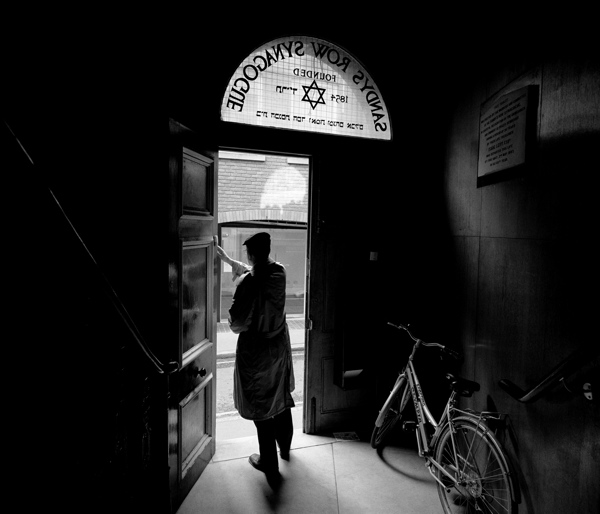
Here is Mr Sender Chaim, always the last to leave after the lunchtime service at Sandys Row. On his way out he touches the box on the door frame which contains the Mezuzah, a scroll with two chapters of the Torah written in Hebrew to be recited daily.
This is one of thousands of intimate photographs taken by Jeremy Freedman over the last five years, documenting his growing involvement with Sandys Row, the oldest surviving Ashkenazi community in London and the only remaining synagogue in Spitalfields. Jeremy’s great-great-great-great-grandfather was one of the founders of the synagogue in 1854, but it was the death of his grandfather Alfred Freedman, the last president of the synagogue, which brought Jeremy back here in July 2005 – where five generations of his family have been before him.
A week after the funeral, Jeremy’s father Henry Freedman called an Extraordinary General Meeting to discuss the future of the shul which had dwindling attendances and a decaying building, and it was at this sombre gathering that Jeremy took his very first photograph in the synagogue, which you can see below. Henry Freedman is at the centre of the photo, and to the left in the dark cap is Jimmy Wilder who had been treasurer of the synagogue for seventeen years. “It was a catharsis,” admitted Jeremy, “As I took pictures, I realised that the majority of the board members were over sixty, many much older, and that nothing could happen unless a new generation got involved.”
Seeking to explore his own family’s past, Jeremy went down into the cellar, his feet sinking into the dust gathered like sand on the beach, making the first footprints in a generation. There he discovered a forgotten vault for the burial of religious documents containing Torah scrolls from the beginning of the community and, under debris, Jeremy found a relic that halted his photography. It was a forgotten vellum commemorating those who paid for the refurbishment of the synagogue a century earlier, in the promise that the acknowledgement of their work would always hang in the vestry.
Six months later, a broken water tank in the caretaker’s flat caused a flood that almost brought down the vestry ceiling. An accident which hastened the imperative for renewal, yet also revealed more of the history of the shul, as Jeremy explained,“We had to empty out the vestry before it was refitted. It took several weekends to clear the contents accumulated over a hundred years, books, letters, ledgers – some written in Dutch, indicative of the origins of past members of the shul. We even found a prayerbook dated 1680, produced by appointment to the Austro-Hungarian Emperor.”
Now the vestry has been refurbished and the vellum’s place is secured, indicative that the reins have been passed to a new generation – as the synagogue looks to the future, celebrating weddings and barmitzvahs with increasing attendances, and anticipating the renovation of the roof funded by English Heritage in time for the two hundred and fiftieth anniversary of the building’s construction. With a quiet emotionalism, Jeremy’s subtle photographs record this transition through the eyes of a participant, while also honouring those senior members, many of whom have passed away in these five years, yet remembered today for keeping the Sandys Row synagogue open when all the others in Spitalfields closed.
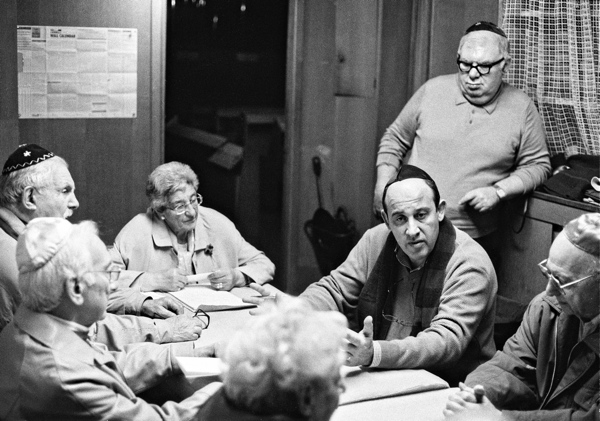
The crisis meeting at the synagogue in July 2005.

Barry Pash is the fourth generation of his family to worship at Sandys Row. A gentle man, once a photographer for a London newspaper, Jeremy took this picture of Barry in the flat where he lives alone in Petticoat Tower, Petticoat Lane.
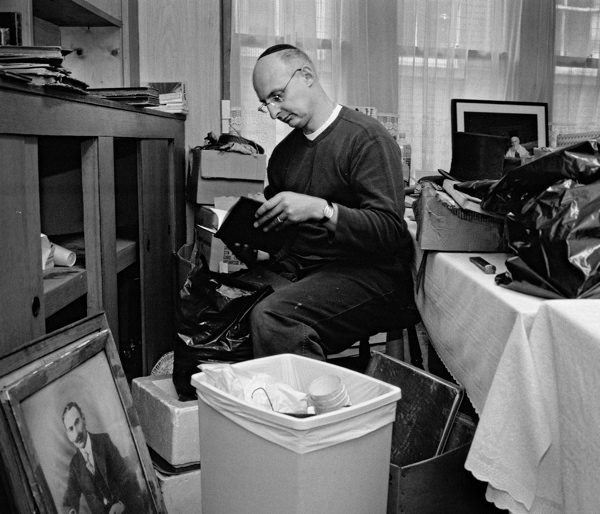
Michael Davidson, a scholar from an orthodox background, sifts through a century of accumulated books and documents in the vestry after the flood of 2006.

Stella Wilder (widow of Jimmy Wilder, the treasurer, whose picture is to be seen on the right) was the secretary of the Sandys Row synagogue for seventeen years until 2005. Born in Old St, she once worked for British Overseas Airways Corporation at their office there and, in spite of her fading sight, still takes huge pleasure today in watching the planes cross the sky, seen from the window of her flat nearby in the Golden Lanes Estate.
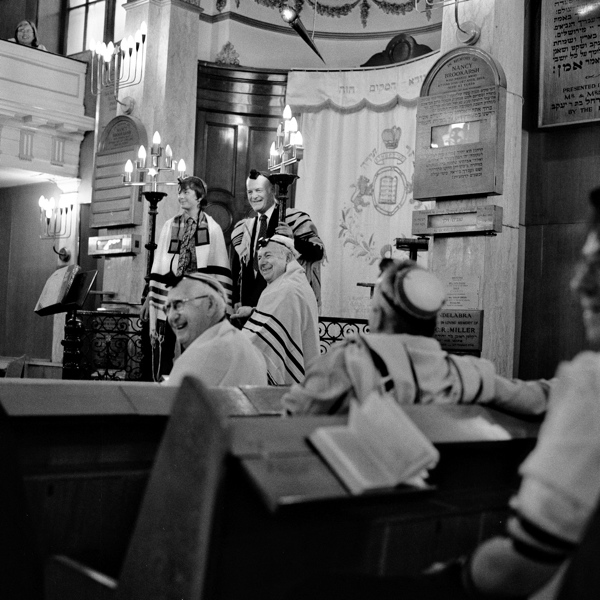
For the first time, Misha is summoned to carry the Torah that he will read at his Barmitzvah, as part of the ritual of becoming a man enacted by his forefathers.

Joe Listner, who used to run the shul, examining the vellum of 1905 discovered in the basement.

Many years ago, Milton who has resided and worked in the locality his whole life, celebrated his marriage here at Sandys Row.
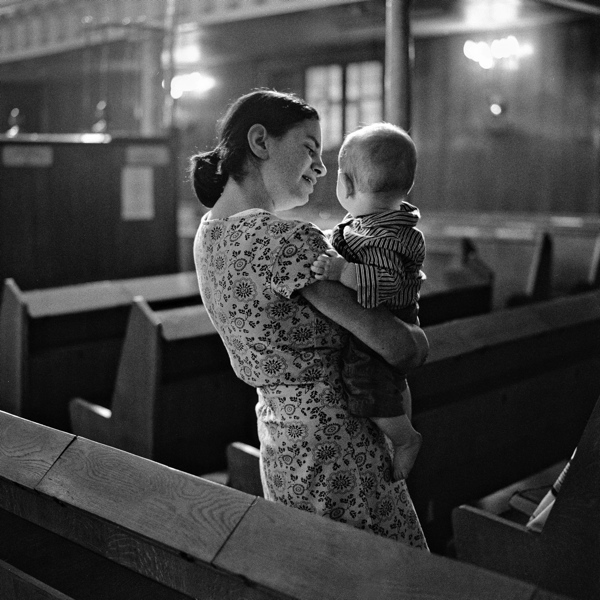
For fifteen years there were no marriages at Sandys Row, then there were three in a year, and now young families are joining the synagogue, as Jewish people move back into the neighbourhood for the first time in a generation.
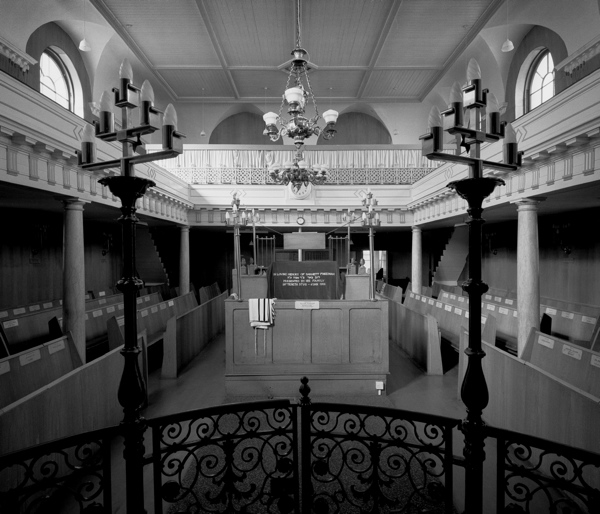
You can read further about Sandys Row Synagogue and see more of Jeremy Freedman’s portraits of the senior members of the shul here: Jeremy Freedman, photographer
Photographs copyright © Jeremy Freedman
Spitalfields Antique Market 14

This is Justin Melican, an agreeable young actor of antipodean origin who enjoys selling kitschy collectables when he is not working. “I’m just back from Cambodia, shooting an episode of an American TV docudrama, playing a drug trafficker,” he let slip with deeply impressive indifference – as if this was something everyone did – before explaining that he has just completed the first year of a three-year interior design course as well. “I’m juggling everything at the moment!” he declared, brimming with the bright energy, bold schemes and winning charisma of one eager to discover his destined place in the world.

This is the gracious Sonoe Sugawara, seen here proudly holding an exquisite nineteenth century girl’s silk undergarment. Sonoe originally sold vintage English clothes from a stall in a Tokyo department store and now has a clever business going whereby she sells kimonos in London too, moving back and forth two or three times a year with a full suitcase in both directions. “My boyfriend’s great-grandparents were dealers before the war, collecting nineteenth and early twentieth century kimonos,” revealed Sonoe with a signficant nod, accounting for the origins of her ravishingly beautiful stock of fine antique kimonos.

This is Matthew Mcfarlane, a free-thinking one man band who enjoys the community here as much as the selling. “I can leave my stall unattended and no one will touch it,” he vouched confidently. Matthew modestly contends his stall offers him a day off from his work as a set builder and designer of shop windows, but I could see he possesses a good eye – and the rescued chairs he has reinvented (to be seen on his blog Sew Watless) testify to a cunning ingenious sensibility. “There is something hauntingly beautiful about dishevelled furniture, left to waste, yet with so much more to give.” he added, revealing his true soulful self.

This is Jennie Sedwell, Heather Sedwell and Lesley Willis – not sisters as you might assume, but in fact three generations who work happily together selling a breathtaking range of vintage textiles, clothing and haberdashery. Lesley has done it as a hobby for twenty-five years, while her mother Jennie joined ten years ago and daughter Heather completed the trio on leaving school. “It was ridiculous!” exclaimed Lesley, “We used to have twelve stalls – as much stock as a big shop – and a van with a mirror for a changing room. We didn’t even have time to sit down, whereas now unfortunately…”, protesting in appealingly overemphatic self-deprecation, whilst still presiding over one of the busiest stalls in the market.
Photographs copyright © Jeremy Freedman


