
Some Christmas Baubles

Is this a lemon? Is this a pine cone? Or is it a sculpture by Tony Cragg? The truth is I do not even know when my grandmother bought this glass decoration and I cannot ask her because she died twenty years ago. All I can do is hang it on my tree and admire it gleaming amongst the deep green boughs, along with all the others that were once hers, or were bought by my parents, or that I have acquired myself, which together form the collection I bring out each year – accepting that not knowing or not remembering their origins is part of their arcane charm.
Although I have many that are more elaborate, I especially admire this golden one for its elegant simplicity of form and I like to think its chic ridged profile derives from the nineteen thirties when my mother was a child, because my grandmother took the art of Christmas decoration very seriously. She would be standing beech leaves in water laced with gelatine in October, pressing them under the carpet in November and then in December arranging the preserved leaves in copper jugs with teazles sprayed gold and branches of larch, as just one example of her fancy contrivances that she pursued each year to celebrate the season in fastidious style.
Given the fragility of these glass ornaments, it is extraordinary that this particular decoration has survived, since every year there are a few casualties resulting in silvery shards among the needles under the tree. Recognising that a Christmas tree is a tremendous source of amusement for a cat – making great sport out of knocking the baubles to the ground and kicking them around like footballs – I hang the most cherished decorations upon the higher branches. Yet since it is in the natural course of things that some get broken every year, and as I should not wish to inhibit the curiosity of children wishing to handle them, I always buy a couple more each Christmas to preserve the equilibrium of my collection.
Of course, I am aware that everlasting baubles are available – they do not smash, they bounce – but this shatterproof technological advance entirely lacks the ephemeral poetry of these fragile beauties that can survive for generations as vessels of emotional memory and then be lost in a moment. Much as we might wish it, life is not shatterproof, and in widespread recognition of this essential frailty of existence, there has been a welcome revival of glass ornaments in recent years.
They owe their origins to the glassblowers of the Thuringian Forest on the border of Germany and the Czech Republic where, in Lauscha, glass beads, drinking glasses, flasks, bowls and even glass eyes were manufactured since the twelfth century. The town is favoured to lie in a wooded river valley, providing both the sand and timber required for making glass and in 1847 Hans Greiner – a descendant of his namesake Hans Greiner who set up the glassworks in 1597 with Christoph Muller – began producing ornaments by blowing glass into wooden moulds. The inside of these ornaments was at first coloured to appear silvery with mercury or lead and then later by using a compound of silver nitrate and sugar water. In 1863, when a gas supply became available to the town, glass could be blown thinner without bursting and by the eighteen seventies the factory at Lauscha was exporting tree ornaments throughout Europe and America, signing a deal with F.W.Woolworth in the eighteen eighties, after he discovered them on a trip to Germany.
Bauble is a byword for the inconsequential, so I do not quite know why these small glass decorations inspire so much passion in my heart, keeping their romance even as other illusions have dissolved. Maybe it is because I collect images that resonate with me? As well as Father Christmas and Snowmen, I have the Sun, Moon and Stars, Clocks and even a Demon to create a shining poem about Time, Mortality and Joy upon my Christmas tree. Let me admit, I cannot resist the allure of these exquisite glass sculptures in old-fashioned designs glinting at dusk amongst the dark needles of fir, because they still retain the power to evoke the rich unassailable magic of Christmas for me.

This pierrot dates from the nineteen eighties.

Three of my grandmother’s decorations. The basket on the left has a piece of florists’ wire that she placed there in the nineteen fifties.

This snowman is one of the oldest of my grandmother’s collection.

Bought in the nineteen eighties, but possibly from a much older mould.

Baubles can be further enhanced with painted stripes and glitter.

The moon, sun and stars were acquired from a shop in Greenwich Avenue on my first visit to New York in 1990, amazingly they survived the journey home intact.


These two from my grandmother’s collection make a fine contrast of colour.

Even Christmas has its dark side, this demon usually hangs at the back of the tree.

It is always going to be nine o’clock on Christmas Eve.

Three new decorations purchased at Columbia Rd last year.

A stash of glittering beauties, stored like rare eggs in cardboard trays.

My first bicycle, that I found under the tree one Christmas and kept ever since.
Mama Irene, Chef
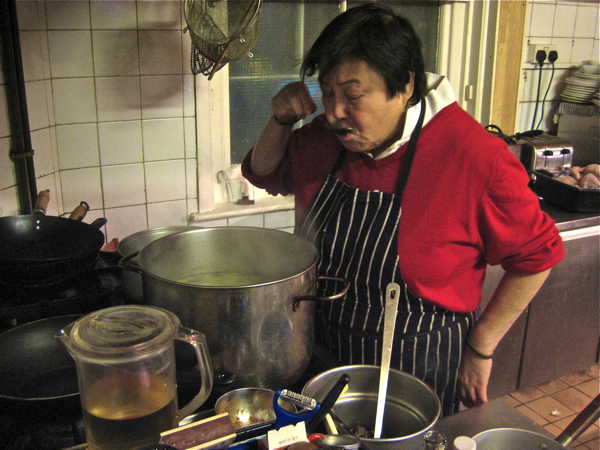
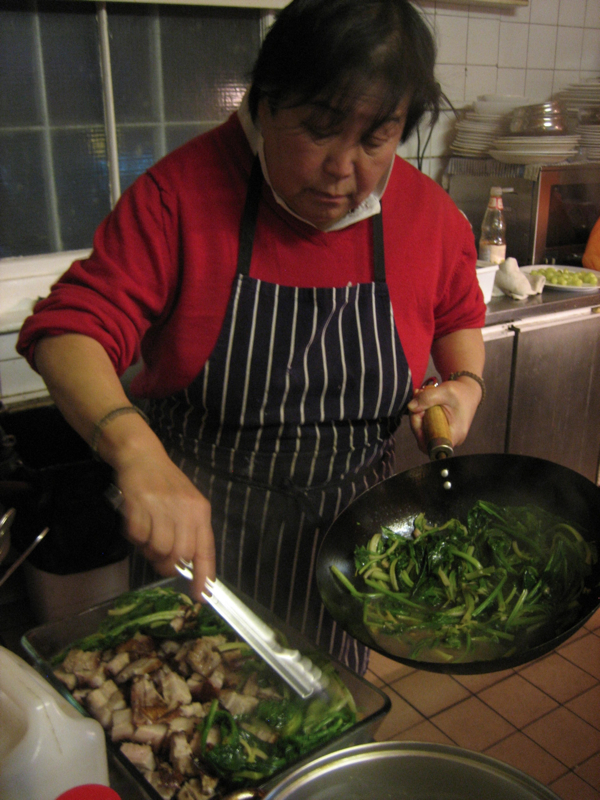
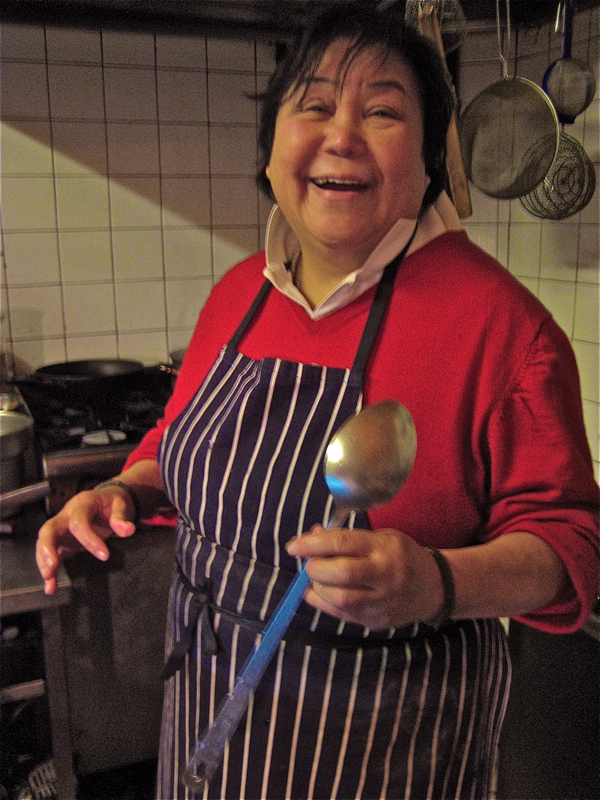
By the time you read this, Irene Sagar – proprietor of Lennies Snack Bar in Calvert Avenue in Shoreditch – will be in Thailand, gone to visit her family for Christmas. But each year, on the night before her departure, she closes early and cooks an elaborate feast for her friends. If you passed by that evening you would have seen a long table in the window with happy diners in party hats enjoying Mama’s Irene’s spicy cuisine, and it was my delight to be there amongst them to savour this special meal and record the preparations.
Lennies Snack Bar presents a modest face to the street, yet the view from inside across to George Dance’s magnificent church of St Leonards opposite, framed in Spring by the almond trees in blossom, creates a breathtaking prospect. But as the dusk fell on this particular afternoon in late December, the church receded into the gloom and the lights were out in the front of the cafe while Mama Irene worked peacefully in the kitchen at the back, where I kept her company and she told me her story.
“I only cook what I love, and I believe you can only do what you love. That’s why it’s not a job, it’s a passion.” she announced, stating her personal creed, as she placed a side of pork in the oven with a pat of affection and set about filleting six seabream conscientiously. “I will never get tired of cooking,” she continued brightly, raising her head momentarily to share a grin with me.
Although you might assume that Mama Irene grew up cooking the Thai and Malaysian food for which she is famous, she only came to it later in life. Born in Malacca to a Malaysian father and a Thai mother she came to Yorkshire in 1958 as the wife of an airforce officer. “It was bloody cold,” she recalled. This was where Mama Irene attempted the Cornish pasty that became her notorious culinary debut, a gesture of reconciliation for her long-suffering husband after she was arrested several times for protesting against nuclear missiles. “I told him, ‘I believe in protest,'” she confided,“‘I married you, not the airforce,’ – but he was worried that they would take away his stripe.” Mama Irene delivered the pasty to her husband at work, with such overzealous contrition that she dropped it on the floor. And, partly as a consequence of this incident, today she is divorced with a fifty-year-old daughter and no hard feelings.
“I used to be an antique dealer specialising in nineteen twenties and Art Deco,” explained Irene, stirring her stockpot and introducing the next chapter in her life with cheerful alacrity “But I was so obsessed with that period that I wouldn’t sell any of it and I nearly lost my house. So I had to quit trading and I registered with a catering agency instead, as a general kitchen assistant. Working in different places, I saw what a chef can do and it made me want to be a chef. I worked during the day and went to school at night to get my qualifications. Then I became a commis chef and in the end I opened my own sandwich bar, Lennies Snack Bar in Old St.”
Mama Irene is justly proud of this period in her life, when things started to go right for her. Such was her success that she needed extra premises to prepare all the sandwiches and that was when she came to Calvert Avenue. “It was twenty years ago.” she realised, peeling garlic and filling with sentiment, “I saw this cafe, a typical greasy spoon, and I fell in love with it. So I asked the owner if she would sell it and I christened it Lennies after my place in Old St. But I thought it could become a Thai restaurant, and I opened up during the day selling homemade food.”
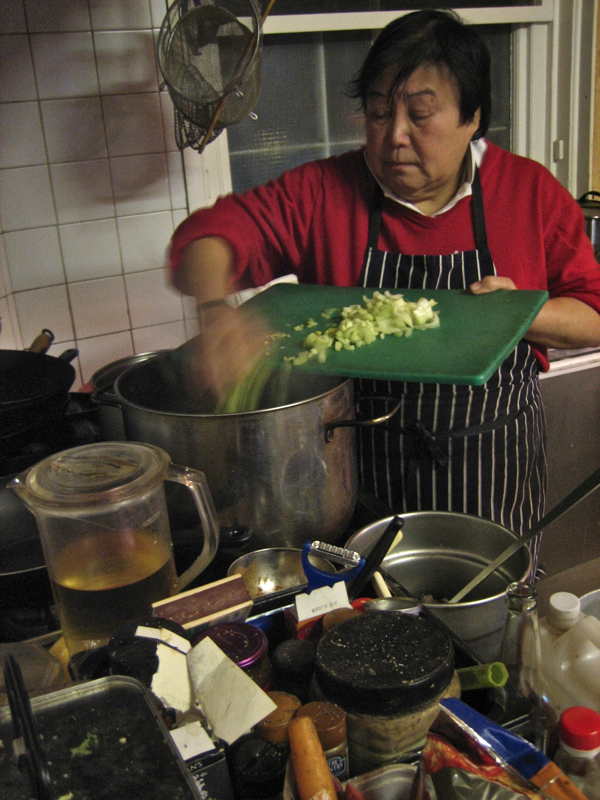
Halting from chopping celery and peering out towards the street to contemplate the changing neighbourhood, “I don’t know if it has changed for the better or the worse,” she said. “When I came here there was a strong community atmosphere, everyone looked out for each other. There was this button and buckle factory that stood empty for years, inhabited by Italian squatters, they had no money and no place to stay, and I used to go to wild parties there. They came to London to study circus and on Summer evenings there used to be juggling, fire-eating and rollerskating in the middle of Calvert Avenue. But also in those days, it was risky to walk down this road alone, quite often people would be attacked for their mobile phones, and they always came in here as a safe house where they could call and wait for the police to come.
This was the only cafe here, and I stayed open late so students studying art and photography at Hackney College could come and eat. They used to say, ‘Let’s go to Mama Irene’s and get a bowl of soup’ and they all gave me a couple of pounds each and I made them a bowl of soup, that’s how opening in the evenings first came about.” Since then, Mama Irene has been running her cafe by day and opening as a Thai restaurant at night, building up a loyal following and acquiring a lot of friends. There is nothing swanky about Lennies Snack Bar, simply a plain cafe with an open kitchen serving honest food and that is just how I like it.
“I love England so much,” she revealed, turning unexpectedly emotional as she added the spices and seasonings to her Thai Curry, “I am quite patriotic, I would rather live here in spite of the snow and the recession. It’s still a very fair place to live. You can make yourself heard here, but in Thailand or Malaysia you can’t even voice your opinion. I worked all my life here and I pay my dues, and I get upset when people run it to the ground.”
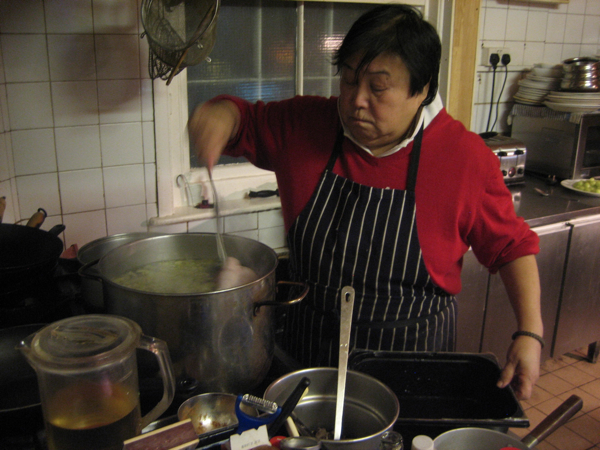
It was all coming together nicely. Once Mama Irene had her seabream marinating and her chicken, duck and pork cooking, and the curry was simmering, it was time to make her famous spicy sauce. “Cooking is an art, both in how you cook it and how you present it.” she informed me with authority, flourishing a ladle and arching her brows for emphasis.“First of all you eat it with your eyes. When it’s inviting and colourful, you want to eat it. My cooking is very spicy, I like strong flavours. I always do wholesome cooking, I don’t do artificial ingredients. In the Summer, I grow my own vegetables and bring them here from my allotment in Twickenham. I pick them in the early morning – you must pick them before midday because they taste so different, especially root vegetables. I grow my own herbs, beans, courgettes, tomatoes, lettuces and onions.”
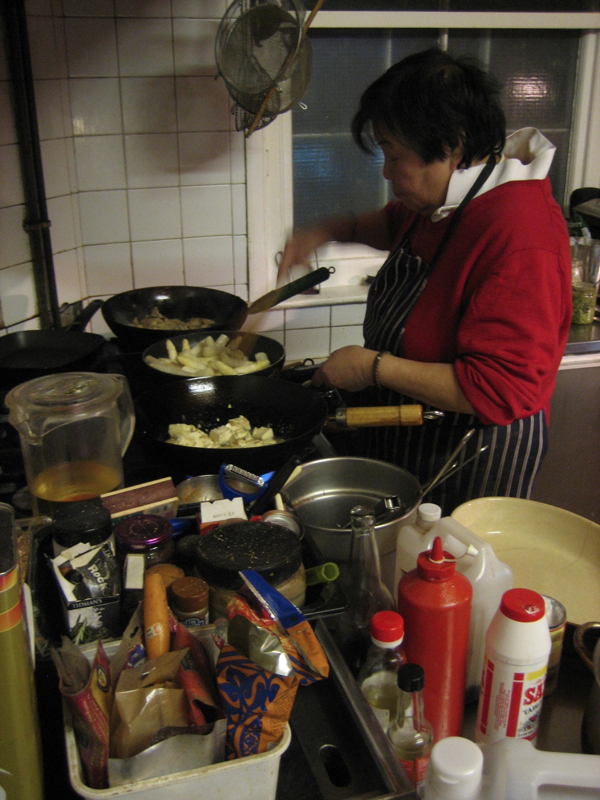
By now, guests had begun to arrive, taking refuge from the cold night and sitting around in hungry anticipation, watching appreciatively as Mama Irene had three woks on the flame simultaneously, cooking the tofu, greens, and asparagus. With a placid nature and concentrated application, she had prepared an entire menu of dishes as we talked, and now they were all ready to be served at the same joyous moment. We had come to pay tribute to Mama Irene, and as we took our seats around the table, we were her children and we were blessed with her beneficence.
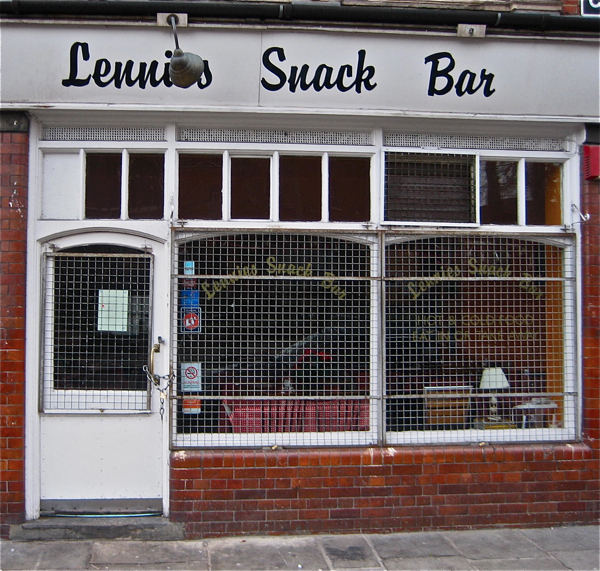
Lennies Snack Bar, 4 Calvert Avenue, is closed until Tuesday 4th January while Irene is in Thailand.
You may be interested in my other stories about Calvert Avenue:
How Raymond’s Shop became Leila’s Shop
Syd’s Coffee Stall, Shoreditch High St
The Ghosts of Old London
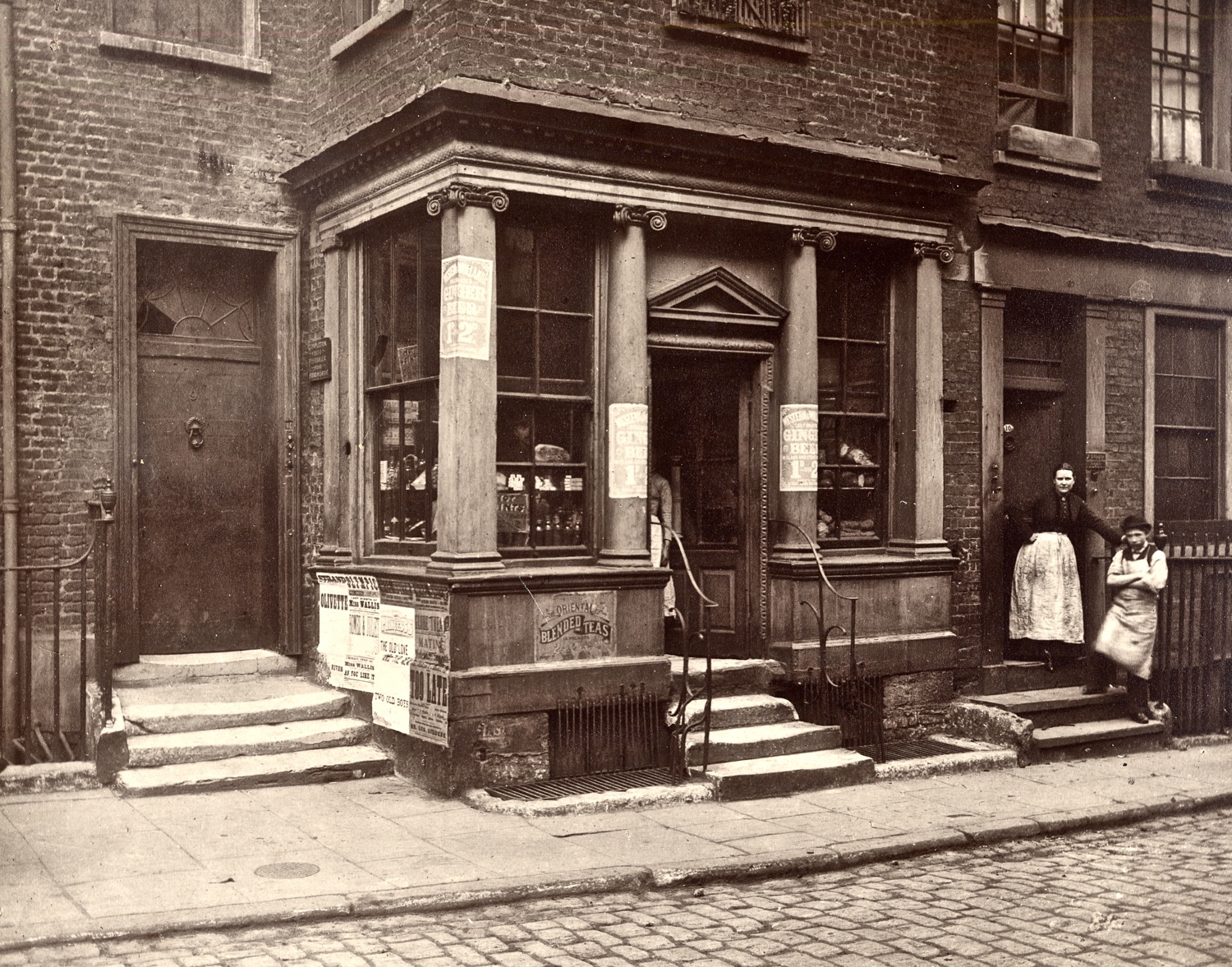
Click to enlarge this photograph
To dispel my disappointment that I cannot rent that Room to Let in Old Aldgate, I find myself returning to scrutinize the collection of pictures taken by the Society for Photographing the Relics of Old London held in the archive at the Bishopsgate Institute. It gives me great pleasure to look closely and see the loaves of bread in the window and read the playbills on the wall in this photograph of a shop in Macclesfield St in 1883. The slow exposures of these photographs included fine detail of inanimate objects, just as they also tended to exclude people who were at work and on the move but, in spite of this, the more I examine these pictures the more inhabited they become.
On the right of this photograph, you see a woman and a boy standing on the step. She has adopted a sprightly pose of self-presentation with a jaunty hand upon the hip, while he looks hunched and ill at ease. But look again, another woman is partially visible, standing in the shop doorway. She has chosen not to be portrayed in the photograph, yet she is also present. Look a third time – click on the photograph above to enlarge it – and you will see a man’s face in the window. He has chosen not to be portrayed in the photograph either, instead he is looking out at the photograph being taken. He is looking at the photographer. He is looking at us, returning our gaze. Like the face at the window pane in “The Turn of the Screw,” he challenges us with his visage. Unlike the boy and the woman on the right, he has not presented himself to the photographer’s lense, he has retained his presence and his power. Although I shall never know who he is, or his relationship to the woman in the doorway, or the nature of their presumed conversation, yet I cannot look at this picture now without seeing him as the central focus of the photograph. He haunts me. He is one of the ghosts of old London.
It is the time of year when I think of ghosts, when shadows linger in old houses and a silent enchantment reigns over the empty streets. Let me be clear, I am not speaking of supernatural agency, I am speaking of the presence of those who are gone. At Christmas, I always remember those who are absent this year, and I put up all the cards previously sent by my mother and father, and other loved ones, in fond remembrance. Similarly, in the world around me, I recall the indicators of those who were here before me, the worn step at the entrance to the former night shelter in Crispin St and the eighteenth century graffiti at the entrance to St Pauls Cathedral, to give but two examples. And these photographs also provide endless plangent details for contemplation, such as the broken windows and the shabby clothing strung up to dry at the Oxford Arms, both significant indicators of a certain way of life.
To me, these fascinating photographs are doubly haunted. The spaces are haunted by the people who created these environments in the course of their lives, culminating in buildings in which the very fabric evokes the presence of their inhabitants, because many are structures worn out with usage. And equally, the photographs are haunted by the anonymous Londoners who are visible in them, even if their images were incidental to the purpose of these photographs as an architectural record.
The pictures that capture people absorbed in the moment touch me most – like the porter resting his basket at the corner of Friday St – because there is a compelling poetry to these inconsequential glimpses of another age, preserved here for eternity, especially when the buildings themselves have been demolished over a century ago. These fleeting figures, many barely in focus, are the true ghosts of old London and if we can listen, and study the details of their world, they bear authentic witness to our past.

Two girls lurk in the yard behind this old house in the Palace Yard, Lambeth.

A woman turns the corner into Wych St.

A girl watches from a balcony at the Oxford Arms while boys stand in the shadow below.

At the Oxford Arms, 1875.


At the entrance to the Oxford Arms – the Society for Photographing the Relics of Old London was set up to save the Oxford Arms, yet it failed in the endeavour, preserving only this photographic record.

A relaxed gathering in Drury Lane.

A man turns to look back in Drury Lane, 1876.

At the back of St Bartholomew’s, Smithfield, 1877.

In Gray’s Inn Lane.

A man peers from the window of a chemists’ at the corner of Lower James St and Brewer St.

A lone policeman on duty in High Holborn, 1878.

A gentleman in Barnard’s Inn.

At White Hart Inn yard.

At Queen’s Inn yard.

A woman lingers in front of the butcher in Borough High St, Southwark.

In Aldgate.
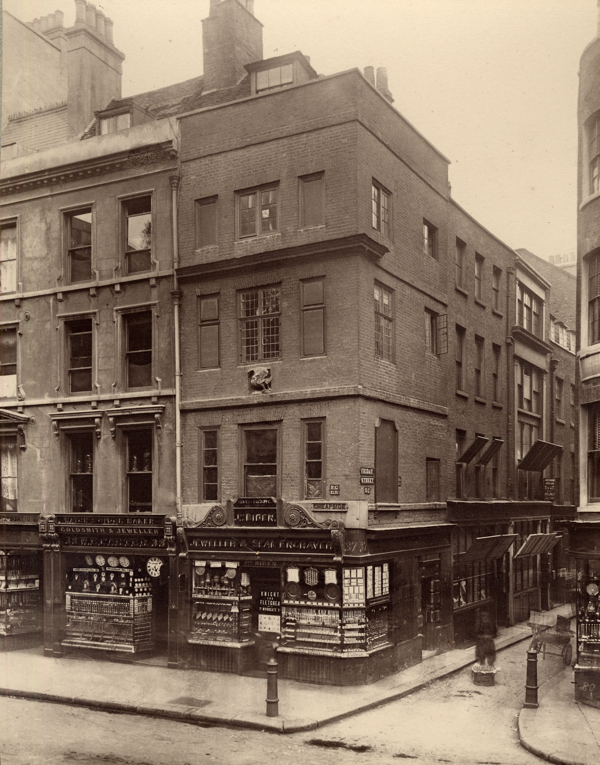
A porter puts down his basket in the street at the corner of Cheapside and Friday St.

In Fleet St.
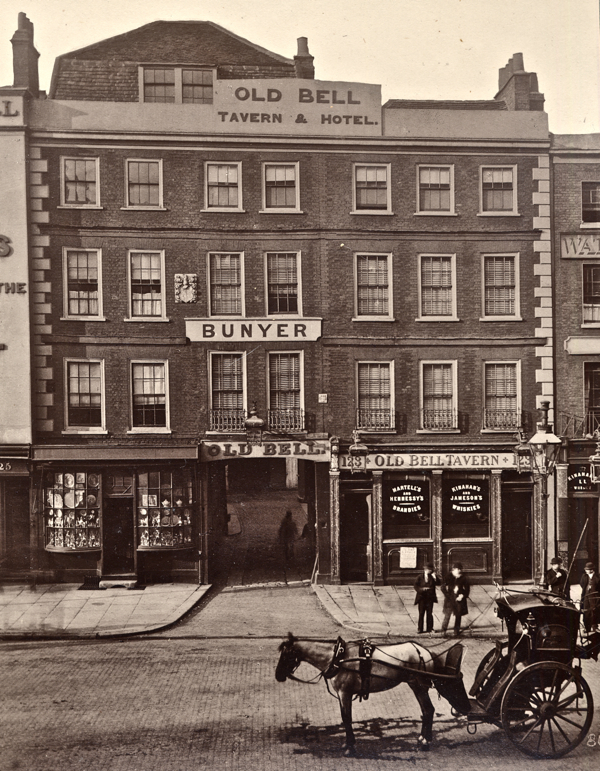
The Old Bell, Holborn

At the corner of Fore St and Milton St.

Doorways on Lawrence Pountney Hill.

A conversation at the entrance to Inner Temple, Fleet St.
Images copyright © Bishopsgate Institute
You can see more pictures from the Society for Photographing the Relics of Old London here In Search of Relics of Old London
On Christmas Night in the City

Fortified by a late supper of lamb cutlets, I set out after eleven through the streets of Spitalfields just as some of the residents were making their way to Christ Church for the midnight service, but I did not join them, instead I walked out into the City on Christmas Eve. As I passed through Brick Lane, the ever-optimistic curry touts were touting to an empty street and in Commercial St a few stragglers who had been out for the night loitered, but I left them all behind as I entered the streets of the City of London where there was no-one. Passing through the deserted Leadenhall Market, illuminated like a fairground, I slipped into the web of narrow alleys to emerge at the Bank of England. Here where the Bank, the Mansion House and the Royal Exchange face each other at this famous crossroads, the place was empty save a lonely policeman patrolling outside the Bank of England.
I headed down to the river and as I crossed the footbridge above the dark water with powerful currents churning in the depths below, I could enjoy the panorama of the vast city of empty rooms around me. Tonight, I was the sole rambler through its passages and byways, an explorer in the unknown territory of the familiar city, transformed by the complete absence of inhabitants. The sound of the gulls’ cry registered as it had not before and birdsong followed me throughout my journey into the dark streets, in which for the first time ever I heard the echo of my own footsteps in the centre of London.
Yet just as I had befriended the emptiness, I came round a corner in Southwark to see the cathedral glowing with light and the tune of a carol blowing on the breeze. I stepped down to the cathedral door and discovered a candlelit service in progress. An usher saw me through the glass door, and although I kept a respectful distance – imbued with the generosity of the season, he could not resist coming outside to lead me in. Before I knew it, I was in the midst of the service and it was overwhelming in contrast to the cold dark streets to which I had acclimatised. But once the bishop had led the choir in a procession through a haze of incense as the congregation sang “O Come all Ye Faithful,” the service was over. So as quickly as I arrived, I was able to return to my wandering.
Hastening Eastward along the Thames, I came to Tower Bridge where I crossed and skirted around the Tower of London. In the absence of floodlighting, its grim austerity came to the fore, yet even though all the gates were shut for the night I could see a few of the residents’ individual lights still burning within. From here I set out Westward, along Cheapside and Cannon St, where I came upon the fabled London Stone, built into an illuminated box in the wall, as I was passing on my way to St Pauls. Here also, the floodlighting was off, allowing Wren’s great cathedral to loom magnificently among the trees like some natural excrescence, a towering cliff of rock, eroded into pinnacles.
Winding my way onwards along the Strand through the courtyards and alleys, I found myself in Lincoln’s Inn Fields and I had it to myself. And in homage to the writer most famous for his walks by night through London, I visited the Old Curiosity Shop. Already, the night was drawing on and I discovered a sense of urgency, walking on purposefully even though I did not where I was going. At the Savoy, I turned down Carting Lane where I came upon one of just three people that I saw suffering the misfortune of sleeping out last night, though equally I was also aware of many bundled up in dark clothing with backpacks walking slowly and keeping to the shadows. I could only presume these people were walking all night in preference to sleeping in the frost.
I followed the Embankment along to Parliament Sq where there was no-one, apart from the antiwar protesters sleeping peacefully in their tents and statues of dead men standing around on plinths. Big Ben struck three in the morning and, without any traffic, I could sense the sound travelling around me, bouncing and reverberating off the stone buildings as I made my way up Whitehall. Coming to the end of Downing St, two policemen with machine guns on duty behind the fortifications spotted me, the lone figure in the street, and I realised they were focusing on me. Then, to my surprise, one waved, and so I returned the wave automatically and the atmosphere of unease was broken.
There were plenty of taxis for hire circling Trafalgar Square – they were the only traffic on the road by this time – but absurdly there were no customers to rent them. Looking through Admiralty Arch, I espied Buckingham Palace tempting me, and I wanted to go walking around St James’ Palace too, but weariness was also coming upon me. It was time to return home. I walked doggedly across Covent Garden, along Holborn and over Smithfield, then through the Barbican and so I found myself in Spitalfields again.
The city was as still as the grave and there was a keen edge to the wind, yet I had kept warm by walking continuously. It was as though I had travelled through a dream – a dream of an empty city. Although I delighted in the privilege of having London to myself, it is an alien place with nobody in it, so I was eager to renounce my monopoly and give the city back to everyone else again, because I longed for the reassurance of my warm bed. Already children were waking to unwrap parcels that appeared mysteriously in the night, although I must confess I saw no evidence of nocturnal deliveries upon my walk. It was now 4:30am on Christmas Morning and as I approached my front door, even before I took out the key to place it in the lock, a cry of a certain cat was heard from just inside, where he had been waiting upon my return for all this time.
You may expect two more reports of nocturnal escapades from the gentle author this week.

Leadenhall Market at 11:50pm on Christmas Eve.

At the Bank at Midnight.

In Southwark Cathedral, 1:00am Christmas Morning.

Leaving Southwark Cathedral.

The London Stone in Cannon St.

At St Pauls, 2:00am Christmas Morning.

The Old Curiosity Shop, 2:30am.

At the Savoy, 2:45am.
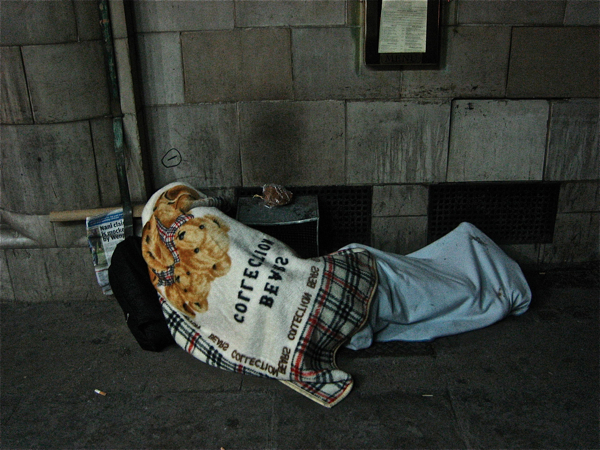
In Carting Lane, next to the Savoy.

A lonely photographer at the London Eye, 2:55am

The Nativity scene in Trafalgar Square, 3:15am.
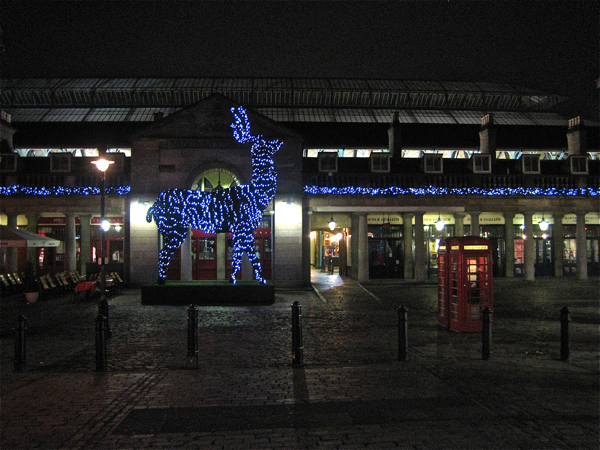
In Covent Garden, 3:30am.

At High Holborn, 3:45am.

At the Barbican, 4:00am on Christmas Morning.
Maurice Franklin, Wood Turner

If you were to rise before dawn on Christmas Eve, and walk down the empty Hackney Rd past the dark shopfronts in the early morning, you would very likely see a mysterious glow emanating from the workshop at the rear of number forty-five where spindles for staircases are made. If you were to stop and press your face against the glass, peering further into the depths of the gloom, you would see a shower of wood chips flying magically into the air, illuminated by a single light, and falling like snow into the shadowy interior of the workshop where wood turner Maurice Franklin, who was born upstairs above the shop in 1920, has been working at his lathe since 1933 when he began his apprenticeship.
In the days when Maurice started out, Shoreditch was the centre of the furniture industry and every premises there was devoted to the trade. But it has all gone long ago – except for Maurice who has carried on regardless, working at his lathe. Now at ninety-one years old, being in semi-retirement, Maurice comes in a few days each week, driving down from North Finchley in the early hours to work from four or five, until eight or nine in the morning, whenever he fancies exercising his remarkable talent at wood turning.
Make no mistake, Maurice is a virtuoso. When rooms at Windsor Castle burnt out a few years ago, the Queen asked Maurice to make a new set of spindles for her staircase and invited him to tea to thank him for it too. “Did you grow up in the East End?” she enquired politely, and when Maurice nodded in modest confirmation of this, she extended her sympathy to him. “That must have been hard?” she responded with a empathetic smile, although with characteristic frankness Maurice disagreed. “I had a loving family,” he told her plainly, “That’s all you need for a happy childhood, you don’t need palaces for that.”
Ofer Moses who runs The Spindle Shop – in the former premises of Franklin & Sons – usually leaves a list for Maurice detailing the work that is required and when he returns next morning, he finds the completed wood turning awaiting him, every piece perfectly achieved. But by then Maurice will already be gone, vanished like a shade of the night. So, in order to snatch a conversation with such an elusive character, a certain strategy was necessary which required Ofer’s collaboration. Early one frosty morning recently, he waited outside the shop in his car until I arrived, and then, once we had checked that there was a light glimmering inside the shop, he unlocked the door and we went in together to discover the source of the illumination. Sure enough, the wood chips were flying, accompanied by the purr of the motor that powered the lathe, and hunched over it was a figure in a blue jacket and black cap, liberally scattered with chips and sawdust. This was Maurice.
Unaware of our presence, he continued with his all-engaging task, and we stood mesmerised by the sight of the master at work, recognising that we were just in time to catch him as he finished off the last spindles to complete a pristine set. And then, as he placed the final spindle on the stack, Maurice looked up in surprise to see us standing there and a transformation came upon him, as with a twirl he removed his overall and cap, sending a shower of wood chips fluttering. The wood turner that we saw hunched over the lathe a moment before was no more and Maurice stood at his full height with his arms outstretched, assuming a relaxed posture with easy grace, as he greeted us with a placid smile.
“This firm was the wood turning champion of Britain in 1928,” announced Maurice with a swagger. “Samuel, my father, had been apprenticed in Romania and was in the Romanian army for two years before he came here at the beginning of the twentieth century, and then he served in the British Army in the 14/18 war before he opened this place in 1920. He had been taught by the village wood worker in Romania, they made everything from cradles to coffins. All the boys used to sleep on a shelf under the bench then.”
Maurice told me he was one of a family of twelve – six boys and six girls – and he indicated the mark in the floor where the staircase once ascended to the quarters where they all lived. “I started when I was thirteen, I’ve still got my indenture papers” he informed me conscientiously, just in case I wanted to check the veracity of his claim, “I took to it from the start. It’s creative and at the end of the day you see what you’ve made. I’m proud of everything I do or I wouldn’t do it.”
In spite of his remarkable age, Maurice’s childhood world remains vivid to him. “Here in Shoreditch, ninety per cent were Jewish and the ones that weren’t were Jewish in their own way. Over in Hoxton, they’d take your tie off you when you arrived and sell it back to you when you left – but now you couldn’t afford to go there. In 1925, you could buy a house in Boundary St for £200, or you could put down a pound deposit and pay the rest off at three shillings a week. I was born here in 1920 and I went to Rochelle School – They won’t remember me.”
The only time Maurice left his lathe was to go and fight in World War II, when although he was offered war work making stretcher poles, he chose instead to enlist for Special Operations. Afterwards, Franklin & Sons expanded through acquiring the first automatic lathe from America, and opening a factory in Hackney Wick to mass-produce table legs. “Eventually we closed it up because everyone was getting older, except me.” quipped Maurice with a tinge of melancholy, as the last of his generation now, carrying the stories of a world known directly only to a dwindling few.
Yet Maurice still enjoys a busy social calendar, giving frequent lectures about classical music – the other passion in his life. “I especially like Verdi, Puccini and Rossini,” he declared, twinkling with bright-eyed enthusiasm, because having made chairs for the Royal Opera House he is a frequent visitor there. “I like all music except Wagner. You’ll never hear me listening to Wagner, because he was Hitler’s favourite composer.” he added, changing tone and catching my eye to make a point. A comment which led me to enquire if Maurice had ever gone back to Romania in search of his roots. “I’ve got no family there, they were all wiped out in the war. My father brought his close relatives over, but those that stayed ended up in Auschwitz.” he confided to me, with a sombre grimace, “Now you know why I wanted to go to war.”
And then, after we had shared a contemplative silence, Maurice’s energy lifted again, pursuing a different thought, “I remember the great yo-yo craze of the nineteen thirties,” he said, his eyes meeting mine in excitement, “We worked twenty-four hours a day.”
“What’s the secret?” I asked Maurice, curious of his astonishing vitality, and causing him to break into a smile of wonderment at my question. “All you’ve got to do is keep on living, and then you can do it. It isn’t very difficult.” he said, spreading his arms demonstratively and shaking his head in disbelief at my obtuseness. “Are you happy?” I queried, provocative in my eagerness to seize this opportunity of learning something about being a nonagenarian. “I’ll tell you why I am happy.” said Maurice, with a grin of unqualified delight and raising one hand to count off his blessings, “I’ve got a wonderful family and wonderful children. I’ve been successful and I’ve got an appetite for life, and I’ve eaten every day and slept every night.” Maurice was on a roll now. “I was going to write a book once,” he continued, “but there’s no time in this life. By the time you know how to live, it’s over. This life is like a dress rehearsal, you just make it up as you go along. One life is not enough, everyone should live twice.”
There was only one obvious question left to ask Maurice Franklin, so I asked it, and his response was automatic and immediate, with absolute certainty. “Yes, I’d be a wood turner again.” he said.


“I wake up every day and I stretch out my arms and if I don’t feel any wood on either side, then I know I can get up.”


Maurice’s handiwork.

Ofer Moses, proprietor of the The Spindle Shop

Maurice’s service book from World War II.

Maurice as a young soldier, 1941


Maurice as a child in the nineteen twenties, in the pose he adopts leaning against his lathe today.

The figure on the left is Maurice’s father Samuel in the Romanian army in the eighteen nineties.

Samuel Franklin as proprietor of Franklin & Sons, Shoreditch.

Maurice Franklin
Photographs copyright © Patricia Niven
You may also like to read about Hugh Wedderburn, Master Woodcarver
Chapter 3. A Funeral at Christmas
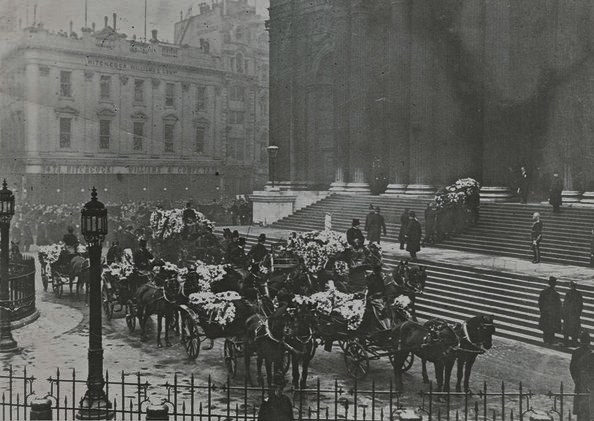
There was grim silence in the middle of the day in Spitalfields on 23rd December 1910, when all activity ceased as the funeral of the three policemen shot dead in Houndsditch on 16th December made its way from Bishopsgate after the service at St Pauls Cathedral, travelling towards the City of London Cemetery in Ilford – as this contemporary newspaper report describes.
Most of the onlookers – including many aliens – stood cramped upon the pavements of Brushfield St for an hour and a half in passive expectation, and the procession moved slowly, as indeed was not only appropriate but necessary in a space so confined. When the hearses passed and the people saw the wreath-laden coffins, they seemed to recognise, in a very personal sense, the pathos and heroism of the lost lives. There was a pitying murmur.
At the end of Brushfield St and corner of Commercial St, which forms an angle of the Spitalfields Market, packing cases stood piled up in tiers and the market employees were clustered upon them. At this point also was to be heard the sombre tolling of the bell from Christ Church, Spitalfields, which directly faces Brushfield St. At noon, workrooms and factories in the neighbourhood released their hands for dinner. Men and girls hurried to the street and at every moment the throng increased. The crowds in Commercial St, where the pavement offered wide standing room, were truly enormous and the presence of so many thousands waiting so patiently was proof of popular feeling deeply stirred. The streets were full of mourners rather than sightseers.
Shopkeepers in the district showed their respect by putting up their mourning boards, or shutters, in the centre of their windows. As the hearses and carriages approached, blinds were drawn. Naturally, at this season of the year, many of the shop windows were gay with Christmas goods, and those seemed curiously out of place on this melancholy occasion.
Englishmen and foreigners mourned alike in Whitechapel. Men and women of foreign nationality gathered together in groups, waiting for the funeral to pass while talking in their native tongues. But they were not aliens of the type that committed the outrage of Saturday last. They appeared to be respectable hard-working people, peaceful and law abiding, and gave the impression they had come to this country to earn their living honestly. The fact is, many of them feel most keenly the stigma which is cast upon them, they resent being classed with criminals who have come to rob, and, with Englishmen, they feel indignation and abhorrence at the crime which has sacrificed those three splendid lives.
Meanwhile there had been significant developments in the case. On the day of the discovery of the corpse of George Gardstein and the arrest of Sarah Trassjonsky at 59 Grove St, Nicholas Tomacoff stepped from the crowd and knocked on the door, looking for a gentlemen by the name of “Fritz Svaars,” in whose room the body had been found. Aware of the £500 reward for information leading to the arrest of the members of the gang responsible for the murders in Houndsditch, he was naturally eager to assist the police, and they booked him into a hotel with all his expenses paid for the next five weeks.
Nicholas Tomacoff had been teaching Fritz Svaars to play the mandolin for the past three months and dropped by unexpectedly to visit him in his room the previous day – on the afternoon before the robbery – only to discover a group of friends with Svaars. Tomacoff was able to give police names and descriptions for the five men he had see there, including George Gardstein. And that very evening he led them personally to 141 Romford St, the residence of Osip Federoff, a locksmith, and 36 Havering St, where Peter Piatkow and Pavell Molachoff lived. All three were arrested, and then a policeman accompanied Tomacoff on a Christmas shopping spree in which he bought boots, a shirt, a collar and socks at the cost of fifteen shillings and sixpence. Subsequently he bought underpants, a vest, socks and a collar for eight shillings and fourpence, and later a hat and an overcoat for fourteen shillings and ninepence, amounting to a new wardrobe courtesy of the police.
Luba Milstein was dragged into Leman St Police Station by her brothers, who had escorted her all the way from Columbia Rd when they suspected her of involvement in the case, and she was placed under arrest. A woman came forward, who recognised the face of George Gardstein on the reward poster, to reveal that she had rented a room to him under the name of Mr Morin at 44 Gold St, and a police search of the room produced a cache of weapons. From the evidence that had come to light and the interviews with Sara Trassjonsky and the others who were now under arrest, the nature of endeavour by the gang of Latvian Anarchists was beginning to emerge, even if the precise nature of their inter-relationships remained unclear. They had rented the property in Exchange Buildings solely for the purpose of the robbery, which although of serious intent was an escapade of dubious practicality.
The Whitechapel police had little sleep for days as the tenacious Inspector Frederick Wensley combed all the lodging houses in the vicinity, where as many as seven hundred men slept each night, in his search for the other members of the gang. Committal proceedings were opened at the Guildhall Police Court on December 21st when the suspects in custody were brought before the court, but before proceedings commenced there was a new and unexpected twist.
During the holiday season, readers may rest assured that they will be kept informed of any advances in the development of this case as they occur.


Memorial cards sold by hawkers at the funeral procession.

The haul from 44 Gold St, described by the press as “the anarchists’ bomb factory.” Guns, ammunition and a small quantity of chemicals were discovered, which a police observer later revealed were “practically useless for the manufacture of explosives. There was no sign of a bomb and no indication that any attempt had been made to make one.”
Images copyright © Bishopsgate Institute
Myra Love, Maori Princess

“My mother was the Queen of Rarataonga, so I am a princess,” admitted Myra Love, with a gentle ambivalent grin, when I pressed her. Yet her ancestry on her father’s side is equally impressive, she is a Maori of the Te Ati Awa tribe of Petone, and her ancestors include two eighteenth century Scots from Selkirk – an explorer and an whaler – who married Maori princesses, Robert Park (brother of Mungo Park) and John Agar Love. “I always say my legs are Scottish,” Myra added with a smirk, claiming the European thread in her lineage with pride.
Today, Myra’s residence is a one bedroom flat in Bethnal Green – as far away as it is possible to be from her ancestral land – yet she still feels her responsibilities to her people, revealing a passionate sense of duty when she speaks of the politics of land. “I never learnt Maori because my grandmother said ‘English is the language of power, and you have to be fluent in English and get the land back’ – and we have. We formed corporations and we’re able to reclaim it today because the leases are coming up after a hundred years. There’s loads of land that we gave away for beads and blankets, and we’re getting it back.” Myra told me, swelling with magnificence and widening her eyes in skittish delight, adding, “Most of Wellington belongs to us now, and we got the railway station back last month.”
In this moment, I was afforded a glimpse of the woman who was born to be Queen of Rarataonga, because even though she does not choose to enact her public role, Myra’s abiding concern is the stewardship of the land on behalf of her people and her driving force is her desire to leave it in a better state. In another age, Myra might have led her tribe in battle, but today she fights at the High Court instead. “We are a warlike people!” Myra informed me proudly, accompanying the declaration with a winning smile. She knows that the success of her endeavour will define her legacy when she is long-gone, and in this sense, her concerns are parallel to medieval English royalty, seeking to unify the realm for generations to come.
“When I was a child, there was a feeling that we were second-class citizens.” continued Myra with a shrug, “If I was put down for being a Maori, my grandmother would say ‘Remember they’re walking on our land,’ and she owned quite a lot of land. My father was going to change how land was owned in our part of the country but he went to war and got killed instead. He was a leader of men. I was only five when he left. He went to Sandhurst and was the first Maori to command a battalion in World War II, but Maori leaders always fight alongside their men, and he was shot.
I was the youngest of three siblings so I didn’t count for very much until they died, and then I became very important because now I own a lot of land. I’m getting some of the land in New Zealand and some of the land in Rarataonga. And their siblings are fighting me for it and I am defending it in the High Court. I’m partitioning it out because I don’t want it for myself and I don’t want them to sell it, and I intend to stay as healthy as possible because they all want me to die.”
Stepping into Myra’s warm flat, painted in primary colours and crowded with paintings, plants, photographs, legal books, jewellery and musical equipment, I entered the court of a woman of culture. Not in the least high-faluting, she balances her serious intent with an attractive emotional generosity, which made it an honour to sit beside her as she opened her photo album. And Myra made it clear that she became the author of her own destiny, when she made the break at twenty-one and ran away – like Audrey Hepburn in “Roman Holiday” – to find a new life in the wider world.
“Once my grandmother died, the family disintegrated and I was moved out of the family house, so I decided to leave. Every Christmas we met together, but when she was gone there was a fight for the land, so because my family were all angry, I chose to go to America and become a jazz singer.
I sold a piece of my land to my uncle for £300 and bought a P&O ticket to San Francisco. You think everywhere’s going to be like New Zealand, so it was a bit of a shock when I got off the boat, because I was bit of a hokey girl. But it was exciting and, going through the Golden Gate Bridge, I thought, ‘My dreams are coming true.’ And some girls on the boat told me they knew Oscar Peterson, and they took me to the Black Hawk Club and there was Oscar Peterson. But I thought, ‘I’m going to New York,’ so I got on a train. It was 1958 and I had £100 left. I was an innocent abroad. In New York, I stayed on Bleecker St, just around the corner from Marlon Brando.
It was such a joy to visit places you’d only read about in books. At school I learnt Wordsworth’s ‘Westminster Bridge’ and when I came to London I had to go there at dawn. By then, I had only about £25 left, but money went a long way in those days.”
Myra told me it takes thirty years to learn to be a jazz singer, and she also filled those thirty years with getting married, having three children, and getting an Open University degree. “I got divorced because he wouldn’t let me go on singing,” she confided, spreading her hands philosophically, “When we broke up, I did a teacher training course and my first job was in the East End. I’ve always worked in underprivileged areas, and I’ve sent more kids to university than I’ve had hot dinners. These kids they know a little about a lot, and they’ve got the ability to latch onto something. They’re more than people who don’t live in the area know, because their struggle has been long. I’ve always believed that knowledge is power and that’s what I’ve tried to teach these kids.”
Recognising their situation equated with that of her own people, Myra discovered a sense of camaraderie with the people of the East End, which drew her to adopt the place as her home from home. And so it was that, Myra Love, the heroic Maori princess – devoted to fighting for the rights of her tribe – became a popular figure in the East End today, renowned for singing jazz at the Palm Tree in Bethnal Green. “I get my kicks from meetings with old East Enders,” she confessed enthusiastically, “They’re a tough breed. These people are just like me – they’re Maoris!”
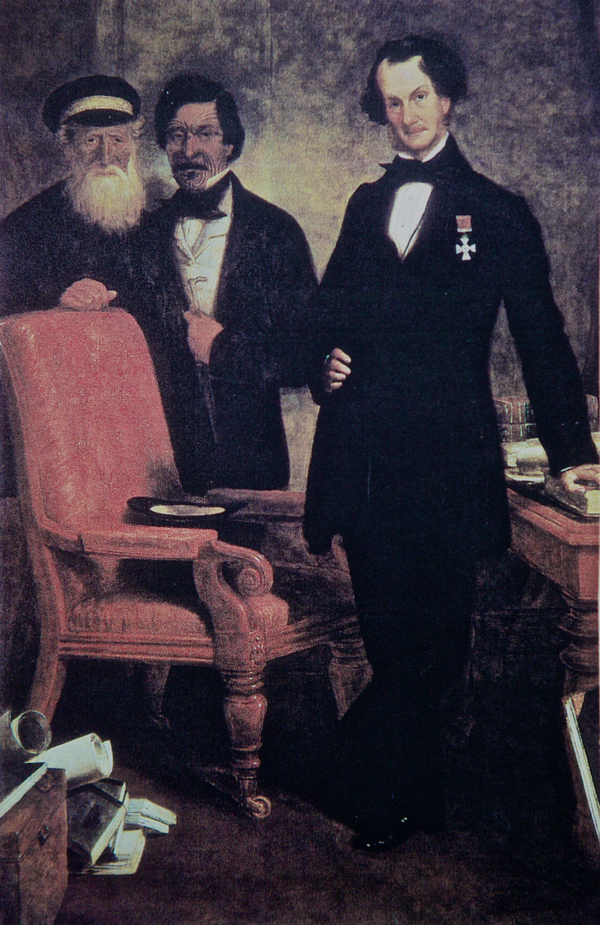
This painting of 1858 by William Beetham shows the Maori Chiefs of Wellington with Dr Featherstone at the time of treaty of Waitanga which established peaceful colonial government in Aotearoa. On the left is Hon Tako Ngatata MLC and in the centre Honiana Te Puni Kokopu, from whom Myra is descended.
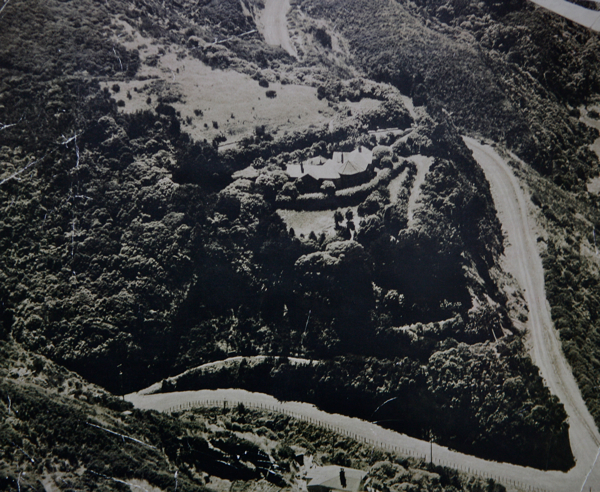
Taumata, Koro Koro Rd, Petone – “My grandmother had this house built in 1898, she picked this hill so she could see where she was born and where she would be buried. And I was born there November 8th, 1934, and I will be buried there too.”
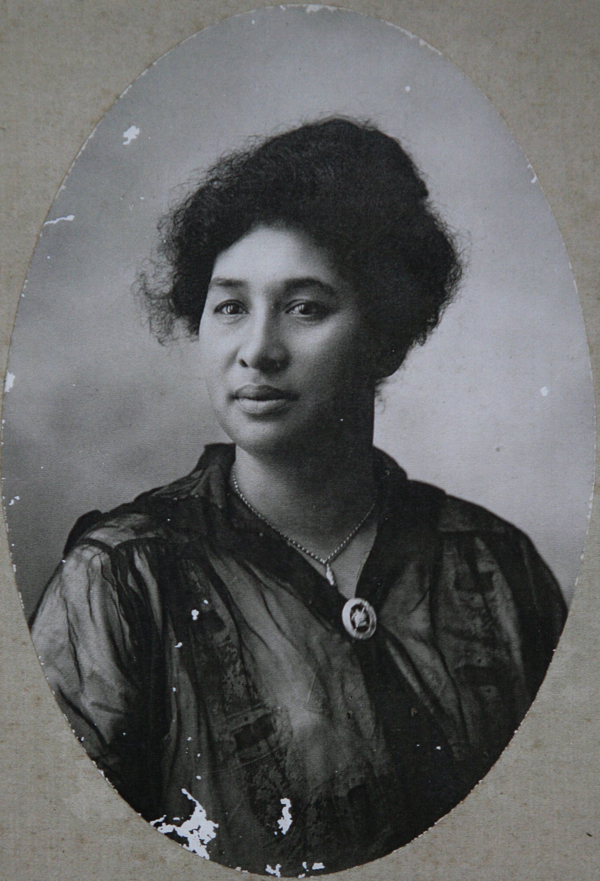
Myra’s grandmother, Ripeka Love
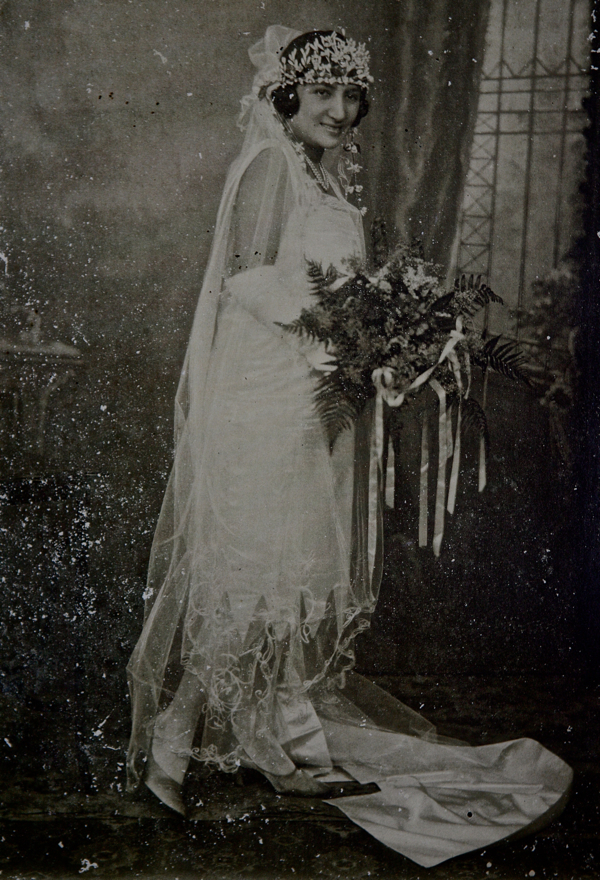
Myra’s mother, Takau Upoko-o-nga Tinirau Makea Nui Ariki Love, Queen of Rarataonga.
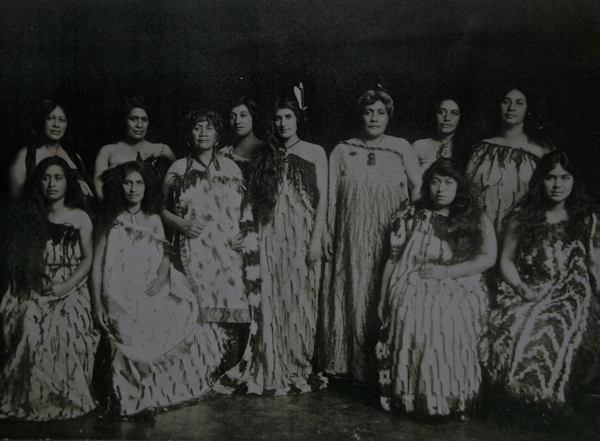
Rangitira women of the Te Ati Awa tribe. At the centre is Lady Pomore, standing to her right Romahora, then Grandaunty Mata with Grandma Ripeka Love at the end of the row.
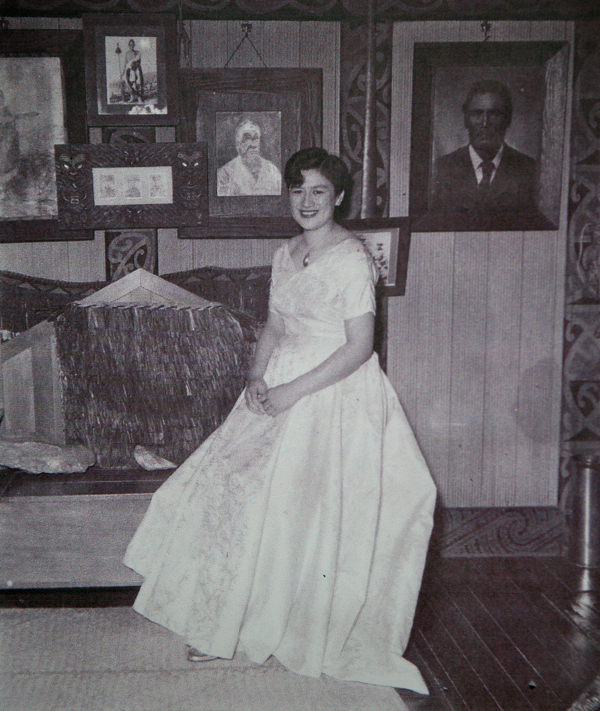
Myra Love in her debutante’s dress – “We are really very posh in the Maori way of thinking!”

Myra Love
Portraits copyright © Patricia Niven












