
Mr Pussy in Winter

It is Midwinter’s Day, and tonight – the longest night of the year – Mr Pussy will not stir from the chimney corner. Warmed by the fire of burning pallets, he has no need of whisky to bring him solace through the dark hours, instead he frazzles his brain in a heat-induced trance. Outside in the streets, Spitalfields lies under snow, the paths are coated in sheet ice and icicles hang from the gutters, but this spectacle holds no interest for Mr Pussy. Like the cavemen of ancient times, his sole fascination is with the mesmerising dance of flames in the grate. And as the season descends towards its nadir in the plunging temperatures of the frozen byways, at home Mr Pussy falls into his own warm darkness of stupefaction.
Mr Pussy is getting old. The world is no longer new to him and his curiosity is ameliorated now by his love of sleeping. Once he was a brat in jet black, now he is a gentleman in a chenille velvet suit, and tufts of white hairs increasingly fleck his glossy pelt. Toward the end of Summer, I noticed he was getting skinny, and then I discovered that his teeth have gone which meant he could no longer crunch the hard biscuits that were always his delight. Extraordinarily, he made little protest at his starvation diet, even as he lost weight through lack of food. Now I fill his dish with biscuits and top it up with water, so that he may satisfy his hunger by supping the resulting slush. And through this simple accommodation – plus a supplement of raw meat – his weight is restored to normal and he purrs in gratification while eating again.
Once Mr Pussy was a wild rover, ranging over the fields in Devon, disappearing for days on end and returning proudly with a dead rabbit in his mouth. Now he does not step beyond the end of the alley in Spitalfields and in these sub-zero temperatures only goes outside to do his necessary business. Sprinting up the stairs, and calling impatiently outside the door of the living room, he is ever eager to return to the fireside and warm his cold toes afterwards, sore from scraping at the frost in the vain attempt to dig a hole in the frozen earth. Like a visionary poet, Mr Pussy has acquired a vivid internal life to insulate himself against the rigours of the world and, in the absence of sunlight, the fire provides his imaginative refuge, engendering a sublime reverie of peace and physical ease.
Yet Mr Pussy still loves to fight. If he hears cats screeching in the yard, he will race from the house to join the fray unless I can shut the door first and prevent him. And even when he has been injured and comes back leaking blood from huge wounds, he appears quite unconcerned. Only two small notches in his ears exist as permanent evidence of this violent tendency, although today I regularly check his brow for tell-tale scratches and recently he has acquired some deep bloody furrows that have caused swelling around his eyes. But I cannot stop him going out, even though it is a matter of concern to me that – as he ages and his reflexes lessen – he might get blinded in a fight one day, losing one of his soulful golden eyes. Since he is blissfully unaware of this possibility, I must take consolation from his response when he could not eat, revealing that Mr Pussy has no expectations of life and consequently no fear of loss. His nature is to make his best accommodation to any exigency with grace.
And be assured, Mr Pussy can still leap up onto the kitchen counter in a single bound. He can still bring in a live mouse from the garden when he pleases and delightedly crunch its skull between his jaws on the bedroom floor. If I work late into the night, he will still cry and tug on the bed sheets to waken me in the early morning to see the falling snow. When the fancy seizes him, he can be as a sprightly as a kitten. Come the Spring, he will be running up trees again, even if now – in the darkest depth of Winter – he only wants to sleep by the fire.
Alone here in the old house in Spitalfields tonight, Mr Pussy is my sole companion, the perfect accomplice for a writer. When I take to my bed to keep warm while writing my stories, he is always there as the silent assistant, curled into a ball upon the sheepskin coverlet. As the years have gone by and Mr Pussy strays less from the house, I have grown accustomed to his constant presence. He has taught me that, rather than fear for his well-being, I need to embrace all the circumstances and seasons that life sends, just as he does.

You can read more about Mr Pussy here:
Laura Knight, Graphic Artist
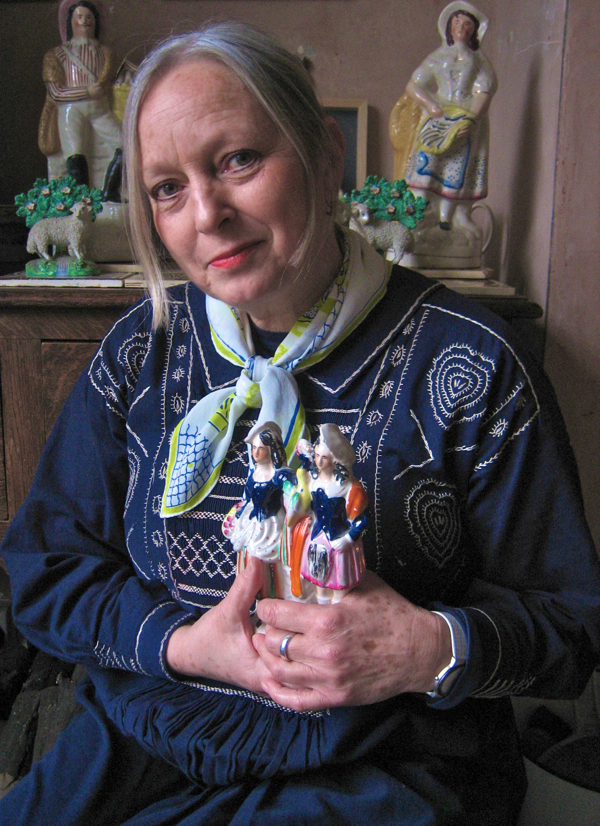
“I bought them ten years ago for £10 in a secondhand shop in the Essex Rd,” revealed Laura Knight with a proud gleam in her eye, when I enquired the origin of this fine nineteenth century couple. “The colour and the style of them really appealed, they spoke to me,” she said, contemplating the cherished figures.
In retrospect, ten pounds was truly a bargain price for this Staffordshire group that has proved to be such a rich source of inspiration for Laura. “With Staffordshire Figures, there’s always two things going on,” she explained to me, articulating the dynamic that gives these modest designs their charisma, “there is the fineness of detail in the moulded form, in contrast to the application of the colour which – I suppose because it may have been done by children – has a childlike, almost crude quality.”
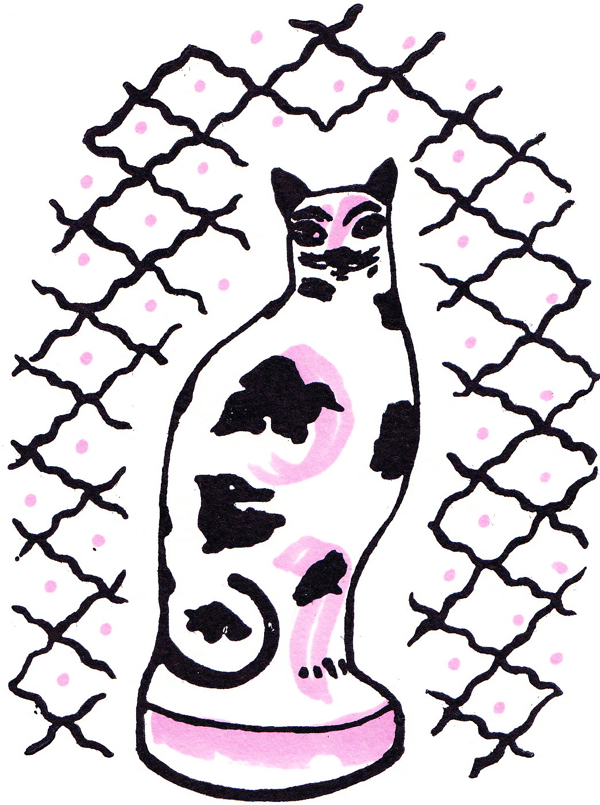
When Laura’s elegant prints of Staffordshire Figures drew my attention recently, capturing the spirit of these pieces with rare grace and economy of means, I recognised they were the assured work of a mature artist in control of her medium. So I became curious to discover the story behind them and I invited her over to find out.
As soon as Laura leapt off the bus outside Liverpool St in the snow, she cast her lively eyes around in wonder at the changes in Spitalfields, recalling humorously that once upon a time she often came to Brick Lane for a curry at the Nazrul and enjoyed watching the strippers over a drink at the Seven Stars in Brick Lane. “It used to be a nice place for cheap night out when I was a student at the Royal College of Art in 1978,” she admitted to me with a nostalgic grin. Laura’s grandparents were from Bethnal Green, “The talk was of boys’ clubs and boxing matches,” she remembered as we walked through the streets together, “It’s sad when you can’t have the conversations that you wish you’d had with them in the nineteen seventies when they were alive.”
There is an emotional resonance to Laura’s graphic work that draws you in, and in which pieces of china exist as personal fragments to evoke an entire culture. “They were on everybody’s mantlepiece and everybody’s dresser. They are a vivid background, deep in our memories of home. There wasn’t a kitchen without a piece of willow pattern or a mantlepiece without a piece of Staffordshire.” said Laura, speaking from the heart, “But because they’re so familiar they’ve become forgotten and no-one’s looking at them any more.”
After graduating from the Royal College, Laura enjoyed a successful career as an illustrator which led to teaching, which led to cutting back on her own work. And then when she quit teaching, she found herself starting all over again as illustrator. “I suppose if you really love something, you just want to keep doing it until you can make it your own,” was Laura’s self-effacing explanation of her predicament at this moment – also the moment when she remembered the Staffordshire couple that she bought in the Essex Rd. “I realised when I was drawing them that they were suitable for rubber stamps,” said Laura, revealing the discovery of her technique, whereby she gets her drawings made up into rubber stamps and then colours them herself, as a cottage industry, just like the ceramic painters of old. “I want to make my work into products that I can sell, rather than wait for people to commission me,” she continued, outlining her policy to achieve artistic independence, “I’ve started working with the London Printworks Trust who have given me a lot of support. They do small runs and they have printed my designs onto silk scarves.”
Knowledgeable and passionate about the history of English popular art, and with a distinctive mature style, Laura Knight is creating work that is irresistibly appealing. And it is my privilege and delight to introduce you to Laura and her joyous creations, because she has no outlets yet. In fact, Laura has just twelve of her beautiful silk scarves with handrolled edges that she sewed herself, and it is a condition of her support from the London Printworks Trust that she needs to sell these before they will print more. They cost £55 each and if you contact her to buy one, she will send it out to you at once.
It is the week before Christmas, need I say more?
Limited numbers of cards, silk scarves and cloth kit cushions are available direct from lauraknight@waitrose.com


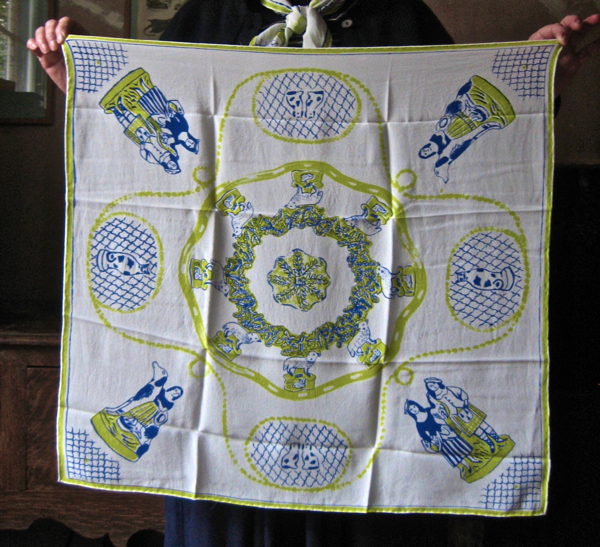
Laura has made twelve of these fine silk scarves, hand rolling the edges of each one.

The Staffordshire couple bought for £10 in the Essex Rd ten years ago.

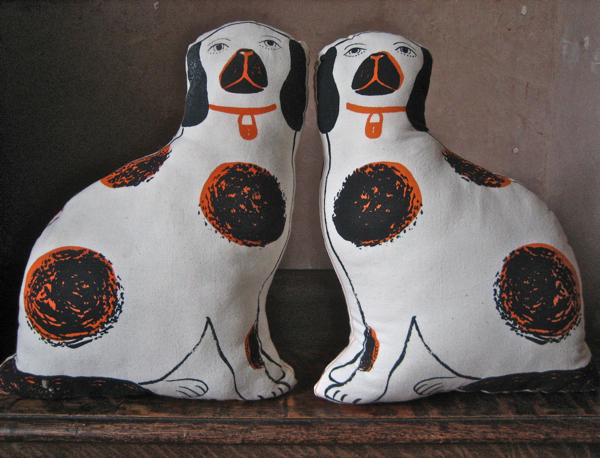
Laura designed this pair of cushions as a cloth kit to sew yourself.
Images copyright © Laura Knight
Columbia Road Market 64
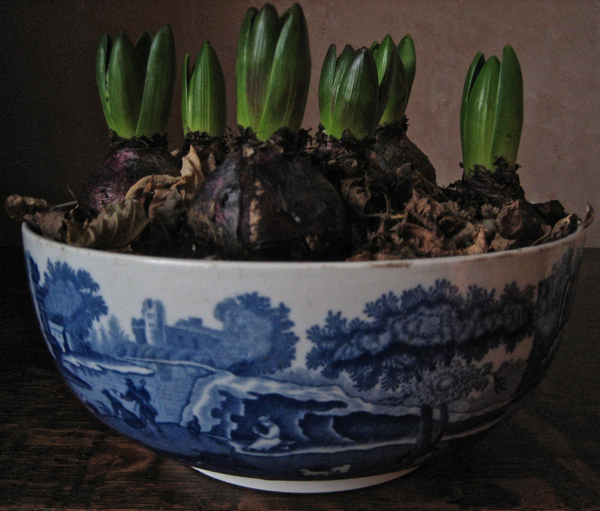
Each year at Christmas, my parents would drive over to Chard in Somerset to visit my grandmother for lunch on Christmas Day, and this blue Spode bowl always sat upon the sideboard in the dining room with blue Hyacinths sprouting in it, as a promise of the New Year and the Spring to come. Subsequently my mother inherited the bowl and it sat upon the dresser in Exeter, but now that all my living relatives are gone, it is here with me in Spitalfields and it is my lone responsibility to uphold the tradition by planting Hyacinths each year. Last year, I filled it with bulbs from Columbia Rd Market which, in a unique precedent in the history of this bowl and to my surprise, turned out to be bright pink. Although my grandmother would certainly not have approved, it was an exuberant break from the conservatism of tradition. But this year, the seller who sold me these six bulbs for £5 assured me they were blue – of the variety called “Blue Pearl”- so I shall now live in keen expectation of the New Year to discover what appears in 2011.
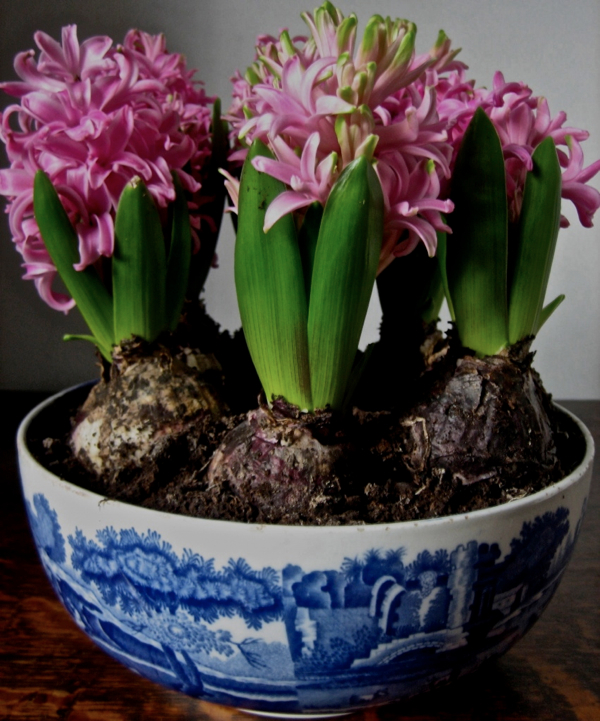
The Hyacinths of 2010.
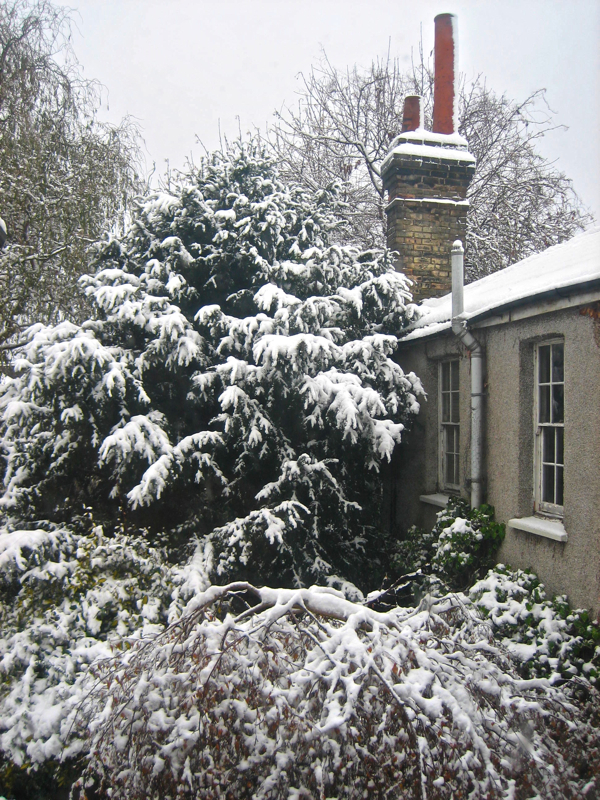
I awoke to this view from my bedroom window in Spitalfields yesterday.
Chapter 2. A Body in Grove St

After a tip-off, police discovered a body at 59 Grove St in Stepney. It was one of the gang who had staged the attempted robbery in Houndsditch on 16th December, and he had been shot accidentally by one of his fellows during their escape.
Dr Scanlon telephoned Arbour Sq Police Station with the news. He had been awoken at 3:30am by two women with their faces concealed by shawls and who could not speak English. He understood that “A man is very bad at 59 Grove St.” and followed them through the dark streets to the house where, lying in a blood-stained bed, he found a man with a bullet-wound to the chest. The dying man refused Dr Scanlon’s suggestion to transfer him to the Royal London Hospital, and so the doctor could only prescribe medication to ease the pain. When he asked what name to write upon the certificate, Dr Scanlon was told “George Gardstein.” Then one of the women returned with him to collect the medicine and he promised that he would visit later to check upon the casualty.
The report of Dr Scanlon’s call was passed to Inspector Frederick Porter Wensley – known as “the Weasel”- who had joined the force in 1887 at the time of the Whitechapel murders. Originally from Somerset, he had a reputation for ambition and was frustrated that he had been held back from promotion to the role of Detective, because it would mean a transfer when he had become too useful in Whitechapel.
Wensley arrived at Dr Scanlon’s surgey in the company of Detective Inspective Thompson of the City of London Police – acknowledging the importance of this unexpected break in the case. Dr Scanlon was instructed to pay a second call and then return to the surgery, both to avoid raising suspicions and to protect himself as informant. Yet inexplicably, when Dr Scanlon discovered the dead body of George Gardstein, he rang the Coroner at once and the news was leaked to the press. Then he returned to the surgery and informed Wensley and Thompson, who raced in anger to 59 Grove St with news reporters on their heels.
Mindful of what happened in Houndsditch and with characteristic pragmatism, Wensley pushed the obese landlady up the staircase ahead of him as a human shield against any bullet, but in the front bedroom he discovered only Gardstein’s wide-eyed corpse upon the bed and a small hunchbacked woman hastily burning papers in the grate in the small back room. Her name was Sara Trasjonsky and it was she who summoned Dr Scanlon.
A tweed cap full of bullets lay upon the bedside table, an overcoat with a bullethole in the back hung upon the bedstead and a loaded pistol was discovered concealed under the bloody mattress. A door key from Exchange Buildings was found in the dead man’s pocket and, in his pocket book, a membership card for a Latvian Anarchist Communist group, beside instructions for detonating bombs by electricity. Gardstein was carrying a fake passport in the name of “Schafshi Khan.”Letters were scattered around the room, mostly correspondence from a man named Fritz in the hard labour section of the Central Prison in Riga and, amongst other papers, there was also a statement of accounts for the Social Revolutionary Party in Baku. It was evident that a criminal gang of Eastern Europeans with political motives were on the loose in the East End, and the City of London Police offered a £500 reward for information leading to to their arrest. “Who are these Fiends in Human Shape?” was the headline in the Daily Mirror, and government policy towards immigrants and political refugees was questioned.
Now that George Gardstein could no longer object, his body was transferred to the Royal London Hospital, where a medical student told a journalist, “We’ve got him. There was very great competition and he’s as handsome as Adonis – a very beautiful corpse!”
You may be assured that further reports of any new developments will be forthcoming in the next week.
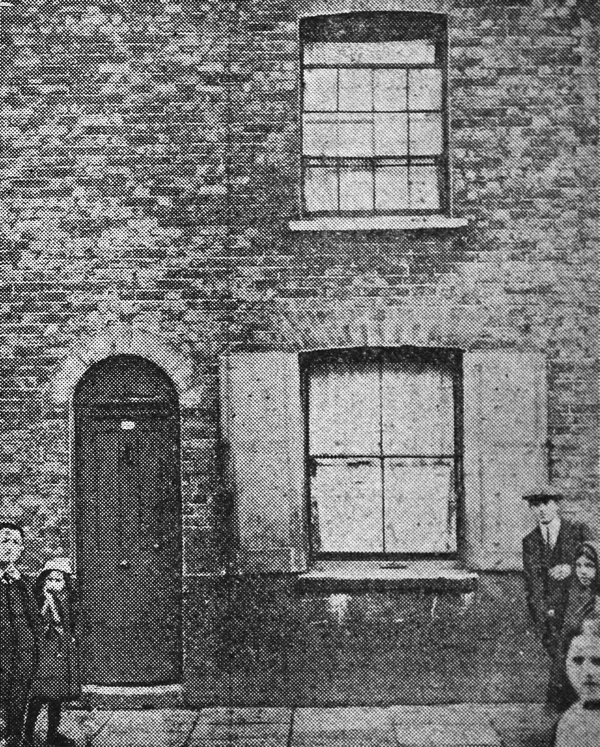
59 Grove St – the body was discovered in the upper room.

Grove St, looking North.

Today, Grove St is renamed Golding St and only a fragment remains. In this view, equating to the photograph above, the approximate site of 59 Grove St is now occupied by the garage in the centre right.
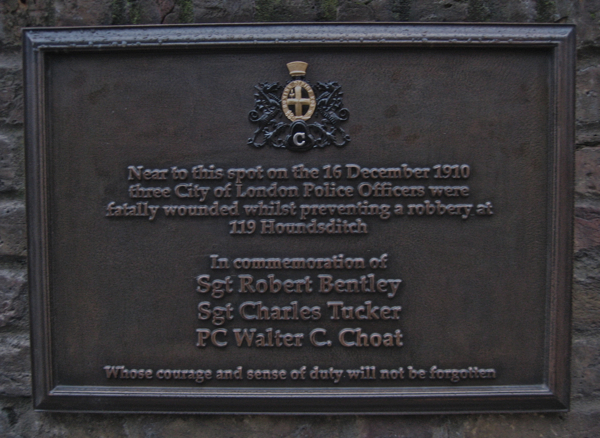
The memorial to the dead policemen unveiled in Cutler St, Houndsditch, last Thursday, on the day of the centenary.
Archive images copyright © Bishopsgate Institute
Captain Shiv Banerjee, Justice of the Peace

This is Shiv Banerjee – the Captain at the wheel of his ship – on the long voyage that led from his birth in Kailish Ghosh Lane in Dhaka, East Bengal in 1945, to the Toynbee Hall in Commercial St, Spitalfields where he resides today. In fact, the accommodation block at the rear of Toynbee Hall has so many staircases opening onto galleries with lines of neat front doors stretching in every direction, that it does have a certain nautical aspect to it, and on the upper terrace where Shiv has his flat there is even a metal rail just like that on a ship – except, when you peer over, you discover Gunthorpe St below rather than the roaring ocean.
We met at the introduction of Muktha, waiter at Herb & Spice, from where it was a short hop down Commercial St to the Toynbee Hall, and as I walked through the courtyards with Shiv, other residents nodded and waved in respectful acknowledgement, enforcing my feeling that I was accompanying the Captain of the vessel. So when I entered his quarters, it was no surprise to discover a model ship in the living room of his modest yet comfortably furnished flat. We had arrived at the chosen location for Captain Banerjee to tell me about his extraordinary journey.
I was born in Kailash Ghosh Lane in Dhaka, and when I was two months old I was brought to New Delhi, where I lived in the government houses at Lake Square, designed by Edwin Lutyens. I’d never seen the sea when I applied to be a cadet, but I wanted to go to different places. I applied for the exam in 1962 and didn’t get selected for interview – about fifty-five thousand people applied for seventy-five places and they only interviewed one hundred and twenty. But I didn’t give up and I studied civil engineering for a year before I was accepted on the Dufferin, the British Navy’s cadet ship for Indians, Burmese, Ceylonese and Singaporeans. It was a lonely life but I learnt to like it because I had never known anything better. I was sixteen years old and earning beyond what anyone in my family had ever earned before and the uniform was very attractive to women too. I became an officer at twenty-one and when I went back to Lake Square and got out from the taxi, everyone would come and say, “Here is the hero!” Everyone was very proud of me and I was very proud of myself.
In 1966, I visited Liverpool. It was wonderful. I thought, “All the white people will be there and all the important people will be there too.” Going ashore was exciting, I had my first fish & chips and went out and saw the sights. At the Seaman’s Club, “Top of the Pops” was on the television and I saw The Beatles. Everything excited me, nothing was depressing or bad. I came from a poor background and everything was free on board ship and I had money to spend on shore. It was one of the most exciting times in my life.
Then, in 1972, I came to London to study for my Master’s Ticket, so I could captain a ship – because if you had it from London, you were “Made in England” and you could work anywhere in the world. At Heathrow, I was asked a lot of questions and the official wasn’t very polite. “Have you got enough money?” he asked me. “I’ve got five thousand pounds in cash.” I said. Then I took a taxi to Lancaster Gate and it was very expensive and I was pick-pocketed seventy-five pounds in the street on the first day. So I moved down to stay at the Queen Victoria’s Seamen’s Rest in the East India Dock Rd and went to study at the School of Navigation at Tower Hill.
A priest in New Zealand once told me the Toynbee Hall in Commercial St was the place to stay, so I went to find out more. They interviewed me and said I could stay for free for two nights and see how we got on. We all used to eat together then, it was very communal. I loved it. I said, “I’ll stay here.” And it was where I met my wife who was a teacher at Christ Church School. This woman asked, “Can you teach me Bengali?” and I fell in love with her and didn’t pass my exam. We moved in together to a flat in Sunley House, Toynbee Hall at £12.50 per week, including heating, maintenance and service charge. Finally, in 1977, I passed my Captain’s Exam and I told my wife, “I’ll take you to sea.” She said, “Either you stay here with me, or I change the locks on the door and get a new man.” So I gave up my sea career, but I said, “Let’s decide a few things. You are white and I am black. Our children will not know if they are black or white, so we will not have children.” Next day, I went and had a vasectomy done and then I took her to sea for a year before we settled here. I came on land but I had no job.
I became a volunteer for a year and a half working at the Attlee Adventure Playground off Brick Lane, and then Donald Chesworth, Warden of Toynbee Hall, said, “I’ll raise the money to pay you.” In those days, the staff was entirely white. I went off to sea for six months to earn some money and he sent a cable to say I was offered the job of “Volunteer Co-ordinator and Education Outreach Officer” and I became the first black worker to be employed by Toynbee Hall. I launched an out of hours project for old people – if something went wrong at night, we would come and see to it – and I also worked with mentally and physically handicapped children. Toynbee Hall became my home, I decided it was my job to keep it neat and clean, although no-one had given me that job. I was a proud person to keep this place clean.
Then I joined the Inner London Education Authority as a Social Worker, but as I still did not have any qualification on land, I did a research diploma at the City Lit on barriers to education for Bangladeshi children. Next I worked in the Homeless Families’ Team, there were so many children out of school because their families were being housed in hotels. I negotiated with teachers to get them places in schools and I set up a homeless families’ project in a church hall in Finsbury Park. Until then, the only entertainment for these people was making babies, sex and sex and sex, education was not in it.
But I was getting tired, and John Profumo CBE and Chairman of Toynbee Hall took me under his wing and took me to the Reform Club where I met the good and the great. And in 1984, he called me and said, “Do you want to be a magistrate?” I said, “I am not legally qualified, I only know about ship captain’s law.” but Lord Ponsonby, C.E.O. of British Home Stores and a retired Brigadier said, “Put me down as your referee.” They asked me to apply and I got it. I was the first Bengali speaking Justice of the Peace.
I consider language to be the basis of everything – knowledge of English language, both spoken and written. And I always felt that, for an individual, if they are to stay in this country, they had to know the language. In the past, people always said “Yes” to everything, because they were not able to express their needs. I started to teach English to blind people and encouraged the families in the Finsbury Park Homeless Families’ Project to learn English together, because I still feel strongly that lack of education is the main barrier to progress.
Shiv’s voyage was guided by an instinctive moral compass, granting him a natural authority today, even though he refrains from asserting his status. Somehow, he discovered a sympathetic crossover from his life on board ship with its respectfully structured society to the civilian world – equally employing his organisational skills and sense of humanity too.
With quiet courtesy and dressing in undemonstrative formal clothes, Shiv has devoted himself to a life of usefulness. It is rare to meet someone as open as Shiv, a shrewd man with a clear conscience, who can speak without subtext and use plain words to tell you exactly what he means. Never cynical nor flippant, Captain Shiv Banerjee, Justice of the Peace, has an open-hearted vocation to serve his people.
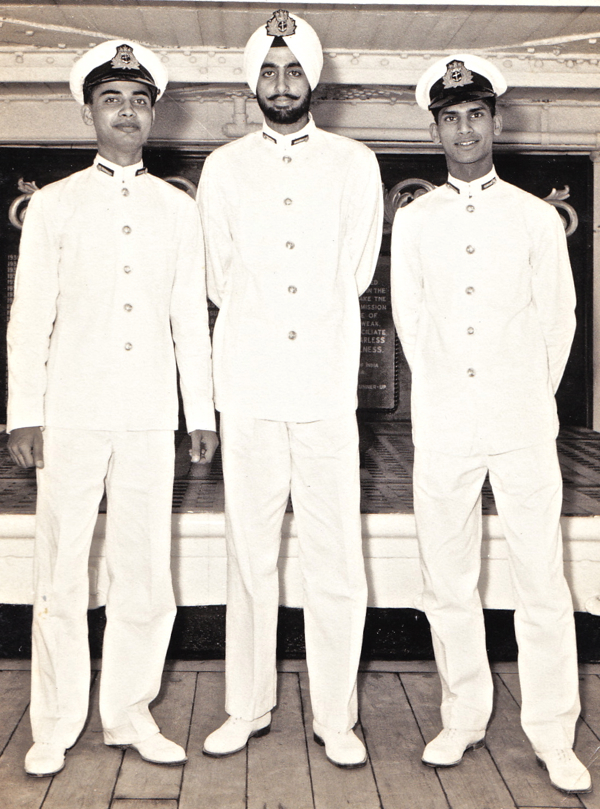
On the left is Shiv, aged seventeen years old, pictured here on board the Training Ship Dufferin with fellow marines Hardev Singh Boparai and Yashpal Das, in August 1963, after the oath ceremony.
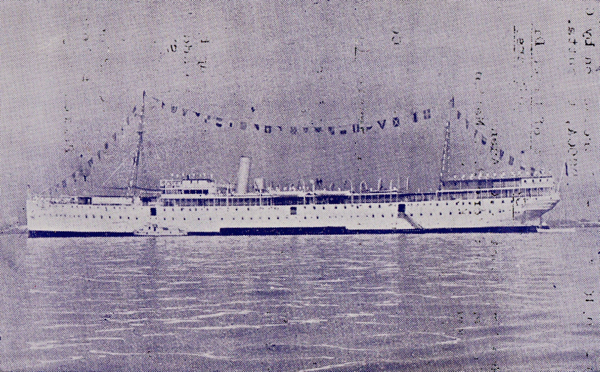
Indian Mercantile Marine Training Ship, Dufferin – “There’ll always be a Dufferin upon the Indian Sea, Wherever flies the Merchant Flag there also we will be.”
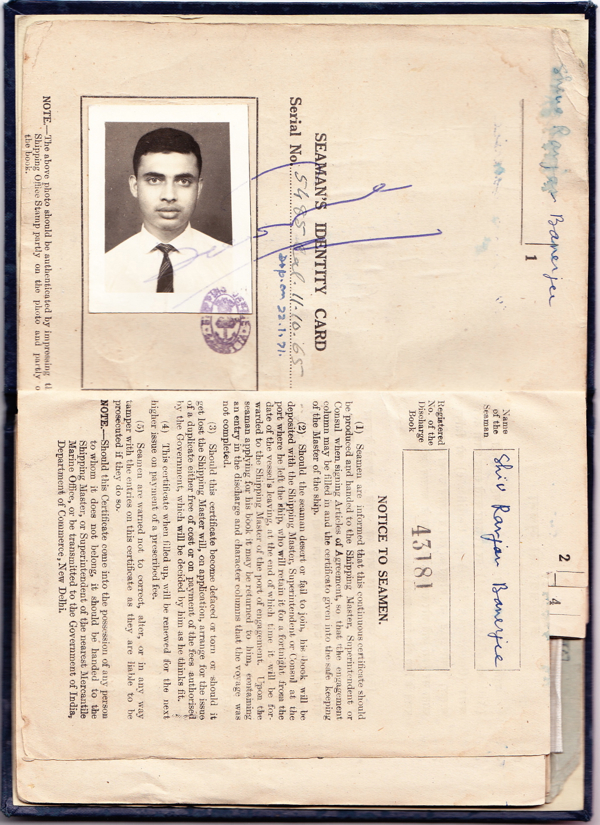
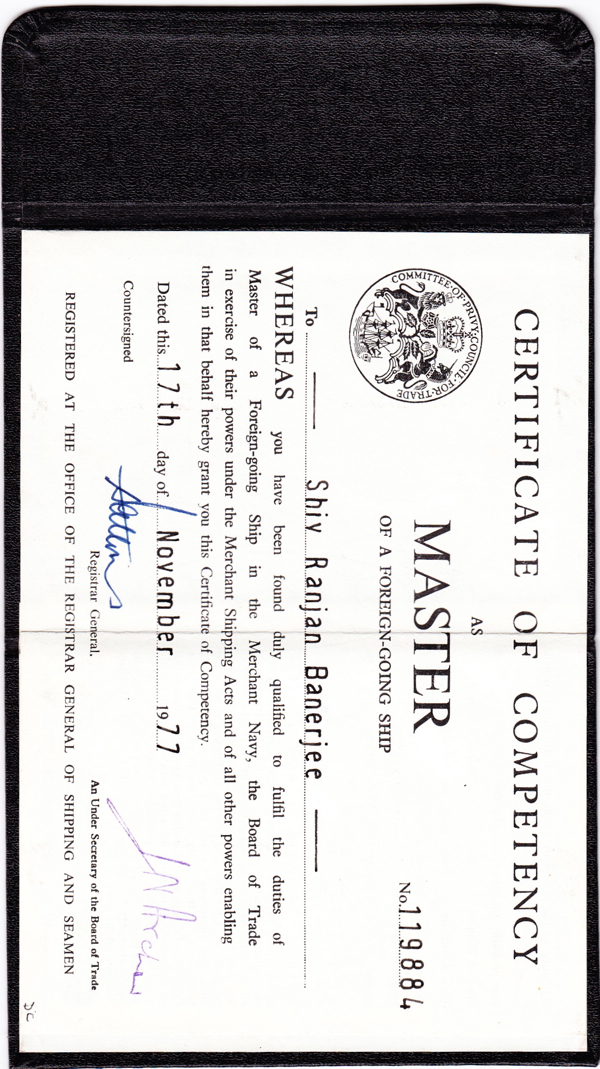
Shiv’s Master’s Ticket that qualifies him to Captain a ship.
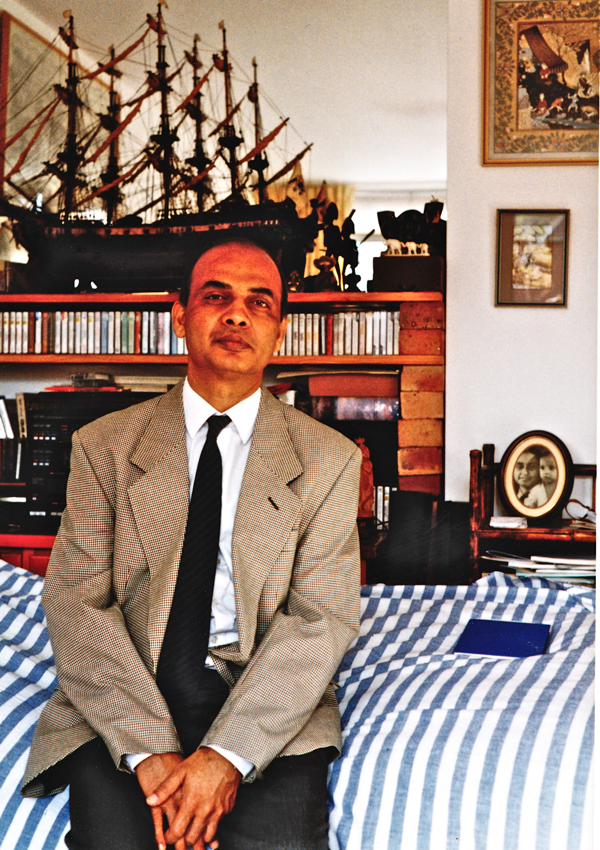
Captain Shiv Banerjee, Justice of the Peace, Toynbee Hall, Spitalfields
Chapter 1. Murder in Houndsditch

A hundred years ago tonight, on 16th December 1910, mysterious sounds of hammering were heard coming from Mr Harris’ empty jeweller’s shop at 119 Houndsditch at the boundary of the City of London. When Max Weil, a fancy goods dealer who lived over his shop next door, returned home after ten that night, he discovered his wife and servant girl agitated by the noises coming from the other side of the wall. On further investigation, he confirmed that Mr Harris had gone home long ago, because the jeweller’s steel gate was locked from the outside, and peering through the window he saw the electric light that always burned in the backroom, illuminating the iron safe rumoured to contain the Tsar’s crown jewels. Everything was as usual – apart from the unexplained hammering.
Although it was a cold night, Weil walked over to Bishopsgate where he fetched Constable Walter Piper and when they listened together outside the shop, they heard what Piper later described as “drilling, sawing and breaking away of brickwork.” He walked around to Exchange Buildings, the cul-de-sac at the rear, to investigate. When Constable Piper knocked at 11 Exchange Buildings – where gaslight glowed above the folding shutter – the door was opened at once and in a manner so furtive that the Constable chose to play innocent, asking, “Is the missus in?”
“She has gone out,” replied the unknown man who answered the door, shaking his head for emphasis. Deeply suspicious now, Piper shrugged it off. “Right, I will call back,” he said, walking away and deducing that a heist was under way. Going to seek back-up, Piper saw a man lurking in the gloom at the entrance to Exchange Buildings, but when the Constable approached, the figure sloped away silently. In Houndsditch, Piper met Constables Walter Choate and Ernest Woodhams, and they took positions outside the jeweller’s shop and at the entrance to Exchange Buildings, while he went to seek assistance from Bishopsgate Police Station.
On his way to the Station, Piper encountered Sergeant Robert Bentley accompanied by two Constables in plain clothes, James Martin and Arthur Strongman. Piper introduced Sergeant Bentley to Max Weil who had sounded the alarm, and Weil took the Sergeant into his counting house to listen to the hammering through the wall. When the Sergeant emerged into Houndsditch again, he met two Sergeants, Bryant and Tucker, sent from Chief Inspector Hayes at Bishopsgate Police Station to convey the message that he had suspicions of some foreigners living in Exchange Buildings.
At once, Bentley went round and knocked again on the door of 11 Exchange Buildings where Constable Piper had called earlier. “Have you been working or knocking about inside?” he asked when the door opened, but received no reply from the man at the door. “Don’t you understand English?” Bentley continued, again without answer. “Do you have anyone that can? Fetch them down.” he insisted, but the man simply let the door swing shut. Persevering, Bentley boldly pushed open the door and walked inside to discover an empty room with a fire burning in the grate, and a cup of tea, and bread and paste upon the table. As Sergeant Bryant stepped into the doorway behind him, both men realised they were being watched from the stairs, but they could not see the watcher’s face, only his legs.
“Is anybody working in there?” repeated Bentley. “No,” came the reply from the man on the stairs. “Anybody in the back?” asked Bentley. “No,” came the reply again. “Can I have a look in the back?” enquired Bentley. “Yes,” came the reply this time. “Show us the way,” requested Bentley. “In there,” said the man on the stairs, pointing toward the yard door, and Bentley took a step in that direction.
The door flew open and another man entered quickly with a pistol aimed at Bentley. Meanwhile, the man on the stairs shot Bentley with a bullet that passed through his helmet and flew out through the shutter. Then the man who had come through the yard door also shot Bentley, twice at point blank range through the shoulder and through the neck. As Bentley fell backwards to collapse dying in the doorway, Bryant, who stood behind him, escaped into the street, where he fell down and lost consciousness due to bullet wounds. Outside, Constable Woodhams, who all this time had been stationed at the entrance to Exchange Buildings, ran to assist on hearing the firing, and also fell to the ground unconscious when a bullet shattered his thigh bone.
Constable Strongman and Sergeant Tucker saw Woodhams fall, and they saw a hand holding a pistol appear from the door, and a pale young man with a moustache and dark curly hair emerge in a suit, firing continuously. Tucker was shot twice, in the hip and the heart. Then in the darkness, the gang ran towards the entrance of Exchange Buildings, firing indiscriminately as they made their escape. Taking refuge, James Martin, a plain clothes Constable, leapt inside the house opposite, placing a hand across the mouth of sixteen-year-old Bessie Jacobs, who lived there, terrified and vulnerable in her nightdress. “Don’t scream. I’m a detective!” he assured her, “I’ll protect your mother and I’ll protect you.”
Constable Walter Choate, a tall man of six feet four inches, had the courage to grab one of the fugitives by the wrist, attempting to seize his gun. Yet as a consequence, Choate was shot in the leg repeatedly, before the rest of the gang turned their weapons upon him too. But such was his tenacity of spirit – even after receiving five more bullets – that he only released his grip when the gang kicked or punched him in the face to free their comrade. And as he fell backwards, a bullet fired by one of the gang yet intended for the Constable, hit the fugitive in the back. Two of his fellows dragged him away to vanish into the night, but he was already mortally wounded.
Once the firing stopped, the inhabitants of Exchange Buildings came out from their houses to discover carnage in the darkness. Some fell over the bodies of the dead and dying policemen. A passing motor car in Houndsditch was requisitioned to race Sergeant Tucker to the Royal London Hospital in Whitechapel, but it was in vain, because he was already dead when examined at 11.50pm by Dr Rainey in the receiving room. Then Dr Rainey turned his attention to Constable Choate who arrived on a stretcher, and remained conscious in spite of nine bullet wounds – although had no memory of the events of the night – and died subsequently at 5:20am. Sergeant Bentley was carried to St Bartholomew’s Hospital where he died at 7:30am next morning. The heist was foiled but three officers were killed and two crippled for life on a single night, and it remains the worst incident for casualties ever suffered by the British police.
You may expect further reports here in coming days, and throughout the coming holiday season, of any new developments in this alarming case.

Artist’s impression from The Daily Graphic, December 18th 1910

The principal locations of the crime scene.

The plan of the attempted heist.

The view from Exchange Buildings looking towards Cutler St.

On the site of Exchange Buildings today.

Costa Coffee occupies the location of Mr Harris’ shop in Houndsditch now.
Archive images copyright © Bishopsgate Institute
Toilets at Dawn

Many people get up in the night to go to the toilet, but Agnese Sanvito gets up in the night and cycles across London to pay a visit. Yet her purpose in getting up is different from most, Agnese gets up to go and photograph the toilet in the dawn. Although not an early riser by temperament, “I can get up straight away – no matter how early – if there is good reason,” admitted Agnese to me candidly, so it is a measure of her commitment to photographing toilets that this constitutes such a reason.
“I kept seeing toilets from the top deck of the bus in different locations.” Agnese told me, rolling her deep brown eyes in wonder, “I find them beautiful, but no-one pays them any attention, and I find them kind of alone.” Let me confess, Agnese’ words struck a chord for me because I share her melancholy connoisseurship of these abandoned temples. Built in an era when their humble public service was considered a worthy purpose, these tragic toilets are those that never evolved into tanning parlours and are now resigned to rot – while the fetid alleys and rank backyards of our city serve as makeshift replacements. I could write at length about Pedley St off Brick Lane that now has the most vigorous fig trees in the East End thanks to all the human fertilizer deposited there. Once upon a time, somebody had the smart idea to sell off our public toilets to raise cash and now we are confronted daily with the reason why they were built.
“I started in Rosebery Avenue, where I saw the first one from the bus,” continued Agnese enthusiastically, “And then one day I was taking photographs at an event in Christ Church, Spitalfields and when I came out, there I saw another one.” Yet her photographic project was far from straightforward, “At first, I tried to photograph them in the day” explained Agnese, with a critical grimace, “but there were always cars and people everywhere, even when the light was good. So I thought maybe a dawn light could be more beautiful, and with less people and cars, you could see the structure better.”
Sentimentalists often praise the beauty of sunsets, but only a few share the secret knowledge that the dawn is far superior in enchantment, and it is the dawn light that elevates these pictures beyond elegies. The possibility of the new day emphasises the grace of these structures, whether contrived of florid wrought iron or framed in modernist simplicity, their utilitarian beauty is undeniable. They are portals to a world denied to us. Closed down and locked up, they confront us with our own conflicted natures – why create something and not use it? The misdirected ingenuity in these pictures is laughable, contriving means to prevent litter accumulating or stop people breaking in, as if anyone would rob a disused toilet. Rather than wrestle with this knotty dilemma, we have entered into a general agreement to pretend they do not exist, and let nature and decay take its course.
“They’re part of the fabric of the city, but because they’re not in use no-one pays attention to them, they are forgotten spaces,” confirmed Agnese affectionately, delighting in these structures that are the catalyst for her elegant photographic mediations upon the culture of the metropolis. “At the moment, I have just photographed those in the area that are near to me. It’s a work-in-progress, I don’t know where it’s going.” said Agnese, thinking out loud, “Now my friends call sometimes and say, ‘I’ve found another one.'”
Anecdotes gather round these disused toilets like old plastic bottles and autumn leaves. Agnese told me that the ladies’ in Smithfield was locked while the men’s was open, drawing the conclusion this was because the workforce at the meat market is male. Laurie Allen told me he was too scared to pull the flush at the one in Petticoat Lane when he was a child in case he started a tidal wave and got drowned. And I recall the sinister spectacle of the one in Whitechapel being pumped with concrete as a praecursor to obliteration, as if it never existed.
Let us applaud photographer Agnese Sanvito for recognising the poetry in this most unpromising of locations. She may not yet know where this is going, but I hope I may presume to ask readers to suggest more subterranean lavatorial locations for Agnese’ elegant lense to focus upon.

Petticoat Lane

Petticoat Lane

Bishopsgate

Smithfield

Clerkenwell Green

Rosebery Avenue/Farringdon

Rosebery Avenue/Farringdon

Rosebery Avenue/Clerkenwell Rd

Stamford Hill

Stamford Hill

Lambs Conduit St

Lambs Conduit St

Kentish Town

Foley St

Foley St
Photographs copyright © Agnese Sanvito












