
Mud God’s Discoveries 1

It is my pleasure to begin the new year by inaugurating a new series on Spitalfields Life, in which each month I visit my esteemed friend Steve Brooker, the mudlark – widely known as Mud God – and he shows me prized discoveries from his personal collection, accumulated over seventeen years of scouring the bed of the Thames.
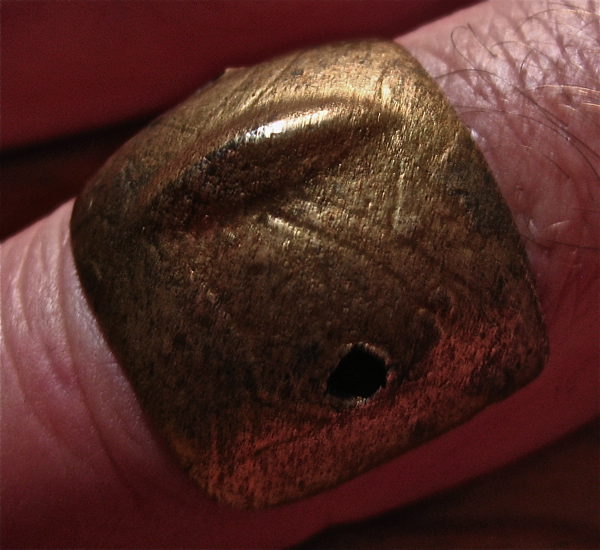
Steve found this knuckle guard from a medieval gauntlet ten years ago at the Customs House near the Tower of London. “I’ve had some amazing finds but, out of all my discoveries, this is the one thing I love the most, a gauntlet knuckle guard from a suit of armour. It’s so delicate, yet by nature of the kink it’s so strong – I can’t bend this,” he told me with a excited grin, his eyes glistening in wonder and delight at the skill displayed in fashioning this gracefully curved sliver of brass and copper alloy inscribed with diagonal lines, once attached by rivets to a chain mail glove. The armoured glove was worn by knight with a cloth or leather glove underneath, yet this knuckle guard just sits upon of Steve’s finger, suggesting that it was made for a much smaller hand, as you would expect in medieval London.
“I dug this one out, which I don’t do much anymore,” explained Steve, recounting the memorable discovery as he picked the knuckle guard from his cabinet of treasures, “I dug a hole really deep down into the river bed, and then I put everything onto a board and ran a metal detector over it.” The knuckle guard was lying in anaerobic mud, with no oxygen, which means it was preserved without rust and gleamed with an enticing mystery when he found it, exactly as it does now. Declaring its precise yet obsolete purpose and elegant manufacture, it evokes an entire world gone more than five hundred years ago.
“I can just imagine a knight coming back from the Crusades and crossing the Thames,” said Steve, inspired by holding the cherished artifact between his fingers, and conjuring a picture for me, “His armour was being dragged off the boat at the landing place and the gauntlet caught against something, the rivets broke and the knuckle guard got knocked off into the river.”
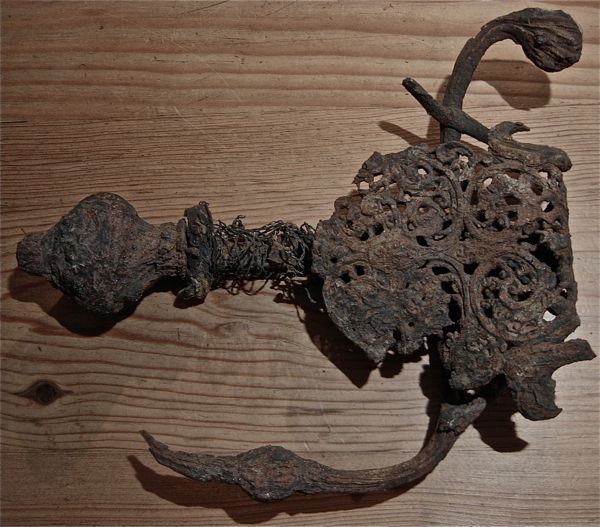
“One day this couple joined me, they’d come to experience the joys of mudlarking but all they could see was gloop – four to five inches of wet mud stretching across the shore at Wapping.” Steve recalled, turning apologetic on behalf of his beloved Thames,“It only happens once in a blue moon.” Yet there was a line at the foreshore that was clean, where there were some corroded lumps of iron and Steve saw a spike emerging from one. “That could be part of a sword, let’s crack it open” suggested Steve, mustering a vain swagger. Yet when he took a look, to his surprise, it was this highly decorated renaissance rapier handle from around 1600. “It was rusty, but shining with silver wire and it had a gold sheen,” said Steve proudly, “You should have seen the look on their faces.”
“The whole thing is a work of art,” Steve declared to me, cradling it lovingly in his hands to show me, “A rapier was an man’s education, when accomplishment with a sword was everything. Everyone that could afford it had one.” And he pointed out the face at the centre of the elaborate design of flourishes upon the guard that had been bent backwards over the hilt, showing me the silver wire that once contained the binding upon the hand grip. The entire hilt sat within Steve’s hand, revealing, like the knuckle guard, that it was made for the much smaller hand of a Londoner over four centuries ago.
“It was thrown away because it was bust,” he theorised with a frown, indicating the useless broken stump of the blade protruding from the hilt, yet balancing the metalwork in his hand appreciatively. “It’s so ornate, but it feels there’s more power to it when it’s rusty,” he continued, perplexed and mulling over this intriguing survivor from Shakespeare’s London which still carries the dynamic spirit of its age today, even in its damaged state.
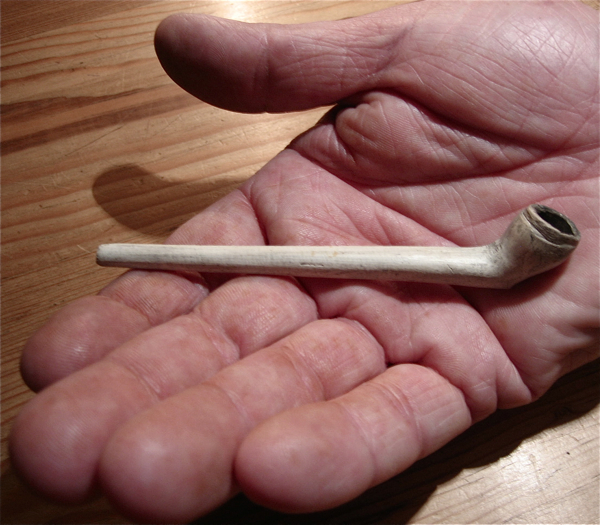
Even before tobacco was introduced by Walter Raleigh in 1586, sailors brought it back and smoked it – but it was very expensive, which is why this early clay pipe dating from 1600 is so tiny. Out of an estimated ten thousand pipes that he has found, mostly from later periods when they were disposable and two-a-penny pre-filled with tobacco, Steve has only found three of these early ones intact.
“This is a stevedore’s pipe that I found at Rotherhithe, still blackened inside. He can work with it in his mouth because it is so short,” said Steve, putting it into his mouth to give a demonstration, before adding with cheery grin, “You find their bodies with the teeth rotted out at one side.”
Then, “Who was at the end of it?” he asked me, taking the pipe from his mouth and gesturing naturally with it for emphasis, “Who was that man or woman or child, that sucked upon this?” As I could not answer his question, Steve pursued his thought further. “This pipe has been through the Plague and the Fire of London,” he said, placing the modest object respectfully on the table, “And it just awes me.”
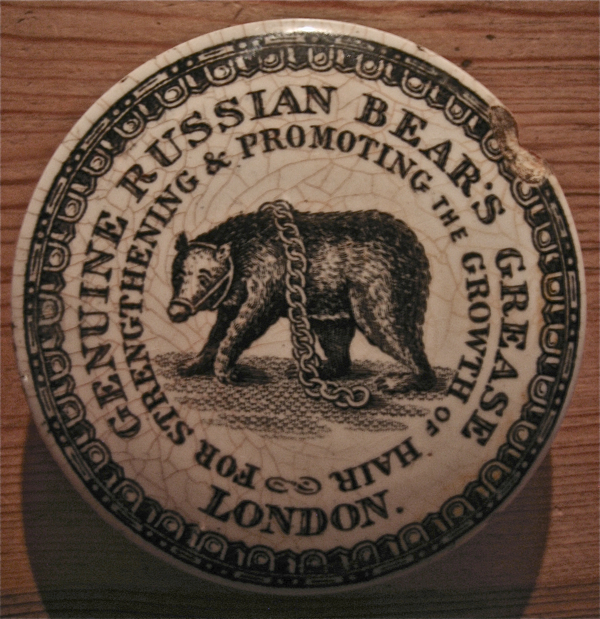
“I don’t know why I like it so much. I love the bear and, being bald, – it’s for hair growth – it makes me laugh!” This was Steve’s explanation when I asked him why this nineteenth century lid from a pot of Russian bear’s grease means so much to him. You can admire the elegant typography and the poignant engraving of the creature, while recognising the sad irony of killing bears for a remedy that does not work, but the appeal of this lid remains intangible to Steve.
“If I had to choose between this and something of monetary value in the collection, I would choose this,” he confirmed to me resolutely, “I’ve had thousands of things up from the river, but I always wanted to find one of these, and a cannon.” It seems that the nature of mudlarking is such that you can almost never discover what you are looking for in the Thames. “You can’t choose what to find, there’s this guy who finds all these gold coins when he only wants a crotal bell,” Steve confided to me, shaking his head with a playful smirk, as an example of the capricious nature of the river.
But one day Steve got lucky when Old Father Thames directed him to a bear’s grease pot lid. “I’d been to test some mud at Charlton near to the O2 Arena but it was poor for finds, although when I walked back along the foreshore there were a lot of bottles, and that’s where I found what I had sought for years, sitting on a tip.” he told me, widening his eyes in excitement as he recalled the sentimental moment fondly. Now Steve just has the find the cannon, because – as you can see below – he already has the cannon balls to go with it.
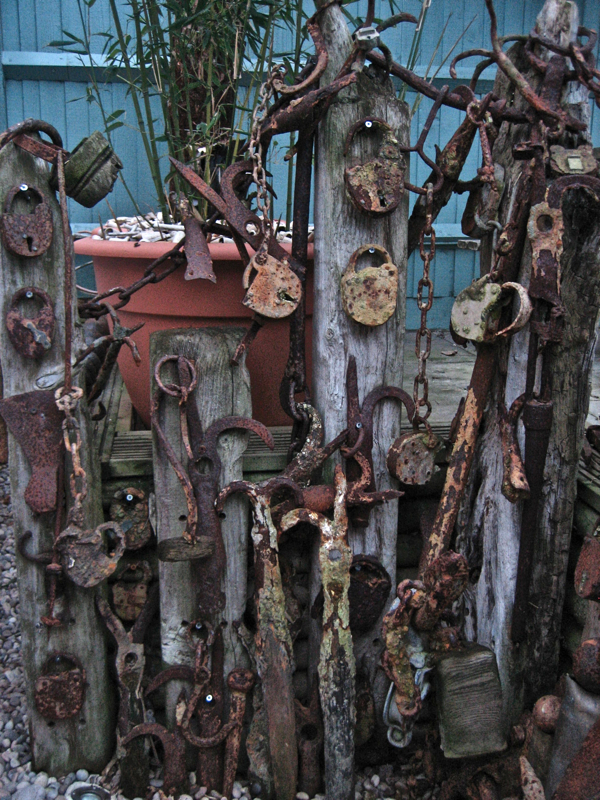
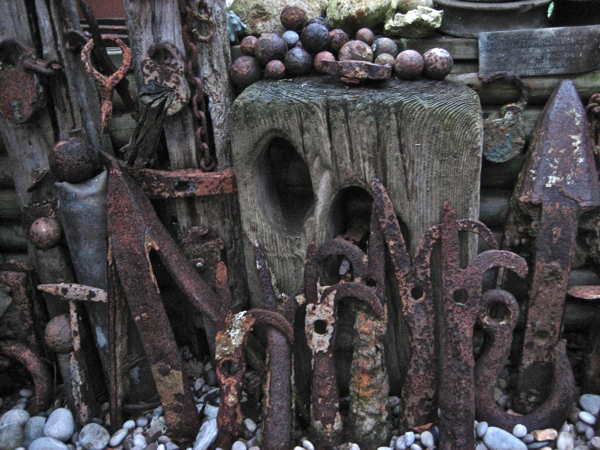
Steve’s finds have spilled out of his house into the garden – boathooks, padlocks, cannon balls, broken Bellarmine jugs and old pipes.
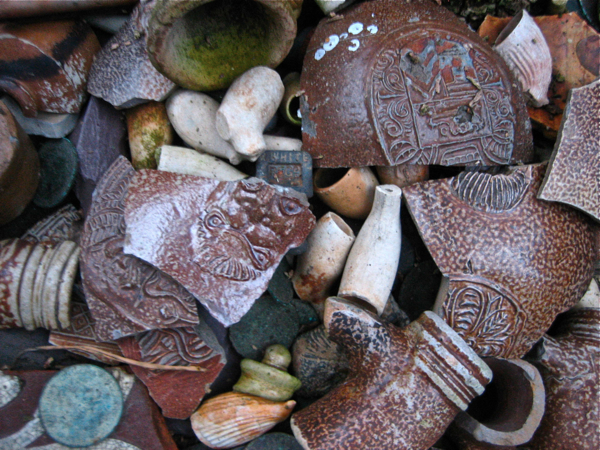
You can find out more at Steve Brooker’s website www.thamesandfield.com and there will be further Mud God’s Discoveries here in February.
Beggars, Newspaper Sellers & Bubblegum Machines
It was a year ago this week that the Evening Standard became a free newspaper, when overnight the cry of the newspaper seller ceased for ever upon the London streets. So I was especially touched to come across Phil Maxwell’s sympathetic pictures of this once familiar sight, published on his daily blog yesterday.
With a panoply of unlikely yet memorable posts about beggars and bubblegum machines, hawkers, hoodies, skateboarders, trolley ladies, and people carrying chairs and wheeling tyres – all witnessed by Maxwell’s superlative photographs – this endeavour is developing into a compelling panorama of the East End over the past thirty years. He dignifies his subjects through compassionate unsentimental observation, taking those who might otherwise be perceived as ‘marginal’ and creating images that place these people where they truly exist, at the centre of life’s drama.
Always alive to the subtle poetry of humanity, Phil Maxwell has become the pre-eminent recorder of London street life in our day, and I wholeheartedly recommend Playground of an East End Photographer to you.
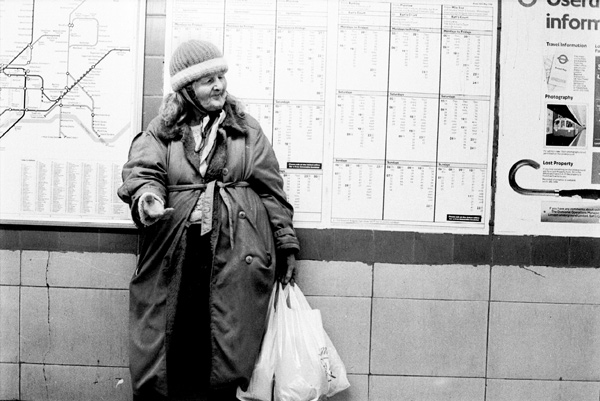
This lady was a regular feature begging at the entrance to Aldgate East tube station in 1984.
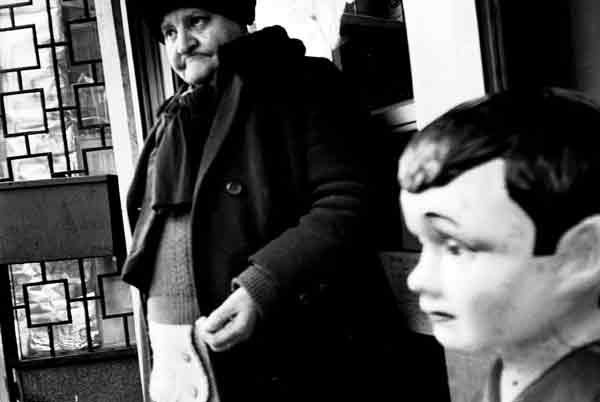
This lady was photographed begging outside the entrance to a newsagent on Whitechapel Rd in 1986.
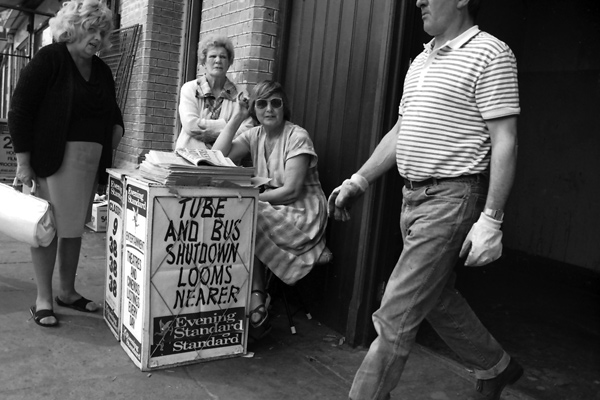
Newspaper sellers at Whitechapel Station, 1988.
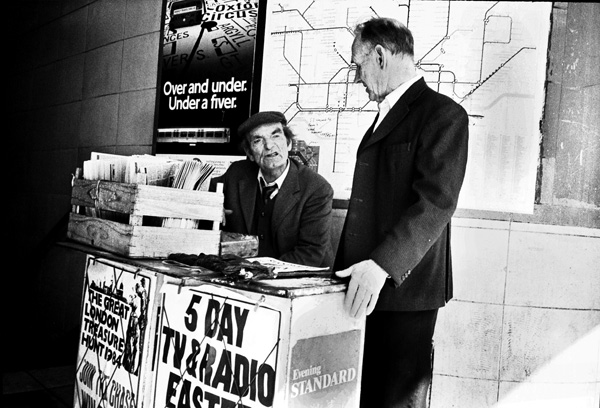
Newspaper sellers at Aldgate East Station, 1987.
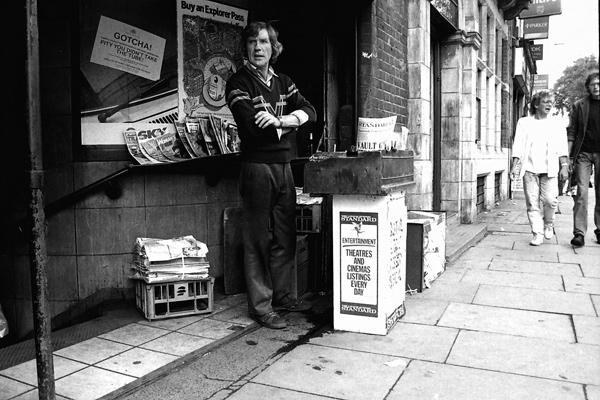
Newspaper seller at Aldgate East Station, 1985.
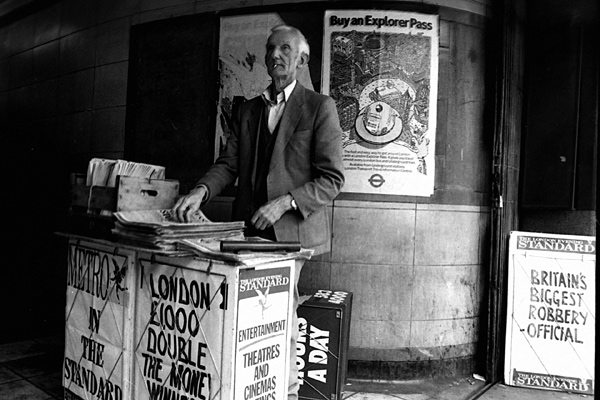
Newspaper seller at Aldgate East Station, 1985.
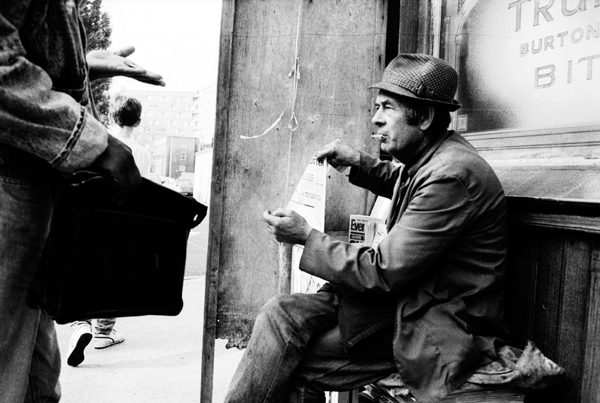
Newspaper seller at The Birdcage, Columbia Rd, 1987.
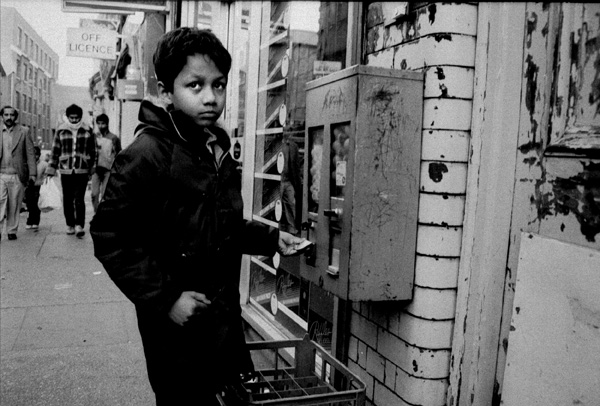
Bubblegum machine on Brick Lane, 1984
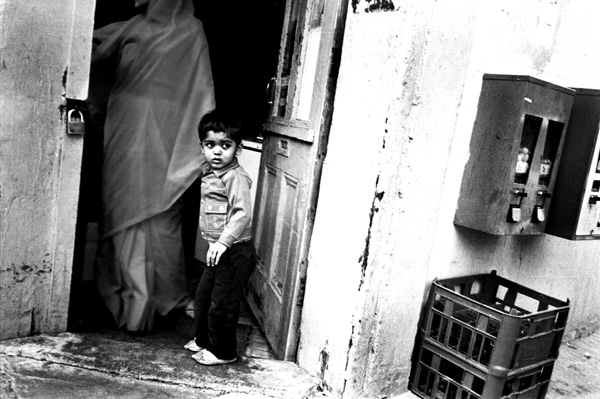
Bubblegum machine next to a shop entrance in Brick Lane, early nineteen eighties.
Photographs copyright © Phil Maxwell
More pictures by Phil Maxwell
Remembering the Cat Lady of Spitalfields
Chapter 5. Shootout in Sidney St

It will be a hundred years ago tonight, that the policemen surrounded the house at 100 Sidney St and waited all night in the snow with their guns ready. At 3:30am, Detective Inspector Wensley spoke to Mrs Bluestein at 102, and by means of a subterfuge – sending her to request the assistance of Mrs Fleishman, the landlady at 100, with her sick husband – he managed to extricate everyone from the house save the two suspects, sleeping in the front room.
At dawn, Wensley threw some pebbles at the window to wake them but received no response. Then, as he was collecting more pebbles, there were six shots from the upper floor and Sergeant Leeson was shot. “Mr Wensley, I am dying. They have shot me through the heart. Goodbye. Give my love to the children. Bury me at Putney.” he said. A bullet had passed right through Leeson’s chest and come out the other side. Once a doctor arrived and Leeson was placed upon a stretcher, it became imperative to get him to hospital, but shooting began again and the doctor was grazed upon the temple by a bullet. Wensley took refuge in the gutter where he lay in the freezing slush for half an hour as the firing continued.When the shooting ceased, Wensley ran back to Arbour Sq Police Station. It was obvious that the police with their antiquated rifles were outgunned by the semi-automatic pistols used by the shooters, so he rang Scotland Yard for assistance.
Winston Churchill, the Home Secretary, was enjoying his morning bath when he received the message from Scotland Yard, requesting authority to bring in troops from the Tower of London. Two officers of the Scots Guards and seventeen soldiers with rifles were dispatched from Tower Hill to join the two hundred policemen already in place, surrounding the two unknown suspects firing from 100 Sidney St. And they were given authority to use any force necessary to resolve the situation, including the use of the Maxim gun that was deployed.
By the time Churchill arrived at noon, the gun battle had been raging for four hours with thousands of shots fired, “We got out of the car. There was a considerable crowd of angry and alarmed people, and I noticed the unusual spectacle of Metropolitan constables armed with shot-guns hastily procured from a local gunsmith. The atmosphere of the crowd was not particularly friendly and there were several cries of ‘Oo let ’em in?’ in allusion to the refusal of our Liberal Government to introduce drastic laws restricting the immigration of aliens. Just at this moment, however, a shot rang out, followed by another and another until there was a regular fusillade… nothing of the sort had ever been seen within living memory in quiet, law-abiding, comfortable England.”
Although he had arrived as an observer, Churchill became part of the discussion about whether to storm the house but at one o’clock, before any decision was made, flames were seen at 100 Sidney St. From a nearby rooftop, a reporter saw a gas jet burning on the first floor, suggesting that the fire may have been a attempt to create a diversion, permitting the desperadoes to escape from the back of the house. Ashes of scraps of paper rose in the billowing clouds of black smoke and drifted over the excited crowds. One gunman leaned out of the window, possibly to take breath, and he was shot in the head, then the other – a burning figure – climbed onto the window ledge, to a gasp of horror from the crowd of thousands. Within seconds, after a burst of shots, he fell backwards into the room, and quickly the fire consumed the house, as the roof and floors came crashing down amongst a roar of flames.
Churchill who claimed he got a bullet hole in his top hat that day, was later criticised for preventing the Fire Brigade from tackling the blaze, his alleged words being, “No, let the buggers burn!”
When a policeman kicked open the door and firemen entered to explore the smoking debris afterwards, they discovered a headless body with the legs burnt away which had fallen from the floor above. Then part of the sidewall collapsed upon five firemen, killing one of them who died of his injuries the following July. Yet by the evening of that day, they found the second charred body, still with his pistol but with his head also missing like his comrade. Although these corpses were unidentifiable, on the basis of the landlady’s testimony, they were named as Fritz Svaars and William Solokoff. No trace was ever found of the legendary Peter the Painter, to whom – in popular lore – is commonly attributed the masterminding of the gang’s activities. If he existed, he remained at large. A century later, scholarly controversy over his true identity continues and recently Tower Hamlets Community Housing named two new housing developments in Sidney St as Peter and Painter houses.
An eleven day trial of the five suspects in custody commenced in May 1911 but, with only fragmentary evidence, they all had their charges dropped, were acquitted or had their convictions quashed. And the judge drew the convenient conclusion that those who fired the shots killing the three policemen upon the night of 16th December 1910 in Houndsditch were the three dead members of the gang. It was an appalling episode in the violent history of the East End, but it proved to be a mere tremor of the coming earthquake that erupted as the First World War on July 28th 1914.
Watch news footage of the siege of Sidney St by clicking here and here, and the fictional scene from Alfred Hitchcock’s “The Man Who Knew Too Much,” inspired by these events, is here.
You may expect an epilogue to this tale shortly.
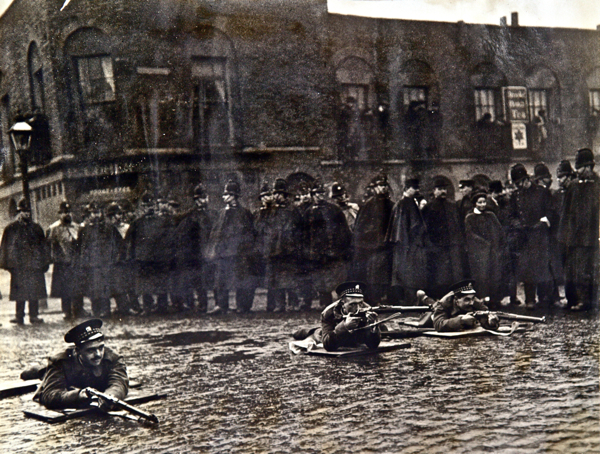
Soldiers of the Scots Guards take up positions.
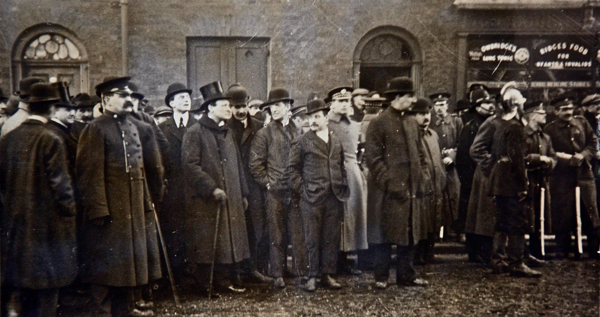
Churchill in his top hat and astrakhan coat stands to the centre left in the crowd.
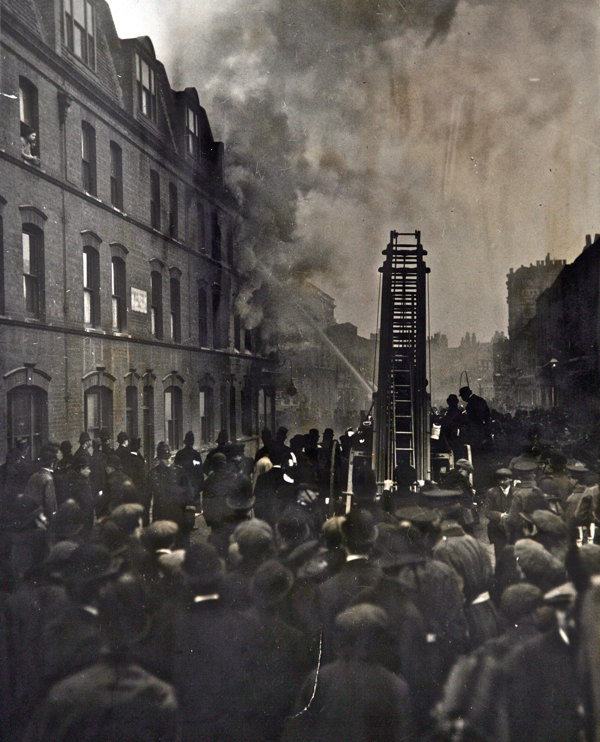
The conflagration.
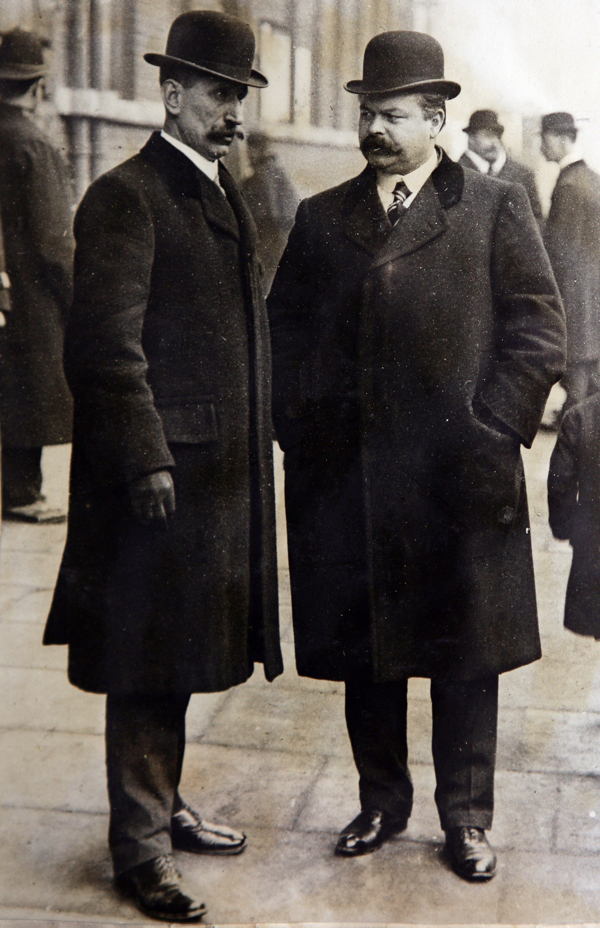
Detective Inspector Frederick Wensley (left) in conference with Chief Detective Inspector John McCarthy.
Images copyright © Bishopsgate Institute
Read the full pitiful story
Chapter 1. Murder in Houndsditch
Chapter 3. A Funeral at Christmas
Churchill & the Anarchists, a free exhibition (including many artifacts and pieces of evidence from the case) runs at the Museum of London in the Docklands until April.
Chapter 4. A Tip Off

Sunday evening at the Anarchists’ Club in Berner St, E 1 – “Awake, ye men who toil! Up proletarians!”
The murder of the three policemen in Houndsditch on 16th December 1910 set Detective Inspector Frederick Porter Wensley – known as ‘the Weasel’ – and the Whitechapel police on a hunt throughout Christmas for members of the Latvian Anarchist Gang on the run in the East End, intensified by the discovery of the dead body of one of their number, George Gardstein, in a rented room in Stepney.
At that time, the term “anarchist” was not yet synonymous with that of “terrorist,” as it subsequently became, rather these were people who sought to bring about social change through agitation and strikes instead of violence. However, the Houndsditch Murders occasioned a significant change in perception of the movement in Britain, even though it had an established presence in the East End, dating from the eighteen seventies when insurrectionists came as refugees from Russia, Germany, and France after the civil war.
Several presumed members of the gang were already in custody thanks to informant Nicholas Tomacoff, the mandolin teacher who was enjoying five weeks in a hotel over the festive season with all expenses paid and had fitted himself out in new clothes thanks to the police reward. It was established that members of the gang had rented properties in Exchange Buildings, staging an attempt to break through the wall into the jeweller’s shop in Houndsditch and steal the Tsar’s jewels that were rumoured to be held there. Arthur Harding, an East End villain who knew them personally described the gang in his autobiography, “We knew they were crooked but we were told they were on the run from the Russian Secret Police, that fact alone gained them our sympathy. They had to live, they had to pay their lodgings, and they needed money for their politics when all’s said and done. That’s why they did these robberies.” Many were educated young Jewish people who had participated in the Latvian revolt for independence from the Russian Empire in 1905, which was brutally repressed by Russian troops – with particular savagery directed against Jews – and several had been imprisoned and tortured, as letters discovered in the room in Grove St testified.
Meanwhile, Louise Bentley, the widow of Sergeant Bentley, had given birth to a son over Christmas, named Robert after his heroic father shot dead on 16th December. “Baby Bentley,” he was christened by the press, emphasising the poignancy of his birth, and a Daily Express fund raised almost two thousand pounds for the three families of the dead policemen in a matter of days.
Then, late on New Year’s Day, an old man appeared at City Police Headquarters, walking in from the driving snow. He was Charles Perelman, who proved to be the most significant informant. He had rented rooms to several members of the gang, and he confirmed there were fifteen in total and told the police that the remaining members were hiding out at an address which was to go down in history, 100 Sidney St. Among those allegedly taking refuge were Fritz Svaars in whose room George Gardstein’s body was discovered and the leader of the gang himself, the enigmatic – even mythic – unnamed figure of “Peter the Painter.”
Later, Detective Inspector Wensley received a phone call after midnight at the Leman St Police Station. “We don’t like the look of things!” he was told, and reinforcements were swiftly drafted from other forces to move in on Sidney St before dawn. They gathered at Arbour Sq Police Station at 12:45am and set out with guns, walking together in the dark through the snowy East End streets, uncertain what they might encounter. Ominously, in the light of the Houndsditch shootings, married men were excluded from the showdown, which was to be the culmination of the violent train of events set in motion before Christmas.
You may expect to read a full account of the events that transpired in Sidney Street imminently.

Until 1892, the tall building on the right of this photograph, 40 Berner St (now renamed Henriques St) was the Russian Anarchists’ Club. It was closed when an LCC inspector declared the premises as unsafe.

In this building on the corner of Fulbourne St in Whitechapel Market was held the Fifth Congress of the Russian Social Democratic Labour Party, consolidating the Bolshevik Party in May 1907, while Lenin, Trotsky, Stalin, Litvinov and Gorky, founders of the future Soviet Union, were all living in exile in Whitechapel.

In Jubilee St, on the corner of Lindley St, (where the pillar box now stands) was the location of the Anarchist’s Club between 1906 & 1914. Previously Lenin addressed a meeting here on March 21st, 1903, and was reportedly seen in the Club in 1907 & 1908.
Archive images copyright © Bishopsgate Institute
Night at the Brick Lane Beigel Bakery

New Year’s Eve is always the busiest night of the year at the Brick Lane Beigel Bakery, so yesterday I chose to spend a night accompanying Sammy Minzly, the celebrated manager of this peerless East End institution, to observe the activity through the early hours as the staff braced themselves for tonight’s rush. Yet even though it was a quiet night – relatively speaking – there was already helter-skelter in the kitchen when I arrived mid-evening to discover five bakers working at furious pace amongst clouds of steam to produce three thousand beigels, as they do every day of the year between six at night and one in the morning.
At the centre of this tiny bakery which occupies a lean-to at the rear of the shop, beigels boiled in a vat of hot water. From here, the glistening babies were scooped up in a mesh basket, doused mercilessly with cold water, then arranged neatly onto narrow wet planks named ‘shebas,’ and inserted into the ovens by Stephen the skinny garrulous baker who has spent his entire life on Brick Lane, working here in the kitchen since the age of fifteen. Between the ovens sat an ogre of a huge dough-making machine, mixing all the ingredients for the beigels, bread and cakes that are sold here. It was a cold night in Spitalfields, but it was sweltering here in the steamy atmosphere of the kitchen where the speedy bakers exerted themselves to the limit, as they hauled great armfuls of dough out of the big metal basin in a hurry, plonking it down, kneading it vigorously, then chopping it up quickly, and using scales to divide it into lumps sufficient to make twenty beigels – before another machine separated them into beigel-sized spongey balls of dough, ripe for transformation.
In the thick of this frenzied whirl of sweaty masculine endeavour – accompanied by the blare of the football on the radio, and raucous horseplay in different languages – stood Mr Sammy, a white-haired gentleman of diminutive stature, quietly taking the balls of dough and feeding them into the machine which delivers recognisable beigels on a conveyor belt at the other end, ready for immersion in hot water. In spite of the steamy hullabaloo in the kitchen, Mr Sammy carries an aura of calm, working at his own pace and, even at seventy-five years old, still pursues his ceaseless labours all through the night, long after the bakers have departed to their beds. Originally a baker, he has been working here since the beigel bakery opened at these premises in 1976, although he told me proudly that the Brick Lane Beigel Bakery superceded that of Lieberman’s fifty -five years ago. Today it is celebrated as the most visible legacy of the Jewish culture that once defined Spitalfields.
Hovering at the entrance to the kitchen, I had only to turn my head to witness the counterpoint drama of the beigel shop where hordes of hungry East Londoners line up all night, craving spiritual consolation in the form of beigels and hot salt beef. They come in sporadic waves, clubbers and party animals, insomniacs and sleep walkers, hipsters and losers, street people and homeless, cab drivers and firemen, police and dodgy dealers, working girls and binmen. Some can barely stand because they are so drunk, others can barely keep their eyes open because they are so tired, some can barely control their joy and others can barely conceal their misery. At times, it was like the madhouse and other times it was like the morgue. Irrespective, everyone at the beigel bakery keeps working, keeping the beigels coming, slicing them, filling them, counting them and sorting them. And the presiding spirit is Mr Sammy. Standing behind the counter, he checks every beigel personally to maintain quality control and tosses aside any that are too small or too toasted, in unhesitating disdain.
As manager, Mr Sammy is the only one whose work crosses both territories, moving back and forth all night between the kitchen and the shop, where he enjoys affectionate widespread regard from his customers. Every other person calls out “Sammy!” or “Mr Sammy” as they come through the door, if he is in the shop – asking “Where’s Sammy?” if he is not, and wanting their beigels reheated in the oven as a premise to step into the kitchen and enjoy a quiet word with him there. Only once did I find Mr Sammy resting, sitting peacefully on the salt bin in the empty kitchen in the middle of the night, long after all the bakers had left and the shop had emptied out. “I’m getting lazy! I’m not doing nothing.” he exclaimed in alarmed self-recognition, “I’d better do something, I’d better count some beigels.”
Later he boiled one hundred and fifty eggs and peeled them, as he explained me to about Achmed, the cleaner, known as ‘donkey’ – “because he can sleep anywhere” – whose arrival was imminent. “He sleeps upstairs,” revealed Mr Sammy pointing at the ceiling. “He lives upstairs?” I enquired, looking up. “No, he only sleeps there, but he doesn’t like to pay rent, so he works as a cleaner.” explained Mr Sammy with an indulgent grin. Shortly, when a doddery fellow arrived with frowsy eyes and sat eating a hot slice of cake from the oven, I surmised this was the gentlemen in question. “I peeled the eggs for you,” Mr Sammy informed him encouragingly, a gesture that was reciprocated by ‘donkey’ with the merest nod. “He’s seventy-two,” Mr Sammy informed me later in a sympathetic whisper.
Witnessing the homeless man who came to collect a pound coin from Mr Sammy nightly and another of limited faculties who merely sought the reassurance of a regular handshake, I understood that because it is always open, the Beigel Bakery exists as a touchstone for many people who have little else in life, and who come to acknowledge Mr Sammy as the one constant presence. With gentle charisma and understated gesture, Mr Sammy fulfils the role of spiritual leader and keeps the bakery running smoothly too. After a busy Christmas week, he was getting low on bags for beigels and was concerned he had missed his weekly deliver from Paul Gardner because of the holiday. The morning was drawing near and I knew that Paul was opening that day for the first time after the break, so I elected to walk round to Gardners Market Sundriesmen in Commercial St and, sure enough, on the dot of six-thirty Paul arrived full of good humour to discover me and other customers waiting. Once he had dispatched the customers, Paul locked the shop again and we drove round to deliver the twenty-five to thirty thousand brown paper bags that comprise the beigel shop’s weekly order.
Mr Sammy’s eyes lit up to see Paul Gardner carrying the packets of bags through the door in preparation for New Year’s Eve and then, in celebration of the festive season, before I made my farewells and retired to my bed, I took advantage of the opportunity to photograph these two friends and long-term associates together – both representatives of traditional businesses that between them carry significant aspects of the history and identity of Spitalfields.


Old friends, Paul Gardner, Market Sundriesman, and Sammy Minzly, Manager of the Beigel Bakery.
In Search of Relics of Old London

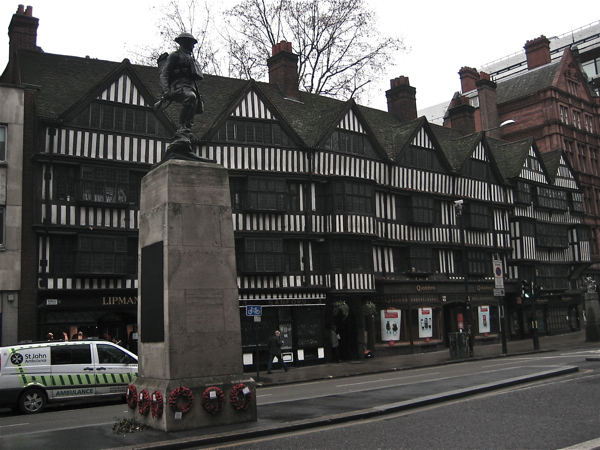
Staple Inn, High Holborn, 1878 & today
Those who have read my stories of A Room to Let in Old Aldgate and The Ghosts of Old London will know that I have become fascinated with the atmospheric detailed pictures taken by the Society for Photographing the Relics of Old London over twelve years from 1875, preserved in the archive at the Bishopsgate Institute. The original intent of these photographs was to record ancient buildings at risk of demolition, in the hope that their quality might be recognised and they could be saved. Most of the edifices portrayed in these melancholic twilight images were destroyed in the nineteenth century but, becoming familiar with these pictures, I recognised a handful that still stand today. So I decided to set out on a quest to find them and discover some Relics of Old London for myself.
It was a suitably foggy morning when I set out across the city with my camera in hand, in the footsteps of Henry Dixon, William Strudrick and A. & J. Bool, the photographers employed by the Society. My intention was not to rival their exemplary works but merely to take look at these places today. Starting at Queen Anne’s Gate, the most Westerly destination, I walked from one location of their pictures to another, making my way Eastwards back to Spitalfields, and passed a pleasant day in the process.
In Whitehall, Inigo Jones’ Banqueting House is surrounded today by buildings in a similar style, which makes me wonder if any passersby realise that it predates everything else in this street, as the lone fragment of the ancient Palace of Whitehall. I recognised a similar phenomenon in Lincoln’s Inn Fields, where Inigo Jones’ Lindsey House is so spruce and clean it is almost indistinguishable from the copy next door, while Newcastle House, also dating from the seventeenth century but reworked by Sir Edwin Lutyens in the nineteen thirties, now looks like a modern pastiche.
In fact, the whole of Central London has been mightily scrubbed up and little of the grime of ages deposited by smoke from coal fires remains now, and the airborne filth which supplied such dramatic patination to nineteenth century photographers has gone. Yet I have clear memories of how black all these buildings were until quite recently, and I recall Trafalgar Sq feeling like centre of a diabolic city when I first visited London and discovered the buildings entirely coated with soot. The outcome of this great clean up is that today the city no longer looks old as it does in old photographs, it has been polished up like new.
I had absurd experiences wandering around Fleet St, Clothfair and Bermondsey St looking for buildings I saw in the photographs which I believed still existed, only to discover they did not. Searching for the reality of pictures that had merged with my own memories, I was confounded. But there were other sites, notably Queen Anne’s Gate, Gray’s Inn and Charterhouse, where little had changed and I was rewarded by the delight of recognition from the photographs.
It was a sentimental journey I made. I knew that the man in the stove pipe hat at the entrance to Charterhouse was not going to be there to grant me a conversation, much as should wish for it, but I still wanted to go and look anyway.
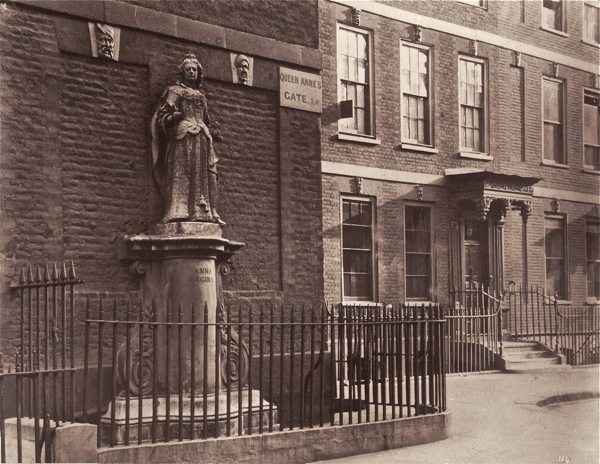
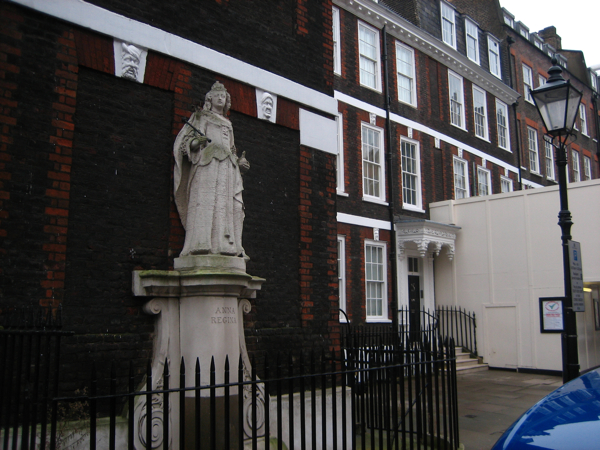
At Queen Anne’s Gate.
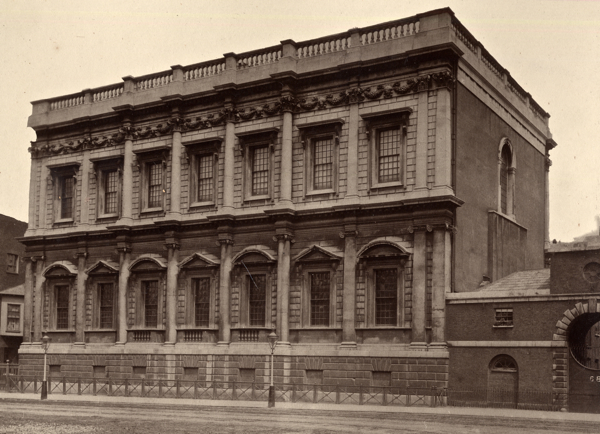

The Banqueting Hall, built by James I to a design by Inigo Jones and completed in 1622, is today all that remains of the Palace of Whitehall. Charles I stepped from a first floor window onto a wooden scaffold where he got his head chopped off on 30th January 1649.

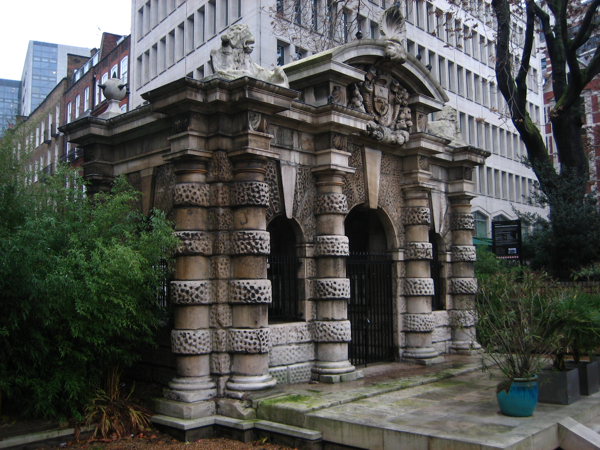
This water gate stood at the river’s edge, fifty yards from Samuel Pepys’ house. Built in 1626, as the triumphal entry for the Duke of Buckingham to York House, since the Victoria Embankment was completed in 1870 it has been marooned a hundred yards from the Thames.
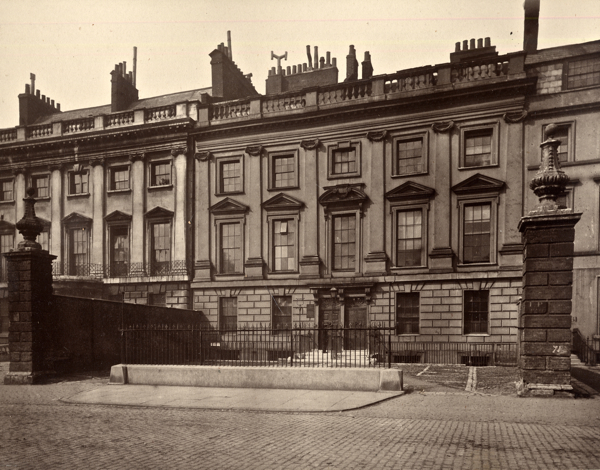
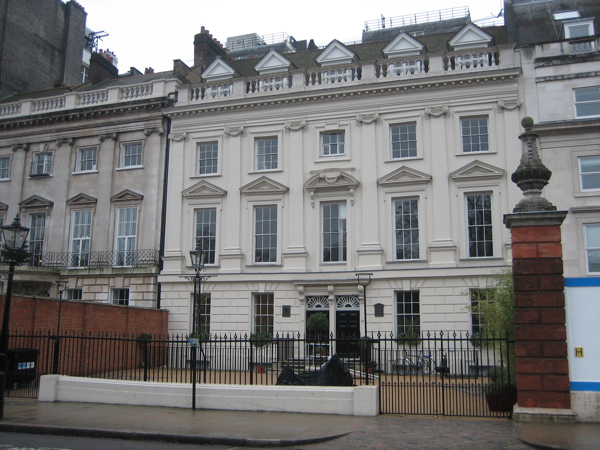
Lindsey House, built in 1640 and attributed to Inigo Jones, in Lincoln’s Inn Fields – it looked older in the nineteenth century than it does now.
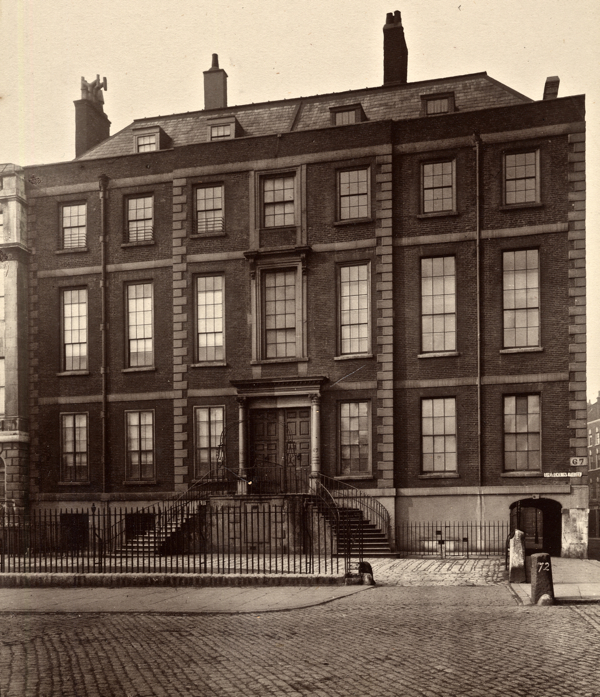

Newcastle House at the corner of Lincoln’s Inn Fields was built in the sixteen eighties and remodelled by Sir Edwin Lutyens in the nineteen thirties.
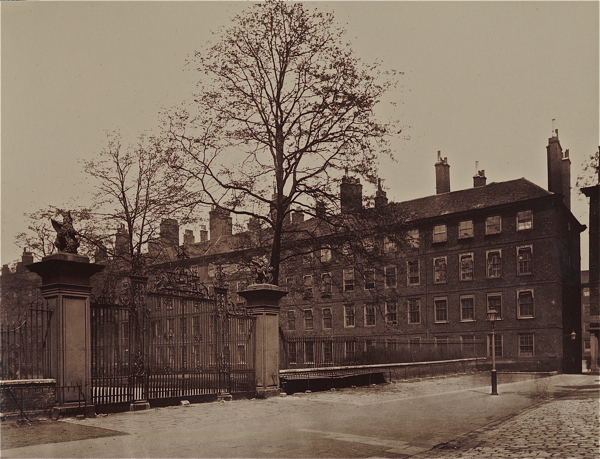
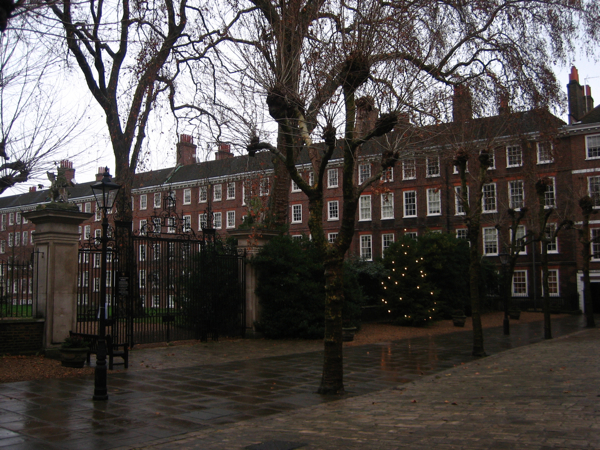
In Gray’s Inn, the Plane trees have grown taller.
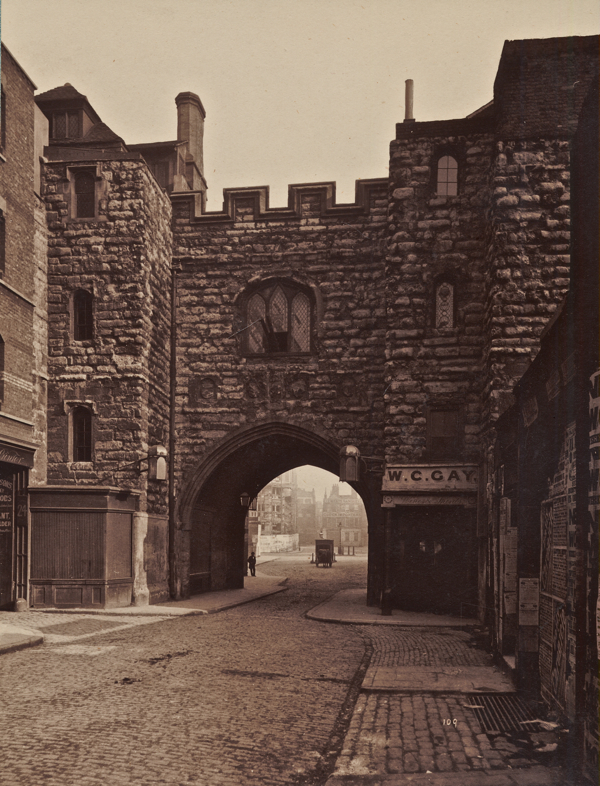
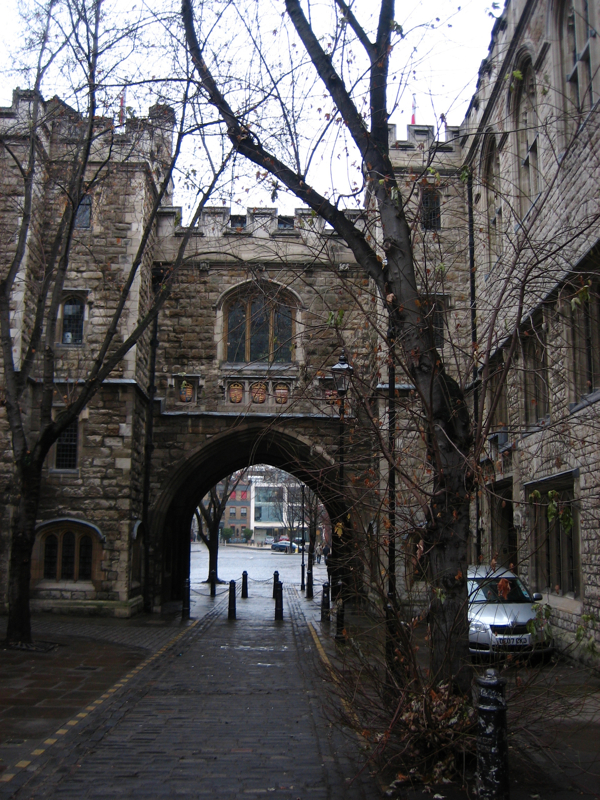
St John’s Gate, Clerkenwell. Built in 1504 by Thomas Docwra and restored heavily in the late nineteenth century.
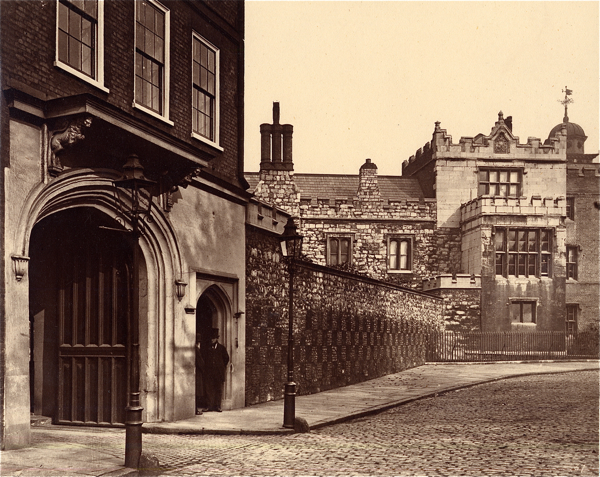
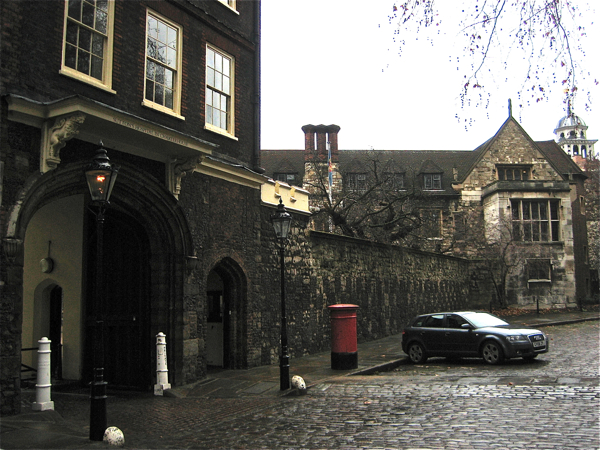
At the entrance to Charterhouse in Smithfield.


Temple Bar, designed by Christopher Wren in 1672, once stood in the Strand as one of the gates to the City of London, but it was removed in 1877 and languished in Theobalds Park in Hertfordshire until it was brought back and installed at the entrance to Paternoster Square next to St Paul’s Cathedral in 2004.
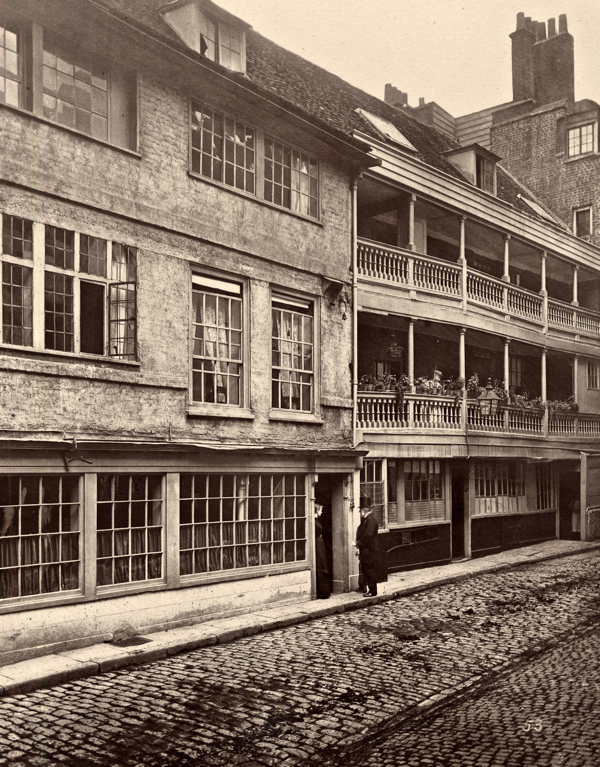
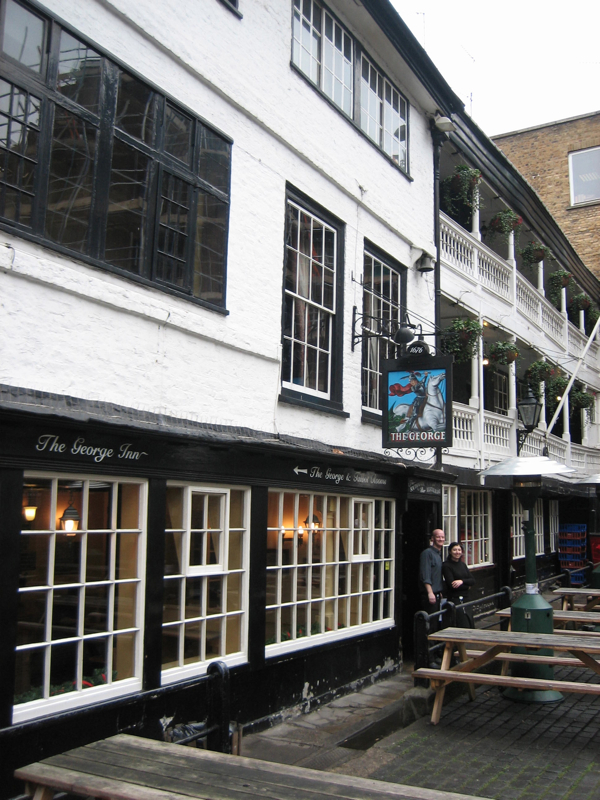
The George is the last of London’s venerable coaching inns – preserved today by the National Trust. Two of the bar staff obliged me by standing in the doorway in place of the couple in the earlier picture.
Archive images copyright © Bishopsgate Institute
If you are interested in old photographs of London you may also like
With the Spitalfields Milkman at Christmas

Yesterday was the first delivery after Christmas for Kevin Read, the heroic milkman who delivers the milk to Spitalfields and a whole expanse of the East End stretching from the Olympic Park in the East to Hoxton Square in the West. After a heavy downpour, on such a damp occluded morning, while the rest of the world were still dozing in their warm beds, it was my pleasure to join Kevin on his round to offer some companionship in his lonely vigil.
The temperatures have risen since last week’s freeze that sent Kevin tumbling off an icy step with an armful of milk bottles in Mile End. “The worst thing about this job is when people don’t clear the snow off the steps. You hold onto the rail and hope you don’t fall.” he declared with admirable restraint. No milk was spilt, but Kevin has a sore back now and – although he insists he takes it in his stride – even after three days off, there is a stiffness to his gait as he hurries from door to door with bottles in hand.
“I worked Christmas Days in this job back in the nineteen eighties,” Kevin recalled without sentiment, cheerful that those times are behind him as we sped along in the heated cabin of his diesel-powered float.“When I had the electric float with the open cabin, I used to be white down one side of my body by the time I arrived at my first call on snowy mornings,” he added with a shudder.
As we drove up through Hackney from Spitalfields in the darkness of the early morning, I spotted a few souls shivering at bus stops, cleaners and service workers reluctantly off to work, and we passed several beaten-up vans of totters cruising the streets to salvage abandoned washing machines and other scrap metal discarded over Christmas. The road sweepers were out too, muffled up in hooded windcheaters like fluorescent Eskimos, dutifully cleaning up the gutters in the night.
“With so many people away, it’s difficult to keep track,” said Kevin, rolling his eyes crazily as he scrabbled through his round book, “I should save time, but I have to keeping checking the books – so I don’t, I just lose money.” With an income consisting entirely of commission on sales, Kevin is used to seeing his earnings plummet at this time of year when offices are shut and customers go away, reducing his weekly delivery from eight thousand to two thousand pints.“After buying diesel for the van, I’ll be lucky if I see twenty pounds for today’s work.” he admitted to me with a shrug, squinting through the windscreen into the murky depths beyond. Yet in recognition of his popularity in the East End, Kevin takes consolation that his Christmas tips were up this year. “People are getting to know me, I’m becoming part of the family!” he reassured me with a cocky smirk, before he ran off into the dark with a wind-up torch and a handful of milk bottles.
“How are you supposed to read a damp note in the dark?” he asked, as he returned from the rain, playfully waving a soggy piece of paper between two fingers, “It’s like being down a coal mine with your eyes shut out there.” The note read “No Milk till Tuesday,” but today was Tuesday. Kevin and I looked at each other. Did the note mean this Tuesday or next Tuesday ? “You need to be mind reader in this job!” observed Kevin, with a wry grimace – though, ever conscientious, he elected to leave milk and make a detour to discover the outcome next day.
For four hours we drove around that cold morning, as the sky lightened and the streetlights flickered out, to deliver two hundred pints of milk, twisting and turning through the streets and housing estates, in what appeared to be an unpopulated city. And Kevin seemed to loosen up, overcoming his stiffness, and constantly checking the pen which was the marker in his round book, dividing the calls done from those still to do, as he made sharp work of his scattered deliveries. In some streets, Kevin makes one call and in others a cluster. It is both inexplicable and a matter of passionate fascination to Kevin – trying to discover the pattern in this chaos. Because if he can unlock the mystery, perhaps he might restore the lost milk rounds of the East End and go from one door to the next delivering milk again, as he did when he began over thirty years ago.
At the end of his short Christmas round, Kevin could go home and have a nap, but he seemed dis-satisfied. “I sometimes think I’d like just this round, without the extra pressure of the office deliveries.” he brooded, envisaging this hypothetical future before dismissing it, smiling in recognition of his own nature, “I’d work three until seven, be done and dusted, and home by eight in the morning – but I’d be so bored.”
The truth is that Kevin provides a public service as much as he is in business, and while it may not make him rich, he shows true nobility of spirit in his endeavour. Renowned for his humour and resilience, it is a matter of honour for Kevin to go out and deliver the milk, working alone unseen in the night for all these years to uphold his promise to his customers, whatever the weather. He takes the rigours of the situation as a test, moulding his character, and this is how he has emerged as an heroic milkman, with stamina and dreams.
There is a myth that it is cheaper to buy milk in a supermarket or shop than have it delivered, but this is false. So why not consider having Kevin deliver to you in the New Year ? – because it is a beautiful thing to discover milk in glass bottles on your doorstep in the morning.


If you want Kevin Read to deliver milk or yoghurt or eggs or fresh bread or even dogfood to you, contact him directly by calling 07940095775 or email kevinthemilkman@yahoo.co.uk. Kevin says, “You don’t have to have a delivery every day,” and “No order is too small.”
You may also enjoy On the Rounds with the Spitalfields Milkman












