The Alteration Tailors of the East End
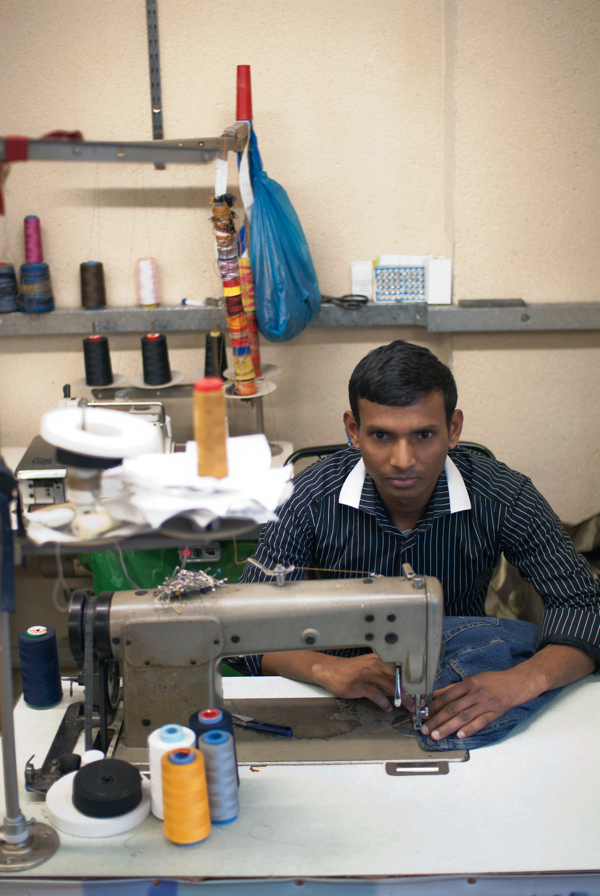
The alteration tailors go disregarded for the most part – no-one notices them. It is almost as if they have mastered the art of invisibility, for they can sit in the window of a dry cleaners or a shoe repair business while the customers come and go to the counter without even casting a glance at the tailor, working placidly at a sewing machine in the most conspicuous position in the shop. From this privileged location facing onto the street, all of existence passes like a charade before the eyes of the alteration tailor, screened by the plate glass window and the collective amnesia of the populace.
Yet there comes a moment when they occupy the focus of attention, when life cannot continue because your trousers split or you discover your hem is showing, and your need of an alteration tailor is burning. Then, like a superhero lurking in the subliminal margin of your consciousness, they step to the fore and you thank the heavens you can rely upon them in the hour of need. A brief conversation is all that is required and, with the mere exchange of a few pounds, your self-esteem is restored.
Such is my fascination with the paradoxical existence of the alteration tailors that I persuaded Spitalfields Life contributing photographer Sarah Ainslie to accompany me on a quest to photograph these ethereal beings, and bring them into visibility. Superficially, it might seem that these stitchers are inferior to the tailors that actually make clothes, yet is my perception that the work of the alteration tailor is a subtler art, one of accommodation to flawed humanity, since the two arenas of endeavour for these tailors are those of repair and adjustment and, commonly, both are indicators of fallibility.
In Bethnal Green, at The Ironing Parlour, there is an eye-catching display of old irons in the window which Hussein, the proprietor, told me he inherited from the previous owner, symbolic tokens of gratitude offered up to the altar of the modest alteration tailor. And it explained a certain self-respecting ease, even a mild swagger common to all the alteration tailors I met, acknowledging they appreciate that what it costs to expend their skill is so much less than what it means to us. As Mohammed Abdul Mannan at Needlepoint in Barnet Grove put it succinctly, “I think it is nice job. People like us because they need it.” Consequently, although it was a source of humiliation to me when a fellow-customer came in to get his wife’s dress repaired and negotiated a price reduction from eight to five pounds, whilst also seeking assurances that it would be done well, the alteration tailor reacted with admirable largesse . “I will do my best for you,” was his poignant response, accepting the mean-spirited reduction with grace. “You’re always going to make a living, but you’re never going to make a fortune in this trade,” was the ambivalent summation – accompanied by a weary smile – quoted by several of my subjects of enquiry.
Yet there is little intrinsic melancholy in the lives of the alteration tailors, because the line of the needy is always balanced by the line of the jubilant, collecting their repairs – whilst the tailors mediate the space between, working conscientiously at their own pace. When I was in The Ironing Parlour, a senior lady pushing a trolley came in hopefully on the off-chance to check if there was anything for her to collect, only to leave disheartened when they explained politely that she had brought nothing in for repair. After searching carefully, just to make sure, Shabaz and Chris, who work here, looked at each other in disappointment to send her away empty-handed.
As Vaida who does the repairs at Classi Clean in the Liverpool St Arcade confirmed with a shy smile, “I like it, from when I was a child.” This week, she is busy taking out the waists for her City gents as she usually does in January, just as she will expect to take them in again next Summer when they lose weight for the beach. Vaida came here from Vilnius eight years ago when she lost her job in a clothing factory after manufacturing transferred to China and Mr Patel, who has run this store for twenty-five years, prizes her for her nimble work. “We were struggling to find a competent seamstress,” he lamented, “They don’t teach it here. Young people in this country can’t even sew on a button.” It did not seem appropriate to tell him of young Ali at Needlepoint in Barnet Grove, six months into the profession with dexterous fingers and an eager personable manner.
Back in Bethnal Green, a different Mr Patel, my old friend at Smarty Pants, did his his best to live up to the name of his shop. “This is what you call philosophical,” he declared, rolling his eyes ironically while seated behind his machine patching a pair of jeans, “The poor man’s necessity is the rich man’s hobby. Here people eat less to lose weight – in the poor countries, they lose weight because they can’t afford to eat. Here people have a Rolls Royce but they prefer to walk – in the poor countries, people walk because they can’t afford the bus. Here people pay to get their old jeans patched – in the poor countries, they can’t afford to buy new ones.” It was a glimpse of the sly wisdom of the alteration tailor, observing weakness and vanity, yet bringing a quick needle and a compassionate sensibility to ameliorate our needs.


Shabaz at The Ironing Parlour.

Hussein, proprietor of Attaboy Dry Cleaners and The Ironing Parlour in the Bethnal Green Rd.


The collection of old irons donated by grateful customers.

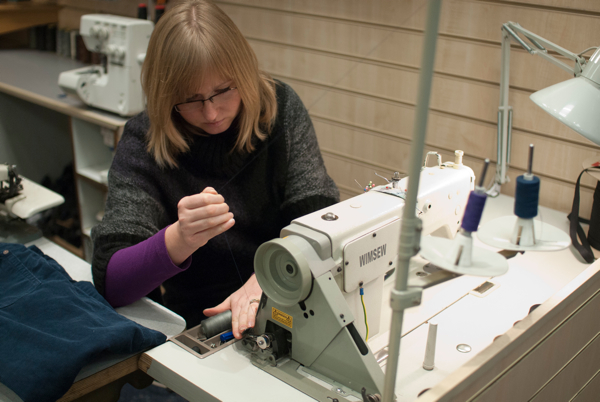
Vaida at Classi Clean in the Liverpool St Arcade.


Raj at Dry Cleaners in Middlesex St
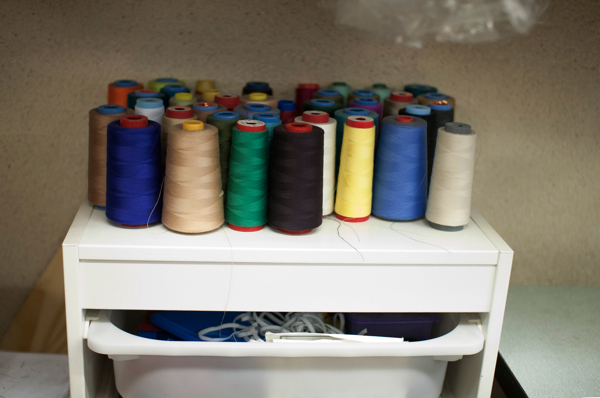


Ali at Needlepoint in Barnet Grove has only been in the profession for six months.


Mohammed Abdul Mannan at Needlepoint in Barnet Grove.


Mr Patel, proprietor of Smarty Pants in the Bethnal Green Rd.

Photographs copyright © Sarah Ainslie
You may like to read about
The Wax Sellers of Wentworth St

Franceskka Abimbola, Franceskka Fabrics
On a rainy Sunday in Spitalfields when everything is grey, I wend my way to Wentworth St to visit the African textile stores, that glow like multicoloured lanterns illuminated in the dusk – where a troupe of magnificent women preside, each one a shining goddess in her own universe. A radiance which Spitalfields Life contributing photographer Jeremy Freedman celebrates in his exuberant portraits published here.
Sunday is when it all happens in Wentworth St, when customers coming from as far as away as Aberdeen and the Netherlands converge to savour its wonders as the international destination for the best Holland Wax, French Lace, Swiss Voile and Headties to be found anywhere.
Weaving through the Petticoat Lane Market and pausing in the drizzle to gaze into the shop windows, you will spy the fine ladies of Wentworth St holding court in their shops to the assembled throng, simultaneously displaying the wit of matriarchs, the authority of monarchs and the glamour of movie-stars, and all dressed up to show off the potential of their textiles. Identified upon the fascias by their first names, as Franceskka Fabrics, Tayo Fashions & Textiles, and Fola Textile, many of these women put themselves forward personally as bold trendsetters, designing their own fabrics, defining the fashion and styling their customers too. In this, the oldest part of Spitalfields, the textile industry which has defined this neighbourhood for centuries is alive and thriving today thanks to the talents of these shrewd businesswomen of Wentworth St.
Franceskka Abimbola, whose business is the longest established here, welcomed me into her kaleidoscopic shop with mirrored ceiling and walls draped in lush fabrics, just as there was a brief lull in the mid-afternoon trade. “In the late eighties, I came here from Edinburgh to Petticoat Lane to buy this fabric and I found the dealers were all Jewish who didn’t wear it and didn’t understand it,” she explained with a humorous frown, “I spoke to Solomon at Renee’s who introduced me to his supplier. So then I wanted to be the first African woman to open a shop, and I used to buy it and sell it from the back of a car. But when I spoke to the supplier about opening my own place, he said, ‘You want to open a shop and start selling my fabrics? I’m going to break you into pieces!'”
Undeterred, Franceskka bravely opened her shop in the Kingsland Rd – at a respectable distance – and, fourteen years ago, she was one of the very first to open in Wentworth St, thus initiating this extraordinary phenomenon where now every other shop here sells Wax, all fiercely competing with their own styles and prices. Thankfully, Franceskka is still in one piece and, in reward for her courage, she is a big success.
“Lots of Nigerian women came at first to buy and ask advice,” she revealed delightedly, “but then women from Gambia, Senegal, Sierra Leone, Zimbabwe and Ghana came too. Many didn’t know how to tie the headtie so I teach them how to do it.” With an unassuming relaxed presence, Franceskka, who has a Post Graduate Diploma in Business Studies, controls her international business empire from this tiny shop, extending to two more in Lagos and a third in Abuja. “I go to the fabric exhibitions in Paris and Spain to get inspiration, I design the fabrics myself and get them manufactured in Switzerland. The French Laces are in vogue at the moment and they are very expensive, but if it’s for a wedding people will go all out to look beautiful.” she said, with a delicate smile and lift of her brow, merely hinting at the razzle-dazzle on offer.
Banke Adetoro at Royal Fashions incarnates the notion of sassy with her extravagant eyelashes, constantly fluttering like butterflies. “There’s nothing you want that you can’t get here,” she informed me with an amused gesture of unqualified authority, when I dropped in, “I get all the latest stuff. I can do as many as twenty buying trips in a year. My shop is the biggest and the most beautiful!” You really need to visit this shop to experience the vast phantasmagoria of patterns on display.
By contrast, across the road at Tayo Fashions & Textiles, I met the alluring Tayo herself in her modestly-sized shop. “My mother used to do this back in Africa, and I picked it up,” she confided to me quietly, “I just started trading at home and through the church, and then I started in a small shop with a little help from the bank. Now I have a shop in Lagos too and I go three times a year.” Outlining the convenient balance between the trade in both continents, “At Christmas it’s busy there when it’s quiet here, and it’s busy here in the Summer when it’s quiet there.” she said. Tayo’s two sons help her out in the shop and I was fascinated that in every single shop I visited these women had their children present. In fact, most had come into it through their families and some already had their children working with them, and I found it an interesting contrast to the perceived dilemma between children and career that many European women face.
Betwixt the fabulous fabric shops in Wentworth St are those selling the accessories to complete the outfit, the gleaming metallic pointy shoes and matching bags in multiple colourways and, of course, the jewellery. My favourite is Beauty Stones, lined entirely with coral necklaces that cascade like a waterfall down the walls to create an environment enraptured like a magic cave in a fairy tale. “In the beginning of African culture, anyone that wears it will be honoured,” declared Onome, the gentle custodian of the coral, “In Africa, we believe it is more precious than gold but, in this market, I have realised that lots of people are in love with it too.” Standing proud, Onome who is a celebrant in her own tribe, gestured to the coral that surrounded her, feeling its benign presence. “It’s my mother’s business,” she continued fondly,”but when she died ten years ago I couldn’t let the business die too.” And today the business is lively, since Onome’s nine children work in the shop (two were adopted after her sister’s death) and, as we spoke, happy little children ran around our legs playing with strings of corals beads they were threading. “It’s really is lovely to look at – sometimes when I put my hand on a bead, it tells me what to do, how to make the necklace,” Onome admitted, clasping a string of coral in her hand, “and the children are very good at the beads too, it’s in the family.”
Speaking with the Wax sellers of Wentworth St, who taught me the Yoruba concept of “Aso- Ebi” – using co-ordinated textiles at a social gathering to express the inter-relationships of all the people there – I realised that these modest shops contain an entire cultural universe with its own sophisticated language spoken in the vocabulary of textiles. Fashion exists here but, more than this, each decision taken, both in the choice and combination of fabrics makes a personal statement, which gives every single outfit a vibrant poetry all of its own.

Sheba Eferoghene, Novo Fashions

Tayo Oladele, Tayo Fashions & Textiles

Fola Mustapha, Fola Textile

Banke Adetoro, Royal Fashions
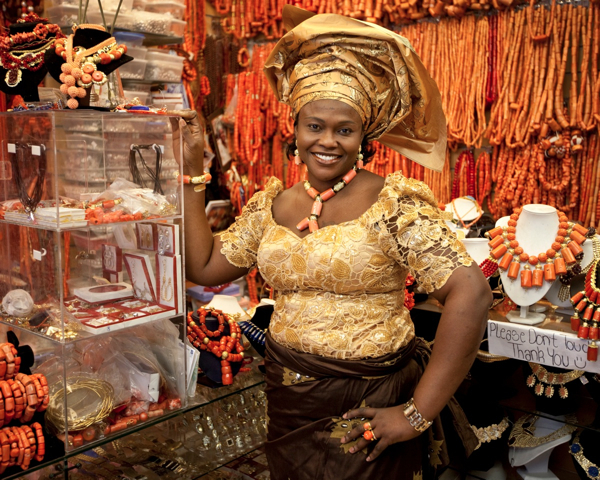
Onome Efebeh-Atano, Beauty Stones
Photographs copyright © Jeremy Freedman
With grateful thanks to Sheba Eferoghene for making the introductions.
You can read my original feature about Jo & Sheba Eferoghene, Novo Fashions
Columbia Road Market 66

George Gladwell has been selling plants on Columbia Rd longer than anyone else and is the only one left who was there on the very first day of the flower market, just a few years after the war. Over eighty years old, yet still lifting heavy boxes and trading through every Winter, George possesses extraordinary vitality and as Chairman of the Association he is the spokesman for his fellow traders, which suits him well because he has greater experience of market life than anyone else and knows his own mind too. Softly spoken, although possessing a powerful physical presence, George has staying power and, remarkably, after more than sixty years of early mornings in the frost, he is still smiling.
When I spoke to George, I was eager to learn about that mythic day when it all began…
“I arrived in this lonely little street in the East End with only boarded-up shops in it at seven o’clock one Sunday morning in February 1949. And I went into Sadie’s Cafe where you could get a whopping great mug of cocoa, coffee or tea, and a thick slice of bread and dripping – real comfort food. Then I went out onto the street again at nine o’ clock, and a guy turned up with a horse and cart loaded with flowers, followed by a flatback lorry also loaded with plants. At the time, I had a 1933 ambulance and I drove that around to join them, and we were the only three traders until someone else turned up with a costermonger’s barrow of cut flowers. There were a couple more horse and carts that joined us and, around eleven thirty, a few guys came along with baskets on their arms with a couple of dozen bunches of carnations to sell, which was their day’s work.
More traders began turning over up over the next few months until the market was full. There were no trolleys then, everything was on the floor. Years ago, it wasn’t what you call “instant gardening,” it was all old gardeners coming to buy plants to grow on to maturity. It was easy selling flowers then, though if you went out of season it was disappointing, but I never got discouraged – you just have to wait.
Mother’s Day was the beginning of the season and Derby Day was the finish, and it still applies today. The serious trading is between those two dates and the rest of the year is just ticking over. In June, it went dead until it picked up in September, then it got quite busy until Bonfire Night. And from the first week of December, you had Christmas Trees, holly and mistletoe, and the pot plant trade.
I had a nursery and I lived in Billericay, and I was already working in Romford, Chelmsford, Epping, Rochester, Maidstone and Watford Markets. A friend of mine – John – he didn’t have driving licence, so he asked me to drive him up on a Sunday, and each week I came up to Columbia Rd with him and I brought some of my own plants along too, because there was a space next to his pitch.
My first licenced pitch was across from the Royal Oak. I moved there in 1958, because John died and I inherited his pitches, but I let the other four go. In 1959, the shops began to unboard and people took them on here and there. That was around the time public interest picked up because formerly it was a secret little market. It became known through visitors to Petticoat Lane, they’d walk around and hear about it. It was never known as “Columbia Rd Flower Market” until I advertised it by that name.
It picked up even more in the nineteen sixties when the council introduced the rule that we had to come every four weeks or lose our licences, because then we had to trade continuously. In those days, we were all professional growers who relied upon the seasons at Columbia Rd. Although we used to buy from the Dutch, you had to have a licence and you were only allowed a certain amount, so that was marginal. It used to come by train – pot plants, shrubs and herbaceous plants. During the war, agriculture became food production, and fruit trees planted before the war had matured nicely. They sold masses of these at the Maidstone plant auctions and I could pick them up for next to nothing and sell them at Columbia Rd for two thousand per cent profit. Those were happy times!
In the depression at the end of the nineteen fifties, a lot of nurserymen sold their plots for building land because they couldn’t make it pay and it made the supply of plants quite scarce. So those of us who could grow our own did quite well but, although I did a mail order trade from my nursery, it wasn’t sufficient to make ends meet. Hobby traders joined the market then and they interfered with our trade because we were growers and kept our stock from week to week, but they would sell off all their stock cheap each week to get their money back. I took a job driving heavy haulage and got back for Saturday and Sunday. I had to do it because I had quite a big family, four children.
In the seventies, I was the first to use the metal trolleys that everyone uses now. My associates said I would never make it pay because I hocked myself up to do it. At the same time, plants were getting plastic containers, whereas before we used to sell bare roots which made for dirty pitches, so that was progress. All the time we were getting developments in different kinds of plants coming from abroad. You could trade in these and forget growing your own plants, but I never did.
Then in the nineties we had problems with rowdy traders and customers coming at four in the morning, which upset the residents and we were threatened with closure by the council. We had a committee and I was voted Chairman of the Association. We negotiated with the neighbours and agreed trading hours and parking for the market, so all were happy in the end.
It’s been quite happy and fulfilling, what I’ve finished up with is quite a nice property – something I always wanted. I like hard work, whether physical or mental. I used to sell plants at the side of the road when I was seven, and I used to work on farms helping with the milking at five in the morning before I went to school. I studied architecture and yet, as a job, I was never satisfied with it, I preferred the outdoor life and the physical part of it. Having a pitch is always interesting – it’s freedom as well.”
I was beguiled by the lyrical tone that George adopted to tell his story, while equally impressed by his determination and ingenuity to survive as a plantsman, sticking with what he loves most, cultivating plants at home on his nursery and selling them each week at the market. And, learning of the evolution of Columbia Rd, I could see that – in spite of the current uncertainty – the market has always been in a state of change.
George told me that in the Spring after the harsh Winter of 1963, he was the only trader at Columbia Rd with Geraniums, which had been decimated throughout the East End by the snow. It was “a bumper year” he recalled, his eyes gleaming in fond reminiscence, and so, after this Winter’s cold snap, George Gladwell is anticipating a bumper Spring for plant sales at Columbia Rd Market.
George will be keeping me up to date with the forthcoming changes to the market, but in the meantime he has a collection of photographs taken over the years in Columbia Rd and I hope to show you some next week.


Photographs copyright © Jeremy Freedman
Jil Cove, Spitalfields Resident

Jil pensive

Jil humorous

Jil astute

Jil valiant

Jil triumphant
As Phil Maxwell’s exuberant portraits reveal, Jil Cove is one of the most quick-witted women you could hope to meet. She first came to Whitechapel in the nineteen fifties as a nurse at the Royal London Hospital, and then worked as a probation officer, putting East End villains on the straight and narrow for a quarter of a century, before becoming leader of the campaign to save the Spitalfields Market – when famously she had all the developers running around in circles for fifteen years. As a consequence of this and all her other work for the community over this time, Jil is universally respected in Spitalfields, even by those who would consider themselves her adversaries. Today she lives in a small block of flats beside Petticoat Lane, where she is proud to count eight different nationalities amongst her neighbours in the building and where, as we sat in her cosy kitchen, she recalled a few impressions from the passing years.
“When I was eight years old, I said, “When I get married, I’m going to marry a black man and have a black baby.” My parents were generous to a fault but they had terrible views about black people. And I know my politics doesn’t come from them because they both voted for Margaret Thatcher. So I think it may be part of my rebellion. We lived across the road from a convent in Brighton and one day when I became a beatnik and wore no shoes, my dad said, “What will the nuns think? They’ll think we can’t afford shoes!” My mum thought I was going through a phase, but it was a sense of rebellion and a sense of justice too.
I trained as nurse in Brighton, and then applied to do midwifery at the Royal London Hospital. My mum came with me for the interview and there were drunks lying on the pavement all along Whitechapel, and she said, “You can’t come here!” but that was why I was attracted to it. I was working here in 1957, when the Windrush came over, and I worked alongside the first influx of black nurses, while my mum couldn’t believe black people were even allowed in the hospital.
After a couple of years, I was advised to give up nursing because I had a slipped disc, so I decided to try to become a probation officer and I got to know a psychiatric social worker at the Toynbee Hall in Commercial St where they had an outpost of Grendon Underwood prison – for inmates with personality disorders. At that time, the building where I live now was for ex-prisoners coming in and going off into the world, and she had a flat there but she needed a back-up to keep an eye on things, and I’ve been here ever since.
One of the things I do remember is walking down Brick Lane and, if you were on your own, Bengali guys would come up and ask “Do you want to come with me?” They were here without their familes in those days. But I discovered if you carried a briefcase, it was, “Good Evening, Miss Cove! Nice to see you.”
In all the twenty-five years I worked in probation, I only took three people back to court for non-co-operation. You saw them for half an hour a week and you were supposed to influence them. My policy was radical non-intervention – I didn’t interfere with them and they didn’t interfere with me, but I was always there if they needed help. I think one of the things that me and my friends who worked together in the service for all those years valued was that we were left alone, but we had a small budget to do things – even as simple as getting a cat speyed.
One poor man, he was convinced the neighbours were sending sinister rays through the walls and ceiling, so we bought baking foil and helped him line the flat with it and it worked, it calmed him down. I remember one family in particular, the dad was a forger, the boys committed offences and the daughters would get pregnant, but somehow the mother held it all together – the kids were immaculately turned out and I always wondered how she did it. Another of the guys I worked with had done a lot of really nasty offences, a real tough nut. He was doing his A levels in prison and I visited him, and he said he’d just read the Diary of Anne Frank and it made him cry. It was November, and I said I wouldn’t retire until he got parole, and he got out next June. He’d never been to the theatre before so I took him to see Julius Caesar – you saw how you could change someone’s life and that’s what made it worthwhile. It was a nice job and I wouldn’t have left, but there was change towards a more punitive approach. In those days you could actually do social work. At my leaving party at The Water Poet, I got so drunk I was drinking pints of vodka and gin, and then they took me home and I drank half a bottle of rum.
On my sixtieth birthday, I had my first tattoo and I paid for it with my first pension money. He said, “You’re my first pensioner, and I’ve never done a daffodil before!” I went home and told my mum. I said, “I’ve had a tattoo,” and she said, “That’s disgusting!” So I thought, “If I can still disgust my mum at sixty, I must be OK.”
Jill told me she has not been to the Spitalfields Market for years, even though it is only quarter of a mile from her home. “The building we got was marginally better than the building they wanted to put there,” she confided, summing up the outcome of her campaign, “But when you’re up against the City and the Local Authority, you don’t stand much of a chance. At the end of the day, there was money.” Yet over time, Jil has been proved right in her case against the development, because in the rebuilding of the market, it was taken away from the residents and is no longer the community focus it once was. Meanwhile, Jil Cove’s influence continues to prevail in Spitalfields because she is woman of great spirit and humour, a passionate unvanquished fighter.
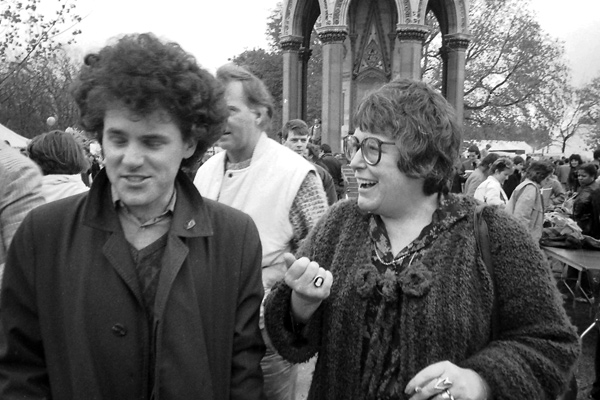
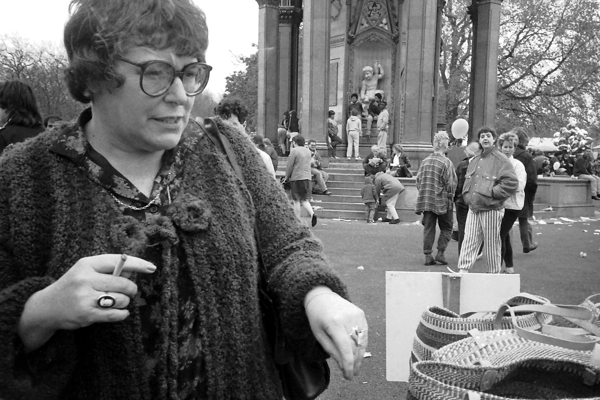
Jil at an event in Victoria Park in the nineteen seventies.
Photographs copyright © Phil Maxwell
The Old Signs of Spitalfields

Commit no Nuisance
I am the keeper of the old signs in Spitalfields. I have embraced it as my self-appointed duty, because although many are “dead” and others have become “ghosts,” disappearing into ether, they are all of interest to me. By “dead” signs, I mean those that no longer have a function, where their useful life is over, and by “ghost” signs, I refer to the next stage in the afterlife of signage where the text fades into illegibility until eventually no trace remains.
Some old signs are prominently placed and some are hidden in obscure corners but, irrespective of their locations, their irrelevance has rendered them invisible – yet I welcome them all into my collection. The more shabby and disregarded, the more I like them, because, as the passing years have taken away their original purpose, these signs have become transformed into poetry. In many cases, the people whom these notices address are long gone, so unless I am there to pay attention to these redundant placards and grant them dignity, they can only talk to themselves like crazy old folk rambling in the dark.
Given that the street name was altered generations ago, who now requires a sign (such as you will find at the junction with St Matthew’s Row) to remind them that Cheshire St was formerly Hare St, just in case of any confusion? I doubt if even the oldest resident, ninety-six year old Charlie Burns in nearby Bacon St, can remember when it was Hare St. And yet I cannot deny the romance of knowing this older name, recalling the former hare marsh at the end of the street.
Ever since someone pointed out to me that “Refuse to be put in this basket” could be interpreted as an instruction to reject being placed in the basket yourself, the literal netherworld implied by signs has captivated me. Now when I see the sign outside the travel agent in Brick Lane with the image of Concorde, I yearn to go in and ask to buy a ticket for Concorde as if – through some warp in reality – the sign was a portal inviting me to a different world where Concorde is still flying and this office in Spitalfields is the exclusive agent. I am fascinated by the human instinct to put up signs, craving permanent declarations and desiring to accrete more and more of them, whilst equally I recognise it is in the survival instinct of city dwellers that we learn to exclude all the signs from our consciousness, if we are to preserve our sanity.
To my mind, there is an appealing raffish humour which these old signs acquire through longevity, when they cock a snook at us with messages which the passage of time has rendered absurd. “Commit no Nuisance” painted discreetly in Fournier St on the side of Christ Church, Spitalfields, has long been a cherished favourite of mine. I wonder what genius came up with this notion, which if it were effective would surely be emblazoned on every street in the world. It could solve many of the problems of humanity at a stroke. Although, unfortunately, it does rely upon a certain obedient compliance from those most likely to offend, who are also those most unlikely to pay attention. Almost faded into illegibility today, with pitiful nobility, “Commit no Nuisance,” speaks in a polite trembling whisper that is universally ignored by those passing in Commercial St.
Even in the face of evidence to the contrary, signs can still propose a convincing reality, which is why it is so perplexing to see those for businesses that no longer exist. They direct me to showrooms, registered offices and departments which have gone, but as long as the signs remain, my imagination conjures the expectation of their continued existence. These old signs speak of the sweatshops and factories that defined the East End until recently, and they talk to me in the voices of past inhabitants, even over the hubbub of the modern city. Such is the modest reward to be drawn from my honorary role as the keep of old signs in Spitalfields.

Generations have passed since Cheshire St was known as Hare St.

This sign at the entrance to Dray Walk in the Truman Brewery, closed twenty years ago, was once altered from “Truman’s” to “Truman Ltd” when the company was sold, and, with due respect, the name of successive company secretaries was updated in stencilled lettering. These considerations are mere vanities now upon a dead sign surrounded by ads for the shops and bars that occupy Dray Walk today.

Travel agent on Brick Lane offering flights on Concorde.

Steam department works office in Fashion St.

Today’s top prices at the scrap metal dealer in Valance Rd.
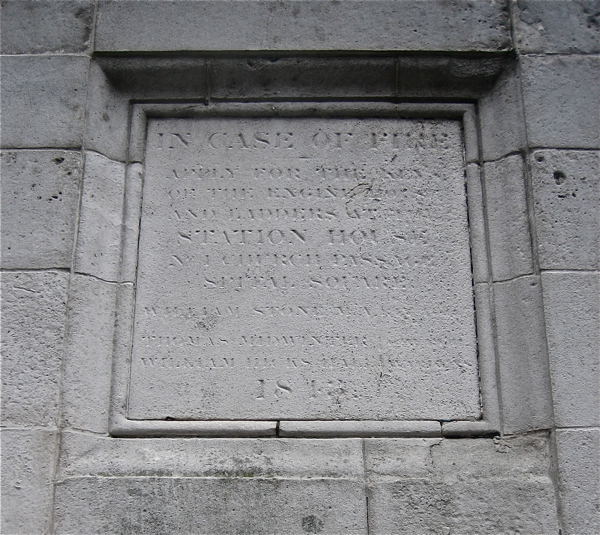
Incised on the side of Christ Church Spitalfields: In case of fire apply for the men of the engine house and ladders at the Station House, No 1 Church Passage, Spital Square. 1843. A precaution adopted after the great fire of 1836.

No more enamelling on Brick Lane.
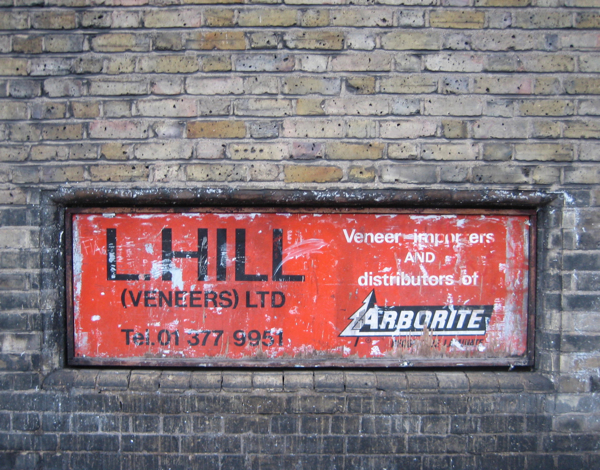
No more veneers on Great Eastern St.

Car Park on Petticoat Lane.

Registered Office in Commercial St.

Charlie’s Motors once offered services from £30 in Brady St.

On Christ Church, Spitafields: All applications about Marriages, Burials & c. at this church must be made to Mr Root. Note the reference to Church St – renamed Fournier St in the nineteenth century.
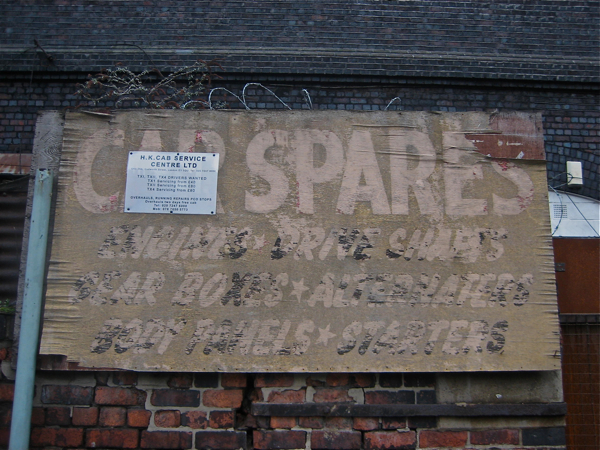
Car Spares on Three Colts Lane.

On Commercial St, “Woollen” overpainted onto “Glass Globes”

In Aldgate, Ben Eine adorns Stick ‘Em Up! sandwich bar.

Off Charlotte Rd, a courteous hand directs you to non-existent showrooms.

Diaphanous oblivion on Commercial St.
Jimmy Keane, Caretaker
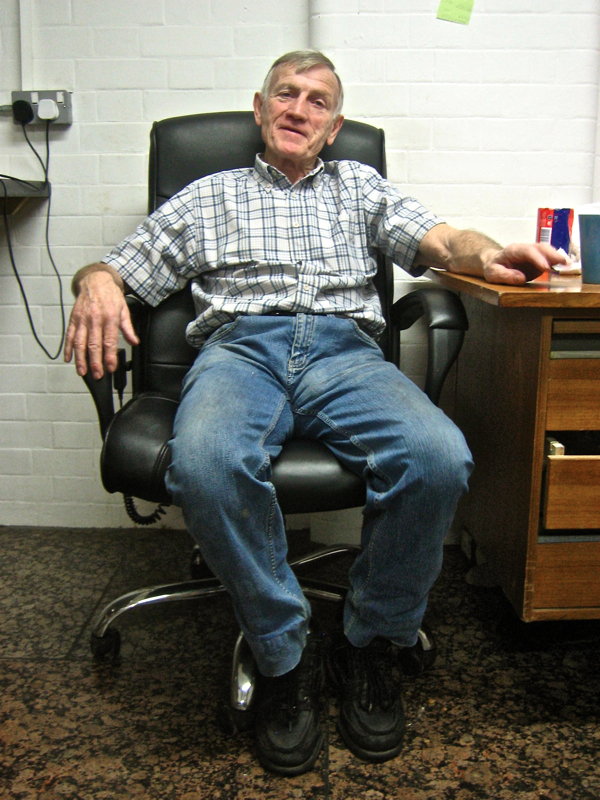
Here is Jimmy Keane, sitting comfortably in his executive chair in his office in the basement of the former Godfrey & Phillips Tobacco building in Commercial St where he has been caretaker for forty years. This mighty edifice on Commercial St, clad in biscuit-brown ceramic bricks, is so large that you can see it filling the entire top left corner of the photograph of Spitalfields which is our header this month.
Few ever get to venture down to Jimmy’s secret lair in the basement of his building, and I recognised I was a favoured guest when he escorted me in from the cold and wet, down the stairs, along the passage and into his private enclave where, as I passed through the metal door, I realised the air was several degrees warmer. “They call me site manager but really I’m just a caretaker. I listen to complaints from the tenants and I sort it out if I can and, if not, I refer it to my superiors.” he said as he poured me a cup of tea, outlining the boundaries of his responsibility with elegant equanimity.
We were in a sparsely furnished room with no windows, that possessed both tranquillity and a climate of its own, where Jimmy could feel at ease in his short-sleeved shirt even in the depths of Winter, and be at peace with his thoughts.“I was in at four-thirty this morning,” he explained with sprightly humour and an Irish twang, gesturing to his thin windcheater drying on a coat-hanger suspended from a pipe, “It was chucking it down, but you just keep walking, because you’ve got to get to work even if it’s raining.”
So there we were in a cosy bunker beneath Spitalfields, where I could ask Jimmy anything and no-one could overhear our conversation. The nature of Jimmy’s employment has given him a unique view of the social changes during his tenure, as an observer with privileged access, and I was eager to learn his appraisal of the different worlds that have passed before his eyes between the walls of this former cigarette factory.
“When I took this job in 1971, the rag trade people were running this area – all Jewish factories in them days. It was rough and ready, now it’s a bit more upmarket. The people working in the sweatshops didn’t have a great deal of freedom, you either did the work or you were sacked. The rag trade wasn’t an easy life to be in. What do you call progress? I suppose it’s progress that those things aren’t done in this country anymore. I saw all that go, and now I’m dealing with a different crowd of people now who’ve got credit cards and they’re upmarket. I haven’t got the education for that kind of thing. What people got in this country was barely a living, they were exploited. But there’s more pressure now on these people I see here on their laptops – if they lose, they can lose a lot. Don’t get me wrong, I’ve had my knocks and I’ve put them behind me. These people come with stress every day. They’re nice people, but I don’t envy them because I’ve got freedom, to me these people haven’t got freedom.
Thirty or forty years ago, people might earn £4 a week and spend £3 of it on beer! They were getting a weekly wage in cash and they didn’t worry about mortgages. When the market and brewery were working twenty-four hours, there were singsongs in the pubs at six in the morning. It was a different buzz and people were happier in themselves, but they were crazy gamblers, horse-racing, dog-racing, dice, cards. They’d love a gamble! I say there’s only two kinds of people that gamble, the needy and the greedy.
When the rag trade was here, I used to go home at Christmas with three or four hundred pounds in cash from tips, now the excuse is, “We don’t carry cash.” They’re a different quality of people today, they’re more selfish. They think because they’re middle class they can look down their nose at you sometimes, but I’m one of those who won’t take it from my employer and I won’t take it from these people either. It’s a lot of snobbery! At the end of the day, I don’t need them but they need me, so I am in a strong position. I’m more or less my own governor here and I’m quite contented.
I was born in Ireland in 1935. There was little work there in the early nineteen fifties, so when my father completed his twenty years in the British army, based in Birmingham, we moved down to the East End. That was 1951. There wasn’t much work in London, I did lots of jobs from making ice cream to being a cooper’s mate. Things only picked up in the late fifties and early sixties, when the building trade expanded. I used to do a bit of work for the family that owned this building and I came here to do a bit of painting, they were Orthodox Jews. Very nice people, and I have worked for three generations of the same family. They wanted a caretaker and I have been here ever since.”
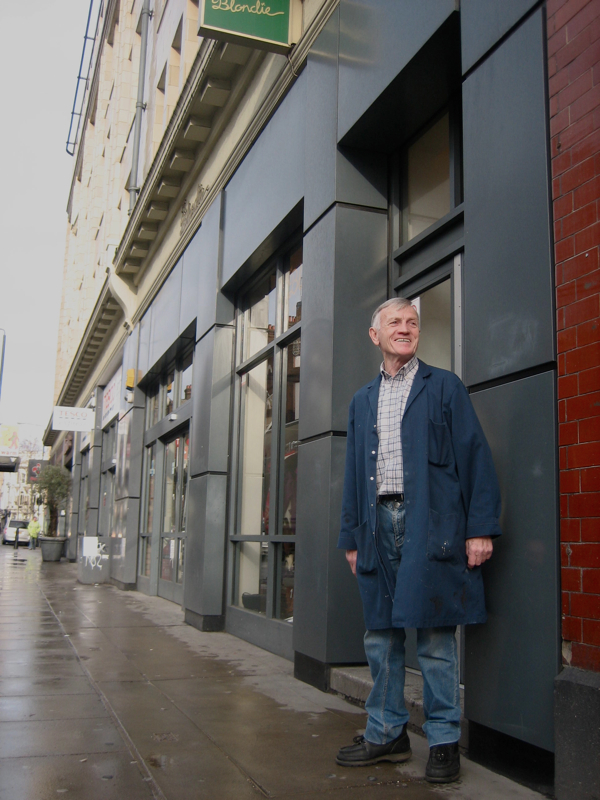
It was a clear-eyed testimony, told with humour and without cynicism, and I was full of admiration for the way Jimmy had recognised the beauty of his situation and negotiated a self-respecting independence of spirit. Resuming a professional persona, he pulled on his long blue coat, standing up with all vigour and swagger of a man half his age, and bragging of how he kept fit running up and down all the stairs.
And when we emerged into the public area, Jimmy began telling me how he had been featured in a fashion shoot by Dazed & Confused when they were based in the building, and how it led to some other modelling work, and how much he enjoyed it, and how he had done quite well out of it, and how they told him he was a natural. Then several young people who worked in the building in media and fashion companies ran up to him, to greet and embrace him enthusiastically, which delighted him, and I saw how popular he was, and I realised that I had been party to the private thoughts of Jimmy Keane, the caretaker – but fortunately I know I can rely upon you to maintain his personal discretion.
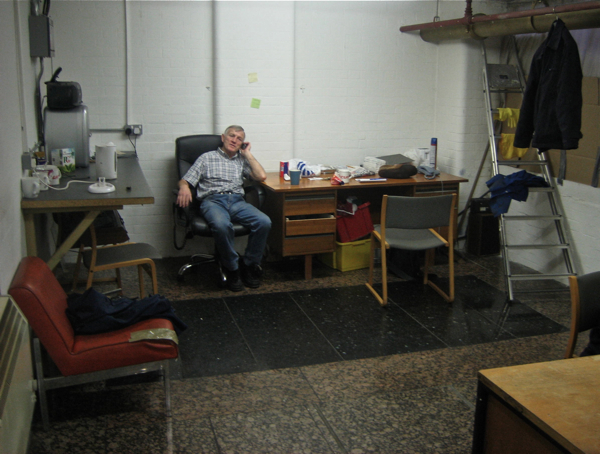
Down in Jimmy’s den.
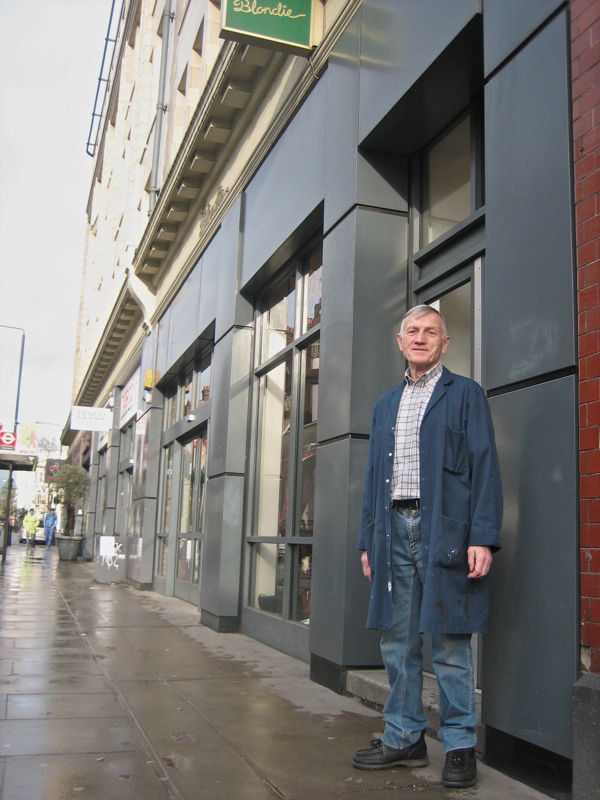
Jimmy, the proud custodian.
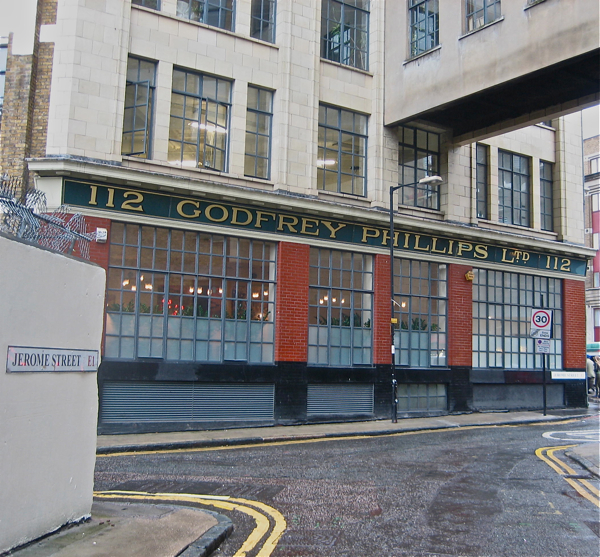
In Jerome St, the lettering of the former cigarette factory remains.
Geraldine Beskin, Occultist

Geraldine Beskin presides as serenely as the Mona Lisa from behind her desk at the Atlantis Bookshop in Museum St, Bloomsbury – the oldest occult bookshop in the world, one of London’s unchanging landmarks and the pre-eminent supplier of esoteric literature to the great and the good, the sinister and the silly, since 1922. “My father came into the shop one day and Michael Houghton, a poet and a magician, who founded it and knew everyone from W.B.Yeats to Aleister Crowley, took a good look at him and said, ‘You’ll own this place one day.'” Geraldine told me, with a gentle smile that indicated a relaxed acceptance of this happy outcome as indicative of the natural order of things.
“I started working here when I was nineteen, and I’ve read a tremendous amount and I’ve done some of it – because you have to be a reader to be a good bookseller.” she said, casting her eyes around with proprietary affection at the sage green shelves lined with diverse and colourful books old and new, organised in alphabetical categories from angels and fairies, by way of magic and paganism, to werewolves and vampires.“This place was set up by magicians for magicians and that’s a tradition we continue today.” boasted Geraldine, who guards this treasure trove with her daughter Bali, the third generation in the book trade and a fourth generation occultist.
Yet in spite of the exoticism of her subject matter, Geraldine recognises the necessity for a certain rigour of approach.“There are New Age shops that sell dangly things and crystals, but we don’t, we’re a quality bookshop” she said, laying her cards boldly yet politely upon the table,”We are not faddist, we have an awareness of the contents of the books.” Working at her desk, sustained by copious amounts of tea, Geraldine is an enthusiastic custodian of a wide range of esoteric discourse upon matters spiritual. “The esoteric is an endless source of fascination,” she assured me, her eyes sparkling to speak of a lifetime’s passion,“There are so many facets to the esoteric that you need never run out of things to be amazed by.”
I am ashamed to confess that even though I pass it every time I walk to the West End, I never visited the Atlantis Bookshop before because – such is the nature of my credulity – I was too scared. But thanks to Simon Costin of the Museum of British Folklore who arranged my introduction to Geraldine, I made it across the threshold this time, and once I was in conversation with Geraldine who admits to being a witch and practising witchcraft, although she prefers the term “occultist,” I discovered my fears were rootless. However, my ears pricked up at the innocent phrase, “I’ve done some of it,” which Geraldine dropped into the middle of her sentence quite naturally and so I enquired further, curious to learn more about the nature of “it.”
“My grandmother, me and my daughter all do it. My dad did it.” she declared, as if “it” was the most common thing in the world, “I come from a family of esoterics. I was born into it, so I think it would be immoral to own a shop like this and not appreciate what people are doing. Loosely it could be called witchcraft, but in reality it is a certain perception or background intuition.”
“Our subject has become very fashionable and young academics don’t have a bloody clue, which is very frustrating for us.” she continued, rolling her eyes at the inanity of humanity,“We try to disabuse people of the myths about witches, they are good kind people on the whole. Most witches are as mortgage-bound and dog-walking as everyone else. Most witches do healing, and buy toilet paper. And there is this side of trying to commune with nature and be aware of the cycle of change. It’s a very rich and rewarding way of life. I practise a bit of magic – there’s so much you can’t learn from books and you have to do it yourself.”
With her waist-length grey hair, deep eyes, and amusingly authoritative rhetorical style, Geraldine is an engaging woman of magnanimous spirit. And I cannot deny a certain vicarious excitement on my part, brightening a grim January morning to discover myself seated in this elegant empty bookshop in Bloomsbury in conversation with a genuine witch. Yet I was still curious about the nature of “it.” So I asked again.
“Witchcraft is a very benign religion, where you work around the seasons of the year.” explained Geraldine patiently, in a pleasant measured tone, “You start off in darkness, and, in Mid-Summer, the Holly King and the Corn King have a fight and the Holly King wins and then the light begins to decline. At Yule, they fight again and the Corn King wins and the light begins to come back to the world. In agrarian societies, people got up at dawn and worked until dusk, and they adjusted how they lived by the seasons. It was the Christians who gave us the devil and we don’t know what to do with him. We have a horned god who is the god of positive male energy – not a devil at all, but the poor soul has been demonized over the years.”
Geraldine convinced me that esoteric cultures from the ancient world remain vibrant, by reminding me that witches were always “green,” ahead of their time in ecological awareness, and – although she could not disclose names – by revealing that top celebrities, from princes to pop-stars, have always frequented the Atlantis Bookshop. “We make a play of only giving out the names of our famous dead customers,” she confided to me with a tantalising smirk. “Most of our customers are practitioners – witchcraft has become the default teenage rebellion religion today,” she added with an ambivalent grin, confirming that, in spite of everything, the future looks bright for witches.
You watch a short film of Geraldine Beskin at the Atlantis Bookshop by clicking here.


The British Museum awaits at the end of the street.


Geraldine and her sister Tish outside the bookshop in the nineteen seventies – “Those were the days when the Rolling Stones and the Beatles used to come in.”