
A Renovation in Fournier St

This is the eighteenth century house in Fournier St that Jane Cumberbatch and her husband Alastair renovated in the nineteen eighties. Today its serene appearance belies the ambitious restoration that was undertaken to bring it back from the verge of collapse a quarter of a century ago.
“Neither of us really realised what we were taking on,” admitted Jane with a winsome smile to find herself standing outside the house she bought in 1985, more than ten years since she left it, “We didn’t realise how beautiful it was because all the panelling was hidden behind layers of hardboard – but we knew we had to do major work because there was a bow in the back wall and a dodgy roof in danger of collapse. Though we were so lucky to find some wonderful people, Richard Naylor was the architect who drew up the plans, Jimmy Brunton was the builder, Bodhan Antoniuw was the carpenter, Robert Davies carved the corbels and Jim Howett made the shutters and our bed, which we still sleep in today.”
Yet before she could achieve her dream, Jane had to suffer the nightmare of the back wall collapsing in the midst of the two year programme of work required before she could move in. “At one point you could look through the floor from the attic to the basement.” she recalled with a sentimental grin, “We had to take it back to the skeleton, but we tried to keep as much as we could and we used recycled boards where we couldn’t. One of the problems is how far do you go, we tried to make the house work for now but you have to retain its integrity. Dan Cruickshank was always around as a sounding board and everyone involved was very passionate.”
When Jane came to live in Spitalfields, the Fruit & Vegetable Market was still in operation and it was a more utilitarian place. “At first people would say, ‘Where is Spitalfields? Is it safe?” Jane informed me, wincing with retrospective irony, before giving in to her affectionate reminiscences, “I remember Nelly, the longest established resident of Fournier St at ninety years old, she had been born there. And Michael and David Gillingham opposite, who had the perfect Georgian house, with a poltergeist that had to be exorcised. And John, who once had a good job, but would stand and rant outside the church gates, yet stop to pat the children on their heads nicely. And there were hawks nesting on the church tower that ate the rats. And one night somebody dumped five hundred tins of used cooking oil outside our front door. And one night somebody set fire to a skip in the street. And there were bombs in the City and Brick Lane, and our windows shook. There was always something going on! And there were so many down and outs, I wonder what happened to them?”
Among Jane’s fond memories of Spitalfields, one night stands out above all others, 16th October 1987. “The night of the hurricane was very scary,” she announced, rolling her dark eyes, “We were woken by this howling wind and the lights went out in the City. All the trees came down in the churchyard and there was this huge gap because the planes opposite were not there any more. I couldn’t get to work next morning, so I went out into the churchyard and took pictures.”
“I don’t think I’ve ever got over leaving Spitalfields because it was magic, but we have all these tangible memories.” said Jane tenderly, thinking out loud and reconciling herself to her experiences, as we looked through her old photographs together, “I used to feel the houses were so old and an awful lot of misery had happened in them. It would have been a rooming house – so many people came through. And we were just another wave of immigrants, amongst all the waves and waves of of different people. Yet all the friends we made here, we still keep in touch, because there were lots of children then and they all used to play in each other’s houses.”
Over the passage of time, Jane Cumberbatch has come to recognise that no-one ever truly owns these old houses, the inhabitants are mere custodians. These photographs (selected from nearly three hundred that she took of the house she eventually left in 1997) record the transformation that she is proud to have supervised, as her personal contribution to the ongoing stewardship of these soulful edifices which have seen so much life over the centuries.

This is the house when Jane first saw in 1985 as U-Tex of London Ltd, Trouser Manufacturer.

The view from the weaver’s loft towards the market.

The derelict loft.
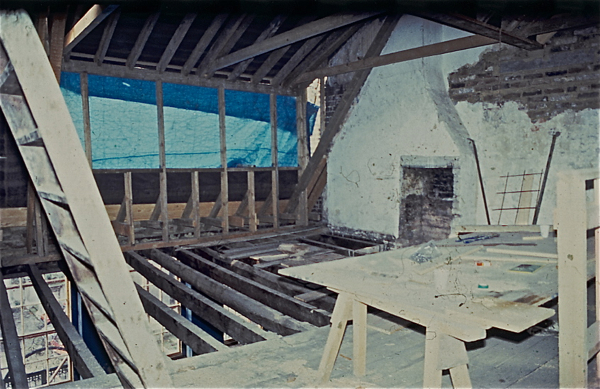
During the replacement of the roof and the floor.

After renovation.
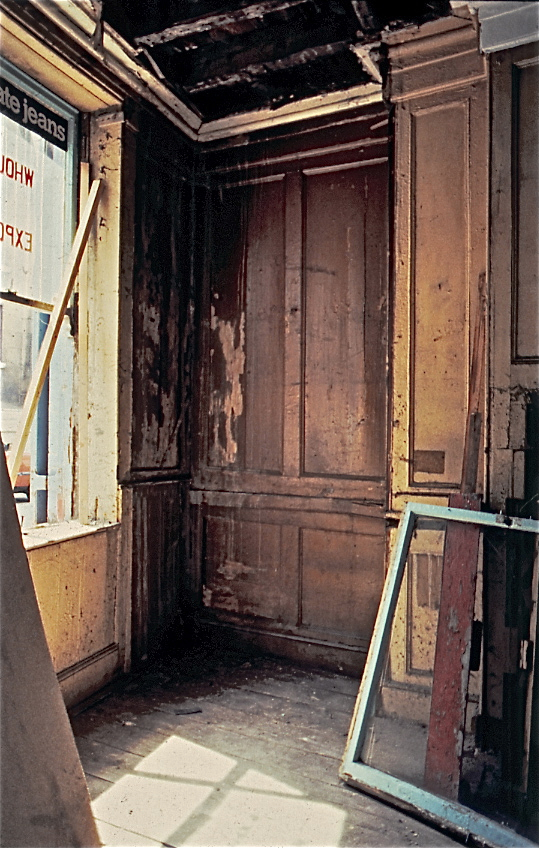
Eighteenth century panelling uncovered on the ground floor.
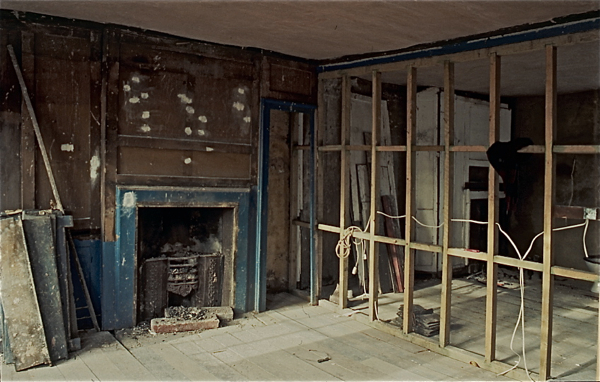
Restoring the original position of a partition wall.

The dining room.

The facade with the signage removed.

The facade with new windows and shutters replicating those of the seventeen twenties.

The bedroom.


The banana merchant at number one Fournier St.

The rear elevation with the bowed back wall.

The absence of back wall after its collapse.

The reconstructed back wall using recycled bricks.

Jane contemplates the dereliction she bought into.


The living room.

Jim Howett, still renovating houses in Fournier St today, fits the new windows.

October 1987, the night of the hurricane in Spitalfields.

Plane trees in the churchyard brought down by the hurricane .
Photographs of renovations copyright © Jane Cumberbatch
Photographs of interiors after renovation copyright © Henry Bourne
Jane Cumberbatch’s book “Pure Style” is published by RPS and you can follow her work through her blog www.purestyleonline.com
You may also like to read my other Fournier St stories
The Wallpapers of Spitalfields
Hugo Glendinning, Photographer
Andy Rider, Rector of Christ Church Spitalfields
The World of the East End Car Wash

Mohaimenul Islam, Car Washer
Car washes come and go in the East End, opening up in vacant railway arches or disused petrol stations, enjoying a brief flowering and then vanishing as unexpectedly as they appeared. When Spitalfields Life contributing photographer Sarah Ainslie and I drove around in her (unwashed) car last week, we found several favourites had gone whilst others had sprung up overnight. Yet within the mutable world of the car washes, business goes on relentlessly, because as quickly as vehicles are cleaned, the traffic and the weather and the mud restore the necessity for it to be done all over again. Teams of men work ceaselessly in shifts, twenty-four hours a day, at a job that requires astounding stamina and patience.
Let me admit, it gives me the shivers just to imagine the lot of a car washer, working outside through the damp and cold of a London Winter, so I was humbled by the goodwill that I encountered from these men, demonstrating resilience and tenacity in circumstances that few would envy. Arriving at T2 Car Wash under the railway arches at the Western extremity of Cable St, beneath the main line coming out of Fenchurch St Station, the car washers welcomed me into their cosy cubby hole off the main working area, a den where they enjoyed a bowl of porridge and watched satellite TV, toasting their toes by the heater during a rare break from the everlasting parade of taxis which pass through here night and day.
Yet once a vehicle pulled up, they were all over it with a preternatural dexterity and speed. Working in concert, they were spraying shampoo, mopping it with sponges – one in each hand – then rinsing it down and polishing it up with chamois leathers – again one in each hand – until the customer received his charge back, gleaming and spotless. And then the car washers moved on to the next in line with undiminished enthusiasm. While one team attended to the exterior, others were hoovering and cleaning out the interior, and everyone worked round each other – like some elaborate dance in which the moves kept shifting as everyone accommodated to everyone else in the constant imperative to keep things moving. These men are expert at what they do and show grace, in demonstrating the warmth of mutual respect, and excelling in an endeavour which to others might be of little consequence.
All this spectacle takes place within a whitewashed arch lit by fluorescents, open to daylight at either end, where, in a glacial mist, every surface glistens with damp and the floor is awash with water and soap suds draining away through culverts. For the most part these men do not wear gloves, even working with wet sponges and wringing them out in cold water, but when I asked “Don’t you get cold?” – the answer was automatic – “We don’t feel the cold when we’re working, and when we’re not working we’re in by the heater.”
In each car wash, I sought human details – the Christmas baubles, or the plastic birds, or the bunting, or the odd chairs scattered around, or the newspaper cuttings stuck to the wall, indicating that the employees had taken possession of their space. Be aware, the car wash is an arena we entered as guests, because the car washers are rulers of their soapy domain and customers must understand the decorum and necessity which requires a retreat to the waiting room, or to use the facilities, or to stand outside, at a respectful distance from the centre of activity.
Alone in the den at the T2 Car Wash, a room excavated into the thickness of the old brick vault, where I was privileged to hover and warm myself, I realised that I had found the inner sanctum in which the car washers came to regroup, sitting upon the worn couch and old office chairs, wiling away the long dark nights and bolstering each other’s resolve to make it through another Winter. In the face of this arduous repetitive work, a group of Ghanaians and Romanians have banded together to make the best of it under an arch in Cable St.
You might say that washing cars is a pointless activity since the vehicles get dirty again at once, yet, as with many human occupations, the nobility lies not in the nature of the task or even in the reward, but in the manner of its execution. And there on the wall in the den, I saw the medal for car washing, awarded to the team for the ever-growing number of customers each month, objective evidence – if it were ever necessary – of the otherwise unacknowledged heroism of the proud car washers of the East End.



George


The den.

Rosoi Lucian

Working without gloves in February.

Kofi shows off the customer facilities.

Car washers never cease work, twenty-four hours a day.

Albani Cletesteanu
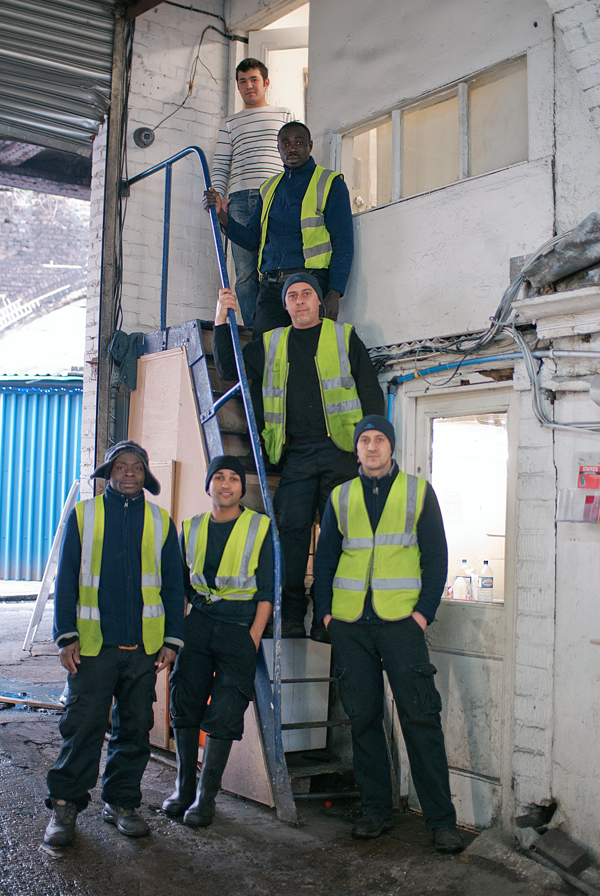
The champion car washers of Cable St.

Wet boots and socks.


Photographs copyright © Sarah Ainslie
Brick Lane Market 1
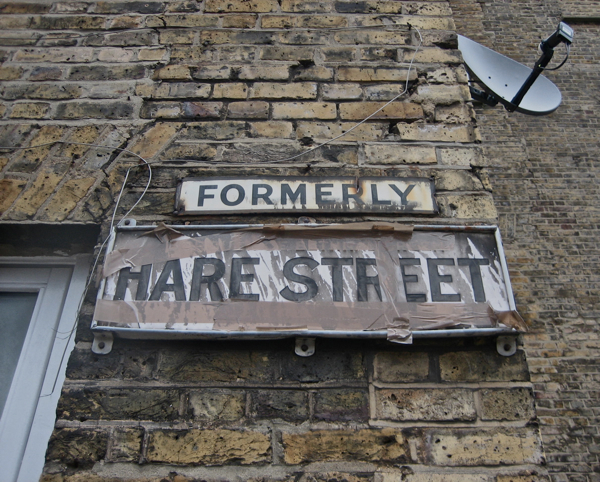
As the first of these Brick Lane posts, it is my pleasure to introduce you to Dennis and Arthur, two stalwarts who incarnate the spirit of the market. You will find them occupying Hare Marsh each Sunday – the cul-de-sac down towards the railway line at the end of Cheshire St, formerly Hare St.

Wiry and agile and full of vitality, Dennis Major has been dealing in toiletries, cut-price chocolate and general hardware in the market for more than thirty-five years. “When I first started, I was down the other end of Cheshire St.” he explained to me casting his beady eyes around at the fabled market that once was here,“They used to sell dogs and cats then, and sometimes I took sickly kittens home that were abandoned in the gutter but they always died. There was a stall that who sold chickens, they would wring their necks and pluck them for you before your eyes. We were next to the bird man, he would go crazy because everybody would be all over the bird cages, and the birds would make such a racket. We did have some laughs.”
For many years Dennis ran a hardware shop in Norbury but, even retired now, he cannot break the habit of Sunday in Brick Lane because the same customers keep coming back to greet him after all these years. While we were talking, Arthur Whitmore, a senior market gardener from Cambridgeshire with hardy features and straggly white hair, who has been travelling down on the bus each Sunday for more than fifteen years in search of “something fresh to see,” popped by to have his weekly chat with Dennis. “There’s no end of villages where I come from,” he informed me, hinting at the workaday nature of his rural life.
When Arthur departed, in a brief lull, Dennis pointed across Cheshire St and confided to me quietly , “One Sunday, I came down when Ginger Marks was killed outside the Carpenter’s Arms. The was a bullet hole in the wall and they’d roped it off where he’d been shot but they never found the body. If you lost a bike in South London you could always find it here next Sunday. This was a good market. People off the boats in the docks would come here and you could sell them all sorts of things. There was a fellow who sold train sets. Most of them have died, there’s not so many like me down here any more.”
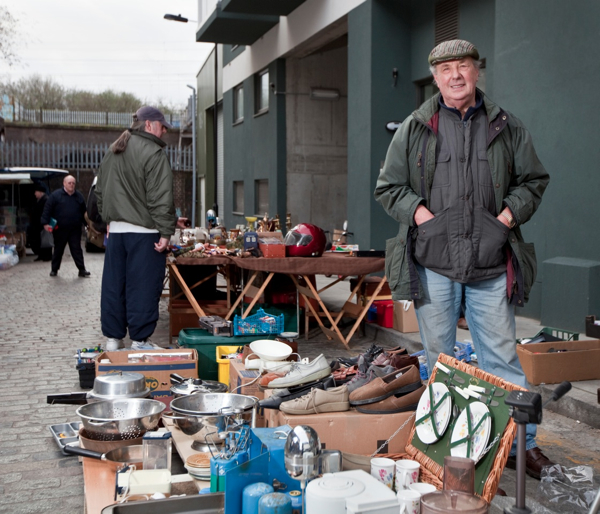
“I’ve been coming here since I first visited with my father to buy canaries for our shop in Woking, that was sixty-two years ago,” revealed Arthur with the relaxed genial air of one entirely at home in the market, for whom doing deals and taking money off a string of customers is second nature. “I’ve always been at this end of the street, since I started as a very young lad fly-pitching with a pram full of bits and pieces.” he recalled enthusiastically, “And I have been on this spot as a licenced trader for at least twenty-five years. I took over from Frank Fisher who’d been here many moons before me, he was a Smithfield meat porter. This little area was packed then, it was a job to get a pitch – they used to fight over them. Ever since I could drive, it’s been a weekly ritual coming into London on Sunday.”
Such is Arthur’s trustworthy reputation that local people will confidently buy used electrical gadgets from him, “I always offer a refund on anything electrical,” he assured me as an African lady delightedly carried off a food processor in her bag for twenty pounds, “I remember what I buy and sell and I know the price of everything. Sometimes I keep things in the interests of future prosperity, and I’ve got a nice rug as a future heirloom. Once I bought a lion with with its foot on the globe for fourteen shillings, then sold it for fifty shillings to a lady named Sylvia. It turned out to be early eighteenth century Capo de Monte and went for £2000 at auction – but when she died ten years ago, she left me £1000 in her will.”
Arthur buys at house clearances and jumble sales, hoping to clear a quarter of the stock that he keeps in his van and top it up again each week. “My father bred canaries and showed them at Crystal Palace. He used to buy the birds up here in the market because he had the experience to know what he was buying. I remember the first thing I ever sold, a BSA bantam motorcycle in Club Row when I was seventeen, and I still can’t keep away from it today.” Arthur confessed to me with an amiable modest grin, hooked by the endless cycle of market life – appreciating it as a place of commerce, and equally as an important location of social life and collective memory.
Market trader portraits copyright © Jeremy Freedman
More John Player’s Cries of London
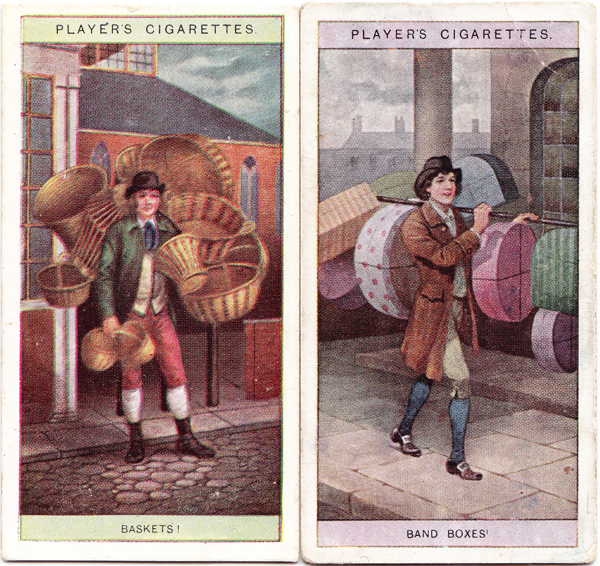
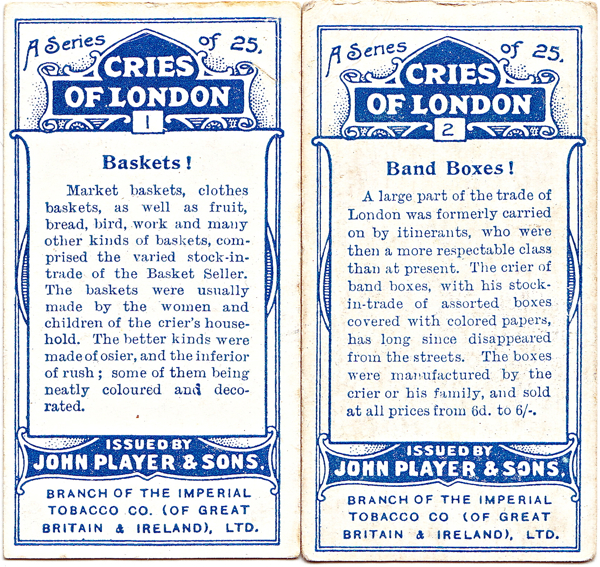
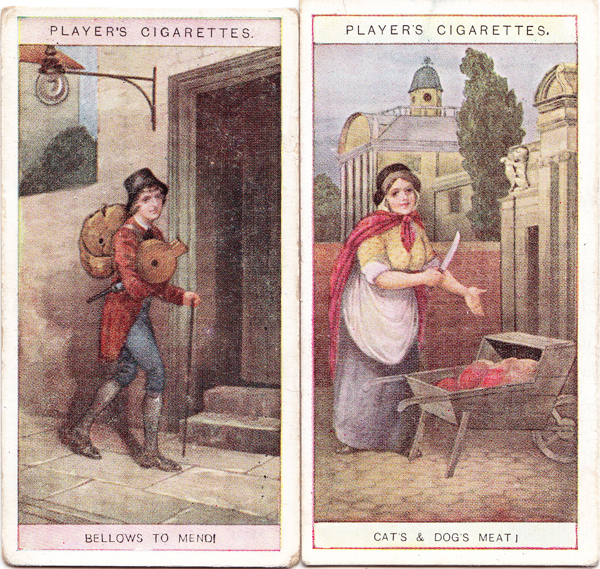
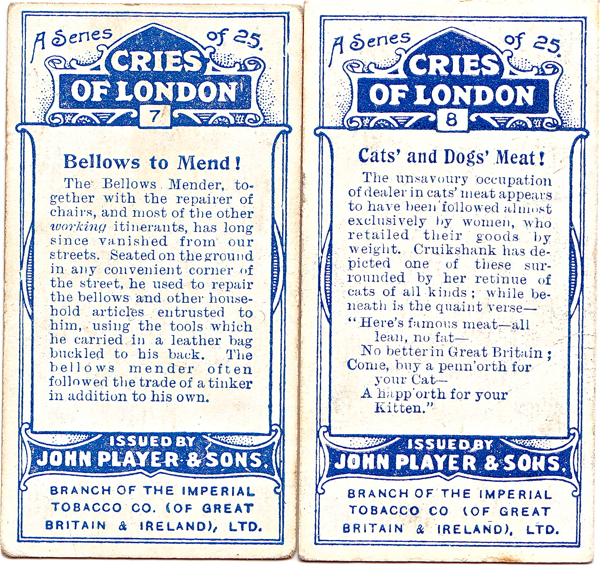
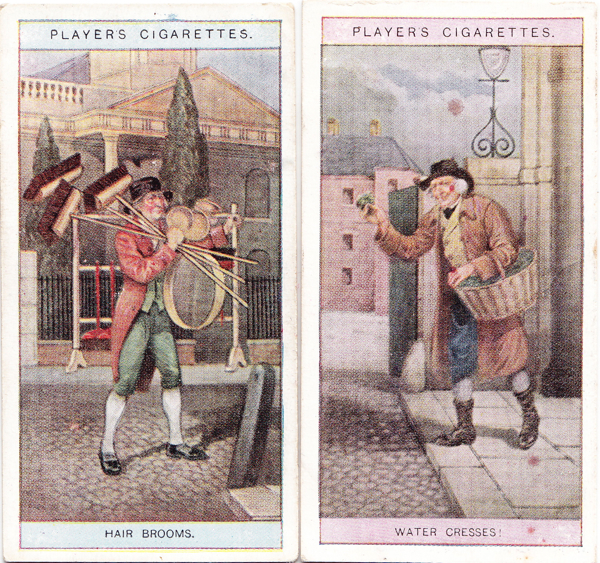
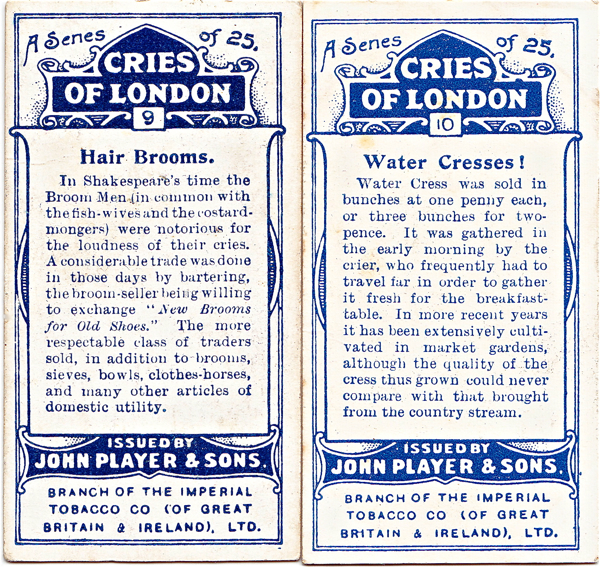
Since I showed you my set of John Player’s Cries of London from 1916 last week, I found this earlier set issued in 1913. The same appealing pantomime aesthetic prevails, and these crudely printed cards portray a surreal idealised old London in which the cats’ meat is as pink as the spots on a hat box and the hawkers are resolutely cheery as they go about the the streets plying their wares -although the clouded skies that accompany each vendor will strike an unexpectedly familiar note of authenticity for any Londoner.
I cannot deny there is a little moralism in the text on the reverse of these cards, apparent when we are told that these itinerants, “were then a more respectable class than at present,” evidenced by the basket seller’s family who made “better kinds of baskets… some of them being neatly coloured and decorated.” Elsewhere we encounter “the cleanly housewife who strews sand plentifully over her floor,” and “the London housewives” who place Lavender in their linen cupboards. Player’s Cries of London are a model of decorum, lacking the playful eroticism of Francis Wheatley’s set from 1790, the celebration of Vagabondia in John Thomas Smith’s set of 1817 and the subversive irony of John Leighton’s set of 1851.
Yet the last two cards are exceptions to this, the Dust Man (whose title still lingers in the vocabulary to describe Refuse Collectors) and the Chimney Sweep – who are missing their implicit companion, the Night Soil man, as presumably too scatological. The Dust Man looks distracted while the Chimney Sweep is overly cheerful verging on the demonic. So, even if these charismatic gaudy images have been more than a little sanitised, in the wicked grin of this bratty little urchin we are reminded of the witty libertarian spirit of the old Cries of London.
All Cries of London are fascinating to me – whether prints, cigarette cards, biscuit tins, plates or playing cards, because the changing nature of these images traces evolving perceptions of the urban poor. It is a genre that delights me by celebrating the infinite resourcefulness of people in creating a living out of nothing.
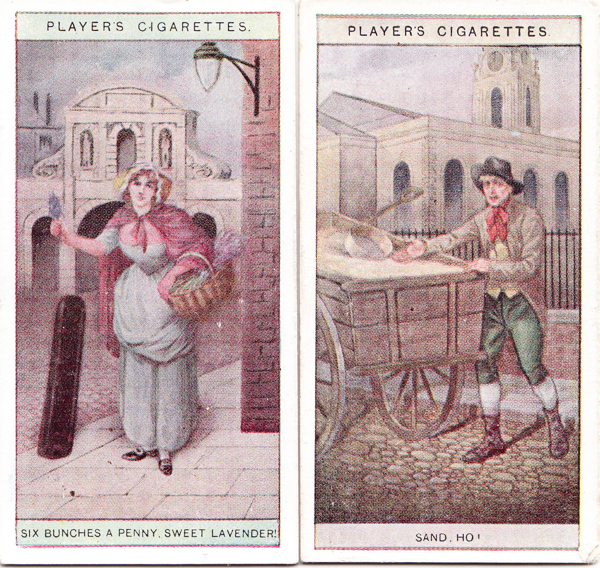
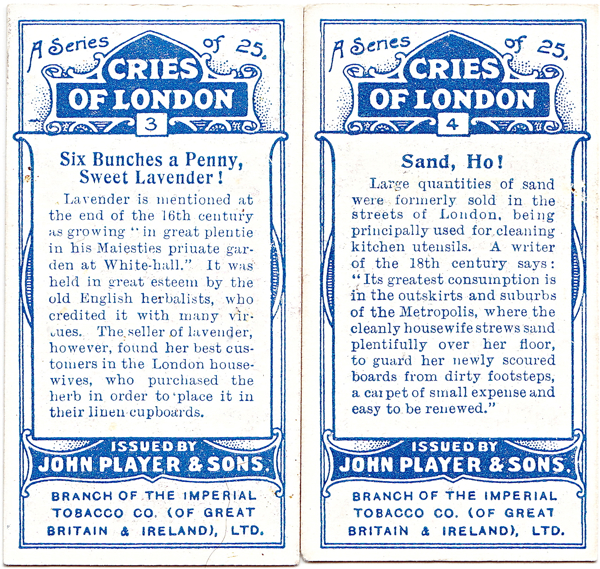
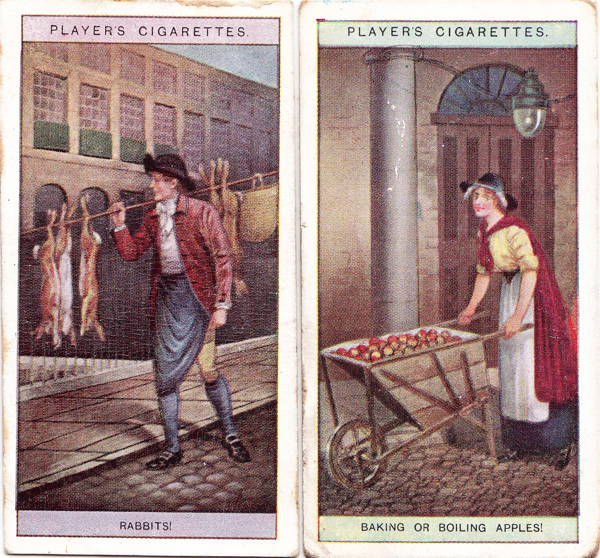
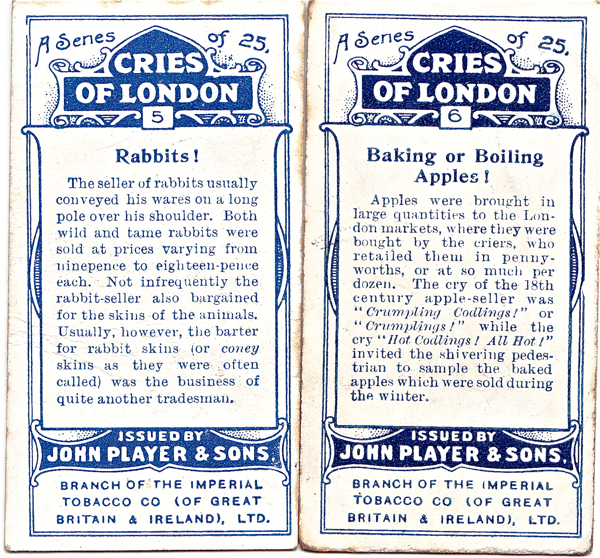
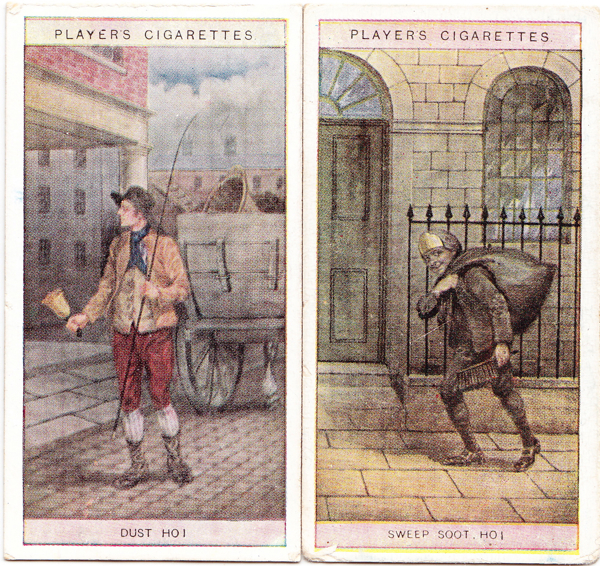
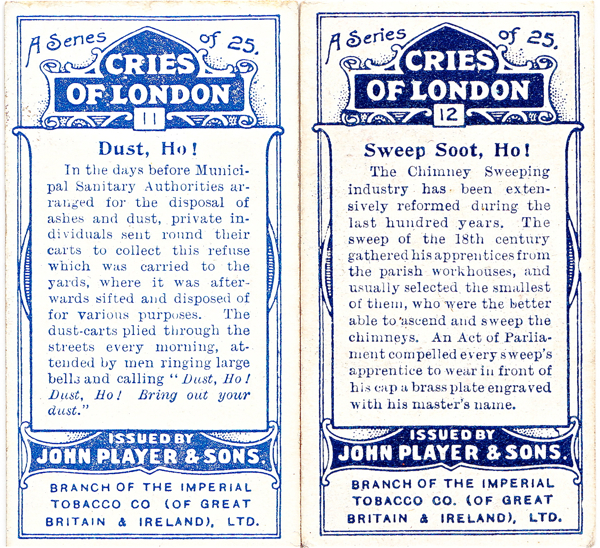
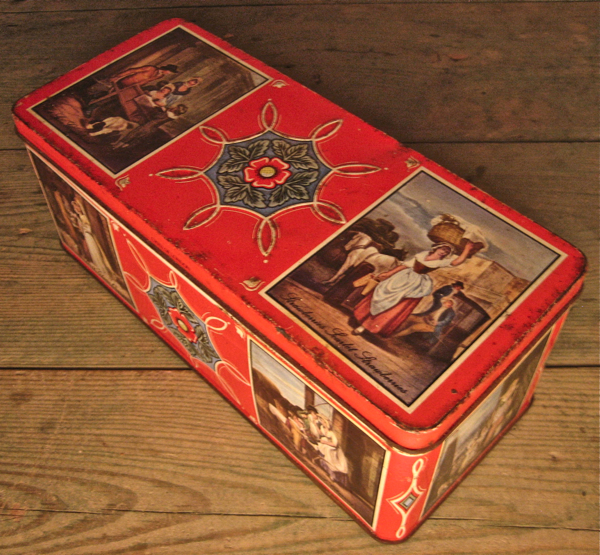
Cries of London – the biscuit tin.
You may like to take a look at
William Nicholson’s London Types
Francis Wheatley’s Cries of London
At the Hoop & Grapes

David Milne (curator at Dennis Severs’ House in Folgate St) took me along to the Hoop & Grapes in Aldgate for a drink yesterday, revisiting a special haunt that he was introduced to by Dennis Severs back in the nineteen eighties.
We walked together from Spitalfields up through Petticoat Lane until we arrived at the busy junction in Aldgate where traffic careers in every direction.“This was the major road in and out of London and it would always have been as full of people as it is now.” said David, as he peered down the road towards Whitechapel, wrinkling his brow to imagine centuries of travellers, before fixing his gaze directly across the road at three of the last remaining timber frame buildings surviving from before the fire of London. The central building, squeezed between its neighbours like a skinny waif sat between two fat people on a bus, was the Hoop & Grapes.
It is the oldest licensed house in the City, built in 1593 and originally called The Castle, then the Angel & Crown, then Christopher Hills, finally becoming the Hoop & Grapes – referring to the sale of both beer and wine – in the nineteen twenties. The first impression when you turn your back on the traffic to enter, is of the appealingly crooked Tudor frontage with sash windows fitted in the seventeen twenties at eccentric angles, and of two ancient oak posts guarding the entrance, each with primitive designs of vines incised upon them.
Stepping through the heavy door patched together over centuries, the plan of the narrow house is still apparent even though the partition walls have been removed. A narrow passageway ran ahead down the left of the building with small rooms leading off to the right, a structure which is revealed today by the placing of the beams in the ceiling and the bulges in the wall where the fireplaces in each room have been sealed up. Opening to your left is the bar, where the premises have expanded into the next house and to the back is flagged floor next to the largest chimney breast in a space that was a kitchen in the sixteenth century.
David and I enjoyed the privilege of access to the cellar where the landlady led us through a sequence of narrowing brick vaults built in the thirteenth century, until we reached the front of the building where she pointed out an old iron hook in the ceiling, held back by a lead catch. “No-one knows what this was for,” she admitted, prompting David to look down at his feet where a metal cover was set into the floor.“There was a well beneath,” he said, speculating,“the Aldgate pump was not far from here and the water table is high.” Then the landlady released the hook to hang vertical and it hung directly over the centre of the cover, perfect for hauling up a bucket. We all exchanged a smile of triumph at solving the puzzle, and stood together to appreciate this rare medieval space, essentially unchanged since Elizabeth I met Mary Tudor fifty yards away at Aldgate in 1553.
Upstairs, the landlady pointed out the site of a listening tube, centuries old yet covered over when a speaker system was fitted recently. This tube enabled whoever was in the cellar to hear what was spoken in the bar and vice versa. David believes it was used in the days of Oliver Cromwell by the landlord, who was in the pay of the authorities, to eavesdrop upon conspirators who chose this pub just outside the City gate for illicit liaisons, and there is no doubt that – thanks to the sparse renovations – once you have been here for a while you can begin to imagine the picture.
We sat down at the quiet corner table next to the crooked window with our drinks. “Dennis and I had this way of looking at things and making it more than it is,” confessed David to me with a contemplative affectionate smile “and that’s what we called ‘the theatre of life’. I used to come and visit him, and we’d go for walks around Spitalfields and end up here for a pint. We were looking for what remains – the signposts to the great City of old – the street that ran down to the City of London was full of houses like this. We would sit here and create a story about the merchants who lived in these ancient houses.”
In this no-man’s land between the City and Whitechapel, the Hoop & Grapes is a reliably peaceful place to go where just a few commuters drop in for a pint and tourists rarely appear – because it does not readily declare its history. Yet time gathers here in the stillness of this modest Tudor building – constructed atop a medieval foundation with eighteenth, nineteenth and twentieth century accretions – while the world rushes past as it always has done.
Through his house in Folgate St, Dennis Severs’ reinvented the way that historic buildings are presented. When David Milne came here with Dennis Severs thirty years ago, all that was in the future, and today more than ten years after his death, David is one of those who maintains Dennis Severs’ creation. “He was a remarkable man,” confided David, as we took our leave of the Hoop & Grapes, “and now this place is a signpost to my past with him.”


David Milne first came here with Dennis Severs thirty years ago.

The thirteenth century cellars.

An ancient hook above the well in the cellar.

Two venerable oak posts carved with vines guard the door, and sash windows added in the seventeen twenties sit within a crooked sixteenth century structure.

An insurance plate from 1782 still adorns the frontage.

The three sixteenth century timber frame houses in Aldgate, predating the fire of London which came within fifty yards. The house on the right was refaced in brick in the eighteenth century.
Photograph of the Hoop & Grapes in the nineteen fifties copyright © Bishopsgate Institute
You may also like to read about
Sandra Esqulant at the Golden Heart
Other Dennis Severs’ House stories
Mick Pedroli, Manager at Dennis Severs’ House
An Afternoon with Roa, Street Artist

With the change in the weather, the street artists are stirring for the first time this year. Yesterday I got a message to say that Roa – the Belgian street artist responsible for the squirrel in Redchurch St and the crane on Brick Lane – was painting a wall at back of the Foundry in Old St, so I grabbed my camera and raced over to discover an empty car park with a lone security guard sitting in a car. I expected him to ask me to leave, but when I enquired about Roa, he told me with some excitement that the celebrated artist was expected at any moment.
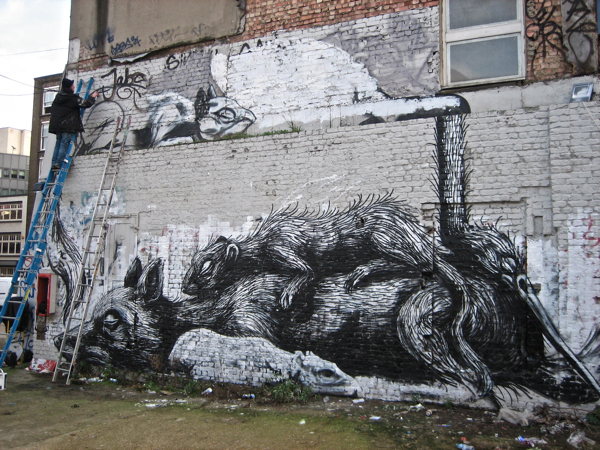
In fact, Roa had started painting the day before, evidenced by a pile of finely drawn creatures, a rat, a fox, a weasel and a heron, adorning the raw end of a building where an adjoining structure had been removed. Just as I was admiring this, a skinny pink-faced young man in a woollen hat came round the corner carrying the front end of a steel ladder, with a portly builder in a blue football shirt following up the rear. They put the ladder down in front of the wall and shook hands, then the builder left.
The lanky young man stepped forward to greet me, all smiles and offering a paint splattered hand – and I was immediately struck by an intensity in his pale blue eyes as vivid as any of the scrawny febrile creatures which have become his trademark. Yet in spite of being full of life, there was a gentleness about him too, and although I was immediately concerned that he needed to start painting, he was happy to stand and chat whilst puffing amiably upon a rolled-up cigarette. Then, “Alright, action!” he exclaimed, as he turned on his heel, climbed the ladder and began sketching out the hind quarters of an animal about twenty feet up on the wall.
As he worked, Roa maintained a pattern of drawing, moving the ladder along and stepping back to see the bigger picture. Yet he had no sketch, the composition was in his mind’s eye and the nature of the picture was conceived to reflect the qualities of this particular wall, which had a ridge halfway up where he was drawing a second pile of creatures – arranging the shapes upon the surface just as the cave artists placed their drawings to fit the contours of the rock face.
Contemplating the animals, all with their eyes shut, I wondered if they were dead or sleeping, a crucial distinction in the meaning of the picture. “Many times my paintings have been the last thing that happens to a building before it is destroyed,” said Roa,” that has happened so many times. In some of those places you feel like life stopped at a certain moment.” I asked him whether his animals were sleeping or dead, “I don’t know,” he said with a shrug, before casting a thoughtful eye over his work, “I like to think they are sleeping.”
We were shivering in the East wind that blows along Old St, so I went to fetch hot drinks and slices of apple pie, and upon my return I was amazed to see a party of a hundred students with cameras emerging from the car park, all beaming contentedly. “They were on a graffiti tour,” explained Roa with modest affability when I handed him his double espresso, “so I invited them in to take a look.”
As the afternoon wore on, Roa reached even higher up the wall, sketching the outline of a heron above the squirrel with the end of a roller on a long telescopic pole, stretching out with it and twirling it down to dip it into the paintpot before swinging it back up again to slap it onto the wall far above his head, all with the satisfying comedic grace of a young Buster Keaton. Roa’s process is to outline his figures with black and then fill them in with solid white before adding the shading and hatching, using a spray can, that brings dynamic life to his animals. These finished works possess such finesse it is as if the designs simply sit upon the surface of the wall, entirely belieing the effort to mediate the irregular surface beneath.
A grasp of the dramatic potential his works is one of the qualities that makes Roa such a superlative street artist. Naturally, there is a tension in the existence of these wild creatures in the cityscape, a tension amplified by their monstrous scale, but, beyond this, Roa knows how to place them. You walk up Hanbury St and the three storey heron appears around the corner. You walk down Redchurch St and the ten foot squirrel leaps out from Club Row. Here in Old St, the effect is more subtle since the painting is in a car park, but the tip of it is visible from the street which will draw people in to confront the whole thing. Most excitingly, commuters sitting on the top of the bus will have a jolt this morning to see this huge pile of sleeping animals, manifesting the somnolent state they might wish to return to, in preference to work, if they had the choice.
For the last five years, Roa has been painting his animals on walls all over the world in response to a chain of invitations. He has only spent a few months in his home town of Ghent in the last year, and now has come to regard wherever he is engaged in the familiar act of painting as his home. Roa makes a living but not a fortune, doing the projects he likes rather than those that pay. Mostly, he gets no monetary reward for his work at all and commonly, as at Old St, pays for the paint out of his own pocket too.
“Even when the conditions are difficult, I really enjoy this,” Roa admitted to me, his eyes gleaming with delight, as we stood alone in the empty car park in the dusk, clutching hot drinks to keep warm. And after all this investment of care and energy, he is happy to walk away and leave his inspirational work out in the street, subject to the random nature of fate. “That’s what I like about painting outside,” Roa explained to me, dismissing his own generosity of spirit, “It’s not something harassing you every day at home.” In a few days, Roa will be gone again like a migratory bird – leaving us the benefits of his life-affirming talent.
(Thanks to the public petition – linked to by this site – Hackney Council have withdrawn their threat to erase Roa’s rabbit in the Hackney Rd and it is now preserved in perpetuity.)

Roa begins his second day’s work on the Old St mural by sketching the hind quarters of a squirrel.
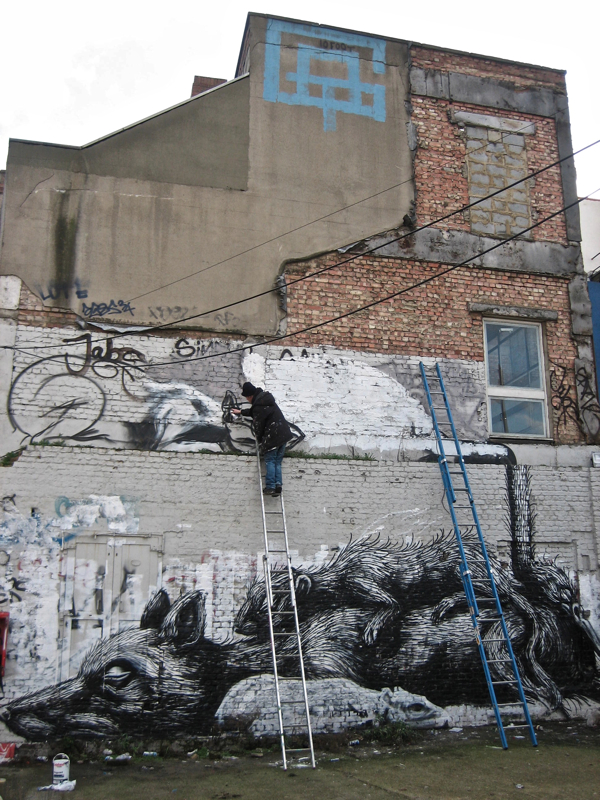
Roa draws the squirrel’s ears.

Roa draws the squirrel’s tail.
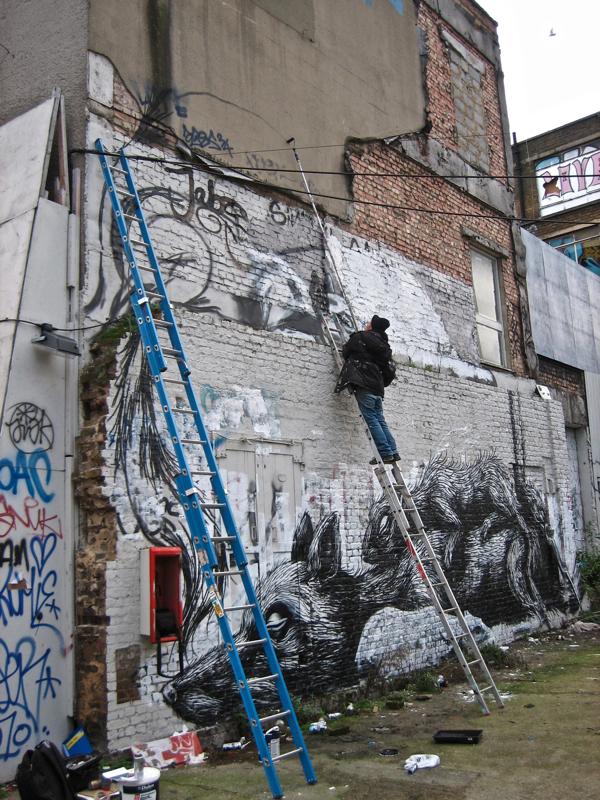
Roa draws the outline of the heron.
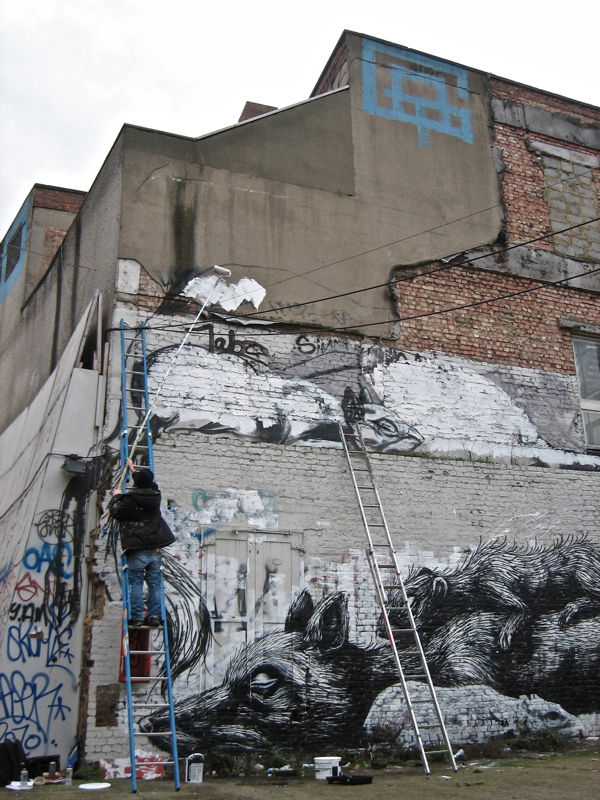
Roa paints the body of the heron.
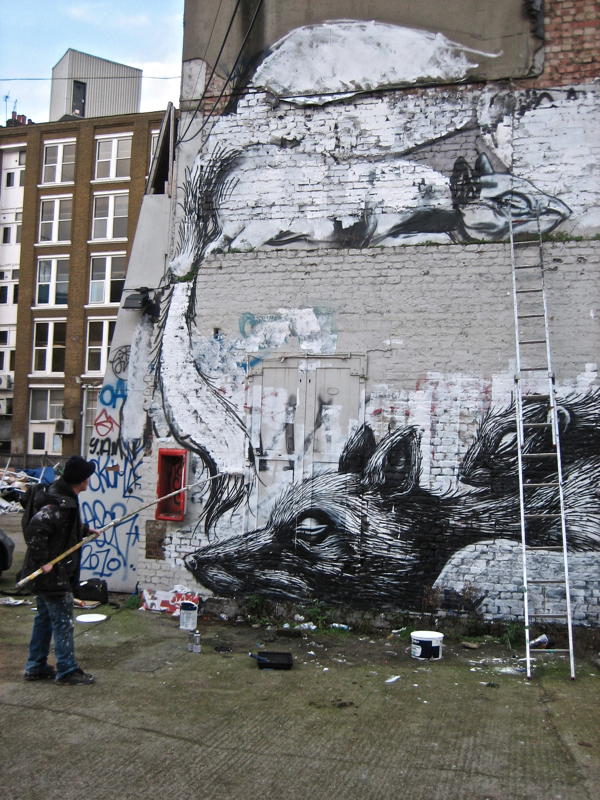
Roa paints the squirrel’s tail.
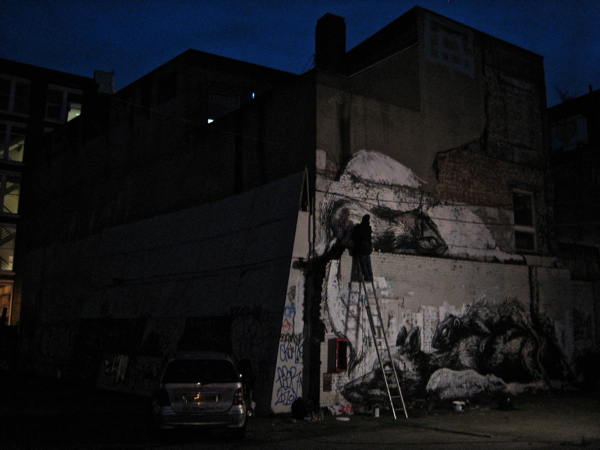
Roa works into the night on his squirrel.
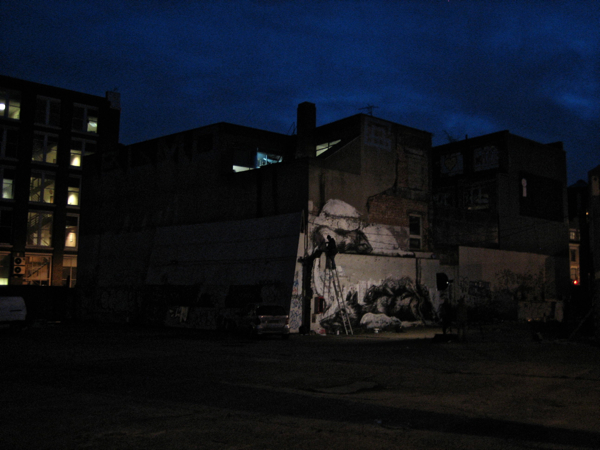
Read my other stories about Roa
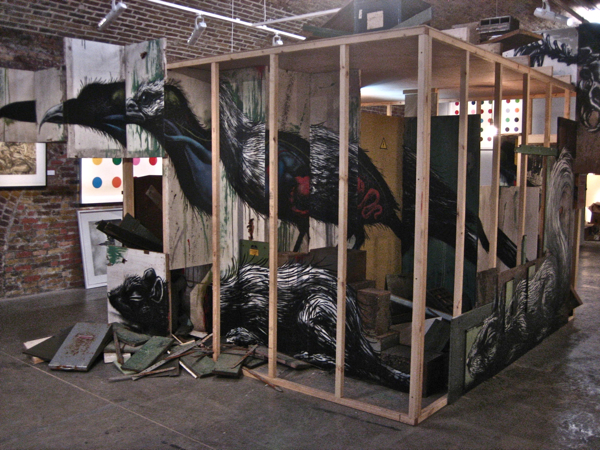
The Return of Roa, Street Artist
You can visit Roa’s gallery installation at Black Rat Projects, Arch 461, Rivington St, Shoreditch, EC2 until March 4th
The Brick Lane Temperance Association

It is my delight to present Charles Dickens’ raucous account of a visit by Sam & Tony Weller to the Brick Lane Temperance Association from The Pickwick Papers with these new drawings by illustrator and printmaker Paul Bommer who I featured last year.
The monthly meetings of the Brick Lane Branch of the United Grand Junction Ebenezer Temperance Association were held in a large room, pleasantly and airily situated at the top of a safe and commodious ladder. The president was the straight-walking Mr Anthony Humm, a converted fireman, now a schoolmaster and occasionally an itinerant preacher, and the secretary was Mr Jonas Mudge, chandler’s shopkeeper, an enthusiastic and disinterested vessel, who sold tea to the members.
Previous to the commencement of business, the ladies sat upon forms and drank tea, till such time as they considered it expedient to leave off, and a large wooden money box was conspicuously placed upon the green baize cloth of the business-table, behind which the secretary stood and acknowledged, with a gracious smile, every addition to the rich vein of copper which lay concealed within.

On this particular occasion the women drank tea to a most alarming extent, greatly to the horror of Mr Weller, senior, who, utterly regardless of all Sam’s admonitory nudgings, stared about him in every direction with the most undisguised astonishment. “Sammy,” whispered Mr Weller, “if some o’ these here people don’t want tappin’ to-morrow mornin’, I ain’t your father, and that’s wot it is. Why, this here old lady next me is a-drowndin’ herself in tea.” “Be quiet, can’t you?” murmured Sam.
“If this here lasts much longer, Sammy,” said Mr Weller, in the same low voice, “I shall feel it my duty, as a human bein’, to rise and address the cheer. There’s a young ‘ooman on the next form but two, as has drunk nine breakfast cups and a half, and she’s a-swellin’ wisibly before my wery eyes.”

There is little doubt that Mr Weller would have carried his benevolent intention into immediate execution, if a great noise, occasioned by putting up the cups and saucers, had not very fortunately announced that the tea-drinking was over. The crockery having been removed, the table with the green baize cover was carried out into the centre of the room, and the business of the evening was commenced by Mr Tadger, an emphatic little man, with a bald head and drab shorts, who suddenly rushed up the ladder, at the imminent peril of snapping the two little legs incased in the drab shorts, and said, “Ladies and gentlemen, I move our excellent brother, Mr Anthony Humm, into the chair.”
Silence was then proclaimed by Mr Tadger, and Mr Humm rose and said – That, with the permission of his Brick Lane Branch brothers and sisters, the secretary would read the report of the Brick Lane Branch committee, a proposition which was received with a demonstration of pocket-handkerchiefs. The secretary having sneezed in a very impressive manner, and the cough which always seizes an assembly, when anything particular is going to be done, having been duly performed, the following document was read:
REPORT OF THE COMMITTEE OF THE BRICK LANE BRANCH OF THE UNITED GRAND JUNCTION EBENEZER TEMPERANCE ASSOCIATION. Your committee have pursued their grateful labours during the past month, and have the unspeakable pleasure of reporting the following additional cases of converts to Temperance.
H. WALKER, tailor, wife, and two children. When in better circumstances, owns to having been in the constant habit of drinking ale and beer, says he is not certain whether he did not twice a week, for twenty years, taste “dog’s nose,” which your committee find upon inquiry, to be compounded of warm porter, moist sugar, gin, and nutmeg (a groan, and “So it is!” from an elderly female). Is now out of work and penniless, thinks it must be the porter (cheers) or the loss of the use of his right hand, is not certain which, but thinks it very likely that, if he had drunk nothing but water all his life, his fellow workman would never have stuck a rusty needle in him, and thereby occasioned his accident (tremendous cheering). Has nothing but cold water to drink, and never feels thirsty (great applause).
BETSY MARTIN, widow, one child, and one eye. Goes out charing and washing, by the day, never had more than one eye, but knows her mother drank bottled stout, and shouldn’t wonder if that caused it (immense cheering). Thinks it not impossible that if she had always abstained from spirits she might have had two eyes by this time (tremendous applause). Used, at every place she went to, to have eighteen-pence a day, a pint of porter, and a glass of spirits, but since she became a member of the Brick Lane Branch, has always demanded three-and-sixpence (the announcement of this most interesting fact was received with deafening enthusiasm).
HENRY BELLER was for many years toast master at various corporation dinners, during which time he drank a great deal of foreign wine, may sometimes have carried a bottle or two home with him, is not quite certain of that, but is sure if he did, that he drank the contents. Feels very low and melancholy, is very feverish, and has a constant thirst upon him, thinks it must be the wine he used to drink (cheers). Is out of employ now and never touches a drop of foreign wine by any chance (tremendous plaudits).
THOMAS BURTON is purveyor of cat’s meat to the Lord Mayor and Sheriffs, and several members of the Common Council (the announcement of this gentleman’s name was received with breathless interest). Has a wooden leg, finds a wooden leg expensive, going over the stones, used to wear second-hand wooden legs, and drink a glass of hot gin-and-water regularly every night – sometimes two (deep sighs). Found the second-hand wooden legs split and rot very quickly, is firmly persuaded that their constitution was undermined by the gin-and-water (prolonged cheering). Buys new wooden legs now, and drinks nothing but water and weak tea. The new legs last twice as long as the others used to do, and he attributes this solely to his temperate habits (triumphant cheers).

Anthony Humm now moved that the assembly regale itself with a song. Brother Mordlin had adapted the beautiful words of “Who hasn’t heard of a Jolly Young Waterman?” to the tune of the Old Hundredth, which he would request them to join him in singing (great applause). It was a temperance song (whirlwinds of cheers).
The neatness of the young man’s attire, the dexterity of his feathering, the enviable state of mind which enabled him in the beautiful words of the poet, to “Row along, thinking of nothing at all,” all combined to prove that he must have been a water-drinker (cheers). And what was the young man’s reward? Let all young men present mark this: “The maidens all flocked to his boat so readily.” (Loud cheers, in which the ladies joined.) What a bright example! “The soft sex to a man,” he begged pardon, “to a female – rallied round the young waterman, and turned with disgust from the drinker of spirits” (cheers). The Brick Lane Branch brothers were watermen (cheers and laughter). That room was their boat, that audience were the maidens, and he (Mr. Anthony Humm), however unworthily, was “first oars” (unbounded applause).
“Wot does he mean by the soft sex, Sammy?” inquired Mr Weller, in a whisper. “The womin,” said Sam, in the same tone. “He ain’t far out there, Sammy,” replied Mr Weller, “they MUST be a soft sex – a wery soft sex, indeed – if they let themselves be gammoned by such fellers as him.” Then, during the song, the little man with the drab shorts disappeared, returning immediately on its conclusion, and whispered to Mr Anthony Humm, with a face of the deepest importance. “My friends,” said Mr Humm, holding up his hand in a deprecatory manner to bespeak silence, “my friends, a delegate from the Dorking Branch of our society, Brother Stiggins, attends below.”
The little door flew open, and Brother Tadger re-appeared, closely followed by the Reverend Mr Stiggins, who no sooner entered, than there was a great clapping of hands, and stamping of feet, and flourishing of handkerchiefs, to all of which manifestations of delight, Brother Stiggins returned no other acknowledgment than staring with a wild eye, and a fixed smile, at the extreme top of the wick of the candle on the table, swaying his body to and fro, meanwhile, in a very unsteady and uncertain manner.
By this time the audience were perfectly silent, and waited with some anxiety for the resumption of business. “Will you address the meeting, brother?” said Mr Humm, with a smile of invitation. “No, sir,” rejoined Mr. Stiggins. The meeting looked at each other with raised eyelids, and a murmur of astonishment ran through the room.
“It’s my opinion, sir,” said Mr Stiggins, unbuttoning his coat, and speaking very loudly – “that this meeting is drunk, sir. Brother Tadger, sir!” said Mr Stiggins, suddenly increasing in ferocity, and turning sharp round on the little man in the drab shorts, “YOU are drunk, sir!” With this, Mr. Stiggins, entertaining a praiseworthy desire to promote the sobriety of the meeting, and to exclude therefrom all improper characters, hit Brother Tadger on the summit of the nose.

Upon this, the women set up a loud and dismal screaming, and rushing in small parties before their favourite brothers, flung their arms around them to preserve them from danger. An instance of affection, which had nearly proved fatal to Humm, who, being extremely popular, was all but suffocated, by the crowd of female devotees that hung about his neck, and heaped caresses upon him. The greater part of the lights were quickly put out, and nothing but noise and confusion resounded on all sides.
“Now, Sammy,” said Mr Weller, taking off his greatcoat with much deliberation, “just you step out, and fetch in a watchman.” “And wot are you a-goin’ to do, the while?” inquired Sam. “Never you mind me, Sammy,” replied the old gentleman, “I shall ockipy myself in havin’ a small settlement with that ‘ere Stiggins.”
Before Sam could interfere to prevent it, his heroic parent had penetrated into a remote corner of the room, and attacked the Reverend Mr. Stiggins with manual dexterity. “Come off!” said Sam. “Come on!” cried Mr Weller, and without further invitation he gave the Reverend Mr Stiggins a preliminary tap on the head, and began dancing round him in a buoyant and cork-like manner, which in a gentleman at his time of life was a perfect marvel to behold.
Finding all remonstrances unavailing, Sam pulled his hat firmly on, threw his father’s coat over his arm, and taking the old man round the waist, forcibly dragged him down the ladder, and into the street, never releasing his hold, or permitting him to stop, until they reached the corner. As they gained it, they could hear the shouts of the populace, who were witnessing the removal of the Reverend Mr Stiggins to strong lodgings for the night, and could hear the noise occasioned by the dispersion in various directions of the members of the Brick Lane Branch of the United Grand Junction Ebenezer Temperance Association.
You can follow Paul Bommer’s blog to see more of his work or read my pen portrait Paul Bommer, Illustrator. More about Charles Dickens in the East End here:
Charles Dickens in Spitalfields
Charles Dickens visits the Silk Warehouse
Charles Dickens visits the Ragged School
Charles Dickens visits the Silk Weavers
Charles Dickens visits the Young Artist


 More of Paul’s Pickwick pictures
All illustrations copyright © Paul Bommer












