
Spring Bulbs at Bow Cemetery

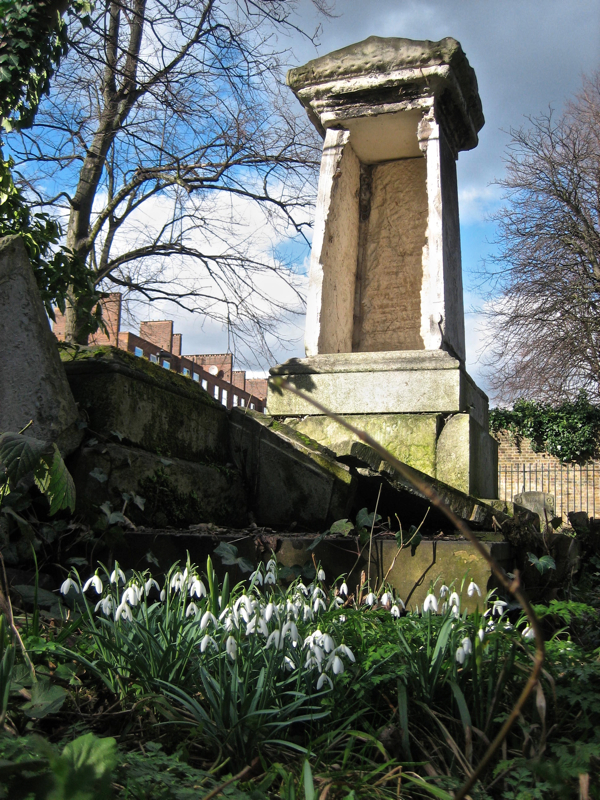
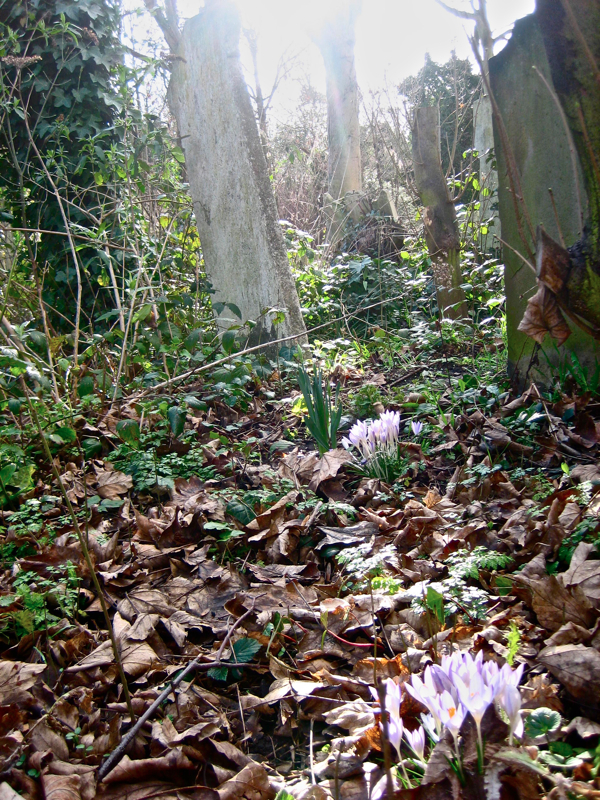
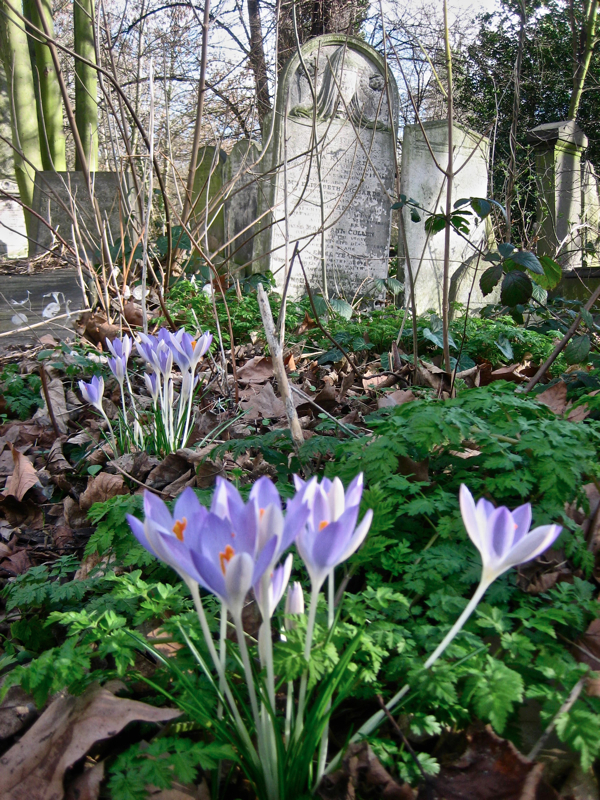
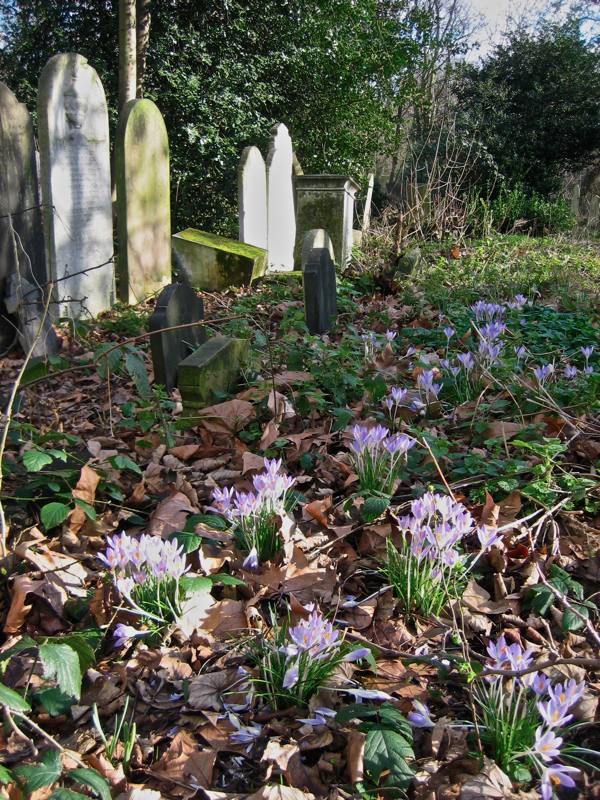
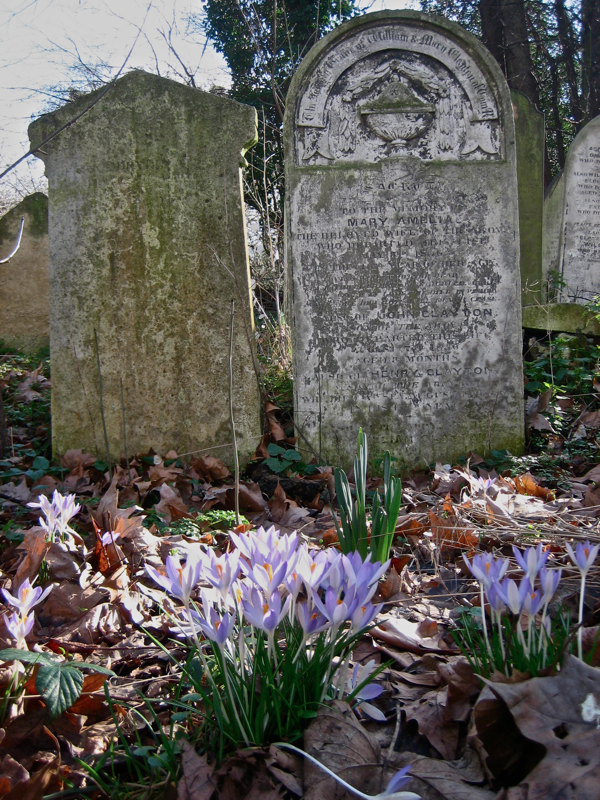
When yesterday’s unseasonably warm sunshine brought temperatures of ten degrees to the East End and the promise of an early Spring, I decided to return to Bow Cemetery – where I spent one of the happiest days of last Summer – to see if the bulbs were showing yet. Already I have some Snowdrops, Hellebores and a few Primroses in flower in my Spitalfields garden, but at Bow I was welcomed by thousands of Crocuses of every colour and variety spangling the graveyard with their gleaming flowers. Beaten and bowed, grey-faced and sneezing, coughing and shivering, the harsh Winter has taken it out of me, but feeling the warmth of the sun today and seeing these sprouting bulbs in such profusion restored my hope that benign weather will come before too long.
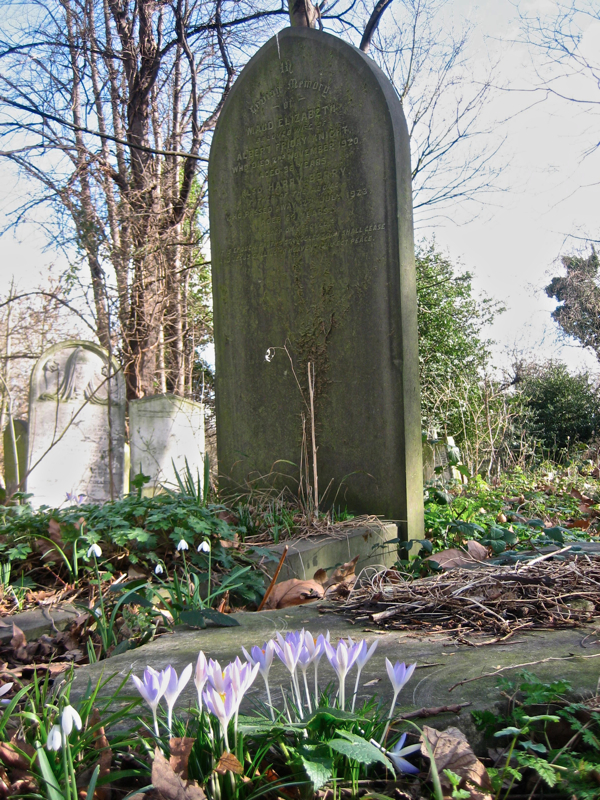
Some of my earliest crayon drawings are of snowdrops, and the annual miracle of Spring bulbs erupting out of the barren earth never ceases to touch my heart – an emotionalism amplified in a cemetery to see life spring abundant and graceful in the landscape of death. The numberless dead of East London – the poor buried for the most part in unmarked communal graves – are coming back to us as perfect tiny flowers of white, purple and yellow, and the sober background of grey tombs and stones serves to emphasis the curious delicate life of these vibrant blooms, glowing in the sunshine.
Here within the shelter of the old walls, the Spring bulbs are further ahead than elsewhere the East End and I arrived at Bow Cemetery just as the Snowdrops were coming to an end, the Crocuses were in full flower and the Daffodils were beginning. Thus a sequence of flowers is set in motion, with bulbs continuing through until April when the Bluebells will come leading us through to the acceleration of Summer growth, blanketing the cemetery in lush foliage again.
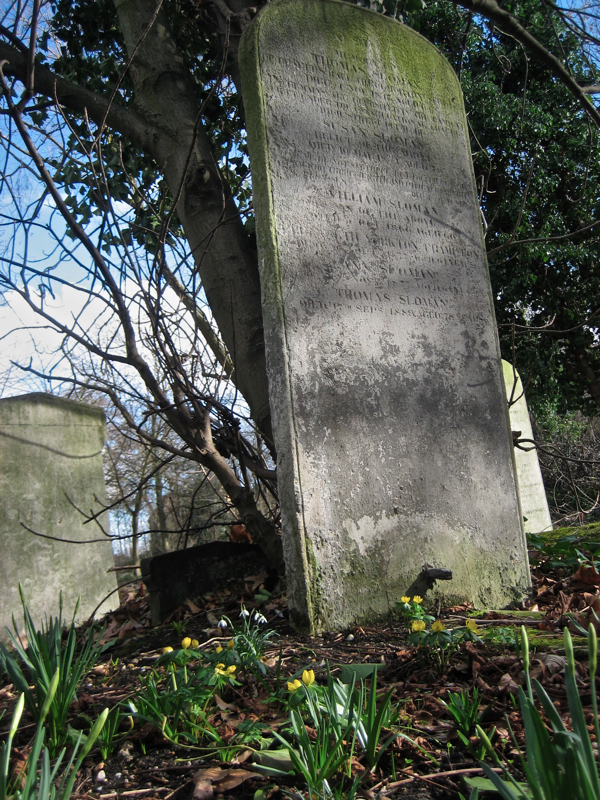
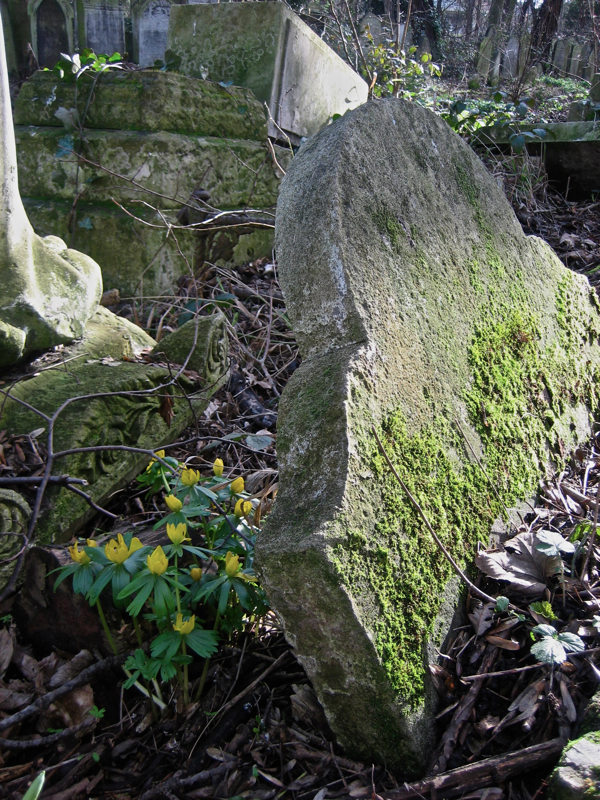
As before, I found myself alone in the vast cemetery save a few Magpies, Crows and some errant Squirrels, chasing each other around. Walking further into the woodland, I found yellow Winter Aconites gleaming bright against the grey tombstones and, crouching down, I discovered wild Violets in flower too. Beneath an intense blue sky, to the chorus of birdsong echoing among the trees, Spring was making a persuasive showing.
Stepping into a clearing, I came upon a Red Admiral butterfly basking upon a broken tombstone, as if to draw my attention to the text upon it, “Sadly Missed,” commenting upon this precious day of sunshine. Butterflies are rare in the city in any season, but to see a Red Admiral, which is a sight of high Summer, in February is extraordinary. My first assumption was that I was witnessing the single day in the tenuous life of this vulnerable creature, but in fact the hardy Red Admiral is one of the last to be seen before the onset of frost and can emerge from months of hibernation to enjoy single days of sunlight. Such is the solemn poetry of a lone butterfly in Winter.
It may be over a month yet before it is officially Spring, but we are at the beginning now, and I offer you my pictures as evidence, should you require inducement to believe it.
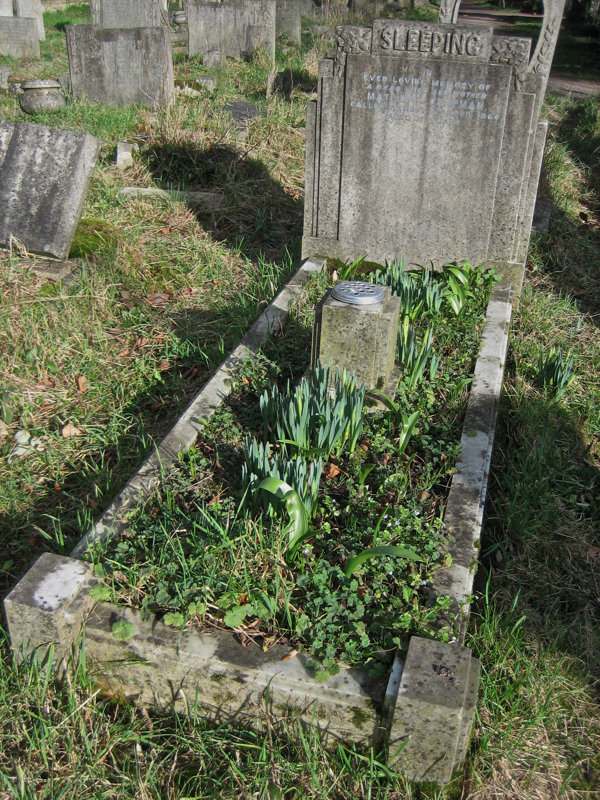
The Spring bulbs are awakening from their Winter sleep.
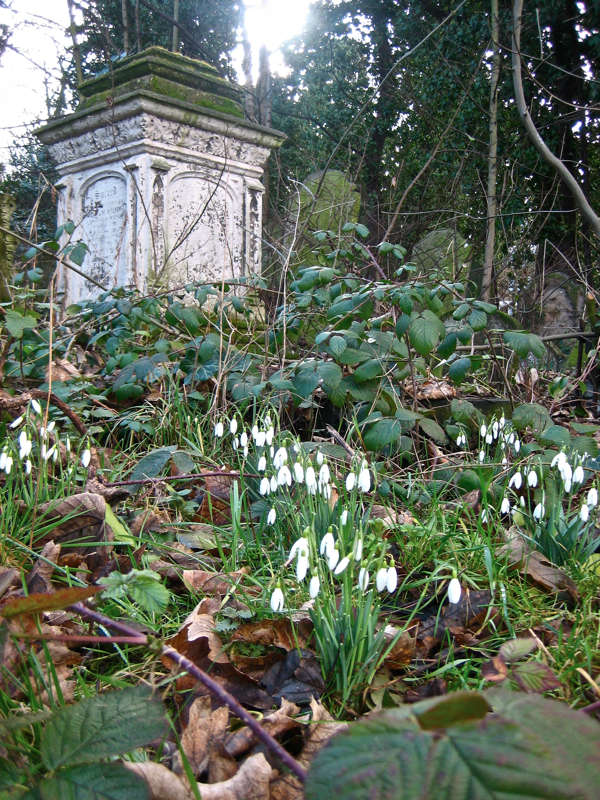
Snowdrops.
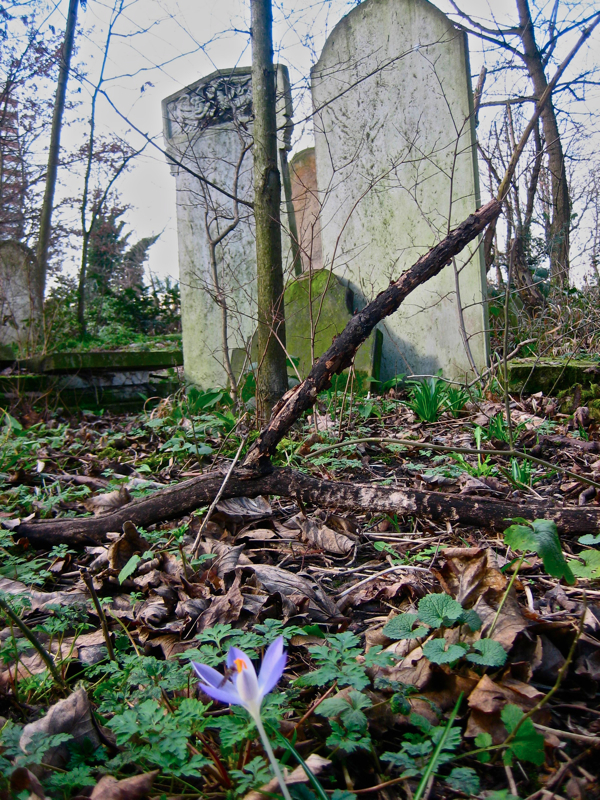
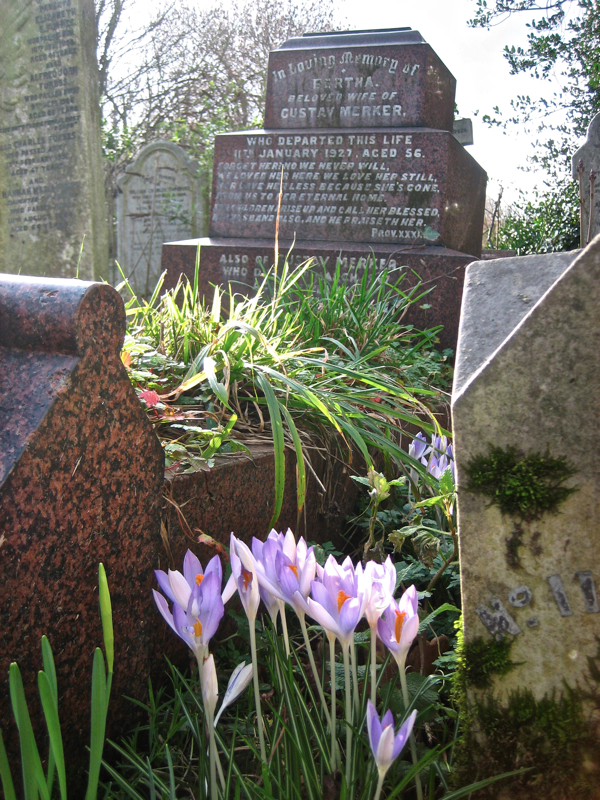
Crocuses
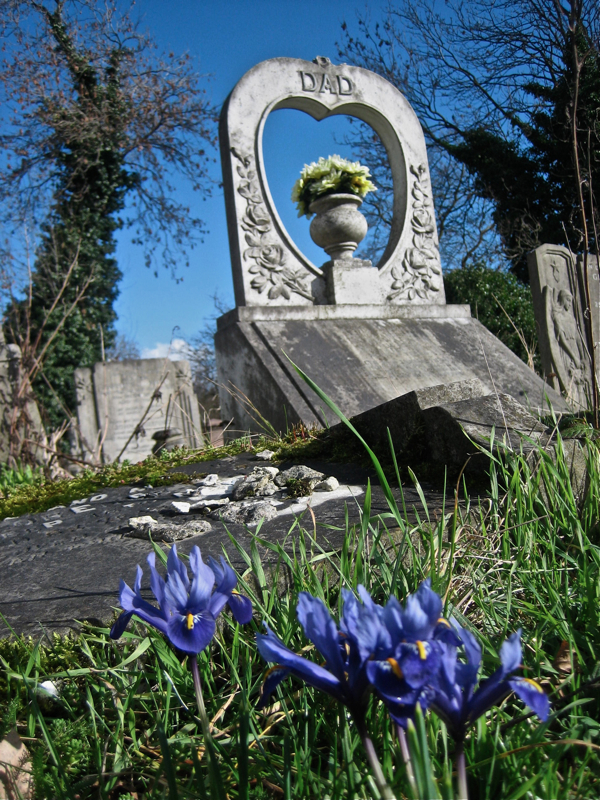
Dwarf Iris
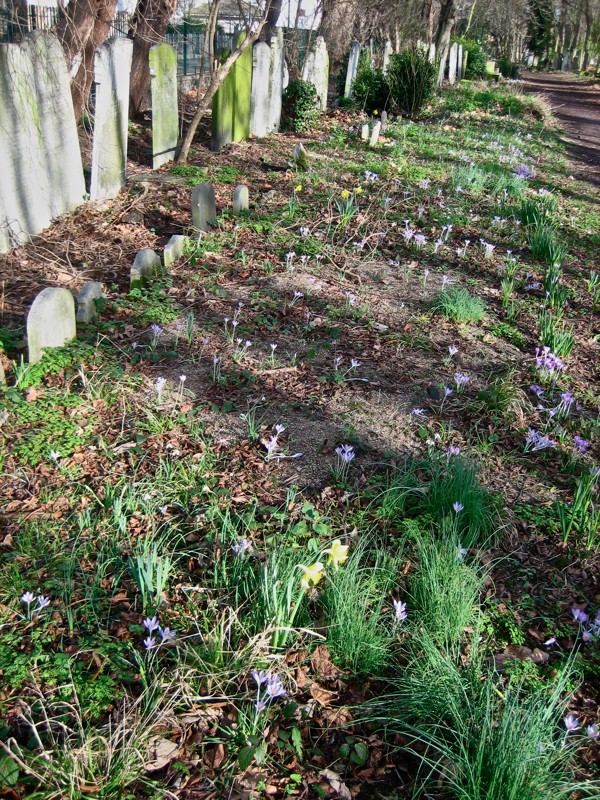
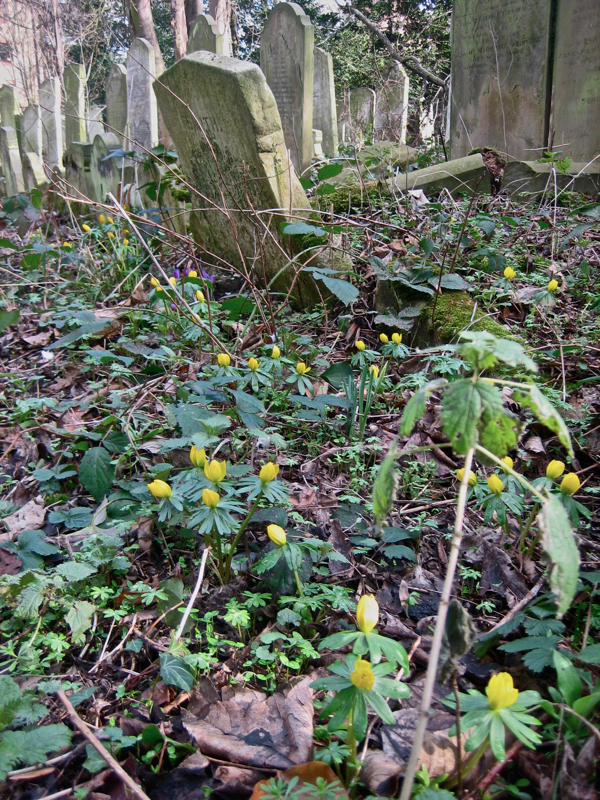
Winter Aconites

Daffodils will be in flower next week.
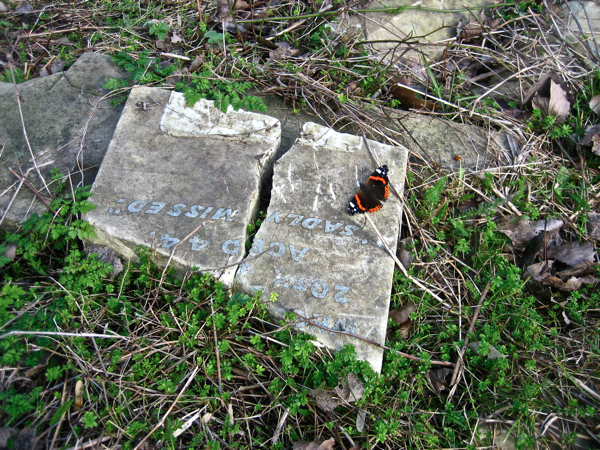
A single Red Admiral butterfly, out of season in mid-February – “sadly missed”
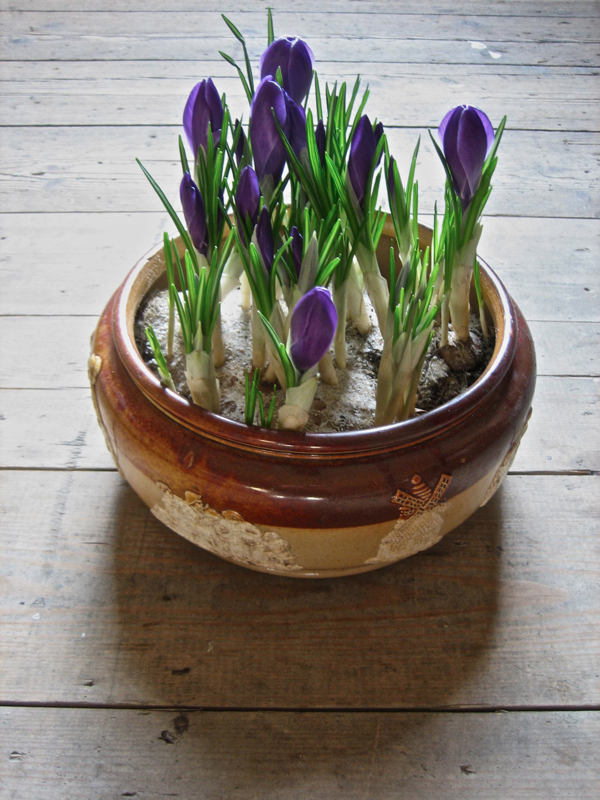
My Crocuses from Columbia Rd Market in a Doulton Lambeth bowl.
Read my original story At Bow Cemetery
Find out more at www.towerhamletscemetery.org
Mud God’s Discoveries 2

On St Valentine’s Day, it is my pleasure to show you love tokens found in the River Thames from the collection gathered over the last seventeen years by my mudlark friend Steve Brooker, widely known as Mud God.
The magical potential of throwing a coin into the water has been recognised by different cultures in different times with all kinds of meanings. Yet since we can never ask those who threw these tokens why they did it, we can only surmise that engraving your beloved’s name upon a coin and throwing it into the water was a gesture to attract good fortune. It was a wish.
With a great river like the Thames racing down towards the ocean, there is a sense of a connection to the infinite. And there is a sweet romance to the notion of a lover secretly throwing a token into the water, feeling that the strength of their emotions connects them to a force larger than themselves.
Naturally, it was not part of the conceit that someone might ever find these coins, centuries later – which gives them a mysterious poetry now, because each one represents a love story we shall never learn. Those who threw them have gone from the earth long ago, and all we can envisage are the coins tossed by unseen hands, flying from the river bank or a from the parapet of a bridge or from a boat, turning over in the air, plip-plopping into the water and spiralling down to lie for centuries in the mud, until Steve Brooker came along to gather them up. Much as we may yearn, we can never trace them back to ask “What happened?”
In the reign of William III, it was the fashion for a young man to give a crooked coin to the object of his affections. The coin was bent both to become an amulet and to prevent it being reused. If the token was kept, it indicated that the affection was reciprocated, but if the coin was discarded then it was a rejection – which casts a different light upon these coins in the river. Are they, each one, evidence of unrequited affections?
From the end of the eighteenth century and until the early twentieth century, smoothed coins were used as love tokens, with the initials of the sender engraved or embossed upon the surface. Sometimes these were pierced, which gave recipient the option to wear it around the neck. In Steve’s collection, the tokens range from heavy silver coins with initials professionally engraved to pennies worn smooth through hours of labour and engraved in stilted painstaking letters. In many examples shown here, the amount of effort expended in working these coins, smoothing, engraving or cutting them is truly extraordinary, which speaks of the longing of the makers.
Steve has found many thousands of coins in the bed of the Thames over the years but it is these worked examples that mean most to him because he recognises the dignity of the human emotion that each one manifests. Those who threw them into the river did not know that Steve was going to be there one day to catch them yet, whatever the outcome of these romances, he ensures that the tokens are kept safe.
Look out for Steve Brooker’s eight part television series MUDMEN which commences on 28th February on History – you can watch the trailer here

Benjamin Claridge.

The reverse of the Benjamin Claridge coin, from the eighteenth century or earlier.

The intials M and W intertwined upon a Georgian silver coin.

The intial W upon the smoothed face of Georgian silver coin, bent into an S shape.

Crooked Georgian silver coin, as the token of a vow or promise.

The initials AMD upon a smoothed coins that has been pierced to wear around the neck.

A copper penny with the letter D.

C.M. Marsh impressed into a penny.

The letter R punched into a penny within a lucky horseshoe.

Pierced coin set with semi-precious stones.

Who was Snod? Is this a lover’s token or a dog tag?

This pierced silver threepence commemorates the date January 11th 1921.

On the reverse of the silver threepence are the initials, L T. Are these the initials of the giver, or does it signify “Love Token”?

A smoothed penny with the name Voilet upon it. A phonetic spelling of the name “Violet”as the beloved spoke it?

Cut coins from the early twentieth century.
Read my stories
and
the Roman coin from Spitalfields that I wear around my neck.

A Spitalfields Valentine from Alan Dein – he took this picture in Fashion St in 1990, but he does not know who wrote the graffiti or why.
Petticoat Lane Market 1

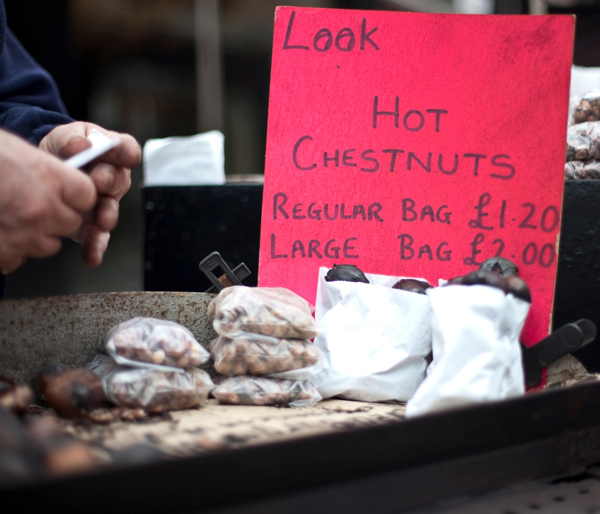
Almost as much of a familiar landmark in Spitalfields as the church or the market, Fred has been standing in his flat cap and selling chestnuts from can of hot coals on a barrow every Sunday at the corner of Bell Lane and Wentworth St for over half a century.
I heard a rumour that chestnut sellers were secret millionaires who put their feet up all Summer, but he was eager to disenchant me of this notion. “The idea that you get rich quick is not true!” Fred swore to me in his singsong voice, glowing with animation, whilst expertly turning over the hot chestnuts with his blackened fingers, “For the past six weeks, I didn’t cover my expenses. I get up at half five, leave the house at a quarter to six, then I am here from eight until four, and by the time I get home it’s eight o’clock. So if I didn’t love this job, I wouldn’t be here now.”
When Fred began in the heyday of Petticoat Lane, Wentworth St was a parade of Jewish Delis, and it was this cultural identity which permitted the existence of the market when laws restricted other Sunday trading in London. “This used to be the best market in London, you couldn’t walk through it,” recalled Fred with absolute authority, his eyes focused in concentration as he stepped over to stir the peanuts that he was caramelising in a pan to one side. Remarkably, while the market has changed beyond all recognition around him, Fred has simply continued roasting chestnuts.
“I was fourteen and a half when I started. My dad sold chestnuts and I used to go and help him up the West End – Greek St and then down in Leicester Sq – until I got a licence here about fifty years ago. I used to have a casual licence, it was so busy then you couldn’t get a pitch unless someone else didn’t turn up. I was on this corner at fifteen before I got married – my wife is English and now I’ve been married fifty years.
The selling business is in the blood, my dad’s family were all chestnut sellers in Malta and my grandfather came from Sicily. King George gave the Maltese people a medal for bravery in the war. We fought the Turks. Everybody wanted a piece of Malta.
My father came over here in the forties from Malta. I was born there and came to London in 1957, helping my dad. He came here to try a different life. Plumber’s Row in Whitechapel, that’s where we lived at first. It was all prostitutes in those houses in them days. I asked my dad who these ladies were. He said, ‘They’re all film stars.’ Then we moved down to live in Christian St, it was all Maltese down there. The East End was nice place to be. We used to buy our chestnuts in the Spitalfields Market, nowadays I have to go further afield.
I’ve always loved selling chestnuts. I’ve been like this since I was a kid. I’ve never been to school, I just wanted to do this. This is about making your customers feel good. With this game, you’ve got to know how to go with people, otherwise don’t come in the market.
My dad designed the can, after two or three years, you have to make a new one. It only takes me half an hour to get the coals hot, with some bits of wood and a spot of paraffin. I work from October until March or April, only three to four months, and as soon as I have finished my year’s stock of chestnuts, it’s over. I’ll ease up now, and I won’t come up if the weather’s bad one Sunday.
I’m going to Malta next week to visit my mum and dad. He went back thirty years ago – if it wasn’t for my grandchildren and my kids, I’d move back to Malta too. But I reckon I’ll be here a few more years.
They should give me a medal for service to the English people.”
As Fred spoke, a continuous stream of eager customers carried off bags of chestnuts. Many were regulars on first name terms and others were tourists that Fred seduced with repartee, inveigling his way into their holiday snaps. As well as chestnuts, Fred sells monkey nuts, freshly caramelised and roasted peanuts, plus water and soft drinks, while his son-in-law Lee fries hamburgers and hot dogs on the other side of the pitch, and Fred’s little grandson runs around excitedly in a flat cap drumming up business. Quite a drama for a street corner.
I asked Fred if he likes chestnuts and he smiled. “I eat them all the time, if I start I can’t stop.” he admitted, picking up a stray chestnut and putting it in his mouth absent-mindedly. “They’re good for your cholesterol – any doctor will tell you.” he declared, chewing and nodding his head in emphatic confirmation.
It is a delicious thing to buy a bag of hot chestnuts on a cold day and peel them in the street – a timeless seasonal ritual. So, as much as I long for the Spring to come, I shall miss Fred on the corner of Bell Lane when he disappears in a few weeks’ time. Then I shall be waiting for his return in October, with his buoyant humour, and bringing the whiff of the new season’s chestnuts from Italy roasted on hot coals, as a time-honoured harbinger of the changing year in the East End – the legendary chestnut seller of Petticoat Lane.


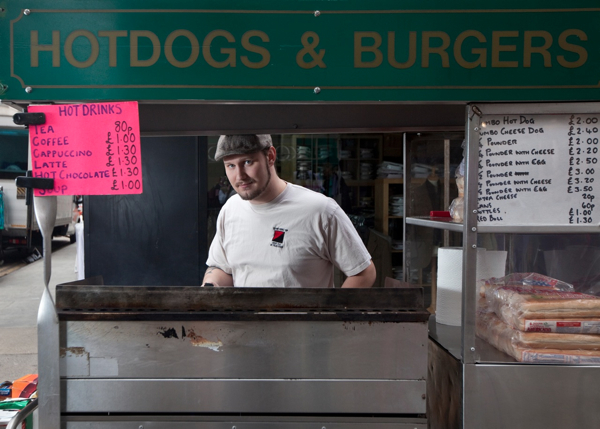
Fred’s son-in-law, Lee, a locksmith by trade, helps out with the hotdogs and burgers.
Photographs copyright © Jeremy Freedman
You may also like to read Larry Goldstein, Toyseller & Cab Driver
Maurice Evans, Firework Collector

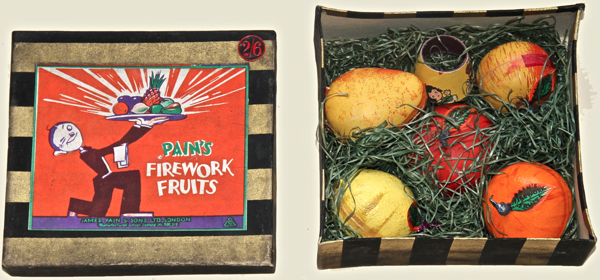
Maurice Evans has been collecting fireworks since childhood and now at eighty-two years old he has the most comprehensive collection in the country – so you can imagine both my excitement and my trepidation upon stepping through the threshold of his house in Shoreham. My concern about potential explosion was relieved when Maurice confirmed that he has removed the gunpowder from his fireworks, only to be reawakened when his wife Kit helpfully revealed that Catherine Wheels and Bangers were excepted because you cannot extract the gunpowder without ruining them.
This statement prompted Maurice to remember with visible pleasure that he still had a collection of World War II shells in the cellar and, of course, the reinforced steel shed in the garden full of live fireworks. “Let’s just say, if there’s a big bang in the neighbourhood, the police always come here first to see if it’s me,” admitted Maurice with a playful smirk. “Which it often isn’t,” added Kit, backing Maurice up with a complicit demonstration of knowing innocence.
“It all started with my father who was in munitions in the First World War,” explained Maurice proudly, “He had a big trunk with little drawers, and in those drawers I found diagrams explaining how to work with explosives and it intrigued me. Then came World War II and the South Downs were used as a training ground and, as boys, we went where we shouldn’t and there were loads of shells lying around, so we used to let them off.”
Maurice’s radiant smile revealed to me the unassailable joy of his teenage years, running around the downs at Shoreham playing with bombs. “We used to set off detonators outside each other’s houses to announce we’d arrived!” he bragged, waving his left hand to reveal the missing index finger, blown off when the explosive in a slow fuse unexpectedly fired upon lighting. “That’s the worst thing that happened,” Maurice declared with a grimace of alacrity, “We were worldly wise with explosives!”
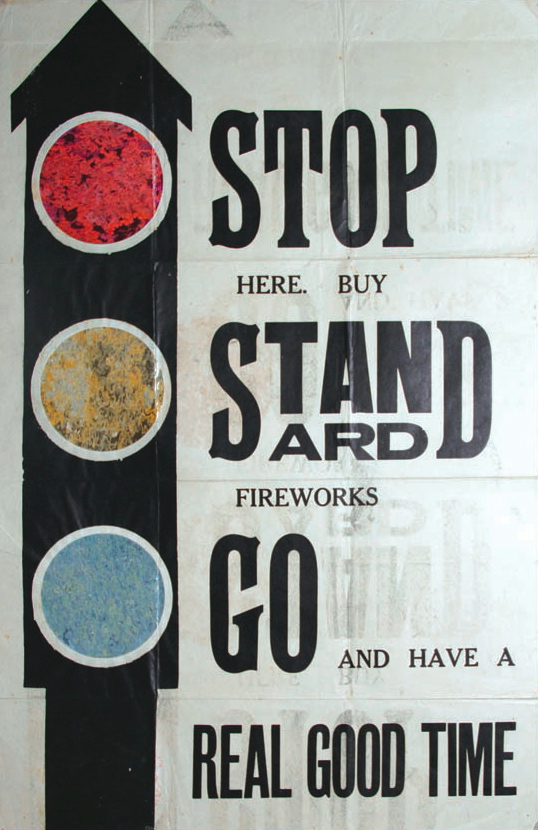
Even before his teens, the love of pyrotechnics had taken grip upon Maurice’s psyche. It was a passion born of denial. “I used to suffer from bronchitis and asthma as a child, so when November 5th came round, I had to stay indoors.” he confided with a frown, “Every shop had a club and you put your pennies and ha’pennies in to save for fireworks and that’s what I did, but then my father let them off and I had to watch through the window.”
After the war, Maurice teamed up with a pyrotechnician from London and they travelled the country giving displays which Maurice devised, achieving delights that transcended his childhood hunger for explosions. “In my mind, I could envisage the sequence of fireworks and colours, and that was what I used to enjoy. You’ve got all the colours to start with, smoke, smoke colours, ground explosions, aerial explosions – it’s endless the amount of different things you can do. The art of it is knowing how to choose.” explained Maurice, his face illuminated by the images flickering in his mind. Adding, “I used to be quite big in fireworks at one time.” with calculated understatement.
Yet all this personal history was the mere pre-amble before Maurice led me through his house, immaculately clean, lined with patterned carpets and papers and witty curios of every description. Then in the kitchen, overlooking the garden where old trees stood among snowdrops, he opened an unexpected cupboard door to reveal a narrow red staircase going down. We descended to enter the burrow where Maurice has his rifle range, his collections, model aeroplanes, bombs and fireworks – all sharing the properties of flight and explosiveness. Once they were within reach, Maurice could not restrain his delight in picking up the shells and mortars of his childhood, explaining their explosive qualities and functions.
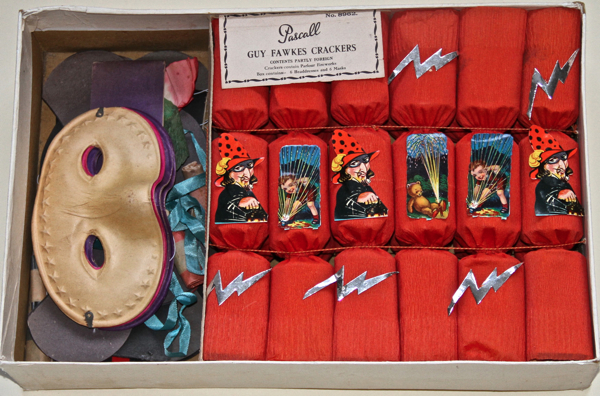
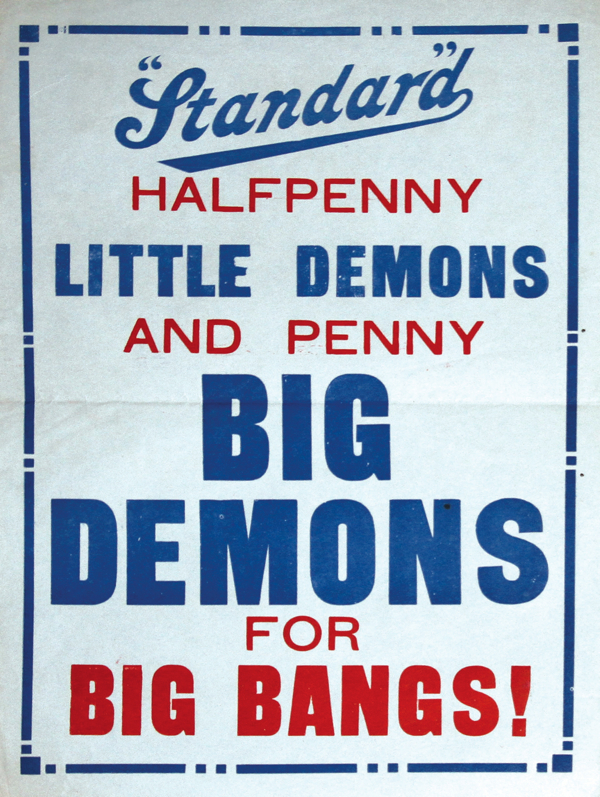
But my eyes were drawn by all the fireworks that lined the walls and glass cases, and the deep blues, lemon yellows and scarlets of their wrappers and casings. Such evocative colours and intricate designs which in their distinctive style of type and motif, draw upon the excitement and anticipation of magic we all share as children, feelings that compose into a lifelong love of fireworks. Rockets, Roman Candles, Catherine Wheels, Bangers, and Sparklers – amounting to thousands in boxes and crates, Maurice’s extraordinary collection is the history of fireworks in this country.
“I wouldn’t say its made my life, but its certainly livened it up,” confided Maurice, seeing my wonder at his overwhelming display. Because no-one (except Maurice) keeps fireworks, there is something extraordinary in seeing so many old ones and it sets your imagination racing to envisage the potential spectacle that these small cardboard parcels propose.
Maurice outgrew the bronchitis and asthma to have a beautiful life filled with fireworks, to visit firework factories around Britain, in China, Australia, New Zealand and all over Europe, and to scour Britain for collections of old fireworks, accumulating his priceless collection. Now like an old dragon in a cave, surrounded by gold, Maurice guards his cellar hoard protectively and is concerned about the future. “It needs to be seen,” he said, contemplating it all and speaking his thoughts out loud, “I would like to put this whole collection into a museum. I don’t want any money. I want everyone to see what happened from pre-war times up until the present day in the progression of fireworks.”
“My father used to bring me the used ones to keep,” confessed Maurice quietly with an affectionate gleam in his eye, as he revealed the emotional origin of his collection, now that we were alone together in the cellar. With touching selflessness, having derived so much joy from collecting his fireworks, Maurice wants to share them with everybody else.

Maurice with his exploding fruit.

Maurice with his barrel of gunpowder

Maurice with his grenades.
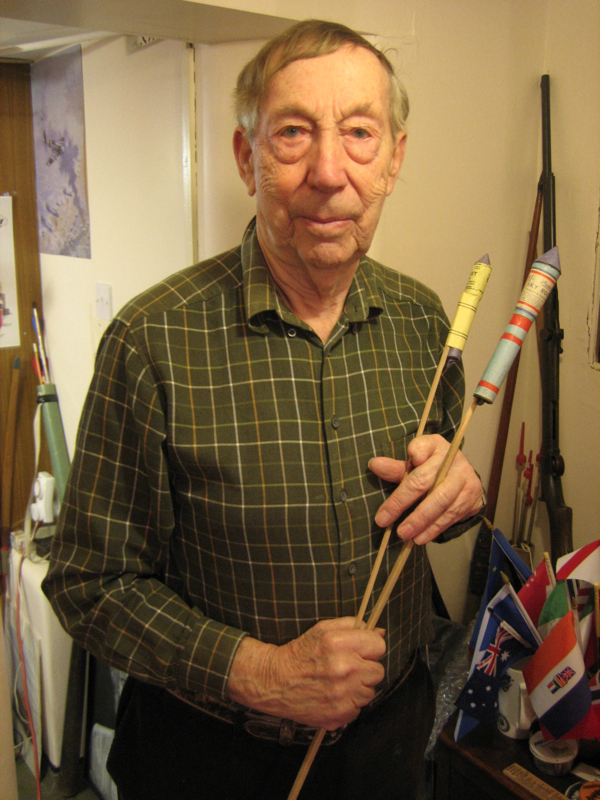
Maurice with two favourite rockets.







Firework photographs copyright © Simon Costin
Read my story about Simon Costin, The Museum of British Folklore
Before & After in Fournier St
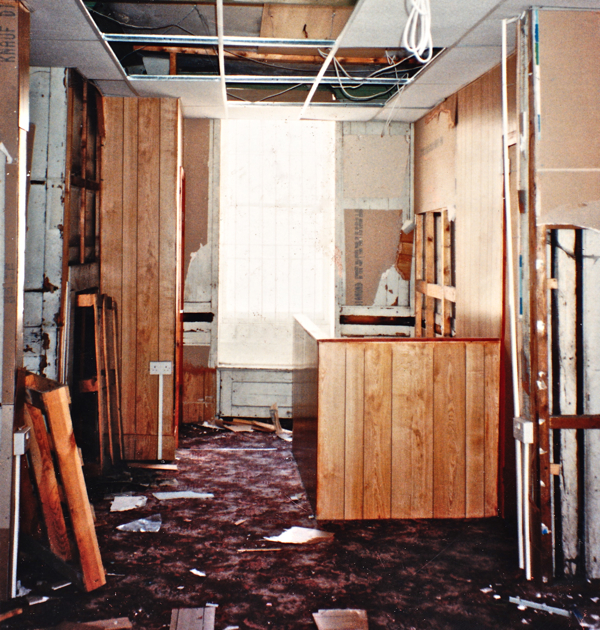
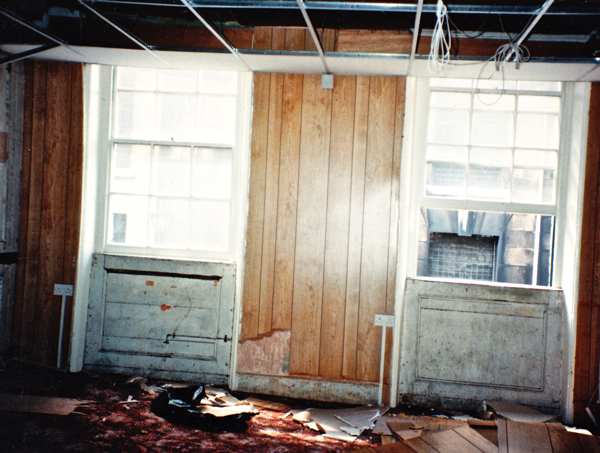
1995, the sweatshop
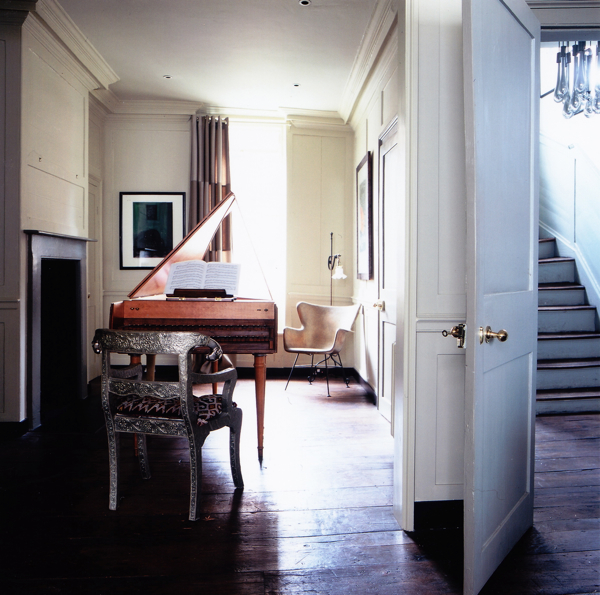
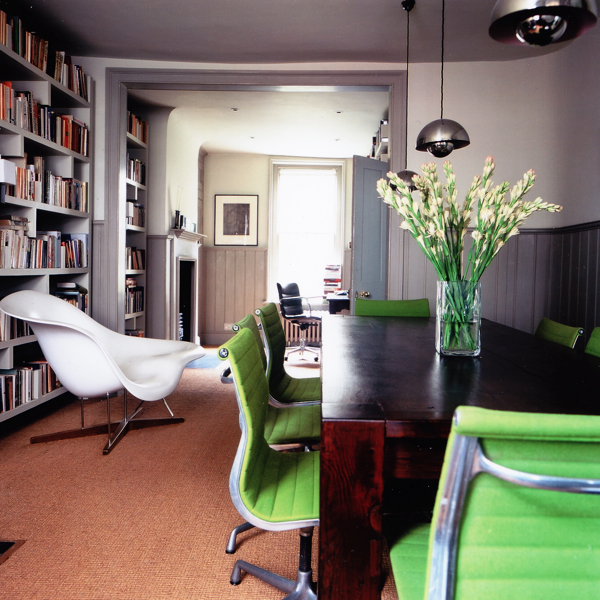
2005, the music room
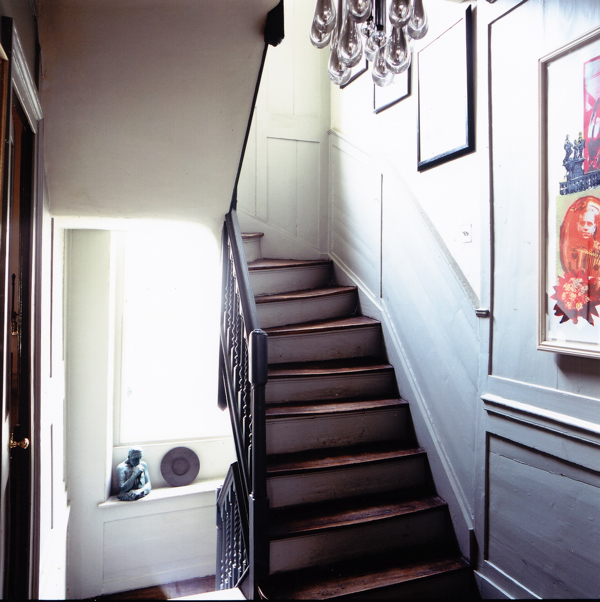
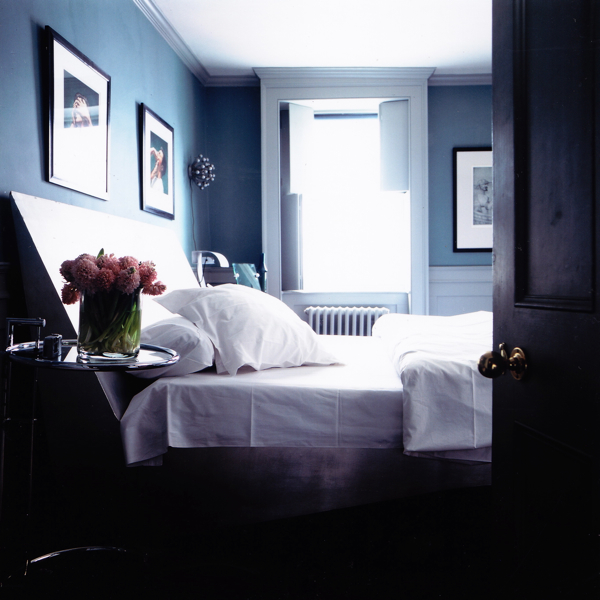
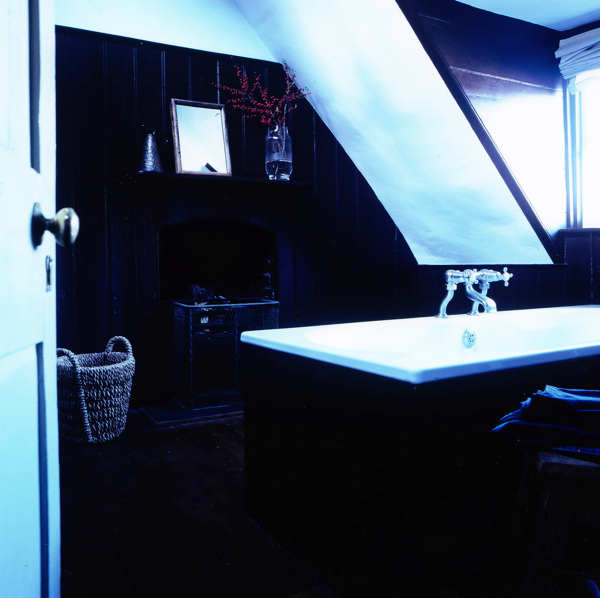
Ten years of renovation lies between these two photographs of the same room in Fournier St – between this snap of the abandoned sweatshop that John Nicolson purchased in 1995 and the swish interior shot by lifestyle photographer Jan Baldwin, that was one of a set taken in 2005 to celebrate the completion of the endeavour. Earlier this week, I showed you the collection of wallpapers dating from 1690 until 1960 and the curios from beneath the floorboards that John salvaged from this ancient house. And today you can see the “before” and “after” pictures which illustrate the breathtaking transformation that has been achieved, bringing new life back to what was once a derelict pile.
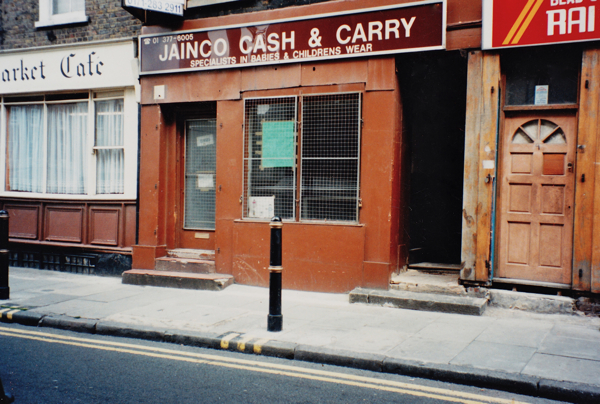
The tailoring industry had found its home there from 1720, through successive owners, Huguenot silk weavers, then Jewish tailors, and subsequently Bengali clothing maunfacturers, up until the nineteen nineties – when cheap manufacturing in the Far East made it no longer profitable to continue and the last owner went bankrupt, leaving the house in the ownership of the bank. No-one had lived there since the nineteen thirties, and by 1995 it was one among an entire terrace of abandoned buildings.
After the Fruit & Vegetable Market closed in 1991, many properties used to store fruit and herbs became empty in Spitalfields. The one next to John’s house had been a banana store, which gave him pause for thought when he first explored the property and discovered the yard overrun with exotic spiders. Yet in spite of this discovery, John had the courage to put his arm through a hole in the cladding on the wall on the first floor, reaching through into the darkness and touching what he believed to be eighteenth century panelling.
Many more discoveries were to be made over the coming years, as well as all the wallpapers and the curios mislaid under the floorboards in the previous three centuries. There was the lost cellar which had entirely filled up with silt. Above the false ceilings, there were grand box cornices installed by William Taylor, the joiner who built the house in 1721. Every room but one had its Georgian fireplace which had been covered over, still thick with soot. There was a mysterious brick flue from the cellar that was revealed to be ventilation for the dying of silks.
And all the doors had been taken off their hinges in the nineteenth century and hung the opposite way round from the previous century – because while the Georgians preferred doors to open into a room, offering a moment of grace as someone entered, the Victorians preferred their doors to open against the wall and wall straight into a room. “I’ve restored it to the Georgian etiquette with the doors opening into the rooms,” John admitted to me with a gracious smile, “to give my guests time to prepare for my imminent arrival.”
The house underwent successive alterations, at first to the panelling in the seventeen-eighties, and then the front wall had entirely been rebuilt in the eighteen twenties when a shopfront was added. John set about returned the house to its original proportions, removing partitions to create two rooms over each of the five floors and restoring missing panelling. He also demolished an outbuilding which filled the back garden and replaced the shopfront with a domestic facade consistent with the eighteen twenties work, including a new door case which derived its proportion and design from the eighteen twenties front door that survived. Elsewhere, John supplemented bead and butt boarding from 1900 and brought a sink back into use from this period, that had once served all the residents of the house when it was divided into tiny flats for Jewish refugees.
Today the house retains all its idiosyncratic appeal, a sympathetic amalgam of the successive alterations that speak of its different inhabitants in Fournier St over the last three centuries. Yet now it is a home again, and thanks to ten years of conscientious and imaginative work by John Nicolson, an atmosphere of peace and domesticity reigns once more.
The house as John found it.
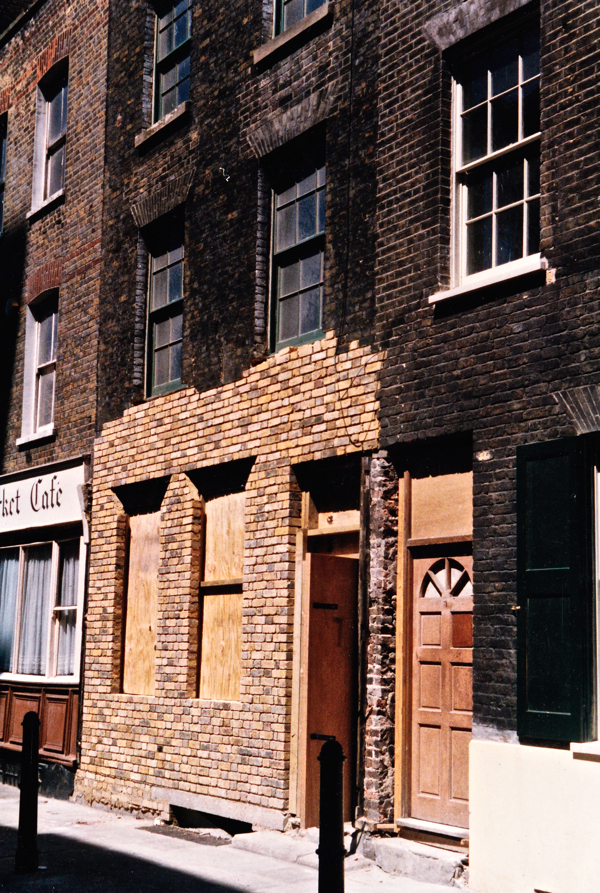
Reconstructing the domestic facade.
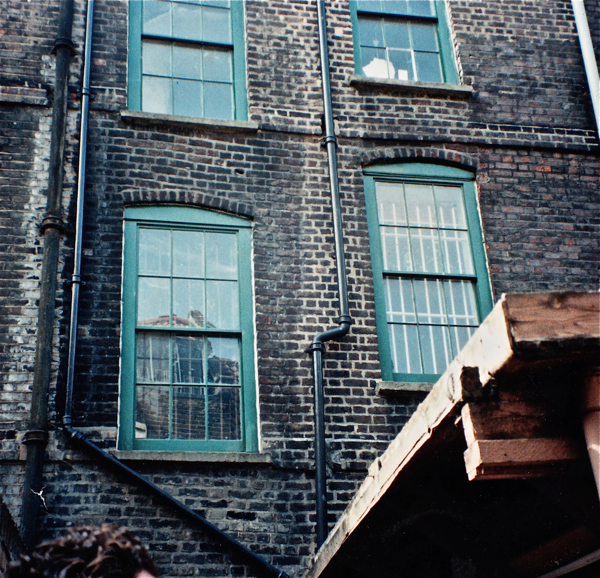
The rear elevation of 1720 with original windows flush with the level of the wall.
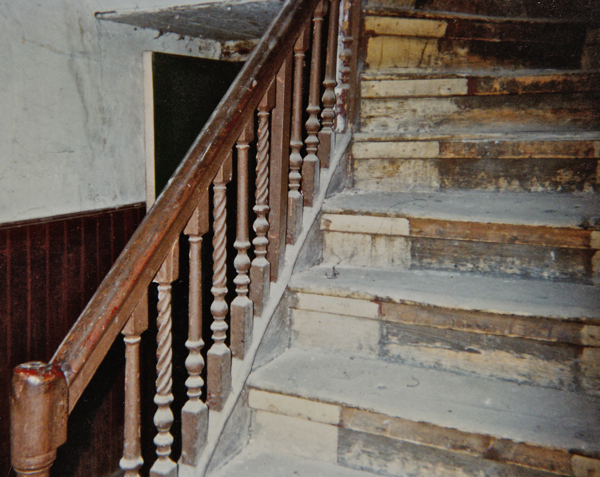
Alternating plain and barley twist spindles from 1720, as John discovered them.
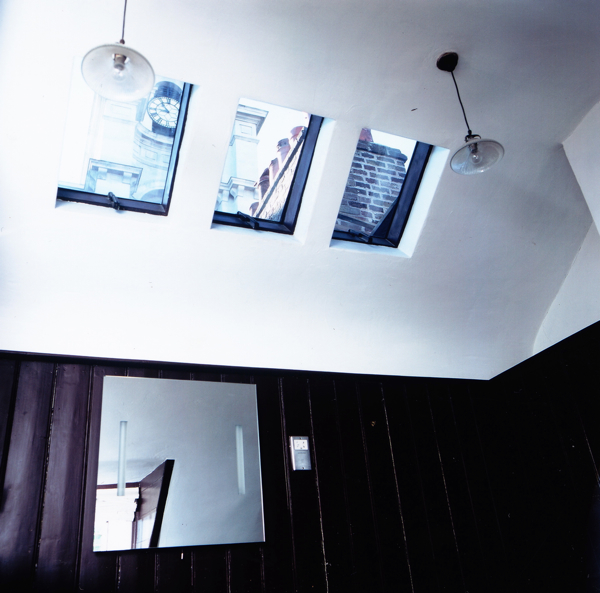
The view from John’s bathroom to the spire of Christ Church, Spitalfields.
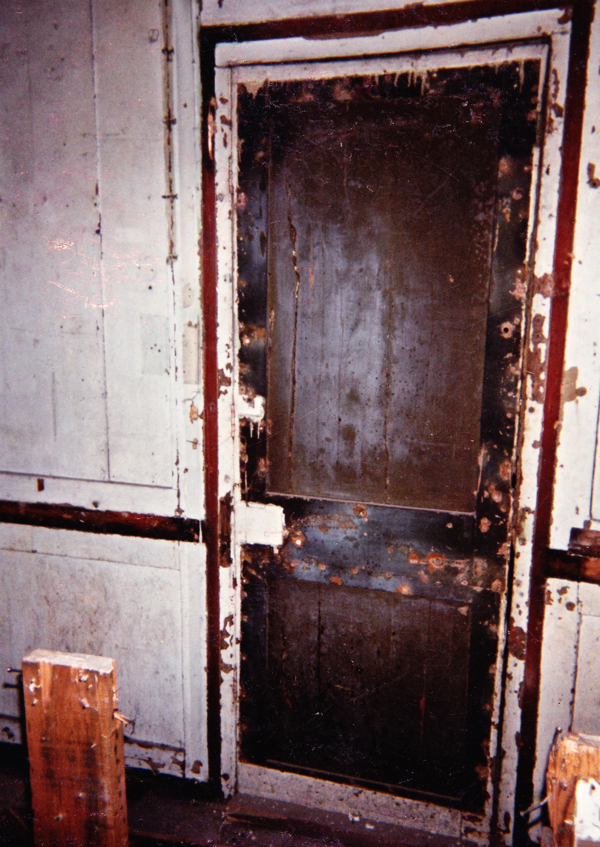
Original lead paintwork on this door, rehung in the nineteenth century to open towards the wall, in contrast to the eighteenth century etiquette, of doors always opening into the room – permitting a moment’s grace before someone entered.
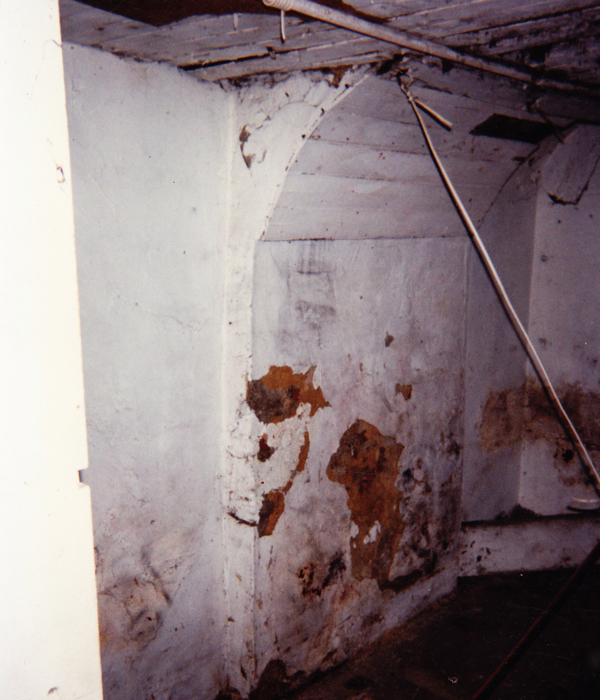
The rear basement as John first saw it, once the silt had been dug out.
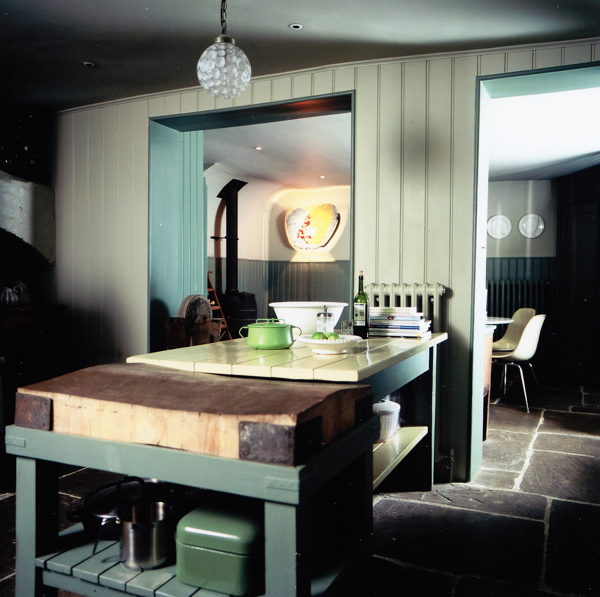
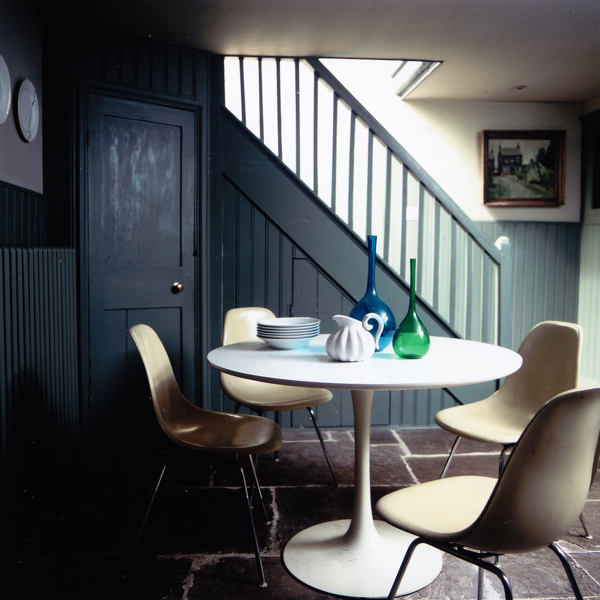
“Before” photographs copyright © John Nicolson
“After” photographs copyright © Jan Baldwin
You may also like to read my other Fournier St stories
The Wallpapers of Spitalfields
John Player’s Cries Of London


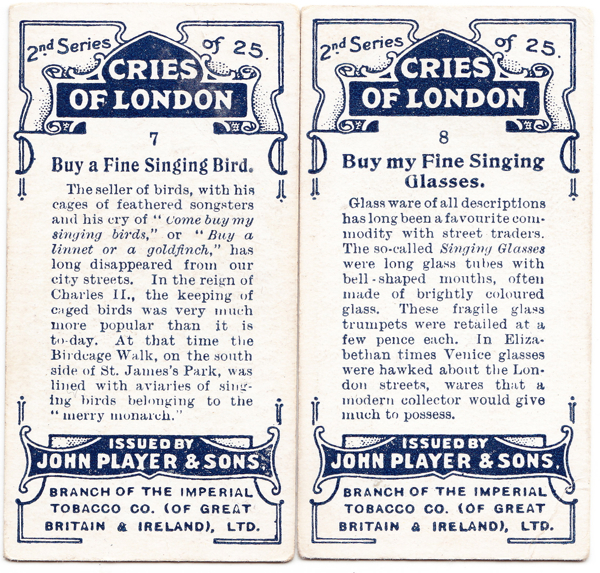
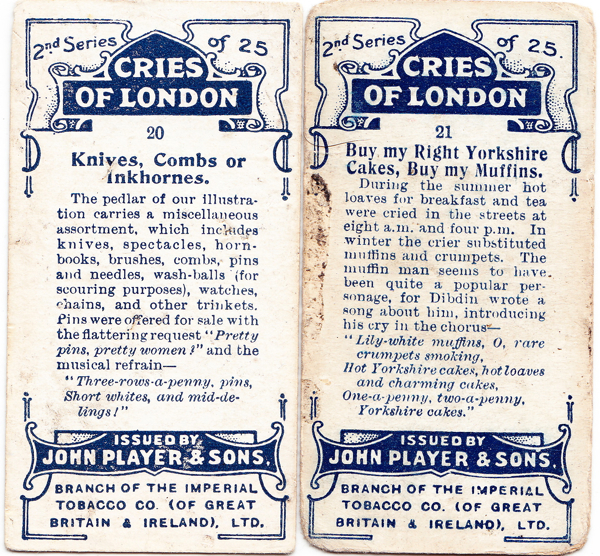
It is my great pleasure to show you these beautiful specimens of John Player’s cigarette cards illustrating the Cries of London, dating from 1916 – as the latest in my ongoing series of portrayals of the street life of our great metropolis down the ages. John Player & Sons put collector’s cards in their cigarette packets from 1893 and it is a measure of the popularity of the Cries of London that the series shown here was the second which was issued.
The jaunty charisma of these gaudy cards with their cheerful hawkers in colourful dress is irresistible, even if historical veracity is sacrificed for the sake of popular appeal. Old London is transformed into a city of swashbuckling romance in these cards, where the streets are as bright as pantomime backdrops and the traders swagger like music hall acts, ready to burst into song – a notion that reached its exuberant apogee in Lionel Bart’s “Who will buy?”
Yet, thumbing through these modest little cards with their corners rounded from use, no-one can deny the affectionate quality of these images and the fond significance that collectors gave to these ephemera, investing them with an emotional meaning which is far beyond mere sentiment or whimsy. The Cries of London celebrate the ingenuity and stamina of those with nothing, who for centuries could eek out a living upon the streets of London by hawking, and use their wits to do it with panache, transforming commerce into popular culture in the process.
In this respect, the Cries of London is the history of poverty retold as the brave and self-respecting history of resourcefulness. And that is why I treasure these lovely cards, enjoying even their quaint self-conscious archaic spellings, their curious anecdotal texts, their grubbiness and their crude printing. Once collected by schoolboys in class and soldiers in the trenches, as minor tokens of intangible value, they passed through so many hands before they arrived in mine – they are rare keepsakes to evoke an entire world.






Two hundred years after Francis Wheatley – the Cries of London tea caddy. When portrait painter Francis Wheatley was elected to the Royal Academy in 1790 in favour of the King’s candidate, it destroyed Wheatley’s career and, when the aristocratic patrons deserted him, he took to painting sympathetic portraits of his wife in the guise of street hawkers instead. He was bankrupt within three years and died in 1801, yet his poignant Cries of London have been celebrated ever since in innumerable prints, cigarette cards, and on biscuit tins and tea caddies – such as mine, shown here.
You may like to take a look at
William Nicholson’s London Types
Francis Wheatley’s Cries of London
Paul Kirby, Upholsterer
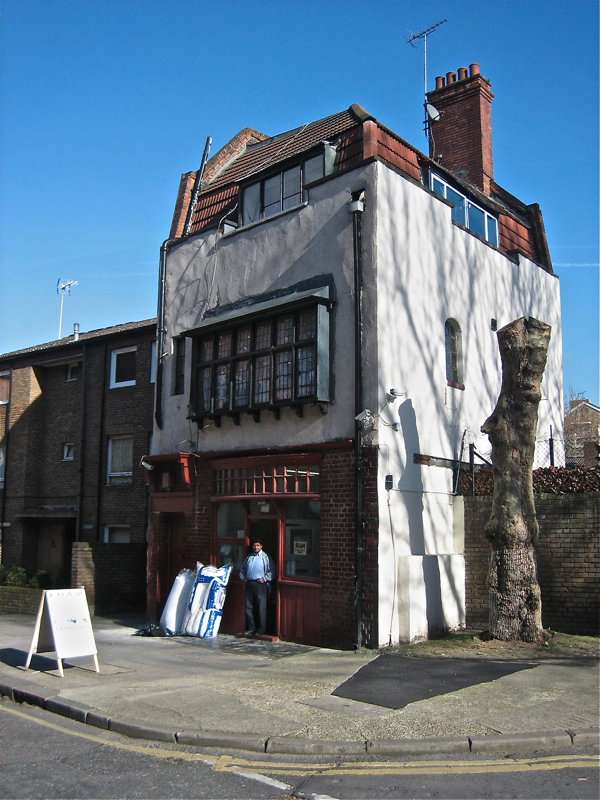
Near the top of Brick Lane, where it peters out into Bethnal Green, stands a lone house of mystery – accompanied by the gnarled stump of an old plane tree. Entirely at odds with the bland redevelopment that surrounds it, this edifice is unapologetic in its utilitarian idiosyncrasy and, when the windows glow at dusk on a rainy night, it possesses a magical allure which fascinates me. This is Paul Kirby’s foam shop.
For years, Paul Kirby has held out bravely against the “regeneration” that razed every other building in sight, and has emerged triumphant as the proud custodian of the last weaver’s house in the neighbourhood – built in the eighteenth century and incorporating a ship’s window into the frontage. “There’s been quite a lot of pressure to knock it down, but I took the council to court and won the case!” declared Paul in jubilant satisfaction, clasping his hands as he rocked back and forth in his easy chair.
You walk right in off the street into Paul’s workshop which occupies the entire ground floor of 74 Swanfield St, and is crammed with foam of every colour and description. On the left of this foam-lover’s paradise is the well-worn cutting board and, on the right, the tethered rolls of foam wait eager to spring into spongy life, while the space between is stacked with foam cushions – including a cherished Charles & Diana wedding souvenir foam cushion which, in astonishing testimony to Paul’s foam shop, has kept its bounce far longer than the ill-fated marriage ever did. And at the centre of all this foam sits Paul in his pork pie hat, a proud Englishman at home in his castle.
“I wouldn’t ever leave the East End now,” confided Paul, whose origins are in Mauritius, “I’ve got used to living in the bustling of Bethnal Green with all the cosmopolitans here. They looked down on foreigners when I first came to London in 1953 and it was hard to get a job or a room. Those were the darkest days, but I had some Jewish friends round here. It was a nice place to live, I loved it. It was elegant. I got a room in Code St off Brick Lane for fifty pence a week, from there I bought a lorry and started my own transport business.
Paul was conscripted into the British Army at eighteen years old from his home in Mauritius in 1950. When his mother died unexpectedly while he was in the forces, Paul was adopted by his commanding officer, who subsequently became Brigadier Kirby, and he returned to live in Britain with his new stepfather.
“I stayed with them in Hastings but it was difficult to get a job there, so he wrote me a letter which I took to a company in London and I got a job right away. Then he retired to St Austell in Cornwall and bought a Tudor house, where I used to visit at weekends. Although I was the only black man in St Austell, I had a lovely time. How people treated me there – it was unbelievable! When I got on the bus, they wouldn’t take money off me. They said, ‘Soldiers don’t pay!’
When I first came from Mauritius I was very fascinated by English furniture, especially Chesterfields, and I thought, ‘I’d like to make one of those.’ I’ve always been interested in furniture, so I studied upholstery. Since 1958 until now, I have been involved with upholstery, mostly lounge suites and I’ve made many Chesterfields.
In the sixties, I worked for the owner of this place. They manufactured reproduction furniture and I was their driver. There were scraps of fabric left over and they gave them to me. I asked the two machinists to make up cushion covers which I filled with scrap foam from the floor. And I took them down the market in Brick Lane on a Sunday and sold them for fifty pence each. And I made £20 each weekend and we shared it between us, which was pretty good when you realise that wages were only £8 a week.
I bought a two up/two down house in Bethnal Green, with no bathroom and an outside toilet, for £300. Then, in 1968, the furniture business moved to bigger premises so the boss asked me to run the shop for £8 a week. To start with, I sold secondhand furniture, wardrobes and things, and I just opened on Sunday because that was the only day people were walking about.
In the nineteen seventies, we had a lot of problems with the National Front. Every weekend, there’d be marches and so on. I used to open up my house for the police to use the toilet because there’d be six bus loads of them waiting outside in case of trouble. I was in the middle of it because I was selling Union Jack cushions and some people asked me to stop selling them as it was a symbol adopted by the National Front, but I am an ex-army man and proud to be a citizen of the United Kingdom. It was not a nice time.
Around 1976, I started repairing furniture, recovering old three piece suites and reselling them, then in 1988 I took the place over and moved in and stayed ever since – but now I can’t compete with the big furniture warehouses, so I just do a bit of repair and sell foam, cushions and suchlike to local people. I have another home but I often stay here when I am working late, and most of my neighbours know me by my first name.”
Actively employed at seventy-eight, Paul Kirby is now among the elite who remember when Bethnal Green and Shoreditch were full of cabinet and furniture makers. And Paul has such a relaxed nature that his foam shop is an attractive place to linger to enjoy the peace and quiet, as if the very fabric of the building has now absorbed his personality – or as if the vast amount of foam insulates against the outer world, absorbing discord.
The recipient of kindness, Paul greets everyone who comes through the threshold with an equal generosity of spirit. You can be guaranteed of a welcome and a smile, as long as you have not come to knock down this venerable weaver’s house in the name of “regeneration” – because, after half a century, Paul and his building are one.
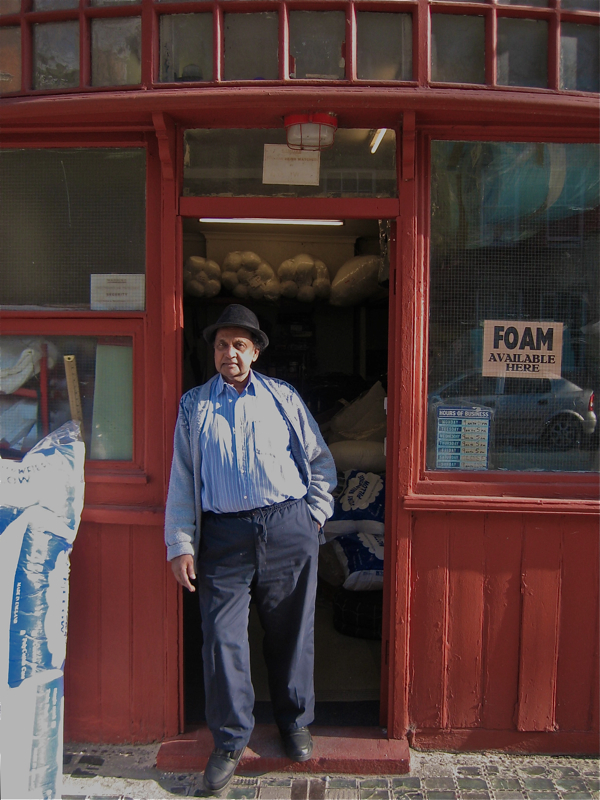


Paul Kirby

The mysterious allure of Paul Kirby’s foam shop at dusk.
You may also like to read about other craftmen in Shoreditch












