In Search of Shakespeare’s London
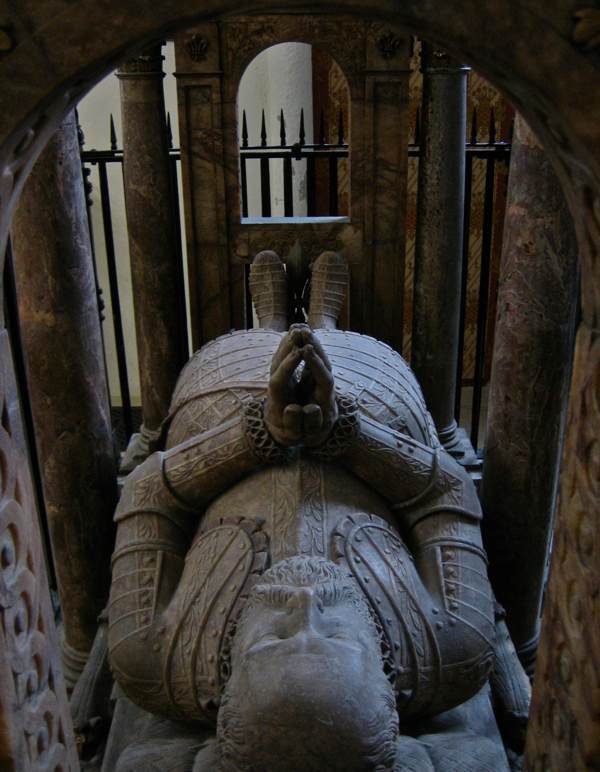
Sir William Pickering, St Helen’s, Bishopsgate, 1574.
Almost a year has passed since I visited the newly discovered site of William Shakespeare’s first theatre in Shoreditch, yet over all this time I have been thinking about where else in London I can locate Shakespeare. The city has changed so much that very little remains from his time and even though I may discover his whereabouts, such as his lodging in Silver St in 1612 – usually the terrain is unrecognisable. Silver St is lost beneath the Barbican now.
Yet, in spite of everything, there are buildings in London that Shakespeare would have known, and, in each case, there are greater or lesser reasons to believe he was there. During these past months, as the mental list of places where I could enter the same air space as Shakespeare has grown, so has my desire to visit them all and discover what remains to meet my eyes that he would also have seen.
Midsummer Day is as good a day as any to go in search of Shakespeare’s London and so I set out under a moody sky, walking first over to St Helen’s Bishopsgate where Shakespeare was a parishioner, according to the parish tax inspector who recorded his failure to pay tax on 15th November 1597. This ancient church is a miraculous survivor of the Fire of London, the Blitz and the terrorist bombings of the nineteen nineties, and contains spectacular monuments that Shakespeare could have seen if he came here, including the eerie somnolent figure of Sir William Pickering of 1574 illustrated above. There is great charm in the diverse collection of melancholic Elizabethan statuary residing here in this quaint medieval church with two naves, now surrounded by modernist towers upon all sides, and there is a colourful Shakespeare window of 1884, the first of several images of him that I encountered upon my walk.
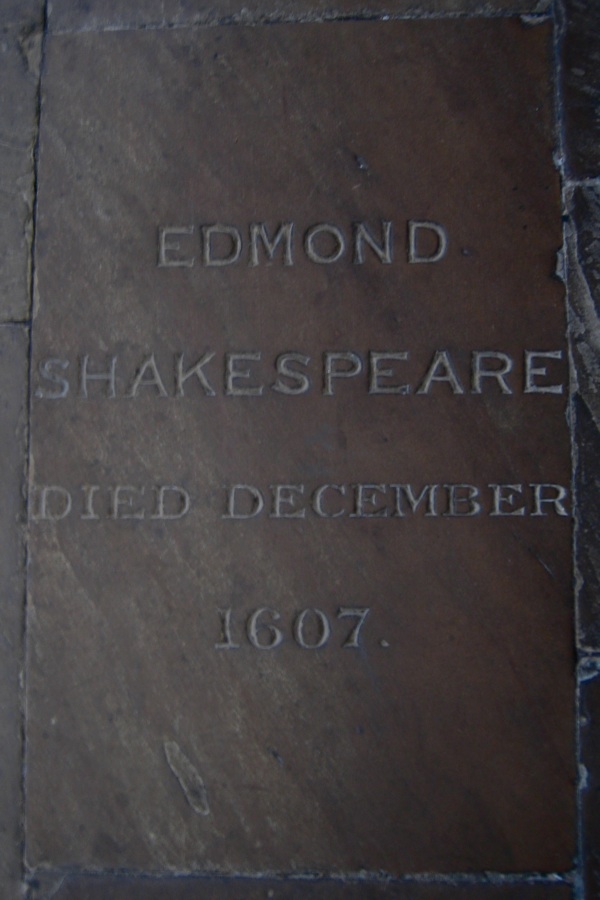
From here, I followed the route that Shakespeare would have known, walking directly South over London Bridge to Southwark Cathedral, where he buried his younger brother Edmund, an actor aged just twenty-seven in 1607, at the cost of twenty shillings “with a forenoone knell of the great bell.” Again there is a Shakespeare window, with scenes from the plays, put up in 1964, and a memorial with an alabaster figure from 1912, yet neither is as touching as the simple stone to poor Edmund in the floor of the choir. I was fascinated by the medieval roof bosses, preserved at the rear of the nave since the Victorians replaced the wooden roof with stone. If Shakespeare had raised his bald pate during a service here, his eye might have caught sight of the appealingly grotesque imagery of these spirited medieval carvings. Most striking is Judas being devoured by Satan, with only a pair of legs protruding from the Devil’s hungry mouth, though I also like the sad face of the old king with icicles for a beard.
Crossing the river again, I looked out for the Cormorants that I delight to see as one of the living remnants of Shakespeare’s London, which he saw when he walked out from the theatre onto the river bank, and wrote of so often, employing these agile creatures that can swallow fish whole as as eloquent metaphors of all-consuming Time. My destination was St Giles Cripplegate, where Edmund’s sons who did not live beyond infancy were baptised and William Shakespeare was the witness. Marooned at the centre of the Barbican today like a galleon shipwrecked upon a beach, I did not linger long here because most of the cargo of history this church carried was swept overboard in a fire storm in nineteen forty, when it was bombed and then later rebuilt from a shell. Just as in that searching game where someone advises you if you are getting warmer, I began to feel my trail had started warm but was turning cold.
Yet, resolutely, I walked on through St John’s Gate in Clerkenwell where Shakespeare once brought the manuscripts of his plays for the approval by the Lord Chamberlain before they could be performed. And, from there, I directed my feet along the Strand to the Middle Temple, where, in one of my favourite corners of the city, there is a sense – as you step through the gates – of entering an earlier London, comprised of small squares and alleys arched over by old buildings. Here in Fountain Court, where venerable Mulberry trees supported by iron props surround the pool, stands the magnificent Middle Temple Hall where the first performance of “Twelfth Night” took place in 1602, with Shakespeare playing in the acting company. At last, I had a building where I could be certain that Shakespeare had been present – but it was closed.
I sat in the shade by the fountain and took stock, and questioned my own sentiment now my feet were weary. Yet I could not leave, my curiosity would not let me. Summoning my courage, I walked past all the signs, until I came to the porter’s lodge and asked the gentleman politely if I might see the hall. He stood up, introducing himself as John and assented with a smile, graciously leading me from the sunlight into the cavernous hundred-foot-long hall, with its great black double hammer-beam roof, like the hand of God with its fingers outstretched or the darkest stormcloud lowering overhead. It was overwhelming.
“You see this table,” said John, pointing to an old dining table at the centre of the hall, “We call this the ‘cup board’ and the top of it is made of the hatch from Sir Francis Drake’s ship ‘The Golden Hind’ that circumnavigated the globe” And then, before I could venture a comment, he continued, “You see that long table at the end – the one that’s the width of the room, twenty-nine feet long – that’s made from a single oak tree which was a gift from Elizabeth I, it was cut at Windsor Great Park, floated down the Thames and constructed in this hall while it was being built. It has never left this room.”
And then John left me alone in the finest Elizabethan hall in Britain. Looking back at the great carved screen, I realised this had served as the backdrop to the performance of ‘”Twelfth Night” and the gallery above was where the musicians played at the opening when Orsino says, “If music be the food of love, play on.” The hall was charged and resonant. Occasioned by the clouds outside, sunlight moved in dappled patterns across the floor from the tall windows above.
I walked back behind the screen where the actors, including Shakespeare, waited, and I walked again into the hall, absorbing the wonder of the scene, emphasised by the extraordinary intricate roof that appeared to defy gravity. It was a place for public display and the show of power, but its elegant proportion and fine detail also permitted it to be a place for quiet focus and poetry. I sat on my own at the head of the twenty-nine foot long table in the only surviving building where one of William Shakespeare’s plays was done in his lifetime, and it was a marvel. I could imagine him there.
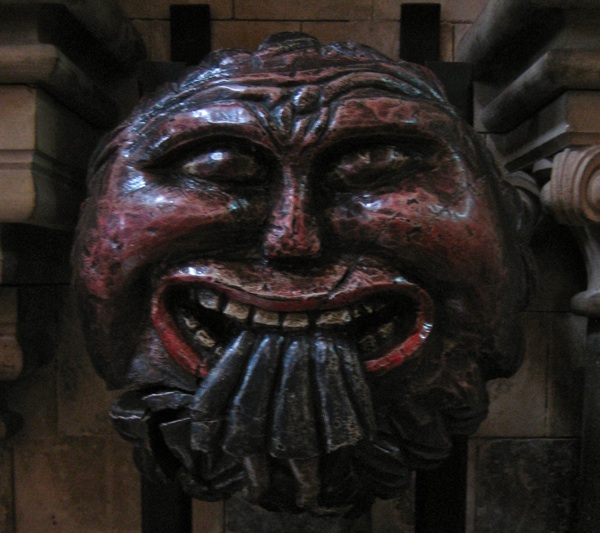
Judas swallowed by Satan
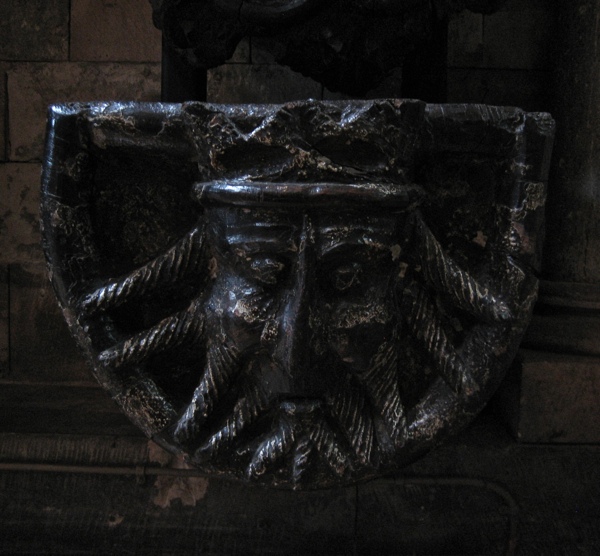
An old king at Southwark
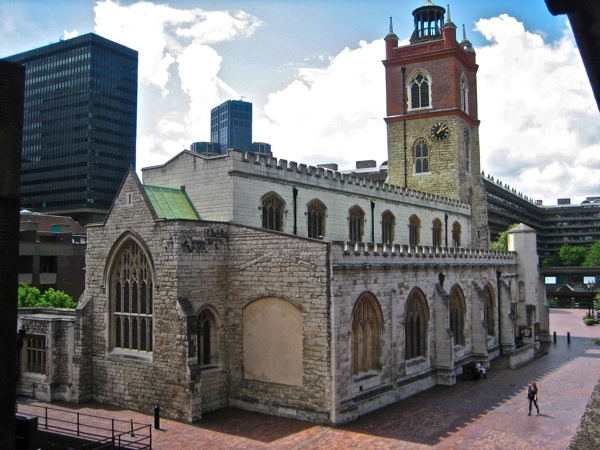
St Giles Cripplegate where Edmund’s sons were baptised and William Shakespeare was the witness.
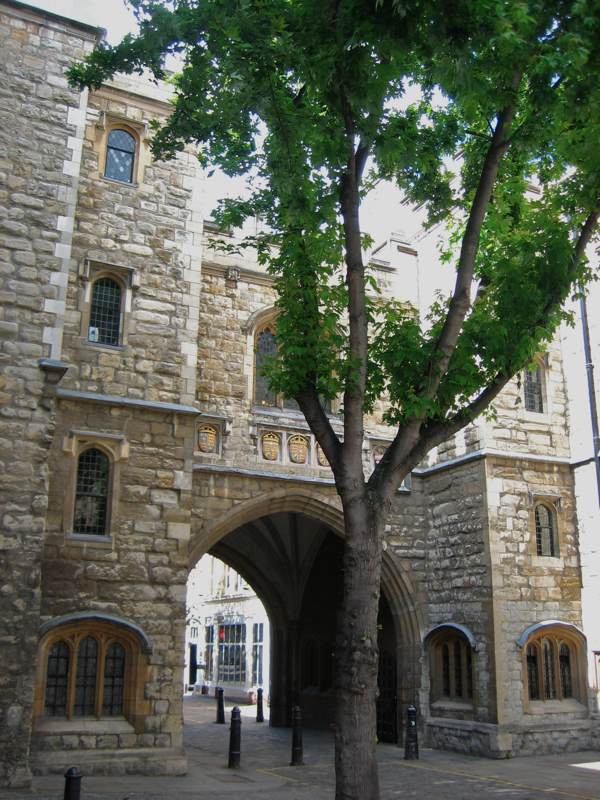
St John’s Gate where William Shakespeare brought the manuscripts of his plays to the Lord Chamberlain’s office to seek approval.
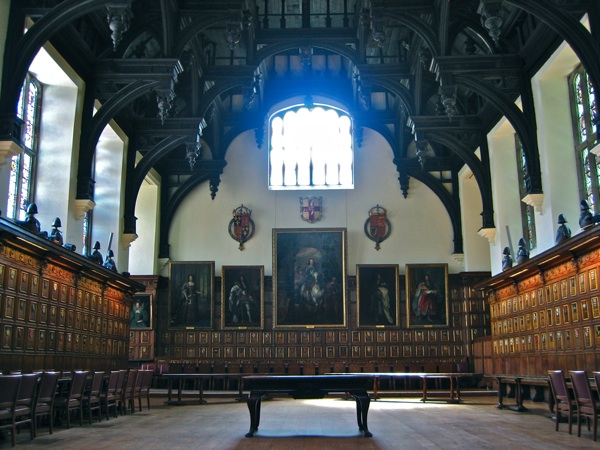
The Middle Temple Hall where “Twelfth Night” was first performed in 1602.
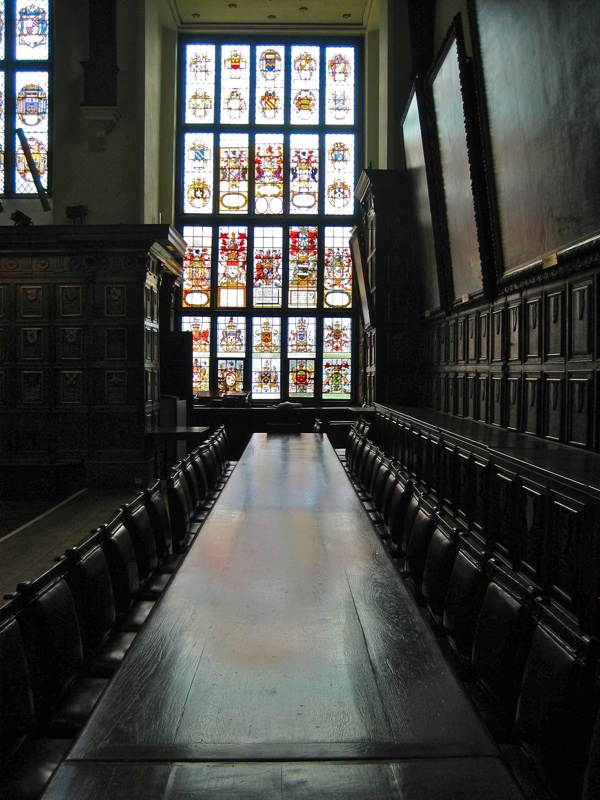
The twenty-nine foot long table made from a single oak from Windsor Great Park.
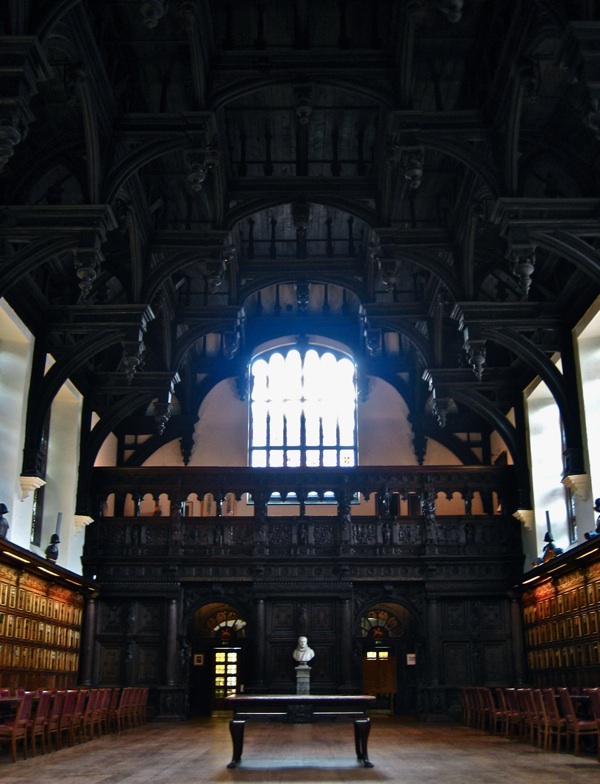
The wooden screen that served as the backdrop to the first production of” Twelfth Night.”
You may like to read these:
At Shakespeare’s First Theatre
The Door to Shakespeare’s London
Colin O’Brien’s Clerkenwell Car Crashes

Accident, daytime 1957
When photographer Colin O’Brien lived at Victoria Dwellings on the corner of Clerkenwell Rd and Faringdon Rd, there was a very unfortunate recurring problem which caused all the traffic lights at the junction to turn green at once. In the living room of the top floor flat where Colin lived with his parents, an ominous “crunch” would regularly be heard, occasioning the young photographer to lean out of the window with his box brownie camera and take the spectacular car crash photographs that you see here. Unaware of Weegee’s car crash photography in New York and predating Warhol’s fascination with the car crash as a photographic motif, Colin O’Brien’s car crash pictures are masterpieces in their own right.
Yet, even though they possess an extraordinary classically composed beauty, these photographs do not glamorise the tragedy of these violent random events – seen, as if from from God’s eye view, they expose the hopeless pathos of the situation. And, half a century later, whilst we all agree that these accidents were profoundly unfortunate for those involved, I hope it is not in poor taste to say that, in terms of photography they represent a fortuitous collision of subject matter and nascent photographic talent. I say this because I believe that the first duty of any artist is to witness what is in front of you, and this remarkable collection of pictures which Colin took from his window – dating from the late forties when he got his first camera at the age of eight until the early sixties when the family moved out – is precisely that.
Yesterday, I accompanied Colin as he returned to the junction of the Clerkenwell Rd and Faringdon Rd in the hope of visiting the modern buildings upon the site of the former Victoria Dwellings. To our good fortune, once we explained the story, Tomasz, the superintendent of Herbal Hill Buildings, welcomed Colin as if he were one of current residents who had simply been away for the weekend. Magnanimously, he handed over the keys of the top flat on the corner – which, by a stroke of luck, is currently vacant – so that Colin might take pictures from the same vantage point as his original photographs.
We found a split-level, four bedroom penthouse apartment with breathtaking views towards the City, complete with statues, chandeliers and gold light switches. It was very different to the poor, three room flat Colin lived in with his parents where his mother hung a curtain over the gas meter. Yet here in this luxury dwelling, the melancholy of the empty rooms was inescapable, lined with tired beige carpet and haunted with ghost outlines of furniture that had been taken away. However, we had not come to view the property, we had come to look out the window and after Colin had opened three different ones, he settled upon the perspective that most closely correlated to his parents’ living room and leaned out.
“The Guinness ad is no longer there,” he commented – almost surprised – as if, somehow, he expected the reality of the nineteen fifties might somehow be restored up here. Apart from the blocks on the horizon, little had changed, though. The building on the opposite corner was the same, the tube embankment and bridge were unaltered, the Booth’s Distillery building in Turnmills St still stood, as does the Clerkenwell Court House where Dickens once served as cub reporter. I left Colin to his photography as he became drawn into his lens, looking back into the midst of the last century and upon the urban landscape that contained the emotional history of his youth.
“It was the most exciting day of my life, when we left,” admitted Colin, with a fond grin of reminiscence, “Canvassers from the Labour Party used to come round asking for our votes and my father would ask them to build us better homes, and eventually they did. They built Michael Cliffe House, a tower block in Clerkenwell, and offered us the choice of any flat. My parents wanted one in the middle but I said, ‘No, let’s get the top flat!’ and I have it to this day. I took a photo of lightning over St Paul’s from there, and ran down to Fleet St and sold it to the Evening Standard.”
Colin O’Brien’s car crash photographs fascinate me with their intense, macabre beauty. As bystanders, unless we have specialist training, car crashes only serve to emphasise the pain of our helplessness at the destructive intervention of larger forces, and there is something especially plangent about these forgotten car crashes of yesteryear. In a single violent event, each one dramatises the sense of loss that time itself engenders, as over the years our tenderest beloved are taken from us. And they charge the photographic space, so that even those images without crashes acquire an additional emotionalism, the poignancy of transience and the imminence of potential disaster. I can think of no more touching image of loneliness that the anonymous figure in Colin O’Brien’s photograph, crossing the Clerkenwell Rd in the snow on New Year’s Eve, 1961.
After he had seen the interior of Herbal Hill Buildings, Colin confided to me he would rather live in Victoria Dwellings that stood there before, and yet, as he returned the keys to Tomasz, the superintendent, he could not resist asking if he might return and take more pictures in different conditions, at a different time of day or when it was raining. And Tomasz graciously assented as long as the apartment remained vacant. I understood that Colin needed the opportunity to come back again, now that the door to the past had been re-opened, and, I have to confess to you that, in spite of myself, I could not resist thinking, “Maybe there’ll be a car crash next time?”

Accident in the rain.

Accident in the rain, 2.


Snow on New Year’s Eve, 1961.

Trolley buses, nineteen fifties.

Clerkenwell Italian parade, nineteen fifties.

Firemen at Victoria Dwellings, nineteen fifties.


Have a Guinness when you’re tired


Colin’s photograph of the junction of the Clerkenwell Rd and Faringdon Rd view, taken yesterday, from Herbal Hill Buildings that now stand on the site of the former Victoria Dwellings.

Colin O’Brien sees his childhood view for the first time in fifty years.
Photographs copyright © Colin O’Brien
More photographs by Colin O’Brien
Rob Ryan in Spitalfields
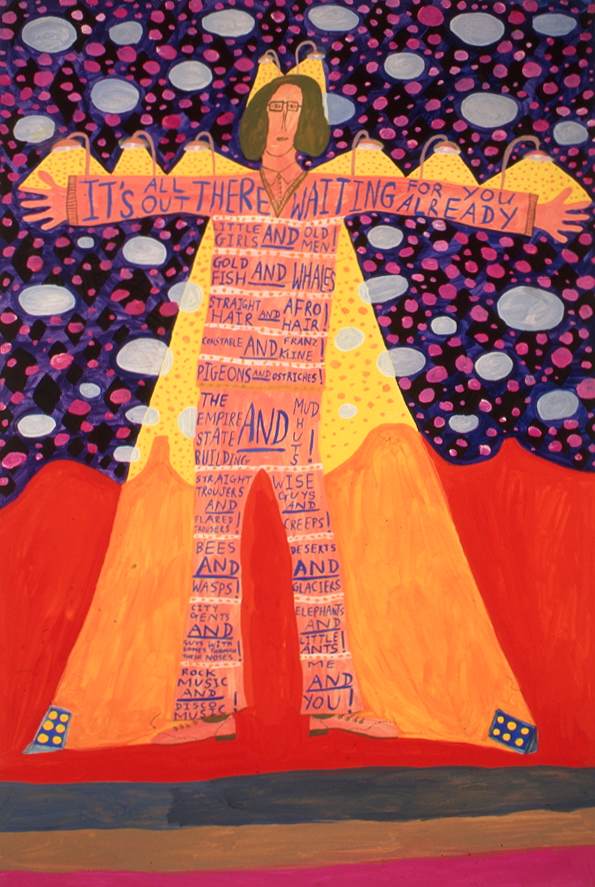
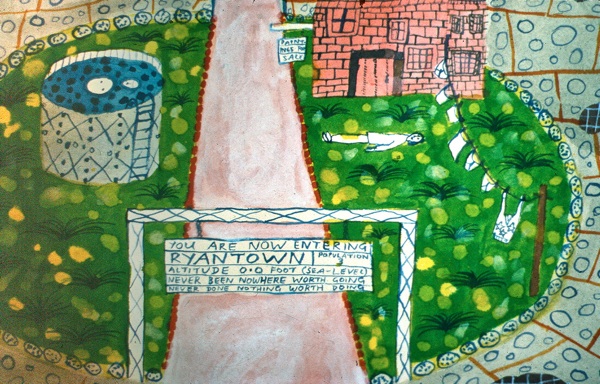
Three years ago, the papercut supremo Rob Ryan opened up a shop, Ryantown in Columbia Rd that sold his designs exclusively. With its white interior and brightly coloured wares covered in his signature graphics, it has a comparable feel to Keith Haring’s Pop Shop on Lafayette St in Greenwich Village. And just as Haring’s style incarnated the vibrant life of New York’s East Village in the nineteen eighties, Rob Ryan has created a visual language that is the most widely recognised expression of the explosion of creativity and new life which has taken place in the East End in the past ten years.
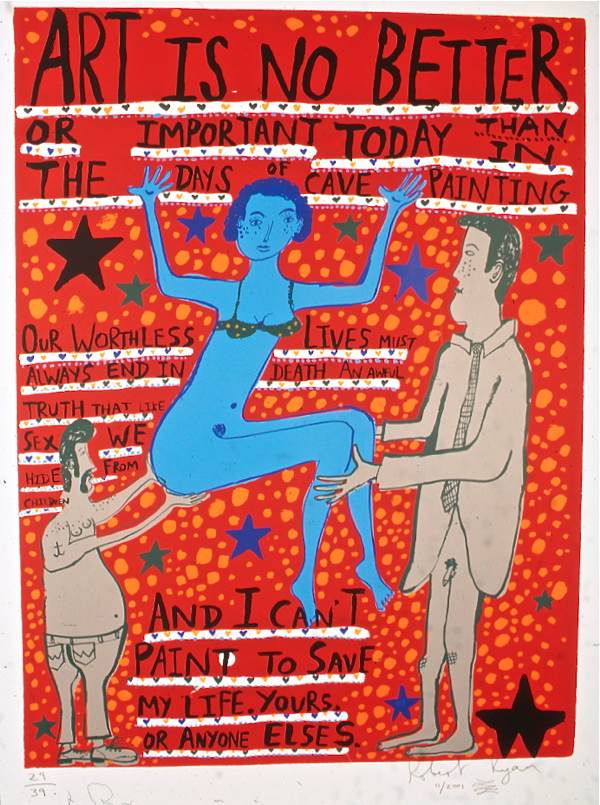
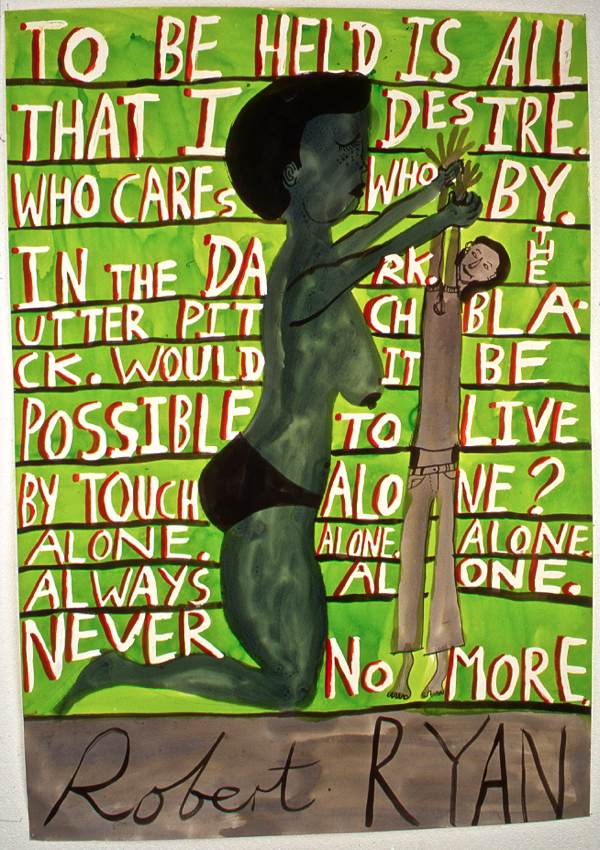
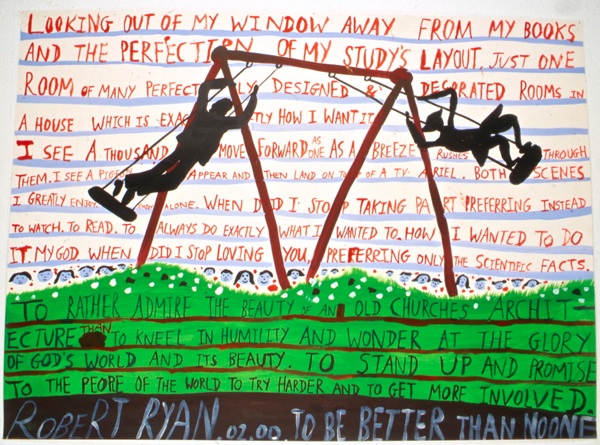
Yet Rob Ryan came to the East End many years earlier. He was one of the artists who benefited from the cheap studio spaces that were available in the Spitalfields Market after the fruit & vegetable market left. For years he worked there, making paintings like those shown here, before he reinvented the venerable art of the papercut in such superlative fashion – and in doing so found for himself the perfect marriage of artist and medium.
I was always curious to see what kind of paintings Rob Ryan did before the papercuts came along and made him famous. So I twisted his arm to bring out some of these old pictures which I publish for you here today. And I took this opportunity to ask Rob a little about the early years in Spitalfields, when he fuelled up with a full cooked lunch at the Market Cafe in Fournier St before each day’s work at his studio in the market.
“I got laid off from my job in 1991 – I was working for a typesetter and I was working from home – and at the same time I was made homeless with a two year old child. While we were on the list for a council flat, we were sent off to Wood Green for nine months. It was a state of limbo and I thought, ‘I’m not going to do any of my own art work until we get a flat.’ Once I moved into my first council flat, in Westminster in 1992, somebody said they had a desk available in a studio with four other illustrators above Barbarella Shoes in Shoreditch High St. And I was there a couple of years before I heard about Spitalfields Arts Projects – they were opening up artists’ studios on the old market. I moved into one of the smallest studios there, on the first floor, and there was a shop on Brushfield St where I could display my work.
My work was very much as it is now, except in ink and paint. I realised that a lot of people after leaving art school – as I had done – took jobs to pay for their studios and then it was too much for them to get there. So I got a job in a cinema in the evenings and at the weekends. I worked twenty hours a week, enough to keep myself going, and I went in to my studio from Monday to Friday. Lorna, my wife, has always supported me in my work, she worked as a teacher. I used to take the kids to school, and then I’d get on my bike and cycle over to the East End and work until three, and then I’d pick up the kids from school, and take them home and give them tea before I’d go to work at five thirty at the cinema, and then I’d come back at the end of the evening.
It sounds like a struggle, but I had such a good time and it all seemed normal at the time. I was always planning shows and working towards shows. I was always busy. I wasn’t working in a commercial way at all. We used to have exhibitions and we only thought to invite the people we knew. Few people found out and nobody ever turned up. But because I had no-one telling me what to do for ten years, maybe it allowed me to build up some level of confidence. I’ve always believed in myself, even before college, I knew that this what I wanted to devote my life to.
I wasn’t working in papercuts at all at that time – that work fell into place a bit later. What set me free was screen-printing. My mind spins around in lots of different directions. Everything changed when I moved to Bethnal Green and set up a screen-printing studio, and then I started doing printing for others and I would just make enough money that I could give up my weekend job. I got asked to do posters and magazine covers. I was really inspired by being busy doing stuff for other people. The level of energy was heightened, and then the papercutting thing came in about eight years ago, in 2003…”
The deceptive simplicity of Rob Ryan’s style is the outcome of years developing his distinctive visual poetic language. And, like William Morris who also took inspiration from traditional techniques to create designs for a wide audience, Rob Ryan has found a way to reinvent papercutting that has true popular appeal, reaching its apotheosis now in books, prints, cards, mugs, teapots, bottles, plates, vases, t-shirts, watering cans, raincoats, umbrellas, moneyboxes, scarves, badges, tiles, tapestries and tapes – all emblazoned with his instantly recognisable designs.
Ten years ago, when Rob was making the pictures you see here, no-one could have predicted the direction his work would take or the outcome that would result. His unlikely success is an inspiration to all the thousands of young artists in East London, the heroic result of following a personal intuition. As he told me plainly, “I didn’t feel any different then, I didn’t feel any better than anyone else. I always look as it as, this is the only work I can do.”
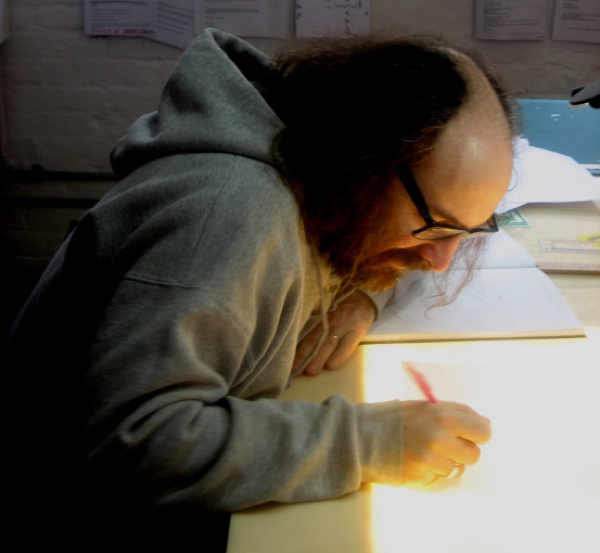
Rob Ryan at work today in Bethnal Green.
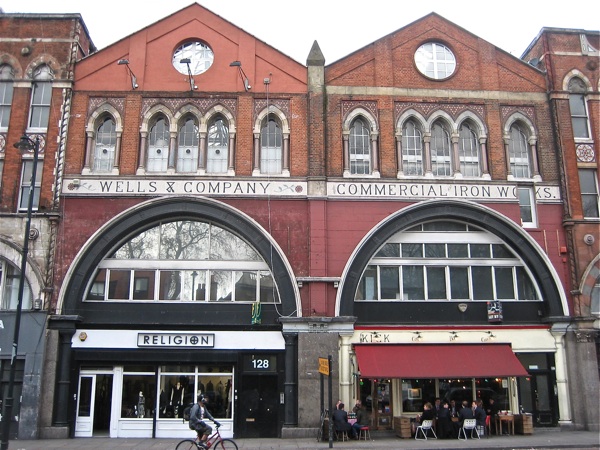
In 1992, Rob Ryan’s first East End studio was a desk above Barbarella Shoes on Shoreditch High St – on the extreme left of the left hand crescent-shaped window.
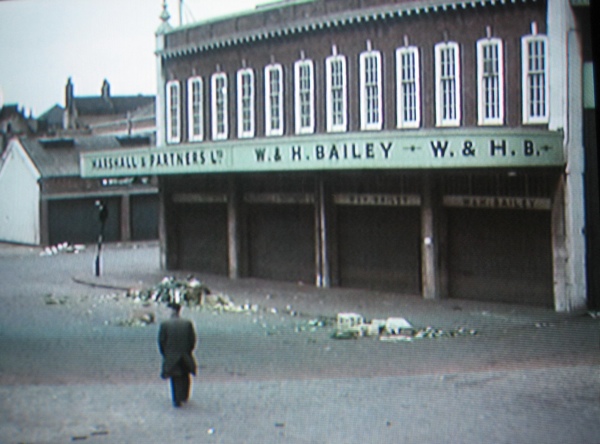
From 1995, Rob Ryan’s studio was the third and fourth windows from the right, at the West end of the Spitalfields Market – this picture shows James Mason walking past in 1967.
Paintings copyright © Rob Ryan
You can see Rob Ryan’s current work at www.misterrob.co.uk, follow his blog here and learn about Ryantown here.
You may also like to read
Colin O’Brien’s Brick Lane Market

Let us take a walk through Cheshire St, Brick Lane, Sclater St and Club Row in the company of photographer Colin O’Brien to experience the life of the Sunday market in the nineteen eighties.
“I loved markets as a child, because I grew up during the nineteen forties in Clerkenwell and I used to go to Leather Lane to hear the patter of the stallholders. There is this mystique about markets for me. I love being surrounded by people and I feel safe in a crowd.” Colin told me, his grey eyes shining in excitement, as we made our way through the crowd onto the bare ground between Cheshire St and Grimsby St where traders sold their wares upon the frozen earth, by the light of lamps and candles.
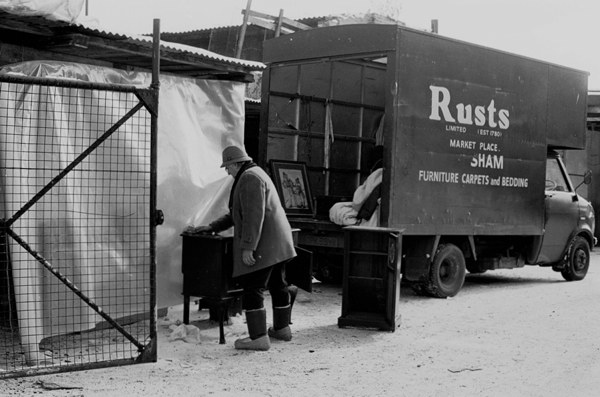
“I’m a bit of a collecting sort of person, myself.” Colin admitted as we scanned the pitiful junk on sale, so carefully arranged in the frost, “I like old things.” It was a bitterly cold morning which led me to ask Colin why we were there. “I tend to go when it’s snowing,” Colin revealed cheerfully as we picked our way through the slush on Brick Lane, “there is a comradeship and drama.”
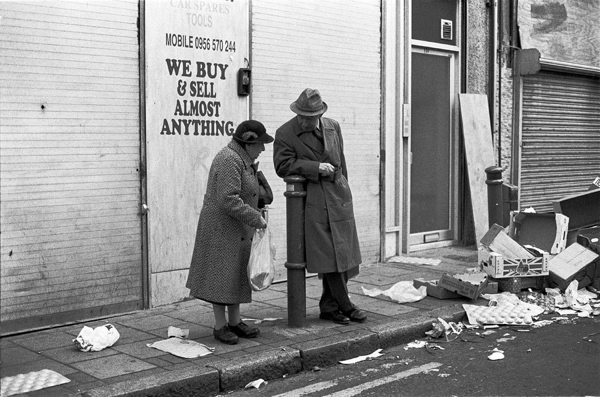
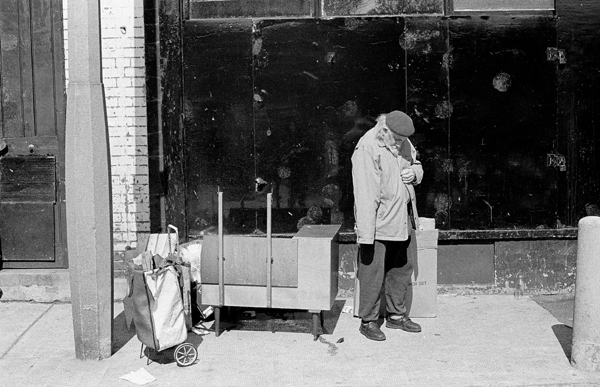
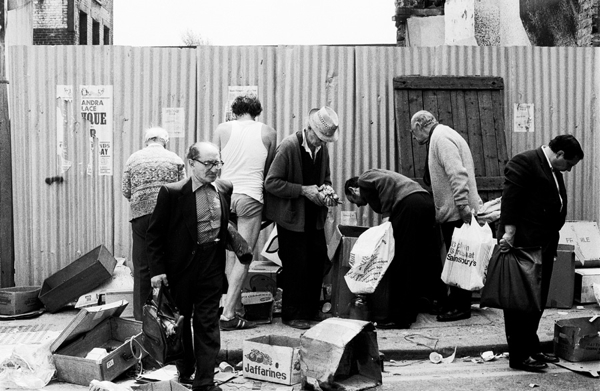
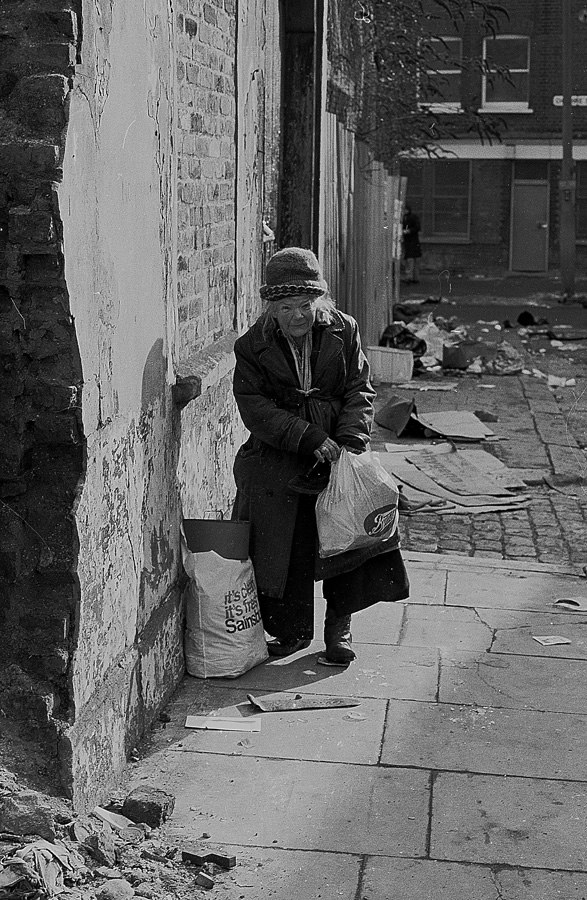
Examining Colin’s pictures later, just a fraction of the total, I realised that most were taken when the market was clearing up and portrayed individuals rather than the crowd. “Packing up is when everything happens,” he explained to me, “they dump all the unsold stuff in the street and the scavengers come to take it. You look at what’s discarded and it’s the history of the time.”
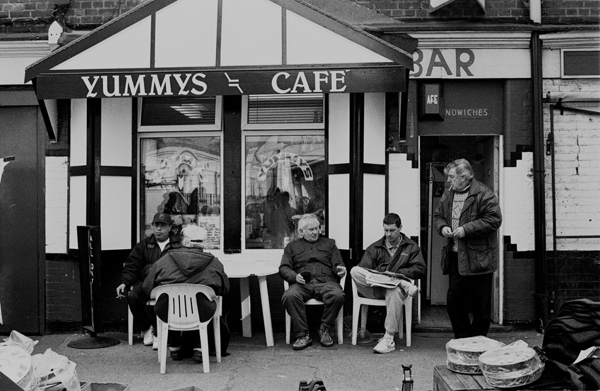
I noticed that the woman sitting at the centre of Colin’s photograph “Coming & goings at the corner of Brick Lane” was surrounded by five men and yet not one was looking at her. I realised that he had photographed her invisibility, and that the same was true for his other soulful portraits of market-goers, market-traders, homeless people, old people and marginal characters – all portrayed here with human sympathy through the lens of Colin O’Brien, yet gone now for ever.

On Brick Lane.





At Club Row.

Comings and goings at the corner of Brick Lane.


At the time of the miners’ strike.

Boy with a typewriter on Cheshire St
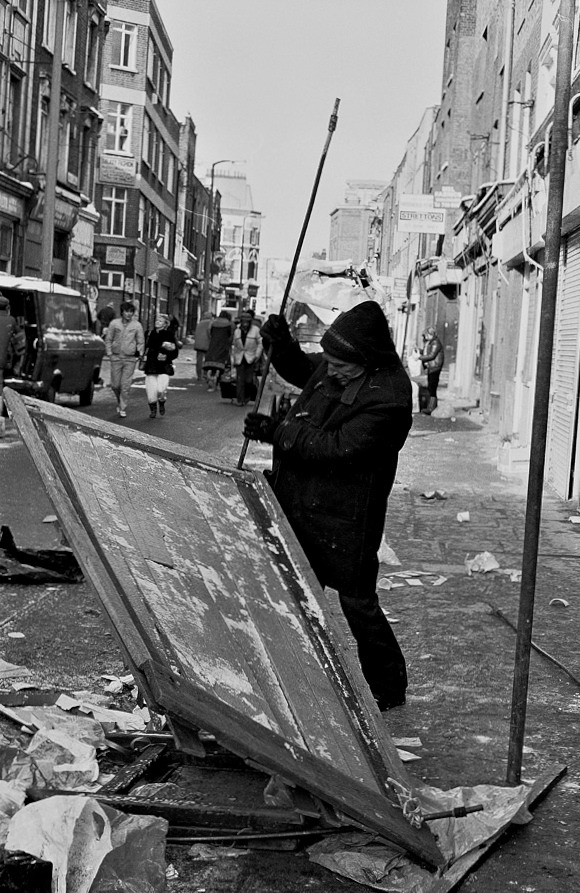
Taking down the stalls on Brick Lane.
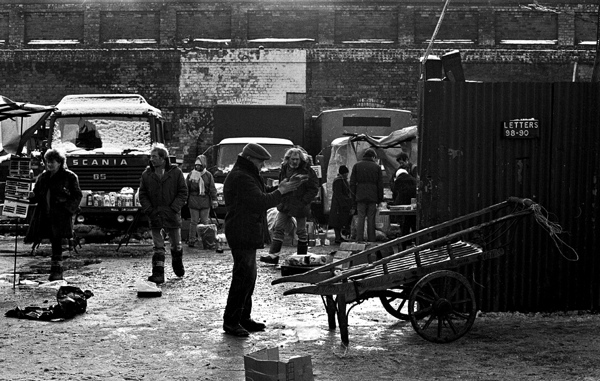
On Sclater St


In Cheshire St.



Photographs copyright © Colin O’Brien
More photographs by Colin O’Brien
Travellers’ Children in London Fields
You may also like to take a look at
Leo Epstein, Epra Fabrics

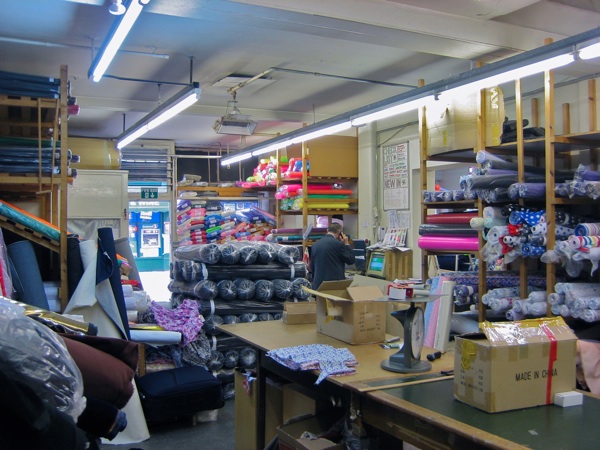
When the genial Leo Epstein, proprietor of Epra Fabrics says, “I am the last Jewish trader on Brick Lane,” he says it with such a modest balanced tone that you know he is just stating a fact and not venturing a comment. “If you’re not a tolerant sort of person you wouldn’t be in Brick Lane,” he adds before scooting across the road to ask his neighbour at the Islamic shop to turn down the Friday prayer just a little. “I told him he can have it as loud as he wants after one o’clock when I’ve gone home.” he explains cheerily on his return – now we can hear ourselves think. “We all get on very well,” he confirms,“As one of my Bengali neighbours said to me, ‘On Brick Lane, we do business not politics.'”
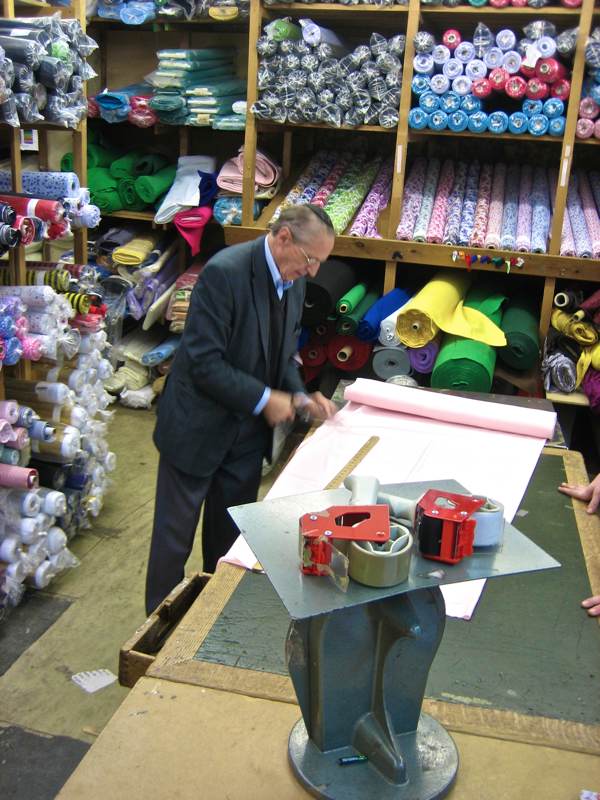
While his son Daniel was in Israel organising Leo’s grandson’s wedding, Leo was running the shop single-handedly, yet he managed – with the ease and grace of his fifty-five years experience – to maintain the following monologue whilst serving a string of customers, cutting bolts of fabric, answering the endless phone calls and arranging a taxi to collect an order of ten rolls of velvet.
“I started in 1956, when I got married. I used to work for a company of fabric wholesalers and one of our customers on Brick Lane said, “There’s a shop to let on the corner, why don’t you take it?” The rent was £6.50 a week and I used to lie awake at night thinking, “Where am I going to find it?” You could live on £10 a week then. My partner was Rajchman and initially we couldn’t decide which name should come first, combining the first two letters of our names, but then we realised that “Raep” Fabrics was not a good trade name and so we became “Epra” Fabrics.
In no time, we expanded and moved to this place where we are today. In those days, it was the thing to go into, the fabric trade – the City was a closed shop to Jewish people. My father thought that anything to do with rebuilding would be a good trade for me after the war and so I studied Structural Engineering but all the other students were rich children of developers. They drove around in new cars while I was the poor student who could barely afford my bus fare. So I said to my father, “I’m not going to do this.” And the openings were in the shmutter trade, I didn’t ever see myself working in an office. And I’ve always been happy, I like the business. I like the social part.
In just a few years, the first Indians came to the area, it’s always been a changing neighbourhood.The first to come were the Sikhs in their turbans, and each group that came brought their trades with them. The Sikhs were the first to print electronic circuits and they had contacts in the Far East, they brought the first calculators. And then came the Pakistanis, the brought the leather trade with them. And the Bengalis came and they were much poorer than the others. They came on their own, as single men, at first. The head of the family, the father would come to earn the money to send for the rest of the family. And since they didn’t have women with them, they opened up canteens to feed themselves and then it became trendy for City gents to come and eat curry here and that was the origin of the curry restaurants that fill Brick Lane today.
Slowly all the Jewish people moved away and all their businesses closed down. Twenty years ago, Brick Lane was a run down inner city area, people didn’t feel safe – and it still has that image even though it’s a perfectly safe place to be. I’ve always like it here.”
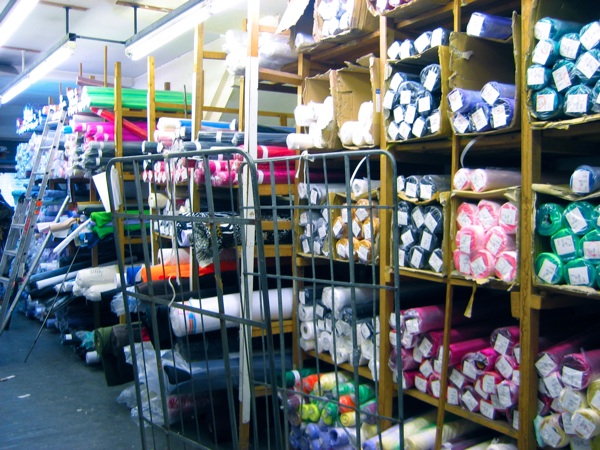
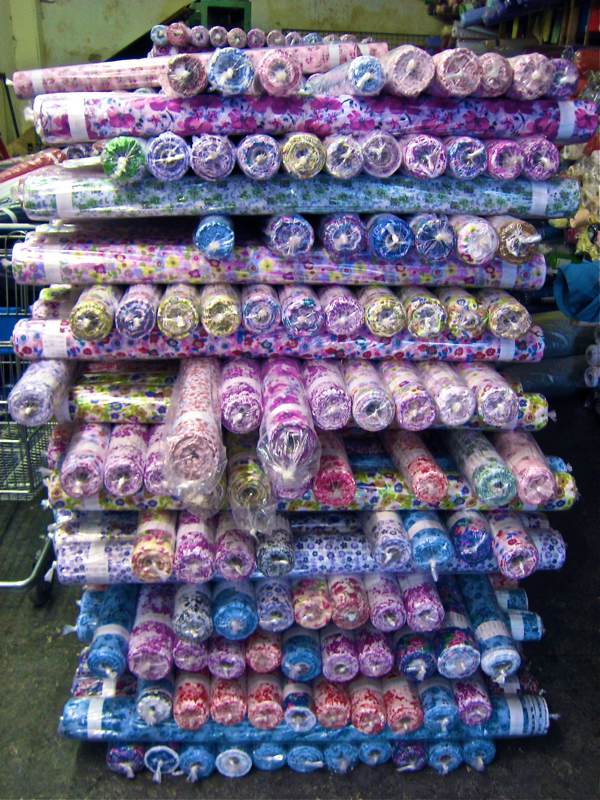
At any time over the last half a century, you could have walked up Fashion St, crossed Brick Lane and entered Epra Fabrics where you would have been greeted by Leo, saying “Good morning! May I help you?‘ with respect and civility, just as he does today. After all these years, it is no exaggeration when he says, “Everyone knows me as Leo.” A tall yet slight man, always formally dressed with a kippa, he hovers at the cash desk, standing sentinel with a view through the door and West along Fashion St to the towers of the City. Here you will find an unrivalled selection of silks and satins. “This is Brick Lane not Park Lane,” is one of Leo’s favourite sayings, indicating that nothing costs more than a couple of pounds a metre. “We only like to take care of the ladies,” is another, indicating the nature of the stock, which is strong in dress fabrics.
“I lived through the war here, so the attack wasn’t really that big a deal,” he says with a shrug, commenting on the Brick Lane nail bomb of 1999 laid by racist David Copeland, which blew out the front of his shop, “Luckily nobody was seriously hurt because on a Saturday everything is closed round here, it’s a tradition going back to when it was a Jewish area, where everything would close for the Sabbath.”
“Many of the Asian shop owners come in from time to time and say,‘Oh good, you’re still here! Why don’t you come and have a meal on us?‘ You can’t exist if you don’t get on with everybody else. It was, in a way, a weirdly pleasant time to see how everyone pulled together.” he concludes dryly, revealing how shared experiences brought him solidarity with his neighbours. Leo Epstein is the last working representative of the time when Brick Lane and Wentworth St was a Jewish ghetto and the heart of the shmutter trade, but he also exemplifies the best of the egalitarian spirit that exists in Brick Lane today, defining it as a place where different peoples co-exist peacefully.

The Redchurch St Rake’s Progress

Like it or not, Redchurch St has become the street in London that is the focus of all that is fashionable and happening, just as Carnaby St and the Kings Rd were in the sixties. When artist Adam Dant first came to Redchurch St in the nineteen nineties he remembers it as mostly printers, button makers and other light-industry, but now it is the white-hot hangout for those who are young and have money to throw around in the bars and boutiques. Inspired by this unlikely and sudden transformation from utilitarian to hedonistic, Adam Dant chose the crossroads where Redchurch St meets Club Row as the terrain for his panorama of “British Drinking” in the manner of Pieter Breughel’s social landscapes – only rather than Flemish proverbs, Adam Dant has illustrated English figures of speech for drunkenness to create an sprawling epic of bacchanalia. (You can click on this and the other plates here to enlarge and study them in detail.)
Something extraordinary happens when so much cultural attention is paid to a single street, it becomes a theatre where people need to perform, carrying an invisible sign above their heads that says “Look at me, I’m on Redchurch St.” A phenomenon that you can witness any day of the week, simply by walking along Redchurch St and observing all the people trying very hard to be unselfconscious. The recent music video for R.E.M. shot by Sam Taylor-Wood and featuring her fiancée Aaron Johnson dancing down Redchurch St, manifests the apogee of this bizarre circumstance – and which also, by an extraordinary fluke of chance, features Adam Dant – who is a resident of Redchurch St – in a fleeting appearance walking his dog Edwin in the background.
As the definitive chronicler of the social change that has come upon this corner of Shoreditch, Adam Dant created a “Redchurch St Rake’s Progress” in the manner of William Hogarth – in which a Rake inherits and loses a fortune upon a single block on Redchurch St. Setting each of the eight intricate tableaux outside buildings on the South side of the street, the series follows the fortunes of the Rake from flourishing his credit card on the corner of Club Row to ending up naked in the gutter at the corner of Chance St. If you have visited Redchurch St on one of the “First Thursdays” recently, when all the galleries have openings and give away free beers, and everyone wanders up and down, enjoying the party, you may recognise the scenes of revelry and rumpus illustrated here.

The young Rake takes possession of his wealth at the corner of Club Row and Redchurch St.

The Levee – the Rake surrounded by artists and hangers-on outside Lounge Lover.

The Rake enjoys an orgy on the pavement outside Watson Bros gunmakers.

The Young Rake is arrested for debt – confronted with his tab outside Museum 52.

The Marriage – outside “The Gallery in Redchurch St.”

The Gaming House – The Rake loses his fortune outside forty-eight Redchurch St.

In the Debtor’s Prison – The Rake and his possessions are thrown into the street outside the Outside World Gallery.

The Madhouse – Final depravity, the Rake is abandoned at the corner of Redchurch St & Chance St.
Pictures copyright © Adam Dant
Just as Hogarth featured his pug in the Rake’s Progress, Adam Dant’s dog Edwin can be seen in the right hand corner of the picture above. Can you spot Adam and his dog in the background of the Sam Taylor-Wood music video for R.E.M. featuring Aaron Johnson dancing down Redchurch St? Click here to watch it and here to watch a parody.
The original drawings of Adam Dant’s “Redchurch St Rake’s Progress” will be on display for Spitalfields Life readers from today and over this weekend at Hales Gallery in the Tea Building in the Bethnal Green Rd – just ask to see them.
You may also like to take a look at
Adam Dant’s Map of the History of Clerkenwell
or his Map of the History of Shoreditch,
or his Map of Shoreditch in the Year 3000,
or his Map of Shoreditch as New York,
or his Map of Shoreditch as the Globe,
or his Map of Shoreditch in Dreams.
And these other Redchurch St stories
The Labour & Wait Brush Museum
King Sour DA MC, Rapper of Bethnal Green
At the Fish Plaice
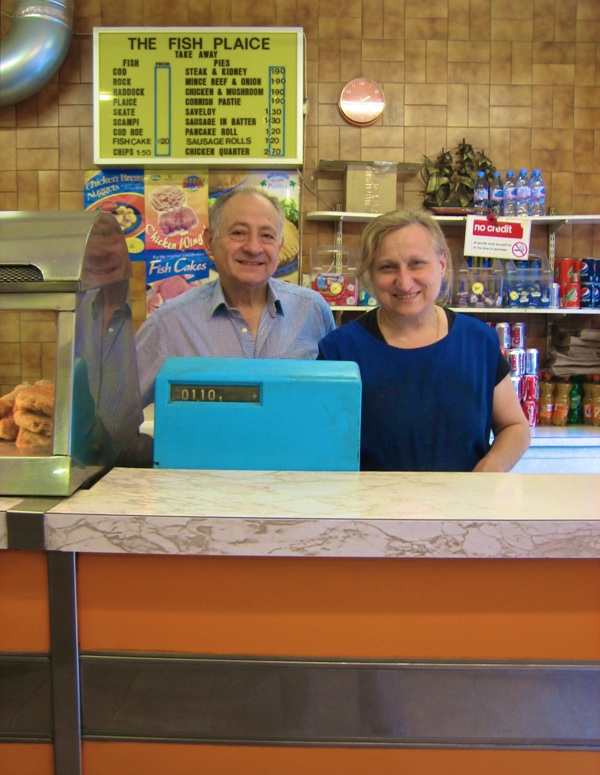
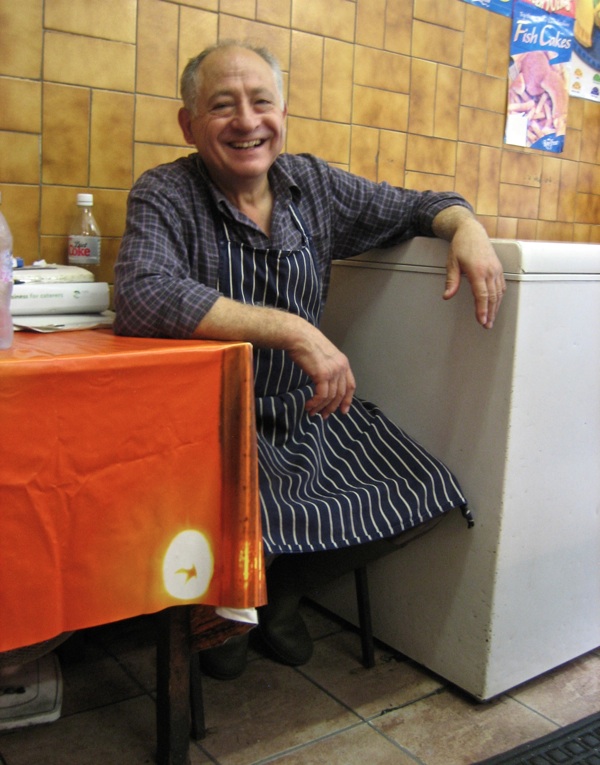
Around three is a good time to visit the Fish Plaice in the Cambridge Heath Rd, between Whitechapel and Bethnal Green. By then the lunchtime rush is over and you have the chance of a leisurely chat with Andy & Nitsa, the couple who have run this place together since 1974 – as I did yesterday, when I took the opportunity to slip behind the counter and see life from the other side of the fish fryer. I discovered it was an ideal place to spend an afternoon on an occluded June day, watching the passersby with their noses set towards Whitechapel and greeting regulars who were seeking consolation in fish cakes and saveloys for a Summer that is not quite working out as it should.
Over the years, all manner of private jokes and rituals have evolved here. “The police want to speak with you, Andy,” called Nitsa casually through the curtain of plastic ribbons when I arrived, as she had done countless times before. And then Andy came out and introduced himself with an eager smile, “I’m Andy, everyone knows me as Andy, my dad was Andy,” – just in case there was any confusion. And when Beryl, a regular customer of thirty-eight years standing, arrived with the greeting, “Got a fish cake?” and asking “Are the chips fresh?”, Andy turned aside with a twinkle in his eye and adopted a loud stage whisper, saying,“Give her the old ones, Nitsa! – which filled Beryl with speechless delight.
Be informed, this is not a fancy fish & chip shop. The decor has not been updated since they opened nearly forty years ago, yet this only adds to the appeal – because it is immaculately clean and cared for, which makes it a place where everyone feels welcome. “Look at this!” exclaimed Andy, taking his bare hand, and – inexplicably – reaching under the fish frier, before – alarmingly – rubbing it upon the floor and then – in a theatrical coup – holding it up jubilantly to reveal an entirely clean hand.
Andy knows as much about fish & chips as it is possible to know, because fish & chips are his culture and his life.“My father had a fish & chip shop in Salmon Lane and we lived over the shop.” he explained, “All the family were in fish & chips, my uncles all had shops. I used to clean potatoes first thing in the morning and help out again after school.”
“Sometimes, I used to get up at four and go with my dad to Smithfield Market to get chickens.” he continued fondly, “Then he’d take me down to Billingsgate Fish Market in the City where we’d meet all his brothers and uncles buying fish, and afterwards he’d take me for a good breakfast in a workmen’s cafe and we’d be back by seven in the morning.”
Yet before he opened up this shop with his wife Nitsa, Andy tried other careers. He trained in motor engineering, and became ladies hairdresser in Whitechapel, off Commercial St – “It was all slums down there in those days.” Next he became a driving instructor and worked at Plessey in electronics too. “You do some crazy stuff when you are young!” he informed me, in authoritative verdict upon these trivial early diversions before he settled down to a lifetime of fish & chips.
“All my family are in restaurants, but I had no clue about fish & chip shops until I met, Andy,” admitted Nitsa with a flirtatious laugh,“By now, we are a good team. When we come in the morning, we know exactly what to do and we do it in no time.”
“I do all the heavy stuff, filleting fish, mixing the batter and chipping, while Nitsa prepares the fryer,” added Andy, “She’s as quick as two people serving, three of my cousins came down to help out once and they couldn’t keep up with her.”
As will be self-evident by now, Andy & Nitsa have very high standards, priding themselves on the superlative quality of their fish & chips which are keenly priced. Nitsa fried me a piece of cod in batter with chips, and it was creamy with a good chewy batter. As I sat in the corner enjoying my late lunch, Andy explained The Fish Plaice is the closest fish & chip shop to the site of London’s first ever fish & chip shop, that opened in Cleveland Way – just round the corner – where Russian Jewish immigrants had the idea to serve both fried fish and chips together from the same shop in the nineteenth century.
“We like it,” admitted Andy, turning contemplative and catching Nitsa’s eye for a shared smile while I concentrated on my lunch, “We’ve been doing it so many years. We love it when when people come back, because it means they appreciated what they had.” All three of us sat together, enjoying the quiet of the afternoon in the empty shop and watching the ceaseless parade outside moving back and forth between Whitechapel and Bethnal Green.
“It’s a nice trade, fish and chips.” conceded Nitsa with a soulful smile, sitting with her arms crossed, casting her blue eyes around the shop where they spent the last thirty-eight years and almost speaking to herself, “We are happy here. The people are very nice and most of the customers are our friends. You always ask after everybody’s families.”
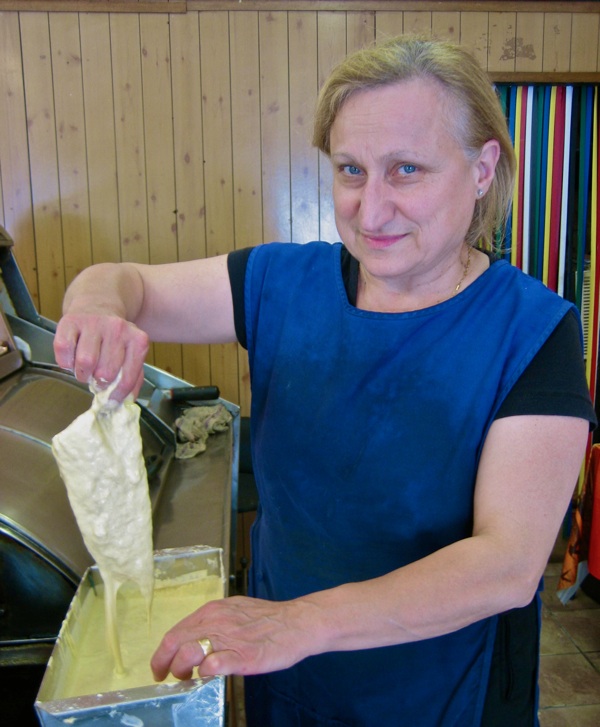
Nitsa fries me a piece of fish in batter.
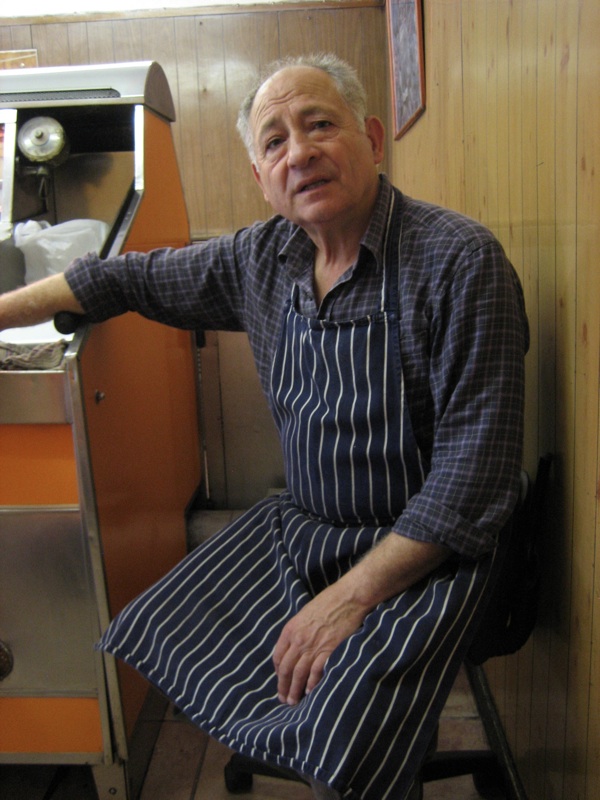
Andy – “All my family were in fish & chips”
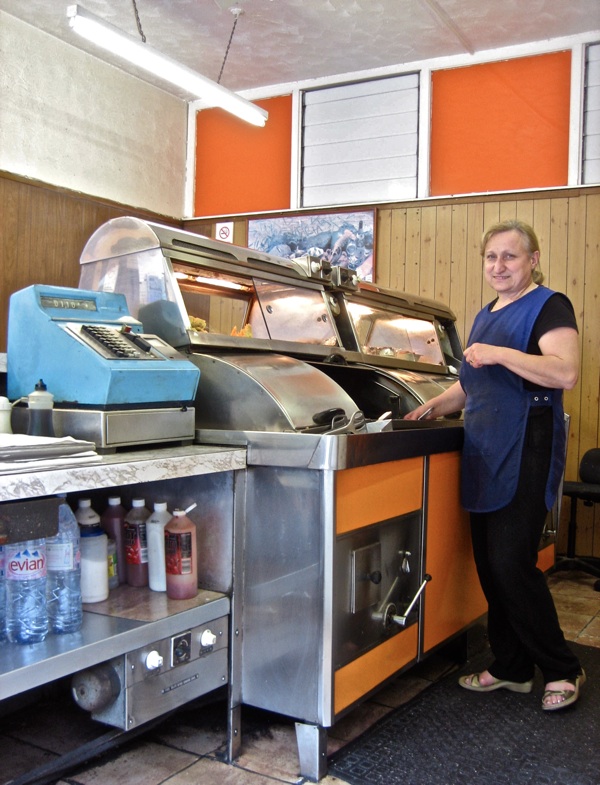
Nitsa, widely known amongst the customers as “Aunty” and “Mammy.”

The Fish Plaice, 86 Cambridge Heath Rd.