
John Moyr Smith’s Tiles 3
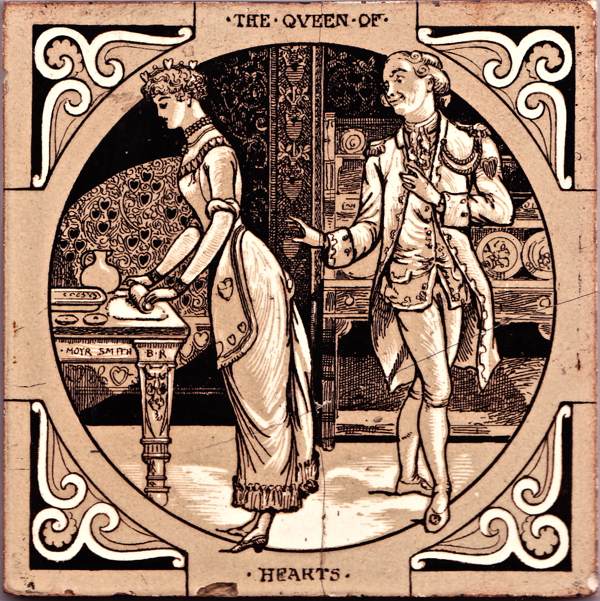
Now I have gathered thirty-seven of the forty-five tiles I shall need to line my fireplace for next Winter, it is time again to show you my latest acquisitions. A current favourite is this curious broken nursery rhyme tile that possesses an unlikely saucy humour, as the Knave reaches out to grab not the Queen’s tarts but that part of her anatomy which almost rhymes with “tarts.” It is closer in spirit to the work of seaside postcard artist Donald McGill than to the innocuous children’s illustrations of Kate Greenaway which you might expect in a Victorian nursery.
Six months ago, I was asked if I had been standing next to a bonfire recently and I realised that all my clothes reeked of wood smoke – on account of the drafty old chimney in my house where I burn wooden pallets from the market in Wintertime. At that moment, I vowed to have an iron stove installed by next Winter and to tile my fireplace in preparation. And these circumstances became the pretext for assembling a serendipitous collection of the work of the prolific nineteenth century Scottish ceramic artist John Moyr Smith, and since my budget is very limited and my house is very old, it suits me very well to buy broken and damaged tiles that other collectors do not want.
John Moyr Smith created many series of tiles illustrating familiar narratives and some quite unfamiliar too – produced cheaply by Minton – and it appeals to me to mix them all up to create a fireplace which is an eclectic compendium of stories, that I may contemplate by the light of the flames each Winter. In fact, the cracks and the chips only add to the appeal for me, providing another level of storytelling – that of the histories of the tiles themselves.
Two of the tiles that I bought for less than five pounds each – since no-one else wanted them because they were stained and cracked – came from the shipwreck of the Simla that left the London docks bound for Sydney and sank after a collision off the Needles in January 1884. These tiles sat at the bottom of the English Channel for over a century until rescued quite recently, which endows them with extra charisma in my eyes – what an extraordinary journey they have come upon to rest in my fireplace, circling back to Spitalfields, just a mile from the London Docks where they set out. In fact, since the Minton factory is in the North of England, it is possible that they passed through already, travelling down Commercial St to get to the docks in 1884.
The most stained tile from the wreck has an image of Hagar & Ishmael in the desert, a biblical story that was entirely new to me. Hagar was an ex-slave who became Abraham’s second wife, before he sent her off into the desert with her son Ishmael and a jar of water. When the jar ran out, they called to God for help who sent them a supply of water and told them they would found a new race of people, the Egyptians. This tile is an image of abandonment that was itself abandoned.
I have come to appreciate the designs of John Moyr Smith for his sense of drama, created by the subtle tension he can place between two figures in a composition, and it fascinates me that he always portrays the instant when events turn, often the moment of jeopardy. And I have deliberately sought out some that mean a lot to me, such as when Hamlet sees his father’s ghost, or Romeo climbs up to embrace Juliet – alongside tiles portraying favourite characters such as Boudicea and Simple Simon.
In another age, Moyr Smith would have been a natural designer of film posters with his ability to encapsulate an entire drama in a single image. His lively vision of the world, as a place thick with stories and rife with drama, is one that I find especially appealing. As I walk through the streets, I cannot avoid interpreting all the interactions of people that I see. This is one of the reasons why the city fascinates me so – it constantly engages my attention and imagination with myriad characters and stories that I can never entirely know.
And so it is with with these tiles, they compose a universe of stories as a constant reminder – should I ever get weary and forget, slumped before my stove – of the rich potential of this life that surrounds me.
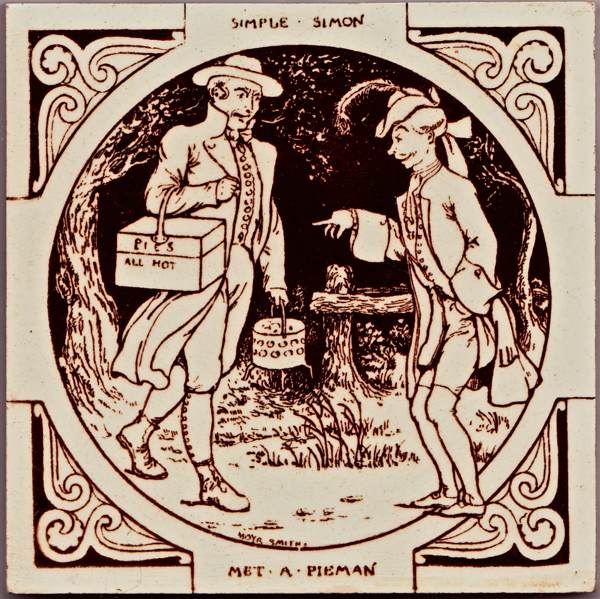
Simple Simon met a Pieman. I like the attenuated style with which Simple Simon is rendered – reminiscent of Dr Seuss.
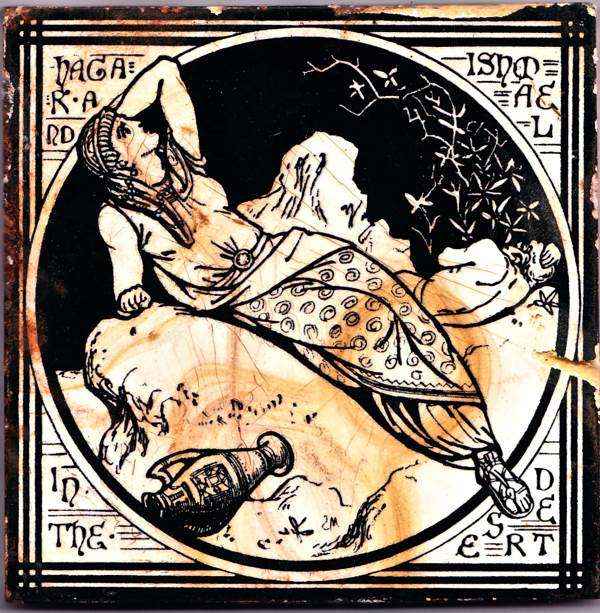
The biblical story of Hagar & Ishmael in the desert – this tile sat at the bottom of the English Channel from 1884 until recently.
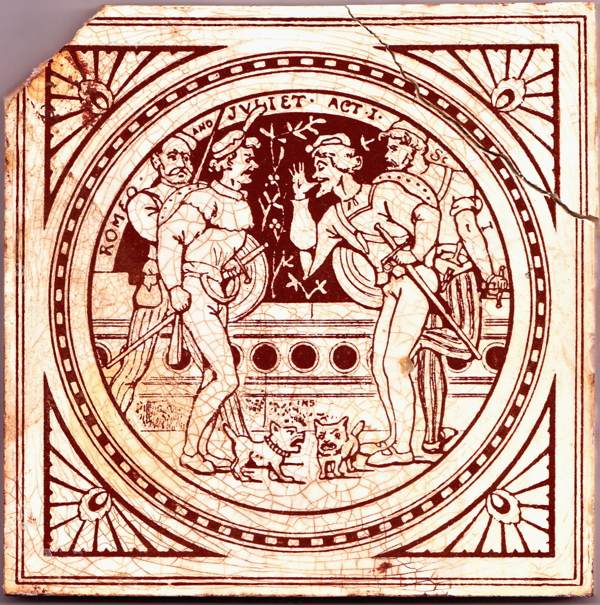
Romeo & Juliet, Act One. Abraham & Sampson “Do you bite your thumb at us, sir?” Another tile from the Simla that sank in 1884.
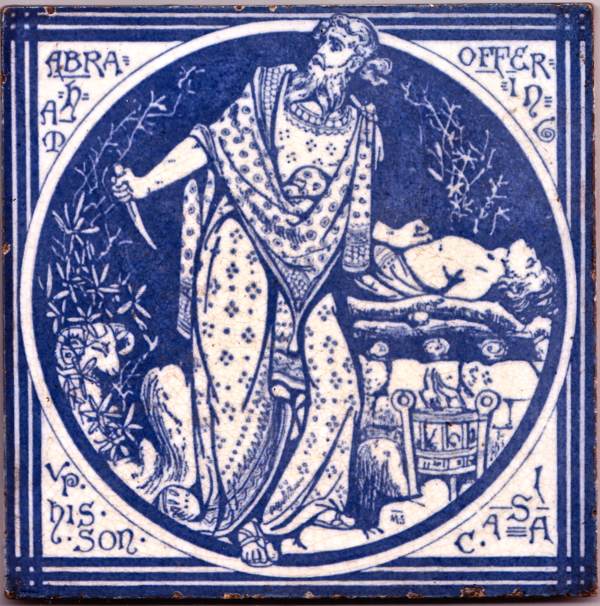
Abraham offering up his son Isaac – the moment before the angel appears to stop Abraham and he sees the ram trapped in the thorn bush.
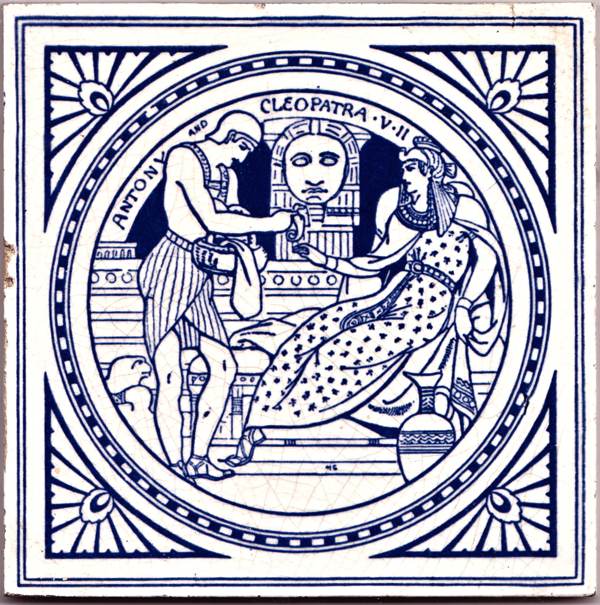
Antony & Cleopatra. Act Five, Scene Two. Cleopatra & the Clown “Hast thou that pretty worm of Nilus there that kills and pains not?”
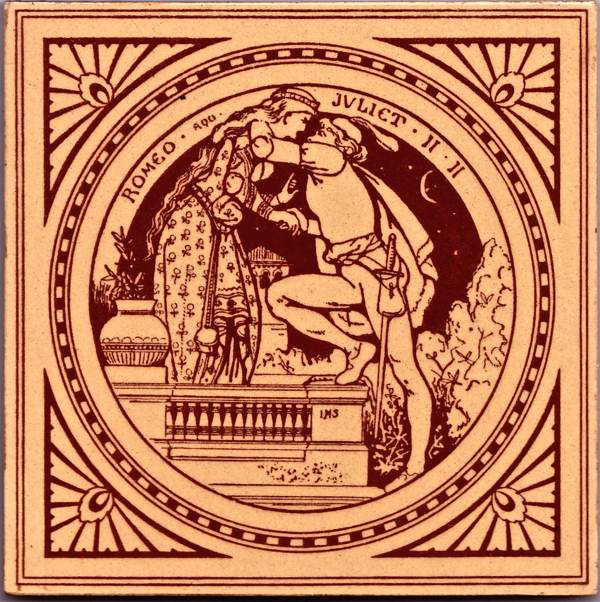
Romeo & Juliet. Act Two, Scene Two – the balcony scene.
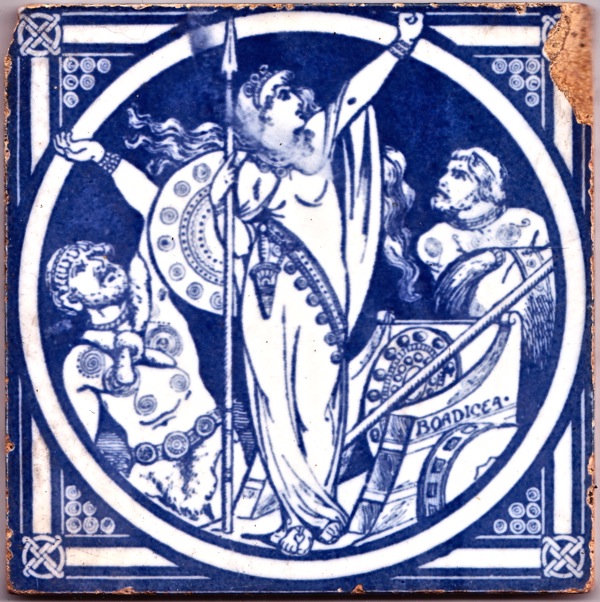
Boadicea leads the Ancient Britons against the Roman Invaders.
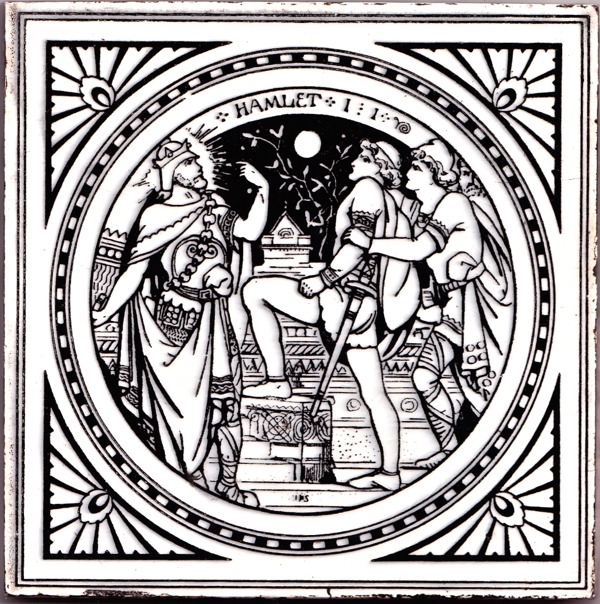
Hamlet encounters his father’s ghost upon the battlements at Elsinore.
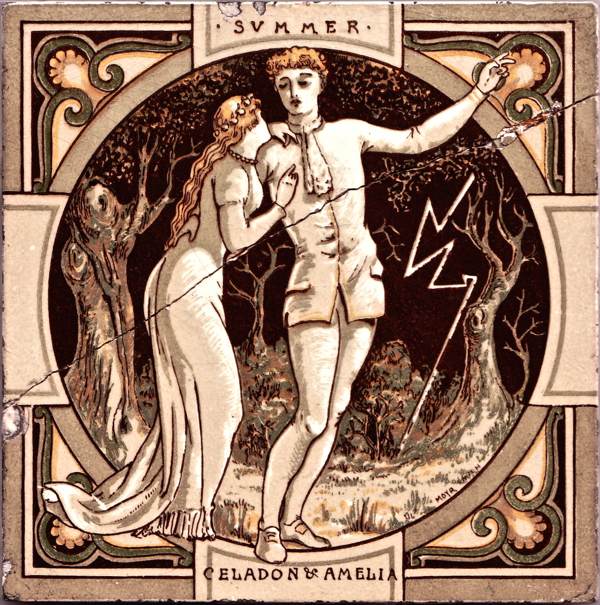
Taken from James Thomson’s poem “The Season”s (1724), this tile shows the moment before the matchless pair of lovers Celadon & Amelia were struck dead by lightning while seeking shelter from a Summer storm in Wales. ” ‘Tis safety to be near thee sure, and thus to clasp perfection!’ From his void embrace, Mysterious Heaven! that moment to the ground, a blackened corse, was struck the beauteous maid.”
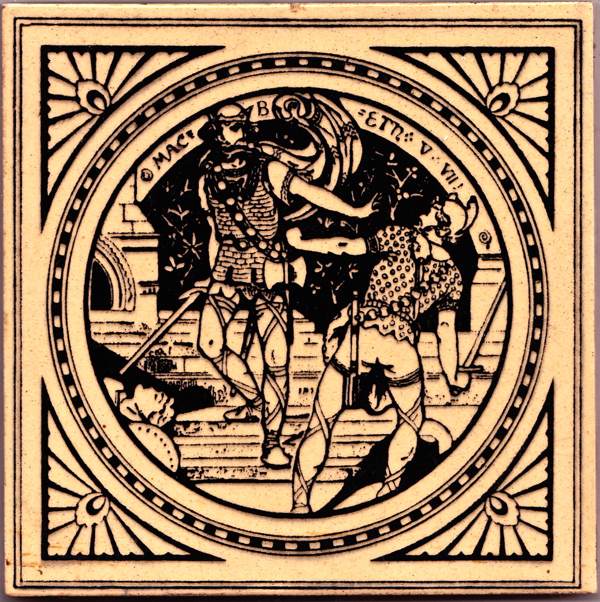
Macbeth. Act Five, Scene Seven. Macbeth confronts Young Siward who was “not of woman born,” fulfilling the witches’ prophecy.

The Dyer, from the artisans series.
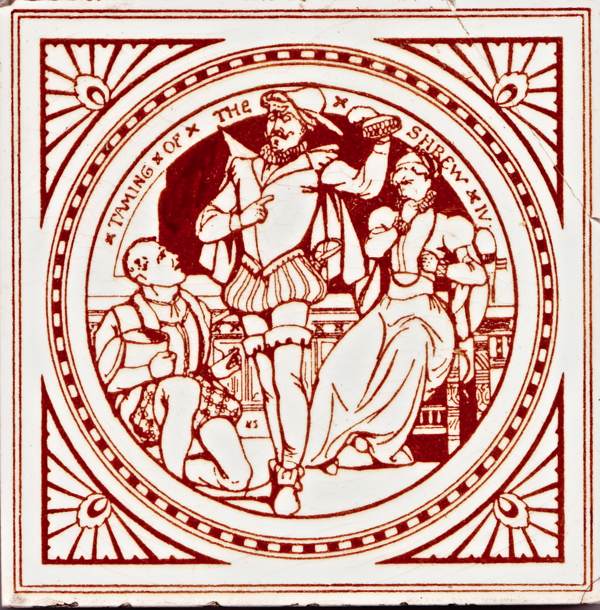
The Taming of the Shrew. Act Four, Scene Three. Petrucio & Katherine “Well, come, my Kate, we will unto your father’s.”
You may also like to read about
Favourite Pie & Mash Shops (Part Two)

At F.Cooke in Hoxton
Already, months have passed since Spitalfields Life contributing photographer Sarah Ainslie and I enjoyed the first instalment of our crawl around all the Pie & Mash Shops in the East End, indulging ourselves recklessly in their irresistible mouth-watering hot meals. And so, with renewed appetite we set out again, led by an inescapable craving for a some good meaty pies and, I am relieved to report, we were not disappointed in our quest.
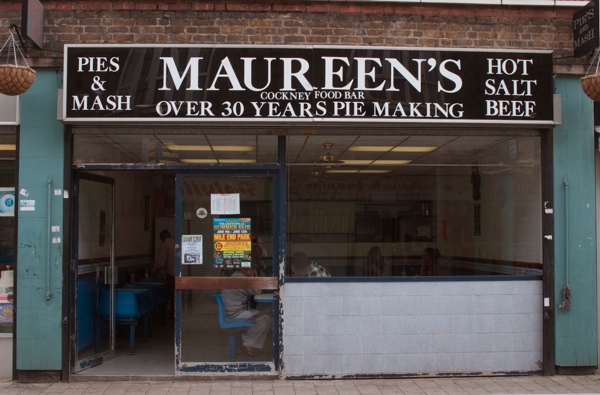
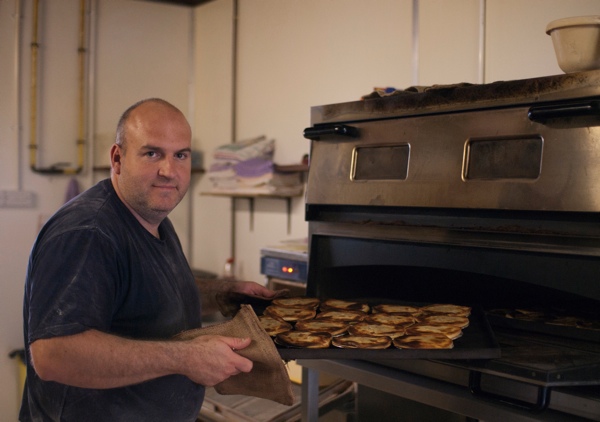
As before, we commenced in the East and worked our way across the territory, starting our journey at Maureen’s Cockney Food Bar in the lively Chrisp St Market – boasting over thirty years of pie making and recently voted as the East End’s number one hidden gem by users of the Docklands Light Railway. Since Maureen retired years ago, the credit goes to her son Jason who bakes the pies and his wife Karen who keeps everything running smoothly. Yet even Karen was a little flushed by current events, which had resulted in a stream of photographers and televisions crews over successive days, and Sandra’s Bullock’s sister – a food journalist and pastry chef – who came in a limousine to savour the pies at Maureen’s.
I was immediately endeared to this friendly and supremely unpretentious establishment that has triumphed on nothing less than the superlative quality of its pies. No wonder trucks arrive from Liverpool and Newcastle before dawn each morning to carry away fresh deliveries to the North of England, and pies are shipped internationally to Spain, Italy and South Africa where ex-patriot East Enders rely upon regular supplies from Maureen’s to ameliorate their homesickness.
The shop is shut on Monday because that is when Jason goes at three in the morning to buy his beef in person at Smithfield Market and then spends all day mincing it by hand. Only he and Maureen know the secret pastry recipe in use for over half century, Karen informed me, raising her eyebrows for effect. And if you are planning a party, be aware that they supply pies in bakers’ dozens – thirteen for the price of twelve – and you get free liquor (as the delicious parsley sauce is known) if you bring your own jug. Ideal for weddings, Karen emphasised. Maureen’s Cockney Food Bar is the East End’s next hot food destination, so you had better go before toffs from Islington find their way across to Milwall or Sandra Bullock’s sister returns with Sandra Bullock.
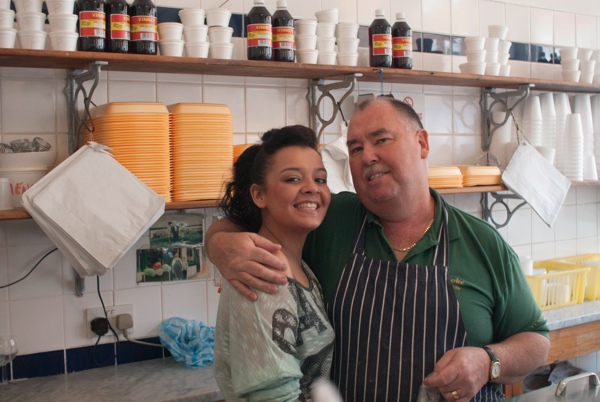
Over in Hoxton, F.Cooke was also alight with the glow of popular appreciation, including a recent visit from David Beckham. Yet Joseph Cooke (whose grandfather opened the other shop in Broadway Market in 1902 now run by his brother Bob) takes it in his stride in the way that only those who enjoy universal popularity can do so. “No additives or artificial flavourings, we only sell top quality gear,” he assured me with a swagger, “The most authentic meal in the East End – the most traditional meal you could have.” And he spread his arms in a happy flourish of satisfaction, accompanied by an angelic smile upon his blithe, round, baby face – before he let it all crumple, rolling his eyes in comic despair, lamenting, “It’s an awful lot of work.”
While the regular diners ate their pies contentedly in near silence, seated at marble tables within the airy space of this former Barclays Penny Bank, Joseph expounded to me enthusiastically about the varieties of parsley available at different times of the year and how this effects the nature of the liquor. “We’re using Spanish parsley at the moment,” he explained, delighting in its tangy flavour and the viscous sauce it makes once it has been minced up. “You splash it on your arm and it stays like paint!” he exclaimed in wonder. Over coming months, to complement the pies made here from a recipe unchanged in four generations of piemakers, there will be fresh liquor of – successively – English, French, Spanish, Italian and Turkish parsley.
Naturally, Joseph was curious to learn how his pies in Hoxton St compared to those of his brother Bob in Broadway Market, but since they both use the same recipe and I did not wish to become the catalyst for any unfortunate sibling conflict I chose my words with care. Let it be known that I found Joseph’s pies gratifyingly meaty with a sweet gravy that was tasty and rich, and I shall be coming back here again. It says something that the floor of the dining room is thoughtfully scattered with sawdust to absorb gravy splashes caused by over-enthusiastic pie eaters. “My old grandmother ate pies every day of her life and when she died at ninety-three, she still had all her own teeth,” added Joseph in afterthought, as further advocacy – if such were needed – of the health benefits of a diet of pie and mash.
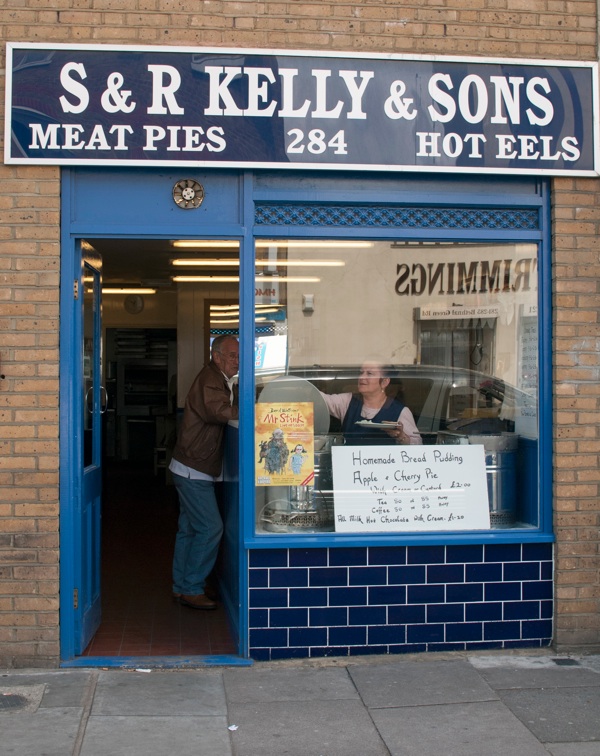
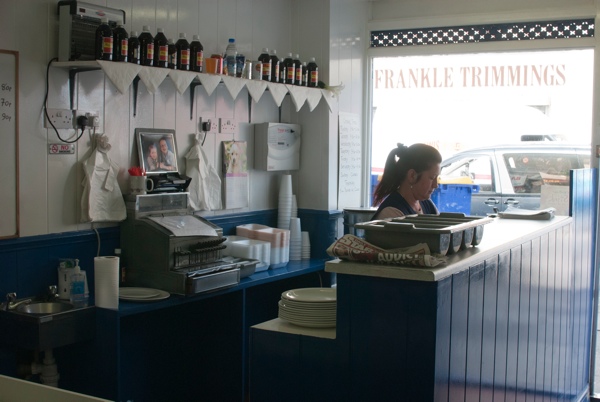
Sarah & I managed to fit in one more Pie and Mash Shop just to make our day complete, S & R Kelly & Sons in the Bethnal Green Rd. This appealingly intimate little blue and white shop with room for just a handful of diners is lined with matchboarding and tiles, and has an interior of Japanese simplicity. Here we met Jill who has worked for proprietor Robert Kelly for fifteen years, serving behind the counter. She explained that out of all the Kelly’s Pie & Mash Shops this was the original, established over one hundred years ago. “Most people seem to like this one!” she agreed when I complimented her on the shop, “They all say it’s the best one. Even people that move away, the first thing they do when they get off the plane is come here and have pie and mash.” We were very sorry to have missed Jill’s oldest regular customer, a venerable lady of a hundred and three who had died a few weeks earlier. “She had been Robert’s milk lady when he was at school and she loved eels, and he didn’t use to charge her,” admitted Jill in affectionate reminiscence.
Of all the various communal spaces in the East End – even more than pubs or churches – Pie & Mash Shops exist in the public consciousness as the most celebrated locations of emotional memory, and the explanation lies in the food. East Enders love their Pie & Mash, because by enjoying this glorious meal they can participate in the endless banquet which has been going on for generations, longer than anyone can remember, and which includes all their family, relatives and loved ones, both living and departed. The world has changed and the East End has transformed, but the Pie & Mash Shops are still here and the feast goes on.
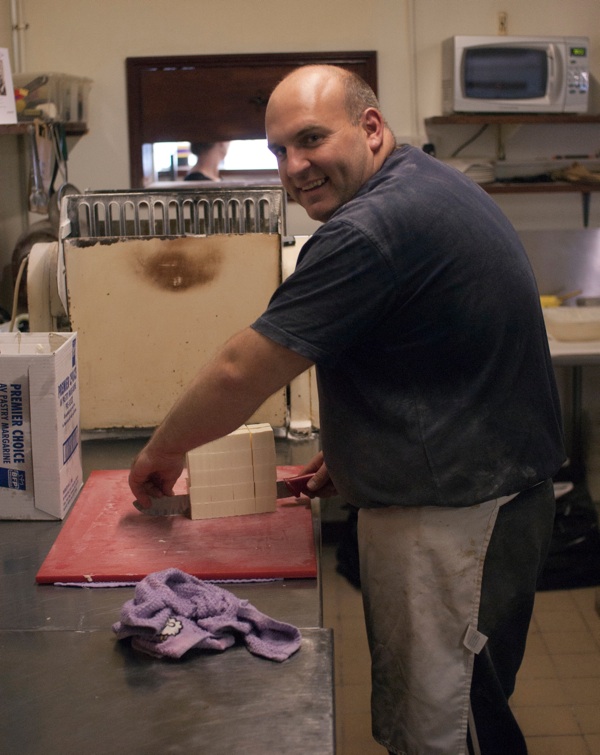
Jason Patterson dices margarine for pastry.
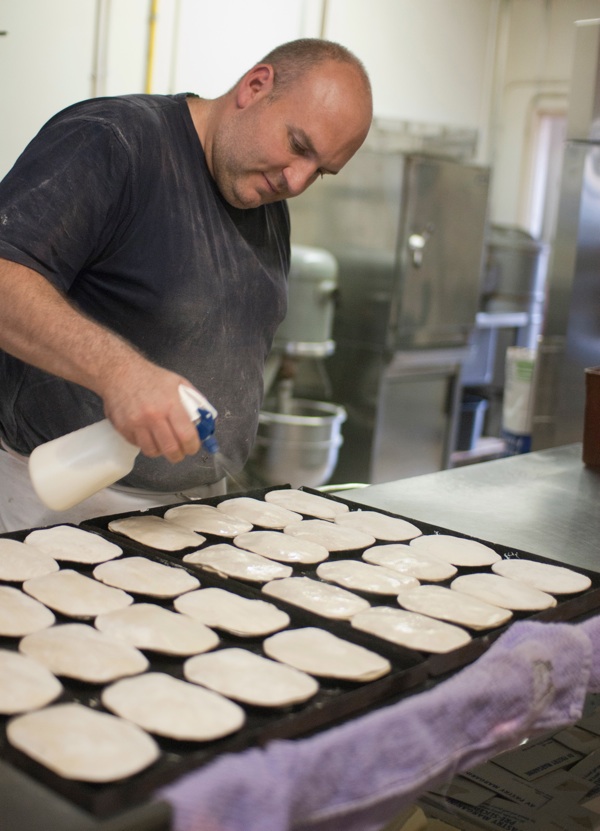
Jason sprays milk onto the pie crust.
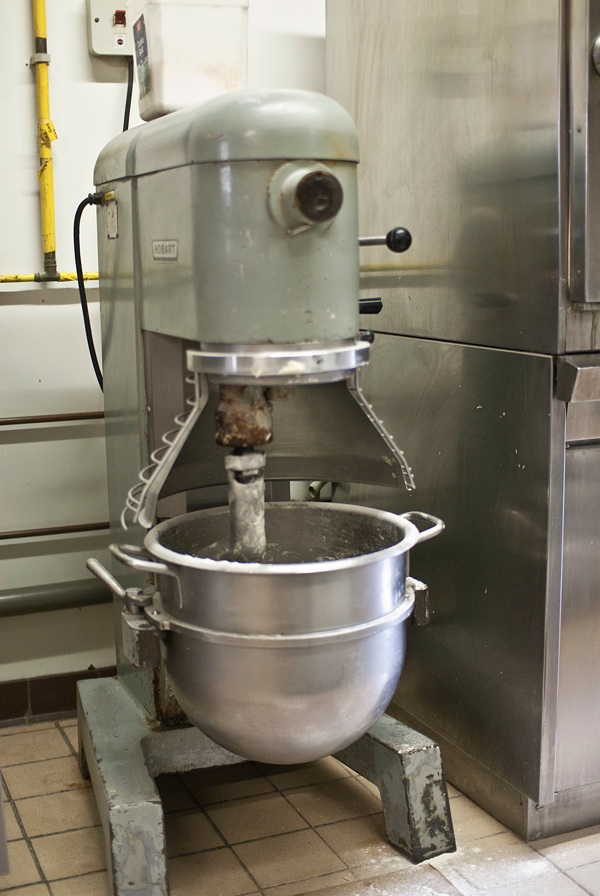
The pastry mixer.
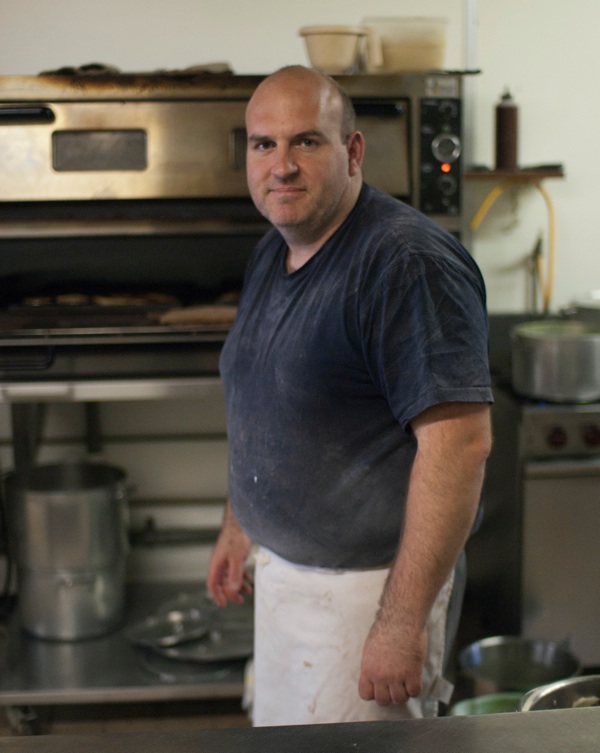
Jason has a secret pastry recipe, in use for half a century and known only to himself and Maureen.
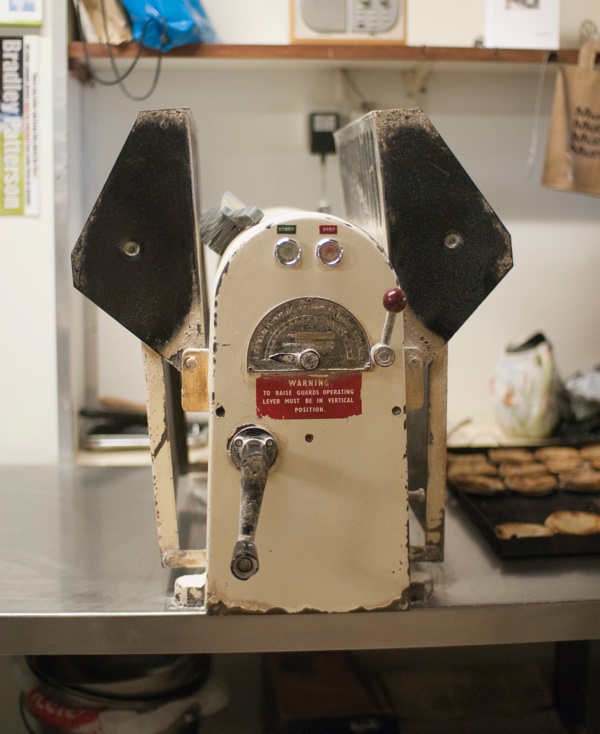
The mincer.
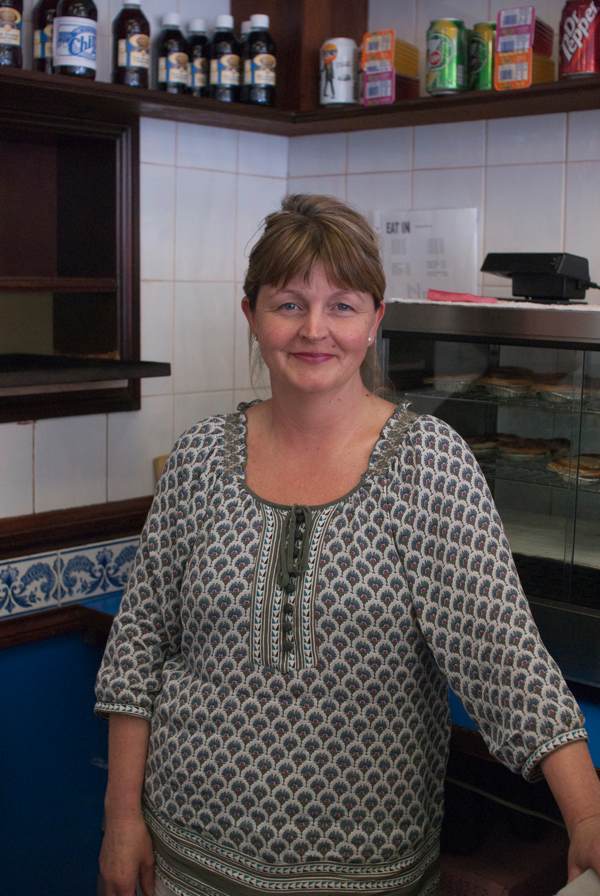
Karen Patterson, the Queen of Chrisp St Market.
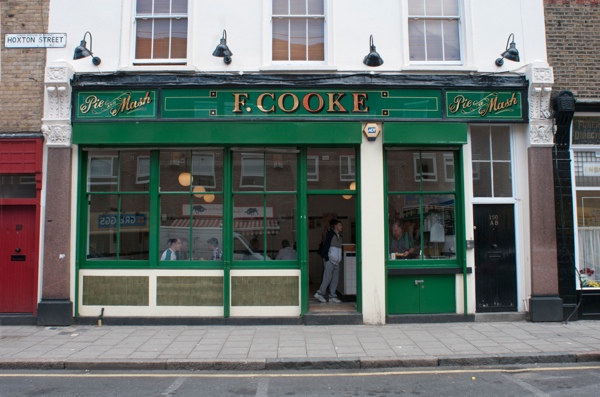
F.Cooke in Hoxton, David Beckham’s preferred Pie & Mash Shop.
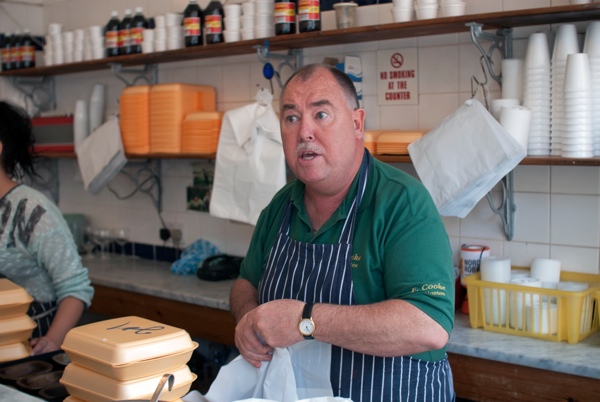
“My old grandmother ate pies every day of her life and when she died at ninety-three she still had all her own teeth.”
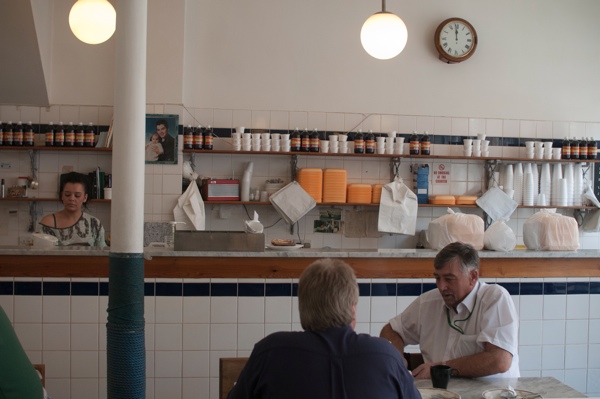
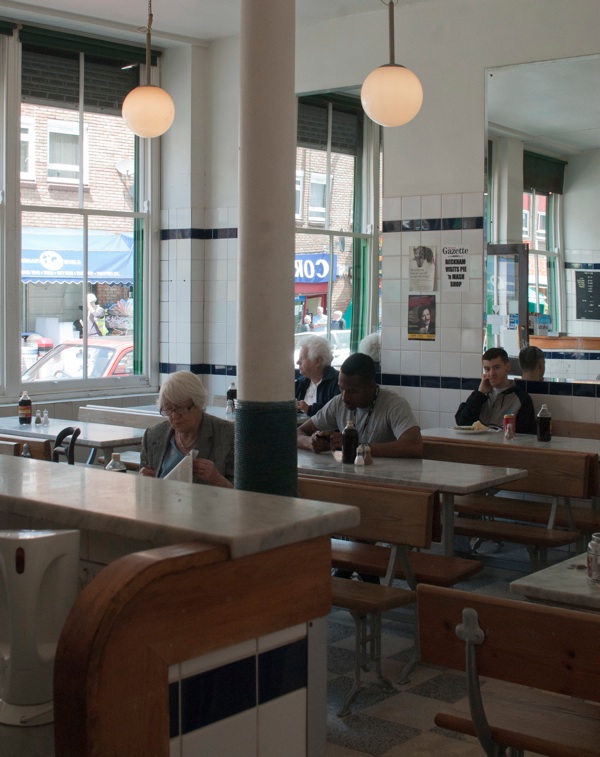
Contented diners eat pies in near silence.

Ladling the liquor made with Spanish parsley.
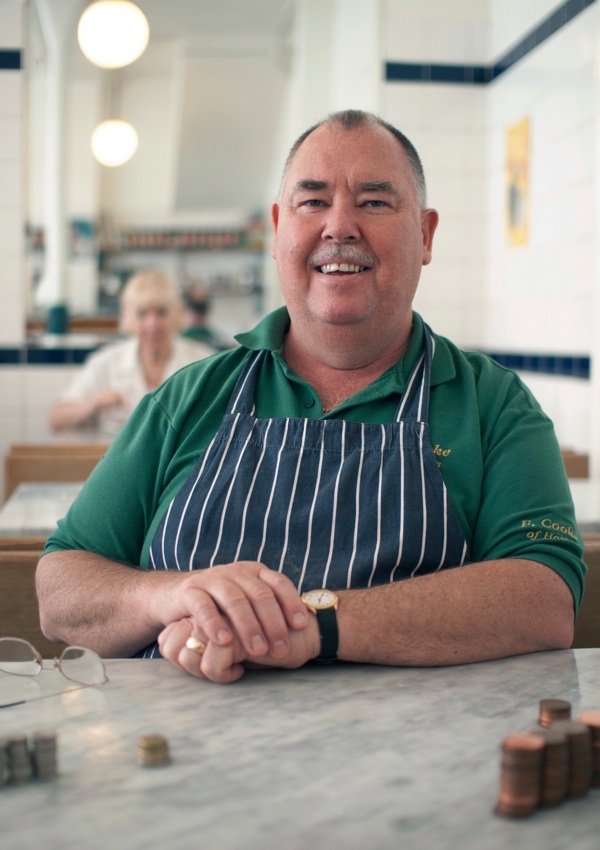
Joseph Cooke, fourth generation piemaker.
Photographs copyright © Sarah Ainslie
You may also like to read
Favourite Pie & Mash Shops (Part One)
At the Penny Farthing Race

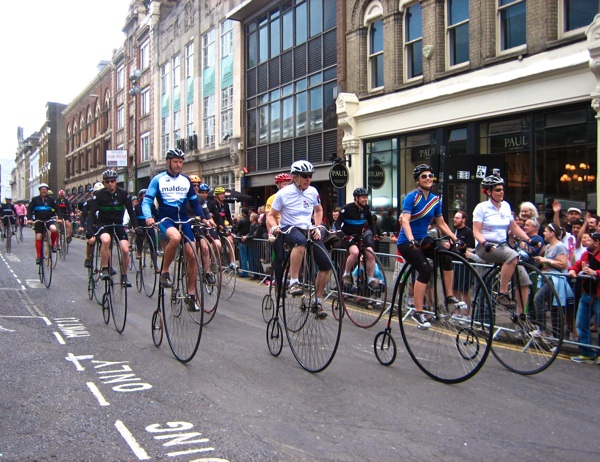
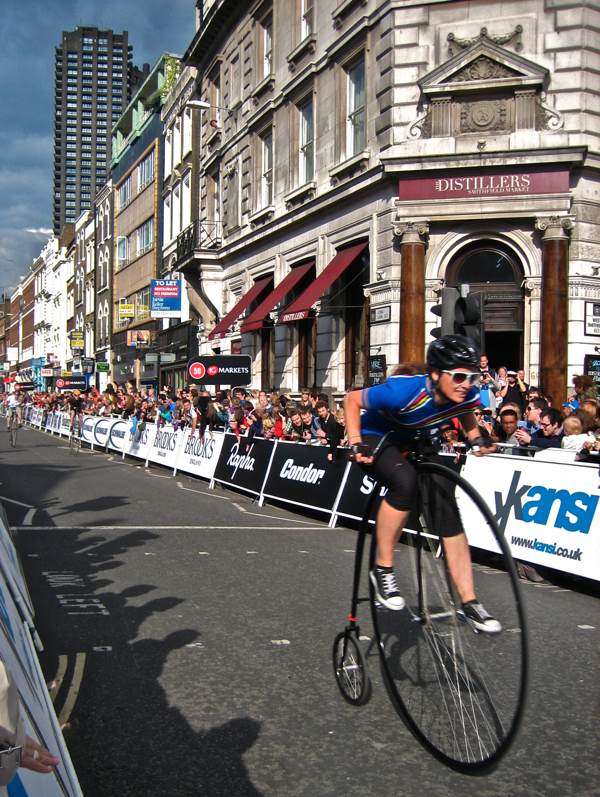
One Saturday each Summer, the grand old meat market in Smithfield transforms into a velodrome where a lively range of contests – including fierce races for professional cyclists and playful dashes for City commuters in bowler hats on folding bikes – take place before for a roaring crowd, bringing hectic life to these streets that are empty for every other weekend of the year. And this year’s big attraction was a Penny Farthing Race, the first to be held in London since the eighteen eighties when the technology of the modern bicycle rendered them obsolete. Yet, confirming that the Penny Farthing is a vehicle to be reckoned with in the twenty-first century, forty competitors converged on Smithfield from the United Kingdom, Australia, America, Spain, France, Italy, Germany and Belgium to compete, some riding venerable old bikes from the nineteenth century and others astride shiny new ones enhanced by the possibilities of modern technology.
The challenge, the drama, the sense of freedom and the possibility that bicycles originally offered are vividly present with Penny Farthings. The unlikely marriage of man and machine that cycling entails becomes obvious to all on a Penny Farthing, when it has been lost by the ubiquity of conventional cycles. Quite simply, the larger the front wheel the faster you go and the problem is not, as you might imagine, going uphill but keeping control while coming downhill at breakneck speed.
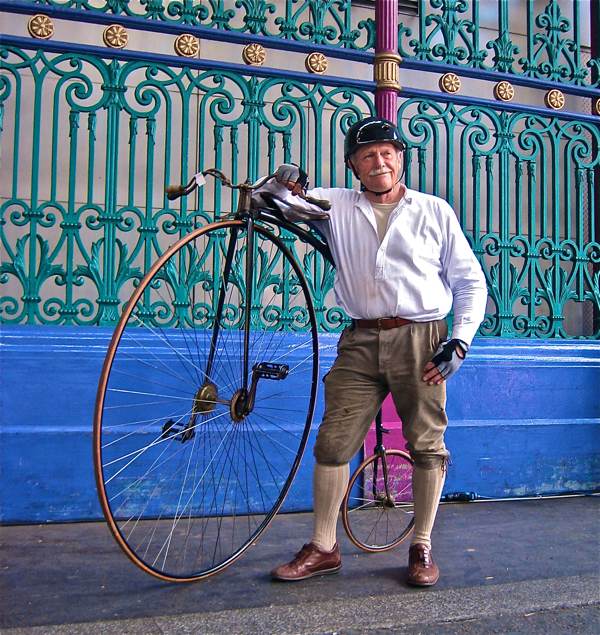
On a Penny Farthing, you are always going to stand out from the crowd and you will get to see over the hedge too, even look down on motorists. And so, the idiosyncratic delight of the Penny Farthing attracts the individualists of the cycling world, those who would rather diverge from the pack and wish to do it on a crazy contraption with one great big wheel and one little tiny one – a beast that requires agility to climb onto and superlative balance to stay in the saddle. Those who cycle “ordinaries,” as specialists refer to them, require a certain strength of character, combining fearlessness and fun, because once you are up in the saddle your feet cannot touch the ground.
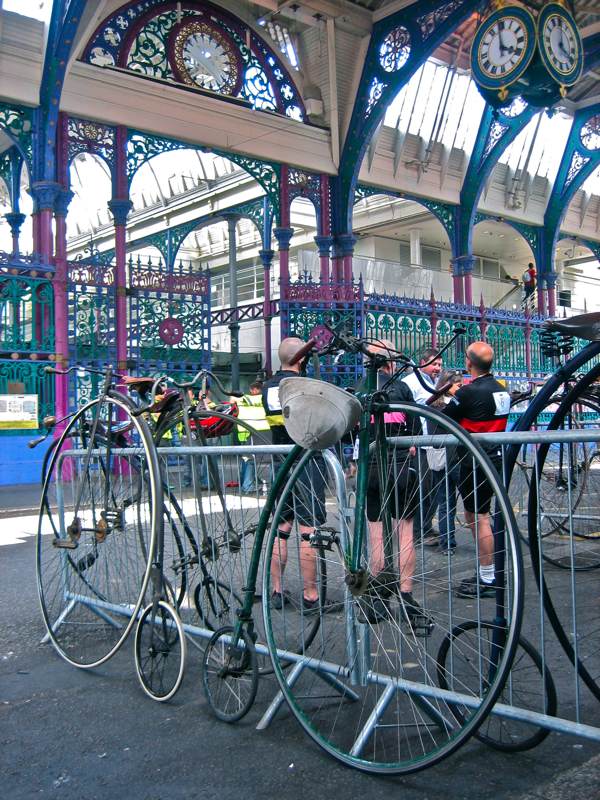
The Penny Farthings – many of which were more than a hundred years old – looked entirely at home lined up in the gloom of the market’s Grand Avenue beneath the intricate cast iron vault, where I took the opportunity to chat with some of the competitors in the half hour before the race, as they prepared to face the glare of the afternoon. “They’re fast, they’re spectacular and they excite the crowds,” enthused Phil Saunders, the succinctly spoken white-haired City gent who organised the gathering, as he stood with one hand on the saddle of his proud machine. Phil told me he has toured Japan on his Penny Farthing, and travelled abroad with it more than fifty times in the last twenty years to participate in races all over the world including Uganda, Kenya, Egypt and Jordan.
“I saw one in a museum as a child but it took me thirty years to go out and buy one for myself!” revealed Graeme Smith – who has been cycling his Penny Farthing for five years now – in wonder at his own equivocation. While Barry Denny, a veteran cyclist from Bury St Edmunds confessed to me that he bought a Penny Farthing as a dignified strategy because, “I can no longer keep up with ordinary bikes.” But the surprise of the afternoon was eager Essex boy Joff Summerfield who admitted in the midst of our conversation that he had cycled twenty-six thousand miles round the world on his Penny Farthing, showing me the dent in his pith helmet where he fell off in Tibet. As I stood in silent wonder at this mind-boggling endeavour, Joff helpfully explained he had panniers on the back for supplies and a basket on the front where he kept his stove for cooking. “It’s not as hard as it sounds,” he said in an unconvincing attempt to shrug it off.
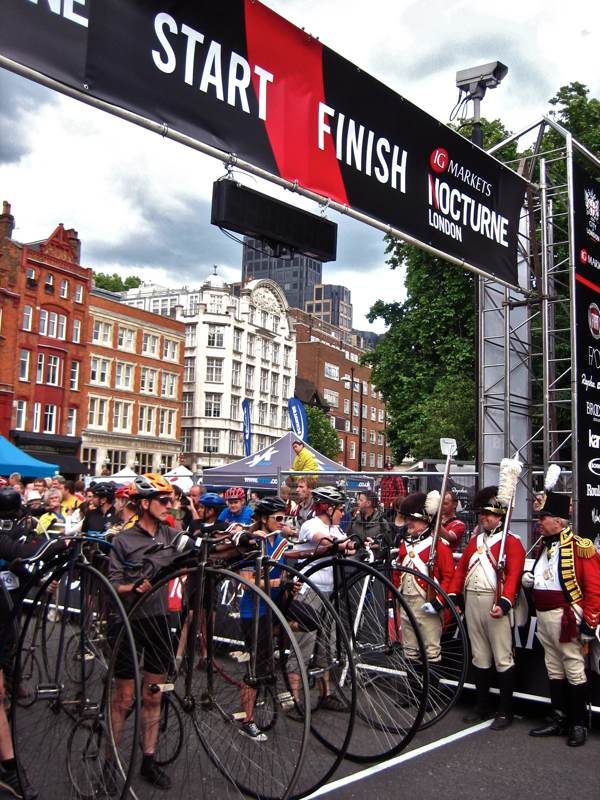
Then, before he could say more, it was time to wheel the Penny Farthings out onto the track where the photographers and television crews awaited, and shots fired by the Portsoken Militia set the race in motion. The cyclists enjoyed one lap around the course together at a casual pace until they passed the starting post for the second time, when they sped away for a one mile dash, pedalling like demons. On the first lap, the bystanders were all entranced by the rare spectacle of so many Penny Farthings, but when the cycles flew away down to the Faringdon Rd and up Charterhouse St, returning by Long Lane before anyone expected it, a ripple of amazement went through the crowd – because in the first race in London for over a century, Penny Farthings had affirmed themselves as serious racers.

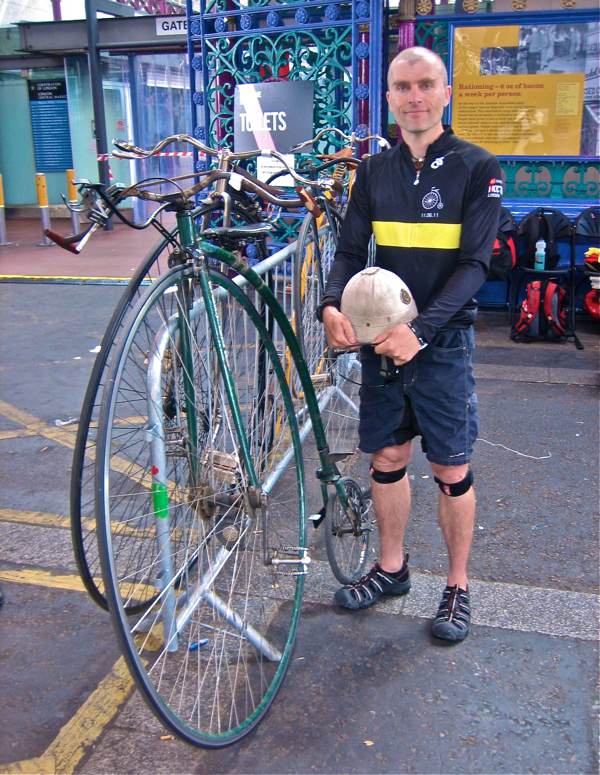
Joff Summerfield and the Penny Farthing on which he cycled round the world.




You can watch Joff Summerfield on his round the world Penny Farthing trip here
You may also like to read about
Brick Lane Market 12
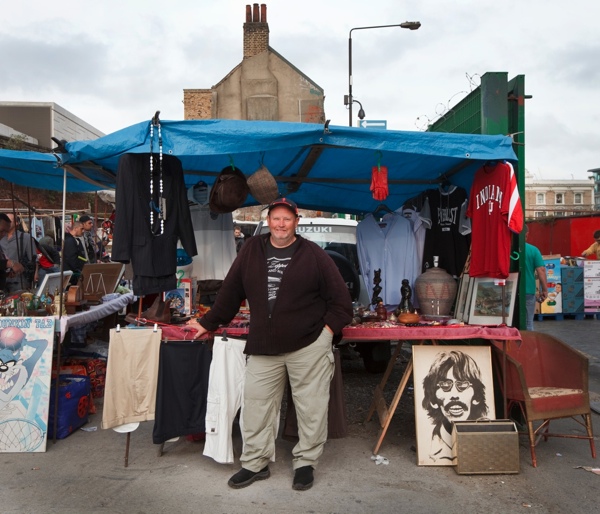
This is Kevin Stocker from Harlow who once served in the Royal Fusiliers. “Need brought me here,” he revealed to me with a phlegmatic grin on a slow Sunday in Sclater St, “Most of the regional markets are dying out, so you’ve got to go where you can find the customers. And I like the hustle and bustle here, it’s a very sociable place.” Of expansive temperament, Kevin is a skilled man who has done many jobs in his varied career – “I trained as a plumber and hated every minute of it” – but now he sells bric-a-brac at boot fairs and antiques markets to earn a living. “I’ve been doing it fifteen years, this July,” he calculated. I joined Kevin for a cup of tea behind the stall to enjoy a chat with him and his pal, the neighbouring stallholder Christine, while the clouds gathering overhead scattering the last customers. “I called her ‘Lucky’ because every day she bought off me, I had a lucky day,” he informed me, catching her eye, as we sipped from our plastic cups.
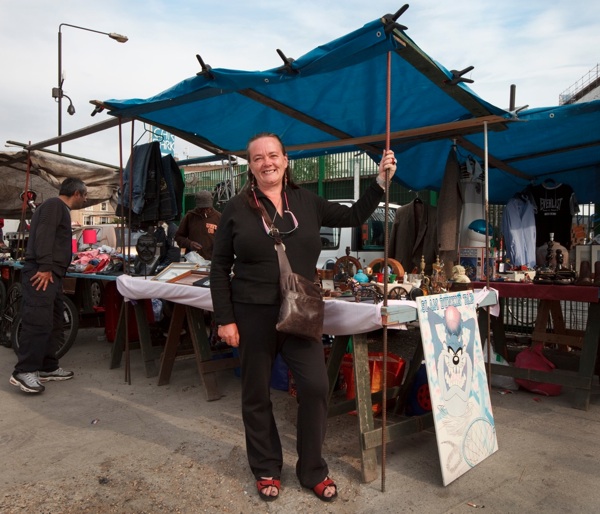
“We’re all here by default, because it’s what we know,” said Christine with a knowing chuckle, “For me it’s all about the people, it’s the social aspect as well as earning enough to pay the odd bill. It’s not my primary focus, like Kevin – although next year it might become so.” A woman who has travelled the world and seen life, Christine worked her way up from trading at car boot sales to international antiques fairs, until she started a theatre group exploring the subject of mental health inspired by her own experience of mental illness. Two years ago, she quit the theatre and now she is back in the market again. “I live in Dagenham and I own a Skoda,” she explained, puffing on her cigarette excitedly, “when I first got started again, I used to come on the bus with all my things and it almost killed me!” A popular character in the Sclater St Market, Christine knows her stuff, and is renowned for her raucous humour and splendid corn-rows.
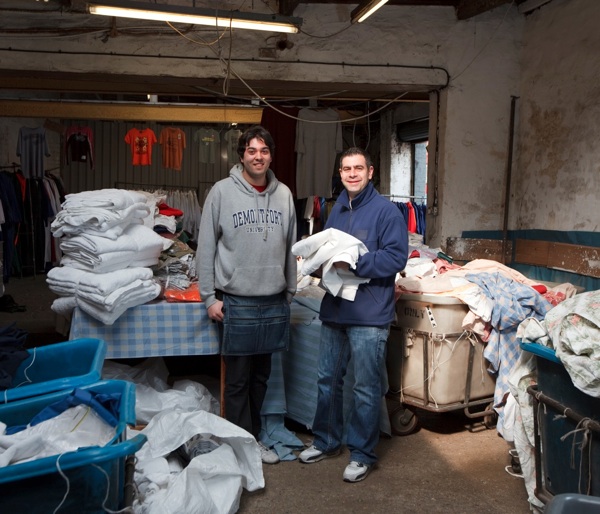
This is Chris & Vince of Abco Wiping Cloths & Janitorial Supplies who deal in secondhand textiles from the former railway workers’ chapel in Sclater St. Here, in this atmospheric shadowy space beneath the foliate Victorian cast iron roof brackets and lancet windows, you can find a wonderful selection of old roller towels, boiler suits, cotton bed sheets and pillow cases, catering uniforms, aprons and coats – even socks at twenty pence a pair. Vince’s grandfather started the business (which also operates from the Coppermill in Cheshire St) in 1920 as rag merchants and they have operated here in the chapel for the past thirty years. “I was probably about three or four when I first came down here, I don’t remember not being here,” recalled Vince with a sentimental smile, taking in the magnificent old store and then gazing out to the building site across the road where the future is being constructed, “But it’s just a hobby now. We’ll be history very soon.”
Photographs copyright © Jeremy Freedman
On the Thames with Crayfish Bob

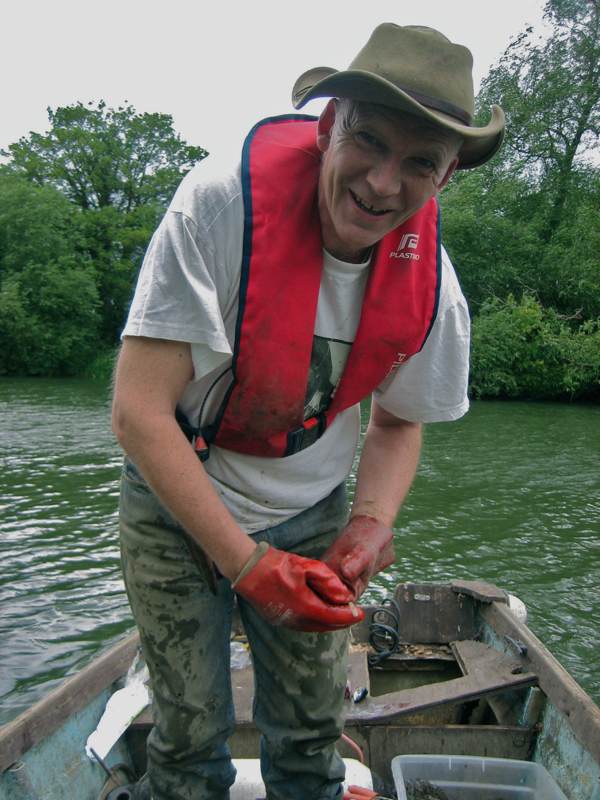
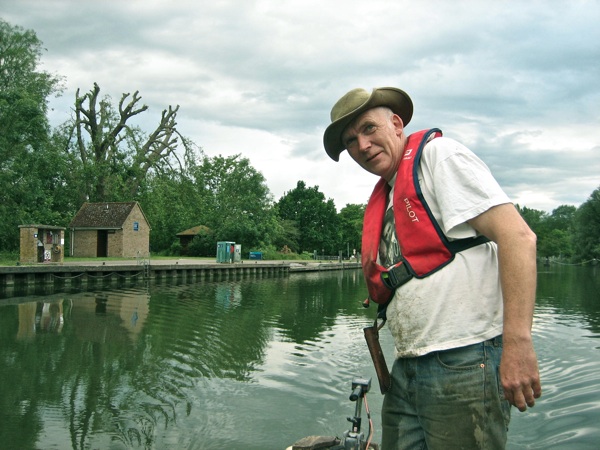
In early Summer, I always get the longing to go up river where the banks are lined with willows and yellow flags, and elderflowers hang down at the water’s edge. So I was delighted to accept Crayfish Bob’s invitation to spend an afternoon with him on the Thames, all the way upstream at Abingdon Lock, where he was emptying his traps in preparation for the event at Toynbee Hall in Commercial St next week where you can eat his Crayfish for dinner for five pounds.
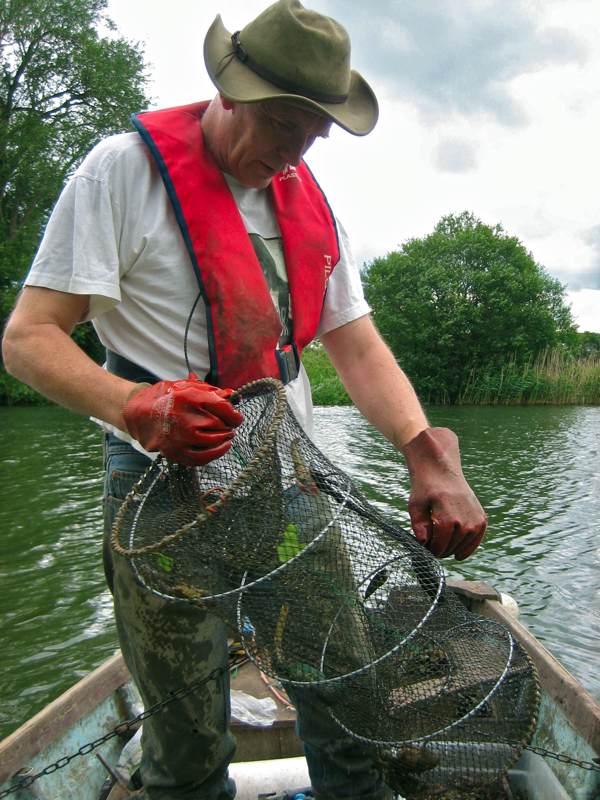
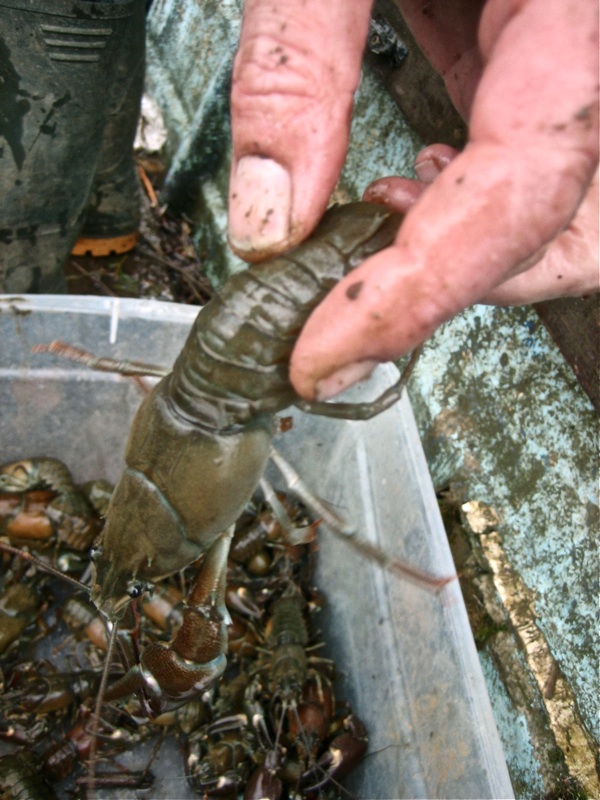
“Hello there!” Bob says in a cheery, friendly tone as he heaves the traps up from the river bed, peering out from under his hat to greet the Crayfish that are gathered in his net eye-to-eye. Then he unzips the trap and gives it a good shake, bouncing the Crayfish up and down, revealing their dramatic orange claws and blue undersides, as they dance and prance along the net to fall ungainly into the bucket. “That’s right, come along now,” he encourages, as if he were a professional tour guide – with an edge of impatience.
You see, Crayfish Bob is a dissimulator as far as freshwater crustacea are concerned, because the blunt truth is he that has made it his personal mission to wipe out the American Signal Crayfish which infest our rivers. With his glinting eyes and twitching smile, Crayfish Bob is a connoisseur of irony, and the irony here is that these American Crayfish were introduced by the government in the nineteen seventies as an alternative to the diminishing stocks of the native variety of White-clawed Crayfish, which they now threaten to replace entirely.
Where others see a problem, Bob sees a business opportunity – and, since 2003, he has devoted himself to finding the means to rid our rivers of these interlopers, by encouraging people to eat them. This is where the second irony becomes apparent – since as Bob’s efforts to promote Crayfish have succeeded in encouraging the fashion for eating Crayfish, more are imported from China to meet the demand. Supermarkets sell cheap inferior Chinese Crayfish labelled as “produced in the United Kingdom” when the fact is they only package them in this country. A disappointing sleight of hand that Bob illustrated to me in a supermarket famous for its declared ethical credentials, when we popped in to buy mackerel to bait the traps on our way to the river.
Bob is driven by a frustration compounded of these ironies. When he drives his fishy van, when he spends countless hours shelling crustacea, when he stands in his tiny boat hauling the traps up from the mud, Bob is single minded in his intent. “I haven’t made any money out of it yet, but if I did I would invest it back in the project,” he admitted to me, clenching his jaw in determination.
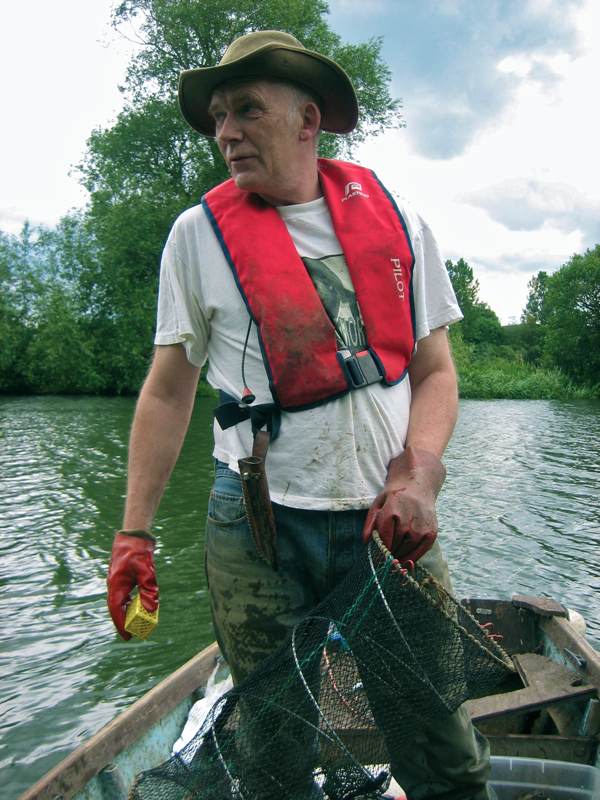
“How’s it going Bob?” yelled a fellow fisherman from the towpath, with a smile and a hint of sceptical superiority, provoking Bob to cease his labour, and stand erect to cock his hat and reply with dignity, “It’s going to happen this year.” And Bob has real reason for this belief because he has just got his first big break. The week after the event in Spitalfields, Bob will be catering the Glastonbury Festival, serving Bob’s Crayfish Bisque to the hoards of hungry revellers. Now there is a sense of urgency to the endeavour because this a chance to shift some Crayfish, to dredge them up from the river and feed them to the festival-goers. “I don’t know if I will be able to offer more than a thousand portions of Crayfish,” Bob muttered, shaking his head and thinking out loud as he picked up the errant Crayfish that strayed from his bucket and were crawling across the floor of his tiny boat in a feeble escape attempt.
Trippers on pleasure boats drifted by, they saw the two of us in the scruffy little boat, but they did appreciate the nobility of our purpose, nor did the Crayfish realise their fate. Five ducklings bobbed past and a red kite dived overhead, yet we alone knew of the grand plan that was underway. “The population here is diminished,” Bob confided to me in modest satisfaction as he emptied another trap, “these have wandered in from elsewhere.”
If you want to help Crayfish Bob redress the balance of Nature, come to Toynbee Hall next week and consume as many as you can of the plague of alien Crayfish that swarm in the Thames.

A Moorhen’s nest.

Bob finds a Pike in his net and holds it for a moment before throwing it back.
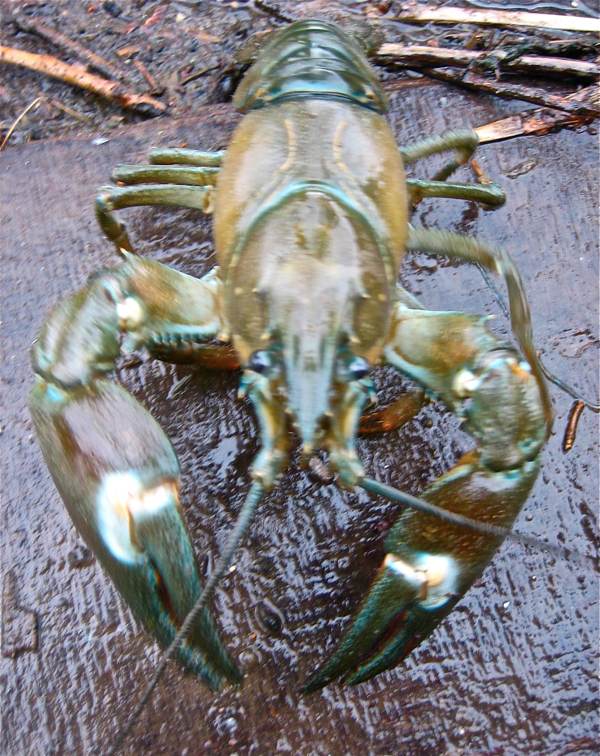
A Crayfish.
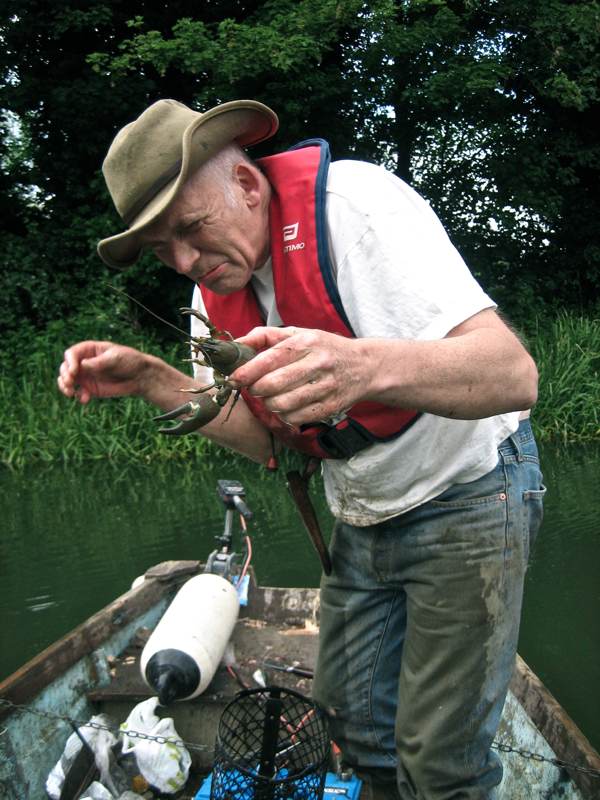
Bob impersonates a Crayfish.
Learn more about Crayfish Bob’s Dinners at Toynbee Hall 13-17th June.
At the Algha Spectacle Works
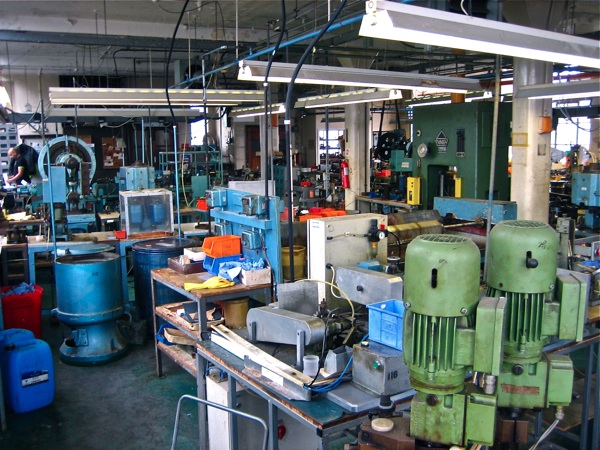
Between Victoria Park and the site of the 2012 Olympics, lies a narrow stretch of land known as Fish Island, filled with a crowded array of dignified old brick industrial buildings. Most are turned over to artists’ studios now, but standing amongst them at the corner of Smeed Rd is the world famous Algha Works, home to Britain’s last metal spectacle frame manufacturer, operating from here for the past century.
In this early steel frame building of 1907, the gold National Health Service spectacles that once corrected the sight of the population were made by Max Wiseman & Co, founded in 1898. Think of any of the famous gold rimmed glasses of the twentieth century, from Mahatma Gandhi to John Lennon, to every bank manager and headmaster, and this where they were manufactured. The heart-shaped sunglasses for Stanley Kubrick’s “Lolita” and, more recently, Harry Potter’s geeky specs were also made here.
You might say that Max Wiseman was a visionary in the world of spectacles. “As a young man of nineteen, I was inspired and tremendously enthusiastic at the possibility of ‘goldfilled’ being the future of spectacles.” he wrote breathlessly in the fiftieth anniversary edition of “The Optician” in 1941, and the rest was history. “Goldfilling” means coating the frame with a sleeve of gold which extends the life of the spectacles by preventing corrosion. Cheaper and lighter than solid gold, resistant to corrosion and longer lasting than gold plating, fourteen carat goldfilled spectacles from the Algha Works were universally available on the NHS in this country for forty years.
“They manufactured two and a half million frames a year here, when two hundred people worked in this building,” Peter Viner, the current managing director told me,“they lived next door and the building opposite was a school.” And he gestured back in time, and towards the window of his office on the top floor with views back across the East End in one direction and to the Olympic stadium in the other. When Peter came here in 1996, there were over fifty employees and today there are just fifteen, yet the ghosts of the past workforce linger in this light and spacious utilitarian building with its magnificent tiled stairwells and toilets.
Before 1932, Max Wiseman imported his frames from Germany, but the disruption of the First World War and inflation of the nineteen thirties led him to buy a complete factory in Rathnau, Germany and transport it to Hackney Wick along with ten optical technicians. When the Second World War broke out, these technicians found themselves interned in Scotland, but the machinery they set up remains in use after all this time. Efficient, serviceable and sturdy, the complete German plant for manufacturing metal spectacles from the nineteen thirties is used to make all the frames at the Algha Works today – one place were you can truly say, they still make them like they used to. In other words, where the purpose of the manufacture to is to create something of the highest quality that will last as long as possible, without built-in obsolescence.
“The black art,” as Peter terms it, describing the swaging, pressing, bending, notching, crimping, burnishing and other means of folding, that comprise the one hundred and thirty operations which go into making a pair of metal frames – including seventeen bends for the bridge alone. Protective of his unrivalled spectacle works, Peter restricted what might be photographed lest his Chinese competitors should garner trade secrets, yet he could not resist taking me to the manufacturing floor and showing off the heart of his operation, which gave me the opportunity to meet some of his proud spectacle makers.
Nirmal Chadha, who had been there twenty-four years, showed me the device that creates the “Hockey” end, bending the “temples” – as the arms of the spectacles are known in the trade. She put in the straight temple, pulled a lever and out came the temple crooked like a Hockey stick, as you would recognise it. Indi Singh, who had been there twenty-two years, demonstrated an elegant machine that spins different wires together to create the tensile arms for spectacles much in demand by sportmen – and curled into a “Fishook” so they can be secured around the ear.
Meanwhile Matt Havercroft, who had been working there just six months, was screwing temples to frames at the other end of the production line. He told me he was completely absorbed in all the processes and devices that are involved in the art of spectacle making. And after doing casual work in a bar and telephone sales, he was delighted to have found an occupation so engaging. Finally, I was proud to shake hands with Raymond Miller who had worked there thirty years and whose mother also worked there before him.
The shared endeavour at the Algha Works is a unique cultural phenomenon that has miraculously survived here in the East End, in spite of the withdrawal of free National Health Service glasses and the flood of cheap imports sold under designer labels which dominate chains of opticians today. So, if you want a pair of handmade classic spectacles that will last the rest of your life, you know where to go.

Algha Works – Algha is a composite of “from Alpha to Omega.”


Max Wiseman founder of Max Wiseman & Co in 1898, leading manufacturers of spectacles.


Nirmal Chadha has worked here twenty-four years.


Matthew Havercroft joined six months ago and intends to stay for the rest of his career.


Indi Singh has worked here twenty-two years.


Raymond Miller has worked at Algha Works for thirty years and his mother worked there before him.

Spectacles made at the Algha Works are sold under the “Savile Rowe” and “Just in Time” brands
You may also like to read about
At James Ince & Sons, Umbrella Makers
At Stephen Walters & Sons, Silkweavers
Spitalfields Antiques Market 22

This is Nancy Lee Child, a weaver who came from New York in 1969 and ran a weaving shop in Walthamstow for thirty-six years until she sold it in 2009. “When I retired at sixty-eight, they said, ‘What are you going to do? You’re an a empress and your empire is your life,'” Nancy confided to me, her sharp blue eyes sparkling with intensity. “But I’d had enough. This is my empire now, it’s six feet long and two feet wide.” she said, gesturing proudly to her stall and crossing her arms in contentment, “I’m in charge, I employ me and I answer to me.” As well as being a virtuoso at the loom, Nancy collected wooden boxes for forty years until she had so many she could not get into her living room. “Now the word is sell ’em and you ain’t buyin’ any more,” she informed me with gruff enthusiasm, “Every one I have, I like and now I’m trying to persuade the public to like ’em too.”

This is Jo & Kelvin Page who deal in drinking and smoking collectibles. “It’s my wife’s baby,” said Kelvin, passing me over to Jo. “We’ve been collecting for a long time,” responded Jo with a diplomatic smile, casting her eyes fondly over all their fancy ashtrays and kitschy cocktail paraphernalia,“I admit I am compulsive, if I see it I have to have it.” “We like to own it for a little while and then we sell it,” continued Kelvin, in tactfully qualification. “We like the nineteen fifties,” declared Jo helpfully. “Neither of us smokes, but we do like a drink,” announced Kelvin, catching Jo’s eye as they exchanged a private smile.“But we don’t overdo it,” added Jo prudently, just in case I imagined they enjoyed a decadent lifestyle, and revealing she is a Paediatric Audiologist for the rest of the week.

This is Tim Mason who has been trading in “quirks of art” for the past twenty-five years. “I used to have a flat full of weird and interesting things, but I am selling it all now I’ve become a dad because I need to keep the wolf from the door,” he confessed to me proudly with a grin untinged by regret, adding, “I’ve still got quite a nice art collection.” Tim’s stock ranges from taxidermy through vintage copies of Playboy to anatomical charts. “It serves me well coming to Spitalfields” he explained, setting his jaw purposefully,“because even if I have a slow day selling, all the other dealers are here so I can do a lot of buying.” If you look closely you can see Kermit the Frog to the left of Tim. “I’ve always had him, he’s been hanging around for years and no-one ever buys him. He’s my mascot,” confided Tim shyly, raising one eyebrow and revealing an unexpected whimsical side.
Photographs copyright © Jeremy Freedman
You also like to look at
Spitalfields Antiques Market 1
Spitalfields Antiques Market 2
Spitalfields Antiques Market 3
etc












