
Peter Bellerby, Globe Maker
Peter Bellerby is speaking about his work next Thursday 7th November at 6pm at Sandys Row Synagogue, E1 7HW. Click here for tickets

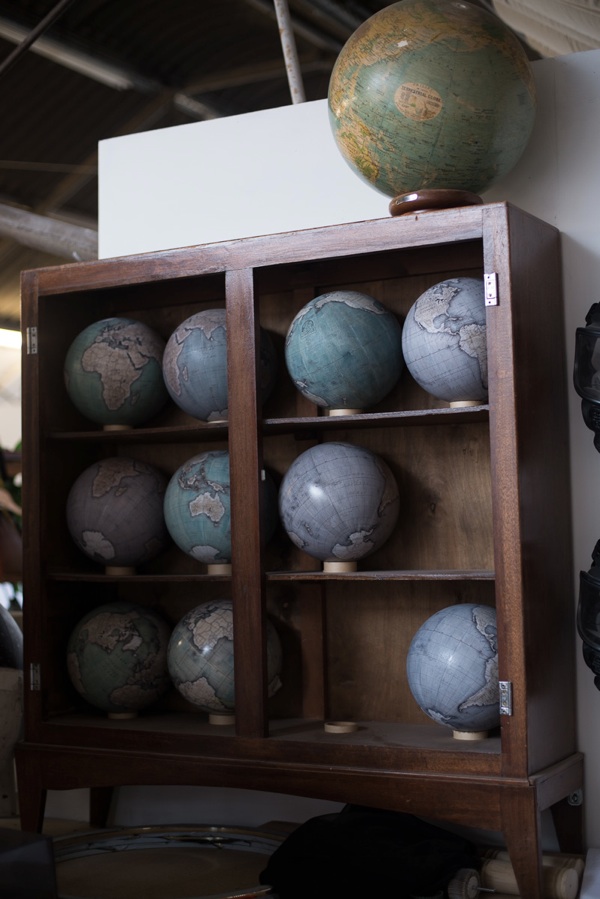
Just a couple of years ago, Peter Bellerby of Bellerby & Co was unable find a proper globe to buy his father for an eightieth birthday present. Now Peter is to be found in his very own globe factory in Stoke Newington and hatching plans to set up another in New York – to meet the growing international demand for globes which he expects to exceed ten times his current output within five years. A man with global ambitions, you might say.
Yet Peter is quietly spoken with deferential good manners and obviously commands great respect from his handful of employees, who also share his enthusiasm and delight in these strange metaphysical baubles which serve as pertinent reminders of our true insignificance in the grand scheme of things.
A concentrated hush prevailed as Contributing Photographer Sarah Ainslie & I ascended the old staircase in the former warehouse where we discovered the globemakers at work on the top floor, painstakingly glueing the long strips of paper in the shape of slices of orange peel (or gores as they are properly known) onto the the spheres and tinting them with fine paintbrushes to achieve an immaculate result.
“I get bored easily,” Peter confessed to me, revealing the true source of his compulsion, “But making globes is really the best job you can have, because you have to get into the zone and slow your mind down.”
“Back in the old days, they were incredibly good at making globes but that had been lost,” he continued, “I had nothing to go by.” Disappointed by the degradation of his chosen art over the last century, Peter revealed that, as globes became decorative features rather than functional objects, accuracy was lost – citing an example in which overlapping gores wiped out half of Iceland. “What’s the point of that?,” he queried rhetorically, rolling his eyes in weary disdain.
“People want something that will be with them for life,” he assured me, reaching out his arms around a huge globe as if he were going to embrace it but setting it spinning instead with a beautiful motion, that turned and turned seemingly of its own volition, thanks to the advanced technology of modern bearings.
Even more remarkable are his table-top globes which sit upon a ring with bearings set into it, these spin with a satisfying whirr that evokes the music of the spheres. Through successfully pursuing his unlikely inspiration, Peter Bellerby has established himself as the world leader in the manufacture of globes and brought a new industry to the East End serving a growing export market.
To demonstrate the strength of his plaster of paris casting – yet to my great alarm – Peter placed one on the floor and leapt upon it. Once I had peeled my fingers from my eyes and observed him, balancing there playfully, I thought, “This is a man that bestrides the globe.”



Isis Linguanotto, Globepainter


John Wright, Globemaker


Chloe Dalrymple, Globemaker


Peter Bellerby, on top of the globe
Photographs copyright © Sarah Ainslie
Upon The Nature Of Terror

I believe I was born with a medieval imagination. It is the only way I can explain the explicit gothic terrors of my childhood. Even lying in my cradle, I recall observing the monstrous face that emerged from the ceiling lampshade once the light was turned out. This all-seeing creature, peering at me from above, grew more pervasive as years passed, occupying the shadows at the edges of my vision and assuming more concrete manifestations. An unexpected sound in my dark room revealed its presence, causing me to lie still and hold my breath, as if through my petrified silence I could avert the attention of the devil leaning over my bedside.
When I first became aware of gargoyles carved upon churches and illustrated in manuscripts, I recognised these creatures from my own imagination and I made my own paintings of these scaled, clawed, horned, winged beasts, which were as familiar as animals in the natural world. I interpreted any indeterminate sound or movement from the dark as indicating their physical presence in my temporal existence. Consequently, darkness, shadow and gloom were an inescapable source of fear to me on account of the nameless threat they harboured, always lurking there just waiting to pounce. At this time of year, when the dusk glimmers earlier in the day, their power grew as if these creatures of the shades might overrun the earth.
Nothing could have persuaded me to walk into a dark house alone. One teenage summer, I looked after an old cottage while the residents were on their holiday and, returning after work at night, I had to walk a long road that led through a deep wood without street lighting. As I wheeled my bicycle up the steep hill among the trees in dread, it seemed to me they were alive with monsters and any movement of the branches confirmed their teeming presence.
Yet I discovered a love of ghost stories and collected anthologies of tales of the supernatural, which I accepted as real because they extended and explained the uncanny notions of my own imagination. In an attempt to normalise my fears, I made a study of mythical beasts and learnt to distinguish between a griffin and a wyvern. When I discovered the paintings of Hieronymous Bosch and Pieter Breughel, I grew fascinated and strangely reassured that they had seen the apocalyptic visions which haunted the recesses of my own mind.
I made the mistake of going to see Ridley Scott’s The Alien alone and experienced ninety minutes transfixed with terror, unable to move, because – unlike the characters in the drama – I was already familiar with this beast who had been pursuing me my whole life. In retrospect, I recognise the equivocal nature of this experience, because I also sought a screening of The Exorcist with similar results. Perhaps I sought consolation in having my worst fears realised, even if I regretted it too?
Once, walking through a side street at night, I peered into the window of an empty printshop and leapt six feet back when a dark figure rose up from among the machines to confront my face in the glass. My companions found this reaction to my own shadow highly amusing and it was a troubling reminder of the degree to which I was at the mercy of these irrational fears even as an adult.
I woke in the night sometimes, shaking with fear and convinced there were venomous snakes in the foot of my bed. The only solution was to unmake the bed and remake it again before I could climb back in. Imagine my surprise when I visited the aquarium in Berlin and decided to explore the upper floor where I was confronted with glass cases of live tropical snakes. Even as I sprinted away down the street, I felt the need to keep a distance from cars in case a serpent might be lurking underneath. This particular terror reached its nadir when I was walking in the Pyrenees, and stood to bathe beneath a waterfall and cool myself on a hot day. A green snake of several feet in length fell wriggling from above, hit me on the back, bounced off into the pool and swam away, leaving me frozen in shock.
Somewhere all these fears dissolved. I do not know where or when exactly. I no longer read ghost stories or watch horror films and equally I do not seek out dark places or reptile houses. None of these things have purchase upon my psyche or even hold any interest anymore. Those scaly beasts have retreated from the world. For me, the shadows are not inhabited by the spectral and the unfathomable darkness is empty.
Bereavement entered my life and it dispelled these fears which haunted me for so long. My mother and father who used to turn out the light and leave me to sleep in my childhood room at the mercy of medieval phantasms are gone, and I have to live in the knowledge that they can no longer protect me. Once I witnessed the moment of death with my own eyes, it held no mystery for me. The demons became redundant and fled. Now they have lost their power over me, I miss them – or rather, perhaps, I miss the person I used to be – yet I am happy to live a life without supernatural agency.


Fourteenth century carvings from St Katherine’s Chapel, Limehouse
Luke Clennell’s Dance Of Death
More than twenty years have passed since my father died at this time of year and thoughts of mortality always enter my mind as the nights begin to draw in, as I prepare to face the spiritual challenge of another long dark winter ahead. So Luke Clennell’s splendid DANCE OF DEATH engravings inspired by Hans Holbein suit my mordant sensibility at this season.
First published in 1825 as the work of ‘Mr Bewick’, they have recently been identified for me as the work of Thomas Bewick’s apprentice Luke Clennell by historian Dr Ruth Richardson.

The Desolation

The Queen
 The Pope

The Cardinal

The Elector

The Canon

The Canoness

The Priest

The Mendicant Friar
 The Councillor or Magistrate

The Astrologer

The Physician

The Merchant

The Wreck

The Swiss Soldier

The Charioteer or Waggoner
 The Porter

The Fool
 The Miser
 The Gamesters

The Drunkards

The Beggar

The Thief

The Newly Married Pair

The Husband

The Wife

The Child

The Old Man

The Old Woman
You may also like to take a look at
Chinnee Kaur, My Mum

Cover price is £35 but you can buy it from Spitalfields Life for £30
CLICK HERE TO ORDER A SIGNED COPY OF ENDURANCE & JOY
The Gentle Author will be giving an illustrated lecture, showing David Hoffman’s photos and telling the stories behind them on Thursday 7th November 7:30pm at Wanstead Tap, 352 Winchelsea Rd, E7 0AQ
Today Suresh Singh recalls the life of his mother in this extract from A MODEST LIVING, MEMOIRS OF A COCKNEY SIKH
 Mum with me in the yard at 38 Princelet St shortly after we left hospital
Mum came to join Dad in London in 1955, bringing my elder sister. I think she quickly became absorbed by motherhood and childbearing. She did not stay healthy because the house was so overcrowded. First she got asthma from the dust mites in the mattresses and then she got tuberculosis. Yet she remained a very generous woman and welcomed everybody. She tolerated our mad house and never said she wanted to live like other Sikh families. She never sought domestic comforts. She understood Dad’s beliefs and adapted to life in England in her own way. To look at Mum, you would think that she never left India. She just stayed in her Punjabi clothes, as if she had arrived yesterday.
She was always cooking in big pans for lots of people, brewing masala tea with milk on the gas ring. It seemed nothing ever boiled over. She had mastered it to an art, the size of the gas flame and the circumference of the pan. She made dals, cooked spinach, and roasted chicken at weekends. We kept a big sack of brown flour in a dustbin, twenty-five kilos, and she loved making chapatis in abundance. They were buttered with Anchor butter, wrapped in cloth to keep them soft and stacked one on top ofthe other in an aluminium pot with a lid. We always thought there was an endless bundle because they never ran out. On Friday someone would bring a freshly-killed chicken from the kosher chicken shop in Petticoat Lane or, as a treat, Dad would buy fish and chips from Alfies on Brick Lane. On Sunday and special occasions Mum would make prashad.
At the end of each week, Dad gave his unopened pay-packet to Mum. She kept it so if the family needed money in India she could get it. They never had a bank account, but had a way of hiding valuables in the house. They sent money through Grewal, the grocer in Artillery Passage, who had a means of exchanging it for rupees.
Mum spent quite a bit of time in hospitals before I was born and then with me in the baby clinic, where she met other women – English, Irish, Scottish, Jewish, Maltese, Pakistani and West Indian. They were all very poor and became friends because they came from big families. They were devoted to their own faiths and shared a strong sense of duty to their families. Every Friday while Mum was in Mile End hospital in Bancroft Road they gave each woman a bottle of Guinness for strength because they believed the iron was good for the blood. As a Sikh, Mum did not drink alcohol so she put the bottles in her bedside cupboard. It was like a drinks cabinet. The Irish women came and she gave them one each, and they all became close.
I remember these women visiting our house. They called her Mrs Singh and she corrected them, saying, ‘No, I am Mrs Kaur.’ They would ask, ‘Are you separated from Mr Singh?’ She was shocked that anyone would ask such a question but explained, ‘No, no, it’s our Sikh faith that men are called Singh and women are called Kaur.’ Singh means lion and Kaur means princess. Mum would then take the opportunity to talk about her faith and how this naming was initiated by the tenth guru, Guru Gobind Singh.
Mum cultivated these warm relationships. She never judged anybody and had a gift for bringing women together regardless of their appearance, way of life or who they were. I think she inherited that quality from her dad who was a wise man. I was the luckiest in the family to spend so much time at home with my parents. They taught me how to hold a family together.
Mum wanted to stay at home and Dad never sent her out to work. She valued the responsibility of keeping the house, caring for her children and others in the family. He valued and trusted her judgement in keeping the household in order. She loved walking us to Christ Church School and enjoyed the social life at the school gate. We came home for dinner every day because the school meals were tasteless, without any spices.
Once my cousins’ wives started coming over from the Punjab and staying with us, Mum took them to the clinic and they would spend time together. She demonstrated how to put a terry nappy on a baby with a safety pin, and how to boil nappies in a pan with Daz on the gas ring to get them nice and white again. She was a mother to them, these newly-wed women who came and stayed for a while. She taught them a few tricks of the trade.
When I was born in 1962, I already had my eldest sister from India, my second sister and my brother. There were always other children in the house, so often I did not know who was family and who was not. Dad had adopted one of our cousins from India and I just thought all these people were family. I called everybody brother or sister. Food was cooked in a large pan and we all ate chapatis together on the floor. It was a simple but hard-working life.

Our family

Mum with a friend in Trafalgar Sq

Dad’s pay packet

Suresh Singh & Jagir Kaur at 38 Princelet St (Photograph by Patricia Niven)

Click here to order a copy of A MODEST LIVING
In this first London Sikh biography, Suresh tells the story of his family who have lived in their house in Princelet St for nearly seventy years, longer I believe than any other family in Spitalfields. In the book, chapters of biography are alternated with a series of Sikh recipes by Jagir Kaur, Suresh’s wife.
Lewis Lupton In Spitalfields
Cover price is £35 but you can buy it from Spitalfields Life for £30
CLICK HERE TO ORDER A SIGNED COPY OF ENDURANCE & JOY
The Gentle Author will be giving an illustrated lecture, showing David Hoffman’s photos and telling the stories behind them on Thursday 7th November 7:30pm at Wanstead Tap, 352 Winchelsea Rd, E7 0AQ
In the spring of 1968, artist Lewis Frederick Lupton came to Spitalfields and submitted this illustrated report on his visit to the Christ Church Spitalfields Crypt Newsletter.

Interior of Christ Church, Spitalfields, 1968 – without galleries or floor
On Ash Wednesday 1968, I set off at eleven for Spitalfields to see the Rev. Dennis Downham about his work among alcoholic vagrants. Walking up the road from the Underground Station, I saw a man very poorly dressed, his face a pearly white, obviously ill. Then came a tramp, as lean, dirty, unkempt, bearded and ragged as any I have seen. This was a district where there was real poverty.

The Rectory was a substantial Georgian house such as one sees in many a country village. The study overlooked a small garden and the east end of the church, where plane trees grew among old tombstones.

After lunch, we went out to see something of the parish. The first person we encountered was a fine-looking young American in search of his ancestors, who asked for the parish registers. After directing him to County Hall, we crossed over into a narrow street between tall old brick houses with carved and moulded eighteenth century doorways. Out of one of these popped a little Jewish man with a white beard, black hat and coat.

Round the corner in Hanbury St, the Rector unlocked (“You have to be careful about locks here”) the door of a building in which the church now worships ( “Christ Church itself needs a lot spending in restoration before it can be used again”). The building now employed once belonged to a Huguenot church, of which there were seven in the parish, and still has the coat of arms granted by Elizabeth I carved above the communion table.

Thousands of French Protestants found a refuge from persecution in this parish. The large attic windows belonging to the rooms where they kept their looms may still be seen in many streets and the street names bear record of the exiles – Fournier St, Calvin St etc

Crossing Commercial St, we came across a charming seventeenth century shop in a good state of preservation. Its fresh paint made it stand out like a jewel from the surrounding drabness.

A stone’s throw further on, photographs pasted in a window advertised the attractions of one of the many night clubs in the area.

Opposite a kosher chicken shop, one of a the staff – a Jewish man with a beard, black hat and white coat was throwing pieces of bread to the pigeons.

Round the corner, we plunged into an offshoot of the famous Petticoat Lane which forms the western boundary of Spitalfields.

Turning eastwards, we tramped along the broken pavements of a narrow lane running through the heart of the district. It seemed to contain the undiluted essence of the parish in its fullest flavour, a mixture of food shops, warehouses, prison-like blocks of flats, derelict houses and bomb-sites. “There are twenty-five thousand people living in my parish. It is the only borough in central London which has residential life of its own,” revealed the Rector.
 Christ Church stands out like a temple of light in the surrounding squalor. Designed by Nicholas Hawksmoor, its scale is much larger than life and the newly-gilded weathervane is as high as the Monument. “I climbed up the ladders to the top last year when steeplejacks were at work upon it,” commented the Rector.

Were it not for the brave work which has been begun in the cellars, the building would only be a proud symbol of the Faith, no more.

Down the steps, to the left of the porch, there is a reception area with an office and a clothes store.

One sleeping fellow had a tough expression. “False nose,” said the Rector, “he had his real one bitten off in a fight.” The central area is devoted to the work for which the crypt was opened. Except for a billiard table, it is like a hospital ward, mainly taken up with beds on which the patients rest and sleep.
Yet, a crypt is crypt and the lack of daylight is a handicap but, with air-conditioning throughout, spotless cleanliness and a colour scheme of cream and turqoise blue, the cellars of Christ Church have been turned into a refuge which offers help and hope to those of the homeless alcoholics who have a desire to be rescued from their predicament. – L.F.L.
You may also like to read about
David Hoffman In Cheshire St Market
Cover price is £35 but you can buy it from Spitalfields Life for £30
CLICK HERE TO ORDER A SIGNED COPY OF ENDURANCE & JOY
The Gentle Author will be giving an illustrated lecture, showing David Hoffman’s photos and telling the stories behind them on Thursday 7th November 7:30pm at Wanstead Tap, 352 Winchelsea Rd, E7 0AQ

“I was born in the East End, but my upwardly-mobile parents moved away to the green fields of Berkshire and then back to the safe suburbs of South London. By the time I drifted back to Whitechapel as a young man in 1970, I found myself in a world I had never imagined.
I encountered bomb sites still rubble-strewn from the war, smashed windows, empty shops, rubbish-scattered streets and many lost, desperate people wandering aimlessly, often clutching a bottle of cheap cider or meths. Then I was broke, unemployed and clueless, and it was scary to imagine a future amidst this dereliction.
I found a room in a damp, rickety slum in Chicksand St and began to explore, soon discovering the Sunday market in Cheshire St where I picked up a warm coat and a blanket for next to nothing. The market was surreal, with people sitting on the kerb hoping to sell a couple of old shoes and a broken razor. Other stalls were stacked with the debris of house clearance – carpets, furniture, pictures, kitchenware and books – whole lives condensed and piled up for sale.
Yet I found the market inspiring. Unregulated and chaotic, the unifying emotion was of hope bubbling through desperation. Even at the very lowest end of poverty, these people thronging the streets had got up early, pulled together a carrier bag of junk and headed off, sustained by the possibility of seeking a few pounds to get them through the next day or two. No matter how badly things had turned out, they were not giving up. It was this hope-filled resilience that buoyed me up and showed me a way forward.”
David Hoffman


Photographs copyright © David Hoffman
In Search Of The Alleys Of Old London
Cover price is £35 but you can buy it from Spitalfields Life for £30
CLICK HERE TO ORDER A SIGNED COPY OF ENDURANCE & JOY
The Gentle Author will be giving an illustrated lecture, showing David Hoffman’s photos and telling the stories behind them on Thursday 7th November 7:30pm at Wanstead Tap, 352 Winchelsea Rd, E7 0AQ
I set out in the footsteps of Alan Stapleton seeking ‘London’s Alleys, Byways & Courts’ that he drew and published in a book in 1923, which I first encountered in the archive at Bishopsgate Institute.
It is a title that is an invitation to one as susceptible as myself to meander through the capital’s forgotten thoroughfares and my surprising discovery was how many of these have survived in recognisable form today.
Clearly a kindred spirit, Stapleton prefaces his work with the following quote from Dr Johnson (who lived in a square at the end of an alley) – ‘If you wish to have a notion of the magnitude of this great city, you must not be satisfied with seeing its great streets and squares, but survey its innumerable little lanes and courts.’

Jerusalem Passage, Clerkenwell

Jerusalem Passage, Clerkenwell

St John’s Passage, Clerkenwell

St John’s Passage, Clerkenwell

Passing Alley, Clerkenwell

Passing Alley, Clerkenwell

In Pear Tree Court, Clerkenwell

In Pear Tree Court, Clerkenwell

Faulkner’s Alley, Clerkenwell

Faulkner’s Alley, Clerkenwell

Red Lion Passage, Holborn

Red Lion Passage is now Lamb’s Conduit Passage, Holborn

Devereux Court, Strand

Devereux Court, Strand

Corner of Kingly St & Foubert’s Place, Soho

Corner of Kingly St & Foubert’s Place, Soho

Market St, Mayfair

Market St is now Shepherd Market, Mayfair

Crown Court, St James

Crown Court is now Crown Place, St James

Rupert Court, Soho

Rupert Court, Soho

Meard St, Soho

Meard St, Soho
Alan Stapleton’s images courtesy Bishopsgate Institute
You may also like to read about


