
Surma Centre Portraits
Spitalfields Life Contributing Photographer Patricia Niven and Novelist Sarah Winman, author of “When God Was a Rabbit,” made this set of portraits at the Surma Centre at Toynbee Hall recently and today it is my pleasure to publish the results of their collaboration.
“After the Second World War, Britain required labour to assist in its post-war reconstruction. Commonwealth countries were targeted and, in what was then East Pakistan (it became Bangladesh after the 1971 Liberation War), vouchers appeared on Post Office counters, urging people to come and work in the United Kingdom, no visa required. The majority of men who came in the 1950’s and 60’s came from a rural background where education was scarce and illiteracy was common. But this generation were hard workers, used to working with their hands, men who could commit to long hours, who had an eagerness to work and a young man’s inquisitiveness to see the world: the perfect workforce to help rebuild this nation. And they did rebuild it, and were soon found working in factories and ship yards, building roads and houses, crossing seas in the merchant navy. These pioneers were the men we met at the Surma Centre.” – Sarah Winman

Shah Mohammed Ali, age 75 years.
I came to this country in November 1961 because my uncle was already living here and inspired me to come. In East Pakistan, I had been working in a shop. I felt life was good. My earliest memory of London was Buckingham Palace. I missed my friends and family but I really missed the weather back home. I became a factory worker, and worked all over the country: a cotton factory in Oldham, a foundry in Sheffield, an aluminium factory in London and Ford motor factory in Dagenham. Ford gave me a good, comfortable life. We had friends all over the country and they would tell us if there was more money being offered at a different factory and then we’d move. I thought I would stay in Britain for four years and then go back home. My heart is in Bangladesh. The roses smell sweeter.

Eyor Miah, age 69 years.
I came to this country in September 1965. I had been a student in East Pakistan. Life was hard, my father was a sailor. I read in a Bengali newspaper stories of people travelling and earning money, and I thought that I, too, would like to do that. I wrote to somebody I knew here to help me. It was a slow process, all done by mail, because of course, there was no internet. It took me two years to gain my papers. I didn’t mind because I was very determined to achieve.
When I first arrived, I became a machinist in the tailoring industry and I earned £1 and ten shillings a week. My weekly outlay was £1 and the rest I saved. Brick Lane was very rundown then. The Jewish population were very welcoming, probably because they were eager for workers! We would queue up outside the mosque and they would come and pick the ones they wanted. In 1969 I bought a house for £55. Of course, I missed my mother who stayed in Bangladesh, and before 1971 I actually thought I would return to live. After that date though, I felt Britain was my home and life was better here.
After tailoring, I worked in restaurants and then began my own business as a travel agent, set up my own restaurants and grocery shop. I have four children. Life has been good to me.

Rokib Ullah, age 81 years.
I came to this country in 1959, because workers were being recruited from the Commonwealth to rebuild after the Second World War. Life in East Pakistan then was good. I was very young and working as a farmer. My fellow countrymen told me about the work in the UK and I came here by air. When I arrived, the airport was so small, not like it is today. And the weather was awful, so bad, not like home, I found that difficult, together with missing my neighbours and friends. I worked in a tyre factory, and then in garment and leather factories. I planned to stay here and earn enough money, and then return to Bangladesh. I am a pensioner now and frequently go back to Bangladesh. It is in my heart. One day I plan to go there forever.

Syed Abdul Kadir, age 77 years.
I first came to this country in 1953. I was in the navy in Karachi and I was selected by the Pakistan Government to be in the Guard of Honour in London at the Queen’s Coronation. I remember this day very clearly. It was June and the weather was cold. When Queen Elizabeth was crowned the noise was tremendous. There were shouts of “God Save the Queen!” and gun salutes were fired. We marched to Buckingham Palace where more crowds were waiting. The Queen and her family came out on the balcony and the RAF flew past the Mall, and the skies above Victoria Embankment were lit up by fireworks. I feel very lucky to have been part of this, and I still have my Coronation ceremony medal.
Since my first visit, I developed a fondness for the British culture, its people and the Royal Family. I have always believed this country looks after its poor.
I owe the Pakistan Navy for much of my experiences in life and was lucky to travel and to see the world. I actively participated in the 1965 India-Pakistan war and the 1971 Pakistan war and have medals for both.
My family are settled here and my life revolves around grandchildren. I have been coming to Surma since 2004. When someone sees me, they call me “Captain!” We are like a family here.

Shunu Miah, age 79 years.
I came to this country in November 1961. Back home, I helped my father farm. It was a good life, still East Pakistan, the population was low, not much poverty, food for everyone: it was a land of plenty. It wasn’t a bad life, I was young and was just looking for more. My uncle had been in the UK since 1931, my father since 1946, both encouraged me to come.
Cinema here was my greatest memory. Back home, cinema was rare. Every Saturday and Sunday there was a cinema above Cafe Naz on Brick Lane, or I’d go to the cinema in Commercial Rd, or up to the West End. It was so exciting, the buildings, the underground, the lights! People were friendly and welcoming then. I saw Indian films, but also Samson and Delilah and the Ten Commandments with Charlton Heston.
I have worked at the Savoy Hotel as a kitchen porter and also in cotton factories in Bradford. What did I miss? Family and friends, of course, but also the weather. The smell of flowers, too, they are much stronger back home. I thought I would stay here and work for three or four years, go home and buy land, build a house and live happily ever after. I have helped to build homes for my family in Bangladesh. I have never been able to own a home here.

Abul Azad, Co-ordinator at the Surma Centre.
“These men are very loyal to a country that has given them a home,” said Abul Azad, the charismatic project co-ordinator at Surma Centre in Whitechapel. “When they first arrived, living conditions were bad, sometimes up to ten people lived in a room. Facilities were unhealthy, toilets outside, and nothing to protect them from an unfamiliar cold that many still talk about. Most intended to earn money to send back to families, and then return after a few years – a dream realised by few, especially after the settlement of families. Instead they were open to exploitation, often working over sixty hours a week, the consequence of which is clearly visible today in low state pensions, due to companies not paying the correct National Insurance contributions. And most Bangladeshi people don’t have private pensions. Culturally, pensions are not of this generation. Their families are their pension – always imagined they would be looked after. But times are changing for everyone.”
Surma runs a regular coffee morning, providing support for elderly Bangladeshi people. The language barrier is still the greatest hindrance to this older generation and Surma provides a specialist team ready to assist their needs – both financially and socially – and to provide free legal advice. It is also quite simply a haven for people to get out of the house and to be amongst their peers, to read newspapers, to have discussions, to talk about what is happening here and in Bangladesh.
There is something profound that holds this group together, a deep unspoken, clothed in dignity. Maybe it is the history of a shared journey, where the desire for a better life meant hours of physical hardship and unceasing toil and lonely years of not being able to communicate. Maybe it is quite simply the longing for home, remaining just that: an unrealised dream. Whatever it is – “This is a very beautiful group.” said Abul Azad.
Photographs copyright © Patricia Niven
You may also like to take look at these other portraits by Patricia Niven and Sarah Winman
An Invitation from The Gentle Author


A Return Visit to Alfred Daniels

Towards the end of my first visit to the studio of Alfred Daniels, the esteemed eighty-six-year-old painter of prolific talent from Bow, he asked me, “Do you think you could come back again next week?” It was an invitation I was happy to accept and – although it took me a little longer than a week – yesterday I travelled eagerly over to Chiswick to pay another call upon him in the large suburban house that his parents bought in 1946 to escape the bombing in the East End.
When I rang the bell twice and received no answer, I peered through the blind into the front room which serves as Alfred’s studio where I spied him, intently at work upon a painting. At first, I was reluctant to disturb his contented reverie but I knew he was expecting me, so I tapped lightly on the window and he sprang into life, coming to the let me in by his front door. Propped up on his desk was a painting of a cat reclining on a fish box with two small boats in the background that Alfred did yesterday. I complimented him on the spirited spontaneous quality of the picture, but he waved my words away with a good-humoured flourish.“It’s the doing of it that’s important not the results,” he informed me with a chuckle, as another thought struck him, “that’s why I gave up religion, because it stops people living in the present tense.”
Yet in spite of his comment, there are certain images that Alfred has returned to continuously throughout his long career and a particular favourite is the gramophone man who always sat in Wentworth St in the nineteen fifties. “I was getting into it,” he admitted in delighted surprise, “and it was becoming different.” The character portrayed in this painting is an East End legend, a subject Alfred first painted from life as a student on a field trip from the Royal College of Art more than sixty years ago. I was intrigued to discover him painting this new version, working from a photograph yet reconfiguring it. “I went there during the blitz, Petticoat Lane and Spitalfields,” he explained to me, thinking out loud again as he resumed work, “it was the first place I experienced a sense of being part of a community, it was the Jewish community then.”
I sat beside Alfred in silence as he grew absorbed in the picture again and cast my eyes around at his other works in progress. Reconsidering themes that resonate for him, he is working on a new depiction of the Royal Exchange in the City and an epic river view looking down the Thames with all the central bridges lined up in parallel. “I never wanted to be a painter,” announced Alfred unexpectedly, still puzzled by the reputation and financial security that his sly, subtly sophisticated paintings have brought him, “I wanted to be an illustrator of life.”
“It isn’t enough to make a picture of something – You have to be there, you have to touch it, you have to experience it.” he assured me as we studied different views of Leadenhall Market that Alfred has done over the years. And he became animated with enthusiasm to revisit the memory of sketching this market more than thirty years ago, an experience distilled further each time he has revisited the image.
Over the phone, Alfred had promised to seek out his Billingsgate sketchbook to show me, that he made in the late sixties when he began drawing on the street as a way to work with art students. “I never tried to teach them, I just took them out with me drawing and worked alongside them so they could see what I did,” he recalled with modest pleasure, pulling the battered hardcover foolscap book from among several in an old satchel on the floor. As Alfred turned the pages, nothing prepared me for the bold fluent quality of his drawings in this book, recording the lost City of half a century ago in crisp confident lines. Alfred’s equal facility with both the human figure and architectural structures creates a tension in these pictures that evokes the energy of the working city with an economy of line which belies the complexity of his vision.
“Did I tell you my story about Francis Bacon?” Alfred asked me, eager again to divert our conversation away from compliments, “He took over from John Minton, teaching us at the Royal College for a spell. In those days, if you were wealthy and well-connected it wasn’t hard to be successful as an artist.” It was an unexpected thought that stopped Alfred in his tracks, as one who possessed none of those prerequisites when he started out. Then, unfortunately, noise at the door terminated our conversation there and I never heard Alfred’s Francis Bacon story, and I never got to look at his stacks of other sketchbooks or hear more of his East End stories. Yet most of all I had enjoyed the peace of sitting with Alfred in his studio while he worked – so this time I was the one to ask the question, “Do you think I could come back again?”


From Alfred’s Billingsgate sketchbook of 1966.

Businessmen at the Royal Exchange and a view of Throgmorton St, 1966.

The old Times building demolished 1968, Upper Thames St.

Southwark Bridge, April 27th
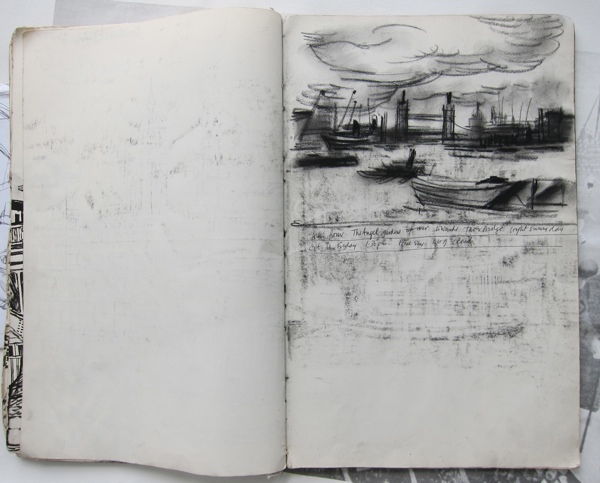
View from the Angel Gardens up river towards Tower Bridge, October 11th Friday 1:30pm

Thameside people, October 1967

Thameside people, dockers, fish porters etc, October 1967

People on London Bridge.

Alfred Daniels
Alfred is exhibiting in The Royal Society of British Artists Annual Exhibition at the Mall Galleries SW1, 29th February – 1oth March. On Wednesday 29th February 11:30am, he will be giving a talk in conjunction with Nick Tidnam on Sketchbooks and Drawing. On Wednesday 7th March 11:30am, he will giving another talk in conjunction with Nick Tidnam, on Arcylics and Mixed Media.
You may like to read about my original visit to Alfred Daniels, Painter
At the Vintners’ Hall

Vintners’ Hall
Last summer, I joined the Worshipful Company of Vintners swan upping on the Thames and yesterday I took up their long-standing invitation to walk over and visit the Vintners’ Hall, established in Lower Thames St since 1446.
Here where the traffic emits a deafening roar as it races past an array of undistinguished corporate classical architecture lining the street, there is no sign of the ancient structures still standing hidden within these modern carapaces. Yet there are wondrous seventeenth century panelled rooms constructed shortly after the Great Fire, built upon the remains of the medieval Hall, where a different atmosphere prevails.
The Court Room of the Vintners’ Company, dating from 1671, is one of London’s oldest continuously-used rooms. Lined with chocolate-dark panelling, adorned with richly-carved swags of foliage and hung with luxurious seventeenth century paintings in golden frames flanked by shadowy mirrors in gilt surrounds, it is one of the few surviving fragments of the Hall. The old master paintings gleam and the sombre panelling recedes to create a charged space that evokes how it all might have been, once. Inside this majestic chamber, it is also possible to deduce how the rest of this structure was configured – because this room comprised the west wing of a symmetrical building with the Hall at the back and a courtyard at the centre. Although the site has been whittled down since the building of Southwark Bridge took a slice off the eastern side and the widening of Lower Thames St pared away a sliver from the northern aspect, and although the courtyard has been built over, much of the current building follows the earlier ground plan.
From the Court Room, you can look through the lobby past Mr Woodroffe’s handsome carved staircase of 1673, to the Hall itself which was rebuilt upon its medieval foundations after the Great Fire. There is a breathtaking change in scale as you enter this unexpectedly huge room where gargantuan chandeliers descend upon ropes from the ceiling far above. As I arrived, flunkies were covering tables that extended into the distance with crisp white cloths, placing chairs in immaculate array and carrying in dozens of identical arrangements of fresh flowers, while the caretakers were polishing up the venerable silver collection and displaying it in lit display cabinets built into the panelling. There is almost no plate that predates the Fire, because the Vintners had to sell it all to pay for the rebuilding. Just a Tudor coconut cup and a stoneware jug mounted in silver gilt survive since they contain so little precious metal, yet the cup dating from a time when the exoticism of a coconut warranted setting in precious metal carries its own bizarre poetry today.
The ambiance of this extraordinary hidden Hall is palatial with an overtone of a religious order and just the hint of an educational institution. And in unlikely and intriguing contrast to all this proud display, five seventeenth century carved women’s heads illustrating the degenerative effects of wine peer down upon the diners, as a warning against over-indulgence.
Upon the next floor, in the lavish withdrawing rooms, I came upon a deed for the hall site dated 1352 and signed by Geoffrey Chaucer’s father, John, who was a prominent Vintner. It was the granting of the Royal Charter of 1363 that gave monopoly upon the importation of wine from Gascony, when it was under British rule, thereby making the fortune of the Vintners Company. One relic that speaks of the wealth of this era is an elaborate embroidered coffin cover given in 1543 by John Husee, Chamberlain of London, for the use of deceased members of the company. St Martin the Patron Saint of Vintners is depicted at either end, while recurring upon the sides are jaunty images of Death personified as a skeleton holding a coffin. It manifests the paradox of the Vintners’ Company, a body existing in the long shadow of its own history yet dedicated to wine that, by its nature, delivers an intensified experience of the present moment.
After walking through the Court Room, climbing the three hundred year old staircase and exploring the Hall, I was eager to descend to the “Bin” – as the vaulted room, where the wine is uncorked and decanted, is called. Relieved to return to a space with a purpose that was self-evident, I found wine waiters busily at work uncorking bottles from the Vintners’ cellar prior to decanting it to breathe before that evening’s dinner. At the centre of the flagged floor was a large table where the decanters would spend the day. This was the centre of it all, because having been in the game for more than eight hundred years, if the Vintners cannot serve wine in an exemplary fashion nobody can.

The Court Room of the Vintners’ Company in continuous use since 1671.


The staircase was built by Mr Woodroffe in 1673.

This window celebrates the mythic “Feast of the Five Kings,” when five medieval monarchs all dined together at Vintners’ Hall as the guests of Henry Picard.

Stephen Freeth, Vintners’ Company archivist.


These five faces overlooking the Vintners’ Hall illustrate the long-term effect of drinking wine.


The “Bin” beneath the hall where wine is uncorked and decanted.

Vintners’ collection of decanters and loving cups awaiting use.

The Vintners’ coat of arms, three barrels and a chevron, adorns all of their properties in the City.

Statue of the Swan Marker outside St James Garlickhythe across Lower Thames St from Vintners’ Hall.
(With grateful thanks to Stephen Freeth, archivist of the Vintners’ Company.)
You may also like to read about
Chris Kelly & Dan Jones in the Playground

Hopscotch at Columbia School, Bethnal Green, 1997
When photographer Chris Kelly sent me these exuberant pictures taken in East End primary schools, I realised it was the ideal opportunity to invite Dan Jones to select children’s rhymes to complement her playful images, drawing from the thousands he has collected in playgrounds here and elsewhere since 1948.
Asked to produce photographs for an education brochure, Chris Kelly turned up at six schools between 2000 and 2002 with camera, lights and optimism. There was never any shortage of ideas or young art directors, and the pictures you see here are the result of a collaboration between photographer, teachers and pupils, with the children aways having the biggest say.
Meanwhile, the heartening news from the playground that Dan Jones has to report is that the culture of rhymes is alive and kicking, in spite of the multimedia distractions of the modern age. The endless process of repetition and reinvention goes on with ceaseless vigour.
(Click here to go to an interactive painting by Dan Jones commissioned by The Museum of Childhood entitled “The Singing Playground” where you can to listen to recordings he made of all the different rhymes in the picture.)

Susan Lawrence Junior School
School dinners, school dinners,
Squashed baked beans, squashed baked beans,
Squiggly semolina, squiggly semolina.
I feel sick! Get a bowl quick!
It’s too late, I done it on the plate!
(Manya Eversley, Bow)

Susan Lawrence Junior School
Everywhere we go
Everywhere we go
People always ask us
People always ask us
Who we are
Who we are
And where we come from
Where we come from
So we tell them
So we tell them
We’re from Stepney
WE’RE FROM STEPNEY
Mighty, mighty Stepney!
MIGHTY, MIGHTY STEPNEY!
And if they can’t hear us,
IF THEY CAN’T HEAR US
We sing a little louder
WE SING A LITTLE LOUDER!
(Call and response chat from Rushmore Junior School)

Bonner Primary School
Inky Pinky Ponky,
Daddy had a donkey.
Donkey died,
Daddy cried,
Inky pinky ponky!
(Dip from St Paul’s Church of England School, Wellclose Sq)

Susan Lawrence Junior School
Zum gali gali gali,
Clap clap clap
Zum gali gali
Clap clap clap
Zum gali gali
Clap clap clap
Zum
clap clap clap
We can work with joy as we sing
Clap clap clap
We can sing with joy as we work
Clap clap clap
(Israeli round from the children of Kobi Nazrul School)

Olga Primary School
Pepsi Pepsi came to town,
Coca Cola shot him down,
Dr Pepper picked him up,
Now they order Seven Up!
(Clapping game from Honor, Sadia, April and Jahira of Bangabundu Junior School)

Bangabandhu Primary School
Im Pim Safety pin
Im pim
Out!
Change your nappies inside out
Not because they’re dirty
Not because they’re clean
Not because your mother says
You’re the Fairy Queen!
(Counting out rhyme from the children of Bangabandhu Primary School)

Holy Family Roman Catholic Primary School
London Bridge is falling down, falling down, falling down.
London Bridge is falling down, My Fair Lady.
Build it up with sticks and stones, sticks and stones, sticks and stones.
Build it up with sticks and stones, My Fair Lady.
Sticks and stones will wear away…
Build it up with iron and steel…Iron and Steel will rust away…
Build it up with bricks and clay…Bricks and Clay will wash away…
(Arch game from children of Bluegate Fields School, Stepney)

Susan Lawrence Junior School
Down in the valley where nobody goes,
There’s an ooky spooky woman who washes her clothes.
With a rub-a-dub here and a rub-a-dub there,
That’s the way she washes her clothes.
(Clapping game from children of St Paul’s Church of England School, Wellclose Sq)

Susan Lawrence Junior School
Please Mr Porter, may we cross your water
To see your lovely daughter, swimming in the water?
(Chasing game for running across the playground at St Paul’s Church of England School, Wellclose Sq)

Marion Richardson School
Once I had a snail
And I 1 it
I 2 it
I 3 it
I 4 it
I 5 it
I 6 it
I 7 it
I ATE (8) it
(Riddle from Colin and his mother at Museum of Childhood, Bethnal Green)

Holy Family Roman Catholic Primary School
Racing car number 9
Losing petrol all the time
How many gallons did you lose?
(6!)
1, 2, 3, 4, 5, 6
You’re OUT!
(Counting out rhyme from Shamima, Natalie Abida and Shazna of Hermitage School, Wapping)

Susan Lawrence Junior School
Twinkle, twinkle, chocolate bar, Daddy (or Mummy) drives a rusty car
Push the button, pull the choke,
Off we go in a puff of smoke,
Twinkle, twinkle, chocolate bar, Daddy drives a rusty car.
(Miming game from infants at Christchurch School, Brick Lane)

Olga Primary School
I like coffee
I like tea
I like climbing up the tree
1, 2, 3, 4, 5
(Dip from the children of Year 4 Christchurch Primary School, Brick Lane)

Holy Family Roman Catholic Primary School
Ta-ra-ra Boom-de-ay!
My knickers flew away
They came back yesterday
From a little holiday
I said “Where have you been?”
They said ‘To see the Queen
At Windsor Castle!”
You little rascal
(Comic song from Katie, Lizzy Alison (Ashford) at Museum of Childhood, Bethnal Green)

Susan Lawrence Junior School
Olicker Bolicker
Suzie Solicker
Ollicker boliker
Knob!
(Dip from Sonny and Marina of Wapping)

Holy Family Roman Catholic Primary School
Ecker decker,
Johnny Cracker,
Ecker decker do,
Ease, cheese,
Butter, bread,
Out goes you
(Counting out rhyme from Columbia School, Bethnal Green)

Bonner Primary School
Jee Jai Jao (Brother-in-law)
Kabhi upor Kabhi nicheh (You’re going up, you’re going down)
Kabhi ageh Kabhi pitcheh (You’re going in front, you’re going behind)
Kabhi eke Kabhi ekh dui teen (Going 1. Going 2. Going 1, 2, 3)
Pushu! (Punch!)
(Hindi dip from Christchurch Primary School, Brick Lane)

Susan Lawrence Junior School
Boom Boom
Shakalaka
Out goes you
Out goes another one
And that is YOU
(Dip from children of Bangabundhu School)

Holy Family Roman Catholic Primary School
In a golden treasure, with an East and a West,
I took my boyfriend to the Chinese shop.
He bought me ice-cream, he bought me a cake,
He sent me home with a bellyache.
I said: “Mama, Mama, I feel sick.
Call me a doctor quick, quick, quick!
Doctor, Doctor, am I gonna die?”
“Count to five if you’re alive
With a 1, 2, 3, 4, 5, 6, 7, 8, 9, 10
You’re dead again!”
(Skipping song from children of year 5 at Arnhem Wharf School)

Holy Family Roman Catholic Primary School
Miss Polly had a dolly that was sick sick sick
(Rock baby in arms)
She called for the Doctor to come quick quick quick
(Hold telephone to ear)
The doctor came with his bag and his hat
(Touch imaginary bag and hat)
And he knocked on the door with a Rat Tat Tat Tat!
(Knock on door)
He looked at the dolly and he shook his head
(Shake head)
He said “Miss Polly, put her straight to bed”
(Wag finger to indicate telling her off)
He wrote out a paper for a pill pill pill
(Write on imaginary paper)
“I’ll be back in the morning with my bill bill bill”
(Clapping and miming game from Rukhaya and Siobhan at Christchurch Primary School, Brick Lane)

Holy Family Roman Catholic Primary School
Sally go round the sun,
Sally go round the moon,
Sally go round the chimney pots
on a Sunday afternoon.
WHOOPS !
(Dancing game from Redriff Primary School, Rotherhithe)
Photographs copyright © Chris Kelly
A playground painting by Dan Jones is being hung in Bethnal Green Children’s Library on 8th March.
You may also like to take a look at
Chris Kelly’s Columbia School Portraits 1996
Chris Kelly’s Cable St Gardeners
and read about
Here are some earlier collections of photography of children in the East End
William Marshall Craig’s Itinerant Traders (Part Two)
After publishing a first selection last week, it is my pleasure to reveal the rest of William Marshall Craig’s Itinerant Traders of London in their Ordinary Costume with Notices of Remarkable Places given in the Background from 1804. As fresh as the day they were coloured, these were recently discovered at the Bishopsgate Institute, bound into the back of a larger volume of “Modern London” published in 1805. In contrast to their attractive aesthetic, these fascinating prints are often unexpectedly revealing of the reality of the lives of the dispossessed and outcast poor who sought a living upon the streets as hawkers at the beginning of the nineteenth century.

A Showman – This amusing personage generally draws a crowd about him in whatever street he fixes his moveable pantomime, as the children who cannot afford the penny or halfpenny insight into the show box are yet greatly entertained with his descriptive harangues and the perpetual climbing of the squirrels in the round wire cage above the box, by whose incessant motion the row of bells on the top are constantly rung. The show consists of a series of coloured pictures which the spectator views through a magnifying glass while the exhibitor rehearses the history and shifts the scenes by the aid of strings. (Hyde Park Corner, this entrance to London is worthy of the grandeur and extent of the metropolis. On one side of the spacious street of Piccadilly are lofty and elegant houses and on the other is a fine view of Green Park and Westminster Abbey.)

Mackerel – More plentiful than any other fish in London, they are brought from the western coast and afford a livelihood to numbers of men and women who cry them through the streets every day in the week, not excepting Sunday. Mackerel boats being allowed by act of Parliament to dispose of their perishable cargo on Sunday morning, prior to the commencement of divine service. No other fish partake that privilege. (Billingsgate Market commences at three o’clock in the morning in summer and four in winter. Salesmen receive the cargo from the boats and announce by a crier of what kinds they consist. These salesmen have a great commission and generally make fortunes.)

Rhubarb! – The Turk, whose portrait is accurately given in this plate, has sold Rhubarb in the streets of the metropolis during many years. He constantly appears in his turban, trousers and mustachios and deals in no other article. As his drug has been found to be of the most genuine quality, the sale affords him a comfortable livelihood. (Russell Sq is one of the largest in London, broad streets intersect at its corners and in the middle, which add to its beauty and remove the general objection to squares by ventilating the air.)

Milk below! – Every day of the year, both morning and afternoon, milk is carried through each square, each street and alley of the metropolis in tin pails, suspended from a yoke placed on the shoulders of the crier. Milk is sold at fourpence per quart or fivepence for the better sort, yet the advance of price does not ensure its purity for it is generally mixed in a great proportion with water by the retailers before they leave the milk houses. The adulteration of the milk added to the wholesale cost leaves an average profit of cent per cent to the vendors of this useful article. Few retail traders are exercised with equal gain. (Cavendish Sq is in Marylebone. In the centre of the enclosure, erected on a lofty pedestal is a bronze statue of William Duke of Cumberland, all very richly gilded and burnished. In the background are two very elegant houses built by Mr Tufnell.)

Matches – The criers are very numerous and among the poorest inhabitants, subsisting more on the waste meats they receive from the kitchens where they sell their matches at six bunches per penny, than on the profits arising from their sale. Old women, crippled men, or a mother followed by three or four ragged children, and offering their matches for sale are often relieved when the importunity of the mere beggar is rejected. The elder child of a poor family, like the boy seen in the plate, are frequent traders in matches and generally sing a kind of song, and sell and beg alternately. (The Mansion House is a stone building of considerable magnitude standing at the west end of Cornhill, the residence of the Lord Mayor of London. Lord Burlington sent down an original design worthy of Palladio, but this was rejected and the plan of a freeman of the City adopted in its place. The man was originally a shipwright and the front of his Mansion House has all the resemblance possible to a deep-laden Indiaman.)

Strawberries – Brought fresh gathered to the markets in the height of their season, both morning and afternoon, they are sold in pottles containing something less than a quart each. The crier adds one penny to the price of the strawberries for the pottle which if returned by her customer, she abates. Great numbers of men and women are employed in crying strawberries during their season through the streets of London at sixpence per pottle. ( Covent Garden Market is entirely appropriated to fruit & vegetables. In the south side is a range of shops which contain the choicest produce and the most expensive productions of the hot house. The centre of the market, as shown in the plate, although less pleasing to the eye is more inviting to the general class of buyers.)

A Poor Sweep Sir! – In all the thoroughfares of the metropolis, boys and women employ themselves in dirty weather in sweeping crossings. The foot passenger is constantly importuned and frequently rewards the poor sweep with a halfpenny, which indeed he sometimes deserves for in the winter after fall of snow if a thaw should come before the scavengers have had time to remove it, many streets cannot be crossed without being up to the middle of the leg in dirt. Many of these sweepers who choose their station with judgement reap a plentiful harvest from their labours. (Blackfriars Bridge crosses the river from Bridge St to Surrey St where this view is taken. The width and loftiness of the arches and the whole light construction of this bridge is uncommonly pleasing to the eye and St Paul’s cathedral displays much of the grandeur of its extensive outline when viewed from Blackfriars Bridge.)

Knives to grind! – The apparatus of a knife grinder is accurately delineated in this plate. The same wheel turns his grinding and his whetting stone. On a smaller wheel, projecting beyond the other he trundles his commodious shop from street to street. He charges for grinding and setting scissors one penny or twopence per pair, for penknives one penny each and table knives one shilling and sixpence per dozen, according to the polish that is required. (Whitehall – this beautiful structure stands in Parliament St, begun in 1619 from a design by Inigo Jones in his purest manner and cost £17,000. The northern end of the palace, to the left of the plate, is that through which King Charles stepped onto the scaffold.)

Lavender – “Six bunches a penny, sweet lavender!” is the cry that invites in the street the purchasers of this cheap and pleasant perfume. A considerable quantity of the shrub is sold to the middling-classes of the inhabitants, who are fond of placing lavender among their linen – the scent of which conquers that of the soap used in washing. (Temple Bar was erected to divide the strand from Fleet St in 1670 after the Great Fire. On the top of this gate were exhibited the heads of the unfortunate victims to the justice of their country for the crime of high treason. The last sad mementos of this kind were the rebels of 1746.)

Sweep Soot O! – The occupation of chimney sweep begins with break of day. A master sweep patrols the street for custom attended by two or three boys, the taller ones carrying the bag of soot, and directing the diminutive creature who, stripped perfectly naked, ascends and cleans the chimney. The greatest profit arises from the sake of soot which is used for manure. The hard condition of the sweep devolves upon the smallest and feeblest of the children apprenticed from the parish workhouse. (Foundling Hospital, a handsome and commodious building in Guildford St, stands at the upper end of a large piece of ground in which the children of the foundation are allowed to play in fine weather.)

Sand O! – Sand is an article of general use in London, principally for cleaning kitchen utensils. Its greatest consumption is in the outskirts of the metropolis where the cleanly housewife strews sand plentifully over the floor to guard her newly scoured boards from dirty footsteps, a carpet of small expense and easy to be renewed. Sand is sold by measure, red sand twopence halfpenny and white five farthings per peck. (St Giles’ Church at the west end of Broad St Giles is a very handsome structure. Over the gate, entering the church yard is fixed a curious bass-relief representing the Last Judgement and containing a very great number of figures, set up in the 1686)

New potatoes – About the latter end of June and July, they become sufficiently plentiful to be cried at a tolerable rate in the streets. They are sold wholesale in markets by the bushel and retail by the pound. Three halfpence or a penny per pound is the average price from a barrow. (Middlesex Hospital at the northern end of Berners St is the county hospital for diseased persons. It stands in a large court with trees, covered by a wall in front with two gates, one of which is represented in the plate.)

Water Cresses – The crier of water cresses frequently travels seven or eight miles before the hour of breakfast to gather them fresh. There is a good supply in the Covent Garden Market brought along with other vegetables where they are cultivated like other garden stuff, but they are inferior to those grown in the natural state in a running brook, wanting that pungency of taste which makes them very wholesome. (Hanover Sq is on the south side of Oxford St, there is a circular enclosure in the middle with a plain grass plot. In George St, leading into the square, is the curious and extensive anatomical museum of Mr Heaviside the surgeon, to the inspection of which respectable persons are admitted, on application to Mr Heaviside, once a week.)

Slippers – The Turk is a portrait, habited in the costume of his nation, he has sold Morocco Slippers in the Strand, Cheapside and Cornhill, a great number of years. To these principal streets, he generally confines his walks. There are other sellers of slippers, particularly about the Royal Exchange who are very importunate for custom while the venerable Turk uses no solicitation beyond showing his slippers. They are sold at one shilling and sixpence per pair and are of all colours. (Somerset House is a noble structure built by the government for the offices of public business. The plate shows the west side of the entrance which contains a gate for carriages and two foot ways. A visit will amply repay the trouble of a stranger.)

Rabbits – The crier of rabbits in the plate is a portrait well known by persons who frequent the streets at the west end of town. Wild and tame rabbits are sold from ninepence to eighteen pence each, which is cheaper than they can be bought in the poulterers’ shops. (Portland Place is an elegant street to the north of Marylebone. From the opening at the upper end is a fine view of Harrow and the Hampstead and Highgate Hills, making it one of the airiest situations in town. The houses being of perfect uniformity and no shops or meaner buildings interrupting the regularity of the design, it is one of the finest street in London.)
Images courtesy of Bishopsgate Institute
You may like to take a look at the rest of
William Craig Marshall’s Itinerant Traders
and these other sets of the Cries of London
H.W.Petherick’s London Characters
John Thomson’s Street Life in London
Aunt Busy Bee’s New London Cries
Marcellus Laroon’s Cries of London
More John Player’s Cries of London
William Nicholson’s London Types
Francis Wheatley’s Cries of London
John Thomas Smith’s Vagabondiana of 1817
John Thomas Smith’s Vagabondiana II
John Thomas Smith’s Vagabondiana III
Thomas Rowlandson’s Lower Orders
The East End from the Top Deck

6th May 2009 12:07pm
In spite of what a certain notorious former Prime Minister is reputed to have said about anyone over thirty who still travels by bus being a failure in life, I suggest that there is no better way to see London than from the top of a double-decker. James Pearson-Howes spent years walking up and down the Kingsland Rd taking photographs at street level in Dalston, but once he got on a bus a whole new perspective opened to him and he felt liberated to take to take a different kind of picture.“From the bus, I could see people going about their daily life without me interfering,” – as he put it with eloquent simplicity.
James’ photographs that you see here were produced as part of a collaborative project with Will Robson-Scott entitled “Top Deck,” in which both the photographers took pictures from the tops of buses as they travelled around the East End and then compared notes. “We carried our cameras whenever we went on a bus. Only on a few occasions, such as the dawn shots, did we get up early specially to go on a bus in order to take pictures,” James explained.
Many self -respecting readers, even over thirty, who travel on buses in the East End will recognise familiar scenes from the 67, 55, 242, 243, 149, 8 and 106 routes. Far below God’s eye view, yet raised significantly above those upon the pavement, the top of a bus provides an ideal platform for photography, both revealing the life of the street at close hand while offering a framed aspect too. This subtle shift of perspective serves to reveal our fellow humans more acutely than when we share their eye level, and the sense of personal exposure in these pictures is touching, as people on the street are revealed inhabiting private feelings within a public space.
Babes in arms and coffins in hearses, spring blossom and winter snowfall, daybreak and sunset, religion, commerce and politics – all of human life can be witnessed from the top of a bus. A sense of levity is encouraged by the momentum of the vehicle itself, always passing onto the next location, and offering up life as a continous fleeting series of tableaux vivants for the photographer to capture. A wedding couple in the snow, a job-seeker on midwinter’s day and a man poised to consume a cake, each of these diverse spectacles of existence presented themselves to James’ roving lens as he came by on the bus. Although the ingenious “Top Deck” project is now concluded, “I still carry a camera every time I go on a bus,” James admitted to me, “- just in case!”

16th April 2009 4:40pm

16th April 2009 4:55pm

6th May 2009 5:39pm


1oth April 2010 2:45pm

21st April 2010 6:17pm

10th April 201o 9:57am

17th April 2010 7:12pm

17th April 2010 3:41pm

21st April 2010 10:47pm

21st April 2010 10:50am

21st April 2010 10:51pm

28th June 2010 6.07am

3rd August 2010 11:37am

8th May 2010 9:30am

8th May 2010 11:20am

13th November 201o 6:43pm

21st December 2010 12:48pm

21st December 2010 4:23pm

23rd October 2011 3.45pm

21st December 201o 1:14pm

10th December 2009 6:05pm

15th June 2011 10.12am

10th September 2010 6:52am

28th May 2010 2:03pm
James Pearson-Howes & Will Robson-Scott have produced a limited edition of five hundred copies of a handsome large format thirty-six page coloured broadsheet of their pictures, entitled TOP DECK. Copies are available here.
You may also like to take a look at James Pearson-Howes’ photographs


