
John Twomey, Champion Fencer

“Ten years, ten medals, ten bells!”
Ten years ago, when John Twomey became landlord of the Ten Bells in Commercial St, he had achieved the distinction of winning the Irish National Fencing Championship ten times – an unsurpassed record in the history of the competition – yet the challenge of taking over the pub led him to forsake his fencing career. But now, in an audacious move, he has decided to return to his beloved sport and attempt to reclaim his title once more at the 2012 Championship in Maynooth, County Kildare, on March 25th – where a contingent from Spitalfields will be present to offer encouragement.
Over this past winter, John has been training conscientiously with Russian Fencing Master, Alex Agrenich, at the magnificent eighteenth century Hanbury Hall in Hanbury St. And so, last week, Spitalfields Life Contributing Photographer Patricia Niven and I decided to go along to show John our support and see how his preparations are shaping up.
“A year ago, when I first started training again, I realised how far back my fencing was,” John admitted to me with a grimace, soberly confronting the task he has embraced, “My reflexes are as fast as ever but my technique has suffered from ten years’ neglect.” Central to these training sessions has been the process of honing John’s style with the epée, his chosen weapon. “I tend to overreact quickly,” John confessed, “So we have been minimising the technique, because you don’t want to waste movement.” This approach is in line with the Russian school of fencing, of which Alex Agrenich is an exponent, characterised by a lack of flamboyance and a pared-down movement. A tall man of phlegmatic temperament, possessing inscrutable humour and undisclosed insight, Alex had John working very hard in response to seemingly effortless gestures on his part.
Even after we opened the windows, the heating, which is permanently on in the Hanbury Hall at this time of year, still served to intensify the hot-house atmosphere the training has acquired in these critical weeks approaching the contest. Tension and temperature rose in tandem, as Alex took John through a series of exercises designed to clarify his method, testing him hard, yet requiring him to do less in reaction.
I took refuge at a distance as the hall resounded to the accelerating rhythmic shuffle of their feet and the repeated click-click of the epées clashing, while John and his fencing master took on a strangely inhuman presence in their insect-like black mesh masks. Yet as the momentum of the physical engagement escalated to breaking point several times, I was surprised when they both took off their masks to reveal relaxed smiles in apparent contradiction to their accumulating perspiration. Though, as John’s wet hair stuck to his brow, his eyes acquired a sparkle that indicated his ferocious intent.
The training consists of repeated individual segments of movement, attempting an attack or a hit, moving on to practising the thrust and exploiting the angle between the blades – all serving to perfect John’s economy of movement, thereby increasing his accuracy and speed. John has been working furiously here for months now with his fencing master three days a week and working out with an army physical trainer on the other two weekdays. “In your forties you have a choice,” he revealed to me boldly with a grin, wiping the sweat from his brow, “whether to live as younger or older.”
As much as those actual contestants John will face in Ireland next month, I could not help but feel that John’s psychological opponent was his own younger self – that he aspires to match once more – which makes this a courageous endeavour indeed, yet one which John has shown he has both the guts and the commitment to accomplish. In the meantime, the toast in John’s majestic nineteenth century tiled barroom is, “Ten years, ten medals, ten bells!”

John Twomey competing in Tallinn in 1990.


Wires attached to this button register when a hit is made.


Russian Fencing Master, Alex Agrenich.


On the roof of the Ten Bells.

John Twomey’s Irish Fencing Championship 2012 attempt is sponsored by The Ten Bells.
Photographs copyright © Patricia Niven
You may also like to read
John Claridge’s East End

The window on the top right of this photograph was John Claridge’s former bedroom when he took this astonishing portrait of his neighbours in Plaistow – Mr & Mrs Jones – in 1968, on a visit home in his early twenties. Once, at the age of eight, John saw a plastic camera at an East End fun fair and knew he had to have it. And thus, in that intuitive moment of recognition, his lifelong passion for photography was born. Saving up money from his paper round in the London Docks, John bought a serious camera and recorded the world that he knew, capturing the plangent images you see here with a breathtaking clarity of vision. “Photography was a natural language,” he assured me, when I asked him about taking these pictures, “This was my life.”
“My father was a docker – everyone worked in the docks, did a bit of boxing or they were villains. My dad went to sea when he was thirteen, he did bare-knuckle boxing, he knew how to rig a ship from top to bottom, and he sold booze in the states during prohibition. I used to get up at five in the morning to talk to him before he went to work and he told me stories, that was my education. People say life was hard in the East End, but I found the living was easy and I loved it.”
With admirable self-assurance, John left school at fifteen and informed West Ham Labour Exchange of his chosen career. They sent him up to the McCann-Erickson advertising agency in the West End where he immediately acquired employment in the photographic department. Then, at seventeen years old, John bravely travelled from Plaistow to Hampstead to knock on the door of Bill Brandt to present one of his prints, and the legendary photographer invited him in, recognising his precocious talent and offering encouragement to the young man.
“I used to meet my mum after work in the Roman Rd where she was a machinist, and you couldn’t see the next street in the fog,” John recalled, when I enquired about the distinctive quality of light in these atmospheric images. At the age of nineteen, John left the East End for good and at the same time opened his first studio near St Paul’s Cathedral. It was the precursor an heroic career in photography which has seen John working at the top of his profession for decades, yet he still carries a deep affection for these eloquent haunting pictures that set him on his way. “My East End’s gone, it doesn’t exist anymore,” he admitted to me frankly with unsentimental discernment, “These are pictures I could never do again, I don’t have that naivety and innocence anymore, but seeing them now is like looking at an old friend.”

Collecting firewood, 1960

1961

1963

1966

1972

1960

Ex-boxer, 1962

1974

1962

1961

Mass X-Ray, 1966

1962

1960

Flower Seller, 1959

1962

Shoe Rebuilders, 1965

London fog, 1959

Going to work, 1959

London Docks, 1964
Photographs copyright © John Claridge
A View of Christ Church Spitalfields

This church is so big that I can hardly see it. Omnipresent and looming over my existence – as I go about my daily business in the surrounding streets – Nicholas Hawksmoor’s towering masterpiece of English baroque, Christ Church, Spitalfields, has become so deeply integrated into my perception that I do not see it anymore. Yet I can never forget it either, because it continually interposes upon my conscious by surprise, appearing on the skyline in places where I am not expecting it.
Equally, I can never get accustomed to the size of it, and it never ceases to startle me when I turn the corner from Bishopsgate into Brushfield St and spy it there across Commercial St – always bigger than I expect, bigger than I remember it. The church’s gargantuan scale makes it appear it closer than it is and – even though my mind’s eye diminishes it – the reality of it always surpasses my expectation.
In this sense, Nicholas Hawksmoor’s masterpiece still fulfils its original function superlatively, which was to be an monumental marker pointing heavenwards and inducing awe among all those who dwell in its shadow. Constructed between 1714 and 1729 – by Act of Parliament – as one of an intended fifty new churches to serve London’s new communities, at a time when the population of Spitalfields was dominated by Huguenot immigrants, Christ Church’s superhuman scale embodied a majestic flourish of power.
Three centuries later this effect is undiminished, though now the nature of its presence is less bombastic and more elusive. Sometimes, especially at night, I look up at the great cliff face of it stretching up into the dark sky and I feel like an ant, but when I walk out from the portico and the vista of Brushfield St opens to me ahead, I experience a mood of elevation as if the world were a spectacle for my sole disposal. Mostly though, it is through the punctuations in my consciousness that I know it, like the finger of God poking into a painting in an illuminated manuscript. According to my own mood and the meteorological conditions, it conjures different meanings – whether berating me, instructing me, reminding me, teasing me or beckoning me – although the precise nature of the signal remains ever ambiguous, beyond the imperative to lift up my eyes to the sky.
Taking a stroll around the territory, I set out to photograph Christ Church from different places and record its ubiquitous nature in Spitalfields. Upon my circular walk, which I undertook clockwise, travelling south then west then north then east and south again, my path traced each of the contrasted social environments that exist within the bounds of this small parish. In turn, these locations proposed different relationships with my subject which I photographed rising over dumpsters, through the window of a sushi bar and even from an orange grove.
Once upon a time the spire of Christ Church had no competition – existing as the sole pinnacle – yet although it rises now to face its much taller neighbours in the City, it holds its own as undaunted and heroic as David facing Goliath. So this is how I choose to interpret this extraordinary building which is so big that I cannot see it anymore, as the manifestation of an indomitable spirit. A sentinel to inspire me in my own equivocal day-to-day existence.

From Bangla Town Cash & Carry.

From Bangla City Continental Supermarket, Brick Lane.

From the Seven Stars.

From an orange grove in Flower & Dean St.

From Petticoat Lane in the City of London.

From Thrawl St.

From Bell Lane.

From Whites Row.
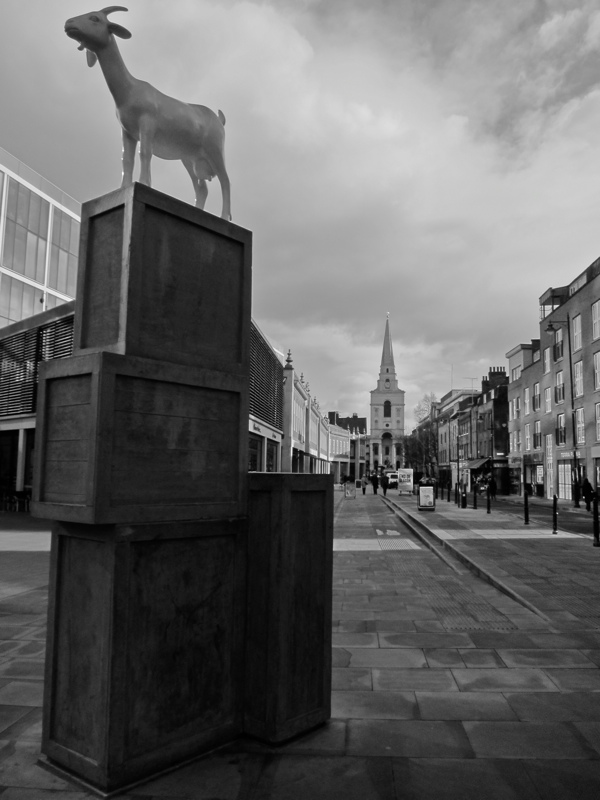
From Bishops Sq.

From Itsu Sushi, Broadgate.

From Shoreditch High St.

From Quaker St.

From the Truman Brewery.

From Corbet Place.

From Hanbury St.

From Fournier St.

Please get in touch if you have a remarkable view of Christ Church from your window or roof, whether near or far, so that I may take a second set of pictures.
You might also like to read about
The Secrets of Christ Church Spitalfields
or take a look at these views of Christ Church
or visit Nicolas Hawksmoor, Architect of the Imagination at the Royal Academy.
Meet the Curry Chefs of Brick Lane


Photographs copyright © Jeremy Freedman
Originally published by Spitalfields Life, Jeremy Freedman’s portraits of The Curry Chefs of Brick Lane are to be shown at Rich Mix, Bethnal Green Rd, from 23rd February until 31st March. Learn more about events accompanying the exhibition including a competition and curry cook-off here
You may like to read about
William Marshall Craig’s Itinerant Traders
The latest wonder in my ongoing exploration into the innumerable prints of the “Cries of London” published over the centuries is William Marshall Craig’s Itinerant Traders of London in their Ordinary Costume with Notices of Remarkable Places given in the Background from 1804. A portrait artist who exhibited at the Royal Academy between 1788 and 1827, Craig was appointed painter in watercolours to the queen. This set of prints was discovered yesterday at the Bishopsgate Institute, bound into the back of a larger volume of “Modern London” published in 1805, and the vibrancy of their pristine colours suggests they have never been exposed to daylight in two centuries.

Hair brooms, hearth brooms, brushes, sieves, bowls, clothes horses and lines and and almost every article of turnery, are cried in the streets. Some of these walking turners travel with a cart, by which they can extend their trade and their profit, but the greater number carry the shop on their shoulders, and find customers sufficient to afford them a decent subsistence, the profit on turnery being considerable and the consumption certain. (Shoreditch Church, standing at the northern extremity of Holywell St, commonly called Shoreditch, is a church of peculiar beauty. It has a portico in front, elevated upon a flight of steps and enclosed with an iron railing, which is disgraced by a plantation of poplar trees.)

Baking & boiling apples are cried in the streets of the metropolis from their earliest appearance in sumer throughout the whole winter. Prodigious quantities of apples are brought to the London markets, where they are sold by the hundred to the criers, who retail them about the streets in pennyworths, or at so much per dozen according to their quality. In winter, the barrow woman usually stations herself at the corner of a street, and is supplied with a pan of lighted charcoal, over which, on a plate of tin, she roasts a part of her stock, and disposes of her hot apples to the labouring men and shivering boys who pass her barrow. (At Stratford Place, on the north side of Oxford St.)

Band boxes. Generally made of pasteboard, and neatly covered with coloured papers, are of all sizes, and sold at every intermediate price between sixpence and three shillings. Some made of slight deal, covered like the others, but in addition to their greater strength having a lock and key, sell according to their size, from three shillings and sixpence to six shillings each. The crier of band boxes or his family manufacture them, and these cheap articles of convenience are only to be bought of the persons who cry them through the streets. (Bibliotheque d’Education or Tabart’s Juvenile Library is in New Bond St.)

Baskets. Market, fruit, bread, bird, work and many other kinds of baskets, the inferior rush, the better sort of osier, and some of them neatly coloured and adorned, are to be bought cheaply of the criers of baskets. (Whitfield’s Tabernacle, north of Finsbury Sq, is a large octagon building, the place of worship belonging to the Calvinistic methodists.)

Bellows to mend. The bellows mender carries his tools and apparatus buckled in a leather bag to his back, and, like the chair mender, exercises his occupation in any convenient corner of the street. The bellows mender sometimes professes the trade of the tinker. (Smithfield where the great cattle market of London is held, on which days it is disagreeable, if not dangerous to pass in the early part of the day on account of the oxen passing from the market, on whom the drovers sometimes exercise great cruelty.)

Brick Dust is carried about the metropolis in small sacks on the backs of asses, and is sold at one penny a quart. As brick dust is scarcely used in London for any other purpose than that of knife cleaning, the criers are not numerous, but they are remarkable for their fondness and their training of bull dogs. This prediliction they have in common with the lamp lighters of the metropolis. (Portman Sq stands in Marylebone. In the middle is an oval enclosure which is ornamented with clumps of trees, flowering shrubs and evergreens.)

Buy a bill of the play. The doors of the London theatres are surrounded each night, as soon as they open, with the criers of playbills. These are mostly women, who also carry baskets of fruit. The titles of the play and entertainment, and the name and character of every performer for the night, are found in the bills, which are printed at the expense of the theatre, and are sold by the hundred to the criers, who retail them at one penny a bill, unless fruit is bought, when with the sale of half a dozen oranges, they will present their customer a bill of the play gratis. (Drury Lane Theatre, part of the colonnade fronting to Russell St, Covent Garden.)

Cats’ & dogs’ meat, consisting of horse flesh, bullocks’ livers and tripe cuttings is carried to every part of the town. The two former are sold by weight at twopence per pound and the latter tied up in bunches of one penny each. Although this is the most disagreeable and offensive commodity cried for sale in London, the occupation seems to be engrossed by women. It frequently happens in the streets frequented by carriages that, as soon as one of these purveyors for cats and dogs arrives, she is surrounded by a crowd of animals, and were she not as severe as vigilant, could scarcely avoid the depredations of her hungry followers. (Bethlem Hospital stands on the south side of Moorfields. On each side of the iron gate is a figure, one of melancholy and the other of raging madness.)

Chairs to mend. The business of mending chairs is generally conducted by a family or a partnership. One carries the bundle of rush and collects old chairs, while the workman seating himself in some convenient corner on the pavement, exercises his trade. For small repairs they charge from fourpence to one shilling, and for newly covering a chair from eighteen pence to half a crown, according to the fineness of the rush required and the neatness of the workmanship. It is necessary to bargain for price prior to the delivery of the chairs, or the chair mender will not fail to demand an exorbitant compensation for his time and labour. (Soho Sq, a square enclosure with shrubbery at the centre, begun in the time of Charles II.)

Cherries appear in London markets early in June, and shortly afterwards become sufficiently abundant to be cried by the barrow women in the streets at sixpence, fourpence, and sometimes as low as threepence per pound. The May Duke and the White and Black Heart are succeeded by the Kentish Cherry which is more plentiful and cheaper than the former kinds and consequently most offered in the streets. Next follows the small black cherry called the Blackaroon, which is also a profitable commodity for the barrows. The barrow women undersell the shops by twopence or threepence per pound but their weights are generally to be questioned, and this is so notorious an objection that they universally add “full weight” to the cry of “cherries!” (Entrance to St James’ Palace, its external appearance does not convey any idea of its magnificence.)

Doormats, of all kinds, rush and rope, from sixpence to four shillings each, with table mats of various sorts are daily cried through the streets of London. (The equestrian statue in brass of Charles II in Whitehall, cast in 1635 by Grinling Gibbons, was erected upon its present pedestal in 1678)

Dust O! One of the most useful, among the numberless regulations that promote the cleanliness and comfort of the inhabitants of London, is that which relieves them from the encumbrance of their dust and ashes. Dust carts ply the streets through the morning in every part of the metropolis. Two men go with each cart, ringing a large bell and calling “Dust O!” Daily, they empty the dust bins of all the refuse that is thrown into them. The ashes are sold for manure, the cinders for fuel and the bones to the burning houses. (New Church in the Strand, contiguous to Somerset House and dividing the very street in two.)

Green Hastens! The earliest pea brought to the London market is distinguished by the name of “Hastens,” it belongs to the dwarf genus and is succeeded by the Hotspur. This early pea, the real Hastens, is raised in hotbeds and sold in the markets at the high price of a guinea per quart. The name of Hastens is however indiscriminately used by all the vendors to all the peas, and the cry of “Green Hastens!” resounds through every street and alley of London to the very latest crop of the season. Peas become plentiful and cheap in June, and are retailed from carts in the streets at tenpence, eightpence, and sixpence per peck. (Newgate, on the north side of Ludgate Hill is built entirely of stone.)

Hot loaves, for the breakfast and tea table, are cried at the hours of eight and nine in the morning, and from four to six in the afternoon, during the summer months. These loaves are made of the whitest flour and sold at one and two a penny. In winter, the crier of hot loaves substitutes muffins and crumpets, carrying them in the same manner, and in both instances carrying a little bell as he passes through the streets. (St Martin in the Fields, the design of this portico was taken from an ancient temple at Nismes in France and is particularly grand and beautiful.)

Hot Spiced Gingerbread, sold in oblong flat cakes of one halfpenny each, very well made, well baked and kept extremely hot is a very pleasing regale to the pedestrians of London in cold and gloomy evenings. This cheap luxury is only to be obtained in winter, and when that dreary season is supplanted by the long light days of summer, the well-known retailer of Hot Spiced Gingerbread, portrayed in the plate, takes his stand near the portico of the Pantheon, with a basket of Banbury and other cakes. (The Pantheon stands on Oxford St, originally designed for concerts, it is only used for masquerades in the winter season.)
Images courtesy of Bishopsgate Institute
You may like to take a look at these other sets of the Cries of London
H.W.Petherick’s London Characters
John Thomson’s Street Life in London
Aunt Busy Bee’s New London Cries
Marcellus Laroon’s Cries of London
More John Player’s Cries of London
William Nicholson’s London Types
Francis Wheatley’s Cries of London
John Thomas Smith’s Vagabondiana of 1817
John Thomas Smith’s Vagabondiana II
John Thomas Smith’s Vagabondiana III
Thomas Rowlandson’s Lower Orders
At the Fruit & Wool Exchange

Opening in 1929, when the volume of imported produce coming through the docks more than doubled in the ten years after the First World War, the mighty Fruit & Wool Exchange in Spitalfields was created to maintain London’s pre-eminence as a global distribution centre. The classical stone facade, closely resembling the design of Nicholas Hawksmoor’s Christ Church nearby, established it as a temple dedicated to fresh produce as fruits that were once unfamiliar, and fruits that were out of season, became available for the first time to the British people.
After sixty years as a teeming warren of brokers and distributors, the building languished when the Fruit & Vegetable Market moved out from Spitalfields in 1991 and there were no wholesalers left to cross Brushfield St and supplement their supplies of British produce from the auctions at the Exchange. Since then, around sixty small businesses operated peaceably from the building which through its shabby grandeur reminded every visitor that it had once seen better days.
Yet it was only a matter of time before the notion of redevelopment arose, and when ambitious plans were revealed over a year ago for a huge new building to replace both the Exchange and the multi-story car park behind it – filling two entire blocks – a sense of disquiet was generated in Spitalfields, especially among those who remembered the uneasy compromises entailed in the rebuilding of the Market.
Few were convinced by the homogeneous box that was proposed to stand in place of the Exchange and many were disappointed when the creators of such mediocrity dismissed the current structure as of negligible architectural worth. In fact, the Commercial St end of the Exchange building closely matches the window structure and red brick of the eighteenth century houses in Fournier St, while the facade mirrors Christ Church itself. Since then, a revised proposal has been forthcoming which retains the Brushfield St frontage facing the Spitalfields Market but is far from being a design worthy to face Nicholas Hawksmoor’s masterpiece of English Baroque upon the opposite side of Commercial St.
Before the decision on the redevelopment is made by Tower Hamlets Council on March 6th and the resident businesses find they may have as little as six months to move, I went over for a look to savour the past glories of the City of London Fruit & Wool Exchange for myself.
Ascending from the grand entrance, a double staircase worthy of a ballroom in a liner or fancy hotel leads you up to the auction rooms. Built as the largest in the country, seating nearly nine hundred people, these magnificent panelled chambers were each the height of two storeys within the building. Fitted with microphones, which were an extraordinary innovation in 1929, possessing elaborate glass roofs that promised to simulate daylight – even on dark and foggy days – to best illuminate the fruit, they were served by high-speed hydraulic lifts to whisk samples of each consignment from the basement in the blink of an eye. Too bad that a recent fire, occurring since the redevelopment was announced, means they can never be visited again. Now the entrances to the most significant spaces which define this edifice are sealed with tape and off-limits for ever, while charred parquet flooring evidences the flames that crept out under the door.
Instead, I had to satisfy myself with a stroll around the empty top floor through centrally-heated corridors maintained at a comfortable temperature ever since the offices were all vacated two years ago. Everywhere I could see evidence of the quality of this building, from the parquet floors which extend through each storey, to the well-detailed brass fixtures and high-quality Crittall window frames that were still in good order. Within the building, hidden light-wells permit glass-ceilings to be illuminated by daylight upon each storey. Peering into these spaces reveals the paradoxical nature of this edifice which presents ne0-classicism to the street but adopts a vigorous industrial-modernism within, employing vast geometric shaped concrete girders to support the roof spans of the auction rooms below and arranging rows of narrow metal windows in close grids that evoke Bauhaus design.
From the top, I descended through floors of long windowless corridors lined with doors, where an institutional atmosphere prevailed, hushing the speech of those stepping outside their offices as they enter these strange intermediary spaces that belong to no-one any more. My special curiosity was to explore the basement which served as a refuge for the residents of Spitalfields during the Blitz. It was here that Mickey Davies, an East End optician known as “Mickey the Midget,” became a popular hero through his work in improving the quality of this shelter. It had gained the reputation as the worst in London, but later acquired the name “Mickey’s Shelter” in acknowledgment of his good work. As a shelter marshall, Mickey witnessed the overcrowding and insalubrious conditions when ten thousand people turned up at this basement which had a maximum capacity of five thousand. He organised medical care and recruited volunteers to undertake cleaning rotas. And, thanks to his initiative, beds and toilets were installed, and even musical entertainment arranged.
The vast subterranean network of chambers has been empty for twenty years now – gloomy, neglected and scattered with piles of broken furniture. Although partitions have been fitted to create storage rooms – where, mysteriously, Rupert Murdoch recently installed his archive – the Commercial St end of the building remains open and forlorn, with concrete pillars adorned by graffiti. Fruit packers marked off batches of produce in pencil on the wall here, and amused themselves by writing their names and making clumsy doodles. In this lost basement, it is still possible to imagine the world of Mickey Davies, where thousands once slept upon the floor while the city burned outside.
From Brushfields St, the City of London Fruit & Wool Exchange appears implacable – yet I discovered it contains a significant part of the hidden history of Spitalfields that will shortly be erased, to leave just an empty facade.


The central staircase, worthy of a ballroom in a liner or grand hotel.

One of several light wells, lined with Crittall windows and permitting daylight to reach lower storeys.


Looking out towards Crispin St from the rear of The Gun.

Washing room in the basement.

As many as ten thousand people slept here every night while taking shelter from the London Blitz.

Nineteen forties graffiti portrait from the basement.

The telephone exchange.

State of art auction room in 1929, lit by a glass ceiling offering “artificial daylight” on foggy days.

Fruit & vegetable auction

An entrance to the Auction Hall, now sealed permanently after a recent fire.


The broken pediment at the top of this frontage mirrors Nicholas Hawksmoor’s design of Christ Church.

The Exchange in 1929. It is proposed that only this frontage be retained in the redevelopment.

View of Christ Church from the top floor.
Learn more about the proposals for the City of London Fruit & Wool Exchange site here
Take a look at Mark Jackson & Huw Davies’ photography of the Spitalfields Fruit & Vegetable Market
Spitalfields Market Portraits, 1991
Night at the Spitalfields Market, 1991
Fruit & Vegetable auction photograph courtesy of Stuart Kira
Other archive images courtesy of Tower Hamlets Local History Library & Archives
On the Kingsland Rd

Brothers on the Kingsland Rd
In 2006, photographer James Pearson-Howes could not afford the rent in Shoreditch and so he moved to the Kingsland Rd, living in a tiny flat on the corner opposite where the new Haggerston Station is now. “Once I discovered the place and the people, I grew to love that road,” he admitted, “I can’t think of anywhere like it. There were Turks, Africans, White, Jewish – it was a hub of creativity and everybody got on.”
James discovered he had arrived at a time of change as major building work for the new East London Line commenced, promising a metamorphosis of this ancient thoroughfare following the line of Ermine St, the Roman road north from London through Spitalfields and across hunting grounds that were once the property of Henry VIII – the king referred to in the name Kingsland Rd.
“There was all this building work going on, so it was an instinctive response for me to record the transformation,” James recalled. “At that time, I made friends with Roy and we both shared a love of the road, so we met three times a week and walked up and down the road together. He told me the stories and I took the photographs.”
Ease and intimacy characterise these fluent images, taken by a photographer who has embedded themselves within the community they portray. And today, some of what is pictured has already gone – Lady Glitter and Pier One are no more – as Dalston changes from a scruffy neighbourhood where everyone can feel at home to live and let live, already becoming another fashionable destination where the rents go up and up and up.
“These were all shot on film. I always take my personal work using film, to trust what I’ve got.” James explained, revealing his preference for the discipline of analogue photography, “You shoot – then you wait and get your your photos back a few days later.” Yet there is a relaxed spontaneous quality shared by all James’ Kingsland Rd pictures, both reflecting his delight in the endeavour and speaking eloquently of the distinctive nature of the place portrayed. “I love street photography and I just wanted to get my teeth into it,” he confessed to me.

“This is my favourite image. A fashion shoot in Ridley Rd Market in front of a man selling fish.”

Ridley Rd Market, late afternoon.

“This gold shop in Dalston is still there.”

“These old boys always sit in the window of this cafe at Dalston Junction.”

Window shopping in Dalston.

Dog leaning out of a truck.

“This is String, a friend of Roy’s and the proprietor of Lady Glitter, a barber’s salon.”

At Lady Glitter.

String observes work on the new railway line and housing complex at the rear of Lady Glitter

The development nears completion.

Guitar girl.

Guitar boy.

“This lady always sat here.”

At “Manhattan” in Dalston, specialising in suits for African weddings.

At “Da Endz,” specialising in New Era hats.

“This girl wanted to show off her watch.”

“Gilbert & George eat dinner at Mangal in the Kingsland Rd every night. Gilbert takes a bus and George walks.”

“I liked this lady’s look with her earrings.”

Paloma Faith, rising pop star.

Jamie from the Klaxons at the laundrette.

Turkish bakers make yufka at Somine Restaurant.

“Sharma, a stylist, who has now opened her own nail bar – Wah Nails.”

“At Pier One, the club was painted all black with neons and day-glo, and they played predominantly Hip Hop and R’n’B.”

At Pier One.

A restaurant at the rear of a car wash.

“Halal grocery store by night, photographed from a passing bus.”

Sleeping by the Regent’s Canal.
Photographs copyright © James Pearson-Howes
You may also like to read these other Kingsland Rd stories


