
David Mason, Wilton’s Music Hall

When I arrived to meet David Mason yesterday afternoon in the bar at Wilton’s Music Hall, the only person sitting there was a man who looked so at home I imagined he must be the caretaker, not David. In fact, this was David, who grew up in the flat above Wilton’s when his father was caretaker in the nineteen fifties and – more than half a century after he moved out – he still feels comfortable in the old place.
Although it was known as the Old Mahogany Bar when David’s family moved into four rooms up above in 1951, the building was not a music hall then but a Methodist chapel. “My father knew it had been a music hall,” David explained to me, “The story we were told was that Wilton’s was thought to be a place of debauchery, and one day three Methodists walking past were so shocked they bought tickets and kneeled down in front of the stage and prayed that it would one day be a place of worship – and, lo and behold, eighty years later the Methodists got it!”
Even in this incarnation, the old music hall was a place of wonder for a small child, granted free run of the building. “When I was eight, my father had to spend ten nights away in hospital. He said, ‘You’re the man of the house.’ and I had to go round with a torch in the dark checking all the locks at night. It was scary, I thought every single noise was someone creeping up on me,” David recalled affectionately, as we walked through the atmospheric empty theatre yesterday.
In 1951 when David was three, his younger brother and sister, John and Jean, were born unexpectedly as twins and the family could no longer live in two rooms in the Peabody Buildings in John Fisher St. His father, Harry, was offered number three Grace’s Alley by Mr Willis the minister in return for care-taking duties, stoking and lighting the boiler, laying out tables and chairs for prayer meeting and some occasional do it yourself, which included knocking up the little wooden cross for the altar. “My parents were married here in the Old Mahogany Bar,” David told me, gesturing around the empty bar where we sat, “He worked for the Port of London Authority as a docker in St Katherine’s Dock and his nan’s family were sugar bakers, they came from Ship Alley in Wellclose Sq – and my mother’s family came from Backchurch Lane.”
David went to St Paul’s opposite the music hall, a Church of England school presided over by Father Joe Williamson known as ‘Holy Joe.’ “He could walk into a fight in Cable St and kneel down and pray and they would stop brawling,” David assured me. The difference between the Methodism at the chapel and the Church of England practices at school was a source of bewilderment to David at an early age. “I was deeply confused, they covered their cross sometimes but we never did, and ours didn’t have a Jesus on it while theirs did. I asked one of the Methodist sisters why our cross did not have Jesus and she said, ‘We believe Jesus rose from the cross,’ but I think the real reason was that my dad made the cross and he couldn’t carve.”
In those days, the London Docks were still active and Wapping was scattered with bombsites where, as a child, David was free to wander. He remembers ships chandlers and mapmakers in the surrounding streets that were inhabited by a closely-knit community including significant numbers of Greek, Maltese and Turkish people. Before the slum clearance programme, Wellclose Sq and Swedenborg Sq stood lined with shambolic old houses and connected by a warren of alleys, in which was Roy’s sweet shop that David remembers as the last place he spent a farthing.
“My dad said that before the war they used to have a book appreciation club and I remember going with him to a Jewish-owned record shop in Aldgate where he reminisced about the record appreciation society. They had a Boys’ Brigade, Scouts, Magic Lantern Shows and there were Methodist Union meetings where ministers from other religions came to explain their beliefs. When we moved in, there was a still a youth club and there were always old ladies sitting knitting and chatting, but during the fifties they had fewer and fewer prayer meetings and my dad had to open up less and less, until it died.”
“In 1959, we were given fourteen days notice to leave by the Methodists and nobody was willing to help.” David confessed to me, “My dad wasn’t a bible bashing type, he wasn’t overtly religious even, but he went to church all his life and he carried the soldier’s prayer in the pocket of his battledress jacket. So I think it hurt him after all this time to feel we were being thrown out. The upshoot was we ended up in three rooms belonging to the Port of London Authority near the Woolwich Ferry and that was the end of our contact with this place.”
At fourteen years old, David came back to get his eyes tested at the Royal London Hospital in Whitechapel and took a stroll alone down to Wapping to see what was going on at his former home, now owned by the GLC. “I rang the bell that said ‘Ring for caretaker’ but no-one answered so I turned to walk away and a gruff voice called, ‘Who are you? What do you want?’ I explained that I used to live there and I knew how many steps there were up to the flat, and he let me in, saying, ‘You really did live here, didn’t you?'” Since David left, the building had become a warehouse for rags, guarded by fierce dogs that were described to him by a friend as “all-stations.”
Returning in recent years to witness the re-opening of Wilton’s Music Hall and visit the space he once knew intimately has been an equivocal experience for David, as he confided to me, “The first time I came back there was a lot of strings being pulled in my heart. I never thought I’d stand in the Old Mahogany Bar in the Methodist chapel and have a glass of wine to drink!” These days, David teaches Painting and Decorating at Barking and Dagenham College and now hopes to bring his students along to Wilton’s to repaint the old place one day, once the structural work is complete.
“I have only got happy memories here, we laughed all the time – but when I lived here there didn’t seem to be as much love for the place as there is now, even though it is in such a state” he concluded, “When I come back now it isn’t like the place I grew up in, it’s a foreign country. It wasn’t the best of places then, yet it did have something – you could call it soul.”

Wilton’s Music Hall was known as the Old Mahogany Bar when David grew up here in the fifties.

Davis’s parents, Anne & Harry Mason, were married in the Old Mahogany Bar at Wilton’s.

St Paul’s School Wellclose Sq where David went to school.

St Paul’s School viewed from the living room window at Wilton’s.

The infants class at St Paul’s photographed on the lawn outside Wilton’s – Miss Webb and Father Joe Williamson (known as Holy Joe) officiate. David sits in the front row directly to the right of the sign.

David’s mother and younger brother John on the roof of Wilton’s where they grew tomatoes and flowers.

David stands in the space once occupied by the flat where he grew up.

David with his mother and the twins in the living room at Wilton’s.

David sits by the fireplace of his former childhood flat. “We used to light this fire at Christmas and have fourteen relatives round – nan, uncles, aunts and cousins..”

David with his nan and the twins. “Her name was Elizer Wiegle and she was of German extraction, and used to attend the Lutheran Church in Alie St.”

David sits on the big staircase at Wilton’s.


Methodist activities at Wilton’s in the fifties.

David recalls reading the theatre’s foundation stone by torchlight with his father as a child.


John Claridge’s portrait of the caretaker at Wilton’s, 1964, after the theatre became a rag store.

Sarah Ainslie’s portrait of Frances Mayhew, current director at Wilton’s Music Hall.
Caretaker portrait copyright © John Claridge
Frances Mayhew portrait copyright © Sarah Ainslie
You may like to read my original story
The New Cries Of London, 1803
This battered little chapbook of 1803 with its intricate hand-tinted engravings of street-sellers – that I found in the Bishopsgate Library – is the latest wonder to be uncovered in my investigation into popular prints of The Cries of London down through the ages. Even within the convention of these images, each artist brought something different and these plates are distinguished by their finely drawn figures – including some unexpected grotesques that appear to have stepped from the pages of a fairy tale, imparting an air of mystery to these everyday scenes of street trading.


Milk below!

New Mackerel!

Dust Ho!

Chairs to mend!

Hot cross buns!

Any work for the tinker?

Cherries, threepence a pound!

Flowers for your garden!

Green cucumber!

Buy my watercress!

Sweep! Sweep!

Ground Ivy!

Green hastings!

Scarlet strawberries!

Primroses!

Past ten o’clock!
Images courtesy Bishopsgate Institute
You may also like to take a look at these other sets of the Cries of London
Geoffrey Fletcher’s Pavement Pounders
William Craig Marshall’s Itinerant Traders
H.W.Petherick’s London Characters
John Thomson’s Street Life in London
Aunt Busy Bee’s New London Cries
Marcellus Laroon’s Cries of London
More John Player’s Cries of London
William Nicholson’s London Types
Francis Wheatley’s Cries of London
John Thomas Smith’s Vagabondiana of 1817
John Thomas Smith’s Vagabondiana II
John Thomas Smith’s Vagabondiana III
Thomas Rowlandson’s Lower Orders
More of Thomas Rowlandson’s Lower Orders
Taking Cover

Why does the rain make me want to sleep? When I hear the drumming of raindrops on my roof, it inspires an urge within me to climb under the covers and sleep, as if I were some hibernatory creature. Even as a child, the rain induced this effect and my parents would sometimes find me peacefully asleep on the sofa in the late afternoon, after returning from school in the drizzle.
On Saturday last, the clear sky presented a credible impression of a summer’s day, but the rain which came down that evening combined with the chill of the night to signal that another season had arrived. In the Sunday market, traders sheltered under canopies and peered out in disappointment at the few customers in the wet streets. Returning from Columbia Rd, cold and damp, I knew I had reached the moment in the year to take out my quilt and put it on the bed in preparation for the coming winter.
After a few judicious repairs, the quilt was ready to serve me for another year, with its glowing woollen colours and satisfying weight, lying on top of the covers to provide emotional and thermal insulation when I lie in the dark listening to the rain. I have written before of how I made this quilt by sewing old tapestries together, in commemoration of my mother in the months after her death – but now it has an age of its own and this receptacle for memory has acquired its own memories too.
There is a sleight of hand – substituting one emotion for another – with my quilt whereby, when my eye falls upon it, I am delighted by its beauty just I am reminded of the one I miss. Similarly, my cat dates from the time when my father died and my pleasure in the antics of this innocent creature colours my sense of loss. Thus, both my quilt and the cat that sleeps upon it serve as antidotes to the sense of enveloping darkness that grief can bring.
As soon as I had spread out the quilt this week, my old cat climbed onto it and curled up to sleep in exactly the same place as he has done each year, prescient of his own position in the order of creation, between the fearsome lion and the docile domestic feline. The pictures upon the quilt have grown familiar to me in recent years, as the last images I see before I sleep and the first I spy upon waking. And so I thought I would photograph some favourites to introduce you to the cast of beloved characters which appear each winter like the cast of a pantomime – the fisherman, the owl, the horse, the bullfighter, the falconer, the dairymaid, and the rest. They have returned to watch over me when the rain induces an irresistible urge to sleep.

This old fisherman was the first tapestry I found.

This is a unique tapestry, not from a kit like the others but copied from an original painting.

This cat dates from the nineteen thirties.

This owl is a favourite.

Notice the detailed stitching on the lion’s face.

These butterflies came from Florida.

This tapestry came from Sri Lanka.


A church in the mountains.


The falconer.

The Angelus from the painting by Millet.

Lowry rendered as a tapestry.


Birds from the Czech Republic.

Vermeer rendered as a tapestry.

You may like to read the original story of
Just Another Day With John Claridge

Cobb St, Spitalfields 1966
One morning in 1966, photographer John Claridge met these four men working in Cobb St, Spitalfields. “They were bloody silly,” recalled John fondly half a century later, “and there’s not enough of that in this world.” It was John’s way of introducing this set of pictures to me, published here for the first time, which he entitles“Just Another Day.”
“They were good people – full of fun – and this picture was nice to take, it has a warmth to it.” he added, upon contemplation of the image. And, if there is a common quality among these pictures, it is an open-hearted delight in the quotidian, or as John puts it –“The daily things that people do, going to work, stopping at the corner, visiting the shops.”
Where others might find only the mundane, John sees the poetry of the human condition. There may be endless sleet in Spitalfields, freezing fog in Victoria Park, and the passengers are eternally falling asleep on the early train out of Upton Park, yet John always reveals the joy and the humanity of his subjects. A generous spirit informs his photographs.
“Some of these pictures are of life drifting by,” John informed me, “because there are gentler ways of seeing the world than the obvious.”

Cup of tea, Spitalfields 1966.

Kosher butchers, Bethnal Green 1962 – “It wasn’t very big and it did have a certain smell to it.”

The cap, Spitalfields 1982 – “I love the things you don’t know as well as the things that are explained.”

Four men, Spitalfields 1982 – “You could create your own story with that.”

The baker at Rinkoffs, Vallance Rd, Bethnal Green 1967 – “Having a cup of tea and enjoying a breath of fresh air as the light’s coming up.”

Rinkoffs, Bethnal Green 1967

Breaker’s yard, E16 1975 – “I was talking to her dad and she just wandered off and got in the car.”

Feeding the birds in Victoria Park, E3 1962 – “there was ice on the lake.”

Passing the graveyard, 1970s

Bridge repair, E3 1960s

The crane, E16 1975 – “I printed this photo for the first time last week.”

SOS motors, Spitalfields 1982

Sewer Bank, Plaistow 1960s – “Where the kids used to go on their bikes and I’d take my scrambler. The craters were fantastic, it was a different kind of playground.”

In Plaistow, 1961 – “Just down the road from where I lived. It certainly has a lot of charm to it, look at how little traffic there is. That could be my dad on the bike, coming back from the docks.”

Station stairs, Upton Park 1963 – “Sometimes I met my mum here after school, when she was coming back from Bow where she worked as machinist making shirts.”

Station entrance, Upton Park 1963 – “I like stations, it’s that feeling you get of arriving on a film set.”

Leaving Plaistow early morning in winter, E13 1963 – “I had a motorbike but I liked going on the tube if the traffic was bad.”

The shed, Plaistow 1969 – “This was at the top of the street where I lived. He used to go round with that barrow and pick things up, and sell bits and pieces in that shed. A very nice man and a gentleman.”

End of the day, Spitalfields 1963.
Photographs copyright © John Claridge
You may also like to take a look at
Along the Thames with John Claridge
At the Salvation Army with John Claridge
A Few Diversions by John Claridge
Signs, Posters, Typography & Graphics
Views from a Dinghy by John Claridge
In Another World with John Claridge
A Few Pints with John Claridge
Some East End Portraits by John Claridge
When Rupert Blanchard Met Bruno Besagni

Rupert Blanchard & Bruno Besagni
Ten years ago, Rupert Blanchard found a beautiful plaster horse in the Coppermill Market in Cheshire St one Sunday morning. At once, the quality of the design and the expertise of the painting caught his eye. Rupert was further intrigued by the initials BB upon the reverse which he had seen before upon other plaster casts for sale in markets back in Swindon where he grew up. The seller of the horse was an old man who had received it new as a wedding present more than forty years ago and now he was divesting himself of his possessions.
It was the first of these horses that Rupert acquired and, in the intervening years, he collected more and more at the car boot sales and fairs where he finds the things that inspire his own work as a furniture maker and designer. So fond of these horses was Rupert that he displayed them proudly alongside his own work at exhibitions.
Imagine his surprise when he read my profile of Italian reproduction artist Bruno Besagni in these pages recently and recognised these plaster horses in their unpainted state in a photo of Bruno at his factory at Stratford, where he made casts in the sixties and seventies. Once I learnt of this discovery, I realised that it was my duty to introduce Rupert and Bruno, the young talent and the old master.
Rupert brought along the original horse that he found in Cheshire St which he keeps as a talisman. He carried it swathed in cloth and clutched it close like a baby, as we walked through the crowded streets of the Angel towards the terrace in the quiet Georgian square where Bruno has lived with his wife Olive for more than fifty years.
“Yes, it’s definitely one of mine!” declared Bruno, breaking into a radiant smile of recognition, as Rupert unwrapped the horse upon the living room carpet, “I painted this one.” A self-confessed Italian Cockney, Bruno trained as a painter at the Giovanni Pagliai factory in Great Sutton St in the nineteen forties, when Clerkenwell was still the centre of the Italian community and known as Little Italy. Pagliai came from Lucca, the centre of religious statuary making in Italy, and the training that Bruno received educated him in this age-old tradition. For centuries, plaster cast sellers from Lucca had plied their trade upon the streets of London selling ornaments in popular designs for the mass market.
Yet Bruno’s passion for his art let him down in business because he could never sell his works for a price that justified the time he spent perfecting them – while rivals produced cruder versions that sold equally well, sometimes pirating Bruno’s own designs. “I was doing all these lovely jobs,” said Bruno gesturing affectionately to his horse, “and I never made any money.”
Such was Bruno’s talent that he made the replica of the statue of St Mary of Mount Carmel that is carried in the Italian Parade in Clerkenwell each year and he has done all the repairs to the statues of saints in the Italian church over the years, replacing their fingers when they got broken off and keeping them all in good order. Today, plaster casts are no longer made as ornaments, resin has replaced plaster, which is now only used for internal architectural mouldings – making Bruno one of the very last to carry the particular skills of making and painting plaster figures.
The popularity of Bruno’s horses and his other designs allowed him set up his own factory in Stratford, only to come up against the very end of the culture. Crudely produced fairground imitations degraded the notion of cast ornamental sculpture. “It went down the tubes, I couldn’t sell one article once they went out of fashion,” confessed Bruno, “It was my dream, but one day we couldn’t sell horses any more.”
“I packed up the statues and went and did artistic work, ornamental plasterwork in hotels,” he recalled, looking back in regret,“but my love was in the statues.” Apart from a lamp in the corner of his sitting room and a mould for the bust of Shakespeare in the shed, Bruno forgot about his statues until last week when Rupert Blanchard appeared with the horse.
It was an extraordinary moment of mutual recognition. Rupert, a designer at the beginning of his career, was full of wonder to meet the legendary “BB” whose initials he had seen on innumerable plaster casts. Equally, Bruno was amazed in his eighty-seventh year to learn that someone with an informed eye had picked out his work from so long ago and understood the quality of it. It was evidence that Bruno was an artist in his chosen medium and the horse was a testament to his achievement in this devalued area of design.
“I didn’t do bad work did I?” said Bruno, thinking out loud as we made our farewells, “It was lovely to see that again, I’m so pleased I found someone who appreciates my work.”


The first lamp of Bruno’s that Rupert found ten years ago in Cheshire St.

Bruno’s factory in Stratford where he made the casts.
 Two horses by Bruno from Rupert’s collection.

Polly Benford restores the paintwork on one of Bruno’s horses.

A Bruno Besagni horse lamp displayed alongside Rupert Blanchard’s furniture at Midcentury Modern.

London street seller of plaster casts from Lucca drawn by John Thomas Smith in 1816.
Studio photographs copyright © Rupert Blanchard
John Thomas Smith image courtesy Bishopsgate Institute
You may like to read my original profiles
Bruno Besagni, Reproduction Artist
and his wife
Olive Besagni, Assistant Film Editor
and
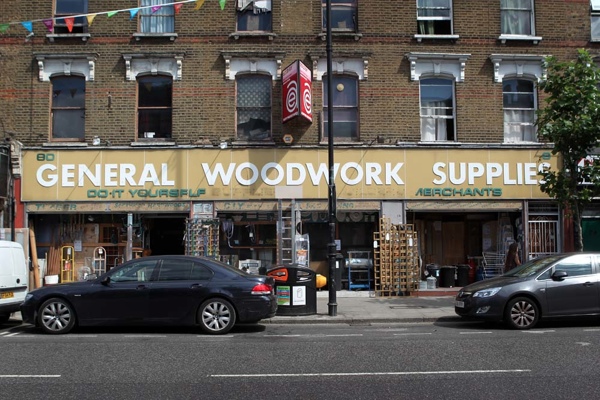
So Long, General Woodwork Supplies

Today, the proprietors of General Woodwork Supplies in Stoke Newington High St hand over the keys of the premises where they have been trading since 1946 to the new owner of the building, and thereby ends the story of a family business that began in Curtain Rd in Shoreditch with General Furniture Trade Supplies in 1896. Already, the handymen of the East End are grieving the loss of this celebrated hardware shop and builders’ merchant that stocked everything, where they cut timber to size, and where you could always get advice and even instructions on how to do it yourself.
General Woodwork Supplies was one of London’s great hardware shops, a temple to the art of do-it-yourself, with innumerable drawers stretching up to the ceiling that contained every possible fixture and fitting. The organisation of the interior had evolved over more than half a century through function and requirement, with two long counters facing you as you walked in the door and a capacious wood store leading off to the right. Every surface and corner was encrusted with a display of household paraphernalia and there were a myriad useful things hanging from above. And, like barmen in a Wild West saloon, the staff welcomed everyone with an understated swagger at General Woodwork Supplies, leaning forward across the counter to engage in banter.
From my own experience, I can vouch this was an invaluable place because they did not expect you to be an expert, showing indulgence while you explained what you needed to do in your own words. And invariably, they always supplied what you needed to do it where other shops failed.
Recognising that an endeavour of such admirable longevity and popular repute must not be allowed to slip un-noticed into history, I went up to Stoke Newington in the final days of General Woodwork Supplies and spoke with Jeff Bentley who has been running the business alongside his two brother-in-laws Michael and David Cohen in recent decades. Meanwhile, photographer Simon Mooney slipped in behind the counter to create his own elegy in pictures.
“My father-in-law Harry started General Woodwork Supplies in 1946. His father Mark Cohen was a master carpenter, he had a business in Curtain Rd – General Furniture Trade Supplies – which the old man established in 1896, supplying the furniture trade in Shoreditch. By the twenties, they were making cinema seats and supplying all the metalwork and brassware to go with them. But in World War II they took a direct hit, all they could do was salvage the stock and put it in storage. And Mark retired then. My father-in-law was in the fire service and since he had a lot of spare time, he used to make toys during the day. Then, after the war, Harry had a workshop with his brother Morry, doing distressed furniture and making it look antique for the Americans. Yet Harry wanted to open a shop, he was in this late twenties and his old man was in his sixties, and meanwhile Morry went off the work as a cabinet maker, he was more skilled.
Harry started off at 120 Stoke Newington Rd for a short time, selling ironwork and brassware, until the building was compulsorily purchased by the council to build flats. He and his wife Dora had three little children by then – David born in 1937, Rita born in 1941 and Michael born in 1946 – and they started off with very small beginnings. He managed to obtain a licence from the Board of Trade to deal in timber, and because of his connections in the business he was able to obtain hardwood, but it was a struggle and they really worked hard.
He rented 78 Stoke Newington High St and he sold some of the salvaged stock from Curtain Rd, he did whatever he could to earn a crust. He made things. He would make box pelmets to order and go into people’s homes to fit them, and that was the mainstay of his trade. His son David went into the airforce for a couple of years before joining the family business. Then, David had an accident and cut a finger off, so young Michael got a dispensation to leave school and work with him at fourteen years old. They employed people and grew the business, and the shop next door became available and they expanded into it. In 1947, they bought the freehold in number 78 and then the freehold of 80 became available too and later 76, and they bought both. During this time, Harry had the foresight to take any job. He said, ‘I can do it,’ knowing he did not have the equipment, but over the years he expanded and bought machinery. It was the cart before the horse.
People started to do work themselves in the mid-fifties. Labour was still cheap but in sixties when it became expensive everyone began to turn their hands to doing things themselves. And, by the late sixties and early seventies, everything went ‘contemporary’ with clean lines and people wanting to get rid of mouldings and features. Rather than replacing panelled doors, we would cut a piece of hardboard to size and they would pin it onto the door and create a modern flush door. They would cut off newel posts and box in banisters to hide the spindles, and this continued throughout the seventies. We got a good reputation for quality things people wanted, we could produce the pieces of wood to size and they could do it themselves. Harry was into specialist hardwoods and we could make skirting and mouldings to order. We started a mail order business and sold timber all over the world. The machines were working all hours of the day!
After property in Islington got too expensive, we got the overflow down here. They were gentrifying, and what we found was that these large houses, which after the war had been converted into flats, were being returned to single houses and we started making the mouldings to fit back to restore them to what it was previously.
I joined the business in 1968. I was a television engineer and I worked in retail selling televisions, and I had been doing that for ten years. When I got married, I was invited to join the family firm. There wasn’t actually a gun put to my head, but it seemed the thing to do and they were welcoming. I had no formal woodwork training apart from what I learnt at school and the rest I picked up as I went along. My father-in-law was the boss and, as he got older, Harry decided that his youngest, Michael, was most adept at business and asked him to handle the day-to-day running, while David leaned towards machinery and he took care of that side of things. I fitted in doing what I was told, most of my time was spent with customers. But everybody knew everything, so we could all cover for each other.
Harry died in February 1991, and he came into the shop regularly until January of that year. All this time, his wife Dora – who is now ninety-nine years old – was in charge of the book-keeping side of the business. My wife gave up her work as a legal secretary when our first child was born, but when our second was two or three, she decided to go and help her mum do the book work. Then Michael got married and, after their little girl was born, his wife joined the other two women doing the books between the three of them, and that’s how things were done.
Now, David is seventy-five, I am seventy-three and Michael is sixty-seven, and the thought of the business going into other hands without us is something we would not want. I have a house that’s been neglected for fifteen years and needs some tender loving care, and I shall try to do it myself. “


Michael Cohen


David Cohen


Jeff Bentley


“Stokey will bloody miss you, it will go down hill!” – “What will we do without you?”

“Good Luck to the three of U” – “Worst news I heard all month! No it can’t be true” – “Thankyou for the help” – “So sad” – ” You will be missed!”
Photographs copyright © Simon Mooney
You might also like to read about these other hardware stores which remain open
London Calling

Click to enlarge Bob & Roberta Smith’s painting
Running in the gallery at Eleven Spitalfields until 26th October, London Calling is a joint exhibition by two artists who are husband and wife, Jessica Voorsanger and the artist known as Bob & Roberta Smith. Both have lived in the East End for the past twenty-two years, since they were married, but they came very different paths to get here and the contrast between their work in this exhibition reveals their complementary relationships to London.
New Yorker, Jessica Voorsanger, first came to London when she was five and ate banana ice cream every day, but what she remembers most vividly was going to Madame Tussauds and talking to an old lady on a bench who turned out to be a waxwork. This same mixture of affection for London landmarks, coloured with a fascination for celebrity and underscored by surrealism, informs her intricate collages. Taking pages from an old tourist souvenir book entitled ‘This is London,’ Jessica has superimposed the faces of famous people upon familiar scenes, creating a bizarre effect worthy of Max Ernst. In Jessica’s work, the mythic landscapes of Central London become the location of collective dreaming, alluring and mysterious.
Bob & Roberta Smith‘s painting above is also inspired by a personal memory of London, that of coming to the East End for an Anti-Nazi march in the late seventies, and of his father recalling the Battle of Cable St. “The East End is the most vibrant, fought-over piece of London with people always coming and going. I grew up in Wandsworth and there was none of that life in West London. I find it very exciting here.” Bob admitted to me, tipping his cap to express his enthusiasm. For the last seventeen years, Bob has taught at the Cass School of Art in Aldgate, cycling along the Bow Rd from Leytonstone where he and Jessica live. And it is this experience which informs his desire to bring back the trams, a pipe dream turned ultimatum graven in his trademark skew-whiff lettering, lovingly painted with ‘One Shot’ signwriting enamel in exuberant colours upon some scruffy old boards picked up in a skip.
“I want to re-invent Whitechapel by bringing back the trams. The tram is such a great piece of design and it was green, and the Bow Rd is living hell. My dream would be to see it lined predominantly with windmills, lavender for the bees, poplar trees and cycle tracks, and there’s no reason why it can’t happen.” Bob assured me, exchanging a complicit smile with Jessica. And I was persuaded.

Rebuild the Bow Rd tram.

British Museum

Imagine the Mile End of the future.

Guildhall.

The replacement for the Routemaster bus.

Belgrave Sq.

The re-opening of the Whitechapel Gallery.

Westminster.

Piccadilly Circus.
Paintings copyright © Bob & Roberta Smith
Collages copyright © Jessica Voorsanger
LONDON CALLING runs until 26th October, more information from Eleven Spitalfields.
MAKE YOUR OWN DAMN ART, a film about Bob & Roberta Smith is being shown at the Curzon Soho this Saturday 22nd September.
Jessica Voorsanger is contributing the imagery for Chapter 22 in MOBY DICK – THE BIG READ, an online audio version of Moby Dick.
Jessica Voorsanger and Bob & Roberta Smith will be leading a walking tour from Eleven Spitalfields on Sunday 14th October.


