
David Garrick at Goodman’s Fields Theatre

“Have mercy, Heaven” – David Garrick as Richard III
This modest Staffordshire figure of c.1840 upon my dresser illustrates a pivotal moment in British theatre, when David Garrick made his debut aged twenty-four as Richard III at Goodman’s Fields Theatre in Aldgate on Monday 19th October 1741. Based upon William Hogarth’s painting, it shows Garrick in the momentous scene on the night before the battle of Bosworth Field when those Richard has killed appear to him in a dream foretelling his death and defeat next day.
The equivocal nature of the image fascinates me, simultaneously incarnating the startling ascendancy of David Garrick, a new force in the British theatre who was to end up enshrined in Westminster Abbey, and the sudden descent of Richard III, a spent force in British monarchy who – if we are to credit the recent discovery – ended up buried in a car park in Leicester. You can interpret the gesture of Garrick’s right hand as attention seeking, inviting you to “Look at my acting” or, equally, it can be Richard’s defensive move, snatching at the air with fingers stretched out in horror. It is, perhaps, both at once. Yet my interest is in Garrick and how he became an overnight sensation, introducing a more naturalistic acting style to the London stage and leading the Shakespearean revival in the eighteenth century. And it all started here in the East End, just a mile south of Shakespeare’s first theatre up the road in Shoreditch.
Garrick’s family were Huguenots. His grandparents fled to London in 1685 and David was born in 1717 as the third of five children while his father Captain Garrick was travelling the country with a recruiting party. Suitably enough, at the age of eleven, David played the part of Kite in George Farquhar’s The Recruiting Officer. Then, in 1737, since there was no money to pay for university, David and his literary classmate Samuel Johnson left their school in Lichfield to walk to London and seek their fortunes. But the sudden death of Captain Garrick within a month delivered an unexpected legacy that permitted David to set up a wine business in the Strand with his brother Peter.
In that same year, the Licensing Act closed all the playhouses in London except Drury Lane and Covent Garden, yet the management of the unlicenced Goodman’s Fields Theatre managed to get a dispensation to present concerts. Far enough east to avoid the eye of the Lord Chamberlain, they bent the rules with posters declaring concerts – even if the performances they advertised were actually plays. Thus Richard III is advertised as a “A concert of vocal and instrumental music” at “the late theatre in Goodman’s Fields.” David Garrick’s name as the leading actor is not given, he is merely referred to as “A GENTLEMAN (Who never appeared on any stage)” – a common practice at this theatre.
Next day, the London Post & General Advertiser reported that Garrick’s “Reception was most extraordinary and the greatest that was ever known upon such an occasion.” And he wrote to his brother Peter immediately, quitting the wine business,“Last night, I play’d Richard ye Third, to ye Surprize of Every Body & as I shall make near £300 p Annum by It & as it is really what I doat upon I am resolv’d to pursue it.”
Garrick continued playing Richard throughout his career, essaying the role as many as ninety times, and this account written years later for The Gentlemen’s Magazine may give us some notion of his performance. “His soliloquy in the tent scene discovered the inward man. Everything he described was almost reality, the spectator thought he heard the hum of either army from camp to camp. When he started from his dream, he was a spectacle of horror. He called out in a manly tone, ‘Give me another horse.’ He paused, and, with a countenance of dismay, advanced, crying out in a tone of distress, ‘Bind up my wounds,’ and then falling on his knees, said in a most piteous voice, ‘Have mercy, Heaven.’ In all this, the audience saw the exact imitation of nature.”
By 27th November 1741, Garrick’s performance had turned into a phenomenon which all of London had to see, as The London Daily Post described, “Last night there was a great number of Persons of Quality and Distinction at the Theatre in Goodman’s Fields to see the Play of Richard the Third who express’d the highest Satisfaction at the whole Performance, several hundred Persons were obliged to return for want of room, the house being full soon after Five o’Clock.”
Yet the success that Garrick brought to the Goodman’s Fields drew attention to the unlicensed theatre – forcing its closure within six months by the authorities, encouraged by the managements of Drury Lane and Covent Garden who were losing custom to their East End rival. Meanwhile, Garrick considered his options and, after a triumphant summer season in Dublin, he walked onto the stage of Drury Lane as an actor for the first time on October 5th 1742 and he had found his spiritual home.
The myth of Garrick as the gentleman who stepped onto the stage, drawn magnetically by his powerful talent and declared a genius of theatre upon his first appearance, concealed a more complicated truth. In fact, Garrick had taken his first professional speaking role on the stage that summer in Ipswich, appearing under the name Lyddall. His own play, Lethe or Aesop in the Shades, had been produced at Drury Lane the year before. And, having played Harlequin in an amateur performance in the room above St John’s Gate in Clerkenwell, he took over at Goodman’s Fields Theatre one night when the actor performing the role became sick. So Richard III was far from Garrick’s first time in front of an audience, although it was the moment he chose to declare his talent, and it is likely that he made significant preparation.
Whenever I look at my Staffordshire figure of Garrick, whether he appears to be waving joyfully or reaching out in despair at the universe is an unfailing indicator of my state of mind. Ironically, Garrick’s monument in Westminster Abbey follows a similar design with a tent rising to a central apex, surrounding an effigy of the great actor making his final curtain call, yet here the proud gesture is entirely unambiguous, he’s saying “Look at me!”

William Hogarth’s painting of David Garrick as Richard III, 1745.

The playbill for David Garrick’s debut at Goodman’s Fields Theatre.

The Goodman’s Fields Theatre, Ayliffe St.

William Hogarth’s painting of The Beggar’s Opera by John Gay, performed as the closing production at Goodman’s Fields Theatre on May 27th 1742.

David Garrick’s monument in Westminster Abbey is to be seen on the top right of this glass slide.

An eighteenth century terrace in Alie St, formerly know as Ayliffe St.

Goodman’s Fields today.
Watercolour of Goodman’s Fields Theatre copyright © Victoria & Albert Museum
Glass slide of Garrick’s monument copyright © Bishopsgate Institute
You may also like to read about
Fire At Crescent Trading

Philip Pittack & Martin White, cloth merchants – “We’re destroyed here!”
“A lifetime’s work has gone up in smoke” declared Philip Pittack, standing in the ruin of the Quaker St premises where he operated Spitalfields’ last cloth warehouse with his partner Martin White, until the recent conflagration. Just two years ago, Philip & Martin were forced to move their business, Crescent Trading, from the old stable across the road and they set themselves up again in their new premises with all their cherished fabrics neatly arranged in metal racks stretching up to the ceiling. Celebrated equally for their ceaseless repartee and their extraordinary bargains, this new calamity is a cruel blow for these two popular gentlemen who, between them, possess over one hundred and twenty years of experience in the trade.
When I received Philip’s emotional phone message, I went round next morning to discover the warehouse flooded and a hole in the roof at the rear where the fire started. Just the night before, Philip recalled – savouring the tender memory – he and Martin had been celebrating at the Mansion House in the City of London, where designs by a student they sponsored were the centrepiece of an evening promoting British wool. Yet next morning, Philip woke to news of a different sort.
“I got a call at 7:45 from the manager of City Electrical next door to say there had been a fire. ‘You’d better get down here,’ he said.” Philip told me, taking a seat in his office in spite of the pool of water covering the floor,“Obviously, I was in shock but I got dressed, jumped in the car and flew down here. Coming along Grey Eagle St, I saw the back door hanging off and smoke billowing out and I felt sick. The manager of City Electrical said, ‘You’ve had a big, big, fire.’ and I said, ‘I don’t want to go in,’ but he guided me through the entrance that had been cut in the door by the firemen and I fell to my knees. I couldn’t speak for an hour, I was so shocked. He gave me a glass of water but I couldn’t drink it I was shaking so much. Then Martin arrived and we just sat and looked at the devastation.”
Even in such circumstances, Philip & Martin managed to retain their dignity and their dapper appearances – Philip in a fine Guernsey sweater, and Martin swathed in a silk scarf and with his monocle swinging. “It took four of us all day to get the water out and we ruined our ordinary shoes, so Martin went over to Blackmans in Cheshire St but they had sold out of Wellingtons and he came back in these designer boots.” continued Philip, with Martin leaning on the doorpost modelling the fancy footwear in question, “Fortunately, by the time I got there the delivery of Wellington boots had arrived.”
An electric fire appears to be the cause of the fire which, mercifully, was restricted to the corner of the warehouse, although heat caused the roof to buckle and smoke filled the whole building, permeating the precious rolls of fine suitings and silks. “We’ve had customers coming in and they’ve gone out crying, saying, ‘What are we going to do now?'” Philip confessed to me, wringing his hands in contemplation of the question. This is the beauty of Crescent Trading. There is a joyous rapport that exists between Philip & Martin and the fashion students and young designers who come to discover fabrics and be inspired, delighting in the knowledge and experience on offer that is always dispensed with wit and levity. It is a human exchange that is cultural as much as it is commercial, and it makes all parties happy.
Facing such a disaster at this point in their careers, many would expect Philip & Martin to retire. Yet I am delighted to report that their spirit is stronger than this. Both worked a lifetime as cloth merchants and come from families that have been in the trade for generations. As soon as it can achieved, they plan to repair the building, clean out the premises and restock. As the last cloth warehouse in Spitalfields, a place that for centuries was filled with cloth warehouses, we need them to carry the living history of the textile industry here.
“We’ve been knocked down, but we will get up again and we’ll be back,” Martin assured me.


Martin White “I could easily get depressed but I’m not a miserable person.”

Philip Pittack – “I was in a terrible state for three days.”


Philip & Martin in happier times.
If you would like to buy any of Crescent Trading’s stock of fabric call 0207 377 5067
You may like to read my earlier stories about Crescent Trading
The Pubs Of Old London

The Vine Tavern, Mile End
I cannot deny I enjoy a drink, especially if there is an old pub with its door wide open to the street inviting custom, like this one in Mile End. In such circumstances, it would be affront to civility if one were not to walk in and order a round. Naturally, my undying loyalty is to The Golden Heart in Commercial St, as the hub of our existence here in Spitalfields and the centre of the known universe. But I have been known to wander over to The Carpenters’ Arms in Cheshire St, The George Tavern in Commercial Rd and The Grapes in Limehouse when the fancy takes me.
So you can imagine my excitement to discover all these thirst-inspiring images of the pubs of old London among the thousands of glass slides – many dating from a century ago – left over from the days of the magic lantern shows given by the London & Middlesex Archaeological Society at the Bishopsgate Institute. It did set me puzzling over the precise nature of these magic lantern lectures. How is it that among the worthy images of historic landmarks, of celebrated ruins, of interesting holes in the ground, of significant trenches and important church monuments in the City of London, there are so many pictures of public houses? I can only wonder how it came about that the members of the London & Middlesex Archaeological Society photographed such a lot of pubs, and why they should choose to include these images in their edifying public discourse.
Speaking for myself, I could not resist lingering over these loving portraits of the pubs of old London and I found myself intoxicated without even lifting a glass. Join me in the cosy barroom of The Vine Tavern that once stood in the middle of the Mile End Rd. You will recognise me because I shall be the one sitting in front of the empty bottle. Bring your children, bring your dog and enjoy a smoke with your drink, all are permitted in the pubs of old London – but no-one gets to go home until we have visited every one.

The Saracen’s Head, Aldgate

The Grapes, Limehouse

George & Vulture, City of London

The Green Dragon, Highgate

The Grenadier, Old Barrack Yard

The London Apprentice, Isleworth

Mitre Tavern, Hatton Garden

The Old Tabard, Borough High St

The Three Compasses, Hornsey

The White Hart, Lewisham

The famous buns hanging over the bar at The Widow’s Son, Bow

The World’s End, Chelsea, with the Salvation Army next door.

The Angel Inn, Highgate

The Archway Tavern, Highgate

The Bull, Highgate

The Castle, Battersea

The Old Cheshire Cheese, Fleet St

The Old Dick Whittington, Cloth Fair, Smithfield

Fox & Crowns, Highgate

The Fox, Shooter’s Hill

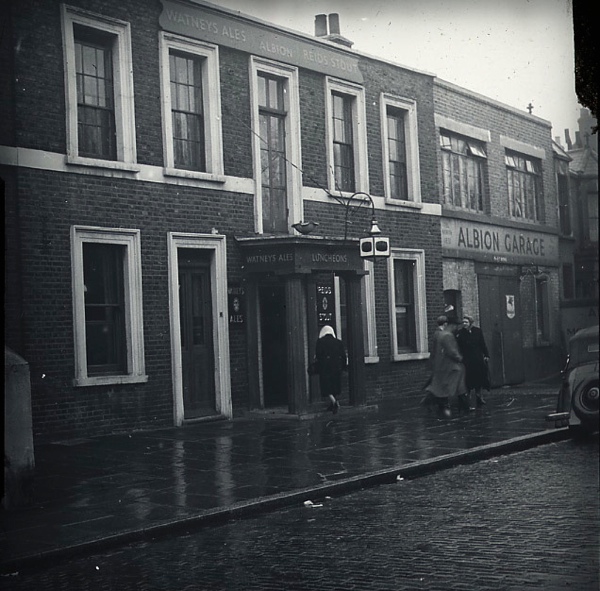
The Albion, Barnesbury

The Anchor, Bankside

The George, Borough High St
Images courtesy Bishopsgate Institute
You may also like to read about
Sandra Esqulant, The Golden Heart
The Carpenter’s Arms, Gangster Pub
Other stories of old London
At the Salvation Army in the Eighties

This candid set of pictures by photographer John Claridge, published here for the first time, were taken in the Salvation Army hostels in Whitechapel, Spitalfields and Hoxton during the eighties, but they are just a selection of those he has taken over the decades for this most famous of East End institutions. “I’m not a religious person but I think the Salvation Army do a fantastic job.” John admitted to me, “So I said, ‘yes,’ when I was asked to do some charity work for them and the relationship lasted over forty years.”
Observing this compassionate endeavour through changing times, John recognises an equilibrium in the nature of the care. “The Salvation Army is a constant world – though some of the causes may be different, nowadays more drugs than alcohol – the people are the same, there’s still the same need.” he told me, as we contemplated these pictures together.
John was determined to maintain the dignity of those he was photographing, despite their circumstances. “It’s not right to intrude on a person’s life but you have to be able say, ‘This is the world we live in,'” he assured me,“And there is a responsibility to try to do that right. Just because somebody has got into this situation, it doesn’t make them a bad person.”
“There’s some sad things here, but there is also a kind of survival and a little bit of humour.” he added, eager to emphasise the resilience of his subjects and create a tender intimacy with the viewer, “If you’re doing something for a charity, you don’t want to set things up. It’s documentary photography but you need people to feel it too. You need to people to think – you might end up here.”


Photographs copyright © John Claridge
You may also like to take a look at
Along the Thames with John Claridge
At the Salvation Army with John Claridge
A Few Diversions by John Claridge
Signs, Posters, Typography & Graphics
Views from a Dinghy by John Claridge
In Another World with John Claridge
A Few Pints with John Claridge
Some East End Portraits by John Claridge
A Walk With King Sour

King Sour DA MC also known as Yasin Ahmed
Descending the stairs from Clive Murphy’s flat above the Aladin Curry House, I passed through the street door and crossed the road to shake hands King Sour, the poet and singer, in his customary position on the corner of Brick Lane and Hanbury St. Yasin had just come from Friday prayers and, in the time before he started work at his uncle’s restaurant that evening, he offered to take me for walk around some of the places that are important to him in Spitalfields.
Even before we set out, the rain came down and so Yasin escorted me along Hanbury St and down a flight of stairs into kitchen of the Reema Balti House. In the warmth of the kitchen, away from the chill of the street, we found Yasin’s uncle, Shawkoth Ali, assiduously chopping spices while Mahfuz, the tandoori chef, rolled out chapatis expertly. For the past four months, Yasin has been working here as a waiter and doing pavement promotion.“There’s forty-seven restaurants here, so it’s very competitive,” he explained, “but I think it makes for a friendly atmosphere to offer people deals on the street.”
This summer, Yasin finished college where he has been studying customer services and then worked at restaurants belonging to cousins in Plymouth and Bournemouth before coming back to London. Recently, Yasin turned eighteen and besides playing the lead in a film for the Whitechapel Gallery – Give to me the life I love – he is going for jobs in hospital administration. “As well as my artistic life, I want a nine to five job,” he informed me shrewdly.
Once we had warmed up, it was time to brave the rain again, so we walked back down Hanbury St towards the Spitalfields Market – this is the direction that Yasin heads when he needs a little time to think, away from the chaos of Brick Lane. To the right, in Lamb St, is a small square with four park benches where Yasin takes refuge when he needs to regain his sense of proportion. “This is where I come when I am upset and need time to consider my problems.” he explained indicating his preferred place to sit, “I can look right into the market and watch the people walk by, and remind myself they all have problems too.”
On the far side of the market, we descended a flight of steps to view the medieval charnel house of St Mary Spital. A huge pane of glass permits you to look through into the ruins beneath the corporate offices looming overhead, and the glass is highly reflective, offering an image of yourself set against the ancient stonework – an effect that especially appeals to Yasin. “This is where I come to write poetry, because it is so different from the other side of Brick Lane, where the streets are full of devils.” he confided to me, widening his eyes, “Where I am from, you see devils all over the place, or should I say misunderstood angels?” We were right at the heart of the financial offices but there was no-one around in the mid-afternoon with the rain falling. Yasin discovered this extraordinary space, silent yet alive with poetic resonance, and he has made it his sanctuary. At ground level, we paused by the fountain and lily pond which the office workers pass by with disinterest, while Yasin stood in wonder, fascinated by the beauty of it.
In the rainy haze of dusk, we left Bishop’s Sq and walked around to White’s Row ascending in the lift to the top of the multi-storey car park. Situated on the wrong side of the congestion charge boundary, this empty car park offers a roof space that is visited by few. It is the ideal destination for Yasin to seek solitude. “I used to smoke up here on a hot day and reflect on life, ” he admitted fondly, as we stood peering down Commercial St and up to the vast spire of Christ Church overhead.
We discovered a startling contrast, crossing Commercial St and finding ourselves back in the narrow streets among the Curry Houses again. “The corner of Brick Lane and Hanbury St is my second home,” Yasin confessed to me, recognising that this is the centre of gravity in his personal landscape, “Brick Lane is a very comfortable place because there is a community where everyone welcomes each other. I’m staying here at least until I am twenty-five, but then I want to move out and give my parents a bit of peace!”

King Sour with his uncle Shawkoth Ali chopping spices and Mahfuz, the Tandoori chef, in the kitchen of the Reema Balti House.

In Lamb St

Yasin contemplates his reflection set against the ruins of the medieval charnel house.

At Bishop’s Sq.

Looking down Commercial St from the top of White’s Row car park.

King Sour DA MC, also known as Yasin Ahmed

Lucinda Rogers‘ drawing of King Sour performing at Rough Trade in the Truman Brewery
[youtube 0sPF9EHxLzo nolink]
You may also like to read my original profile of
At Clive Murphy’s Flat

Clive Murphy at his desk
Writer Clive Murphy has lived in his two room flat above the Aladin Curry House on Brick Lane since 1974 and filled it with an ever-growing collection of books, papers and memorabilia. But this weekend he is going to tidy up, and so I realised I must record Clive’s glorious disarray lest his environment lose any of its charisma in the process of getting organised.
When Clive saw the card in the window and rented this flat, it was above a draper’s, but that went long ago as the Bengali shops and curry houses filled the street. Then, in more recent years, the nightlife arrived, with clubbers and party animals coming to throng Brick Lane at all hours. Yet, throughout this time, Clive has lived quietly on the first floor, looking down upon the seething hordes of visitors and inhabiting a private world that is largely unchanged, save the accumulation of books and leaks in the ceiling.
Walking up the narrow staircase from the street, you come first to Clive’s kitchen looking back towards Hanbury St and Roa’s crane. At the front is a larger room looking onto Brick Lane which serves as Clive’s bedroom and study, lined with fine furniture barely visible under the tide of paper, and sitting beneath a water-stained ceiling that resembles a map of the world.
“I’ve had so may leaks and serious floods,” Clive recalled philosophically, “I have been sitting in the kitchen and water has come from the ceiling like from a tap. The landlord wanted to get me out because he could get seven times the rent, but when when the inspectors came round to assess the rent, I said, ‘Do you want to see my bathroom, it’s above the wardrobe?’ That brought my rent down.” And Clive raised his eyes to the tin bath on top of the wardrobe, chuckling in triumph.
Before he came to Spitalfields, Clive had already gained a reputation as a writer, with two novels and two volumes of oral history published. “When I first started writing, I’d write a short story and it’d be accepted, but then the pace slows down …” he confessed to me, casting his eyes over to the shelf dedicated to the volumes that comprise his life’s work and then gazing around at the piles of notebooks, files and packets of his books, mixed up with the contents of his library scattered higgedly-piggedly around the room.
“You see that suitcase,” he indicated, casually gesturing back to the tin bath which I now realised contained a battered case with a tag, “it has a novel in it.” I enquired about a stack of thirty old exercise books which caught my eye. “They are for the continuation of one of my novels, eventually I might read the whole lot and write a book” Clive assured me, turning to point out a selection of bibles on the shelf next to his bed. “My mother became a bit holy in old age, but that was because her friend seduced her into religion,” he informed me wearily, just in case I might assume they were his, “I think if people convert to Christianity in later life it’s a symptom they have lost their minds or need an emotional crutch to lean on.”
On the floor next to the bed was a wallpaper pattern book with newspaper cuttings pasted in it, the most recent of twenty-seven volumes that Clive has filled. “I collect all the things and people that interest me, either because they attract me or because I dislike them,” he explained, “I also keep all correspondence and note all phone calls.”
Visiting Clive’s flat is like entering his crowded mind, containing all the books he has read, all his own work and all the minutiae of life he has sought to preserve. It is the outcome of Clive’s infinite curiosity about life. “I used to walk all night and have lots of promiscuous encounters.” he confided to me, “I was an immigrant and I had to make friends. They say, ‘Don’t talk to strangers,’ but I think that’s very stupid advice because if I didn’t talk to strangers I’d have known nobody. I’m a very gregarious person, hence by talking to people at great length I got to know them.”
It was Friday afternoon and Clive was bracing himself for the approaching weekend and the ceaseless nocturnal crowds beneath his window.“It does keep you alert and alive and interested.” he admitted to me with characteristic good grace, “I don’t know anywhere else now and I have grown to love my little world. I like being in the hub of things.”

In Clive’s kitchen.


Note the wallpaper pattern books which Clive uses as scrap books for his press cuttings.


Clive at his desk overlooking Brick Lane.

“When the inspectors came round to assess the rent, I said, ‘Do you want to see my bathroom, it’s above the wardrobe?’ That brought my rent down.”


You may also like to read my original profile of Clive Murphy
Clive Murphy’s oral histories are available from Labour and Wait
and his ribald rhymes are available from Rough Trade
The Markets Of Old London

Clare Market c.1900
I never knew there was a picture of the legendary and long-vanished Clare Market – where Joseph Grimaldi was born – until I came upon this old glass slide among many thousands in the collection of the London & Middlesex Archaeological Society, housed at the Bishopsgate Institute. Scrutinising this picture, the market does not feel remote at all, as if I could take a stroll over there to Holborn in person as easily as I can browse the details of the photograph. Yet the Clare Market slum, as it became known, was swept away in 1905 to create the grand civic gestures of Kingsway and Aldwych.
Searching through this curious collection of glass slides, left-overs from the days of educational magic lantern shows – comprising many multiple shots of famous landmarks and grim old church interiors – I was able to piece together this set of evocative photographs portraying the markets of old London. Of those included here only Smithfield, London’s oldest wholesale market, continues trading from the same building, though Leather Lane, Hoxton Market and East St Market still operate as street markets, but Clare Market, Whitechapel Hay Market and the Caledonian Rd Market have gone forever. Meanwhile, Billingsgate, Covent Garden and Spitalfields Fruit & Vegetable Market have moved to new premises, and Leadenhall retains just one butcher selling fowl, once the stock-in-trade of all the shops in this former cathedral of poultry.
Markets fascinate me as theatres of commercial and cultural endeavour in which a myriad strands of human activity meet. If you are seeking life, there is no better place to look than in a market. Wherever I travelled, I always visited the markets, the black-markets of Moscow in 1991, the junk markets of Beijing in 1999, the Chelsea Market in Manhattan, the central market in Havana, the street markets of Rio, the farmers’ markets of Transylvania and the flea market in Tblisi – where, memorably, I bought a sixteenth century silver Dutch sixpence and then absent-mindedly gave it away to a beggar by mistake ten minutes later. I often wonder if he cast the rare coin away in disgust or not.
Similarly in London, I cannot resist markets as places where society becomes public performance, each one with its own social code, language, and collective personality – depending upon the nature of the merchandise, the location, the time of day and the amount of money changing hands. Living in Spitalfields, the presence of the markets defines the quickening atmosphere through the week, from the Thursday antiques market to the Brick Lane traders, fly-pitchers and flower market in Bethnal Green every Sunday. I am always seduced by the sense of infinite possibility when I enter a market, which makes it a great delight to live surrounded by markets.
These old glass slides, many of a hundred years ago, capture the mass spectacle of purposeful activity that markets offer and the sense of self-respect of those – especially porters – for whom the market was their life, winning status within an elaborate hierarchy that had evolved over centuries. Nowadays, the term “marketplace” is sometimes reduced to mean mere economic transaction, but these photographs reveal that in London it has always meant so much more.

Billingsgate Market, c.1910
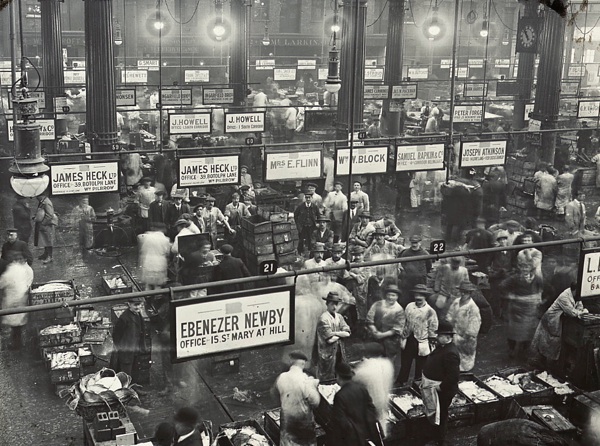
Billingsgate Market, c.1910

Whitechapel Hay Market c.1920 (looking towards Aldgate)

Whitechapel Hay Market, c.1920 (looking east towards Whitechapel)

Porters at Smithfield Market, c.1910

Caledonian Rd Market, c.1910

Book sale at Caledonian Rd Market, c.1910

Caledonian Rd Market, c.1910

Caledonian Rd Market, c.1910

Covent Garden Market, c.1920

Covent Garden Market, c.1910

Covent Garden, c.1910

Covent Garden Market, 1925

Covent Garden Market, Floral Hall, c.1910

Leadenhall Market, Christmas 1935

Leadenhall Market, c.1910

East St Market, c.1910

Leather Lane Market, 1936
 Hoxton Market, Shoreditch, 1910

Spitalfields Market, c.1930
Images courtesy Bishopsgate Institute
You may like to look at these old photographs of the Spitalfields Market by Mark Jackson & Huw Davies
Night at the Spitalfields Market
Other stories of Old London


