
Joanna Moore, Artist
Come and see Joanna Moore’s drawings at The Artists of Spitalfields Life opening at Ben Pentreath Ltd on Wednesday 7th November.
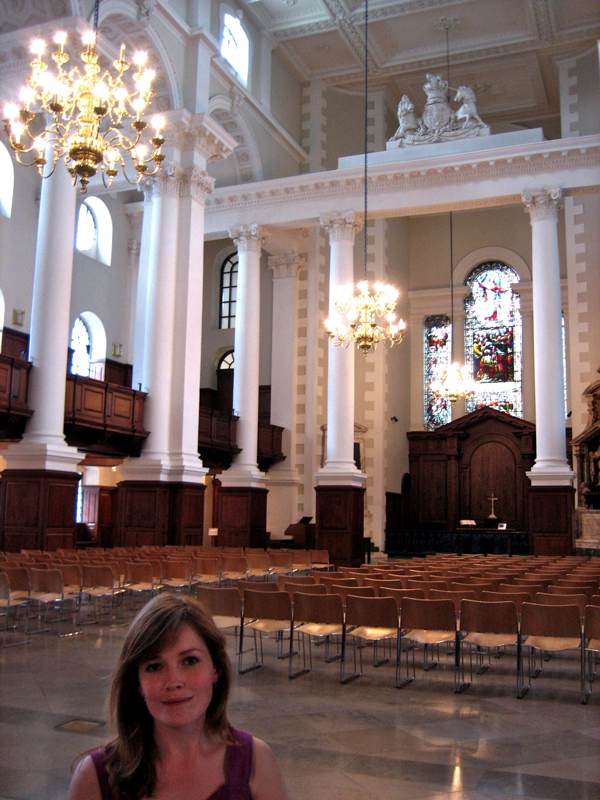
When I arrived to meet Joanna Moore at the end of an afternoon’s drawing in Christ Church, Spitalfields, a small crowd had gathered to peer over her shoulder at her work. As you can see from the photo above, it is an interior that presents a considerable challenge to an artist. I would not choose to sit down with a pen and paper and try to draw it, but this was precisely what Joanna had done. It was her first attempt and, in a single session lasting just a couple of hours, she succeeded with such style that as the drawing approached completion, people stopped to marvel at her facility with lines.
I took Joanna to the Market Coffee House afterwards, to celebrate her remarkable afternoon’s work, of which she appeared modestly unaware. In the Coffee House she opened a portfolio to show me her other drawings of Spitalfields. A couple of years ago, Joanna came to live in an old house in Hanbury St for a couple of months and while she was here, something extraordinary happened, she discovered a compulsion to draw. “Life started changing and I went part-time in my job because I needed to see how well I could draw. I realised that if I didn’t do it now, I’d never do it. And this coincided with moving to Spitalfields – I found it so inspiring here.” explained Joanna, recalling that harsh Winter which proved such a cathartic and creative time in her life.
As Joanna produced an array of the fine drawings from her portfolio which record her time here, she spoke of the excitement of the circumstances from which they arose. “It was lonely living here in this beautiful old house, but I was determined to draw – separated from the people around me, I didn’t know anyone, I was just renting a basement. I bought myself fingerless gloves to work outside, but it was so cold I could only do an hour’s drawing at a time. You can deal with the cold in your head and body, though when your hands get cold, then you can’t control your fingers to draw anymore.”
It was apparent from these fluent drawings that Joanna’s achievement was far greater than simply retaining control of her fingers but, more than this, I was inspired by the personal discovery these works manifested. The nest of lines within these quiet yet sophisticated drawings trace the birth of a vibrant talent. Within the pluralism of contemporary art, there is a resurgence of drawing and a recognition that a talent and facility for draughtsmanship – which Joanna found within herself – is not to be under-rated. In architectural drawing, most people struggle to get their lines in the right place when attempting to record structures, but for Joanna this is second nature. She can do it with ease, and brings wit and humanity along too.
Joanna never set out to draw, she trained as an architect yet became alienated at the idea of life in front of a computer terminal, switching to Art History in the middle of her studies. Since leaving Cambridge five years ago, Joanna worked as an architectural historian but found herself increasingly fascinated with looking at the buildings she was working on. Then, at twenty-five years old, Joanna discovered what she wanted to do, embarked on a year’s course at the Prince’s Drawing School in Shoreditch and now works as a freelance illustrator.
“The more I draw, the faster I get and the freer I get,” admitted Joanna, her eyes gleaming with determination and passion for her chosen course. “It’s a very pure pleasure,” she continued with a gentle smile, considering her portfolio and aspiring to find words for the dynamic experience of drawing,”That’s why I’m driven, because it’s the purest art form you can get – to record what’s in front of you. I don’t want to use my drawings as the basis for paintings because I’m more interested in drawing the next thing.”
Too few people follow their enthusiasms, and so I was inspired to meet Joanna Moore at this crucial moment in her life.

Princelet St

Trinity Green Almshouses, Whitechapel
 The Brick Lane Beigel Bakery

At the Tower of London

Christ Church, Spitalfields
Drawings copyright © Joanna Moore
You may also like to read about
Joanna Moore & The Spitalfields Nobody Knows
Marianna Kennedy, Designer
Come and see Marianna Kennedy’s lamps and mirrors at The Artists of Spitalfields Life opening at Ben Pentreath Ltd on Wednesday 7th November.

Behind this enigmatic facade – lettered W&A Jones – at 3 Fournier St, directly across from Christ Church Spitalfields is the showroom, workshop and home of designer Marianna Kennedy. You can even see Nicholas Hawksmoor’s spire reflected in the crown glass panes of her shopfront.
For years, I have walked past this place and wondered what goes on here, so I was very excited to go inside and meet Marianna in person. Entering through the door on the right, I found myself in a bare eighteenth century hallway, where I was greeted by a woman dressed in elegant charcoal tones who spoke with a soft Canadian accent. Marianna invited me upstairs and I followed in her footsteps until we arrived in her beautifully proportioned panelled living room. As I craned in wonder at the window, looking down onto Fournier St and raising my eyes to the steeple towering overhead, Marianna busied herself screwing up newspaper with professional aplomb. She was lighting a fire in my honour, so we could enjoy a fireside chat.
Observing my curiosity, Marianna offered me a tour of the house and then, with a playful levity, she was off again, vanishing from the room like the White Rabbit. I followed her up more stairs, round and round, with each storey offering a new perspective backwards into all the secret gardens and yards that comprise the spaces between these ancient houses in the shadow of the church. There are so many of these wonderfully irregular old staircases in Spitalfields, each with their own creaking language and each leading to surprises. At the top of this one, we turned sharply and ascended a final narrow flight, barely two feet wide, to pass through a door and arrive on the roof where, hidden behind the parapet, Marianna has created an astounding secret garden with a wildflower meadow. The rooftop is on a level with the bell tower of the steeple across the road, and Marianna stood patiently in the frosty meadow with all the mysterious poise of a heroine in a Wilkie Collins novel – while I gazed across the rooftops of Spitalfields, admiring the ramshackle irregularity of the old tiled roofs and chimney pots.
Once we were back by the fireside, Marianna settled into a wing chair illuminated by the morning sunshine and became eloquent in her affection for the architecture of the old houses here. She explained that she first came to stay in Fournier St twenty-five years ago while a student at the Slade. Marianna and her husband renovated 42 Brushfield St (the house with the sign “A. Gold, French Milliners”) before taking on the current property in a derelict state, prior to their repairs, ten years ago. Working with the Spitalfields Trust over all this time, Marianna has developed a sympathetic instinct for the decor of these wonderful spaces through the subtle use of traditional paint colours for panelling and old floors. “It is all about lack of ego, restraint and humanity,” she admitted to me. “You can make something look so natural, like it has always been there,” she explained, before adding significantly “- that is a very hard thing to do.” Certainly, Marianna’s home confirms this aesthetic, a working house with elegant functional spaces which serves as the ideal showplace for her furniture designs.
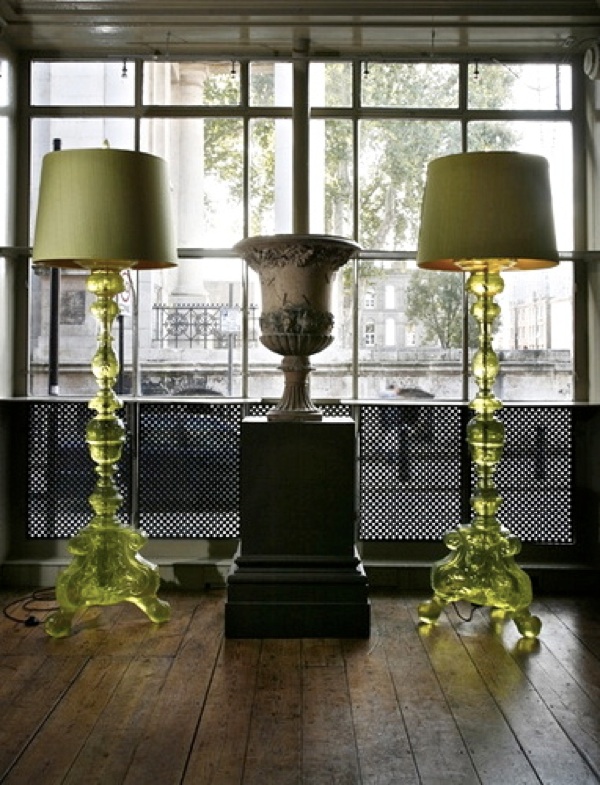
Above the fireplace in her living room is a huge bronze foliate mirror with tinted mercury glass to Marianna’s design, here in a corner is a lacquerwork table with cast bronze legs, hanging against the stairwell window is a dazzling collection of colourful transparent resin casts of plasterwork details and in each room there are the lamps of traditional design, also cast in brightly coloured resin – these are her signature pieces. All these artefacts are unmistakeably contemporary and yet, because they are made by craftsmen using techniques that have been around for centuries, they compliment the interior of the old house.
As we made our way down to the shop to say goodbye, I congratulated Marianna on recreating such a beautiful house. “It still has its magic,” she said with understatement, and, after my experience that day, I can happily confirm her assertion.

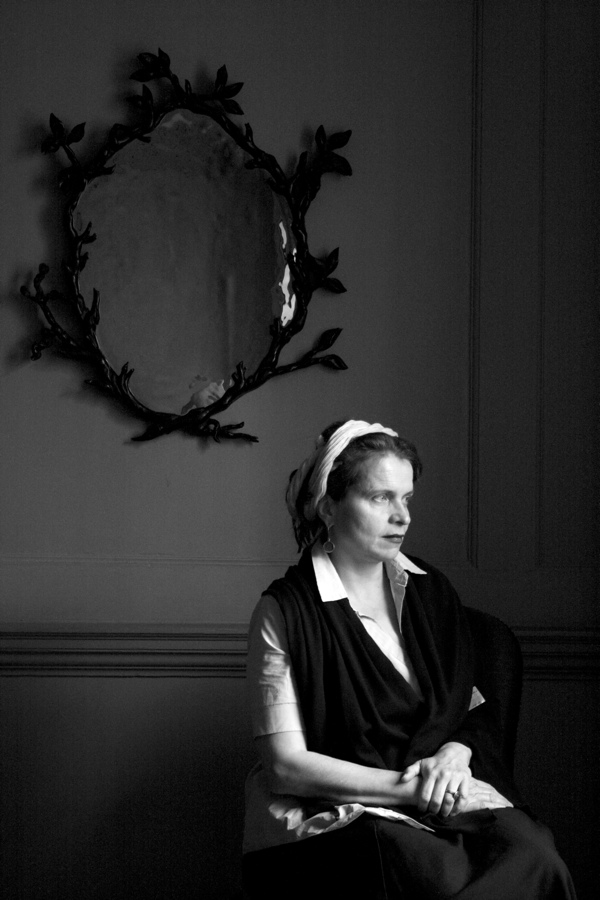
Marianna Kennedy
Portrait copyright © Lucinda Douglas Menzies
You may also like to read about
Laura Knight, Graphic Artist
Come and see Laura Knight’s graphics at The Artists of Spitalfields Life opening at Ben Pentreath Ltd on Wednesday 7th November.
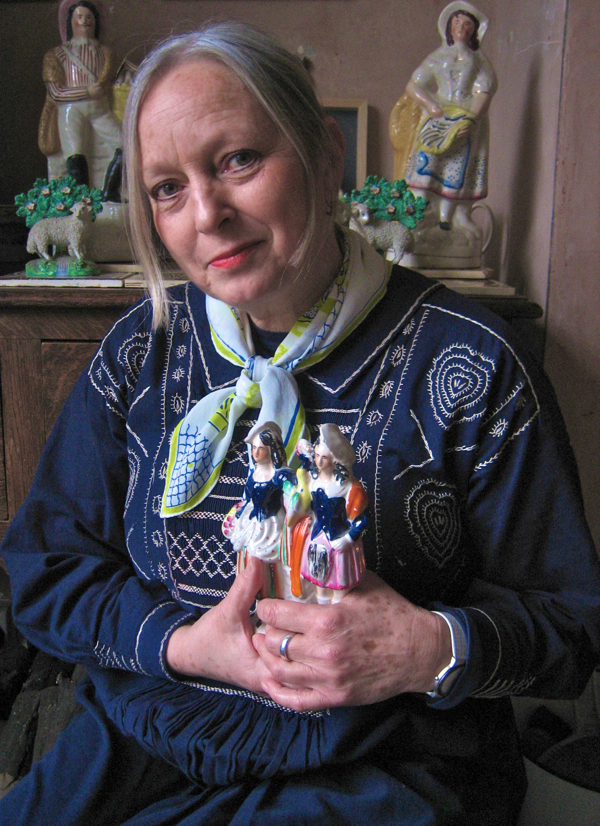
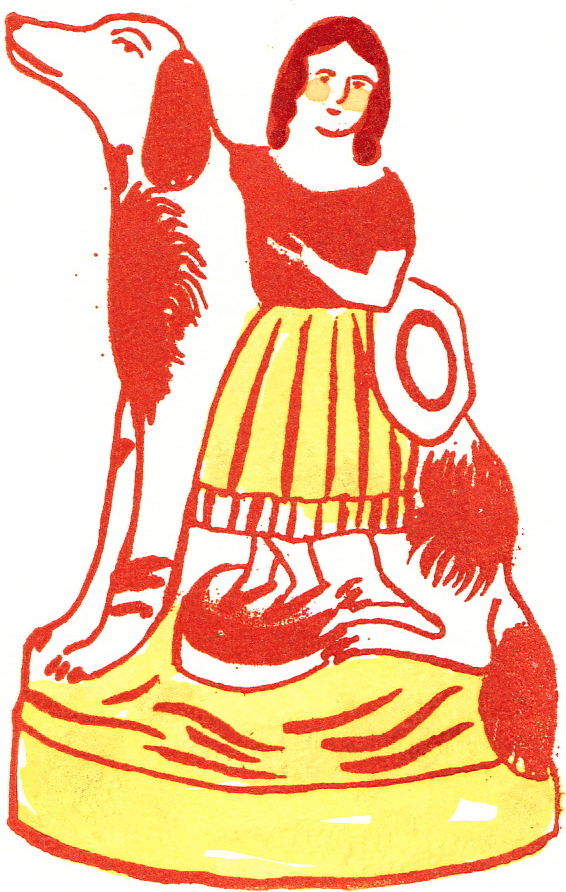
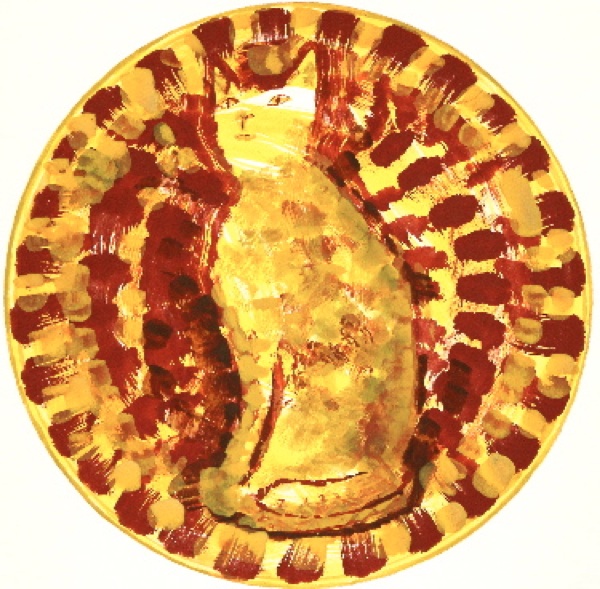
“I bought them ten years ago for ten pounds in a secondhand shop in the Essex Rd,” revealed Laura Knight with a proud gleam in her eye, when I enquired the origin of this fine nineteenth century couple. “The colour and the style of them really appealed, they spoke to me,” she said, contemplating the cherished figures.
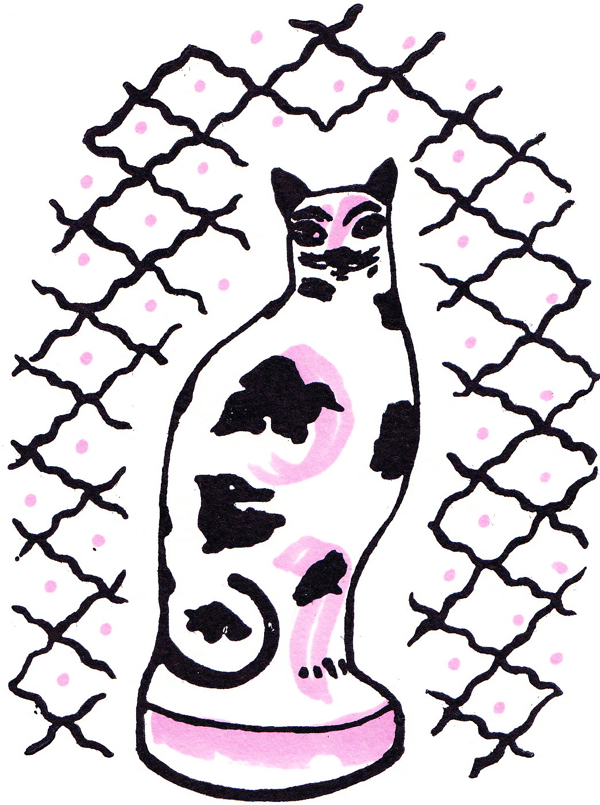
In retrospect, ten pounds was truly a bargain price for this Staffordshire group that has proved to be such a rich source of inspiration for Laura. “With Staffordshire Figures, there’s always two things going on,” she explained to me, articulating the dynamic that gives these modest designs their charisma, “there is the fineness of detail in the moulded form, in contrast to the application of the colour which – I suppose because it may have been done by children – has a childlike, almost crude quality.”
When Laura’s elegant prints of Staffordshire Figures first drew my attention, capturing the spirit of these pieces with rare grace and economy of means, I recognised they were the assured work of a mature artist in control of her medium. So I became curious to discover the story behind them and I invited her over to find out.
As soon as Laura leapt off the bus outside Liverpool St, she cast her lively eyes around in wonder at the changes in Spitalfields, recalling humorously that once upon a time she often came to Brick Lane for a curry at the Nazrul and enjoyed watching the strippers over a drink at the Seven Stars in Brick Lane. “It used to be a nice place for cheap night out when I was a student at the Royal College of Art in 1978,” she admitted to me with a nostalgic grin. Laura’s grandparents were from Bethnal Green, “The talk was of boys’ clubs and boxing matches,” she remembered as we walked through the streets together, “It’s sad when you can’t have the conversations that you wish you’d had with them in the nineteen seventies when they were alive.”
There is an emotional resonance to Laura’s graphic work that draws you in, and in which pieces of china exist as personal fragments to evoke an entire culture. “They were on everybody’s mantlepiece and everybody’s dresser. They are a vivid background, deep in our memories of home. There wasn’t a kitchen without a piece of willow pattern or a mantlepiece without a piece of Staffordshire.” said Laura, speaking from the heart, “But because they’re so familiar they’ve become forgotten and no-one’s looking at them any more.”
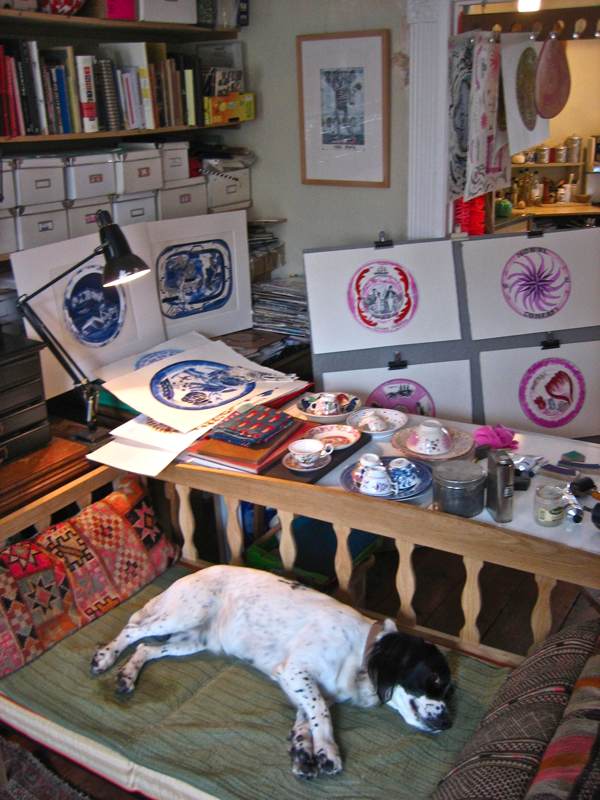
After graduating from the Royal College, Laura enjoyed a successful career as an illustrator which led to teaching, which led to cutting back on her own work. And then when she quit teaching, she found herself starting all over again as illustrator. “I suppose if you really love something, you just want to keep doing it until you can make it your own,” was Laura’s self-effacing explanation of her predicament at this moment – also the moment when she remembered the Staffordshire couple that she bought in the Essex Rd. “I realised when I was drawing them that they were suitable for rubber stamps,” said Laura, revealing the discovery of her technique, whereby she gets her drawings made up into rubber stamps and then colours them herself, as a cottage industry, just like the ceramic painters of old. “I want to make my work into products that I can sell, rather than wait for people to commission me,” she continued, outlining her policy to achieve artistic independence, “I’ve started working with the London Printworks Trust who have given me a lot of support. They do small runs and they have printed my designs onto silk scarves.”
Knowledgeable and passionate about the history of English popular art, and with a distinctive mature style, Laura Knight is creating work that is irresistibly appealing. And it is my privilege and delight to introduce you to Laura and her joyous creations.
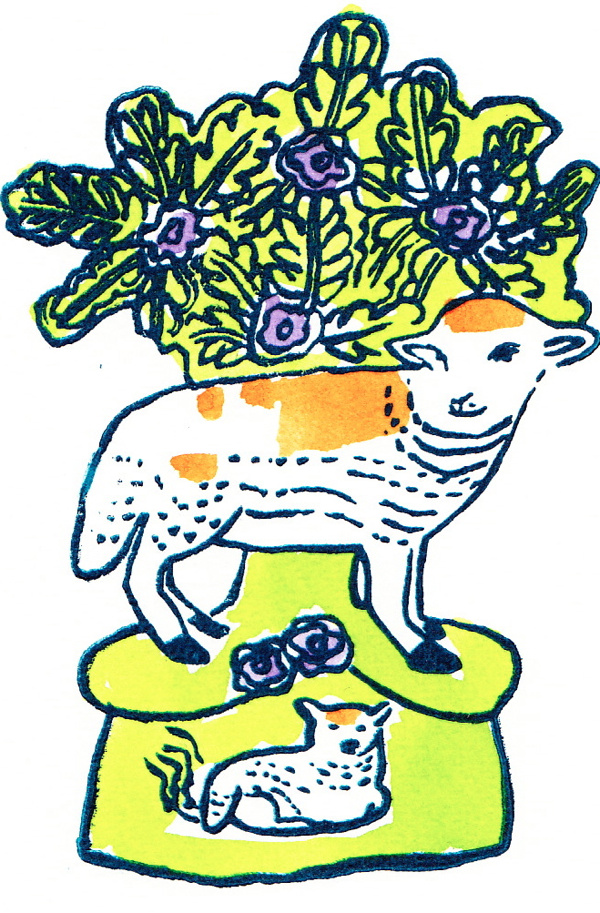
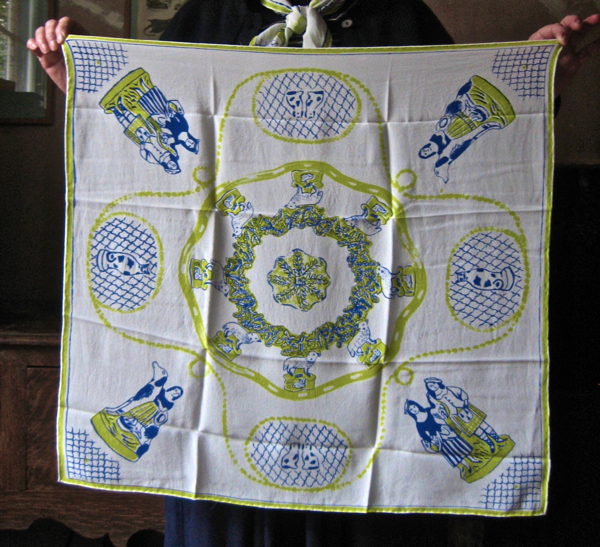
Laura makes these fine silk scarves, hand-rolling the edges of each one.

The Staffordshire couple Laura bought in the Essex Rd ten years ago.

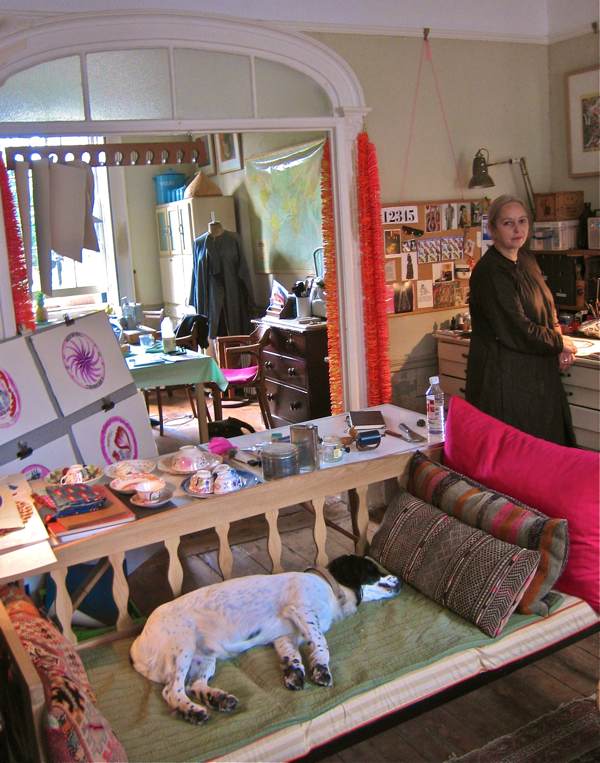
Laura at work in her studio
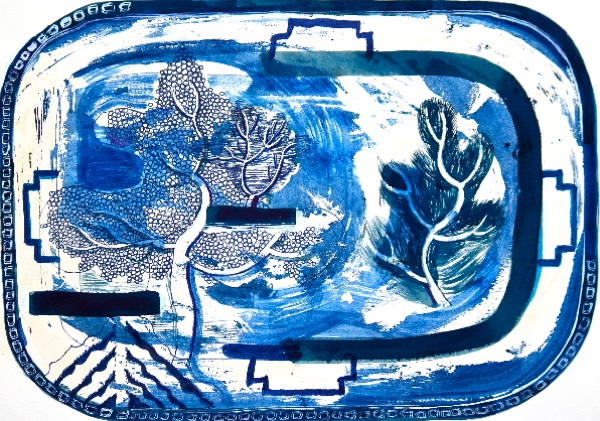
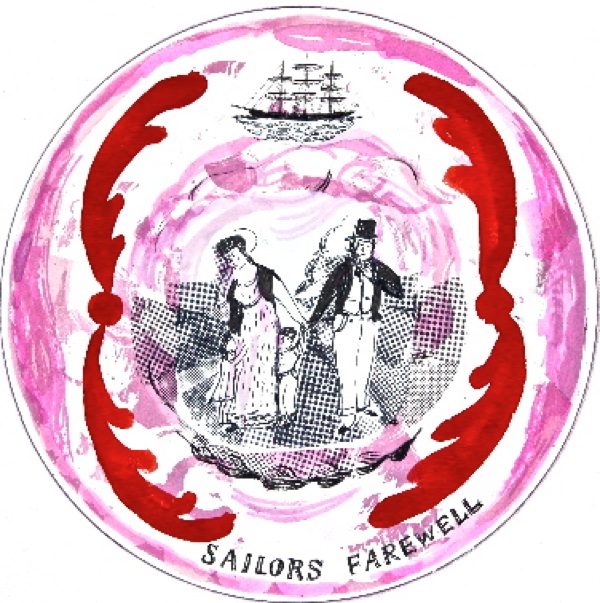
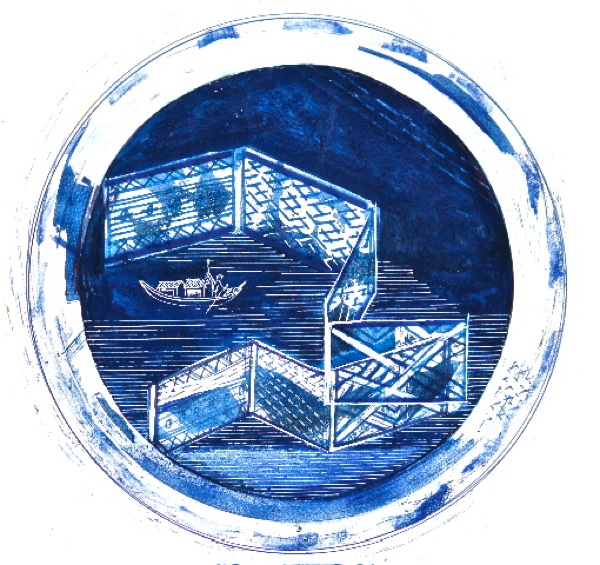
Artwork copyright © Laura Knight
Sebastian Harding, Illustrator & Modelmaker
Come and see Sebastian Harding’s model of Nicholas Culpeper’s House at The Artists of Spitalfields Life opening at Ben Pentreath Ltd on Wednesday 7th November.
“I’ve been in London for three years,” illustrator Sebastian Harding told me, “and I’m bored by the usual guides because there’s a lot of London you’re not encouraged to visit – such as Holborn, Smithfield and the City, but there’s been industry and life there for two thousand years.” So, Sebastian set out to create his own guidebook to Smithfield and evoke the vanished sights by constructing these characterful models of buildings that disappeared long ago and publishing them himself, accompanied by their stories, in a book. “Working as an illustrator in three dimensions, I wanted to make them more tangible and bring history alive.” he explained modestly.

Many guidebooks talk of opening hours and prices, of queues and “must sees.” You need not worry about any of that with this tour, for all you are about to read about is gone. This book is for the intrepid traveller who is prepared to imagine as well as see. You will look in vain for a blue plaque, for this is a walk of lost lives and forgotten buildings. There is no necessary order in which to see these sights but all are within ten minutes of each other.
I hope you enjoy wandering among the ghosts of Smithfield’s dark and sordid past, and remember – the most gripping true stories have always contained an element of fiction.

The Fortunes Of War Public Tavern, Cock Lane – A Sinister Sidetrade.
Smithfield Market’s proximity to St Bartholomew’s Hospital betrays a lot about the British public’s distrust of the medical trade. It is fitting therefore to focus on one building that catered to both trades – The Fortunes Of War Public Tavern.
Let us place ourselves in the eighteenth century as we watch a student of anatomy making his way into the tavern. He is here, not as you would expect for his leisure, but for his studies. He is led by the landlord down dank mouldering stairs to the cellar. Rows of sacks give off a pungent smell of rotting meat, yet these are not the carcasses of swine or cattle but the bodies of recently dead Smithfield residents.
This was the secret trade of the Body Snatchers or Resurrectionists that supplied students and professors of anatomy with fresh corpses. For a God-fearing public, it was immoral and barbarous in the extreme, for this was a time when many believed a soul would only be granted into heaven if their corporeal body was intact, while being dissected meant an eternity in purgatory.

John Aston’s House, Charterhouse Lane – An Unfair Execution
John Aston was a priest in the parish of Smithfield, arrested at the same time as the influential protestant leader John Rogers. Queen Mary’s secret police randomly inspected any priests who had been advocates of protestantism before her ascension to the throne in 1553.
Unsurprisingly, the inspections would usually find a protestant bible or a mass being held. Typically, the raids were held on Sundays and John Aston’s misfortune was to be found eating meat in one of these raids. The tyrannical catholic religion of the sixteenth century forbade any consumption of meat on Sunday and he was burnt at the stake for this trifling pretence.

20 Cock Lane – Poltergeists in the Panelling.
The name of this street can be traced to its proximity to the market, where poultry would once have been traded, but it also serves also as a risqué innuendo, since for hundreds of years it was the preferred haunt of prostitutes. It was on this street that fraud, haunting, murder and sex were all intertwined in one story.
Late one November night in 1760,William Kent was away on business in Norfolk. His wife Fanny, wishing to alleviate the loneliness of her nights alone, invited Betty the youngest daughter of the Parsons – the landlord’s family – to sleep in her bed. In the night, Fanny was disturbed by scratching sounds like claws on wood and lay frozen with fear. On appealing to Mr & Mrs Parsons, she was told a shoemaker lived next door and her fears were assuaged. But the next night was Sunday when no good Christian would ever work, yet the scratching came again, brought to a terrifying end by a loud bang.
After William Kent returned the next night the sounds were not heard again. Then, two months’ later, after a furious row, Mr Parsons threw the Kents’ possessions out onto the street, even though William had not received a penny of the money he had loaned to his landlord the previous year. Subsequently, Fanny succumbed to smallpox and died on February 2nd 1761.
Some time later, the Parsons family began to hear the same scratching again and made sure it became a talking point for superstitious members of the community. The methodist preacher John Moore held a séance and ,when he asked if a spirit was present, a knock rang out. A second question followed – “Was the spirit that of the late Fanny?” Another knock. “Was Fanny murdered by her husband?” the reverend asked and then followed the loudest banging the party had heard.
Subsequently, William Kent was hanged, but afterwards the events were revealed as a fraud motivated by the feud between Mr Parsons and his tenant over the loan. Parsons was sentenced to three years in prison and three days in pillory, but later became regarded as something of a celebrity.

Mother Clapp’s Molly House, Field Lane – An Unusual Coffee House.
This was not a coffee house as we would know it, but rather a private club for gay gentlemen, where they could meet and form relationships without fear of discovery. The discretion of fellow members was crucial and entry was only permitted to those who knew a password. There were even gay marriage ceremonies conducted in locked rooms between men, with one donning a bride’s dress and the other a groom’s jacket. Mother Clapp herself presided over all, only leaving to get refreshments from the pub across the street.
Everything we know about this secret sub-culture stems from the raid by The Society For The Reformation Of Manners which had placed secret police inside the house. One man, a milkman, was hung for being found in the act of sodomy and Mother Clapp was sentenced to a day in the pillory. The crowd was so furious that they ripped the pillory from the ground and trampled it, and Mother Clapp died from the injuries sustained.

Sebastian Harding
The architectural legacy of the body snatchers can be seen in the watch houses that were built adjacent to most parish churches. An example of this may be seen at the church of St Sepulcre’s in Smithfield.
Illustrations copyright © Sebastian Harding
A limited number of copies of Sebastian Harding’s Smithfield: A Selective History are available for sale at £7 and may be purchased from the show or by emailing seb.harding1@gmail.com
Marc Gooderham, Painter
Come and see Marc Gooderham’s pictures at The Artists of Spitalfields Life opening at Ben Pentreath Ltd on Wednesday 7th November.
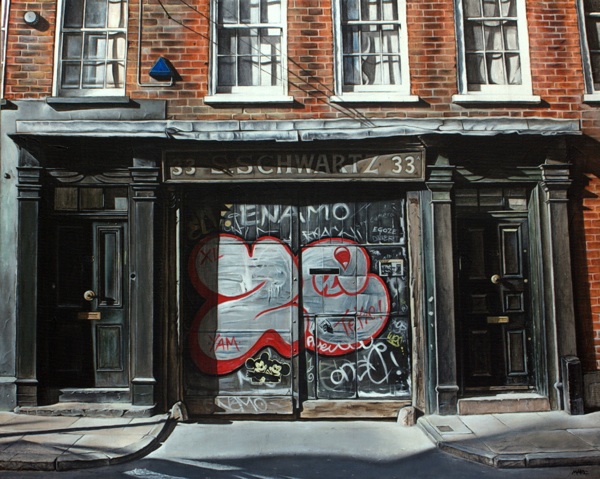
Later Afternoon, Fournier St, Spitalfields
There are so many art galleries in my neck of the woods that I have adopted the Jean-Luc Godard approach to visiting them. In other words, I take it at a run just as Anna Karina, Sami Rey and Claude Brasseur sprinted through the Louvre in “Band à Part.” Yet very occasionally – as I am nipping in and out of every gallery in Redchurch St on the first Thursday of the month – something will stop me in my tracks and cause me to linger. Such was the case when I first came upon the visionary paintings of Marc Gooderham.
Here was the world – the very streets – that I knew, but subtly transformed as if by memory or dream. Marc chooses places that exist in the periphery of vision and recreates them in his mind’s eye, revealing the otherness of the familiar with understated surrealism.
It was this shock of recognition that first halted me in front of his pictures, pausing to establish the locations and then becoming seduced by the brooding melancholy of these deserted streets, absent of pedestrians yet haunted by the presence of all those who have come through. With some of these places, I thought only I had spotted their unlikely appeal – because, like Marc, I am drawn to the shabby poetry of these disreputable and neglected corners, sites that characterise the distinctive identity of London more truthfully than the homogeneous sheen of all the gleaming corporate palaces.
“This project started from exploring the city and wandering the streets, so I know it will be an endless undertaking because there’s always something new to discover around every corner,” Marc admitted to me with a helpless smile, as we trudged the empty streets around Petticoat Lane one morning recently. “What makes this such a fascinating place is the proximity of the City of London to these old terraces – and the contrast of the street art makes it even more interesting.” he continued, raising his eyes to the boarded up, tumbledown buildings. “I try to avoid catching the bus,” he confessed as we crossed Commercial St, “so I get the chance to walk and discover the next site for a painting. Once I find the site, I take lots of photographs and make sketches, looking for the best time of day.”
Starting with a pencil sketch to establish the perspective, Marc builds up his paintings in washes of acrylic upon canvas. At first he paints the sky, then the architecture and finally the accretions upon the surface of the buildings. He calls these, the three key elements to a painting – elements that combine in a moment circumscribed by the fleeting light. It is a moment set against the age of the buildings and the ephemeral street art which can change overnight.
When Marc and I visited some of his locations, I was fascinated to discover he had rearranged them in his pictures, removing lampposts and reconfiguring the proportions to create his desired effect. Just as these sites do not draw attention to themselves, Marc’s paintings are quiet works that withhold their painterly and conceptual sophistication behind a superficial veil of heightened realism.
A softly-spoken man with gentle intense eyes, Marc works three days of every week at a job to pay the bills and spends the rest of his time devoted to his paintings which each take six weeks from conception to completion. For the last two years, Marc has been working on this epic series of paintings of lonely corners, assembling a set that he plans eventually to show as a gazetteer of his personal vision of London. Or, as Marc put it plainly, “Two years ago, I devoted my life to painting.”
Inspired by L.S. Lowry and Edward Hopper, Marc Gooderham’s cityscapes beneath a Northern sky possess a soulfulness and mystery that hint at undisclosed life behind those doors and windows. They are well-worn settings for the enigmatic human drama of the city, comprising more stories than you can ever know.
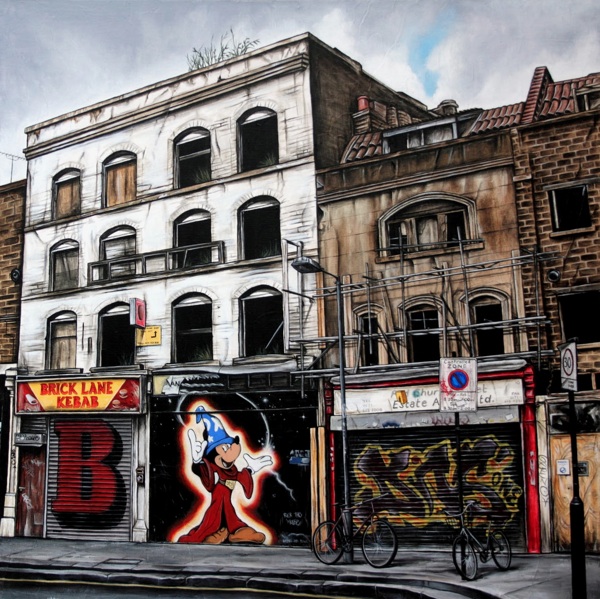
Together Again, Redchurch St.
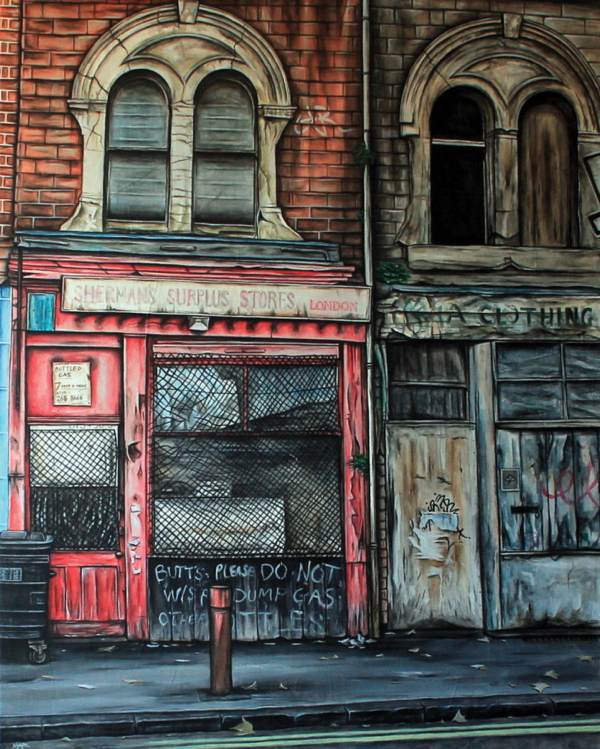
Vallance Rd, Whitechapel
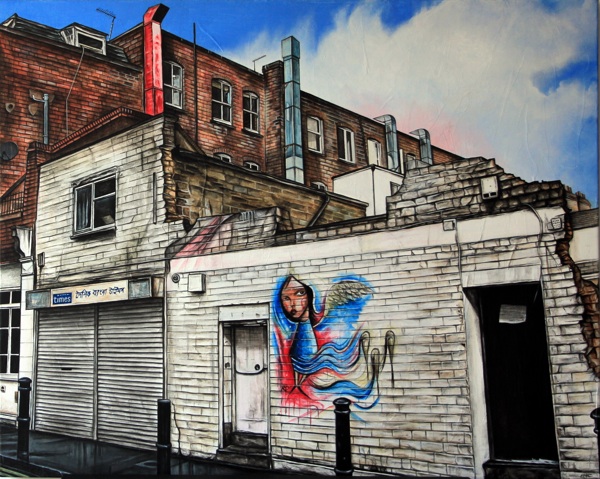
Fallen, Hanbury St.
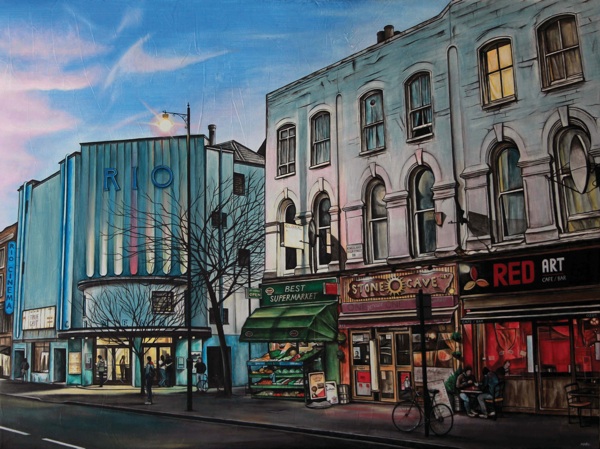
Rio Cinema, Dalston.
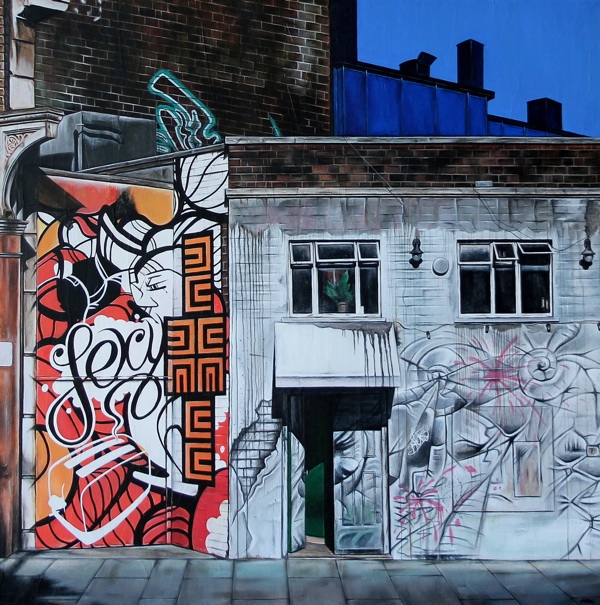
The Tyger, Great Eastern St.
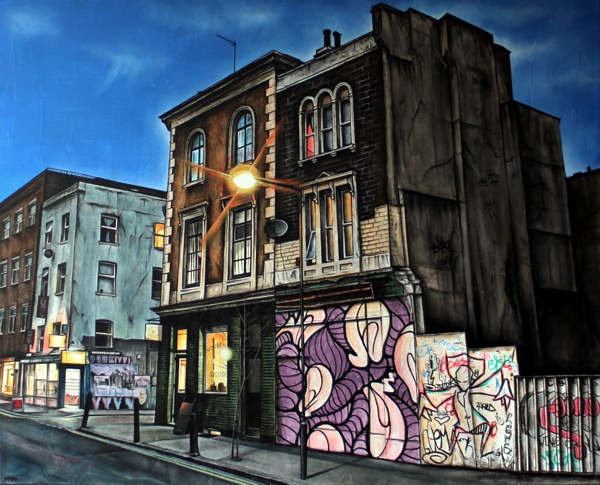
Corner of The Street, Redchurch St.

The Lonely Stretch, Coronet St.
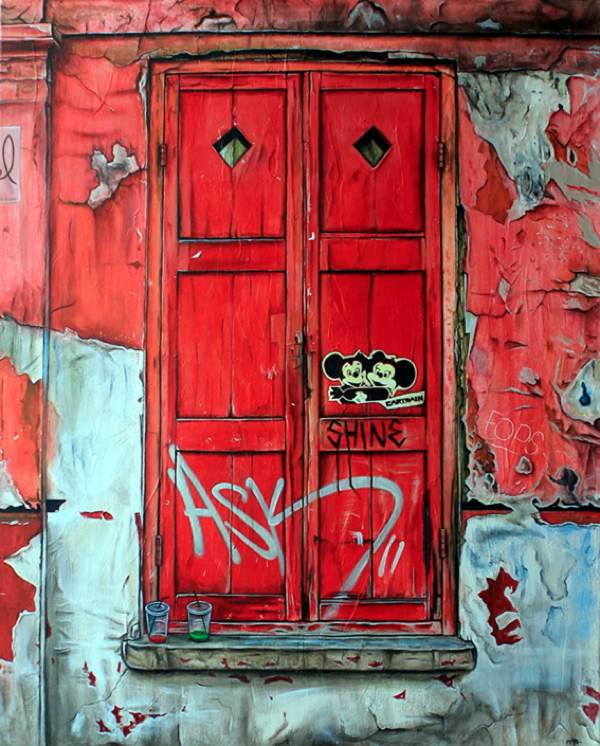
Back To The Old House, Princelet St.
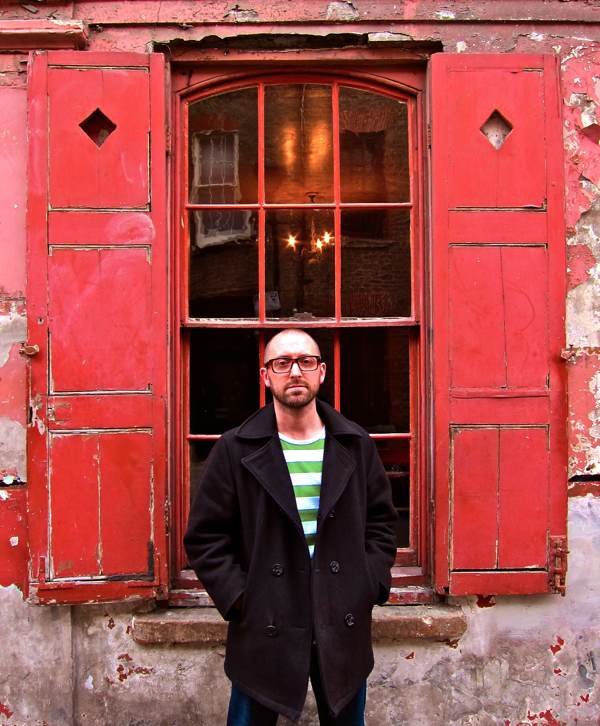
Marc Gooderham
Paintings copyright © Marc Gooderham
You may also like to read about
Recent Paintings by Marc Gooderham
Anthony Eyton, Painter
Come and see Anthony Eyton’s pictures of Spitalfields at The Artists of Spitalfields Life opening at Ben Pentreath Ltd on Wednesday 7th November.
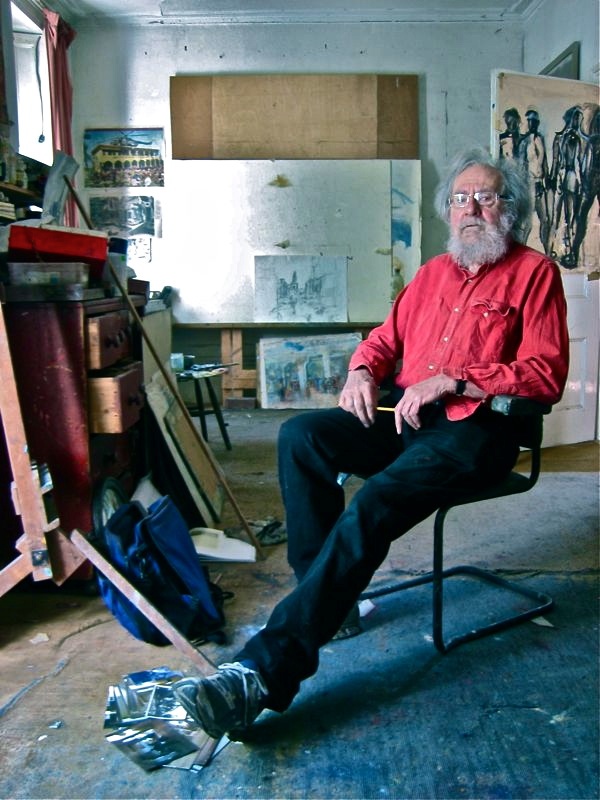
I took the 133 bus from Liverpool St Station, travelling down South of the river to visit the eighty-eight year old painter Anthony Eyton at the elegant terrace in the Brixton Rd where has lived since 1960 – apart from a creative sojourn in Spitalfields, where he kept a studio from 1968 until 1982. It was the 133 bus that stops outside his house which brought Anthony to Spitalfields, and at first he took it every day to get to his studio. But then later, he forsook home comforts to live a bohemian existence in his garret in Hanbury St and the result was an inspired collection of paintings which exist today as testament to the particular vision Anthony found in Spitalfields.
A tall man with of mane of wiry white hair and gentle curious eyes, possessing a benign manner and natural lightness of tone, Anthony still carries a buoyant energy and enthusiasm for painting. I found him working to finish a new picture for submission to the Royal Academy before five o’clock that afternoon. Yet once I arrived off the 133, he took little persuasion to lay aside his preoccupation of the moment and talk to me about that significant destination at the other end of the bus route.
“That biggest strangest world, that whirlpool at Spitalfields, and all the several colours of the sweatshops, and the other colours of the degradation and of the beautiful antique houses derelict – I think the quality of colour was what struck me most.” replied Anthony almost in a whisper, when I asked him what drew him to Spitalfields, before he launched into a spontaneous flowing monologue evoking the imaginative universe that he found so magnetically appealing.
“From Brick Lane to Wilkes St and in between was special because it’s a kind of sanctuary.” he continued, “And looking down Wilkes St, Piero della Francesca would have liked it because it has a kind of perfection. The people going about their business are perfectly in size to the buildings. You see people carrying ladders and City girls and Jack the Ripper tours, and actors in costume outside that house in Princelet St where they make those period films, and they are all in proportion. And the market was still in use then which gave it a rough quality before the City came spilling over and building its new buildings. Always a Mecca on a Sunday. I used to think they were all coming for a religious ceremony, but it’s pure commerce, and it’s still there and it’s so large. It’s very strange to me that people give up Sunday to do that… – It’s a very vibrant area , and when Christ Church opens up for singing, the theatre of it is wonderful.”
Many years before he took a studio in Spitalfields, Anthony came to the Whitechapel Gallery to visit the memorial exhibition for Mark Gertler in 1949, another artist who also once had a studio in an old house in one of the streets leading off the market place. “Synagogues, warehouses, and Hawksmoor’s huge Christ Church, locked but standing out mightily in Commercial St, tramps eating by the gravestones in the damp church yard. “Touch” was the word that recurred,” wrote Anthony in his diary at that time, revealing the early fascination that was eventually to lead him back, to rent a loft in an eighteenth century house in Wilkes St and then subsequently to a weavers’ attic round the corner in Hanbury St where the paintings you see below were painted.
Each of these modest spaces were built as workplaces with lines of casements on either side to permit maximum light, required for weaving. Affording vertiginous views down into the quiet haven of yards between the streets where daylight bounces and reflects among high walls, these unique circumstances create the unmistakable quality of light that both infuses and characterises Anthony Eyton’s pictures which he painted in his years there. But while the light articulates the visual vocabulary of these paintings, in their subtle tones drawn from the buildings, they record elusive moments of change within a mutable space, whether the instant when a model warms herself at the fire or workmen swarm onto the roof, or simply the pregnant moment incarnated by so many open windows beneath an English sky.
Anthony’s youngest daughter, Sarah, remembers coming to visit her father as a child. “It was a bit like camping, visiting daddy’s studio,” she recalled fondly, “There were no amenities and you had to go all the way downstairs, past the door of the man below who always left a rotten fish outside, to visit the privy in the yard that was full of spiders which were so large they had faces. But it was exciting, an adventure, and I used to love drawing and doing sketches on scraps of paper that I found in his studio.”
For a few years in the midst of his long career, Spitalfields gave Anthony Eyton a refuge where he could find peace and a place packed with visual stimuli – and then two years ago, a quarter of a century after he left, Anthony returned. Frances Milat who was born and lived in the house in Hanbury St came back from Australia to stage a reunion of all the tenants from long ago. It was the catalyst for a set of circumstances which prompted Anthony to revisit and do new drawings in these narrow streets which, over all this time, have become inextricable with his identity as an artist.
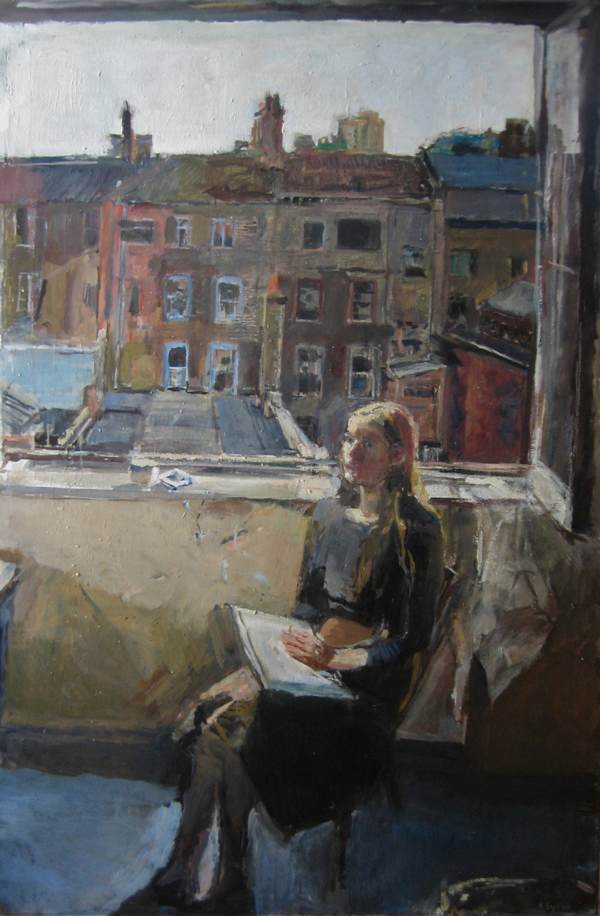
Christine, 1976/8. – “She was very keen that the cigarette smoke and grotty ashtray should be in the picture to bring me down to earth.”
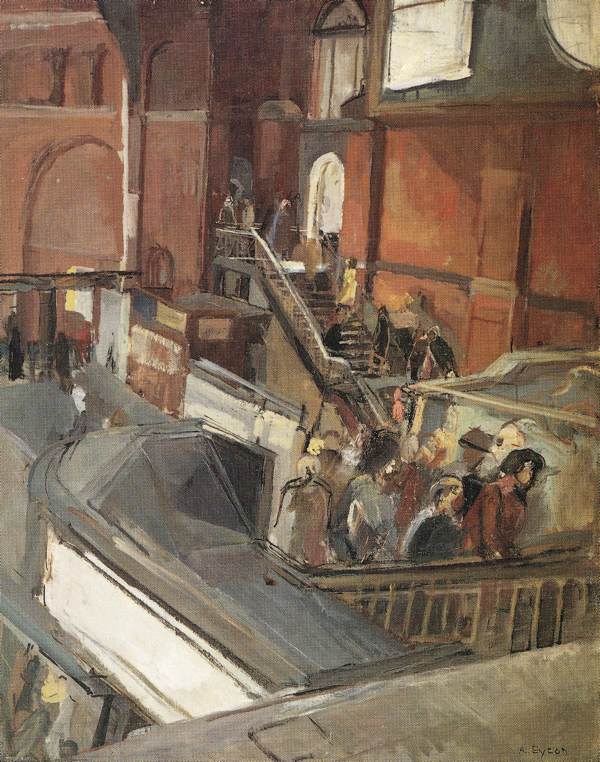
Liverpool St Station, mid-seventies.
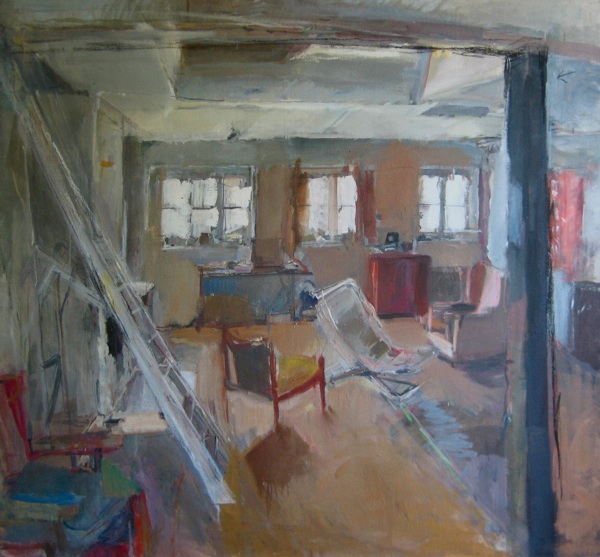
Studio interior, 1977.
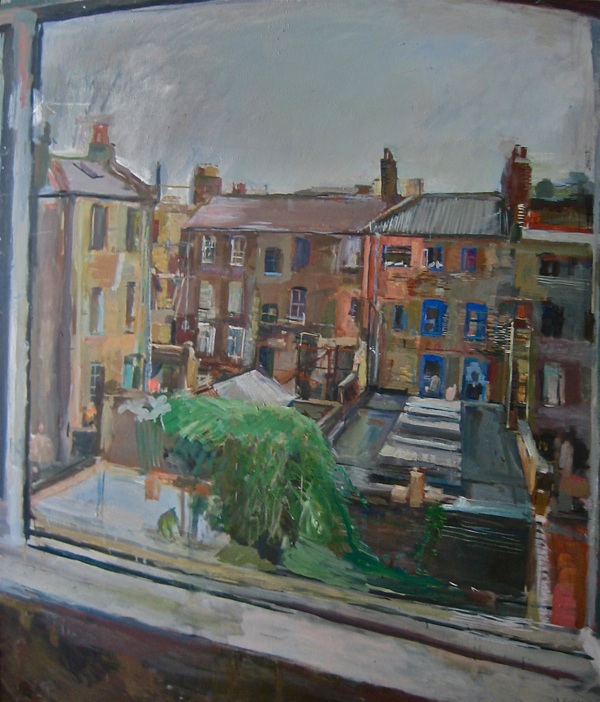
Back of Princelet St, 1980

Girl by the fire, 1978.
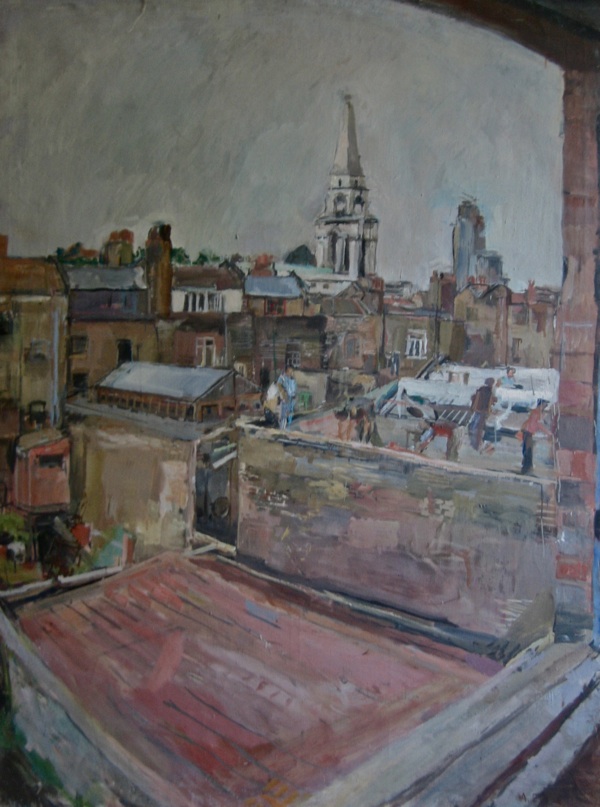
Workers on the roof, 1980
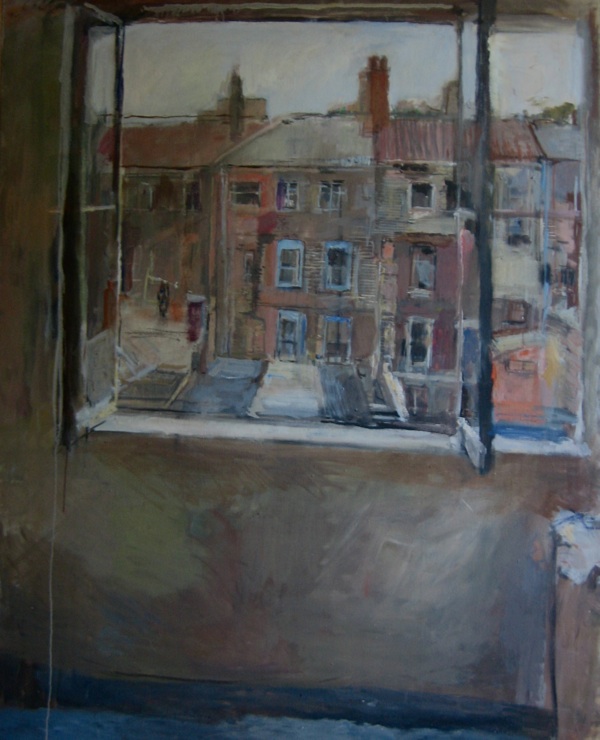
Open window, Spitalfields, 1976.
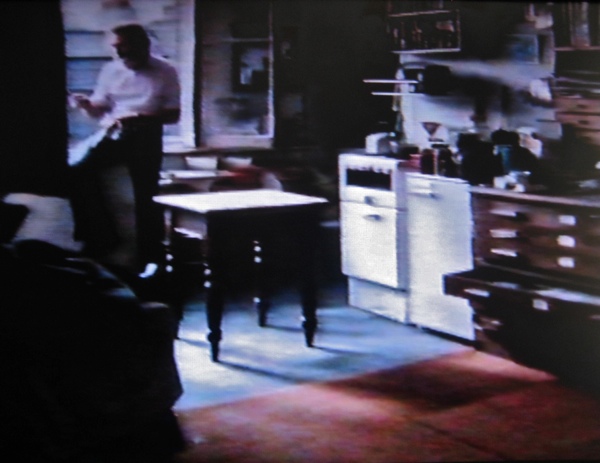
Anthony Eyton working in his Hanbury St studio, a still from a television documentary of 1980.

Wilkes St, 2011
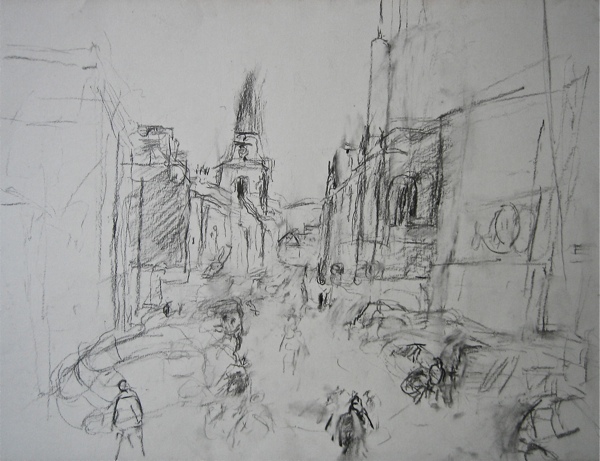
Fournier St from Banglatown, 2011
Pictures copyright © Anthony Eyton
Watch a film of Anthony Eyton in his extraordinary garden here.
You may also like to read about
Adam Dant & The Map Of Spitalfields Life
Come and see The Map of Spitalfields Life drawn by Adam Dant at The Artists of Spitalfields Life opening at Ben Pentreath Ltd on Wednesday 7th November.
[youtube mvq38fBhGDI nolink]
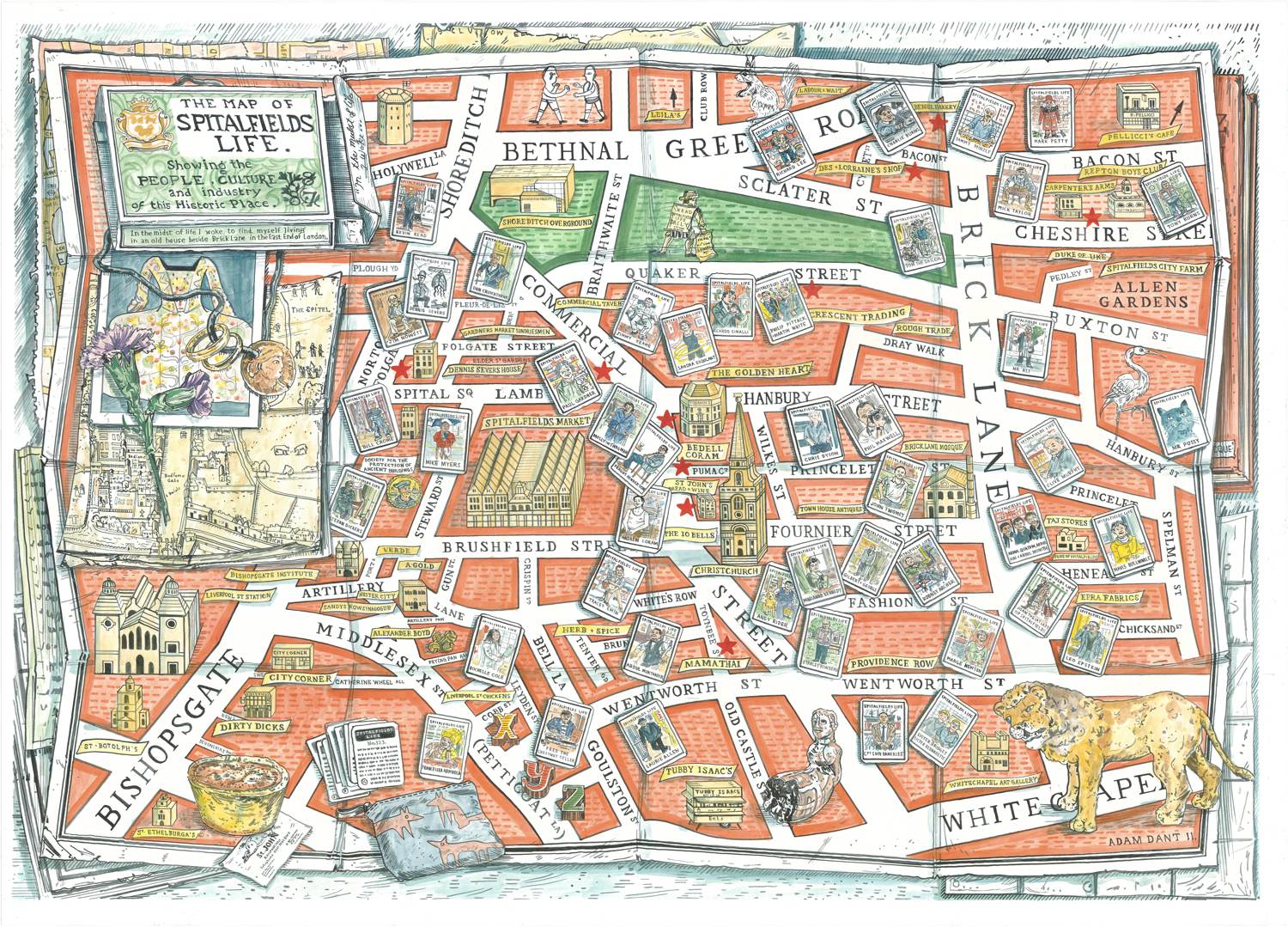 Click to enlarge the map
Adam Dant and I burnt the midnight oil to contrive The Map of Spitalfields Life for your delight and, once it was done, we could barely contain our excitement to show it to the world.
It was produced under conditions of the strictest secrecy and, before the unveiling, Adam Dant and I alone knew who was on the map. I ran around Spitalfields like the White Rabbit, delivering invitations. Yet although those who got an invitation were confirmed of their place on the map, they did not discover who else was on it until Sandra Esqulant. landlady of The Golden Heart, unveiled it. Rumour, gossip and speculation about the map spread like wildfire through the narrow streets of Spitalfields, and the conflagration reached white heat by the day of the unveiling.
The Map of Spitalfields Life is published by Herb Lester and full-colour copies are on sale at £4. This pocket-sized edition is the ideal companion to a walk through the streets of Spitalfields. Illustrated in colour by Adam Dant, cartographer extraordinaire, with fifty portraits of the people who make Spitalfields distinctive. On the reverse, you will find the stories of all those portrayed on the front written by yours truly, plus a guide to the essential Spitalfields landmarks and destinations.
Adam Dant has produced a hand-tinted limited edition for collectors and Spitalfields aficionados, suitable for framing at £420, each copy signed by the artist and The Gentle Author.
Adam Dant said, “We hope this map may assist the cartographic aesthetic to leap forward beyond the homogeneity of computerised rendering and the turgid angst of psycho- geography.”
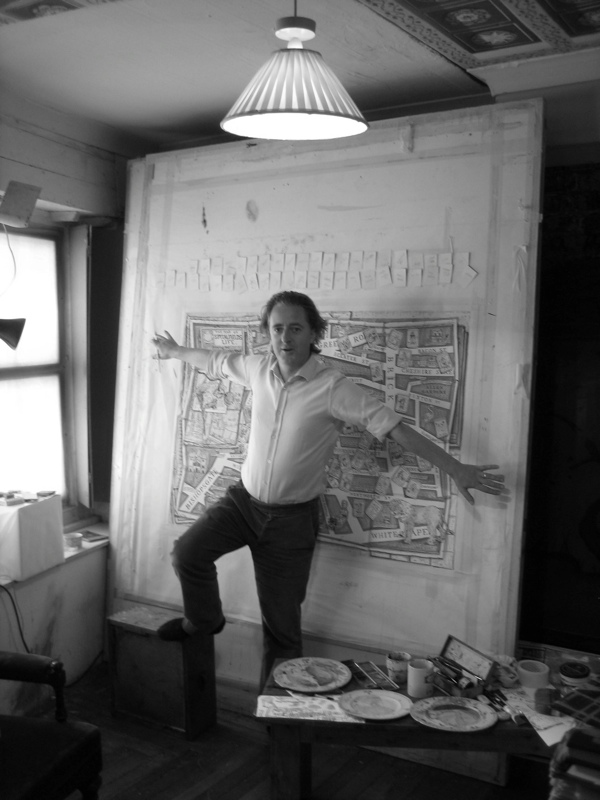
Adam Dant tries vainly to hide The Map of Spitalfields Life from prying eyes.
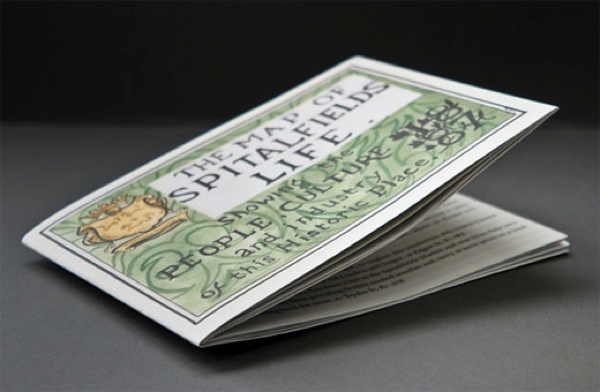
Photograph of the Herb Lester edition of the map by Stephanie Lynn
You may also like to read about
Unveiling The Map Of Spitalfields Life
and these other maps by Adam Dant
Map of the History of Shoreditch
Map of Shoreditch in the Year 3000
Map of Shoreditch as the Globe
Map of the History of Clerkenwell
Map of the Journey to the Heart of the East End
Map of the History of Rotherhithe
Click here to buy a copy of The Map of Spitalfields Life drawn by Adam Dant with descriptions by The Gentle Author













