
The Artists Of Spitalfields Life


Ben Pentreath Ltd, 17 Rugby Street, Bloomsbury, WC1N 3QT
During the next week, leading up to the opening, I shall be publishing the stories of the artists featured in the exhibition.
Ruminations of a Ghost Hunter
At Halloween, it is my pleasure welcome this guest post from Roger Clarke, the Paranormalist of Shoreditch and author of A Natural History of Ghosts published tomorrow by Penguin.

Ye Olde Axe by Julie Cook
Last Saturday, 27th October, the Fortean Society held a Ghosts Conference at the Bishopsgate Institute and, in between lectures on ‘Ghosts in London’s Hospitals and Theatres’ and ‘Ghosts of the Senate House,’ I attempted to access some nineteenth century trades directories housed there. My friend and now host, The Gentle Author, no stranger to the building – indeed, known to haunt it – had suggested I research there in my quest to find out more concerning an intriguing Shoreditch figure, Georgiana Eagle. She was christened at St Leonard’s Church and her grandfather was a Shoreditch publican of Huguenot descent. I was trying to find out which pub. Was it one of the ‘lost’ haunted pubs of Shoreditch – Ye Olde Axe or the Nag’s Head on Hackney Rd, for example?
I had come across the name of Georgiana Eagle while researching my book A Natural History of Ghosts, and as a Shoreditch resident myself, I was naturally intrigued by her. Dalston was a Victorian nexus of young female psychics including the infamous Florence Cook in the eighteen seventies, and there was a very famous Dalston spiritualist group at the time many of whose members worked on the railways – two recently-built spurs (now the Overground) had opened up the area and were apparently instrumental in making Dalston popular for séances. It was a new area, opening new doors into the other world. However it seems an even younger East London psychic proceeded Miss Cook by several decades amongst the furniture-making factories and leather-working rooms of Shoreditch.
For many years, until 1963 in fact, a gold watch that was displayed in the College of Psychic Studies in Kensington was linked to Georgina Eagle. Known colloquially as ‘Vicky’s Ticker’ it had sported the following inscription ‘Presented by Her Majesty to Miss Georgina Eagle for her Meritorious and Extraordinary Clairvoyance produced at Osborn [sic] House, Isle of Wight, July 15th, 1846.’ It seems it had been bought by the famous newspaperman and even more famous Titanic victim W.T.Stead, and donated to the medium Etta Wriedt precisely because she was known to channel the imperious voice of the late queen.
It has been a holy grail amongst biographers of Queen Victoria to find the mediums the grieving queen might have consulted after the death of Prince Albert but, surprisingly, there is absolutely no evidence she ever consulted one. At first glance, this mysterious watch seemed to suggest otherwise though after a little research it soon emerged there were always, frankly, insurmountable problems with its authenticity. The name of Osbourne House was misspelled. The date predates the demise of Albert and also the advent of the London séance fashion by several years. It also turns out that little Georgiana’s father was a quite well-known stage magician called Barney Eagle.
In fact, little Georgiana did a double-act with her father, a mind-reading trick still in use today, and travelled round the country to local theatres and fairs. Though Eagle was not a conjuror of the first rank, he seemingly had a great gift for self-promotion and made hay with a public spat with another, much more famous, magician named John Henry Anderson. According to the magic historian Charles Waller ‘Of all of Anderson’s imitators, he was the most impudent…he stole Anderson’s tricks, copied his patter, and exactly produced his programme and billing matter’. Also 1846, the date on the watch when Georgiana was only eleven years old, was also the date he published his ‘Barnado’s Book of Magic’. Young Georgiana was billed by her father as ‘The Mysterious Lady,’ and members of the audience were invited to blindfold her in an ‘unmasking of clairvoyance’ (according to the Yorskhireman in December of that year).
Was the watch, which was stolen in 1963 and has never been since, simply a bit of promotional kit used by Barney Eagle to get attention for his book and his mind-reading act in 1846? Or did he add an inscription later? More likely, either Stead or Wriedt added the inscription after hearing a garbled version of the story – and that her act, for from professing to be of clairvoyance, was in fact a bit of flagged up vaudevillian fun.
As early as 1843, Eagle describes himself as an ‘ambidextrous prestidigitator to Her Majesty the Queen’ and adopted such colourful stage names as ‘The Napoleon of Wizards’ and ‘The Royal Wizard of the South.’ His insistence on some kind of royal connection over many years does suggest that at some point a member of the royal family witnessed one of his shows and that this was his main calling card. He died onstage in a Guernsey Temperance Hall in 1858, leaving his store of stage props and tricks to Georgiana, who only fitfully used them over the following years as her three husbands came and went – a photographer, a music professor and a finally a draper twenty-five years her junior. In 1873 in Cheltenham, she was billed as the ‘World Famed Wizard Queen, Humourist and Clairvoyant Mesmerist.’ Vicky’s Ticker seems certain to have been amongst her effects when she died in 1911, since that is the year it ends up with the mediums of Kensington.
It isn’t clear from these later bills whether this Shoreditch girl was now passing herself off as a real medium, and stranger things have been known in the annals of mediumistic practice. Her professional mention of humour seems however to suggest a quality usually lacking in the world of the Victorian Spiritualist, a little levity, and it must be seen as an irony she should end up role-reversed after death, co-opted and contained by the professional organisation of the very people she was actually debunking. As it happens, the library section which listed publicans of the era was closed for lunch and I never had time to go back, after getting sucked in to a talk on the Enfield Poltergeist. I like to think of her in one of the more freighted pubs of the area, perhaps at Ye Olde Axe which, though opposite the church where she was christened, is now a strip joint with an unfairly beautiful exterior. I see it every day from my house, where I wrote my ghost book, with its forlorn, stopped clock.
According to Guy Lyon Playfair – the main investigator of the Enfield Poltergeist – in his Haunted Pub Guide – ‘In 1979, a team of workmen spent nine weeks renovating Ye Olde Axe, which had been derelict for twenty-five years and had enjoyed a fairly unsavoury reputation before that’. Whilst the workmen were digging out foundations for a new fire escape, they found the skeletal remains of two people, including their legs and skulls. The bodies were buried in a trench two foot deep, along with a pair of rusty scissors.
The workmen had stayed overnight onsite in the somewhat derelict building. Playfair tells the story of one of these, one David Simcoe. ‘I’m a light sleeper,’ he said, ‘and one evening we heard quite a lot of noise and thought one of our mates had come into the room where we were sleeping.’ The next morning, they learned that he had been sound asleep before they had gone to bed. The following night, the men put a plank against their bedroom door. In the morning the plank was down and the door was open. This, said Simcoe, was just one of several strange things that had happened while he had been there. I have a feeling that we can expect more of this kind of thing, in view of this pub’s history.

St Leonard’s Church where Georgina Eagle, World-Famed Wizard Queen, Humourist and Clairvoyant Mesmerist, was baptised.

Ye Olde Axe where the mysterious skeletal remains were discovered, buried with a pair of rusty scissors.

Dalston became a nexus for female psychics in the eighteen seventies due to improved transport links.

Georgina Eagle commonly performed under the stage name of Madame Gilliland Card.
Photograph of Ye Olde Axe copyright © Julie Cook
Playbill © British Library
You may also like to read about
Bill Crome, the Spitalfields Window Cleaner who sees Apparitions
Cecile Moss of Old Montague St

Cecile aged four
Although Cecile Moss lived in Old Montague St for fourteen years, this is the only photograph taken of her in Spitalfields, and it was taken for a precise purpose. A photographer came round to take it in 1955, the year Cecile arrived from Jamaica aged four years old, and the picture was sent back to her family in the Caribbean as evidence that she was attending a proper Catholic school with a smart uniform and therefore all was well in London. Yet in contrast to the image of middle class respectability which Cecile’s mother strove to maintain, the family lived together in one room in a tenement and the reason there are no other photographs is because they had no money for a camera.
Almost no trace survives today of the Old Montague St that Cecile knew – a busy thoroughfare crowded with diverse life, filled with slum dwelllings, punctuated by a bomb site and a sugar factory, and lined with small shops and cafes. There, long-established Jewish traders sat alongside dodgy coffees bars in which Maltese, Somalis, Caribbeans and others congregated to do illicit business. In fact, Old Montague St offered a rich and stimulating playground to a young child filled with wonder and curiosity, as Cecile was.
The novel presence of black people proved a challenge to many East Enders at that time. “Sometimes, they knotted their handkerchiefs when they saw me,” recalled Cecile with mixed emotion, “and they’d say, ‘If you see a black person that’s good luck.'” Fortunately, Cecile’s mother’s professional status as a teacher proved to be an unexpected boost to Cecile in this new society and later Cecile became a teacher herself, an occupation that she pursues today from her home in New Cross Gate where she lives with her children and grandchildren. “Since the new overground train, I’ve spent a lot more time in the East End and I still have a lot of friends there.” she admitted to me when I visited her last week, “As you grow older, you tend to want to go back to your home.”
“We came to England from Jamaica in 1955, me, my sister Clorine and my mother, Marlene Moss, to Old Montague St in Spitalfields. She left my father and came over to live with her sister, Daisy. I was four years old and I didn’t know I was coming to England, I was traumatised. But I remember what I was wearing, I wore a double-breasted coat with a velvet Peter Pan collar and lace-up shoes. My mother was a teacher in Jamaica and she didn’t want us to look like refugees arriving in England. The voyage lasted ten days and we were met by my uncle at Southampton. It was very confined on the boat so that when I got off, I kept on running around.
We lived in a building where the Spitalfields health centre is today. We were 9b, above a shop where two elderly Jewish sisters lived. My mother cried for days because we had to share one toilet with three other floors, so it was really quite disgusting. I was told that I had come to get a doll. But it was an ugly chalky-skinned blond doll, and I was so angry and upset that I threw it away and smashed it, which made my aunt think I was a very ungrateful little girl. My mother,my sister and I all lived in one room. My sister was eleven and she remained silent, whereas my mum and I just cried a lot. I missed my family in Jamaica.
Because we were Catholics, we went to St Anne’s Catholic church and mother got talking to the priest. He told her she could teach in St Gregory, a Secondary Modern in Wood Close, doing supply work. When she started at the school she was shocked. One of the pupils was absent from the register and they said, ‘He’s gone down for GBH.’ My mother came back and asked my aunt, ‘What is this GBH?’ She said she was going introduce Shakespeare to the school but they said,‘We don’t want you bringing any of your kind of rubbish here!’
I went to St Patrick’s school around the back of St Anne’s and my sister, because she had already passed the eleven-plus, went to Our Lady’s convent in Stamford Hill. Yet I only lasted two weeks at St Patrick’s because the kids hit me and pushed me over. I can’t remember if they called me racist names, but I know I was terribly unhappy. My mother took me away and sent me to Stamford Hill too. I was five years old, and she put me on the 653 bus and told the conductor where to let me off. The people on the bus would look after me and I never missed my stop. I felt safe. So we lived in the East End but we went to school in North London. That was unusual but, because my mother was a teacher, we were middle class, even though we lived in Old Montague St which was a slum. Old Montague St had quite a reputation for drugs. There were dark tenements with dark passages with dark dealings.
When my mum got a permanent job at St Agnes’ school in Bow, she took me away from Our Lady’s at seven years old. So I never went back to school in Spitalfields but I used to play out on the street a lot. Most of the children I played with were second generation Irish with names like Touhy, O’Shea, Latimer and Daley – that’s who I grew up with. There was an older Irish boy who looked out for me, he said I was part of the gang. He told us we mustn’t speak to the people on Brick Lane because they were Jewish. He was looked after by his grandmother. She was a character. Every Saturday night, she went to the pub on the corner of Chicksand St and filled a jug with port or whatever and stumbled back singing, ‘Daisy, Daisy give me your answer do.’ And my mother cried and said, ‘Look what we have come down to.’ One day, the old lady, she tied a skipping rope across the street to stop the traffic so that we could play. When the police came along, she said, ‘The children have got nowhere to play.’ And we were all shocked, but later they opened a playground on the corner of Old Montague St and Vallance Rd.
I loved going to Petticoat Lane. Every Friday, my aunt would go and get a chicken – you could choose one and they would kill it for you. There were street entertainers, an organ grinder and man who lay on a bed of hot coals. Walking up Wentworth St, there were all Jewish shops with barrels of pickles and olives outside. I was fascinated but my mother said, ‘That’s not our food.’ A lot of the stallholders were quite friendly to me and my mother because they thought we were the next wave of immigrants. There was a cafe I walked past with my mum, it was full of black-skinned men but I couldn’t understand what they were saying even though they were like us. They were Somalis. The men outside, they’d give me sixpence and put me on their knee. They liked to see me because they were away from their own children. I think we were some of the first West Indians here, there were no other black kids.
I spent a lot of time in the fleapit cinema on Brick Lane on Saturdays. But by the time I turned seven, my mum stopped me playing out. She forbade me, so my wanderings around Spitalfields stopped and I don’t mix with the kids on the street anymore. Instead I became more friendly with the kids I was at school with in Bow.
My aunt Daisy went back to Jamaica and my sister returned when she was eighteen. So it was just me and my mum in the end. We shared a bedroom and we had a sitting room, with the kitchen in the hallway. I was very embarrassed about where I lived and I didn’t bring friends home because it was a slum. All this time, my mother was not divorced, she was still married and it really held her back. She even had to ask a friend to his name down for her to be able to buy a television.
There was a hardware shop and other shops run by Jewish people, where they got on well with my mother. There was a bit of snobbishness because she was a teacher. It used to cushion me too, I was Mrs Moss’ daughter. When she complained, they used to say to her, ‘Never mind, we had it, now it’s your turn.’ Referring the racial prejudice, they meant it was something you put up with, then it would pass. And by the time I left Spitalfields, it was the Bengalis coming in, so it was quite profound what they said – it was a rite of passage at that time.
When I was eighteen, we moved out. Looking back on it, I’ve got to say it was a happy time. I knew when I’d forgotten Jamaica and made my transition to England. I played a lot on the stairs and I pretended to have a ‘post office’ there. One day my mother was there too, washing some clothes on the landing and she corrected my speech. ‘It’s not ‘spag-ETTEE,” she said, ‘It’s ‘spaghetti” And, I realised then, that was because I’d left Jamaica behind and I spoke Cockney.
Today I often teach immigrants, children for whom English is their second language, and I can say to them, ‘I know what you are going through.'”

Old Montague St 1965 by Geoffrey Fletcher


Cecile Moss
John Claridge’s Boxers (Round Three)
Photographer and Ex-Boxer John Claridge took on members of London Ex-Boxers Association when he returned to the East End recently. John distinguished himself with some fine shots in Round One, proved himself a class act with a bravura display of his singular talent in Round Two, and enters the ring for Round Three with his spirit blazing.

Nat Rodgers (First fight 1959 – last fight 1964)

George Bracken (First fight 1960 – last fight 1964)

George Hollister (First fight 1962 – last fight 1965)

Terry Bay (First fight 1949- last fight 1956)

Mike Taub (Boxing writer since 1960)

George McManus (Boxing fan since 1944)

Tommy Mellis (President Surrey Ex-Boxers Association)

Terry Clarke (Boxing writer since the nineties)

Don Ewing (First fight 1966 – last fight 1972)

Ray Caulfield (First fight 1964 – last fight 1970)

Stephen Powell (President of London Ex-Boxers Association & Landlord of The Globe)

Willie Hudson (First fight 1967 – last fight 1972)
Photographs copyright © John Claridge
Take a look at
John Claridge’s Boxers (Round One)
John Claridge’s Boxers (Round Two)
and these other pictures by John Claridge
Along the Thames with John Claridge
At the Salvation Army with John Claridge
A Few Diversions by John Claridge
Signs, Posters, Typography & Graphics
Views from a Dinghy by John Claridge
In Another World with John Claridge
A Few Pints with John Claridge
Some East End Portraits by John Claridge
Sunday Morning Stroll with John Claridge
The High Days & Holidays of Old London

Boys lining up at The Oval, c.1930
School is out. Work is out. All of London is on the lam. Everyone is on the streets. Everyone is in the parks. What is going on? Is it a jamboree? Is it a wingding? Is it a shindig? Is it a bevy? Is it a bash?
These are the high days and holidays of old London, as recorded on glass slides by the London & Middlesex Archaeological Society and once used for magic lantern shows at the Bishopsgate Institute.
No doubt these lectures had an educational purpose, elucidating the remote origins of London’s quaint old ceremonies. No doubt they had a patriotic purpose to encourage wonder and sentiment at the marvel of royal pageantry. Yet the simple truth is that Londoners – in common with the rest of humanity – are always eager for novelty, entertainment and spectacle, always seeking any excuse to have fun. And London is a city ripe with all kinds of opportunities for amusement, as illustrated by these magnificent photographs of its citizens at play.
Are you ready? Are you togged up? Did you brush your hair? Did you polish your shoes? There is no time to lose. We need the make the most of our high days and holidays. And we need to get there before the parade passes by.

At Hampstead Heath, c.1910.

Walls Ice Cream vendor, c.1920.

At Hampstead Heath, c.1910.

At Hampstead Heath, c.1910.

Balloon ascent at Crystal Palace, Sydenham, c.1930.

At the Round Pond in Kensington Gardens, 1896.

Christ’s Hospital Procession across bridge on St Matthews Day, 1936.

A cycle excursion to The Spotted Dog in West Ham, 1930.

Pancake Greaze at Westminster School on Shrove Tuesday, c.1910.

Variety at the Shepherds Bush Empire, c.1920.

Dignitaries visit the Chelsea Royal Hospital, c.1920.

Games at the Foundling Hospital, Bloomsbury, c.1920.

Riders in Rotten Row, Hyde Park, c.1910.

Physiotherapy at a Sanatorium, 1916.

Vintners’ Company, Master’s Installation procession, City of London, c.1920.

Boating on the lake in Battersea Park, c.1920.

The King’s Coach, c.1911.

Queen Victoria’s Diamond Jubilee procession, 1897.

Lord Mayor’s Procession passing St Paul’s, 1933.

Policemen gives directions to ladies at the coronation of Edward VII, 1902.

After the procession for the coronation of George V, c.1911.

Observance of the feast of Charles I at Church of St. Andrew-by-the-Wardrobe, 1932.

Chief Yeoman Warder oversees the Beating of the Bounds at the Tower of London, 1920.

Schoolchildren Beating the Bounds at the Tower of London, 1920.

A cycle excursion to Chingford Old Church, c.1910.

Litterbugs at Hampstead Heath, c.1930.

The Foundling Hospital Anti-Litter Band, c.1930.

Distribution of sixpences to widows at St Bartholomew the Great on Good Friday, c.1920.

Visiting the Cast Court to see Trajan’s Column at the Victoria & Albert Museum, c.1920.
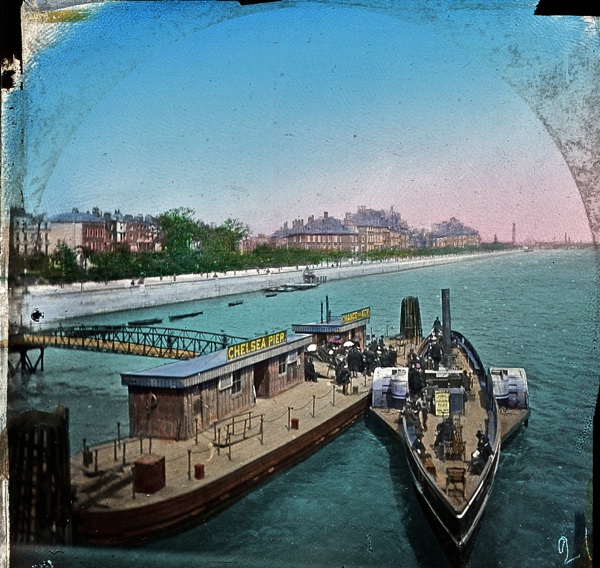
A trip from Chelsea Pier, c.1910.

Doggett’s Coat & Badge Race, c.1920.

Feeding pigeons outside St Paul’s, c.1910.

Building the Great Wheel, Earls Court, c.1910.
Glass slides copyright © Bishopsgate Institute
You may also like to take a look at
Mike Tsang’s Chinese East Enders
“What interests me is what happens to people who exist between cultures,” admitted Mike Tsang introducing his forthcoming exhibition of portraits, “I am a documentary photographer and I do unusual portraits, but I also love doing interviews as well.”
Mike lives on Brick Lane and grew up in Harrow, but his parents came from Mauritius and their parents were from Guangzhou in South China – so he has a vivid personal relationship to his subject.
“When I was tidying up my childhood room, I found all these old photos but I didn’t know the stories and, when I showed them to my parents, it unlocked memories that they had not spoken of in years,” Mike explained, revealing the origin of his ongoing project to document the lives of British Chinese people, from which I publish this East End selection.

PC William Wong of Poplar
“I was born in Hong Kong and came to the United Kingdom when I was three years old.
My mother’s family grew up as subsistence farmers in a village called Lai Chi Wo near the border of China. My grandfather was in the Merchant Navy and he landed in England, which is how we came to be here. He saved up enough money while he was travelling to open up a restaurant in Cumbria. At first, he would send money back to my mother in Lai Chi Wo but eventually she came over to join him.
If you have ever been to the museum in Hong Kong with a traditional Hakka village rebuilt, it’s pretty much what ours is like – with walls on the outside and in the way people would dress. When I went back there last year, I had a chance to walk around the hills in the village. It is still what my parents saw when they were young. Because I’ve always lived in cities, it was a very big step just to imagine the way they used to live. Every ten years in the village, there’s a get-together where everyone who’s overseas returns. There’s traditional dancing to celebrate people who’ve spread out all over the world but who have come back to the village to remember their heritage. My mother bumped into someone who she used to know when she was younger. It was amazing to see, and it gave me a stronger sense of identity.
We were in East London first of all, in Poplar. I was the only Chinese person at primary and at secondary school. Everyone knew who you were and you had to learn to stick up for yourself, shall we say. I mean, it’s the same with working life actually – there are not many Chinese police officers in the Met police.”

Zoe Chan of Dalston
“I’ve lived in London my whole life. I’m an artist and architectural designer and I’ve just set up my practice, Atelier ChanChan.
My mother’s father grew up as a peasant and became a precious metal carrier between provinces, so he was quite a tough guy but he was completely uneducated. They moved to Hong Kong and, when it became occupied by the Japanese, they hoarded as much currency as possible because at the time it was worth absolutely nothing. When the Japanese left, they made millions and started their own bank. My grandma was my grandfather’s third wife, so on my mum’s side I have a massive family.

Zoe Chan’s grandfather at the centre of his graduating class at the Institut des Hautes Etudes Internationales in Paris in 1953.
On my dad’s side, my great-grandfather was a judge in the Qing dynasty but, when the whole regime changed after the revolution, he became a lawyer in Shanghai. My grandfather followed in his footsteps and became a lawyer too but, when the regime changed, he moved to Paris and got his doctorate in International Law. From there he became a businessman and also went into property. When he started making a lot of money he sent all his kids – my father and my aunts and uncles – to a British school in Madrid, then from there they went to school in England because the education was better.

Zoe Chan’s grandmother with Kiki the Afghan.
So, both my parents went to boarding school in the UK and grew up here. After university, they actually both went to Hong Kong for a few years but when they wanted to start a family they came back here. I think, because all my friends at school were British and I never really talked about my identity, I felt British. At school I didn’t have any Chinese friends, so from a young age I would have said I was British because it was easier and I could just avoid the subject. But when I finished high school, I went to Beijing to try to learn Chinese and I met a lot of international Chinese people who I really connected with. It made me realise that I was a lot more Chinese than I thought. All of the cultural and family values that I have are very Chinese but I had never realised that – I just thought it was my family.”
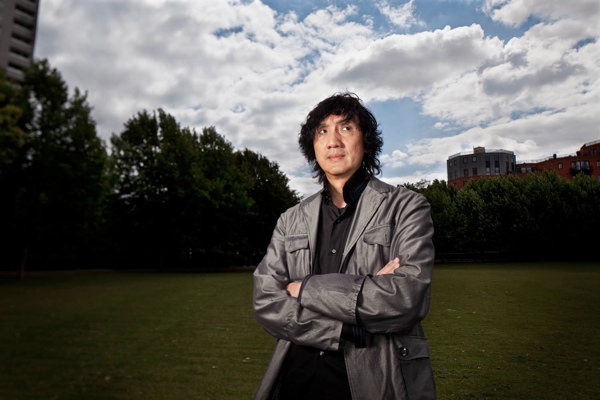
Hi Ching of Isle of Dogs
“I was born in London, then was brought up in Singapore, but I came back here to study and have lived here ever since.
My great-grandparents on my dad’s side came to Penang, in Malaysia, from a village in Fujian. My paternal grandmother was Hakka, from British Guyana, and there is a very interesting story about how she met my grandfather. Her family were moneylenders and her parents used to keep her wealth in gold ingots in a safe. Grandmother was a pretty rebellious spirit. One night, she managed to get hold of the key to the safe by snipping the necklace that the key was attached to as great-grandma was asleep. She took one gold ingot and used it to flee British Guyana for London, where she met my grandfather who was studying at Cambridge.
My mum’s adoptive mother was a nurse and adopted her two girls from destitute families. Mum’s parents were supposedly also Fujianese emigrants, but she could never find them. Mum was the first generation of girls that were educated in Penang and she became a teacher. My great-grandparents were very keen on education and I think this has been passed down the family, as most of my paternal aunts and uncles have had some sort of university education.

The wedding of Hi Ching’s mother and father in Penang in 1944.
My parents were brought up in strikingly different households. One was affluent and influential and the other was humble and grass roots. They didn’t get on! So when I was around two, as soon as mum had got her degree, she upped and left home. She drove all the way from Penang to Singapore on her own with me. This journey was very difficult in those days. I would consider her extremely brave to have done what she did. When she arrived in Singapore, she got a job and met my step-dad who married her. He was a doctor and Queen’s Scholar, a socialist, and set up his clinic in the poorest part of Singapore, called Rakyat Clinic – the People’s Clinic.
I always knew I was Chinese, but now I feel more British, especially after I came to live in the Isle of Dogs during the eighties. The first Chinatown in London was down here and that fascinated me. Even though it is no more, the history of the area makes it feel more familiar to me.”

Alan Mak of Bow
“I’m originally from Yorkshire but now I live in London and work as a lawyer.
Both my parents are from Guangdong in Southern China. They are from small, rural villages and their families were involved in subsistence farming and fishing – pretty poor backgrounds. My dad came to England in the sixties after a stint at Hong Kong airport as an aircraft fitter, just as Mao’s cultural revolution was getting going. He came to Britain to work as a waiter in takeaways and restaurants, starting off in London, then Edinburgh, Scarborough, Leeds and finally settled in York where he eventually started his own takeaway – our small family business. My mum joined him a bit later on. She’s from a big family with lots of brothers and sisters. She came to join my dad and they started the shop and that was going for about twenty-five years until they retired in 2006.

Alan Mak, as a child, celebrating a birthday with his father and sister Lisa in York.
I think they were coming for a better life, like lots of people of his generation. They left everything behind and came to an unfamiliar country to make a new life for themselves. They were very keen that their children would grow up to have a better future and a better lifestyle than they did and they thought Britain was a great place to come – a real open country where they could make the best of themselves. They worked very long hours. They made huge sacrifices for us and they are a great inspiration to me.
My upbringing and childhood were heavily influenced by the life that I lived in our takeaway shop and actually working in it all the time. The shop was five minutes from the Minster in the centre of York, and we served a largely working-class community. A lot of the people who came into the shop were people from local council housing estates, passing trade and also from the two pubs that were opposite the shop. I’d meet a whole range of people from all walks of life and society, but they did tend to be White British rather than Chinese. Most of my childhood was spent working in the shop, from about seven or eight years old, and it gave me the experience of talking to people of all social backgrounds.

Alan Mak worked in the family takeaway.
I sometimes travel to America for work, and have noticed the American Chinese have been very successful in becoming much more influential in American society over time. There have been American Chinese cabinet members. The American Chinese are a lot more established in their country than we as British Chinese are. Most arrived in America at the end of the eighteenth Century with The Gold Rush, so they have been there a lot longer, whereas in Britain the biggest waves of Chinese migration only came the sixties and seventies.”

Eric Lau of Stoke Newington
“I’m a music producer and I’m British-born Chinese.
My parents are from Hong Kong and they moved to the UK in the 1960s to find work. There wasn’t much hope in Hong Kong during that era because of the civil unrest. My uncle helped them out initially. He sent over my dad first and then my mother joined afterwards. Immediately after arriving, they worked in the food industry in Chinatown which then led on to separate private takeaways and businesses that were run by cousins and uncles.
I was born in Hertford, then moved to Ely when I was three, and stayed there until I was eighteen, after which I moved to London. Growing up in Cambridgeshire wasn’t very multicultural, I was one of only a handful of Chinese people in the school. Whether I got treated differently or not is hard for me to say. Sometimes, I felt maybe you get teased a little bit or people may come across differently to you because you are Chinese, or some people haven’t experienced being around Chinese people – or even any other races – before. It’s a subtle thing. You can sense that when you’re a child, but you try and not let it affect you in the way you are.

Eric Lau’s father and the football team he played for in Hong Kong.
Since my parents came from Hong Kong, they’ve been in survival mode since day one. That’s all they know – family first, make money, save money – anything else is secondary, so for me to do something like music, it’s not a career path that my parents would even comprehend how to make a living from. So it was understandably very difficult for them to get a grasp of, because no-one close to us had done that before.
My father and I found it very hard to communicate when I was young, because there was a language barrier – with my Cantonese – so it was very hard for me to articulate things, and he would get the wrong end of the stick sometimes. Recently, and because he can now see what I stand for as a human being, he has a lot of questions and he’s interested in what I’m doing. So that opens up a lot of conversations about my music. And I have so many questions to ask him: about certain Chinese proverbs, or why a word is made up like that, or what is it like back home in Hong Kong, growing up there, what were they doing in that time. I’m beginning to realise how lucky I am, so that’s why I’m embracing the fact that I am Chinese more as I get older.”
Portraits copyright © Mike Tsang
Between East and West: The British Chinese is at SW1 Gallery from 6th until 16th November. Tuesday – Friday 12-6pm, and Saturday 12-4pm.
You may like to see these other pictures by Mike Tsang
At Colin O’Brien’s Flat

Colin O’Brien at Michael Cliffe House in Clerkenwell
Photographer Colin O’Brien enjoyed a happy childhood growing up during the forties and fifties in Victoria Dwellings on the corner of the Clerkenwell Rd and the Farringdon Rd. Yet the dilapidated nineteenth century tenement was considered a slum and whenever politicians came round canvassing for votes, Colin’s father Edward would ask them to build better homes for the residents.
The promise was finally delivered by Finsbury Borough Council in 1965 when Colin’s parents were offered the pick of the flats in newly-built, Michael Cliffe House, just a quarter of a mile away on the other side of Clerkenwell. Modestly, Colin’s parents suggested choosing a flat halfway up the soaring modernist tower but Colin, who was now in his twenties, had other ideas and he persuaded them to take the very top flat, which offered the most spectacular panoramic views.
In Victoria Dwellings, Colin’s nascent photographic imagination had been fired by the frequent car crashes which took place beneath his window whenever the traffic lights all turned green at once. There were no car crashes to be seen at Michael Cliffe House but, unfortunately, in its early years it became a magnet for suicides. “You’d hear them going down and there’d be an almighty thump,” Colin recalled with a frown, rolling his eyes, “I walked in once and there as a body under a blanket but, even as a photographer, I didn’t want to see.”
Instead, at Michael Cliffe House, Colin’s new source of inspiration was the heart-stopping spectacle of forked lightning over the City of London – a phenomenon that he was ideally placed to photograph from his favoured vantage point at cloud level in Clerkenwell. When he took his first photograph of lightning, Colin delivered his print in person to Fleet St the next morning to the offices of the Daily Express and sold the picture at once. It was subsequently used in adverts by Brown-Boveri Ltd, a company that manufactured lightning conductors. And, the next year, Colin took another even more dramatic picture of lighting descending from the heavens towards St Paul’s and sold that one to the Evening Standard.
Michael Cliffe House was named in honour of the local Labour MP, an ex-Mayor of Finsbury , who had been Chairman of the Housing Committee and famously wrote to President Kennedy and Nikita Kruschev in 1961, at the peak of the Cold War, urging a moratorium on nuclear testing. One of the last high-rise developments in the borough, its towering structure expressed the optimism of its time, and Colin and his parents were delighted with their brand new home in the clouds. They had moved so far up in the world, they could now amuse themselves watching people tobogganing on Parliament Hill each winter.
“I could look down on Northampton Buildings where I was born in 1940 and from where we moved to Victoria Dwellings, both of which I saw demolished once we moved into Michael Cliffe House.” Colin explained to me, as I stood with him on the balcony of his flat last week. From this lofty perch, Colin’s entire childhood landscape was visible even if he has now witnessed it change beyond all recognition. Yet this height also grants a liberating sense of perspective, confronting the viewer with the overwhelming wonder of the city. “There’s supposed to be no money and we’re in a recession, but look at all the cranes,” declared Colin with a bemused grin, gesturing to the new structures that punctuate the skyline, evidencing London’s continuing transformation.
“My father lived here for ten years alone after my mother died, and I got really close to him,” confided Colin, as we returned inside to the shelter of the domestic space, “He was a nice hardworking man who worked twelve hours a day sorting letters at the Mount Pleasant Post Office. After he died, I found a diary that said, ‘We’re five shillings short on the rent this week, I don’t know what we’ll do.'” Once it became possible, Colin’s parents bought their beautiful flat in the sky and Colin keeps it now as a haven containing his memories of them and as a vantage point to keep an eye upon his home territory.
Just one item of furniture survives in Colin’s flat from the Victoria Dwellings days, a small wooden table that was the only piece he ever made at school in woodwork class. Once upon a time, Colin brought it home proudly on the tube from Sir John Cass School in Aldgate to Victoria Dwellings in Farringdon. Yet, with its clean modern lines and unfussy design, it matches the aesthetic of the new flat better than it could ever have suited Victoria Dwellings. Colin O’Brien’s table is at home in Michael Cliffe House.

The view from Colin O’Brien’s flat looking towards the City of London.

At dusk.

In the sixties, when the Tate Modern building was still operating as a power station.

The building of the Barbican towers in the seventies.

Michael Cliffe House today – Colin’s flat is the top one on the right.

The entrance.

Colin’s photograph of lightning over St Paul’s taken from the flat in 1971.

As published in the Daily Express next day.

As used in an advert for lightning conductors.

Colin’s second, even more spectacular, photograph of lightning over St Paul’s from 1972.

As published in the Evening Standard next day.

Northampton Buildings in Clerkenwell where Colin was born.

Looking down in Northampton Dwellings from Michael Cliffe House.

Colin’s childhood flat was the top window on the far right of Victoria Dwellings in the Clerkenwell Rd.

Victoria Dwellings were demolished in the seventies.

The Rio Cinema where Colin used to sneak in to watch films as a child.

The site of the Rio Cinema today, with Michael Cliffe House in the background, photographed by Sam Nightingale.

Colin’s mother Edith relaxes in the new flat at Michael Cliffe House.

Colin’s father Edward in the lounge of the flat in Michael Cliffe House.

Colin O’Brien sits in his room in Michael Cliffe House that he moved into in 1965, with the table he made in woodwork classes at Sir John Cass School – the only piece of furniture left from the previous flat in Victoria Dwellings.
Photographs copyright © Colin O’Brien
Take a look at these other Colin O’Brien stories
Colin O’Brien’s Clerkenwell Car Crashes
Colin O’Brien’s Kids on the Street
Travellers’ Children in London Fields


