
A Walk Through Time In Spitalfields

Sandys Row from the north
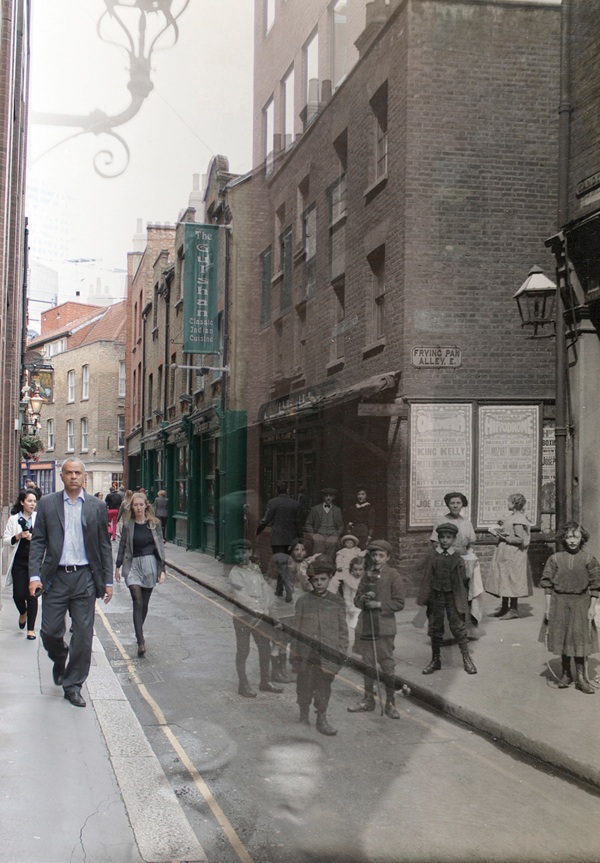
After seeing the work of photographer C.A.Mathew published on Spitalfields Life, Adam Tuck was inspired to revisit the locations of the pictures taken a century ago. Subtly blending his own photographs of Spitalfields 2012 with C.A.Mathew’s photographs of Spitalfields 1912, Adam has initiated an unlikely collaboration with a photographer of a century ago and created a new series of images of compelling resonance.
In these montages, people of today co-exist in the same space with people of the past, manifesting a sensation I have always felt in Spitalfields – that all of history is present here. Yet those of a hundred years ago knew they were being photographed and many are pictured looking at the camera, whereas passsersby in the present day are mostly self-absorbed. The effect is of those from the past wondering at a vision of the future, while those of our own day are entirely unaware of this ghostly audience.
It is hard to conceive of the meaning of time beyond our own lifespan. But these photographs capture something unseen, something usually hidden from human perception – they are pictures of time passing and each one contains a hundred years.
Sandys Row from the south

Looking from Bishopsgate down Brushfield St, towards Christ Church

Steward St

Looking down Widegate St towards Sandys Row

Looking down Middlesex St towards Bishopsgate

From Bishopsgate looking up Middlesex St

In Crispin St

In Bell Lane

In Artillery Lane looking towards Artillery Passage

From Bishopsgate through Spital Sq

Frying Pan Alley
Montages copyright © Adam Tuck
C.A.Mathew photographs courtesy Bishopsgate Institute
You may like to read the original stories
The Chambers of Old London

Impending gloom at the Mansion House, c. 1910
Given the increasing volatility of meteorological conditions, as we head into another long winter in the northern hemisphere, and given the fact that rain which is falling upon the capital is falling as snow across the country, I think the only prudent course of action is to withdraw into one of the chambers of old London. Once the last meagre ray of December sunlight has filtered through the lace curtains, highlighting the dust upon the armoire, pull the brocade drapes close and bank up the fire with sea-coal. Stretch out upon the chaise langue, I shall take the sofa and my cat will settle in the fauteuil.
These glass slides once used for magic lantern shows by the London & Middlesex Archaeological Society at the Bishopsgate Institute reveal glimpses into the lavish chambers occupied by those at the pinnacle of power in old London, and I can only wonder what the East Enders of a century ago thought when exposed to these strange visions of another world.

State Room Chelsea Royal Hospital, c. 1920

Drawing Room at Lindsay House, Chelsea, former home of the Moravians, 1912

Hall at Fulham Palace, c. 1920

White Drawing Room, Buckingham Palace, c. 1910

Dining Room at Buckingham Palace, c. 1910

Christians’ Sitting Room, Buckingham Palace, c. 1910

Prince Consort’s Writing Room, Buckingham Palace, c. 1910

Throne Room at St James’ Palace, c.1910

Prince Consort’s Music Room, Buckingham Palace, c. 1910

Prince Consort’s Tapestry Room, Buckingham Palace, c. 1910

Empress Eugiene’s Room, Buckingham Palace, c. 1910

Bow Saloon, Buckingham Palace, c. 1910

Prince Consort’s Writing Room, Buckingham Palace, c. 1910

Prince Consort’s Music Room, Buckingham Palace, c. 1910

Queen Victoria’s Dolls’ House, Kensington Palace, c. 1910

Holland House, c. 1910

Lord Mayor’s Room, Mansion House, c.1910

Drawing Room, Goldsmiths Hall, c. 1920

Drawing Room, Armourers’ Hall, c. 1920

Small Hall at Cordwainers’ Hall, 1920
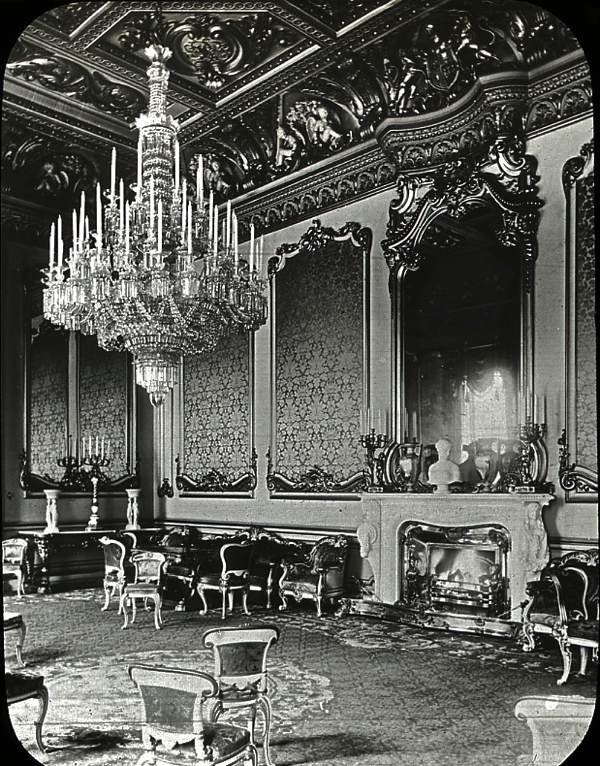
Drawing Room, Goldsmiths’ Hall, 1920

Drawing Room, Salters’ Hall, c. 1910

Drawing Room, Mercers’ Hall, 1920

Drawing Room, Devonshire House, c. 1910

Ballroom at Devonshire House, c. 1910

Drawing Room, Whitehall Gardens, 1913

Prince Consort’s Dressing Room, Buckingham Palace, c. 1910

Belgian Suite Bedroom, Buckingham Palace, c. 1910

Prince Consort’s Study, Buckingham Palace, c. 1910

Bow Saloon, Buckingham Palace, c. 1910

Throne Room, Buckingham Palace, c. 1910

Vestry of St Lawrence Jewry, c. 1920
Glass slides copyright © Bishopsgate Institute
You may also like to take a look at
City Reform Group

At the end of last week, on a winter’s day remarkable for the clarity of its light, the vestry room above the porch of Christ Church, Spitalfields, was filled with an expectant throng for the launch of the City Reform Group.
Their ambition is to restore the reputation of the City of London which has sunk to an all-time low in recent years with an endless grimy catalogue of misdemeanours exposed since the financial crash that brought the country to its knees. Grievous failings such as criminal manipulation of the markets, mis-selling of financial products, pilfering of pension funds and engineering of tax avoidance schemes on a grand scale are compounded in the public eye by a greedy bonus culture which flourishes unabated.
A year ago, the Occupy movement at St Paul’s Cathedral revealed that while the general populace recognises the City of London no longer serves the Common Good, the Corporation is complacent in its ability to serve itself handsomely. Working within the established channels, the City Reform Group endeavours to deliver change by encouraging new candidates – any citizen is eligible to stand – in the forthcoming March elections to the Common Council, and by inviting all candidates to sign up to seven pledges that outline their moral responsibility.
After a welcome by Adrian Newman, Bishop of Stepney, it fell to Father William Taylor (a figure well-known in Spitalfields), to introduce the speakers who represented the diverse range of social interests unified by the Group – Pula Houghton, Director of Which? The Consumers’ Association – Simon Walker, Director General of the Institute of Directors – David Davis, Member of Parliament – Giles Fraser, Ex-Canon of St Paul’s Cathedral – and David Pitt-Watson of the Royal Society of Arts.
Pula Houghton reported the results of a Consumer Association survey in which 71% of those questioned declared they did not trust the banks. Simon Walker of the Institute of Directors was eloquent in his commitment to Capitalism, Enterprise and the Free Market yet acknowledged that the concept of the Free Market must be turned back on itself so flaws in Corporate governance can be challenged. David Davis, who sat on the government’s Independent Panel on the Future of Banking, emphasised that he discovered many workers in the financial industries admitted the system forced them to do things they knew were wrong, yet had no Hippocratic oath – as other professions do – which gave them the authority to raise a challenge in the workplace.
It was Canon Giles Fraser who invoked the ancient right of Sanctuary upon the steps of St Paul’s Cathedral last year, permitting the protestors to stay and asking the police to leave, thereby becoming the catalyst for the camp which occupied the churchyard last winter. The subsequent conflict within the Church of England that led to the eviction of the camp also led to Fraser’s departure from St Paul’s. He is a passionate advocate of the need for a wider democratic involvement in the City to restore moral principles and ensure it acts for the Common Good. And, gazing from the windows of Christ Church towards the glass towers of the City gleaming in the November sunlight, Fraser confronted the audience with the harsh contrast between the vast wealth represented by the City and the deprivation in Tower Hamlets where 50% of children live below the poverty line.
The final speaker, David Pitt-Watson of the Royal Society of Arts, summed up the purpose of the gathering succinctly when he said, “This is not a protest, this is an election.” and he concluded by quoting Margaret Mead’s famous words – “Never doubt that a small group of thoughtful, committed citizens can change the world – indeed, it’s the only thing that ever has.”
There are twenty-five thousand voters within the City of London and I understand that, even within corporations, a free vote is exercised – which means the potential is there and waiting for new candidates to reinvigorate Britain’s last Rotten Borough, where more than half the wards went uncontested in the last election. So I call upon readers to consider standing in the election next March. A non-party political organisation, the City Reform Group can offer advice to prospective candidates who wish to sign up to the seven pledges below.
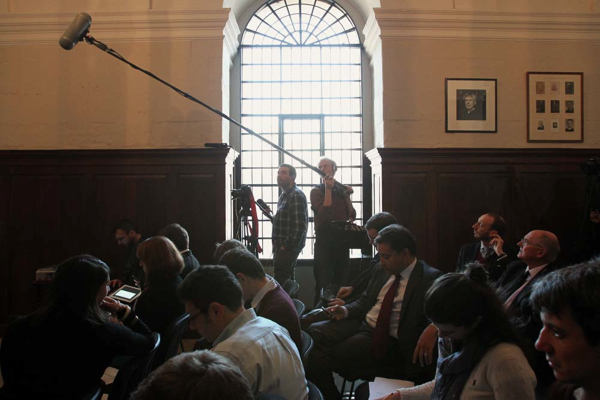

Father William Taylor introduces the speakers.


Adrian Newman, Bishop of Stepney


David Davis MP and Giles Fraser Ex-Canon of St Paul’s Cathedral

Pula Houghton, Director of Which?


David Pitt-Watson, Royal Society of Arts



Photographs copyright © Simon Mooney
The Cats of Spitalfields
Contributing Photographer Chris Kelly is renowned for her volume of cat photography The Necessary Cat – A Photographer’s Memoir, so I asked her if she would make a survey of the cats of Spitalfields and today I am delighted to publish her pictures of local felines and their human slaves.
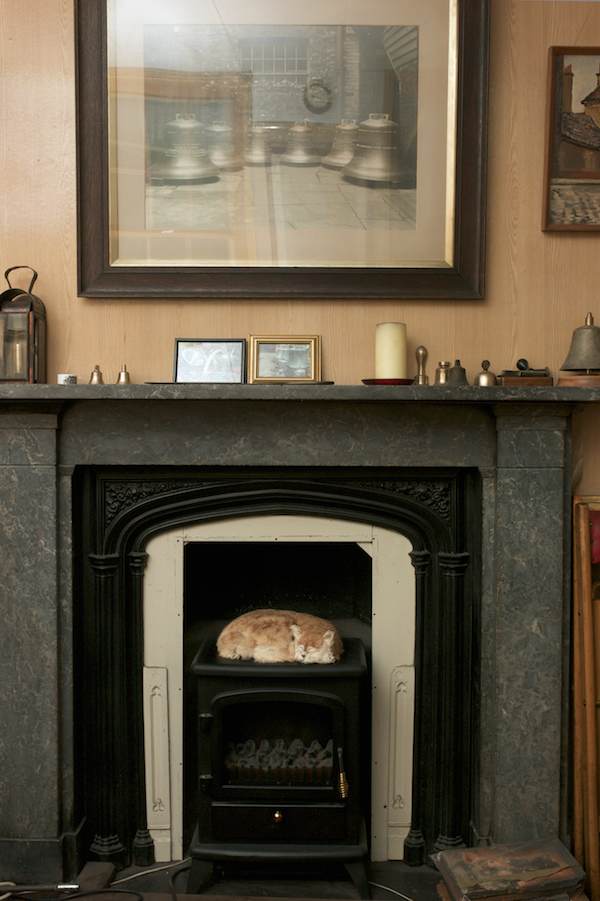
In the Bell Foundry Office, Whitechapel
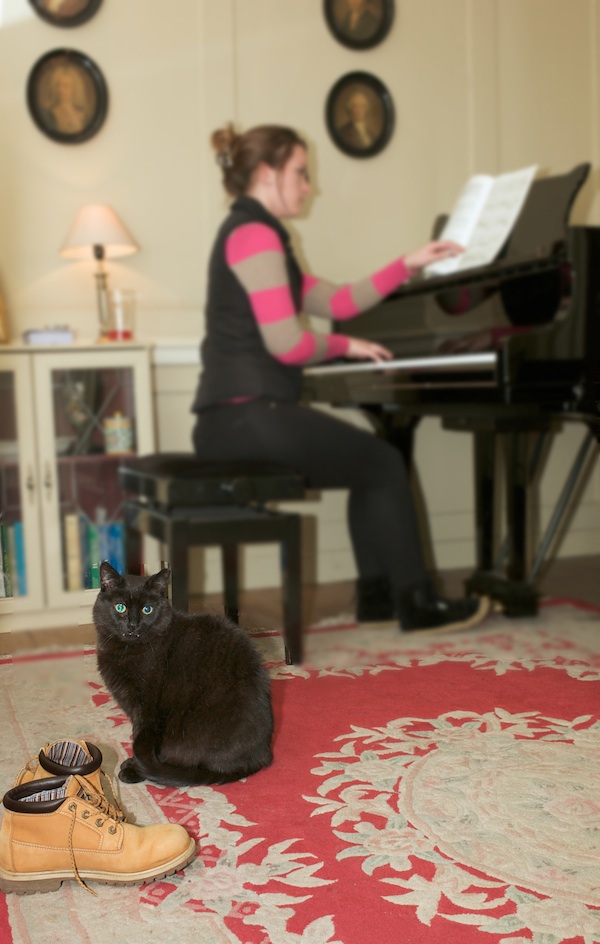
Sooty the Bell Foundry Cat
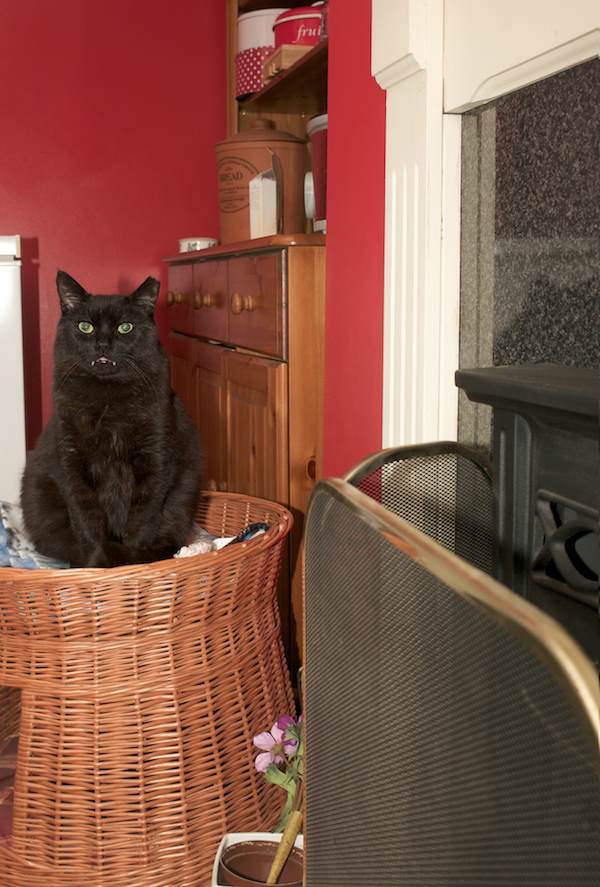
Sooty the Bell Foundry Cat & Kathryn Hughes, Master Bell Founder
“Sooty came from a London charity called Paws for Life, they rehome elderly cats or those with medical problems. He was a fighting tom taken off the streets and is FIV positive. For the first few months here he just hid in corners, but the whole house is his domain now although heʼs not allowed in the foundry.
We got him to deal with the mice and he catches any that come out from under the cooker. He sleeps upstairs with our two girls and follows us around. Itʼs lovely to have him here, especially if any one of us is alone in the house.
We think heʼs about seven or eight. Heʼs fairly scarred and scabbed and half of one ear is missing. He likes to be king of the castle. Heʼs usually fine with girls, although heʼll give ours a nip if theyʼre a bit slow to put out his breakfast. He doesnʼt like men much, especially if theyʼre wearing big boots and he only comes down to the office when the men have gone home.
He loves listening to music but only piano music and singing, he hates the trumpet and violin. He sometimes sits on a chair near the piano when my daughter is playing.
Our previous cat Sandy walked in off the street and stayed for ten years. He was the complete feral cat, he could climb a vertical ladder in the yard and be away over the rooftops. He was never really ours. He was an excellent ratter and there were plenty of the nasty large creatures around when foundations were being rebuilt. Heʼd present them to us, of course.
We acquired the toy cat in the office when Sandy died. Itʼs very lifelike and a source of great amusement and cat jokes.”
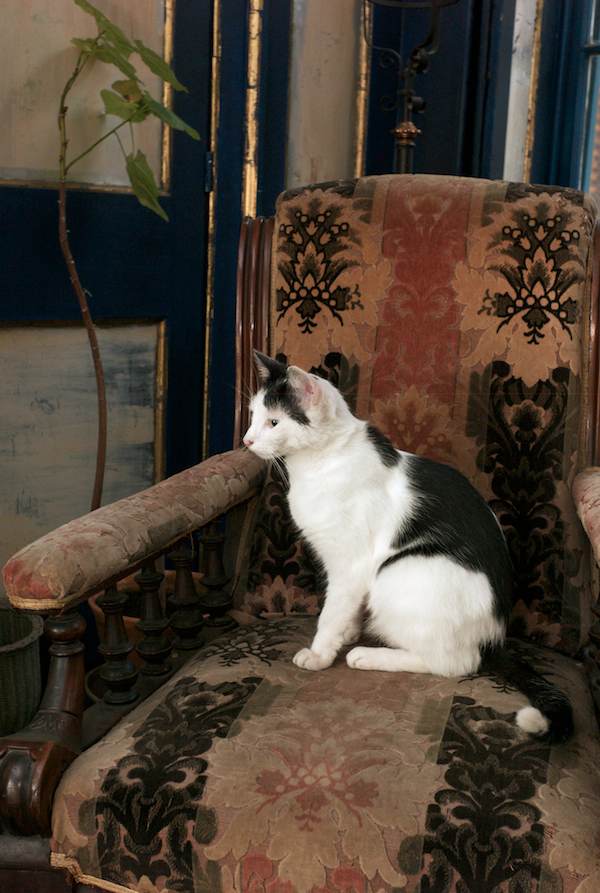
Earl
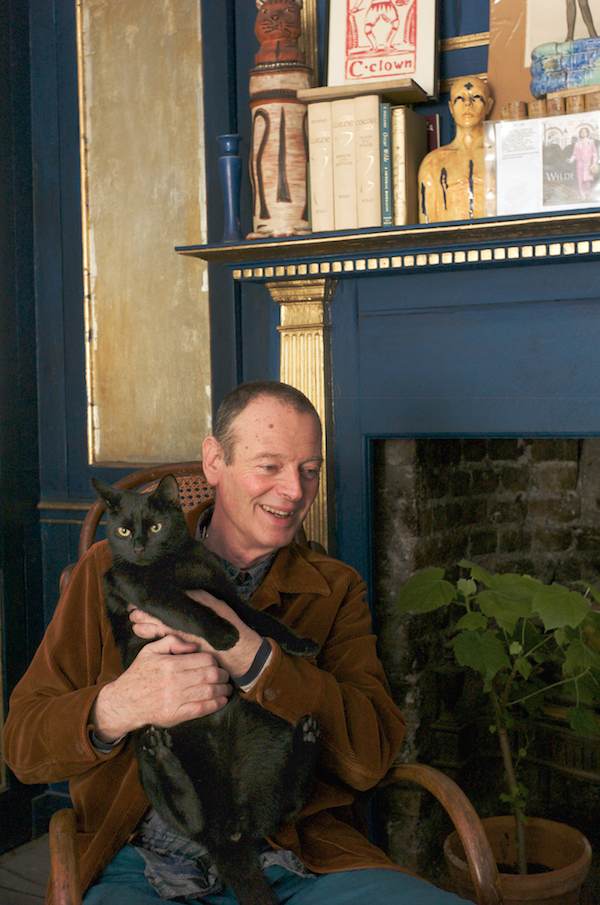
Fitzroy & Rodney Archer
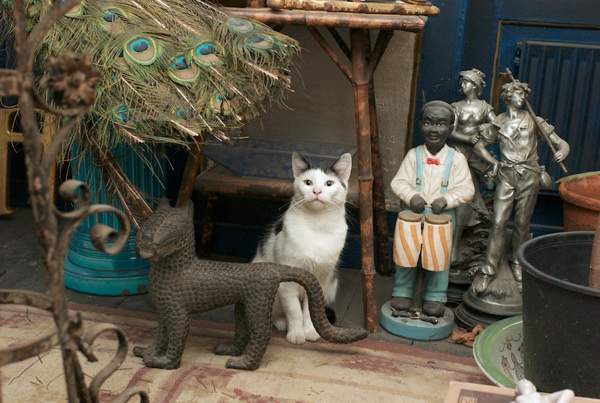
Earl & Fitzroy & Rodney Archer
“I was mourning my last cat for two years and I didnʼt want another cat. But then mice moved into the guest rooms upstairs, so I went to a cat rescue place just before Christmas last year. It was like an adoption agency – I had to be interviewed but there was no problem because Iʼve kept cats for forty years. They phoned me after a while and I had to explain that the cats were undergoing a personality change due to being renamed.
The black and white cat is Earl and the black cat is Fitzroy. Theyʼre named after good friends although one of them is allergic to cats. He does sometimes feed them when Iʼm away though. Because they werenʼt kittens, they came already formed but Iʼm beginning to love them although they do knock things off window ledges and I find vases on the floor. They get on pretty well together even though Earl tends to jump out at Fitzroy, and whereas Earl will sit on the bed, itʼs a huge honour if Fitzroy enters the room.”
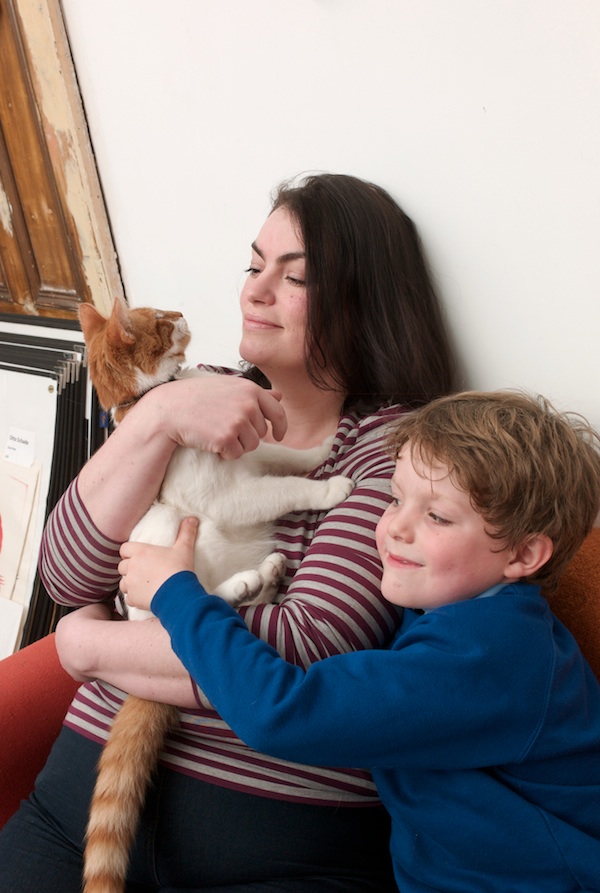
Sparkly & Melanie & Harvey Denyer
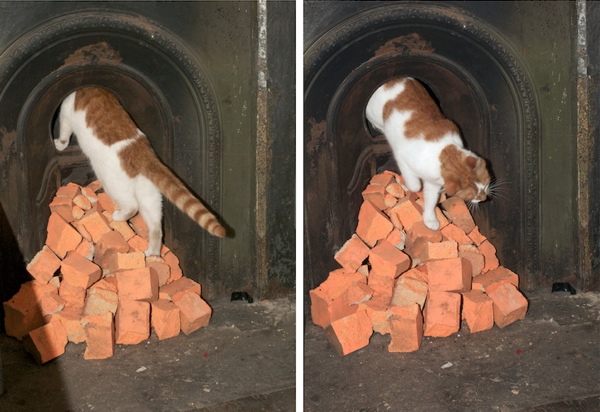
Sparkly is a curious cat
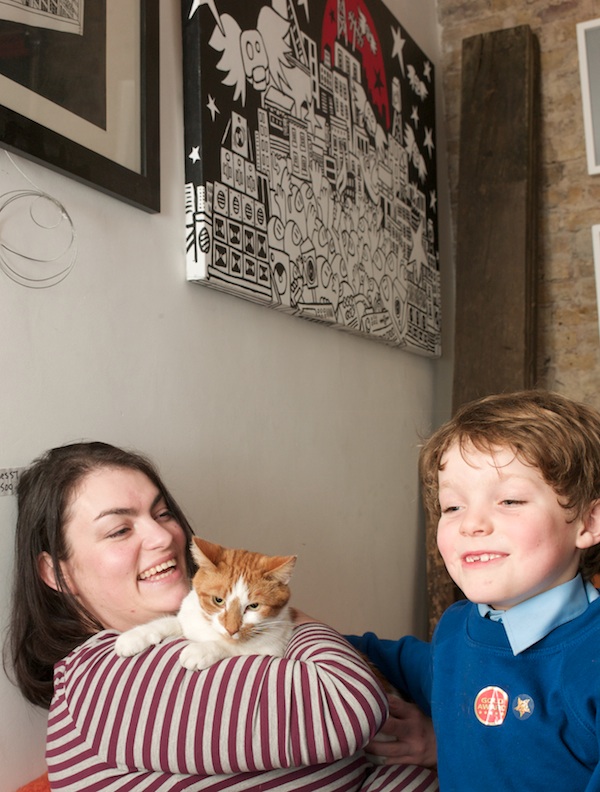
Sparkly & Melanie & Harvey Denyer
Melanie – “Sparkly came from Battersea Dogs & Cats Home three years ago. Sparkly is quite famous in the area and even before we had the cafe he was always known as The Rag Factory cat. (The Rag Factory on Heneage St is used for rehearsals, filming, classes and exhibitions)
Then he became well known in the cafe too. He liked to be with the customers, and children from the local school would stop and talk to him. Unfortunately, we had a visit from the environmental health people and heʼs banned from the cafe now.
Sparkly was twelve weeks old when he came and my son Harvey was only three, but Battersea are fantastic about matching cats with families. Sparkly was a lot more forgiving then he might have been.
Our worst experience with Sparkly was when he disappeared from The Rag Factory last November. He was missing for five months. We think he must have got into a builderʼs van. He was found in Essex and taken to the PDSA but when they examined him the vet didnʼt find his chip. Then a local shelter fostered him but before he was rehomed he was scanned again and they found the chip. When he came back, he behaved as though heʼd never been away though heʼs a bit more of a homebody now.”
Harvey – “Heʼs my cat really. I named him. We were going to call him Sparkle but I accidentally said Sparkly.”
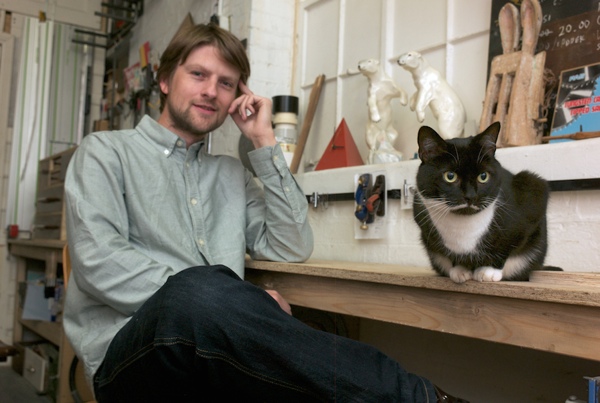
Carlos & Rupert Blanchard
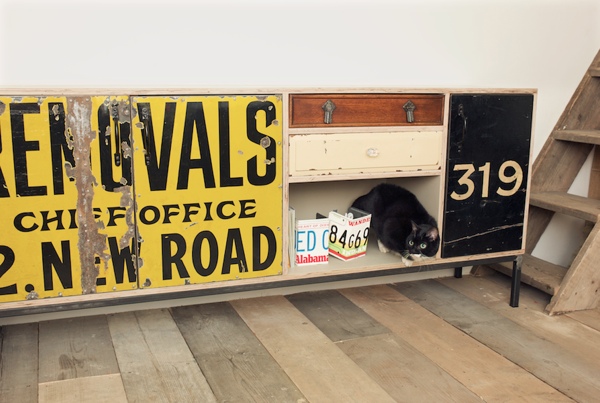
Carlos & a piece of Rupert’s furniture
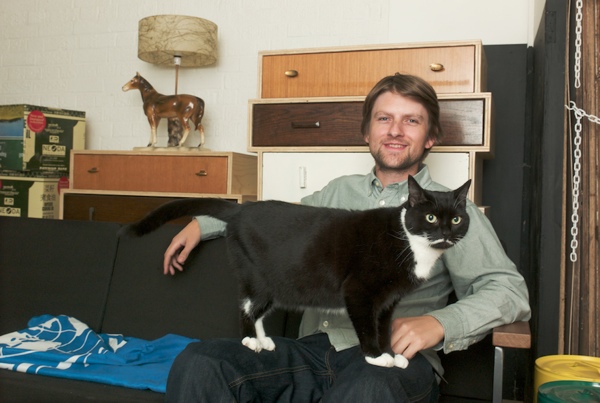
Carlos & Sofia & Rupert Blanchard & Polly Benfield
“Rupert Blanchard (cat person) met Polly Benford (dog person) in Swindon in 1999 and in 2003, they moved in together in Hackney.
The guys next door got a pair of cats to deal with mice, but moved to Mexico after having had the cats for only six months. Polly turned into a cat person because, she says, “Carlos is gentle and friendly like a dog” and we inherited the cats. The cats had been named Carlos and Sofia after King Juan Carlos and Queen Sofia of Spain. The first week we had Sofia and Carlos, they presented us with six mice. We havenʼt seen another one since, although one of the cats caught a moth recently.
They have a holiday once a year in the Wiltshire countryside with six other family cats. Just about everyone in the family has cats. Carlos always dominates.
We think they are brother and sister and are about eleven years old. Carlos is strong, healthy and very friendly but gets scared easily by the Hoover. He loves going out onto the rooftops. He also gets into every film and photo shoot possible. Sofia is always in and out of the vets, prefers life under the bed or on an Eames chair and is scared of new people. Both are much loved.”
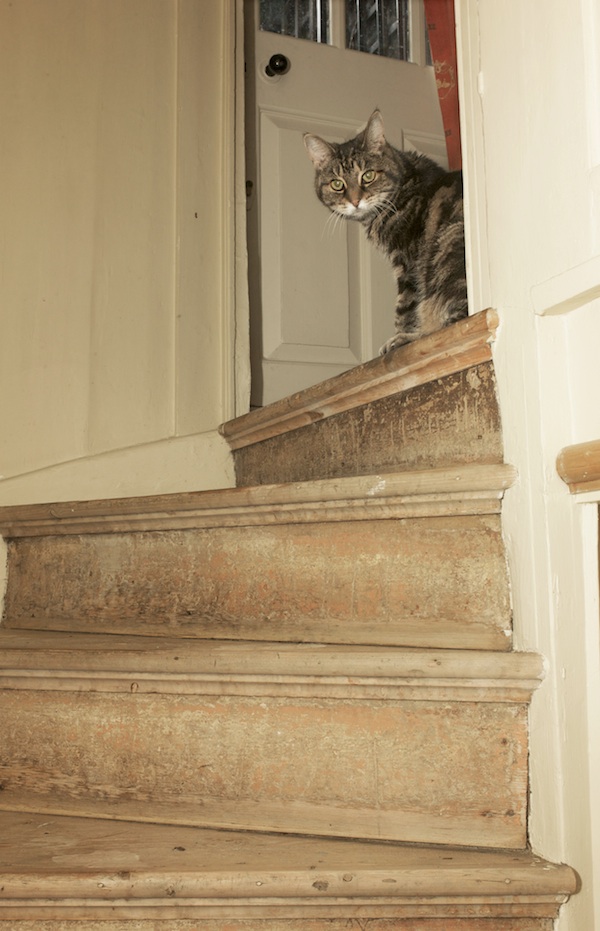
Theodora
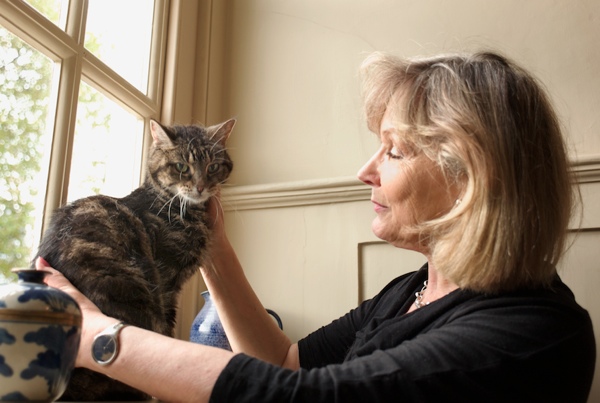
Theodora & Charlie de Wet
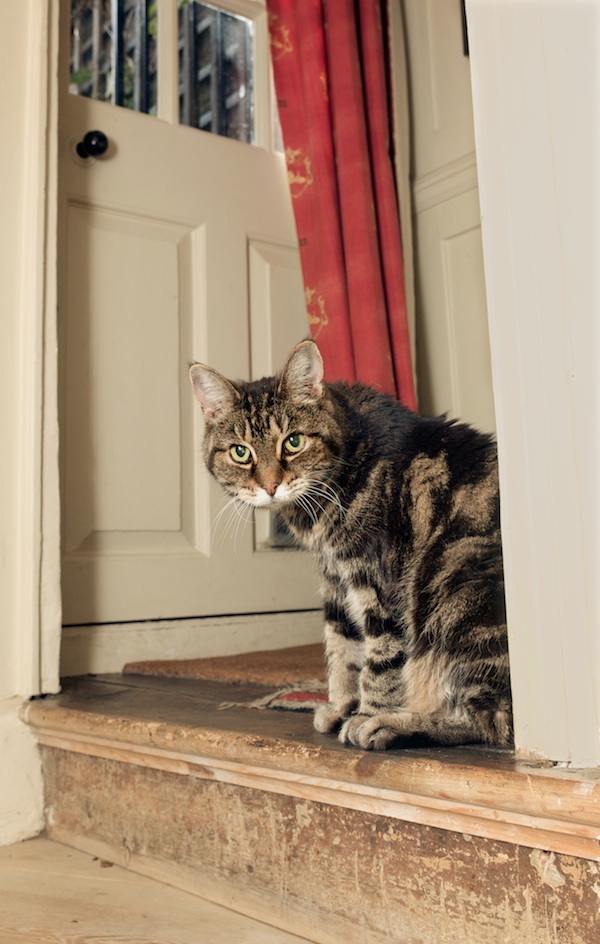
Theodora & Charlie de Wet
“Opera is my passion and Theodora is named after an opera. Maybe the next kitty will be called Aida, Nora or Maria Stuada!
Theodora, or “Dorable Dora” as she also is known, is my granny cat. She sleeps twenty-two hours of the day and night in front of the Aga dreaming. During the remaining two hours, always from 2.00am to 4.00am, she climbs three floors to tell me about these dreams. I get a swipe across my face to wake me up to listen. And then she plays like a kitten and relates every detail of her dreams. Aghhhh…but I love her dearly. When Theodora has told me everything she can remember she jumps off the bed and, if I am lucky, I get to sleep. If not, memories of all my furry family come flooding back – Puppy, Gorgeous Ginger Tom, Miss Gingerbits, Debbie & Greta, Dee Dee & Kennington. All were strays and some were in the most appalling condition, but they were all wonderful characters who shared and enhanced my life.
We were a five kitty household and Theodora is the last of that family. She and her sister Miss Fluff Bunny cost £5 each and came from Fiona Wheeler who, fourteen years ago, lived in Wilkes St. Mother Cat had several litters and so quite a few homes in the area have kitties who are related. Before Fitzroy and Earl moved in with Rodney Archer, he used to have a very fine cat called Horace who would drape himself around Rodneyʼs shoulders. He was a cousin of my girls and there must be many more of them …”

Bungy & Sammy Dobkin at Forest Reclaim
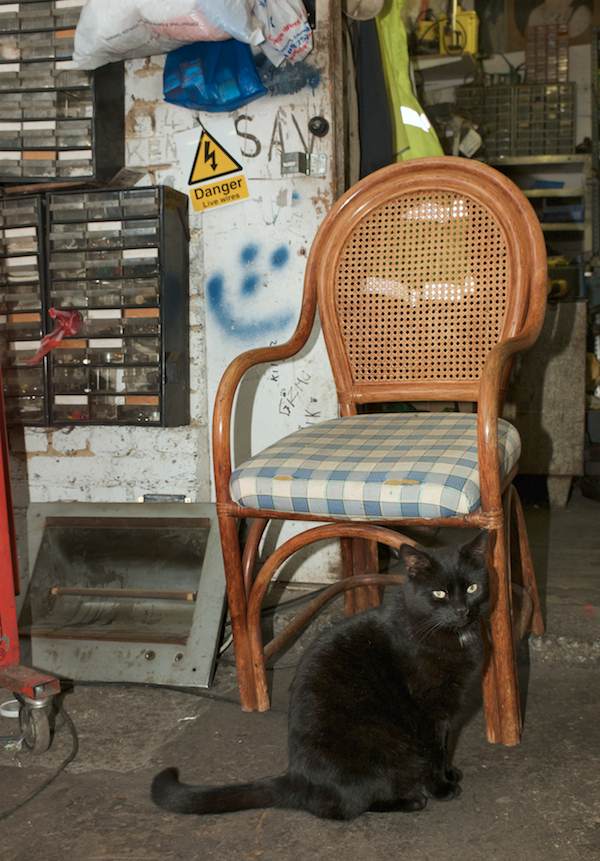
Shadow
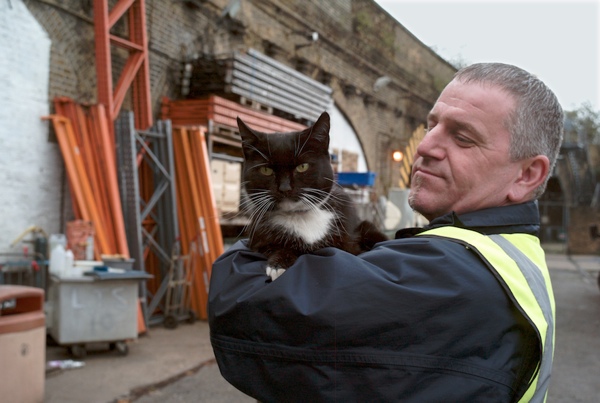
Bungy & Shadow & Sammy Dobkin at Forest Reclaim
“Iʼve worked here for a couple of years. Itʼs a family business and Daniel the owner is my cousin. Bungy, the black and white cat and Shadow, the black cat, live on the premises. Theyʼre both good mousers and Shadow loves a pigeon. I feed them both – Shadow prefers dry food and Bungy likes wet food.
Shadow turned up about a year and a half ago. He could be from anywhere because he tends to jump into strange vans. Someone put Bungy through the fence when he was just a kitten and heʼs been here for about eight or ten years.
Customers like them and people who are passing often stop and talk to them, but theyʼre spending a lot of time in front of the fire at the moment.”
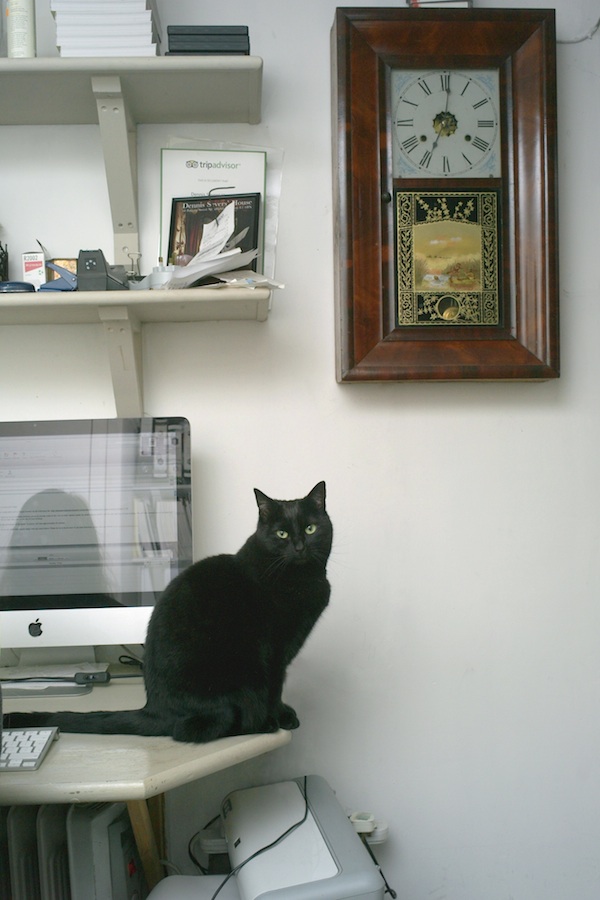
Madge in the office at Dennis Severs’ House

Madge & David Milne, Curator
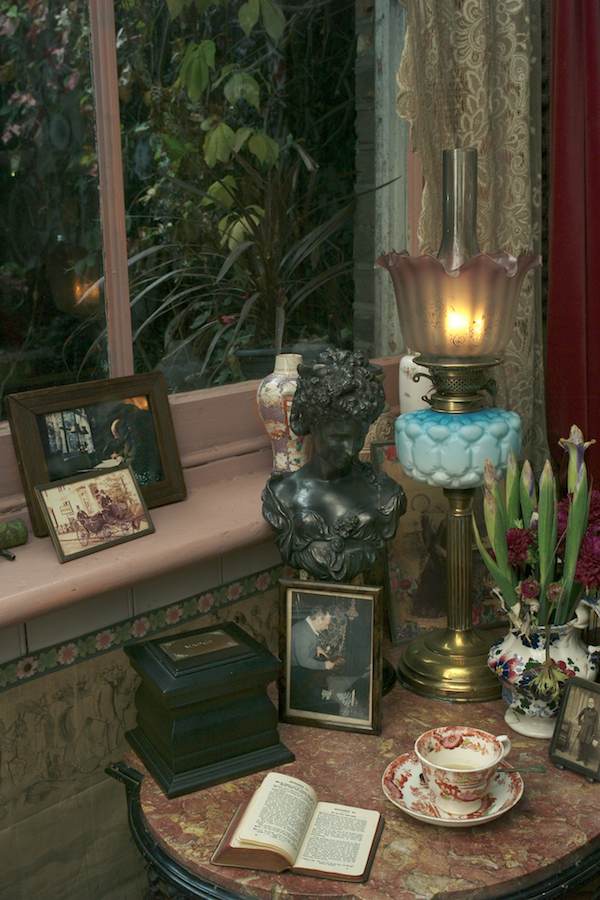
The ashes of Madge’s predecessor are in the urn.
Madge & David Milne, Curator at Dennis Severs’ House
“Thereʼs always been a cat here, and the last three have been called Madge. The first Madge was buried in the back yard in September 1991, and the ashes of the second cat are in an urn in the Victorian room beneath a portrait of Dennis Severs.
The current Madge came from a rescue place in Hackney. She was a bit frightened at first but she was only a baby, so we kept her in the office then slowly took her out into the rest of the house. Now she has secret places all over the house, including the attic. We donʼt know where she goes.
Sheʼs often around during visits. Unfortunately, some people think sheʼs a prop and give her a prod. Sheʼll respond with a miaow or a nip. She often sits in the same places and the same chairs that the previous cat liked.
She knows we put food out when the visitors come and she likes licking the butter off the toast. And sheʼs been known to tip over the eggs and eat the yolk.
She likes to be outside on the terrace in warm weather. She has friends too. She goes into Tedʼs house next door. I donʼt live here but Dennis and I were good mates and I always enjoyed the house before I became Curator.
My own cat is an Oriental Havana with emerald eyes. I was on a waiting list for two years for that particular colour and her breeders said, “If she doesnʼt like you, you canʼt have her.” Luckily when I brought her home she came out of her box, had a look round and went to sleep. Sheʼs very possessive and if there are other people in the flat sheʼll bring something to me so that I notice her.”
Photographs copyright © Chris Kelly
Chris Kelly’s THE NECESSARY CAT – A PHOTOGRAPHER’S MEMOIR is available from many independent bookshops including Brick Lane Books, Broadway Books & Newham Bookshop.
You may also like to read about
and take a look at these other pictures by Chris Kelly
Chris Kelly’s Columbia School Portraits 1996
Chris Kelly’s Cable St Gardeners
Christmas Stories


Illustration by Mark Hearld
Bell by Rob Ryan
The Fogs & Smogs of Old London
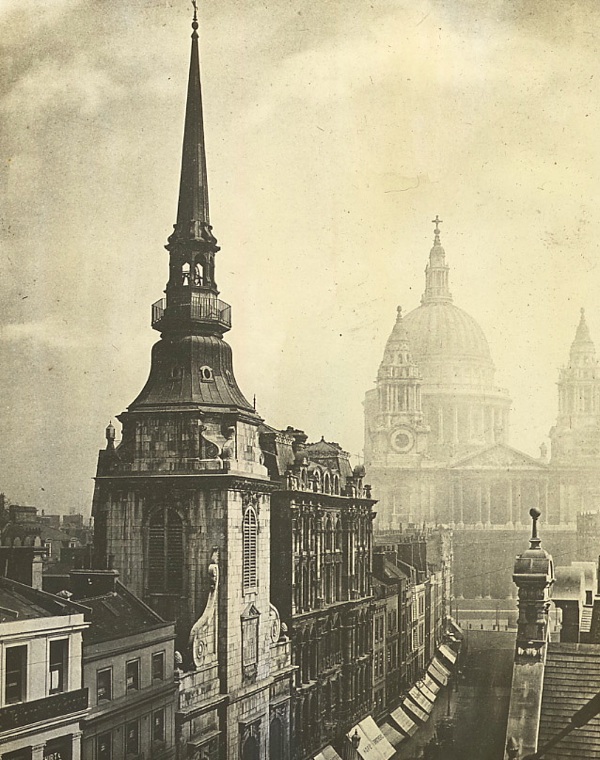
St. Martin, Ludgate with St. Paul’s Cathedral, c. 1900
At this time of year, when dusk gathers in the mid-afternoon, a certain fog drifts into my brain and the city itself grows mutable as the looming buildings outside my window merge into a dark labyrinth of shadows beyond. Yet this is as nothing compared with the smog of old London, when a million coal fires polluted the atmosphere with clouds of filthy black smoke carrying noxious fumes, infections and lung diseases. In old London, the city resounded with a symphony of fog horns on the river and thousands of people coughing in the street.
Looking at these glass slides of a century ago, once used for magic lantern shows by the London & Middlesex Archaeological Society at the Bishopsgate Institute, the fogs and smogs of old London take on quite another meaning. They manifest the proverbial mythic “mists of time,” the miasma wherein is lost all of human history, save the sketchy outline that some idle writer or other jotted down. Just as gauzes at the pantomime conjure the romance of fairyland, the hazes in these pictures filter and soften the images as if they were faded memories, receding into the past.
The closer I examine these views, the more I wonder whether the fog is, in some cases, an apparition called forth by the photographic process itself – the result of a smeary lens or grime on the glass plate, or simply an accident of exposure. Even so, this photographic fogging is no less evocative of old London than the actual meteorological phenomenon. As long as there is atmosphere, the pictures are irresistibly atmospheric. And old London is a city eternally swathed in mist.
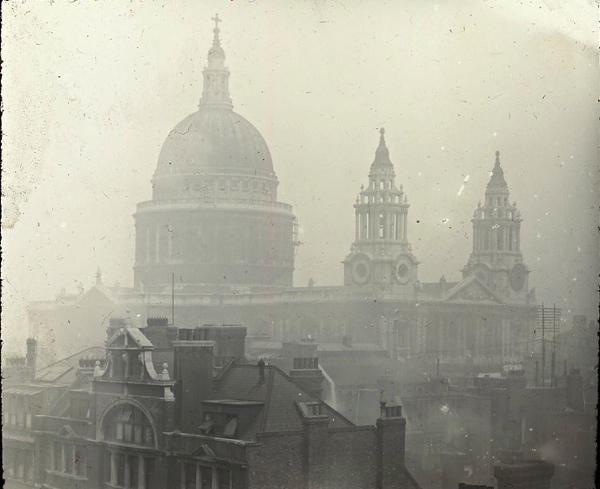
St Paul’s Cathedral from the north-west, c. 1920

Pump at Bedford Row, 1911

Cenotaph, 1919

Upper Thames view, c. 1920
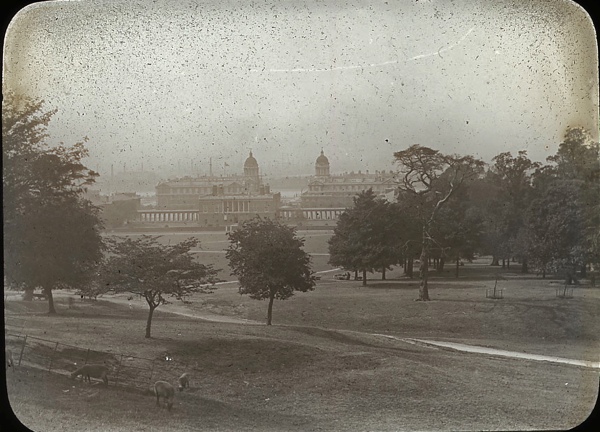
Greenwich Hospital from the Park, c. 1920

City roadworks, 1910

Looking north across the City of London, c. 1920
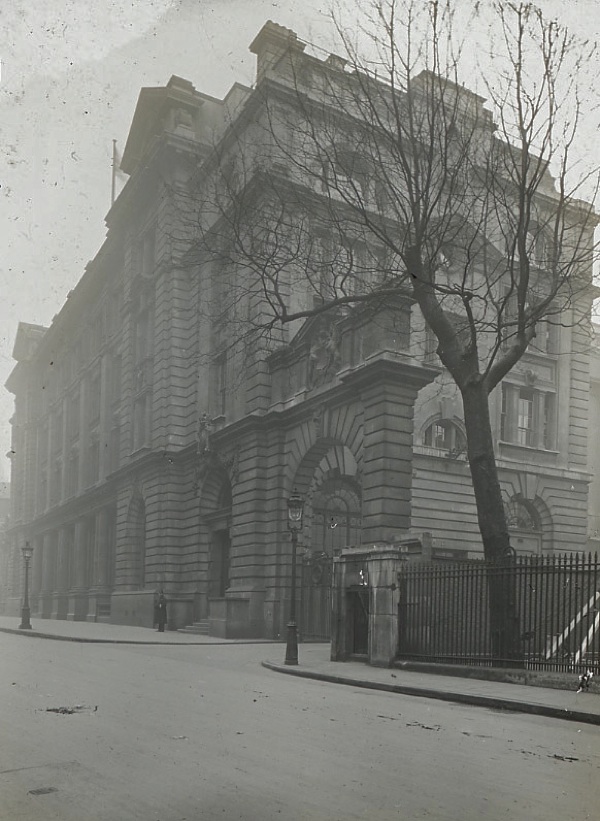
Old General Post Office, c. 1910

View eastwards from St Paul’s, c. 1910

Hertford House, c. 1910

New River Head, c. 1910

The Running Footman public house, c. 1900
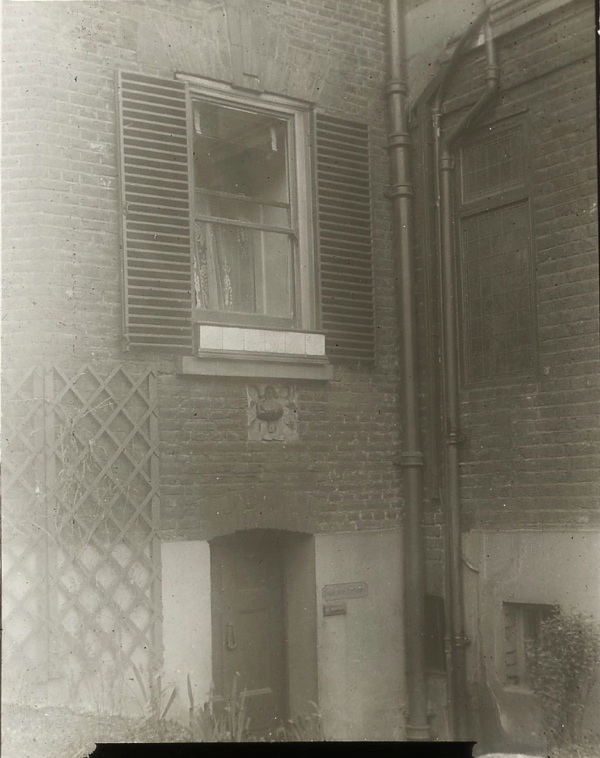
Unidentified building, c 1910

Church Row, Hampstead, c. 1910

Danish Ambassador’s residence, Wellclose Square, Wapping c. 1910

Church of All Hallows, London Wall, c. 1890

Drapers’ Almshouses, Bromley Street, c. 1910

Battersea Bridge, c. 1910

32 Smith Grove, Highgate, in the snow, 1906

Unknown public building, c. 1910
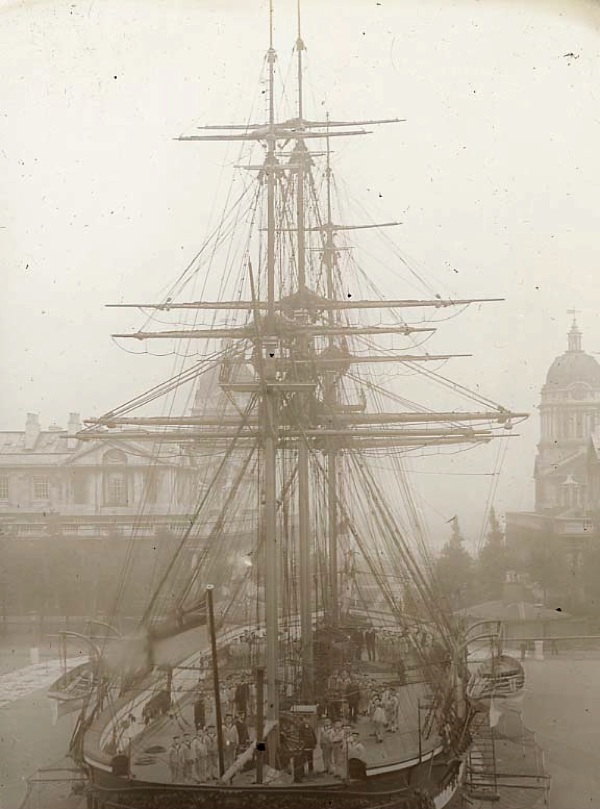
Training ship at Greenwich, c. 1910

Flooded moat at the Tower of London, c. 1910

The Woodman, 1900

Bangor St, North Kensington, c. 1910

Terrace of the Houses of Parliament, c.1910
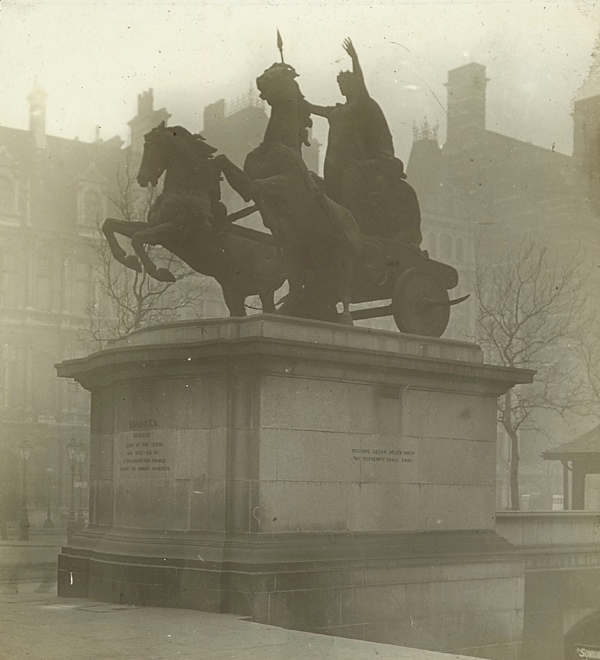
Statue of Boudicca on Westminster Bridge, c. 1910
Glass slides copyright © Bishopsgate Institute
You may also like to take a look at
Colin O’Brien’s Pellicci Portraits
Spitalfields Life Contributing Photographer Colin O’Brien begins a new series today, taking portraits of the esteemed diners at London’s most celebrated family-run cafe – E.Pellicci at 332 Bethnal Green Rd, in business since 1900. Many customers have been coming their whole lives to this tiny marquetry-lined restaurant where everyone sits cheek-by-jowl, engaging their neighbours in lively conversation while enjoying freshly cooked honest food at keen prices, and demonstrating that in the East End community spirit is alive and flourishing.
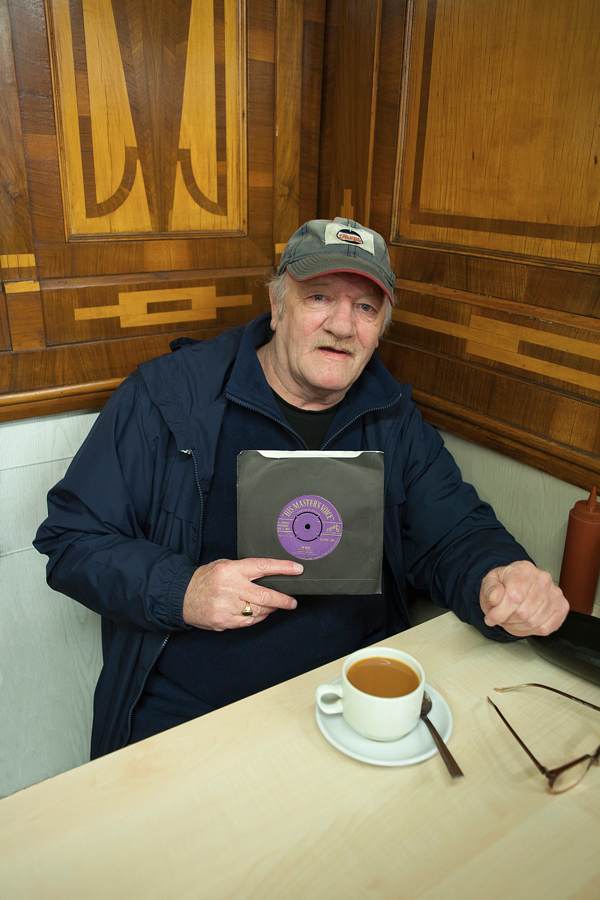
Juke Box Jimmy, the Scots Cockney – “I’ve been coming to Pelliccis since I first arrived from Scotland in 1960 and I eat here five days a week.”
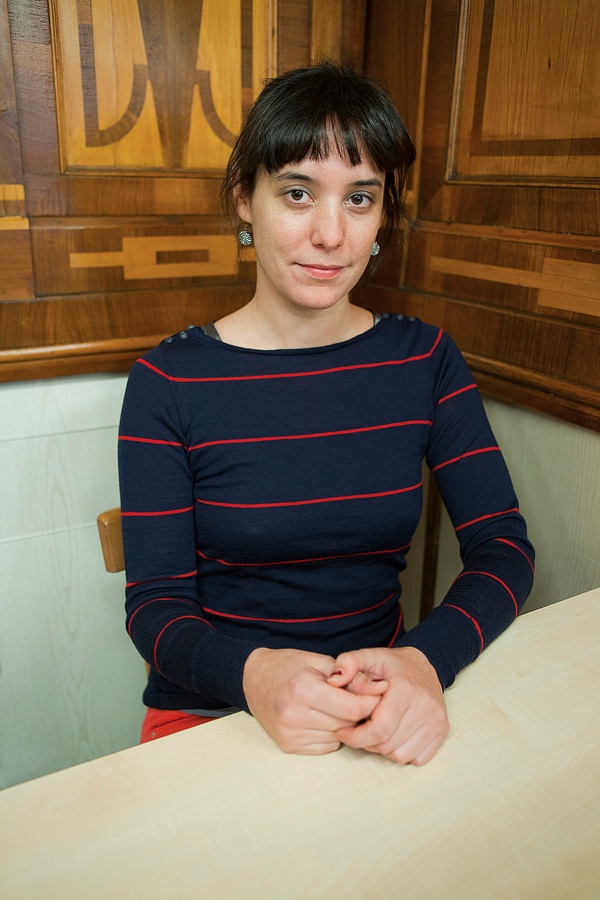
Julie Rassatt – I’ve been coming here since about five years ago, I live across the street.”
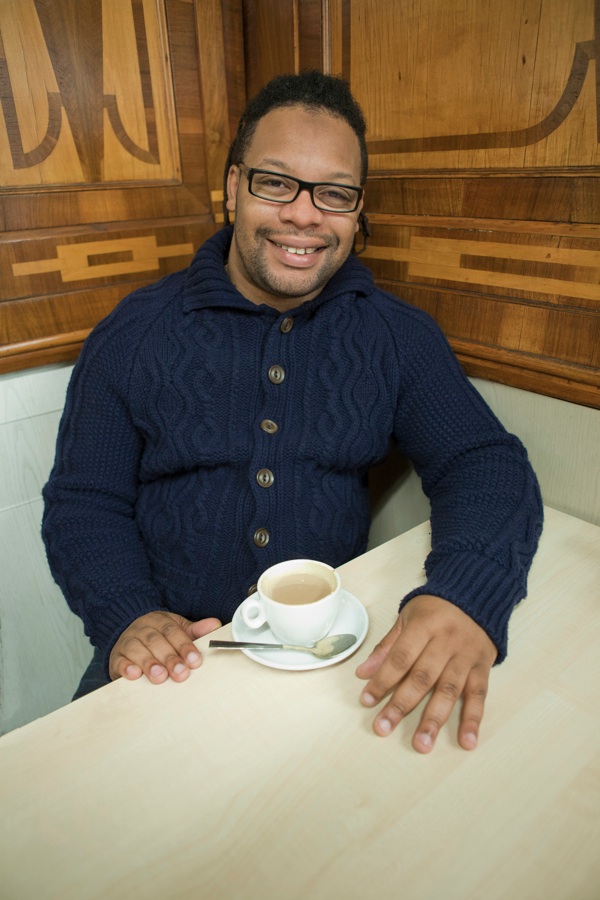
Del – “My aunt Theresa first brought me here when I was twelve, and I’ve been coming in my own since I was about sixteen and I am thirty-two now.”
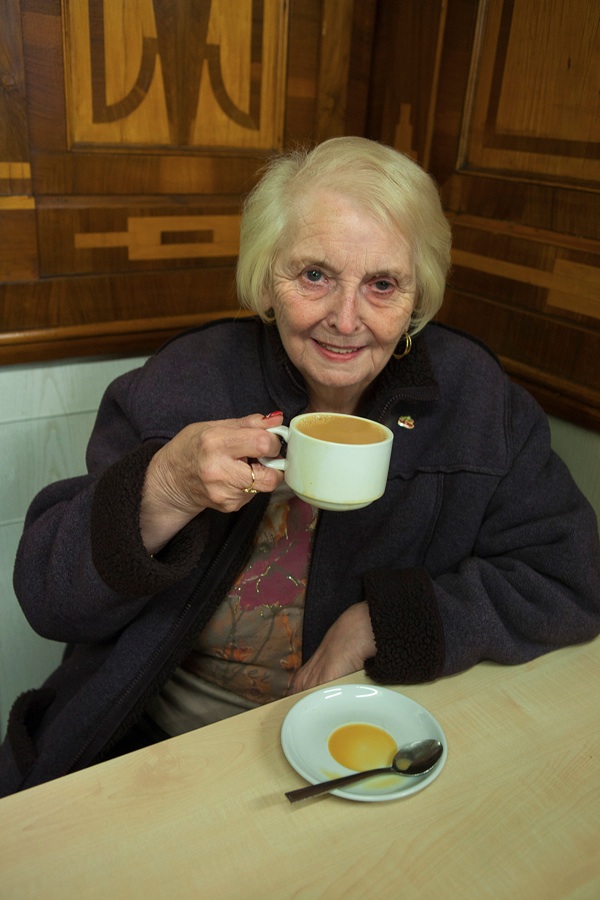
June Mumford – “I’ve been coming here since I was eight or nine.”
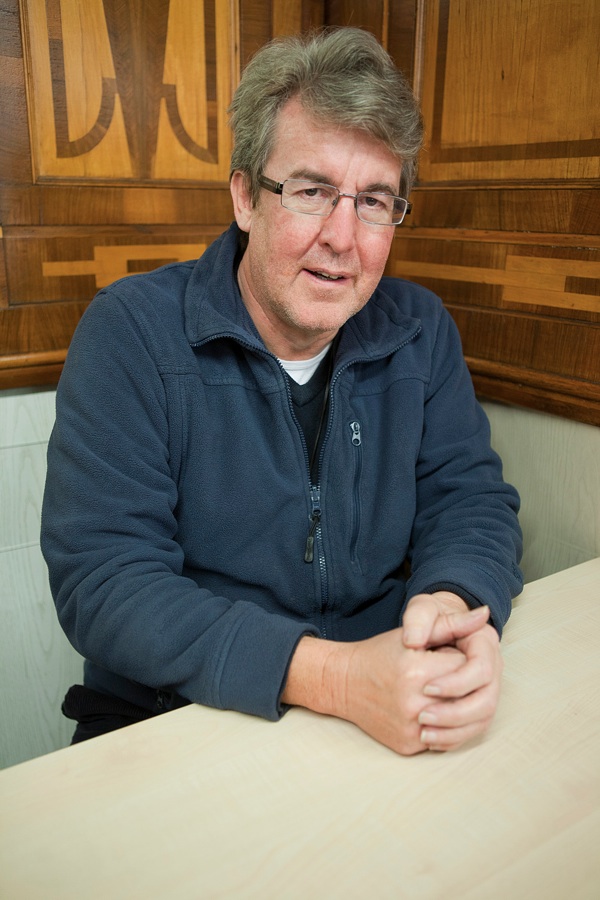
Dave Cowland, Cab Driver & Boxing Trainer – “I’m a newcomer, I only started coming here a couple of years ago.”

Maureen Thaxter – “I’ve been coming here regularly, on and off, since my daughter was small and she’s forty-seven now.”

Tyrone Walker Hebborn, Cinema Owner & Ex-Roofer – “I first came to Pelliccis in the late eighties, when I was working with my dad doing roofs in Bethnal Green.”

Samantha Clarke – “I used to come here with my dad when I was little and I’m twenty now.”

John Atherton – “I live in West London but I always visit Pelliccis whenever I am in the neighbourhood. I found out about it from book of Classic Cafes five years ago and I’ve been coming regularly ever since.”
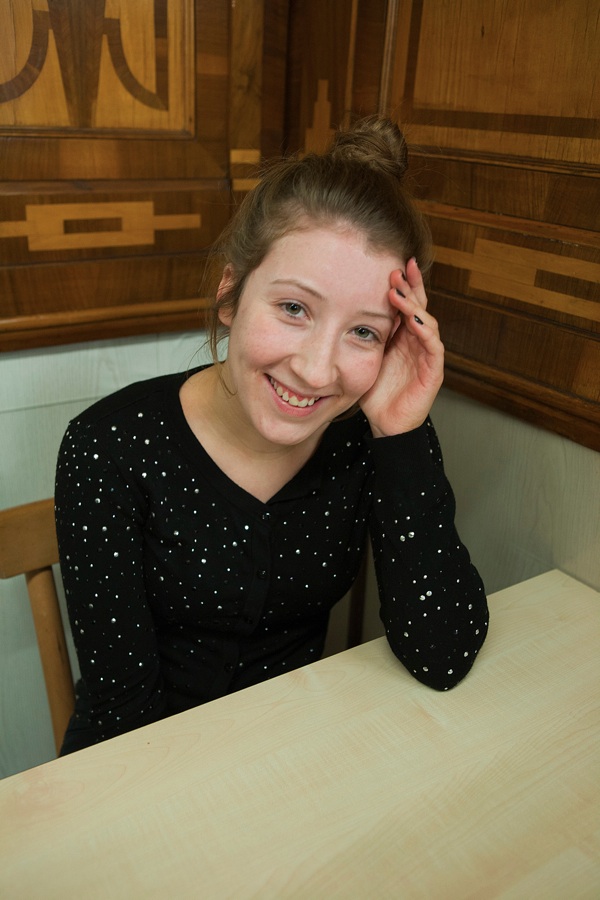
Lauren Bonner – “This is my first visit to Pelliccis!”
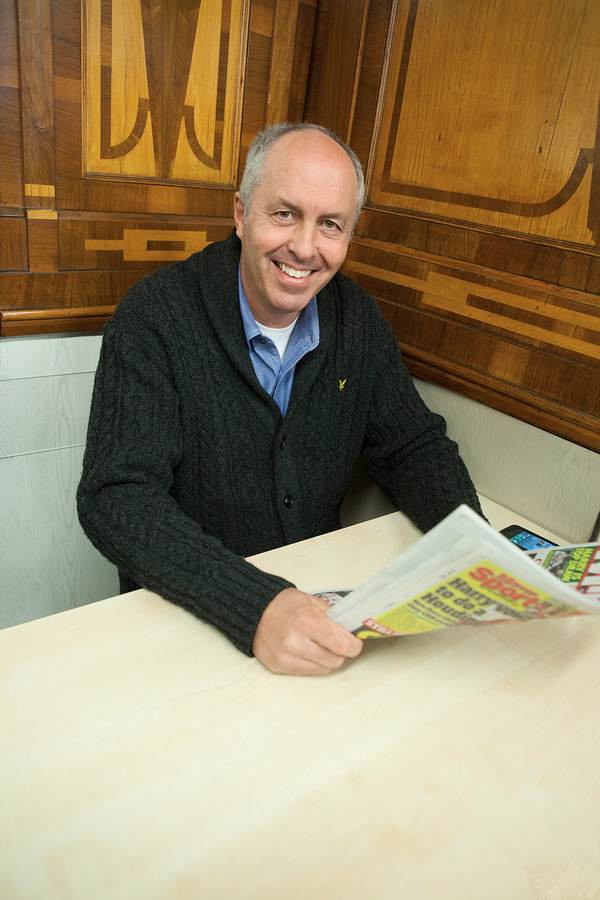
Melvin Pamplin, Can Driver & Ex-Roofer – “I’ve been coming here most days for about thirty years.”
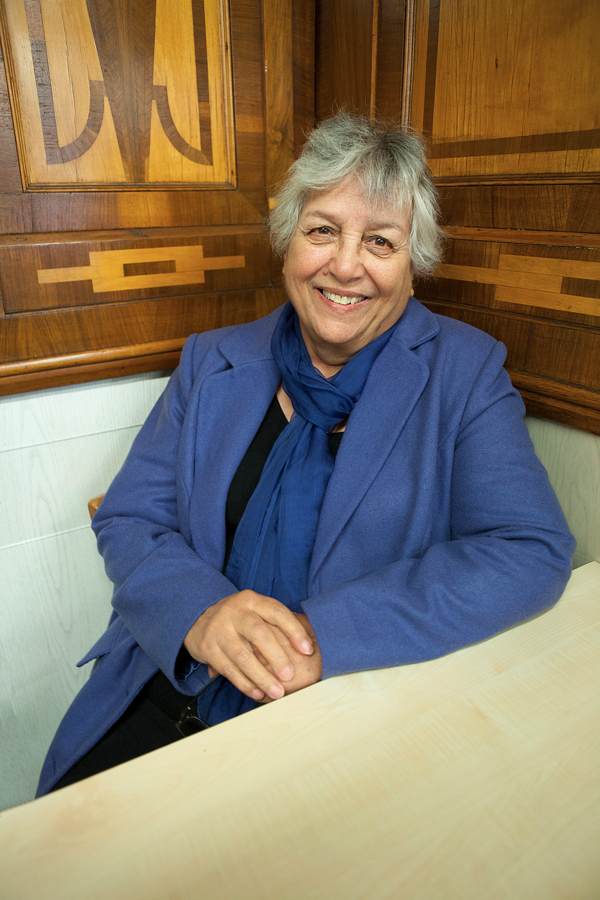
Elizabeth James – “I’ve been coming here for twenty-five years, ever since my son Michael first brought me here.”

Michael James – “I was born in Stepney and I’ve been coming here thirty years. I think I first came with the Art Critic Andrew Lambirth.”
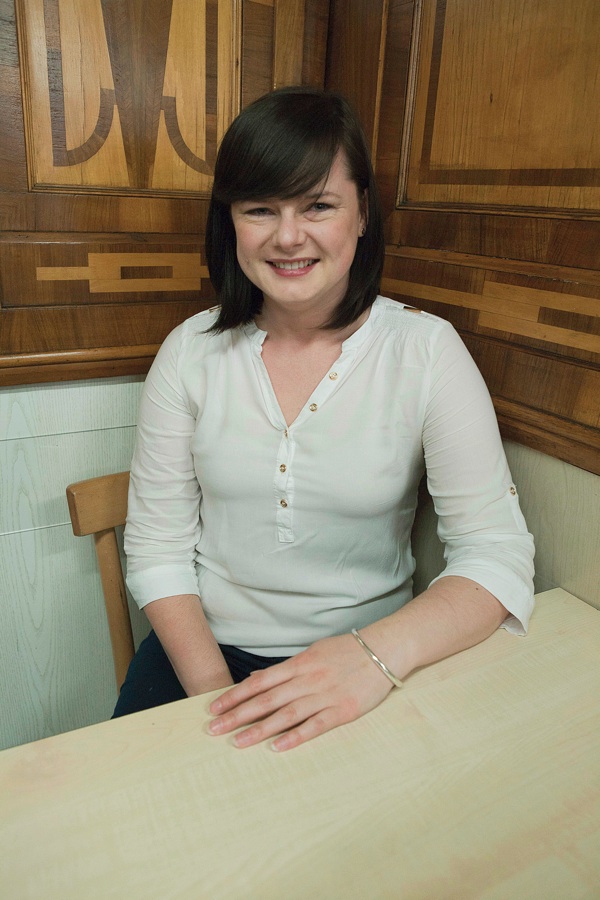
Claire Marden, Hampshire Lass – “I’m from the Isle of Wight, I’ve only been coming here for a year.”

Stan Dowsett – ‘I can’t remember how long I’ve been coming here, I’ve been fairly regular for many years and my office is just down the road. On Sunday, I was elected Toastmaster President to the Toastmasters’ Guild.”
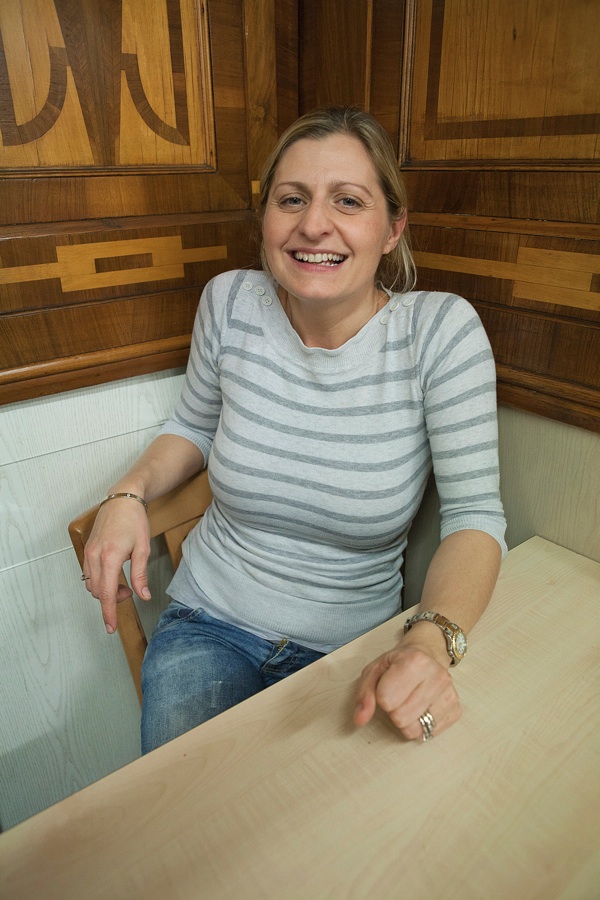
Anna Pellicci – proud third generation in the family business.
Photographs copyright © Colin O’Brien
You may like to read these other Pellicci stories
Maria Pellicci, The Meatball Queen of Bethnal Green
And these other Colin O’Brien stories
Colin O’Brien’s Clerkenwell Car Crashes
Colin O’Brien’s Kids on the Street
Travellers’ Children in London Fields
Colin O’Brien’s Brick Lane Market












