
At Pellicci’s Christmas Party
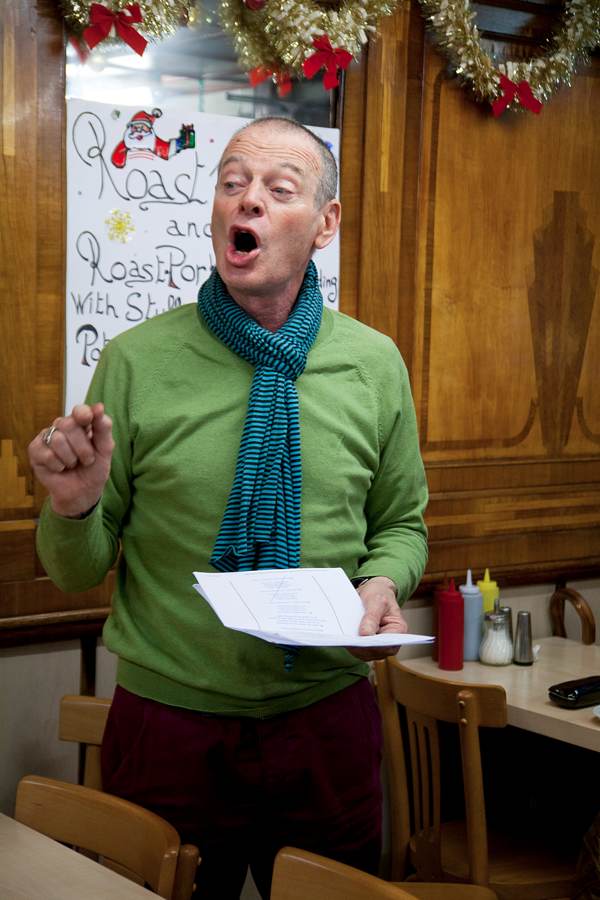
Rodney Archer gives his rendition of ‘Santa Claus is Coming to Town’…
A rain storm engulfed the East End early on the Saturday morning before Christmas, yet the foul weather did not discourage me from rolling out of my bed and along the Bethnal Green Rd to the celebrated E.Pellicci before nine in the morning with the hope of witnessing Rodney Archer perform “Santa Claus is Coming to Town.” The golden glow of the cafe interior shone like a beacon through the foul weather as I arrived to be greeted by the Christmas crib with the baby Jesus, angels and shepherds, all just visible through the steamed-up window. Once inside, I joined Rodney at the corner table where he was conscientiously studying the lyrics in advance of his big moment.
Even though the volume of custom was depleted on account of the filthy weather, Nevio Pellicci was not discouraged. He understood that what we lacked in numbers we gained in emotional solidarity as fellow refugees from the storm. And so, taking the initiative in the role of host that is his birthright and which he fulfils so superlatively, he handed out the carol sheets. Striking the metal chimney upon the boiler for the hot water with a spoon, Nevio drew the cafe to order, causing the two tables of families with children to look up with especial eagerness from their fried breakfasts – as he led the assembly in a spirited rendition of “Rudolph the Red-Nosed Reindeer.”
Photographer Colin O’Brien arrived in the midst of the carol, an expression of wonderment spreading across his face as he stepped from the chilly street into the cafe. And then, it was Rodney Archer’s moment. He stood and sang all the verses of his chosen carol, articulating the lyrics with a practised eloquence, and the entire cafe joined in with “You’d better watch out, you’d better beware, because Santa Claus is coming to town…” Visibly relieved to sit down again during his applause, “I didn’t sleep all night,” he confessed to me wiping the perspiration from his brow, “And now it’s over.”
Yet the concert party was just about to change gear, as the members of the Tower Hamlets Environmental Services Team arrived at the same moment as members of the London Late-Starters Orchestra came in for for breakfast, as they always do when practising in the rehearsal room across the road. Gina Boreham stood up and gave a elegantly modulated performance of “When you’re young at heart,” which brought the cafe to a standstill and then followed it with a soulful version of “When the hangover strikes.”
By now, things were going with quite a swing which prompted Nevio Pellicci to bring out his wedding photos and Maria and her crew to emerge from the kitchen bedecked in tinsel. “When I was a kid, all the stallholders from the market used to come in for hot toddies at this time of year,” Nevio recalled fondly, thinking back to years past, “And I used to get lots of Christmas presents.” Colin O’Brien took the rare opportunity to capture all the Pellicci team in one picture which prompted Nevio to say, “That’s the Christmas card sorted for next year!”
By this time, the rain had relented and it was just growing light outside. There was time for a last collective rendition of “Silent Night” before all realised that – once we had exchanged seasonal greetings – it was the moment to disperse upon our respective Christmas errands, while the saner residents of the East End were yet to stir from their slumbers.

The renowned baritone voice of Nevio Pellicci led the carols.
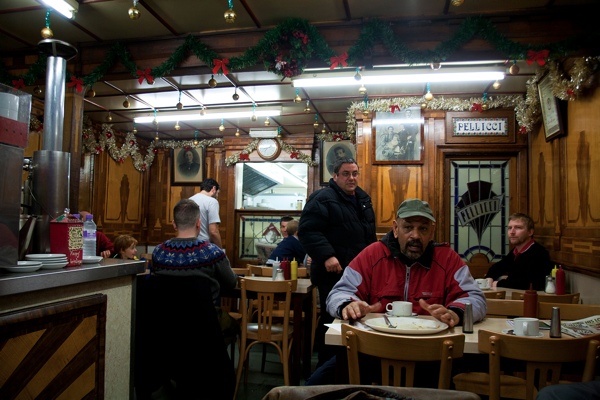

Gina Boreham


Magda and Maria


“I didn’t sleep all night and now it’s over.”


Silva, Maria, Tony, Nevio, Kinga & Magda

Photographs copyright © Colin O’Brien
You may like to read these other Pellicci stories
Maria Pellicci, The Meatball Queen of Bethnal Green
Colin O’Brien’s Pellicci Portraits ( Part One)
Colin O’Brien’s Pellicci Portraits (Part Two)
John Claridge’s Boxers (Round Nine)
On Boxing Day, the day in the festive calendar traditionally associated with sporting activities, it is my delight to introduce Round Nine in the epic series of characterful portraits of the members of the London Ex-Boxers Association by Contributing Photographer John Claridge.
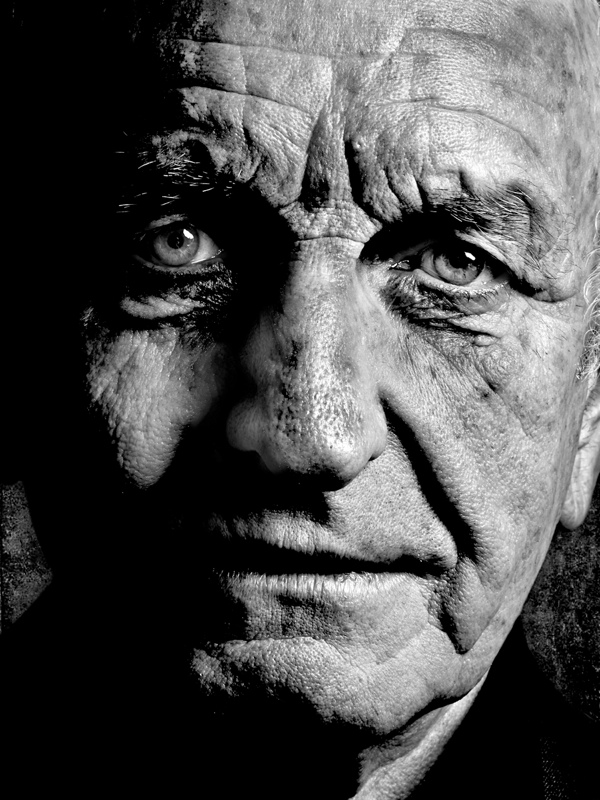
David Parker (First fight 1956 – Last fight 1961)

Anthony Brinton (Boxing Trainer)

Freddie King (First fight 1951 – Last fight 1965)
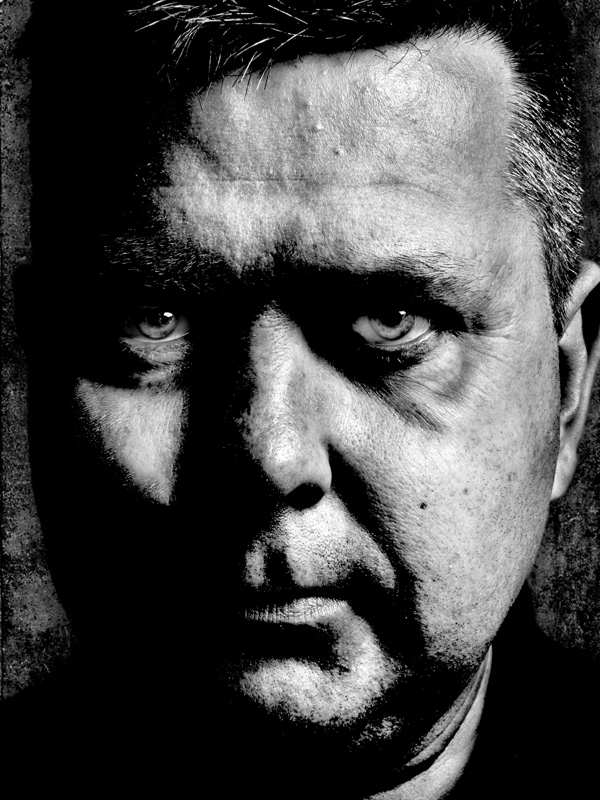
Dean Ferris (First fight 1986 – Last fight 1993)
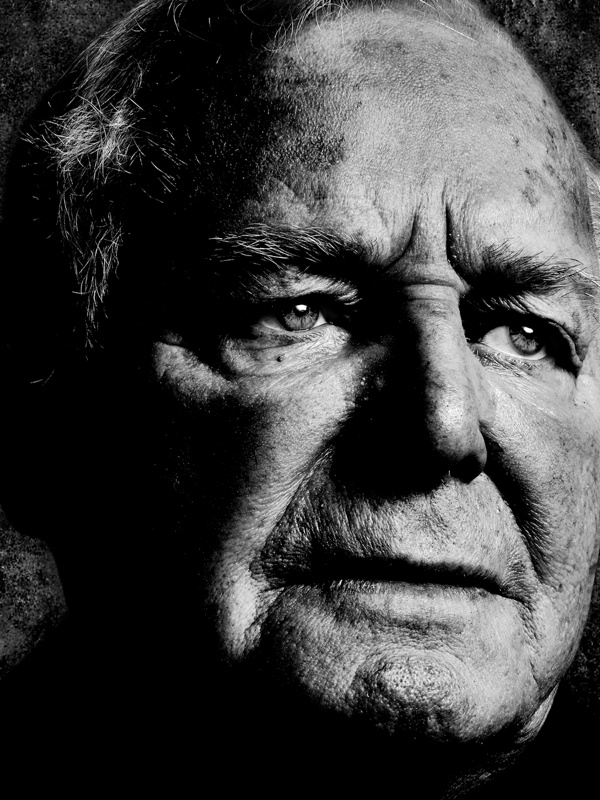
Henry Browne “of London Town” (First fight 1936 – Last fight 1952)
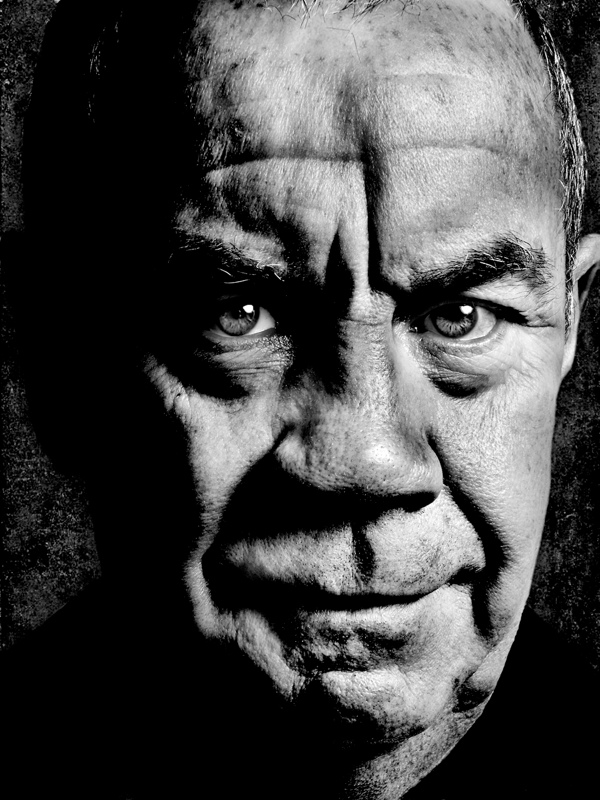
Jim Oliver (First fight 1961 – Last fight 1978)
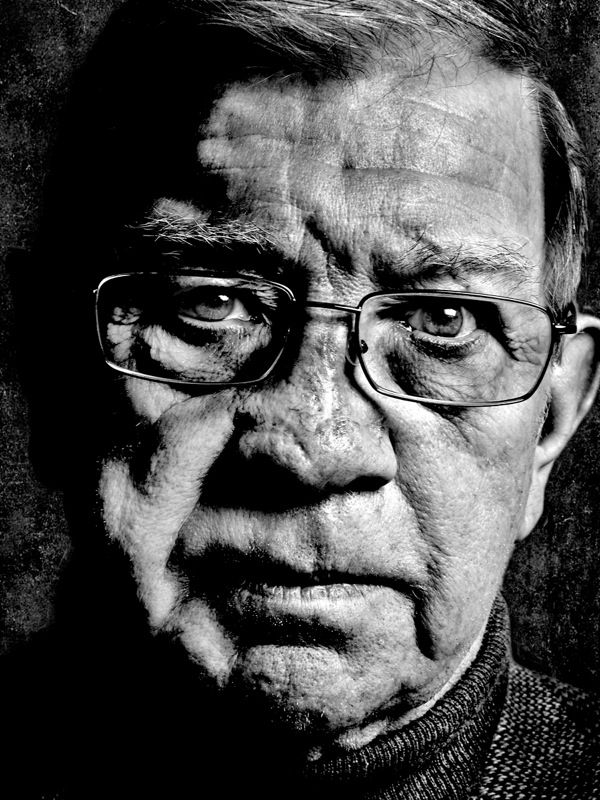
Billy Walker (First fight 1959 – Last fight 1962)
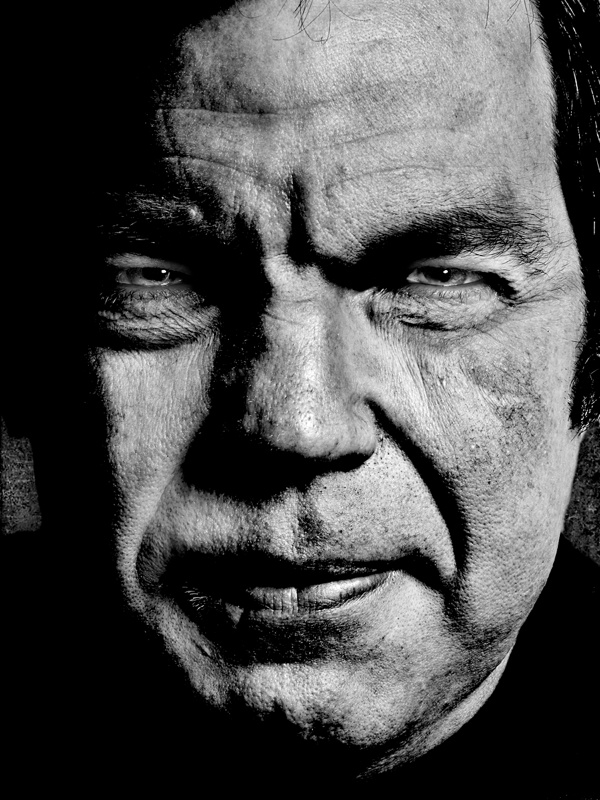
Stephen Kent (London Ex-Boxers Association resident filmmaker)
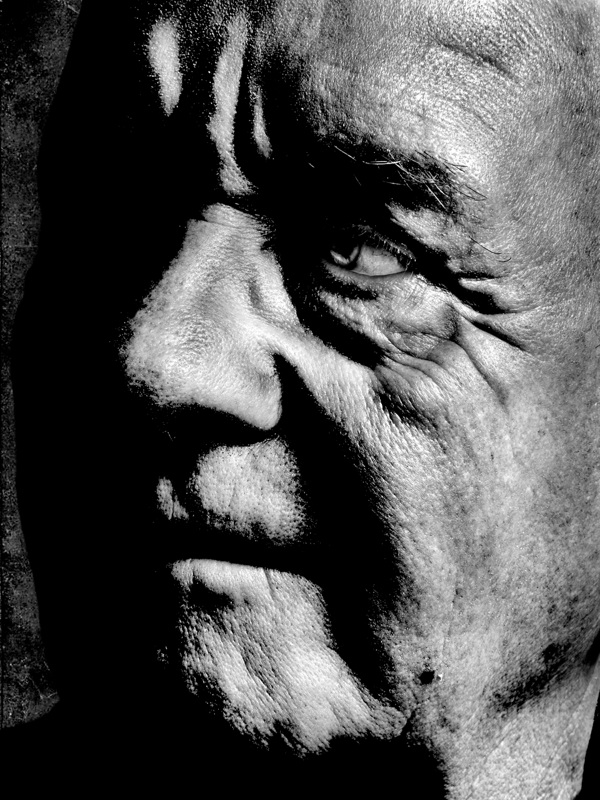
Bernie Dillan (First fight 1945 – Last fight 1961)
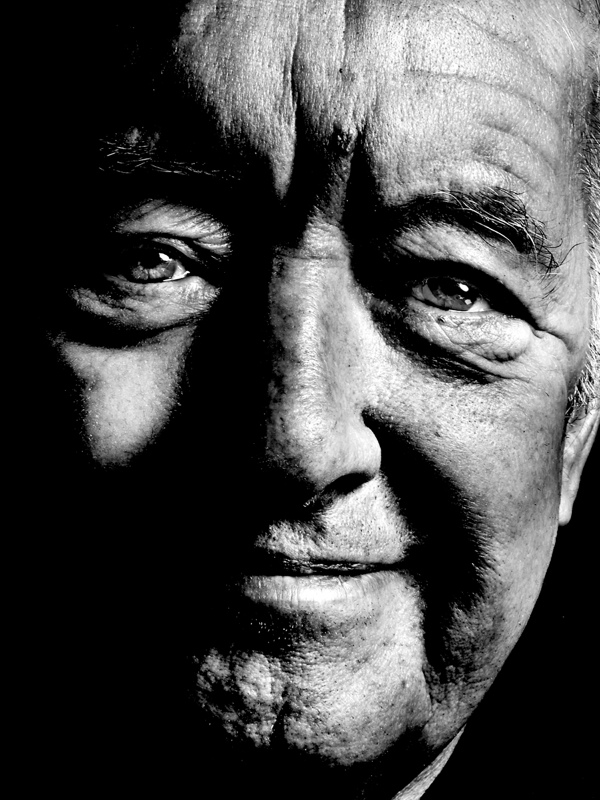
Albert Collier (Footballer from boxing family)
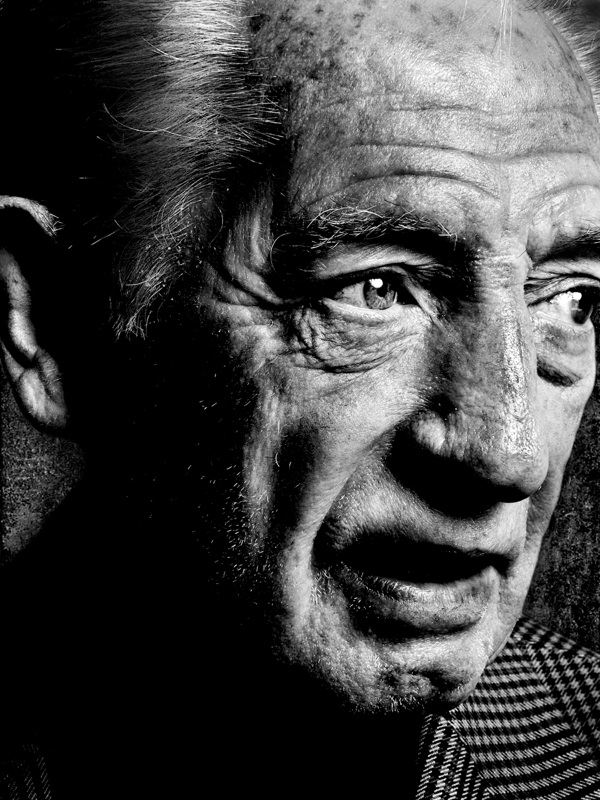
Billy Meek (First fight 1949 – Last fight 1972. Plus parallel career as jockey)
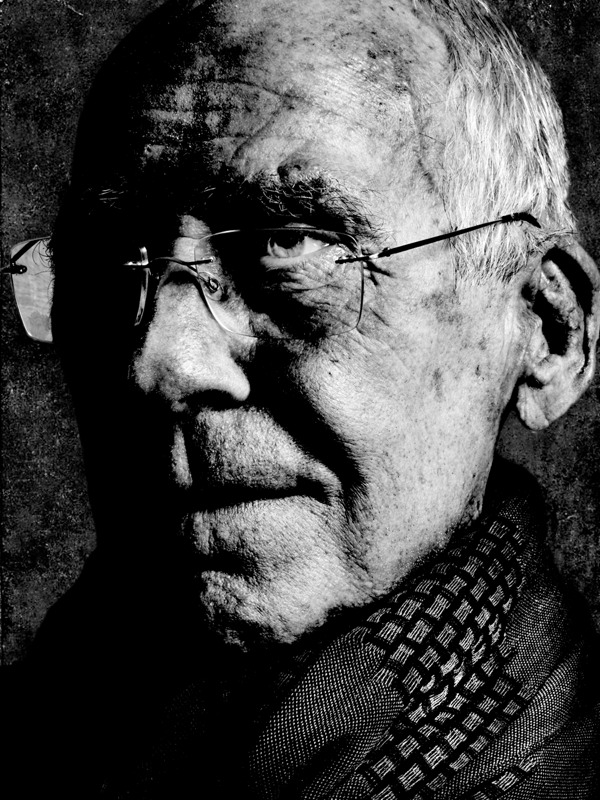
Roy Pollard (First fight 1947 – Last fight 1954)
Photographs copyright © John Claridge
Take a look at
John Claridge’s Boxers (Round One)
John Claridge’s Boxers (Round Two)
John Claridge’s Boxers (Round Three)
John Claridge’s Boxers (Round Four)
John Claridge’s Boxers (Round Five)
John Claridge’s Boxers (Round Six)
John Claridge’s Boxers (Round Seven)
John Claridge’s Boxers (Round Eight)
and these other pictures by John Claridge
Along the Thames with John Claridge
At the Salvation Army with John Claridge
A Few Diversions by John Claridge
Signs, Posters, Typography & Graphics
Views from a Dinghy by John Claridge
In Another World with John Claridge
A Few Pints with John Claridge
Some East End Portraits by John Claridge
Sunday Morning Stroll with John Claridge
At the Smithfield Christmas Eve Auction

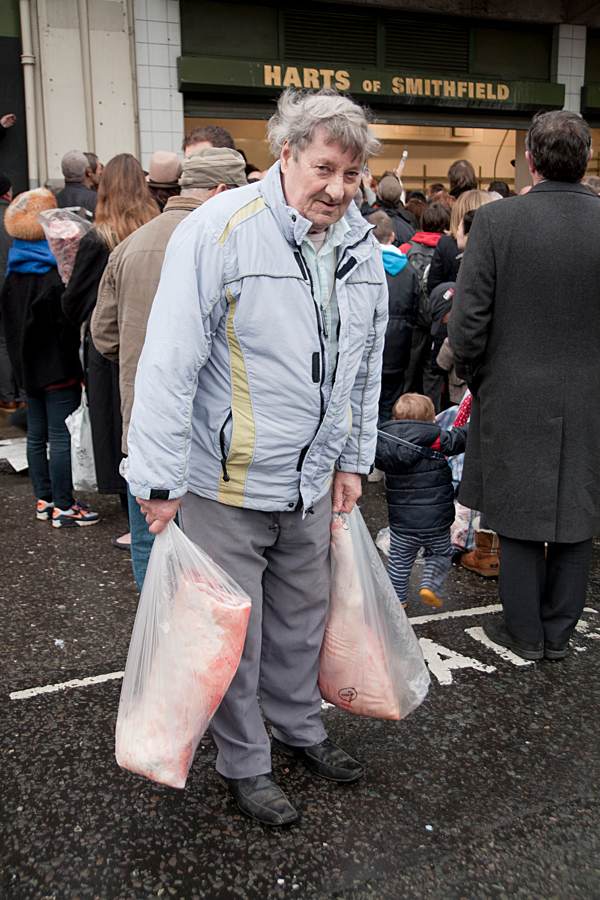
The carnivores of London converged upon Smithfield Market yesterday, as they do every year for the annual Christmas Eve auction staged by Harts the Butcher. At ten in the morning, the rainy streets were almost empty yet, as I came through Smithfield, butchers in white overalls were wheeling precarious trolleys top-heavy with meat and fowls over to the site of the auction where an expectant crowd of around a hundred had gathered, anxiously clutching wads of banknotes in one hand and bags to carry off their prospective haul in the other.
Contributing Photographer Colin O’Brien met me there. He grew up half a mile away in Clerkenwell during the nineteen forties and, although it was his first time at the auction, he remembered his father walking down to Smithfield to get a cheap turkey on Christmas Eve more than sixty years ago. Overhearing this reminiscence, a robust woman standing next to us in the crowd struck up a conversation as a means to relieve the growing tension before the start of the auction which is the highlight of the entire year for many of stalwarts that have been coming for decades.
“You can almost guarantee getting a turkey,” she reassured us with the authority of experience, revealing she had been in attendance for fifteen successive years. Then, growing visibly excited as a thought came into her mind, “Last year, I got thirty kilos of sirloin steak for free – I tossed for it!”, she confided to us, turning unexpectedly flirtatious. Colin and I stood in silent wonder at her good fortune with meat.“We start preparing in October by eating all the meat in the freezer,” she explained, to clarify the situation. “Last night we had steak,” she continued, rubbing her hands in gleeful anticipation, “and steak again tonight.”
Yet our acquaintance was terminated as quickly as it began when the caller appeared in a blood-stained white coat and red tie to introduce the auction. A stubby bullet-headed man, he raised his hands graciously to quell the crowd. “This is a proper English tradition,” he announced, “it has been going on for the last five hundred years. And I’m going to make sure everybody goes away with something and I’m here to take your money.”
His words drew an appreciative roar from the crowd as dozens of eager hands were thrust in the air waving banknotes, indicative of the collective blood lust that gripped the assembly. Standing there in the midst of the excitement, I realised that the sound I could hear was an echo. It was a reverberation of the famously uproarious Bartholomew Fair which flourished upon this site from the twelfth century until it was suppressed for public disorder in 1855. Yesterday, the simple word “Hush!” from the caller was enough to suppress the mob as he queried, “What are we going to start with?”
The answer to his question became manifest when several bright pink loins of pork appeared as if by magic in the hatch beside him, held by butchers beneath, and dancing jauntily above the heads of the delighted audience like hand puppets. These English loins of pork were soon dispatched into the crowd at twenty pounds each as the curtain warmer to the pantomime that was to come, followed by joints of beef for a tenner preceding the star attraction of day – the turkeys! – greeted with festive cheers by the hungry revellers. “Mind your heads, turkeys coming over…” warned the butcher as the turkeys in their red wrappers set out crowd-surfing to their grateful prospective owners as the cash was passed hand to hand back to the stand.
It would not be an understatement to say that mass hysteria had overtaken the crowd, yet there was another element to add to the chaos of the day. As the crowd had enlarged, it spilled over into the road with cars and vans weaving their through the overwrought gathering. “I love coming for the adventure of it,” declared one gentleman with hair awry, embracing a side of beef protectively as if it was the love of his life, “Everyone helps one another out here. You pass the money over and there’s no pickpockets.”
After the turkeys came the geese, the loins of lamb, the ribs of beef, the pork bellies, the racks of lamb, the fillet steaks and the green gammon to complete the bill of fare. As the energy rose, butchers began to throw pieces of red meat into the crowd to be caught by their purchasers and it was surreal to watch legs of lamb and even suckling pigs go flying into the tumultuous mass of people. Finally, came tossing for meat where customers had the chance of getting their steaks for free if they guessed the toss correctly, and each winning guess was greeted with an exultant cheer because by then the butchers and the crowd were as one, fellow participants in a boisterous party game.
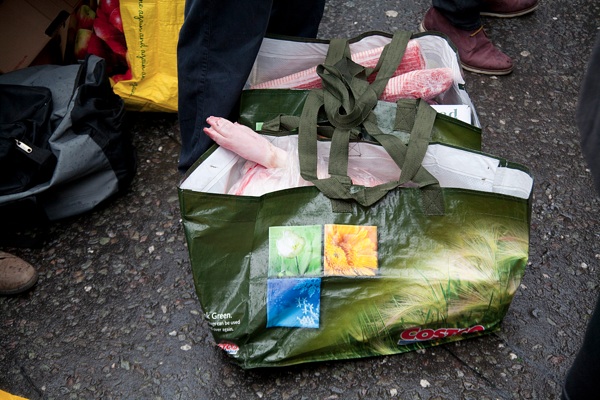
Just ninety minutes after it began, the auction wrapped up, leaving the crowd to consolidate their proud purchases, tucking the meat and fowls up snugly in suitcases and backpacks to keep them safe until they could be stowed away in the freezer at home. In the disorder, I saw piles of bloody meat stacked on the muddy pavement where people were tripping over them. Yet a sense of fulfilment prevailed, everyone had stocked up for another year – their carnivorous appetites satiated – and they were going home to eat meat.
As I walked back through the narrow City streets, I contemplated the spectacle of the morning. It resembled a Bacchanale or some ancient pagan celebration in which people were liberated to pursue their animal instincts. But then I realised that my thinking was too complicated – it was Christmas I had witnessed.




Photographs copyright © Colin O’Brien
You might also like to read
The World of the East End Saree Shops

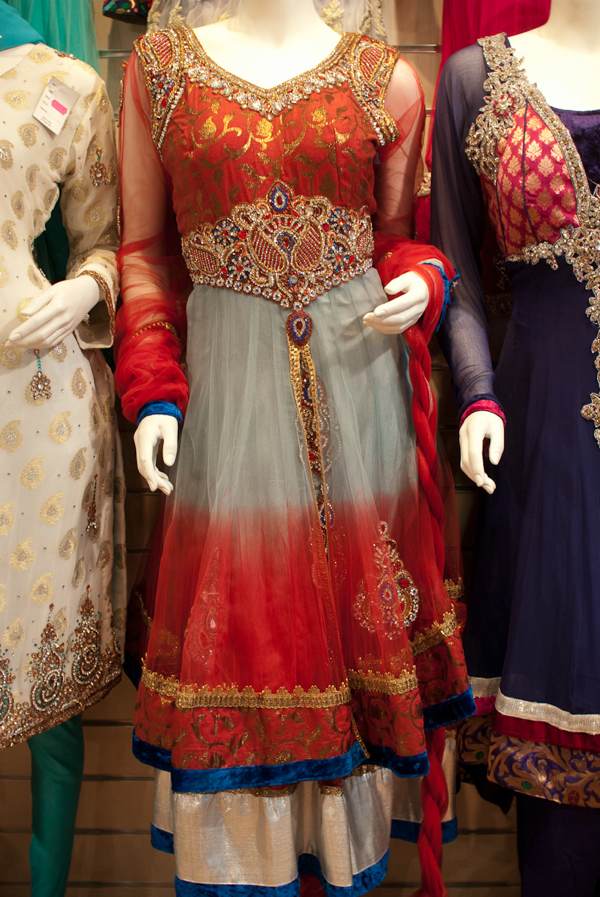
In these recent days, when it has barely got lighter than dusk and I have been walking around bent double into the driving rain, I found myself lifting my gaze occasionally in admiration at the illuminated windows of saree shops that cluster in Bethnal Green and Whitechapel. So, when Contributing Photographer Sarah Ainslie brought me these poignant images of saree shops glimmering with colour and light despite the pervasive gloom, I suggested we pay a few of these establishments a call and discover more of the world of the East End saree shops.
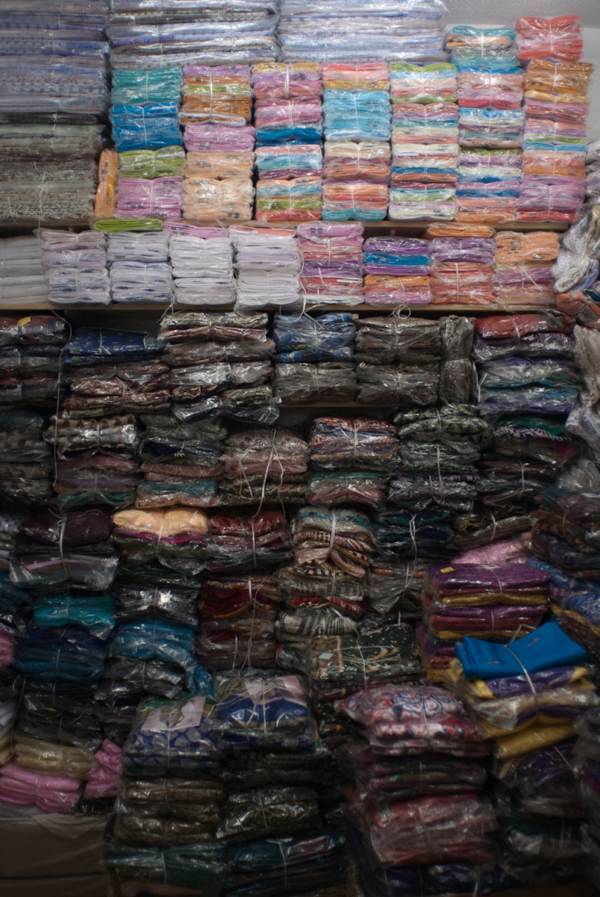
In Bethnal Green, at Zhara Fashion House we were greeted by three women, Majida, Shuheli and Afsana, who have just started in business one month ago, specialising in selling fabric lengths which permit their young customers to make sarees to their own patterns and thus avoid the ready made styles that fill the other shops. Their youthful optimism was in harsh contrast to Abdul Latif at Modhubon Ltd who had been trading for twenty-one years across the road in a shop stacked to the ceiling with sarees folded neatly on shelves. “I used to go to India once a year to buy stock, but not for the last three years,” he confessed with a frown, “I’ve had a very bad run.” Mr Latif’s customers are senior women who have been economising with their purchases, he revealed, and this week, far outside the summer wedding season, he was alone in his magnificently decorated shop like the host of a party to which nobody came.
Yet just a couple of doors down, we discovered a brisk trade at Mahir where lots of saree bargains were to be had in the sale and the entire range of stock was accessible to the eager women browsing on rails. Sumsun Nahar Shirne, the briskly efficient under-manager, explained that this was one of seven branches scattered as far apart as Leeds and Luton, owned by her cousin Shurajul Islam Akbas. “Customers come from as far away as Germany, Italy, France, even America,” she bragged.
Similarly at Zari, next door, where Shofig Islam brought ten years of retail experience at Superdrug to the family business, there was no shortage of customers. Shofig had an impressive array of vibrantly coloured glittering sarees, yet he was eager to stress that he stocked a wide range of different garments to suit the tastes of younger women who like to mix western and eastern clothes in their every day wardrobes and only wear full sarees for special occasions. Alert to social trends, working closely with manufacturers in India to deliver the designs that women want and with his richly-coloured stock creating a dazzling display, Shofig admitted to me that he had even been able to expand the business recently.
Taking the stroll down Vallance Rd, we set out to explore the saree shops shining in the shadows of the alleys leading off Whitechapel Rd and – among other delights – discovered the wonders of Zai, a compact traditional establishment where proprietor Helal Khan, who has been in business for ten years, welcomed us kindly. Mr Khan has a loyal trade of local women who frequent his discreet premises with its immaculately organised stock.
The dusk that had prevailed all day turned to darkness as the rain set in again and we just had time left to step into Cuckoo Fashions in Whitechapel Market, which we found remarkable for the selection of panels of richly patterned printed silks at just fifteen pounds each. It was tempting to carry some away but we were spoiled for choice, as we had been all day by the sensuous hues and tinsel on display at every shop we visited. In spite of social changes, we were reassured that the saree shops will be with us for the foreseeable future to bring glitz to our dowdy East End streets. So we set off into the murk with our spirits lifted by the exposure to so much glowing colour and vowed to come back another day.


Abdul Latif, Modhubon Ltd.


Shofig Islam at Zari.


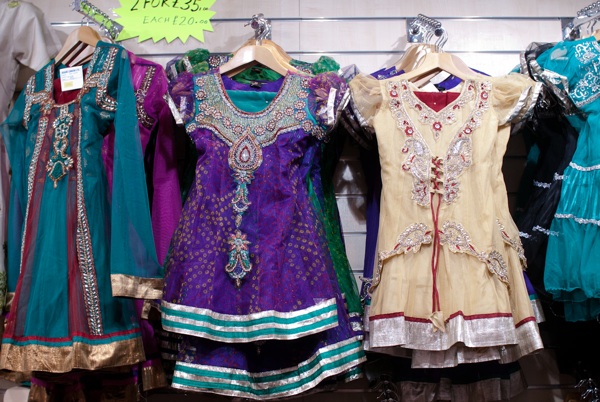


Helal Khan at Zai in Whitechapel.


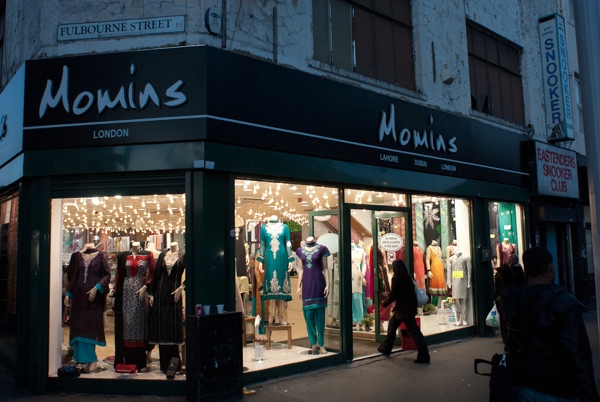

Fatima Chowdury, Jumara Noor Eli and Sumsun Nahar Shirna at Mahir in Bethnal Green.



Photographs copyright © Sarah Ainslie
You may also like to read about
The Chicken Shops of Spitalfields
Save The Marquis Of Lansdowne
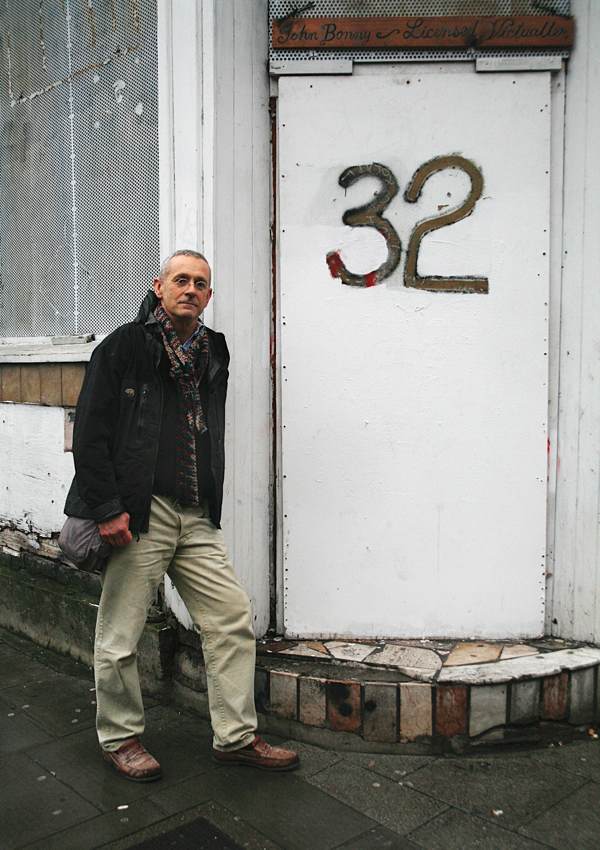
Tim Whittaker, Director of the Spitalfields Trust on the threshold of The Marquis of Lansdowne
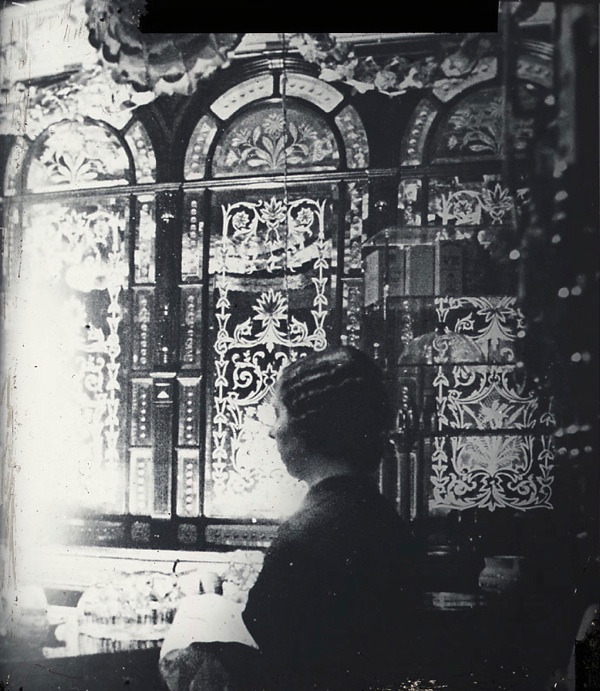
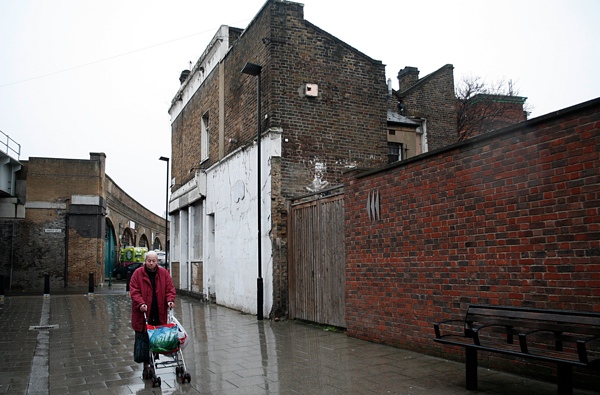
Since 1839, The Marquis of Lansdowne has stood on a quiet corner in Hoxton round the back of the Geffrye Almshouses (which became the Geffrye Museum in 1914) and it is not unlikely that a few pensioners from the almshouses might have frequented the Marquis on occasion.
It is a quintessential London public house and, as in so many East End streets, forms the lynchpin of the neighbourhood. Historically, pubs stood as a counterpoint to the church – offering temples where men sought solace from the pressure of their working and domestic lives. Yet in recent years hundreds have gone, taking away community meeting places and impoverishing social life.
The Marquis of Lansdowne closed in 2000 and now belongs to the Geffrye Museum which describes itself as “the museum of the home.” Disappointingly, the Museum wants to demolish the pub and clear the site for a new building by architect David Chipperfield. They are passing over the opportunity to restore this dignified Regency building and include it as part of the museum, enriching their collection and broadening the story they tell of the lives of working people by showing “the home from home.” According to the Museum’s current plans, The Marquis of Lansdowne and the history it represents are destined to be erased, giving way to pavement widening and a plant room for the new structure.
In November, Tim Whittaker, Director of the Spitalfields Historic Buildings Trust (who won the Country Life Restoration of the Century Award for his outstanding work in renovating two modest early nineteenth century terraces in Whitechapel) wrote to the Geffrye Museum asking them not to demolish The Marquis of Lansdowne, and offering to take on the pub and restore it to its former glory. The Spitalfields Trust proposal included the option to work in partnership with the Museum or to buy The Marquis of Lansdowne, renovate it and lease it to a tenant. Since the Geffrye’s Museum’s projected edifice on this site is to include a bar and restaurant, you might hope that an architect could embrace the opportunity to make The Marquis of Landowne the starting point for the design of the new structure, finding a sensitive and ingenious way to connect the pub with the existing Museum buildings.
Yet the Geffrye Museum rejected the option of retaining The Marquis of Landowne, pursuing instead the notion of another signature building by a star architect to add to the one they opened in 1998. However, the application for £16.3 million funding for the new building has yet to be approved by the Heritage Lottery Fund and maybe questions will be raised about the validity of using Heritage Lottery money to destroy our heritage? Equally, Hackney Council Planning Department has not yet given its consent to the demolition of The Marquis of Lansdowne which they have identified as a “heritage asset” within a Conservation Area.
The Geffrye Almshouses were originally built by the Ironmongers’ Company in 1714 and the Museum itself was created as a result of a public petition when these historic buildings were threatened with demolition after the Ironmongers moved their almshouses to Kent one hundred years ago. In their enlightenment, the London County Council responded to the petition by creating the Geffrye Museum dedicated to the history of the furniture industry that thrived in Hoxton and Shoreditch at the time.
A century later, there is a new public petition addressed to the Geffrye Museum itself – asking them to grant a reprieve to The Marquis of Lansdowne, showing respect for the culture of the working people of London by integrating it into the museum, and thereby acknowledging the significance of the public house in all our histories.
I urge you to spread the word to your friends and family throughout the festive period.
Sign the Petition to save The Marquis of Lansdowne here
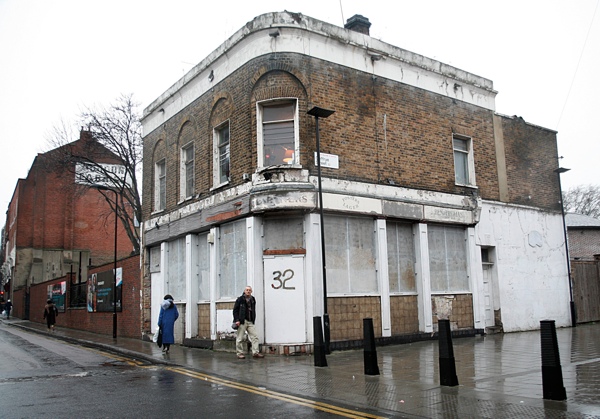
The Marquis of Lansdowne on the corner of Cremer St & Geffrye St
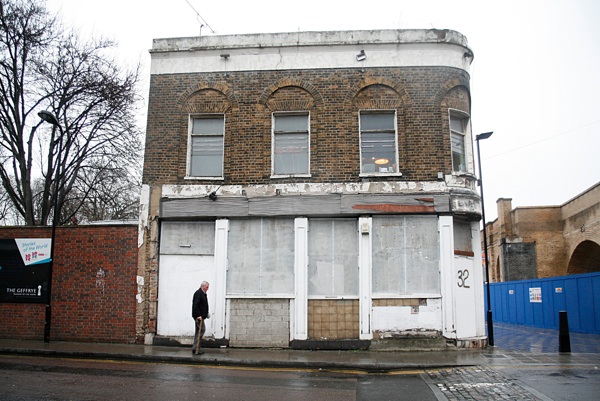
A local landmark in Hoxton since 1839.
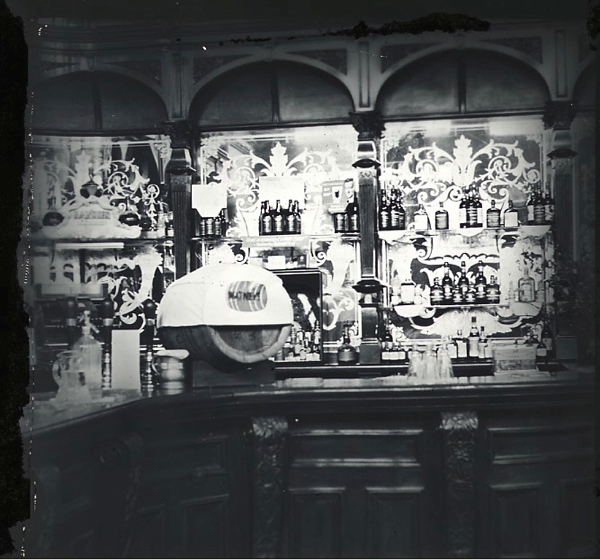
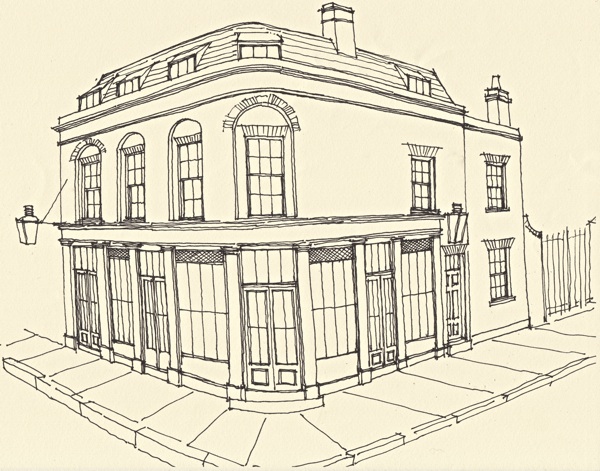
Sketch by Tim Whittaker of The Spitalfields Trust illustrating his proposal to renovate the Marquis of Lansdowne.
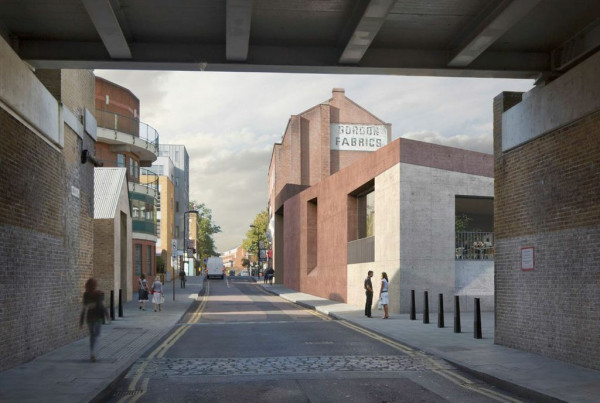
The concrete box on the right is the proposed replacement for The Marquis of Lansdowne.
Colour photographs copyright © Colin O’Brien
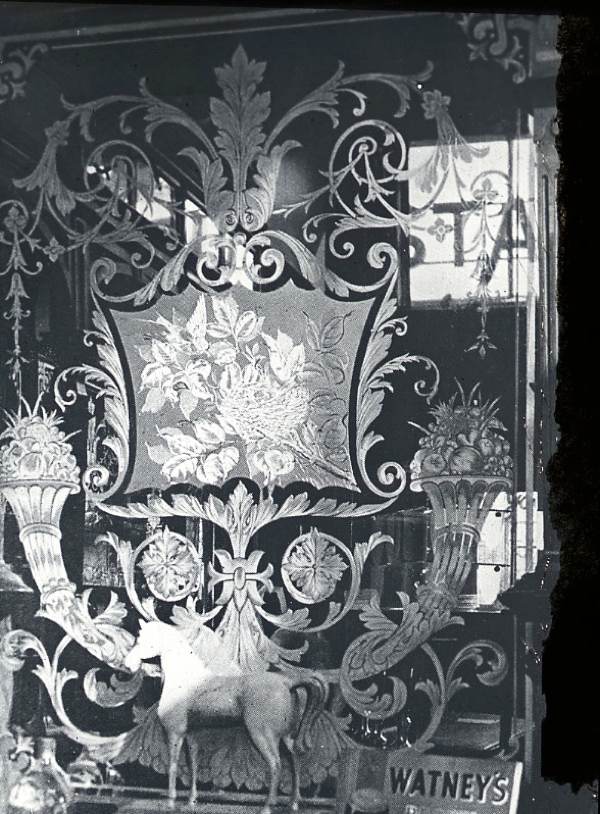
Black & white photographs show former London pub interiors
Visit the Facebook page for the Campaign to Save The Marquis
You may also like to read about
Sandra Esqulant, The Golden Heart
Colin O’Brien’s Pellicci Portraits (Part 4)
Roast turkey with all the trimmings was the special of the day at E. Pellicci, 332 Bethnal Green Rd, all this week. In the midst of the pre-Christmas melee, Contributing Photographer Colin O’Brien & I dodged the fry-ups and plates of pasta to bring you another set of portraits of the lucky diners at London’s best-loved family-run cafe. Colin had his favourite ham, egg & chips again but Nevio Pellicci persuaded me to have the scrambled eggs with smoked salmon for a change, then we both finished it off with syrup pudding & custard as usual.

Teresa Kerry – “I’ve been coming to Pelliccis for twenty years but I don’t come as often as I should. When my friends get together, this is where we meet.”

Eric Hall of BBC Radio Essex’ Eric Hall’s Monster Memories – “I am told I was brought here in my pram, so I am probably the longest-running customer.”

Mandy Martin – “I first came to Pelliccis when I was fifteen and I come at least twice a week. I’ve been coming with my mum who’s eighty-eight, it’s a real community here.”

Josh Weller – “I live next door to Maria Pellicci and I’ve been eating at Pelliccis for a year.”

Sequin Tan – “This my first time at Pelliccis. It was recommended on Anthony Bourdain’s website.”
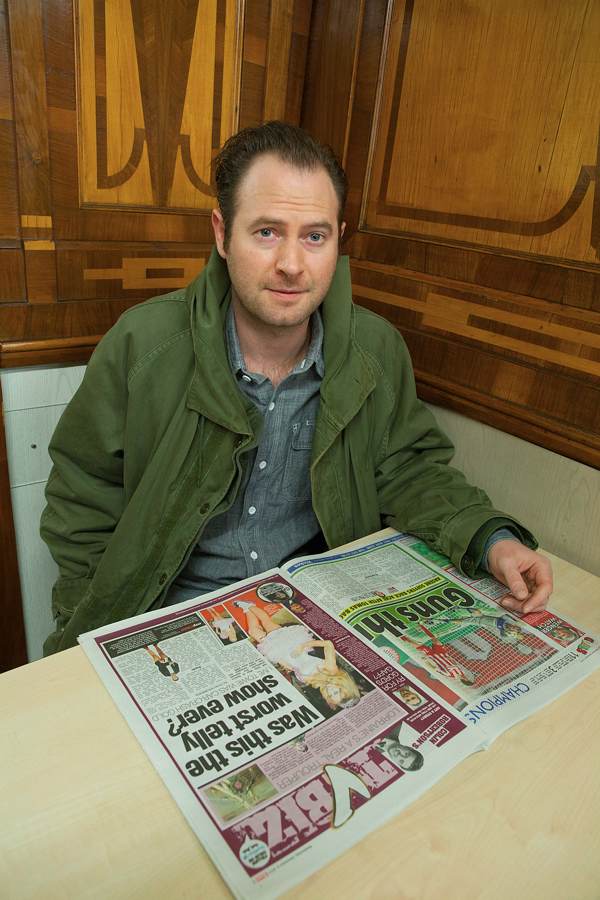
Alex Georgou – “For the last five years, I’ve been coming to Pelliccis at least once a week and sometimes I come every day – Monday to Friday.”

“Trendy Wendy” Rolt – “I first came here three years ago, since I started working with Arch 76.”

Darren Knotts – “I’ve not been coming to Pelliccis that long but I come twice a week – it looks good!”

Suraya Klein-Smith – “I’ve been coming to Pelliccis nearly every day since I was about nine.”

Ric Prescod – “I’ve been coming to Pelliccis every Wednesday for three years, since I started training regularly at the Repton Boxing Club.”

Peter Smith – “I come to Pelliccis twice a day – that’s ten times a week – ever since we started the contract with Hackney Council six months ago.”

“Birthday Girl” Hannah Voller – “Nevio’s wife Nicola is my best friend and I’ve been coming here every week for five years.”

David Robinson – “I’ve been coming to Pelliccis since I was four, that’s over sixty years. I remember Nevio’s grandfather Primo. My mum used to bring us along when she did her weekly shopping.”

Graeme Walker – “This is my second time at Pelliccis.”

Silvia Pascalau – “I’ve been working at Pelliccis two years at Easter.”
Photographs copyright © Colin O’Brien
You may like to take a look at
Colin O’Brien’s Pellicci Portraits ( Part One)
Colin O’Brien’s Pellicci Portraits (Part Two)
Colin O’Brien’s Pellicci Portraits (Part Three)
and read these other Pellicci stories
Maria Pellicci, The Meatball Queen of Bethnal Green
and see these other Colin O’Brien stories
Colin O’Brien’s Clerkenwell Car Crashes
Colin O’Brien’s Kids on the Street
Travellers’ Children in London Fields
Colin O’Brien’s Brick Lane Market
Roll Up For Magic Lantern Shows!
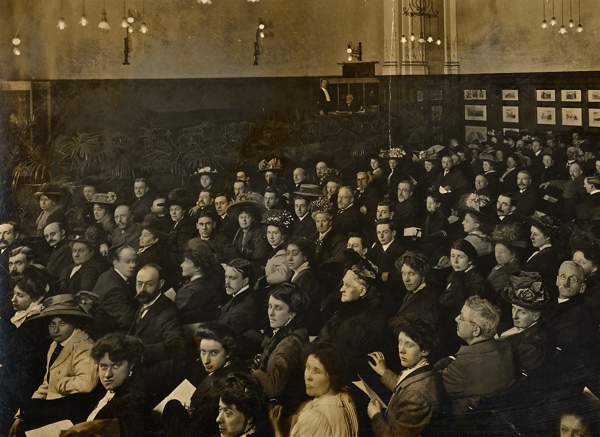
Awaiting a Magic Lantern Show at the Bishopsgate Institute
It is my delight to collaborate with the Bishopsgate Institute, staging a return to the glory days of Magic Lantern Shows that were such a popular feature of the Institute in its early years.
We have invited Libby Hall, collector of dog photography, and two Spitalfields Life Contributing Photographers Phil Maxwell and Colin O’Brien to show their favourite pictures to an audience as modern day Magic Lantern Shows and talk about their work – to cheer up our evenings in January, February and March.
Admission is free but tickets must be reserved in advance and we expect to get booked out, so if you would like to come we advise you to book online sharpish through the Bishopsgate Institute or by calling 020 7392 9200.
[youtube VYXUJvTQ9IM nolink]
Libby Hall, Tuesday 29th January at 7.30pm
Between 1966 and 2006, Libby Hall collected old photographs of dogs, amassing many thousands to assemble what is possibly the largest number of canine pictures ever gathered by any single person. Libby began collecting casually when the photographs were of negligible value, but by the end she had published four books and been priced out of the market.
Yet through her actions Libby rescued an entire genre of photography from the scrap heap, seeing the poetry and sophistication in images that were previously dismissed as merely sentimental – and today, we are the beneficiaries of her visionary endeavour.

Brick Lane Laundrette Kiss
Phil Maxwell, Tuesday 26th February at 7.30pm
Phil Maxwell is the photographer of Brick Lane – no-one has taken more pictures here over the last thirty years than he. And now his astonishing body of work stands unparalleled in the canon of street photography, both in its range and in the quality of human observation that informs his eloquent images.
“More than anywhere else in London, Brick Lane has the organic quality of being constantly changing, even from week to week.” Phil told me when I asked him to explain the enduring fascination for a photographer. “Coming into Brick Lane is like coming into a theatre, where they change the scenery every time a different play comes in – a stage where each new set reflects the drama and tribulations of the wider world.”

Clerkenwell Car Crash, 1957
Colin O’Brien, Thursday 28th March at 7.30pm
Colin O’Brien grew up fifty yards from Hatton Garden in Victoria Dwellings, a tenement at the junction of Farringdon Rd and Clerkenwell Rd – the centre of his childhood universe in Clerkenwell, which Colin portrayed in spellbinding photographs that evoke the poetry and pathos of the forgotten threadbare years in the aftermath of World War II.
Over all this time, Colin has pursued his talent and taken more than half a million pictures, many of them in the East End. His work is barely known because he never worked for publication or even for money, devoting himself single-mindedly to taking photos for their own sake – yet over the passage of time, as a consequence of the rigour and purism of his approach, the authority of Colin O’Brien’s superlative photography stands comparison with any of the masters of twentieth century British photography.












