
Adam Dant’s Map of Industrious Shoreditch
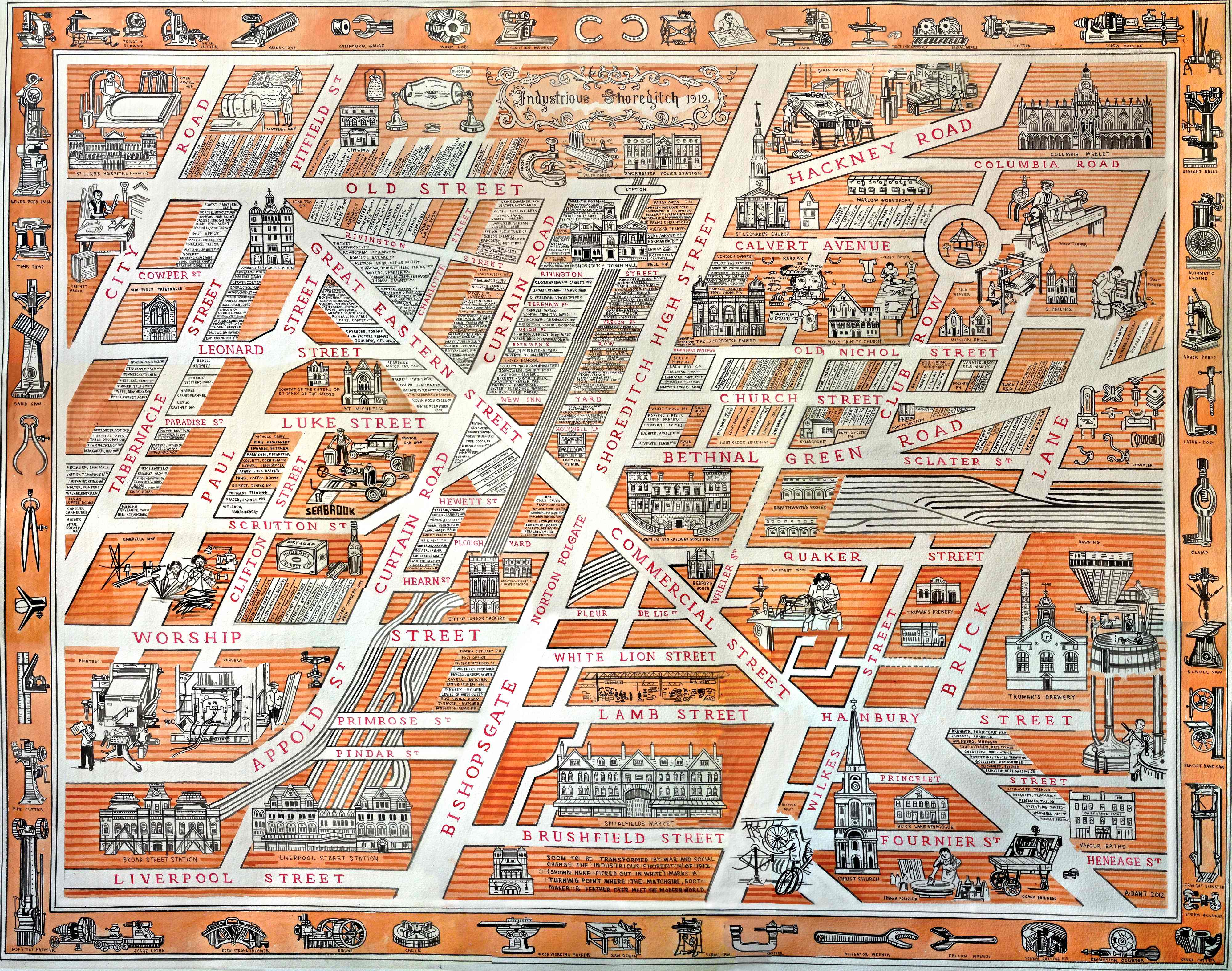
Click twice to enlarge and study the details of Industrious Shoreditch
A century before the New Industries that define Shoreditch today, there were once the Old Industries. Then, small manufacturers and their suppliers occupied every building, and the neighbourhood teemed with skilled workers and craftsmen who made things with their hands. Cartographer extraordinaire Adam Dant celebrates this culture with his Map of Industrious Shoreditch, 1912.
“I chose 1912 because it precedes the First World War, when everything changed. It encapsulates Industrious Shoreditch,” explained Adam, “I started off with the major landmarks serving the industries of the time. For the main thoroughfares, I listed the concentrations of manufacturers, using lists of companies from the Post Office Directories. These are complemented by vignettes of people making things, and I filled the border with machines used for wood and metalwork.”
After the First World War, many of the industries moved to larger factories outside London and the twentieth century saw the decline of manufacturing in Shoreditch, with the hardware shops and suppliers of raw materials being the last to go, holding on even into recent decades. Now that Shoreditch is booming again with new technology companies occupying many of the old buildings once used for manufacturing, Adam Dant’s map offers us a poignant opportunity to explore that lost world of industriousness.
You will discover mattress makers, french polishers, feather dyers, hatters, bootmakers, chandlers, over-mantle manufacturers, cabinet makers, coach builders, wood turners, corset makers, and more…
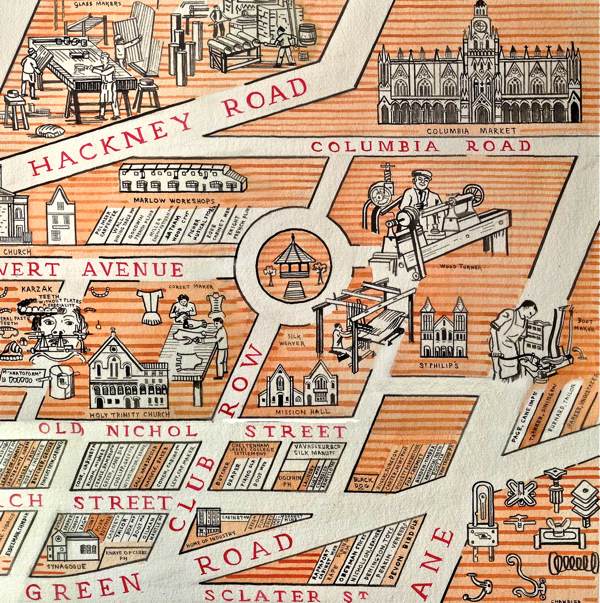
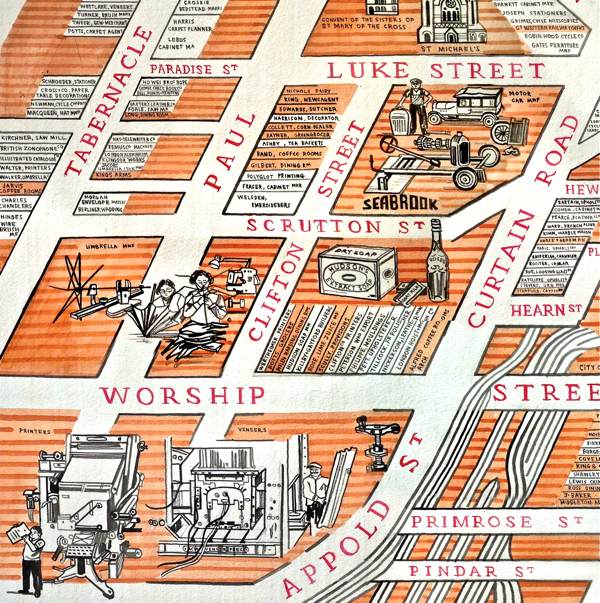
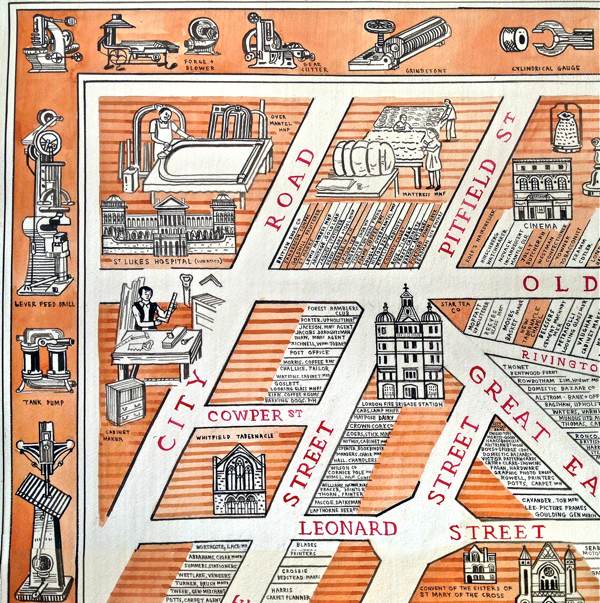
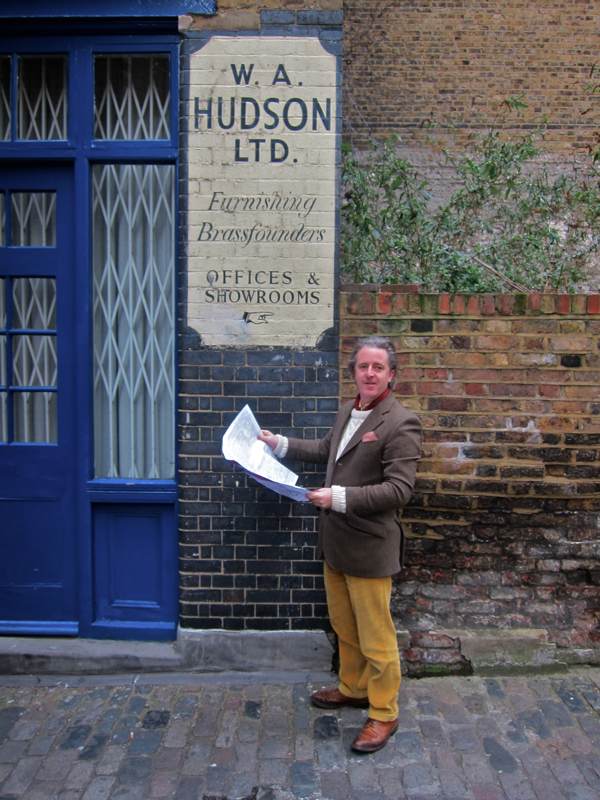
Adam Dant goes in search of Industrious Shoreditch
Map copyright © Adam Dant
You may like to take a look at some of Adam Dant’s other maps
Map of the History of Shoreditch
Map of Shoreditch in the Year 3000
Map of Shoreditch as the Globe
Map of the History of Clerkenwell
Map of the Journey to the Heart of the East End
Map of the History of Rotherhithe
Click here to buy a copy of The Map of Spitalfields Life drawn by Adam Dant with descriptions by The Gentle Author
Clive Murphy, Phillumenist

Clive Murphy, Phillumenist
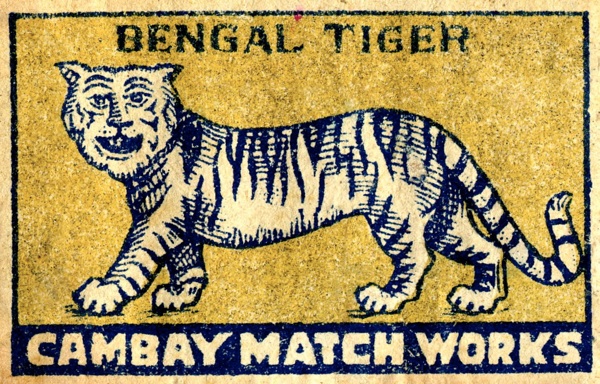
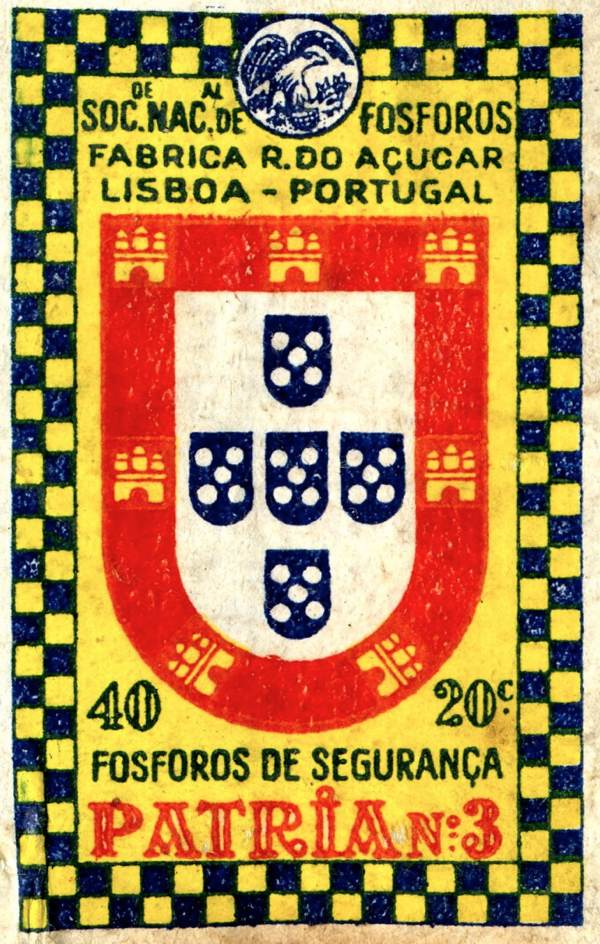
Nothing about this youthful photo of the novelist, oral historian and writer of ribald rhymes, Clive Murphy – resplendent here in a well-pressed tweed suit and with his hair neatly brushed – would suggest that he was a Phillumenist. Even people who have known him since he came to live in Spitalfields in 1973 never had an inkling. In fact, evidence of his Phillumeny only came to light recently when Clive donated his literary archive to the Bishopsgate Institute and a non-descript blue album was uncovered among his papers, dating from the era of this picture and with the price ten shillings and sixpence still written in pencil in the front.
I was astonished when I saw the beautiful album and so I asked Clive to tell me the story behind it. “I was a Phillumenist,” he admitted to me in a whisper, “But I broke all the rules in taking the labels off the matchboxes and cutting the backs off matchbooks. A true Phillumenist would have a thousand fits to see my collection.” It was the first time Clive had examined his album of matchbox labels and matchbook covers since 1951 when, at the age of thirteen, he forsook Phillumeny – a diversion that had occupied him through boarding school in Dublin from 1944 onwards.
“A memory is coming back to me of a wooden box that I made in carpentry class which I used to keep them in, until I put them in this album,” said Clive, getting lost in thought, “I wonder where it is?” We surveyed page after page of brightly-coloured labels from all over the world pasted in neat rows and organised by their country of origin, inscribed by Clive with blue ink in a careful italic hand at the top of each leaf. “I have no memory of doing this.” he confided to me as he scanned his handiwork in wonder,“Why is the memory so selective?”
“I was ill-advised and I do feel sorry in retrospect that they are not as a professional collector would wish,” he concluded with a sigh, “But I do like them for all kinds of other reasons, I admire my method and my eye for a pattern, and I like the fact that I occupied myself – I’m glad I had a hobby.”
We enjoyed a quiet half hour, turning the pages and admiring the designs, chuckling over anachronisms and reflecting on how national identities have changed since these labels were produced. Mostly, we delighted at the intricacy of thought and ingenuity of the decoration once applied to something as inconsequential as matches.
“There was this boy called Spring-Rice whose mother lived in New York and every week she sent him a letter with a matchbox label in the envelope for me.” Clive recalled with pleasure, “We had breaks twice each morning at school, when the letters were given out, and how I used to long for him to get a letter, to see if there was another label for my collection.” The extraordinary global range of the labels in Clive’s album reflects the widely scattered locations of the parents of the pupils at his boarding school in Dublin, and the collection was a cunning ploy that permitted the schoolboy Clive to feel at the centre of the world.
“You don’t realise you’re doing something interesting, you’re just doing it because you like pasting labels in an album and having them sent to you from all over the world.” said Clive with characteristic self-deprecation, yet it was apparent to me that Phillumeny prefigured his wider appreciation of what is otherwise ill-considered in existence. It is a sensibility that found full expression in Clive’s exemplary work as an oral historian, recording the lives of ordinary people with scrupulous attention to detail, and editing and publishing them with such panache.





Clive Murphy, Phillumenist
Images courtesy of the Clive Murphy Archive at the Bishopsgate Institute
You may like to read my other stories about Clive Murphy
Clive Murphy’s oral histories are available from Labour and Wait
and his ribald rhymes are available from Rough Trade
Tony Hall’s East End Panoramas

In the sixties, Tony Hall bought a Horizont camera of Russian manufacture that was designed for taking panoramic photographs and he used it to take these magnificent pictures of East End streets, published today for the first time. Originally trained as a painter, Tony Hall became a newspaper artist in Fleet St and pursued photography in the afternoons between shifts.
“He’d always been passionate about wide-angle lenses, it was his landscape painter’s background – he had a painter’s eye,” Libby Hall, Tony’s wife revealed to me, “When he was sixteen, his paintings were accepted for the Royal Academy but he wanted to do something different, so he gave it up in favour of commercial art and photography.”
The Horizont camera had a lens that rotated in sync with the shutter to create a panoramic view, but they were unreliable and, when the lens became out of sync with the shutter, patches of light and dark appeared on the image. Tony bought three cameras in the hope of getting one to work consistently and in the end he gave up, yet by then he had achieved this bravura series of pictures which emphasise the linear qualities of the cityscape to dramatic effect.
“Tony loved tools of all sorts and he always said that if you had the tool you could work out how to use it,” Libby recalled, “He was very frustrated by the Horizont, but he was very pleased when it worked.”
It is the special nature of Tony Hall’s photographic vision that he saw the human beauty within an architectural environment which others sought to condemn and, half a century later, his epic panoramas show us the East End of the nineteen sixties as we never saw it before.
Click on any of the photographs below to enlarge and enjoy the full panoramic effect.
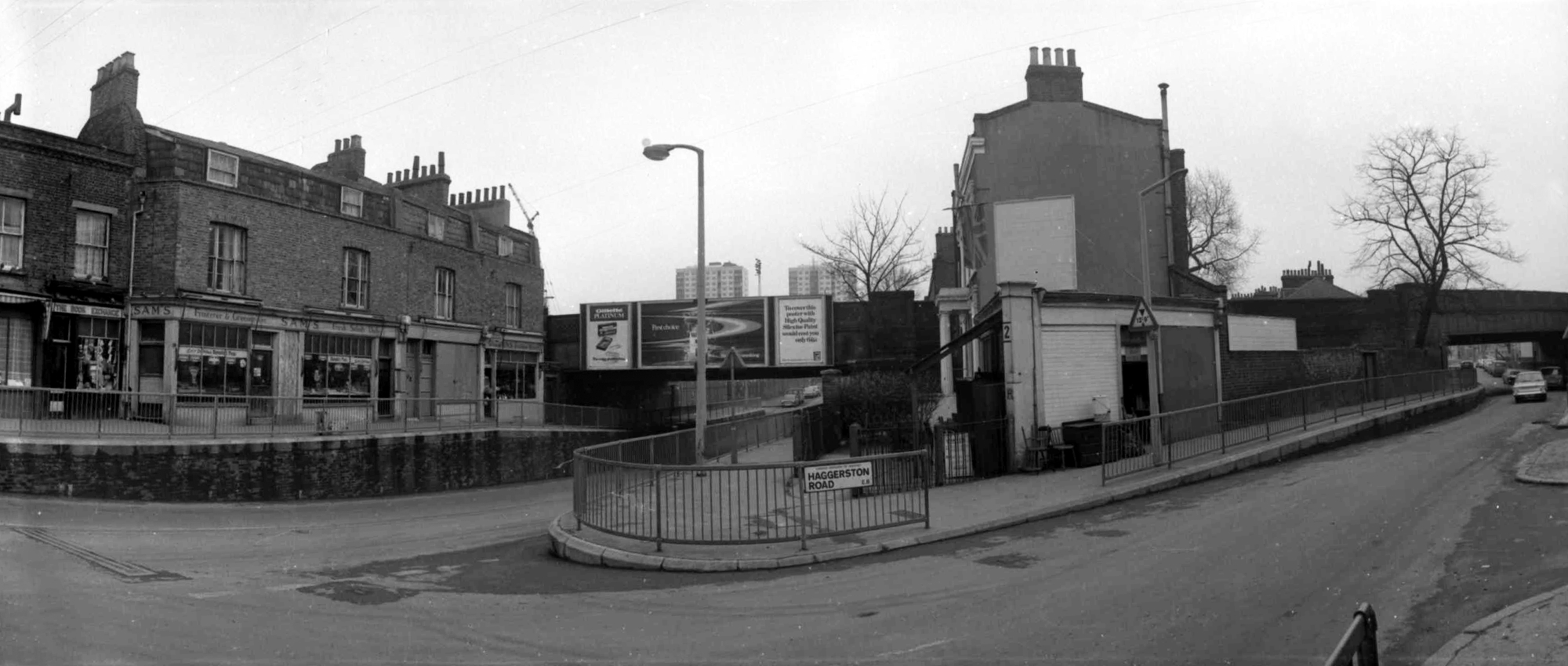
Corner of Middleton Rd & Haggerston Rd
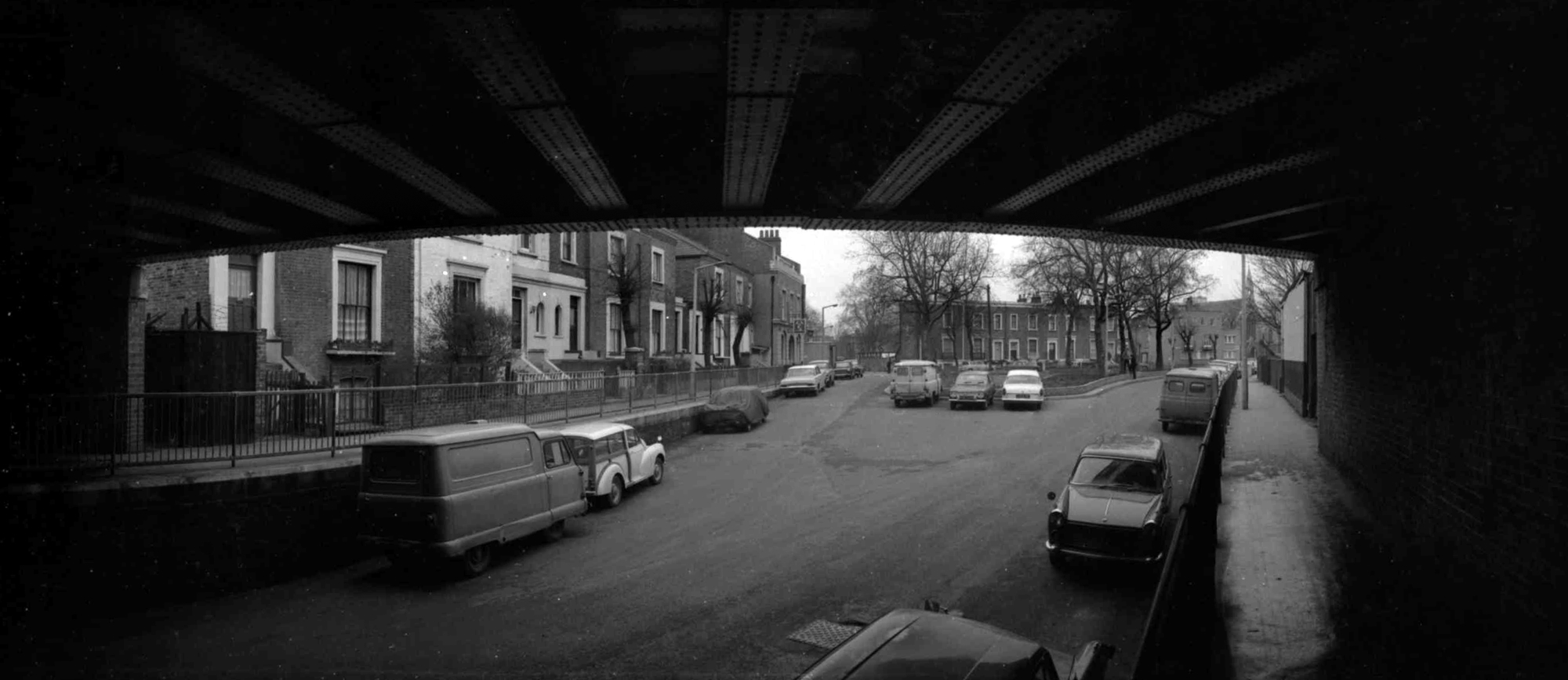
Haggerston Rd

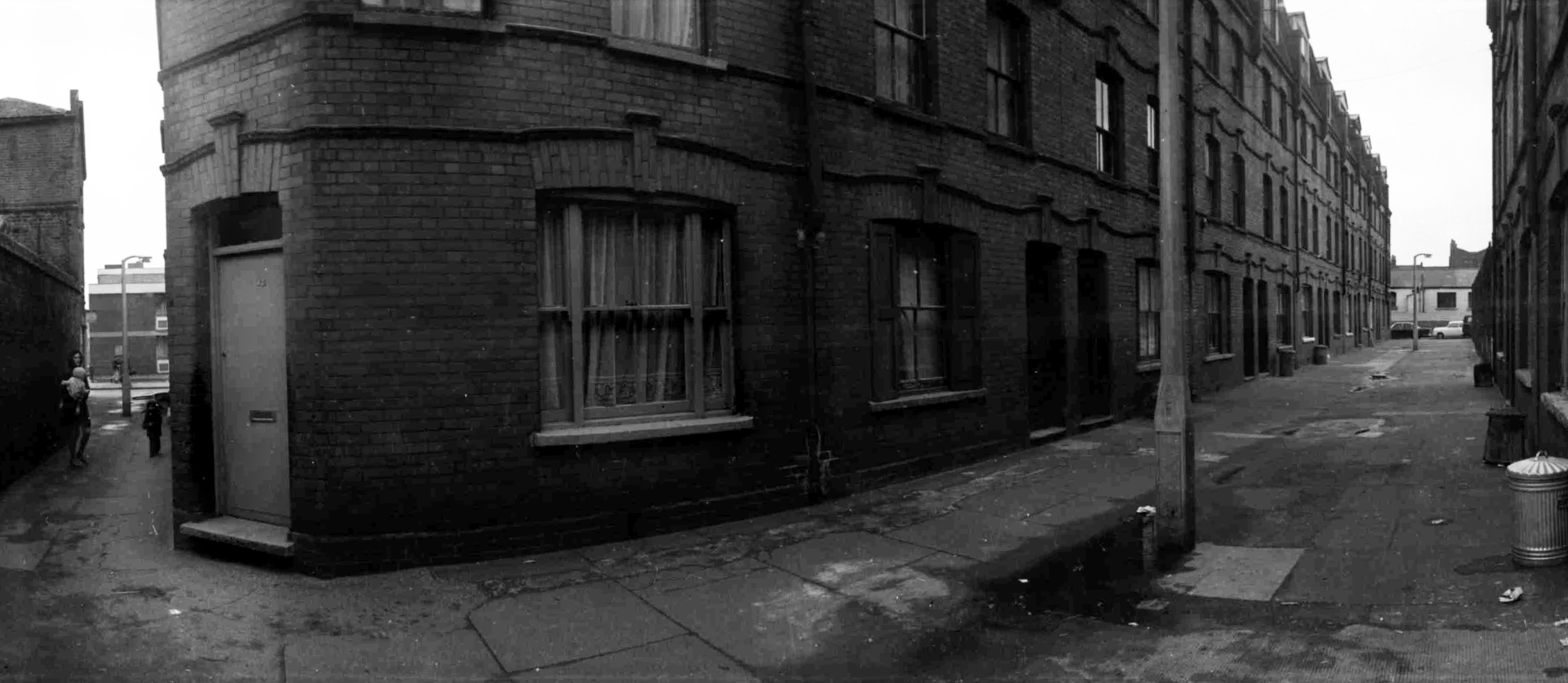


Old Montague St & Black Lion Yard

Old Montague St

Hessel St


Corner of Lyal Rd & Stanfield Rd

Corner of Lyal Rd & Stanfield Rd


Bridge House, Tredegar Rd

Sclater St

Leopold Buildings, Columbia Rd

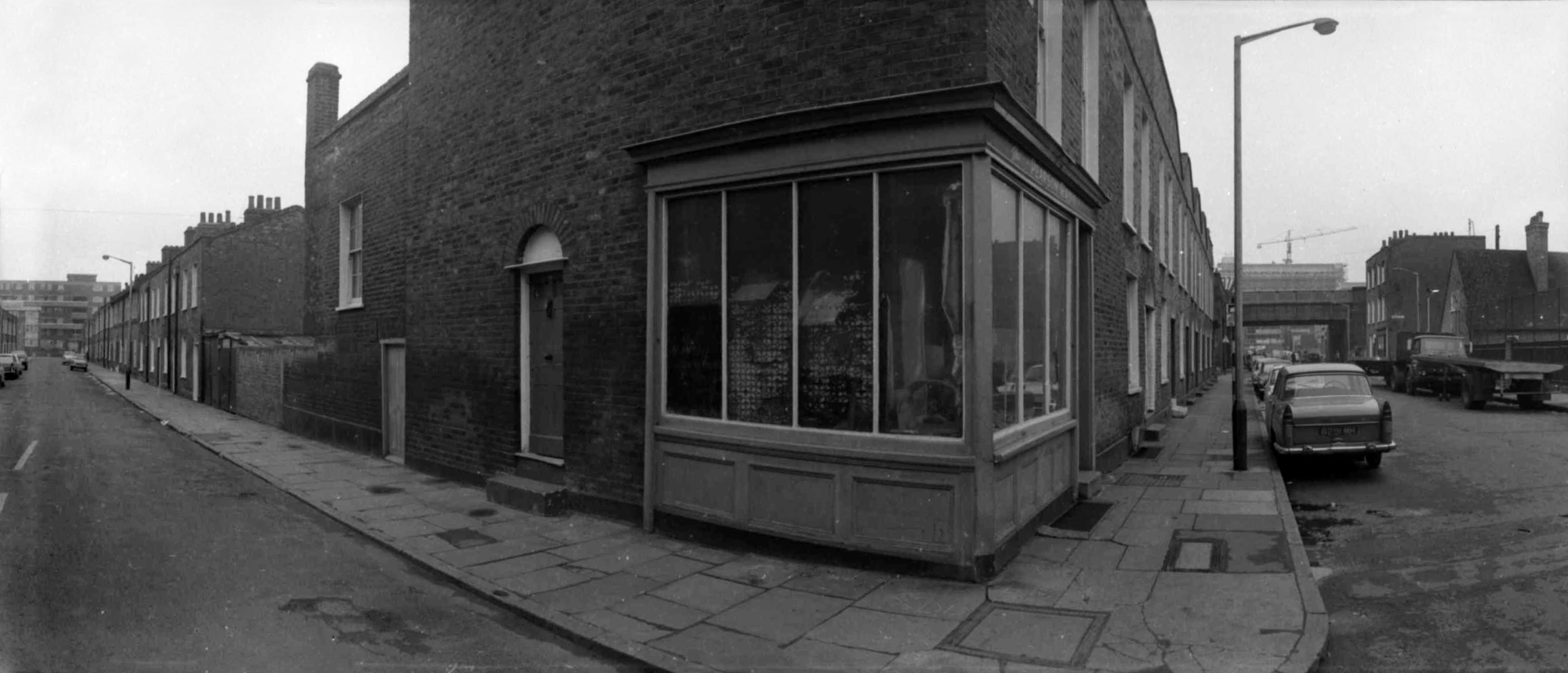

Pearson St & Appleby St

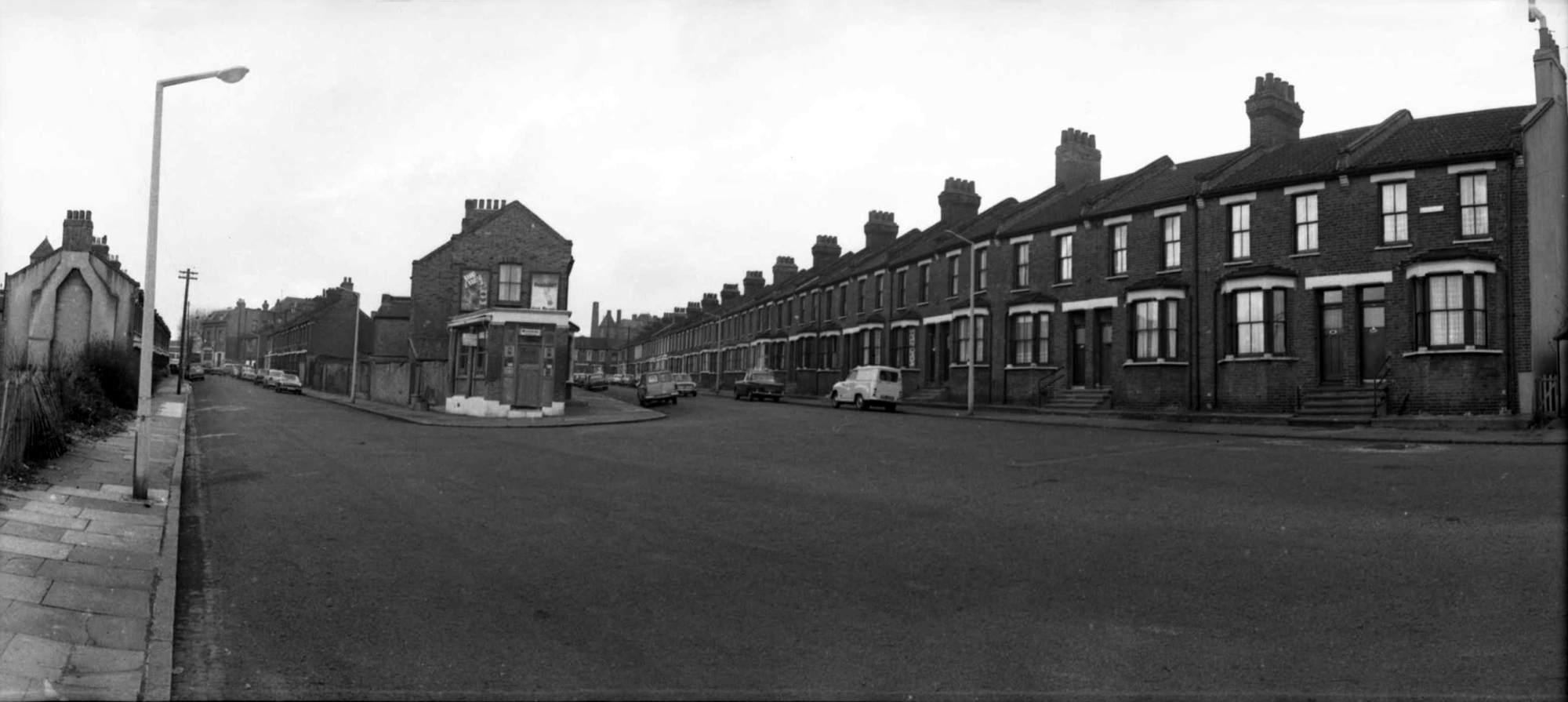

Corner of Well St & Holcroft Rd

Hackney Rd

St Leonards Rd


St Leonards Rd


Photographs copyright © Libby Hall
Images Courtesy of the Tony Hall Archive at the Bishopsgate Institute
Libby Hall & I would be delighted if any readers can assist in identifying the locations and subjects of Tony Hall’s photographs.
You may also like to read
Colin O’Brien’s Pellicci Portraits (Part 6)
With the icy blast howling through the East End, Contributing Photographer Colin O’Brien and I had no choice but to seek refuge at E.Pellicci, London’s best-loved family run cafe, at 332 Bethnal Green Rd. We arrived at seven o’clock and tucked in to bacon and eggs before dawn, and then Colin set to work to make these portraits of the early birds.
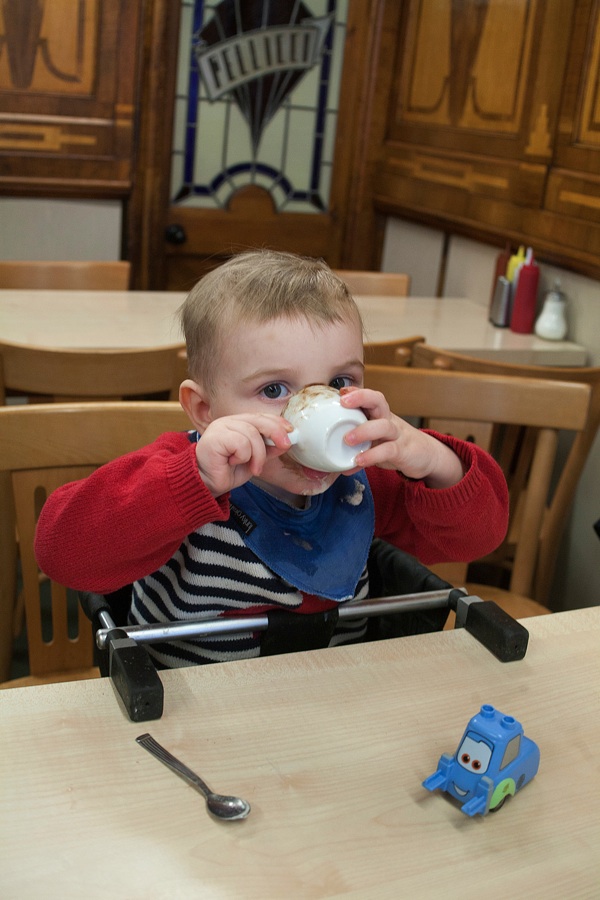
Quentin Croucher – “I’ve been coming here all my life…”
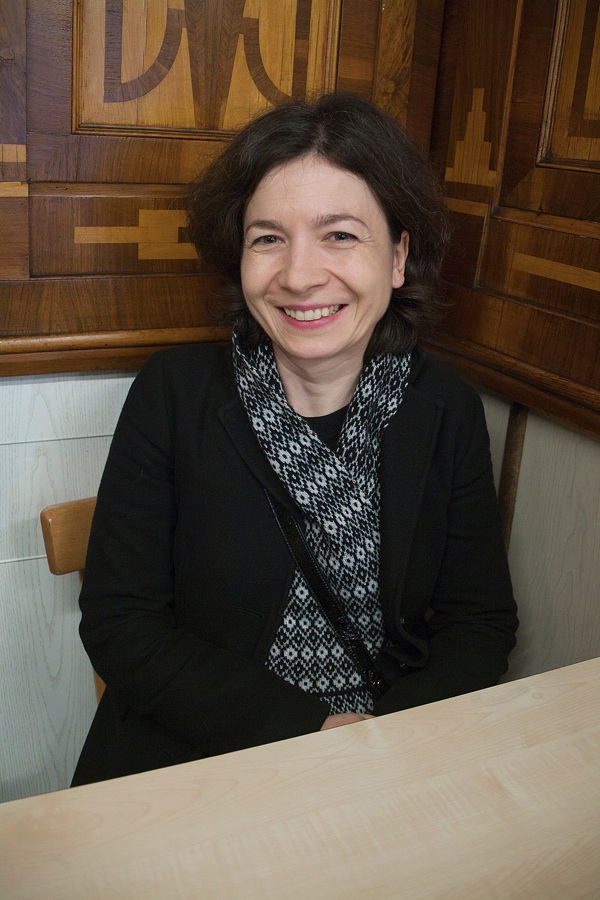
Daniella Parker – “I first came to Pelliccis five years ago and now I come once or twice a month.”

Terry Martin – “I first came here thirty years ago and I’ve been a regular for twenty-five years.”
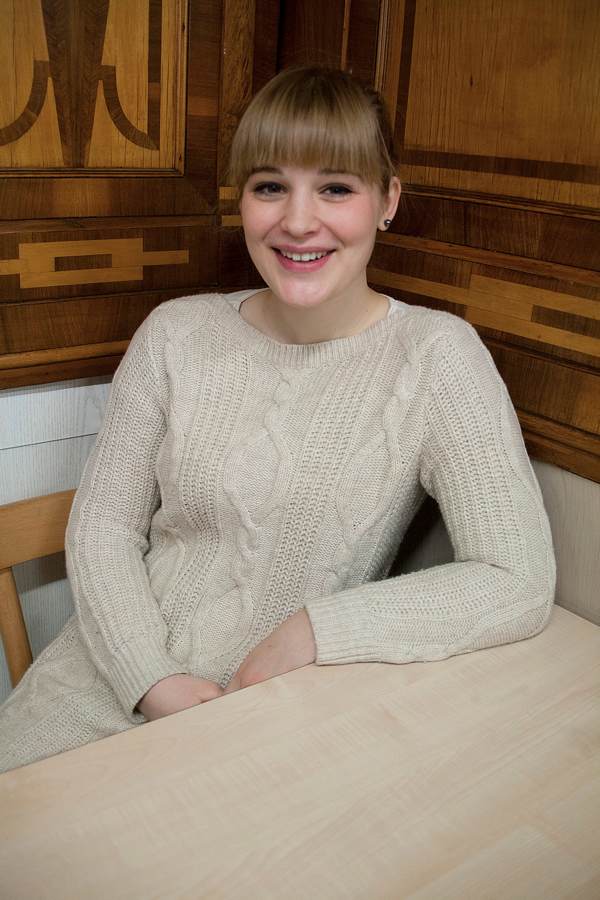
Samantha Lomonaco – “I’m American but I’m visiting from Japan, I’ve come all the way from Tokyo to get real cannelloni.”
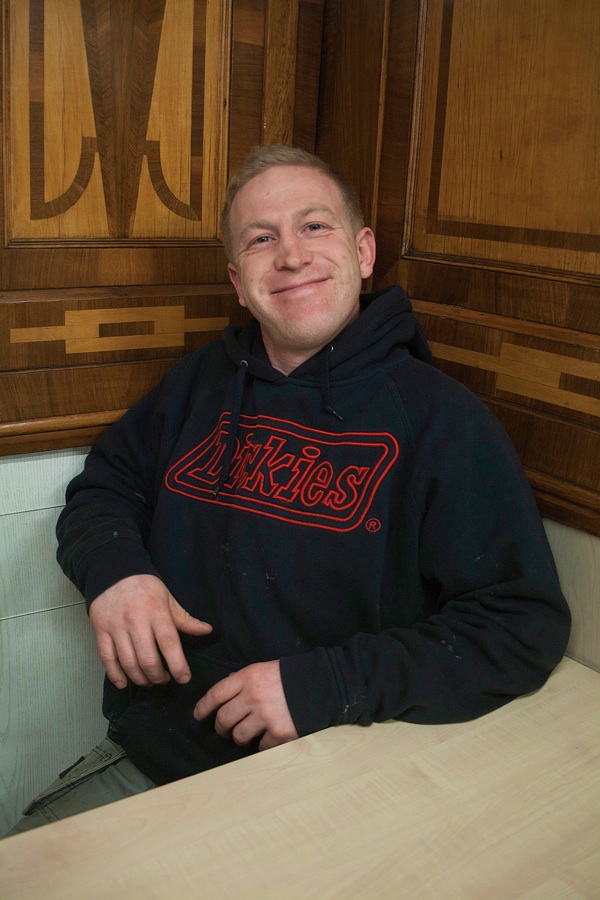
Joseph Surry, Specialist Lead Plumber – “I first came here about four years ago, and now I drop in whenever I’m passing through or doing a job locally.”
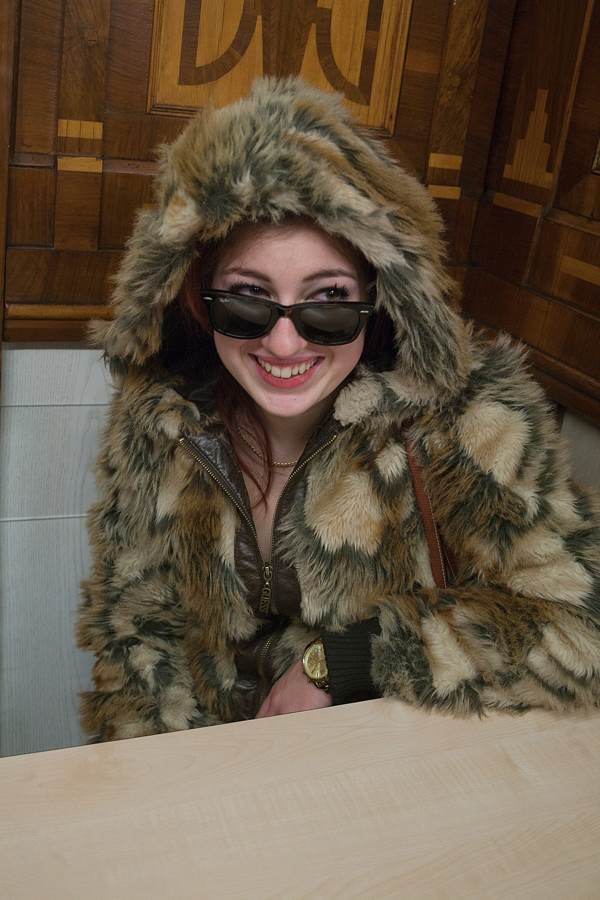
Micha Kanis – “I discovered this place two years ago and now I come here when I’m hung over – I haven’t had any sleep, I’ve been up all night drinking Jack Daniels.”

Miah Anhar – “I’ve been coming to Pelliccis for a long time, quite a few years. I come every day for breakfast and then tea. The staff are very good and always happy.”
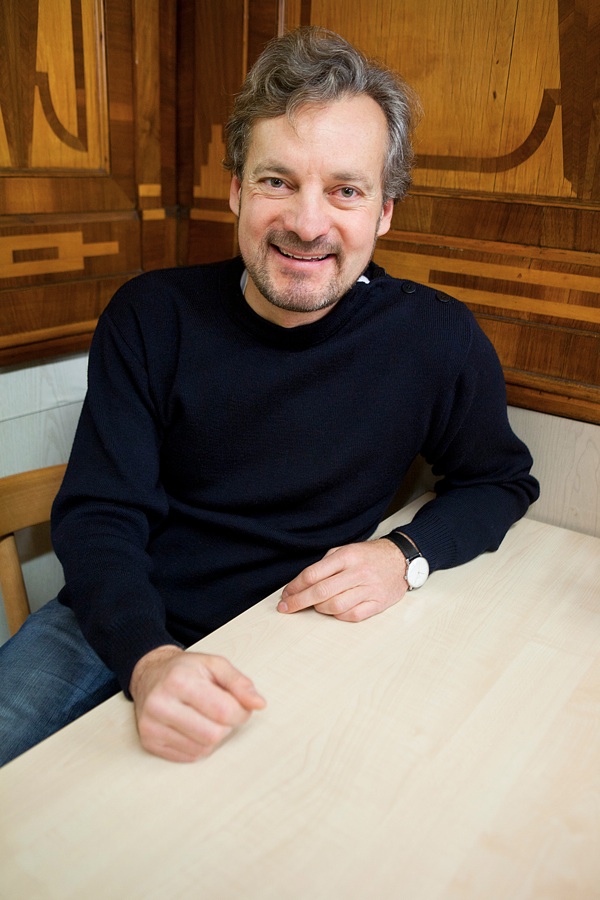
Paul Tremmel – “I’ve been coming here for two years and I come once a week. I am Maria Pellicci’s neighbour.”
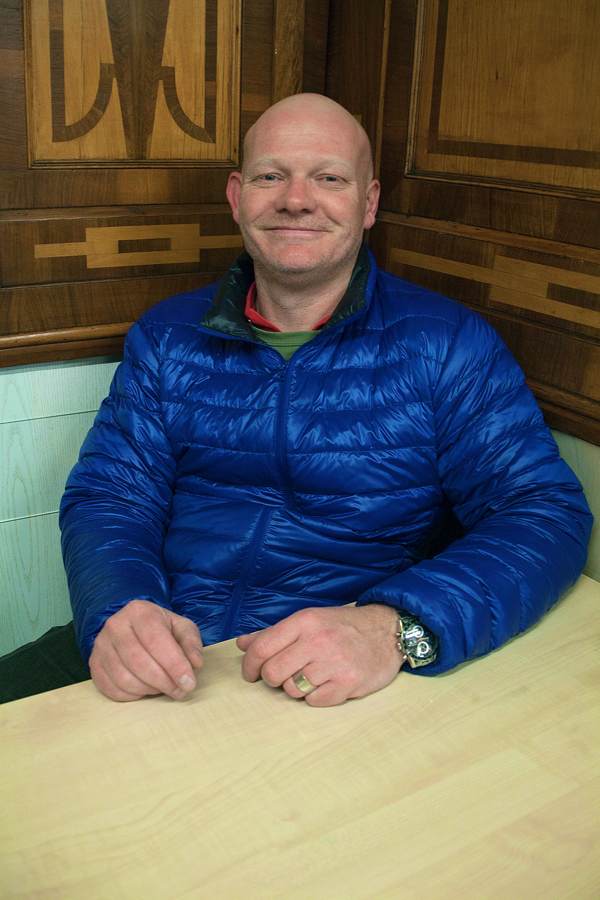
Kevin Brennan – “I’ve been coming in here for fifteen years, I come in here a lot.”
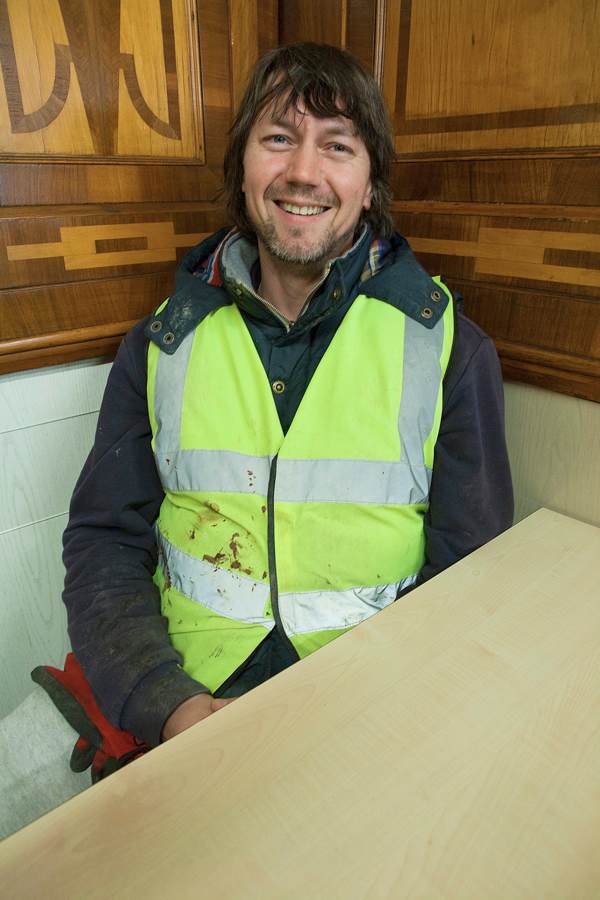
Chris Punter, Artist – “My first time here!”
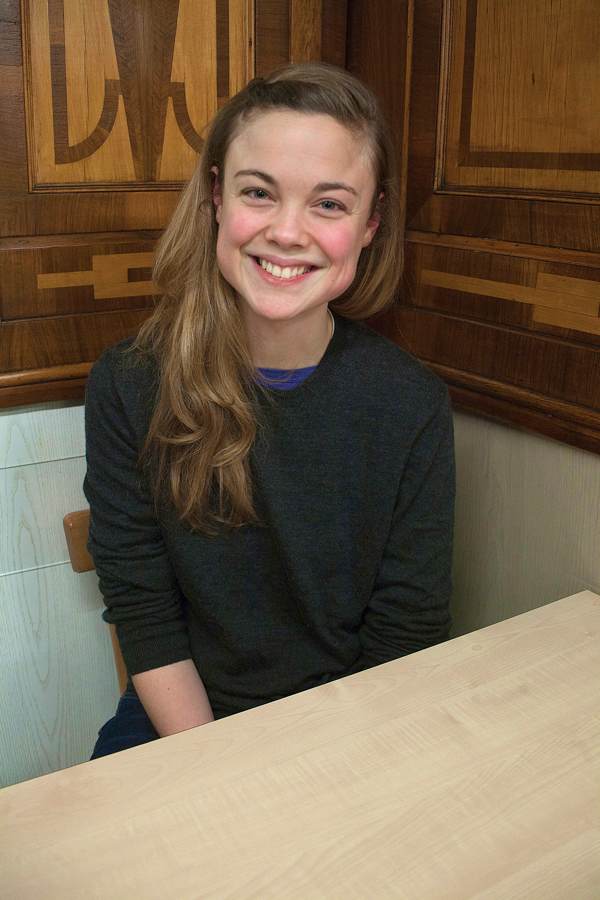
Liz Seabrook – “I just got here two minutes ago. It’s beautiful, very atmospheric, and the food looks good.”
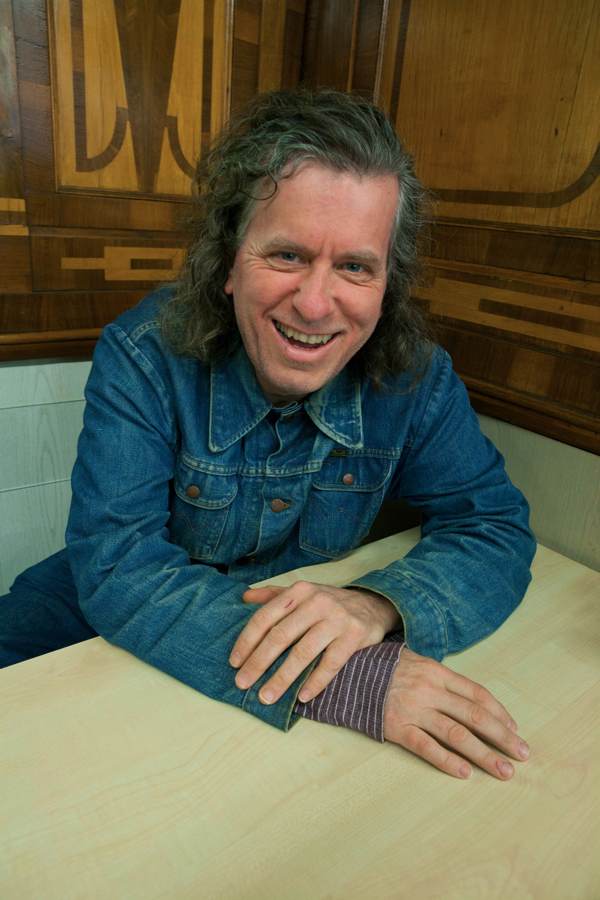
Mark Mulcahy, Musician – “This is my favourite place in London. I come here every seven years.”
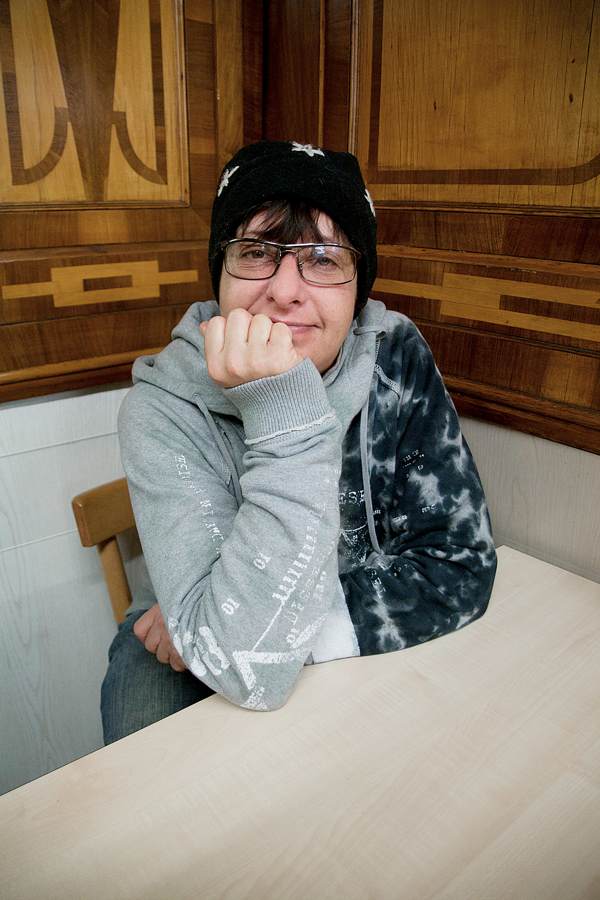
Michaela Cucchi – “I’m forty-six and I’ve been coming to Pelliccis since I was forty-tw0. My grandparents used to come in here.”

Joseph De’Ath – “I’m only young, I’ve been coming three years. I come every day for lunch.”

Bruna Pellicci – “I used to do the washing up in here when I was seven years old. Now I come in every morning on my way to work, I’m a computer administrator for a law firm.”
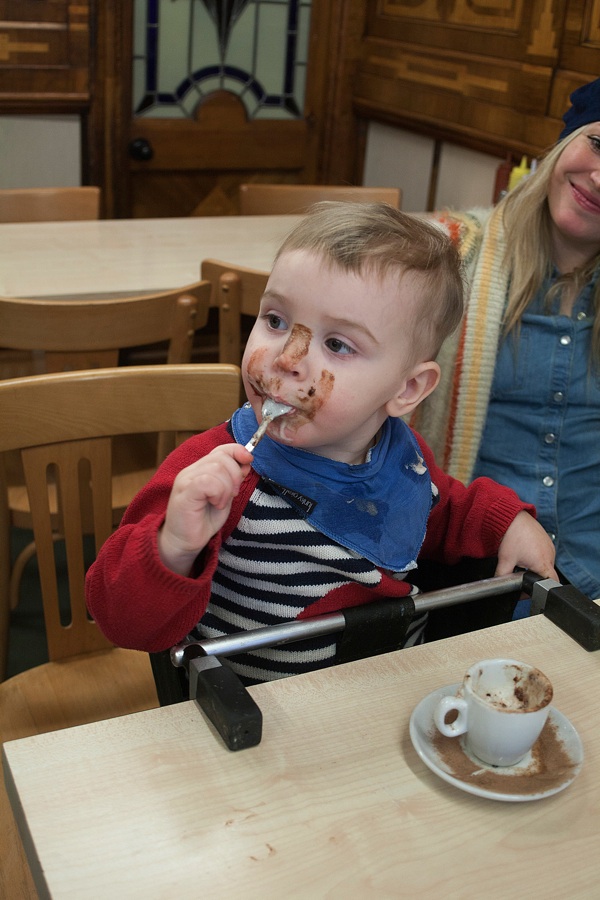
Photographs copyright © Colin O’Brien
You may like to take a look at
Colin O’Brien’s Pellicci Portraits ( Part One)
Colin O’Brien’s Pellicci Portraits (Part Two)
Colin O’Brien’s Pellicci Portraits (Part Three)
Colin O’Brien’s Pellicci Portraits (Part Four)
Colin O’Brien’s Pellicci Portraits (Part Five)
and read these other Pellicci stories
Maria Pellicci, The Meatball Queen of Bethnal Green
and see these other Colin O’Brien stories
Colin O’Brien’s Clerkenwell Car Crashes
Colin O’Brien’s Kids on the Street
Travellers’ Children in London Fields
Colin O’Brien’s Brick Lane Market
The Dogs of Spitalfields in the Snow
Contributing Photographer Sarah Ainslie braved the blizzard to bring us this survey of the effect of snowy conditions upon our frisky East End canines and here you see the results of her endeavours. “The snow had just started to fall and they were all so excited.” she reported to me afterwards in breathless understatement, “The dogs were going crazy,”
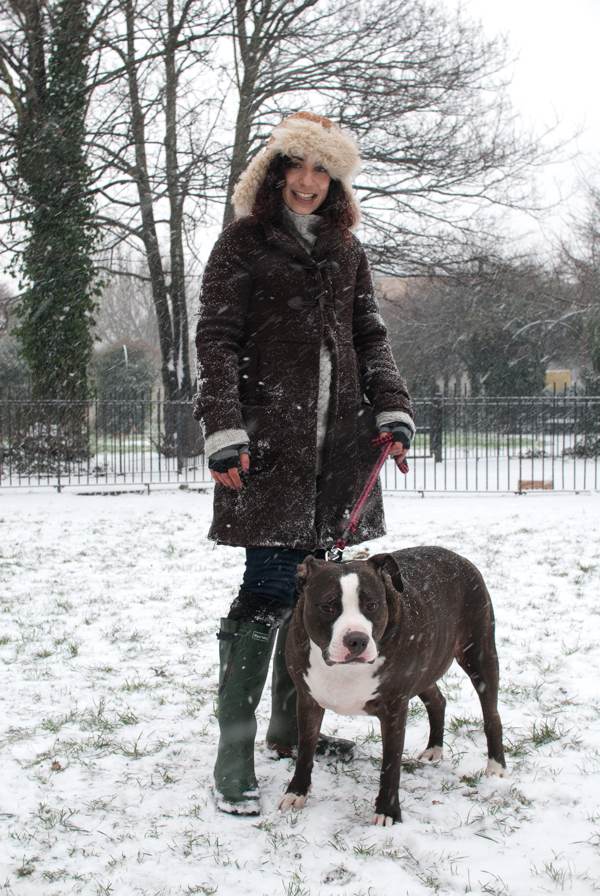
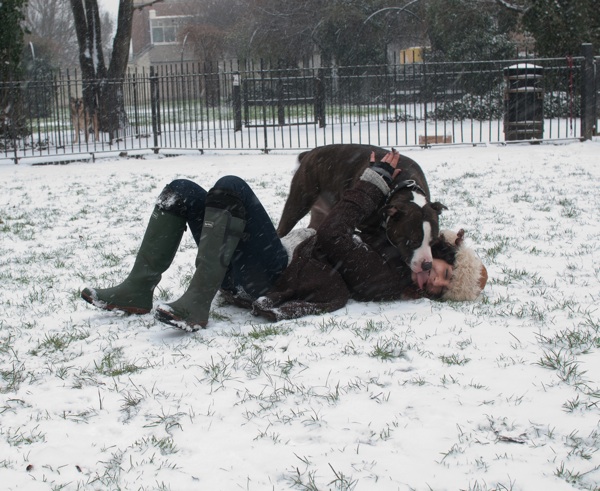
Beetlejuice (Staffordshire Bull Terrier) & Sarah
Beetlejuice is extremely friendly and bounded across to knock the photographer over next. Apparently, he has epilepsy and takes medication for it which makes him gain weight. Sarah, who walks Beetlejuice four times a week for her parents, calls him her “big dollop of lard.”

Daisy (Welsh Terrier) & Fiona
Although Fiona is a professional dog walker who usually walks a number of dogs at once – including Molly, Sandra Esqulant’s dog from The Golden Heart – Daisy is particular and will only tolerate being walked on her own.
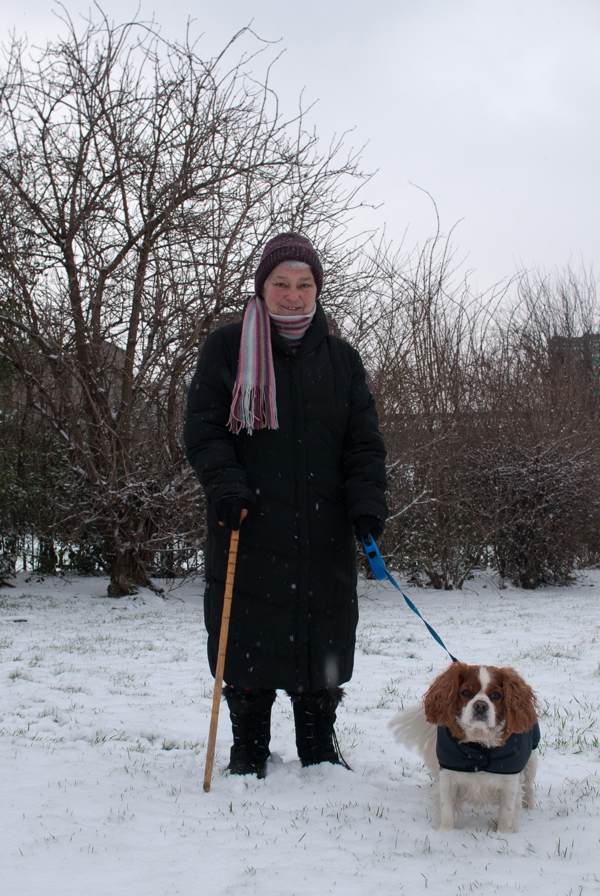
Muffin (King Charles Spaniel) & Chris
Muffin was taking Chris for a walk in Ion Sq. Chris is a dignified East Ender who has lived her life around Columbia Rd and Muffin is her dedicated companion.
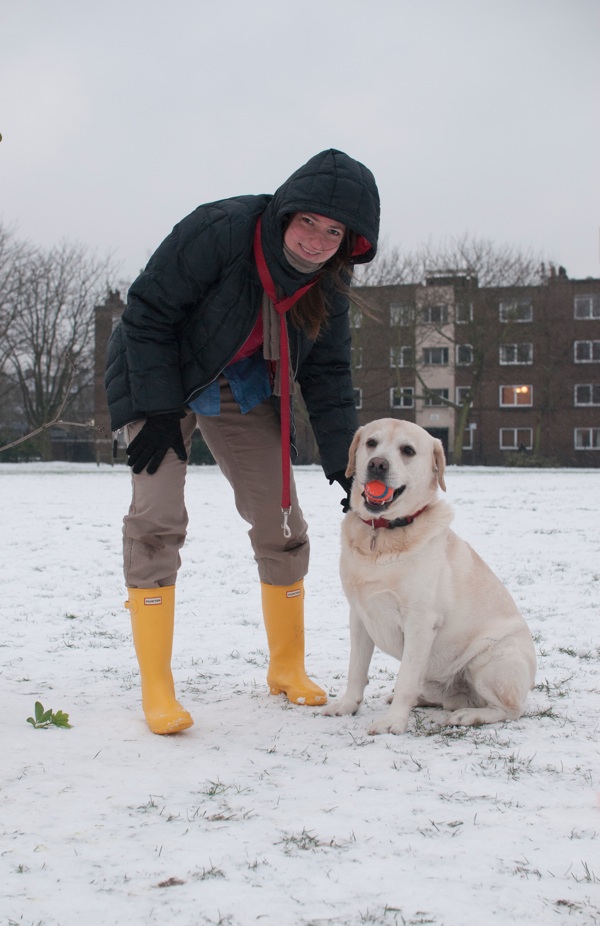
Malone (Golden Labrador) & Susanna
Malone was acquired by Susanna as a puppy seven years ago in Barcelona, and they moved to London three and a half years ago. After Susanna lost a baby in pregnancy, she realised through the depth of her affection for Malone that she could love an adoptive child as if it were her own, and that is what she hopes to do.
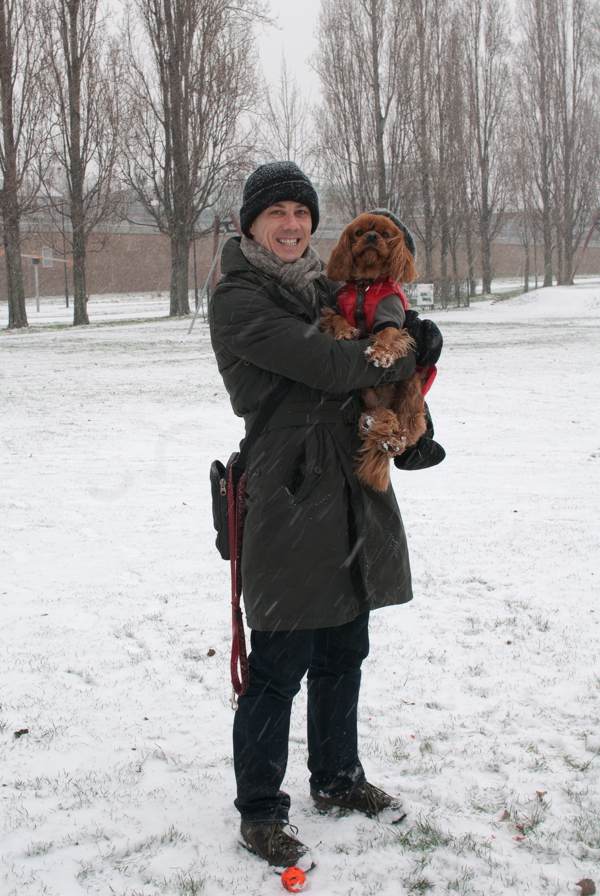
Higgins (King Charles Spaniel) & Mark
Higgins gets taken to Allen Gardens by Mark who is a graphic designer living in Spitalfields. They both came over from Australia last year and this is Higgins’ first experience of snow. The outfit Higgins is wearing was acquired on a recent trip to Vienna.
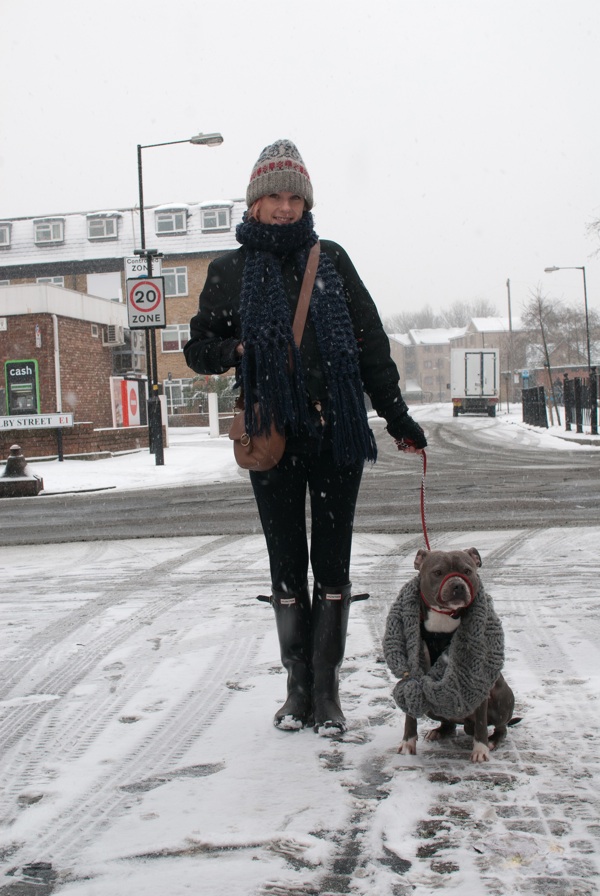
Buster (Staffordshire Bull Terrier) & Beth
Sometimes Buster gets anxious and insecure while he is outside walking on the leash but he turned playful and relaxed when he saw the school children running around in the snow. A homeboy by nature, Beth says Buster is cuddly and adorable like a teddy bear within the security of his own four walls.
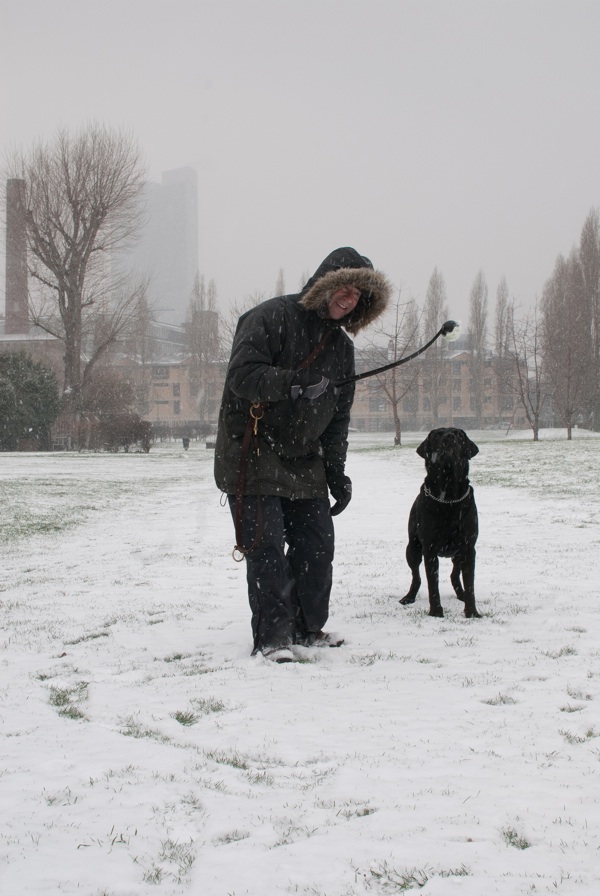
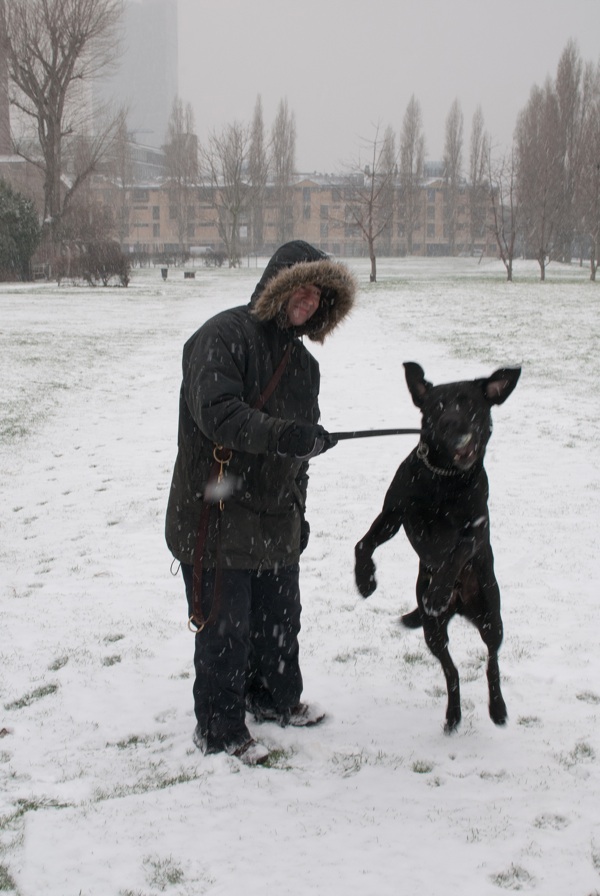
Fred (Labrador) & Ron
Fred is five years old and lives on the outskirts of London with Ron. They arrive at the local school at 5:30am so that Ron can let the cleaners in as part of his caretaking duties. Then Fred & Ron head out for a walk around the park and Ron usually stops to have a chat with the prostitutes on the street.
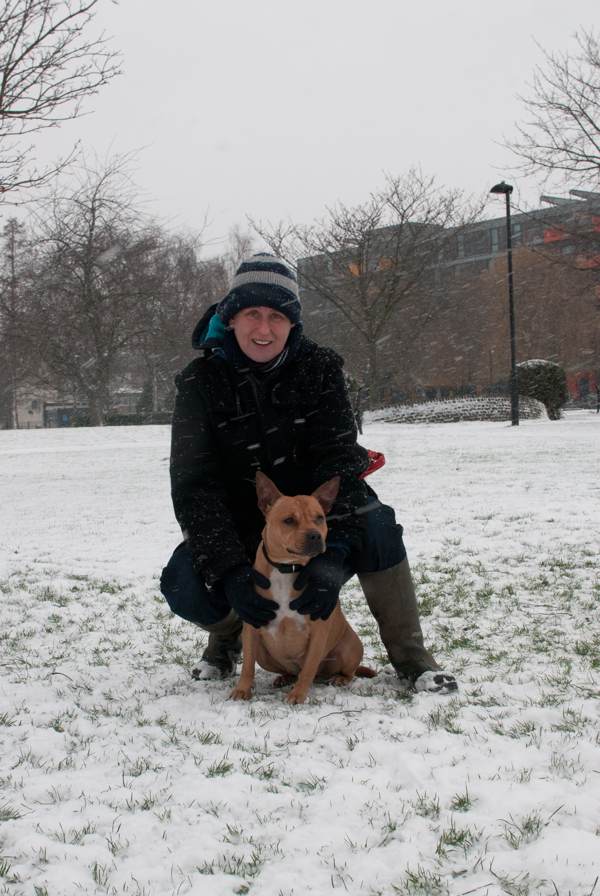
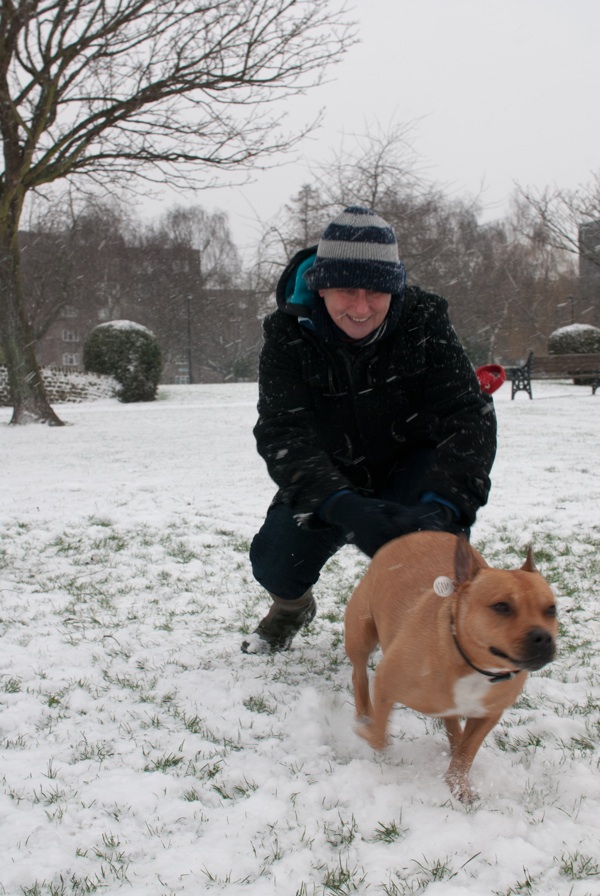
Aggie (Staffordshire/French Bulldog Cross) & Liane
Aggie is four and a half years old and loves the snow so much that it was almost impossible for Liane to hold her still for a photograph.
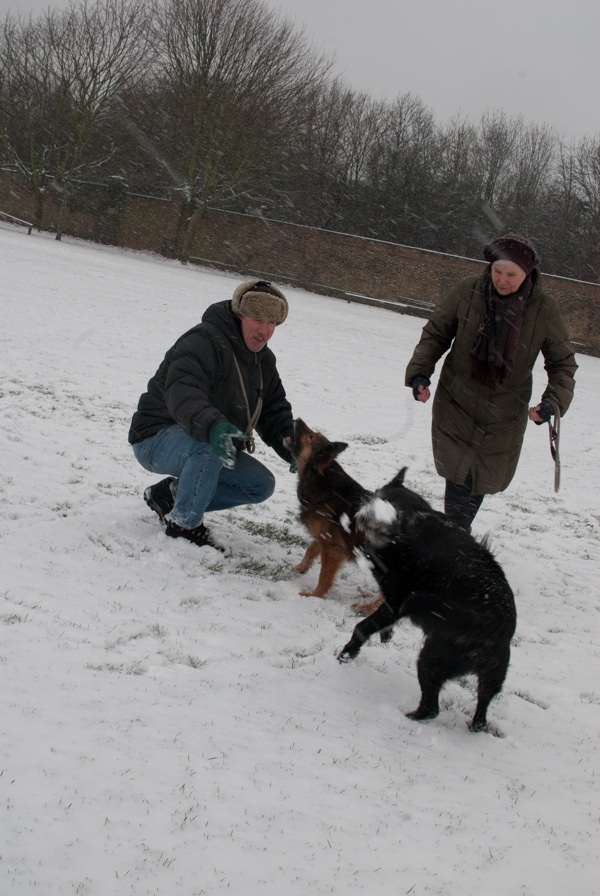
Juju & Boudica with Penny & Leslie
Juju & Boudica were so over-excited by the snow that chaos ensued when Penny & Lesley even tried to get them to stand still for a picture.
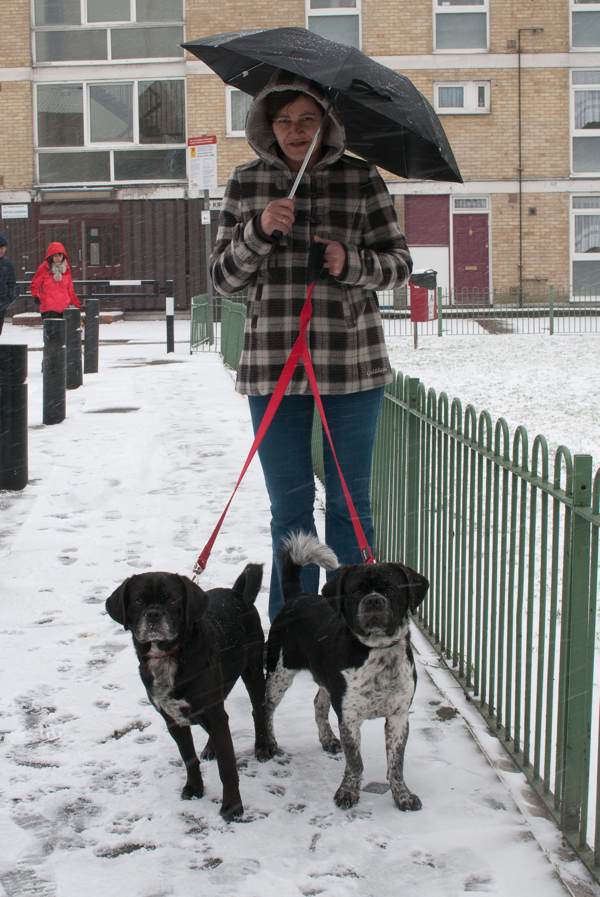
The Bosses Dogs & Sandra
As part of her duties at work, Sandra regularly walks this eager and excitable pair of dogs belonging to her employer. They barked when they were going to have their picture taken, until Sandra showed them who was boss and achieved the desired result at once.
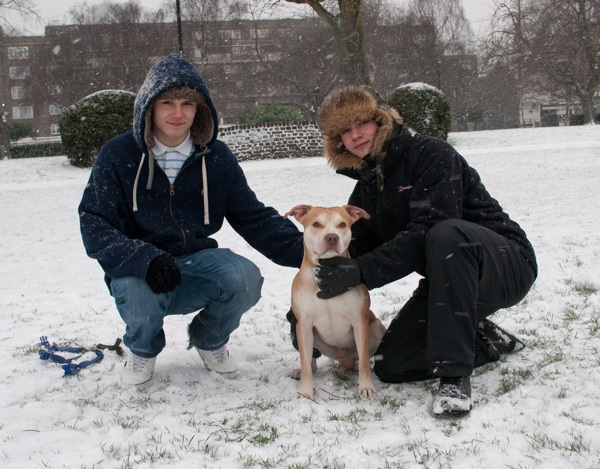
Stan (Long-Legged Irish Staffordshire) with Reg & Harry
Stan is one of the family for brothers Reg & Harry. So when Harry got the day off from work and the snow shut Reg’s college, it was the perfect opportunity for the three of them to enjoy an afternoon at the park.
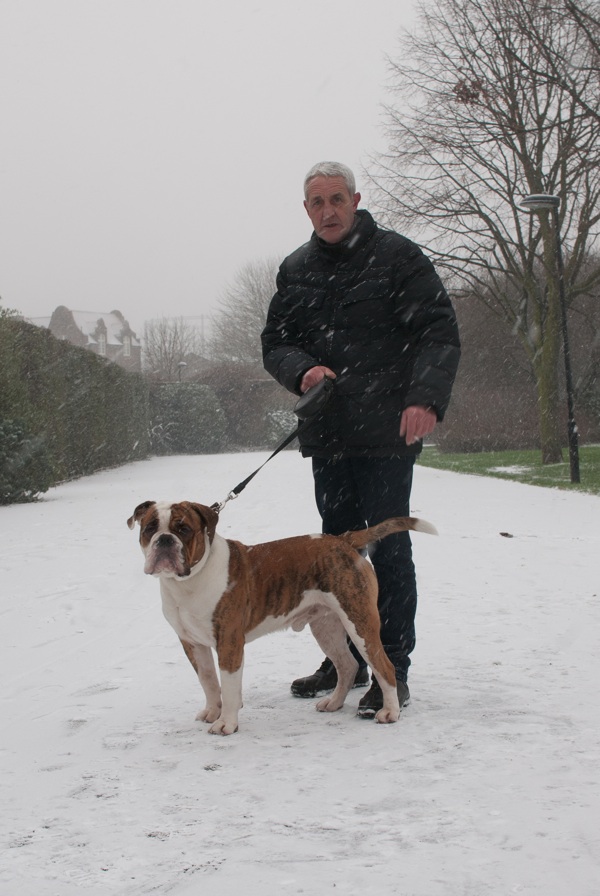
Kobi (Victorian Bull Dog) & Steve
Kobi was chosen by Steve, who wanted a small dog, when he was just a little puppy with big feet. Originally bred for pulling logs, Victorian Bull Dogs require plenty of exercise and these days Kobi keeps Steve on the run in all weathers.

Pippi (Mongrel) with Trisha & Mason
As Sarah was walking through St Matthew’s Churchyard in Bethnal Green she saw Pippi scampering towards her through the snow accompanied by Mason. Then Mason’s granny – Trisha – appeared from behind a tree and hurled a well-aimed snowball at her grandson, scoring a directed hit. After introductions were made, Trisha explained she was supervising Mason since his school had closed at lunchtime, but the brief conversation was curtailed once Pippi appeared with a stick and they all ran off again off frolicking together in the snow.
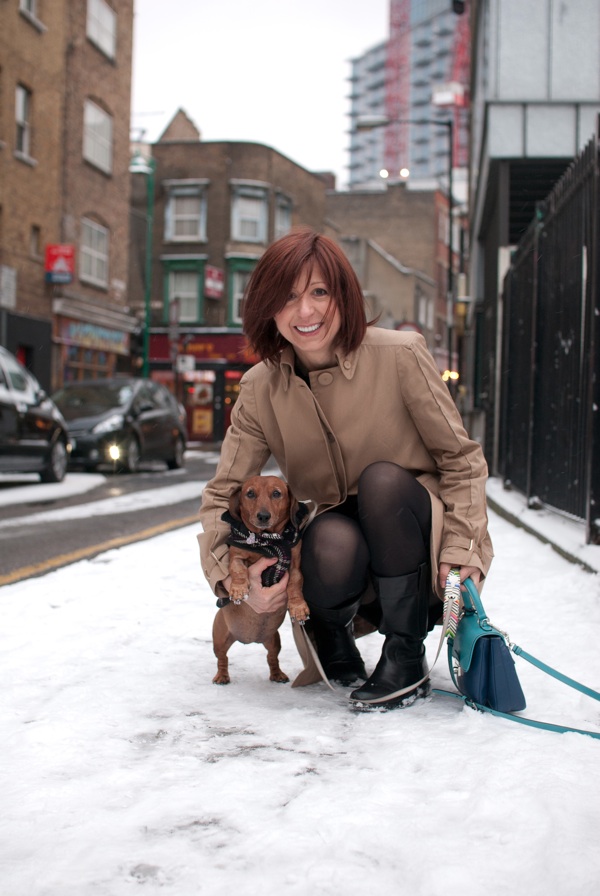
Candy (Dachshund) & Fiona
Candy & Fiona live on Brick Lane and were in a big hurry, but they just stopped long enough to get their portrait done because they always wanted to be featured in ‘Dogs of Spitalfields.’
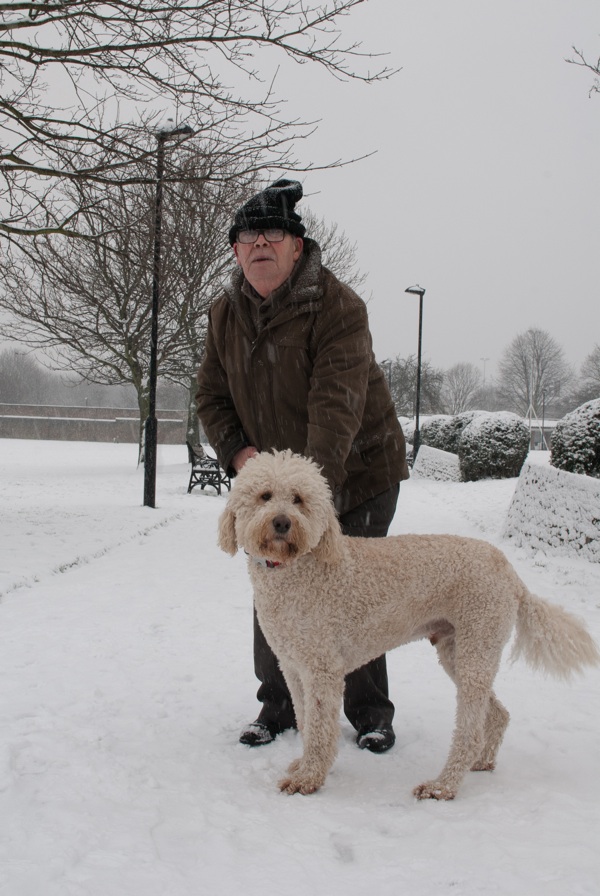
Fudge (Labradoodle) & John
Fudge was acquired by John when he retired from trading in street markets. Now John walks him three times a day and John’s grandchildren shout “Where’s Fudge?” whenever he pays them a visit. “People don’t take no notice of anyone, but when you’ve got a dog with you it’s different – now everyone says ‘hello’ to me.” John revealed proudly.
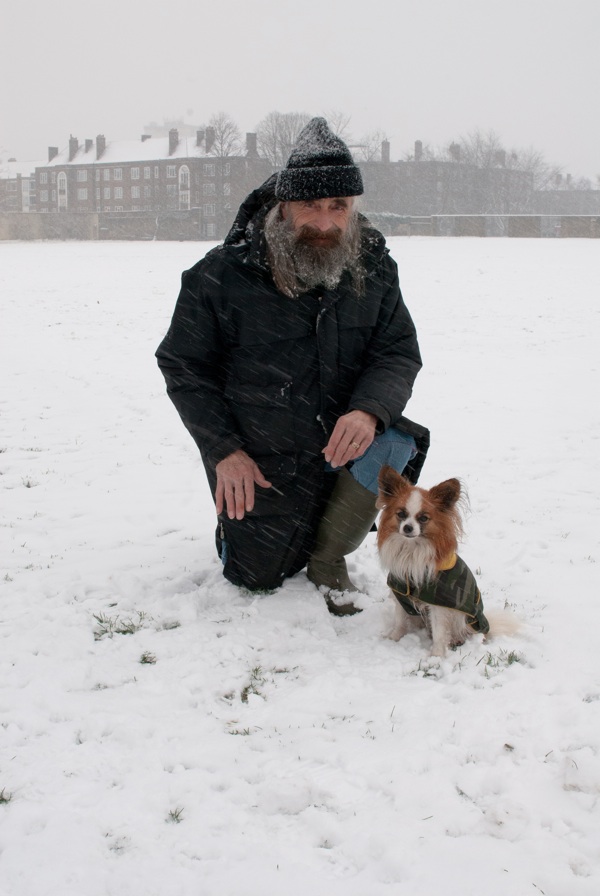
Coco (Papillion) & Keith
In the August 2011 series of ‘Dogs of Spitalfields,’ Coco & Keith were featured on their balcony overgrown with summery plants, so Sarah took this opportunity to make a contrasting portrait of these old friends in the snow.
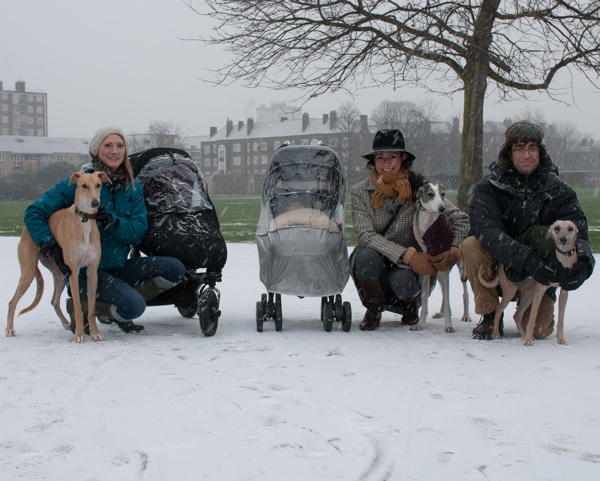
Dasher (Saluki Lurcher) & Tamzin, Dora (Saluki Lurcher) & Mimi, Tim (Whippet) & Robert
Dasher and Dora are rescue dogs but Tim came from a farm in Somerset and has a classy pedigree. By nature, Lurchers and Whippets are very sociable creatures and like to stick together, consequently their owners met and became friends.
Photographs copyright © Sarah Ainslie
The Dogs of Spitalfields in Spring
The Dogs of Spitalfields in Autumn
East End Snowmen
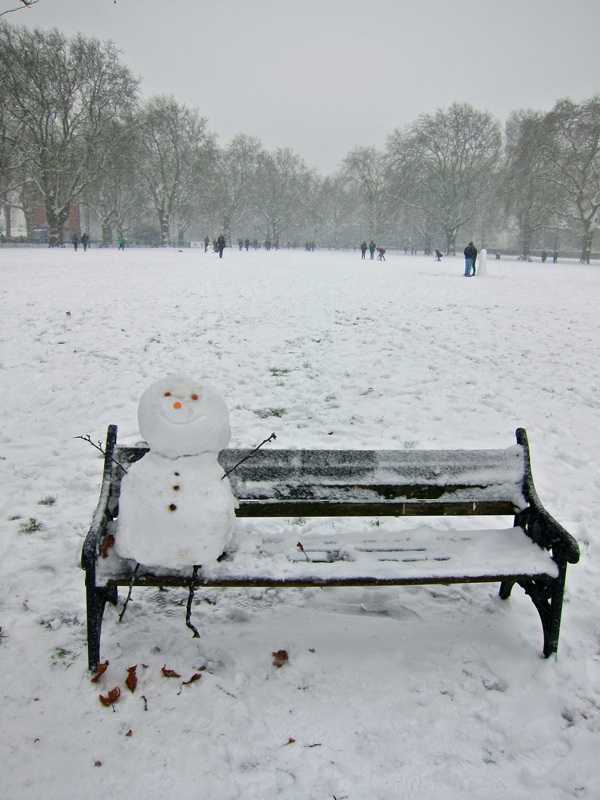
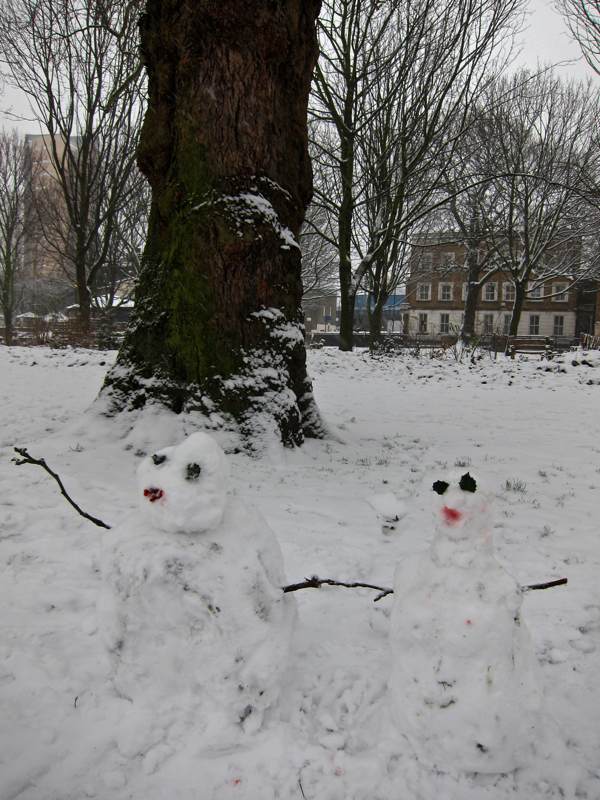
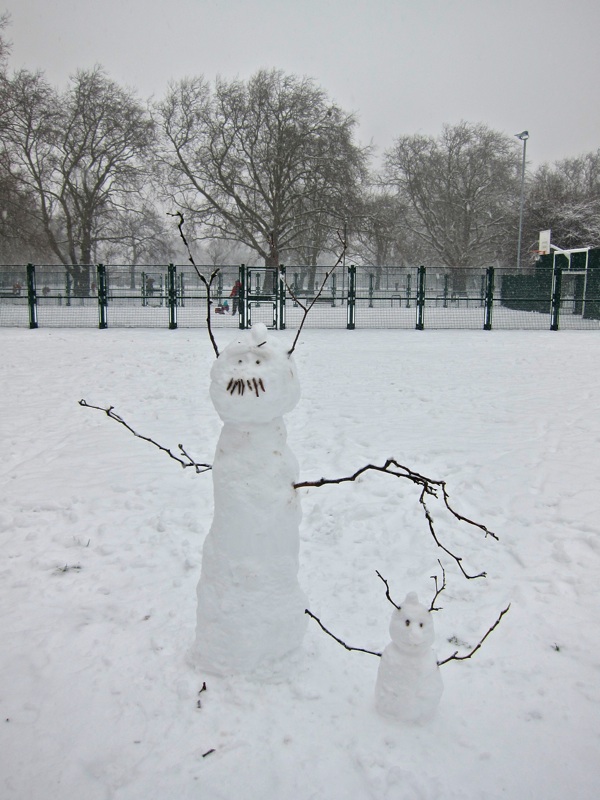
Yesterday delivered the perfect conditions for the arrival of the snowmen in the East End. At first I came upon them in yards and gardens, but before long they were scattered all over the parks and open spaces, lonely sentinels with frozen smiles. Snowmen are short-lived beings and many of those I photographed were just completed, only to be destroyed shortly after my pictures were taken. Yet when I returned later, I often found they had been reconstructed, and – as others appeared in the vicinity and the creators sought to be distinctive – a strange kind of evolution was taking place.






You may also like to take a look at
Nicholas Borden, Artist
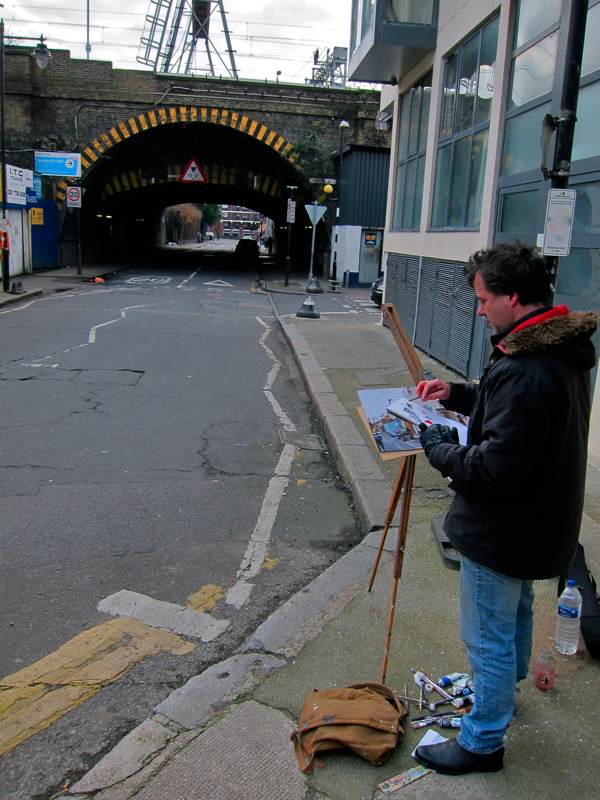
I came across Nicholas Borden standing with his easel in the cold, painting on the corner of Three Colts Lane before Christmas and, even at first glance, I was captivated by his work. But I was unable to speak with him since he was already getting his ear bent by a passing cyclist. Instead, Nicholas handed me one of his cards in gracious response to the brief compliment I was able to interject.
The afternoon light was fading fast as I continued on my way, considering the frustration of the landscape painter on the street, subject to constant distraction from idle passersby. Yet when I visited his studio recently, Nicholas admitted that he enjoys the interruptions.“It’s good to be in the open air and interacting with people.” he enthused, “They see what you are doing and they come and start talking to you – people are very flattering.”
He showed me the series of bold panoramic paintings he has been working on which, in their unusual broad proportion, evoke those early renaissance pictures created to adorn marriage chests by artists such as Uccello and Botticelli. Employing vibrant colours and dynamic compositions, Nicholas’ paintings manifest the spontaneous life of the East End streets with painterly ease, delighting in the quirky geometry and the curious divergent perspectives of familiar locations.
“Since I left college, I think I was lost for a couple of years but now I feel I am at a very creative stage – part of this has come from working on location,” he declared in excitement, as he showed me the works he has created in the past eighteen months, “I’ve got several easels and I carry my backpack and portfolio. I’m quite hardy so I can withstand most weather, I’m an outdoors person.”
Originally from the West Country, Nicholas came to London to study Graphics at St Martins College of Art and then Communications at the Royal College of Art, and he recalls the first time he visited the East End. “I remember coming to a party on Brick Lane, it was quite an eye-opener to a boy from Devon – certainly different and exciting, I suppose.” he confided, “And this has been the area of London I have always come back to.” After graduation Nicholas returned to Devon and he took jobs in factories and warehouses, without making any art for several years. “I gave it up,” he confessed with frown of regret, withdrawing into himself, “Then I had my car stolen and the people who took it broke into my flat when I was there, that was a real low point for me.”
Coming back to live with his brother in the East End, Nicholas started making pictures again. “I returned to the kind of work I did as a teenager, doing line drawings,” he explained modestly, revealing how he liberated himself from the problematic experience of his college education and regained emotional possession of his artistic endeavours by picking up a personal thread.
Of course, there is a sophisticated technique that belies itself in these elegant pictures, but more significantly there is a joy in the medium that grants them an immediate appeal. “This is a re-invention, I feel I have completely transformed myself,” Nicholas assured me, surprised at his own words.
Even though he has not yet shown any of these pictures or had an exhibition, I know you will be seeing more of the work of Nicholas Borden. But in the meantime, if you spot him on a street corner in the East End, you are licensed to go up and say, “hello.”
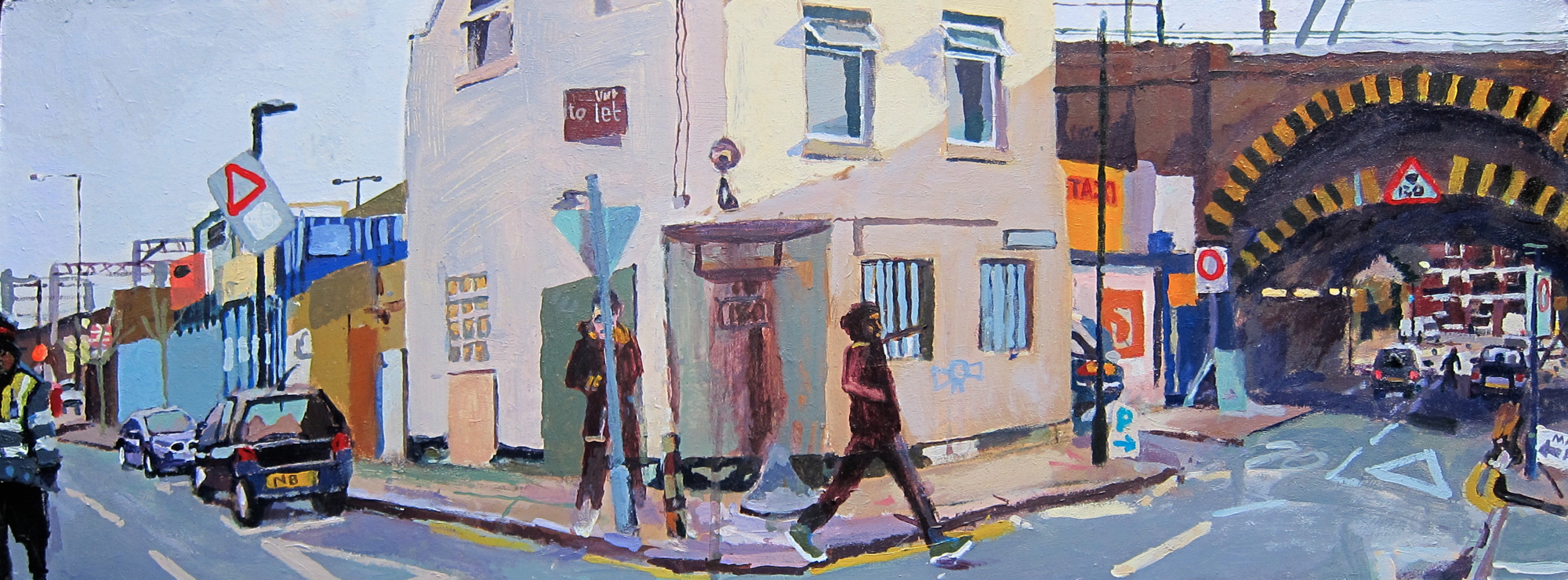
Three Colts Lane (click to enlarge)
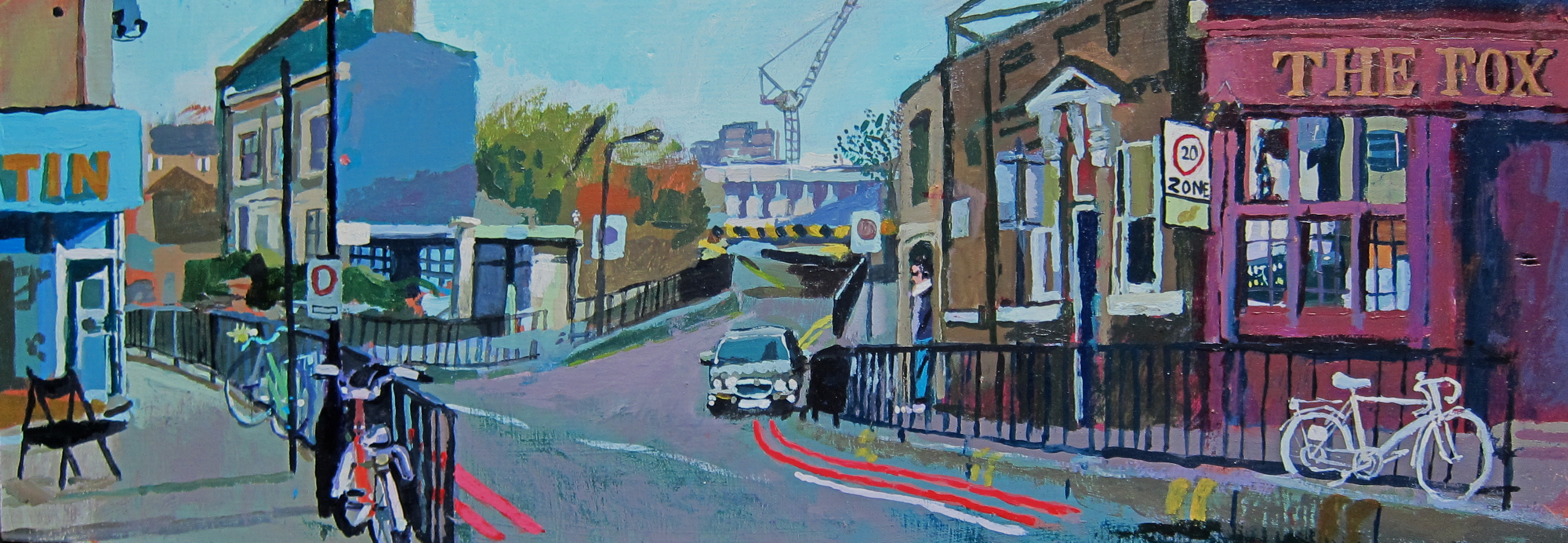
Middleton Rd, Dalston (click to enlarge)
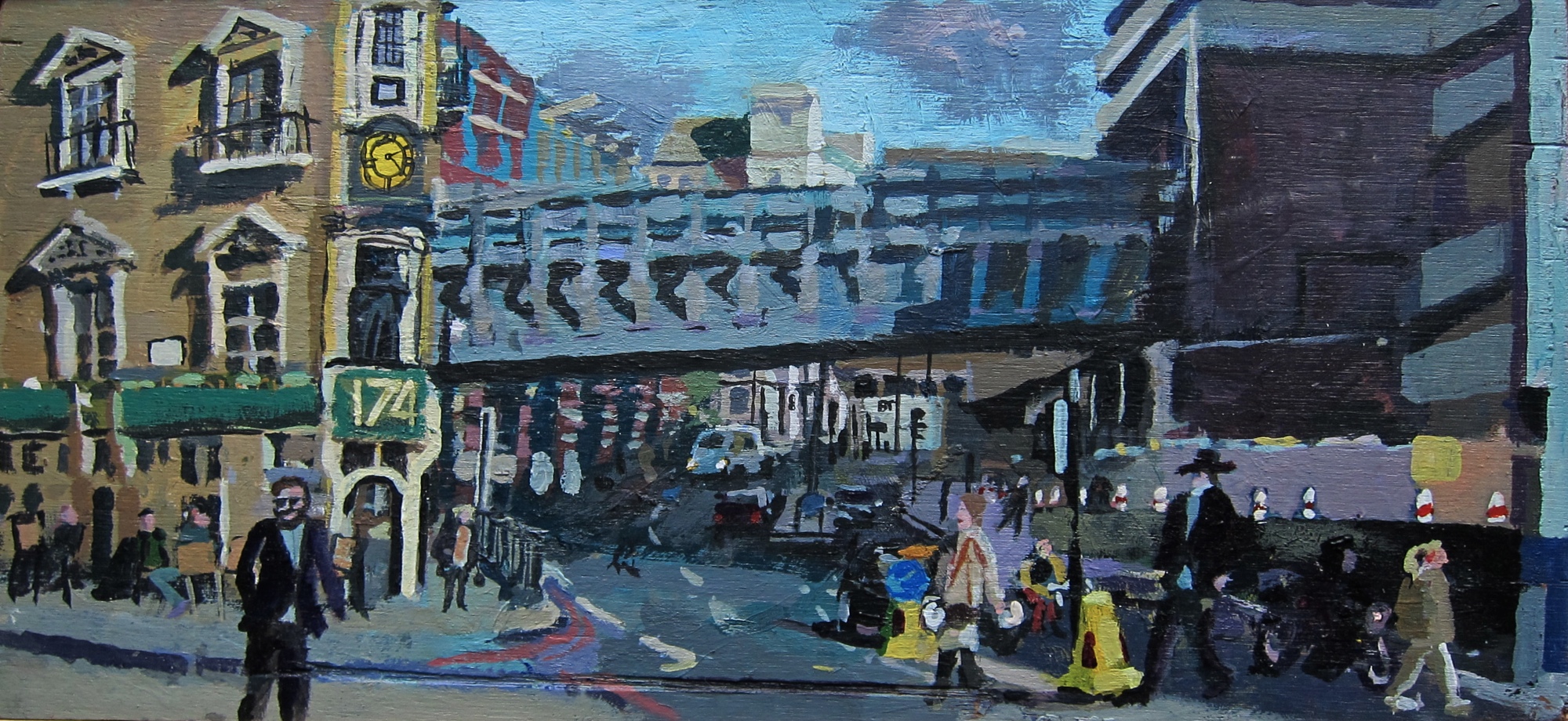
Blackfriars (click to enlarge)
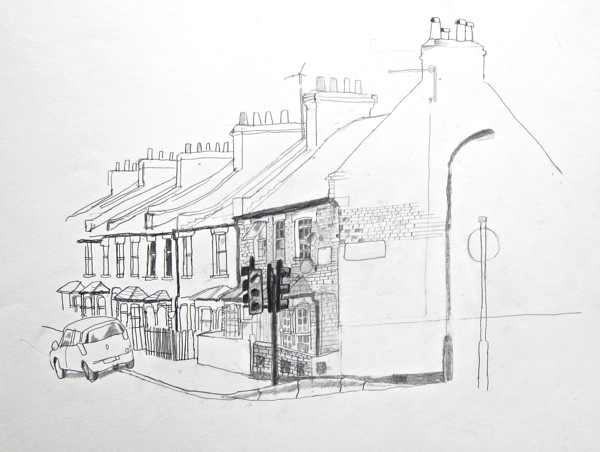
Wick Rd, Hackney

Regent’s Canal next to Victoria Park

Dalston Junction

Victoria Park
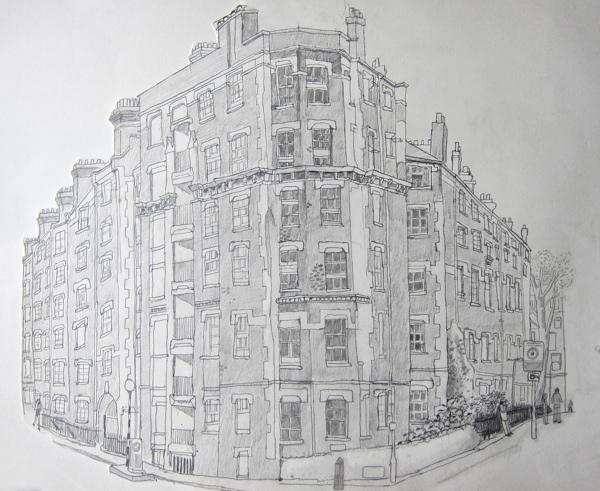
Cavendish Mansions, Clerkenwell Rd

Regent’s Canal at Mare St
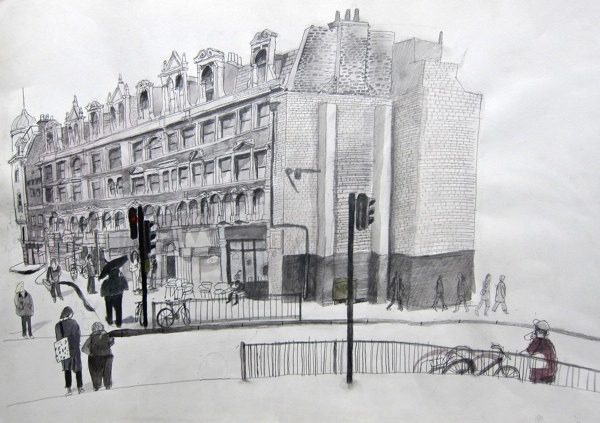
Earnshaw St, High Holborn

Whitechapel from the roof of the Idea Store
Images copyright © Nicholas Borden












