
Soerditch by Dant (Chapter Three)
It is my pleasure to publish this week’s instalment of Contributing Artist Adam Dant’s cartoons from SOERDITCH, Diary of a Neighbourhood, satirising the culture of our dearly-beloved Shoreditch – each one a beautifully rendered view of the neighbourhood , captioned with a clueless thing overheard on the street.
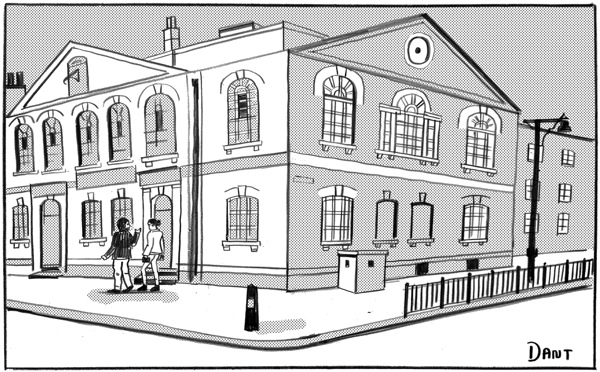
“This place is amazing – first it was used by the Huguenots, then the Methodists, then the Jews, then the Muslims & soon the Scientologists move in!”
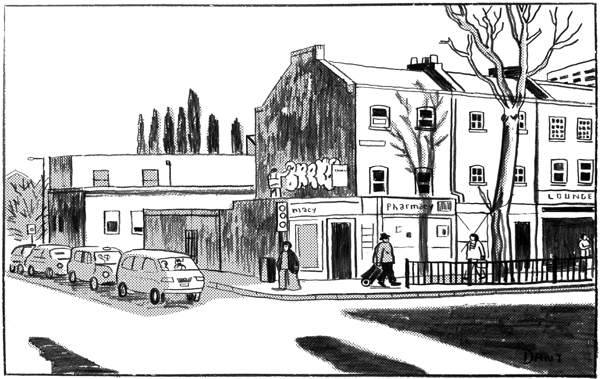
“It depends what you want to eat really – right is yuppie, left is chavvie …”
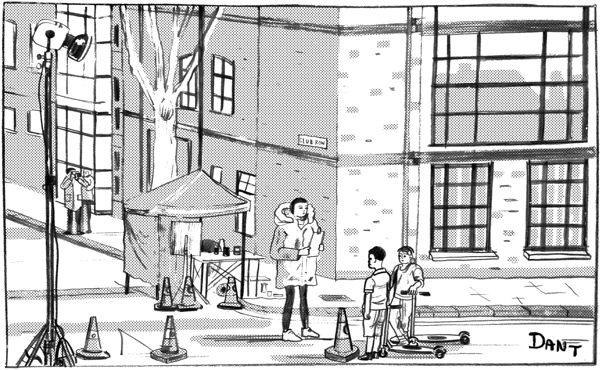
“I’m sorry kids, I’d like to let you past but, as you can see, we’ve got very important fashion shoot going on here!”
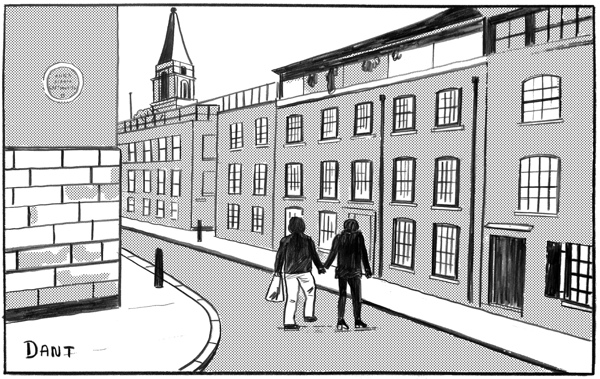
“Can we go back to Croydon soon? All this creepy, peely painty vibe round here’s beginning to freak me out!”
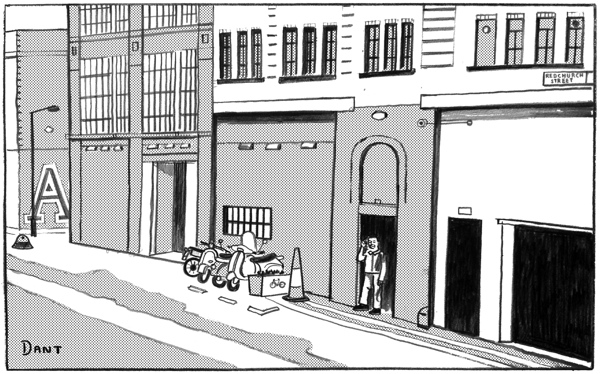
“Sorry love, I’ve got to stay at the agency until we get the design of the ‘Z’ in the new ‘JeanZ’ logo right.”
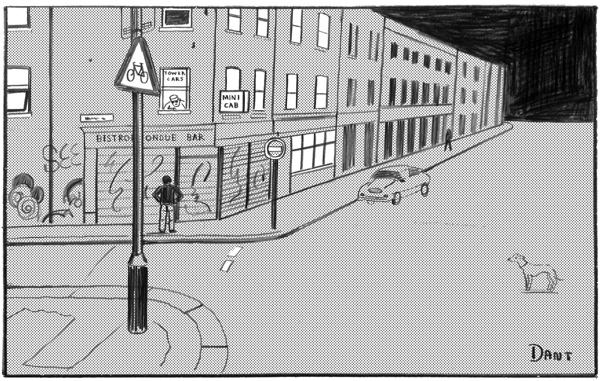
“To Kensington” … “Kennington? … ” No, Kensington!!!” … “Canning Town?”
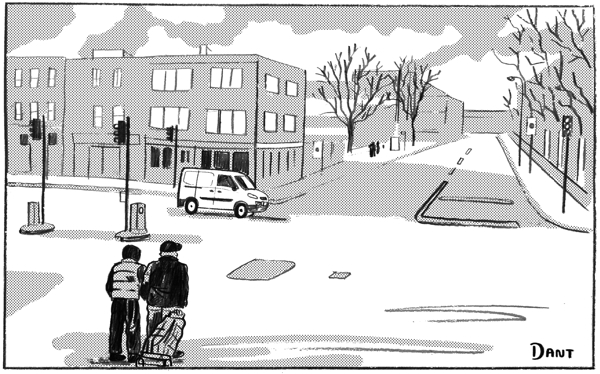
“I was just going to pop into the library for a little afternoon nap!” … “Don’t you mean the ‘Idea Store?'”
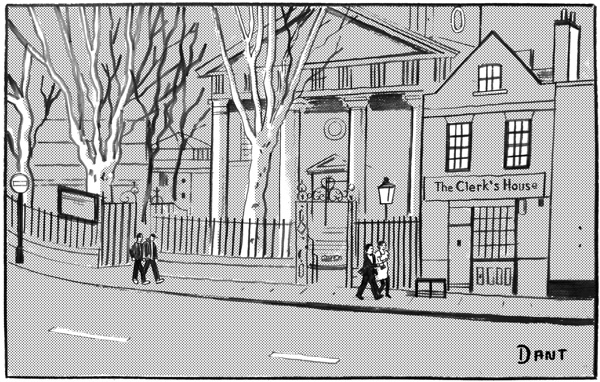
“Don’t be stupid, of course it’s safe to walk around Shoreditch at night in evening dress. Haven’t you see those old pictures of the Kray Twins? They were from round here and they were always in black tie.”
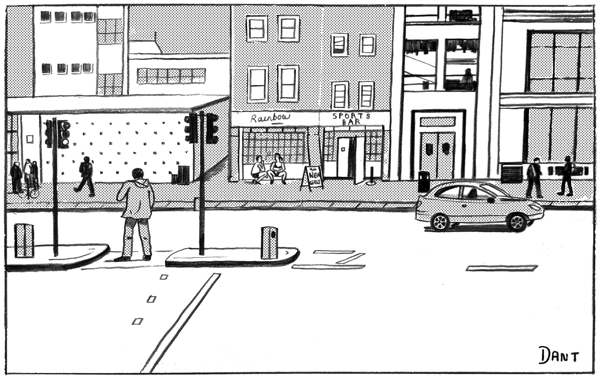
“I saw this Eastenders show … so unrealistic, the people, the food, the houses, the english, everything …”
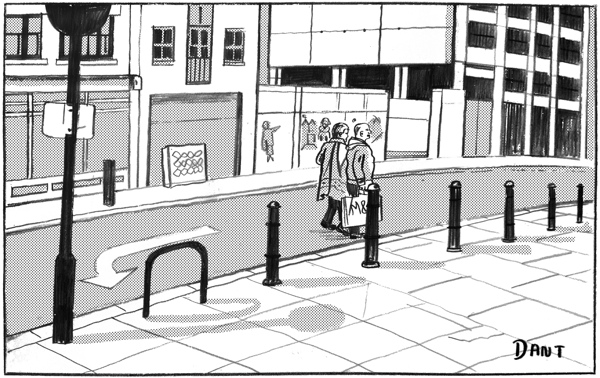
“Do you think Shakespeare would live in Shoreditch if he came to London nowadays?” … “He’d stay in Stratford, the theatre’s better now.”
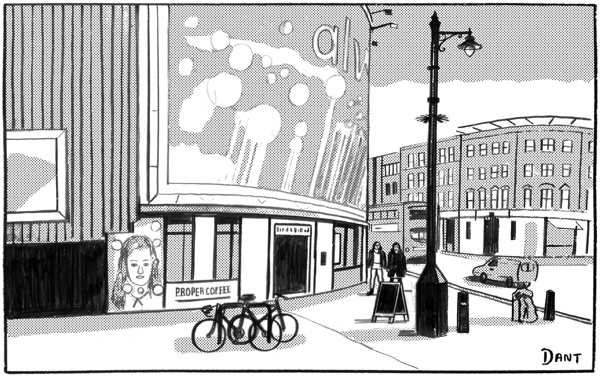
“English bloody Heritage sneaked into our squat while we were at Wimbledon and gave it an effing Grade I listing …”
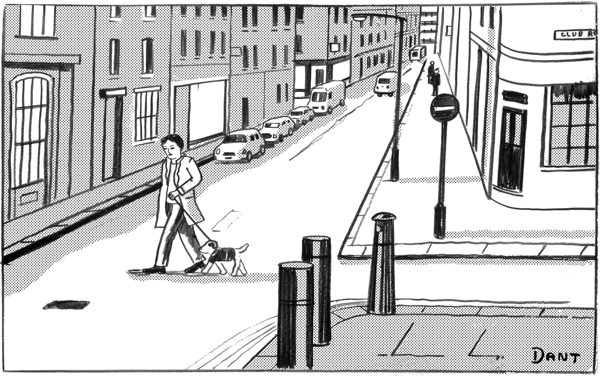
“Well, there’s another pub we won’t be visiting for a while.”
Soerditch is the old name for Shoreditch, quoted by the historian John Stow in his Survey of London 1598, as “so called more than four hundred yeares.” It means sewer ditch, in reference to the spring beside Shoreditch Church, once the source of the lost River Walbrook which flowed from there towards the City of London.
Drawing from a pair of unlikely inspirations, namely Giles‘ cartoons for the Daily Express and Hiroshige‘s ‘One Hundred Famous Views of Edo,’ Adam Dant pulls off an astonishing sleight of hand – simultaneously portraying the urban landscape of Shoreditch with spare lines and flat tones that evoke the woodcuts of Hiroshige, while also satirising the manners and mores of the people through witty social observations in the manner of Giles.
The exhibition runs at Eleven Spitalfields Gallery until 26th April and all one hundred and twenty-five cartoons are published in an album with an introduction by Jarvis Cocker, produced in the style of Giles’ celebrated annuals and available to buy online from Spitalfields Life Shop.
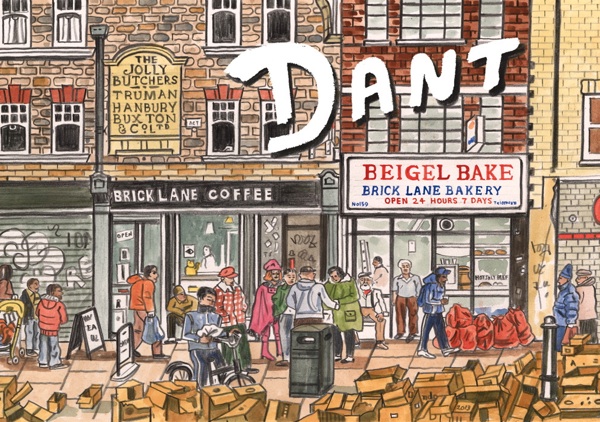
Click here to buy your copy of SOERDITCH by DANT – Diary of a Neighbourhood (125 Views of Shoreditch) – while stocks last!
Cartoons copyright © Adam Dant
Adam Dant is represented by Hales Gallery
You may also like to see these earlier selection of cartoons by Dant
A Walk Through Time in Spitalfields Market
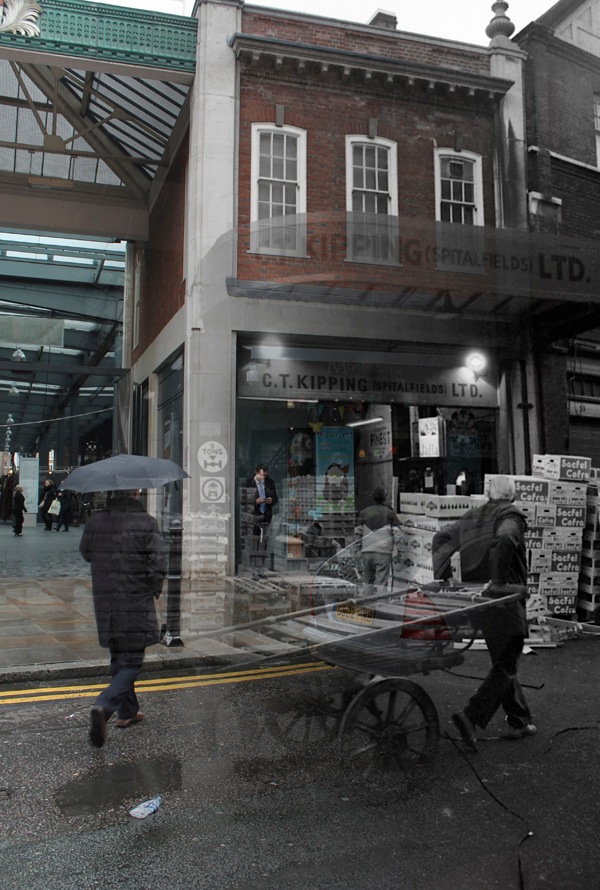
Once upon a time, the Romans laid out a graveyard along the eastern side of the road leading north from the City of London, in the manner of the cemetery lining the Appian Way. When the Spitalfields Market was demolished and rebuilt in the nineteen-nineties, stone coffins and funerary urns with copper coins were discovered beneath the market buildings – a sobering reminder of the innumerable people who came to this place and made it their own over the last two thousand years. Outside the City, there is perhaps no other part of London where the land bears the footprint of so many over such a long expanse of time as Spitalfields.
In his work, Adam Tuck plays upon this sense of reverberation in time by overlaying his own photographs upon earlier pictures to create subtly modulated palimpsests, which permit the viewer to see the past in terms of the present and the present in terms of the past, simultaneously. He uses photography to show us something that is beyond the capability of ordinary human vision, you might call it God’s eye view.
Working with the pictures taken by Mark Jackson & Huw Davies in 1991, recording the last year of the nocturnal wholesale Fruit & Vegetable Market before it transferred to Leyton after more than three centuries in Spitalfields, Adam revisited the same locations to photograph them today. The pictures from 1991 celebrate the characters and rituals of life within a market community established over generations, depicted in black and white photographs that, at first glance, could have been taken almost any time during the twentieth century.
In Adam Tuck’s composites, the people in the present inhabit the same space as those of the past, making occasional surreal visual connections as if they sense each others presence or as if the monochrome images were memories fading from sight. For the most part – according to the logic of these images – the market workers are too absorbed in their work to be concerned with time travellers from the future, while many of the shoppers and office workers cast their eyes around aimlessly, unaware of the spectres from the past that surround them. Yet most telling are comparisons in demeanour, which speak of self-possession and purpose – and, in this comparison, those in the past are seen to inhabit the place while those in the present are merely passing through.
Although barely more than twenty years have passed since the market moved out, the chain stores and corporate workers which have supplanted it belong to another era entirely. There is a schism in time, since the change was not evolutionary but achieved through the substitution of one world for another. Thus Adam’s work induces a similar schizophrenic effect to that experienced by those who knew the market before the changes when they walk through it today, raising uneasy comparisons between the endeavours of those in the past and the present, and their relative merits and qualities.

Brushfield St, north side.

Lamb St, south side.
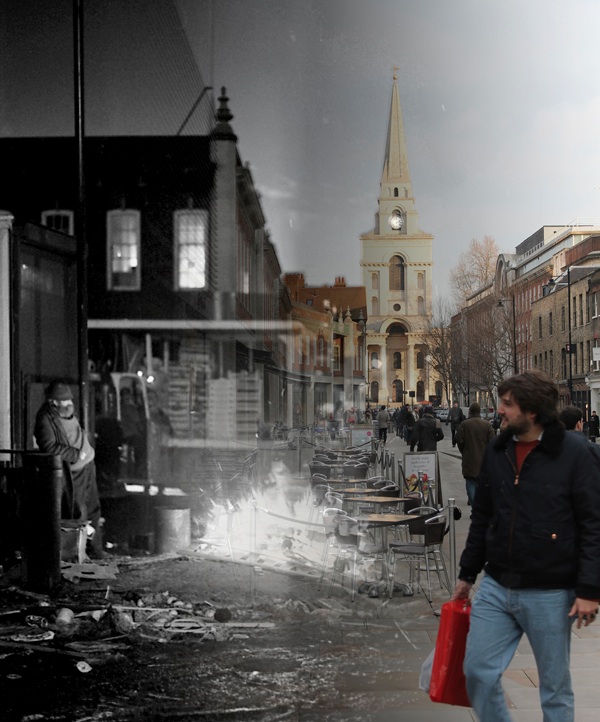
Brushfield St, looking east.

In Brushfield St.

In Gun St.

Brushfield St, looking south-east.

Looking out from Gun St across Brushfield St.

In Brushfield St.

Market interior.

Northern corner of the market.
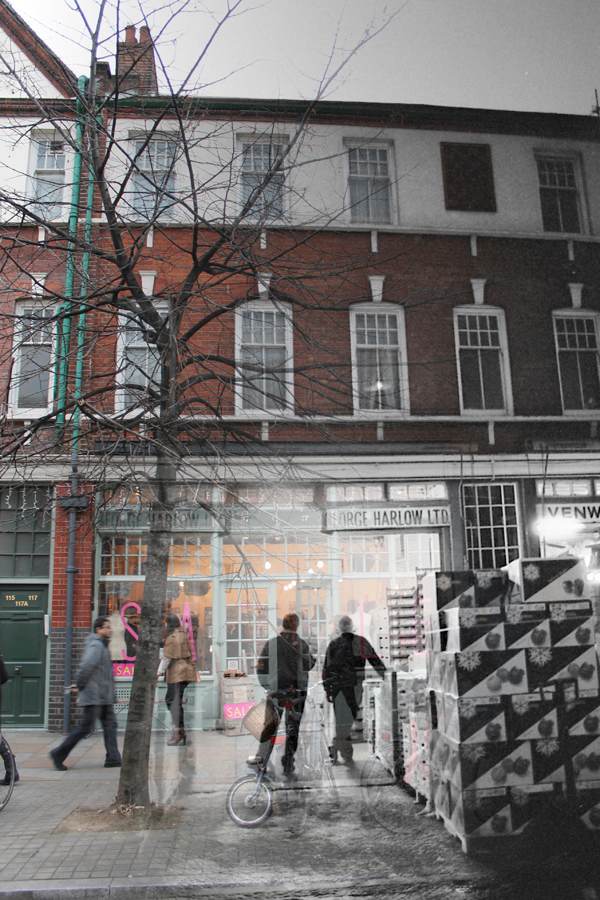
In Lamb St.

Lamb St looking towards The Golden Heart.
Photographs copyright © Mark Jackson & Huw Davies & Adam Tuck
Mark Jackson & Huw Davies photographs courtesy Bishopsgate Institute
You may like to look at more of Adam Tuck’s work
A Walk Through Time in Spitalfields
and Mark Jackson & Huw Davies pictures of the Spitalfields Market
Spitalfields Market Portraits, 1991
Night at the Spitalfields Market, 1991
Mark Jackson & Huw Davies’ Photographs of the Spitalfields Market
Albert Turpin, Artist
As the first exhibition of the East London Group in eighty years opens next week, David Buckman author of From Bow To Biennale: Artists of the East London Group recalls the forgotten name of Albert Turpin, Artist, Window Cleaner & Mayor of Bethnal Green. Turpin was a significant creative talent and an integral part of the lost history of one of the major artistic movements to come out of the East End in the last century.
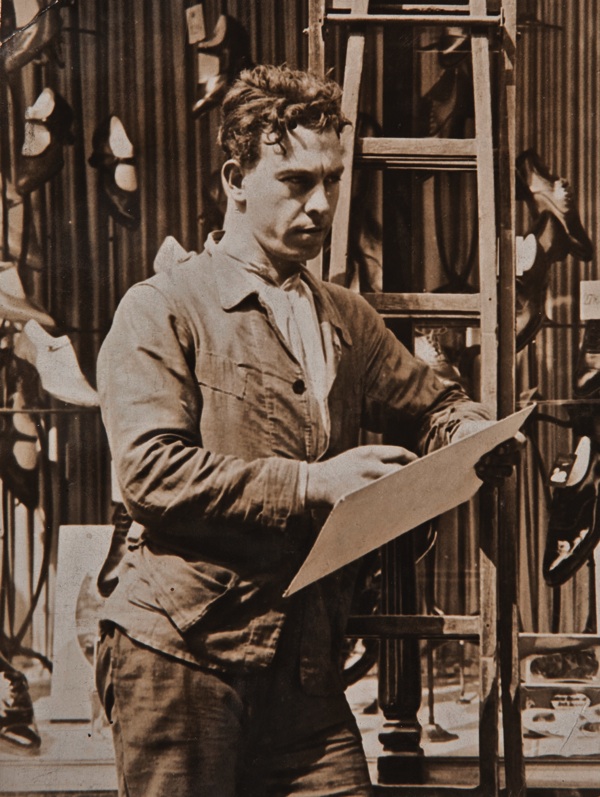
Albert Turpin, Artist, Window Cleaner & Mayor of Bethnal Green
It is thanks to chance that the work of artist Albert Turpin has been preserved. Based in Claredale House, Claredale St, Bethnal Green, Turpin pursued his mission to record the area where he had been born and lived until his death in 1964. His work always sold well but, by the time his widow Sally died in 1981, Turpin’s realism had become unfashionable.
With their only daughter Joan living abroad, Sally worried about what to do with the legacy of paintings remaining after Turpin’s death. They might easily have ended in a skip but, luckily, storage was secured and they survived. Now, several fine examples are to be displayed in the first exhibition of East London Group paintings since 1936, opening at Abbott & Holder in Museum St, Bloomsbury, on Thursday March 21st.
Chance also played an important part in steering Turpin towards the East London Group and John Cooper, the man who inspired it. Turpin’s background was not an auspicious one for an aspiring artist, born in 1900 in Ravenscroft Buildings off Columbia Rd, Bethnal Green, an area of acute deprivation. His father earned what little he could at jobs including being a tea-cooper, feather sorter and casual docker. When Albert Turpin left Globe Rd School at fourteen, like his father, he tried a bit of everything to earn a crust. But at fifteen, he joined the army until – at his father’s insistence – when the first World War was killing thousands, he was extracted and enlisted in the Royal Marines.
On ship, he began “to dabble away, trying to get Gibraltar and other overseas scenes down on canvas.” He was sufficiently encouraged by shipmates that, after he married Sally Fellows in 1922 and took up window cleaning, he finished the windows by lunchtime so he could spend the rest of the day painting. Interviewed after the Second World War when he was an established exhibitor at the Whitechapel Art Gallery’s East End Academy shows, Turpin revealed his motives as “a love of nature and a desire to copy it,” and the wish to show others “the beauty in the East End and to record the old streets before they go.”
Turpin was aware that tuition could improve his technique and he spent six years taking evening classes at Bethnal Green Working Men’s Institute and at the Bow & Bromley Commercial Institute, showing paintings in exhibitions held by the Institute at the Bethnal Green Museum. Among Albert’s teachers in Bethnal Green was the inspirational John Cooper, whose classes at Bow led to the important East London Art Club show at the Whitechapel Art Gallery in December 1928, in which Albert exhibited ten canvasses. They included characteristic and popular Turpin subjects, such as ‘The Dustbin,’ ‘At the Ale House,’ ‘Street Scene,’ ‘The Fruit Stall’ and ‘Jellied Eels’, but a portrait of ‘The Artist’s Wife’ was not for sale.
The Whitechapel show was so successful that Charles Aitken, Director of the National Gallery, Millbank, (now Tate Britain), transferred some of the pictures to his own gallery, including several of Turpin’s. Then, in the spring of 1929, a modified version of the Tate show toured to Salford, featuring Turpin’s ‘The Artist’s Wife’ and ‘The Dustbin,’ which had been bought by the influential dealer Sir Joseph Duveen.
While studying in Bethnal Green, Turpin met other future East London Group exhibitors who continued their tuition with John Cooper at Bow – men such as George Board, Archibald Hattemore, Elwin Hawthorne and the Steggles brothers, Harold and Walter. Hawthorne’s wife Lilian recalled Albert fondly as“a jolly chap” and Walter Steggles, who sketched with him, remembered his great sense of humour, describing Turpin as a man who “made jokes about everything including himself. He was liked by all who knew him.”
When Alex Reid & Lefevre launched the first of its eight annual exhibitions of work by the East London Group in November 1929, Turpin showed three pictures and in following years he contributed regularly to other East London Group exhibitions, as well as these annual shows at the Lefevre Galleries. But latterly his submissions became sporadic and his work was not present in the sixth exhibition in December 1934 or the last in December 1936. Group member Cecil Osborne told me that John Cooper had declined one of Turpin’s later pictures, a painting of his wife, and that the artist “went off in a huff and that was the last we saw of him.” Yet by the mid-thirties, Turpin had other demands upon his time.
In his fascinating unpublished autobiography, Turpin recalls how, once, on the way to an art group, he had been impressed to hear a speech by Bill Gee, a working class activist. It was during the winter of 1926, in the year of the General Strike, and Turpin wrote that Gee “did not teach me anything I did not already know, but what he did do was to make me forget all about my art class and join up with the organised workers right there.” Turpin joined the Labour Party, becoming affiliated to the North-East Bethnal Green Branch and eventually also to the Co-operative Party.
The East London Group had no political affiliations itself, but for Albert Turpin his political standpoint and his art merged naturally. His cartoons in local newspapers always “had a message,” Walter Steggles recalled. Speaking of Turpin’s painting ‘The Dustbin,’ originally displayed at the Whitechapel Art Gallery, Steggles recalled Turpin’s original title was ‘Man Must Eat,’ and the canvas depicted a man eating food scavenged from a bin – until Turpin modified the picture to avoid offending the public. Yet Turpin’s forthright titles did not deter the critics. Writing about the picture he submitted to the second Lefevre exhibition in December 1930, that model of refinement, The Lady, compared Turpin’s subjects to those of Daumier and Hogarth, praising his “rare and precious gift! – a sense of the physical beauty of oil paint.” Later Lefevre contributions would include titles that speak for themselves, such as ‘Unemployed,’ ‘Night Shelter,’ ‘Rags’ and ‘Slum Clearance.’
It was a tribute to Turpin’s physical stamina and determination that while earning his living as a window cleaner, he managed to pursue his political career and his art. He was an active anti-Fascist protester and, while a member of the Bethnal Green Borough Council, appeared at Old St Police Court accused of using insulting words and behaviour and assaulting a constable. He was also active in the Ex-Servicemen’s National Movement “for Peace, Freedom and Democracy” and supported the Republicans in the Spanish Civil War.
The Second World War offered further outlets for Turpin’s artistic talents. Having served part-time with the London Fire Brigade from early 1938, then full-time in September 1939 when he acted as secretary of a branch of the Fire Brigades Union, Turpin joined the National Fire Service in August 1941, remaining with it until October 1946. From 1940, he was an official Fire Brigade War Artist with his work exhibited both in Britain and North America. While an instructor at a London Fields Fire Service training school, after telling students the right way of doing a thing, he would sometimes “make a lightning sketch to show what might happen if they ignored my advice.”
After leaving the Fire Service, Turpin resumed window cleaning and part-time painting and was unanimously elected Mayor of Bethnal Green, 1946-47. He refused to wear mayoral robes, the Evening News reported, “because he thinks it is a waste of taxpayers’ money.” As a man with a strong moral standpoint, loathing gambling and – his mother having died of cirrhosis of the liver – refusing to clean pub windows, Turpin found Dr Frank Buchman’s Moral Re-Armament (MRA) movement attractive when he encountered it in 1946. Buchman hoped for “moral and spiritual rearmament” to achieve “a hate-free, fear-free, greed-free world.” After seeing the MRA play ‘The Forgotten Factor,’ Turpin was gripped by their message and became active in the cause. Early in 1947, MRA’s publication ‘New World News’ pictured Turpin on its cover as “Victory Mayor,” standing among blitzed ruins.
Until his death, seventeen years later, he continued to make drawings and paintings of Bethnal Green, Stepney, Hackney, Hoxton and Islington. Although the East London Group was no longer active post-war, Turpin still showed his pictures – at Morpeth School in Bethnal Green, Whitechapel Art Gallery, Guildhall Art Gallery and Qantas Gallery in Piccadilly.
Albert Turpin’s paintings are a unique record of the old East End by one who knew it intimately.

Castle St. Oil on board.

Marian Sq, Hackney. Oil on canvas, 1952.
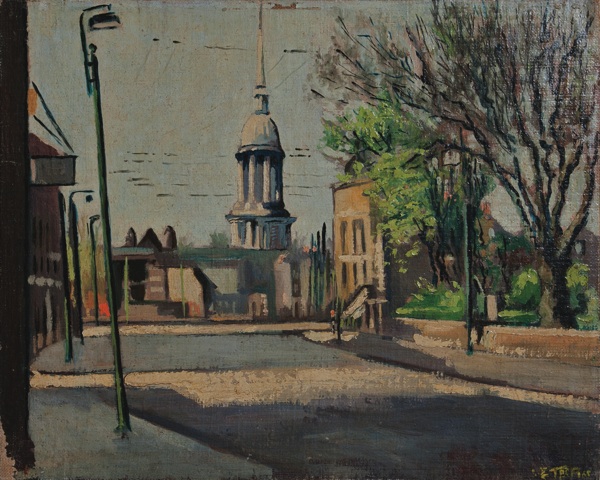
St Leonards’s Shoreditch from Hackney Rd. Oil on board, c.1955.

Rebuilding St Matthew’s Church, Bethnal Green. Oil on canvas, c.1956.

Verger’s House, Shoreditch. Oil on canvas, 1954.

Salmon & Ball, Bethnal Green. Oil on canvas, c.1955.

Shakey’s Yard in Winter. Oil on Canvas, c.1952.

On Guard. Oil on canvas, c.1943.
You may also like to read David Buckman’s other features about the East London Group
From Bow to Biennale: Artists of the East London Group by David Buckman can be ordered direct from the publisher Francis Boutle and copies are on sale in bookshops including Brick Lane Bookshop, Broadway Books, Newham Bookshop, Stoke Newington Bookshop and London Review Bookshop.
The exhibition From Bow to Biennale – Artists of the East London Group opens at Abbott & Holder, Museum St, Bloomsbury,WC1, on Thursday 21st March and runs until Saturday 6th April.
Barbara Jezewska, Teacher

Barbara as a pupil of the Central Foundation Grammar School for Girls, Spitalfields
Barbara Jezewska was not born in the East End nor was she of East End parentage, yet she lived her formative years here and it left an indelible impression upon her.“I love the people, the places and the experiences that I have known, and look for every opportunity to go back and visit,” she confessed to me, “I consider myself so rich for having grown up in a time and a place that was quite extraordinary.”
Barbara grew up in Casson St, a modest back street connecting Old Montague St and Chicksand St in Spitalfields. Opposite was Black Lion Yard, known then as the Hatton Garden of the East End because it contained eighteen jewellery shops. Old Montague St had a sleazy reputation in those days – it was a busy thoroughfare crowded with diverse life, filled with slum dwelllings, punctuated by a bomb site and a sugar factory, and lined with small shops and cafes. There, long-established Jewish traders sat alongside dodgy coffees bars in which Maltese, Somalis, Caribbeans and others congregated to do illicit business.
While others might consider themselves disadvantaged to grow up in such an environment, Barbara’s experience was quite the opposite and she recognised a keen sense of loss from the moment her family were rehoused in 1965 as part of the slum clearance programme. Very little of Casson St survives today and the spot where Barbara’s house stood is now a park, yet it is a location that still carries immense significance for her.
“We moved to 1 Casson St in 1957 when I was three years old. We came to London from Paxton, Berwickshire on the border with Scotland where my mother, Elizabeth Carr, had been born. My father was Polish, born in Lublin, and when he was fifteen, he ran away from home and ended up fighting in the Warsaw Uprising in 1944. He never talked about it but he had a graze on his arm that he said was from a bullet wound. I believe he met my mother while he was washing dishes at a West End hotel where she also worked. When I was eighteen he left and married again, and I only saw him a few times before he died. We became estranged and, in 1994, we got a phone call to say he had died in Poland.
My father couldn’t speak English when he arrived in this country, but he was very talented in music and he paid for guitar lessons out of his earnings. As a child, I remember him practising and practising and I didn’t appreciate what was going on, yet eventually he ended up teaching at Trinity College, Cambridge.
We shared the house in Casson St with a Greek family, the Hambis. It wasn’t partitioned, they had some rooms and we had the others. There was no bathroom, no heating and no hot running water. We did have an inside toilet but the Hambis had one in the back yard. They had five children and there were the three of us, so there was always somebody to play with and always something going on.
Across the street from us was the Beehive Nougat Factory (‘nugget’ as we used to say it). We rang the bell and asked for an old man we called ‘Uncle Alf’ who worked there, and he gave us sweets, handfuls of broken chocolates and nougat. We used to raid the bins of the textile factories and get cardboard tubes, then we’d stage incredible battles, lining up on either side of the street and hitting each other with the tubes until they broke. There was Mrs Miller who sold toys on Petticoat Lane, when she and my mother met they would talk for hours. One day, a dandelion seed – which we called fairies – floated by and went into Mrs Miller’s mouth while they were talking. She swallowed it and never noticed, so we always remembered ‘the day Mrs Miller swallowed a fairy!’ There was Mrs Isaacs, a widow who lived next door who spent all her time at the upstairs window, watching. If you did anything she didn’t approve of, she’d shout at you. One day, I was going to chalk on the wall and she shouted out, ‘Don’t you make a mess!’ I stuck my tongue out at Mrs Isaacs and she disappeared from the window, so I ran back inside and said to my mother, ‘Mrs Isaacs is coming,’ and she came round and said, ‘Your daughter stuck her tongue out at me!’
We used to play on the bomb sites and I climbed into a basement of a bombed-out house in Old Montague St. I was scared because there was a lot of rubble on top but I found some silver threepenny bits in a bag. We took them to the sweet shop and passed them off as sixpences. I think the shopkeeper realised they were silver and was happy to accept them for sweets. Round the corner in Hopetown St, lived Alfie and his parents who were the first get a television. So, at 4pm, we’d all queue up outside Alfie’s house – half a dozen of us – and ask to watch the Children’s Hour, and we’d sit on the kitchen floor to watch. The only time we went to the seaside was on a Sunday school trip, and they gave us Christmas parties at which we’d all get a present of a second-hand toy.
There were several tramps that I remember. Coco worked for the stallholders and slept in an empty building on the corner of Black Lion Yard, every morning he came out with his bucket of slops and threw it over onto the bomb site. Ivan used to wander up and down Old Montague St, and I think I saw two men trying to kill him once, dropping bricks from the roof as he walked past. Stinky Sheridan had one leg and used to sell matches in Whitechapel Rd. Whenever we saw the tramps, my mother who was a very kind person, taught me to respect them, she’d say, ‘Remember, that’s somebody’s son.’
In 1965, we were moved out as part of slum clearance to Brownlow Rd, off Queensbridge Rd in Haggerston. At the time, I was eleven and we thought it was very exciting. It was a maisonette with a bathroom, so we thought it was wonderful, but my experience when we moved was I felt lonely and missed the other children in our extended family. It felt strange. But being realistic, it would have been pretty awful staying in Casson St without any privacy or a bathroom.
I went to Robert Montefiore Primary School in Hanbury St and, when I left, I remember saying to my mother, tell the headmaster I want to go to the Central Foundation Grammar School in Spital Sq. I’d heard it was the good place to go. We were allowed out to wander around the Spitalfields Market at lunchtime. Every month the girls used to support a different charity there. We’d go down to the market and beg boxes of fruit and sell it at breaktimes and the money would go to charity. The art room overlooked the market and I did a painting of it that won a prize. I joined the choir so I could sing at St Botolph’s in Bishopsgate and get invited back for sandwiches and ice cream by the Worshipful Company of Fan Makers. I thought I was very clever because I went to a Grammar School.
My first job was at Fox’s the Chemist in Broadway Market, from four until six every day after school and all day Saturday for £2.50. At eighteen, I left school and worked for two years in the City at the National Westminster Bank in Threadneedle St. It was easy to get work, you could go to an agency and get a job, and if you didn’t like it you could go back in the afternoon and get a different one.
Then I did teacher training in Tooting. I couldn’t do it at eighteen because my father wouldn’t sign the grant form as he was about to remarry and didn’t want to commit himself, but when the divorce came through my mother signed. I asked to do my teaching practise in the East End and I was placed at Virginia Rd Primary School. I qualified as teacher in 1978, and I worked at Randal Cremer school in Hackney, I was part-time at Redlands School off Sidney St and deputy head at St Luke’s in Old St. I had wanted to be a teacher since the age of five, I think I just wanted a register and a red pen.
At forty-five, I had a son and we moved to Walthamstow and then to Hetfordshire, but I want to be back here – and one day I’ll be back. You can’t explain it to some people, because so many worked so hard to get out. My son Adem, he’s fourteen and I bring him to see the street art. I think he’s interested in the East End.”

Barbara keeps the button box from her childhood in Casson St. On the table are swatches from her mother’s dresses bought in Petticoat Lane and a necklace she made out of melon pips at age nine in 1963.

Barbara’s school report from the Central Foundation Grammar School in Spital Sq, July 1968.
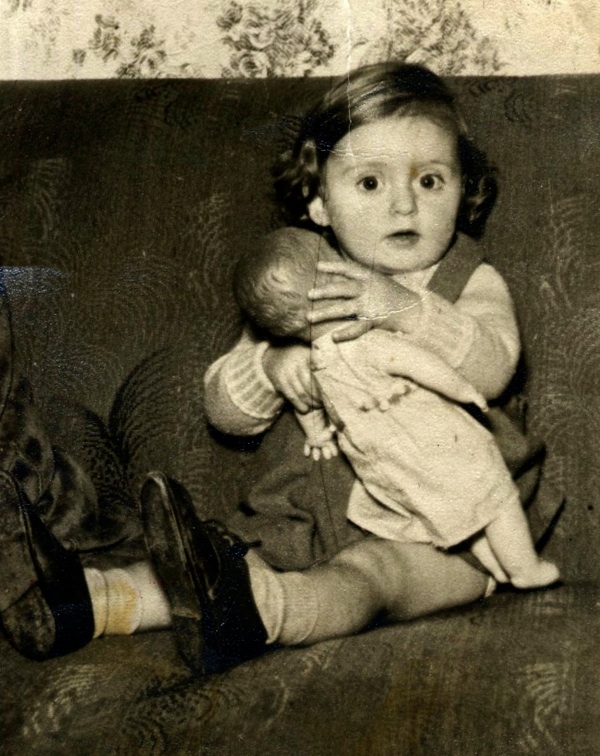
Barbara, aged three.

The ‘goal’ where Barbara and her friends played football, photographed in the eighties.

Barbara, aged five.

The furniture factory opposite Barbara’s home in Casson St, photographed in the eighties.
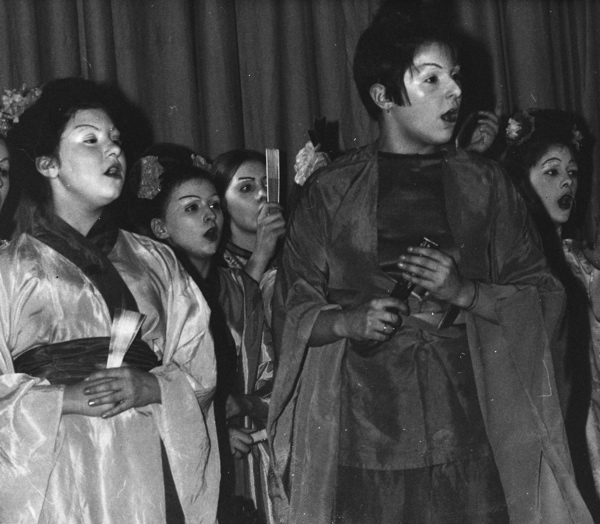
Barbara (second from the left) in the Central Foundation School production of The Mikado.

Casson St under demolition.

Jerzy Jezewska, Barbara’s father was a celebrated guitarist who taught at Cambridge.
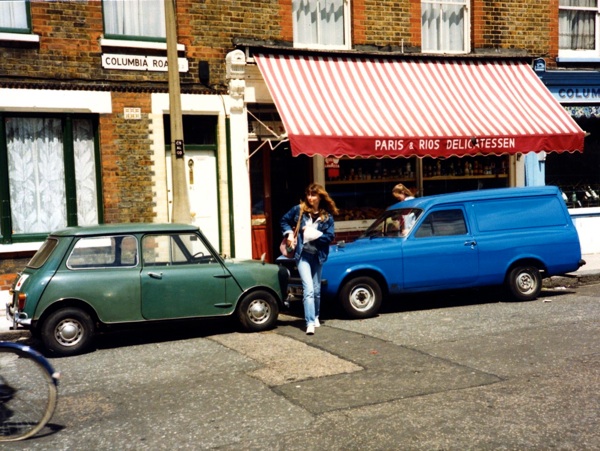
Barbara visits Columbia Rd in the eighties.
You may also like to read about
Tony Bock on the Railway

A mischievous trainspotter changes the departure time at Liverpool St Station
“I have always liked railway stations, a focal point of the community – the start and finish of a journey,” Photographer Tony Bock admitted to me, introducing these elegant pictures which are published here for the first time today. “Often the journey was a daily chore, but sometimes it was an occasion,” he added, in appreciation of the innate drama of rail travel.
Tony’s railway photographs date from the years between 1973 and 1978, when he was living in the East End and worked on the East London Advertiser, before he left to take took a job on the Toronto Star, pursuing a career as a photojournalist there through four decades.
“Although plenty has been written about the architecture of railways and the industrial ‘cathedrals’ – from the perspective of the twenty-first century, it is easy to forget the great change the railway brought when it first arrived in the mid-nineteeth century. Liverpool St Station was opened in 1874 and survived largely unchanged into the nineteen seventies.
So, in 1977, when proposals to redevelop the station were suggested, I decided to spend some time there, documenting the life of the station with its astonishing brick and iron architecture. I loved the cleaners, taking a break, and the young lad taking it upon himself to reschedule the next train – ‘Not This Train’! Meanwhile, the evening commuters heading home looked as if they were being drawn by a mysterious force.
Next door to Liverpool St was Broad St Station, only used for commuter trains from North London then and already it was looking very neglected. Only a few years later, it closed when Liverpool St was redeveloped.
Over in Stratford, the rail sheds dated back to the days when the Great Eastern Railway serviced locomotives there. Surprisingly, British Rail were still using some of the sheds in 1977, maintaining locomotives amongst the rubble that eventually became the site of the Olympic Park.
Finally, from the very earliest days of railways, I found three posters on the wall in the London Dock, Wapping. The one in the centre is from the Great Northern Railway, dated 1849, the other two from the North Union Railway Company, dated 1836, and it is still possible to read that one hundred and twelve pounds or ten cubic feet would be carried for three shillings according to the Rates, Tolls and Duties. The North Union operated in Lancashire and only lasted until 1846. How did these posters survive, they were likely one hundred and thirty years old. I wonder if anyone was able to salvage them?
I suppose there is an irony that I am writing this today in my home which is a village railway station built by the Canadian Pacific Railway in 1904. The building now sits in woods, since the local branchline is long gone. Yet any station – grand or modest – will always carry a significance for the community they are part of.”


Farewells at LIverpool St


Ticket collecting at Liverpool St

Cleaners, taking a break, at Liverpool St.


Commuters at Broad St Station.

Waiting for a train at Victoria Station

Wartime sign in the cellar of Broad St Station, demolished in 1986.
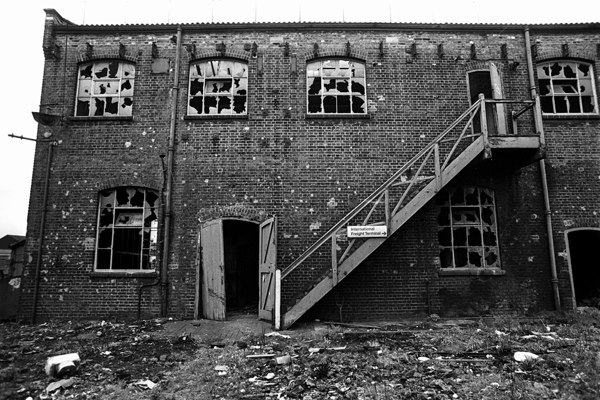
Stratford Railway works, now engulfed beneath the Olympic site

Repair sheds at Stratford

Engine sheds at Stratford

Railway posters dating from 1836 in London Dock, Wapping
Photographs copyright © Tony Bock
You may like to see these other photographs by Tony Bock
More Spires of City Churches

St Lawrence Jewry, Gresham St
In January, I waited so long for a clear day to take pictures of spires in the City of London that when we were blessed with another one last week, I could not resist going back to take more photographs. Such has been my preoccupation that, in future, I shall always be inclined now to think of clear days in early spring as “ideal weather to photograph church spires in the City.”
Yet there were other obstacles beyond the meteorological that I had to contend with in my quest for spires, not just delivery vans parked in the wrong places and people standing in front of churches making long mobile phone calls, but the over-zealous guard who challenged my motives as I stood with my camera upon the public footpath, suspiciously implying I might have sinister intent in photographing church spires – which could have grave implications for national security. “You realise this is the City of London,” he informed me in explanation of his impertinence, as if I could be unaware.
Fortunately, it is in the nature of photographing church spires that I had no choice but to lift up my eyes above these trifles of life and I was rewarded for my tenacity in the pursuit with all the wonders that you see here. In Rome or any other European capital, such a close gathering of architectural masterpieces would be venerated among the finest treasures of the city. In London, our overfamiliarity with these epic churches means they have become invisible and hardly anyone looks at them. Commonly, the ancient spires are overshadowed by the modern buildings which surround them today, yet I found – in many cases – that the act of focusing attention upon these under-appreciated edifices revealed them newly to my eyes.

St Mary Le Bow, Cheapside
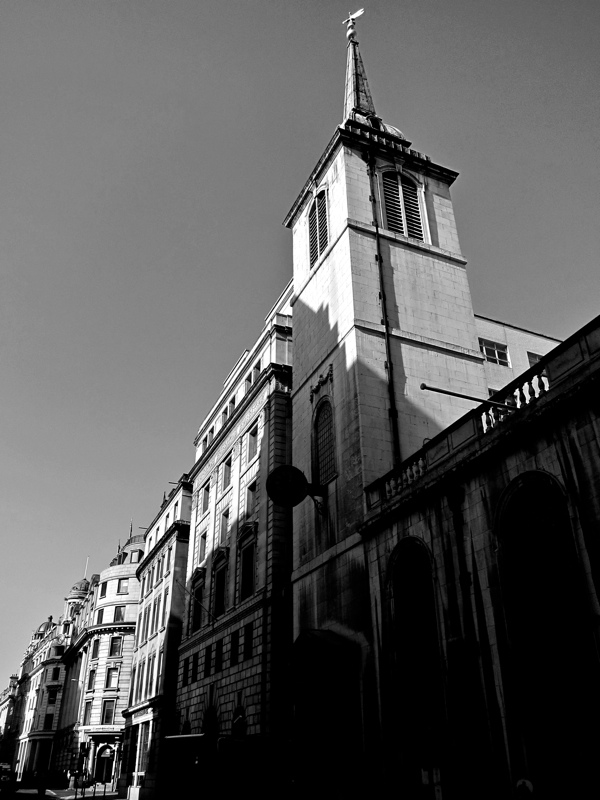
St Margaret’s, Lothbury

St Vedast, Foster Lane

Christchurch Greyfriars, Newgate St

Christchurch Greyfriars, Newgate St

St Mary Le Bow, Cheapside

St Mary Le Bow, Cheapside

St Stephen, Walbrook

Whittington’s Almshouses, College Hill

St James, Garlickhythe

St Michael Paternoster Royal, College Hill

1 & 2 Lawrence Pountney Hill – Built in 1703, these are the finest surviving merchants’ houses in the City.
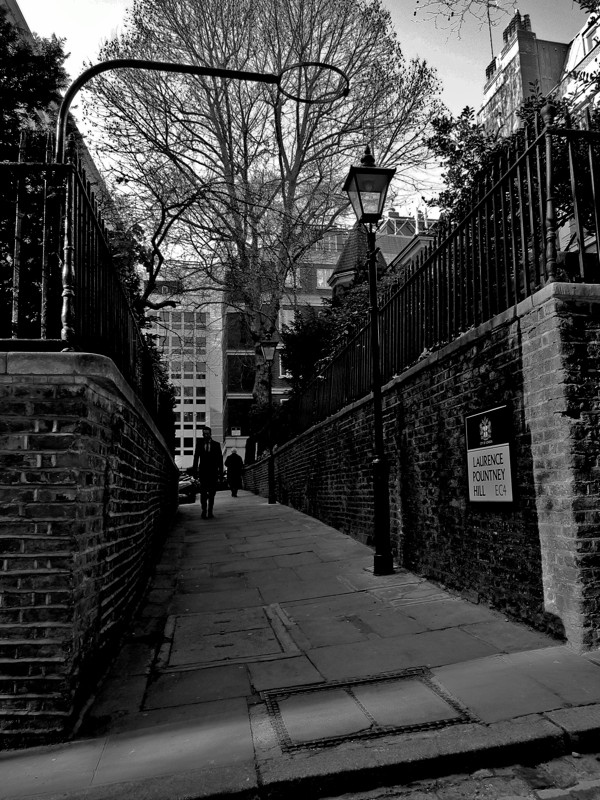
Churchyard of St Laurence Pountney

St Magnus the Martyr, Lower Thames St

St Dunstan in the East, Idol Lane

All Hallows Staining, Mark Lane

St Botolph’s, Aldgate
You may also like to take a look at
Last Night at St John Bakery

Heroic Baker & Pastry Chef Justin Piers Gellatly places his last loaf of bread into the oven
Three years ago, I spent a night in the bakery at St John, recounting the nocturnal activities of Justin Piers Gellatly and his fellow bakers, making the delicious bread which became so integral to the success of St John that they named their Spitalfields restaurant St John Bread & Wine. In those days, Justin used to take over the kitchen in Commercial St at night to do his baking, but as demand for his bread grew he moved to his own bakery under a railway arch in Druid St, south of the river, where production quadrupled as the bakers worked in shifts twenty-two hours a day, seven days a week.
At the same time, the word spread of Justin’s heroic prowess in the creation of eccles cakes, mince pies, hot cross buns and especially doughnuts, turning the railway arch into a popular destination on Saturday mornings as hundreds of hungry south Londoners converged at the bakery, intent upon carrying off trophies while they were still warm from the oven.
Yet, just as all good things must come to an end, Justin left the bakery last week. So I returned to share his last night among the ovens, recording the moment for posterity and celebrating his catalogue of achievement in baking over the last thirteen years at St John. You might think that such success would compromise Justin in some way, but what I discovered was that during the small hours he checked every single one of the thousand loaves he baked that night to ensure they met his approval and then he did all his own cleaning up too, carrying sacks of flour around and making up all the orders as well.
“It’s quite emotional tonight,” he admitted to me with a crooked smile when I arrived around ten to the seeming chaos of the steamy bakery, where Justin stood surrounded by hundreds of loaves proving. Further into the recesses of the arch, beneath the golden barrelled vault, Luka Mokliak was producing the vast quantities of dough required and at the far end Mariusz Korczak was making the cakes. The warm humid air was fragrant with the commingled aromas of sour dough, hot cross buns and doughnuts. “It doesn’t feel like it’s ending, it seems like I’ll be back tomorrow,” Justin declared over his shoulder, as he tossed flour onto a table of loaves and set to work furiously, scoring them and delivering them into the oven just as he removed others that were baked.
“Time goes so quickly here,” he admitted, running back and forth between the preparation of loaves to go into the oven and checking the progress of those already in each of the six ovens, “You blink and it’s time to go home – the night disappears.” I perched on a table, amazed at Justin’s stamina. “The longest shift I did was three days,” he confessed as he ran past, “I lived at St John, I slept on the flour sacks. I baked at night, slept for a few hours, did pastry during the day and baked again at night.”
Casting my eyes around the bakery at all the activity, I asked Justin how much of the output was his creation. “Everything,” he said, “the sweet side of it.”
“When I first started, there was not much baking going on at St John – only the eccles cake and I perfected that.” he recalled, “I was let loose, to be honest. My mother left me these cookbooks, handwritten by her, and full of things she had learnt from her mother and others. Many of the things I created for St John, such as the mince pies and Christmas puddings, were her recipes.”
It made complete sense, since the wonder of Justin’s baking is that it is like superlative home baking without any of the compromises of commercial production. Watching Justin manage the process of baking a thousand loaves to perfection, I realised what a complex task it was to pull it off at this volume. Over the years, he perfected juggling all the variables, so that the loaves went not just into the oven but into his mind too and he held them there, paying attention to every mutable aspect, the seasonal qualities of the flour, even the effects of changing air pressure and moisture in the atmosphere. It was a virtuoso act of mental and physical dexterity all at once.
“I never set out to be a baker but I worked in a kitchen where there were bakers, so I came in on my day off to learn and I got hooked.” he told me, preparing the last batch of loaves to go into the oven, “One of the first things to get me was the sound the bread makes when it cools after it has come out of the oven – it’s the bread singing!”
The hours had flown away and a stack of a thousand loaves had grown between the ovens and the door. It was an epic night’s work for one man, a daily miracle of Biblical proportions. Justin worked placidly as he had done through all the years until the moment came to take out the last loaves and shut down the ovens. He lifted out the shovel of rye sourdough and tipped it down, so that the loaves fell into the basket with finality. “That’s the end of the show!” he said quietly, almost to himself and in disbelief at his own words. Yet you may be assured Justin leaves a team of bakers that he trained who will continue his work faithfully.
I learnt the catalyst for Justin’s departure is his wish to spend more time caring for his sister, who is unwell, but one day he means to come back to baking. “I’ve had some generous offers, but I want to do my own thing.” he confessed, “I want to do more doughnuts but always with bread , that’s my passion.”

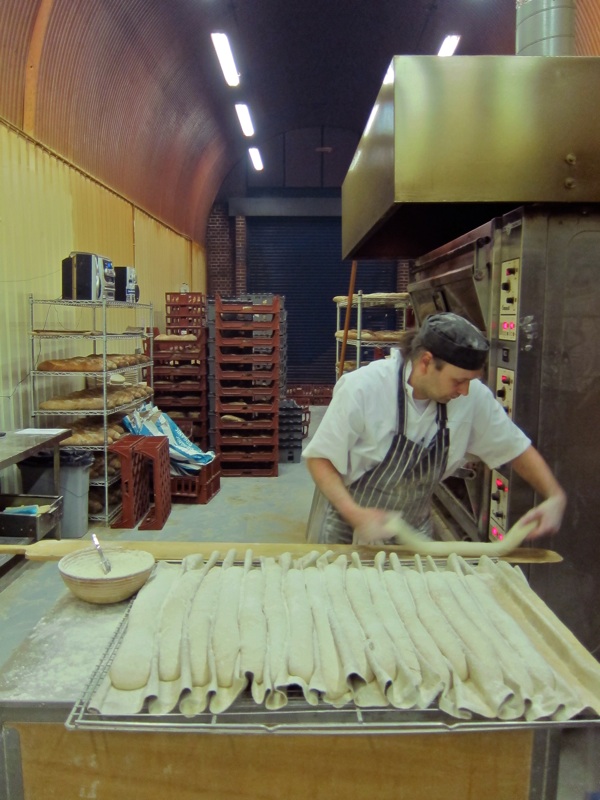
Justin places baguettes upon the ‘peal’ ready to go in the oven.

Scoring the loaves with a razor blade


Luka Mokliak makes the dough
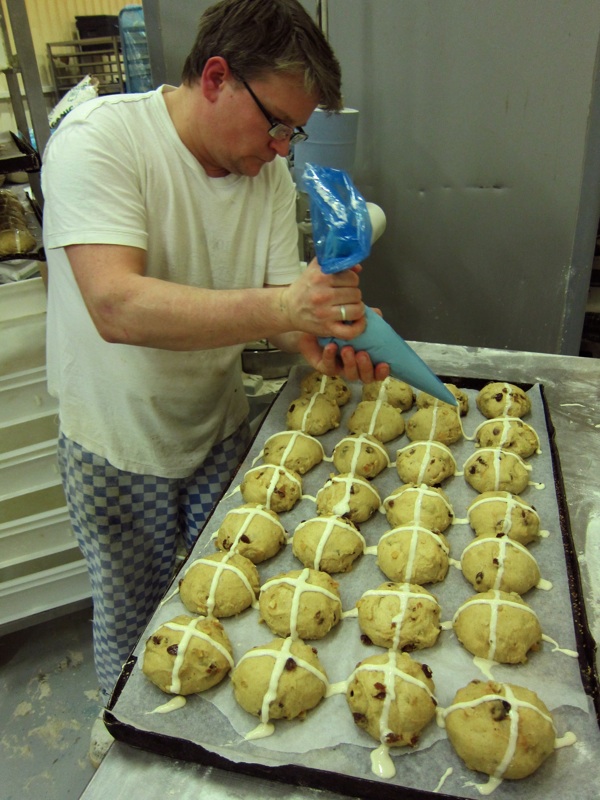
Mariusz Korczak crosses the buns.

A moment of preoccupied calculation.
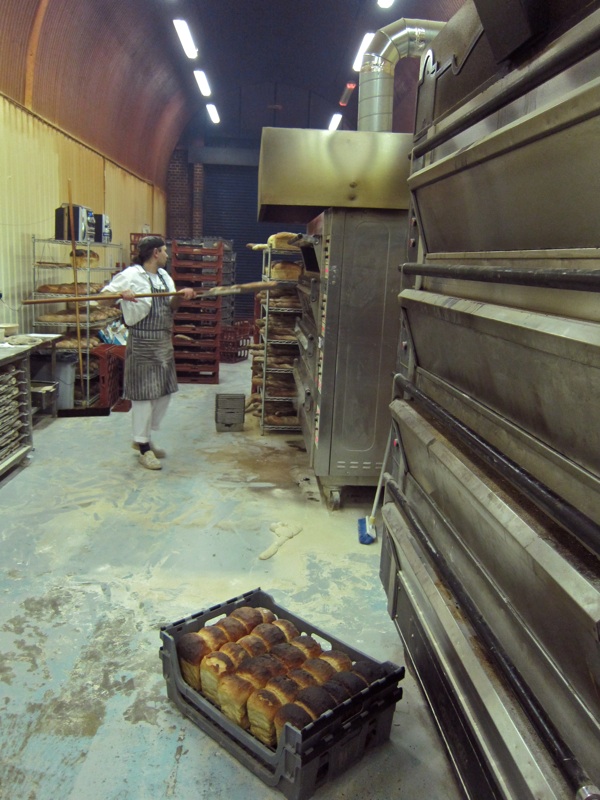


Luka & Justin make soda bread.

Mariusz waits for the doughnuts to fry.


Justin prepares to put his last loaves in the oven.

“That’s the end of the show!” – Justin’s last loaves come out of the oven.
You may like to read my other bakery stories
Night in the Bakery at St John
Justin Piers Gellatly, Head Baker & Pastry Chef
The Bread, Cake & Biscuit Walk
and look back over my eulogies of Justin’s creations
The First Mince Pies of the Season












