
The Pubs Of Old London

The Vine Tavern, Mile End
I cannot deny I enjoy a drink, especially if there is an old pub with its door wide open to the street inviting custom, like this one in Mile End. In such circumstances, it would be affront to civility if one were not to walk in and order a round. Naturally, my undying loyalty is to The Golden Heart in Commercial St, as the hub of our existence here in Spitalfields and the centre of the known universe. But I have been known to wander over to The Carpenters’ Arms in Cheshire St, The George Tavern in Commercial Rd and The Marksman in Hackney Rd when the fancy takes me.
So you can imagine my excitement – especially now the pubs have re-opened – to discover all these thirst-inspiring images of the pubs of old London among the thousands of glass slides left over from the days of the magic lantern shows given by the London & Middlesex Archaeological Society at the Bishopsgate Institute a century ago. It did set me puzzling over the precise nature of these magic lantern lectures. How is it that among the worthy images of historic landmarks, of celebrated ruins, of interesting holes in the ground, of significant trenches and important church monuments in the City of London, there are so many pictures of public houses? I can only wonder how it came about that the members of the London & Middlesex Archaeological Society photographed such a lot of pubs, and why they should choose to include these images in their edifying public discourse.
Speaking for myself, I could not resist lingering over these loving portraits of the pubs of old London and I found myself intoxicated without even lifting a glass. Join me in the cosy barroom of The Vine Tavern that once stood in the middle of the Mile End Rd. You will recognise me because I shall be the one sitting in front of the empty bottle. Bring your children, bring your dog and enjoy a smoke with your drink, all are permitted in the pubs of old London – but no-one gets to go home until we have visited every one.

The Saracen’s Head, Aldgate

The Grapes, Limehouse

George & Vulture, City of London

The Green Dragon, Highgate

The Grenadier, Old Barrack Yard

The London Apprentice, Isleworth

Mitre Tavern, Hatton Garden

The Old Tabard, Borough High St

The Three Compasses, Hornsey

The White Hart, Lewisham

The famous buns hanging over the bar at The Widow’s Son, Bow

The World’s End, Chelsea, with the Salvation Army next door.

The Angel Inn, Highgate

The Archway Tavern, Highgate

The Bull, Highgate

The Castle, Battersea

The Old Cheshire Cheese, Fleet St

The Old Dick Whittington, Cloth Fair, Smithfield

Fox & Crowns, Highgate

The Fox, Shooter’s Hill

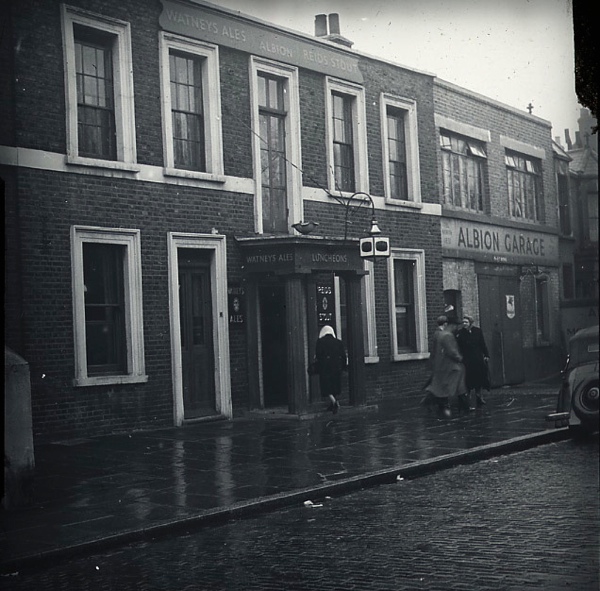
The Albion, Barnesbury

The Anchor, Bankside

The George, Borough High St
Images courtesy Bishopsgate Institute
You may also like to read about
Sandra Esqulant, The Golden Heart
David Hoffman Speaks
Photographer David Hoffman will be in conversation with Gaynor Tutani at the Museum of the Home on Wednesday 20th November at 6:30pm, discussing his new book and exhibition ENDURANCE & JOY IN THE EAST END.
This is the only event David is doing in person, so if you want to hear him speak please book now because it is likely to sell out quickly.

From squatting in Whitechapel’s’s Fieldgate Mansions, to becoming a celebrated protest photographer, David Hoffman shares his journey of documenting hidden histories of homelessness, racism, and the beauty and grittiness of the East End.
This in conversation with Museum of the Home’s Gaynor Tutani is centred around the Museum’s current exhibition, Endurance & Joy in the East End: The Photography of David Hoffman and the publication of his monograph by Spitalfields Life Books, Endurance & Joy in the East End 1971–1987.
The talk will explore Hoffman’s life’s work and his commitment to capturing the realities of inequality and injustice in Britain, revealing harsh truths with remarkable clarity. His work is recognised for its contemporary relevance amid the cost of living and housing crisis, racial tension, and social division such as those seen in the August 2024 riots in the UK.
Museum of the Home is committed to discussing ideas of home and belonging. The evening will celebrate David Hoffman, his art and photographs, whose allure and pain remain with us in the present day. Attendees will be inspired by his works and reminded of the importance of figures such as Hoffman, those whose life purpose has been to uncover and document the uncomfortable, while promoting the joy, hope and perseverance of humanity that refuses to be extinguished.

Cover price is £35 but you can buy it from Spitalfields Life for £30
CLICK HERE TO ORDER A SIGNED COPY OF ENDURANCE & JOY

.

On Night Patrol With PC Lew Tassell

Police Constable Lew Tassell of the City of London Police
“One week in December 1972, I was on night duty. Normally, I would be on beat patrol from Bishopsgate Police Station between 11pm-7am. But that week I was on the utility van which operated between 10pm-6am, so there would be cover during the changeover times for the three City of London Police divisions – Bishopsgate, Wood St and Snow Hill. One constable from each division would be on the van with a sergeant and a driver from the garage.
That night, I was dropped off on the Embankment during a break to allow me to take some photographs and I walked back to Wood St Police Station to rejoin the van crew. You can follow the route in my photographs.
The City of London at night was a peaceful place to walk, apart from the parts that operated twenty-four hours a day – the newspaper printshops in Fleet Street, Smithfield Meat Market, Billingsgate Fish Market and Spitalfields Fruit & Vegetable Market.
Micks Cafe in Fleet St never had an apostrophe on the sign or acute accent on the ‘e.’ It was a cramped greasy spoon that opened twenty-four hours a day, seven days a week. During the night and early morning it served print-workers, drunks returning from the West End and the occasional vagrant.
Generally, we police did not use it. We might have been unwelcome because we would have stood out like a sore thumb. But I did observation in there in plain clothes sometimes. Micks Cafe was a place where virtually anything could be sourced, especially at night when nowhere else was open.”
Lew Tassell

Middle Temple Lane

Pump Court, Temple

King’s Bench Walk, Temple

Bouverie St, News of the World and The Sun

Fleet St looking East towards Ludgate Circus

Ludgate Hill looking towards Fleet St under Blackfriars Railway Bridge, demolished in 1990

Old Bailey from Newgate St looking south

Looking north from Newgate St along Giltspur St, St Bartholomew’s Hospital

Newgate St looking towards junction of Cheapside and New Change – buildings now demolished

Cheapside looking east from the corner of Wood St towards St Mary Le Bow and the Bank

HMS Chrysanthemum, Embankment

Constable Lew Tassell, 1972
Photographs copyright © Lew Tassell
You may also like to take a look at
Mary Burd, Clinical Psychologist

‘You cannot overestimate sitting down quietly with someone and listening to what they have to say’
Mary Burd worked as Clinical Psychologist at the Jubilee St Practice in Stepney between 1979 and 2009, beginning as a mental health trainee and eventually becoming Head of Mental Health Services in Tower Hamlets. Over this time, she saw great changes both in the nature of the East End and in the health service itself. In thirty years of work, Mary grew deeply engaged with the lives of those that she served and, when I interviewed her recently, she spoke to me with deep affection for the people and the place.
“When I was twenty and first came to London in the sixties, a friend of mine said to me on a spare evening, ‘Why don’t you come to the East End? I work in a youth club there.’ That visit to Dame Colet House was my very first time working in Tower Hamlets, I helped out in the youth club and I can remember it was pretty tough. I had to guard the cash box from Les whose main interest was to raid it.
Ultimately, it was chance that brought me to work in the East End. In my early thirties, I decided that I needed to change career – I had been working in publishing – so I went and did a psychology degree at Brunel University and then studied Clinical Psychology at the University of East London. It was a three year course with placements and I was based at the Royal London Hospital in Whitechapel. In my final year I could chose, and I always wanted to work in General Practice, so I went to the Jubilee St Practice in 1977 which was operating in portacabins then.
I remember sitting around the table with the group of GPs. A rather elderly gentleman asked me, ‘What are you doing here?’ I said, ‘I’ve come because I would like to provide psychological help within practices, rather for everybody to have to go to the Outpatients Department.’ And he said, ‘I think you’d be better off working in John Lewis.’
In spite of this, I had an amazing time and I did a lot of work with Health Visitors, helping them with babies and toddlers who had behavioural problems. Often, they couldn’t sleep or didn’t eat properly. I used to accompany the Health Visitors and help them think about what was going on. I got a research grant to look at the application of psychology in Primary Care, but it was really just an excuse to stay on at the Jubilee St Practice. At the end of that, the Director of Nursing said, ‘We really like the work you have done with Health Visitors and we are creating a psychology post for someone to do that sort of work.’ So that was how I started off.
I had a job that I loved working in General Practice in the East End. In those days, there was very little mental health provision and I was lucky enough to go into a practice which was forward thinking. It comprised three doctor’s practices that had come together and, when one of those GPs died, his relationship with his patients was so strong they all joined his funeral cortege.
When I first came to the East End, there were only a few practices that had more than one doctor and a few helpers. There were a lot of elderly doctors operating out of converted shops. I remember going to a practice to talk about the service and the only examination couch was in the kitchen, and it was propped up on old medical journals. There was so much dust you could write your name in it and there were files scattered about the place without any proper confidentiality. It was completely archaic and that was in the early eighties, not so very long ago. Because healthcare was so prized by people in the East End, who had never been used to decent medical services, I think they put up with things that people in other areas of London might not have done.
Jubilee St Practice became my home in the East End. I was always ambitious and I used every attempt to get funding for my work, and I taught on the East London Vocational Training Scheme, training GPs. I found that GPs who came onto the East London Scheme tended to stay in Tower Hamlets, so I got to know them all. It meant that, when they came to practice, they were receptive to the things I was doing and it gave me easy access into the world of General Practice.
As the doctors practicing in High St shops retired, the Family Practitioner Council invested in new practices. The new GPs coming in were of a high calibre and they wanted to practice in decent surroundings to give the best possible care. They were keen on the idea of a multi-disciplinary team, so they worked with nurses and Heath Visitors. By the time, I left every practice in Tower Hamlets had onsite psychological support.
In the early days, I set up a referral service. So a GP could come to me and say, ‘I’ve Mrs X and she’s terribly depressed at the moment, do you think you could see her?’ I would not work with a practice unless they would give a minimum of an hour a month to discuss the patients. There was a tremendous sense of partnership. We worked so closely and it was a fantastic time.
I was very often asked to write housing letters but in all my time I only wrote two, because I knew there was absolutely no point. Instead, I can remember writing the the local authority saying, ‘What is the point of me providing a service to a young woman with four children living on the fourteenth floor of a tower block?’ By then, many families were moving out but there were still many extended families. I remember asking a young mother, ‘How often do you see your ma?’ and she said, ‘Oh not very often, only three times a week.’ I think living cheek by jowl brought pressures. The positive was stronger than the negative but, even so, some people were oppressed, not the young children but the mothers. Their own mothers used to go round and do the washing for them, and there was a real dependency.
I was in Jubilee St during the big influx of Sylheti people and we had a big problem in that General Practices did not refer people with mental health problems from that community. In the eighties, we were the very first to set up a Bangladeshi counselling service and we trained somebody who spoke the language to run it, and then we did the same for the Somali community. There is a difficulty because some people think that a service by their own community is not as good as one provided by white healthcare professionals. We used the insights of the Bangladeshi and Somali counsellors to help us to work with those populations.
Patients would sometimes talk to me about ‘those Paki bastards’ and I would always point out that this language was not acceptable. In my time, I saw a lot of people from the Bangladeshi community. I can remember one woman whose husband was a complete nightmare but culturally there was no way she could leave him. It was very hard to work with her because it was absolutely clear where her distress was coming from – it was from her relationship with her husband – but she could not alter that in any way. I could only offer her a place to talk about it and a place to consider other things that she might be able to do to improve her life, so that she understood she was not totally alone with her problem.
I did a lot of teaching of young doctors and medical students and I think – wherever in the world you are – you cannot overestimate sitting down quietly with someone and listening to what they have to say. Doctors who are always trained to do things find that very difficult to understand.
I joined the Jubilee St Practice in 1979 and I retired in 2009. I also worked in St Stephen’s Rd, Bow, in an all women practice which was unique in the East End at the time, when most doctors were older men. The working atmosphere at the practice was collegiate and they were very interested in the emotional life of their patients, which I think was unusual then. They looked after their staff very well.
I also worked in Wapping, where the GP had a bed with a pink quilt. I thought, ‘What’s this doing in the General Practice?’ In fact, it was where the GP slept when he was on call at night. He had his own bedroom at work. I observed the changing nature of the Wapping population. When the City people started to move in, they had much higher expectations and demanded to be seen when they needed to be seen.
There are a lot more children now with mental problems than when I started. There are multiple reasons. Not all children are in families where they get the nurturing that they need. Diet has a bit to do with it too. We could talk about air pollution. A lid used to be kept on by quite severe discipline. In general, children are much more disturbed now than twenty years ago. Families are much more disconnected with less extended families.
Over thirty years in the East End, I saw a major improvement in health services. District nursing and health visiting was of a very high quality in Tower Hamlets. The great thing about the East End was that it attracted people who are creative and want to improve health care. Every healthcare professional who has worked in Tower Hamlets and moved on still talks about working in the East End because there was a tremendous sense of collaboration and the patients were inspiring – because life was not easy for them.
I had a fantastic career, I was so lucky. Every year, the Bengali services had a Disability Awareness Day at Swanlea School in Whitechapel. The Bengali Disability Council set it up and they presented me a wonderful plaque for my services to the Bengali people of Tower Hamlets. That was the most moving occasion I have ever experienced. I got the MBE for services to healthcare in East London too, but the other award meant more to me because it meant I had been accepted by the community.”


Mary with former colleagues at the Jubilee St Practice

Mary Burd, Clinical Psychologist
Photographs copyright © Sarah Ainslie
You may also like to read about
Jeffery Johnson’s Favourite Signs
Enigmatic Photographer Jeffrey Johnson deposited a stack of his pictures from the seventies and eighties with Archivist Stefan Dickers at the Bishopsgate Institute, including these photos of signs and ghost signs. Sharing Jeffrey’s relish at this magnificent array, I cannot resist the feeling that he is one after my own heart in savouring both the poetry and aesthetics of London’s old signage.


Win her affections with A1 Confections

Temporary office staff urgently required

Permanent waving clubs held here


More news than in any other daily paper


English clock system


Barry Lampert – Your choice for Hackney

The best food for the whole family sold here

Home cured haddocks & bloaters


The noted house for paper bags

£40 worth for four shillings weekly


Families and dealers supplied


Harris the sign king

Headache draughts

Progressive working class catering


For that natural just combed look

Radio London wireless said ‘The cosy fish bar in Whitecross St serves the best quality fish & chips in London.’

See the light…taste the light

We specialies in suits, donkey coats, officers uniforms, belts & braces, sailors clothing…


Laying out & measuring up undertaken
Photographs copyright © Jeffrey Johnson
In William Blake’s Lambeth

Glad Day in Lambeth
If you wish to visit William Blake’s Lambeth, just turn left outside Waterloo Station, walk through the market in Lower Marsh, cross Westminster Bridge Rd and follow Carlisle Lane under the railway arches. Here beneath the main line into London was once the house and garden, where William & Catherine Blake were pleased to sit naked in their apple tree.
Yet in recent years, William Blake has returned to Lambeth. Within the railway arches leading off Carlisle Lane, a large gallery of mosaics based upon his designs has been installed, evoking his fiery visions in the place where he conjured them. Ten years work by hundreds of local people have resulted in dozens of finely-wrought mosaics bringing Blake’s images into the public realm, among the warehouses and factories where they may be discovered by the passerby, just as he might have wished. Trains rumble overhead with a thunderous clamour that shakes the ancient brickwork and cars roar through these dripping arches, creating a dramatic and atmospheric environment in which to contemplate his extraordinary imagination.
On the south side of the arches is Hercules Rd, site of the William Blake Estate today, where he lived between 1790 and 1800 at 13 Hercules Buildings, a three-storey terrace house demolished in 1917. Blake passed ten productive and formative years on the south bank, that he recalled as ‘Lambeth’s vale where Jerusalem’s foundations began.’ By contrast with Westminster where he grew up, Lambeth was almost rural two hundred years ago and he enjoyed a garden with a fig tree that overlooked the grounds of the bishop’s palace. This natural element persists in the attractively secluded Archbishop’s Park on the north side of the arches in the former palace grounds.
To enter these sonorous old arches that span the urban and pastoral is to discover the resonant echo chamber of one of the greatest English poetic imaginations. When I visited I found myself alone at the heart of Lambeth yet in the presence of William Blake, and it is an experience I recommend to my readers.


‘There is a grain of sand in Lambeth that Satan cannot find”


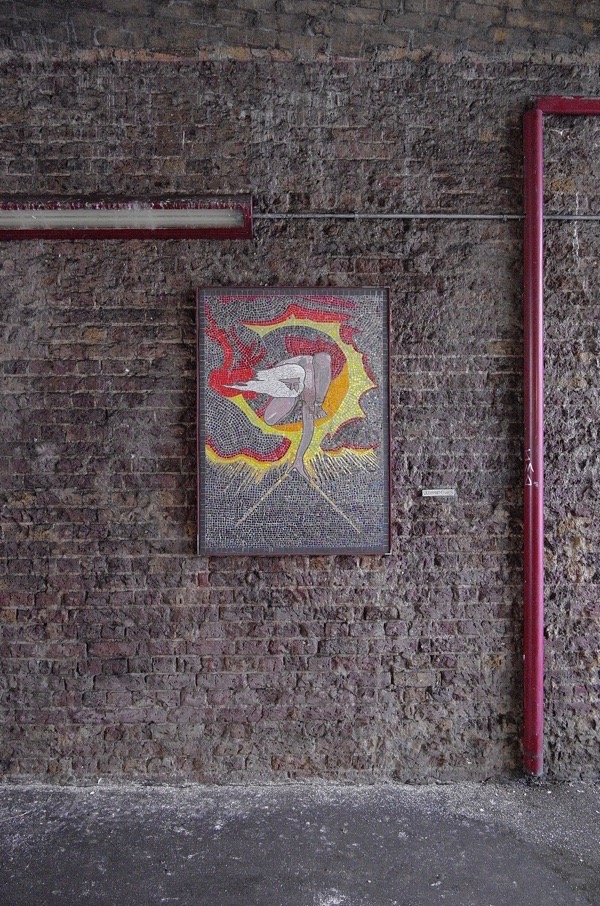


These mosaics were created by South Bank Mosaics which is now The London School of Mosaic
You may also like to take a look
James Mackinnon, Artist
The Gentle Author will be giving an illustrated lecture, showing David Hoffman’s photos from ENDURANCE & JOY IN TE EAST END 1971 -1987 and telling the stories behind them next Thursday 7th November 7:30pm at Wanstead Tap, 352 Winchelsea Rd, E7 0AQ

Twilight at London Fields, 2012
The streetscapes of James Mackinnon (born 1968), especially those of the East End and of London Fields in particular, captivate the viewer with their powerful atmosphere and magical sense of possibility – an effect compounded by the breathtaking accomplishment of their masterly execution.
“I grew up in South London in Lee Green, so I used to go to the Isle of Dogs through the foot tunnel under the Thames and I was mystified by the area north of the river. Sometimes I would bunk off school with a sketchbook and go wandering there. It seemed a mysterious land.
Later on, having left home and gone through college, there was a big recession and it was tough, all the students were scrabbling around for work, I had an epiphany. I was sat next to the Thames and I realised I just wanted to look at buildings and paint them.
In the early nineties, I moved to the East End because it was affordable and I had always wanted to explore there. I was slowly drawn to where my heart was guiding me, I would go round the back streets and explore the hinterlands. There is something compelling about going somewhere you do not really know about – the mysterious world of places. The atmosphere of places is born of people and their residue, it’s about people living there.
I lived near London Fields and there is this little terrace of Georgian houses with a railway line and overhead electric wires, and there are some tower blocks in the distance. It was such an interesting juxtaposition. A lot of East London landscapes have that, you might get a church sitting next to a railway line, next to tower block, next to the canal and a bit of old railing and some graffiti. That funny mixture. So I would just go and paint what I wanted. It was an act of faith, I knew it was what I had to do.
I tried having a studio but I was always a struggling artist so, when it came to rent day, it got tricky. There was a lot of signing on the dole and I lived in my studio for a bit to save money on the rent but the landlord found out and it was a cat and mouse game.
By the time I left, I think I had found myself. There is something in the painting that says it is by me rather than anyone else and that has evolved from having done it for twenty years. I just about managed to survive. I learned I have got the tenacity and self belief, that this is what I love. You find your path after a lot of struggle but it only comes by doing it.
You realise that a great painting can come from something very ordinary, you can go for a walk and there might be something round the corner that knocks you out. There was a lot of that in the East End and I am still obsessed by it though it is changing hugely. Some of the landscapes have altered already and some of the shops have gone.
I miss Hackney in many ways but I do not miss struggling and rents going up. I was there until around 2013, I had a great time and made some good friends. So now I have moved to Hastings. I had a little boy and it became untenable to carry on living in the East End. I had no choice.”

Homage to James Pryde, 2009 (The Mole Man’s House)

Broadway Market

Shops in Morning Lane, 2014

Hackney Canal near Mare St, 2012

Canal, Rosemary Works 2014

Savoy Cafe, Hackney, 2012

James Tower, London Fields, 2012

Alphabeat, 2007
Paintings copyright © James Mackinnon
Take a look at some of the other artists featured in East End Vernacular


