
At the Workhouse on Cleveland St
My esteemed colleague Dr Ruth Richardson outlines the background to her bravura campaign that saved an eighteenth century workhouse from demolition and uncovered important literary history at the same time. Yet, as she reports, the battle to preserve the building in a way that respects its cultural significance continues.

Please Sir, I want some more!
Many readers will be aware of the successful campaign waged in late 2010 and early 2011 to prevent the destruction of the Workhouse on Cleveland St – which stands at the Goodge St end of Fitzrovia, in Camden on the border with Marylebone.
In October 2010, when I was asked to become the historian of the campaign, I was in the midst of other things but the plea was plaintive and urgent, and something told me I should not put it aside. For generations, the building had been a major London workhouse – the Strand Union Workhouse – before it became an annexe of the Middlesex Hospital in 1948. Back in 1989, I and my sweetheart had written about a Poor Law Medical Officer – Joseph Rogers – who had worked in the building in the mid-Victorian era. The campaigner who tracked me down had read our article.
Dr Rogers’ Reminiscences of a Workhouse Medical Officer make the place unique, because Cleveland St is the only workhouse in England to have a published doctor’s memoir detailing the regime as it operated, written from the inside. Dr Rogers instigated a ground-breaking series of investigative articles in The Lancet in the eighteen-sixties which lifted the lid on the terrible conditions for the sick poor in such places. He founded the ‘Society for the Improvement of Workhouse Infirmaries’ which attracted influential supporters including Florence Nightingale and Charles Dickens. The reforms that followed in the eighteen-seventies, that originated in Cleveland St, involved the erection of major new hospitals in a ring round London and other cities, establishing many of the locations still in use for NHS health-care provision today.
When I went over to Cleveland St to meet the campaigners, I was horror-struck to find the Middlesex Hospital – a once proud and venerable institution, always buzzing with vitality – just a vast field of rubble. My father’s life had been saved there, I loved the place. I was aghast. The other campaigners, I soon realised, were also suffering what can only be described as post-traumatic shock, after the wilful destruction of that fine institution. In place of the beating heart of the neighbourhood, there was a black hole.
All of us had that crater in our minds as we worked. It was the sheer vandalism of its destruction which gave focus to the campaign to save the Middlesex Hospital’s Outpatients Department. The Camden Council planning meeting that could permit the demolition was only five weeks away.
English Heritage had done a thorough job in recommending the Workhouse building should be listed. Every scrap of supportive evidence had been submitted, including our work on Dr Rogers. Only a tiny number of recommendations are ever rejected, but after lobbying by the local MP Frank Dobson, Margaret Hodge, the minister responsible under the previous Labour government, had refused to list the Workhouse. A ministerial decision cannot be appealed without ‘substantive’ new evidence and we had nothing to add.
I had only ever worked on one such campaign before. At the height of the Thatcher era, the last-minute attempt to save the Rose Theatre had been half-successful. I knew from that experience that without Mr Shakespeare, this one stood little chance. But the Rose had garnered huge support in only six days and here we had five weeks. Our chances of saving the Workhouse were dismal but – and this was the important thing – at least we could put up a good fight. Future historians looking at its loss would know a battle had taken place.
I spent the first week drafting a good letter to The Times and getting a decent clutch of signatures for it, agreeing the final tweaks to the text with every signatory. Such things take time. The Times came up trumps with a colour photo and a dream headline, “Georgian Gem on the Danger List.” The workhouse is certainly Georgian – it is older than Brighton Pavilion, built in the seventeen-seventies. But it is not a beautiful building. It is plain and utilitarian, built in local London stock brick shortly after the overcrowded parish of St Paul Covent Garden had purchased a field from the Duke of Bedford for its new poorhouse and burial ground.
I was enormously grateful to The Times for that headline. Now we had only four weeks to find something on which to base an appeal to the Conservative minister. While I was digging in the history, I pondered the identity of the patron saint of workhouses? It had to be Saint Charles. I prayed that he and Mr Dickens would sort it out between them, and they did.
The first glimmer of hope was when I discovered that one of the two blacking factories in which Charles Dickens had worked as a boy had been within the parish of Covent Garden, so he might have worked alongside parish apprentices sent out from this workhouse. That was something, especially as he had named the villain ‘Fagin’ in Oliver Twist after a boy in the factory.
Wondering where he had been living at that time, while his family was incarcerated in the Marshalsea Debtors’ Prison, I landed upon the answer which became the key to solve my problem. The Dickens family had moved about a lot and one of their London addresses – which curiously appeared twice – was in a street called Norfolk St, near the Middlesex Hospital.
The street-name no longer exists but, poring over an old map in the Westminster Archives with a magnifying glass, I think I yelped out loud with delight. Norfolk St is now the southern end of Cleveland St! None of the biographers had ever made a connection between that address and the Workhouse, yet Dickens lived there for nearly five years before he wrote Oliver Twist.
When I shared the news with my fellow campaigners, we found ourselves shaking with a sense of blissful coincidence. It was sufficient new evidence to delay matters until we could mount an appeal and, when we did, the Minister referred the matter back to English Heritage who again recommended listing. This time, because of the connection with Dickens, the Minister listed the building.
Since then, I have done further research on the street and the district in Dickens’ day, and found good grounds for supposing that the Workhouse was important to Oliver Twist – the central plotline fits the topography, and the uniforms and regime were closely similar between the reality and his book. Not least, right opposite the Workhouse I found that, in Dickens’ day, there had been a shopkeeper called – YES – Bill Sykes!
Regrettably, when the Minister listed the Workhouse, he also issued what is known as a ‘certificate of immunity’ on the rest of the site, which exempts it from protection. Quite why this was done to a location with significant heritage is unclear. Dead from the Strand parishes are buried deep in the ground around the Workhouse and there are several good solid Victorian buildings, including the Master’s House and the Receiving Wards, on each side of the listed building. At the back, there are two splendid Nightingale Wards which are unique in London for being attached to an eighteenth century poorhouse.
The owners of the site have recently put forward plans which envisage the destruction of everything but the listed building. A high-rise apartment block will occupy the burial ground and glitzy buildings are planned to flank the most famous Workhouse in the world, which will be broken up internally for expensive flats. I asked a man who said he was the architect if his buildings would last as long as those already standing there have done – yet, for some reason, he seemed unable to enunciate a reply.


Dickens house with the blue plaque

Charles Dickens’ calling card while resident in Fitzrovia. (reproduced courtesy of Dan Cilanesco)

Showing the proximity of Dickens’ childhood home and the Strand Union Workhouse
Follow Cleveland St Workhouse blog to keep in touch with developments.
You may also like to read about
Charles Dickens at Park Cottage
Charles Dickens in Limehouse & Shadwell
Dr Syntax in London
Written anonymously and published in 1820, The Tour of Dr Syntax Through the Pleasures & Miseries of London was one of a popular series of comedies featuring the idiosyncratic Dr Syntax, a character originated by William Coombe and drawn by Thomas Rowlandson. These plates are believed to be the work of Robert Cruikshank, father of George Cruikshank.

Dr Syntax & his Spouse plan their trip to London

Setting out for London

Arriving in London

Robbed in St Giles High St

A Promenade in Hyde Park

A Flutter at a Gaming House

At an Exhibition at the Royal Academy

At a Masquerade

In St Paul’s Churchyard on a Wet & Windy Day

Inspecting the Bank of England

Presented to the King at Court

A Night at Vauxhall Pleasure Gardens

A Visit to the House of Commons

A Trip behind the Scenes at the Opera

A Lecture at the London Institution

Going to Richmond on a Steam Boat

Reading his Play in the Green Room

Overshoots London Bridge & pops overboard into the Thames

Images courtesy of Bishopsgate Institute
You may also like to take a look at
More of Tom & Jerry’s Life in London
The Gentle Author’s Next Pub Crawl
What could be a nicer way to spend a lazy October afternoon than slouching around the pubs of Smithfield, Newgate, Holborn and Bloomsbury?

The Hand & Shears, Middle St, Clothfair, Smithfield

The Hand & Shears – They claim that the term ‘On The Wagon’ originated here – this pub was used for a last drink when condemned men were brought on a wagon on their way to Newgate Prison to be hanged – if the landlord asked ,“Do you want another?” the reply was “No, I’m on the wagon” as the rule was one drink only.

The Rising Sun – reputedly the haunt of body-snatchers selling cadavers to St Bart’s Hospital

The Rising Sun and St Bartholomew, Smithfield.

The Viaduct Tavern, Newgate St– the last surviving example of a Victorian Gin Palace, it is notorious for poltergeist activity apparently.

The Viaduct Tavern, Newgate

The Viaduct Tavern, Newgate

The Viaduct Tavern, Newgate

Princess Louise, High Holborn – interior of 1891 by Arthur Chitty with tiles by W. B. Simpson & Sons and glass by R. Morris & Son
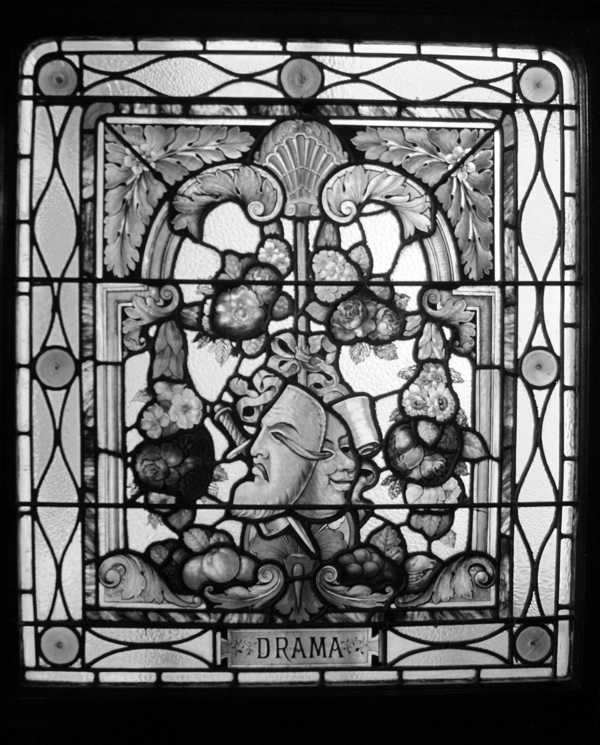
Window at the Princess Louise, Holborn

Princess Louise

Princess Louise

Cittie of Yorke, High Holborn

The Lamb, Lamb’s Conduit St, Bloomsbury – built in the seventeen-twenties and named after William Lamb who erected a water conduit in the street in 1577. Charles Dickens visited, and Ted Hughes and Sylvia Plath came here.

The Lamb

The Lamb
You may also like to look at
Return Of The King Of The Bottletops

Robson Cezar
A pair of huge Staffordshire Dogs appeared in Rough Trade East in the Old Truman Brewery yesterday to the amazement of those browsing for new music. Fashioned by Brazilian artist and Spitalfields resident, Robson Cezar, from almost seven thousand bottletops, they are harbingers of the imminent arrival of my new London Album.
After collecting, sorting and glueing so many bottletops in place, no wonder Robson threw his hat in the air as a gesture of triumph when his magnificent gleaming picture was finally installed. If you have enjoyed a drink in The Golden Heart in Commercial St or The Carpenters Arms in Cheshire St recently – then, unwittingly, you may have contributed to the creation of these fearsome beasts.
Yet these dogs are just part of a menagerie of creatures created by Robson Cezar this year, seemingly given animate life by the shimmering light and moving reflections which are a quality of his unique artistic medium, conjuring sophisticated effects of colour and tone using waste materials that no-one else values.
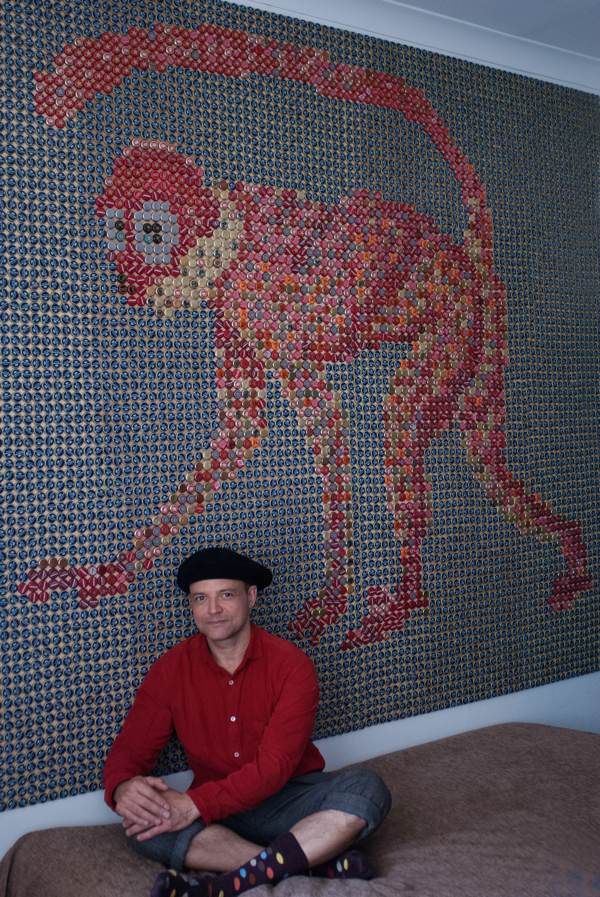
Robson Cezar with his Squirrel Monkey fashioned out of seven thousand bottletops.


Polar Bear


Red Squirrel


A Vida Continua – Life Goes On


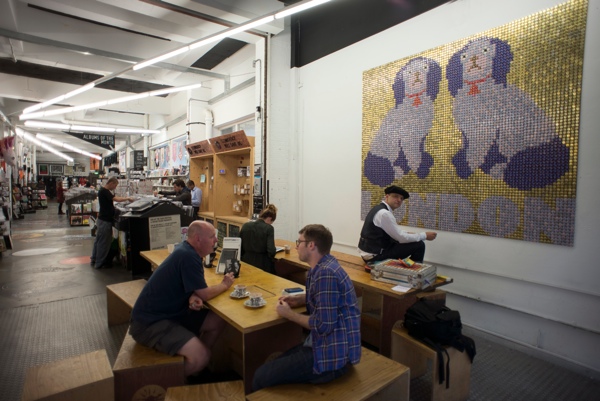
Staffordshire dogs at Rough Trade East
Photographs copyright © Sarah Ainslie
You may like to read my original story
Happy Birthday Alfred Daniels!

“Edward Bawden taught me how important it is to sharpen your pencil properly!”
Alfred Daniels, the celebrated painter from Bow known as ‘the Lowry of the East End,’ is eighty-nine years old today and still painting with undiminished passion. I went over yesterday to take this birthday portrait and I found him in the throes of preparing his new exhibition that opens at the Russell Gallery next week, including all the paintings shown below.
“I saw a film of myself walking and I thought, ‘Who’s that bloody old man?’ Because I don’t feel old, even though I look like my grandfather – the one from Plotsk,” Alfred admitted with a weary grin, contemplating his venerable age. Alfred confided to me that he is astonished to be alive, having cheated death three times.
“My brother Sid & I were walking down the Whitechapel Rd trying to pick up girls. We only had a bit of bombing in Bow, it wasn’t intensive like in Whitechapel and Stepney,” Alfred remembered, “Sid wanted to take the underground from Stepney Green but I had a funny feeling about it, so we walked home instead and I learnt next day that Stepney Green station had been hit.”
“My father was an air raid warden and my mother was a nurse, so they told us both to sleep in the shelter while they went to work at night,” Albert told me, recounting his second brush with mortality, “And when next door got bombed, the blast blew the wardrobe on top of the bed in our room and would have killed us.”
“Then I got a mastoid at the base of my skull when I was in the RAF and it had to be removed, so I dropped out of my squadron,” revealed Alfred, “and they were all killed, except for my friend who was invalided out, and me.”
We sat in silent gratitude in Alfred’s first-floor kitchen, admiring the autumn leaves in the neighbouring gardens and considering Alfred’s near misses of so long ago, that had permitted him to survive to see this annual spectacle on the eve of his eighty-ninth birthday.
And, taking this moment to look back over such a prolific career, he recalled how it all started.
“I began my career at the age of fourteen and a half, in 1939, by working in Commercial Art Studios. One in Chancery Lane, then at Clement Dane Studio and finally at my Uncle Charles’ studio in Fetter Lane which got bombed in the big raid on the city in December 1940.
The value of working in a studio was that nobody taught you anything, so you taught yourself by observing how the other artists worked and tried it for yourself. You were told what to do but not how to do it. Working in a studio was a unique experience for a fifteen-year-old: the atmosphere, the bright light, the smells of paint and cow gum – and learning the use of soft and hard brushes, coloured inks, poster paint, pencils and crayons, ruling pens, set squares and T squares, Bristol board and fashion card. Quite different from my Grammar School, which my Uncle had persuaded my parents to let me leave.
At the Clement Dane Studio in the Strand, I had to file the work of the illustrators and poster designers they represented, and I was greatly impressed by the way they told stories. Alas, they closed after Dunkirk and I went to work for my Uncle Charles in Fetter Lane, on the top floor of the Vogue magazine photographic studio. I was his only assistant and I did lettering, layouts, paste-ups and various illustrations both comic and serious, and when photographic retouching was needed I did that too, all for one pound a week.
It helped me to draw better and so I went to Life Classes at Woolwich Polytechnic Art Department at weekends, since all the London Art Schools were closed at night because of the intense bombing. The Head of the Department, Mr Buckley, was so impressed by my efforts he suggested I apply for a Scholarship to Art School and I was given one at ten shillings a week which upset my mother because it was less than the pound I was earning from Uncle Charles.
During the war, I served as a wireless operator and gunner in the RAF and in 1947, after I was demobbed, I went to the Royal College of Art where I received a first class degree and stayed on for a year to study mural design. The college was crowded with demob students like myself and I indulged in inactivity in the Student Common Room and was elected Social Secretary. I looked after the theatre group, the film society and the weekly dances. For my efforts, I was rewarded fifty pounds which I spent on a student visit to Italy and what I saw there made me want to become a mural painter.
Over the years, I have carried out many public commissions including paintings, murals for Hammersmith Town Hall, calendars for Oxford University Press and posters for the General Post Office. But my future career grew from what I learnt working in those Commercial Art Studios. To do things on your own initiative, to stick to your objective, and to work to a deadline and deliver to the client on time.”

Billingsgate Market

Gramophone man on Brick Lane

London Coal Exchange with St Mary-at-Hill and St Margaret Pattens

The Yellow Cello in the Portobello Rd

Vanishing London

Religious Revivalists

St Paul’s from Bankside

Southwark Cathedral and London Bridge

Tower of London

Boat Race at Hammersmith Bridge

Old Shepherd’s Bush Station

On Hastings’ Beach

Alfred’s cat, Flinty, who died on July 2nd

Flinty’s successor, Pushkin, who arrived on July 4th

In Alfred’s studio

Happy Birthday Alfred Daniels!
Paintings copyright © Alfred Daniels
Read my other stories about Alfred Daniels
The Mosaic Makers of Hoxton

Next time you are walking up Shepherdess Walk in Hoxton and you pass that sinister tunnel with the worn flagstones, leading under the shabby nineteenth century terrace, I recommend you take courage and pass through it to the park at the other end where a wonderful surprise awaits you.
For the last two years, artist Tessa Hunkin and around one hundred and fifty people have been working to create an elaborate set of mosaics in Shepherdess Walk Park, which are inaugurated with a party on Thursday this week. These breathtakingly beautiful pieces of work are destined to become an attraction in their own right – drawing people from far and wide to this corner of Hoxton – but before the crowds arrive, I had the pleasure of going over to admire them in the company of Tessa and couple of the stalwart mosaic makers, as they contemplate the completion of their mighty task which has transformed an unloved part of the park into an inspirational spot.
Taking the lyrical name of Shepherdess Walk as a starting point, the first mosaic portrays the shepherdesses that once drove their sheep through here when Hoxton was all fields. Next to this, a double wall panel illustrates park life throughout the seasons of the year in the East End while, underfoot, a pair of pavement mosaics show the wild flowers that persist, all illustrated in superb botanic detail. The quality of execution and subtle sense of colour in Tessa Hunkin’s designs combine with humorous observation of the detail of the social and the natural world to create works of lasting value which residents of Hoxton can enjoy for generations to come.
You will pleased to learn that after the success of the Shepherdess Walk mosaics, the team are already working on an ambitious new mosaic for Pitfield St, commemorating the Hoxton Palace of Varieties, and then Tessa and the mosaic makers will be moving to a studio in Hackney Downs to undertake a commission for a children’s playground.


Ken Edwards
“That’s my little rabbit, I named him ‘Randy.’ I’ve been coming here for over a year but, the first time, I thought it was something I wouldn’t be able to do. Yet Tessa showed me how to do it and I’ve been coming ever since. We work each Wednesday and Thursday afternoon, and every other Saturday when the youngsters from the Estate come to help. Even when you are not here, it’s what you think about. I live over in Well St and I walk here. Coming here, it helps with your sanity. We talk, we laugh, we joke. I love coming here, it’s very therapeutic, it’s a family atmosphere. I was a painter and decorator before and when you paint a flat that’s it, but this work that we’ve done is going to be here long after we’ve all gone and that’s very important to me.”


Katy Dixon
“I joined the summer before last. I am an artist and maker and I believe that art can heal people. We work as a group and enjoy the art of conversation together, and I imagine that’s how people would have worked on mosaics a long time ago in Pompeii. We like to listen to music while we work but it’s not always easy to find music that we can all agree upon. We tend to listen to reggae because it has an earthy quality.”


Tessa Hunkin
“We’ve made a little bit of Carthage here in Hoxton. I was inspired by the Roman mosaics of North Africa. It was my idea, I’ve been making mosaics for twenty-five years and I started working with people with mental health problems. I like working with groups of people on large compositions that they can be proud of. Mosaic-making is very time-consuming and laborious, so it seemed a good idea to work with people who have too much time, for whom filling time can be a problem. Also, I’m very interested in the historical precedents and that gives the work another dimension. This project started in July 2011 and it was going to be for six months but, when we came to end of the first mosaic nobody wanted the empty shop that is our workshop, so we just carried on.”


Nicky Turner
“When Tessa showed me the work, I thought it was interesting and I wanted to try but, originally, it was only going to be until the end of the year and now I’ve been here two years. I live in Stratford, two bus rides away, but I come two or three times a week. It’s always different here, so I never get bored. I worked on the borders, and I get satisfaction and self-esteem from doing this work.


Work in progress on the new Pitfield St mosaic, celebrating the former Hoxton Palace of Varieties

Nicky shows off his rings.

Ken with the poem he wrote about the mosaics


Katy with one of the sheep she will lead to the ceremony on Thursday, dressed as a shepherdess

The old tunnel from Shepherdess Walk that leads to the mosaics in the park.

Click on this image to enlarge

Click on this image to enlarge
All are welcome at the unveiling of the mosaics in Shepherdess Walk Park on Thursday 10th October at 3pm, preceded by refreshments from 2pm at the Community Hall on Murray Grove, Hoxton.
At Butler, Tanner & Dennis in Frome

Book Designer, David Pearson, with pages of The Gentle Author’s London Album
Everyone that loves books knows the name of Butler & Tanner, Britain’s oldest and foremost colour printer – established in Frome in 1845 and nowadays known as Butler, Tanner & Dennis. This was the printer that Allen Lane went to in 1935 to print Ariel, the first Penguin Book, and so it was my great delight to go down to Somerset with Book Designer, David Pearson, and Contributing Photographer, Patricia Niven, to see the pages of The Gentle Author’s London Album roll off the presses at the same print works.
We met at Paddington Station before dawn and the sun was just rising as the train sped through the West Country to deliver us to Frome, where we walked from the station to our destination in the aptly-named Caxton Rd. Upon arrival at the unexpectedly quiet print works, we were ushered into a waiting room and told that the first page would be ready shortly. Once we were led through into the factory we encountered the clamour of the machines, where vast presses – each one the size of whale – were spewing forth huge pages of print.
Here we met printers Paul Wrintmore and Clive Acres, and I saw pages of the Album for the first time, laid upon a brightly-lit table that simulated daylight. To my right, the great machine sat humming to itself with impatience as it waited to run off thousands of copies. But first we had to give our approval and I had to sign off the sheet. Each sheet contains twenty-four pages and here, in these unfamiliar surroundings, I was delighted to find my old friends The Dogs of Old London, The Pointe Shoe Makers, The Car Crashes of Clerkenwell and The Spitalfields Nippers. This was one of those moments when you confront something entirely familiar as if you are seeing it for the first time. It all looked well to me, with sharp details and good definition even within the darker areas of the pictures and, where there were flat areas of colour, the tones were even. I could find no flaw.
Yet I stood back, deferring to David Pearson as the design professional, and he leaned over close, casting his critical gaze upon his beautiful pages. The printers stood behind us, exchanging expectant glaces in silence. This was not a moment to discover a mistake and thankfully we did not find any. Most importantly, we were both satisfied with the quality of the printing and I signed the sheet, setting the great press in motion. After a tour of the factory, we came back to see the second sheet and were satisfied again and I signed it off too, content now to leave the rest of the book in the safe hands of the printers.
The early start and the emotionalism of the occasion caught up with us, and we were happy to climb back onto a train and, feeling relieved, we dozed all the way back to Paddington. Yet I took copies of each of the sheets of the Album with me as souvenirs and I have been examining them for errors ever since. I have not found any yet – but I am still looking.

W.T.Butler’s Steam Printing works in Frome, 1857

W.T. Butler, 1850

Early print specimen from Butler & Tanner

Joseph Tanner went into partnership with W.T. Butler in 1863

Early print specimen by Butler & Tanner

Butler & Tanner Print Works, 1905

Paper to print The Gentle Author’s London Album

Setting up the type, 1920

A special colour of ink mixed for The Gentle Author’s London Album

Adjusting the press, 1930

Pumping the ink to print The Gentle Author’s London Album

Typesetting, 1950

David Pearson inspects one of the plates to print The Gentle Author’s London Album

Printing machine, 1935

Heidelberg Speedmaster XL 162 printing press, standing by

Printing Works Beano, 1950

Paul Wrintmore, one of the printers of The Gentle Author’s London Album, with the first page

Plate making, 1950

Clive Acres, one of the printers of The Gentle Author’s London Album

Printing press, 1950

The first page of the Album to come off the press

Digital typesetting, 1970

David Pearson scrutinises the first page

Printing press, 1978

Sewn-together copies heading for the bindery

Digital printing, 1988

In the bindery

1912, Sherlock Holmes

1935, Ariel – the first Penguin Book

1950, The Lion, the Witch & the Wardrobe

1965, James Bond

2013, The Gentle Author’s London Album
Colour photographs copyright © Patricia Niven
Archive images courtesy of Butler, Tanner & Dennis
You may also like to read about


