
In Celebration Of Brick Lane
It is my great delight to announce the publication of BRICK LANE by Phil Maxwell on Thursday 3rd April and to invite you to join me in raising a glass of Truman’s Beer to celebrate!
We have worked with distinguished designer Friederike Huber to create a magnificent three hundred page book of Phil’s photographs in chronological order, from 1982 until the present day, telling the story of volatile social change upon one of Britain’s most celebrated streets.
Published by Spitalfields Life Books and printed in Britain by Butler, Tanner & Dennis, the book costs just £10 and you can pre-order your copy by clicking here.
Additionally, we are giving away one thousand of these beautiful posters, each signed and numbered by Phil Maxwell. Come to the launch to get yours or you can collect one afterwards from some of our favourite shops including Brick Lane Bookshop, Broadway Bookshop, Gardners’ Market Sundriesmen, Rough Trade, Labour & Wait, Leila’s Shop, Newham Bookshop & Townhouse.


Introduction by The Gentle Author
PHIL MAXWELL is the photographer of Brick Lane. Over the last thirty years, no-one has taken more pictures there than he and his astonishing body of work stands unparalleled in the canon of street photography, both in its range and in the quality of human observation that informs these eloquent images.
“More than anywhere else in London, Brick Lane has the quality of being constantly changing, even from week to week,” Phil told me when I asked him to explain his enduring fascination. “Coming into Brick Lane is like coming into a theatre, where they change the scenery every time a different play comes in – a stage where each new set reflects the drama and tribulations of the wider world.”
In 1981, when Phil Maxwell moved to London from Liverpool, he found himself living in a council flat off Brick Lane where he lives to this day. “They told me, ‘You won’t find people in London as friendly, they don’t have the Scouse humour,'” Phil recalled, “But when I moved here I found that Liverpool humour and East End humour were almost the same – developed out of hardship, in which people were able to laugh at their own demise. The East End was a small world and a wonderful place in those days. The area was a desert, so much corrugated iron, so many bombed out buildings, and many old Jewish people with a great sense of humour.”
Phil’s work is distinguished by a strong empathy, drawing the viewer closer. In particular, he succeeded in winning the trust of Bengali people and portraying their community with relaxed intimacy. “That’s because I live on the other side of the tracks and the vast majority of my neighbours are Bengalis,” Phil revealed, “The main problem Bengali families face is overcrowding, with parents and kids living in tiny flats where they cannot socialise freely, and so Brick Lane became the place where they could be themselves in a way they couldn’t at home.”
When I confided to Phil that the lyrical quality of his portraits of older people appealed to me especially, he pointed out the woman with white hair, enfolding herself in her pale overcoat. “She seems bemused by what is happening round her, but in her appearance she is very much part of the built environment that surrounds her,” he said, thinking back over the years, “I find older people have a kind of demeanour which derives from the environment they’ve been living in and that makes them interesting to photograph.”
In its mutable nature, Brick Lane presents an ideal subject for photography – offering an endless source of fleeting moments that expose a changing society within a changing environment and, since the early eighties, Phil Maxwell has made it the focus of his life’s work.
Yet, as well as recording the changes in Brick Lane itself, these pictures also capture many of Phil’s friends. His long-term involvement with his subjects means that he is never merely taking photographs, he is always recording life happening. Thus, every single image is another frame in an ongoing drama, with the same people and places recurring over three decades. For this reason, Phil’s pictures never contain anonymous faces in the street, because these were the people he lived among every day.
It is this affectionate yet unsentimental relationship with his subjects that gives Phil Maxwell’s photographs their special quality. As Phil admitted open-heartedly, “I would be nowhere without these people, they are my constant inspiration. I always have a camera in my pocket and whenever I go out I always see something I have never seen before. I love the different cultures and histories that are on my doorstep. Wherever I travel in the world, I always come back and find a little of it here. I couldn’t live anywhere else now – such a mixture of class, race, cultures, and aspirations and it’s all here in one go.”

CLICK HERE TO PRE-ORDER YOUR COPY OF PHIL MAXWELL’S BRICK LANE FOR £10

So Long, Aaron Biber
In respect for the grief of the Biber family, we have held the announcement until this spring of the death of Aaron Biber, London’s Oldest Barber, last year on November 27th. It seems Aaron was not feeling so well one day and went to hospital to get a check-up. He was kept in for observation and died peacefully there. It was a quiet conclusion to Aaron’s extraordinary career as a barber spanning eight decades and, in spite of the tribulations of life, his triumph was to keep cutting up until the very end.

Aaron Biber cut hair for nearly eighty years, using the same blue steel scissors that his father gave him when he began at twelve years old, which he sharpened himself. At ninety-one years old, Aaron still worked six days a week at his tiny salon in Tottenham, waking each morning at four, driving the five minute journey from his home in Chingford and opening up the salon from six until midday.
After all that time, Aaron could not retire because he knew nothing else. “Three doctors have told me, I would be dead within two months if I stopped,” he admitted to me with a helpless smile,“I can’t stop at home because my wife passed away after seventy years of marriage.”
For more than forty years, Aaron’s business was a going concern in Tottenham until one summer morning, shortly after his wife died, when he arrived for work to discover a crowd of two hundred, including eighty interviewers outside his barber’s shop. The rioters had destroyed Aaron’s salon and he found himself at the centre of an international media storm. “I was on TV all over the world, Canada, Vietnam, Australia, Germany, Japan …” he recalled in bemusement, “And the Archbishop of Canterbury, Boris Johnson and Prince Charles, they all came to see me.”
Although his salon was restored thanks to donations from an internet campaign, Aaron’s customers – many of whom had been coming for decades from all over London – disappeared. On the Monday of the week I visited, Aaron had one customer and on Tuesday also only one customer. No wonder he was delighted when I walked through the door at the end of the morning, on a day that had been a total blank, to interrupt his melancholic discourse with his pal Richard. “I’ve been cutting his hair since he was a baby,” declared Aaron to me, by way of introduction, with an affectionately dismissive flick of the wrist in the direction of his friend. A gesture reciprocated by Richard with a nod of confirmation and a loyal smile.
“They took everything, even my kettle and my chairs!” explained Aaron casting his eyes around at his memories of the destruction, “Luckily, I always carry my scissors with me, so they were safe at home.” Lesser men would be defeated what happened, but Aaron’s experience of life granted him a sense of proportion which permitted a degree of equanimity.
Aaron’s mother and father both came as refugees to the East End from Poland in the eighteen nineties. “My mother grew up on the farm, and the Russians used to ride through the village on horseback and knock people to the ground as they passed,” Aaron informed me, “My father killed a copper who assaulted him and he ran to England to escape.”
“When I was around ten years old, my mother moved out from Myrdle St where we lived because my dad wouldn’t give her a penny. She took all the children – nine sons and four daughters – to Coke St off Commercial Rd near the Bell Foundry. We went to the Jewish Board of Guardians to get an iron token for the soup kitchen, and we got bread and pilchards and kosher margarine. We used to go round the streets searching for money and once we found half a crown, we bought two salt beef sandwiches and had one shilling and eightpence left.
We had to work because we were starving. When I was ten, I went across the road to work for Mr Cohen making beigels for sixpence and then I weighed out sugar for his wife in the shop next door for tuppence, so I had eightpence. I used to wash down the horses, Ginger & Tubby, for Barney Dan, he had a cart and went round delivering stuff. He took me down to Covent Garden. I can tell you all about Covent Garden because I met my wife there, her father Alex Simmons, he designed all the sets for the theatres. I took a room in Tavistock St on the first floor, full of lads cutting hair. Later, I had a place in Hanbury St opposite the market in Spitalfields and I cut all the porters’ hair.
I cut hair for the police for fifty years, they wanted to make me a policeman at seventeen but my father said, ‘No, you don’t!’ I cut the hair for the flying squad for twenty-five years. Everyone wanted me because I cut hair properly. We used to have the police lined up outside the shop, there was a shortage of barbers.
We had all nationalities down in Cable St, Italians, Spanish, Maltese, Ghanese. I picked up all the languages. I can still speak Ghanese. We had the High Commissioner of Ghana come for a hair cut. Everyone got on and we all used to help each other out. I remember the Battle of Cable St, I was by the Royal Mint and the dockers came out of the dock to stop Mosley. I went to one of his rallies in Victoria Park to have a look but my mother warned me, she said, ‘They’ll kill you.’
During the war I was guarding Tower Bridge when Winston Churchill came along and said to me, ‘Shoot any parachutists you see coming down.’ I said, ‘What if they are ours?’ They showed me where they expected me to sleep and I said, ‘Forget it, I’m going home to my mother.’
I could have gone on the Queen Mary to America, cutting hair. There was this bloke in the docks, he said, ‘I’ll fix you up get you a job there, all you have got to do is give me a hundred pounds later.’ Most of the barbers from the East End went to America. My brother Ben opened a salon in Times Sq, but I couldn’t go because I was my mother’s blue-eyed boy, her favourite. She said, ‘No, not with them German submarines you’re not going.’ I never had any children. My mother told me, ‘It’s too much trouble.'”

“Everyone wanted me because I cut hair properly.”

Aaron cuts hair in Cable St in 194o.

“The Archbishop of Canterbury, Boris Johnson and Prince Charles, they all came to see me.”

Aaron outside his salon in St Anne’s Rd in the nineteen fifties.
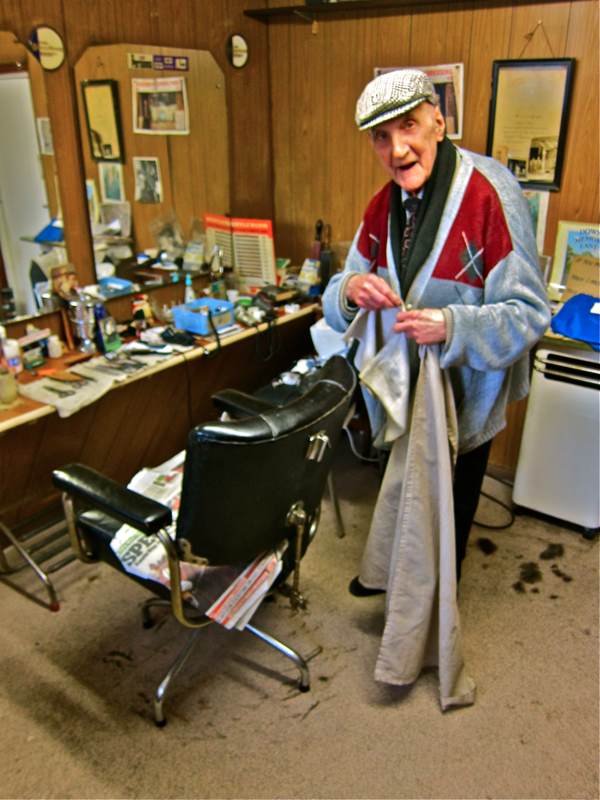
“I cut the hair for the flying squad for twenty-five years.”

The blue steel scissors given to Aaron by his father seventy-eight years ago when Aaron was twelve years old, wrapped in a nineteen forties linen towel.

“I can still speak Ghanese.”

Aaron’s pal Richard – “I’ve been cutting his hair since he was a baby.”

Aaron’s brother Ben (left) outside his salon in Times Sq, New York.

Aaron’s salon in Tottenham.

“Three doctors have told me, I would be dead within two months if I stopped.”
Visit the Aaron Biber memorial website Keep Aaron Cutting
You may also like to read about
Bishopsgate Portraits
Spitalfields Life Contributing Photographer Colin O’Brien took these portraits at this week’s launch of Bishopsgate Voices, the new oral history CD featuring people from Spitalfields & Bishopsgate, produced by the Bishopsgate Institute.

Alan Griver, Printer & Boxing Coach – “I can remember walking out at lunchtime and seeing a film being shot in Fournier St. It was about the American Revolution and it was supposed to be a Boston street, Boston at that time. All their old buildings had gone, so they couldn’t shoot it in Boston and they looked at Fournier St which looked exactly like one of the roads in Boston. I watched the redcoats marching up and down.”
Alan Griver was born in 1938 on Underwood St. His parents were originally from the Ukraine, his father arriving in London at five years old. Alan’s father worked in the timber trade and later owned a sweet shop on Well St, Hackney. Alan was evacuated to Luton in World War II but returned to attend Holcroft Rd School. He trained to be a Boxer and went on to teach boxing and start his own gymnasium.

Mavis Bullwinkle, Secretary at Royal London Hospital – “You can’t imagine it now, but every fish had a different taste. When you buy fish now, it’s all got the same taste because it’s all been frozen. But you used to get your plaice that used to be as big as that on your plate and it would cost hardly anything.”
Mavis Bullwinkle was born at the London Hospital on 18th May 1932. Her father was a Clerk and her mother worked in the office of a clothing company before leaving to become a Housewife. She attended the Sir John Cass School before being evacuated to Aylesbury and returning to London when she was thirteen. Mavis was Christ Church Sunday school teacher for thirty years and worked as a Short-Term Typist before moving to the London Hospital, where she worked for forty years.

Sid Joseph, Bus Driver & Postman – ‘We used to have a paper man, selling papers, and when I went down there he knew my name. He said… “Tell Mum and Dad that Hitler’s invaded Russia.” I didn’t know what Russia was! I goes, “Is there a place called Russia?” Me mum said, “Yes. Why?” I said, “Hitler’s invaded ‘em”. I’m not gonna repeat what my mother said.”
Sidney Joseph was born in Windsor House, Wenlock St in 1931. His mother was a Housewife and his father worked as a Porter in Spitalfields Market. The family later moved to Brunswick Buildings, Goulston St and he attended the Jewish Free School. During the war, Sid was first evacuated to Bishops Stortford and then to Padstow. Upon his return to London he attended Christ Church School, leaving at age fourteen to work as a Hatmaker. He completed his two year long National Service, starting at age eighteen, stationed in Dusseldorf. Leaving the army in 1951, Sid came back to the East End, where he worked as a Van Driver delivering smoked salmon, then as a Bus Driver and finally as a Driver for the Post Office.

Lesley Keeper, Machinist & Barmaid – “In the middle of our street, we had a great big square [bomb] debris which led to the next street and all the kids used to play on there and that was our playground. And I always remember Mrs Dexter who lived opposite, she had two daughters Patsy & Jean, and she used to call with arms folded out the top window, ‘Pat! Jean! Go and play nicely on the debris.'”
Lesley Keeper was born on 15th November 1947 at Mile End Hospital. Her father was a Coalman and her mother was a Machinist. Her first job at age fifteen was at the office of the clothes-making company, Ellis & Goldstein. Lesley later worked at a Chemist in Houndsditch and as a Clerk at Bethnal Green Hospital, before marrying at age eighteen and having two kids before she was twenty.

Norah Pam, Clerical Officer & PA to Director of Redbridge Health Authority – “From the top of the building you could see the red glow in the sky, you could see the planes coming over and the German planes had a completely different sound from ours. You could hear them, you know, chug-chug-chug as they came along – and you’d hear the bombs.”
Norah Pam was born on 31st May 1925 near the Tower of London. She lived at Howard Buildings in Deal St and attended All Saints School. In 1932, she contracted scarlet fever and diphtheria and spent a total of twelve weeks in the isolation ward at the hospital in Homerton. She later attended Sir John Cass School and worked at Ferguson Radio after leaving school. She met her husband, a navy man, in 1948. They married in 1950 and had two children.

Henrietta Keeper, Ballad Singer & Sample Machinist – “My husband died fourteen years ago of emphysema from smoking and he ate a lot of hydrolized fat. So when he died, I threw away the biscuits and I bought a book on Nutrition and studied it, and now I’ve got strong. I only eat wholemeal bread – white bread’s a killer. I am keeping well, to stay alive for the sake of my children because I love them. I don’t want to go the same way my husband did.”
Henrietta Keeper was born and lived her whole life in Bethnal Green, apart from when she evacuated to Little Saxham, near Bury St Edmunds, at the beginning of World War II. Henrietta worked as a Sample Machinist and joined the Tate & Lyle Concert party for thirty years. Today she may still be heard singing each Friday afternoon at E. Pellicci in Bethnal Green.

Reg Denny, Policeman – “You take Commercial St, not too far from here… you’d walk past the wholesale market and most of the time you’d get the sort of sweet smell of the fruit and then the not-so-good smell at the end of the day when you had the stale cabbage and the rotten beetroot and whatnot.”
Reg Denny was born in 1942 in Clapham. His father was in the fruit & vegetable trade, and his mother worked in a sweet shop in Clerkenwell. He moved to the East End in 1961 to join the police, working at the Commercial Rd Station and living in a police hostel nearby.

Emily Shepherd, Waitress, Clerk & Machinist – “And we had the radio on and then Neville Chamberlain came on and I remember him saying, ‘We are at war with Germany.’ I didn’t know what war was all about much but I knew it was gonna be bad, you know.”
Emily Shepherd was born in 1927 in Bethnal Green. Her father was a Horse and Cart Man and her mother was a Cleaner. Emily worked as a Waitress, Clerk & Machinist in a clothing factory and she has never lived outside the East End.

Keith Martin, Bank Officer – ‘Christmas Eve was the day and it was probably highly illegal – even in those days – but the people on the first floor who did all the back office work used to get a barrel for Christmas and they had this keg of beer up there, and people would go and help themselves to it from time to time.’
Keith Martin was born in 1953 in Forest Gate Hospital and brought up on Newcomen Rd, Leytonstone. He lived at home until his marriage at age twenty-six, when he moved to Dagenham. His first job was at a department store in Leytonstone but he later worked for Midland Bank in the City and Canary Wharf.

Joyce Ward, Teacher & Foreign Office Civil Servant – “My oldest aunt was working as a domestic in a large house somewhere or another. She had quite a good job and she always looked extremely smart. One Christmas, she got the chauffeur of her house to drive her to our house. Now can you imagine, the whole street of people poured into the road to see this – it was probably a Rolls Royce or something in front of our house…”
Joyce Ward was born in 1926 at 13 Columbia Rd, her father was a Tailor and her mother a Housewife. She went to school on Virginia Rd and Rusher St, was evacuated to Bishops Stortford, but later returned and attended Clapton County Secondary School. Joyce read Maths at University College and worked in a semi-secret post for the Foreign Office where she met her husband.

Hannah Jacobson, Civil Servant – “I lived with my grandmother… but across the road… my other grandmother lived, my paternal grandmother, she had so many children that I was more over there than with my grandmother because I used to play with them.”
Hannah Jacobson was born in the Maternity Hospital, Hackney in 1927. Her father was a Fishmonger, working all over London and later owning his own shop. Due to her father moving around for work, she attended twenty-five different schools as a child. Between the ages of five and twelve she lived at 22 Eric St, Mile End, where – during the Blitz – a landmine hit her house and her neighbours were killed.

Joy Harris, Dressmaker – “I was fifteen and he was seventeen. And then we got engaged when I was seventeen-and-a-half and got married at nineteen. I was an average age but Larry was probably a bit older to get married. He was twenty-two.”
Joy Harris was born in Barking in 1946. Her father was a Greengrocer who owned two shops and her mother worked in a factory. After leaving school, she had an apprenticeship as a Dressmaker and worked in Fashion St. Later in life, she worked in a hospital for the mentally ill and became an Occupational Therapist.

Larry Harris, Teleclerk in London Docks – “I think we had the last horse and cart that used to come in… The reference for his number plate was HC1, horse and cart one… Very fond memories of it.”
Larry Harris was born in 1943 at home in Dagenham. His father worked as an Electrician and his mother was a Cleaner and then worked at a sweets factory in Clerkenwell. Larry left school at fifteen to work for Arbuck Smith in the City and later for the Port of London Authority in 1959. He worked there for twenty years before joining Tate & Lyle in Silvertown for a further thirty years.

Sandra Scotting, Copyright Executive – “I’d come home from school sometimes and I’d find a crab or a lobster on the floor because my uncle used to work at the fish market. And he’d come home after his shift, put a load of things in the sink… and sometimes they’d get out… There they’d be crawling along the hallway!”
Sandra Scotting was born in Bethnal Green in 1947. Her mother was a Dressmaker and her father a Tailor. The family lived in Crown House on Bonner Rd, moving to Gore Rd in Hackney when Sandra was eleven. She attended Central Foundation Grammar School and trained as a Doctor, working at the Queen Elizabeth Children’s Hospital when she was newly qualified.

Jeff Borsack, Antiques Dealer – “I had to go to the poor board with my grandmother so that they could give me a uniform to go to the school. That was the dire straits we were in. And I always remember overhearing a lady say to the other gentlemen on the panel… “Children like this shouldn’t go to grammar school.” And I think that actually gave me quite a steely resolve in my life, that I was going to show this woman that children like me could benefit from it.”
Jeff Borsack was born on City Rd in 1937. After his parents died in the Blitz, Jeff went to live with his grandmother until he was evacuated to Berkhamstead. Upon his return to London, he attended Central Foundation Grammar School and studied Hebrew in the evenings, before taking Accountancy and Law at university. He became an Antiques Dealer with an office in Stamford Hill and has worked in markets throughout London.

Linda Simmons, Charities Administrator – “There’s one [rhyme] I remember – I can’t remember the beginning of it – but it ended “Betty Grable is a star. S. T. A. R.” Well, the thing was, we still used to say “Betty Grable is a star” but none of us had ever seen Betty Grable because she was a wartime pin-up, you know.”
Linda Simmons was born in 1949 to a Docker father and a Machinist mother. She spent her childhood in Bethnal Green and for the first three years of her life she lived with her grandparents on Chiltern St, later moving to a council flat in Teesdale St. Linda attended Christ’s Hospital School in Sussex for two years, retuning to the East End to attend John Howard Girls’ Grammar School. She later went on to Oxford University to read English and met her husband, before returning to London to work in publishing until leaving work to raise two children. Later, she returned to work for the Citizens’ Advice Bureau in 1981 and volunteered for the Terrence Higgins Trust, then joined for the Central London Action on Street Health, supporting sex workers, drug users and homeless people.

Copies of the CD cost £5 and are available to purchase at the Bishopsgate Library or may be ordered direct from Stefan.Dickers@bishopsgate.org.uk
Portraits copyright © Colin O’Brien
You may also like to look at
Syd Shelton’s East Enders

Brick Lane 1978
Photographer Syd Shelton‘s enduring fascination with the East End was sparked by a childhood visit from Yorkshire with an uncle and aunt more than fifty years ago. “My cousin was was working in a mission somewhere off Bethnal Green Rd,” Syd recalled, “It was a scary part of London then and I remember my uncle looked out of the window every few minutes to check the wheels were still on his car!”
“The day I left college in 1968, I came down to London and I have worked here ever since, photographing continuously in Hackney and Tower Hamlets,” Syd admitted to me.
In the seventies, Syd became one of the founders of Rock Against Racism, using music as a force for social cohesion, and his photographs of this era include many affectionate images of racial harmony alongside a record of the culture of racism . “It was an exciting time when, after the death of Altab Ali, the Asian community stood up to be counted and the people of the East End became militant against the National Front,” he explained, “In 1981, I got a studio in the Kingsland Rd and I only gave it up recently because the rents became too expensive.”
Syd’s portraits of East Enders span four decades yet he did not set out consciously to document social change. “I never started this as a project, it’s only when I looked back that I realised I had taken swathes of pictures of people in the East End,” he explained, “So now I come back and spend a day on the streets each week to continue.”
“I say I am not a documentary photographer, because I like to talk to people before I take my picture to see what I can coax out of them,” he qualified,“Taking photos is what makes my heart beat.”

Bethnal Green 1980

Linda, Kingsland Rd 1981

Bethnal Green 1980

Bagger, Cambridge Heath Rd 1979

Columbia Rd 1978

Jubilee St, 1979

Petticoat Lane 1981

Brick Lane 1978

Aldgate East 1979

Brick Lane 1980

Hoxton 1979

Tower Hamlets 1981

Brick Lane 1976

Jubilee St 1977

Brick Lane 1978

School Cleaners’ Strike 1978

Petticoat Lane 1978

David Widgery, Limehouse 1981

Sisters, Bow 1984

Sisters, Tower Hamlets 1988

Bow Scrapyard 1984

Ridley Rd Market 1992

Ridley Rd Market 1992

Ridley Rd Market 1995

Whitechapel 2013

Shadwell 2013

Brick Lane 2013

Dalston Lane 2013

Bethnal Green 2013
Photographs copyright © Syd Shelton
You may also like to take a look at
Bandele “Tex” Ajetunmobi, Photographer
Monty Meth’s Bookbinders
As a twenty-one year old photojournalist, Monty Meth visited Sangorski & Sutcliffe, traditional bookbinders, and took portraits of the craftsmen and women at their workshop in Poland St, published in ‘The Sphere’ in September 1947. Remarkably, Sangorski & Sutcliffe are still in business today, producing bindings in the time honoured-fashion and operating now from premises in Victoria.

Head of the firm, Mr Stanley Bray, works on the special binding for ‘The Rubaiyat of Omar Khayyam’ a task which it will take him ten years to complete. Around him can be seen the original drawings of the two previous bindings which were lost – the first in the Titanic disaster and the second during the London Blitz. The covers will contain one thousand and fifty-one jewels inset into the leather, use five thousand pieces of leather and contain one hundred square feet of gold leaf. The completed book will be a fine and rare specimen of the English bookbinder’s art.

Cutting the edges of the book – the instrument being operated by the craftsman in this picture is a miniature “plough,” whose accuracy and fineness of finish are essential to good work.

The sections of the book are sewn on a frame. This type of frame is essentially the same as those in use for hundreds of years in the bookbinding craft. Each section – usually of eight or sixteen pages – is sewn to the cords singly, until the whole book has been built up ready for the boards or covers to be added.

Sewing in the headband – this band, woven in at the top and bottom of the book will protect it against rough usage in handling on the bookshelves. In the finished volume, both the headbands are covered by the leather binding. The headbands are made up of silks in contrasted colours.

The cords which bind the sections of the book are frayed out so that they can be laced into the boards which form the covers. The smoothness of the finish of the leather depends upon this operation.

Cutting up a skin for leather back and corners. The original, rich, dark-red, native-tanned Nigerian goatskin, almost identical to the Morocco used by French and English master-binders of the eighteenth century, is now used for binding many books in this country today. The leather is usually British-dyed. Here it is being cut to size for back and corners ready for paring, as shown below. The grain of the leather adds to the finish of the book.

Before being pasted to the back and corners of the book, the leather has to be pared to a suitable thickness. The leather must be capable of being turned neatly over all the joints and it must also be of uniform thickness. Hence it is pared by an expert on a stone, a task which calls for great skill and sureness of touch.

The bands on the back of the book are sharpened. Before a book is lettered, the expert finisher secures as much definition as possible. Later he will add lines across the back which will add greatly to the general attractiveness of the book.

The leather margin of the front cover is decorated with gold leaf ornamentation. This work is undertaken by a finisher, who is responsible for all the tooling on the leather. He is the aristocrat of the bindery, and upon his invention in design and skill in execution the final appearance of the book depends. The craftsman above is considered by experts to be one of the best in the country today.

A very important feature of bookbinding is the restoration of old books – they come from rare bookshelves and most of them are old classics. Under an expert craftsman’s hand, they will regain all their old charm and use.

The completed volumes, hand-produced in every binding detail, receive their final pressing from twelve to twenty-four hours. After that, they will be ready to sustain the roughest usage. This massive press is over one hundred years old and is still in full use.
At one time, Britain enjoyed a great reputation for the craftsmanship of our hand bookbinders. From Cromwellian times onwards right up to the late-Victorian days, leather-bound books lined the shelves of our forefathers. Very few firms remain in this country to pursue this ancient craft, but amongst those which remain, Sangorski & Sutcliffe hold a very high place – in fact, amongst connoisseurs of bookbinding they rank at the very top. The binding of a book necessitates thirty-eight different operations – as yet, no machine has been invented which competes in skill and artistry with the art of the hand bookbinder. At their workshops in Poland St, craftsmen have prepared books for many exhibitions since 1904 – and as proof that this kind of bookbinding is still in demand by book lovers all over the world, sixty-five per cent of theoutput is for export.
You may also like to read my profile of Monty Meth
Monty Meth, Photographer & Journalist
and take a look at
Monty Meth, Journalist & Photographer

Can you spot Monty Meth in this photograph of the Cambridge & Bethnal Green Boys Club Summer camp at Greatstone in Kent in 1939? Wearing the jacket in the front row, Monty is distinguished by his ear-to-ear smile – a distinctive expression of a generous spirit that still graces his visage seventy-five years later.
Already, when this was taken, Monty was attending photography classes given by Harry Tichener, Member of the Royal Photographic Society and Manager of the Boys Club, who took this picture recording that glorious fleeting moment in the last summer before World War II. Today Monty credits his experience at the Club as the first step towards his career in Fleet St, firstly as a Photographer and then as a Journalist, winning him the News Reporter of the Year in 1970. Yet he is equally aware that it could all have turned out very differently.
“There is no doubt that without the Club, I should have become a bit of a ‘tea leaf,'” he confessed to me,“We used to knock things off from shops – I’m not proud of what we did, but you had no choice other than to be one of the boys. Not only did the Club give me some principles, it showed me how to think and act.”
When I visited Monty this week at his home in Oakwood, North London, I found – even at eighty-eight years old – he had already been up since five-thirty and out for his morning swim at six o’clock at the pool, long before I arrived. Monty met me at the Underground station and we walked together through the suburban streets with their carefully-tended gardens to reach the well-appointed home he shares with Betty his wife, where we settled down to chat.
“I was born in Bethnal Green at 10 Columbia Rd, above a barber’s shop where two families shared a few rooms. It was opposite the triangle where taxis waited and my memory is of horses and carts. My mother Millie came to London from Newcastle as a domestic servant to a Jewish family in Stepney and my father Max came from Austria. He was a bread roundsman and that’s how they met. They married in 1918 at New Rd Synagogue and had three sons, Arthur in 1919, Ron in 1921 and me in 1926. We moved from Columbia Rd to a new block of flats opposite the Children’s Hospital in the Hackney Rd in 1938 and I used to go after school to learn Talmud and Torah at the synagogue on the corner of Chance St. Afterwards, at seven o’clock, I used to bunk into the Cambridge & Bethnal Green Boys Club in the Blue Anchor on the next corner, and I got thrown out regularly until I was twelve.
In 1938, when I was old enough, I join the Club but I only stayed until 1944 when I went into the Royal Navy, yet I am absolutely certain that my career as a photographer which followed came as a result of my experiences there. I worked on the newsheet with David Roxan who preceded me in Fleet St and became a reporter at the News of the World, and I attended Harry Tichener’s Photography Class. As a result of my contacts with Bernard Collier and Bobby Gray, who were also in his class but had taken jobs at a picture agency in Fleet St called Photopress, I joined the agency when I left school at fourteen years old as a Messenger Boy, delivering photographs to newspapers for ten shillings a week. A year later, the Topical Press Agency offered me double the wages and I stayed with them until I went into the Navy.
When I returned to the Topical Press Agency after the war, I worked first in the dark room and then as a Photographer. I won an award for my work from Encyclopaedia Britannica but, in 1954, I didn’t see a future as a Photographer in Fleet St. I was writing and doing photo-stories for magazines on subjects like the Cornish china clay industry, the trug makers of Herstmonceux and traditional bookbinders, when I took a job as a feature journalist in Leeds. Betty came down from Scotland and we decided to set up home there, until 1965 when I became Industrial Correspondent for the Daily Mail – which was much less right wing in those days.
I was made Industrial Editor and, in 1970, I won Newspaper Reporter of the Year, before being recruited by Beecham as head of Communications where I stayed seventeen years, leaving in 1989 when they were bought by the Americans and became Smith Kline Beecham. Then in my sixties, I started a consultancy business that I ran with a colleague from the Daily Mail until 1999 when I was seventy-four.
I was a good Photographer and a pretty good Journalist. I had a good education and, at ten years old ,we were writing essays – what the Club gave me was the confidence to stand up and speak, I learnt how to take minutes, be part of a committee and accept responsibility.”
Determined to apply his skills to benefit others, Monty took over the Enfield Over-Fifties Forum upon his retirement and built up the membership from seventy to six thousand, mobilising a significant campaigning group to advocate the interests of seniors in his neighbourhood. And, returning to where it all started, Monty became Chairman of the Cambridge & Bethnal Green Old Boys from 2000 until 2012, raising £37,000 for charities dedicated to maintaining the kind of youth club culture from which he once drew such benefit so long ago.

Monty Meth with his Macintosh Classic of 1990, from which he runs the Enfield Over-Fifties Forum

The ‘intruder’ at the Queen’s visit – photograph by Montagu Meth of Topical Press Agency, published in Daily Mirror 4th March 1951

Winston Churchill goes to vote – photograph by Montagu Meth of Topical Press Agency, published in Daily Telegraph 26th October 1951

10 Columbia Rd where Monty Meth was born above the barber’s shop (now a cafe) in 1926

Monty Meth when he joined the Royal Navy in 1944 at eighteen

Monty (centre) with his brothers, Arthur and Ron

Monty as Industrial Editor of the Daily Mail

Monty is News Reporter of the Year in 1970

Monty and Betty
Monty Meth has asked me to announce that this year’s 90th Cambridge & Bethnal Green Anniversary Dinner on September 1st, celebrating the foundation of the Club in 1924, will also be the last.
You may also like to read these other stories of members of Cambridge & Bethnal Green Boys Club
and watch
Viscountess Boudica’s St Patrick’s Day

Beannachtaí na Féile Pádraig oraibh
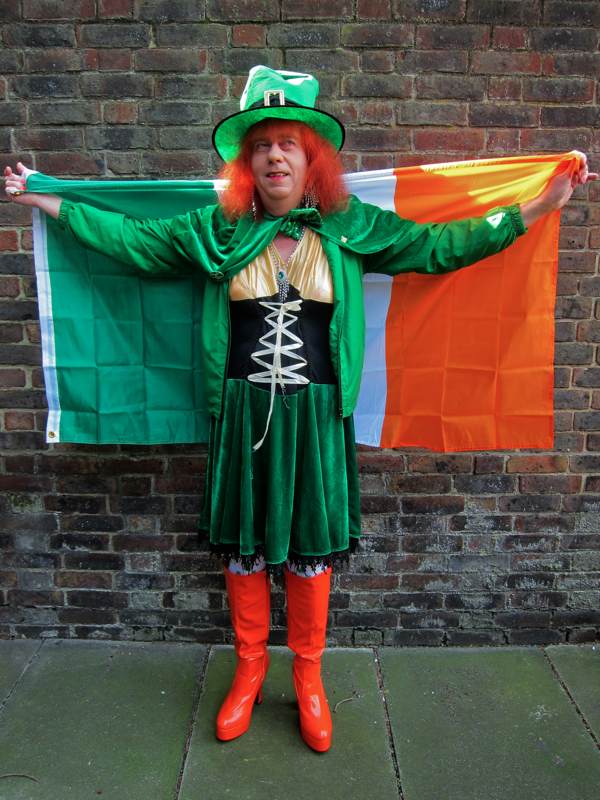
In the East End, we owe a debt of gratitude to Viscountess Boudica of Bethnal Green for her inspirational example in observing each of the festivals of the year with passion and gusto. This week finds her togged up like a cheeky Leprechaun and swigging Guinness as if she was born to it, and when I enquired further I discovered this was precisely the case.
“My people were landowners near Dublin but when Elizabeth I sent her army into Ireland, we were forced to flee to France and then we returned to live in Gloucestershire,” she admitted to me with the melancholy refined smile of one from an ancient aristocratic lineage.“Once when I was a child, we were on holiday in Wales and I stared out to sea – I always felt there was something out there for me,” she continued, getting lost in contemplation as she surveyed the magnificent green and orange decorations that adorned her pink living room.
It was only as an adult that the Viscountess Boudica discovered her true origins. “Even before I found out I was Irish, I knew I was different from everybody else in relating to English culture, ” she confessed to me as she stroked her ginger locks and sipped her Guinness thoughtfully, “Now I’m planning to go to Dublin in the next six months in search of my roots…”

Éirinn go brách


Cá mbeidh tú ag fliuchadh na seamróige?


Sláinte!


Tabhair póg dom, táim Éireannach.



Viscountess Boudica’s jacket with Irish badges from the days she hung out with skinheads

Viscountess Boudica searches for St Patrick’s Day music

Viscountess Boudica recommends The Nolans and Sham 69 for your St Patrick’s Day listening


Viscountess Boudica pulls out one of her old Irish themed coats


Viscountess Boudica models the outfit she has designed for her trip to Dublin in search of her roots
Be sure to follow Viscountess Boudica’s blog There’s More To Life Than Heaven & Earth
Take a look at
Viscountess Boudica’s Domestic Appliances
Viscountess Boudica’s Halloween
Viscountess Boudica’s Christmas
Viscountess Boudica’s Valentine’s Day
Read my original profile of Mark Petty, Trendsetter
and take a look at Mark Petty’s Multicoloured Coats


