
Rush Hour At Liverpool St Station
On Blue Monday, I present my account of the mighty phenomenon that is Rush Hour at Liverpool St Station, complemented by the pictures of Contributing Photographer Simon Mooney, who passes through regularly at that time of the morning and always carries his camera.

At seven, the dark streets of Spitalfields were empty, save the traders waiting outside the market in the rain, yet by then the first commuters were already crossing Liverpool St Station, descending from the trains and walking purposefully into the underground. At this hour before dawn, I found the station hushed and barely anyone spoke, walking swiftly and preoccupied, many were almost sleepwalking – as if they still inhabited the dreams of the night, as if the moment of awakening would be the point of arrival at their destination.
More trains were arriving from eastern counties, each one announced by a loud rattle, thump and hiss, reverberating throughout the cavernous station before another wave of passengers in dark raincoats, and clutching umbrellas and briefcases, poured out into the luminous white concourse. Among a crowd seemingly still intent upon their nocturnal journeys, just a few runners and cyclists punctuated the muted rhythm of the multitude.
Lined up along one side of the vast space, brightly-lit kiosks sold hot drinks – but everyone passed them by, heading for the far end where the escalator creaked, at this hour serving only to transport travellers upward and out of the station. Streaming diagonally from the north-east, where the mainline trains arrive, the primary migration courses towards the City of London at the the south-west corner, drawing all as if by some magnetic force.
Arriving from Walton-on-the-Naze, Thorpe-Le-Soken, Turkey St, Brimsdown, Wivenhoe, Seven Sisters and Silver St, after eight o’clock, the current of humanity is swollen and grown animated, no longer pacing in unison, with more chatting and the occasional smile. The day has broken and the bare murmur of an hour earlier has become the hum of a swarm, teeming through the station. Standing in midst of the current of people when it peaks at eight-thirty, you cannot see through the crush to either end of the station. The momentum of the crowd is palpable, acting upon you as it flows around you like water round a stone in a river. You feel as invisible as a ghost.
You see the masses but you notice the individuals, drawing your attention by a private smile or a fleeting scrap of conversation, and you imagine the dark bedrooms and the alarms that snatched them prematurely from their slumbers, the hot showers that wakened them and the hasty walks to get them to the station.
For a hundred and forty years and throughout the twentieth century, this surging current of humanity has coursed through Liverpool St Station, growing in force. A phenomenon to compete with any migration the natural world has to offer, whether eels, or geese, or even ants, the spectacle of this daily wonder is a fleeting spectre that ebbs and flows, but is entirely incidental to the participants in transit who protect their personal equanimity by resisting the presence of their fellow travellers.
Yet I spot a group of school children in high spirits who are immediately awestruck by the sight of it – as I am – and to them it evokes the magic of the fairground or the carnival, momentarily liberating them to misbehave and play. They recognise the truth of it. With elaborate decorative arches towering overhead, the station is a theatre staging a great epic, performed twice daily, with an infinite cast of characters filling the stage in a chorus of which every one is a leading character, and the drama is called ‘Rush Hour At Liverpool St Station.’


Photographs copyright © Simon Mooney
You may also like to take a look at
Signs Of Life

First Snowdrops in Wapping
Even now, in the depths of Winter, there is plant life stirring. As I travelled around the East End over the past week in the wet and cold, I kept my eyes open for new life and was rewarded for my quest by the precious discoveries that you see here. Fulfilling my need for assurance that we are advancing in our passage through the year, each plant offers undeniable evidence that, although there may be months of Winter yet to come, I can look forward to the Spring that will arrive before too long.

Hellebores in Shoreditch

Catkins in Bethnal Green

Catkins in Weavers’ Fields

Quince flowers in Spitalfields

Cherry blossom in Museum Gardens

Netteswell House is the oldest dwelling in Bethnal Green

Aconites in King Edward VII Memorial Park in Limehouse

Cherry Blossom near Columbia Rd

Hellebores in Spitalfields

Spring greens at Spitalfields City Farm

The gherkin and the artichoke

Cherry blossom in Itchy Park

Soft fruit cuttings at Spitalfields City Farm

Seedlings at Spitalfields City Farm

Cherry blossom at Christ Church
You may also like to read
Sam Syntax’s Cries Of London

Harris, the publisher’s office, at the corner of St Paul’s Churchyard
As I discover more series of Cries of London in my ever-expanding investigation – such as these Sam Syntax Cries from the eighteen-twenties that came to light in the Bishopsgate Institute last week – old friends from earlier series return in new guises, evidencing the degree to which the creators of these popular prints plagiarised each other.
Do you recognise the Hot Cross Bun Seller from the New Cries Of London 1803 or Green Hasteds from Francis Wheatley’s Cries of London or the Watchman from T. L. Busby’s Costume Of The Lower Orders or the Hot Gingerbread Seller from William Marshall Craig’s Itinerant Traders? The recurrence of these figures demonstrates how common images of tradesmen became standardised through repetition over centuries.
Yet equally, when I see a trader here as particular as the toy lamb seller originally portrayed by John Thomas Smith in his Vagabondiana of 1815, it makes me wonder whether, perhaps, this was a portrait of a celebrated individual, a character once recognisable throughout the city.

Eels, Threepence a Pound! Live Eels! & Rabbits! Fresh Rabbits! Buy a Rabbit!

Milk Below, Maids! Milk Below! & One a Penny, Two a Penny, Hot Cross Buns!

Plum Pudding and Pies! Hot! Piping Hot! & Sweep! Sweep Ho! Sweep!

Water Cresses! Buy My Nice Water Cresses! & Dust! Dust Ho! Dust!

Buy a Mat or a Hair Broom! & Cat’s Meat or Dog’s Meat!

Chairs to Mend! Any Old Chairs To Mend! & Green and Young Hastings! Green and Buy!

Swords, Colours and Standards! & Sweet Briar and Nosegays, So Pretty Come and Buy!

Potatoes, Three Pounds A Penny! Potatoes! & Hot Spice Gingerbread! Hot! Hot! Hot!

Lobsters! Live Lobsters! All Alive, Lobsters! & Choice Banbury Cakes! Nice Banbury Cakes!

Lambs To Sell! Young Lambs To Sell! & Currants Red And White, A Penny A Pot!

Flounders! Jumping Alive! Fine Flounders! & Matches, Please To Want Any Matches, Ma’am!

Sixpence A Pottle, Fine Strawberries! & News! Great News In The London Gazette!

Past Twelve O’Clock and A Cloudy Morning! & Patrol! Patrol!

Buy A Live Goose! Buy A Live Goose! & Live Fowls! Live Fowls! Buy A Live Fowl!

Flowers Blowing! All A-Growing! & Winkles! A Penny A Pint, Periwinkles!

Images courtesy © Bishopsgate Institute
You may also like to take a look at these other sets of the Cries of London
More John Player’s Cries of London
More Samuel Pepys’ Cries of London
Geoffrey Fletcher’s Pavement Pounders
William Craig Marshall’s Itinerant Traders
H.W.Petherick’s London Characters
John Thomson’s Street Life in London
Aunt Busy Bee’s New London Cries
Marcellus Laroon’s Cries of London
William Nicholson’s London Types
Francis Wheatley’s Cries of London
John Thomas Smith’s Vagabondiana of 1817
John Thomas Smith’s Vagabondiana II
John Thomas Smith’s Vagabondiana III
Thomas Rowlandson’s Lower Orders
Stuart Freedman’s Pie & Mash & Eels

At Manze’s Tower Bridge Rd, London’s oldest Pie & Mash Shop, which opened in 1897
In days like these, we all need steaming-hot pie & mash & eels to fortify us, as we face the vicissitudes of life and the weather. It gave photographer Stuart Freedman the excuse to visit some favourite culinary destinations and serve up these tasty pictures for us, accompanied by this brief historical introduction as an appetiser.
Eels have long been a staple part of London food and were once synonymous with the city and its people. Lear’s Fool in his ramblings to the King, witters – “Cry to it, nuncle, as the Cockney did to the eels when she put ‘em i’ the paste alive, she knapped ‘em o’ the coxcombs with a stick, and cried ‘Down, wantons, down!’”
In a city bisected by the Thames, the eel’s popularity was that it was plentiful, cheap and, when most meat or fish had to be preserved in salt, eels could be kept alive in puddles of water. Reverend David Badham reports in his ‘Prose Halieutics Or Ancient & Modern Fish Tattle’ in 1854 – “London steams and teems with eels alive and stewed. For one halfpenny, a man of the million may fill his stomach with six or seven long pieces and wash them down with a sip of the glutinous liquid they are stewed in.”
Such was the demand that eels were brought over from The Netherlands in great quantities by Dutch eel schuyts, commended for helping feed London during the Great Fire. Although they were seen as inferior to domestic eels, the British government rewarded the Dutch for their charity by Act of Parliament in 1699, granting them exclusive rights to sell eels from their barges on the Thames.
When the Thames became increasingly polluted and could no longer sustain a significant eel population during the nineteenth century, the Dutch ships had to stop further upstream to prevent their cargo being spoiled and the rise of the Pie & Mash Shops was a direct result of the adulteration of eels and pies sold on the streets.

A delivery of live eels at F. Cooke in Hoxton

Joe Cooke kills and guts the eels freshly at the rear of his shop in Hoxton Market

A dish of jellied eels served up in Hoxton

Paddy makes the pie lids at F. Cooke in Broadway Market

Tasty pies awaiting their destiny in Broadway Market

Joe strains the golden potatoes in Hoxton
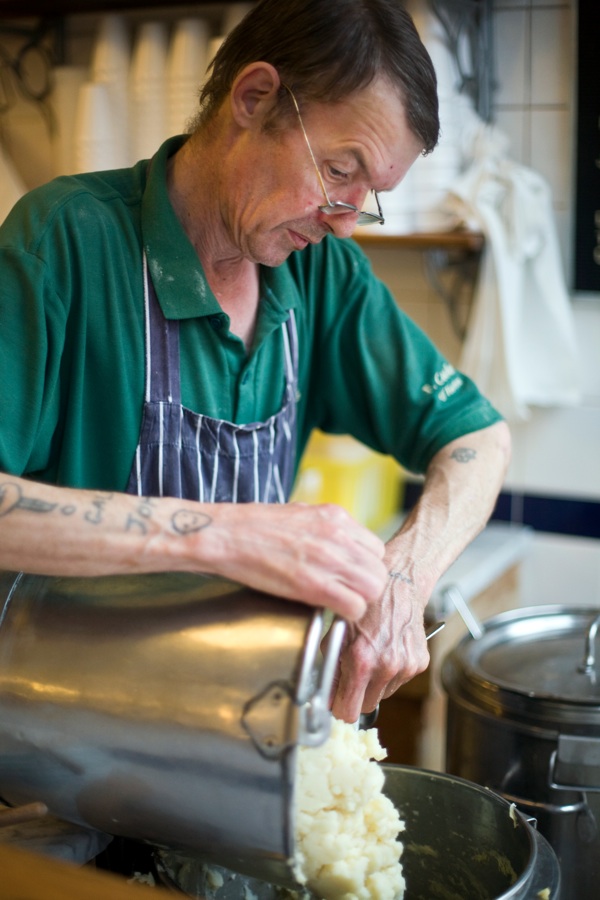
Joe fills a bucket of creamy mash behind the counter in Hoxton

Kelly dishes up pies & mash with liquor at Manze’s in Tower Bridge Rd

Tucking in at Manze’s in Tower Bridge Rd

Manze’s, Walthamstow

Manze’s, Tower Bridge Rd

Sawdust at Manze’s in Walthamstow

Victorian tiling at Manze’s in Tower Bridge Rd

Original 1897 interior at Manze’s in Tower Bridge Rd

Lisa at Manze’s in Walthamstow

Miss Emily McKay enjoying pie & mash as an eighty-eighth birthday treat in Broadway Market

Clock of 1911 at F. Cooke in Broadway Market

Interior of F. Cooke in Broadway Market

F.Cooke – “trading from this premises since 1900”

Enjoying eels in Hoxton Market

Interior of Manze’s in Walthamstow

Art Nouveau tiles in Walthamstow

Vinegar, salt & pepper on marble tables at F.Cooke in Hoxton Market

Wolfing it down at Manze’s in Tower Bridge Rd

Glass teacups at Manze’s in Walthamstow

Wooden benches and tables of marble and wrought iron at Manze’s in Tower Bridge Rd

Bob Cooke, fourth generation piemaker, at F.Cooke in Broadway Market
Photographs copyright © Stuart Freedman
You may also like to read about
Boiling the Eels at Barney’s Seafood
Some Favourite Pie & Mash Shops
T L Busby’s Costume Of The Lower Orders

In spite of the title, there is an encouraging lack of subservience among T L Busby’s lively portraits of the Lower Orders from 1820, which suggests the description may be taken as economic rather than pejorative. Only the beggar woman looks defeated, while the rest are rapt with their intent upon turning a shilling and return our gaze with an eager expectation of doing business, irrespective of their ragged attire. Drawing upon Marcellus Laroon’s Cries of London of one hundred and fifty years earlier, this series certainly make a vivid contrast with Richard Dighton’s City Characters of 1824, who sport a superior quality of tailoring, yet many of whom are almost comatose by comparison with the quick life possessed of these street-wise Lower Orders.


The Waterman displays his the badge of the company he served.
Images courtesy of Bishopsgate Institute
You may also like to take a look at
Thomas Rowlandson’s Lower Orders
More Thomas Rowlandson’s Lower Orders
The Gentle Author’s Wapping Pub Crawl

Four-hundred-year-old stone floor at The Prospect of Whitby
Tempted by the irresistible promise of bright January sunlight, I set out for Wapping to visit those pubs which remain in these formerly notorious riverside streets once riddled with ale houses. Yet although there are pitifully few left these days, I discovered each one has a different and intriguing story to tell.

Town of Ramsgate, 288 Wapping High St. The first alehouse was built on this site in 1460, known as The Hostel and then as The Red Cow from 1533. The pub changed its name again, to the Town of Ramsgate, in 1766 to attract trade from Kentish fishermen who unloaded their catch at Wapping Old Stairs adjoining. Judge Jeffreys was arrested here in disguise, attempting to follow the flight of James II abroad in 1688, as William III’s troops approached London.

The Turk’s Head, 1 Green Bank. Originally in Wapping High St from 1839, rebuilt on this site in 1927 and closed in the seventies, it is now a community cafe.

Captain Kidd, 108 Wapping High St. Established in 1991 in a former warehouse and named after legendary pirate, Wiiliam Kidd, hanged nearby at Execution Dock Stairs in 1701.


Turner’s Old Star, 14 Watts St. In the eighteen-thirties, Joseph Mallord William Turner set up his mistress Sophia Booth in two cottages on this site, one of which she ran as an alehouse named The Old Star. In 1987, the current establishment was renamed Turner’s Old Star in honour of the connection with the great painter. Notoriously secretive about his lovelife, Turner adopted Sophia’s surname to conceal their life together here, acquiring the nickname ‘Puggy Booth’ on account of his portly physique and height of just five feet.

The Old Rose, 128 The Highway. 1839-2007

The last pub standing on the Ratcliffe Highway

The Three Suns, 61 Garnet St. 1851 – 1986

The Prospect of Whitby, 56 Wapping Wall. Founded 1520, and formerly known as The Pelican and The Devil’s Tavern.


What does a cat have to do to get a drink around here?


Sir Hugh Willoughby sailed from The Prospect of Whitby in 1533 upon his ill-fated attempt to discover the North-East Passage to China.

The Grapes, 76 Narrow St. Founded in 1583, the current building was constructed in 1720 – it is claimed Charles Dickens danced upon the counter here as a child.


Anthony Gormley’s sculpture visible from the balcony of The Grapes
You may like to read about my previous pub crawls
The Gentle Author’s Next Pub Crawl
The Gentle Author’s Spitalfields Pub Crawl
Billy & Charley’s Curious Leaden Figures
“Curious leaden figures discovered at Shadwell” read the shameless announcement published in the ‘Illustrated Times’ of February 26th 1859, placed there by George Eastwood, eager dealer in the works of Billy & Charley, two East End mudlarks turned forgers who succeeded in conning the London archaeological establishment for decades with their outlandish and witty creations.
These fine examples of Shadwell shams from the collection of Philip Mernick fascinate and delight me with their characterful demeanours, sometimes fearsome and occasionally daft – inspiring my speculative captions which you see below.

Witch doctor

Telephonist

Blood-thirsty

Indignant

Hookah pipe

Popish

St Peter

Bemused

Listening

Aghast

Weary Conqueror


Surly Knight


CURIOUS LEADEN FIGURES DISCOVERED AT SHADWELL
Announcement by George Eastwood, Billy & Charley’s dealer, published in the Illustrated Times, February 26th, 1859
A very considerable addition has been made during the winter to the singular leaden signacula found at Shadwell, which were the subject of a trial at Guildford. They are now on view at Mr. George Eastwood’s, Haymarket, where they have been inspected by some of the most experienced antiquaries, who, while they one and all concur in asserting the perfect genuineness of these remarkable objects, do not fully agree in explaining the purpose for which they were made. Upon one point there is no dispute, and that is, that the figures date from Queen Mary’s time, and were probably used in religious processions. Some of the badges resemble the earlier pilgrims’ signs.
The centre figure shown in the illustration we give of these additions to archaeological science, is that of a king holding a sword in his left hand and with the other pointing downward. The head is surmounted by a crown, the hair is long and flowing, the beard square in form and the face altogether bears great resemblance to the effigies seen on some of our early Saxon coins. To the right of this figure is another, evidently a bishop, judging from the mitre which he wears – the dress is apparently extremely rich in ornamentation. Immediately in front of thisfigure stands a smaller one, also of an ecclesiastic, but having no inscription on its base like the others. Again, in front of this another mitred statue holding a scepter of globular form at the top and dressed in robes of costly material. To the left are two well-formed bottles with handles, the lesser one having winged figures around the body. The larger one has also figures upon it and a foliated pattern. To the left of the king, who forms the centre of our group, stands a female figure, in not very graceful attitude, bearing a scepter in one hand and having the other resting on her hip. The remainder are but repetitions, to a great extent, of those already described and require no further explanation.
You may also like to take a look at


