
Song Of The Long-Gone
It has been my long-held ambition to publish fiction on Spitalfields Life and today it is my great pleasure to introduce this haunting vignette by Sarah Winman author of When God Was A Rabbit, as the first of three Ghost Stories Of Old London specially written for the occasion by Contributing Writers – Kate Griffin & Rosie Dastgir’s stories will follow tomorrow and the next day.

December 1930. The first flutter of snow fell with dusk and settled quietly along Fleet Lane and Old Bailey. Nobody saw the boy leave the tenement but his footprints were visible as he made his way down to Ludgate Hill, to the warehouses and wharves on the north shore of the Thames.
Trig Lane was snowless. The towering warehouses protected the narrow pass and the boy stood at the top of the steps and let the familiar smell of the river soothe him. The tide was out, the river quiet, the cranes opposite were eerie and still. He was only nine but he looked older because he felt things deeply and was a deep thinker. He listened to the lap of waves upon the shingle and thought it to be the loneliest sound. Like a dog, he heard things that most people didn’t. Sometimes at night, he heard the flick flick flick of ropes against a mast, and sometimes he heard an indescribable sound, a sound that, had he been older, he would have known to be the sound of longing because it lived in the space where his father should have been.
Six months before the boy had asked about his father. Your father was a sailor, his mother had said.
“What was he like?”
“Like you.”
“Where did you meet him?”
“Down by the river.”
“When’s he coming home?”
“Soon.”
“How soon?”
“Christmas soon.”
Six days to go.
The boy stepped down onto the snowy foreshore and ran his hand across a barge sunk low in the ooze. He stumbled to the water’s edge where waves lapped at his ankles and rivermud ate his shoes.
Now is the time, he thought.
Carefully, he took out a boatswain’s whistle from his pocket. His mother had told him it was his father’s whistle and the boy believed her because he needed to. The metal was cold against his lips. He clasped his hand around the narrow tube, placed his finger over the hole, inhaled carefully, and blew. He lifted his finger for another pitch, lowered it, lifted it again until the shrill notes pierced the chill air with their sole intent: You can come home now!
And for hours those notes cut across the river to Southwark, to Bermondsey, to the streets beyond, and business slowed as heads rose from tasks, and conversations halted mid-flow, as memory and, for some, the return of melancholy were stirred by that plaintive call.
In an attic room on Borough High Street, Mr Alfred Booker moved the leather from the last and held up the outline of a shoe to the window pane. In the quiet light, the object was already a thing of beauty, and with poetry in his heart, he looked down at the uneven stumps of his legs – one rooted to the earth, the other falling short – and a life-long sorrow lifted and he whispered through the calling notes, “I am enough.”
And then a mile west, in Gibbin’s confectionary store, young Miss Jevers suddenly halted the sale of her aniseed balls, when she inexplicably cried out, “Actually, I’ve changed my mind!” and they were left rolling in the weighing bowl, as she shuddered at that unnatural happening, that strange occurrence the day her taste changed, when she chose peppermints over aniseed, and when she would later choose Miss Nevis over Mr Greene. And she would remember that day like a birthday, for that was what it was: a new beginning.
And as the notes drifted from the boy’s mouth, so they entered his mother’s heart and took her back to her Past, back down to Wapping High Street and those mossy old steps that glistened with the slap of waves, where she stood, intoxicated, awaiting the shadow of the row boat and the grin of her man and the rough hand that led her up the steep incline, past the laughing singing voices from the Town of Ramsgate, over the cobbled road to the ancient wall of St John’s graveyard, where, giggling through the sacred dark they stumbled towards the broad trunk of a chestnut tree, and there, under the eyes of the Dead, they created life.
You can come home now!
Onwards and upwards those notes twirled, tripping upon the crested waves as the river grew fat, grew dark and high. And some notes fell upon the wings of gulls and were carried downriver beyond Tower Bridge where the Lightermen paused and doffed their caps as a sign of respect to a song they all knew. And some notes were carried down chimneys into hostels and hospitals, soothing the fractured and whispering to the lonely.
On and on the boy played, lost in his song, unaware of the mud sucking at his knees and the water swirling about his neck.
Candles were lit across the city and people spoke to those they didn’t know and grievances were forgotten and extra places were laid at tables and hats were raised and smiles replaced frowns and unspoken memories were spoken of once again. And the boy felt warm and never felt the icy blast that swamped his lungs and stilled his heart and never felt the blanket of eternal dark that fell like night because that was the moment when he saw a face, and it was a bright face with a wide grin surrounded by light. And it was his face but so much older.
You came home, said the boy.

Glass slides courtesy Bishopsgate Institute
St Paul’s Of Old London

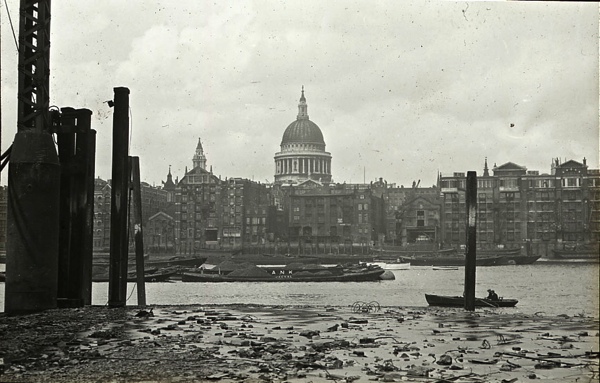
At midnight on Christmas Eve, I found myself standing inside St Paul’s Cathedral among the the company of several hundred other souls. The vast interior space of the cathedral is a world unto itself when you are within it, as much landscape as architecture, yet when the great clock struck twelve overhead, my thoughts were transported to the rain falling upon the empty streets in the dark city beyond. Perhaps I was thinking of some of these lantern slides created a century ago by the London & Middlesex Archaeological Society for lectures at the Bishopsgate Institute?
Until 1962, St Paul’s was the tallest building in London and, in my perception of the city, it will always stand head and shoulders above everything else. Even before I saw it for myself, I already knew the shape of the monstrous dome from innumerable printed images and looming skyline appearances in films. Defying all competition, the great cranium of the dome contains a spiritual force that no other building in London can match.
A true wonder of architecture, St Paul’s never fails to induce awe when you return to it because the reality of its scale always surpasses your expectation – as if the mind itself cannot fully contain the memory of a building of such ambition and scale. No-one can deny the sense of order, with every detail sublimated to Sir Christopher Wren’s grand conception, yet the building defies you.
Although every aspect has its proportion and purpose, the elaborate intricacy expresses something beyond reason or logic. You are within the skull of a sleeping giant, dreaming the history of London, with its glittering panoply and dark episodes. The success of this building is to render everything else marginal, because when you are inside it you feel you are at the centre of the world.




Glass slides courtesy Bishopsgate Institute
You may also like to take a look at
The Lantern Slides of Old London
The High Days & Holidays of Old London
The Fogs & Smogs of Old London
The Forgotten Corners of Old London
The Statues & Effigies of Old London
Viscountess Boudica’s Christmas

Let it be said that if anyone in the East End knows how to keep the spirit of Christmas, it is the Viscountess Boudica of Bethnal Green. At this time of year, her tiny flat near Columbia Rd is transformed into a secret Winter Wonderland where the visitor may forget the chill of the gloomy streets outside and enter a realm of magic, fantasy and romance in which the Viscountess holds court like a benevolent sprite or fairy godmother, celebrating the season of goodwill in her own inimitable style.
Boudica had already been at work for weeks when I arrived with my camera to capture the Christmas spectacle for your delight, yet she was still putting the finishing touches to her display even as I walked through the door. “You see these bells?” she said, reaching up to add them to the colourful forest of paper decorations suspended from the ceiling,“I bought them in Woolworths in Tottenham for 45p in 1984. When I think of all the people they have looked down upon – if only these bells could talk, they’ve seen it all!”
Evidence of the season was apparent wherever I turned my eyes, from the illuminated coloured trees that filled each corner – giving the impression that the room was actually a woodland glade – to the table where Boudica was wrapping her gifts and writing cards, to the corner where a stack of festive records awaited her selection, to the innumerable Christmas knick-knacks and figures that crowded every surface, and the light-up reindeer outside in the garden, glimpsed discreetly through the net curtains. “This is thirty years worth of collecting,” she explained, gesturing to the magnificent display enfolding us, “that set of lights is older than I am.”
In common with many, this is an equivocal time for Viscountess Boudica who does not have happy childhood memories of Christmas. “It was hell,” she admitted to me frankly, “We didn’t have any money to buy presents and, in our family, Christmas was always when fights and arguments would break out. The reason I have so many decorations now is to make up for all the years when I didn’t have any.” Yet Boudica remembers small acts of kindness too. “The local shops used to save me their balloons and give me scraps of fabric that I used to make clothes for the kittens in the barn – and that was the beginning of me making my own outfits,” she recalled fondly.
“People should remember what it’s all about,” Boudica assured me, linking her own childhood with the Christian narrative,“It’s about a little boy who didn’t have a home. They should think of others and remember there’s poor people here in Bethnal Green.” Naturally, I asked the Viscountess if she had a Christmas message for the world and, without a second thought, she came to back to me with her declaration – “Be kind to each other and get rid of discrimination!”


Boudica contemplates her Christmas listening – will it be Andy Williams or Jim Reeves this year?

“Whenever I hang up these bells, I think of all the people they have looked down upon over the years”


Wrapping up her gifts.


Filling her stocking


Nollaig Shona Dhaoibh!


Drawings copyright © Viscountess Boudica
You may like to read my other Christmas stories
Christmas At Gardners Market Sundriesmen

Paul Gardner takes last-minute Christmas orders for paper bags
The grey streets were empty with the first drops of rain falling yesterday, as I made my way to visit my friend Paul Gardner, the paper bag baron and fourth generation proprietor of the Gardners’ Market Sundriesmen, the oldest family business in Spitalfields. Yet the lights were gleaming brightly at his shop in Commercial St upon all the colourful bags, stacked in such appealing disarray as if a shipload of paper bags had been wrecked and washed up here upon the tide.
“Stephen’s been here helping me, as it’s been mental,” admitted Paul with a significant cheery gesture towards the mysterious darkness at the rear of the shop where his son – recently returned from Latin America – was now taking on the formidable challenge of organising Paul’s stock room. “People do wonder how I find anything and it doesn’t normally matter, but packets were falling on Stephen’s head,” Paul confessed to me with an explanatory grimace, “Now, if I say ‘twisted handle brown paper carrier bags’ he knows where they are.”
And thus it is that for the first time in a generation, the use of the plural on the shop sign, “Gardners Market Sundriesmen” has its literal meaning once more.
Meanwhile, as passersby struggled up Commercial St with their feeble umbrellas turning inside-out in the accumulating gale-force winds, inside Paul’s shop, the Christmas storm appeared to have already passed through. “I could possibly take the day off on Christmas Eve,” he deliberated idly, egged on by his son,“but I promised to deliver to the Beigel Bakery and I’ll be up at five-thirty anyway…”
Paul’s dilemma was left unresolved because Stanley, a fellow Market Sundriesman and long-standing customer who trades in paper bags from the back of a van, popped by to pick up stock and dispense greetings. “It’s changed a lot round here in thirty-two years, it’s a different life !” he declared in disbelief, shaking Paul’s hand forcibly with an excess of season goodwill, “Not that he has changed, just got more curly.”
Upon his swift departure, a girl with waist-length red hair stumbled in from the storm, her bleary eyes widening in amazement at the spectacle. “Hello!” she announced in delight, “I’ve not been here before – it’s fantastic!” Paul proposed candy-striped bags, as the most suitable for the chocolates she was making as gifts. “Red and green are very popular at this time of year,” he ventured tentatively as she made a reckoning of the contents of the coins in her purse. “I only need about ten,” she revealed apologetically. “That’ll be fifty pence for ten,” Paul answered, causing her to break into a big smile. “I’ll take another five,” she decided recklessly.
The downpour had begun and an exhausted shopkeeper in a wet coat was next through the door. “F*ck Christmas! It’s so stressful,” he pleaded wearily, “I never get a chance to enjoy it, so I’m taking three days off including Friday – that’s not a luxury is it? I’ve had such a crappy year.” Paul, Stephen and me, we all nodded sagely in confirmation of his wise decision, and – resolved – he took his bags and left quickly.
Yet Paul was still uncertain regarding the big question of Christmas Eve opening.“I’ve stayed here before on Christmas Eve and taken a fiver and got fed up and gone home,” he recalled, thinking out loud for the benefit of Stephen and me, until we were interrupted again. “I’ve got to leave at once!” gasped the visitor, gesturing to his vehicle parked on the red route outside,“I’ve got all the cameras watching me with the compliments of the season.” Next came a man in an ankle-length military coat who wanted butcher’s hooks and then a fashionably-dressed woman who needed three hundred popcorn bags, “for the Secret Cinema at the Troxy.”
“My mum sounded fed up on the phone,” Paul confided to me during a lull in the morning,“So Stephen, Robert and me, we’re going to get up at dawn on Christmas Morning and drive down to her house at Frinton. Then we’re going to call her and tell her to get up because Father Christmas is outside, and Robert’s going to play his trombone!” Father and son exchanged a mischievous smile of complicity in anticipation of the imminent festival.
“All these bloody Christmas shoppers!” the manager of a local shoe shop exclaimed in near-hysteria – breaking our reverie as he barged through the door – dripping with rain and glowing in frustration,“The General Public turned into savages yesterday. Everyone’s buying double of everything – I only wish the coppers were going into my pocket.” Then he staggered off with an armful of carrier bags that seemed to placate his emotion. And there were no more customers and a silence fell upon the shop as the trade ebbed away.
“I’ve been pleasantly surprised,” said Paul, when the time came to close up and depart into the raging storm outside, “It’s always hit and miss at Christmas.”
“I’ll come in early in the morning tomorrow and see what happens,” he decided, heartened by the day’s custom and discovering resolution all-of-a-sudden, “I’ve got two days holiday after that and then the weekend, so it’s not too bad.”

Paul’s son Stephen has just returned from travelling through Latin America

Paul & Stephen, fourth and fifth generation Market Sundriesmen

Paul mans the counter at the front …

… while Stephen organises the stock at the rear

Stephen takes a turn behind the counter – “Are you his son? You look like him?”

Stanley, a customer of thirty-two years standing, pops by to deliver a Christmas greeting – “It’s changed a lot round here in thirty-two years, it’s a different life! Not that he has changed, just got more curly.”
Gardners’ Market Sundriesmen, 149 Commercial St, E1 6BJ (open from 6:30am on Christmas Eve)
You may like to read my other stories about Paul Gardner
Paul Gardner, Paper Bag Seller
At Gardners’ Market Sundriesmen
Joan Rose at Gardners’ Market Sundriesmen
Christmas Meat Auction At Smithfield
I am publishing my story of the Christmas Eve Meat Auction at Smithfield today as a reminder to any readers who may wish to go along tomorrow, because – unless SAVE Britain’s Heritage is successful in preventing the proposed demolition of the General Market next year – this could be your last chance to witness this annual tradition.

The carnivores of London converged upon Smithfield Market, as they do every year for the annual Christmas Eve auction staged by Harts the Butcher. At ten in the morning, the rainy streets were almost empty yet, as I came through Smithfield, butchers in white overalls were wheeling precarious trolleys top-heavy with meat and fowls over to the site of the auction where an expectant crowd of around a hundred had gathered, anxiously clutching wads of banknotes in one hand and bags to carry off their prospective haul in the other.
Contributing Photographer Colin O’Brien met me there. He grew up half a mile away in Clerkenwell during the nineteen fifties and, although it was his first time at the auction, he remembered his father walking down to Smithfield to get a cheap turkey on Christmas Eve more than sixty years ago. Overhearing this reminiscence, a robust woman standing next to us in the crowd struck up a conversation as a means to relieve the growing tension before the start of the auction which is the highlight of the entire year for many of stalwarts that have been coming for decades.
“You can almost guarantee getting a turkey,” she reassured us with the authority of experience, revealing she had been in attendance for fifteen successive years. Then, growing visibly excited as a thought came into her mind, “Last year, I got thirty kilos of sirloin steak for free – I tossed for it!”, she confided to us, turning unexpectedly flirtatious. Colin and I stood in silent wonder at her good fortune with meat.“We start preparing in October by eating all the meat in the freezer,” she explained, to clarify the situation. “Last night we had steak,” she continued, rubbing her hands in gleeful anticipation, “and steak again tonight.”
Yet our acquaintance was terminated as quickly as it began when the caller appeared in a blood-stained white coat and red tie to introduce the auction. A stubby bullet-headed man, he raised his hands graciously to quell the crowd. “This is a proper English tradition,” he announced, “it has been going on for the last five hundred years. And I’m going to make sure everybody goes away with something and I’m here to take your money.”
His words drew an appreciative roar from the crowd as dozens of eager hands were thrust in the air waving banknotes, indicative of the collective blood lust that gripped the assembly. Standing there in the midst of the excitement, I realised that the sound I could hear was an echo. It was a reverberation of the famously uproarious Bartholomew Fair which flourished upon this site from the twelfth century until it was suppressed for public disorder in 1855. Yesterday, the simple word “Hush!” from the caller was enough to suppress the mob as he queried, “What are we going to start with?”
The answer to his question became manifest when several bright pink loins of pork appeared as if by magic in the hatch beside him, held by butchers beneath, and dancing jauntily above the heads of the delighted audience like hand puppets. These English loins of pork were soon dispatched into the crowd at twenty pounds each as the curtain warmer to the pantomime that was to come, followed by joints of beef for a tenner preceding the star attraction of day – the turkeys! – greeted with festive cheers by the hungry revellers. “Mind your heads, turkeys coming over…” warned the butcher as the turkeys in their red wrappers set out crowd-surfing to their grateful prospective owners as the cash was passed hand to hand back to the stand.
It would not be an understatement to say that mass hysteria had overtaken the crowd, yet there was another element to add to the chaos of the day. As the crowd had enlarged, it spilled over into the road with cars and vans weaving their through the overwrought gathering. “I love coming for the adventure of it,” declared one gentleman with hair awry, embracing a side of beef protectively as if it was the love of his life, “Everyone helps one another out here. You pass the money over and there’s no pickpockets.”
After the turkeys came the geese, the loins of lamb, the ribs of beef, the pork bellies, the racks of lamb, the fillet steaks and the green gammon to complete the bill of fare. As the energy rose, butchers began to throw pieces of red meat into the crowd to be caught by their purchasers and it was surreal to watch legs of lamb and even suckling pigs go flying into the tumultuous mass of people. Finally, came tossing for meat where customers had the chance of getting their steaks for free if they guessed the toss correctly, and each winning guess was greeted with an exultant cheer because by then the butchers and the crowd were as one, fellow participants in a boisterous party game.
Just ninety minutes after it began, the auction wrapped up, leaving the crowd to consolidate their proud purchases, tucking the meat and fowls up snugly in suitcases and backpacks to keep them safe until they could be stowed away in the freezer at home. In the disorder, I saw piles of bloody meat stacked on the muddy pavement where people were tripping over them. Yet a sense of fulfilment prevailed, everyone had stocked up for another year – their carnivorous appetites satiated – and they were going home to eat meat.
As I walked back through the narrow City streets, I contemplated the spectacle of the morning. It resembled a Bacchanale or some ancient pagan celebration in which people were liberated to pursue their animal instincts. But then I realised that my thinking was too complicated – it was Christmas I had witnessed.


Photographs copyright © Colin O’Brien
You might also like to read about
David Hoffman At Crisis At Christmas

Almost by chance, at the end of the seventies, photographer David Hoffman found himself recording the formation of an organisation called Crisis at Christmas that opened up disused spaces and created temporary shelters staffed by volunteers to provide accommodation for the homeless through the holiday season when other shelters were shut.
As a participant rather than a visitor, David was able to take intimate photographs of those who sought refuge, capturing emotional images which are compassionate yet void of sentimentality.
There is a timeless quality to many of these pictures that could equally be of refugees from a war zone or in some apocalyptic dystopian vision of the future, yet this is London in the recent past and Crisis at Christmas is still with us and the work goes on.
“At the time, I was known for my photos of the homeless at St Botolph’s in Aldgate and I was going out with a girl named Peta Watts, who was working at Crisis at Christmas – so when she asked me to take pictures there, I leapt at the chance of becoming the Crisis photographer, and I did it for three years.
This was the early days of these shelters and they used derelict churches. One of them was St Philip & St Augustine in Whitechapel, round the corner from the squat where I lived in Fieldgate Mansions, and the next year it was at the Tradescant church of St Mary’s in Lambeth. So there were very little facilities – perhaps only a cold tap and one toilet for hundreds of people – and the whole thing was a chaotic feat of organisation, but somehow it all worked. They got donations of food and clothing and toys. And I remember some of the guys found an old bath tub in a skip and brought it in and filled it with water, so they could wash themselves. There was no regard to Health & Safety or regulation as we know it, but it all worked brilliantly and everyone was very well looked after. There was no hierarchy and the homeless people would be involved in the cooking and arranging the mattresses, and keeping the whole thing running.
I photographed it because it was a wonderful event and – like at St Botolph’s – some of the people were couples, and I took their pictures and brought them prints the next day. Many of these people had been living on the streets all year and the photographs helped them to have a more positive self-image.
Some would be shooting up and and others would be drinking, and an ambulance would come two or three times a day to pick people up. There were fights too, and I remember there was an unspoken rule that only one volunteer would approach to break it up by speaking softly – and it never failed. Many of the volunteers were middle class people who would work eighteen to twenty hours a day. What I liked about it was people coming together and doing things for themselves – and it just worked, and the homeless people looked after each other.”


Photographs copyright © David Hoffman
Click here to donate to Crisis At Christmas
You may like to take a look at these other pictures by David Hoffman
Midwinter Light At Christ Church

Today is the shortest day of the year and, at eleven minutes past five this afternoon, we pass the solstice taking us back towards shorter nights and longer days. At this time when the sun is at its lowest angle, Christ Church Spitalfields can become an intricate light box with powerful rays of light entering almost horizontally from the south and illuminating Nicholas Hawksmoor’s baroque architecture in startling ways. Yesterday’s crystalline sunlight provided the ideal conditions for such phenomena and inspired my to attempt to capture of these fleeting effects of light.


You may also like to read about


