
At Hyper Japan
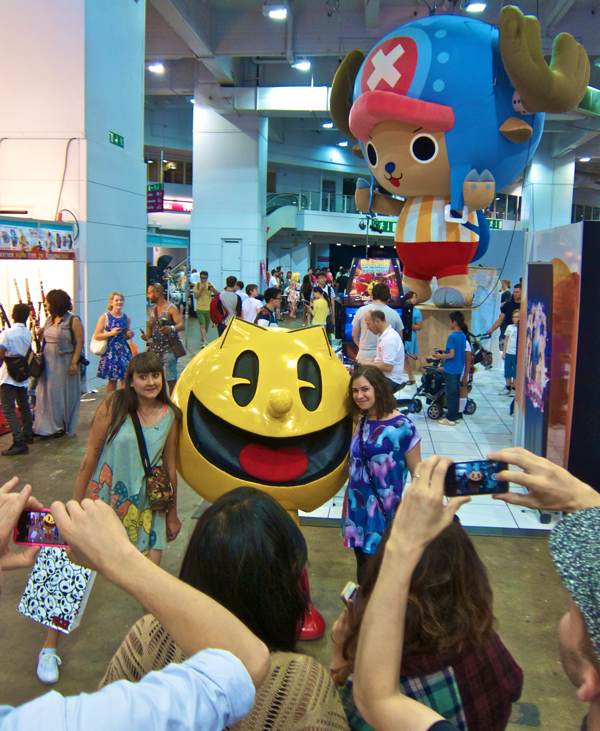
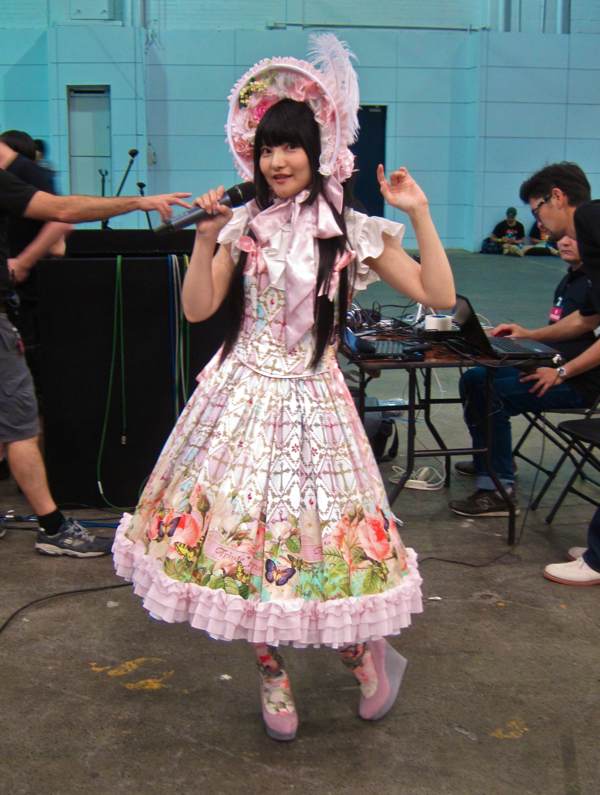
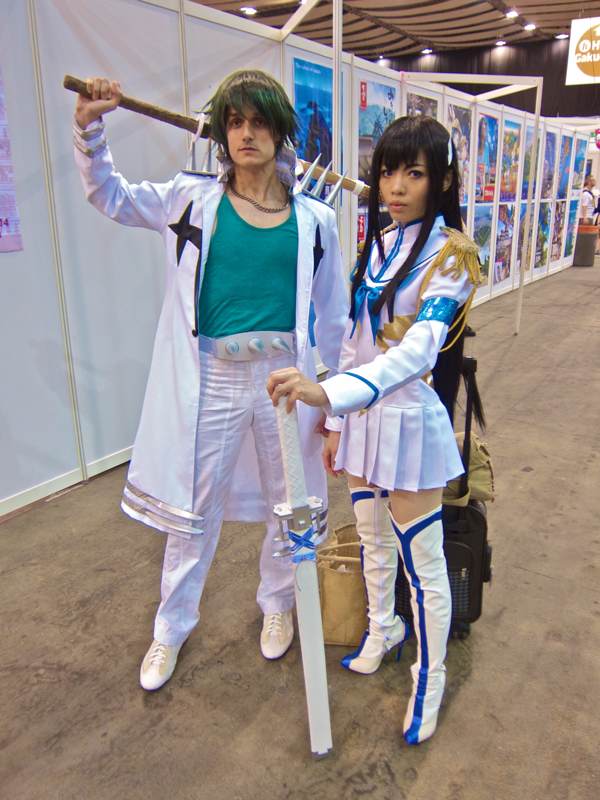
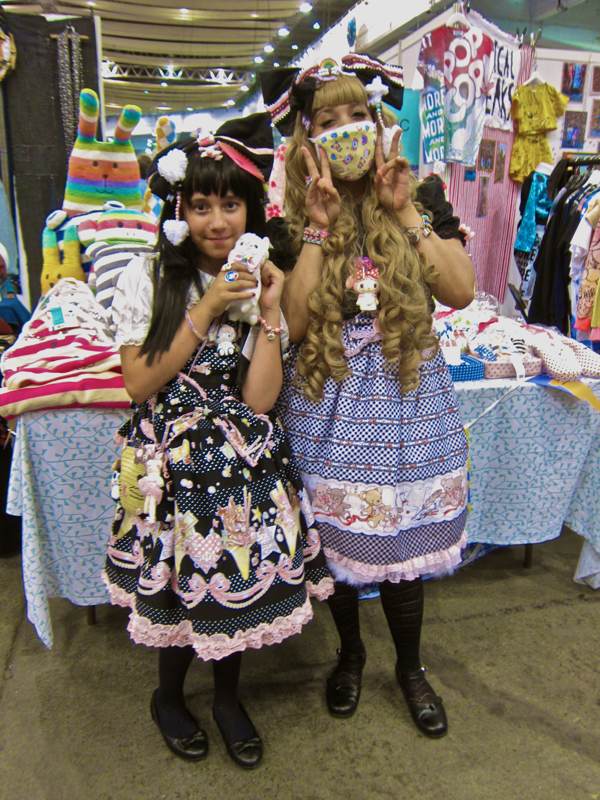
On Saturday, Earls Court was teeming with manga characters – from fairies to steam-punks and schoolgirls to super-heroes. There were those with pointy ears, there were those with tails and plenty with primary-coloured hair. Some were ferocious and other were funny, yet they all shared a sense of joy in the Japanese art of dressing up extravagantly and embodying your fantasy in public that is known as ‘cosplay.’ Hyper Japan promises video games, pop music, sushi, samurai swords, bonsai, comics, and more – but it was the costumed characters in their glory that stole the day.

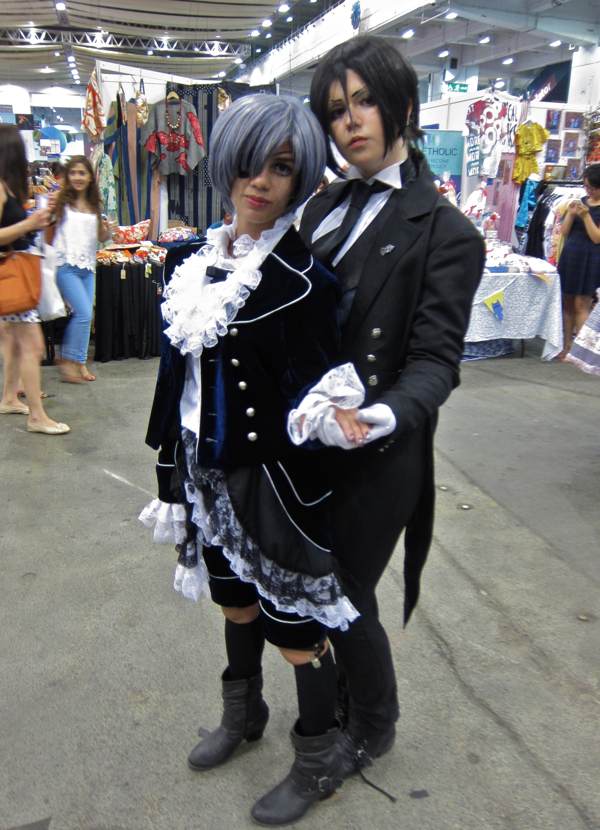
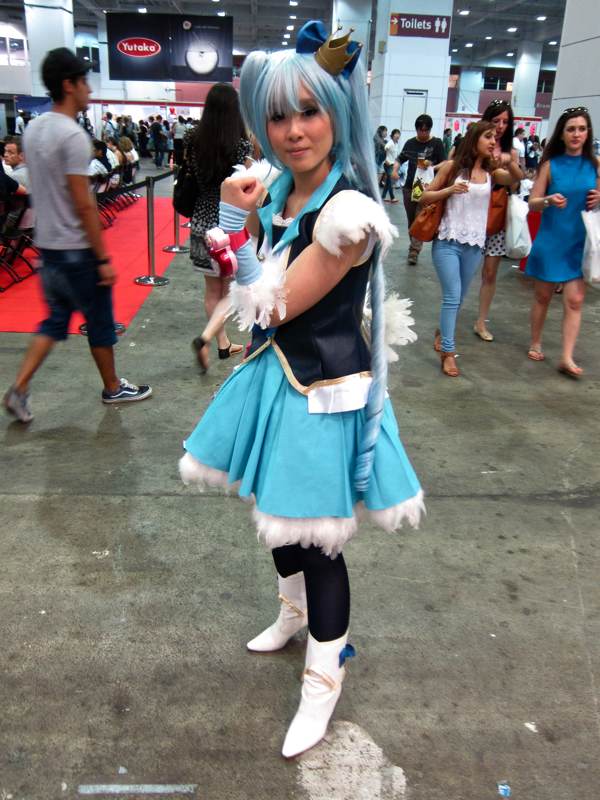


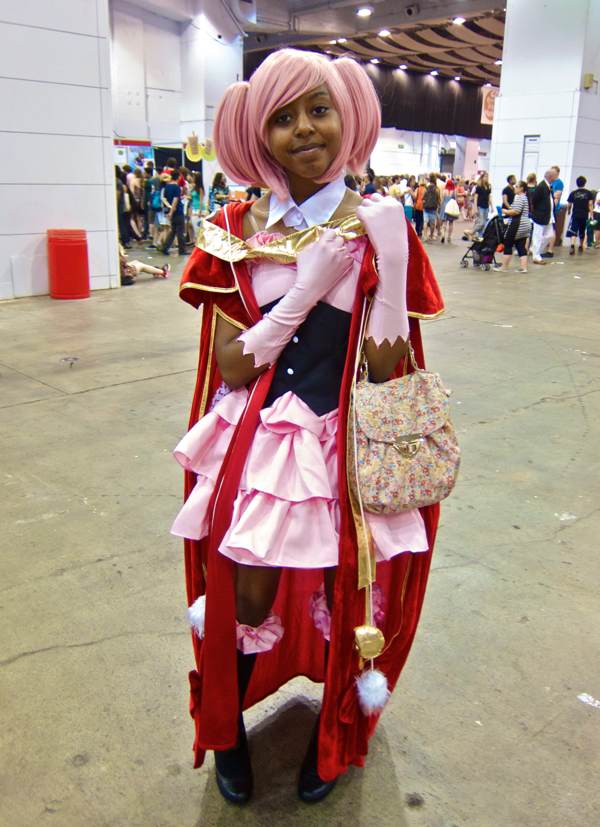
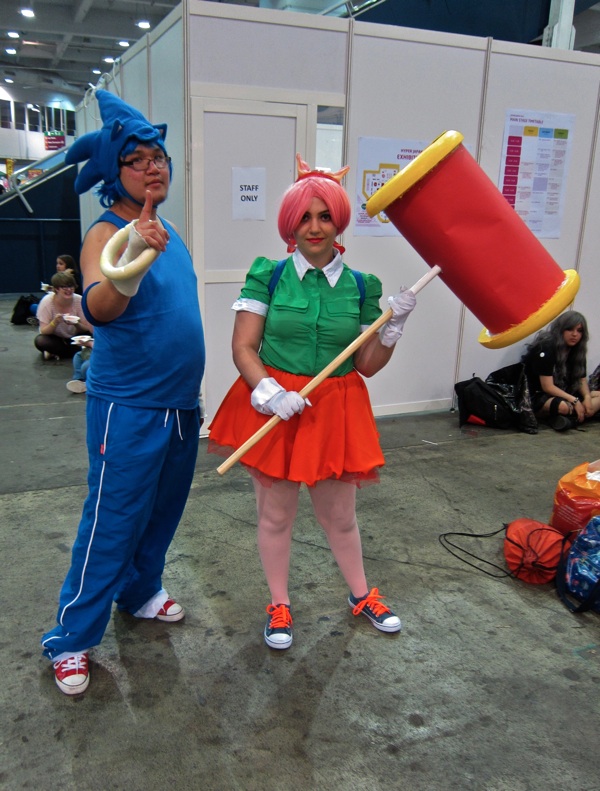
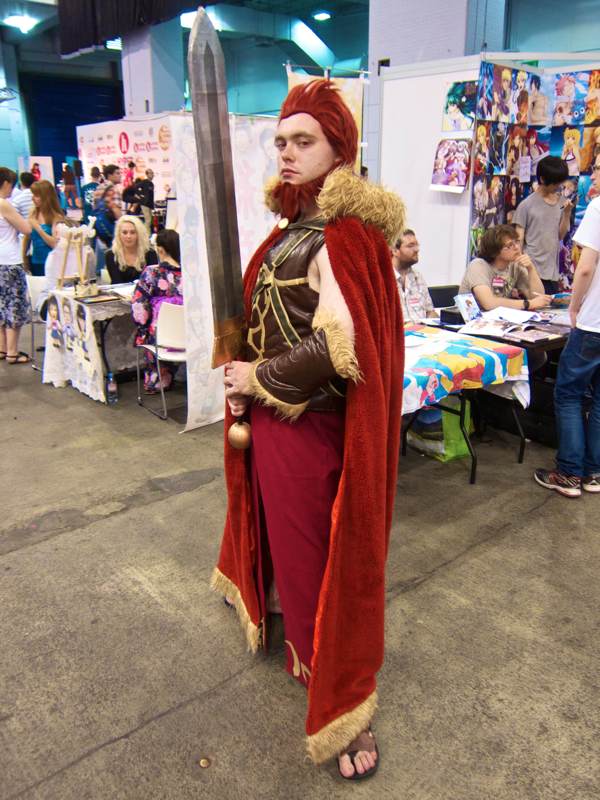

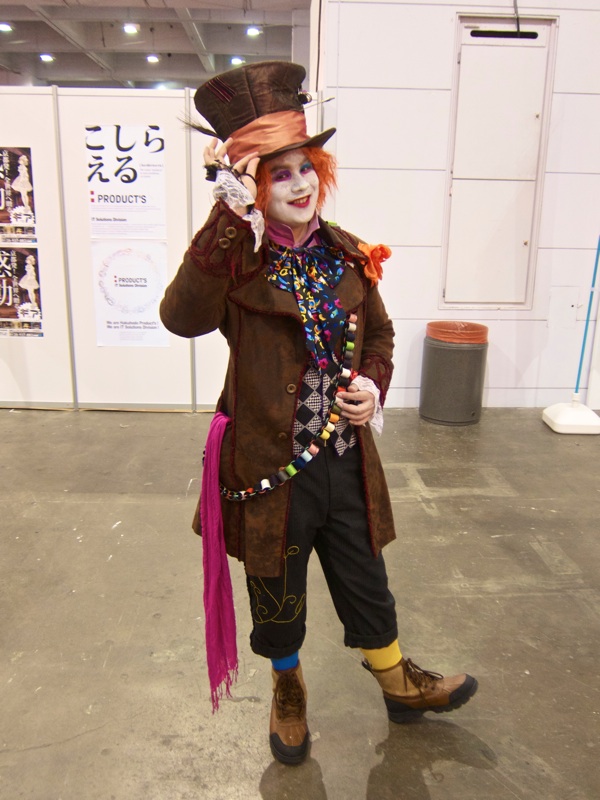
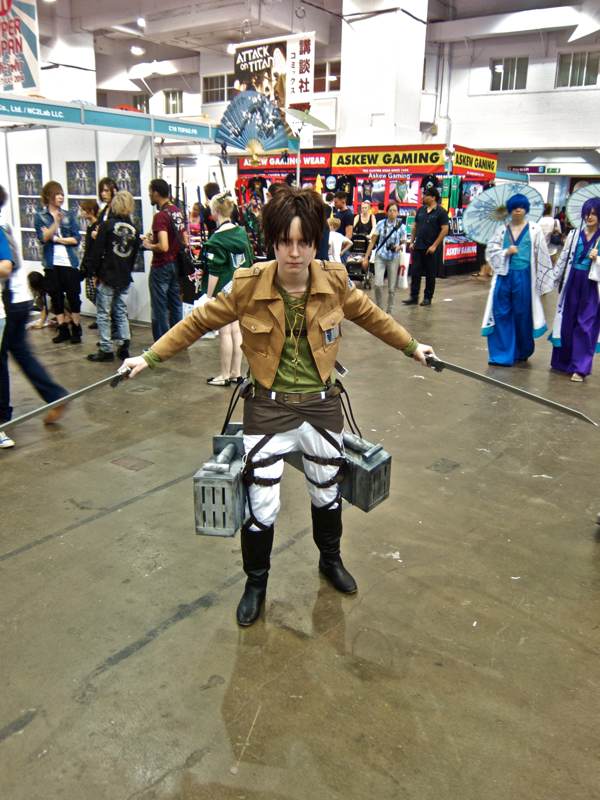
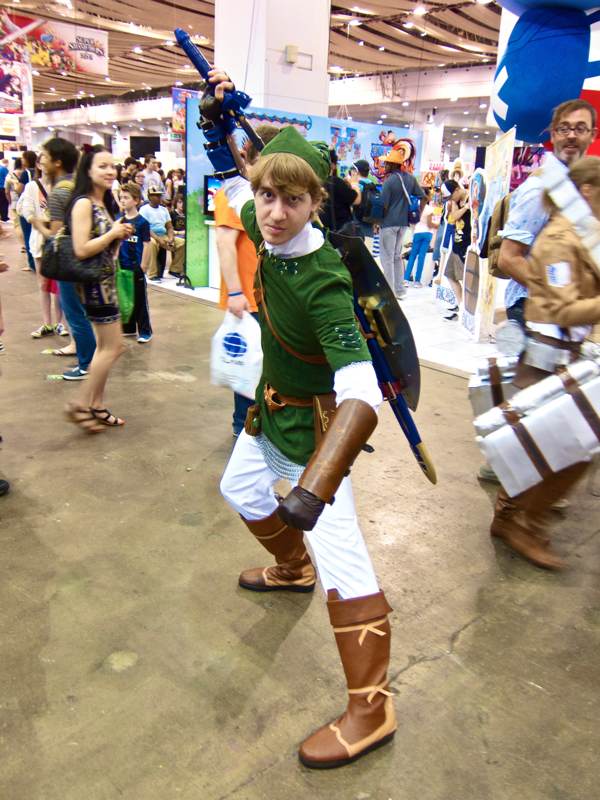
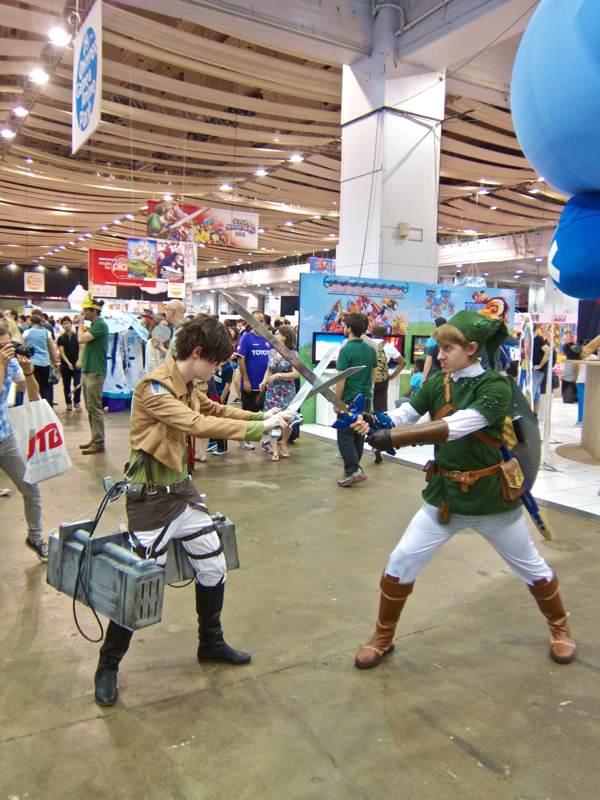


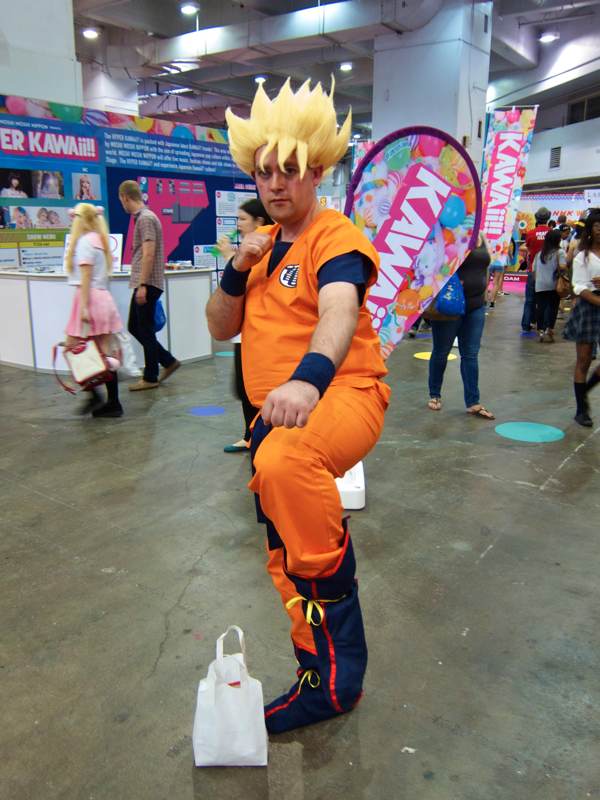

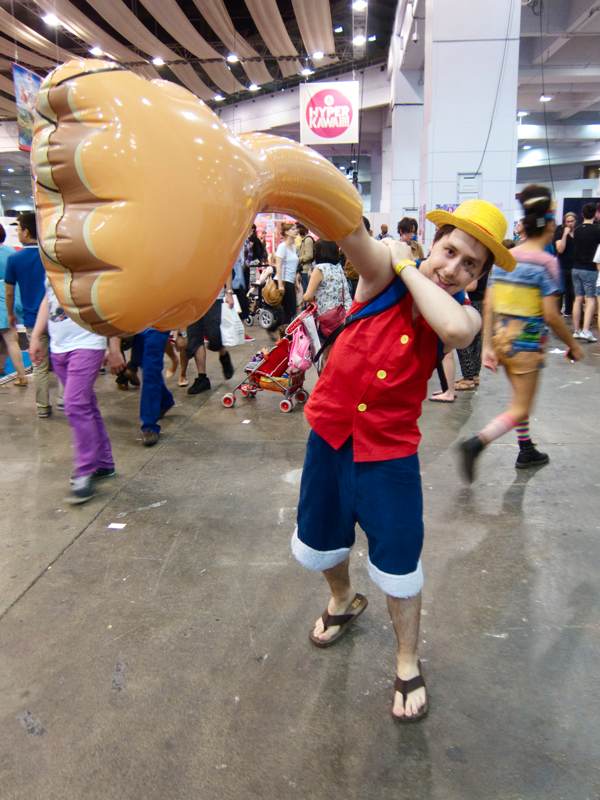
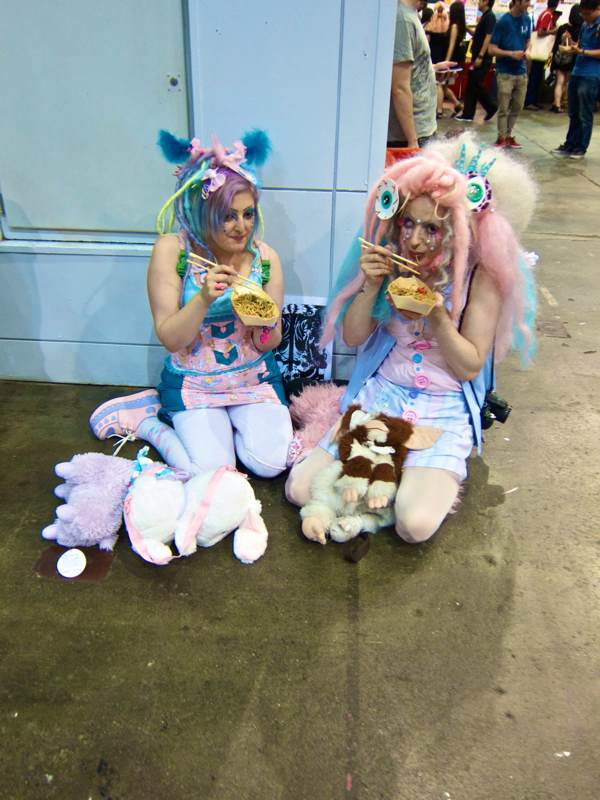
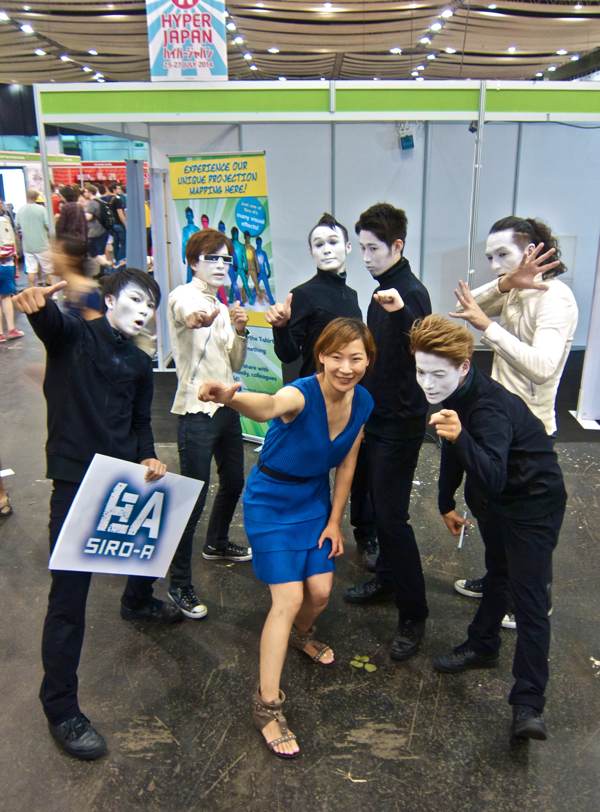
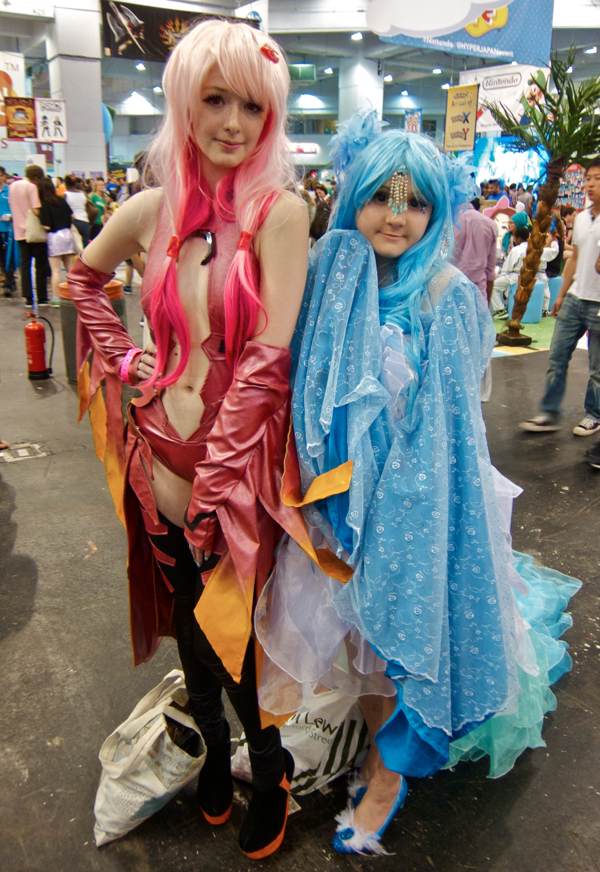
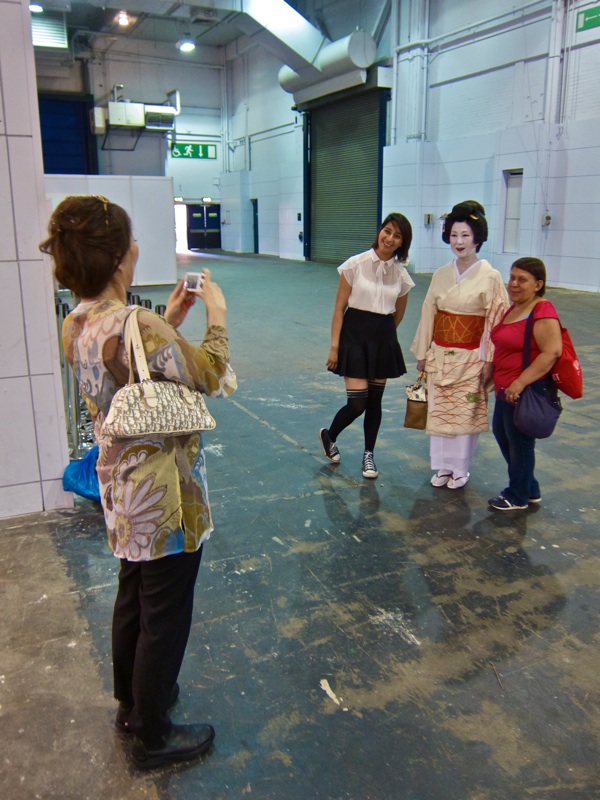

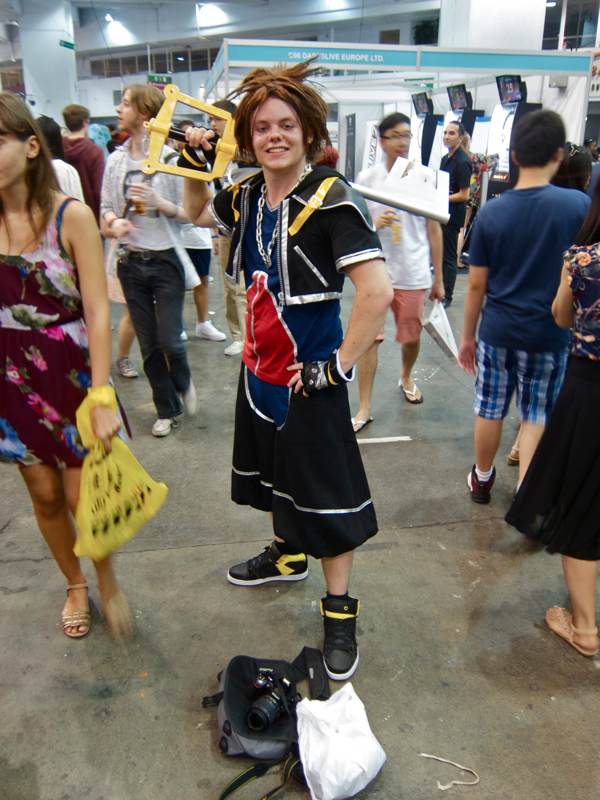
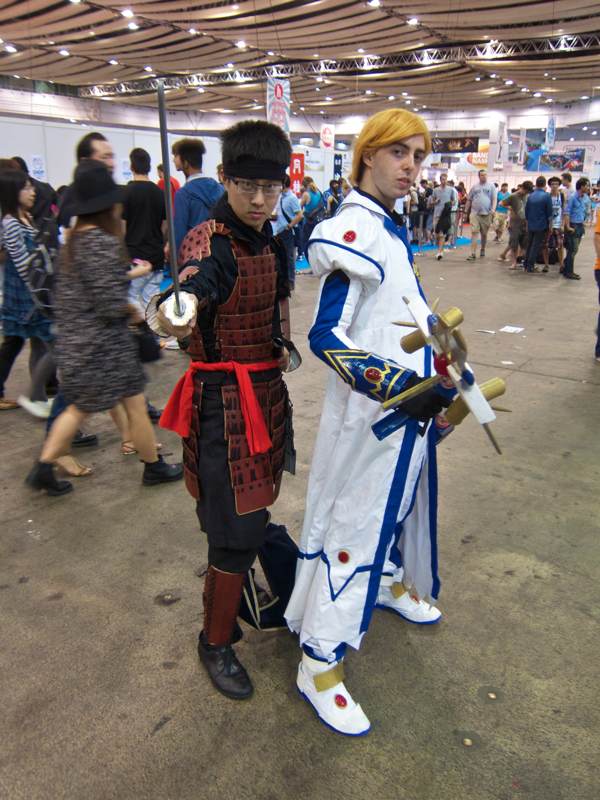

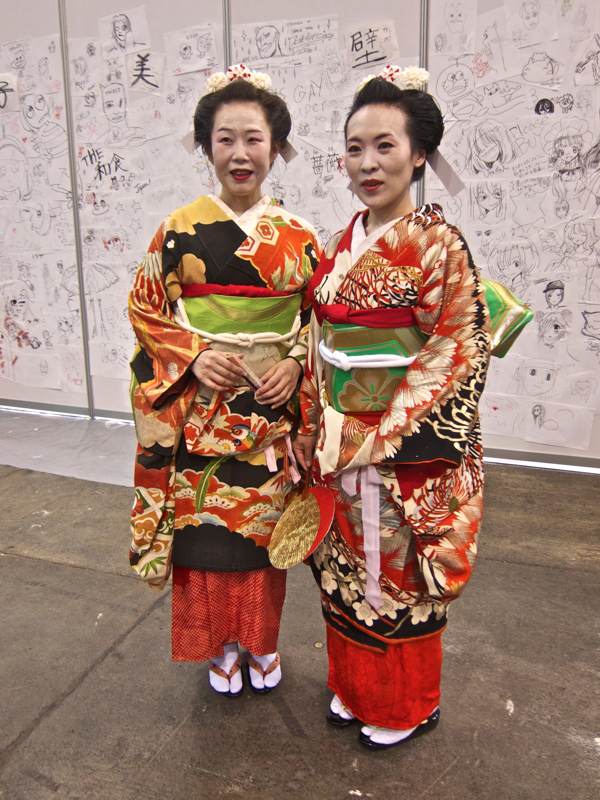

The last day of Hyper Japan 2014 is at Earls Court today from 9:30am until 6:00pm
Charles Hindley’s Cries Of London
The most recent acquisition in my Cries of London collection is a second edition of Charles Hindley’s ‘History of the Cries of London, Ancient & Modern’ from 1884. My predecessor had the same idea to collect images of the Cries and trace their development over time and, in his book, he reprints many wood blocks from earlier chapbooks, including the set below. Originally just the size of a thumbnail, these anonymous finely-observed prints evoke the circumstance and demeanour of hawkers and pedlars in early-nineteenth century London with startling economy of means.
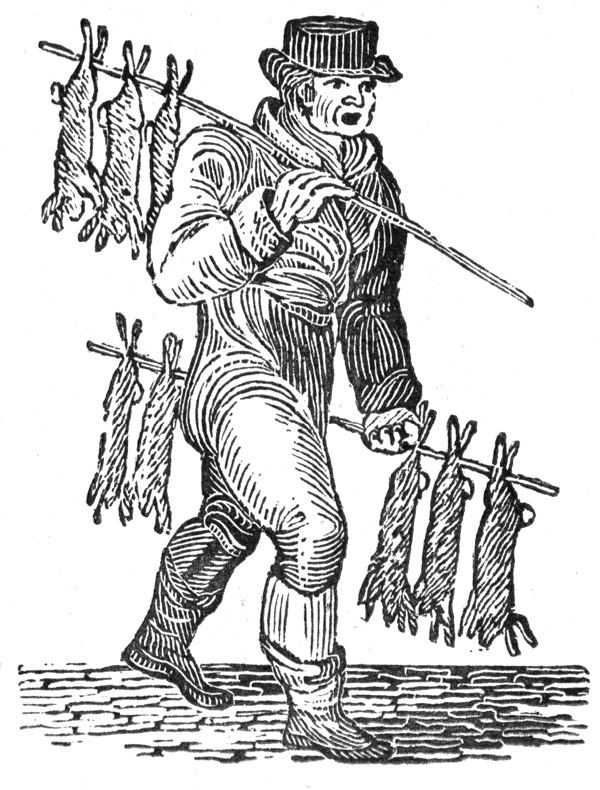
The Rabbit Man – Buy my rabbits! Rabbits, who’ll buy? Rabbit! Rabbit Who will buy?
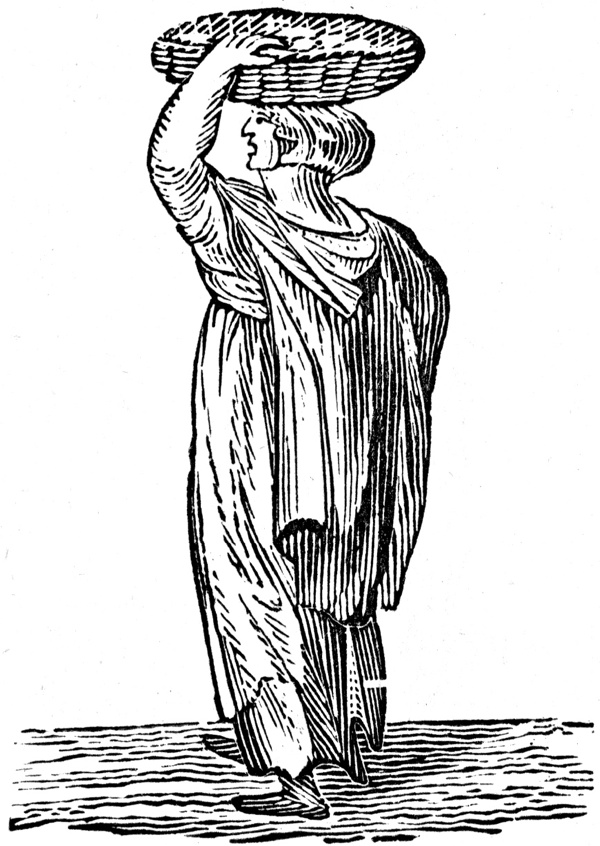
New Cockles – Buy my cockles! Fine new cockles! Cockles fine and cockles new!
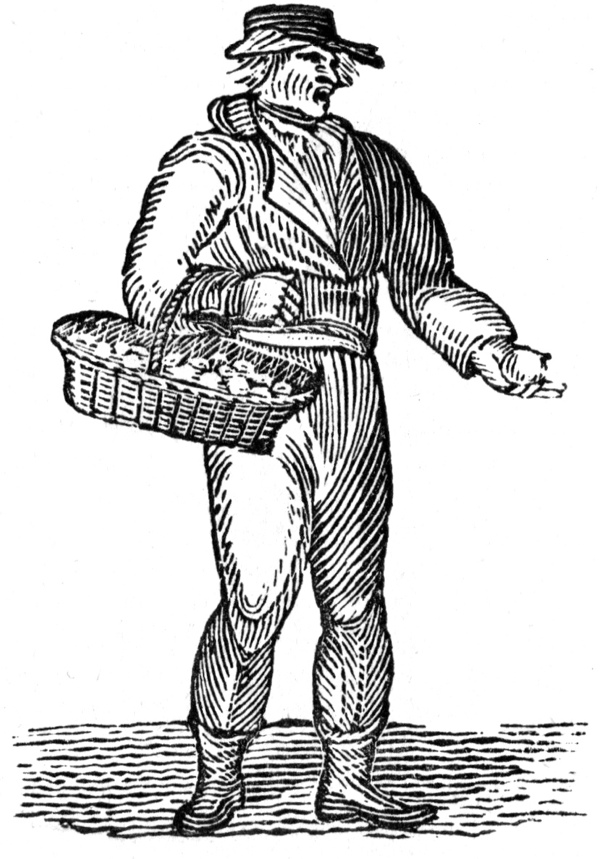
Banbury Cakes – Buy my nice and new Banbury Cakes! Buy my nice new Banbury Cakes, O!
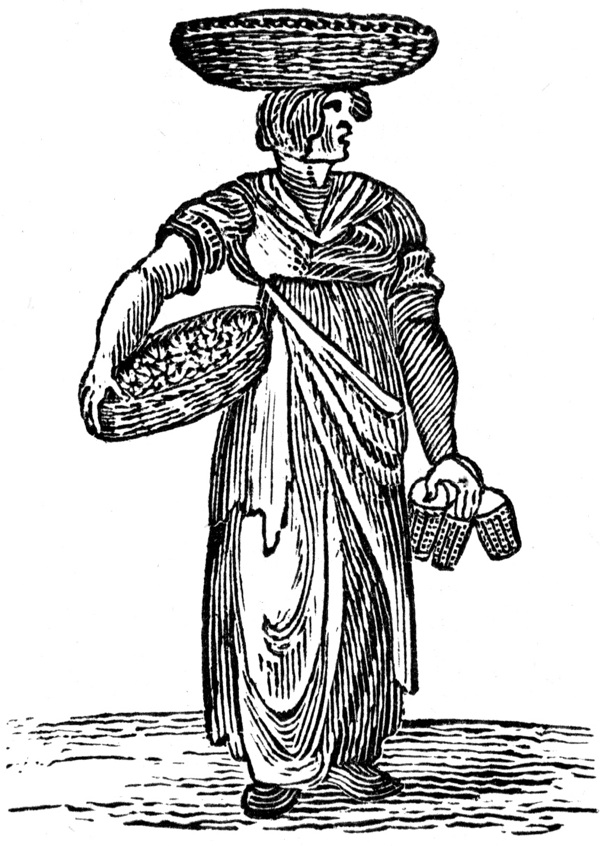
Mulberries – Mulberries, all ripe and fresh today! Only a groat a pottle – full to the bottom!
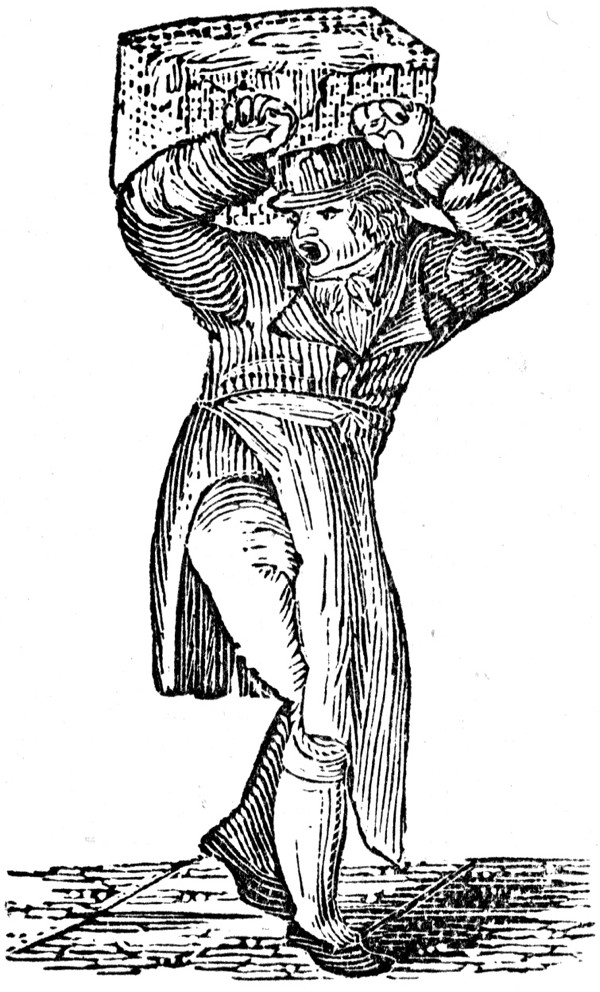
Capers, Anchovies – Buy my capers! Buy my nice capers! Buy my anchovies! Buy my nice anchovies!
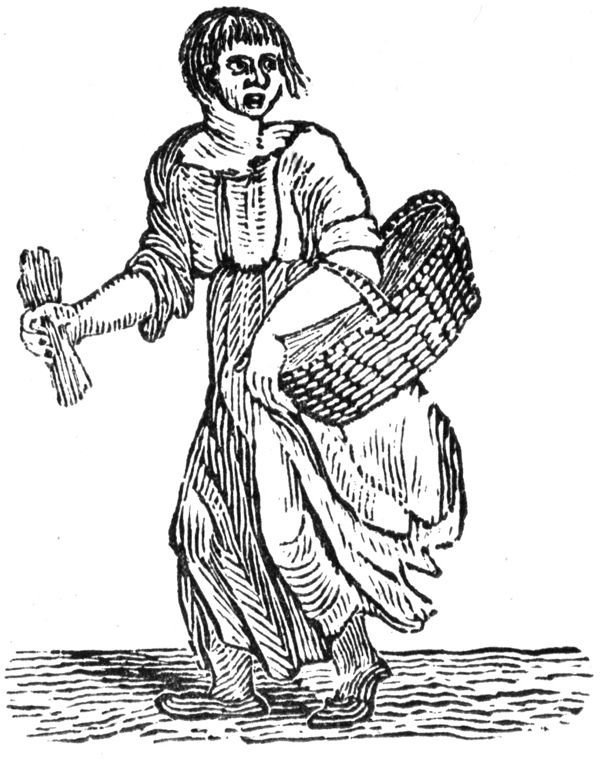
Lavender – Buy my lavender! Sweet blooming lavender! Sweet blooming lavender! Blooming lavender!
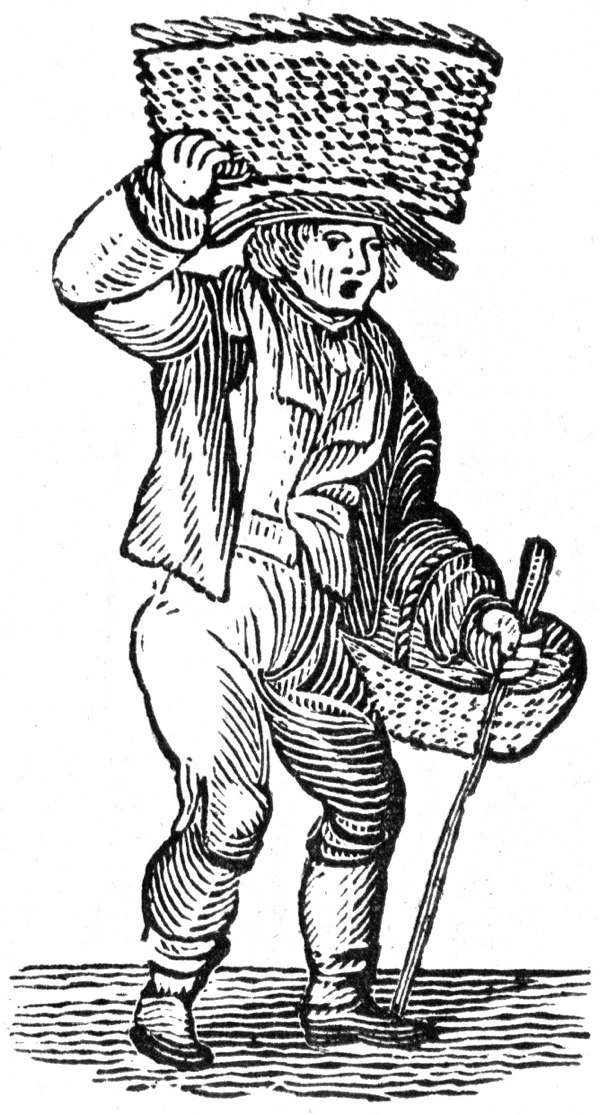
Mackerel – Live mackerel! Three a-shilling, O! Le’ping alive, O! Three a-shilling,O!
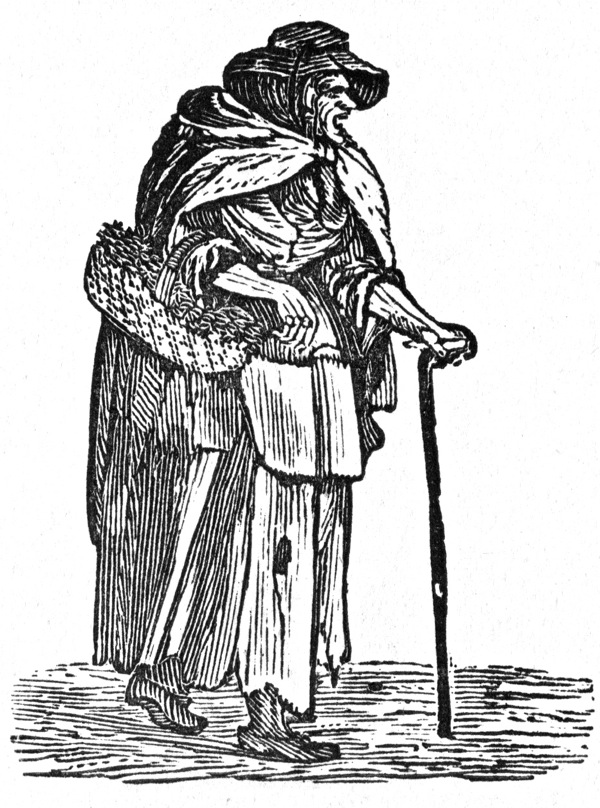
Shirt Buttons – Buy my shirt buttons! Shirt buttons! Buy shirt buttons! Buttons!
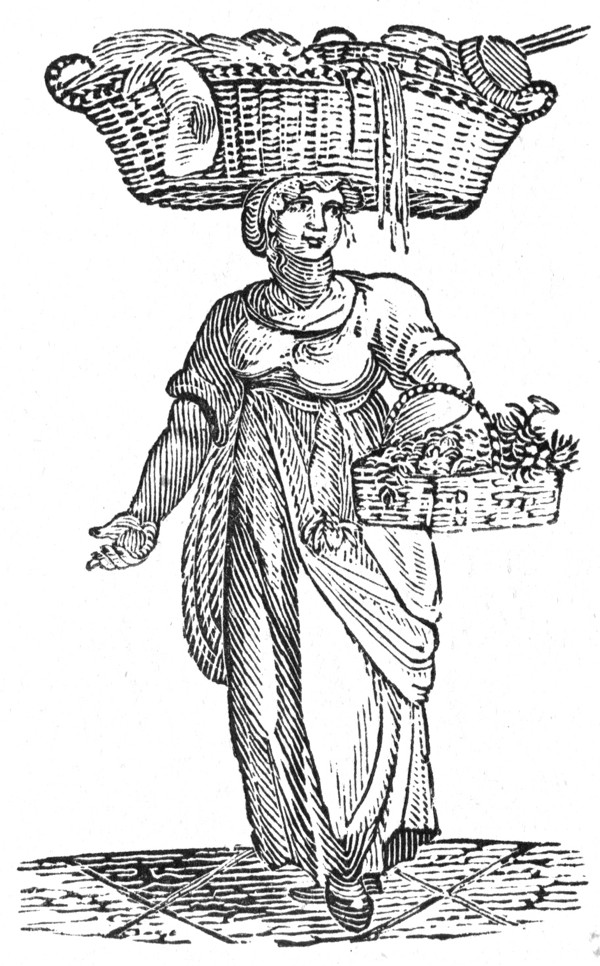
The Herb Wife – Buy rue! Buy sage! Buy mint! Buy rue, sage and mint, a farthing a bunch!
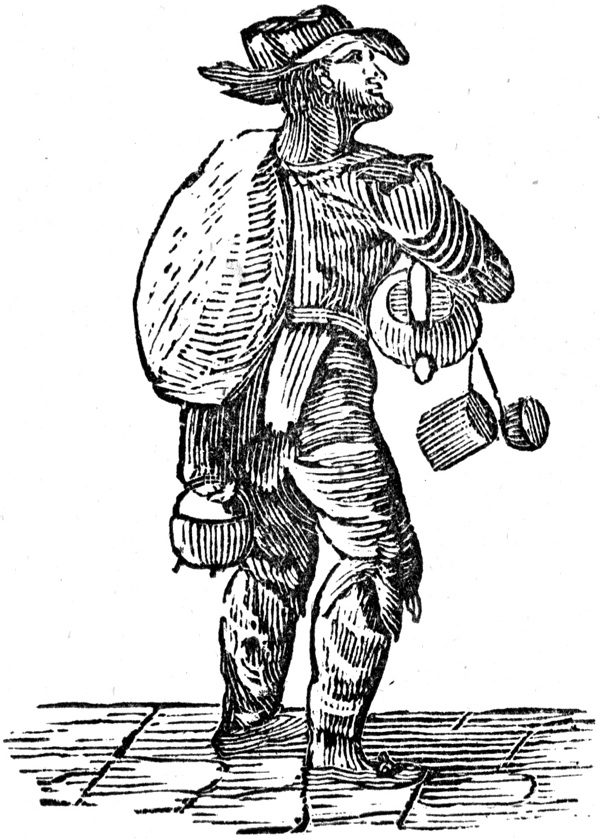
The Tinker – Maids, I mend old pots and kettles! Mend old pots and kettles, O!
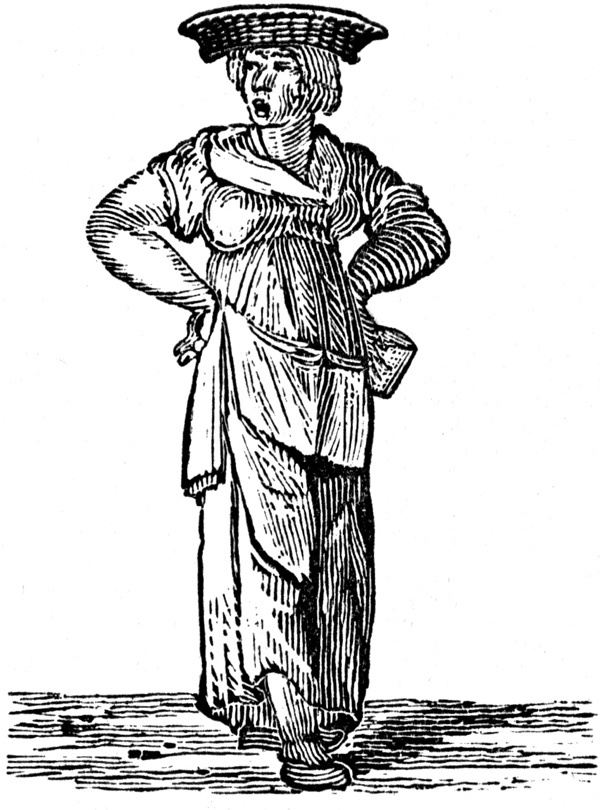
Buy fine flounders! Fine dabs! – All alive, O! Fine dabs! Fine live flounders, O!
You may also like to take a look at these other sets of the Cries of London I have collected
More John Player’s Cries of London
More Samuel Pepys’ Cries of London
Geoffrey Fletcher’s Pavement Pounders
William Craig Marshall’s Itinerant Traders
H.W.Petherick’s London Characters
John Thomson’s Street Life in London
Aunt Busy Bee’s New London Cries
Marcellus Laroon’s Cries of London
William Nicholson’s London Types
Francis Wheatley’s Cries of London
John Thomas Smith’s Vagabondiana of 1817
John Thomas Smith’s Vagabondiana II
John Thomas Smith’s Vagabondiana III
Thomas Rowlandson’s Lower Orders
James McBarron of Hoxton
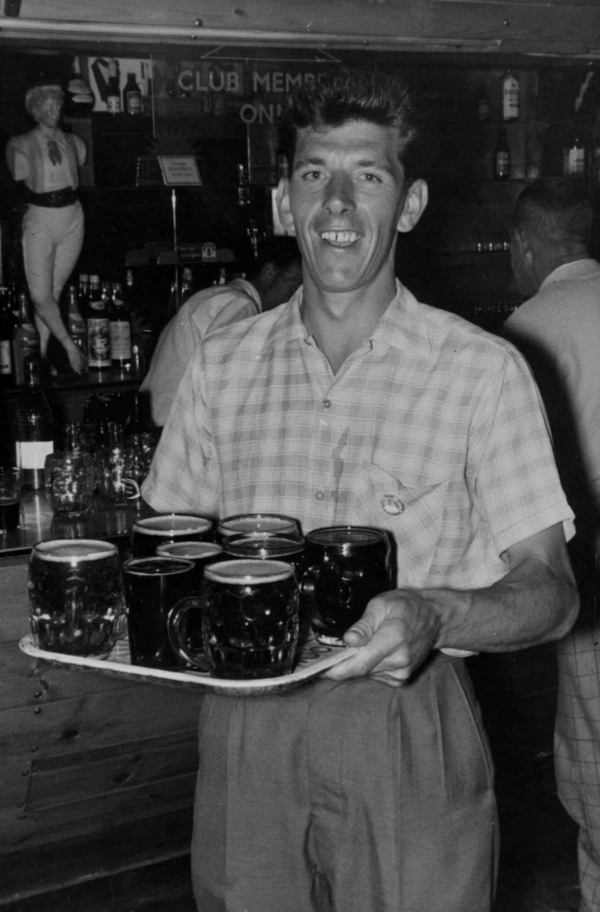
James McBarron
When I published Bob Mazzer’s Underground photographs from the seventies and eighties, I was astonished by how many readers got in touch to name people in the pictures, but I never expected it to happen when I published Horace Warner’s photographs of the Spitalfields Nippers from around 1900. Yet Lynne Ellis wrote to say her father James McBarron recognised Celia Compton whom Horace Warner photographed at the age of fifteen in 1901. By the time James knew Celia, as a child in the thirties, she was Mrs Hayday and he encountered her as a money-lender when he was sent to make the weekly repayments on his mother’s loans.
Intrigued by this unexpected connection to a photograph of more than a century ago, I took the train from Fenchurch St down to Stanford Le Hope recently to meet James McBarron and learn more of his story. This is what he told me.
“I am from Hoxton, Shoreditch, I was born in George Sq at the back of Hoxton Sq – it’s not there anymore. There were seven tenements and another building where Mrs Hayday lived, all around a yard with a lamppost in the middle. We attached a rope onto the lamppost and swung on it. We used to have a bonfire there in November and all the families came along. It was like a village and a lot of people were related, and everyone knew each other. We were clannish and there were quite a few families with members in different flats – my grandmother and grandfather lived there in one flat and I had two aunts in another.
Eighty years later I can still remember Mrs Hayday, even though I was only seven, eight or nine at the time. It was in 1936 or thereabouts. She was a money-lender and I was sent by my mother every Sunday to pay sixpence to her, but it didn’t mean anything to me at the time. To my eyes, as young boy, she was overwhelming. I was shown into the bedroom by her daughter and she was always lying there in bed. She took out a book from the bedside and made a note of the money. I recall an impression of crisp white sheets and she had dyed blonde hair. She was a buxom woman, a little blowsy. She smelled of scent – Phul Nana by Grossmith – the only scent I knew as a young boy, the factory was in Newgate St. I was awestruck because she was so unlike any of the other people I knew. There was a never a man there or a Mr Hayday. She was a very nice lady, she said, ‘Hello’ and ‘Say ‘Hello’ to your mum and dad.’ And that was Mrs Hayday.
My father, George, was a carpenter from Sunderland and he served in the Great War. My mother worked at Tom Smith’s Cracker Factory in Old St. My parents met in London and my mother’s family already lived in George Sq. My grandfather, he was an inventor and I admired him very much. He made a little working steam engine, and he tapped the gas main and had a tube with a little flame, so he could light his roll-ups. He played the violin and read music, and he never went to work. My gran used to go round to the pub for a jug of beer and they’d all go upstairs to my grandparents’ flat and play darts, and he’d play the violin.
We kids used to chop firewood to make money. The boys and girls used to go around collecting tea-chests and packing-boxes from the back of all the furniture factories, and say ‘Can we take it away, Mister?’ We chopped it up into sticks and made bundles, and we’d sell them for a penny or a ha-penny. We used to go to Spitalfields Market and ask for ‘Any spunks?’ or ‘Spunky oranges and apples?’ and they’d chuck the fruit that was going bad to us.
We didn’t think we were poor, except there was a family called Laban who were better off than us. He was a bookmaker and had touts. I remember their son had a jacket with pleats in the back and I wanted one like it, but when my mum eventually got me one it wasn’t so good. My father had a blue serge suit and it was pawned each Monday to pay the rent and bought back each Friday when he got paid. On Sundays, we went down to Stephenson’s Bakery in Curtain Rd to get a penny loaf.
When you came out of George Sq, there was a little alleyway leading through to Hoxton Market. There was Marcus the Newsagent, and next to it was Pollock’s and they had toy theatres in the window and these glass bottles with coloured liquid – it was a tiny shop. Next to that was Neville’s where my father bought our boots and shoes. I can remember every shop in the Market. Hoxton St was different then, bustling with stalls and there were barrows selling roasted chestnuts and boiled sheep’s heads.
William was the eldest child in our family, then I was born, then Peter, then Johnny and last of all Margaret. There was twenty-one years between us and she was born while I was away in the army, so she didn’t know me when I came back. I knocked them up at seven in the morning and called, ‘Here’s your boy, back again!’ We had three rooms – two bedrooms and a living room, and that’s why we had to move.
After the war, they moved us up to Haggerston to a new building in Stean St and George Sq was demolished because it was a slum. Everything broke up when people moved out. They took out all our furniture – including a table and chest of drawers my father made – and put it in a closed van and fumigated it because of the bugs. I’ve still got his tool box. It was a ragtag and bobtail existence, but I think we were a little better off than some. “
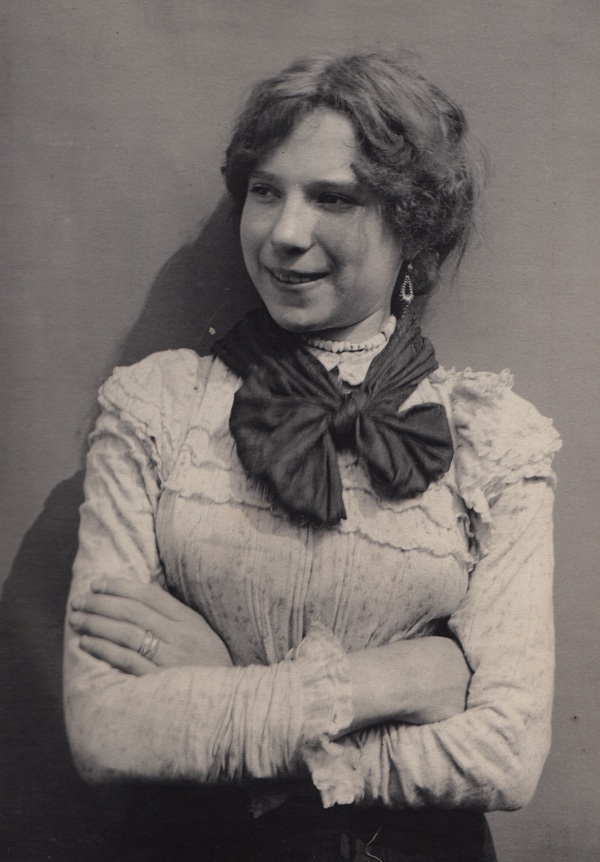
Celia Compton photographed at age fifteen by Horace Warner in 1901. Years later in 1936, a year after her husband died and when James McBarron was a child, she lived at 5e George Sq and he knew her by her married name of Celia Hayday.
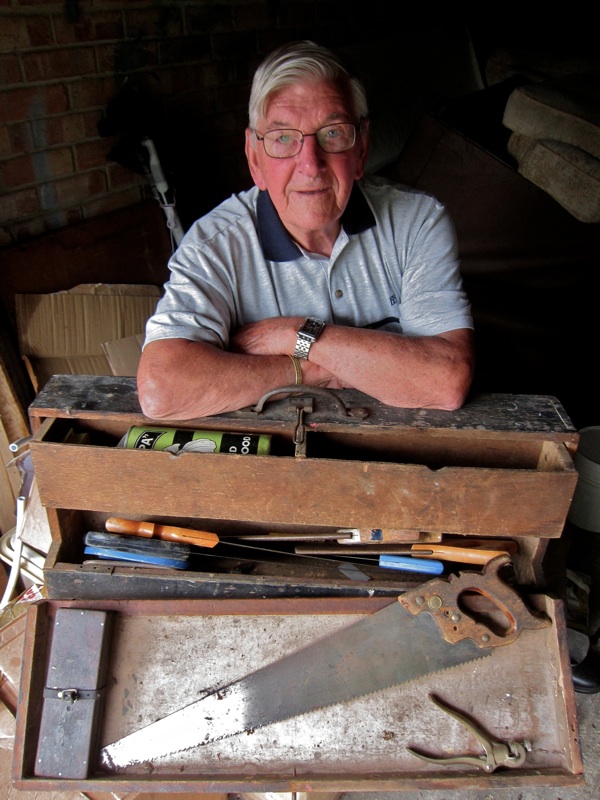
James McBarron with his father’s carpentry box
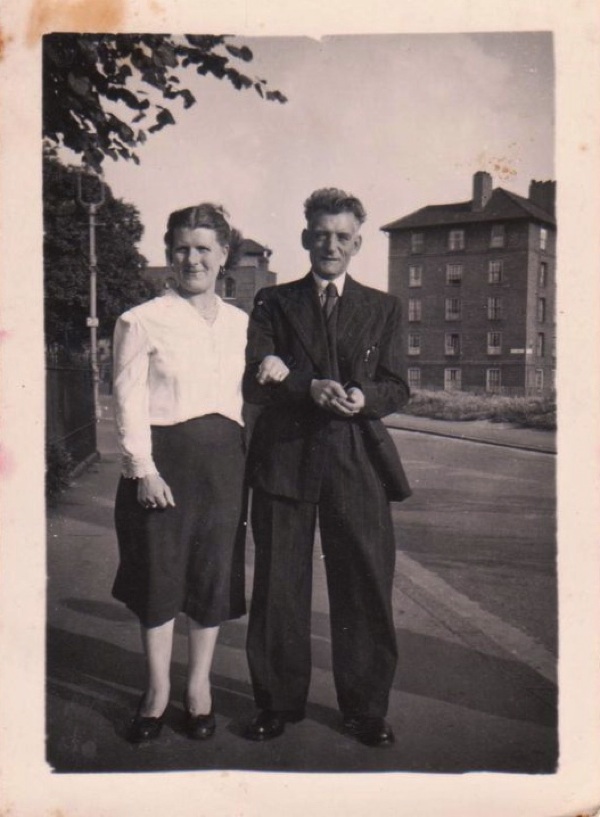
Margaret & George McBarron in Haggerston
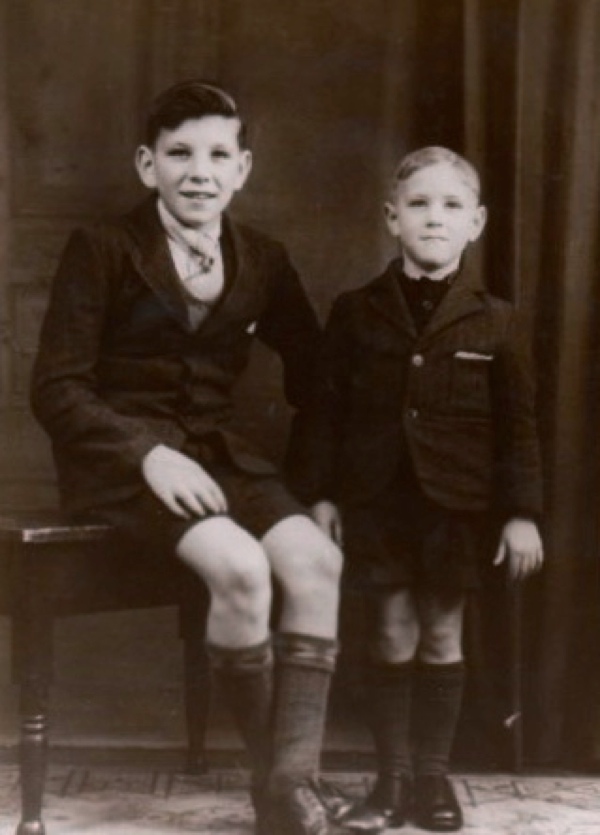
James and his brother Peter
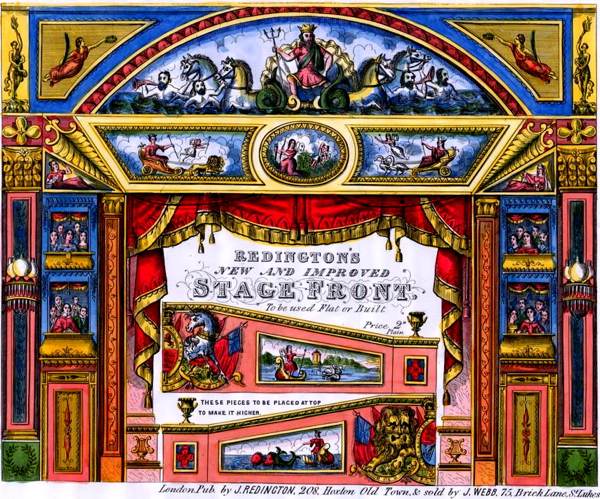
As a boy, James visited Benjamin Pollock’s Toy Theatre shop at 208 Hoxton Old Town
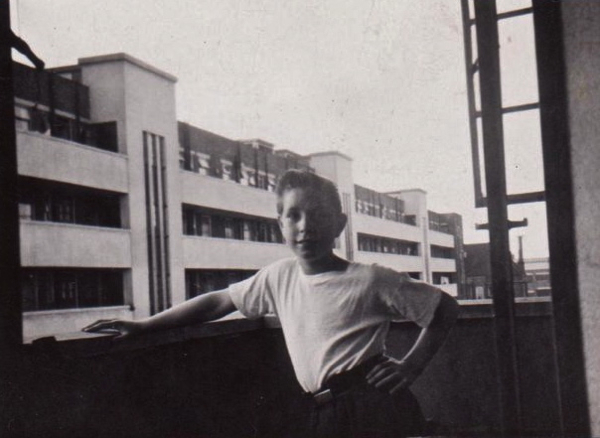
James’ younger brother Johnny in the new flat when the family were rehoused in Stean St, Haggerston, in 1946
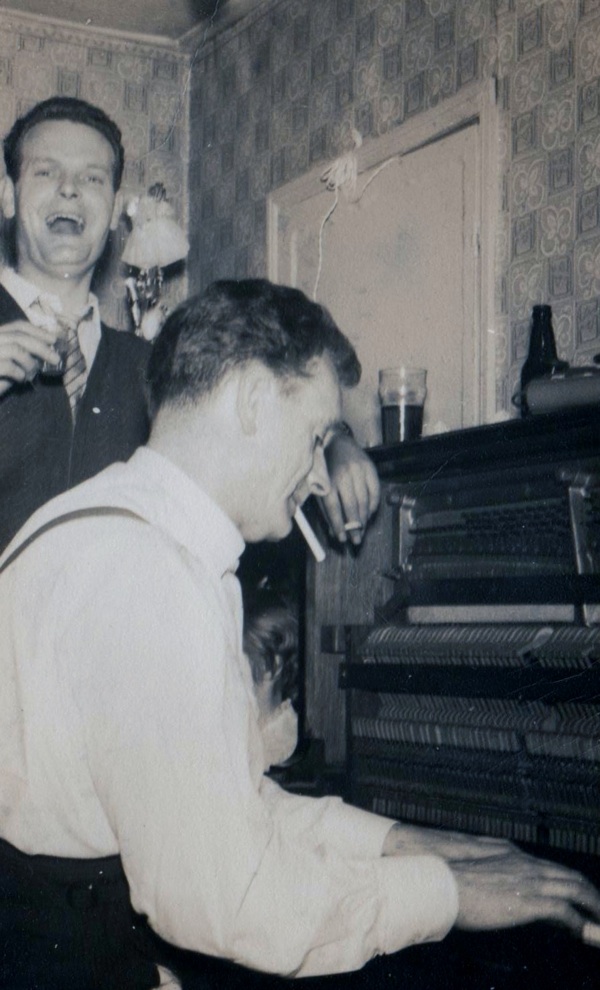
James’ elder brother William at the piano
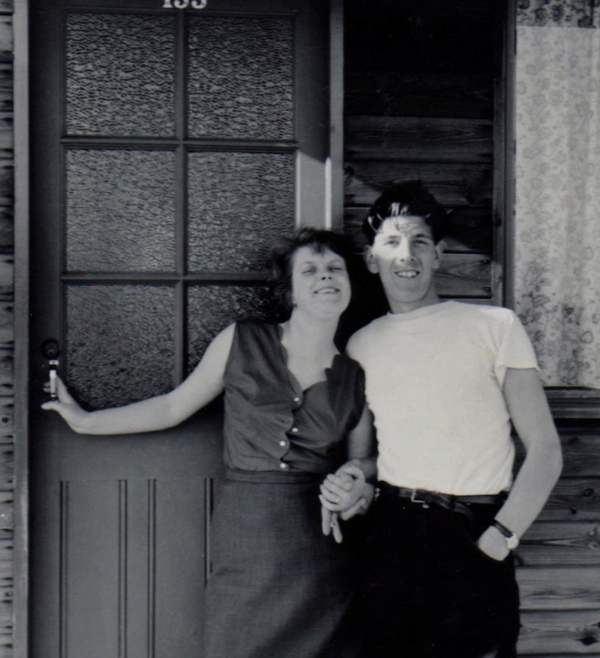
James & June McBarron
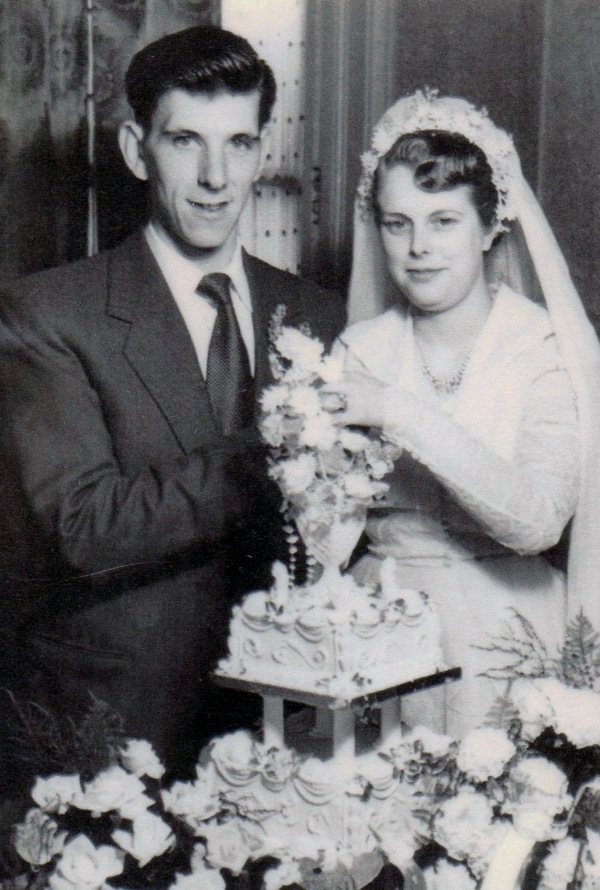
James & June McBarron got married in St Leonard’s Shoreditch on 5th June 1954 and celebrated their diamond wedding this summer
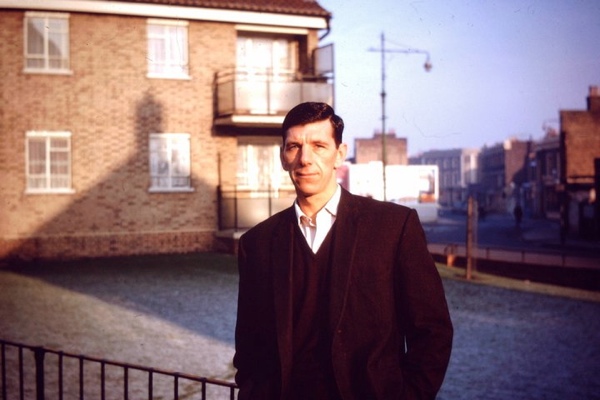
James McBarron, 1965
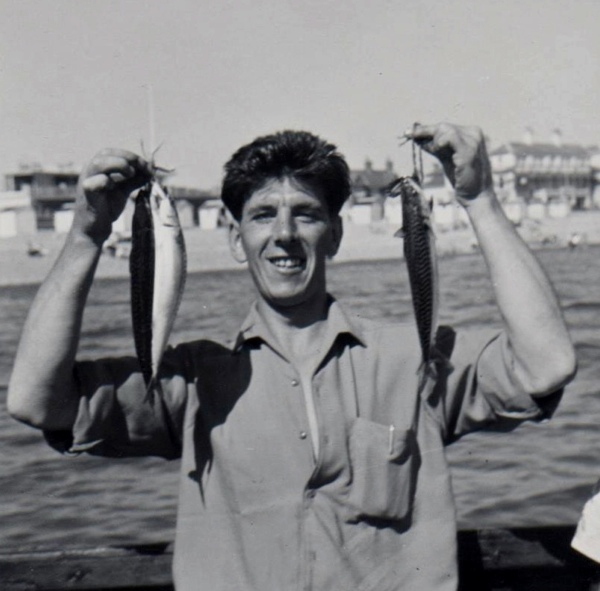
James catches mackerel on holiday in Devon
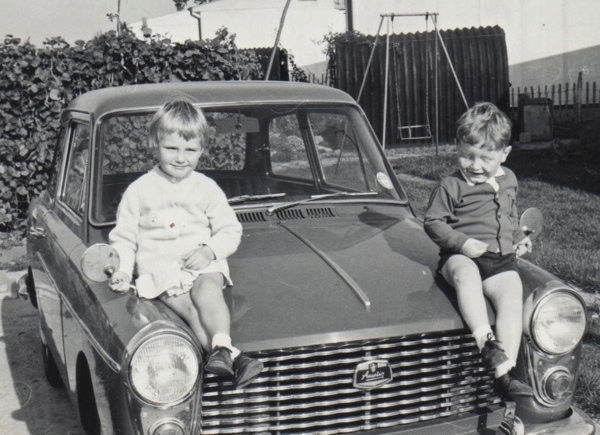
James & June McBarron’s children, Lynne & Ian, in the sixties
You may also like to read these other Hoxton stories
Joseph Markovitch, I’ve live in Hoxton for eight-six and a half years
Roy Reed At Billingsgate Market 1975
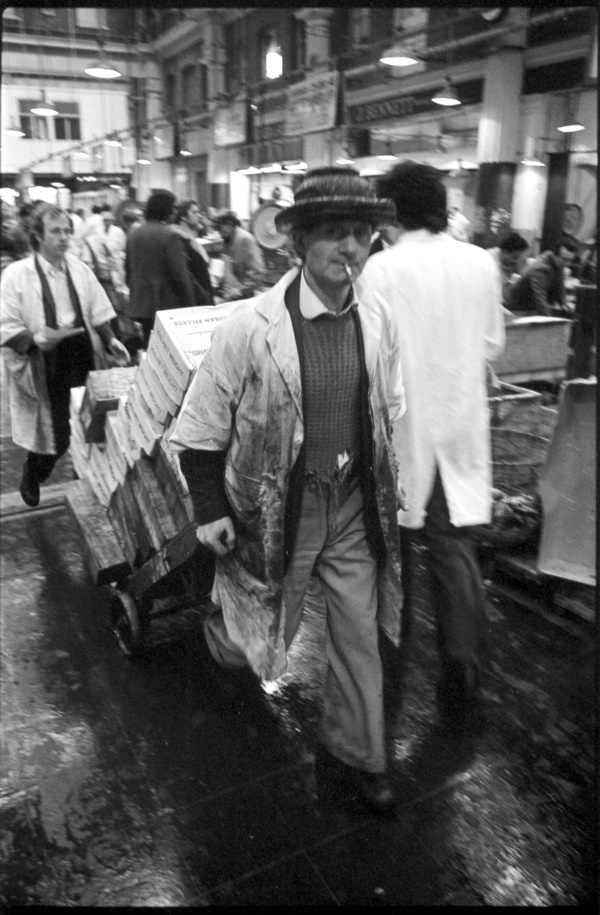
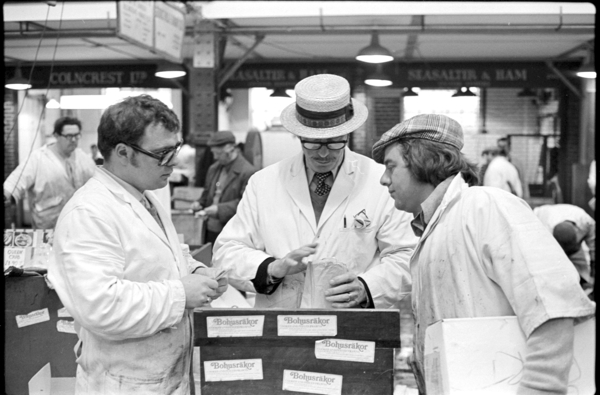
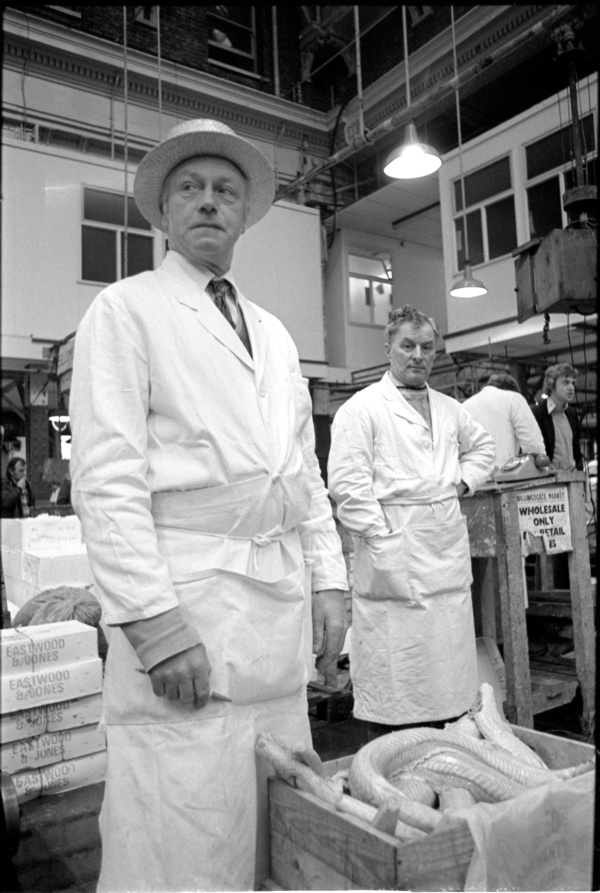
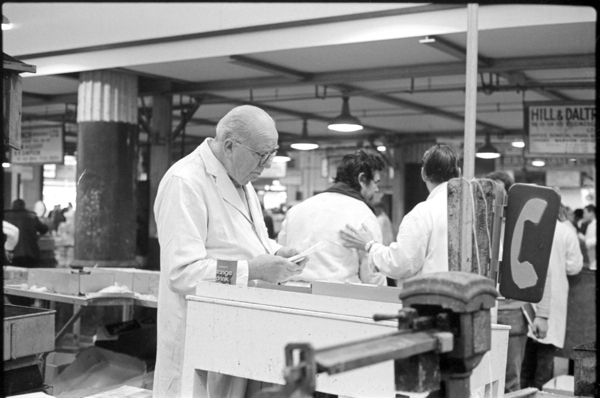
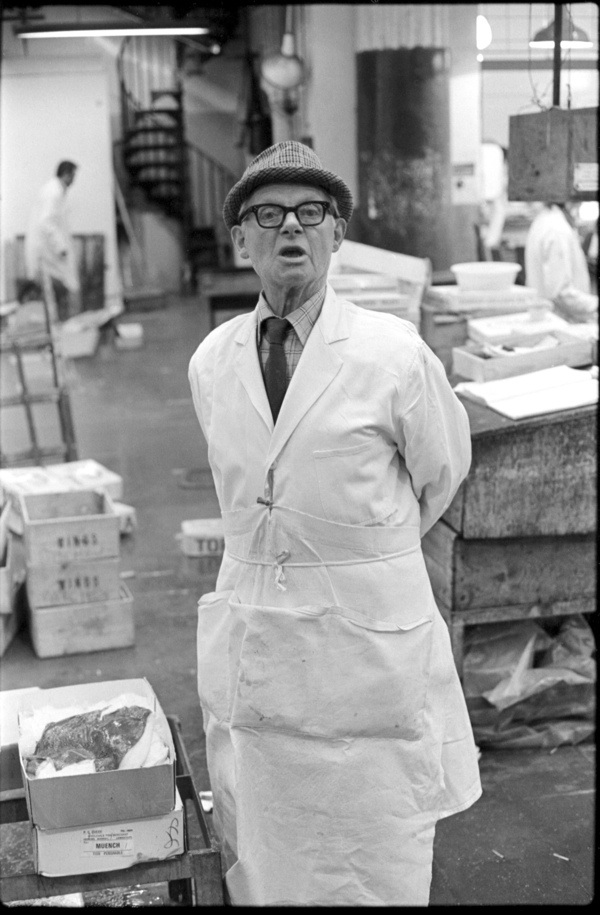
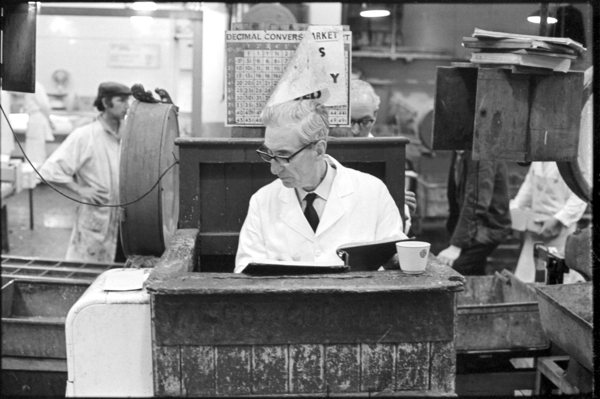
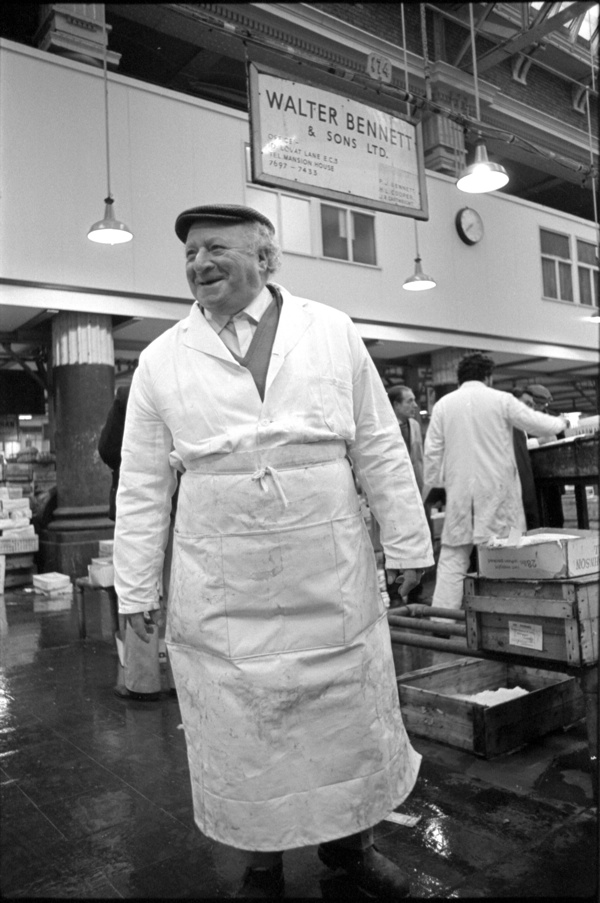
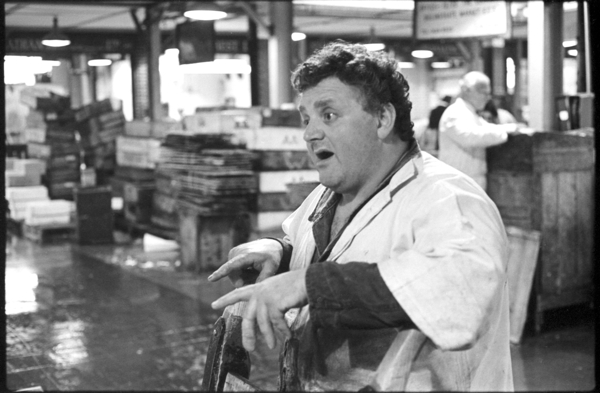
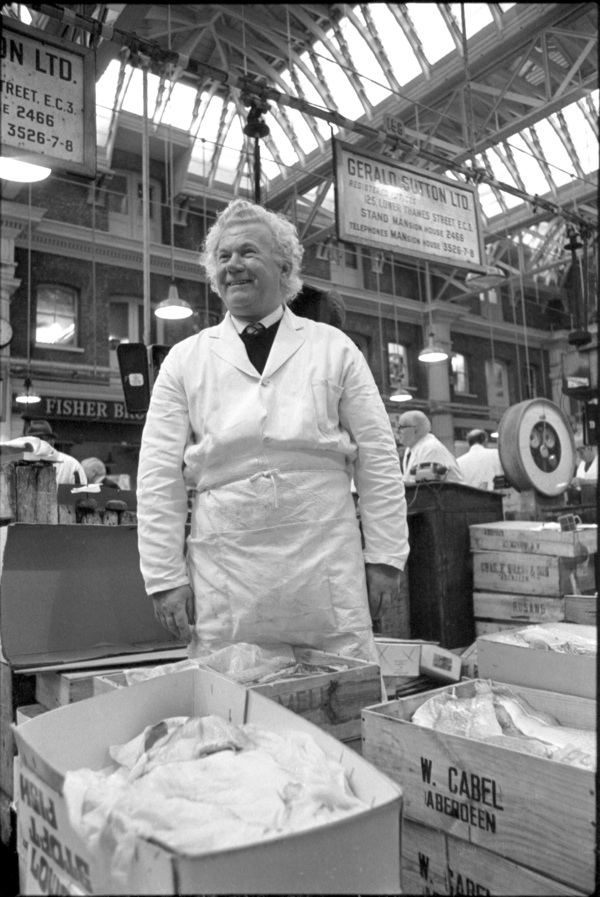
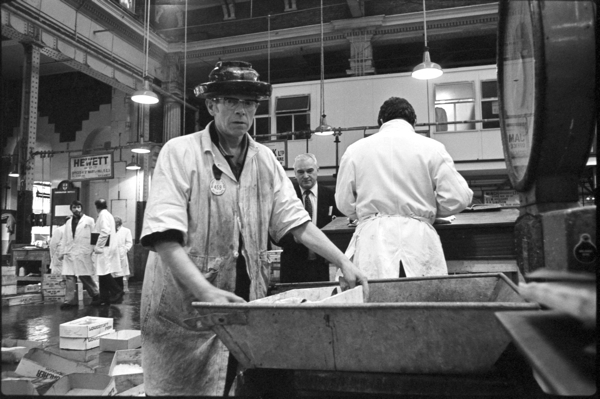
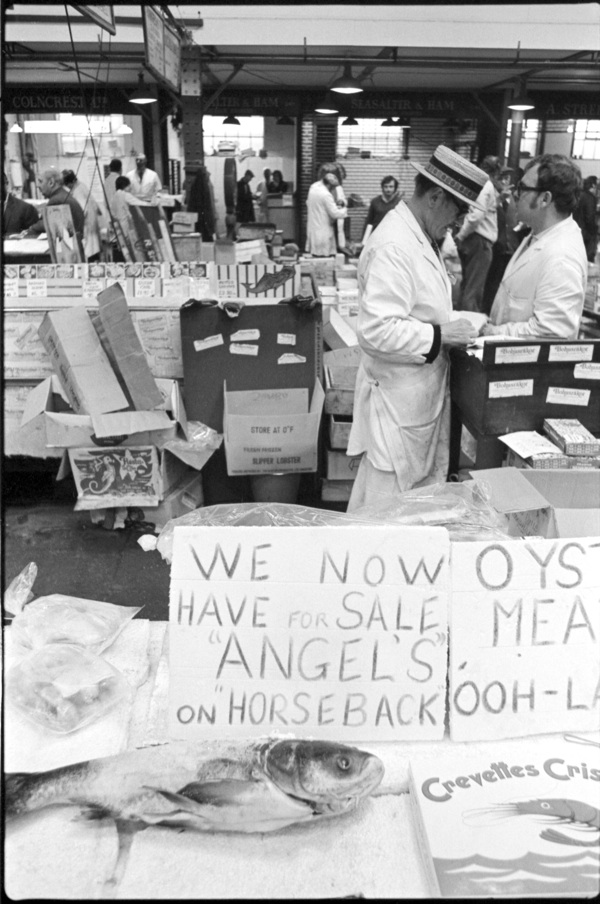
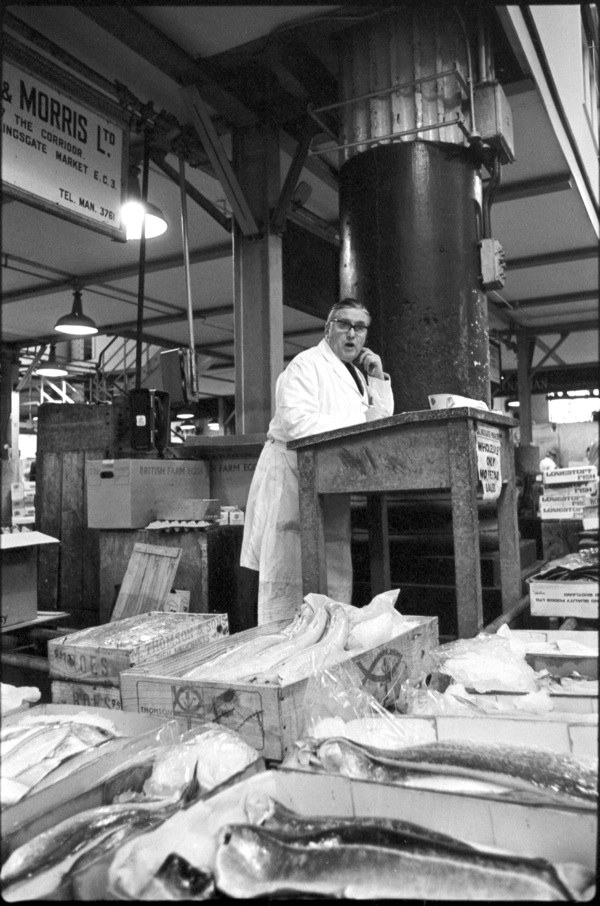
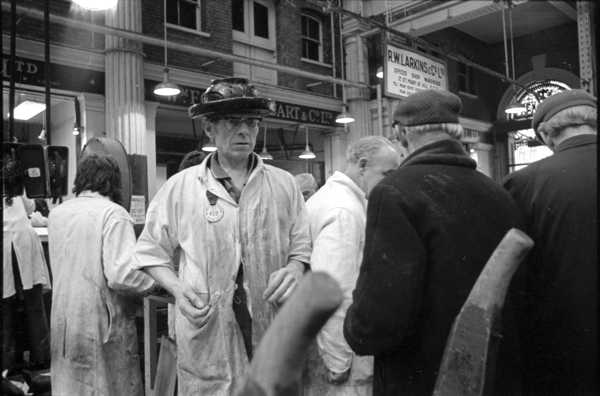
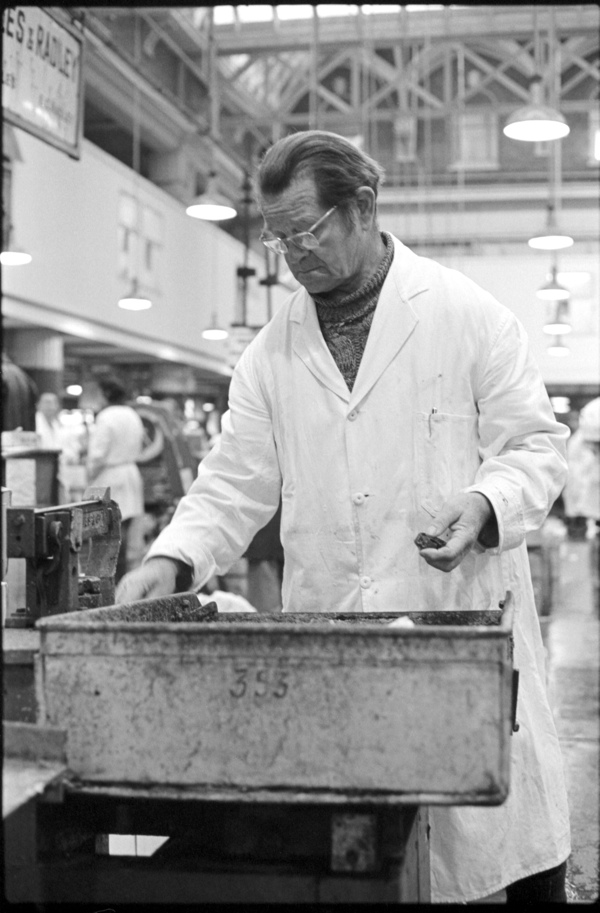
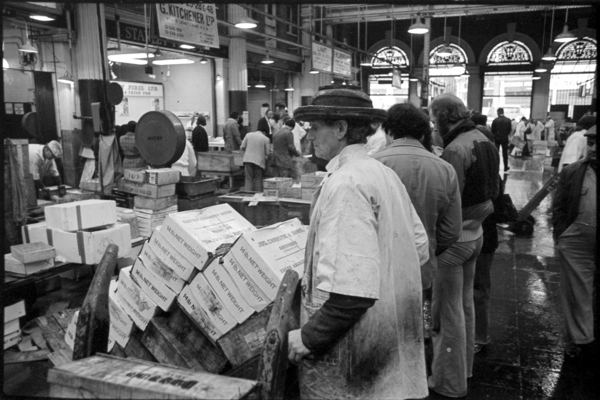
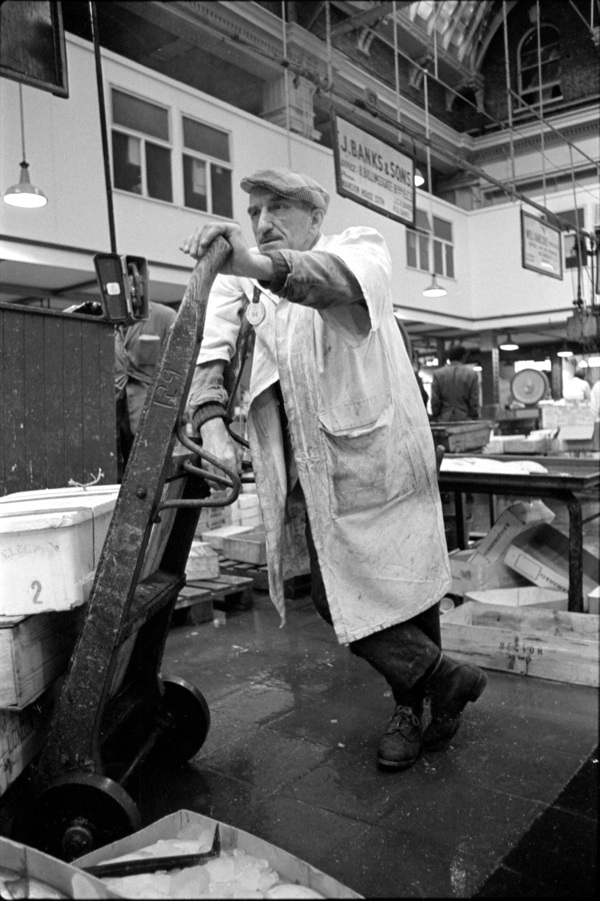
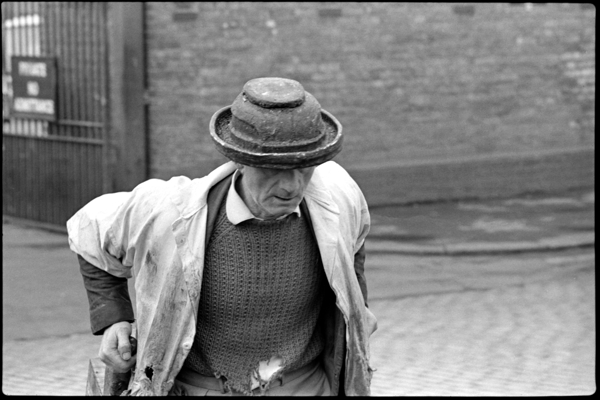
Roy Reed took these pictures of Billingsgate Market when he was a twenty-three-year-old documentary photography student at the London College of Printing in 1975 and they are seeing the light of day for the first time now.
Roy’s enthusiasm for the subject was greater than the interest of the student-journalist who asked him to take the pictures for a project on London’s dying markets. “When I suggested we get there early, she said, ‘See you there at eight,'” Roy recalled, rolling his eyes significantly. In the event, Roy got there at seven-thirty on a February morning and took his pictures just here as business was winding up at the nocturnal market. Forty years later, any disappointment Roy might harbour that the project was never written up and published is outweighed by his satisfaction in having taken these rare photographs of a lost world.
“It was nice chatting with the porters,” Roy remembered fondly, “No-one seemed to mind having their photograph taken – except maybe the guy in the tweed hat, you can see him looking at me suspiciously in the picture.” Taken at the time the market was already due to leave its ancient location next to London Bridge, Roy’s lively photographs comprise a fascinating record of a seemingly recent era in market life that grows increasingly remote.
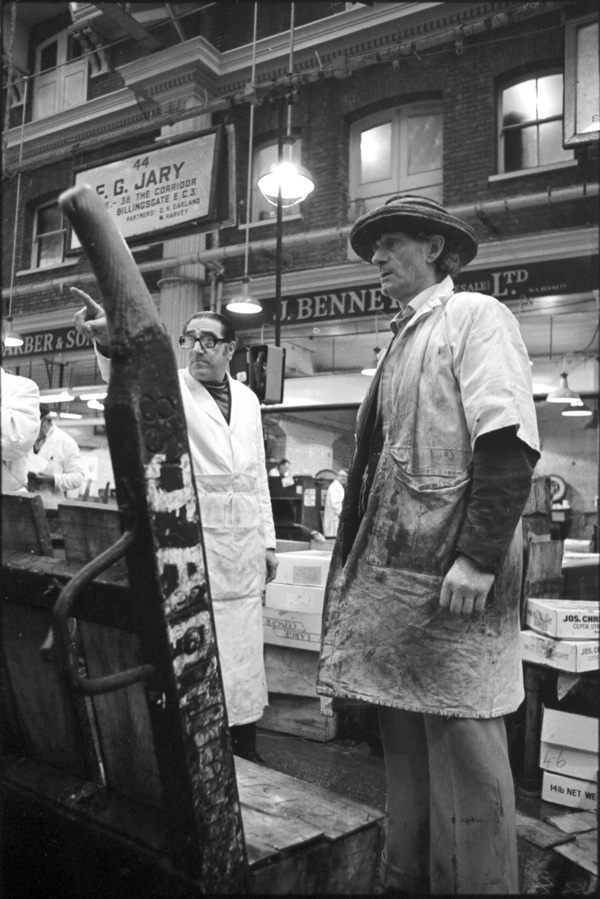
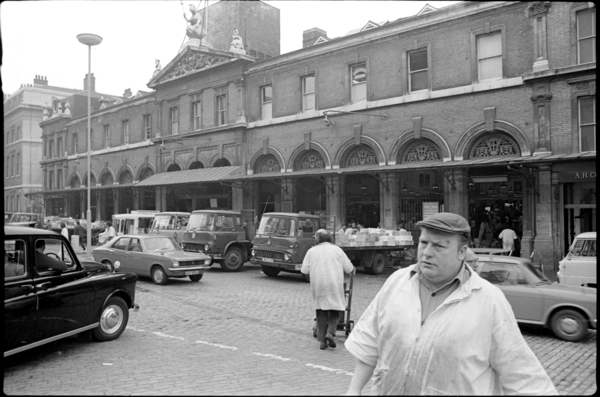
Photographs copyright © Roy Reed
You may also like to read about
Music Hall Artistes Of Abney Park Cemetery
When the summer heat hits the city and the streets get dusty and dry, I like to seek refuge in the green shade of a cemetery. Commonly, I visit Bow Cemetery – but last week I went along to explore Abney Park Cemetery in Stoke Newington to find the graves of the Music Hall Artistes resting there.
John Baldock, Cemetery Keeper, led me through the undergrowth to show me the memorials newly restored by the Music Hall Guild and then left me to my own devices. Alone in the secluded leafy glades of the overgrown cemetery with the Music Hall Artistes, I swore I could hear distant singing accompanied by the tinkling of heavenly ivories.
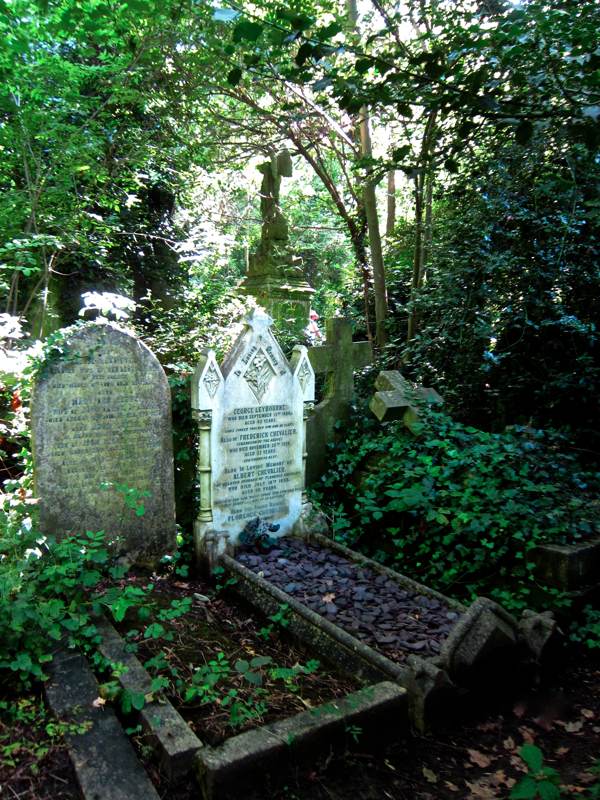
George Leybourne, Songwriter, Vocalist and Comedian, also known as Champagne Charlie (1842 – 1884) & Albert Chevalier (1861- 1923), Coster Comedian and Actor. Chevalier married Leybourne’s daughter Florrie and they all rest together.
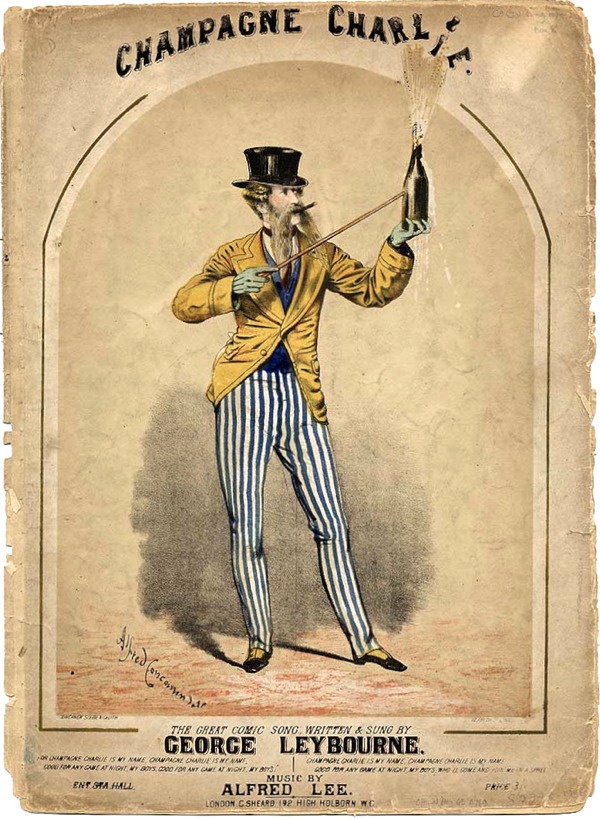
George Leybourne – “Champagne Charlie is my name, Champagne Charlie is my name ,There’s no drink as good as fizz, fizz, fizz, I’ll drink every drop there is, is, is!”
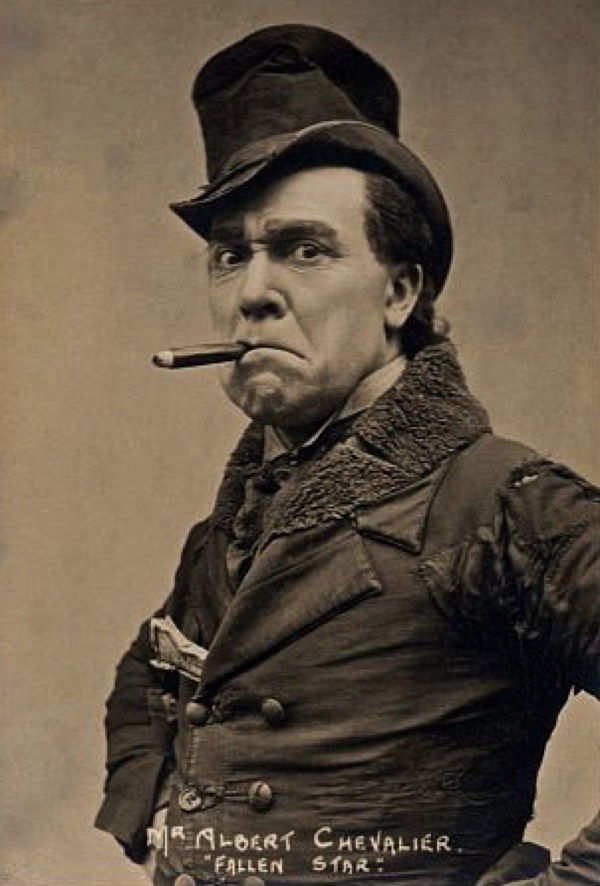
Albert Chevalier – “We’ve been together now for forty years, An’ it don’t seem a day too much, There ain’t a lady livin’ in the land, As I’d swop for my dear old Dutch.”
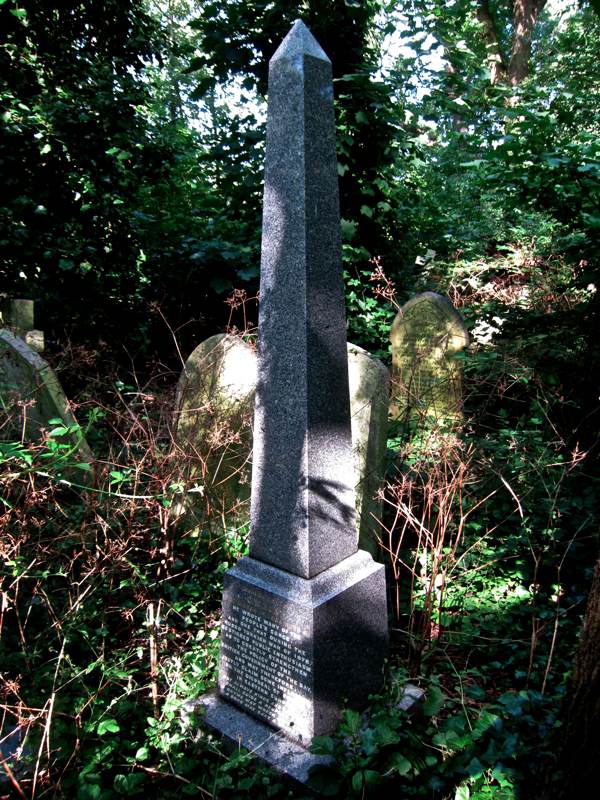
G W Hunt (1838 – 1904) Composer and Songwriter, his most famous works were “MacDermott’s War Song” (The Jingo Song), “Dear Old Pals” and “Up In A Balloon” for George Leybourne and Nelly Power.
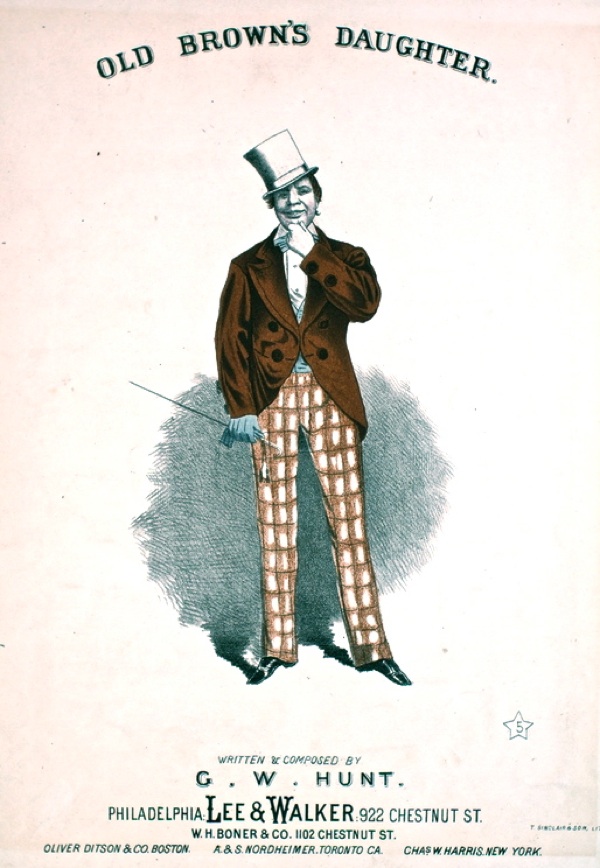
G W Hunt
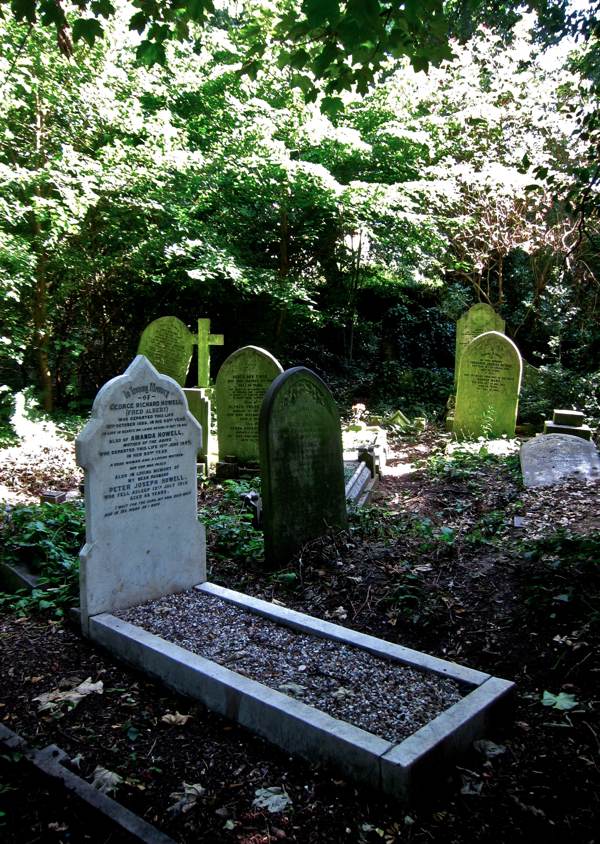
Fred Albert George Richard Howell (1843 – 1886) Songwriter and Extempore Vocalist
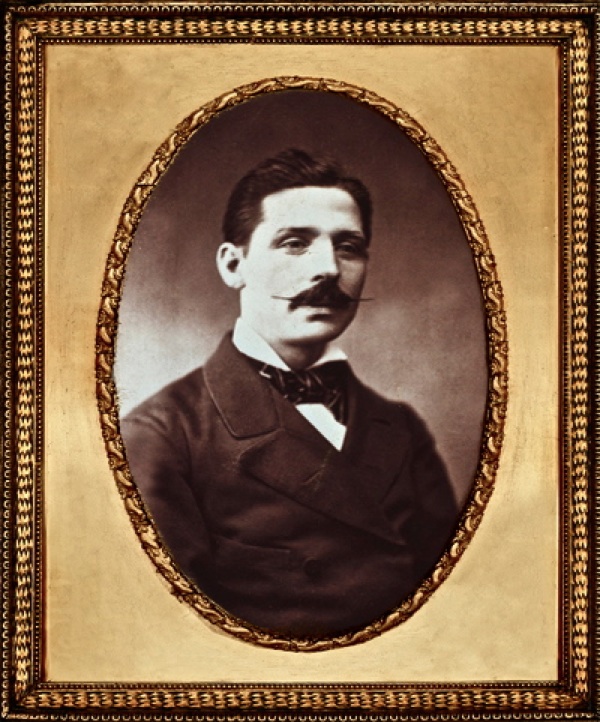
Fred Albert
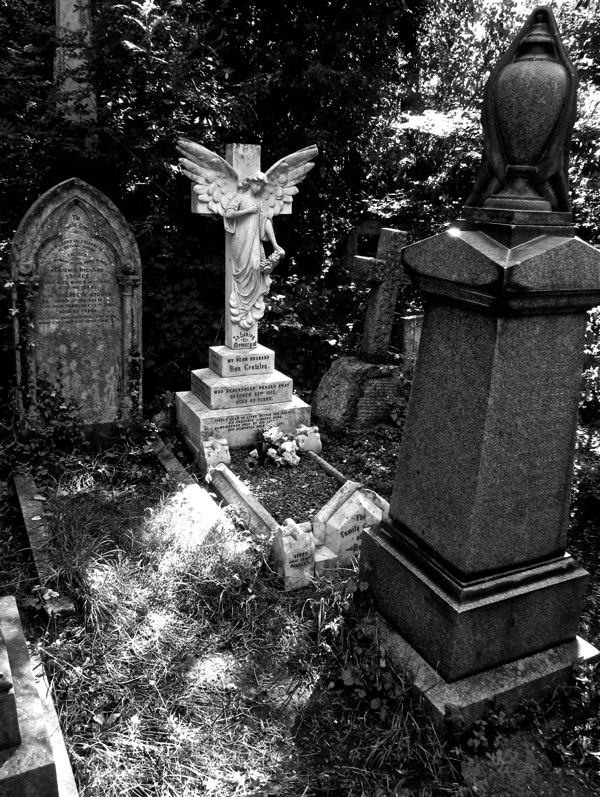
Dan Crawley (1871 – 1912) Comedian, Vocalist, Dancer and Pantomime Dame rests with his wife Lilian Bishop, Actress and Male Impersonator. He made his London debut at nineteen at Royal Victor Theatre, Victoria Park, and for many years performed three shows a day on the sands at Yarmouth, where he met his wife.They married in Hackney in 1893 and had four children, and toured together as a family, including visiting Australia, before they both died at forty-one years old.
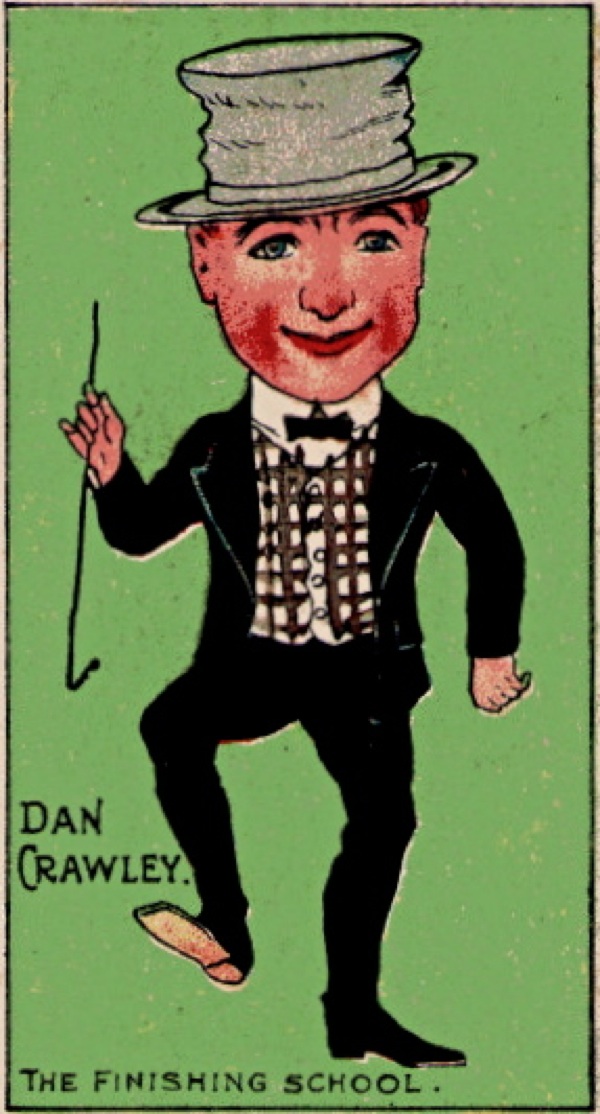
Dan Crawley
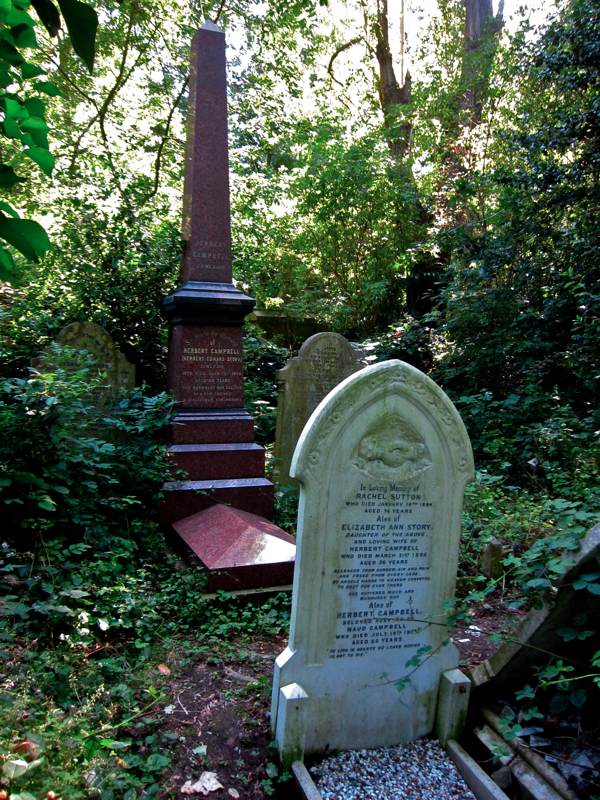
Herbert Campbell (1844 – 1904) Comedian and Pantomime Star. The memorial behind the tombstone was erected by a few of his friends. Herbert Campbell played the Dame in Pantomime at Drury Lane for forty years alongside Dan Leno, until his death at at sixty-one.
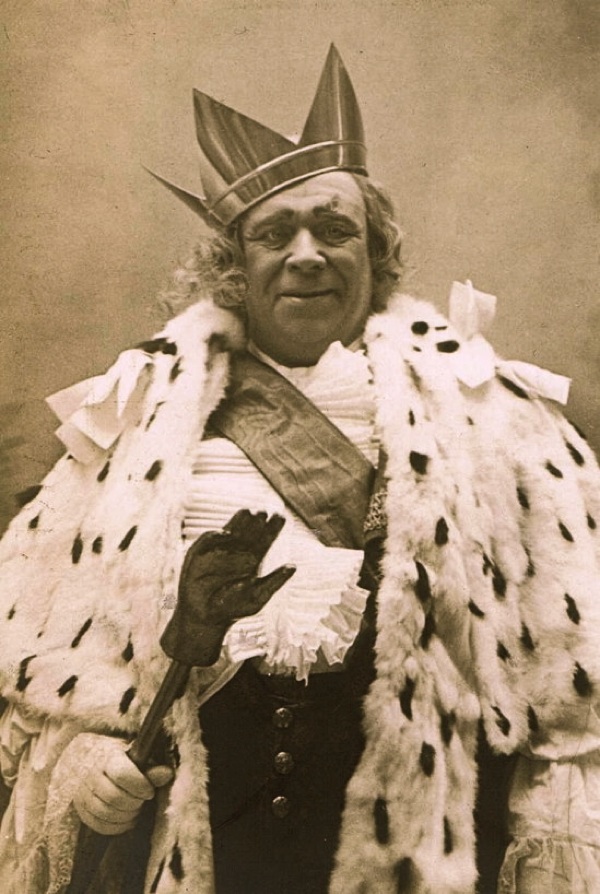
Herbert Campbell, famous comedian and dame of Drury Lane
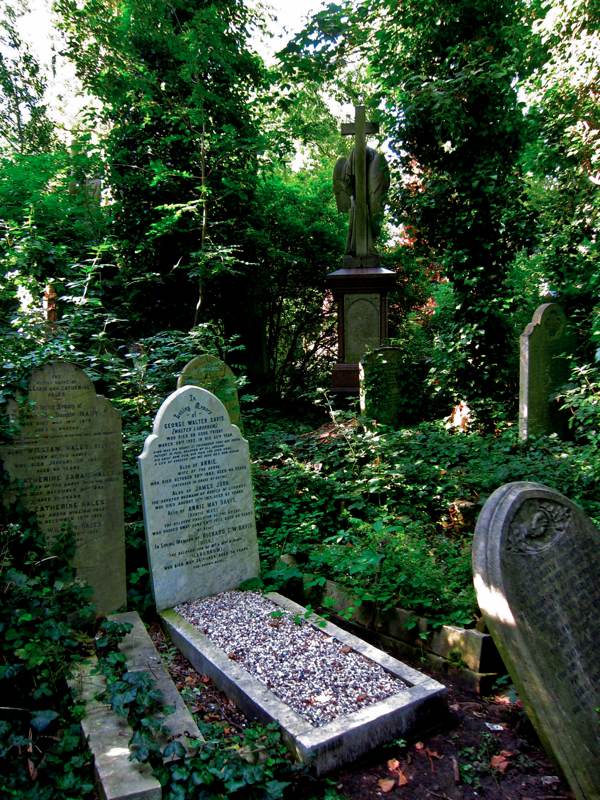
Walter Laburnum George Walter Davis (1847 – 1902) Singer, Patter Vocalist and Songwriter
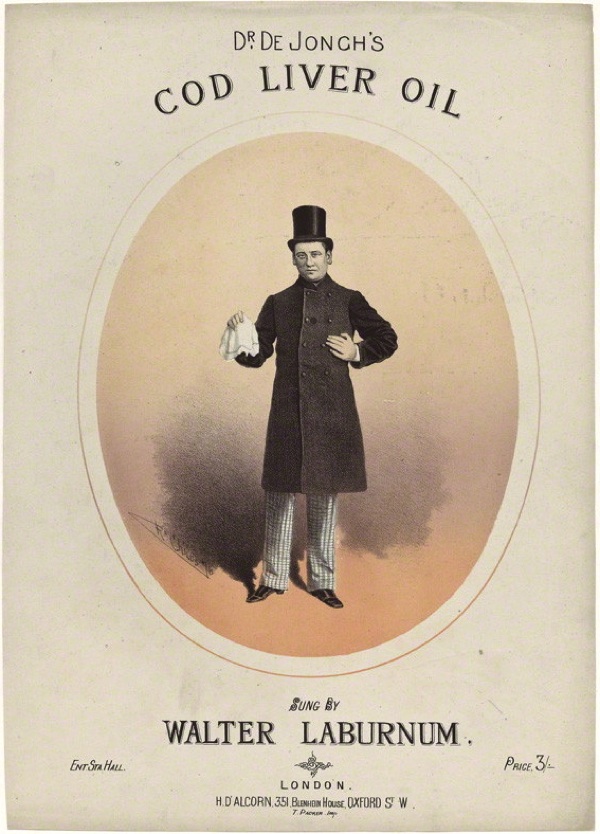
Walter Laburnum

Nelly Power Ellen Maria Lingham (1854 – 1887) started her theatrical career at the age of eight, and was a gifted songstress and exponent of the art of male impersonation. Her most famous song was ‘The Boy I Love Is Up In The Gallery.” She died from pleurisy on 19th January 1887, aged just thirty-two.
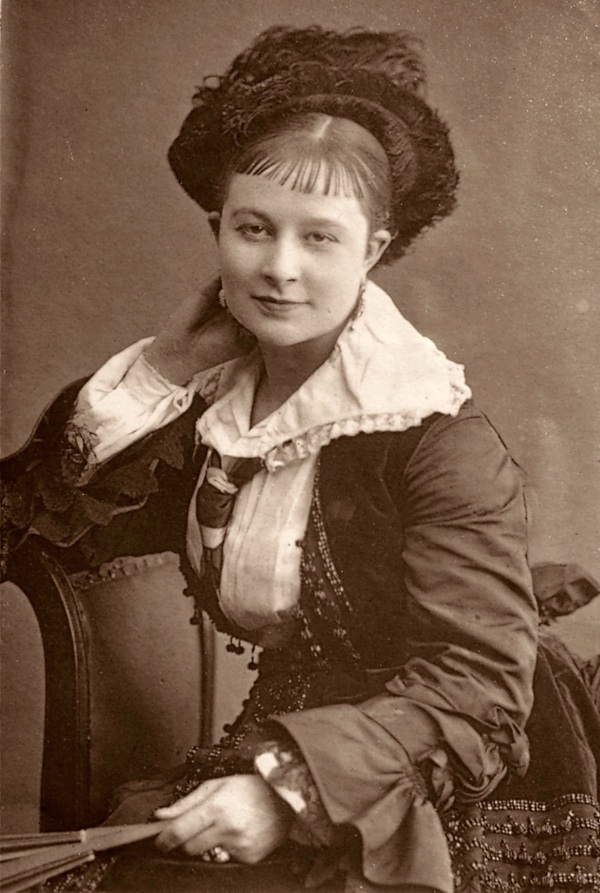
Nelly Power – Vesta Tilley was once her understudy
The Music Hall Guild will be hosting a free guided walk through Abney Park Cemetery to visit the Music Hall Artistes next Sunday 27th July – meet at the cemetery gates at 2pm
In Old Rotherhithe
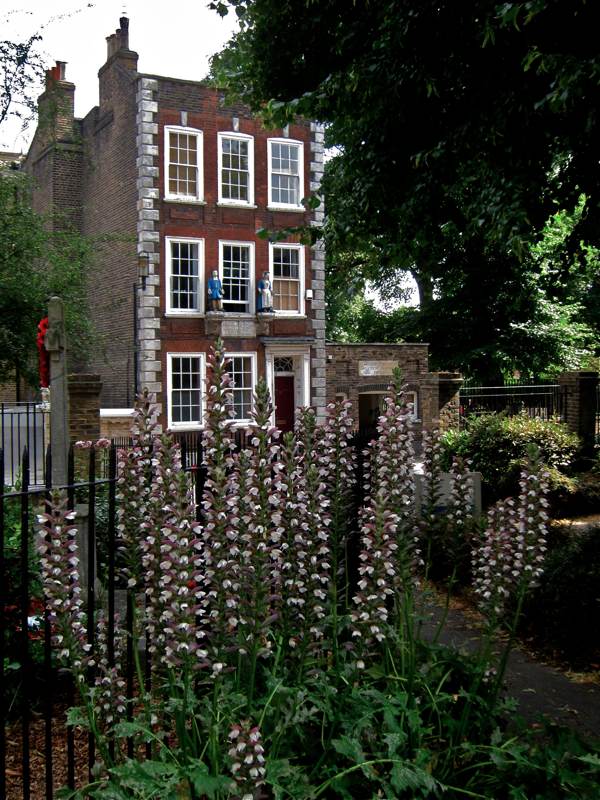
St Mary Rotherhithe Free School founded 1613
To be candid, there is not a lot left of old Rotherhithe – yet what remains is still powerfully evocative of the centuries of thriving maritime industry that once defined the identity of this place. Most visitors today arrive by train – as I did – through the Brunel tunnel built between 1825 and 1843, constructed when the growth of the docks brought thousands of tall ships to the Thames and the traffic made river crossing by water almost impossible.
Just fifty yards from Rotherhithe Station is a narrow door through which you can descend into the 1825 shaft via a makeshift staircase. You find yourself inside a huge round cavern, smoke-blackened as if the former lair of a fiery dragon. Incredibly, Marc Brunel built this cylinder of brick at ground level – fifty feet high and twenty-five feet in diameter – and waited while it sank into the damp earth, digging out the mud from the core as it descended, to create the shaft which then became the access point for excavating the tunnel beneath the river.
It was the world’s first underwater tunnel. At a moment of optimism in 1826, a banquet for a thousand investors was held at the bottom of the shaft and then, at a moment of cataclysm in 1828, the Thames surged up from beneath filling it with water – and Marc’s twenty-two-year-old son Isambard was fished out, unconscious, from the swirling torrent. Envisaging this diabolic calamity, I was happy to leave the subterranean depths of the Brunels’ fierce imaginative ambition – still murky with soot from the steam trains that once ran through – and return to the sunlight of the riverside.
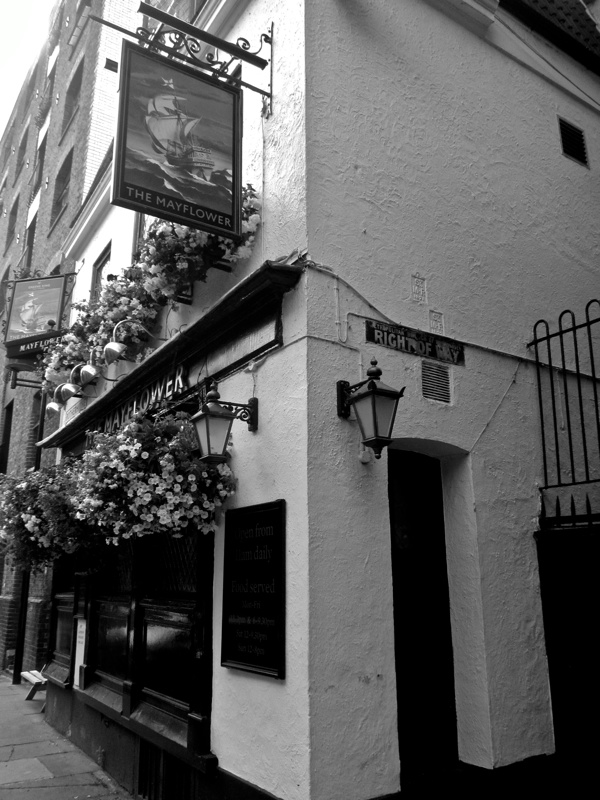
Leaning out precariously upon the Thames’ bank is an ancient tavern known as The Spread Eagle until 1957, when it was rechristened The Mayflower – in reference to the Pilgrims who sailed from Rotherhithe to Southampton in 1620, on the first leg of their journey to New England. Facing it across the other side of Rotherhithe St towers John James’ St Mary’s Rotherhithe of 1716 where an attractive monument of 1625 to Captain Anthony Wood, retrieved from the previous church, sports a fine galleon in full sail that some would like to believe is The Mayflower itself – whose skipper, Captain Christopher Jones, is buried in the churchyard.
Also in the churchyard, sits the handsome tomb of Prince Lee Boo. A native of the Pacific Islands, he befriended Captain Wilson of Rotherhithe and his two sons who were shipwrecked upon the shores of Ulong in 1783. Abba Thule, the ruler of the Islands, was so delighted when the Europeans used their firearms to subdue his enemies and impressed with their joinery skills in constructing a new vessel, that he asked them to take his second son, Lee Boo, with them to London to become an Englishman.
Arriving in Portsmouth in July 1784, Lee Boo travelled with Captain Wilson to Rotherhithe where he lived as one of the family, until December when it was discovered he had smallpox – the disease which claimed the lives of more Londoners than any other at that time. At just twenty years old, Lee Boo was buried inside the Wilson family vault in Rotherhithe churchyard, but – before he died – he sent a plaintive message home to tell his father “that the Captain and Mother very kind.”
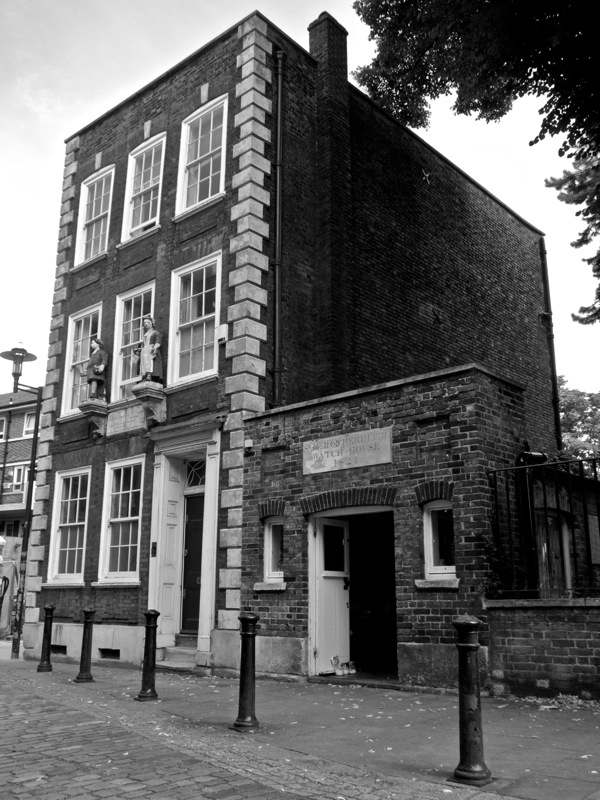
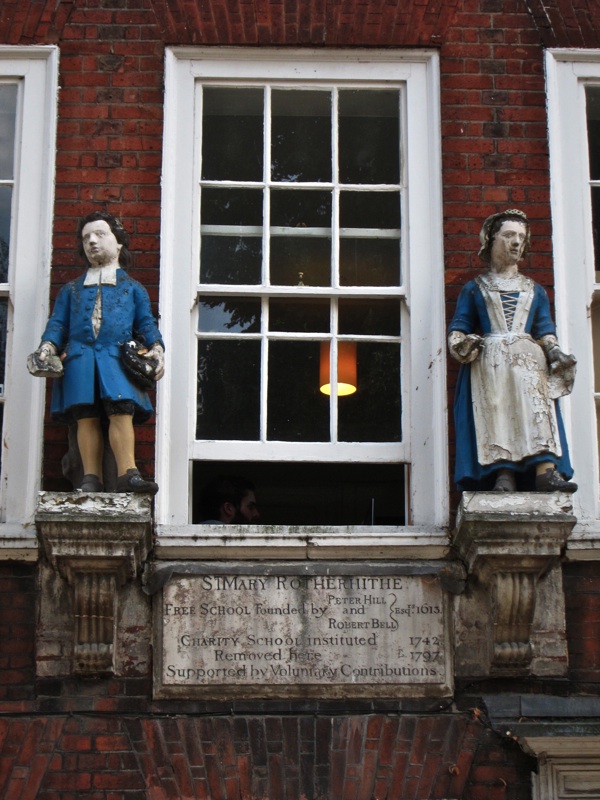
Across the churchyard from The Mayflower is Rotherhithe Free School, founded by two Peter Hills and Robert Bell in 1613 to educate the sons of seafarers. Still displaying a pair of weathered figures of schoolchildren, the attractive schoolhouse of 1797 was vacated in 1939 yet the school may still be found close by in Salter Rd. Thus, the pub, the church and the schoolhouse define the centre of the former village of Rotherhithe with a line of converted old warehouses extending upon the river frontage for a just couple of hundred yards in either direction beyond this enclave.
Take a short walk to the west and you will discover The Angel overlooking the ruins of King Edward III’s manor house but – if you are a hardy walker and choose to set out eastward along the river – you will need to exercise the full extent of your imagination to envisage the vast vanished complex of wharfs, quays and stores that once filled this entire peninsular.

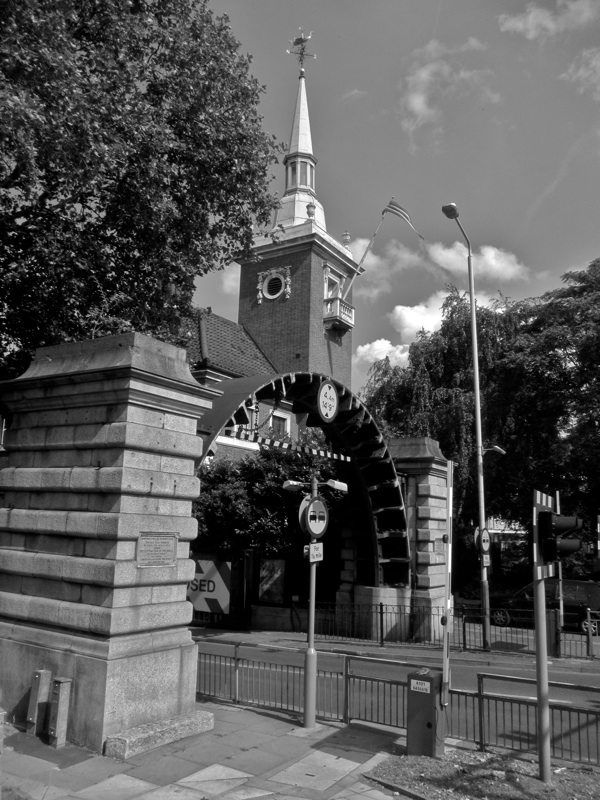
At the entrance to the Rotherhithe road tunnel stands the Norwegian Church with its ship weather vane
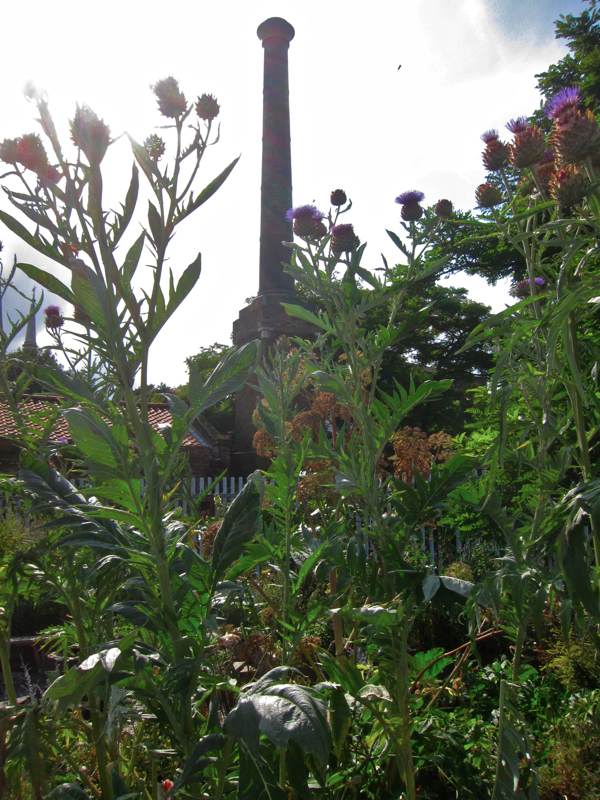
Chimney of the Brunel Engine House seen from the garden on top of the tunnel’s access shaft
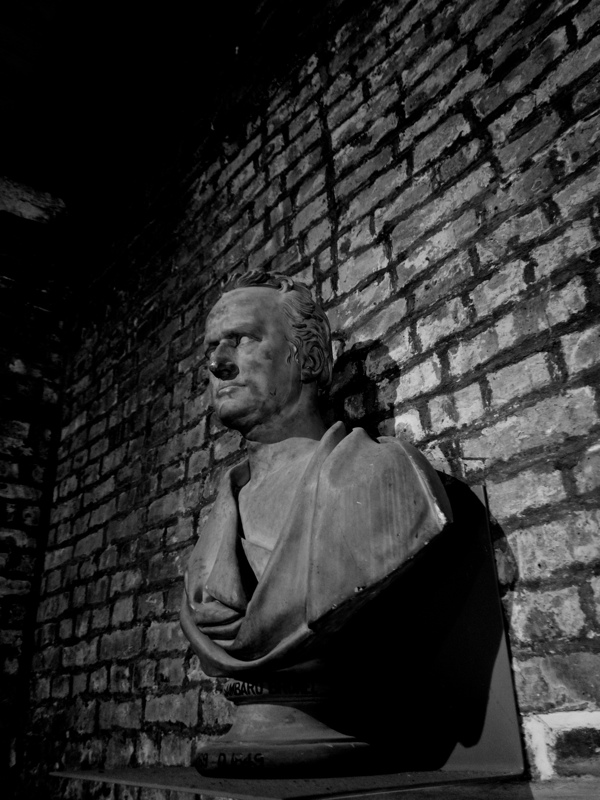
Isambard Kingdom Brunel presides upon his audacious work
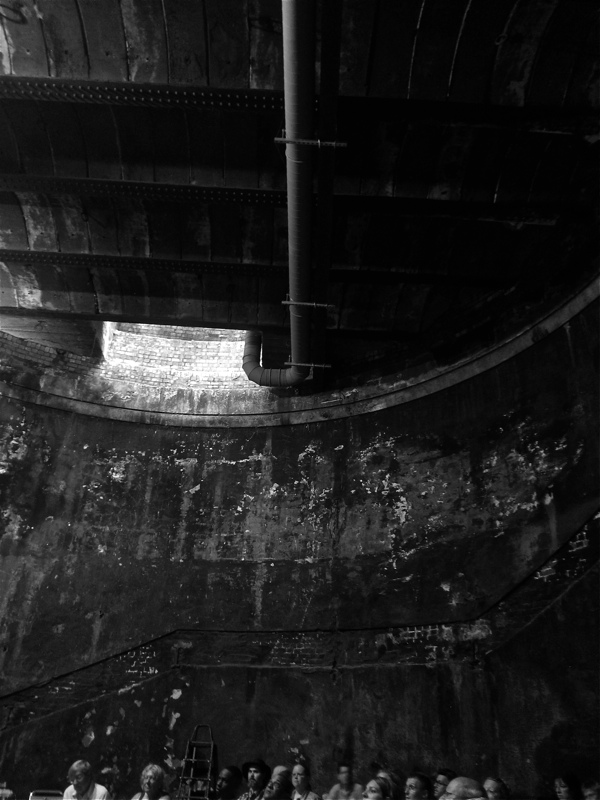
Visitors gawp in the diabolic cavern of Brunel’s smoke-blackened shaft descending to the Thames tunnel
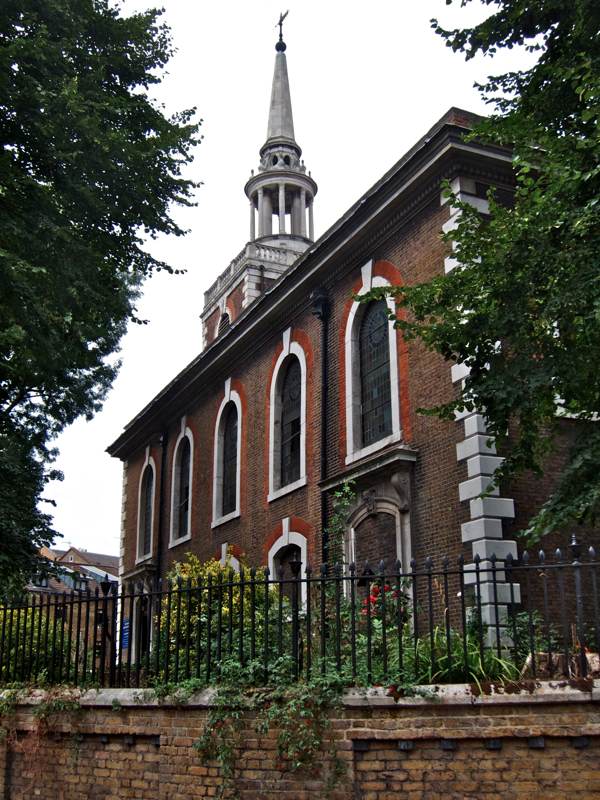
John James’ St Mary’s Rotherhithe of 1716
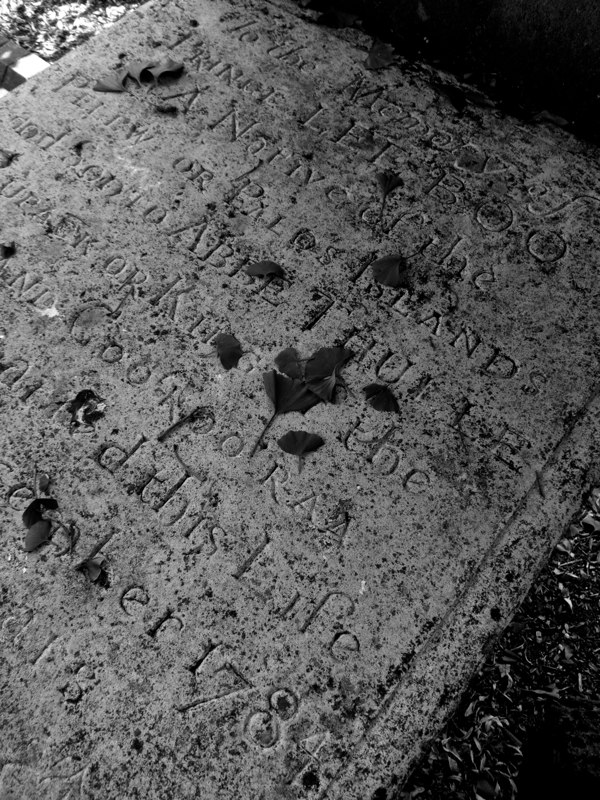
The tomb of Prince Lee Boo, a native of the Pelew or Pallas Islands ( the Republic of Belau), who died in Rotherhithe of smallpox in 1784 aged twenty
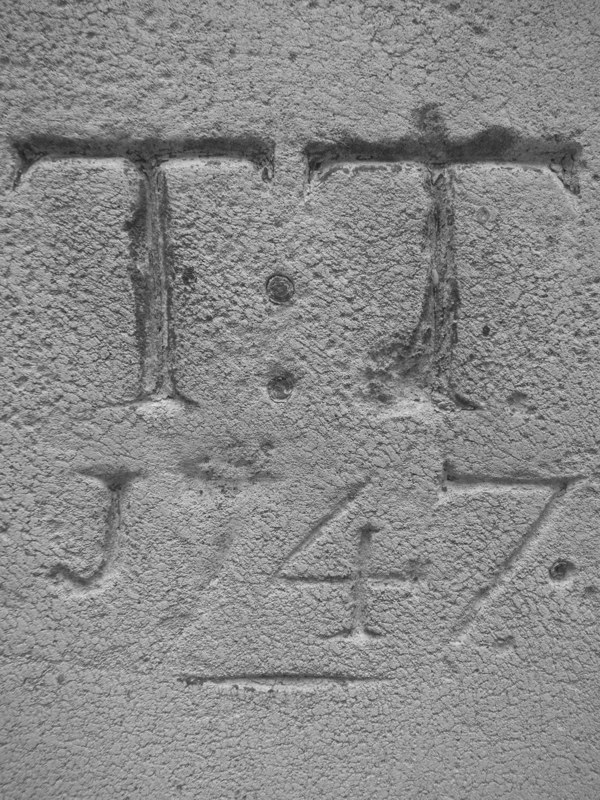
Graffiti upon the church tower
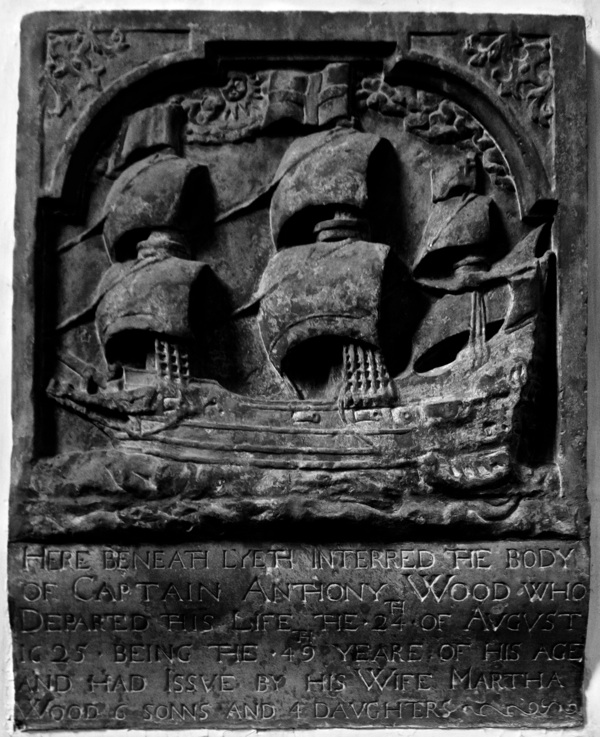
Monument in St Mary’s, retrieved from the earlier church
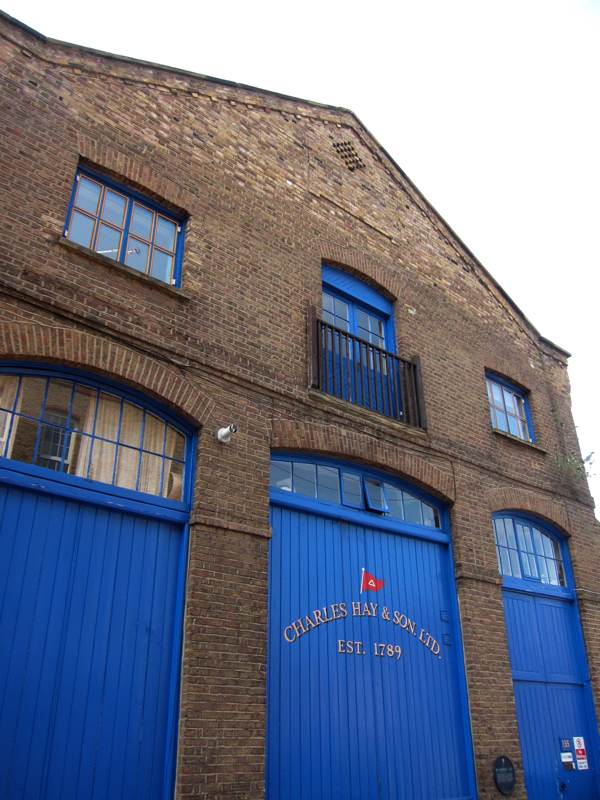
Charles Hay & Sons Ltd, Barge Builders since 1789
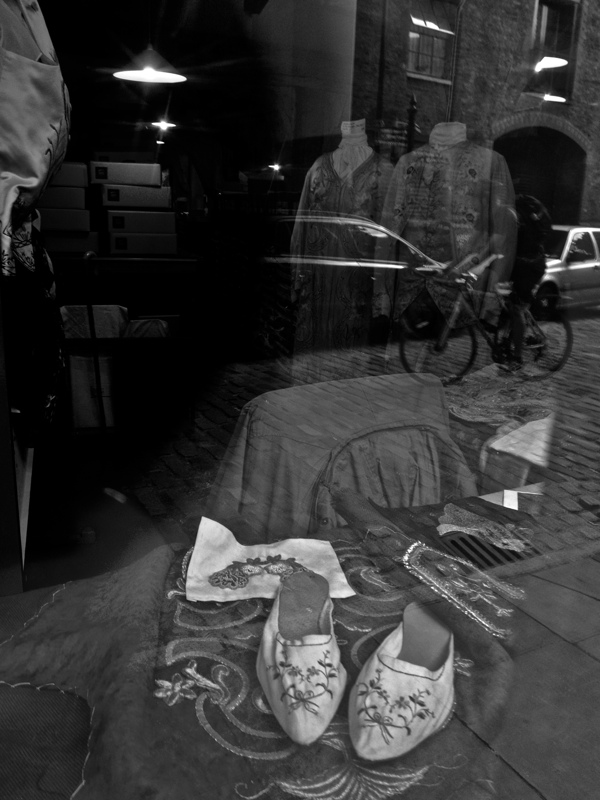
Peeking through the window into the costume store of Sands Films
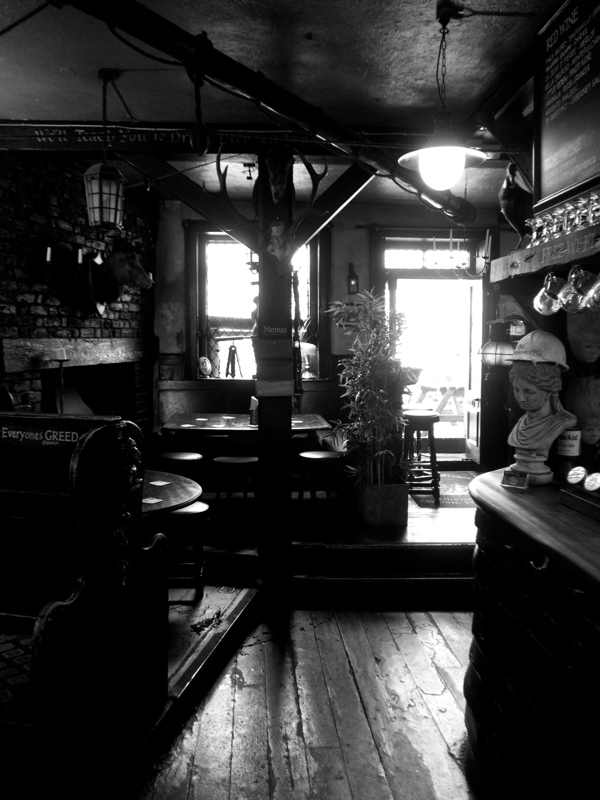
Inside The Mayflower
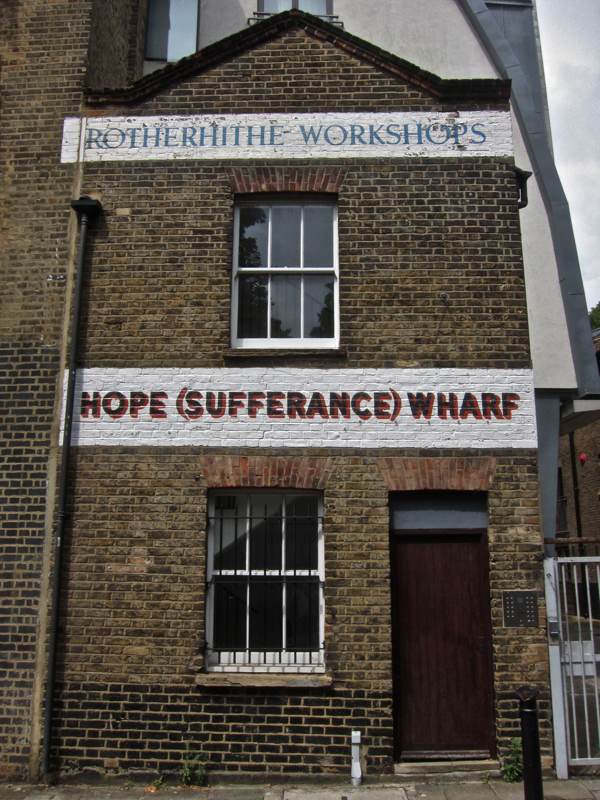
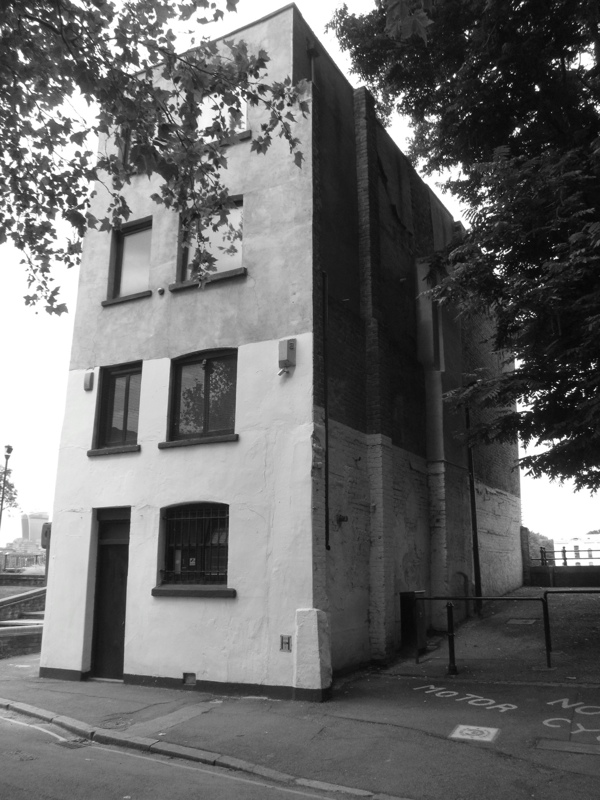
A lone survivor of the warehouses that once lined the river bank
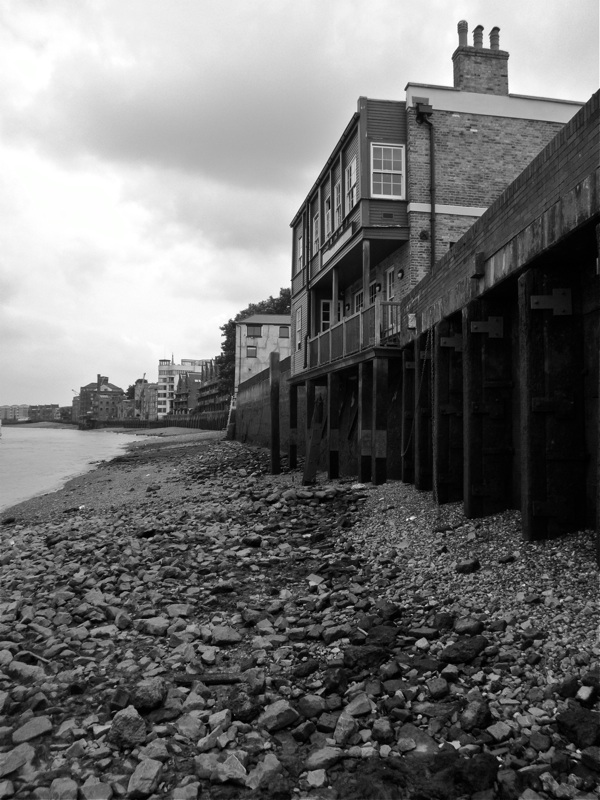
Looking east towards Rotherhithe from The Angel
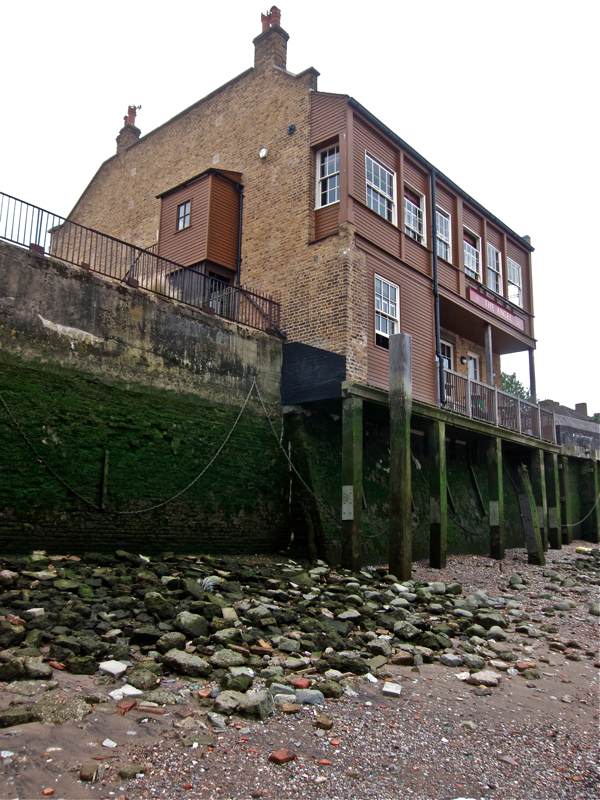
The Angel
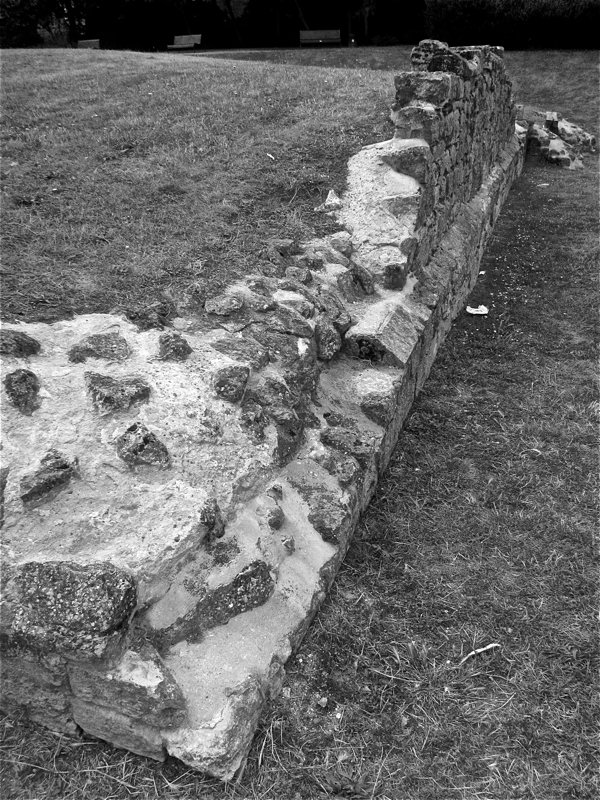
The ruins of King Edward III’s manor house
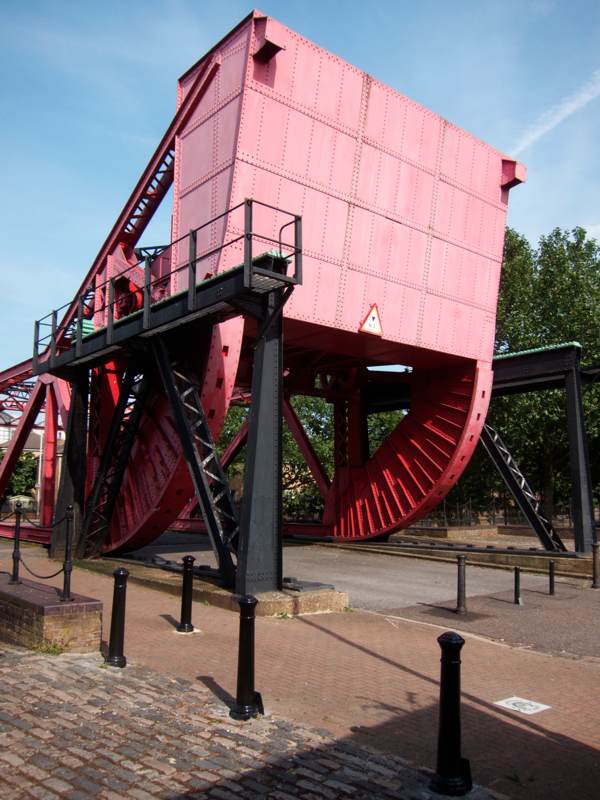
Bascule bridge
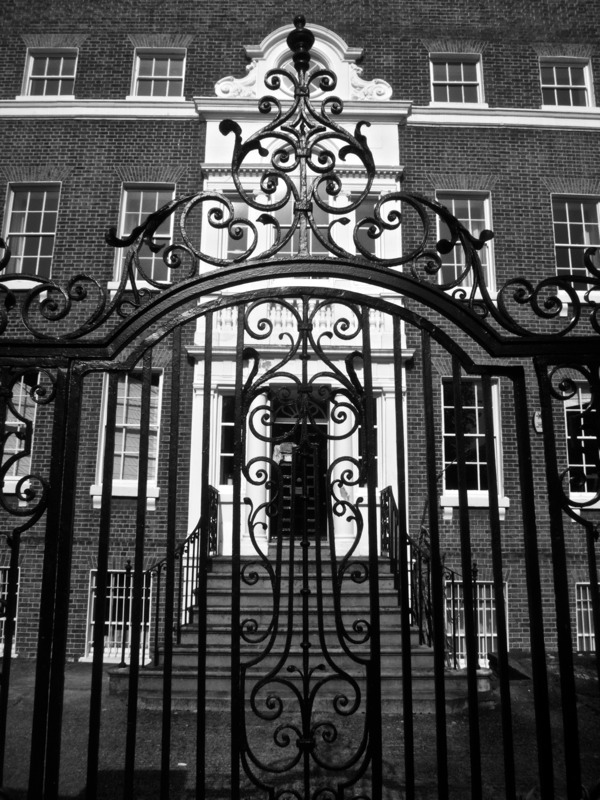
Nelson House
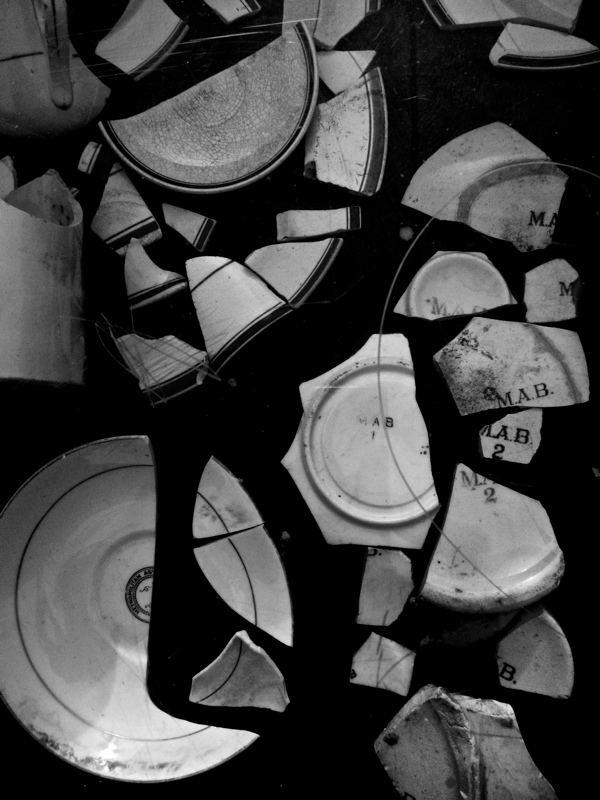
Metropolitan Asylum Board china from the Smallpox Hospital Ships once moored here
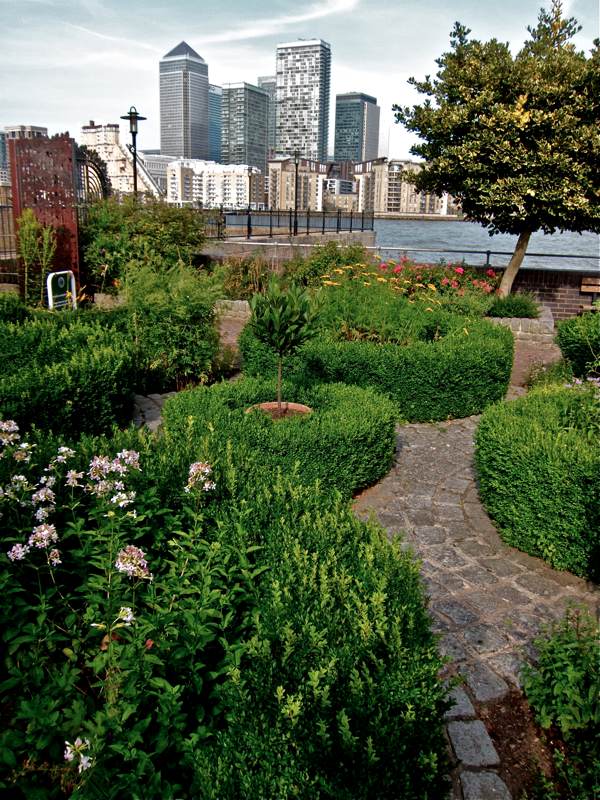
Looking across towards the Isle of Dogs from Surrey Docks Farm
Take a look at
Adam Dant’s Map of Stories from the History of Rotherhithe
and you may also like to read
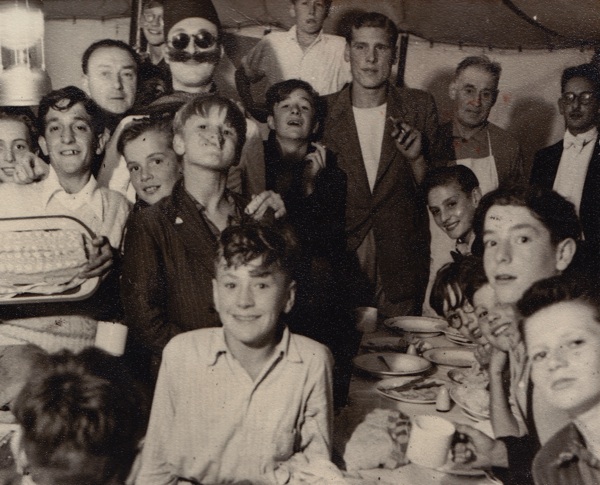
Boys’ Club Summer Camp Banquet 1942, Max is on the far left
My pal Maxie Lea rang to convey the sad news that this year’s Cambridge & Bethnal Green Old Boys’ Club Dinner, celebrating ninety years since the founding of the Club in 1924, will also be the last. Numbers have been dwindling in recent years but – understandably – Maxie wants the final dinner to be a bumper.
So please spread the word. If you were once a member of the Club and you would like to attend the Sixty-Eighth Annual Reunion to be held on Monday 1st September at the Imperial Hotel, Russell Sq, please give Maxie a call on 020 8954 0708.Monty Meth, who joined the club in 1938, will be the Speaker.
There has been an unbroken run of these reunions since the first, held in 1946 by Cecil Bright & Sydney Tabor with over three hundred and fifty Old Boys in attendance. It was my pleasure to attend one of these dinners for the first time in 2010 and I have joined the Old Boys each year since then, and you may look forward look to my report on this poignant final dinner in early September.
Operating from its headquarters in Chance St, the Cambridge & Bethnal Green Boys’ Club succeeded in raising the aspirations for generations of boys from the Boundary Estate and surrounding streets. As Ron Goldstein, who joined in the Club 1933, put it to me famously, “Half of the boys would have ended up as the next generation of gangsters and criminals if it had not been for the Club.” Originally founded as an exclusively Jewish boys club, they opened their doors to all in response to the rise of Oswald Mosley and his black shirts in the East End in 1936. It is a measure of the significance that the Old Boys place upon their experience at the Club that they still choose to meet all these years later and rekindle the friendships of long ago.
Maxie’s phone call inspired me to look back over the stories I have written about members of the Club and collect together these joyous evocative photographs by Harry Titchener – known to the boys as “T” – who, as well as being Club manager, was a professional photographer and member of the Royal Photographic Society.

Tea in the orchard 1942, Max sits on the right drinking a mug of tea

On Herne Bay Sands, Max stands in profile on the right

Boat trip, Max raises his fingers to his chin in the centre left of the picture

Maxie Lea (second from left) does the dishes at summer camp

Looking down on Dover, Max is on the left of the group

High jinks at the Greatstones Camp Tuck Shop 1939

The cook makes dough in a field at Greatstones – note the makeshift stoves in the background

Treasure hunt, Max is centre left beneath the tree

The treasure hunt continues, Max is on the right


Mealtime at Greatstones Summer Camp 1939

Max & Stanley go boating

France 1959, Max is seen in profile, waving at the centre left of this picture

Harold goes for breakfast while Paul & Max look on

Max peels the spuds at the centre of this picture

On a Sunday ramble through the outskirts of London
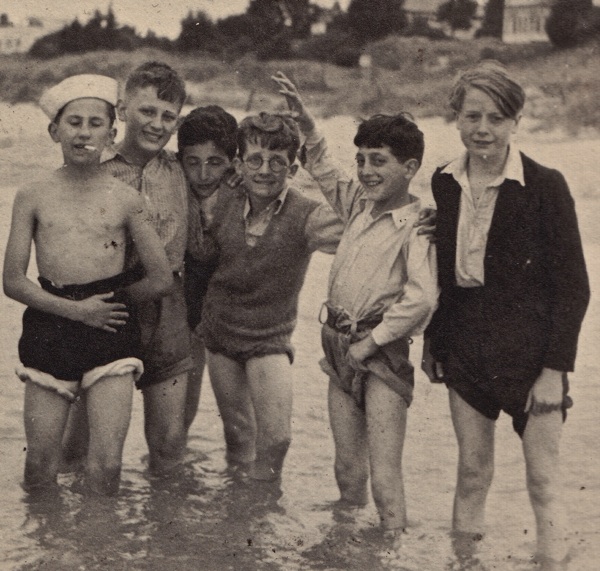
Max is in the centre right, paddling with his pals, Stanley, Manny, Butch & Ken
Photographs by Harry Titchener MRPS
You may also like to read my interviews with members of the Cambridge & Bethnal Green Boys’ Club
and watch












