
In Old Rotherhithe

St Mary Rotherhithe Free School founded 1613
To be candid, there is not a lot left of old Rotherhithe – yet what remains is still powerfully evocative of the centuries of thriving maritime industry that once defined the identity of this place. Most visitors today arrive by train – as I did – through the Brunel tunnel built between 1825 and 1843, constructed when the growth of the docks brought thousands of tall ships to the Thames and the traffic made river crossing by water almost impossible.
Just fifty yards from Rotherhithe Station is a narrow door through which you can descend into the 1825 shaft via a makeshift staircase. You find yourself inside a huge round cavern, smoke-blackened as if the former lair of a fiery dragon. Incredibly, Marc Brunel built this cylinder of brick at ground level – fifty feet high and twenty-five feet in diameter – and waited while it sank into the damp earth, digging out the mud from the core as it descended, to create the shaft which then became the access point for excavating the tunnel beneath the river.
It was the world’s first underwater tunnel. At a moment of optimism in 1826, a banquet for a thousand investors was held at the bottom of the shaft and then, at a moment of cataclysm in 1828, the Thames surged up from beneath filling it with water – and Marc’s twenty-two-year-old son Isambard was fished out, unconscious, from the swirling torrent. Envisaging this diabolic calamity, I was happy to leave the subterranean depths of the Brunels’ fierce imaginative ambition – still murky with soot from the steam trains that once ran through – and return to the sunlight of the riverside.
Leaning out precariously upon the Thames’ bank is an ancient tavern known as The Spread Eagle until 1957, when it was rechristened The Mayflower – in reference to the Pilgrims who sailed from Rotherhithe to Southampton in 1620, on the first leg of their journey to New England. Facing it across the other side of Rotherhithe St towers John James’ St Mary’s Rotherhithe of 1716 where an attractive monument of 1625 to Captain Anthony Wood, retrieved from the previous church, sports a fine galleon in full sail that some would like to believe is The Mayflower itself – whose skipper, Captain Christopher Jones, is buried in the churchyard.
Also in the churchyard, sits the handsome tomb of Prince Lee Boo. A native of the Pacific Islands, he befriended Captain Wilson of Rotherhithe and his two sons who were shipwrecked upon the shores of Ulong in 1783. Abba Thule, the ruler of the Islands, was so delighted when the Europeans used their firearms to subdue his enemies and impressed with their joinery skills in constructing a new vessel, that he asked them to take his second son, Lee Boo, with them to London to become an Englishman.
Arriving in Portsmouth in July 1784, Lee Boo travelled with Captain Wilson to Rotherhithe where he lived as one of the family, until December when it was discovered he had smallpox – the disease which claimed the lives of more Londoners than any other at that time. At just twenty years old, Lee Boo was buried inside the Wilson family vault in Rotherhithe churchyard, but – before he died – he sent a plaintive message home to tell his father “that the Captain and Mother very kind.”
Across the churchyard from The Mayflower is Rotherhithe Free School, founded by two Peter Hills and Robert Bell in 1613 to educate the sons of seafarers. Still displaying a pair of weathered figures of schoolchildren, the attractive schoolhouse of 1797 was vacated in 1939 yet the school may still be found close by in Salter Rd. Thus, the pub, the church and the schoolhouse define the centre of the former village of Rotherhithe with a line of converted old warehouses extending upon the river frontage for a just couple of hundred yards in either direction beyond this enclave.
Take a short walk to the west and you will discover The Angel overlooking the ruins of King Edward III’s manor house but – if you are a hardy walker and choose to set out eastward along the river – you will need to exercise the full extent of your imagination to envisage the vast vanished complex of wharfs, quays and stores that once filled this entire peninsular.


At the entrance to the Rotherhithe road tunnel stands the Norwegian Church with its ship weather vane


Chimney of the Brunel Engine House seen from the garden on top of the tunnel’s access shaft

Isambard Kingdom Brunel presides upon his audacious work

Visitors gawp in the diabolic cavern of Brunel’s smoke-blackened shaft descending to the Thames tunnel

John James’ St Mary’s Rotherhithe of 1716

The tomb of Prince Lee Boo, a native of the Pelew or Pallas Islands ( the Republic of Belau), who died in Rotherhithe of smallpox in 1784 aged twenty

Graffiti upon the church tower

Monument in St Mary’s, retrieved from the earlier church

Charles Hay & Sons Ltd, Barge Builders since 1789

Peeking through the window into the costume store of Sands Films


Inside The Mayflower


A lone survivor of the warehouses that once lined the river bank

Looking east towards Rotherhithe from The Angel

The Angel

The ruins of King Edward III’s manor house

Bascule bridge

Nelson House

Metropolitan Asylum Board china from the Smallpox Hospital Ships once moored here

Looking across towards the Isle of Dogs from Surrey Docks Farm
Take a look at
Adam Dant’s Map of Stories from the History of Rotherhithe
and you may also like to read

Boys’ Club Summer Camp Banquet 1942, Max is on the far left
My pal Maxie Lea rang to convey the sad news that this year’s Cambridge & Bethnal Green Old Boys’ Club Dinner, celebrating ninety years since the founding of the Club in 1924, will also be the last. Numbers have been dwindling in recent years but – understandably – Maxie wants the final dinner to be a bumper.
So please spread the word. If you were once a member of the Club and you would like to attend the Sixty-Eighth Annual Reunion to be held on Monday 1st September at the Imperial Hotel, Russell Sq, please give Maxie a call on 020 8954 0708.Monty Meth, who joined the club in 1938, will be the Speaker.
There has been an unbroken run of these reunions since the first, held in 1946 by Cecil Bright & Sydney Tabor with over three hundred and fifty Old Boys in attendance. It was my pleasure to attend one of these dinners for the first time in 2010 and I have joined the Old Boys each year since then, and you may look forward look to my report on this poignant final dinner in early September.
Operating from its headquarters in Chance St, the Cambridge & Bethnal Green Boys’ Club succeeded in raising the aspirations for generations of boys from the Boundary Estate and surrounding streets. As Ron Goldstein, who joined in the Club 1933, put it to me famously, “Half of the boys would have ended up as the next generation of gangsters and criminals if it had not been for the Club.” Originally founded as an exclusively Jewish boys club, they opened their doors to all in response to the rise of Oswald Mosley and his black shirts in the East End in 1936. It is a measure of the significance that the Old Boys place upon their experience at the Club that they still choose to meet all these years later and rekindle the friendships of long ago.
Maxie’s phone call inspired me to look back over the stories I have written about members of the Club and collect together these joyous evocative photographs by Harry Titchener – known to the boys as “T” – who, as well as being Club manager, was a professional photographer and member of the Royal Photographic Society.

Tea in the orchard 1942, Max sits on the right drinking a mug of tea

On Herne Bay Sands, Max stands in profile on the right

Boat trip, Max raises his fingers to his chin in the centre left of the picture

Maxie Lea (second from left) does the dishes at summer camp

Looking down on Dover, Max is on the left of the group

High jinks at the Greatstones Camp Tuck Shop 1939

The cook makes dough in a field at Greatstones – note the makeshift stoves in the background

Treasure hunt, Max is centre left beneath the tree

The treasure hunt continues, Max is on the right


Mealtime at Greatstones Summer Camp 1939

Max & Stanley go boating

France 1959, Max is seen in profile, waving at the centre left of this picture

Harold goes for breakfast while Paul & Max look on

Max peels the spuds at the centre of this picture

On a Sunday ramble through the outskirts of London

Max is in the centre right, paddling with his pals, Stanley, Manny, Butch & Ken
Photographs by Harry Titchener MRPS
You may also like to read my interviews with members of the Cambridge & Bethnal Green Boys’ Club
and watch
Eliza Begum, Bridal Florist
The seventh of seven stories by Writer & Anthropologist Delwar Hussain, author of Boundaries Undermined, who grew up in Spitalfields

Eliza Begum looks like she is buried under flowers. There are large bundles of roses, gerberas, pink lilies, gypsophila, hydrangeas and chrysanthemums everywhere. This is nothing new. For the last eight years she has been making wedding bouquets from the dining room of her house just off Brick Lane.
This time, however, the order is slightly different. A secondary school in Plaistow is organising a prom night for its final year students and they want flowers – a lot of them. Eliza explains that the theme of the prom is “summer” so everything has to be colourful and bright. They have ordered one hundred and thirty-seven buttonholes, wrapped and pinned with foliage – one hundred and five single red roses, wrapped and ribboned – ten large bouquets and three massive table arrangements.
“I usually make bouquets, corsages, buttonholes, garlands, large displays with fresh flowers, bedroom decorations and headdresses. Holidays and weekends are mental and the main wedding season is obviously spring and summer. It is particularly buzzing then because everyone wants to have their weddings at the same time. I have bookings three months in advance, but then there is always a surge and I often have to refer clients to other bridal florists. Someone will always call me up and say that they need something ASAP. Or two days before an event, I will receive a message saying that they want to add ten more buttonholes to their list. They don’t understand that I have to pre-order the flowers, so then I have to find them somehow. When things get really chaotic, I enrol my husband into it as well. He has become quite nifty at putting the flowers together for buttonholes.
I like working with a client to create the overall look. I work from pictures, ideas or themes that they bring to me. Mostly people tend to want red and white colours. Carnations are durable, so I use them if someone has a particular sort of colour theme. I use celosia, which look a little like velvety brains. At the moment, I am using a lot of peonies and gerberas. The latter come in bright colours, but they don’t last very long. Orchids are my favourite. Each plant is different, unique. They come in all shapes, colours and sizes. They take a lot of skill to grow. I had a white orchid shower bouquet for my own wedding some years ago.
I do an in-house service which involves making fresh flower canopies, draping them around the matrimonial bed. Someone recently wanted me to decorate their horse-drawn carriage. The vehicle itself was like the glass one Cinderella had in the fairy tale. The bride had an image of herself being totally immersed in flowers and emerging out of the carriage with the flowers tumbling out with her. But I couldn’t do it because she called me only a week before the event. I told her that I needed to pre-order the flowers which would take some time and that the carriage hire company may not even give permission for such a thing. In the end, she settled for strings of flowers instead, which I think looked much better.
Since the recession, the price of flowers has gone up and they are much more expensive than what they were. I think it has become harder for people to weigh up the costs and benefits of them. Having said that, people tend to spend quite a lot of money on their weddings anyway and the recession hasn’t changed that. I’ve noticed that people want their flowers to look standard and uniform. They don’t want them to look natural. They don’t want their flowers to smell either. They say it may clash with their perfume, or that they suffer from hay fever.
I got started in it when I was eighteen years old and my older sister was getting married. She wanted a particular design for her bouquet and we went to a florist for a quote. They were asking for eighty pounds. I was shocked and thought I could make it myself. So I did and continued to do so.
I was working as a youth worker at the time and started teaching the young people how to do flower arranging. I was then hired to do various different youth projects related to flowers. From that, people began asking me to do their weddings. It was around then that I also did a professional training course as I wanted to know what I was actually doing.
Afterwards, I would get my flowers delivered directly from Holland. I was young and new to the business and got a little nervous by the large amounts of flowers coming in. I didn’t know how to store them all. I decided to change my flower dealer and to go to the New Spitalfields Market in Leyton and Columbia Rd Flower Market instead. It is much more expensive buying in such a way, but it is less wasteful and I can get the precise numbers that I need.
I have built up a great rapport and relationship with the sellers at Columbia Rd. I have been going there for years now. I can call them before hand and ask them to get me something, or some of them even save me flowers that they think I would like. The advice they give me is really useful too – information on storage, cutting, dying roses blue for example, how to make them last longer, that sort of thing…”


Buying flowers at Columbia Rd Market

To commission flowers from Eliza Begum email eliza25@hotmail.co.uk
Photographs copyright © Sarah Ainslie
You may also like to read about

ENVOI FROM DELWAR HUSSAIN
“I would like to thank you, readers, for allowing me to bring to you some amazing stories from East Enders. I really look forward to the next installment.”
Portrait of Delwar Hussain copyright © Lucinda Douglas-Menzies
Sina Sparrow, Graphic Illustrator
The sixth of seven stories by Writer & Anthropologist Delwar Hussain, author of Boundaries Undermined, who grew up in Spitalfields

The first time I saw Sina Sparrow’s graphic illustrations was on the staircase of the Hackney Picture House last year. It was a dark, winter’s evening and I had been to see a film on my own. I was walking down the stairs when a series of black and white images leapt out at me.
The illustrations were striking and they were attached to the wall using bulldog clips. All were of men in various states of nudity. Some of them were embracing intimately and others kissed. A few of the drawings had captions with wry comments and observations. They looked like graffiti from toilet walls, but they seemed more thoughtful, considerate, melancholic even. One was of a topless man captioned “He sleeps with everyone but me,” with a heart coloured-in beside the figure.
I tell Sina this when I meet him in Limehouse where he lives and works from his bedroom. He runs Debbie, a monthly club in Bethnal Green, and is tired and sleep deprived. He laughs, which he does easily, often and with volume, telling me he remembers that exhibition vividly – he had split up with a boyfriend and was feeling heartbroken while hanging those pictures on the staircase. “I stood back and looked at my work and thought ‘all of this is so sad. I really hope people connect to it and think it’s fun,’” he recollects, again laughing.
Much of Sina’s work is autobiographical, excavating his own store of experiences, desires and fantasies. It concerns a range of observations on relationships, break-ups, sexuality, pop-culture and loneliness, and also upon the ordinariness of life, the enigma of coincidences, the nature of attraction, the inherent difficulties of living in London and our relationship with technology.
Growing up in Surbiton, Sina was writing and reading comics from an early age. “I love words and pictures and found comics exciting. I was into superheroes such as the X-men, Wonder Woman, Thor, Superman and Batman, Cloak and Dagger and the Justice League. I found the characters all really attractive because they were really powerful and beautiful, and they were fighting for social justice at the same time.”
Sina initially drew his own comics based upon what he was reading and he gave them away to people he knew. Then, around the age of sixteen, he discovered that there were others who were making and photocopying their own zines, and this led him to take his own material more seriously. In his work, he began to address what was happening in his own life, exploring matters to do with identity and bullying – the latter, he says, was especially pivotal.
“I went to an all-boys school and there was a lot of homophobia in the air. I didn’t have very many friends and was bullied quite a lot. Much of it centred upon my sexuality. At the time I didn’t even know what I was, but this did not matter to the bullies. What this period allowed me was a lot of time to work on my art and creative writing. Reading comics such as X-Men helped – this story about mutants is essentially a metaphor for race, sexuality and other forms of difference, and the ways in which people react to that.”
“Boy Crazy Boy” was the first of these zines, taking a sardonic look at everyday incidents which Sina experienced. One of his stories was about a boy Sina had crush on. One day, the boy invites Sina to his house, which he is over the moon about until he discovers that the crush’s boyfriend is there as well, when he didn’t even know he had one.
Sina’s parents are both academics who initially encouraged their son’s enthusiasm for comics but, when it seemed like he wasn’t growing out of them, they became anxious about it. “Comics were thought to be slightly regressive, in relation to ‘real’ art and literature.” They also grew uncomfortable by some of the content when, at thirteen, Sina’s biggest influence was a series called “Love & Rockets” by Mexican-American brothers Gilbert & Jaime Hernandez about two punk girls in a lesbian relationship.
Sina went to art school and did a degree in illustration, but he says it made him feel lost and disillusioned with his work. It took a long time to get back to making comics again. He did a series called “Art Fag – Tales of Love and Loneliness that could be yours,” and a zine called “Pretty Boys Ignore You” which is a series of illustrations that he did in the bars and cafes of Shoreditch and Soho, imagining the stories of strangers he sat next to.
Sina’s work is honest and frank. “It’s about feelings, ambiguous and sometimes negative feelings – I think it is important to talk about the darker side of life,” he admits – but he also hopes his illustrations make people laugh and connect emotionally through humour. “The more specifically I speak about my own life and experiences – ironically – the more universal my work becomes,” he suggests, “Straight people can look at it and say, ‘Oh that’s really romantic’ or ‘I feel like that too.’”


“I don’t want to be hot or cool or – or fabulous,” he said, “I just wanna be me.”


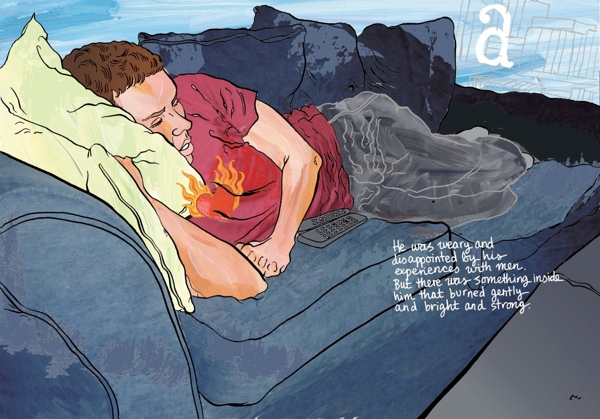
But there was something inside him that burned gently and bright and strong

Drawing for The Melting Ice Caps album cover

Portrait of musician Owen Duff

Sina Sparrow
Illustrations copyright © Sina Sparrow
Photographs copyright © Jeremy Freedman
You may also like to read about
Beekeepers On The Isle Of Dogs
The fifth of seven stories by Writer & Anthropologist Delwar Hussain, author of Boundaries Undermined, who grew up in Spitalfields

What was once the caretaker’s yard at George Green’s School on the Isle of Dogs is now a beautiful and thriving community garden, abundant in plants and flowers, as well as fruit and vegetables. It is fringed on all sides by tall trees and even taller high-rise blocks that overlook it. Beside one of the far walls of the garden, I meet three figures, dressed in white. Their heads are covered in white helmets with protective meshing over their faces. Resembling astronauts from a sixties science-fiction film, they hunch over four wooden structures – inspecting, examining and searching. These are the beekeepers, checking one of their hives for an elusive queen bee.
Thirty-year-old Lee Diep Chu is a newly qualified teacher and one of the volunteers in charge of the bee colonies here. Lee is a native of the Island and a former student at George Green’s School. Growing up in the eighties, she says that much of the area was derelict with not much going on. The British National Party were very active then and, coming from one of the small pockets of Vietnamese and Chinese communities, Lee says many people lived in fear. But slowly, from the mid-nineties onwards, it began to get better. There was more funding for local-government initiatives focusing on the Island and a lot more being done for young people at the School too. Beekeeping emerged out of this particular history of deprivation and development on the Isle of Dogs.
The excitement in Lee’s voice as she explains the world of the honey bees is obvious and infectious and, soon enough, it is easy see why. “If we can’t see the queen, then we look for signs of her eggs and larvae which is what we have been doing,” she explains, “The colony itself knows very quickly if it is queen-less. They can smell that she is no longer there. This means that they go into emergency mode and will quickly rear another queen to replace the missing one.
At first, I thought ‘Ooooo, bees. A bit dangerous, aren’t they?’ It is obviously a common fear. But now I am fascinated by them. I feel very attached and protective over the four colonies that we have set up. I come here after work and on Sundays, smoke the bees or simply watch them. None of us volunteers are experts by any means, we just like doing it. It’s a group effort and really therapeutic.
The colony is like one, large animal and can be seen as a single entity. When a new queen is required, she is chosen from amongst all of the other bees. The colony will feed the chosen one royal jelly for sixteen days until she hatches and continue to do so throughout her adult life. This enables her to grow larger and fatter than the others. Afterwards, flies into the air and mates with around ten male drones. From that one session, she is fertile for up to five years allowing her to lay between fifteen hundred to two thousand eggs a day, which she drops into cells.
The worker bees usually begin their lives as house-keeping bees, keeping the hive clean. Some will nurse the new born, their sisters, and produce wax in order to build new combs. Others will guard the hive from intruders such as wasps or hornets, but also larger creatures. Towards the final stages of their lives, the workers forage for pollen and nectar. Whilst the queen can expect to live between two to five years, the life span of the worker bee on the other hand is around six weeks. They eventually die of exhaustion. Contrary to popular belief, it isn’t much fun being a queen bee. She is a slave to the colony. Her job is to just lay eggs. If the queen doesn’t do what is expected of her, the other bees will simply kill her off.
The colonies are made up of female bees. The male drones are expected to mate with queens from different hives – they don’t do much else and are pretty useless. In the winter, the females will kill the males off, or at least keep them away from the hive. Then, there will only be a few thousand or so of them left, keeping the hive warm and the queen alive. As beekeepers there is little else we can do to help them then. We try and keep viruses down, such as the varroa virus which is deadly and we give them sugar solution and fondant, but other than that, we just hope and pray that they make it through in to spring. This will be the start of the mating season, when the cycle begins all over again.”
The decline in the bee population have been a cause for concern for a while. Across Europe, estimates suggest that bee numbers have more than halved in recent years, with some species of bees already extinct in the United Kingdom. This is particularly troubling as bees are not just required to produce honey and wax, but crucially to pollinate a third of the food we eat – including many varieties of fruit, vegetables, plants and crops.
Lee explains that “Colony Collapse Disorder” is connected to the overuse of pesticides and new agricultural techniques which are fatal for bee species. However, bee populations in London are thriving. “We don’t know precisely why this is, but it may be because the bees are not exposed to insecticide in the way that they are in the countryside.”
“What about the pollution in London?” I ask, “Why it is that insecticide affects them but pollution doesn’t?” “We don’t know the answer to this,” Lee replies, “yet it could become an issue further down the line.”
Honey has many medicinal benefits, but using locally-produced honey is even better for allergies and especially Hay Fever – since it is local pollen that causes the irritation. Lee uses the honey they get from their bees to treat her own Hay Fever. At the moment, like the rest of the produce grown in the garden, the honey produced by the Isle of Dogs’ bees is used in the George Green’s School café. The local pub and some restaurants also sell the honey, and Lee hopes to sell it more widely.


Manda Helal – Beekeeping volunteer
I am a gardener and I wanted to learn more about bees. I heard there will be a problem with our food if we don’t have enough bees. I like the slowness of it all. Watching the bees, being busy, busy, busy. But the honey itself weighs a tonne – it takes strength. They all look so happy. You don’t see them as individuals, but as a collective. It’s all of them working together that makes it work. If they were to break off from the rest, it wouldn’t work. It’s fascinating.

Jules Robertson – Beekeeping volunteer
Jules is another volunteer who looks after the bees. I used to live in one of the tower blocks that overlooks the garden. I heard about the real crisis that bees are in and that urban beekeeping was the way forward for their survival. There is something about the biodiversity of London that means they can thrive here. So I went looking all over the place for somewhere to do beekeeping. It came as a shock that I didn’t have to go far at all and it was just on my doorstep.

Lee Diep Chu has just written to me to say that one of their hives has reared a new queen which has begun laying eggs, something they are all very excited about.
Photographs copyright © Colin O’Brien
You may also like to read about
Naz Choudhury, Bollywood Dancer
The fourth of seven stories by Writer & Anthropologist Delwar Hussain, author of Boundaries Undermined, who grew up in Spitalfields

If ever a real-life Bollywood story was to be set in East London, it should be based upon Naz Choudhury’s own life. It has all the ingredients required – a story overcoming real adversity, demanding steely determination, involving dooshoom dooshoom (Bollywood parlance for fisticuffs), plus glamour, music and dance – a generous amount of it.
Naz grew up in Pauline House, the most distinct of the sixties high rise tower blocks off Vallance Rd and – for some – a by-word for misguided, outdated urban development, poverty, crime-ridden dilapidation and social alienation.
From here, the thirty-year-old has become an extremely successful dancer, producer and entrepreneur. He began dancing at family functions and weddings from the age of thirteen and then got involved in local dance events, which he says he never took too seriously. With his mother’s help, he started dancing at annual mela festivals all across east London.
“The dance I do is a form of world dance. It takes its influences from western dance forms and mixes it with that of eastern styles. When you look at what I do, it is urban bollywood, latin bollywood, commercial bollywood which is what most people know, as well as traditional kathak, bharatanatyam and bhangra. I have always enjoyed the freedom of dancing. I enjoy putting on the stage charisma, making people smile, the crowd appreciating what I do, making them go ‘wow’!!
I learnt the language of dance myself. I am full-on self taught. I’ve never had a teacher. What this means is that when I hear a beat, it tells me to move a certain way. It determines whether I go hard, soft, or smooth. I let the beat take me and then I just freestyle, do my own thing.
My biggest influences are Michael Flatley, Coach Carter, the Bollywood actor Salman Khan and Rocky Balboa [the fictional character played by Sylvester Stallone in the Rocky films]. They are all of my inspirations, Balboa especially because he fights for everything he does. I always think, if I can’t beat myself in order get a step up, what is the point in being here.”
In 2000, Naz attended an audition for a Bollywood dance show in Leicester Sq alongside seven hundred other hopefuls. It was for a place as a backing dancer in a spectacular Bollywood performance at Wembley Arena with celebrities and stars from the Bombay film industry. He was seventeen years of age.
“I kept thinking that I was a normal guy from East London. But for two months, I practiced hard on a routine in my bedroom. My neighbours have never really complained. I don’t practice late and I usually play the music on my headphones. After I performed it, I could hear the clapping and the smiles on the judge’s faces. I knew I had done well. I got a place on the show. I went home and practised the moves that we were to do. I was going to master it and be the best. During the rehearsals that followed, the other dancers, who were all older, would come and ask me to help them with the counts. On the night of the show, I met famous actors, actresses and models. It was all so glamorous.”
This jump from dancing at local events in the East End to performing in front of thousands of people was incredible, Naz says – bigger than what he would go on to achieve later in his life. After this, things just blew up, he says. He did a second show and then another one. There were thousands of people attending them. Soon after, Naz formed his own dance group which toured all across Europe.
But, as quickly as everything took off, the jobs fizzled out. He remembers coming back to Pauline House from Spain where he had been performing and found there was nothing else. “How does one go from such a high of feeling alive, to coming back down to earth,” Naz wondered. He suffered from depression for a while. However this was not going to be the only trial he faced.
Naz found local people turning against him because he danced. “Boys from local religious groups would mock and abuse me. I would have massive groups of them threatening and trying to provoke me. It was never a small group of people. They would call me names, say that I was being gay by dancing and a kafir [a non-believer]. They said dancing was wrong. It was against Islam. Some of the stuff they would say was really insulting. I suppose it is because I am different. I am not the same as everyone else around me.
I won’t forget what they did. I had put my blood, sweat and tears into this and here were people trying to stop me from doing what I wanted to do. There was a period when I had to move out of Pauline House because it got really bad. It was becoming a huge challenge to fight these guys whilst at the same time, to fight for work.
But then, being an East London boy, I was never going to back down and let them get away with it. I would also go and throw down with them. I created my own support – I also had people who would take a punch for me or throw one if needs be. Other dancers would come to my support, as would my older brother and his friends. Eventually, I think I won people over. The funny thing is, now some of these guys want to come to my shows and want to shake my hand when they see me.”
Naz picked himself up and started doing small workshops in the borough. Teaching nine to fifteen-year-olds the dance moves he had learnt and mastered. One summer, he trained around forty of them who worked so hard, that he managed to get them a gig at the Millenium Dome. “They killed the performance,” he says, “We all danced our hearts out.”
This proved to be one of the most important moments of his life. From that, he got another booking where he danced with Bollywood superstars Shah Rukh Khan, Arjun Rampal and Shilpa Shetty. The Pakistani popstar Atif Aslam headlined. From 2007, Naz decided to produce his own show. At his first attempt, he sold out the Albert Hall. He was twenty-three years old. This is what he does now, organising large Bollywood, all-singing, all-dancing super shows.
“I love being from where I am. Having my family, my friends and the drama around me. This is my natural habitat. I live in a world that is surreal, glamorous, but I still live with my family. I love it. I feel accepted here and don’t need to please anyone. My mother has constantly helped me. She has always wanted me to be more than I am. I don’t want to show her the stress, just the glamour. But of course she knows that its not all easy. I have achieved all my dreams. I’m just enjoying everything I do now.”


Naz Choudhury at Pauline House
Portraits copyright © Phil Maxwell
Kalina Dimitrova, Cellist & Bookseller
The third of seven stories by Writer & Anthropologist Delwar Hussain, author of Boundaries Undermined, who grew up in Spitalfields

Kalina & I sit in a corner of the Brick Lane Bookshop, enclosed by the titles of Alexander McCall Smith, Zadie Smith and the Gentle Author. “I like getting lost in books,” she explains, sporadically playing with a set of keys in her hands and her unruly hair. “I enjoy escaping into stories and not wanting to talk to anybody. I read a lot in French and English, usually fiction and some non-fiction too.” One of the first novels she read in English was “An Equal Music” by Vikram Seth. Set in London, it is about an illicit love affair between a pianist and a violinist. The book has particular poignancy because Kalina is not only the manager of the bookshop, she is a musician herself.
As well as being raised on a musical diet of Beethoven, Shostakovich, Schubert and healthy servings of opera, Kalina’s parents often took her to classical music concerts in Sofia. There was a lone Beatles LP which belonged to her father but, aside from this, she listened to very little else other than classical music until her teens. Schubert’s “Arpeggione Sonata” for the cello became formative and her favourite. At the age of five, when her parents asked whether she would like to learn to play an instrument, Kalina chose the cello – a decision she has never regretted.
She describes the sound as similar to the human voice. “It has a low register and a high register, like a person speaking.” It was also the shape and size of it that she took to, like holding a child. I see this myself, when she is being photographed, posing next to her cello as a mother might stand next to a child in a family portrait.
As a consequence of her decision, Kalina took classes several times a week. She also studied the piano, theory of music, and chamber and orchestra music. She eventually earned herself a place at the only music school in Sofia, named after the Bulgarian composer, Lubomir Pipkov. Bulgaria was still under Communist rule then and its people were experiencing hardship. “I remember we did not have items such as bananas or oranges. Music from the West was difficult to get hold of and there were shortages of milk and water,” she admitted to me.
However, with a French mother, Kalina was lucky because her family were not subject to the same restrictions as others, meaning they were able to travel. Every summer, they went to France to stay with her maternal grandmother, providing Kalina with a sense of the world beyond Bulgaria. While away, she would buy presents for friends back home which they could not find in Sofia. She remembers neighbours considered her family to be privileged, wealthy even. But her parents were working people like others, she says.
Bulgaria, like much of the former USSR, was experiencing dramatic change by the time she became a teenager. Just months after the collapse of the Berlin Wall, demonstrators took to the streets of Sofia calling for democratic rule. Kalina was one of these protesters in the throng, marching arm in arm with her father. “People didn’t know anything but Communism,” she says, “We wanted to be able to choose our own government.” The crowds sang revolutionary songs and there was the heady sense of revolt against the status quo.
Yet Kalina was ambivalent as to how much it all concerned her. “At the time, I thought that it didn’t apply to me very much. Remember, I had travelled abroad, but others hadn’t. Many, such as my friends, had never seen mangoes, Cocoa Cola or even people of different ethnicities.”
At the age of eighteen, Kalina had the choice of going to school in France or staying in Sofia. There was no question that she was going to do anything but music. She took her cello to London for audition at the Guildhall. Excitement and nerves were to be her companion. “I had worked so hard for it, practicing for months. I didn’t want to stay in Bulgaria any more – I felt the music scene was stagnant and the political and economic situation was unstable. By then, everyone I studied with was leaving for Germany or America.”
She did a technical exam and played an extract from the First Suite for Unaccompanied Cello by Bach and a second piece by Haydn to show off her abilities, all from memory. “The difficult thing about exams is that regardless of how many months you have practiced, in the ten or twenty minutes that you have, it just has to be the most perfect you can make it.” The years of training paid off. The examiners liked her performance and offered her a four-year bachelor’s degree in music.
The course was to be relentless. Kalina discovered there was a lot more competition than she had experienced in Sofia, likening it to being a professional athlete. “You had to train all the hours and improve each time. I used to practise between three to seven hours each day. It was hard work but enjoyable too.”
But this wasn’t all. Alongside studying, Kalina performed concerts professionally for money, and was a member of a quartet playing wedding gigs and background music at events. She also gave private lessons and did babysitting. This was how she came to meet Bookshop Manager, Denise Jones, and get a Saturday job at East Side Books in Whitechapel before it moved to Brick Lane and got a name change.
Today, Kalina is part of a trio with piano and clarinet, playing Brahms, Beethoven, Faure and lesser known composers. They call themselves “Aubert Trio” – Aubert was the name of her maternal French grandfather who used to make bridges for stringed instruments. “I’ve played in various combinations but chamber music is something I really enjoy. In an orchestra, you are one part of a much bigger group without much of a voice but, in a chamber group, you are usually the only cello. You have a voice and can express yourself, you can say what you want.”
Currently, the trio are working with a composer who is writing a piece for them. Kalina does not practice like an athlete anymore but just an hour or so each day. Considering herself no longer to be a full-time musician, she recognises that she appreciates music much more. “Books and music have always worked together for me. I continue to find inspiration in them both.”


Kalina at Brick Lane Bookshop, 166 Brick Lane
Photographs copyright © Jeremy Freedman


