
The Metropolitan Machinists’ Co
The plethora of bicycle shops around Spitalfields today is not a new phenomenon as confirmed by this 1896 catalogue for The Metropolitan Machinists’ Co, yet another of the lost trades of Bishopsgate, reproduced courtesy of the Bishopsgate Institute


Images courtesy Bishopsgate Institute
You may also like to take a look at
Dickens At The City Of London Theatre, Norton Folgate
As part of the SAVE NORTON FOLGATE cultural festival, I am delighted to announce a trio of events in which three leading Dickensian scholars celebrate our greatest of nineteenth century novelists, whose works first reached the stage in Norton Folgate.
All events in the festival are free – click here to see the programe

The very first stage version of any of Charles Dickens’ works took place in Norton Folgate at The City of London Theatre, which opened on March 27th 1837 with a production of The Pickwick Club or The Age We Live In. It was produced even before all the installments of the novel had been published, requiring Edward Stirling, the playwright, to expend some imagination in resolving his hastily-composed drama.
Designed by Samuel Beazley, architect of Drury Lane, and managed by Christopher Cockerton, The City of London Theatre was described as “the handsomest house in London” in 1837. Accommodating an audience of more than a thousand, it displayed an imposing facade onto Bishopsgate, dignified with tall Corinthian columns.
Their production of ‘The Pickwick Club’ was only the first of many pirated stage versions of Dickens’ novels to be presented throughout his long writing career yet – despite their author’s displeasure – audiences flocked to see these popular dramas.
By November 1838, The City of London Theatre was presenting ‘Nicholas Nickelby,’ followed shortly in December by ‘Oliver Twist or The Life of a Workhouse Boy’ with scenes advertised including ‘Fagin’s Den in Field Lane,’ A Beer Shop in Clerkenwell’ and ‘Garret of Bill Sykes, the Flash Burglar.’
In later years, the theatre declined, largely due to the proximity of The Standard nearby in Shoreditch. By 1868, it had become a Music Hall and finally, in 1870, it was converted to a Temperance Hall before being destroyed by fire in 1871. Yet The City of London Theatre in Norton Folgate deserves to be remembered for its early successes, as the location of the first flourishing of Charles Dickens’ works in dramatic form.

The City of London Theatre, Norton Folgate, 1860

(reproduced courtesy of Theatre & Performance Collection, University of Kent)

(Reproduced courtesy of East London Theatre Archive)

(Reproduced courtesy of Bishopsgate Institute)

(Reproduced courtesy of East London Theatre Archive)

(Reproduced courtesy of Bishopsgate Institute)

(Reproduced courtesy of East London Theatre Archive)

(Reproduced courtesy of Bishopsgate Institute)

(Reproduced courtesy of East London Theatre Archive)

(Reproduced courtesy of Bishopsgate Institute)

(Reproduced courtesy of Bishopsgate Institute)

The facade of the City of London Theatre survived on Norton Folgate until 1915 (photograph courtesy of Bishopsgate Institute)
You may also like to read about
Inside The Nicholls & Clarke Buildings
In Norton Folgate, the magnificent array of nineteenth century warehouses on Blossom St and the adjoining handsome showrooms on Shoreditch High St form a unique composition of buildings – that was, from 1875 and until quite recently, the headquarters of Nicholls & Clarke, supplying hardware and ironmongery of all kinds.
Retaining only fragments of exteriors, British Land want to obliterate this complex under monolithic corporate office blocks of eleven to thirteen storeys, but thanks to Photographer Rachael Marshall we are able to assess the quality and appeal of these flexible spaces through her atmospheric pictures taken in 2010.
“My starting point was the fact that the creation of new buildings involves the destruction of landscapes and consumption of energy but 9% of property in the United Kingdom lies empty. In some parts of London this is 28%,” Rachael explained to me,”Shouldn’t bringing unused buildings back to life be expected in the same way that recycling a tin can is expected?”


Photographs copyright © Rachael Marshall
You will be able to visit these historic buildings for yourself between June 26th & 28th, when they host Best of Brittania 2015, featuring a dazzling array of British design and manufacture. Britain’s largest pop-up Department Store promises jewellery, shoes, mens’, womens’ & childrens’ clothes, home furnishings, bicycles & motorcars, food & drink, all produced in this country.
.

Click here for a simple guide to HOW TO OBJECT EFFECTIVELY prepared by The Spitalfields Trust
Follow the Campaign at facebook/savenortonfolgate
Follow Spitalfields Trust on twitter @SpitalfieldsT
The Spitalfields Trust’s SAVE NORTON FOLGATE exhibition curated by The Gentle Author is at Dennis Severs House, 18 Folgate St, E1
My Love Letter To London

Photograph of Fashion St 1990 by Alan Dein
London my love,
I loved you from the first moment I saw you and I can never forget how beautiful you were then.
Over all these years, as I have got to know you closely and we shared a life together, I grew to believe that you belonged to me.
Yet you have changed – and sometimes now I feel you are being taken away from me – but my love for you has never wavered even if, when I no longer recognise you, it fills me with grief.
Looking at old pictures of you, I realise you have always been changing and I was infatuated when I believed you belonged to me, because I thought foolishly that I had discovered you for my own.
Please understand, I do not blame you for seducing me, because I wanted to be seduced – and knowing I am one of countless thousands that have been seduced by you does not lessen my affection for you.
If I am possessive, it is because I want to protect you from those that would exploit you.
You have been through a lot – things that have formed you and things that have damaged you, but they are part of who you are and I cherish it all.
My old love, please have the courage to resist those who tell you need facelifts and want to tart you up with expensive trinkets.
They want to pimp you out and put your prices up, so you will be only for the rich.
Then you will have to turn people away, when you have always embraced all comers, including me – and that is what I love about you.
TGA xxx

Lush Life In Norton Folgate
As part of the SAVE NORTON FOLGATE cultural festival, we are delighted to welcome Professor Dick Hobbs, Criminologist & Ethnographer, who will be talking about his study of criminality at Nicholls & Clarke in Norton Folgate, LUSH LIFE, next Monday 16th February at 6:30pm at The Water Poet in Folgate St. All events in the festival are free – click here to book your ticket

Professor Dick Hobbs on Blossom St where he once dealt in sanitary ware
Niclar House, the labyrinthine warehouse complex occupying the block between Norton Folgate and Blossom St, is boarded up and awaiting an uncertain future at present. Yet until recently this space was occupied by Nicholls & Clarke, an empire of ironmongery and sanitaryware that contained a hidden warren of semi-criminal subcultures. Dick Hobbs came here as a young man employed to lift toilets, yet he became so fascinated by the creative intricacy of the illicit activities which he encountered that it inspired him to become an Ethnographer and Criminologist.
“My concern is primarily with deviance as an everyday feature of life, an activity that is integral to urban existence, and which I believe justifies academic attention in its own right, without being hampered by any conceits regarding helping the police with their enquiries,” he writes – with appealing irony – in the introduction to his book Lush Life, Constructing Organised Crime in the UK.
Making a sentimental pilgrimage to Spitalfields on his way to an important meeting in Whitehall, Professor Hobbs took me on a stroll over to Blossom St in search of a lost world and we were lucky enough to step inside the empty building. The cavernous basements of Nicholls & Clarke that fan out beneath Spitalfields, in which the workers once hunted rats at two shillings a tail, offered a natural metaphor for the nefarious culture that is the Professor’s special field of expertise and interest. “All ethnographers should bring their biographies to the research table,” he told me.
“It all started at Nicholls & Clarke in Blossom St. My dad got a job here at fourteen years old and worked for forty-seven years as a clerk and warehouseman. He went away for five years to the war, but he wanted to go back afterwards and stayed until he was sixty-three.
When I belatedly became an academic, I based much of the data for my PhD on life and larceny at Nicholls & Clarke. I worked in the warehouse as a young man in the seventies, I’d be doing all sorts of things, carrying toilets, sinks and cast iron baths around. At the time I worked there, the place was full of war heroes from El Alamein, Arnheim and the Atlantic Crossings. Some of these men were quite damaged but they were the enterprise of the firm until the eighties. They were sophisticated and dynamic in the way they did business. It was a wonderful place where I learnt about ducking and diving, and life in general, from a workforce consisting of rough sleepers, bankrupt furriers, degenerate gamblers, fighters, ex-war heroes, and a few ordinary people.
After I left school, I worked as an office boy in Great Eastern St. That was awful, I couldn’t stand office work, so I worked as a dustman and street sweeper. I did all sorts of things, but whenever I needed work I could always ask my father to call up one of the Directors at Nicholls & Clarke, Cyril Wakeman – father of Rick Wakeman – and get me work at twenty pounds a week, cash in hand, to pick up toilets. Cyril liked to talk about Rick’s success, his latest hit and how much the latest tour in America made and which page three girl he was dating. And at the end, he’d always ask how I was doing but I wasn’t dating page three girls, I was lifting toilets.
Working there, it had the biggest influence upon me. I was fascinated by how these ordinary people found a little niche for themselves. They were paid almost nothing but they found a way to make it work for their benefit and win a little self-esteem. They had customers. Plumbers would come round and they would go off into corners doing deals on damaged or old stock.
As a kid, I really enjoyed myself and I loved it there – the characters were amazing. There was Bob a gambler who worked in Blossom St but used to slip out through the shop in Norton Folgate to place bets. Everyone else wore dirty overalls, but he wore a pristine white coat and he looked like a dentist. He put his head down and walked purposefully out through the shop. Once a posh woman who wanted to buy some paint asked, ‘Do you work here?’ and without missing a step he said, ‘Not if I can help it.’ It was a magic moment.
There were elderly Jewish men who had been left behind when everyone else moved out to Forest Hill or wherever. One was Yossul, a furrier who had fallen upon hard times and whenever a manager came along he’d slip into a dark corner, whispering, ‘The Cossacks are coming!’ There was a young man in the office who was unusually ugly and acquired the nickname ‘The young Burt Lancaster,’ which became shortened to ‘Burt Lancaster’ that became shortened to ‘Burt’ and eventually he answered to it. Then there was Charlie Nails who spent all his days in the nail room. Nails were bought by weight and there was always spillage so the firm sent round a scrap metal dealer to collect it once a month. But Charlie sold the boxes of nails direct to the scrap metal dealer who resold them back through the front of the building again. It was sharp. A guy who had nothing found a way to make a life for himself.
While at Nicholls & Clarke, I started to go to night school and I picked up two O levels and an A level. Then I went to teacher training college and qualified as a teacher and worked in Newham for three to four years, before I got a place at the London School of Economics to study Sociology where I was taught by David Downs who had written about East End kids and that’s where I came across the work of Charles Dickens and Henry Mayhew writing about nineteenth century London and Raphael Samuel’s ‘East End Underworld, the life of Arthur Harding,’ which outlined the world of East End criminality that was familiar to my dad. I showed it to him and he was able to correct some of it, such was his level of scholarship. I could talk to him about a scholarly work.
What was once labelled as delinquency is seen as making a good deal these daysl. The world has caught up with the East End and we are all Arthur Daleys now. The East End was always based upon entrepreneurship albeit within a framework of trading connections and communality, but today we’re all traders and encouraged to be entrepreneurs, except there’s little to temper the competitive edge.”


Niclar House, the frontage of Nicholls & Clarke in Norton Folgate.


Professor Dick Hobbs in the former sanitary department of Nicholls & Clarke
You may also like to take a look at
Billy Frost, the Krays’ Driver
The SAVE NORTON FOLGATE exhibition curated by The Gentle Author for The Spitalfields Trust is at Dennis Severs House, 18 Folgate St, E1 6BX, from tomorrow -Saturday 14th February.
Thomas Barnes, Photographer
The most prolific nineteenth century East End photographer was Thomas Barnes, responsible for producing over one hundred thousand portraits taken between 1858 and 1885 at his studio at 422 Mile End Rd in Bow.
Although these cartes de visite are without names, Barnes numbered most of his pictures – enabling us to create a sequence and establish an indication of their dates, as demonstrated by these fine examples selected from Philip Mernick‘s collection gathered over the past twenty years.
Remembered today primarily for his widely-discredited before-and-after photos commissioned by Dr Barnardo, nevertheless Thomas Barnes’ studio portraits reveal a photographer of abundant talent and accomplishment. It is a poignant gallery of withheld emotion, bringing us face to face with anonymous long-dead East Enders who are now inhabitants of Tower Hamlets Cemetery Park.

Number 4178 – taken between 1858 & 1864

Unnumbered

Number 21236 – 1867

Number 33999 – taken around 1870

Number 34101 – taken around 1870

Number 37432 – taken after 1873

Unnumbered

Number 38774 – taken after 1873

Number 41536 – taken mid-1870s

Unnumbered

Number 43979 – taken mid-1870s

Number 44425 – taken prior to 1877

Number 47385 – taken prior to 1877

Number 53458 – 1877
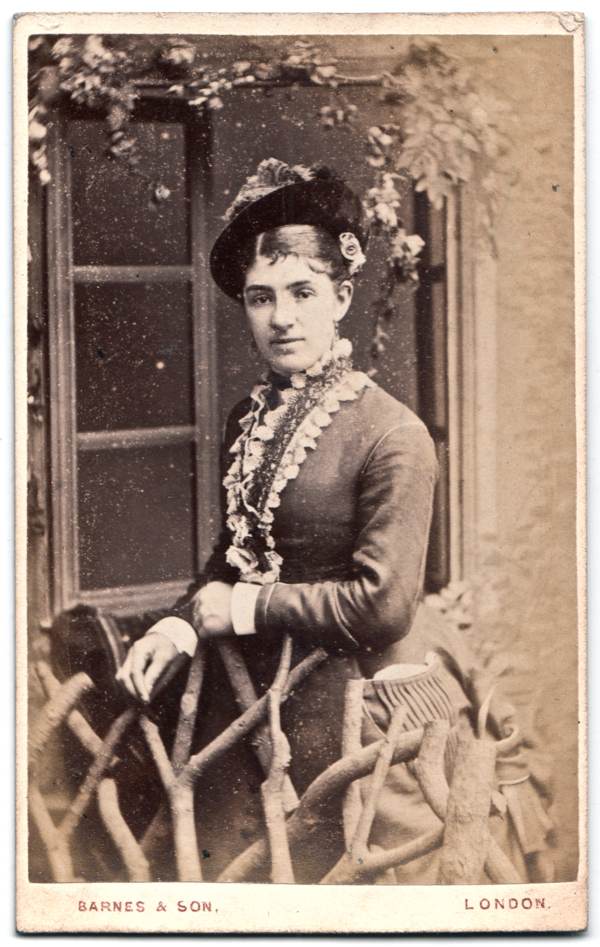
Number 56157 – 1877

Unnumbered

Number 57248 – 1877

Number 65460 – taken between 1877 and 1880

Number 75384 – taken after 1880

Photographs reproduced courtesy of Philip Mernick
Biographical details of Thomas Barnes supplied by David Webb
You may also like to take a look at
Love Tokens From The Thames
With St Valentine’s Day looming at the end of the week, I thought this would be a good moment to publish this collection of lovers’ tokens from the Thames gathered over the past eighteen years by my old pal Steve Brooker, the mudlark – widely known as the Mud God.

Perhaps a phonetic spelling of the name ‘Violet’ as the admirer spoke it?
The magical potential of throwing a coin into the water has been recognised by different cultures in different times with all kinds of meanings. Yet since we can never ask those who threw these tokens why they did so, we can only surmise that engraving your beloved’s name upon a coin and throwing it into the water was a gesture to attract good fortune. It was a wish.
With a great river like the Thames racing down towards the ocean, there is a sense of a connection to the infinite. And there is a sweet romance to the notion of a lover secretly throwing a token into the water, feeling that the strength of their emotions connects them to a force larger than themselves.
It was not part of the conceit that anyone might ever find these coins, centuries later – which gives them a mysterious poetry now, because each one represents a love story we shall never learn. Those who threw them have long gone from the earth and all we can envisage are the coins tossed by unseen hands, flying from the river bank or a from the parapet of a bridge or from a boat, turning over in the air, plip-plopping into the water and spiralling down to lie for centuries in the mud, until Steve Brooker came along to gather them up. Much as we may yearn, we can never trace them back to ask “What happened?”
In the reign of William III, it was the fashion for a young man to give a crooked coin to the object of his affections. The coin was bent, both to become an amulet and to prevent it being spent. If the token was kept, it indicated that the affection was reciprocated, but if the coin was discarded then it was a rejection – which casts a different light upon these coins in the Thames. Are they, each one, evidence of unrequited affections?
For centuries, smoothed coins were used as love tokens, with the initials of the sender engraved or embossed upon the surface. Sometimes these were pierced, which gave recipient the option to wear it around the neck. In Steve’s collection, the tokens range from heavy silver coins with initials professionally engraved to pennies worn smooth through hours of labour and engraved in stilted painstaking letters. In many examples shown here, the amount of effort expended in working these coins, smoothing, engraving or cutting them is truly extraordinary, which speaks of the longing of the makers.
Steve has found many thousands of coins in the bed of the Thames over the years but it is these worked examples that mean most to him because he recognises the dignity of the human emotion that each one manifests. Those who threw them into the river did not know that anyone was going to be there one day to catch them yet, whatever the outcome of these romances, Steve ensures the tokens are kept safe.

Benjamin Claridge.

The reverse of the Benjamin Claridge coin, from the eighteenth century or earlier.

The intials M and W intertwined upon a Georgian silver coin.

The intial W upon the smoothed face of Georgian silver coin, bent into an S shape.

Crooked Georgian silver coin, as the token of a vow or promise.

The initials AMD upon a smoothed coins that has been pierced to wear around the neck.

A copper penny with the letter D.

C.M. Marsh impressed into a penny.

The letter R punched into a penny within a lucky horseshoe.

Pierced coin set with semi-precious stones.

Who was Snod? Is this a lover’s token or a dog tag?

This pierced silver threepence commemorates the date January 11th 1921.

On the reverse of the silver threepence are the initials, L T. Are these the initials of the giver, or does it signify “Love Token”?

Cut coins from the early twentieth century.

You may like to read my other stories about Steve Brooker
Mud God’s Religious Offerings from the Thames
or take a look at


