
The Oldest Tree In The East End
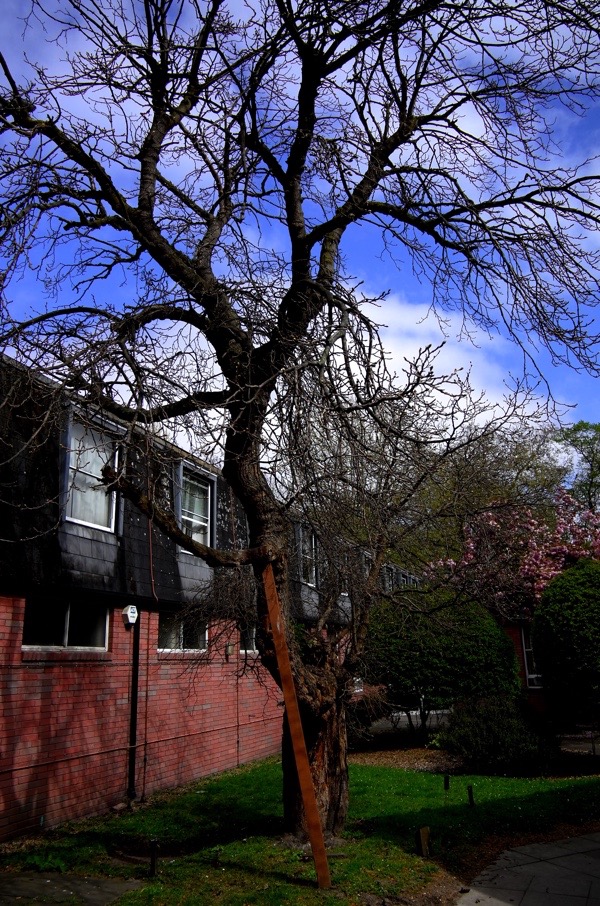
Thanks to an invitation from one of the readers, I had the opportunity of making the acquaintance of the oldest tree in the East End yesterday, a dignified tottering specimen known as the Bethnal Green Mulberry. It is more than four hundred years old and its leaves were intended to feed silkworms cultivated by local weavers.
The Black Mulberry originally grew within the grounds of Bishop Bonner’s Palace that stood on this site and an inkwell in the museum of the Royal London Hospital, made in 1915 from a bough, has a brass plate engraved with the sardonic yarn that the Bishop sat beneath it to enjoy shelter in the cool of the evening while deciding which heretics to execute.
Yesterday’s visit was a poignant occasion since the Mulberry stands today in the grounds of the London Chest Hospital which opened in 1855 and closed forever last week prior to being handed over by the National Health Service today, in advance of redevelopment. My only previous visit to the Hospital was as a patient struggling with pneumonia, when I was grateful to come here for treatment and feel reassured by its gracious architecture surrounded by trees. Of palatial design, the London Chest Hospital is a magnificent Victorian philanthropic institution where the successful campaign to rid the East End of tuberculosis in the last century was masterminded.
It was a sombre spectacle to see workmen carrying out desks and stripping the Hospital of its furniture, and when a security guard informed me that building had been sold for twenty-five million and would be demolished since “it’s not listed,” I was shocked at the potential loss of this beloved structure and the threat to the historic tree too. Yet as far as I am aware, no formal decision has been made about the future of the Hospital’s fabric and, thankfully, the Mulberry is subject to a Tree Preservation Order.
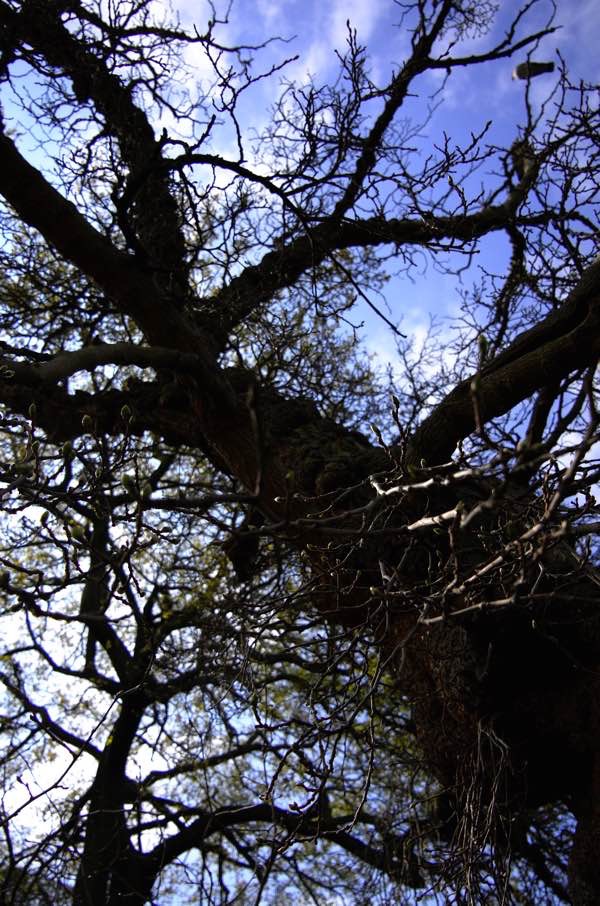
Gainly supported by struts that have become absorbed into the fibre of the tree over the years, it was heartening to see this ancient organism coming into leaf once more and renewing itself again after four centuries. The Bethnal Green Mulberry has seen palaces and hospitals come and go, but it continues to bear fruit every summer regardless.
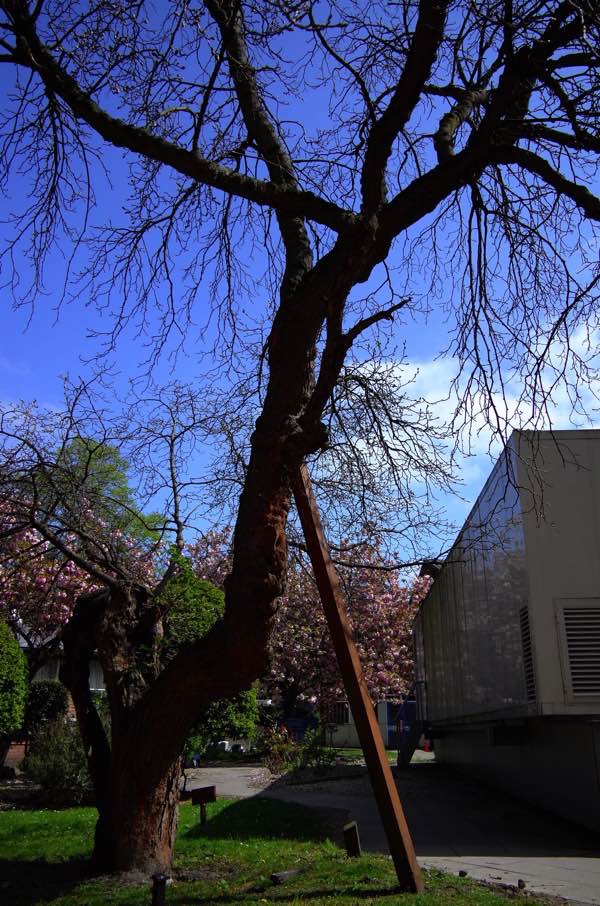
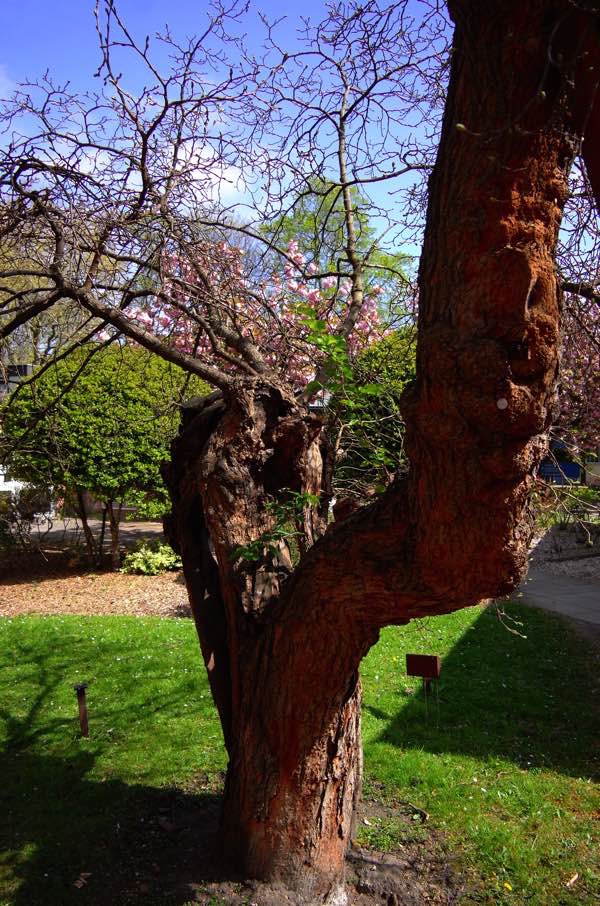
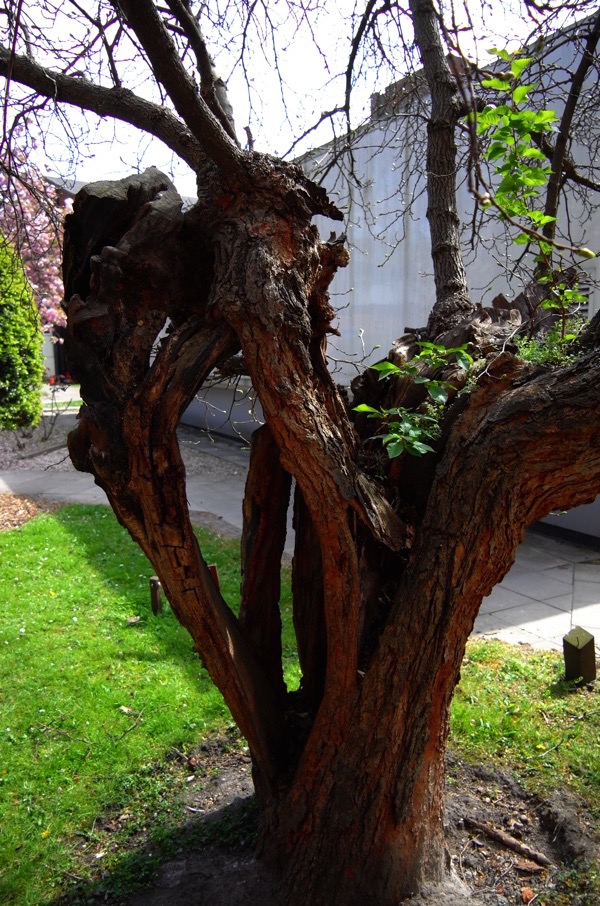
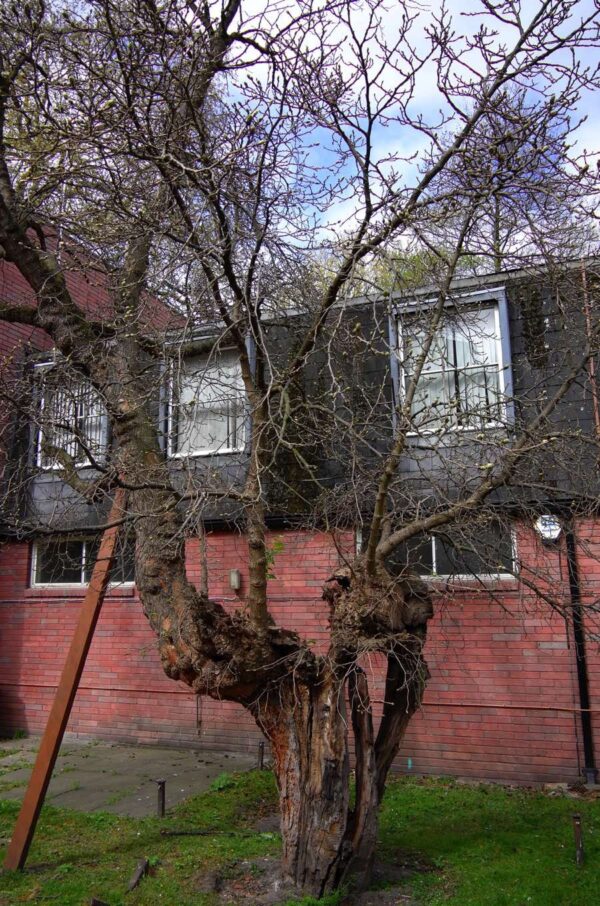
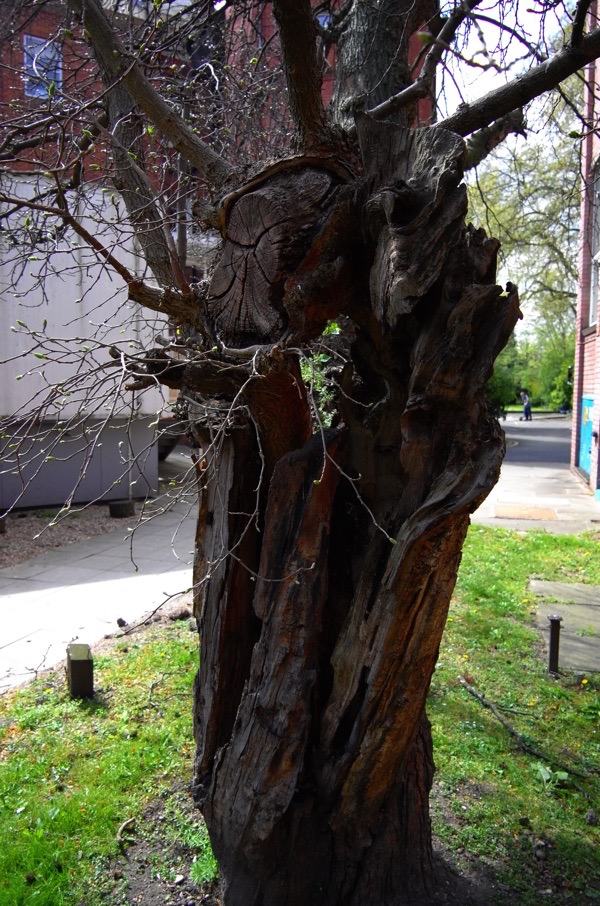
The Mulberry narrowly escaped destruction in World War II and charring from a bomb is still visible
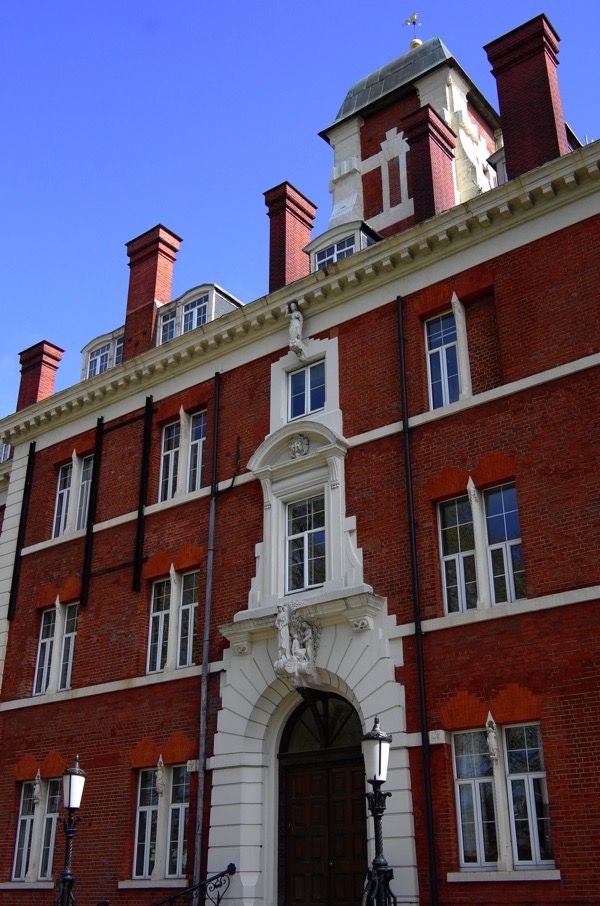
The London Chest Hospital opened in 1855 and closed forever last week
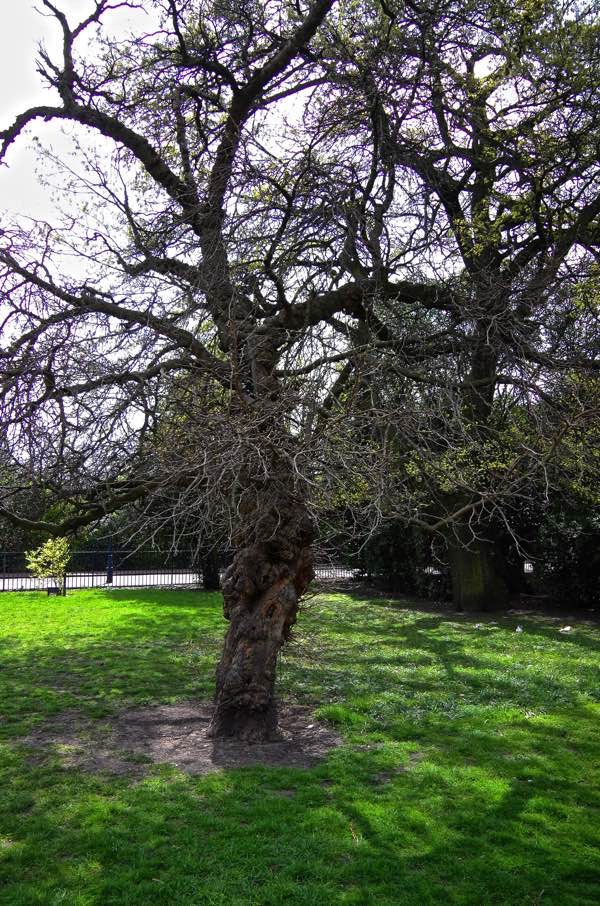
Ancient Mulberry in Victoria Park which may be a contemporary of the Bethnal Green Mulberry
You might also like to read about
Return Of The Monoliths
This week, I learnt of a thirty-three storey tower proposed in Whitechapel on top of Sainsburys’ supermarket and last week, I was told of a twenty-five storey tower proposed for the Holland Estate beside Petticoat Lane. Meanwhile, campaigns to prevent blocks of more than forty storeys at the Bishopsgate Goodsyard and thirteen storeys in the Conservation Area in Norton Folgate have been running for months.
All of which makes John Claridge‘s photographs of the construction of monoliths in the East End in the last century especially pertinent. Many of these structures were subsequently regarded as mistaken in conception and have long been demolished. Yet as we embark upon a new wave of taller, meaner monoliths, it seems that no lessons have been learned.
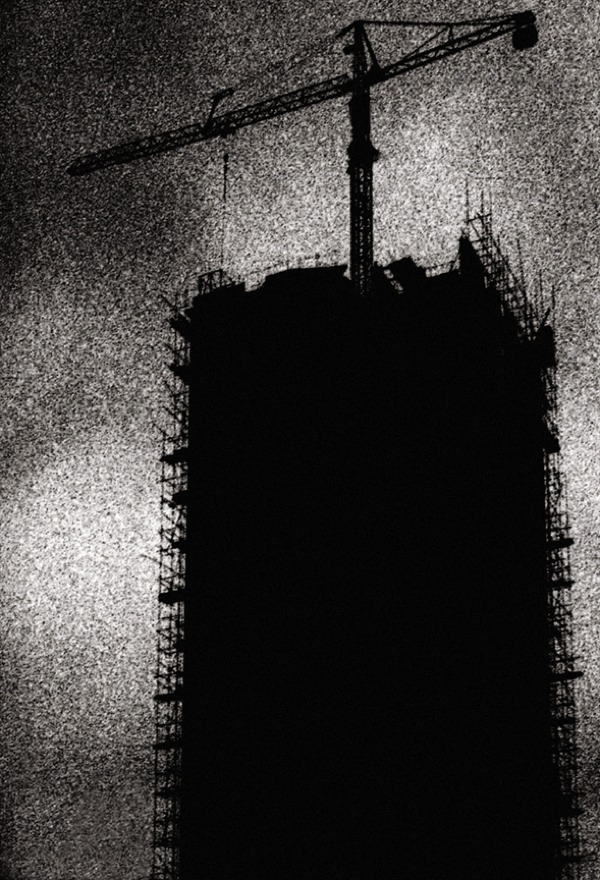
In the Beginning
“The rich got richer and the poor got bathrooms” – this is photographer John Claridge’s caustic verdict upon the invasion of the monolithic tower blocks in the East End of his youth, as recorded in this set of pictures taken between 1962 and 1982.
“In the terraces of two-up two-downs, people could talk over the garden fence but in the towers they became strangers to each other. The culture of how they lived was taken away from them, and I knew a lot of people that got fucked up by it.” John told me, still angry about the wilful destruction of communities enacted in the name of social progress. “It was a cheap shot. People were making a fortune out of putting up crap.” he revealed in contempt, “I don’t think anyone has the right to destroy other people’s lives in that way and tie it up with a silk ribbon.”
While in London’s richer neighbourhoods old terraces were more likely to be renovated and preserved, in the East End and other poorer districts pressure was exerted through slum clearance programmes to force people from their homes, demolishing swathes of nineteenth century housing in preference to simply installing modern amenities. In retrospect, many of these schemes appear to have been driven by little more than class prejudice and created more social problems than they solved, dislocating communities and systematically erasing centuries of settled working class culture.
John’s photographs record how the monoliths first asserted their forbidding presence upon the landscape of the East End, arriving like the Martian fighting machines in the War of the Worlds. “You made fun of it and got on with your life,” he admitted to me and, with sardonic humour – adopting titles from cinema and jazz – he confronts us in these pictures with a series of mordant graphic images that imprint themselves upon the consciousness.
As new, even larger, tower blocks rise over the East End today, John Claridge’s vivid photographs of the monoliths remain as resonant as ever.
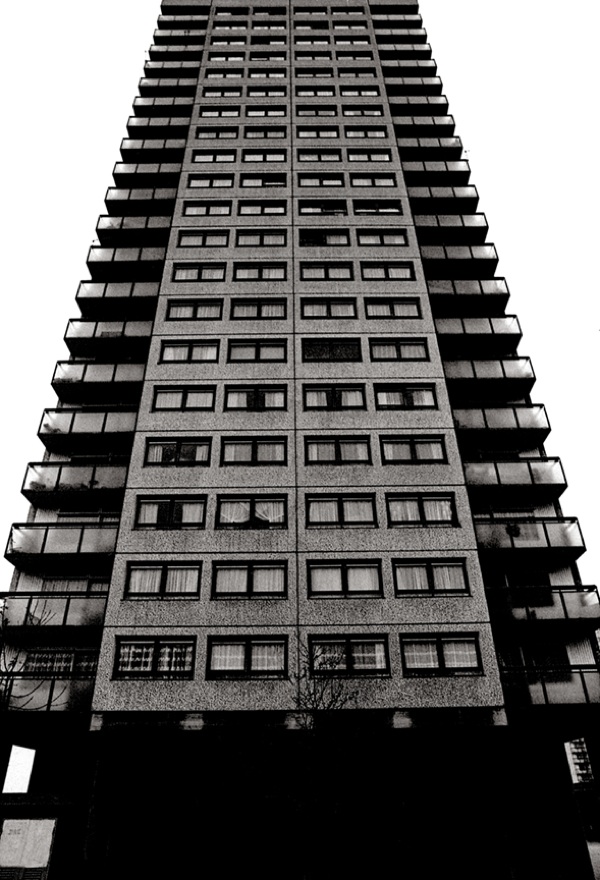
On Dangerous Ground – “They didn’t half put them up quick, I’m telling you.”
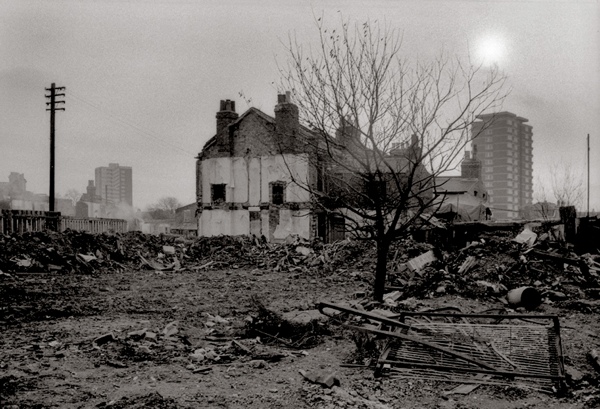
Gloomy Sunday

Room With a View – “Which is the view, from this window or from the block?”
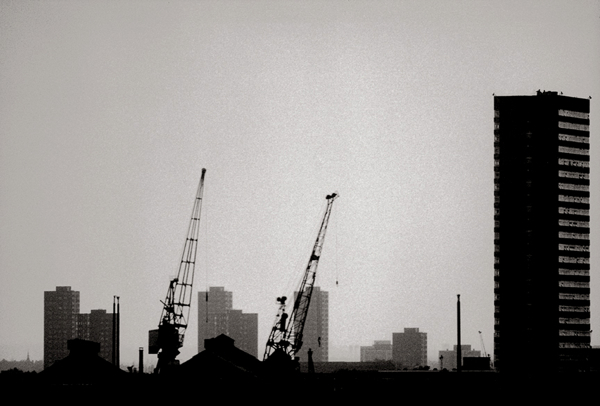
The Dark Corner

The Four Horsemen
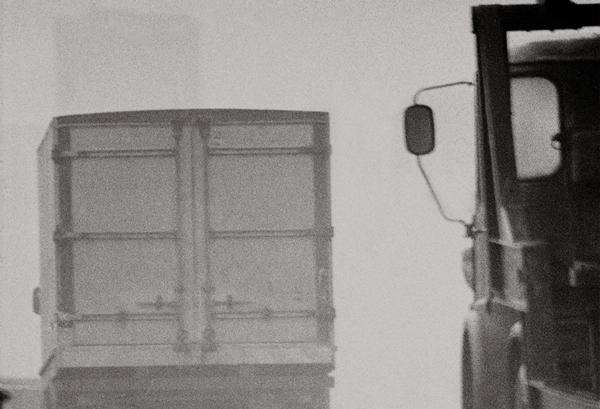
Foggy Day

Three Steps to Heaven
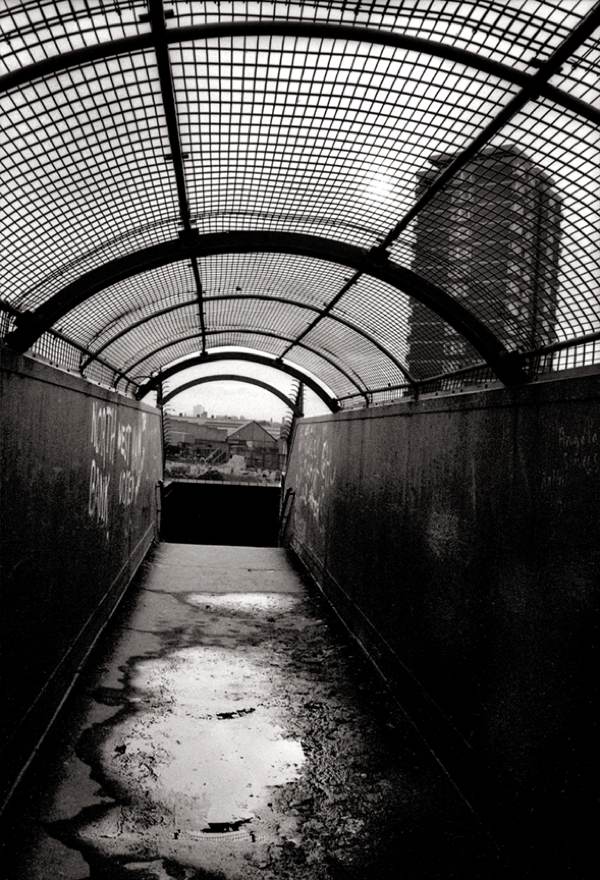
Caged – “An old lady who lived in a block in which the lift broke told me she felt like a caged animal.”

Freedom is Just Another Word – “Prefabs offered one kind of freedom and tower blocks offered another – but then the word didn’t mean anything anymore.”
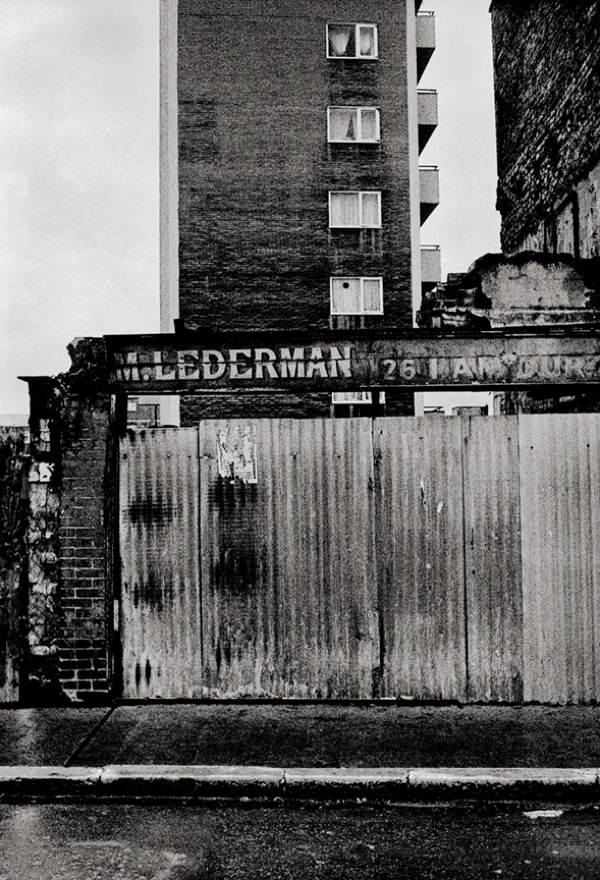
Stranger on the Third Floor – “Once the small businesses go, people became estranged from their local environment.”
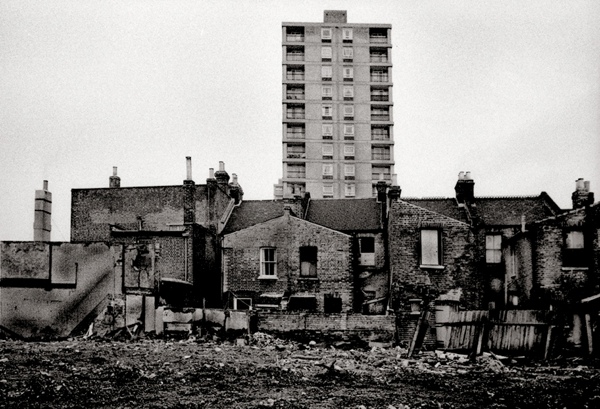
Odds Against Tomorrow – “There were still a few people left in this derelict terrace because they didn’t want to move out, but the odds were against them.”

House of Cards – “When a gas stove blew up and part of Ronan Point collapsed, my father, who was a qualified engineer, went to check it out – there were bolts missing and it had been constructed on the cheap.”

Dark Water -“These reminded me of apartment buildings in the Eastern Bloc.”
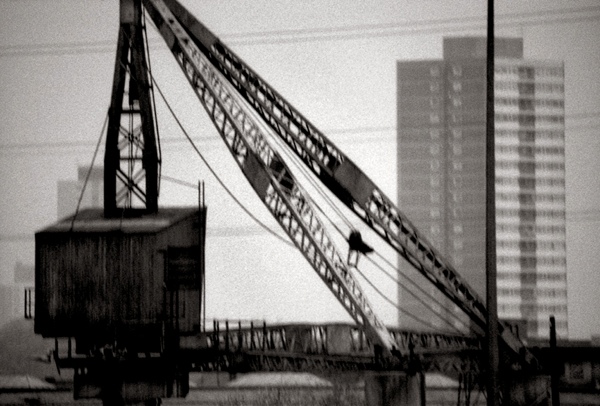
House of Strangers
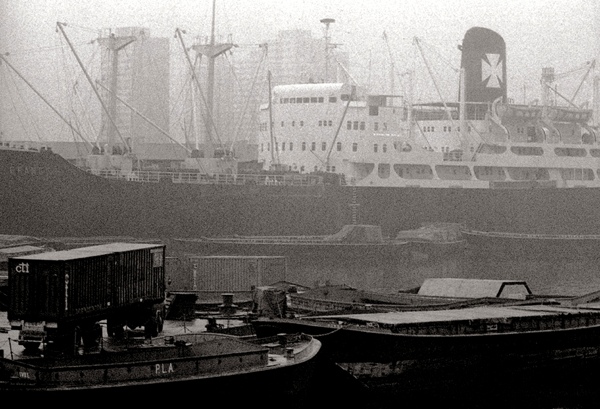
Undercurrent

Out of Nowhere
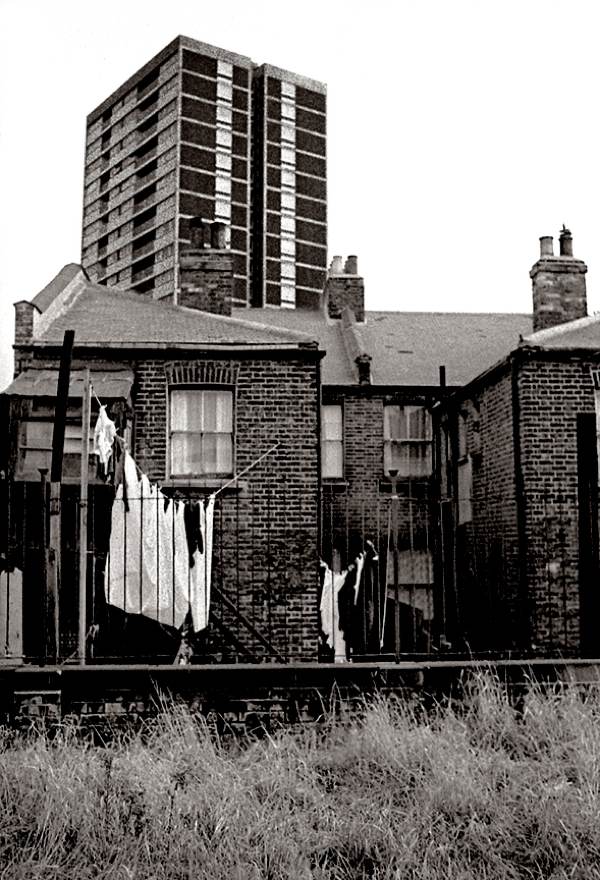
High Wall
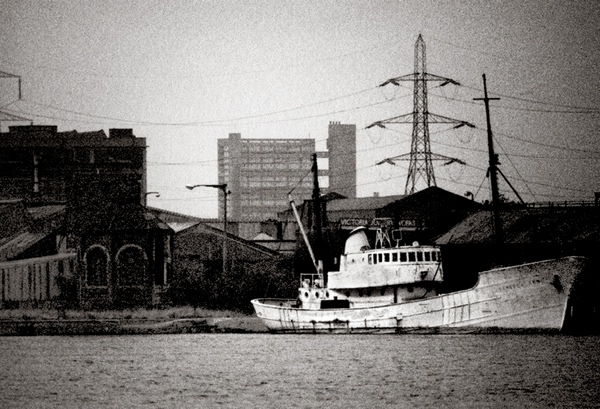
Dark Passage
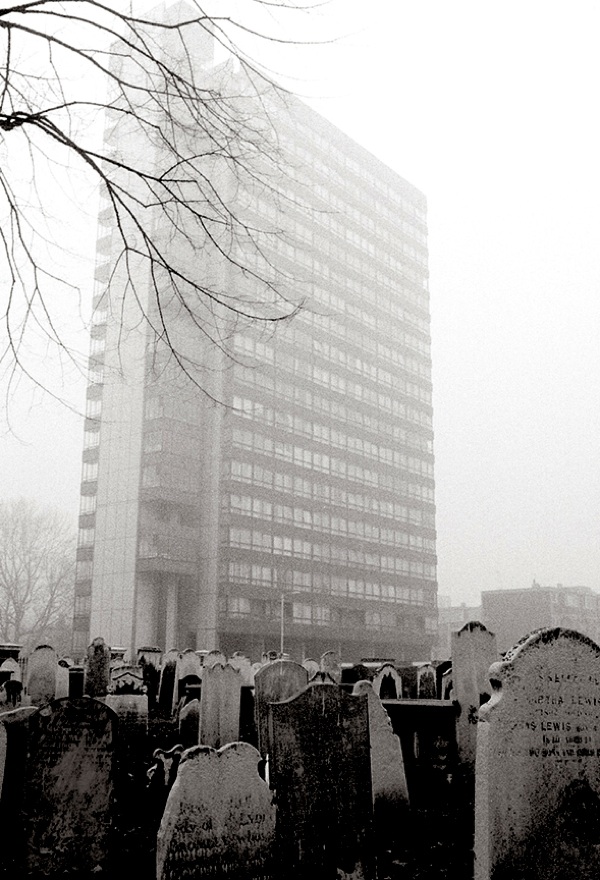
Lift to the Scaffold
Photographs copyright © John Claridge
You may also like to take a look at
Along the Thames with John Claridge
At the Salvation Army with John Claridge
A Few Diversions by John Claridge
Signs, Posters, Typography & Graphics
Follow the East End Preservation Society
Facebook/eastendpsociety
Twitter/eastendpsociety
Click here to join the East End Preservation Society
In Search Of William Shakespeare’s London
On the eve of William Shakespeare’s birthday, I present this account of my quest to find his London
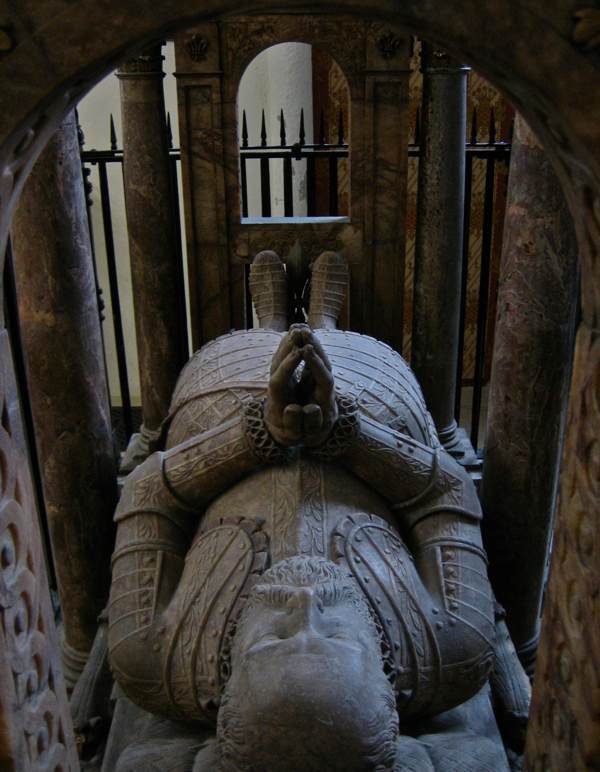
Sir William Pickering, St Helen’s, Bishopsgate, 1574.
Ever since I visited the newly-discovered site of William Shakespeare’s first theatre in Shoreditch, I found myself thinking about where else in London I could locate Shakespeare. The city has changed so much that very little remains from his time and even though I might discover his whereabouts – such as his lodging in Silver St in 1612 – usually the terrain is unrecognisable. Silver St is lost beneath the Barbican now.
Yet, in spite of everything, there are buildings in London that Shakespeare would have known, and, in each case, there are greater or lesser reasons to believe he was there. As the mental list of places where I could enter the same air space as Shakespeare grew, so did my desire to visit them all and discover what remains to meet my eyes that he would also have seen.
Thus it was that I set out under a moody sky in search of Shakespeare’s London – walking first over to St Helen’s Bishopsgate where Shakespeare was a parishioner, according to the parish tax inspector who recorded his failure to pay tax on 15th November 1597. This ancient church is a miraculous survivor of the Fire of London, the Blitz and the terrorist bombings of the nineteen nineties, and contains spectacular monuments that Shakespeare could have seen if he came here, including the eerie somnolent figure of Sir William Pickering of 1574 illustrated above. There is great charm in the diverse collection of melancholic Elizabethan statuary residing here in this quaint medieval church with two naves, now surrounded by modernist towers upon all sides, and there is a colourful Shakespeare window of 1884, the first of several images of him that I encountered upon my walk.
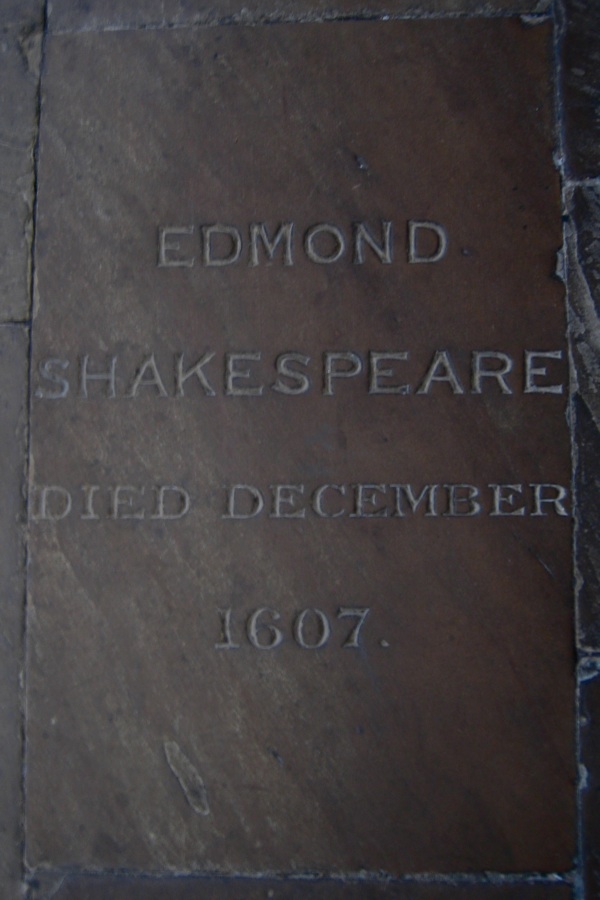
From here, I followed the route that Shakespeare would have known, walking directly South over London Bridge to Southwark Cathedral, where he buried his younger brother Edmund, an actor aged just twenty-seven in 1607, at the cost of twenty shillings “with a forenoone knell of the great bell.” Again there is a Shakespeare window, with scenes from the plays, put up in 1964, and a memorial with an alabaster figure from 1912, yet neither is as touching as the simple stone to poor Edmund in the floor of the choir. I was fascinated by the medieval roof bosses, preserved at the rear of the nave since the Victorians replaced the wooden roof with stone. If Shakespeare had raised his bald pate during a service here, his eye might have caught sight of the appealingly grotesque imagery of these spirited medieval carvings. Most striking is Judas being devoured by Satan, with only a pair of legs protruding from the Devil’s hungry mouth, though I also like the sad face of the old king with icicles for a beard.
Crossing the river again, I looked out for the Cormorants that I delight to see as one of the living remnants of Shakespeare’s London, which he saw when he walked out from the theatre onto the river bank, and wrote of so often, employing these agile creatures that can swallow fish whole as as eloquent metaphors of all-consuming Time. My destination was St Giles Cripplegate, where Edmund’s sons who did not live beyond infancy were baptised and William Shakespeare was the witness. Marooned at the centre of the Barbican today like a galleon shipwrecked upon a beach, I did not linger long here because most of the cargo of history this church carried was swept overboard in a fire storm in nineteen forty, when it was bombed and then later rebuilt from a shell. Just as in that searching game where someone advises you if you are getting warmer, I began to feel my trail had started warm but was turning cold.
Yet, resolutely, I walked on through St John’s Gate in Clerkenwell where Shakespeare once brought the manuscripts of his plays for the approval by the Lord Chamberlain before they could be performed. And, from there, I directed my feet along the Strand to the Middle Temple, where, in one of my favourite corners of the city, there is a sense – as you step through the gates – of entering an earlier London, comprised of small squares and alleys arched over by old buildings. Here in Fountain Court, where venerable Mulberry trees supported by iron props surround the pool, stands the magnificent Middle Temple Hall where the first performance of “Twelfth Night” took place in 1602, with Shakespeare playing in the acting company. At last, I had a building where I could be certain that Shakespeare had been present – but it was closed.
I sat in the shade by the fountain and took stock, and questioned my own sentiment now my feet were weary. Yet I could not leave, my curiosity would not let me. Summoning my courage, I walked past all the signs, until I came to the porter’s lodge and asked the gentleman politely if I might see the hall. He stood up, introducing himself as John and assented with a smile, graciously leading me from the sunlight into the cavernous hundred-foot-long hall, with its great black double hammer-beam roof, like the hand of God with its fingers outstretched or the darkest stormcloud lowering overhead. It was overwhelming.
“You see this table,” said John, pointing to an old dining table at the centre of the hall, “We call this the ‘cup board’ and the top of it is made of the hatch from Sir Francis Drake’s ship ‘The Golden Hind’ that circumnavigated the globe” And then, before I could venture a comment, he continued, “You see that long table at the end – the one that’s the width of the room, twenty-nine feet long – that’s made from a single oak tree which was a gift from Elizabeth I, it was cut at Windsor Great Park, floated down the Thames and constructed in this hall while it was being built. It has never left this room.”
And then John left me alone in the finest Elizabethan hall in Britain. Looking back at the great carved screen, I realised this had served as the backdrop to the performance of ‘”Twelfth Night” and the gallery above was where the musicians played at the opening when Orsino says, “If music be the food of love, play on.” The hall was charged and resonant. Occasioned by the clouds outside, sunlight moved in dappled patterns across the floor from the tall windows above.
I walked back behind the screen where the actors, including Shakespeare, waited, and I walked again into the hall, absorbing the wonder of the scene, emphasised by the extraordinary intricate roof that appeared to defy gravity. It was a place for public display and the show of power, but its elegant proportion and fine detail also permitted it to be a place for quiet focus and poetry. I sat on my own at the head of the twenty-nine foot long table in the only surviving building where one of William Shakespeare’s plays was done in his lifetime, and it was a marvel. I could imagine him there.
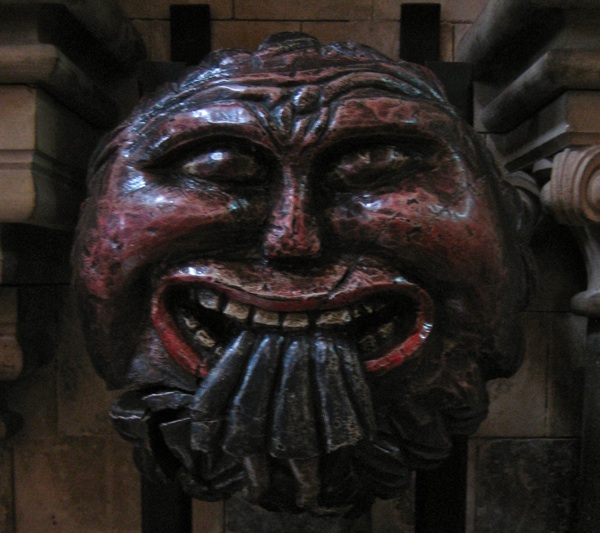
Judas swallowed by Satan
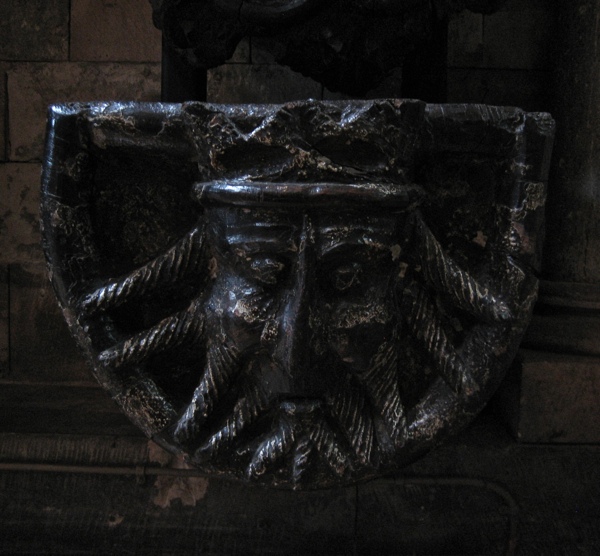
An old king at Southwark
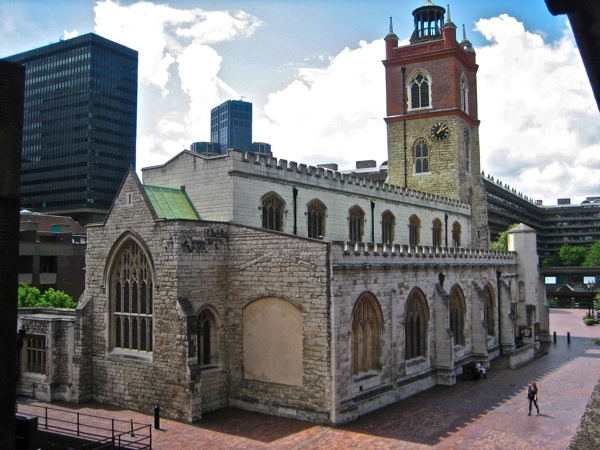
St Giles Cripplegate where Edmund’s sons were baptised and William Shakespeare was the witness.
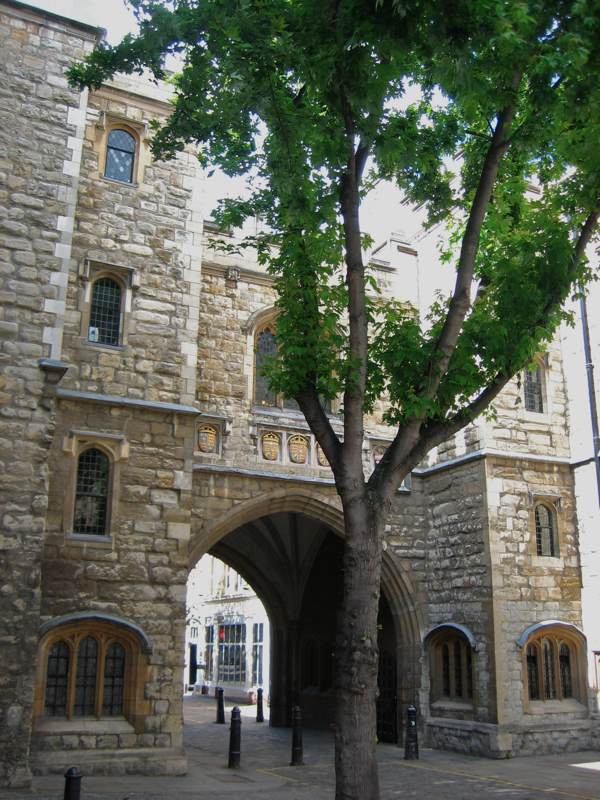
St John’s Gate where William Shakespeare brought the manuscripts of his plays to the Lord Chamberlain’s office to seek approval.
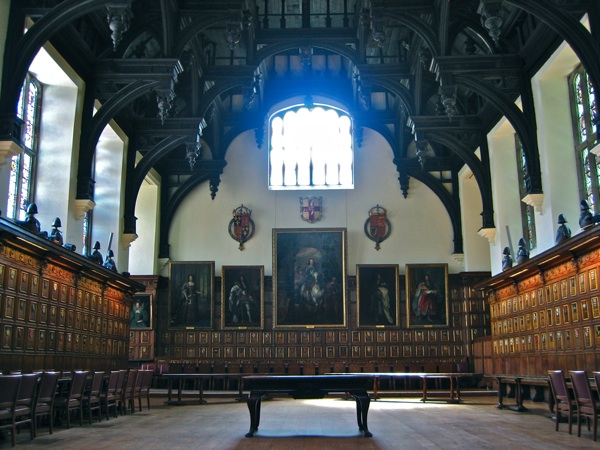
The Middle Temple Hall where “Twelfth Night” was first performed in 1602.
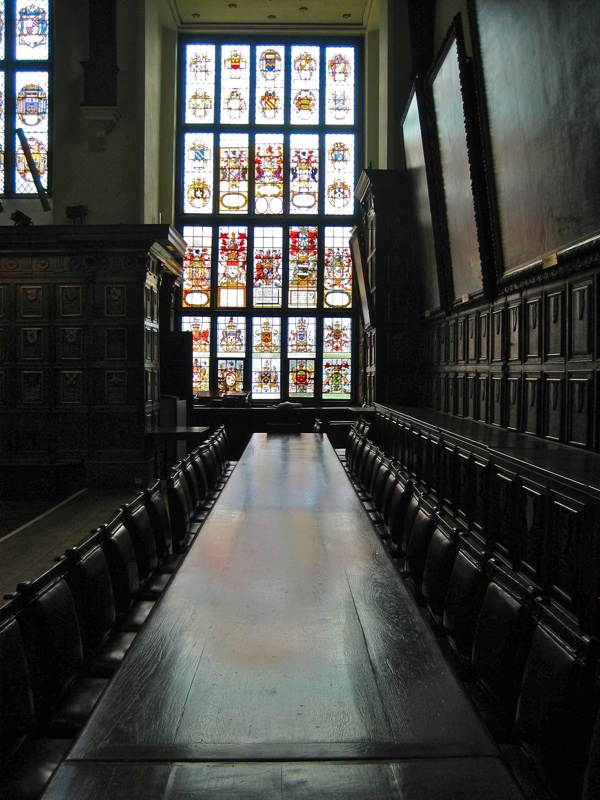
The twenty-nine foot long table made from a single oak from Windsor Great Park.
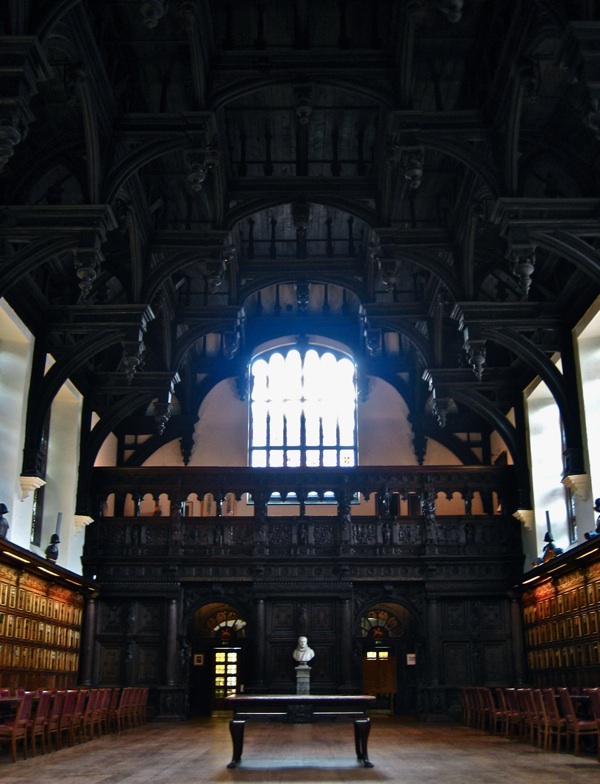
The wooden screen that served as the backdrop to the first production of” Twelfth Night.”
You may like to read these:
At Shakespeare’s First Theatre
The Door to Shakespeare’s London
Sir George’s Residence for Respectable Girls
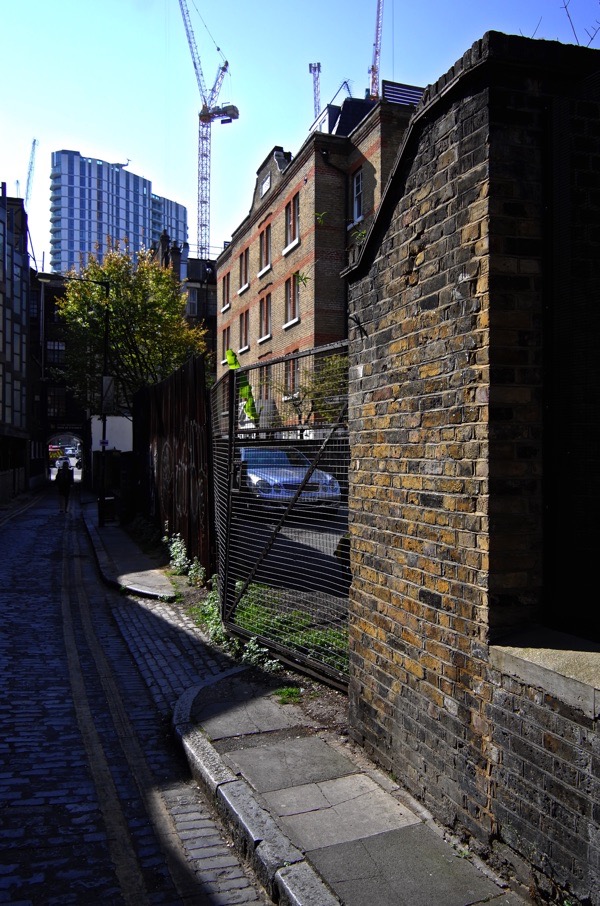
All the years I have been walking through Gunthorpe St, taking a shortcut through the back streets to Spitalfields, I have never had any reason to notice the tall unassuming brick building set back from the street with the date 1886 set in a stucco panel on the top, until current resident Daron Pike wrote to share the intriguing history he has discovered – for this was once ‘Sir George’s Residence for Respectable Girls.’
‘Respectable’ tells it all, distinguishing the residents from those ‘unrespectable’ girls whose presence made Whitechapel a notorious destination for predatory males in the final decades of the nineteenth century. When the Residence was built, Gunthorpe St was known as George Yard, described by the East London Advertiser in 1888 as “one of the most dangerous streets in the locality – a narrow turning out of the High St leads into a number of courts and alleys in which some of the poorest of the poor, together with thieves and roughs and prostitutes, find protection and shelter in the miserable hovels bearing the name of houses.”
Provision merchant turned evangelist, George Holland, founded the George Yard Mission and Ragged School in the eighteen-fifties, winning recognition for his philanthropic work which permitted him to raise the finance for the Residence. “When Mr Holland began his work, George Yard was inhabited by such a desperate class that he often had to be accompanied by two policemen, bricks, flower pots and other missiles being, even then, flung at his head,” wrote the ‘Record of Christian Work’ in October 1885, thirty-five years after George Holland established his Mission, “Now, however anyone may walk through that locality with impunity … the success of this work has mainly been owing to Mr Holland’s untiring soul, three days being the longest holiday he has allowed himself since he first put his hand to the work.”
Yet it was the knife attack upon Emma Smith in George Yard in April 1888 followed by the murder of Martha Tabram close by in August of that year, initiating a spree of violence against women known retrospectively as ‘the Whitechapel Murders,’ which shone a light upon the work of George Holland in the national press. In November 1886, The Times reported on a conference of the Ragged School Union at which “Mr Holland next gave a graphic description of his work in the eastern part of London, remarking that in times past some 50,000 children had passed through his hands and that he now had under his care some 3,000 men, women and children.”
The violent murders of 1888 inspired terror among those at the ‘Residence for Respectable Girls’, while also throwing into relief the necessity of the Mission and the Residence, as the Daily News reported in November that year – “Mr. George Holland, whose remarkable work has been going on for so very many years in premises occupying an obscure position in George Yard, Whitechapel – where it will be remembered one of these unfortunate women was found with thirty or forty stabs – says that the sensation has affected his institution very greatly. He has some hundreds of young women connected with his place, and many of them have been afraid to stir out after dark. He is under some anxiety, too, lest ladies who have been wont to come down there on winter evenings to teach and entertain his young people, should be deterred by this latest addition to the evil reputation of Whitechapel.”
George Holland died in 1900 and, by the First World War, the building had ceased to be a home for girls and was in general residential use by a predominantly Jewish population, until the sixties when it was emptied of inhabitants at the time of the slum clearances in the East End. Today it is well kept and back in use as flats. The Mission itself and the Ragged School are long gone, and just the implacable ‘Sir George’s Residence for Respectable Girls’ remains in Gunthorpe St to remind us of his compassionate purpose.
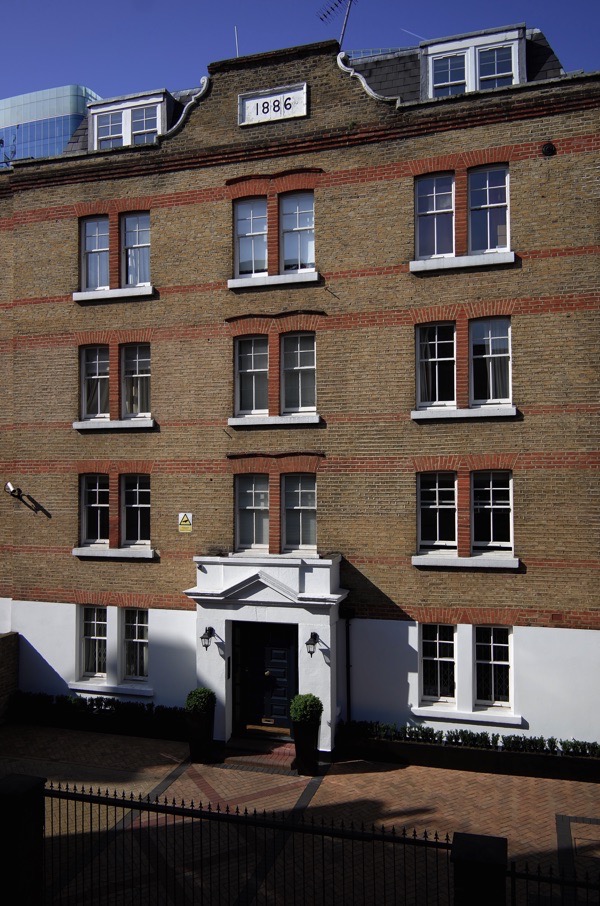
Sir George’s Residence for Respectable Girls
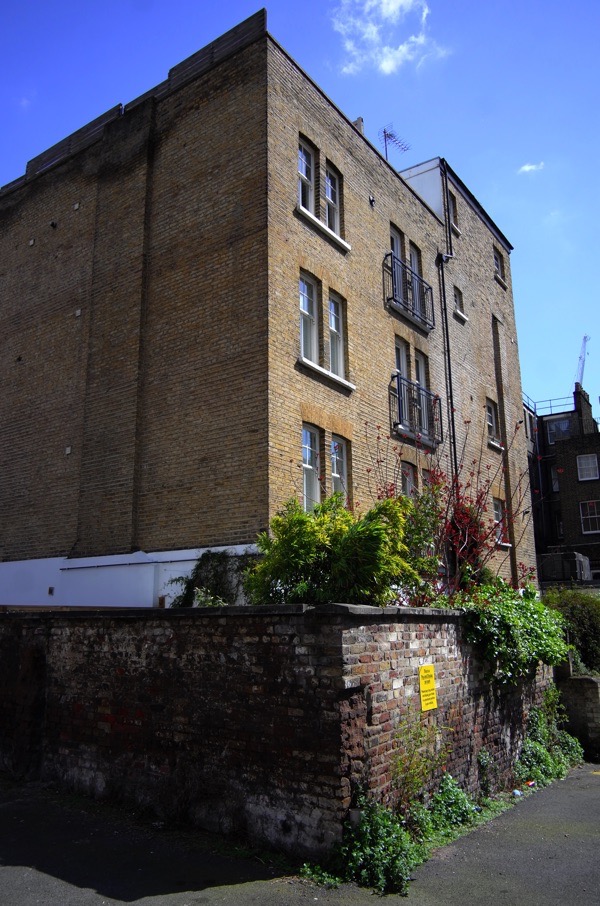
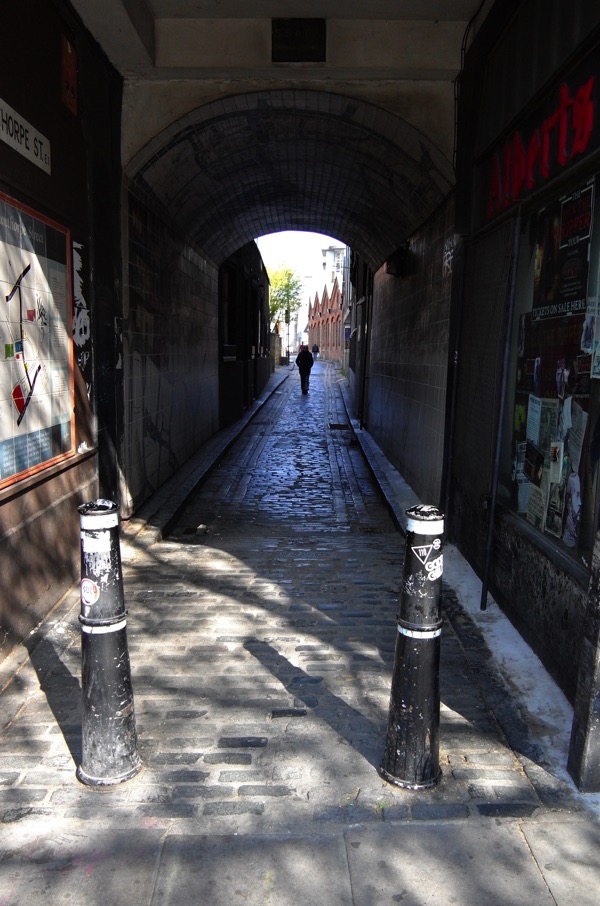
Gunthorpe St
You might also like to take a look at
Peta Bridle’s London Etchings
Every couple of months, Peta Bridle sends me her latest drypoint etchings of favourite people and places in London, and this new batch celebrates many beloved landmarks that are at risk of destruction. “It made my visits to these places seem more pressing to record them, not knowing how quickly boarding might go up, preventing anyone from seeing them ever again,” Peta admitted to me.
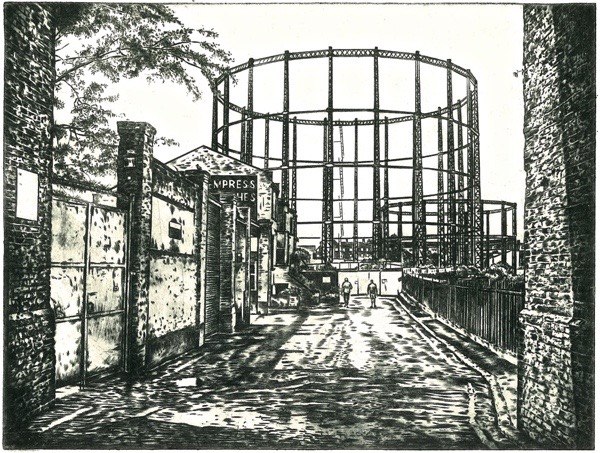
Gas Holders, Bethnal Green – “Viewed from Mare St, along Corbridge Crescent past Empress Coaches, you see a fine pair of nineteenth century gas holders. English Heritage have decided not to list them and instead granted the owners a Certificate of Immunity against listing, permitting the gas holders to be destroyed and the site redeveloped.”
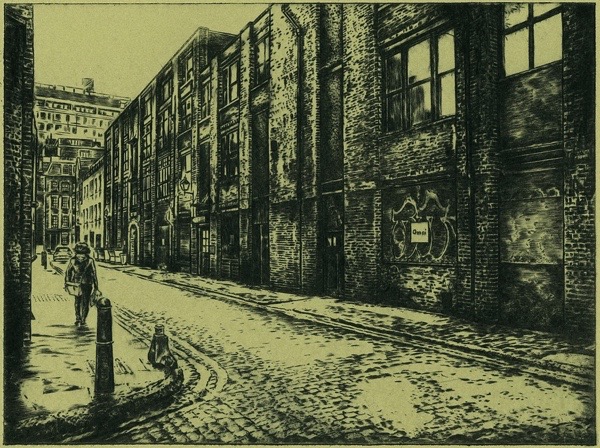
Blossom St, Norton Folgate – “Running the length of Blossom St are a row of Victorian warehouses built in 1868. Once the headquarters of Nicholls & Clarke they now stand empty, awaiting their fate. This is such a beautiful atmospheric street with its black brickwork and cobbles, I find it inconceivable that a tower block could one day loom in its place.”
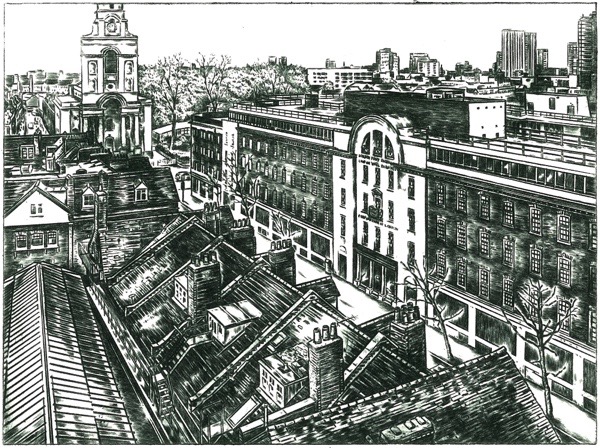
Fruit & Wool Exchange, Spitalfields – “Viewed from the top of Spitalfields Market, the dignified Wool and Fruit Exchange has stood in Brushfield St since 1927, yet only a part of the facade will remain when the bulldozers move in this summer.”
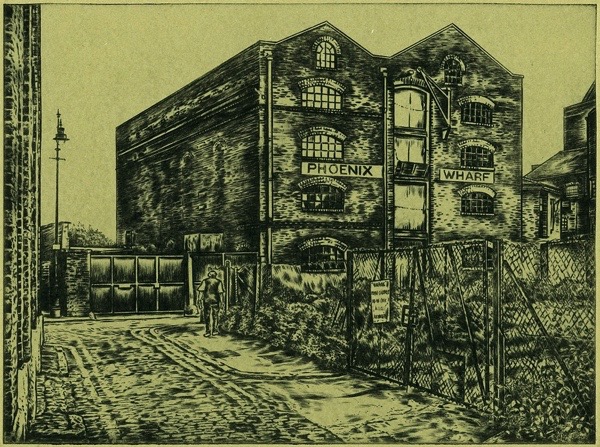
Phoenix Wharf, Wapping High St – “This beautiful old wharf caught my eye when I was out on a walk. It was built around 1830 and is the oldest wharf in Wapping. Luckily the building itself is not under threat, but the view we have of it now will change forever as the car park opposite is due for redevelopment along with Swan Wharf next door. The developers plan to reduce the Stepney lamppost, the oldest gas lamp left in London, to a stump.”
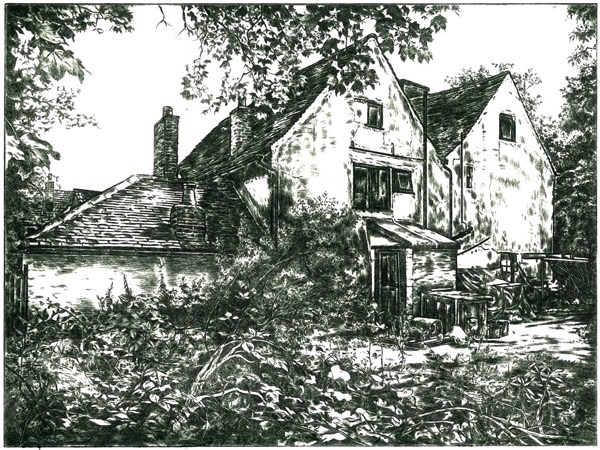
Oxgate Farm, Cricklewood – “One could easily walk past this without realising what a beautiful building lies behind the scaffolding. Yet once inside it is peaceful and quiet, and modern London is shut off completely. Oxgate Farm has stood here since 1465 and was once part of a thousand acre Manor of Oxgate owned by St. Paul’s Cathedral but now it is reduced to just the farm and back garden. Although Oxgate Farm has managed to survive the centuries, now it badly needs repairs to stop it falling down.”
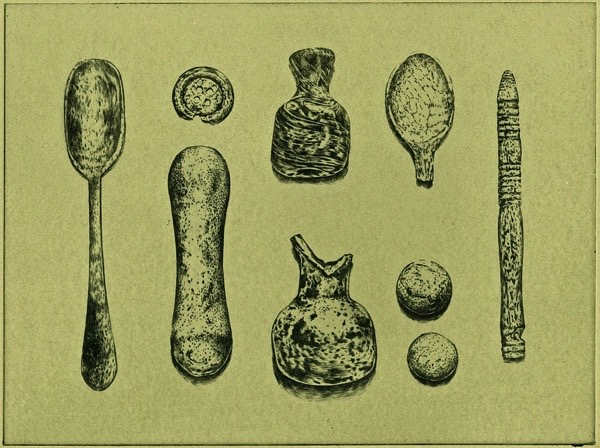
Archaeological finds from the Bishopsgate Goodsyard – From the left to right – Bone spoon, bone button (top), ceramic wig curler (beneath), green glass phial(top), green glass bottle (beneath), white ceramic spoon (top), pair of ceramic marbles and a child’s bone whistle. (Courtesy of Museum of London Archaeology).
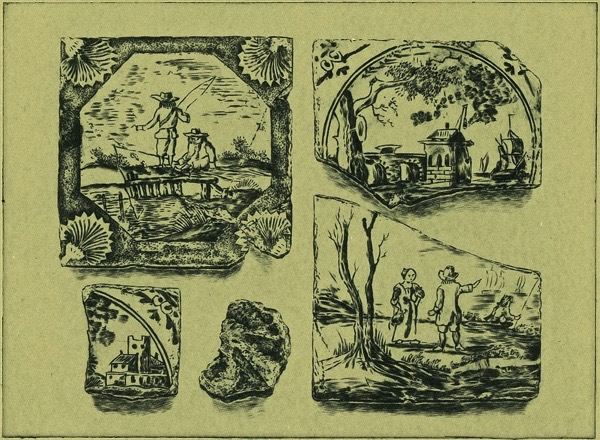
Tiles from the Bishopsgate Goodsyard – “Eighteenth century tin-glazed delftware wall tiles, as used in the fire surrounds of upper and middle class households. On the top left, I like the grumpy expression on the fisherman’s face – probably because he had tangled his line around his companions legs – also, the expressive posture of the couple talking in the meadow below appeals to me, she with her hand on her hip and clutching her bag.” (Courtesy of Museum of London Archaeology)
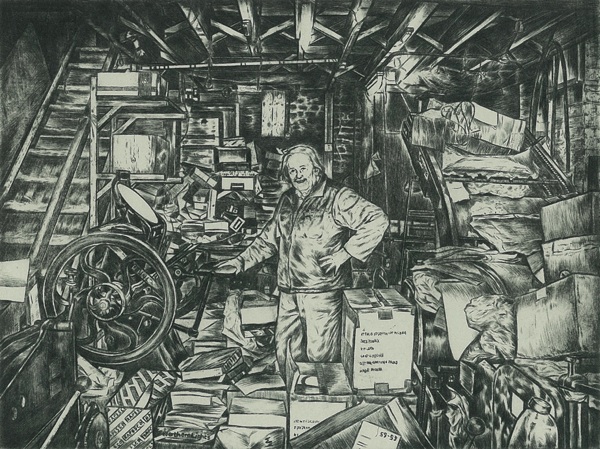
Gary Arber, W F Arber & Co Ltd – Last year, Gary closed the print shop opened by his grandfather Walter in 1897 – “Gary is stood next to a Golding Jobber which he told me was used to print handbills for the suffragettes. On his right stands a Supermatic machine and, behind him in the corner, is a Heidelberg which he filled with paper to show me how it worked. The whole room was a confusion of boxes and paper with the odd tin toy thrown in, and lots of string hanging from the ceiling. I feel privileged to have been invited downstairs to make this record of his print shop.”
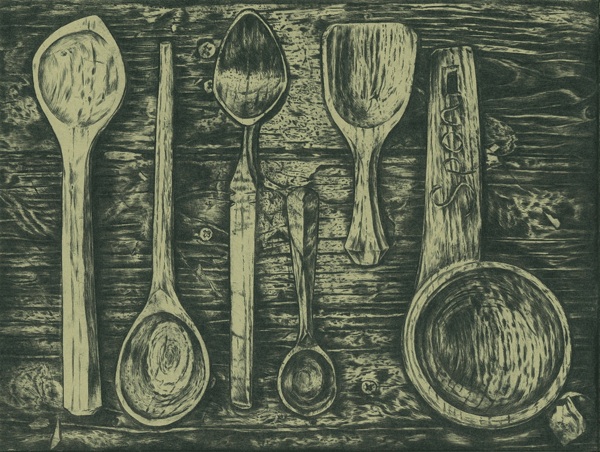
Spoons by Barn The Spoon – “From left to right: A cooking spoon. A spoon of medieval design. A spoon based on a Roma Gypsy design. The small spoon in the centre is a sugar spoon. A shovel. The large spoon on the right is a Roman ladle spoon. Barn told me the word ‘Spon’ which is carved on the handle is an old Norse word which means ‘chip of wood.’”

Leila’s Shop, Calvert Avenue “- I love visiting Leila’s Shop throughout the year to discover the fresh vegetables of every season, straight from the field and piled up in mouth-watering displays.”
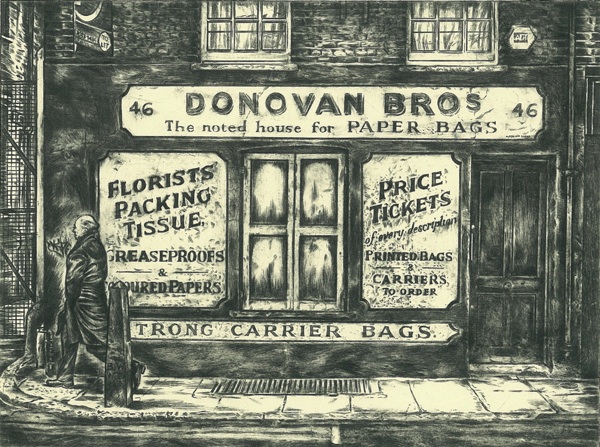
Donovan Bros, Crispin St – “Although it is not a shop anymore I believe Donovan Bros are still producing packaging. I like the muted colours the shop front has been painted and wonder what the shop would have looked like inside?”
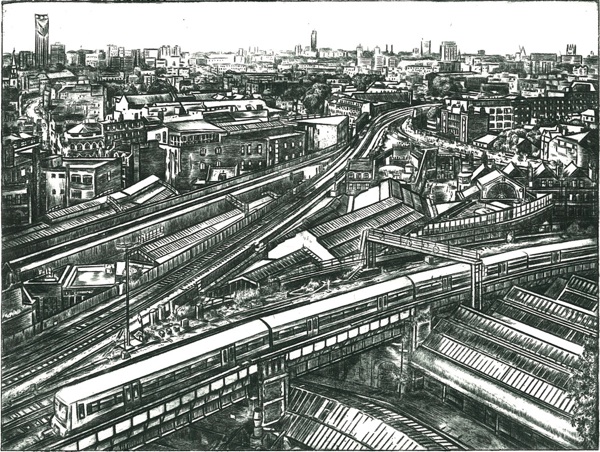
Borough Market, London Bridge – “This is the view overlooking Borough Market, looking from the top of Southwark Cathedral tower. The views of London from up there are beautiful but I don’t like the height too much!”

Wapping Old Stairs – “To reach the stairs you have a to go along a tiny passage to the side of the Town of Ramsgate. Originally, the stairs were a ferry point for people wishing to catch a boat along the river. I think they are quite beautiful and I like to see the marks of the masons’ tools, still left on the stones after all this time.”
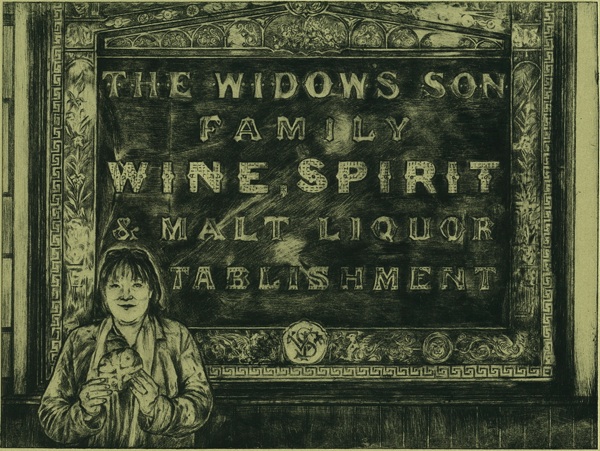
The Widow’s Son, Bow – “The landlady stands holding a hot cross bun in front of a large glass Victorian mirror with the pub name etched onto it. Every Good Friday, they have a custom where a sailor adds a new bun in a net hanging over the bar to celebrate the widow who once lived here, who made her drowned sailor son a hot cross bun each Easter in remembrance.”
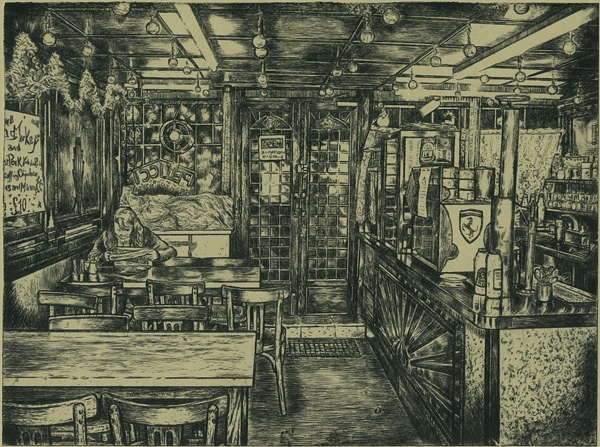
E.Pellicci, Bethnal Green Rd. “Nevio Pellicci kindly allowed me to make a couple of visits to take pictures as reference to create this etching. It was at Christmas time and after they closed for the afternoon. Daisy my daughter is sitting in the corner.”

Paul Gardner at Gardners’ Market Sundriesmen, Commercial St. “I did buy a few bags off Paul whilst I was there!”
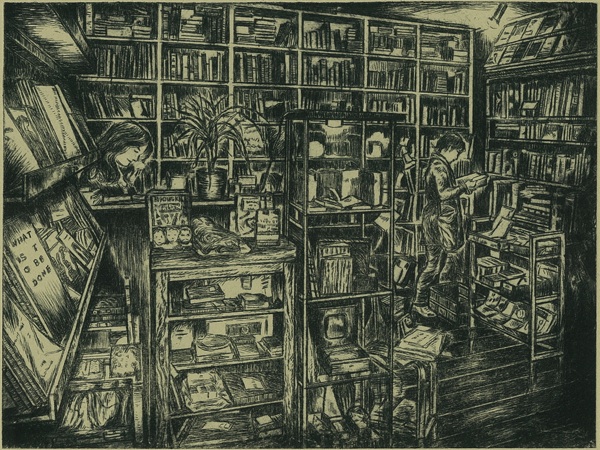
Tanya Peixoto at bookartbookshop, Pitfield St. “I am friends with Tanya who runs this shop and she has stocked my homemade books in the past.”
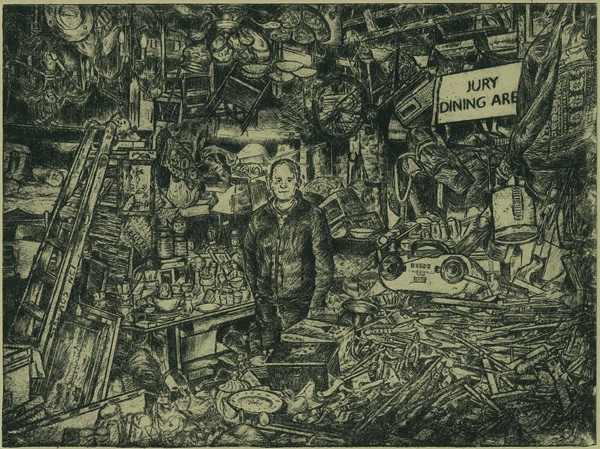
Des at Des & Lorraine’s Junk Shop, Bacon St. “An amazing place that I want to re-visit since I never got to look round it properly …”
Prints copyright © Peta Bridle
Neville Turner Returns To Elder St
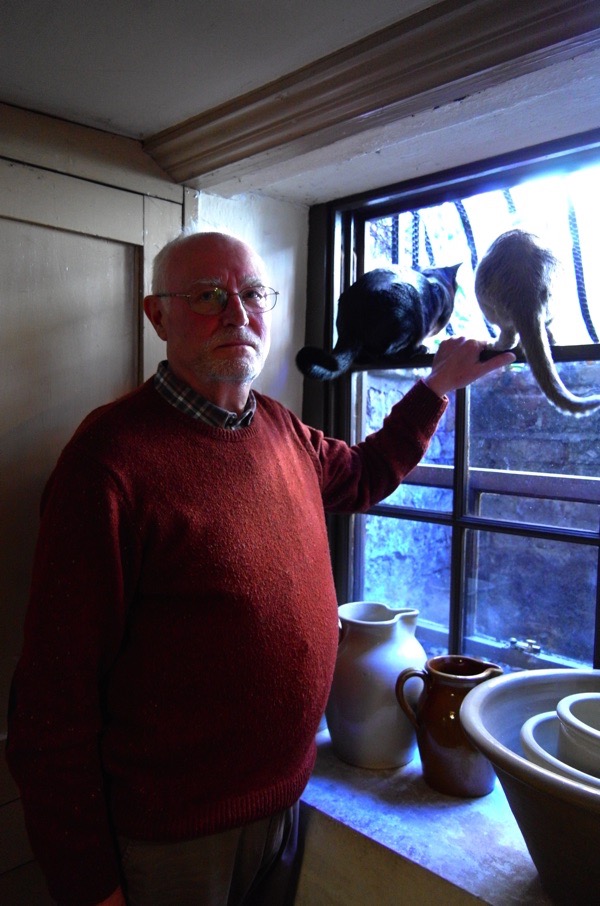
Neville in the cellar where he sheltered during the London blitz
Three years ago, I wrote an account of Neville Turner’s childhood in Elder St in the forties and fifties, and yesterday I had the pleasure of accompanying Neville when he visited his former home for the first time since he left in the sixties. Neville’s family lived here from 1931 to 1974, and were the last to inhabit this eighteenth century weaver’s house before it fell into disrepair and was narrowly saved from destruction at the hands of British Land through the intervention by the squatters of the Spitalfields Trust in 1977.
From the moment we walked through the door, the cats intuitively recognised Neville as a special visitor and – as you can see in the picture above – chose to accompany him closely as a gesture of respect to the returning son of the house.
Neville fondly remembered Mrs Knuckles who lived in the front room when he was a small child, she had been bombed out of her own home and Neville’s family took her in. Later, this became Neville’s bedroom. “I took this off,” he exclaimed in surprise pointing at the dado rail, “I did it so I could line the room with hardboard, even the cornice, and I hung wallpaper from Sanderson’s that cost me a week’s salary.” When he was sixteen, Neville was apprenticed as a tailor in Savile Row and by the age of eighteen, he had moved to another job in Aldersgate where he received double the wages – as a cutter in a ladies’ fashion house, permitting him the disposable income to decorate his room with fancy wallpaper.
Yet Neville’s tastes have changed in the intervening half century and he complimented the current owners on restoring the panelling and replacing the dado rail. “We wanted out with the old in those days,” he confessed to me in regret, “I used to walk across bomb sites to work in Aldersgate and we looked upon Centrepoint as the future – I used to love looking at that place.”
Upstairs on the first floor was the living room and kitchen in Neville’s day. Decorated with boldly patterned wisteria wallpaper, this was where the extended family enjoyed memorable Christmas dinners at a long table. “My father was in the gambling game and if people couldn’t pay their debts they gave him things, so we had two cookers and we were the first in the street to have a big American fridge and a car,” he explained as we stood in the current owner’s bedroom that was once Neville’s kitchen. The quiet yard at the rear of the house contained a stable in those days and was used to store costermongers’ barrow for the market. Neville recalled the clatter, the equine smells and the flies that filled the kitchen in the summer months.
Neville’s family only lived on two floors of the four storey house, so we did not ascend any further to the rooms above where a docker and his wife lived then, but descended instead to the cellar. “We never went down here much,” Neville declared as we climbed down to where he and his family were joined by their neighbours to shelter from the London blitz.
In wartime, the ceiling was re-inforced with corrugated iron and a steel prop to support the roof in case the house collapsed overhead. Around a dozen people passed long nights together here during the bombing, playing cards while Neville and his friends amused themselves by melting down lead scavenged from the nearby bomb sites to cast toy soldiers in a mould. “We were lucky no bombs fell on Elder St,” Neville admitted to me with a grin of relief. Today the cellar is in use as the kitchen of the house and Neville recognised the nineteenth century stone sink. “It was always dripping and an enormous fungus grew upon it which rather frightened me,” he recalled, “In fact, my father used to grow mushrooms down here.”
“If you were born here, this is your heritage,” Neville said to me, feeling comfortable again in his old home, “It was a community, everyone lived outside and it was completely safe. We even knew all the policemen at the station next door by name.”
“People I met were shocked, they said, ‘You live where?’ They couldn’t believe we didn’t have a bathroom,” he continued,” But I used to go the bathhouses in Goulston St, Pitfield St or Ironmonger Row – which was popular because it had showers. I’d never seen a shower before and you could pay extra to adjust the temperature.”
“I was the youngest of three children and – at a certain point – my mother said to me, ‘Don’t you think it’s time you got married?’ and I left here in 1964 and married Margaret in 1968,” Neville concluded with a shrug, “We moved down to Putney, but it was soulless and I nearly had a nervous breakdown. I’m sure people who grow up there like it, yet I didn’t – so we moved back to the Kingsland Rd to be in the East End again.”
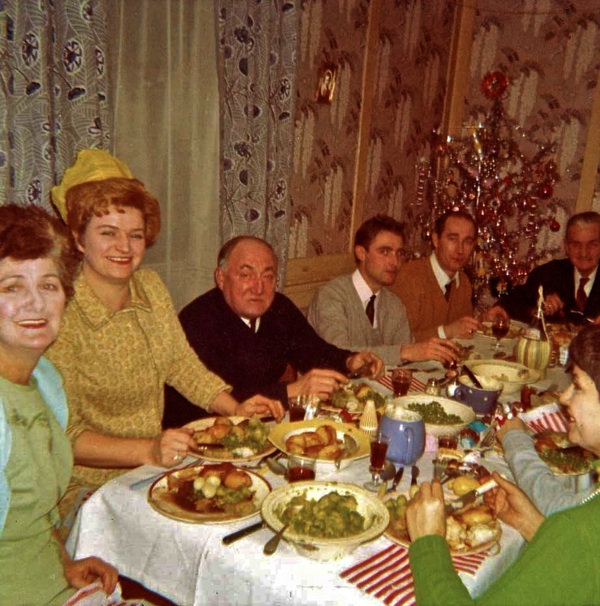
On the first floor, Neville (fourth from left ) sits next to his father for Christmas in 1968
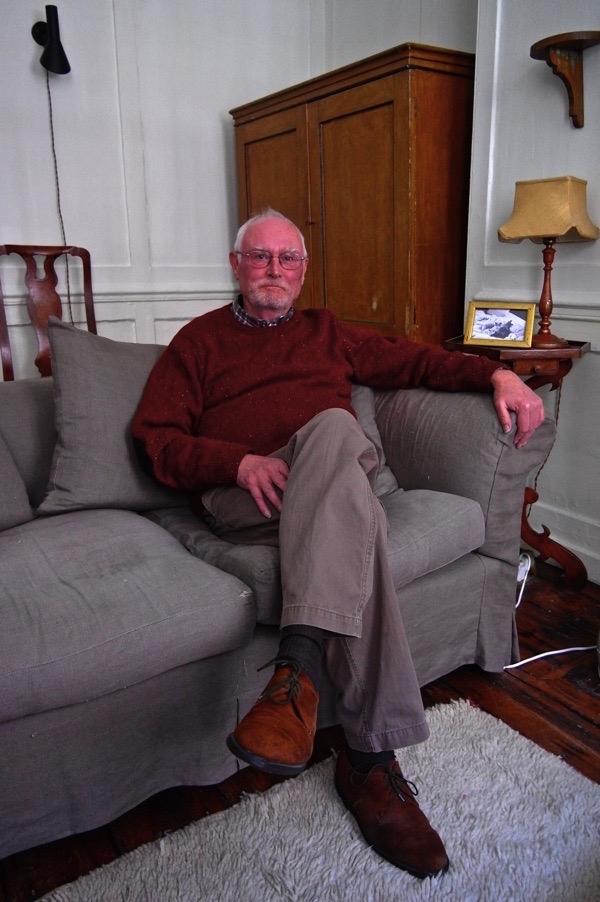
Neville relaxes in first floor room which was once his family’s dining room
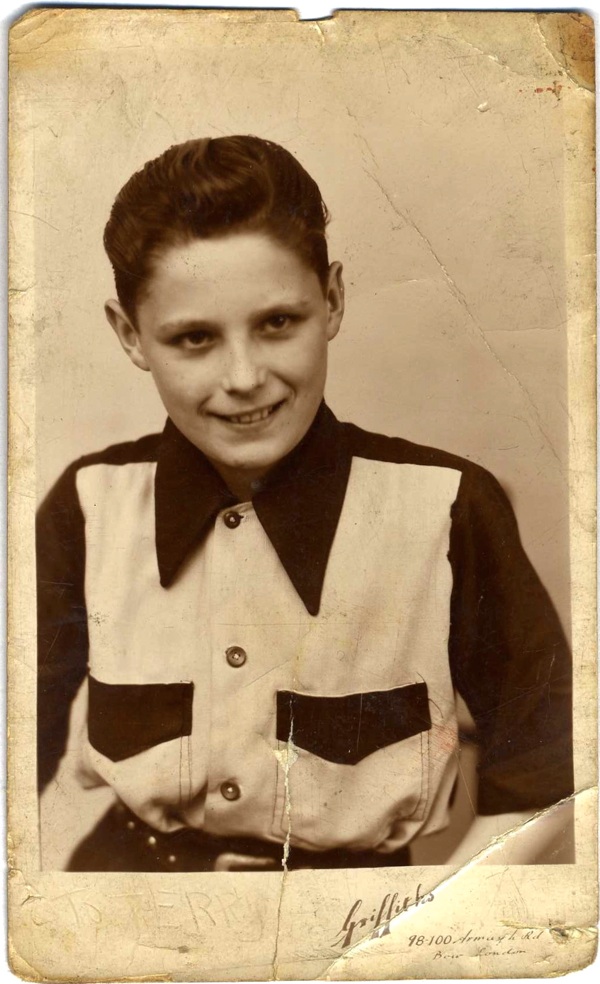
Neville aged eleven in 1951
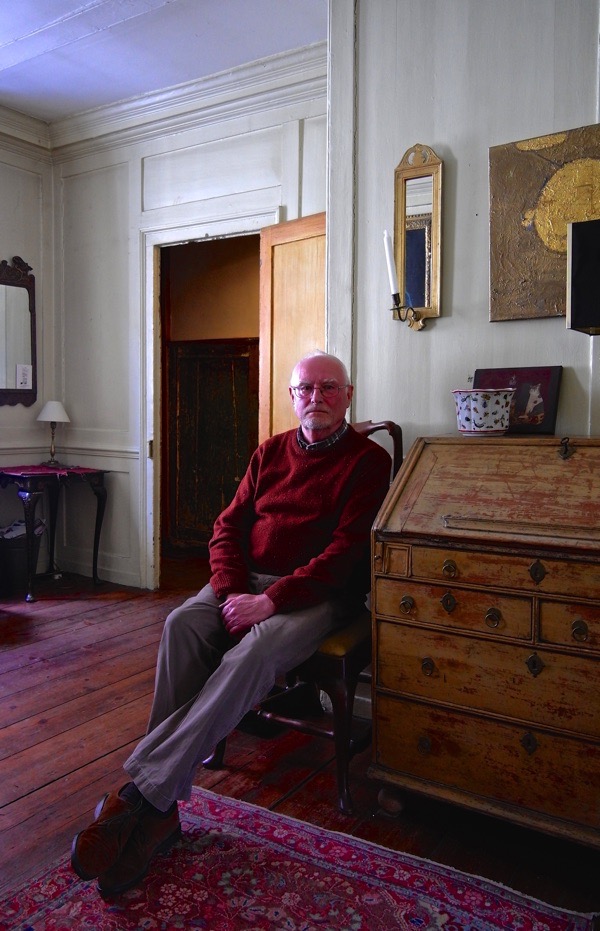
Neville sits in the ground floor room which was his childhood bedroom
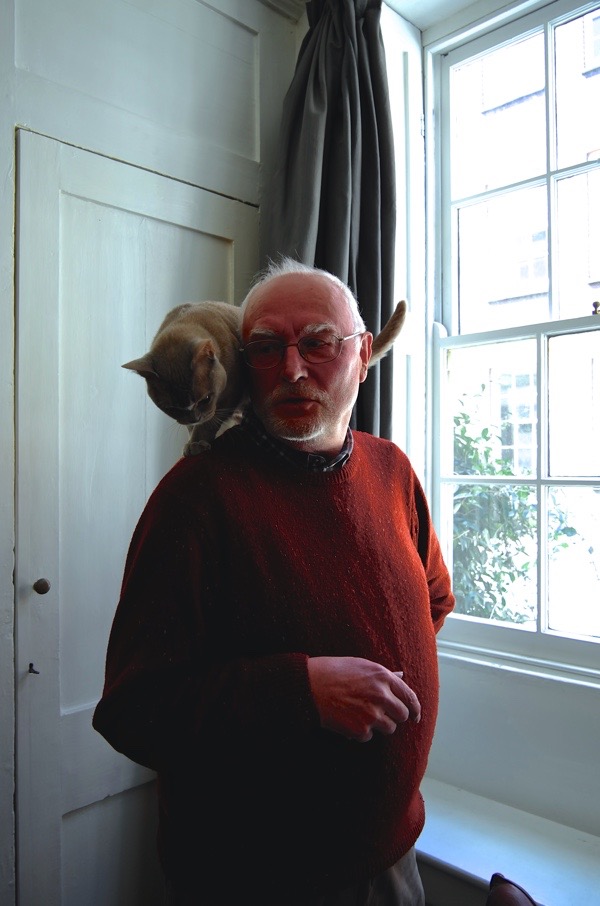
Neville is welcomed back by the presiding spirit of Elder St
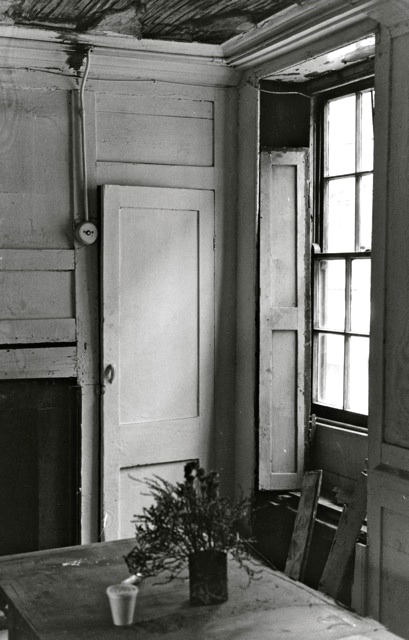
The first floor room during the squat to save the building in 1977
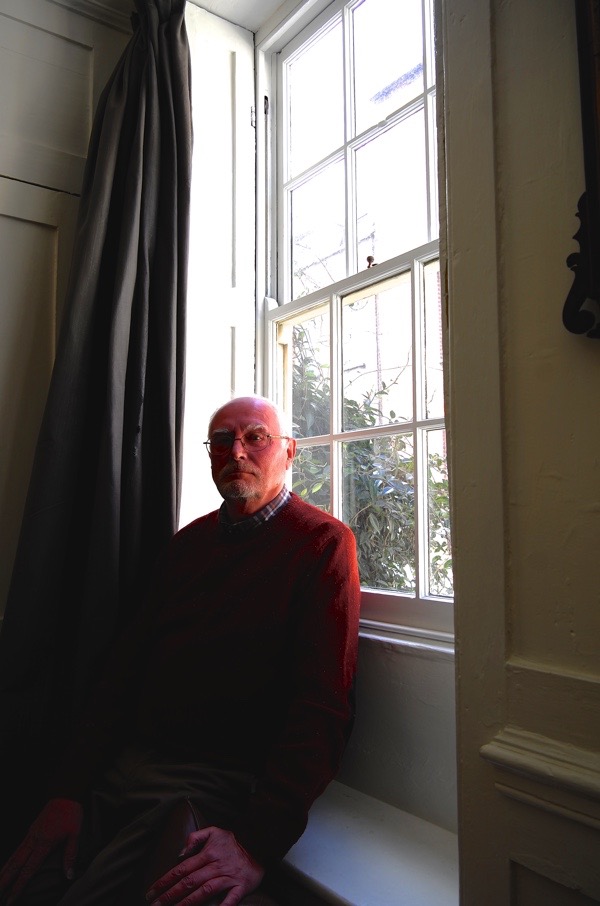
Neville sits in the window on the first floor
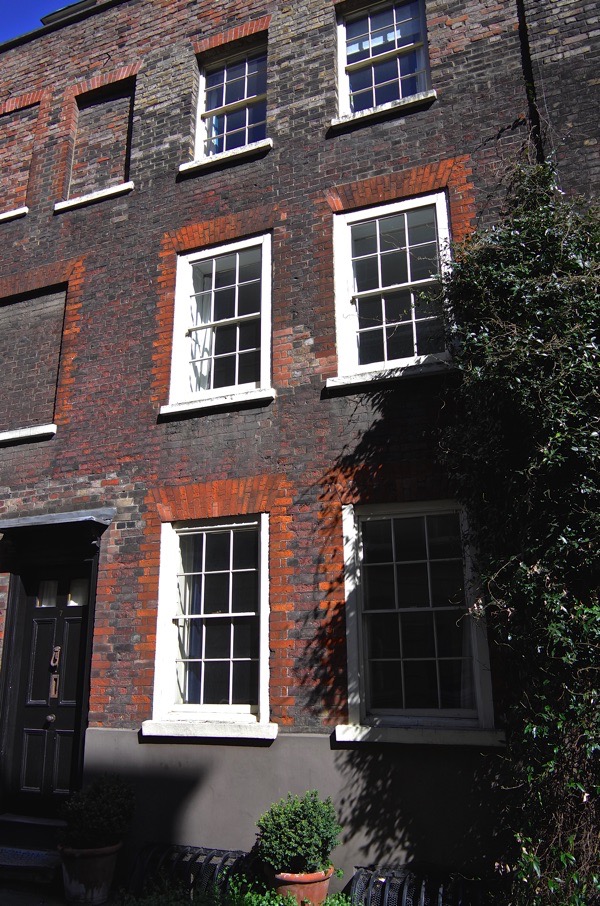
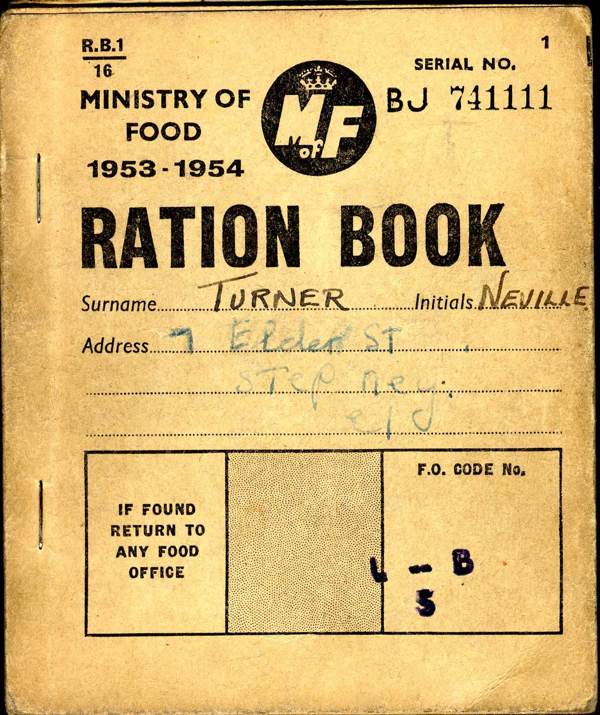
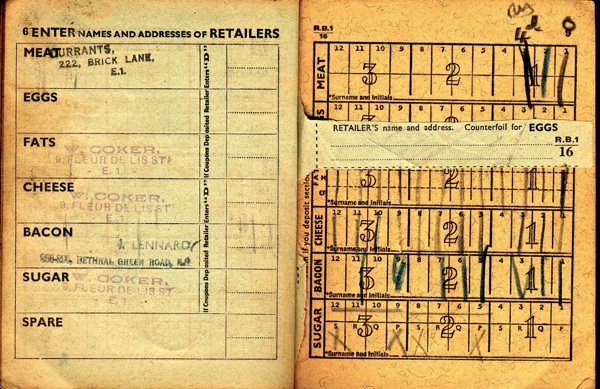
Neville’s ration book
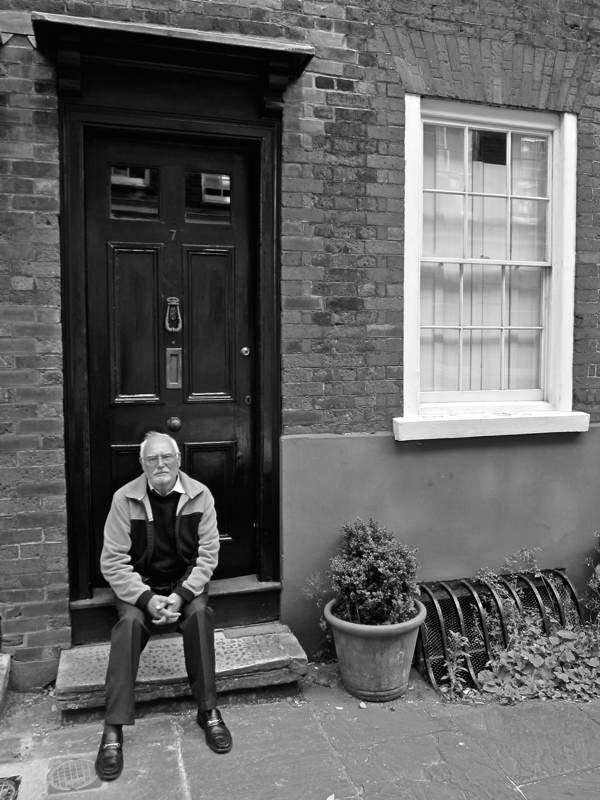
Neville sits on the step in Elder St just as he did as child in the nineteen-forties
You may like to read my original story
Squatters Return To Elder St
To reflect the strange time warp in Elder St – where British Land who were prevented from demolishing Norton Folgate in 1977 have returned in 2015 to finish the job – five of those who were photographed on the steps of 7 Elder St in 1977 have gathered in the same location to restage the picture nearly forty years later for Contributing Photographer Sarah Ainslie.
Below, Kate & Michael Hodgkin who grew up in 19 Elder St, the house of historian Raphael Samuel, recall that memorable teenage summer of 1977 when they found their way into a newspaper photograph.
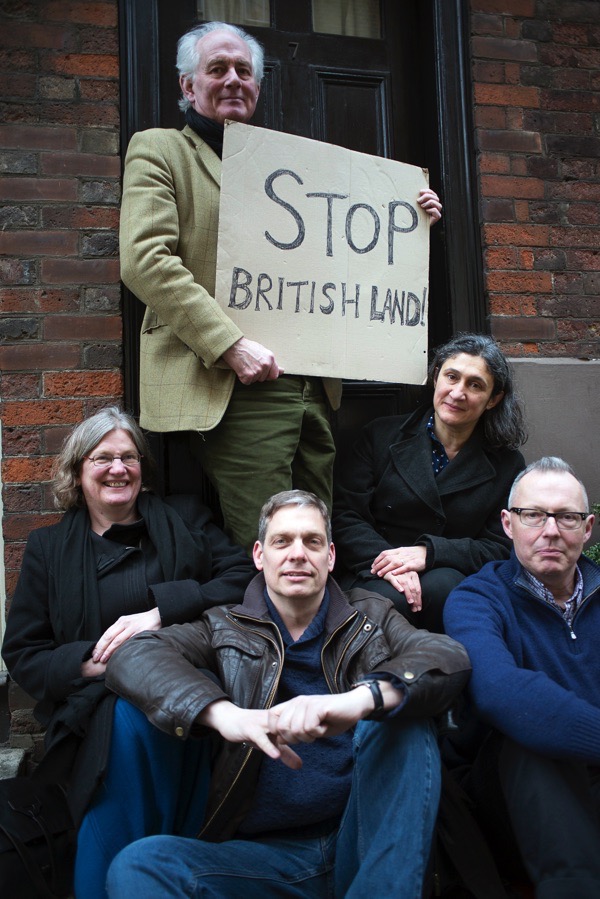
Dan Cruickshank standing with Katharine Hodgkin, Michael Hodgkin, Carla Mitchell & Colin Butler

Dan Cruickshank and friend stand in the doorway. Kate Hodgkin and Carla Mitchell sit in the doorway. Daniel Mitchell, Michael Hodgkin and Colin Butler sit on the step.
Katharine Hodgkin remembers Elder St
“When we first lived in Elder St at the beginning of the seventies, it was practically empty. As people left the last occupied houses on our side of the street, we would climb in and out of the backs of them. There were a few families still in the Peabody Buildings in Commmercial St, but when I went to the Central Foundation Girls’ School in Spital Sq none of the other girls lived nearby.
It was a strangely quiet place to live, beached by the outgoing tides of people. The local markets – Petticoat Lane and Club Row – were busy, and there were still Jewish shops run by Raphael Samuel’s relatives, and streets with new spicy smells that I did not yet identify as Bangladeshi. But the little cluster of Folgate St, Elder St, Blossom St, Fleur de Lys St, was a backwater run down into dereliction.
By the time of the photo, my brother Mick & I had moved out, though our older brother Dom stayed on with Raph (Raphael Samuel) and we came back most weekends. We were in the mid-to-late teens by then and busy being seventies political teenagers – it was the time of Rock Against Racism and the Anti-Nazi League and demos all the time. So we naturally gravitated to protests going on in Elder St.
The area has changed so much, and the ghost of the old Spitalfields can seem a faded and feeble one. But I was perversely heartened by the enduring shabbiness of the streets, and the sense that the materiality of the buildings continuing to hold memory of the former communities, even though the inhabitants have mostly changed.
I would rather see the graffiti and empty shells at the Commercial St end of Elder St than the neo-Georgian facades blighting Folgate St at the other. There is a stubborn continuity in the narrow turning streets and the way the houses close in around you. The thought of losing all this to more mega-buildings is a melancholy one.
When we met to restage the photo, we stood outside 7 Elder St sharing memories of outdoor lavatories, posters all over the kitchen wall, books lining the spiral staircase. It is good that the street was saved, is lived in, and the houses are better loved and cared for.”
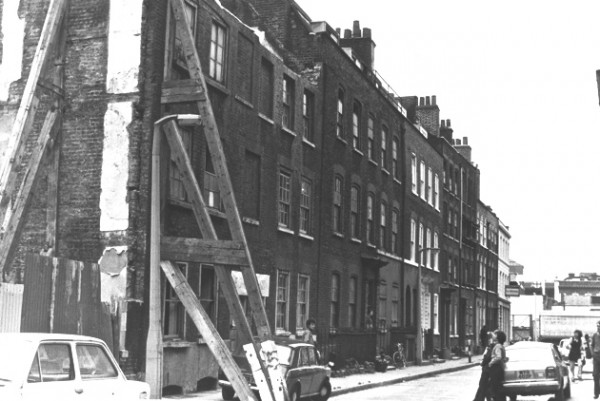
5 & 7 Elder St after the demolition was halted by the squatters of the Spitalfields Trust
Michael Hodgkin remembers Elder St
“Like my sister Kate, going back now, I remember how we used to scramble over the back wall from our home to the ragwort-covered building site behind. I would have fruit fights with abandoned produce in the market with a boy called John from the Peabody Buildings and the son of the family who ran the Italian shop on Commercial Rd by the top of Folgate St. And I remember painting our front step regularly with Cardinal Red to keep an East End traditional doorstep going.
One day we were sitting there barefoot, as we often did, when some passing American tourists starting taking photos as if documenting vestiges of late-nineteenth century East End poverty, rather than our late-twentieth century Bohemianism.”
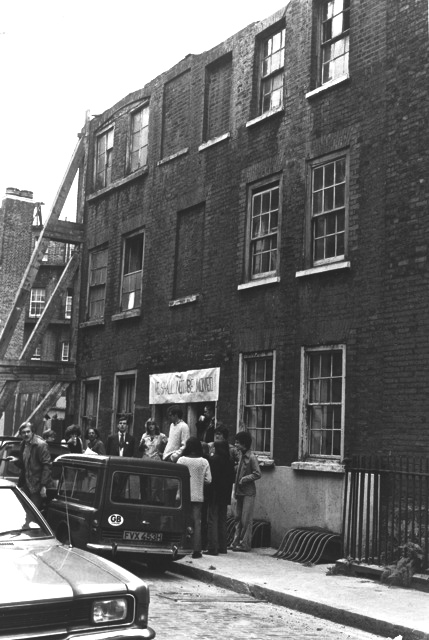
Squatters gather outside 7 Elder St – fourth from left is historian Raphael Samuel
Photographs by Anne Kilby
Dan Cruickshank speaks to SAVE NORTON FOLGATE at Shoreditch Church at 6:30pm on Wednesday 22nd April, with guests Sian Phillips reading the poetry of Sir John Betjeman and Conservation Consultant Alec Forshaw dissecting the British Land scheme. Dan will be telling the story of how British Land were defeated in Norton Folgate in 1977 and outlining the current battle. Click here to book your free ticket.












