
Towers Over The Goodsyard
Spitalfields Life Contributing Photographer Simon Mooney presents his completed film
[youtube wBbckajC91Q nolink]
Click here to read the East End Preservation Society’s guide to how to object effectively
You may also like to read about
Kitty Jennings, New Era Estate
No doubt you have read in the national press of the plight of the New Era Estate in Hoxton which has recently been acquired by an American property company that seeks to increase the rents to market value, disregarding the circumstances of the residents many of whom live upon modest incomes.
Today I publish my interview with long-term occupant, Kitty Jennings – drawing my readers attention to the petition, which already has over a quarter of a million signatories, and the public demonstration which gathers outside the offices of Westbrook Partners in Berkeley Sq at 12:30pm on Monday and marches to Downing St to present the petition, demanding justice for the tenants of the New Era Estate. Kitty is not as mobile as she once was, but she hopes some Spitalfields Life readers might be able to attend on her behalf.

Kitty, Amelia (Doll Doll), Jimmy, Gracie & Patricia Jennings, Gifford St, Hoxton c.1930
One Sunday afternoon last summer, I walked over to Columbia Rd Market to get a bunch of flowers for Kathleen – widely known as Kitty – Jennings, who has lived in Hoxton since 1924. I found her in her immaculately tidy flat in the New Era Estate near the canal where for many years she lived with her beloved sister Doll Doll, whose ashes now occupy pride of place in a corner of the sitting room.
Once Barbara Jezewska, who grew up in Spitalfields and was Kitty’s neighbour in this building for seventeen years, had made the introductions, we settled down in the afternoon sun to enjoy beigels with salmon and cream cheese while Kitty regaled us with her memories of old Hoxton.
“Thank God we were lucky, we had a father who had a good job, so we always had a good table. There was not a lot of work when I was a kid, but we always got by. We were lucky that we always had good clothes and never got knocked about.
My father, Jim, he was a Fish Porter at Billingsgate Market and he had to work seven days. He was born in the Vinegar Grounds in Hoxton, where they only had one shared tap in the garden for all the cottages, and he was a friendly man who would help anyone. He left for work at four in the morning each day and came back in the early afternoon. We lived on fish. I’m a fish-mullah, I like plaice, jellied eels, Dover sole and middle skate. My poor old mum used to fry fish night and day, she was always at the gas stove.
I was born in Gifford St, Hoxton. There were five of us, four girls and one boy, and we lived in a little three bedroom house. My mother Grace, her life was cooking, washing and housework. She didn’t know anything else.
When my sister Amelia was born, she was so small they laid her in a drawer and we called her ‘Doll Doll.’ They put her in the Queen Elizabeth Children’s Hospital when she had rheumatic fever and she didn’t go to school because of that. She was happy-go-lucky, she was my Doll Doll.
One day, when she was at school, there was an air raid and all the children hid under the tables. They saw a man’s legs walk in and Doll Doll cried out, ‘That’s my dad!’ and her friend asked, ‘How do you recognise him?’ and Doll Doll said, ‘Because he has such shiny shoes.’ He took Doll Doll and said to the teacher, ‘My daughter’s not coming to school any more.’
I was dressmaking from when I left school at fourteen. My first job was at C&A in Shepherdess Walk but I didn’t like it, so I told my mum and left. I left school at Easter and the war came in August. After that, I didn’t go to work at all for five years. Then I went to work in Bishopsgate sewing soldiers’ trousers, I didn’t like that much either so I stayed at home.
Doll Doll and I, we used to love going to Hoxton Hall for concerts every Saturday. It cost threepence a ticket and there was a man called Harry Walker who’d sling you out if you didn’t behave. Afterwards, we’d go to a stall outside run by my uncle and he’d give us sixpence, and we’d go and buy pie and mash and go home afterwards – and that was our Saturday night. We used to go there in the week too and do gym and see plays.
On Friday nights, we’d go to the mission at Coster’s Hall and they’d give you a jug of cocoa and a biscuit, and the next week you’d get a jug of soup. It didn’t cost anything. We used to go there when we were hungry. In the school holidays, we went down to Tower Hill Beach and we’d cut through the market and see my dad, and he’d give us a few bob to buy ice cream.
Me and Doll Doll, we stayed at home with my mum and dad. The other three got married but I didn’t want to. I couldn’t find anybody that I liked, so I stayed at home with mummy and daddy, and I was quite happy with them. When they got old we cared for them at home, without any extra help, until they died. We had understanding guvnors and, Doll Doll and I took alternate weeks off work to care for them.
Doll Doll and I moved into the New Era Estate more than thirty years ago. In those days, it was only women and once, when my neighbour thought her boiler was going to explode, we called the fire brigade. Doll Doll leaned over the balcony and called, ‘Coo-ee, young man! Up here!’
We never went outside Hoxton much when we were young, but – when we grew up – Doll Doll and I went to Florida and Las Vegas. I finally settled down and I didn’t wander no more. I worked as a dressmaker at Blaines in Petticoat Lane for thirty-five years, until it closed forty years ago and I was made redundant.”

Doll Doll, Kitty and their mother Grace

Kitty in her flat in Hoxton
 Doll Doll

Kitty places fresh flowers next to Doll Doll’s ashes each week

Kitty at a holiday chalet in Guernsey, 1960

Kitty Jennings with her friend and neighbour of sixteen years, Barbara Jezewska
You may also like to read about
Remembering AS Jasper’s ‘A Hoxton Childhood’
Happy Birthday East End Preservation Society!

It was a year ago this week that several hundred people gathered in the Great Hall at the Bishopsgate Institute to found The East End Preservation Society, as a means to unite everyone who cares about the future of the East End and its built environment. The creation of the Society was inspired by the saving of the Marquis of Lansdowne from demolition and in response to the looming prospect of a slew of large-scale development proposals threatening to blight the East End for generations to come.
Early on, the Society won a victory in Whitechapel when a characterful nineteenth century terrace, which had been condemned, was revealed to be the last fragment of the Pavilion Theatre complex and was subsequently rescued from destruction. Yet the last year has also witnessed the tragic demolition of the Queen Elizabeth Children’s Hospital soon to be followed by the Spitalfields Fruit & Wool Exchange. Meanwhile, in the last few days, a brave initiative by Open Dalston failed to prevent Hackney Council proceeding to demolish the Georgian terrace in Dalston Lane as part of a “Conservation-led” scheme.
To address these challenges at the first opportunity, a team of Conservation specialists have come together who now meet monthly to consider all relevant planning applications and devise the most effective letters of response on behalf of The East End Preservation Society. In parallel to this, there is a popular programme of public talks upon pertinent subjects – such as Community Planning and The History of the Bishopsgate Goodsyard – and tickets for all these events always sell out in advance. A lively facebook page highlights campaigns arising in the East End and permits anyone to bring new cases to the attention of the Society.
At this moment the Society faces the largest battle it is ever likely to face, in the form of the monstrous proposals for the Bishopsgate Goodsyard, described recently as “the biggest thing to hit Shoreditch since the plague” and “degeneration not regeneration” by two eloquent critics. The Society has created a clear guide that explains how to object, outlining the salient points which carry weight with planning committees.
Next year, the Society hopes to raise the level of debate upon the current planning crisis in London with the Inaugural CR Ashbee Memorial Lecture in the Great Hall at the Bishopsgate Institute. We choose to remember CR Ashbee (1863-1942) as founder of the Guild of Handicrafts in the East End, as a pioneer of the Conservation Movement, and a Progressive Architect and Designer whose influence was seminal upon Frank Lloyd Wright among many others. The intention of this endeavour is to invite high-profile speakers to address the most pressing questions for the future of London and its built environment, stimulating a debate that can redress the contemporary situation.
I am proud to announce that Oliver Wainwright, Architecture & Design Critic of The Guardian, has accepted the invitation to deliver The East End Preservation Society’s Inaugural CR Ashbee Memorial Lecture in April 2015, which will be entitled “The Seven Dark Arts of Developers.”
But before we get to that, British Land who demolished the best part of the Georgian houses in Elder St in the nineteen-seventies before they were halted by the opposition of Dan Cruickshank, John Betjeman and others, have returned with a new scheme to redevelop Norton Folgate. In the next few days, they are staging a public exhibition of their final proposals prior to submitting the planning application in December. Readers are encouraged to visit and record their responses in writing at this event.

The Marquis of Lansdowne to be restored by the Geffrye Museum as part of its development plans

Whitechapel’s Theatrical terrace saved from demolition (Photo by Alex Pink)

The Queen Elizabeth Children’s Hospital has been demolished this year

The Spitalfields Fruit & Wool Exchange will be demolished next year

The Georgian terrace in Dalston Lane will be demolished next year (Photo by Simon Mooney)

The proposed development for the Bishopsgate Goodyard

‘A new Society is needed to promote an urban vision which is not governed by short term and personal profit, but which evokes and embraces the communal aims which enshrine the spirit and character of east London.’ – Dan Cruickshank, at the launch of The East End Preservation Society, November 2013

British Land’s invitation to the exhibition of their final plans for Norton Folgate


Follow the East End Preservation Society
Facebook/eastendpsociety
Twitter/eastendpsociety
Click here to join the East End Preservation Society
You may also like to read about
The East End Preservation Society
The Launch of The East End Preservation Society
Eva Frankfurther, Artist

There is an unmistakeable melancholic beauty which characterises Eva Frankfurther‘s East End drawings made during her brief working career in the nineteen-fifties. Born into a cultured Jewish family in Berlin in 1930, she escaped to London with her parents in 1939 and studied at St Martin’s School of Art between 1946 and 1952, where she was a contemporary of Leon Kossoff and Frank Auerbach.
Yet Eva turned her back on the art school scene and moved to Whitechapel, taking menial jobs at Lyons Corner House and then at a sugar refinery, immersing herself in the community she found there. Taking inspiration from Rembrandt, Käthe Kollwitz and Picasso, Eva set out to portray the lives of working people with compassion and dignity.
In 1958, afflicted with depression, Eva took her own life aged just twenty-eight, but despite the brevity of her career she revealed a significant talent and a perceptive eye for the soulful quality of her fellow East Enders.


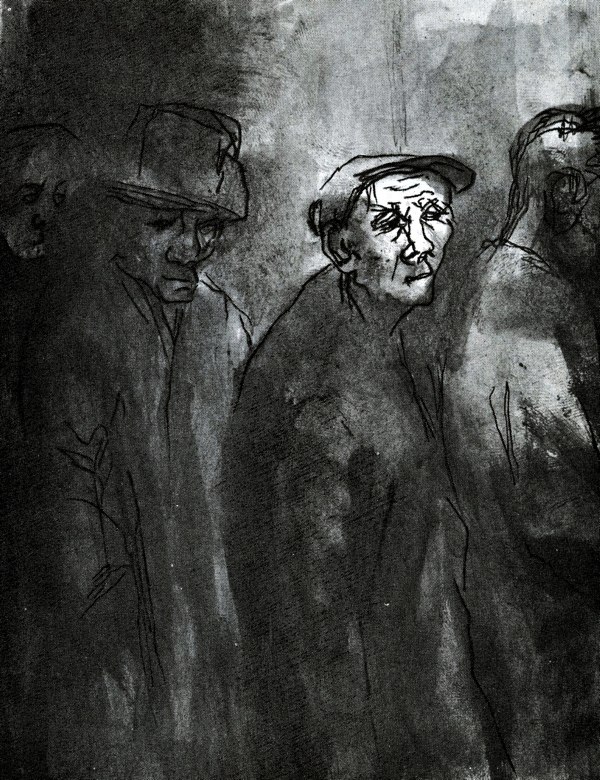


“West Indian, Irish, Cypriot and Pakistani immigrants, English whom the Welfare State had passed by, these were the people amongst whom I lived and made some of my best friends. My colleagues and teachers were painters concerned with form and colour, while to me these were only means to an end, the understanding of and commenting on people.” – Eva Frankfurther
Images courtesy Bishopsgate Institute
You may also wish to take a look at
On The Bishopsgate Goodsyard, 24

Mick Hardie, Butcher

Mick Hardie
Observe Mick Hardie’s quizzical smile, peering at me askance, when I took his portrait last week upon his return to the corner of Spitalfields that he left in 1967. It is a smile that is not so different from his grin of wonderment captured in a Coronation party photograph, sixty-one years earlier – taken just fifty yards away from this new picture when he was nine years old. Yet in spite of the lifetime that has passed between the two photographs, Mick was able to speak vividly of his youth and formative experiences in these narrow streets, which have changed almost beyond recognition in the last half century.
“I moved away in 1967. We got offered a house in Wanstead and we lived there thirty-nine years, and then we moved to Frinton eight years ago – I don’t know why we moved to Frinton, my wife saw a house there and liked it. Now, everyday I send my daughter a photo of the sea from my mobile phone.
In 1946, my parents moved into Albert Family Dwellings, Deal St, Spitalfields. My mother May Edith Hardie came from Waterlow Buildings in Three Colts Lane, Bethnal Green, but my father, John James Hardie, he was a Scotsman. I had been born in Hitchin in 1942 and I was four, and my elder brother Brian was six, when we moved into the Dwellings. There was still a bomb shelter in the courtyard. I can remember most of the people in the buildings and all the details of the neighbourhood, because my father died of tuberculosis when I was six and I became a child of the streets. If I ever needed anything, I called up to my mother and she would let me down a doughnut wrapped in paper on a string.
Everyone knew each other in Albert Family Dwellings, people leaned out of the windows and chatted with their neighbours above and below. You used to get the old Jewish people sitting around in the evenings, that’s what I remember, and on Friday they asked you to to turn the lights and gas on and off. One of the highlights was the procession from St Anne’s, the Catholic church. They used to process along Underwood Rd, up Vallance Rd and back along Buxton St.
The Truman’s bottling plant was nearby and, every day, I could hear the clogs of the bottling girls in Woodseer St – it was like an army on the march. From the window of Howard Buildings, you could look across and see the girls in the bottling plant.
We had two bedrooms, a living room and a small scullery with a coal bin, which had to be kept clean because my mother used the top of it as a work surface. Everyone had a coal fire and the coal man carried hundred-weight sacks of coal up the stairs on his back. The scullery was so small, you could wash your drawers while sitting on the toilet and, if you wanted a bath, you went to Cheshire St Public Baths. Under Howard Buildings, next door, there was a washhouse where all the residents did their laundry.
I belonged to every youth club, even the Jewish youth club. I bought a bike in Club Row and cycled to Victoria Park. I was always a keen reader and I borrowed books from St Matthew’s Library, across the railway line. I used to buy toast and dripping in the cafe at the foot of the Pedley St bridge and carry it up the steps, and make a greasy thumbprint on the cover of my book. When we had no money, we collected rags and waste paper and sold them to the waste merchant in Cheshire St.
They pulled down All Saints Church in Buxton St when I was was ten, fortunately I could still go to Christ Church Spitalfields – but not very often, mind! After my father’s funeral, my mother never wanted to go to church again. When I left school at fifteen, I got a job as a messenger boy in a shipping office in Gravel Lane, Wapping.
I met my wife, Doreen Delaney, through the All Saints youth club in December 1958 and that was it, we got married in 1963. I remember I was standing on a street corner one night and a friend asked me to come along carol singing with the choir, and I don’t like carol singing but I went along anyway, and that’s how I met Doreen. They never said it would last – but we just celebrated our fiftieth wedding anniversary with Rock ‘n Roll, fish and chips, and beer! She was in the choir. After we met, I went to church just to hear her sing, and I waited for her afterwards and walked her home. Doreen used to roller skate through Liverpool St Station.
A year later, when we decided to get married, my mother in law said, ‘You’d better get a proper job.’ So I became a butcher and that was my life for the next forty-five years. I worked at Smithfield and I worked at Sainsburys, and I worked in the Bethnal Green Rd when every other shop was a butcher’s shop. In those days, you could walk from Hanbury St, down Vallance Rd, then turn left and all along the Whitechapel Rd as far as the cinema, it was full of stalls that were very good.
Because Doreen was in the choir, we got married for free at Christ Church and the choir sang for us as punishment. After we married, we moved into 99 Woodseer St and my brother lived almost next door in 104. Ours had been the flat belonging to Mrs Ivory, the dinner lady at All Saints School. We just had a living room, bedroom, scullery and backyard, but we were quite happy there. I had so many part-time jobs, trying to get a buck.
I can remember everything about that time, yet I can’t tell you what I did yesterday.”

Mick stands at the centre of this detail of the Coronation Party photo with his collar over his jumper

In the full photo, Mick stands centre left at the back of the crowd celebrating in Deal St, 1953

Doreen & Mick on a youth club ramble, 1960

Doreen and friends on the Bank Holiday ramble, 1960
 Mick with a friend on a youth club excursion to Littlehampton, 1960

Friends at Littlehampton, 1960

Mick and pal sky-larking for the camera, Littlehampton 1960

Mick & Doreen, married at Christ Church, Spitalfields, 1963

Mick Hardie at Albert Cottages where he lived from 1963-7 when he first married
You may also like to read about these other residents of Deal St, Spitalfilds


