
Streets Of Old London

Piccadilly, c. 1900
In my mind, I live in old London as much as I live in the contemporary London of here and now. Maybe I have spent too much time looking at old photographs – such as these glass slides once used for magic lantern shows by the London & Middlesex Archaeological Society at the Bishopsgate Institute?
Old London exists to me through photography almost as vividly as if I had actual memory of a century ago. Consequently, when I walk through the streets of London today, I am especially aware of the locations that have changed little over this time. And, in my mind’s eye, these streets of old London are peopled by the inhabitants of the photographs.
Yet I am not haunted by the past, rather it is as if we Londoners in the insubstantial present are the fleeting spirits while – thanks to photography – those people of a century ago occupy these streets of old London eternally. The pictures have frozen their world forever and, walking in these same streets today, my experience can sometimes be akin to that of a visitor exploring the backlot of a film studio long after the actors have gone.
I recall my terror at the incomprehensible nature of London when I first visited the great metropolis from my small city in the provinces. But now I have lived here long enough to have lost that diabolic London I first encountered in which many of the great buildings were black, still coated with soot from the days of coal fires.
Reaching beyond my limited period of residence in the capital, these photographs of the streets of old London reveal a deeper perspective in time, setting my own experience in proportion and allowing me to feel part of the continuum of the ever-changing city.

Ludgate Hill, c. 1920

Holborn Viaduct, c. 1910

Trinity Almshouses, Mile End Rd, c. 1920
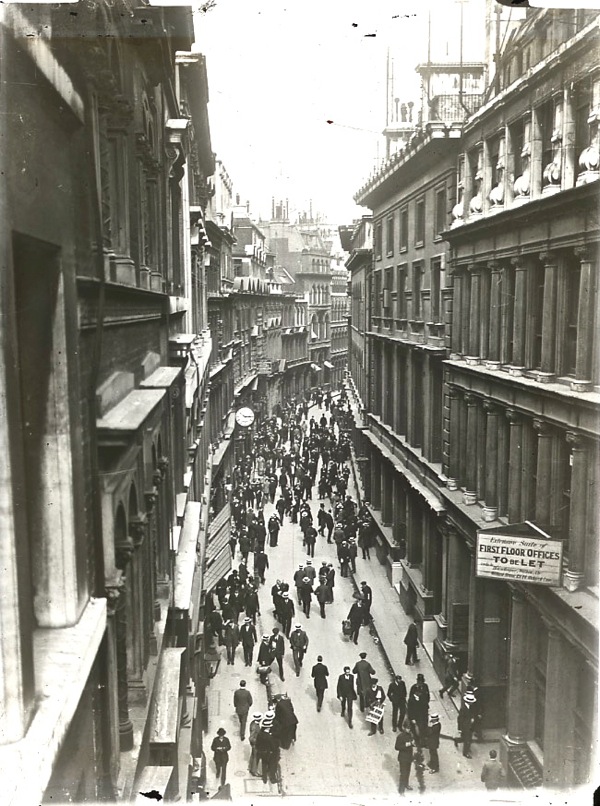
Throgmorton St, c. 1920

Highgate Forge, Highgate High St, 1900

Bangor St, Kensington, c. 1900

Ludgate Hill, c. 1910

Walls Ice Cream Vendor, c. 1920

Ludgate Hill, c. 1910

Strand Yard, Highgate, 1900
 Eyre St Hill, Little Italy, c. 1890

Muffin man, c. 1910

Seven Dials, c. 19o0

Fetter Lane, c. 1910

Piccadilly Circus, c. 1900

St Clement Danes, c. 1910
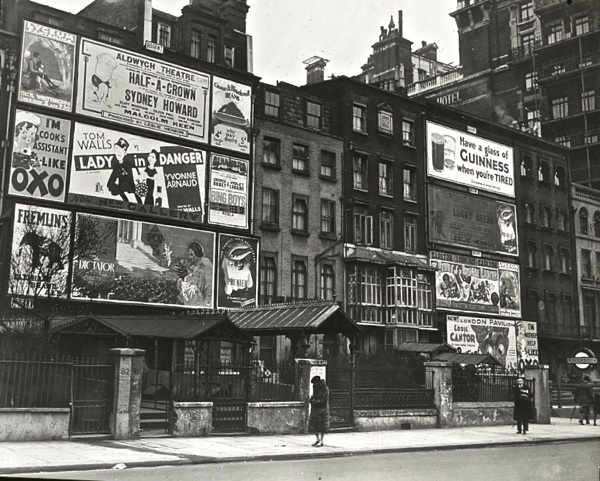
Hoardings in Knightsbridge, c. 1935

Wych St, c.1890

Dustcart, c. 1910

At the foot of the Monument, c. 1900
 Pageantmaster Court, Ludgate Hill, c. 1930

Holborn Circus, 1910

Cheapside, 1890

Cheapside ,1892

Cheapside with St Mary Le Bow, 1910

Regent St, 1900
Glass slides courtesy Bishopsgate Institute
You may also like to take a look at
At The RHS Spring Flower Show

There may yet be another month before spring begins, but inside the Royal Horticutural Hall in Victoria it arrived with a vengeance yesterday. The occasion was the RHS Plant & Design Show held each year at this time, which gives specialist nurseries the opportunity to display a prime selection of their spring-flowering varieties and introduce new hybrids to the gardening world.
I joined the excited throng at opening time on the first day, entering the great hall where shafts of dazzling sunshine descended to illuminate the woodland displays placed strategically upon the north side to catch the light. Each one a miracle of horticultural perfection, it was as if sections of a garden had been transported from heaven to earth. Immaculate plant specimens jostled side by side in landscapes unsullied by weed, every one in full bloom and arranged in an aesthetic approximation of nature, complete with a picturesque twisted old gate, a slate path and dead beech leaves arranged for pleasing effect.
Awestruck by rare snowdrops and exotic coloured primroses, passionate gardeners stood in wonder at the bounty and perfection of this temporary arcadia, and I was one of them. Let me confess I am more of a winter gardener than of any other season because it touches my heart to witness those flowers that bloom in spite of the icy blast. I treasure these harbingers of the spring that dare to show their faces in the depths of winter and so I found myself among kindred spirits at the Royal Horticultural Hall.
Yet these flowers were not merely for display, each of the growers also had a stall where plants could be bought. Clearly an overwhelming emotional occasion for some, “It’s like being let loose in a sweet shop,” I overhead one horticulturalist exclaim as they struggled to retain self-control, “but I’m not gong to buy anything until I have seen everything.” Before long, there were crowds at at each stall, inducing first-day-of-the-sales-like excitement as aficionados pored over the new varieties, deliberating which to choose and how many to carry off. It would be too easy to get seduced by the singular merits of that striped blue primula without addressing the question of how it might harmonise with the yellow primroses at home.
For the nurserymen and women who nurtured these prized specimens in glasshouses and poly-tunnels through the long dark winter months, this was their moment of consummation. Double-gold-medal-winner Catherine Sanderson of ‘Cath’s Garden Plants’ was ecstatic – “The mild winter has meant this is the first year we have had all the colours of primulas on sale,” she assured me as I took her portrait with her proud rainbow display of perfect specimens.
As a child, I was fascinated by the Christmas Roses that flowered in my grandmother’s garden in this season and, as a consequence, Hellebores have remained a life-long favourite of mine. So I was thrilled to carry off two exotic additions to a growing collection which thrive in the shady conditions of my Spitalfields garden – Harvington Double White Speckled and Harvington Double White.
Unlike the English seasons, this annual event is a reliable fixture in the calendar and you can guarantee I shall be back at the Royal Horticultural Hall next year, secure in my expectation of a glorious excess of uplifting spring flowers irrespective of the weather.


Double-gold-medal-winner Catherine Sanderson of ‘Cath’s Garden Plants’


You may also like to read about
Bob Mazzer, Tube Photographer
We are proud to announce that Bob Mazzer, Tube Photographer Extraordinaire who first found fame here in the pages of Spitalfields Life, is back with an exhibition which opened yesterday at the Leica Gallery at the Royal Exchange in the City of London and runs until March 11th.
“There’s definitely a link between being born in Aldgate and taking all these pictures on the tube,” Bob admitted to me, “You don’t think you are starting a project, but one day you look back over your recent pictures and there are a dozen connected images, and you realise it is the beginning of a project – and then you fall in love with it.”
“For a while in the eighties, I lived with my father in Manor House and worked as a projectionist at a porn cinema in Kings Cross. It was called The Office Cinema, so guys could call their wives and say, ‘I’m still at the office'” recalled Bob affectionately, “Every day, I travelled to Kings Cross and back. Coming home late at night, it was like a party and I felt the tube was mine and I was there to take pictures.”


Photographs copyright © Bob Mazzer
You may also like to take a look at
Beigels Already
Debbie Shuter’s short film ‘Beigels Already’ was shot at Brick Lane Beigel Bakery in 1992. Watch out for appearances by some familiar local characters, including Mr Sammy looking youthful and sassy.
You may also like to read about
At Arthur Beale

Did you ever wonder why there is a ship’s chandler at the top of Neal St where it meets Shaftesbury Avenue in Covent Garden. It is a question that Alasdair Flint proprietor of Arthur Beale gets asked all the time. ‘We were here first, before the West End,’ he explains with discreet pride,‘and the West End wrapped itself around us.’
At a closer look, you will discover the phrase ‘Established over 400 years’ on the exterior in navy blue signwriting upon an elegant aquamarine ground, as confirmed by a listing in Grace’s Guide c. 1500. Naturally, there have been a few changes of proprietor over the years, from John Buckingham who left the engraved copper plate for his trade card behind in 1791, to his successors Beale & Clove (late Buckingham) taken over by Arthur Beale in 1903, and in turn purchased by Alasdair Flint of Flints Theatrical Chandlers in 2014.
‘Everyone advised me against it,’ Alasdair confessed with the helpless look of one infatuated, ‘The accountant said, ‘Don’t do it’ – but I just couldn’t bear to see it go…’
Then he pulled out an old accounts book and laid it on the table in his second floor office above the shop and showed me the signature of Ernest Shackleton upon an order for Alpine Club Rope, as used by Polar explorers and those heroic early mountaineers attempting the ascent of Everest. In that instant, I too was persuaded. Learning that Arthur Beale once installed the flag pole on Buckingham Palace and started the London Boat Show was just the icing on the cake. Prudently, Alasdair’s first act upon acquiring the business was to acquire a stock of good quality three-and-a-half metre ash barge poles to fend off any property developers who might have their eye on his premises.
For centuries – as the street name changed from St Giles to Broad St to Shaftesbury Avenue – the business was flax dressing, supplying sacks and mattresses, and twine and ropes for every use – including to the theatres that line Shaftesbury Avenue today. It was only in the sixties that the fashion for yachting offered Arthur Beale the opportunity to specialise in nautical hardware.
The patina of ages still prevails here, from the ancient hidden yard at the rear to the stone-flagged basement below, from the staircase encased in nineteenth century lino above, to the boxes of War Emergency brass screws secreted in the attic. Alasdair Flint cherishes it all and so do his customers. ‘We haven’t got to the bottom of the history yet,’ he admitted to me with visible delight.

Arthur Beale’s predecessor John Buckingham’s trade card from 1791

Nineteenth century headed paper (click to enlarge)


Alasdair Flint’s office

Account book with Shackleton’s signature on his order for four sixty-foot lengths of Alpine Club Rope

Drawers full of printing blocks from Arthur Beale and John Buckingham’s use over past centuries

Arthur Beale barometer and display case of Buckingham rope samples

Nineteenth century lino on the stairs

War emergency brass screws still in stock


More Breton shirts and Wellingtons than you ever saw

Rope store in the basement

Work bench with machines for twisting wire rope


Behind the counter

Jason Nolan, Shop Manager

James Dennis, Sales Assistant


Jason & James run the shop

Receipts on the spike

Arthur Beale, 194 Shaftesbury Avenue, WC2 8JP
You may also like to read about
Viscountess Boudica’s Valentines

Viscountess Boudica of Bethnal Green confessed to me that she has never received a Valentine in her entire life and yet, in spite of this unfortunate example of the random injustice of existence, her faith in the future remains undiminished.
Taking a break from her busy filming schedule, the Viscountess granted me a brief audience to reveal her intimate thoughts upon the most romantic day of the year and permit me to take these rare photographs that reveal a candid glimpse into the private life of one of the East End’s most fascinating characters.
For the first time since 1986, Viscountess Boudica dug out her Valentine paraphernalia of paper hearts, banners, fairylights, candles and other pink stuff to put on this show as an encouragement to the readers of Spitalfields Life. “If there’s someone that you like,” she says, “I want you to send them a card to show them that you care.”
Yet behind the brave public face, lies a personal tale of sadness for the Viscountess. “I think Valentine’s Day is a good idea, but it’s a kind of death when you walk around the town and see the guys with their bunches of flowers, choosing their chocolates and cards, and you think, ‘It should have been me!'” she admitted with a frown, “I used to get this funny feeling inside, that feeling when you want to get hold of someone and give them a cuddle.”
Like those love-lorn troubadours of yore, Viscountess Boudica has mined her unrequited loves as a source of inspiration for her creativity, writing stories, drawing pictures and – most importantly – designing her remarkable outfits that record the progress of her amours. “There is a tinge of sadness after all these years,” she revealed to me, surveying her Valentine’s Day decorations,” but I am inspired to believe there is hope of domestic happiness.”


You may also like to take a look at
Viscountess Boudica’s Domestic Appliances
Viscountess Boudica’s Halloween
Viscountess Boudica’s Christmas
Read my original profile of Mark Petty, Trendsetter
and take a look at Mark Petty’s Multicoloured Coats
Vinegar Valentines
As Valentine’s Day approaches and readers are preparing their billets-doux, perhaps some might like to contemplate reviving the Victorian culture of Vinegar Valentines?
When I met inveterate collector Mike Henbrey last summer in the final months of his life, he showed me his cherished collection of these harshly-comic nineteenth century Valentines which he had been collecting for more than twenty years.
Mischievously exploiting the expectation of recipients on St Valentine’s Day, these grotesque insults couched in humorous style were sent to enemies and unwanted suitors, and to bad tradesmen by workmates and dissatisfied customers. Unsurprisingly, very few have survived which makes them incredibly rare and renders Mike’s collection all the more astonishing.
“I like them because they are nasty,” Mike admitted to me with a wicked grin, relishing the vigorous often surreal imagination manifest in this strange sub-culture of the Victorian age. Mike Henbrey’s collection of Vinegar Valentines has now been acquired by Bishopsgate Institute, where they are preserved in the archive as a tribute to one man’s unlikely obsession.
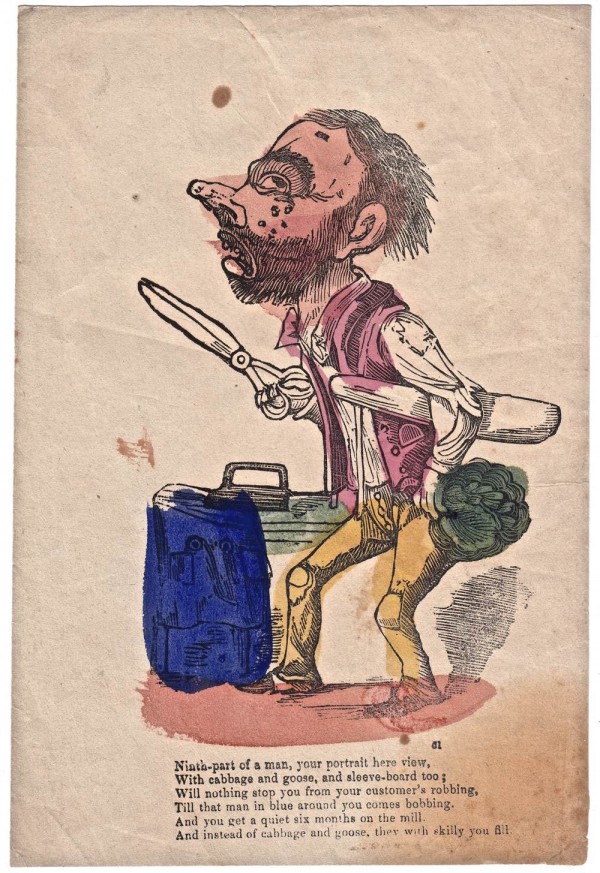


Images courtesy Mike Henbrey Collection at Bishopsgate Institute
You might also like to look at


