
Jeffrey Johnson’s Favourite Pubs
One day Jeffrey Johnson walked into the Bishopsgate Institute, deposited a stack of his splendid photographs with Archivist Stefan Dickers and left without another word. We can only conclude that these fond pictures from the seventies and eighties record the enigmatic Jeffrey’s favourite pubs. Some are familiar, but for the locations of the others – some of which are long gone – I call upon the superior experience of my readers.

Hoop & Grapes, Aldgate (Dentures Repaired)

Sir Walter Scott, Broadway Market

Knave of Clubs, Bethnal Green Rd

Dericote St, Broadway Market

Crown & Woolpack, St John St, Clerkenwell

Horn Tavern, Knightrider St, City of London (now known as The Centrepage)

Unknown pub

The Queen’s Head, City of London

The Queen’s Head, City of London

Unknown pub

Unknown pub

Old Bell Tavern, St Pancras

Magpie & Stump, Old Bailey

The Mackworth Arms, Commercial Rd


Green Man

Green Man

Marquis of Anglesey, Ashmill St

The Crooked Billet

The Bull’s Head (Landlords fight to save City pub)

The White Horse

The Olde Wine Shades, City of London

The Crispin, Finsbury Avenue

The Blue Posts, West India Dock Rd, Limehouse (Plasterer’s Required – Call at Back Door)

The Ticket Porter, Arthur St, City of London

Weavers Arms
Photographs copyright © Jeffrey Johnson
You may also like to take a look at
The Taverns of Long Forgotten London
Alex Pink’s East End Pubs Then & Now
The Gentle Author’s Next Pub Crawl
The Gentle Author’s Spitalfields Pub Crawl
The Gentle Author’s Dead Pubs Crawl
The Gentle Author’s Next Dead Pubs Crawl
Day Of Reckoning For Norton Folgate
UPDATE: Proceedings are now concluded and the verdict will come next week

Readers are encouraged to attend the Judicial Review happening at 10:30am in Court 4 at the Royal Courts of Justice in the Strand today which will decide the future of Norton Folgate.
If the Spitalfields Trust win their case and Boris Johnson is judged to have erred in law to the degree that his decision granting British Land permission to obliterate Norton Folgate is invalidated, then the door is open for this historic district to be saved. If, on the contrary, British Land and the Greater London Authority win their case and Boris Johnson is judged to have acted within his powers as Mayor of London, then we can all wave goodbye to the neighbourhood. Click here to read the terms of the Judicial Review.
To commemorate today’s historic watershed, Adam Dant has produced a Limited Edition of 100 signed and numbered Irish linen tea towels of The Curse of Norton Folgate, illustrating the mystic retribution invited by anyone who chooses to despoil this cherished spot.
If Norton Folgate is saved, the tea towel will become a trophy you can frame and, if the outcome is otherwise, you can use it to dry your dishes – or wipe your tears. The tea towels are hand-printed in black and eau-de-nil by Brian Gurtler in Spitalfields.
TEA TOWELS ARE SOLD OUT!

To all those who seek to despoil Norton Folgate, the Beasts of Bishopsgate hearby curse you!
After more than a year, the long campaign to #SaveNortonFolgate reached its culmination last week in a triumphant concert for a packed audience at Shoreditch Church, and Photographer Sarah Ainslie and Artist Ken Sequin were there to capture the highlights.


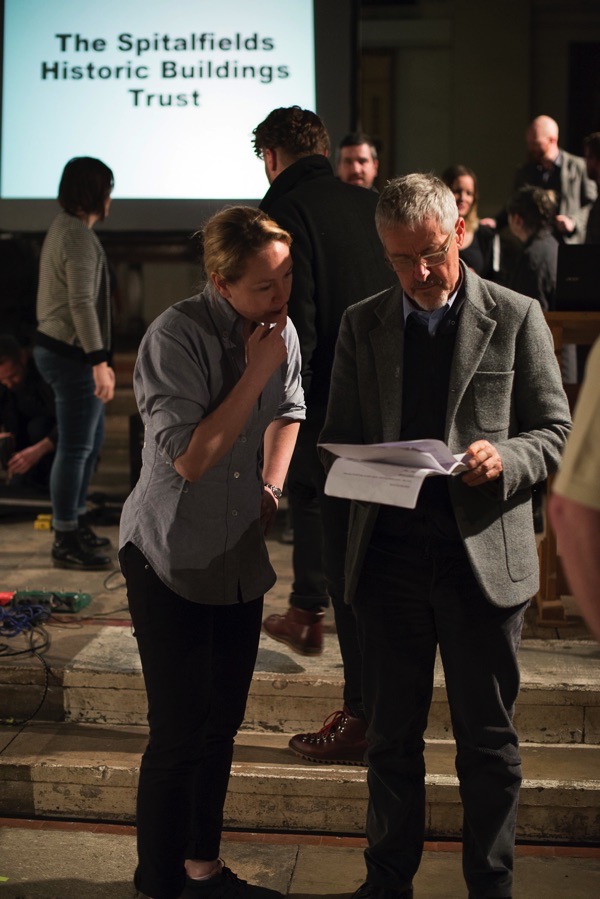
Produce Frances Mayhew consults with Griff Rhys Jones


Tom Carradine


Griff Rhys Jones introduces the evening


Suggs reads from ‘The Liberty of Norton Folgate’


Debbie Chazen read from Pickwick Papers


Oliver Leigh-Wood of the Spitalfields Trust waves a big stick and talks about British Land


Katherine Rhodes performed magic


Jonathan Pryce gave his rendition of ‘If it wasn’t for the ‘ouses in between’


Drew Worthley sang his ‘Ode to Stepney’


Stick In The Wheel sang ‘Tom O’Bedlam’


Griff Rhys Jones wraps up the proceedings


Photographs copyright © Sarah Ainslie
Drawings copyright © Ken Sequin
More Phil Maxwell On Sclater St
Complementing yesterday’s collection of Phil Maxwell’s Photographs of Sclater St Market in black and white, here are more – including some colour images that tie this series to the present day


Photographs copyright © Phil Maxwell
You may also like to take a look at
Phil Maxwell’s Kids On The Street
Phil Maxwell’s East End Cyclists
Phil Maxwell in Bethnal Green Rd
Phil Maxwell & Sandra Esqulant
Phil Maxwell On Sclater St

For the last thirty years, Contributing Photographer Phil Maxwell has been recording the ever-changing life of Sclater St Market. In the seventeenth century, this was known as Slaughter’s Land and Sclater is an archaic spelling of it, yet today the accepted pronunciation is ‘Slater.’ The name reminds us that, in spite of the apparently transient nature of street trading, this is an ancient market. By 1711, it had been laid out as ‘Sclater’s Lane’ and paved by 1723, and for centuries a bird market thrived here, persisting into recent memory at the end of the last century.
But only last year, the yard market to the north of Sclater St was lost to redevelopment and there are rumours that the yard to the south has been sold too. Yet every Sunday, you will still find Richard Lee, the bicycle parts seller, whose grandfather started on the same pitch in 1880 and, whenever I go down Sclater St, I stop to pay my respects to Robert Green and his sister Patricia, whose father Ronald began trading here in the fifties, on my way to carry off some bags of fresh produce at a bargain price from Westley Mattock, who boasts the longest fruit and veg stall in the East End.


Photographs copyright © Phil Maxwell

CLICK HERE TO BUY A COPY OF PHIL MAXWELL’S ‘BRICK LANE’ FOR £10
You may also like to take a look at
Phil Maxwell’s Kids On The Street
Phil Maxwell’s East End Cyclists
Phil Maxwell in Bethnal Green Rd
Phil Maxwell & Sandra Esqulant
Viscountess Boudica’s St George’s Day

Happy St George’s Day!
I was a little surprised when the Viscountess Boudica summoned me over to Bethnal Green to show off her new St George’s Day outfit. Refashioned from a pair of old curtains, it is adorned with images of that controversial English country pastime of fox-hunting. Her choice of design only made sense to me when the Viscountess admitted that, in this particular scenario, she identifies with the fox. Similarly in the myth of St George & the Dragon, it is the dragon which wins Boudica’s sympathy. Thus Boudica’s patriotism is of a distinctive nature, identifying with those who discover themselves at the rough end of our national culture.
For the past week, the Viscountess has been at work to adorn her tiny flat with a forest of flags, rosettes and fairy lights in white and red, creating an irresistibly festive atmosphere to welcome all those who cross her threshold.
In one corner, a table is laid ready for a St George’s Day picnic. In another corner hangs a red flag with a dragon, commemorating Edward the Confessor, whom Boudica considers the last English monarch. Yet another corner harbours a shrine to Prince Harry, Boudica’s favourite among our current batch of royals. ‘He’s the only one that’s good-looking,’ she admitted to me, ‘the rest have all those teeth.’ Given Boudica’s affection for cuddly red foxes and her own flaming locks, I did wonder if there was some affinity for all things ginger at play.
No-one enters into the spirit of our festivals with such boundless creativity and joyous enthusiasm as the indefatigable Viscountess Boudica, embodying a genuine spirit of emotional generosity and selflessly delivering inspiration and entertainment to those in the East End and far beyond. God Bless Her Highness and Long May She Reign Over Bethnal Green!

Viscountess Boudica is a foxy lady

Viscountess Boudica’s creative paper cutting

Viscountess Boudica shows off her homemade patriotic pom-pom

Viscountess Boudica with St George & the Dragon


Prince Harry is the Viscountess’ favourite royal


Be sure to follow Viscountess Boudica’s blog There’s More To Life Than Heaven & Earth
Take a look at
Viscountess Boudica’s Domestic Appliances
Viscountess Boudica’s Halloween
Viscountess Boudica’s Christmas
Viscountess Boudica’s Valentine’s Day
Read my original profile of Mark Petty, Trendsetter
and take a look at Mark Petty’s Multicoloured Coats
At Shakespeare’s Theatre In Shoreditch
On the eve of the four hundredth anniversary of William Shakespeare’s death, I recall my visit to the site of the Theatre in Shoreditch where his career as an actor and dramatist began

Over in Shoreditch, just a few minutes walk from Spitalfields, is the site of a seventeenth century playhouse called ‘The Theatre’ built by James Burbage in 1576, where William Shakespeare’s career as a dramatist began. In this, the first custom-built public theatre, Shakespeare played as an actor and his first plays were performed, notably Romeo & Juliet and an early version of Hamlet.
Stepping through a blank door in the wooden hoarding in New Inn Yard, I walked along a raised pathway to look down upon the archaeological dig and see where the earth has been painstakingly scraped back to reveal the foundations of the ancient playhouse.
Senior archaeologist Heather Knight indicated the section of curved stonework which comprised part of the inner wall of the theatre and next to it a section of the paving of the passage where, more than four hundred years ago, the audience walked through into the body of the theatre, once they had paid their penny admission. Beyond this paving, a beaten earth floor has been uncovered, sloping gently down in the direction of the stage.
This is where the audience stood to watch Shakespeare’s early plays for the first time.
For any writer, Shakespeare is a name that has a resonance above all others, and once Heather Knight explained what I was seeing, it took a while for the true meaning to sink in. My head was full with the cacophony of the dusty sunlit street and the discordance of heavy traffic and, superficially, the site itself was like any other archaeological dig I have visited. There was no poetry in it.
But then the words of Hamlet came to me, “To die, to sleep. To sleep, perchance to dream. Ay, there’s the rub. For in that sleep of death what dreams may come, when we have shuffled off this mortal coil, must give us pause…” And my stomach began to churn because I knew I was standing on the other side of Shakespeare’s unfathomable dream. It was as if I could feel the tremor of the London earthquake of 1580 coursing through my body. The modern city grew diaphanous and street sounds faded away.
We know no more of what happens in the sleep of death than Shakespeare did. Yet we can say we do know the literal substance of the dreams evoked by these lines from Hamlet – the things that were to come in the space where Hamlet’s words were spoken by James Burbage’s son Richard, who was the first to play the role.
We know things unknown to the writer or the actor or the audience in that moment, and, in this sense it may be said that we ourselves (even the archaeologists) are all part of Shakespeare’s boundless dream within the sleep of his own death.
We know that, after a disagreement in 1598, The Theatre was covertly demolished by the theatre company while the freeholder Giles Allen was away for Christmas and the materials used to construct The Globe in Southwark the following spring. We know that a factory was built on the site in the seventeenth century, then a house in the eighteenth century, and a warehouse in the nineteenth century until it became a lumber yard in the twentieth century, before archaeologists came along with sonar devices in the twenty-first century to ascertain the position of the theatre – although the workers in the lumber yard and all the local people always knew the yard was on top of ‘Shakespeare’s Theatre.’
Yet it was never Shakespeare’s theatre in any real sense, it is unlikely the audience here were aware of any particular significance in the event when they heard his words, because he was an unknown quantity then. Plays were performed just once from cue scripts without any rehearsal or expectation of posterity.
Each actor had a roll of paper with their character’s lines, plus their cue lines – so they knew when to speak. The implications of this were twofold. Firstly, the actors had to listen attentively to each other so they did not miss their cues. Secondly, beyond a broad knowledge of the story, the actors might not know exactly what was going to happen in a scene. It placed the actor in the present tense of the dramatic moment, knowing no more of the outcome than their character did. The actor playing Romeo might take the poison without knowing that Juliet was going to wake up.
Shakespeare’s plays were conceived to play upon the spontaneous poetry of the elusive instant that – for both the actors and audience – occurred uniquely. This embrace of the ephemeral moment is both innate to the form of Shakespeare’s plays and it is their subject too – the fleeting brilliance of life. His works were delights that, as transient as butterflies on Summer days, existed without expectation of longevity.
The beautiful paradox is that, in recognition of their superlative quality, Shakespeare’s colleagues collated and printed them, so that his words could travel onwards through time and space to become the phenomenon we know today. And this modest piece of earth in Shoreditch is where it all began.
Releasing me from my idle speculation upon the dust, Heather Knight held up a concrete discovery in triumph. It was an earthenware ale beaker that she had found, with a lustrous green glaze, which fitted the hand perfectly – a drinking vessel that Shakespeare would recognise, of the style that would be used in the tavern scenes at The Boars’s Head in Henry IV Part One, first performed at The Theatre. Heather has never found a complete beaker before and because it was discovered at The Theatre and is contemporary with Shakespeare, it is a magic artifact.
It is something from Shakespeare’s world that he could have seen or touched. Although we can never know, we are permitted to dream.

Click on the image to enlarge Adam Dant’s Map of Shakespeare’s Shordiche
You may like to read these
In Search Of Shakespeare’s London
The Door to Shakespeare’s London
In The Cherry Orchards Of Kent

In April when the green shoots are sprouting and all the leaves unfurling, who can resist a pilgrimage to view the cherry blossom at the National Collection of Fruit Trees at Brogdale in Kent? This is the largest collection of fruit in the world – as the guides proudly remind you – with two hundred and eighty-five types of cherry among over two thousand varieties of fruit, including apples, pears, plums, currants, quinces and medlars.
As if this were not remarkable enough, I was informed that this particular corner of Kent – at the edge of Faversham – offers the very best conditions in the world for growing cherries. They may have originated in the forests of Central Asia, travelling east and west along the Silk Road before they were introduced by order of Henry VIII nearby at Sittingbourne, but here – I was assured – they have found their ultimate home.
The constitution of the soil in Kent is ideal for cherries and the temperate climate, in which the tender saplings are sheltered from the wind by long hedges of hornbeam, produces a delicacy of flavour in the ripe fruit which cannot by matched by the climactic extremes of the Mediterranean.
It was with these thoughts in mind that I advanced up the track, lined with decorative blossom in those livid pink tones so beloved of mid-twentieth century town planners, before turning the corner of a long hedge to confront the orchard of cherries. There are two specimens of each variety regimented in lines that stretch into the distance. The cherry trees are upon parade, awaiting your inspection and eager to display their flamboyant regalia.
A mild winter followed by a cool spring this year has produced conditions without precedent in the memory of Kent locals and delayed the advance of the fruit trees. Yet there was more than enough cherry blossom to induce euphoria, with the promise of future blossom rendering what I saw as an alluring overture to the full flowering that is still to come.


The National Collection of Fruit Trees at Brogdale in Kent is opening for Hanami tours over the next two weekends, 21st-24th April & 28th- 30th April.
You may also like to take a look at


