
Frost Bros, Rope Makers & Yarn Spinners


Founded by John James Frost in 1790, Frost Brothers Ltd of 340/342 Commercial Rd was managed by his grandson – also John James Frost – in 1905, when these photographs were taken. In 1926, the company was amalgamated to become part of British Ropes and now only this modest publication on the shelf in the Bishopsgate Institute bears testimony to the long-lost industry of rope making and yarn spinning in the East End, from which Cable St takes its name.


First Prize London Cart Parade – Manila Hemp as we receive it from the Philippines

Hand Dressing

The Old-Fashioned Method of Hand Spinning

The First Process in Spinning Manila – The women are shown feeding Hemp up to the spreading machines, taken from the bales as they come from the Philippines. These three machines are capable of manipulating one hundred and twenty bales a day.

Manila-Finishing Drawing Machines

Russian & Italian Hemp Preparing Room

Manila Spinning

Binder Twine & Trawl Twine Spinning – This floor contains one hundred and fifty six spindles

Russian & Italian Hemp Spinning

Carding Room

Tow Drawing Room

Tow Spinning & Spun Yarn Twisting Room

Tarred Yarn Store – This contains one hundred and fifty tons of Yarn

Tarred Yarn Winding Room

Upper End of Main Rope Ground – There are six ground four hundred yards long, capable of making eighteen tons of rope per ten and a half hour day

Rope-Making Machines – This pair of large machines are capable of making rope up to forty-eight centimetres in circumference

House Machines – This view shows part of the Upper Rope Ground and a couple of small Rope-Making Machines

Number 4 House Machine Room

The middle section of a machine capable of making rope from three inches up to seven inches in circumference, any length without a splice. It is thirty-two feet in height and driven by an electric motor.

Number 4 Rope Store

Boiler House

120 BHP. Sisson Engine Direct Coupled to Clarke-Chapman Dynamo

One of our Motors by Crompton 40 BHP – These Manila Ropes have been running eight years and are still in first class condition.

Engineers’ Shop with Smiths’ Shop adjoining

Carpenters’ Store & Store for Spare Gear

Exhibit at Earl’s Court Naval & Shipping Exhibition, 1905

View of the Factory before the Fire in 1860

View of the Factory as it is now in 1905 – extending from Commercial St
Images courtesy Bishopsgate Institute
You may also like to take a look at
Henry Mayhew’s Street Traders

The Long-Song Seller
There is a silent ghost who accompanies me in my work, following me down the street and sitting discreetly in the corner while I am doing my interviews. He is always there in the back of my mind. He is Henry Mayhew, whose monumental work,”London Labour & London Poor,” was the first to give ordinary people the chance to speak in their own words. I often think of him, and the ambition and quality of his work inspires me. And I sometimes wonder what it was like for him, pursuing his own interviews, one hundred and fifty years ago, in a very different world.
Mayhew’s interviews and pen portraits appeared in the London Chronicle and were published in two volumes in 1851, eventually reaching their final form in five volumes published in 1865. In his preface, Mayhew described it as “the first attempt to publish the history of the people, from the lips of the people themselves – giving a literal description of their labour, their earnings, their trials and their sufferings in their own unvarnished language.”
These works were produced before photography was widely used to illustrate books, and although photographer Richard Beard produced a set of portraits to accompany Mayhew’s interviews, these were reproduced by engraving. Fortunately, since Beard’s photographs have not survived, the engravings were skillfully done. And they are fascinating images, because they exist as the bridge between the popular prints of the Cries of London that had been produced for centuries and the development of street photography, initiated by JohnThomson’s “Street Life in London” in 1876.
Primarily, Mayhew’s intention was to create a documentary record, educating his middle class readers about the lives of the poor to encourage social change. Yet his work transcends the tragic politics of want and deprivation that he set out to address, because the human qualities of his subjects come alive on the page and command our respect. Henry Mayhew bears witness not only to the suffering of poor people in nineteenth century London, but also to their endless resourcefulness and courage in carving out lives for themselves in such unpromising circumstances.

The Oyster Stall. “I’ve been twenty years and more, perhaps twenty-four, selling shellfish in the streets. I was a boot closer when I was young, but I had an attack of rheumatic fever, and lost the use of my hands for my trade. The streets hadn’t any great name, as far as I knew, then, but as I couldn’t work, it was just a choice between street selling and starving, so I didn’t prefer the last. It was reckoned degrading to go into the streets – but I couldn’t help that. I was astonished at my success when I first began, I made three pounds the first week I knew my trade. I was giddy and extravagant. I don’t clear three shillings a day now, I average fifteen shillings a week the year through. People can’t spend money in shellfish when they haven’t got any.”

The Irish Street-Seller. “I was brought over here, sir, when I was a girl, but my father and mother died two or three years after. I was in service, I saved a little money and got married. My husband’s a labourer, he’s out of worruk now, and I’m forced to thry and sill a few oranges to keep a bit of life in us, and my husband minds the children. Bad as I do, I can do a penny or tuppence a day better profit than him, poor man! For he’s tall and big, and people thinks, if he goes round with a few oranges, it’s just from idleniss.”

The Groundsel Man. “I sell chickweed and grunsell, and turfs for larks. That’s all I sell, unless it’s a few nettles that’s ordered. I believe they’re for tea, sir. I gets the chickweed at Chalk Farm. I pay nothing for it. I gets it out of the public fields. Every morning about seven I goes for it. I’ve been at business about eighteen year. I’m out till about five in the evening. I never stop to eat. I am walking ten hours every day – wet and dry. My leg and foot and all is quite dead. I goes with a stick.”

The Baked Potato Man. “Such a day as this, sir, when the fog’s like a cloud come down, people looks very shy at my taties. They’ve been more suspicious since the taty rot. I sell mostly to mechanics, I was a grocer’s porter myself before I was a baked taty. Gentlemen does grumble though, and they’ve said, “Is that all for tuppence?” Some customers is very pleasant with me, and says I’m a blessing. They’re women that’s not reckoned the best in the world, but they pays me. I’ve trusted them sometimes, and I am paid mostly. Money goes one can’t tell how, and ‘specially if you drinks a drop as I do sometimes. Foggy weather drives me to it, I’m so worritted – that is, now and then, you’ll mind, sir.”

The London Coffee Stall. “I was a mason’s labourer, a smith’s labourer, a plasterer’s labourer, or a bricklayer’s labourer. I was for six months without any employment. I did not know which way to keep my wife and child. Many said they wouldn’t do such a thing as keep a coffee stall, but I said I’d do anything to get a bit of bread honestly. Years ago, when I as a boy, I used to go out selling water-cresses, and apples, and oranges, and radishes with a barrow. I went to the tinman and paid him ten shillings and sixpence (the last of my savings, after I’d been four or five months out of work) for a can. I heard that an old man, who had been in the habit of standing at the entrance of one of the markets, had fell ill. So, what do I do, I goes and pops onto his pitch, and there I’ve done better than ever I did before.”

Coster Boy & Girl Tossing the Pieman. To toss the pieman was a favourite pastime with costermonger’s boys. If the pieman won the toss, he received a penny without giving a pie, if he lost he handed it over for nothing. “I’ve taken as much as two shillings and sixpence at tossing, which I shouldn’t have done otherwise. Very few people buy without tossing, and boys in particular. Gentlemen ‘out on the spree’ at the late public houses will frequently toss when they don’t want the pies, and when they win they will amuse themselves by throwing the pies at one another, or at me. Sometimes I have taken as much as half a crown and the people of whom I had the money has never eaten a pie.”

The Street- Seller of Nutmeg Graters. “Persons looks at me a good bit when I go into a strange place. I do feel it very much, that I haven’t the power to get my living or to do a thing for myself, but I never begged for nothing. I never thought those whom God had given the power to help themselves ought to help me. My trade is to sell brooms and brushes, and all kinds of cutlery and tinware. I learnt it myself. I was never brought up to nothing, because I couldn’t use my hands. Mother was a cook in a nobleman’s family when I was born. They say I was a love child. My mother used to allow so much a year for my schooling, and I can read and write pretty well. With a couple of pounds, I’d get a stock, and go into the country with a barrow, and buy old metal, and exchange tinware for old clothes, and with that, I’m almost sure I could make a decent living.”

The Crockery & Glass Wares Street-Seller. “A good tea service we generally give for a left-off suit of clothes, hat and boots. We give a sugar basin for an old coat, and a rummer for a pair of old Wellington boots. For a glass milk jug, I should expect a waistcoat and trowsers, and they must be tidy ones too. There is always a market for old boots, when there is not for old clothes. I can sell a pair of old boots going along the streets if I carry them in my hand. Old beaver hats and waistcoats are worth little or nothing. Old silk hats, however, there’s a tidy market for. There is one man who stands in Devonshire St, Bishopsgate waiting to buy the hats of us as we go into the market, and who purchases at least thirty a week. If I go out with a fifteen shilling basket of crockery, maybe after a tidy day’s work I shall come home with a shilling in my pocket and a bundle of old clothes, consisting of two or three old shirts, a coat or two, a suit of left-off livery, a woman’s gown maybe or a pair of old stays, a couple of pairs of Wellingtons, and waistcoat or so.”

The Blind Bootlace Seller. “At five years old, while my mother was still alive, I caught the small pox. I only wish vaccination had been in vogue then as it is now or I shouldn’t have lost my eyes. I didn’t lose both my eyeballs till about twenty years after that, though my sight was gone for all but the shadow of daylight and bright colours. I could tell the daylight and I could see the light of the moon but never the shape of it. I never could see a star. I got to think that a roving life was a fine pleasant one. I didn’t think the country was half so big and you couldn’t credit the pleasure I got in going about it. I grew pleaseder and pleaseder with the life. You see, I never had no pleasure, and it seemed to me like a whole new world, to be able to get victuals without doing anything. On my way to Romford, I met a blind man who took me in partnership with him, and larnt me my business complete – and that’s just about two or three and twenty year ago.”

The Street Rhubarb & Spice Seller. “I am one native of Mogadore in Morocco. I am an Arab. I left my countree when I was sixteen or eighteen years of age, I forget, sir. Dere everything sheap, not what dey are here in England. Like good many, I was young and foolish – like all dee rest of young people, I like to see foreign countries. The people were Mahomedans in Mogadore, but we were Jews, just like here, you see. In my countree the governemen treat de Jews very badly, take all deir money. I get here, I tink, in 1811 when de tree shilling pieces first come out. I go to de play house, I see never such tings as I see here before I come. When I was a little shild, I hear talk in Mogadore of de people of my country sell de rhubarb in de streets of London, and make plenty money by it. All de rhubarb sellers was Jews. Now dey all gone dead, and dere only four of us now in England. Two of us live in Mary Axe, anoder live in, what dey call dat – Spitalfield, and de oder in Petticoat Lane. De one wat live in Spitalfield is an old man, I dare say going on for seventy, and I am little better than seventy-three.”

The Street-Seller of Walking Sticks. “I’ve sold to all sorts of people, sir. I once had some very pretty sticks, very cheap, only tuppence a piece, and I sold a good many to boys. They bought them, I suppose, to look like men and daren’t carry them home, for once I saw a boy I’d sold a stick to, break it and throw it away just before he knocked at the door of a respectable house one Sunday evening. There’s only one stick man on the streets, as far as I know – and if there was another, I should be sure to know.”

The Street Comb Seller. “I used to mind my mother’s stall. She sold sweet snuff. I never had a father. Mother’s been dead these – well, I don’t know how long but it’s a long time. I’ve lived by myself ever since and kept myself and I have half a room with another young woman who lives by making little boxes. She’s no better off nor me. It’s my bed and the other sticks is her’n. We ‘gree well enough. No, I’ve never heard anything improper from young men. Boys has sometimes said when I’ve been selling sweets, “Don’t look so hard at ’em, or they’ll turn sour.” I never minded such nonsense. I has very few amusements. I goes once or twice a month, or so, to the gallery at the Victoria Theatre, for I live near. It’s beautiful there, O, it’s really grand. I don’t know what they call what’s played because I can’t read the bills. I’m a going to leave the streets. I have an aunt, a laundress, she taught me laundressing and I’m a good ironer. I’m not likely to get married and I don’t want to.”

The Grease-Removing Composition Sellers. “Here you have a composition to remove stains from silks, muslins, bombazeens, cords or tabarets of any kind or colour. It will never injure or fade the finest silk or satin, but restore it to its original colour. For grease on silks, rub the composition on dry, let it remain five minutes, then take a clothes brush and brush it off, and it will be found to have removed the stains. For grease in woollen cloths, spread the composition on the place with a piece of woollen cloth and cold water, when dry rub it off and it will remove the grease or stain. For pitch or tar, use hot water instead of cold, as that prevents the nap coming off the cloth. Here it is. Squares of grease removing composition, never known to fail, only a penny each.”

The Street Seller of Birds’ Nests. “I am a seller of birds’-nesties, snakes, slow-worms, adders, “effets” – lizards is their common name – hedgehogs (for killing black beetles), frogs (for the French – they eats ’em), and snails (for birds) – that’s all I sell in the Summertime. In the Winter, I get all kinds of of wild flowers and roots, primroses, buttercups and daisies, and snowdrops, and “backing” off trees (“backing,” it’s called, because it’s used to put at the back of nosegays, it’s got off yew trees, and is the green yew fern). The birds’ nests I get from a penny to threepence a piece for. I never have young birds, I can never sell ’em, you see the young things generally die of cramp before you can get rid of them. I gets most of my eggs from Witham and Chelmsford in Essex. I know more about them parts than anybody else, being used to go after moss for Mr Butler, of the herb shop in Covent Garden. I go out bird nesting three times a week. I’m away a day and two nights. I start between one or two in the morning and walk all night. Oftentimes, I wouldn’t take ’em if it wasn’t for the want of the victuals, it seems such a pity to disturb ’em after they made their little bits of places. Bats I never take myself – I can’t get over ’em. If I has an order of bats, I buys ’em off boys.”

The Street-Seller of Dogs. “There’s one advantage in my trade, we always has to do with the principals. There’s never a lady would let her favouritist maid choose her dog for her. Many of ’em, I know dotes on a nice spaniel. Yes, and I’ve known gentleman buy dogs for their misses. I might be sent on with them and if it was a two guinea dog or so, I was told never to give a hint of the price to the servant or anybody. I know why. It’s easy for a gentleman that wants to please a lady, and not to lay out any great matter of tin, to say that what had really cost him two guineas, cost him twenty.”
Images courtesy Bishopsgate Institute
You may like to take a look at
John Thomson’s Street Life in London
Aunt Busy Bee’s New London Cries
Marcellus Laroon’s Cries of London
More John Player’s Cries of London
William Nicholson’s London Types
Francis Wheatley’s Cries of London
John Thomas Smith’s Vagabondiana of 1817
The Metropolitan Machinists’ Co, 1905
Last month – courtesy of Bishopsgate Institute – I published the 1896 cycling accessories catalogue of the Metropolitan Machinists’ Co of Bishopsgate Without and today I publish their catalogue from 1906 as an illustration of how rapidly cycling advanced into the new century, especially – as you will see – in the applied science of the ‘Anatomical Saddle’ which offered extra support to the ischial tuberosities.


Images courtesy Bishopsgate Institute
You may also like to take a look at
The Metropolitan Machinists’ Co, 1896
The Gentle Author’s Wapping Pub Crawl

Four-hundred-year-old stone floor at The Prospect of Whitby
Tempted by the irresistible promise of the riverside, I set out for Wapping to visit those pubs which remain in these formerly notorious streets once riddled with ale houses. Yet although there are pitifully few left these days, I discovered each one has a different and intriguing story to tell.

Town of Ramsgate, 288 Wapping High St. The first alehouse was built on this site in 1460, known as The Hostel and then as The Red Cow from 1533. The pub changed its name again, to the Town of Ramsgate, in 1766 to attract trade from Kentish fishermen who unloaded their catch at Wapping Old Stairs adjoining. Judge Jeffreys was arrested here in disguise, attempting to follow the flight of James II abroad in 1688, as William III’s troops approached London.

The Turk’s Head, 1 Green Bank. Originally in Wapping High St from 1839, rebuilt on this site in 1927 and closed in the seventies, it is now a community cafe.

Captain Kidd, 108 Wapping High St. Established in 1991 in a former warehouse and named after legendary pirate, Wiiliam Kidd, hanged nearby at Execution Dock Stairs in 1701.


Turner’s Old Star, 14 Watts St. In the eighteen-thirties, Joseph Mallord William Turner set up his mistress Sophia Booth in two cottages on this site, one of which she ran as an alehouse named The Old Star. In 1987, the current establishment was renamed Turner’s Old Star in honour of the connection with the great painter. Notoriously secretive about his lovelife, Turner adopted Sophia’s surname to conceal their life together here, acquiring the nickname ‘Puggy Booth’ on account of his portly physique and height of just five feet.

The Old Rose, 128 The Highway. 1839-2007

The last pub standing on the Ratcliffe Highway

The Three Suns, 61 Garnet St. 1851 – 1986

The Prospect of Whitby, 56 Wapping Wall. Founded 1520, and formerly known as The Pelican and The Devil’s Tavern.

What does a cat have to do to get a drink around here?


Sir Hugh Willoughby sailed from The Prospect of Whitby in 1533 upon his ill-fated attempt to discover the North-East Passage to China.

The Grapes, 76 Narrow St. Founded in 1583, the current building was constructed in 1720 – it is claimed Charles Dickens danced upon the counter here as a child.

You may like to read about my other pub crawls
The Gentle Author’s Next Pub Crawl
The Gentle Author’s Spitalfields Pub Crawl
Surma Centre Portraits
Photographer Patricia Niven and Novelist Sarah Winman made this series of portraits and interviews at the Surma Centre at Toynbee Hall.
“After the Second World War, Britain required labour to assist in post-war reconstruction. Commonwealth countries were targeted and, in what was then East Pakistan (it became Bangladesh after the 1971 Liberation War), vouchers appeared on Post Office counters, urging people to come and work in the United Kingdom, no visa required. The majority of men who came in the fifties and sixties came from a rural background where education was scarce and illiteracy was common. But this generation were hard workers, used to working with their hands, men who could commit to long hours, who had an eagerness to work and a young man’s inquisitiveness to see the world: the perfect workforce to help rebuild this nation. And they did rebuild it, and were soon found working in factories and ship yards, building roads and houses, crossing seas in the merchant navy. These pioneers were the men we met at the Surma Centre.” – Sarah Winman

Shah Mohammed Ali
I came to this country in November 1961 because my uncle was already living here and inspired me to come. In East Pakistan, I had been working in a shop. I felt life was good. My earliest memory of London was Buckingham Palace. I missed my friends and family but I really missed the weather back home. I became a factory worker, and worked all over the country: a cotton factory in Oldham, a foundry in Sheffield, an aluminium factory in London and Ford motor factory in Dagenham. Ford gave me a good, comfortable life. We had friends all over the country and they would tell us if there was more money being offered at a different factory and then we’d move. I thought I would stay in Britain for four years and then go back home. My heart is in Bangladesh. The roses smell sweeter.

Eyor Miah
I came to this country in September 1965. I had been a student in East Pakistan. Life was hard, my father was a sailor. I read in a Bengali newspaper stories of people travelling and earning money, and I thought that I, too, would like to do that. I wrote to somebody I knew here to help me. It was a slow process, all done by mail, because of course, there was no internet. It took me two years to gain my papers. I didn’t mind because I was very determined to achieve.
When I first arrived, I became a machinist in the tailoring industry and I earned £1 and ten shillings a week. My weekly outlay was £1 and the rest I saved. Brick Lane was very rundown then. The Jewish population were very welcoming, probably because they were eager for workers! We would queue up outside the mosque and they would come and pick the ones they wanted. In 1969 I bought a house for £55. Of course, I missed my mother who stayed in Bangladesh, and before 1971 I actually thought I would return to live. After that date though, I felt Britain was my home and life was better here.
After tailoring, I worked in restaurants and then began my own business as a travel agent, set up my own restaurants and grocery shop. I have four children. Life has been good to me.

Rokib Ullah
I came to this country in 1959, because workers were being recruited from the Commonwealth to rebuild after the Second World War. Life in East Pakistan then was good. I was very young and working as a farmer. My fellow countrymen told me about the work in the UK and I came here by air. When I arrived, the airport was so small, not like it is today. And the weather was awful, so bad, not like home, I found that difficult, together with missing my neighbours and friends. I worked in a tyre factory, and then in garment and leather factories. I planned to stay here and earn enough money, and then return to Bangladesh. I am a pensioner now and frequently go back to Bangladesh. It is in my heart. One day I plan to go there forever.

Syed Abdul Kadir
I first came to this country in 1953. I was in the navy in Karachi and I was selected by the Pakistan Government to be in the Guard of Honour in London at the Queen’s Coronation. I remember this day very clearly. It was June and the weather was cold. When Queen Elizabeth was crowned the noise was tremendous. There were shouts of “God Save the Queen!” and gun salutes were fired. We marched to Buckingham Palace where more crowds were waiting. The Queen and her family came out on the balcony and the RAF flew past the Mall, and the skies above Victoria Embankment were lit up by fireworks. I feel very lucky to have been part of this, and I still have my Coronation ceremony medal.
Since my first visit, I developed a fondness for the British culture, its people and the Royal Family. I have always believed this country looks after its poor.
I owe the Pakistan Navy for much of my experiences in life and was lucky to travel and to see the world. I actively participated in the 1965 India-Pakistan war and the 1971 Pakistan war and have medals for both.
My family are settled here and my life revolves around grandchildren. I have been coming to Surma since 2004. When someone sees me, they call me “Captain!” We are like a family here.

Shunu Miah
I came to this country in November 1961. Back home, I helped my father farm. It was a good life, still East Pakistan, the population was low, not much poverty, food for everyone: it was a land of plenty. It wasn’t a bad life, I was young and was just looking for more. My uncle had been in the UK since 1931, my father since 1946, both encouraged me to come.
Cinema here was my greatest memory. Back home, cinema was rare. Every Saturday and Sunday there was a cinema above Cafe Naz on Brick Lane, or I’d go to the cinema in Commercial Rd, or up to the West End. It was so exciting, the buildings, the underground, the lights! People were friendly and welcoming then. I saw Indian films, but also Samson and Delilah and the Ten Commandments with Charlton Heston.
I have worked at the Savoy Hotel as a kitchen porter and also in cotton factories in Bradford. What did I miss? Family and friends, of course, but also the weather. The smell of flowers, too, they are much stronger back home. I thought I would stay here and work for three or four years, go home and buy land, build a house and live happily ever after. I have helped to build homes for my family in Bangladesh. I have never been able to own a home here.

Abul Azad, Co-ordinator at the Surma Centre.
“These men are very loyal to a country that has given them a home,” said Abul Azad, the charismatic project co-ordinator at Surma Centre in Whitechapel. “When they first arrived, living conditions were bad, sometimes up to ten people lived in a room. Facilities were unhealthy, toilets outside, and nothing to protect them from an unfamiliar cold that many still talk about. Most intended to earn money to send back to families, and then return after a few years – a dream realised by few, especially after the settlement of families. Instead they were open to exploitation, often working over sixty hours a week, the consequence of which is clearly visible today in low state pensions, due to companies not paying the correct National Insurance contributions. And most Bangladeshi people don’t have private pensions. Culturally, pensions are not of this generation. Their families are their pension – always imagined they would be looked after. But times are changing for everyone.”
Surma runs a regular coffee morning, providing support for elderly Bangladeshi people. The language barrier is still the greatest hindrance to this older generation and Surma provides a specialist team ready to assist their needs – both financially and socially – and to provide free legal advice. It is also quite simply a haven for people to get out of the house and to be amongst their peers, to read newspapers, to have discussions, to talk about what is happening here and in Bangladesh.
There is something profound that holds this group together, a deep unspoken, clothed in dignity. Maybe it is the history of a shared journey, where the desire for a better life meant hours of physical hardship and unceasing toil and lonely years of not being able to communicate. Maybe it is quite simply the longing for home, remaining just that: an unrealised dream. Whatever it is – “This is a very beautiful group.” said Abul Azad.
Photographs copyright © Patricia Niven
You may also like to take look at these other portraits by Patricia Niven and Sarah Winman
So Long, Nelson St Synagogue
After more than a century of operation, Nelson St Synagogue is to be auctioned off on 12th February. Since part of the roof collapsed at the time of the pandemic in 2020 it has been disused. Click here for details of the auction
Below you can read my account of a visit there in 2012.

Leon Silver
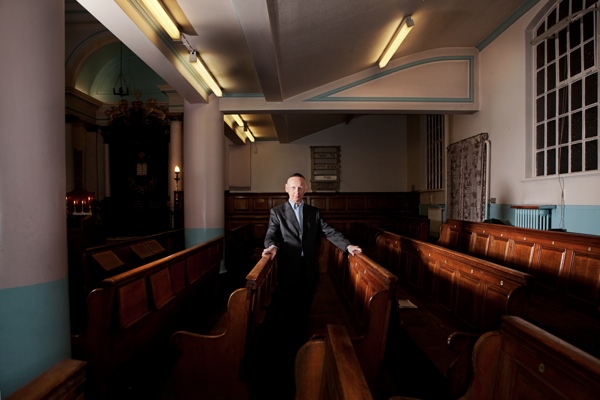
When Leon Silver opened the golden shutter of the ark at the East London Central Synagogue in Nelson St for me, a stash of Torah scrolls were revealed shrouded in ancient velvet with embroidered texts in silver thread gleaming through the gloom, caught by last rays of afternoon sunlight.
Leon told me that no-one any longer knows the origin of all these scrolls, which were acquired as synagogues closed or amalgamated with the departure of Jewish people from the East End since World War II. Many scrolls were brought over in the nineteenth century from all across Eastern Europe, and some are of the eighteenth century or earlier, originating from communities that no longer exist and places that vanished from the map generations ago.
Yet the scrolls were safe in Nelson St under the remarkable stewardship of Leon Silver, President, Senior Warden & Treasurer, who had selflessly devoted himself to keeping this beautiful synagogue open for the small yet devoted congregation – mostly in their eighties and nineties – for whom it fulfilled a vital function. An earlier world still glimmered there in this beautiful synagogue that may not have seen a coat of new paint in a while, but was well tended by Leon and kept perfectly clean with freshly hoovered carpet and polished wood by a diligent cleaner of ninety years old.
As the sunlight faded, Leon and I sat at the long table at the back of the lofty synagogue where refreshments were enjoyed after the service, and Leon’s cool grey eyes sparkled as he spoke of this synagogue that meant so much to him, and of its place in the lives of his congregation.
“I grew up in the East End, in Albert Gardens, half a mile from here. I first came to the synagogue as a little boy of four years old and I’ve been coming here all my life. Three generations of my family have been involved here, my maternal grandfather was the vice-president and my late uncle’s mother’s brother was the last president, he was still taking sacrament at ninety-five. My father used to come here to every service in the days when it was twice daily. And when I was twenty-nine, I came here to recite the mourner’s prayer after my father died. I remember when it was so crowded on the Sabbath, we had to put benches in front of the bimmah to accommodate everyone, now it is a much smaller congregation but we always get the ten you need to hold a service.
I’m a professional actor, so it gives me plenty of free time. I was asked to be the Honorary Treasurer and told that it entailed no responsibility – which was entirely untrue – and I’ve done it ever since. As people have died or moved away, I have taken on more responsibility. It means a lot to me. There was talk of closing us down or moving to smaller premises, but I’ve fought battles and we are still here. I spend quite a lot of hours at the end of the week. We have refreshments after the service, cake, crisps and whisky. I do the shopping and put out the drinks. The majority here are quite elderly and they are very friendly, everyone gets on well, especially when they have had a few drinks. In the main, they are East Enders. We don’t ask how they come because strictly speaking you shouldn’t ride the bus on the Sabbath. Now, even if young Jewish people wanted to come to return to the East End there are no facilities for them. No kosher butcher or baker, just the kosher counter at Sainsburys.
My father’s family came here at the end of the nineteenth century, and my maternal grandfather Lewis (who I’m named after) came at the outbreak of the First World War. As a resident alien, he had to report to Leman St Police Station every day. He came from part of the Austro-Hungarian Empire and he came on an Austrian passport, but when my mother came in 1920, she came on a Polish passport. Then in 1940, my grandfather and his brothers were arrested and my grandmother was put in Holloway Prison, before they were all interned on the Isle of Man. Then my uncle joined the British army and was told on his way to the camp that his parents had been released. My grandparents’ families on both sides died in the Holocaust. My mother once tried to write a list of all the names but she gave up after fifty because it was too upsetting. And this story is true for most of the congregation at the synagogue. One man of ninety from Alsace, he won’t talk about it. A lot of them won’t talk about it. These people carry a lot of history and that’s why it’s important for them to come together.
When Jewish people first came here, they took comfort from being with their compatriots who spoke the same style of Yiddish, the same style of pronunciation, the same style of worship. It was their security in a strange new world, a self-help society to help with unemployment and funeral expenses.”
Thanks to Leon, the shul to existed as a sacred meeting place for these first generation immigrants – then in their senior years – who shared a common need to be among others with comparable experiences. Polite and softly spoken yet resolute in his purpose, Leon Silver was custodian of a synagogue that was a secure home for ancient scrolls and a safe harbour for those whose lives were shaped by their shared histories.


Photographs 2 & 3 © Mike Tsang
Stephen Watts, Poet

“I remember coming out of the tube in Whitechapel in 1974 and being overwhelmed,” recalled Stephen Watts affectionately, his deep brown eyes glowing with inner fire to describe the spiritual epiphany of his arrival in the East End, when coming to London after three years on North Uist in the Outer Hebrides. Today Stephen lives in Shadwell and has a tiny writing office in the Toynbee Hall in Commercial St where I paid him a call upon him.
“Migration is in my awareness and in my blood,” he admitted, referring to his family who were mountain people dwelling in the Swiss Alps on the Italian border – living twelve hundred feet above sea level – and his grandfather who came to London before the First World War, worked in a cafe in Soho and then bought his own cafe. “I realised this was an area of migration since the seventeenth century when the farm workers of Cambridgeshire, Kent and Suffolk began to arrive here, and I immediately felt an affinity for the place,” Stephen continued, casting his thoughts back far beyond his own arrival in Whitechapel, yet wary to qualify the vision too, lest I should think it self-dramatising.
“It is very easy to be romantic about it, but I think migration has been the objective reality for many people in the twentieth and twenty-first century. So it seemed to be something very natural, when I came to live in Whitechapel.” he revealed with an amiable smile. Yet although he allowed himself a moment to savour this thought, Stephen possesses a restless energy and a mind in constant motion, suggesting that he might be gone at any moment, and entirely precluding any sense of being at home and here to stay. Even if he has lived in his council house in Shadwell for forty years, I would not be surprised if the wind blew Stephen away.
A tall skinny man with his loose clothes hanging off him and his long white locks drifting around, Stephen does present a superficial air of insubstantiality, even other-wordliness. Yet when you are in conversation with Stephen you quickly encounter the substance of his quicksilver mind, moving swiftly and using words with delicate precision, making unexpected connections. “In the Outer Hebrides the unemployment rate was twenty-five per cent and it was the same in Tower Hamlets when I arrived,” he said, informing me of the parallels with precise logic, “also Tower Hamlets had large areas of empty water then, just like the North Uist.” drawing comparison between the abandoned dockland and the Hebridean sea lochs, in regions of Britain that could not be more different in ever other respect.
We took the advantage of the frosty sunlight to make a half hour’s circuit of the streets attending Brick Lane and these familiar paths took on another quality in Stephen’s company, because while I tend to be always going somewhere, Stephen has the sense to halt and look around – indicative of certain open-ness of temperament that has led him befriend all kinds of people in pubs and on the street in Whitechapel over the years. I took this moment to ask Stephen if he chose to be a poet. “I made a choice when I quit university after a year and went to live in North Uist,” he said as we resumed our pace, “and then I made a choice to be a poet. But as a choice it was unavoidable, because I realised that it was so much part of me that not to have done it would be a denial of my humanity.”
Returning to the Toynbee Hall, Stephen allowed me the privilege of a peek into his tiny room on an upper floor, not much larger than a broom cupboard. The walls were lined with thin poetry books in magnificent order, arrayed in wine boxes stacked floor to ceiling and standing proud of the walls to create bays, leaving space only for one as slim as Stephen to squeeze through. It was a sacred space, the lair of the mountain man or a hermit’s retreat. It felt organic, like a cave, or maybe – it occurred to me – a shepherd’s hut carved out of the rock. And there, up above Stephen’s head was an old black and white photo of shepherds on a mountain road, taken in the Swiss Alps whence Stephen’s family originate and where even now he still returns to visit his relatives.
Stephen’s room is a haven of peace in the midst of Whitechapel, yet he delights to complement his life in here by working alongside Bengali and Somali poets in all kinds of projects in schools around Tower Hamlets, and pursues translation alongside his own poetry too, as means to “invite difference” into his work. Possessing a natural warmth of personality and brightness of temperament which make you want to listen and hang off his words, Stephen has a genuine self-effacing charm. “I don’t believe in being a professional poet in the sense of promoting myself, being a poet is about becoming embedded in humanity,” he proposed modestly, presuming to speak for no-one than himself, “And that’s why I lived in the East End and that’s why I still find it inspiring – because of the tremendous range of human presence in Whitechapel.”
BRICK LANE
(after the death of Altab Ali, and for Bill Fishman)
Whoever has walked slowly down Brick Lane in the darkening air and a stiff little rain,
past the curry house with lascivious frescoes,
past the casual Sylheti sweet-shops and cafés
and the Huguenot silk attics of Fournier Street,
and the mosque that before was a synagogue and before that a chapel,
whoever has walked down that darkening tunnel of rich history
from Bethnal Green to Osborne Street at Aldgate,
past the sweat-shops at night and imams with hennaed hair,
and recalls the beigel-sellers on the pavements, windows candled to Friday night,
would know this street is a seamless cloth, this city, these people,
and would not suffocate ever from formlessness or abrupted memory,
would know rich history is the present before us,
laid out like a cloth – a cloth for the wearing – with bits of mirror and coloured stuff,
and can walk slowly down Brick Lane from end to seamless end,
looped in the air and the light of it, in the human lattice of it,
the blood and exhausted flesh of it, and the words grown bright with the body’s belief,
and life to be fought for and never to be taken away.

Song for Mickie the Brickie
Mickie I met down Watney Street and he whistled me across.
“How are you” he said
—and of course really meant “have you a little to spare for some drink”—
but could not bear to ask.
We walked through the decayed market,
a yellow-black sun gazed down over Sainsbury’s as I went to look for change.
Ten pound was hardly enough to get him through the dregs of that bitter day.
We stood on the corner where for centuries people have stood.
Many worlds passed us by.
When he had been in hospital he’d taken his pills and been looked after and had not got worse.
Now he’s barely getting by.
He walks out of the rooming house in Bethnal Green when it gets too loud inside.
His scalp’s flaking and he needs a reliable level and a small brickie’s trowel.
That woman’s son’s inside for good.
That one’s man is a chronic alcoholic.
This one’s on her own and better for it.
But how can you know anyone’s story when every day you walk by without stopping.
Charlie Malone was a good friend. So was John Long.
Now they’re resting in Tadman’s Parlour
—and first thing in the morning Mickie’ll go and say to them words that cannot be answered.
Those are the best words, but they’re hardest to bear.
To me he says : “Always—always—stop me—always—come across.”
And what is the point of centuries of conversation if no-one’s ever there to hear.

FRAGMENT
… And so I long for snow to
sweep across the low heights of London
from the lonely railyards and trackhuts
– London a lichen mapped on mild clays
and its rough circle without purpose –
because I remember the gap for clarity
that comes before snow in the north and
I remember the lucid air’s changing sky
and I remember the grey-black wall with
every colour imminent in a coming white
the moon rising only to be displaced and
the measured volatile calmness of after
and I remember the blue snow hummocks
the mountains of miles off in snow-light
frozen lakes – a frozen moss to stand on
where once a swarmed drifting stopped.
And I think – we need such a change,
my city and I, that may be conjured in
us that dream birth of compassion with
reason & energy merged in slow dance.
Photographs copyright © Lucinda Douglas-Menzies


